US ECONOMICS
VENEZUELA
U.S. Department of State. 06/18/2020. The United States Targets Network Supporting Corrupt Venezuelan Actors Attempting to Evade Sanctions. Michael R. Pompeo, Secretary of State
Today, the United States imposed sanctions against active participants in a network of companies that transported oil stolen from the Venezuelan people under the guise of an oil-for-food scheme. This enterprise skimmed millions from funds that were claimed to have been for humanitarian aid, yet failed to deliver the promised food to the Venezuelan people. The illegitimate Maduro regime continues to steal Venezuelan resources to tighten its authoritarian grip over the Venezuelan people. Today’s action is another warning that any individual or company that facilitates this theft will no longer enjoy access to the U.S. financial system. Maduro’s corrupt regime is directly responsible for the political, economic, and humanitarian crisis in Venezuela.
The United States is steadfast in its support for Interim President Juan Guaido, the democratically elected National Assembly, and the Venezuelan people in their quest for a peaceful democratic transition. The United States calls on the international community to increase pressure against the Maduro regime until it relinquishes its illegitimate hold on power.
CHINA
U.S. Department of State. 06/17/2020. Secretary Michael R. Pompeo’s Meeting with Chinese Communist Party Politburo Member Yang Jiechi
The below is attributable to Spokesperson Morgan Ortagus:
Secretary of State Michael R. Pompeo met today with Chinese Communist Party (CCP) Politburo Member Yang Jiechi in Honolulu, Hawaii to exchange views on U.S.-China relations. The Secretary stressed important American interests and the need for fully-reciprocal dealings between the two nations across commercial, security, and diplomatic interactions. He also stressed the need for full transparency and information sharing to combat the ongoing COVID-19 pandemic and prevent future outbreaks.
RODHIUM GROUP. June 18, 2020. NOTE. China. Who’s Buying Whom? COVID-19 and China Cross-Border M&A Trends
Thilo Hanemann and Daniel H. Rosen
The COVID-19 pandemic depressed equity values around the globe, triggering fears across the United States, Europe and Asia of a distressed asset buying spree by Chinese companies. These concerns drove many governments to enact policies – some temporary, some permanent – to shield their companies from Chinese takeovers. Several months into the pandemic, the data tell a different story about cross-border M&A trends. There are no signs of a Chinese outbound investment boom, like the one seen after the global financial crisis a decade ago. Instead, takeovers are headed in the other direction: into China.
This Time Is Different: China’s Investors Are Staying Home
The global financial crisis of 2008/2009 was a catalyst for Chinese outbound investment. PRC companies were insulated from the financial shocks hitting the US and Europe, saw opportunities in falling overseas asset prices, and took advantage of ample liquidity at home and a newly permissive attitude in Beijing toward taking money abroad. That outbound boom cooled after 2016, but the disarray caused by COVID-19 rekindled concerns about another Chinese takeover wave.
In March, we argued that China’s outbound investors are not in a good position to ramp up overseas buying and capitalize on the pandemic in a big way. Compared to the boom years, Chinese companies with global ambitions face a very different environment today, due to the combination of heavy debt loads, tighter domestic liquidity conditions, Beijing’s controls on outbound capital flows and an activated political allergy to Chinese investment abroad.
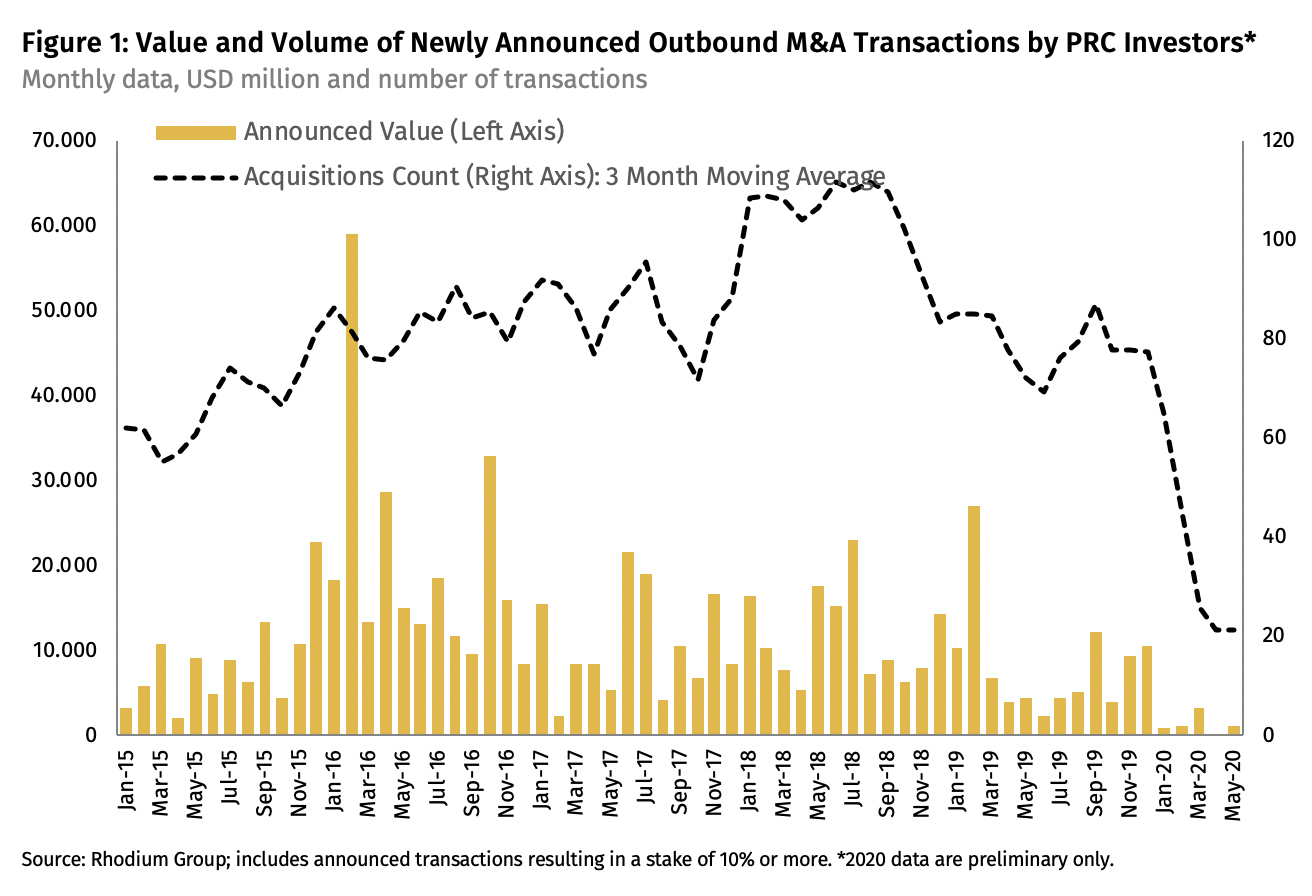
As the second quarter of the year nears a close, the latest data confirm our initial point of view. In the first five months of 2020, Chinese outbound M&A activity collapsed compared to previous years (Figure 1). The number of newly announced transactions dropped from around 90 per month in the 2016-2018 period to barely 30 per month between January-May 2020. Compared to the same period in 2019, new outbound deal making by Chinese firms is down 71% in volume and 88% in value terms. Average monthly transaction values dropped from a peak of more than $20 billion in 2016 to $12 in 2018 and a mere $1.3 billion in 2020. So far this year, all companies in China combined have spent around the same amount on overseas acquisitions as HNA Group did in 2016 on one transaction – its purchase of a 25% stake in Hilton Worldwide Holdings ($6.5 billion).
Knocking at Whose Door? Foreign M&A in China Remains Resilient
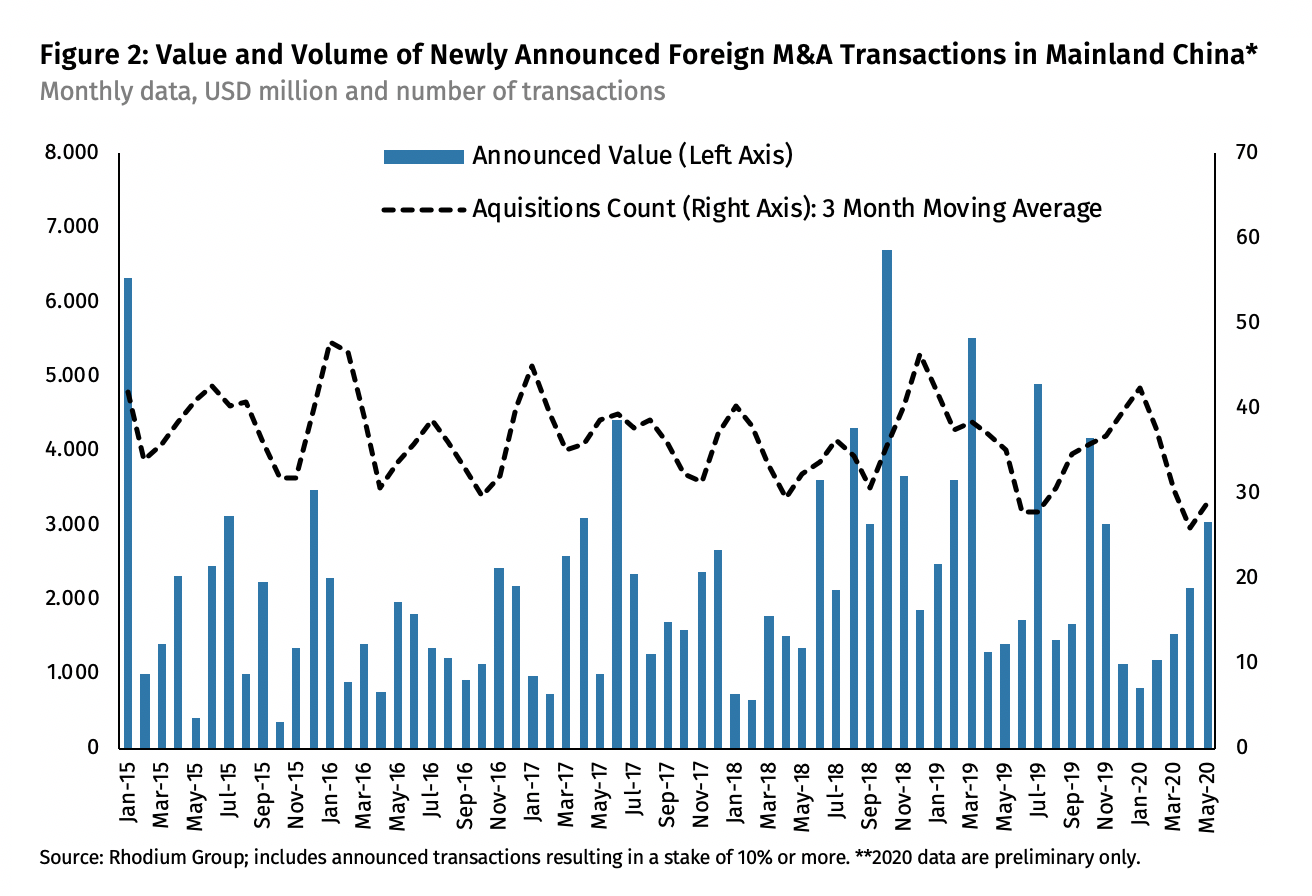
With the spotlight on Chinese outbound investment, few have noticed how resilient foreign M&A in China has been over the past 18 months. For years, FDI in China was dominated by greenfield investments. Over the past decade, foreign M&A activity in China has averaged $20-25 billion per year, a paltry level for an economy worth $13 trillion. Since mid-2018, however, foreign deal making has picked up. In 2019, it reached a 10-year high of $35 billion (Figure 2).
The COVID-19 outbreak has slammed deal-making in both directions this year. But flows into China have picked up every month since January. In the first five months of 2020, foreign M&A into China totaled $9 billion, surpassing Chinese outbound M&A activity in both volume and value terms for the first time in a decade.
Recent deals offer clues about what is driving foreign appetite for Chinese assets. First, Chinese consumption. While consumption has taken a hit – as it has everywhere else – firms are still betting on the secular rise of China’s middle class. One example from 1Q 2020 is Pepsi’s $700 million acquisition of Chinese snack brand Be & Cheery. Second, policy liberalization. Foreign firms are buying shares in their own joint ventures, after China lifted foreign equity thresholds. Volkswagen announced it would take control of its joint venture with Anhui Jianghuai Automotive Group in a $1.1 billion deal, and JP Morgan is acquiring full control of its Chinese mutual fund joint venture for an estimated $1 billion. Third, Chinese firms have matured (through entrepreneurialism, industrial policy and other means) to become leaders in some industries. For the first time, therefore, it is attractive for foreigners to buy technology and industrial assets rather than build from scratch. Volkswagen’s plans to acquire a 26% stake in Chinese battery maker Guoxuan High-Tech for $1.2 billion is a prime example.
Policy Implications
The data points above are just a snapshot of a rapidly changing environment and should be treated as such. But the trends that have emerged over the first five months of 2020 offer some valuable insights for policymakers grappling with China’s role in global cross-border investment flows.
First, reduced FDI flows will be a global reality for some time and China is no exception. The COVID-19 pandemic is dragging on international trade, people flows, and cross-border capital movements. UNCTAD predicts that global FDI flows could drop up to 40% in 2020. China is not an exception and is experiencing diminished capital inflows and outflows.
Second, slowing Chinese outbound investment over the 2017-2020 period shows China’s rise as global investor is not inevitable. China remains vastly under-invested in the world relative to the size of its economy, so it is reasonable to expect Chinese outbound FDI growth to continue. But that does not mean it will happen. China’s future as a global investor depends on two factors: first, the successful implementation of policy reforms at home that have bedeviled leaders in Beijing for years; and second, foreign comfort with Chinese capital, a condition that has shifted starkly to the negative in recent years.
Third, foreign appetite for assets in China will remain robust, despite the chorus of political decoupling and economic re-shoring talk, as long as China represents a sizable share of global growth. Over the past 18 months, we have recorded levels of foreign M&A into China that were not seen in the previous decade. Most of that activity has been driven by American and European firms taking advantage of looser foreign ownership limits or betting on Chinese consumer demand. Over the past century, these firms have continued to do business in challenging locations like Venezuela, Burma and Libya. If China remains an important source of global demand growth, they will exert themselves to invest into that opportunity.
These data points underscore how important it is that OECD policymakers get the balance right between addressing valid security concerns and maintaining openness to foreign capital – both inbound and outbound. Robust investment screening mechanisms exist not just to mitigate national security risks, but to provide the confidence needed to stick to principles of economic liberalism in times of crisis. The pandemic is putting our systems to the test, increasing the role of the state in many economies and accelerating the deployment of investment screening tools to guard against foreign takeovers that could impinge on national security. That is natural and to some extent necessary. But it is important that governments do not go too far and end up undermining the dynamism and competitiveness of open market economies they are trying to protect.
FULL DOCUMENT: https://rhg.com/research/whos-buying-whom/
COLOMBIA
U.S. Department of State. 06/18/2020. Department of State Offers Rewards for Information to Bring Colombian Drug Traffickers to Justice. Michael R. Pompeo, Secretary of State
Today, the U.S. Department of State announced rewards up to $10 million each for information leading to the arrest and/or conviction of Seuxis Hernandez-Solarte, aka “Jesus Santrich,” and Luciano Marin Arango, aka “Ivan Marquez.” Both are former senior leaders of the FARC who dropped out of the peace process and have a long history of involvement in drug trafficking activities, which resulted in their criminal indictments.
The United States values its partnership with Colombia. We will continue the strong U.S.-Colombian law enforcement information sharing and capacity building efforts which are essential to disrupting and dismantling transnational criminal organizations operating in the region. We also share Colombia’s concern that the Maduro regime is providing support to illegal armed groups from Colombia.
These rewards are offered under the Department of State’s Narcotics Rewards Program (NRP). More than 75 major narcotics traffickers have been brought to justice under the NRP since it began in 1986. The Department has paid more than $130 million in rewards for information leading to those apprehensions.
The Bureau of International Narcotics and Law Enforcement Affairs manages the NRP in close coordination with the Drug Enforcement Administration (DEA), the Federal Bureau of Investigation (FBI), the U.S. Immigration and Customs Enforcement/Homeland Security Investigations (ICE/HSI), and other U.S. government agencies. These actions demonstrate the Department’s commitment to supporting law enforcement efforts and a whole of government approach to combatting drug trafficking and transnational organized crime.
INTERNATIONAL TRADE
DoC. The Kansas City Star. June 18, 2020. Op-Ed by Commerce Secretary Wilbur L. Ross: Under Donald Trump’s Leadership, the U.S. Economy Will Come Back Strong
There is no doubt the coronavirus pandemic has dramatically impacted our day-to-day lives. Americans are making adjustments to everything from their morning routines to how they’re managing their money. Families have yearned for good economic news for several months now, and last week we saw the beginning of an economic revival they’ve so desperately needed.
By multiple predictions, May and June are likely to be the nadir of the recession, followed by a sharp recovery toward the early fall. The ADP National Employment Report for May shows the number of newly-unemployed dropped to below 3 million, versus a consensus forecast of 7 million. The U.S. Department of Labor announced last week that the economy added more than 2.5 million jobs in May, versus what was expected to be a 7.5 million jobs loss.
While economists estimated large declines in payrolls and increases in unemployment, the data shows just the opposite: Payrolls rose and the jobless rate fell from 14.7% to 13.3%.
Consumer spending makes up about 70% of our economy and Americans already received what the White House calculates as $400 billion in federal support provided by the government’s coronavirus relief package. As stores and restaurants begin to reopen, a large majority of that money will be invested back into local economies across the country. The U.S. Commerce Department’s Census Bureau on Tuesday released data showing a 17.7% surge in retail sales for the month of May, much higher than the 8% that many economists had forecast.
The reason for this is simple: the resilience of the American consumer.
As average weekly unemployment benefits for those who lost work because of the pandemic are now supplemented by $600 per week from the federal government, in addition to the $1,200 one-time payment to Americans in low- and middle-income brackets, President Donald Trump has continued to ensure that Americans have every opportunity to recover from the economic downturn. Fundamentally different from what Americans experienced in 2009, when they were leaving the labor market with no hope of reemployment, 77% of unemployed Americans now expect they will be reemployed quickly, and consumer confidence continues to grow.
Measures signed into law by the president have infused $4 trillion into the American economy, twice the amount post-2009. This money is going straight back into the economy and ultimately into the pocketbooks of everyday Americans, where it belongs — marking a second fundamental difference from what we experienced in 2009, where relief went to plug structural flaws in mismanaged state capitols and Wall Street.
But we can’t gloss over a third, very critical difference between the economic revitalization we’re soon to see and the recession we experienced just over 10 years ago: the contrast of a strong American economy versus the severe structural problems in the economy of the late 2000s. Wages remained stagnant for middle-class America for more than a decade. Gross domestic product had been recklessly inflated by excessive mortgages and other forms of credit. Banks were already failing, and therefore incapable of transmitting increased liquidity into the real economy. Consumer confidence was incredibly low. By contrast, our biggest problem before the coronavirus pandemic was that under the leadership of the president, there were more available jobs — 6.5 million to be exact — than there were people to fill them.
The malaise that led to a catastrophic 2009 had been accumulating for years, and it is not surprising that it took a leader like Donald Trump to help overcome it. The coronavirus, in contrast, is a one-time health crisis that caused a temporary collapse to the economy. Now that America is reopening, it should not take long for us to see the economic recovery unfold. Confidence is growing in both the economy and our president.
As the economy gets back to where it was, with record low unemployment for African Americans, Hispanics, women and the disabled, and with more rapid increases in non-supervisory pay, Americans deserve to be hopeful and eager to get back to their pre-pandemic routines. While we focus on improving the economic growth of our nation, all Americans from coast to coast will be able to enjoy the economic benefits of which the United States of America is capable.
DOCUMENT: https://content.govdelivery.com/accounts/USDOC/bulletins/291692c
EUA. CHINA. REUTERS. 18 DE JUNHO DE 2020. Câmara de Comércio dos EUA pede que China acelere compras de produtos norte-americanos
Por Andrea Shalal
WASHINGTON (Reuters) - A Câmara de Comércio dos Estados Unidos enfatizou nesta quinta-feira a importância de laços funcionais entre EUA e China e instou Pequim a intensificar suas compras de bens e serviços norte-americanos, conforme combinado na Fase 1 do acordo comercial, apesar dos atrasos causados pelo coronavírus.
A Câmara de Comércio informou que a pandemia claramente desacelerou o progresso de ambos os governos, mas que há razões para ter esperança. Também saudou conversas regulares entre as duas maiores economias do mundo sobre implementação de compras, reformas de propriedade intelectual e outras questões cobertas pelo acordo comercial.
“A implementação é crucial. O Covid-19 retardou inquestionavelmente o progresso de ambos os governos, e será essencial para que o ritmo de implementação das compras acelere acentuadamente”, afirmou em comunicado, após uma reunião virtual dos principais líderes empresariais dos EUA e da China na quarta-feira.
A reunião, uma das duas convocadas anualmente pela Câmara e pelo Centro de Intercâmbio Econômico Internacional da China, um centro de estudos com sede em Pequim, focou na Fase 1 do acordo comercial que entrou em vigor em fevereiro e nos desafios da cadeia de suprimentos.
As tensões entre os dois países aumentaram nos últimos meses, provocando perguntas sobre o futuro do acordo comercial, no qual a China concordou em comprar 200 bilhões de dólares a mais em bens e serviços norte-americanos em dois anos.
A China ameaçou retaliar depois que o presidente dos EUA, Donald Trump, assinou legislação na quarta-feira pedindo sanções contra a repressão dos uigures da China, uma minoria muçulmana.
A Câmara disse que os 1,4 bilhão de consumidores da China representam o mercado que mais cresce para as empresas norte-americanas, mas as empresas norte-americanas também enfrentam inúmeros desafios ao fazer negócios com a China.
Apesar dos desafios e das recentes tensões, afirmou que um relacionamento funcional entre os dois países “é do interesse fundamental dos norte-americanos e de paz e estabilidade no mundo”.
CORONAVIRUS
U.S. Department of State. 06/18/2020. UPDATE: The United States Continues to Lead the Global Response to COVID-19
The United States continues to lead the global effort to respond to and end the COVID-19 pandemic. Building upon decades of investment in life-saving health and humanitarian assistance, the American people should be proud of the real results we are achieving through our help to nations around the world, which also helps protect the homeland. The U.S. government has so far allocated more than $12 billion that will benefit the global COVID-19 response, and we continue to ensure that the substantial U.S. funding and scientific efforts on this front remain a central and coordinated part of the worldwide effort against the disease. Our efforts are far from over but continue to make a real and lasting impact.
Since the outbreak of COVID-19, the U.S. Government has announced more than $1.2 billion in State Department and U.S. Agency for International Development (USAID) emergency health, humanitarian, economic, and development assistance specifically aimed at helping governments, international organizations, and non-governmental organizations (NGOs) fight the pandemic. This funding, provided by Congress, will save lives by improving public health education; protecting healthcare facilities; and increasing laboratory, disease-surveillance, and rapid-response capacity in more than 120 countries.
The United States has mobilized as a nation to make this an impressive global effort. Working with the private sector, we are actively fulfilling President Trump’s commitment to provide ventilators to our partners and allies in Africa, Asia, Europe, and Latin America. Our foreign assistance funding to date for the response to the COVID-19 pandemic now includes more than $200 million specifically for ventilators.
The COVID-19 assistance to-date from the State Department and USAID includes the following:
- Approximately $428 million in emergency health assistance from USAID’s Global Health Emergency Reserve Fund for Contagious Infectious-Disease Outbreaks and Global Health Programs account. These funds prioritize interventions to mitigate the pandemic and prepare communities in developing countries affected by and at-risk of COVID-19. This includes funding for ventilators – highly specialized, state-of the art medical equipment used in hospitals and other medical facilities to help support patients who are having trouble breathing. These life-saving devices are compact, and will give recipient countries flexibility in treating patients most seriously affected by advanced COVID-19 symptoms easily and quickly throughout the country. As an added benefit, the ventilators can also be used to treat patients for other respiratory ailments beyond the virus for years to come.
- More than $462 million in humanitarian assistance from USAID’s International Disaster Assistance (IDA) account. This assistance supports case-management and keeps essential health care operating; provides risk-communication and community-engagement programs; supports efforts to prevent and control infections; provides safe water and hygiene items; provides emergency food assistance; and strengthens local capacity and coordination by working with existing health structures and with others in the humanitarian community. These funds prioritize populations affected by ongoing humanitarian crises, particularly internally-displaced people (IDPs) and other displaced persons, because of their heightened vulnerability, the elevated risk of severe outbreaks in camps and informal settlements, and anticipated disproportionate mortality in these populations.
- More than $206 million from the Economic Support Fund (ESF). These funds promote American foreign-policy interests by financing shorter-term mitigation efforts and addressing the second-order impacts of the pandemic in the long term, across a variety of sectors. ESF funding is also being used to provide ventilators.
- More than $173 million in humanitarian assistance from the Migration and Refugee Assistance (MRA) account, provided through the State Department’s Bureau of Population, Refugees, and Migration. These funds help international organizations and NGO partners address the increased vulnerability created by the pandemic of refugees and host communities as well as among migrants and other vulnerable and conflict-affected people. This includes strengthening local health responses and provision of emergency relief items to vulnerable families.
This new COVID-19 foreign assistance is provided in addition to the more than $100 billion in global health funding and nearly $70 billion in overseas humanitarian assistance provided by the United States in the last decade alone.
These new amounts do not include assistance being provided by other U.S. Government Departments and Agencies, including the Centers for Disease Control and Prevention (CDC) within the U.S. Department of Health and Human Services and the Department of Defense (DoD).
In addition to this direct funding from the U.S. Government, our All-of-America approach is helping people around the world to confront the ongoing pandemic. Through the generosity of American private businesses, non-profit groups, charitable organizations, faith-based organizations, and individuals, Americans have now provided more than $4.6 billion in donations and assistance globally for COVID-19 response, more than any other nation.
To meet the most urgent needs, U.S. Government Departments and Agencies are coordinating efforts to prioritize foreign assistance to maximize the potential for impact. The United States is providing the following assistance through the State Department and USAID:
Africa:
- Angola: $570,000 for health assistance is helping provide risk-communications and water and sanitation, as well as to prevent and control infections in key health facilities in Angola. This assistance comes on top of long-term U.S. investments in Angola, which total $1.48 billion over the past 20 years, including over $613 million for health assistance.
- Bénin: $1.5 million in health assistance will help Béninois respond to the outbreak by funding the coordination and planning of outbreak-response activities, strengthening surveillance and rapid-response capabilities, and risk-communications and engagement with communities. This assistance joins $1.72 billion in total assistance for Benin over the past 20 years, over $364 million of which was for health.
- Botswana: $1.5 million in health assistance to address the outbreak. Funding will support risk-communications and community engagement, with a focus on the most vulnerable populations, the procurement of essential health commodities and logistic support, and strengthening case-management and the prevention and control of infections in key health facilities. This assistance builds on nearly $1.2 billion in total assistance in Botswana over the last 20 years, over $1.1 billion of which has been for health.
- Burkina Faso: Nearly $14.3 million in health and humanitarian funding will go toward risk-communications, water and sanitation, preventing and controlling infections in health facilities, public-health messaging, and emergency food assistance. This includes $2.5 million in health assistance, $9 million in IDA humanitarian assistance, and nearly $2.8 million in MRA humanitarian assistance, which will help protect the health of vulnerable people in Burkina Faso during the pandemic. Over the past 20 years, the United States has invested a total of more than $2.4 billion in Burkina Faso, including over $222 million for health.
- Burundi: More than $3 million in total funding for the response to COVID-19 includes $2 million in health assistance and more than $1 million in MRA humanitarian assistance to help protect the health of vulnerable people. The health assistance will improve the planning and coordination of response activities, the strengthening of surveillance and rapid-response capabilities, strengthening capacities for case-management and the prevention and control of infections, and the training of health workers. The United States has invested more than $997 million in total assistance for Burundi, including more than $254 million for health, over the past 20 years.
- Cameroon: $16.7 million for health and humanitarian assistance will help provide infection-control in key health facilities, strengthen laboratories and surveillance, prepare communities, bolster local messaging, and provide emergency food assistance. This includes $14.1 million for health and IDA humanitarian assistance from USAID and more than $2.6 million in MRA humanitarian assistance to support refugees, IDPs, and host communities. This assistance builds upon more than $960 million in total U.S. Government investment in the country over the past 20 years, over $390 million of which was for health.
- Central African Republic: More than $10 million in humanitarian assistance, including $6.5 million in IDA humanitarian assistance that will go toward risk-communications, preventing and controlling infections in health facilities, and safe water supplies, and more than $3.5 million in MRA humanitarian assistance that will help protect the health of vulnerable people in the Central African Republic during the pandemic. The U.S. Government has provided $822.6 million in total in the Central African Republic over the last 20 years, including $4.5 million in emergency health assistance in Fiscal Year (FY) 2019.
- Chad: $4.2 million in humanitarian assistance, including $1.5 million from the IDA account for preventing and controlling infections in health facilities, raising community awareness of COVID-19, and improving hygiene, and nearly $2.7 million in MRA humanitarian assistance to help protect the health of vulnerable people in Chad during the pandemic. This new assistance builds upon the foundation of nearly $2 billion in total U.S. assistance over the last 20 years, including more than $30 million for health.
- Republic of Congo (ROC): $250,000 in health assistance will address the outbreak, by supporting the coordination and planning of response activities, risk- communications and community-outreach activities and the training of health workers in protocols for preventing and controlling infections in health facilities. The United States has invested in the Republic of Congo for decades, including more than $171.2 million in total U.S. assistance over the last 20 years, over $36.9 million of which has been for health.
- Côte d’Ivoire: $3.2 million in health assistance to address the outbreak by financing risk-communications and community engagement; the training of health care providers in protocols for preventing and controlling infections in health facilities and the appropriate management of cases of COVID-19 and influenza-like illnesses; and ensuring these facilities are appropriately supplied with essential health commodities. Funding will also finance the training of health workers in critical community-level surveillance techniques, such as case-finding and contact-tracing. Over the past 20 years, the United States has invested more than $2.1 billion in long-term development and other assistance in Côte d’Ivoire.
- Democratic Republic of the Congo (DRC): Approximately $26.1 million in total including $16 million for health and IDA humanitarian assistance that will improve the prevention and control of infections in health facilities, and support improved awareness of COVID-19, including by working with religious leaders and journalists on risk-communication messaging. Nearly $5.1 million in MRA humanitarian assistance will help protect vulnerable people in the DRC during the pandemic. The $6 million in health assistance funding will support supply-chain management and logistics, as well as the procurement of essential health commodities; strengthening critical disease-surveillance activities, including community-based surveillance, contact-tracing, and case-finding; strengthening practices to prevent and control infections at health facilities and train health workers, as well as community-based efforts to improve access to water and basic hygiene materials, with the direct distribution of kits to households to prevent infections. Health assistance also will support mobilizing thousands of volunteers in targeted, high-risk Provinces to conduct risk-communications and community-engagement activities. Finally, approximately $5 million in ESF will go toward distance and alternative education for Congolese children and youth so they can continue to learn and maintain protective routines and social connections while schools remain closed across the country. This builds upon more than $6.3 billion in total U.S. assistance over the past 20 years, including more than $1.5 billion for health.
- Djibouti: $750,000 in total, including $500,000 in health assistance to address the outbreak and $250,000 in MRA humanitarian assistance to assist vulnerable migrants and host communities as they deal with the pandemic. Health assistance will support strengthening the capacity for testing, supply-planning, supply-chain management and the distribution of urgent health commodities needed for COVID-19. The health assistance also will fund risk-communications and community-outreach activities, the training of health workers to implement protocols to prevent and control infections in health facilities and manage cases of COVID-19; and disease-surveillance and rapid-response protocols and functionality. The United States has already invested more than $338 million in Djibouti over the last 20 years.
- Eswatini: $1.1 million in health assistance to address the outbreak by bolstering Eswatini’s emergency health response, which could include the procurement of supplies, contact-tracing, laboratory diagnostics, and raising public awareness. This assistance builds upon the foundation of U.S. Government investments in the Kingdom, which total more than $529 million assistance over the last 20 years, including more than $490 million for health.
- Ethiopia: More than $42.5 million in assistance to counter COVID-19, including $26.5 million in IDA humanitarian assistance for risk-communications, the prevention and control of infections in health facilities, disease-surveillance, contact-tracing, coordination, and emergency food assistance; more than $5.6 million in MRA humanitarian assistance for vulnerable people, including refugees, migrants, and host communities; and more. This assistance is in addition to the United States’ long-term investments in Ethiopia over the past 20 years of more than $13 billion, over $4 billion of which was for health.
- Ghana: $1.6 million in health assistance to address the outbreak by strengthening outbreak-response capabilities, including community-based surveillance for case-finding and contact-tracing; improve laboratory diagnostic capacity; optimize the management of COVID-19 cases and the prevention and control of infections in health facilities; and promote risk-communications and community-engagement activities. This assistance builds upon $3.8 billion in total U.S. Government investments in Ghana over the last 20 years, including over $914 million for health.
- Guinea: $1.3 million in health assistance to address the outbreak by financing risk-communications and community-outreach activities, the training of health workers to implement protocols to prevent and control infections in health facilities; and disease-surveillance and rapid-response protocols and functionality. The United States has invested nearly $1 billion in total assistance in Guinea over the last 20 years, including over $365.5 million for health.
- Kenya: Nearly $14.4 million for health and humanitarian assistance, including $13.5 million in health and IDA humanitarian assistance to provide emergency food assistance; bolster risk-communications; prepare health-communication networks and media for possible cases; and help provide public-health messaging for media, health workers, and communities; and $947,000 in MRA humanitarian assistance for refugees and host communities. This assistance specific to COVID-19 comes on top of long-term U.S. Government investments in Kenya, which total $11.7 billion over the last 20 years, including more than $6.7 billion for health.
- Lesotho: $750,000 in health assistance to address the outbreak by strengthening outbreak-response capabilities, including community-based surveillance for case-finding and contact tracing, strengthening laboratory diagnostic capacity, and optimizing case-management and the prevention and control of infections in health facilities. The health assistance also will finance risk-communications and community-engagement activities. This assistance builds upon decades of U.S. investments in Lesotho, which total more than $1 billion over the last 20 years, including more than $834 million for health.
- Liberia: $2.3 million in health and IDA humanitarian assistance will provide critical aid for all 15 Liberian Counties (emergency-operation centers, training, contact-tracing, hospitals, and community health care), support quarantine efforts, and provide village-level support. The United States has helped lay a strong foundation for Liberia’s response to COVID-19 through more than $4 billion in total assistance over the past 20 years, including more than $675 million for health.
- Madagascar: $2.5 million in health assistance to address the outbreak by strengthening laboratory capacity for diagnostics; deploying mobile laboratories for decentralized diagnosis; improving regional and District surveillance, including data systems and the training of community health volunteers in contact-tracing; promoting risk-communications and community-engagement activities, including a staffed hotline, mass-media campaigns and prevention messages; the training of health professionals infection and prevention control training, procurement of essential health commodities, and improvements in waste management. The United States has invested more than $1.5 billion in total assistance for Madagascar over the last 20 years, including over $722 million for health.
- Malawi: $4.5 million in health assistance to address the outbreak. Funding will support the COVID-19 response and preparedness activities at the district level, including surveillance activities, strengthening infection and prevention control practices, screening at points of entry, and case management. Funding will also support risk communication and community engagement, including radio and social media campaigns; and technical assistance to optimize supply chain logistics and management. The United States has provided more than $3.6 billion in total assistance for Malawi over the past 20 years, including more than $1.7 billion for health.
- Mali: More than $9.1 million in assistance for the response to COVID-19, which includes $2.4 million for health assistance and $2.7 million in IDA humanitarian assistance for risk-communications, the prevention and control of infections in health facilities, and coordination; and more than $4 million in MRA humanitarian assistance to support vulnerable in Mali during the pandemic. Health assistance will support risk-communications and community engagement, including by establishing community communication networks with modern and traditional methods and to call on citizens to counter misinformation and rumors, as well as support to the Ministry of Health’s National Hotline; strengthening diagnostic networks and disease-surveillance systems, optimizing real-time surveillance to accelerate the detection and investigation of cases and contact-tracing and train and mobilize existing community-surveillance, early-warning and emergency rapid-response teams to report infections and assist ill persons in getting prompt and appropriate care. The health funding also will finance activities to prevent and control infections at priority case-detection points (including points of entry to Mali along high-traffic cargo routes) and public and community health facilities, including through the procurement of equipment and supplies to prevent infections and manage medical waste. This new assistance builds upon decades of U.S. Government investments in Mali, which total more than $3.2 billion over the last 20 years, including more than $807 million for health.
- Mauritania: $250,000 in health assistance to address the outbreak by financing risk-communications and community-engagement activities, strengthening supply-chain management and logistics, and improving the prevention and control of infections in health facilities. The United States has provided more than $424 million in total assistance over the last 20 years for Mauritania, including more than $27 million for health, which builds a strong foundation for their pandemic response.
- Mauritius: $500,000 in health assistance to address the outbreak under the national response strategy for COVID-19, including by strengthening coordination and logistics; developing and disseminating risk-communications and prevention materials at the community level; strengthening protocols for the prevention and control of infections in health facilities; disseminating case-management guidelines and training health workers in their use; improving surveillance and rapid-response protocols and functionality; and expanding laboratory capacity. This assistance builds upon the foundation of more than $13 million in total U.S. Government investments over the past 20 years, including more than $838,000 for health.
- Mozambique: $6.8 million, including $4.8 million for health assistance and $2 million in IDA humanitarian funding will finance risk-communications and community engagement, including mass-media prevention messages; water and sanitation; and the prevention and control of infections in key health facilities in Mozambique. The health assistance also will fund the training of health workers in case-management and ensuring health facilities are prepared to respond to the outbreak. The United States has invested nearly $6 billion in Mozambique over the past 20 years, including more than $3.8 billion for health.
- Namibia: $750,000 in health assistance to address the outbreak by improving laboratory capacity for diagnostics and technical assistance in supply-chain management and logistics. This assistance comes in addition to nearly $1.5 billion in total U.S. Government investments to Namibia over the past 20 years, including more than $970.5 million in long-term health assistance.
- Niger: Nearly $6.4 million in assistance includes nearly $800,000 for health assistance and $3 million in IDA humanitarian assistance for risk-communications, the prevention and control of infectious diseases in health facilities, and coordination; and more than $2.6 million in MRA humanitarian assistance will support vulnerable people in Niger during the pandemic, including refugees, and vulnerable migrants, and host communities. This assistance comes on top of more than $2 billion in total U.S. Government investments for Niger in the past 20 years, nearly $233 million for health.
- Nigeria: More than $41.3 million in assistance, which includes more than $3.3 million for health assistance and $34 million in IDA humanitarian funding for risk-communications, water and sanitation, infection-prevention, coordination, and emergency food assistance; and nearly $4.1 million in MRA humanitarian assistance for vulnerable people. This assistance joins more than $8.1 billion in total assistance for Nigeria over the past 20 years, including more than $5.2 billion for health.
- Rwanda: $2.2 million in assistance for Rwanda’s response to COVID-19 includes $1.7 million for health assistance that will help with disease-surveillance and case-management, and $474,000 in MRA humanitarian assistance to support refugees and host communities in Rwanda. This comes on top of long-term U.S. Government investments in Rwanda that total more than $2.6 billion in total assistance over the past 20 years, including more than $1.5 billion for health.
- Sénégal: $3.9 million in health assistance to support risk-communications, water and sanitation, the prevention and control of infections in health facilities, public health messaging, and more. In Sénégal, the U.S. has invested nearly $2.8 billion in total over the past 20 years, nearly $880 million for health.
- Sierra Leone: $2.7 million in health and IDA humanitarian assistance to address the outbreak by strengthening surveillance activities, case-finding, contact-tracing, risk-communications, community engagement, and the management of cases of COVID-19 at health facilities. This assistance joins decades of U.S. investments in Sierra Leone, totaling more than $954 million in total assistance over the past 20 years, including nearly $260 million for health.
- Somalia: More than $17.1 million in humanitarian assistance for the response to COVID-19 will fund risk-communications, the prevention and control of infectious diseases in health facilities, case-management, and more, including for internally displaced persons, refugees, returnees, and vulnerable migrants. This assistance comes in addition to $5.3 billion in total assistance for Somalia over the last 20 years, including nearly $30 million for health.
- South Africa: Approximately $8.4 million in health assistance to counter COVID-19 will fund risk-communications, water and sanitation, the prevention and control of infections in health facilities, public health messaging, and more. The United States has also pledged to send up to 1,000 ventilators to South Africa, the first 50 of which arrived on May 11, 2020. This assistance joins more than $7 billion in total assistance by the United States for South Africa in the past 20 years, nearly $6 billion invested for health.
- South Sudan: Nearly $40.6 million in assistance includes $32.2 million in IDA humanitarian assistance for case management, prevention and control of infections, logistics, coordination efforts, risk communications, water, sanitation and hygiene, and emergency food assistance; $2.8 million in health programming; and more than $5.6 million in MRA humanitarian assistance that will support refugees and host communities in South Sudan during the pandemic. The health assistance will fund expanded training of health workers and peer educators on proper practices to prevent and control infections in health facilities to protect communities and patients, particularly those at high risk or who are immunocompromised, and strengthening the capabilities of health facilities and communities to manage and refer cases of COVID-19. The health assistance also will fund expanding efforts to address community concerns, including by tracking and combating rumors, misconceptions, and grievances. This funding builds upon past U.S. investments in South Sudan that total $6.4 billion over the past 20 years, including more than $405 million for health.
- Sudan: More than $27.6 million in assistance includes $1 million in health assistance and $20.3 million in IDA humanitarian assistance for strengthening laboratory capacity, disease surveillance and contact-tracing, case-management, risk-communications, disease-surveillance, the prevention and control of infections, water, sanitation and hygiene; $5 million in ESF for cash assistance to vulnerable families adversely affected by COVID-19; and more than $1.3 million in MRA humanitarian assistance to support vulnerable people. The United States has invested more than $1.6 billion in total assistance for Sudan over the last 20 years, more than $3 million of which was for health.
- Tanzania: $3.7 million in assistance includes $3.4 million in health assistance funds the strengthening of laboratory capacity for optimal diagnostics, risk-communications, water and sanitation, the prevention and control of infections, public health messaging, and more. It also includes $310,000 in MRA humanitarian assistance to support vulnerable refugees, migrants, and host communities with a focus on children, youth, and their care providers. The United States has invested more than $7.5 billion total in Tanzania over the past 20 years, nearly $4.9 billion for health.
- Uganda: $4.2 million in assistance includes $2.3 million in health assistance to address the outbreak and nearly $1.9 million in MRA humanitarian assistance will support refugees and host communities, including youth, and their care providers, in Uganda during the pandemic. The health assistance will strengthen the prevention and control of infections and case-management practices in health facilities, including by training health workers in new protocols; promote risk-communications and community engagement, including materials and messages to address most vulnerable groups; and improve management systems to ensure the accountability and availability of, and access to, health commodities, essential medicines, and health supplies in health facilities to maintain the continuity of services. This assistance is provided in addition to the nearly $8 billion in total U.S. Government investments for Uganda over the last 20 years, including nearly $4.8 billion for health.
- Zambia: $3.4 million for health assistance will fund risk-communications, water and sanitation, the prevention and control of infections, public health messaging, and more. This assistance joins $4.9 billion total U.S. Government investments for Zambia over the past 20 years, nearly $3.9 billion in U.S. health assistance.
- Zimbabwe: Nearly $15 million, including nearly $3 million for health assistance and $12 million for IDA humanitarian assistance will help to prepare laboratories for large-scale testing, support case-finding activities for influenza-like illnesses, implement a public-health emergency plan for points of entry, and emergency food assistance. The health assistance will fund the strengthening of laboratory capacity, the prevention and control of infections and the management of cases of COVID-19 in health facilities, including hand-washing stations, screening centers, preparing hospitals to be ready to treat COVID-19 patients, training health workers, and setting up alternative care-delivery points. Funding also will also support the training of rapid-response teams, community health workers and volunteers; and risk-communications and community engagement. This new assistance builds on a history of U.S. investments in Zimbabwe – nearly $3 billion total over the past 20 years, nearly $1.2 billion of which was for health.
- Regional Efforts in the Sahel: $5 million in ESF will strengthen the efforts of partner governments and civil society to manage and respond to COVID-19 with transparent communication and response. These investments will cover Burkina Faso, Niger, The Gambia, Chad, and Mali.
- Regional Efforts in West Africa: $5 million in ESF will go towards conducting information campaigns with local authorities and communities and engaging community groups, community radio stations, and local media actors to develop targeted messaging in local languages. This assistance will also engage citizens in local-led advocacy, dialogue, and inclusive behavior change. These investments will cover Cameroon, Côte d’Ivoire, Togo, Bénin, and Guinea.
- Regional Sub-Saharan Africa Humanitarian Assistance: More than $6 million in MRA humanitarian assistance to help vulnerable people during the pandemic.
Asia:
- Afghanistan: $20.6 million in COVID-19 assistance includes more than $7.1 million for health and IDA humanitarian assistance to support the detection and treatment of COVID-19, as well as protection and health support, for IDPs, and nearly $3.1 million in MRA humanitarian assistance for Afghan returnees. In addition, the United States has redirected $10 million in existing resources to support the United Nations Emergency Response Plan for COVID-19 to conduct disease-surveillance, improve laboratories, manage cases of the disease, prevent and control infections in health facilities, engage with local communities, and provide technical assistance to the Government of Afghanistan, and $500,000 to procure COVID-19 prevention and control supplies for correctional facilities.
- Bangladesh: More than $43.4 million in assistance includes $21.4 million for health and IDA humanitarian assistance to help with case-management, surveillance activities, the prevention and control of infections in health facilities, risk- communications, water, sanitation, hygiene, and emergency food assistance. In addition, more than $22 million in MRA humanitarian support will support vulnerable people during the pandemic, including refugees and host communities. This builds upon nearly $4 billion in total U.S. assistance over the past 20 years, which included more than $1 billion for health.
- Bhutan: $1 million in total assistance includes $500,000 in ESF to support microenterprises to generate income for those affected by COVID-19 and to strengthen food security for Bhutanese unemployed because of the shutdown of tourism and construction sectors as well as increase the skills of these individuals, including unemployed youth. It also includes $500,000 in health assistance to strengthen diagnostic laboratory capabilities and clinical case-management, provide virtual training for healthcare providers and lab personnel, and design and produce risk-communications materials. This assistance builds upon more than $6.5 million in total U.S. Government investments over the past 20 years, including $847,000 for health.
- Burma: Nearly $13.5 million total, including approximately $8.3 million for health and $3 million in IDA humanitarian assistance for the prevention and control of infections in health facilities, case-management, laboratories, risk-communications and community engagement, as well as water and sanitation supplies, including assistance to IDP camps that are facing water shortages. This also includes nearly $2.2 million in MRA humanitarian assistance to support vulnerable people and host communities during the pandemic. This assistance comes on top of long-term U.S. Government investments in Burma that total more than $1.3 billion over the past 20 years, which includes more than $176 million for health.
- Cambodia: More than $11 million in total assistance for the response to COVID-19 includes $5 million in ESF for relief and job-skills training for vulnerable people, such as returning migrants, and expanded efforts to counter trafficking and protect children. It also includes more than $6 million in health assistance to help the Cambodian Government prepare laboratory systems, activate case-finding and event-based surveillance, communicate risk, support technical experts for response and preparedness, and more. The U.S. Government has invested more than $1.6 billion in total assistance over the past 20 years, which includes more than $730 million for health.
- India: Nearly $5.9 million in health assistance to help India slow the spread of COVID-19, provide care for the affected, disseminate essential public health messages to communities, strengthen case-finding and surveillance, and mobilize innovative financing mechanisms for emergency preparedness and response to the pandemic. Additionally, the funds will support State-specific COVID-19 challenges and address bottlenecks in supply-chains that stem from the lock-down of India’s borders. This builds on a foundation of nearly $2.8 billion in total assistance to India over the last 20 years, which includes more than $1.4 billion for health.
- Indonesia: $11 million includes more than $9 million in health funding to help the Indonesian Government prepare laboratory systems, activate case-finding and event-based surveillance, support technical experts for response and preparedness, and more. It also includes nearly $1.5 million in MRA humanitarian assistance for refugees, vulnerable migrants, and their host communities. The U.S. Government has invested more than $5 billion in total assistance over the past 20 years, including more than $1 billion for health.
- Kazakhstan: More than $3.1 million for health assistance will help prepare laboratory systems, activate case-finding and event-based surveillance, support technical experts for response and preparedness, bolster risk communication, and more. This assistance builds upon U.S. investments of more than $2 billion in total assistance over the last 20 years, including $86 million for health.
- Kyrgyz Republic: Approximately $900,000 for health assistance will help prepare laboratory systems, activate case-finding and event-based surveillance, support technical experts for response and preparedness, bolster risk communication, and more. The United States has invested nearly $1.2 billion in total assistance for the Kyrgyz Republic over the past 20 years, including more than $120 million for health.
- Laos: $4.4 million for health assistance is helping the government prepare laboratory systems, activate case-finding and event-based surveillance, support technical experts for response and preparedness, and more. This assistance builds upon U.S. Government investment in Laos over time, including more than $348 million over the past decade, of which nearly $92 million was health assistance.
- Malaysia: $1.2 million total includes $1 million in health assistance that will fund the prevention and control of infections in health facilities, community engagement, disease-surveillance and contact-tracing systems, bolster risk-communications, and more in response to COVID-19. It also includes $200,000 in MRA humanitarian assistance to support COVID-19 response efforts for refugees and asylum seekers in Malaysia. This assistance builds upon a foundation of decades of U.S. investment in Malaysia, totaling more than $288 million over the past 20 years, including more than $3.6 million for health.
- Maldives: $2 million in ESF will support the expansion of social-protection services led by local civil-society organizations and assist them to advocate effectively for COVID recovery policies. Funding will provide technical assistance to the government to develop effective economic, fiscal, monetary measures in response to the COVID-19 pandemic. S. investments in Maldives include more than $30 million in total assistance since 2004.
- Mongolia: Nearly $1.2 million for health assistance is helping the Mongolian Government prepare laboratory systems, activate case-finding and event-based surveillance, and support technical experts for response and preparedness, and more. The United States has invested more than $1 billion in total assistance for Mongolia over the past 20 years, including nearly $106 million for health.
- Nepal: $7.3 million in total assistance includes $2.5 million in ESF to support local governments and disaster-management committees to respond to the economic and social impacts of COVID-19, and will provide small grants to the private sector and CSOs to enable economic recovery, mitigate food insecurity, and address the needs of vulnerable populations. It also includes $4.8 million for health assistance that is helping the Nepali Government to conduct community-level risk-communications, prepare laboratory systems, activate case-finding and surveillance, support technical experts for response and preparedness, and more. Over the past 20 years, U.S. Government investment in Nepal totals more than $2 billion, including more than $603 million for health.
- Pacific Islands: $24.2 million total in assistance from USAID, which includes $14.5 million in IDA humanitarian assistance to support risk-communications, the prevention and control of infectious diseases in health facilities, logistics, coordination efforts, and more; $5 million in ESF for small grants to strengthen the capacity of CSOs to combat disinformation and hate speech at the community and national levels, to protect the rights of vulnerable and marginalized groups, and to increase their resilience and ability to respond to the economic impacts of COVID-19; and $4.7 million for health assistance, which is helping governments prepare laboratory systems, activate case-finding and event-based surveillance, and support technical experts for response and preparedness. To date, the United States Government, through multiple government agencies, has provided over $159 million to help Pacific Island countries respond to COVID-19, including over $131 million for the Freely Associated States of Palau, Marshall Islands, and the Federated States of Micronesia. Over the last 20 years, the United States has invested over $5.21 billion in assistance to the Pacific Islands. Over the last decade, the United States has invested more than $620 million for health in the Pacific Islands.
- Papua New Guinea (PNG): $3.55 million for health assistance is helping the Government of PNG prepare laboratory systems, activate case-finding and event-based surveillance, and support technical experts for response and preparedness, risk-communications, the prevention and control of infectious diseases in health facilities, and more. The United States has invested over $108 million total in Papua New Guinea over the past 20 years, including more than $52 million for health.
- Pakistan: Nearly $18 million in total assistance for Pakistan’s response to COVID-19 includes $5 million to support 66,000 COVID-affected vulnerable families under the Government of Pakistan’s emergency cash-assistance program; $10 million in health assistance to strengthen monitoring and better prepare communities to identify potential outbreaks, including funding for the training of healthcare providers and other urgent needs; and nearly $2.9 million in MRA humanitarian assistance to help vulnerable people in Pakistan. U.S. long-term investment in Pakistan over the past 20 years includes more than $18.4 billion in total assistance, which includes nearly $1.2 billion for health.
- The Philippines: More than $19.1 million in total COVID-19 assistance includes $5 million in ESF to provide grants and skills training to heavily affected sectors and communities; facilitate access to credit for micro and small enterprises; and support the efforts of the national government to improve crisis-management and procurement and promote a regulatory environment that enhances the resilience of communities and businesses. In addition, about $6.5 million in health assistance will help upgrade laboratories and specimen-transport systems and intensify case-finding and event-based surveillance, support Filipino and international technical experts in risk-communications and the prevention and control of infectious diseases in health facilities; and $6.8 million in IDA humanitarian assistance will improve community-level preparedness and response, promote handwashing and hygiene, and more. Finally, $875,000 in MRA humanitarian assistance will support vulnerable people during the pandemic. The United States has invested more than $4.5 billion in total assistance over the past 20 years, which includes $582 million for health assistance.
- Sri Lanka: More than $5.8 million in total assistance includes $2 million in ESF to increase social services for areas and populations most affected by the COVID-19 crisis, address the specific threats to social cohesion, and mitigate negative economic impacts; $2 million in additional ESF for strengthening small and medium-sized enterprises and increasing women’s economic participation; and $1.3 million in health assistance to help the Sri Lankan Government prepare laboratory systems, activate case-finding and event-based surveillance, support technical experts for response and preparedness, conduct risk-communications, prevent and control infectious diseases in health facilities, and more. Finally, $590,000 in MRA humanitarian assistance will support vulnerable people during the pandemic. Over the past 20 years, U.S. assistance in Sri Lanka has totaled more than $1 billion, which includes $26 million for health.
- Tajikistan: Approximately $866,000 for health assistance is helping prepare laboratory systems, activate case-finding and event-based surveillance, support technical experts for response and preparedness, bolster risk-communications, and more. This support builds on more than $1 billion in total U.S. assistance over the past 20 years, which includes nearly $125 million for health.
- Thailand: More than $6.5 million for health assistance will help the Thai Government prepare laboratory systems, activate case-finding and event-based surveillance, support technical experts for response and preparedness, promote risk-communications, prevent and control infectious diseases in health facilities, and more. $730,000 in MRA humanitarian assistance will support surveillance and response capacity in all nine camps on the Thailand-Burma border hosting refugees from Burma. This assistance builds upon long-term U.S. Government investments in Thailand of more than $1 billion in total assistance over the past 20 years, which includes nearly $214 million for health.
- Timor-Leste: Almost $1.1 million for health assistance is helping the Government of Timor-Leste prepare laboratory systems, activate case-finding and event-based surveillance, support technical experts for response and preparedness, bolster risk-communications, and more. The United States has invested more than $542 million in total assistance for Timor-Leste since independence in 2002, including nearly $70 million for health.
- Turkmenistan: Approximately $920,000 for health support has been made available to help prepare laboratory systems, activate case-finding and event-based surveillance, support technical experts for response and preparedness, bolster risk communication, and more. Over the past 20 years, the United States has collaborated closely with the Government of Turkmenistan and local partners to implement bilateral and regional programs totaling more than $207 million, including over $21 million in the health sector.
- Uzbekistan: Approximately $3.9 million in health funding is helping prepare laboratory systems, activate case-finding and event-based surveillance, support technical experts for response and preparedness, bolster risk-communications, and more. This COVID-19 response assistance builds on more than $1 billion in total assistance over the past 20 years, including more than $122 million in the health sector.
- Vietnam: Nearly $9.5 million in total assistance for response to COVID-19 includes $5 million in ESF, which will bring much-needed resources to bear immediately, including to support private-sector recovery by enhancing access to finance for businesses; improve firms’ capacity during an expected surge in demand; and working with the Government of Vietnam to bolster its relief interventions. It also includes almost $4.5 million in health assistance to help the Government prepare laboratory systems, activate case-finding and event-based surveillance, support technical experts for preparedness and response, conduct community education and engagement, prevent infections in health-care settings, public health screening at points of entry, and more. Over the past 20 years, the United States has invested more than $1.8 billion in total assistance for Vietnam, including more than $706 million for health.
- Regional Efforts in South and Central Asia: $2 million in ESF will provide essential services to vulnerable migrants in Central Asia stranded across the region as a result of border closures and ensure their safe return home in accordance with their own wishes and the help of NGOs and national governments. Additionally, $800,000 in health assistance is helping governments and NGOs across the region prepare laboratory systems, activate case-finding and event-based surveillance, support technical experts for response and preparedness, promote risk-communications, prevent and control infectious diseases in health facilities, and more. Furthermore, nearly $2.8 million in MRA humanitarian assistance will support vulnerable people in Southeast Asia and $425,000 in MRA humanitarian assistance will help vulnerable people in Central Asia during the pandemic. In addition to historic bilateral support to individual countries in the region, the United States has provided more than $226 million for health assistance regionally, and in total more than $3 billion in development and other assistance provided regionally over the last 20 years.
Europe and Eurasia:
- Albania: More than $2 million for health assistance is helping prepare laboratory systems, activate case-finding and event-based surveillance, support technical experts for response and preparedness, bolster risk-communications, and more. Over the last 20 years, the United States has invested more than $693 million in total assistance to Albania, including more than $51.8 million for health.
- Armenia: $2.7 million for health assistance is helping prepare laboratory systems, activate case-finding and event-based surveillance, support technical experts for response and preparedness, bolster risk-communications, and more. The United States has invested more than $1.57 billion in total assistance to Armenia over the past 20 years, including nearly $106 million for health.
- Azerbaijan: Nearly $3.6 million in total assistance includes $3 million in health assistance which is helping prepare laboratory systems, activate case-finding and event-based surveillance, support technical experts for response and preparedness, bolster risk-communications, and more. It also includes $565,000 in MRA humanitarian assistance that will help vulnerable people and host communities during the pandemic. Over the past 20 years, the United States has invested more than $894 million in total assistance to Azerbaijan, including nearly $41 million for health.
- Belarus: $1.7 million for health funding is helping prepare laboratory systems, activate case-finding and event-based surveillance, support technical experts for response and preparedness, bolster risk-communications, and more. This assistance comes on top of decades of U.S. investment in Belarus, totaling more than $301 million over the past 20 years, including nearly $1.5 million for health.
- Bosnia and Herzegovina: $2.2 million for health assistance is helping prepare laboratory systems, activate case-finding and event-based surveillance, support technical experts for response and preparedness, bolster risk-communications, and more. The United States has invested more than $1.1 billion in total assistance for Bosnia and Herzegovina over the past 20 years, including $200,000 for health.
- Bulgaria: $500,000 in health assistance to address the outbreak. This assistance builds on longstanding U.S. assistance for Bulgaria, which totals more than $558 million in total assistance over the past 20 years, including more than $6 million for health.
- Georgia: $2.7 million for health funding is helping prepare laboratory systems, activate case-finding and event-based surveillance, support technical experts for response and preparedness, bolster risk communication, and more. The United States has provided more than $3.6 billion in total U.S. assistance over the past 20 years, including nearly $139 million for health.
- Greece: $3.3 million in MRA humanitarian assistance will support COVID-19 response efforts for migrants and refugees in Greece. This assistance builds upon a foundation of U.S. support for Greece, which totals more than $202 million in total investments over the last 20 years, including nearly $1.8 million for health.
- Italy:S. support includes $50 million in health, humanitarian, and economic assistance implemented by USAID to bolster Italy’s response to COVID-19. USAID is expanding and supplementing the work of international organizations, non-governmental organizations, and faith-based groups responding to the pandemic in Italy and mitigating its community impact. USAID is also working with the Italian government to purchase health commodities and working to support Italian companies affected by the COVID-19 pandemic.
- Kosovo: Nearly $1.6 million in health assistance is helping prepare laboratory systems, activate case-finding and event-based surveillance, support technical experts for response and preparedness, bolster risk communication, and more. This assistance to combat COVID-19 is in addition to long-term U.S. investments, which total over $772 million in total assistance in Kosovo over the past 20 years, including more than $10 million for health.
- Moldova: Nearly $2.2 million for health assistance is helping prepare laboratory systems, activate case-finding and event-based surveillance, support technical experts for response and preparedness, bolster risk communication, and more. This COVID-19 assistance builds upon U.S. investments of more than $1 billion in total assistance over the past 20 years, including nearly $42 million for health.
- Montenegro: $300,000 in health assistance to address the outbreak. This assistance joins long-term U.S. investment in Montenegro totaling more than $332 million, including more than $1 million for health.
- North Macedonia: $1.5 million for health assistance is helping prepare laboratory systems, activate case-finding and event-based surveillance, support technical experts for response and preparedness, bolster risk communication, and more. Over the past 20 years, the United States has invested more than $738 million in total assistance for North Macedonia, including nearly $11.5 million for health.
- Romania: $800,000 in health assistance to address the outbreak. In addition, the U.S. Government fully funded an operation by the North American Treaty Organization (NATO) to transport personal protective equipment (PPE) from South Korea to Romania. The United States has invested in Romania for decades, totaling nearly $700 million in total U.S. assistance in the last 20 years, including more than $55 million for health.
- Russia: On June 4, USAID completed its shipment of 200 high-quality ventilators to the Russian people. The United States donated the American-manufactured ventilators and startup supplies and delivered them via military air.
- Serbia: More than $2 million for health assistance is helping: expand testing, activate case-finding and event-based surveillance; deploy additional technical expertise for response and preparedness; bolster risk communication and community engagement; and improve hygiene practices in the home. The United States has invested more than $1 billion in total assistance to Serbia over the past 20 years, including nearly $5.4 million for health.
- Turkey: Nearly $5.7 million in MRA humanitarian assistance will support COVID-19 response efforts for refugees and host communities in Turkey. This funding is in addition to the $18 million for Syrian refugee assistance inside Turkey announced March 3, and builds upon nearly $1.4 billion in total U.S. assistance to Turkey over the past 20 years, including more than $3 million for health assistance, helping lay the foundation for the current response.
- Ukraine: $15.5 million in total assistance includes $13.1 million in health and IDA humanitarian assistance that will improve the ability of local health care institutions to care for the sick and combat further spread of COVID-19 while increasing public communication to lower contagion risk. These funds will also mitigate secondary impacts such as loss of livelihoods and public services to vulnerable populations, including conflict-affected communities in eastern Ukraine. It also includes $2.4 million in MRA humanitarian assistance to support vulnerable populations during the pandemic. The United States has invested nearly $5 billion in total assistance to Ukraine over the past 20 years, including nearly $362 million for health.
- Regional Efforts in Europe and Eurasia: $5 million in ESF will empower civil society actors to safeguard democratic institutions and ensure citizens are heard during the pandemic. Funding will also assist civil society organizations to provide citizen oversight over their governments’ efforts to respond to COVID-19.
Latin America and the Caribbean:
- Argentina: $300,000 in previously announced MRA humanitarian assistance will support COVID-19 response efforts for refugees and host communities. This funding is in addition to U.S. funding for Argentina over the past 20 years, $95.1 million total including nearly $696,000 for health.
- Bahamas: $750,000 in previously announced health assistance will increase risk communication and community engagement, infection prevention and control, surveillance and rapid response, and strengthen case management. This assistance comes in addition to decades of U.S. investment in the Bahamas, including nearly $143.1 million in total assistance over the past 20 years, $264,800 of which was for health.
- Belize: $300,000 in previously announced health assistance to address the outbreak and improve operational capacity and case-management. This assistance builds upon past U.S. investment in Belize, which totals more than $120 million over the past 20 years, including nearly $12 million for health.
- Bolivia: Nearly $900,000 in previously announced funding, including $750,000 in health assistance to build capacity in COVID-19 diagnostics and improve epidemiological surveillance; and $130,000 in MRA humanitarian assistance will support COVID-19 response efforts for refugees and host communities. This assistance joins long-term U.S. investment in Bolivia, including nearly $2 billion in total U.S. assistance over the past 20 years, which includes $200 million for health.
- Brazil: More than $9.5 million, including $6 million in previously announced IDA humanitarian assistance for emergency activities in health, water, sanitation, and hygiene; $2 million in previously announced health funding will provide immediate support to vulnerable communities in the Amazon, including risk-communications and community engagement, the prevention and control of infections in health facilities, water and sanitation, and disease-surveillance and rapid response; $700,000 in MRA humanitarian assistance to support refugees and host communities as they deal with the pandemic; and $950,000 in previously announced ESF to incentivize private-sector investments in mitigating the non-health impacts of the disease on rural and vulnerable urban populations. This assistance builds upon past U.S. Government investment in Brazil, which totals more than $617 million over the past 20 years, including more than$103 million for health.
- Chile: $20,000 in previously announced MRA humanitarian assistance to support COVID-19 response efforts for refugees and host communities. U.S. assistance to Chile totals $105.9 million over the 20 past years, including $914,000 for health.
- Colombia: Nearly $13.6 million in assistance for Colombia’s response to COVID-19 includes $8.5 million in previously announced IDA humanitarian assistance that is helping surveil the spread of the virus, provide water and sanitation supplies, manage COVID-19 cases, and more; and more than $5.1 million in MRA humanitarian assistance, including $450,000 in new funding, which supports efforts to help vulnerable people during the pandemic and host communities. In Colombia, the United States has invested nearly $12 billion in total assistance over the past 20 years, which includes approximately $32.5 million in health assistance.
- Costa Rica: Nearly $900,000 in funds for Costa Rica’s response to COVID-19 includes $800,000 in previously announced health assistance and $80,000 in previously announced MRA humanitarian assistance to support refugees, vulnerable migrants, and host communities as they deal with the pandemic. U.S. Government investment in Costa Rica over the past 20 years has totaled $207 million, including $19.2 million for health.
- Dominican Republic: Nearly $3.7 million in response efforts, including $275,000 in MRA humanitarian assistance to support the COVID-19 response for refugees, vulnerable migrants, and host communities. This funding is in addition to $1.4 million in health assistance to address the outbreak, which is supporting epidemiological analysis and forecasting, contact-tracing, as well as pandemic surveillance; and $2 million in previously announced ESF to address critical needs in the areas of social protection, psychosocial support, education, water and sanitation, and food security in vulnerable communities. The United States has invested in the Dominican Republic’s long-term health and development through more than $1 billion in total U.S. assistance over the past 20 years, which includes nearly $298 million for health.
- Ecuador: Nearly $13.7 million in total funding to respond to COVID-19 includes $11 million in previously announced IDA humanitarian assistance, which will finance transportation and logistics, provide emergency food assistance, and enhance risk-communications and community-outreach efforts; $670,000 in MRA humanitarian assistance, including $130,000 in new funding, to support refugees and host communities; and $2 million in previously announced health assistance that will improve the provision of emergency care, enhance facility-based COVID protocols, prevent and control infections in health facilities, and strengthen the clinical management of cases of COVID-19. Over the last 20 years, the United States’ long-term commitment to Ecuador includes more than $1 billion in total assistance, of which nearly $36 million was for health, to help Ecuadorians deal with other major public health challenges such as Zika and malaria.
- El Salvador: Nearly $6.6 million in previously announced funding to respond to COVID-19, including $2 million in IDA humanitarian funding for risk-communications, water, sanitation, and hygiene; $2 million in ESF to address the second-order impacts of the pandemic in El Salvador through creating jobs and increasing access to credit, both critical factors in driving illegal immigration to the United States; and nearly $2.6 million in health assistance to address the outbreak. Support will include the prevention and control of infections in health facilities, and case-management. Additionally, USAID donated 250 ventilators to assist El Salvador with its national response. The donated ventilators, produced in the United States, are highly specialized, state-of the art medical equipment that are used in hospitals and other medical facilities to help support patients who are having trouble breathing. Included in the donation is one year of training on their correct use and maintenance. Over the past 20 years, the United States has invested in El Salvador’s health and long-term development through more than $2.6 billion in total assistance, which included $111 million for health.
- Guatemala: More than $8.4 million in previously announced assistance including $6 million in IDA humanitarian assistance for risk-communications and interventions in water, sanitation and hygiene and $2.4 million in health funding for Guatemala that will strengthen the country’s health institutions to respond to COVID-19 in the areas of preventing and controlling infections in health facilities, disease-surveillance, risk-communications, and clinical case-management. U.S. long-term investment in Guatemala’s health and development has totaled more than $2.6 billion in total assistance over the past 20 years, which included $564 million for health.
- Guyana: $350,000 in previously announced MRA humanitarian assistance to support the COVID-19 response effort for refugees and host communities. This assistance comes in addition to the regional COVID-19 response efforts in the Caribbean. Regionally, US assistance has totaled $840 million total over the past 20 years, which includes $236 million for health.
- Haitï: $13.2 million in previously announced health and IDA humanitarian assistance for Haitï will support risk-communication efforts, improve water and sanitation, prevent infections in health facilities, manage COVID-19 cases, strengthen laboratories, and more. The United States has invested nearly $6.7 billion in Haitï over the past 20 years, including more than $1.8 billion for health.
- Honduras: $5.4 million in previously announced assistance includes $3 million in IDA humanitarian assistance for risk-communications and interventions in water, sanitation and hygiene; and $2.4 million in health assistance that will help the Government of Honduras respond to the epidemic through focused support in the areas of laboratory strengthening, improved disease-surveillance, and the clinical management of COVID-19 cases. Some of these funds will also target infection-control in migrant-receiving communities. The United States has also invested nearly $1.9 billion in total assistance in Honduras over the past 20 years, which included $178 million for health.
- Jamaica: $1 million in previously announced health funding to support coordination, the prevention and control of infections in health facilities, the clinical management of cases of COVID-19, risk-communications, and disease-surveillance. This assistance builds upon the U.S. Government’s investments in Jamaica of nearly $619 million over the past 20 years, including nearly $87 million for health.
- México: Nearly $1.9 million in MRA humanitarian assistance, including $90,000 in new funding will support refugees, asylum seekers, vulnerable migrants, and host communities in México as they deal with the pandemic. The U.S. Government’s long-term investment in México of $4.8 billion over the past 20 years, including more than $61 million for health, has helped build the foundation for the country’s response to COVID-19.
- Nicaragua: $750,000 in previously announced health assistance will provide training on infection prevention and control, pandemic management, and support for targeted communication and community engagement activities and community case management for the most at-risk populations for COVID-19.
- Panamá: $825,000 in funding, including $750,000 in previously announced health assistance to optimize health system capacity to care for COVID-19 patients; and $125,000 in MRA humanitarian assistance, including $50,000 in new funding, to support the COVID-19 response for refugees, vulnerable migrants, and host communities. The United States has a history of investing in Panama’s health and long-term development through more than $425 million in total assistance over the past 20 years, including more than $33.5 million for health.
- Paraguay: Nearly $1.4 million in funding including $1.3 million in previously announced health assistance to support risk communication efforts, infection control and prevention, clinical case-management, laboratory capacity strengthening, and surveillance; and $95,000 in MRA humanitarian assistance to support the COVID-19 response for refugees and host communities. U.S. Government investment in Paraguay is long-term and totals more than $456 million total over the past 20 years, including more than $42 million for health.
- Perú: Nearly $13 million in total response funding to COVID-19 includes $7 million in new IDA humanitarian assistance for emergency health and water, sanitation, and hygiene; $545,000 in MRA humanitarian assistance to support the COVID-19 response for refugees and host communities; $3 million in previously announced ESF for addressing the economic impact of COVID-19 and preventing backsliding on shared, top-level development and security issues, including the fight against the drug trade; and $2.5 million in previously announced health assistance to provide technical assistance and training in surveillance, the prevention and control of infections in health facilities, risk-communications, and community engagement. The United States’ strong history of investing in Perú’s health and long-term development, through more than $3.5 billion in total assistance over the last 20 years, including nearly $265 million for health, has laid the foundation for the country’s response to COVID-19.
- Trinidad and Tobago: $250,000 in previously announced MRA humanitarian assistance to support the COVID-19 response for refugees and host communities. This assistance comes in addition to the regional COVID-19 efforts in the Caribbean region, where U.S. assistance totaled $840 million total over the past 20 years, including $236 million for health.
- Uruguay: $600,000 in COVID-19 funding includes $500,000 in previously announced health assistance for facilitating risk communication and community engagement, providing hygiene and medical supplies for health care facilities, and mitigating the secondary effects of the outbreak by continuing access to social-protection programs, and $100,000 in previously announced MRA humanitarian assistance to support the COVID-19 response for migrants, refugees, and host communities. This assistance comes in addition to the more than $22 million in U.S. assistance provided to Uruguay over the past 20 years.
- Venezuela: More than $12.3 million of previously announced humanitarian assistance to the Venezuelan people is helping surveil the spread of the virus, provide water and sanitation supplies, manage COVID-19 cases, and more. In Venezuela, the U.S. has invested more than $278 million in total long-term assistance over the past 20 years, including more than $1.3 million in direct health assistance. In the last year, the U.S. Government provided additional, life-saving humanitarian assistance and development programming inside Venezuela not captured in COVID-19 response amounts.
- Regional Efforts in Central America: $845,000 in previously announced MRA humanitarian assistance will support regional efforts to help vulnerable people in El Salvador, Guatemala, and Honduras during the pandemic.
- Regional Efforts in the Caribbean: $2.2 million in previously announced health funding to help 10 Caribbean countries (Antigua and Barbuda, Barbados, Dominica, Grenada, Guyana, St. Kitts and Nevis, Saint Lucia, St. Vincent and the Grenadines, Suriname, and Trinidad and Tobago) scale up their risk-communications efforts, provide water and sanitation, prevent and control infectious diseases in health facilities, manage COVID-19 cases, build laboratory capacity, and conduct surveillance. This builds upon decades of strategic U.S. investment in the broader region, including more than $840 million over the past 20 years, $236 million of which was for health.
Middle East and North Africa:
- Algeria: $2 million in health assistance to support Algeria’s response to COVID-19 and mitigate its impact on Algerian society by strengthening risk communication and community engagement approaches under the Government of Algeria Preparedness and Response Plan.
- Iraq: More than $45 million in COVID-19 assistance for Iraq includes more than $33.1 million for health and IDA humanitarian assistance that is helping prepare laboratories, implement a public-health emergency plan for points of entry, activate case-finding and event-based surveillance to help prevent future disease outbreaks, and more. The funding includes nearly $12.5 million in MRA humanitarian assistance to assist vulnerable people during the pandemic, including refugees and host communities. This assistance builds upon the U.S. Government’s long-term investment in Iraq, which adds up to more than $70 billion in total assistance in the past 20 years, including nearly $4 billion in the health sector.
- Jordan: More than $8.6 million in assistance includes nearly $7.2 million in MRA humanitarian assistance to support response to COVID-19 efforts to help vulnerable people in Jordan, including refugees and host communities, and $1.5 million in health assistance, which will support infection prevention and control to stop the spread of the disease, as well as laboratory strengthening for large-scale testing of COVID-19. The United States also is spearheading donor support to the Government of Jordan, coordinating life-saving assistance and prioritizing investments to respond rapidly now and to plan ahead as the threat evolves. The U.S. Government’s investments in the last 20 years alone total more than $18.9 billion, including more than $1.8 billion for health.
- Lebanon: $28.3 million in assistance for Lebanon includes $18.3 million in IDA humanitarian assistance for response to COVID-19 activities targeting vulnerable Lebanese, such as supporting private health facilities to properly triage, manage, and refer patients; ensure continuity of essential health services; carry out risk communication and community outreach activities, increase access to water, sanitation, and hygiene, and provide emergency food assistance to Syrian refugees and vulnerable Lebanese. $10 million in MRA humanitarian assistance will support COVID-19 response efforts to help refugees and host communities in Lebanon. These amounts build upon the nearly $4.9 billion in bilateral assistance, including more than $187 million for health, that the United States has provided for Lebanon in the last 20 years. In addition to the bilateral funding, the United States has provided more than $2.3 billion in humanitarian assistance to respond to the Syria crisis in Lebanon.
- Libya: $12.4 million in response to COVID-19 includes $3.5 million in ESF to help municipalities to formalize their crisis response functions, develop emergency management plans, and train teams in crisis emergency response. In addition, assistance will expand key public awareness, education, and guidance messages during the COVID-19 crisis. It also includes $6 million in IDA humanitarian assistance being provided for Libya to support risk communication, improve case-management, bolster coordination for an effective COVID-19 response, and strengthen infection prevention and control; and nearly $3 million in MRA humanitarian assistance to help vulnerable people during the pandemic, including refugees, vulnerable migrants, and host communities.
- Morocco: Nearly $7.7 million in total response to COVID-19 funding includes $4 million in ESF to support socio-economic recovery among marginalized and vulnerable populations in urban and rural populations through a cash relief program; and $3.7 million for health assistance that is helping prepare laboratory systems, activate case-finding and event-based surveillance, support technical experts for response and preparedness, bolster risk communication, and more. This assistance builds upon long-term U.S. investments in Morocco that add up to more than $2.6 billion over the last 20 years, including $64.5 million for health.
- Syria: More than $31 million in humanitarian assistance for the response to COVID-19 in Syria supports risk communication, disease surveillance, water, sanitation and hygiene programs, infection prevention and control. This assistance joins decades of U.S. investments for the Syrian people, including more than $10 billion in humanitarian assistance for people in need inside Syria, Syrian refugees, and host communities since the beginning of the conflict. A number of U.S. sanctions exemptions and authorizations apply with respect to the provision of humanitarian assistance, including medicines and medical supplies, throughout Syria.
- Tunisia: $600,000 for health assistance will help prepare laboratory systems, activate case-finding and event-based surveillance, support technical experts for response and preparedness, bolster risk communication, and more. The United States has invested more than $1.3 billion in Tunisia over the past 20 years, including more than $7 million for health.
- West Bank/Gaza: $5 million in IDA humanitarian assistance is helping provide immediate, life-saving assistance in the West Bank.
- Yemen: More than $2.5 million in humanitarian assistance will support COVID-19 response efforts to help refugees, vulnerable migrants, internally displaced persons, and host communities. In the past 20 years, the United States has provided nearly $4 billion in total assistance for Yemen’s long-term development, including nearly $132 million for health.
- Regional Efforts in the Middle East: $3 million in MRA humanitarian assistance to help vulnerable people during the pandemic.
Global:
- Approximately $92.1 million in global and regional health and humanitarian programming is being provided worldwide through international organizations and NGOs, including for programs that support supply-chain management, new partnerships, monitoring and evaluation, and more.
- $23 million to procure ventilators for key partners and Allies around the globe, fulfilling President Trump’s generous promises.
- Nearly $10 million in MRA humanitarian assistance for the global response to COVID-19 to address the challenges posed by the pandemic in refugee, vulnerable migrant, and host communities, including for children, youth, and their care providers.
- $5 million in ESF for USAID’s Bureau for Democracy, Conflict, and Humanitarian Assistance (DCHA) will support civil society organizations (CSOs) to promote citizen-centered governance; respect for press and civic freedoms by monitoring legal protections for journalists and CSOs; provide legal assistance where COVID-related emergency laws have been used to restrict rights; ensure public health responses are non-discriminatory and counter efforts to blame or stigmatize marginalized groups related to COVID-19; promote media integrity and communicating responsible information on COVID-19; counter misinformation and disinformation; ensure the financial sustainability of independent media outlets; and provide support to human rights defenders to carry out their important work.
- Nearly $4.3 million in ESF for USAID’s Bureau for Economic Growth, Education, and Environment (E3) to expand trade and access to education. With approximately $750,000 USAID will provide technical assistance and surge capacity to partner governments and USAID Missions on education responses to COVID-19, create a Global Working Group on Distance Learning in Crisis, and launch a Virtual Center of Excellence for Education Distance Learning for developing countries. With $3.5 million USAID will support a global public-private partnership to support partner governments to reduce trade barriers on medical devices and testing kits/instruments and improve governments’ adherence to international standards for medical equipment.
- $8 million in ESF for USAID’s Bureau for Resilience and Food Security (RFS) will support a multi-partner effort to mitigate pandemic-related shocks to the global food and agriculture system. Some policy responses in emerging economies to the pandemic are already negatively impacting local food systems, and food insecurity, hunger and malnutrition are growing concerns. USAID will produce data and analysis to help countries implement forward-looking policies; help small and medium-sized food and agriculture businesses shift business models and withstand the most severe impacts; and rapidly disseminate information in emerging economies about how consumers can safely participate in food and agriculture activities and markets amid COVID-19. The partnership includes collaborating with finance sector partners to unlock financing for small and medium-sized food and agribusinesses.
- $2 million in ESF is planned for the Secretary of State’s Office of Global Women’s Issues (S/GWI) to ensure survivors of gender-based violence (GBV) have access to emergency assistance, improved protections, and justice. The funds also intend to support advocacy and awareness campaigns on the gendered economic, governance, and security implications of GBV, particularly as it relates to the COVID-19 pandemic.
FULL DOCUMENT: https://www.state.gov/update-the-united-states-continues-to-lead-the-global-response-to-covid-19-3/
_________________
ORGANISMS
INTERNATIONAL TRADE
OCDE. REUTERS. 18 DE JUNHO DE 2020. Evitar negociações de impostos internacionais pode desencadear guerra comercial, diz OCDE
PARIS (Reuters) - O fracasso em chegar a um acordo internacional de tributação de grandes empresas digitais pode desencadear uma guerra comercial perigosa, disse a Organização para a Cooperação e Desenvolvimento Econômico (OCDE) nesta quinta-feira, pedindo aos países que continuem envolvidos em negociações depois que Washington anunciou que as abandonaria por ora.
“Na falta de uma solução multilateral, mais países tomarão medidas unilaterais e os que já as possuem poderão não mais retê-las”, afirmou o secretário-geral da OCDE, Ángel Gurría, em comunicado.
“Isso, por sua vez, desencadearia disputas fiscais e, inevitavelmente, aumentaria as tensões comerciais. Uma guerra comercial, especialmente neste momento em que a economia mundial está passando por uma crise histórica, prejudicaria ainda mais a economia, o emprego e a confiança”, acrescentou ele.
Reportagem de Leigh Thomas
________________
ECONOMIA BRASILEIRA / BRAZIL ECONOMICS
BRASIL - EUA / BID
MRE. DCOM. NOTA-64. 17 de Junho de 2020. Nota conjunta do Ministério das Relações Exteriores e do Ministério da Economia sobre a eleição para a presidência do Banco Interamericano de Desenvolvimento - BID
O Governo brasileiro recebeu positivamente o anúncio do firme comprometimento do governo dos Estados Unidos com o futuro do Banco Interamericano de Desenvolvimento (BID) por meio da candidatura norte-americana à presidência da instituição.
O Brasil e os Estados Unidos compartilham valores fundamentais, como a defesa da democracia, a liberdade econômica e o Estado de Direito.
O Brasil defende uma nova gestão do BID condizente com esses valores e com o objetivo maior de promoção do desenvolvimento e da prosperidade na região.
PIB
BACEN. 18 Junho 2020. BC divulga o Índice de Atividade Econômica do Banco Central (IBC-Br) de abril de 2020.
DOCUMENTO: https://www.bcb.gov.br/detalhenoticia/17096/nota
BACEN. PORTAL G1. 18/06/2020. 'Prévia' do PIB indica tombo de 9,73% na economia brasileira em abril, maior queda desde 2003. Indicador divulgado pelo Banco Central mostra efeitos da pandemia do coronavírus na economia, que começaram a ser sentidos com mais intensidade de março em diante.
Por Alexandro Martello, G1 — Brasília
O nível de atividade da economia brasileira registrou retração de 9,73% em abril, na comparação com o mês anterior, aponta o Índice de Atividade Econômica (IBC-Br), divulgado nesta quinta-feira (18) pelo Banco Central (BC).
O indicador é considerado uma "prévia" do Produto Interno Bruto (PIB), que é a soma de todos os bens e serviços produzidos no país e serve para medir a evolução da economia.
O resultado reflete os efeitos da pandemia do novo coronavírus, sentidos com maior intensidade na economia a partir de março. O número foi calculado após ajuste sazonal, uma espécie de "compensação" para comparar períodos diferentes.
De acordo com informações do BC, essa foi a maior queda do indicador desde o início de sua série histórica, em janeiro de 2003, ou seja, em pouco mais de 17 anos.
Em março, primeiro mês de impacto da Covid-19 na economia, o IBC-Br já havia registrado retração de 6,16% na comparação com fevereiro. Antes disso, o maior tombo havia ocorrido em maio de 2018 (-3,96%), refletindo os impactos da greve dos caminhoneiros.
Evolução do IBC-Br
EM % NA COMPARAÇÃO COM O MÊS ANTERIOR (APÓS AJUSTE SAZONAL)
JAN/20
0,06
0,06
Fonte: Banco Central
Na comparação com abril do ano passado, informou o Banco Central, o índice de atividade econômica da instituição apresentou queda de 15,09%. Nesse caso, o índice foi calculado sem ajuste sazonal, pois considera períodos iguais.
No acumulado dos quatro primeiros meses deste ano, de acordo com a instituição, o índice de atividade econômica registrou uma redução de 4,15%. Em 12 meses até abril de 2020, os números do BC indicam uma queda de 0,52% na prévia do PIB – sem ajuste sazonal.
Previsões para a economia
- Em 13 de maio, o governo brasileiro estimou uma queda de 4,7% para o PIB de 2020, tendo como base a perspectiva de que as medidas de distanciamento social terminarão no fim de maio.
- O Banco Mundial prevê uma queda de 8% do PIB brasileiro e o Fundo Monetário Internacional (FMI) estima um tombo de 5,3% em 2020.
- Economistas do mercado financeiro estimaram, na semana passada, um tombo de 6,51% para o PIB brasileiro em 2020.
Recessão x depressão
Nesta quarta-feira (17), o ministro da Economia, Paulo Guedes, afirmou que a economia brasileira está em recessão e que o cenário "pode se transformar em depressão", se não forem adotadas medidas adequadas como a realização das reformas estruturais.
"Paralisamos parcialmente a nossa economia, e provocamos, nos autoinfligimos, uma recessão. Que pode se transformar em depressão se não lutarmos adequadamente", disse o ministro da Economia na ocasião.
- A recessão técnica se caracteriza por um período de queda do Produto Interno Bruto (PIB) por dois trimestres seguidos, com aumento do desemprego e queda da renda.
- Já a depressão é um estado mais grave da recessão, ou seja, um longo período de desemprego, falências de empresas e níveis reduzidos de produção e investimentos.
PIB x IBC-Br
Os resultados do IBC-Br são considerados uma "prévia do PIB". Porém, nem sempre mostraram proximidade com os dados oficiais do Produto Interno Bruto.
O cálculo dos dois é um pouco diferente – o indicador do BC incorpora estimativas para a agropecuária, a indústria e o setor de serviços, além dos impostos.
O IBC-Br é uma das ferramentas usadas pelo BC para definir a taxa básica de juros do país. Com o menor crescimento da economia, por exemplo, teoricamente haveria menos pressão inflacionária.
Atualmente, a taxa Selic está em 2,25% ao ano, na mínima histórica, e o Banco Central indicou, no comunicado da última reunião do Comitê de Política Monetária (Copom), que um "eventual ajuste futuro no atual grau de estímulo monetário será residual".
BACEN. REUTERS. 18 DE JUNHO DE 2020. Atividade econômica do Brasil inicia 2º tri com queda de quase 10% em abril por vírus, mostra BC
Por Camila Moreira
SÃO PAULO (Reuters) - A economia brasileira iniciou o segundo trimestre mostrando todo o impacto das medidas de contenção ao coronavírus com forte contração de quase 10% em abril do índice de atividade do Banco Central, renovando o recorde da série histórica.
O Índice de Atividade Econômica do Banco Central (IBC-Br), considerado sinalizador do Produto Interno Bruto (PIB), registrou perdas de 9,73% em abril sobre março, em dados dessazonalizados informados pelo BC nesta quinta-feira.
Isso renovou o recorde negativo na série histórica do IBC-Br iniciada em 2003, que havia sido registrado em março, quando o período de confinamento pela Covid-19 ainda não havia compreendido o mês todo.
O BC revisou a queda de março sobre o mês anterior para 6,17%, de 5,90% divulgado anteriormente.
O dado de abril, entretanto, foi um pouco melhor do que o esperado em pesquisa da Reuters, que apontava para um recuo de 11,0%%.
Na comparação com abril de 2019, o IBC-Br apresentou perda de 15,09% e, no acumulado em 12 meses, teve queda de 0,52%, segundo números observados.
“Embora a pandemia ainda precise ser controlada, dados recentes e algumas de nossas métricas sugerem que a atividade pode ter atingido o ponto mais baixo e alcançado um ponto de infexão em meados de maio”, avaliou em nota o economista do Goldman Sachs Alberto Ramos.
“A informação sobre a atividade real melhorou ligeiramente em maio, um processo que esperamos que continuem julho e acelere no terceiro trimestre...”, completou.
A economia brasileira chegou a mostrar sinais positivos no início do ano, mas a epidemia de coronavírus jogou por terra qualquer expectativa de recuperação este ano.
No primeiro trimestre, o PIB encolheu 1,5% sobre os três meses anteriores, mais forte retração desde 2015, de acordo com dados do IBGE.
O mês de abril mostrou os impactos totais das medidas adotadas contra o coronavírus em todo o país, como suspensão da produção, fechamento de lojas e empresas e isolamento social.
A produção da indústria brasileira despencou 18,8% em relação a março, queda mais forte na série histórica iniciada em 2002.
As vendas no varejo tiveram as maiores perdas em 20 anos em abril, de 16,8%, enquanto o volume de serviços caiu 11,7% na comparação com o ano anterior, recorde para o setor.
Na véspera, o Banco Central levou os juros básicos à nova mínima histórica de 2,25% ao ano, ao mesmo tempo em que deixou aberta a porta para nova redução “residual” à frente, condicionada à avaliação do cenário.
Segundo o BC, os próximos passos vão depender de novas informações sobre o efeito da pandemia de coronavírus, além de uma diminuição das incertezas com relação à trajetória das contas públicas no Brasil.
A pesquisa Focus mais recente do Banco Central mostra que o mercado já prevê contração de 6,51% para a economia este ano, passando a um crescimento de 3,50% em 2021.
FGV. IBRE. 17/06/2020. Indicador de Atividade Econômica aponta retração de 8,8% da economia em abril
O IAE-FGV – Resultado final, aponta retração de 8,8% da atividade econômica em abril, em comparação a março. Este resultado mostra o impacto negativo gerado pela COVID-19 na economia brasileira, no primeiro mês completo de isolamento social. Na análise interanual a queda registrada em abril foi de 12,9%. Ambas as taxas foram recorde de retração nestas comparações considerando a série histórica iniciada em 2000.
Os maiores impactos negativos foram sentidos nas atividades industriais e de serviços, que apresentaram recordes de retração em abril, na análise interanual. As quedas mais acentuadas na indústria total foram na transformação seguida da construção; e, nos serviços as maiores quedas foram no comércio, em outros serviços e nos transportes. Todas as atividades citadas apresentaram as maiores retrações de suas respectivas séries históricas.
No trimestre móvel, o indicador aponta retração de 5,8% no trimestre em abril, em relação ao trimestre findo em janeiro e de 4,5% na comparação interanual.
O IAE-FGV é um indicador que antecipa a tendência da economia brasileira a partir da divulgação de três versões com base na divulgação das principais pesquisas mensais de atividade divulgadas pelo IBGE. As principais informações para a atualização do indicador são: Pesquisa Industrial Mensal – Produção Física (PIM-PF); Pesquisa Mensal de Comércio (PMC) e; Pesquisa Mensal de Serviços (PMS).
DOCUMENTO: https://portalibre.fgv.br/noticias/indicador-de-atividade-economica-aponta-retracao-de-88-da-economia-em-abril
FGV. IBRE. 18/06/2020. II Seminário de Análise Conjuntural
Os efeitos da pandemia do coronavírus sobre a atividade econômica ainda são de difícil mensuração. A certeza é que, este ano, haverá uma forte recessão mundo afora, de diferentes graus de intensidade em cada país. No Brasil, onde é alta a informalidade e o setor de serviços contribui com mais de 70% do PIB, o cenário é de uma forte contração da atividade econômica, que já vinha com baixo crescimento nos dois últimos anos. O II Seminário de Análise Conjuntural, que o Instituto Brasileiro de Economia (IBRE), da Fundação Getulio Vargas, realizará em parceria com o jornal O Estado de S. Paulo, vai apresentar os cenários macroeconômicos mais recentes para o País e os impactos da pandemia pelo mundo.
Moderador
Adriana Fernandes - Colunista do O Estado de S. Paulo
Palestrantes
José Júlio Senna - Chefe do Centro de Política Monetária do FGV IBRE
Armando Castelar - Coordenador da Economia Aplicada do FGV IBRE
Silvia Matos - Coordenadora do Boletim Macro FGV IBRE
VÍDEO: https://www.youtube.com/watch?v=xIdfhFppKzU&feature=youtu.be
MEconomia. 18 DE JUNHO DE 2020. Preservar regra do teto de gastos é fundamental para pós-pandemia, diz Sachsida
BRASÍLIA (Reuters) - O secretário de Política Econômica do Ministério da Economia, Adolfo Sachsida, renovou nesta quinta-feira o apelo pela preservação da regra do teto de gastos como pilar microfiscal para o pós-pandemia.
Em seminário online promovido pelo Tribunal de Contas da União (TCU), ele também afirmou que será preciso avançar na agenda de concessões e privatizações, na reforma tributária, na melhor focalização de programas sociais, e em políticas mais eficientes tanto para promoção de empregos quanto para falências.
Por Marcela Ayres
INDÚSTRIA
IBGE. 18/06/2020. PIA Empresa: 309 mil empresas industriais ocupavam 7,7 milhões de pessoas e tiveram receita líquida de R$ 3,4 trilhões em 2018
Em 2018, 309,0 mil empresas ativas ocuparam 7,7 milhões de pessoas e pagaram um total de R$ 308,0 bilhões em salários, retiradas e outras remunerações. A receita líquida de vendas apurada pelo setor foi de R$ 3,4 trilhões.
Em 2018, o faturamento bruto total das empresas industriais foi de R$ 4,8 trilhões. Desse montante, 77,8% foram oriundos da venda de produtos e serviços industriais, um aumento de participação em relação a 2009 (74,7%).
O segmento de fabricação e produtos alimentícios, que já tinha a maior fatia de receita líquida de vendas em 2009 (18,2%), teve um aumento de 3,5 pontos percentuais, passando a 21,7% em 2018.
Ente 2009 e 2018, o setor industrial teve uma queda na ocupação de 2,3%, puxada pela perda de 203,2 mil empregos nas indústrias de transformação.
As atividades das indústrias de transformação que tiveram maior aumento no número de pessoas ocupadas entre 2009 e 2018 foram Manutenção, reparação e instalação de máquinas e equipamentos (27,9%); Fabricação de bebidas (28,1%); e Fabricação de produtos alimentícios (15,5%). As maiores quedas foram na Fabricação de produtos de madeira (-21,0%), na Fabricação de equipamentos de informática, produtos eletrônicos e ópticos (-17,7%) e na Confecção de artigos do vestuário e acessórios (-18,6%).
Entre os setores da produção industrial, a Fabricação de produtos alimentícios detém 22,8% do total de pessoal ocupado, seguida pela Confecção de artigos do vestuário e acessórios, que detém um percentual de 7,8%.
Em 2018, o empregado das indústrias extrativas gerou, em média, R$ 678,2 mil, enquanto o das indústrias de transformação gerou R$ 163,1 mil.
A Extração de petróleo e gás natural se destaca tanto como segmento de maior nível salarial mensal em 2018 (25,2 salários mínimos), quanto como o de maior crescimento em relação a 2009 (18,6 s.m.).
Em 2018, as oito maiores empresas do setor industrial eram responsáveis por 24,2% do VTI nacional.
De 2009 a 2018, a participação das Indústrias extrativas na geração de valor no total da Indústria passou de 9,6% para 14,7%.
Mesmo com perda de participação em dez anos, o Sudeste ainda concentrava 58,3% do VTI nacional em 2018
Essas são algumas das informações da Pesquisa Industrial Anual – PIA Empresa 2018.

Em 2018, valor da transformação industrial foi de R$ 1,4 trilhão
O universo da pesquisa, formado por empresas industriais com uma ou mais pessoas ocupadas, englobou 309,0 mil empresas ativas em 2018, que ocuparam 7,7 milhões de pessoas e pagaram um total de R$ 308,0 bilhões em salários, retiradas e outras remunerações. Em termos de faturamento, a receita líquida de vendas apurada pelo setor foi de R$ 3,4 trilhões. Desse universo de empresas, 303,1 mil eram indústrias de transformação e 5,9 mil, indústrias extrativas.
A atividade industrial gerou R$ 1,4 trilhão de valor da transformação industrial (VTI), que é a diferença entre o valor bruto da produção industrial (R$ 3,1 trilhões) e os custos das operações industriais (R$ 1,7 trilhão). Desse montante, 90,6% (R$ 2,9 trilhões) foram oriundos das indústrias de transformação.
Faturamento bruto total das empresas industriais foi de R$ 4,8 trilhões em 2018
Em 2018, o faturamento bruto total das empresas industriais – que inclui a atividade industrial e outras atividades, como revenda de mercadorias, prestação de serviços não industriais, aluguel de imóveis etc. – foi de R$ 4,8 trilhões. Desse montante, 77,8% foram oriundos da venda de produtos e serviços industriais, um aumento de participação em relação a 2009 (74,7%). A receita das atividades não industriais também aumentou de participação, de 6,5% em 2009 para 8,6% em 2018. As demais receitas (aluguéis, juros de operações financeiras etc.) passaram por uma redução de participação no período, de 18,8% para 13,6%. A receita líquida de vendas, apurada subtraindo-se impostos, vendas canceladas e descontos incondicionais da receita bruta, foi de R$ 3,4 trilhões em 2018. Desse total, 67,8% se concentravam em grandes empresas (com 500 ou mais pessoas ocupadas).
Indústria alimentícia passou de 18,2% a 21,7% de participação na receita líquida de vendas em dez anos
Em dez anos, as indústrias extrativas tiveram aumento de 2,6 pontos percentuais (p.p.) na participação na receita líquida de vendas, chegando a 5,7% do total em 2018. A extração de petróleo e gás natural (1,6 p.p.) e a extração de minerais metálicos (1,1 p.p.) foram os principais destaques do setor. Entre as indústrias de transformação, o segmento de fabricação e produtos alimentícios, que já tinha a maior fatia de receita líquida de vendas em 2009 (18,2%), teve um aumento de 3,5 p.p., passando a 21,7% em 2018.
Esse crescimento foi compensado por uma redução na maioria dos demais segmentos que compõem as indústrias de transformação, com destaque para a fabricação de veículos automotores, reboques e carrocerias, que registrou a maior variação negativa de participação na receita líquida de vendas de toda a indústria (-2,7 p.p. em 10 anos), passando de 12,0% para 9,3%.
Puxada pela indústria de transformação, ocupação no setor industrial caiu 2,3% em dez anos
A atividade industrial empregou cerca de 7,7 milhões de pessoas em 2018. Entre 2009 e 2019, as indústrias de transformação, responsáveis por 97,6% do pessoal ocupado na indústria, perderam 203,2 mil empregos, o que provocou uma queda de 2,3% no número total de empregos da indústria.
As atividades das indústrias de transformação que tiveram maior crescimento no número de pessoas ocupadas entre 2009 e 2018 foram: Manutenção, reparação e instalação de máquinas e equipamentos (27,9%); Fabricação de bebidas (28,1%); e Fabricação de produtos alimentícios (15,5%). As maiores quedas apareceram na Fabricação de produtos de madeira (-21,0%), na Fabricação de equipamentos de informática, produtos eletrônicos e ópticos (-17,7%) e na Confecção de artigos do vestuário e acessórios (-18,6%).
No âmbito das Indústrias extrativas, destaca-se a atividade de Extração de petróleo e gás natural, que registrou, em 2018, um valor sete vezes maior que em 2009, enquanto a redução mais expressiva foi na Extração de carvão mineral (-33,5%).
Um em cada cinco empregados da indústria trabalhava na fabricação de alimentos em 2018
Entre os setores da produção industrial, a Fabricação de produtos alimentícios detém 22,8% do total de pessoal ocupado, seguida pela Confecção de artigos do vestuário e acessórios, que detém um percentual de 7,8%. Destacam-se, também, como maiores empregadoras, as atividades de Fabricação de veículos automotores, reboques e carrocerias e de Fabricação de produtos de metal, exceto máquinas e equipamentos, empregando 5,8% e 5,7% do total, respectivamente, e a Fabricação de produtos de borracha e de material plástico, com 5,2%.
As Indústrias extrativas registraram, em 2018, cerca de 187,6 mil pessoas ocupadas (2,4% do total apurado na PIA-Empresa), que estão concentradas na Extração de minerais metálicos (43,3%) e na Extração de minerais não metálicos (40,6%).
Empregado das indústrias extrativas gerava, em média, R$ 678,2 mil em 2018
Analisando-se a produtividade do trabalho – a razão entre o valor da transformação industrial e o número de pessoas ocupadas – as indústrias extrativas, em 2009, eram 2,4 vezes mais produtivas do que as de transformação. Essa razão passou a 4,2 vezes em 2018, ano em que o empregado das indústrias extrativas gerou, em média, R$ 678,2 mil, enquanto o das indústrias de transformação gerou R$ 163,1 mil.
Extração de petróleo e gás natural pagava, em média, 25,2 salários mínimos mensais em 2018
A indústria em geral apresentou uma redução do salário mensal, mensurado em termos de salários mínimos (s.m.), de 3,5 s.m. para 3,2 s.m. no decorrer desses dez anos. No mesmo período, ocorreu uma redução de 0,6 s.m. nas indústrias extrativas (de 5,4 s.m. para 4,8 s.m.) e de 0,2 s.m. nas indústrias de transformação (de 3,4 s.m. para 3,2 s.m.).
A Extração de petróleo e gás natural se destaca tanto como segmento de maior nível salarial mensal em 2018 (25,2 s.m.), quanto como o de maior crescimento em relação a 2009 (quando era de 18,6 s.m.), sendo o único setor com aumento do salário médio mensal nas indústrias extrativas. Nas indústrias de transformação, as atividades com maiores médias salariais foram as de Fabricação de coque, de produtos derivados do petróleo e de biocombustíveis (8,6 s.m.) e de Fabricação de produtos farmoquímicos e farmacêuticos (7,1 s.m.).
Porte médio das empresas de extração de petróleo e gás natural triplicou em dez anos
Em 2018, o porte médio das empresas industriais era de 25 pessoas ocupadas. Nas Indústrias extrativas, houve destaque para a Extração de petróleo e gás natural, que, além de ter registrado um aumento expressivo no número de pessoas ocupadas, na produtividade do trabalho e no salário médio mensal, também apresentou um crescimento expressivo no porte médio de suas empresas: em 2018, foi estimada uma média de 77 pessoas em cada empresa, cerca de três vezes maior que aquela registrada em 2009.
Já nas Indústrias de transformação, 16 dos seus 24 segmentos registraram queda no porte médio. Em 2018, entre as atividades que compõem esse setor, a Fabricação de coque, de produtos derivados do petróleo e de biocombustíveis figura como tendo o maior porte médio, de 554 pessoas por empresa, seguida pela Fabricação de produtos farmoquímicos e farmacêuticos (215 pessoas) e pela Fabricação de produtos do fumo (109 pessoas).
Oito maiores empresas do setor industrial geram 24,2% do VTI nacional
O nível de concentração na indústria é medido pela “razão de concentração de ordem 8” (R8), índice que mede o percentual do valor da transformação industrial correspondente ao gerado pelas oito maiores empresas do setor. O nível de R8 das empresas industriais subiu de 21,4% em 2009 para 24,2% em 2018. Nas indústrias extrativas, esse aumento foi de 67,7% para 74,0% e, nas de transformação, de 20,4% para 22,3%.
Entre as atividades das indústrias extrativas, a Extração de petróleo e gás natural teve uma redução significativa na concentração, de 98,8% em 2009 para 88,8% em 2018, enquanto as demais tiveram aumento de concentração no período. Já entre as indústrias de transformação, apenas cinco de seus 24 segmentos registraram um R8 maior que 50%, com destaque para a Fabricação de coque, de produtos derivados do petróleo e de biocombustíveis (93,1%).
Em dez anos, participação das indústrias extrativas no VTI aumentou de 9,6% para 14,7%
A composição do valor da transformação industrial mostrou que, entre 2009 e 2018, as Indústrias extrativas ampliaram sua importância na geração de valor no total da Indústria, passando de 9,6% para 14,7% de participação, registrando o maior índice da série, iniciada em 2007, com o lançamento da Classificação Nacional de Atividades Econômicas - CNAE 2.0. Mesmo sofrendo uma redução nesse período, as Indústrias de transformação mantiveram sua participação predominante em 2018 (85,3%).
Entre as Indústrias extrativas, as atividades que mais avançaram nesses 10 anos foram a Extração de minerais metálicos (3,9 p.p.) e a Extração de petróleo e gás natural (3,7 p.p.), registrando, em 2018, uma participação de 40,1% e 50,9%, respectivamente.
Já nas Indústrias de transformação, a Fabricação de produtos alimentícios foi o setor mais relevante em valor agregado, correspondendo a 18,3% do valor da transformação industrial e tendo elevado a sua participação em 2,6 p.p. em 10 anos.
Sudeste concentra 58,3% do VTI nacional
No âmbito regional, a Região Sudeste concentrou 58,3% do valor da transformação industrial, em 2018, liderando o ranking de produção no país, seguida das Regiões Sul (19,0%), Nordeste (10,3%), Norte (6,9%) e Centro-Oeste (5,5%). Embora permaneça na liderança no ranking regional, a Região Sudeste apresentou recuo de 2,4 p.p. na comparação com 2009. O deslocamento produtivo observado se dirigiu, em especial, à Região Centro-Oeste (avanço de 1,0 p.p.) e à Região Norte (aumento de 0,9 p.p.).
De 2009 a 2018, participação de São Paulo na produção regional caiu 5,2 p. p.
No Sudeste, São Paulo, que, em 2018, concentrou 57,2% da produção da Região, recuou em 5,2 p.p. na comparação com 2009. Esse movimento pode guardar relação com o desempenho de sua indústria automotiva, que recuou cerca de 4,7 p.p. nesse período e saiu da primeira para a quarta posição no ranking daquele Estado. Já Minas Gerais (19,1%) aparece como o destaque positivo, com avanço de 2,3 p.p. de participação na Região em uma década, impulsionado, sobretudo, pela expansão da Extração de minerais metálicos e da Metalurgia.
Além da Fabricação de produtos alimentícios, que corresponde a 12,3% do valor da transformação industrial da Região, destaca-se a cadeia formada pela Fabricação de coque, de produtos derivados do petróleo e de biocombustíveis (13,5% da Região) e pela Extração de petróleo e gás natural (11,5%), as quais são desenvolvidas notadamente no Rio de Janeiro, São Paulo e Espírito Santo.
Apenas Santa Catarina apresentou aumento de participação no Sul em dez anos
A estrutura produtiva da Região Sul, em 2018, apresentou homogeneidade na distribuição entre as Unidades da Federação e preservou o ranking em relação a 2009, O Paraná representou 36,6% do valor da transformação industrial da Região, seguido do Rio Grande do Sul (36,5%) e Santa Catarina (26,9%), sendo este o único a apresentar evolução no período de 10 anos (2,0 p.p.). A região se destaca pela Fabricação de produtos alimentícios, responsável por 22,6% do valor da transformação industrial regional.
Pernambuco e Maranhão ganharam participação em dez anos
A Região Nordeste avançou 0,5 p.p., entre 2009 e 2018, e apresentou mudanças estruturais importantes na composição do valor da transformação industrial. Destaca-se o avanço de 4,5 p.p. de Pernambuco, impulsionado pelo surgimento de atividades antes não tradicionais ali, em especial aquelas associadas à cadeia automotiva e ao complexo de biocombustíveis e refino de petróleo. O Maranhão apresentou aumento de 3,0 p.p., com destaque para o surgimento de novas plantas de papel e celulose. Porém, a concentração permaneceu alta, com Bahia (42,1%), Pernambuco (20,0%) e Ceará (13,9%) perfazendo mais de ¾ da produção regional.
Três atividades concentram 43,5% da produção nordestina: refino de petróleo e produção de biocombustíveis (desenvolvidas principalmente no Rio Grande do Norte, Pernambuco e Bahia); indústria alimentícia (listada como uma das três principais em todos os Estados da Região); e química (na qual Alagoas, Sergipe e Bahia são os principais expoentes).
Pará assumiu liderança do ranking no Norte, ganhando 19,1 p. p. em dez anos
A Região Norte avançou 0,9 p.p. na participação do valor da transformação industrial da indústria brasileira entre 2009 e 2018. Destaca-se o avanço em 19,1 p.p. do Pará, fazendo com que esse estado passasse a liderar o ranking da Região com 49,9% do valor da transformação industrial, em detrimento do Amazonas, que caiu para a segunda posição. Juntas, as duas unidades da Federação concentram 94,4% da produção regional.
As três principais atividades da região concentram 59,6% do valor da transformação industrial. Além da Extração de minerais metálicos, que correspondeu a 79,8% da produção do Pará, ocupou papel de destaque a produção de eletrônicos, respondendo por 25,5% da produção do Amazonas. O terceiro lugar coube à indústria de bebidas, que abrangeu 17,1% desse mesmo Estado e 4,5% do valor da transformação industrial rondoniense.
Mato Grosso do Sul superou Mato Grosso com ganho de 12,1 p. p. em dez anos
O Centro-Oeste foi responsável pela maior evolução em termos de composição nacional do valor da transformação industrial em 10 anos (1,0 p.p.). Destaca-se Mato Grosso do Sul (27,3%), único estado da Região a demonstrar avanço da participação na comparação entre 2009 e 2018 (12,1 p.p.), superando Mato Grosso no ranking estadual (23,7% do valor da transformação industrial regional). A região apresentou forte concentração produtiva nas suas três principais atividades, que juntas agregaram 62,9% do valor da transformação industrial regional, capitaneadas pela indústria alimentícia.
Pesquisa Industrial Anual. Após quatro anos de quedas, ocupação na indústria tem alta de 0,7% em 2018. Indústria empregou 7,7 milhões de pessoas em 2018, uma ligeira alta em relação ao ano anterior
O número de pessoas trabalhando nas indústrias brasileiras aumentou cerca de 0,7% de 2017 para 2018, sendo essa a primeira alta desde 2013. E as indústrias extrativas ampliaram sua importância na geração de valor no total da indústria em 1,2 ponto percentual, atingindo 14,7% de participação, o maior índice da série. Esses são alguns dados da Pesquisa Industrial Anual (PIA) 2018, divulgada hoje (18) pelo IBGE, que também mostrou aumento recorde na concentração de mercado.
Após quatro quedas sucessivas, a ocupação na indústria deu sinais de início de recuperação em 2018. Entre dezembro de 2017 e dezembro de 2018, foram criados cerca de 50 mil novos postos de trabalho. Com isso, a quantidade de trabalhadores na indústria passou para 7.698.689, estando ainda abaixo do número de ocupados em 2009. Entre 2013 e 2017, cerca de 1,4 milhão de trabalhadores deixaram de ocupar postos no setor industrial.
A alta de pessoal ocupado ocorreu nas indústrias de transformação (0,68%), que são também as que empregam mais gente na indústria (97,56%). Já no setor extrativo, houve queda nesse quesito (-0,39%).
Porém, as indústrias extrativas ganham cada vez mais espaço de participação no que se refere à importância em geração de valor no total da indústria. Apesar de terem registrado retração nesse sentido em 2015 e 2016, aumentaram sua importância em 2017 e 2018 e, desde 2009, já somam uma alta de 5,1 pontos percentuais de participação, passando de 9,6% para 14,7% no período.
“Um grande avanço no setor de petróleo se deu no período mais recente, com a exploração das reservas do pré-sal”, comenta a gerente da pesquisa, Synthia Santana
Já a Fabricação de veículos automotores, reboques e carrocerias registrou perda de dinamismo em relação à relevância em valor agregado, tendo descido duas posições no ranking das maiores participações no valor de transformação industrial (de 3º para 5º lugar). Com queda acentuada (3,8 p.p.) entre 2009 e 2018, alcançando 7,4% do valor agregado nas Indústrias de Transformação, essa foi a atividade com maior redução no período de dez anos entre os setores da indústria.
“O setor enfrentou sucessivas crises. Em primeiro lugar, na crise financeira de 2008 todos os países sofreram retrações significativas, então a economia brasileira foi afetada, sobretudo naqueles setores dependentes do setor externo. Para conter a crise foram adotadas políticas contracíclicas que atenuaram um pouco este efeito (como redução do IPI), mas, entre 2014 e 2015, sofremos uma crise interna importante, não houve tempo hábil para que essa indústria se recuperasse do choque anterior”, lembra Synthia.
No ranking das atividades industriais em relação a valor de vendas, a extração de petróleo e gás natural subiu cinco posições, saindo da 11ª posição em 2017 para a 6ª posição em 2018. Em contrapartida, a fabricação de veículos automotores perdeu posição novamente, descendo um degrau e passando a 3ª colocação para a fabricação de coque, de produtos derivados de petróleo e de biocombustíveis.
Concentração de mercado na indústria atinge nível recorde
A pesquisa também mostrou que a concentração de mercado no setor industrial no Brasil aumentou 2,9 pontos percentuais em 2018, atingindo 24,2%, o maior patamar da série iniciada em 2009. O índice mede o percentual do valor da transformação industrial gerado pelas oito maiores empresas do setor.
Entre 2009 e 2018, tanto a indústria extrativa quanto a de transformação apresentaram aumento na concentração, de 67,7% para 74,0% e de 20,4% para 22,3%, respectivamente.
Nos setores das Indústrias Extrativas, somente a Extração de petróleo e gás natural teve uma redução significativa na concentração: de 98,8% em 2009 para 88,8% em 2018. Os demais segmentos que compõem o setor tornaram-se mais concentrados ou permaneceram no mesmo patamar inicial. Apenas a Extração de minerais não metálicos, que inclui a extração de areia, argila e sal, apresentou uma concentração menor que 50% em 2018 (20,1%).
Já em relação às Indústrias de Transformação, apenas cinco de seus 24 segmentos registraram um índice de concentração maior que 50%, com destaque para a Fabricação de coque, de produtos derivados do petróleo e de biocombustíveis (93,1%). A atividade que mais aumentou seu nível de concentração foi a Fabricação de celulose, papel e produtos de papel, que passou de 44,8% em 2009 para 61,0% em 2018. E a atividade com maior redução foi a Fabricação de veículos automotores, reboques e carrocerias, que caiu de 48,0% para 37,5% no mesmo período.
DOCUMENTO: https://agenciadenoticias.ibge.gov.br/agencia-sala-de-imprensa/2013-agencia-de-noticias/releases/27995-pia-empresa-309-mil-empresas-industriais-ocupavam-7-7-milhoes-de-pessoas-e-tiveram-receita-liquida-de-r-3-4-trilhoes-em-2018
IBGE. 18/06/2020. PIA Produto: óleos brutos de petróleo, óleo diesel, minérios de ferro, automóveis e carnes bovinas são destaques da indústria em 2018
Em 2018, o valor da receita de vendas nas 39,0 mil unidades locais industriais das 32,5 mil empresas com 30 ou mais pessoas ocupadas totalizou R$ 2,6 trilhões.
As cinco maiores participações eram de produtos alimentícios (16,9%), produtos químicos (10,3%), coque, produtos derivados do petróleo e biocombustíveis (10,1%), veículos automotores, reboques e carrocerias (9,9%) e metalurgia (7,4%).
De 2017 para 2018, a fabricação de automóveis ganhou 0,5 ponto percentual de participação, mas caiu uma posição no ranking, do 3º para o 4º lugar. Já a extração de petróleo e gás natural passou da 11ª posição em 2017 para a 6ª posição em 2018.
Entre 2017 e 2018, os óleos brutos de petróleo, com vendas de R$ 88,5 bilhões e participação de 3,4% no total, passaram à primeira posição no ranking, trocando de lugar com o óleo diesel, que teve R$ 82,4 bilhões e 3,2% de participação.
Em 2018, os 100 produtos industriais com maior valor de vendas somaram receita de R$ 1,4 trilhão, equivalente a 54,7% do total da receita das unidades locais industriais das empresas com 30 ou mais pessoas ocupadas.
Entre os produtos que mais perderam posições frente a 2017, destacam-se os sabões ou detergentes em pó, o leite em pó e as preparações em xarope para elaboração de bebidas para fins industriais.
Na Região Norte, os três principais produtos industriais (minérios de ferro, televisores e telefones celulares) concentraram 32,8% do total de vendas da região. No Centro-Oeste, as carnes bovinas, o etanol para fins carburantes e os resíduos da produção de óleo de soja representaram 29,4% do total regional.
Essas são algumas das informações da Pesquisa Industrial Anual – PIA Produto 2018, que traz dados sobre valor da produção, receita líquida de vendas, quantidade produzida e vendida, a partir da investigação de unidades locais das empresas com 30 ou mais pessoas ocupadas e/ou que auferiram receita bruta superior a R$ 15,1 milhões no ano anterior ao de referência da pesquisa.
Dez atividades industriais concentram 74,1% do valor de vendas
Em 2018 foram pesquisados cerca de 3,4 mil produtos e serviços industriais nas 32,5 mil empresas com 30 ou mais pessoas ocupadas e suas 39,0 mil unidades locais industriais. O valor da receita de vendas nas unidades locais industriais totalizou R$ 2,6 trilhões em 2018 e os setores com as maiores participações, entre os 29 investigados, foram: produtos alimentícios (16,9%), produtos químicos (10,3%), coque, produtos derivados do petróleo e biocombustíveis (10,1%), veículos automotores, reboques e carrocerias (9,9%), metalurgia (7,4%), extração de petróleo e gás natural (4,1%), extração de minerais metálicos (4,0%), máquinas e equipamentos (4,0%), celulose, papel e produtos de papel (3,8%) e produtos de borracha e de material plástico (3,6%). A soma dessas dez principais atividades industriais concentrou 74,1% do total do valor de vendas de produtos e serviços industriais em 2018.
Em relação a 2017, os setores industriais que mais ganharam participação nas vendas foram coque, produtos derivados do petróleo e biocombustíveis (1,1 ponto percentual), extração de petróleo e gás natural (0,9 p.p.), metalurgia (0,7 p.p.), veículos automotores, reboques e carrocerias (0,5 p.p.) e extração de minerais metálicos (0,3 p.p.). Já as atividades que mais perderam participação foram produtos alimentícios (-1,8 ponto percentual), bebidas (-0,3 p.p.), outros equipamentos de transporte (-0,2 p.p.), confecção de artigos do vestuário e acessórios (-0,2%) e produtos de borracha e de material plástico (-0,2%).
Mesmo com ganho de participação, a fabricação de veículos automotores, reboques e carrocerias perdeu uma posição no ranking de 2017 para 2018, passando do 3º para o 4º lugar e trocando de posição com coque, produtos derivados do petróleo e biocombustíveis. Já a extração de petróleo e gás natural passou da 11ª para a 6ª posição, no período.
Óleos brutos de petróleo foram o principal produto em vendas em 2018
No ranking dos dez maiores produtos em relação às vendas de 2018, o grupo dos óleos brutos de petróleo liderou com vendas de R$ 88,5 bilhões e participação de 3,4% no total. Em seguida estão óleo diesel (R$ 82,4 bilhões e 3,2% de participação), minérios de ferro (R$ 72,2 bilhões e 2,8%), automóveis, com motor a gasolina, álcool ou bicombustível, de 1.500 a 3.000 cilindradas (R$ 61,4 bilhões e 2,3%), carnes de bovinos frescas ou refrigeradas (R$ 50,4 bilhões e 1,9%), etanol não desnaturado para fins carburantes (R$ 47,7 bilhões e 1,8%), gasolina automotiva (R$ 45,6 bilhões e 1,7%), pastas químicas de madeira (celulose) (R$ 37,1 bilhões e 1,4%), tortas, bagaços, farelos e outros resíduos da extração do óleo de soja (R$ 32,0 bilhões e 1,2%) e telefones celulares (R$ 29,1 bilhões e 1,1%). Os dez maiores produtos, em conjunto, representaram 20,8% do valor das vendas em 2018, participação superior à registrada em 2017 (19,2%).
Entre 2017 e 2018, os óleos brutos de petróleo trocaram de posição no ranking com o diesel. O etanol não desnaturado para fins carburantes também subiu uma posição, invertendo o posto com a gasolina. A maior evolução do período, entretanto, foi do produto pastas químicas de madeira (celulose), que subiu da 12ª posição em 2017 para a 8ª em 2018.
Os 100 produtos com maior valor de vendas somaram receita de R$ 1,4 trilhão
Em 2018, os 100 produtos industriais com maior valor de vendas somaram receita de R$ 1,4 trilhão, equivalente a 54,7% do total da receita das unidades locais industriais das empresas com 30 ou mais pessoas ocupadas. Entre esses produtos, os que mais ganharam posições no ranking, em relação a 2017, foram: zinco e ligas de zinco em formas brutas (lingotes, placas, etc.), que passou da 152a para a 93a colocação, naftas (da 112a para 69a), ligas de alumínio em formas brutas (lingotes, plaquetas, granalhas, etc.) (da 111a para 84a), caminhão-trator (cavalo mecânico), para reboques e semirreboques (da 56a para 30a), máquinas para colheita (da 105a para 80a), vergalhões de aços ao carbono (da 115a para 91a), tubos flexíveis e tubos trefilados de ferro e aço (da 122a para 98a), veículos para o transporte de mercadorias, com motor diesel, de capacidade máxima de carga não superior a 5 t (da 69a para 47a), ferronióbio (da 78a para 57a) e laminados metálicos (da 100a para 79a).
Sabões, leite em pó e xaropes para bebidas tiveram maiores quedas no ranking entre 2017 e 2018
Os dez produtos que mais perderam posições em relação a 2017 foram: sabões ou detergentes em pó (da 68a para 100a colocação), leite em pó (da 63a para 90a), preparações em xarope para elaboração de bebidas para fins industriais (da 47a para 63a), herbicidas (da 33a para 49a), café torrado e moído (da 36a para 51a), alumínio não ligado em formas brutas (da 80a para 95a), serviços relacionados à extração de petróleo e gás, exceto a prospecção (da 31a para 45a), bombons e chocolates em barras (da 54a para 68a), arroz semibranqueado ou branqueado (da 37a para 50a) e óleo de soja em bruto (da 42a para 54a).
Maiores concentrações de receita de vendas de produtos industriais estão no Norte e Centro-Oeste
Analisando os dados regionais, observa-se nas Regiões Norte e Centro-Oeste, e de forma menos intensa nas demais regiões, uma concentração nos principais produtos industriais. Na Região Norte, responsável por 6,9% do valor de vendas do país, minérios de ferro (19,3%), televisores (6,9%) e telefones celulares (6,6%), registraram as maiores participações e representaram 32,8% do total de vendas da região.
No Centro-Oeste, região que responde por 6,5% do total da receita industrial, os destaques foram carnes de bovinos frescas ou refrigeradas (12,6%), etanol não desnaturado para fins carburantes (8,8%) e tortas, bagaços, farelos e outros resíduos da extração do óleo de soja (8,0%), que foram responsáveis por 29,4% das vendas.
No Nordeste, que concentra 11,0% das vendas industriais, os destaques foram óleo diesel (5,9%), automóveis, com motor a gasolina, álcool ou bicombustível, de 1.500 a 3.000 cilindradas (4,8%) e pastas químicas de madeira (celulose) (3,3%), que corresponderam a 14,0% do total da receita.
Já no Sudeste, região mais industrializada do país, com mais da metade (55,4%) do total das vendas, e onde estão localizadas as maiores bacias petrolíferas do país, os três principais produtos, óleos brutos de petróleo (6,1%), óleo diesel (2,7%) e automóveis, com motor a gasolina, álcool ou bicombustível, de 1.500 a 3.000 cilindradas (2,5%), totalizaram 11,3% da receita de vendas.
Por fim, na Região Sul, que corresponde a 20,2% das vendas nacionais, os produtos líderes foram óleo diesel (3,9%), carnes e miudezas de aves congeladas (2,9%) e tortas, bagaços, farelos e outros resíduos da extração do óleo de soja (2,1%), que atingiram 8,9% do valor de vendas na região.
Na série histórica de dez anos (2009-2018), apenas o Sudeste perdeu participação (de 62,0% para 55,4%), perda que foi absorvida, em especial, pelo Centro-Oeste (de 4,0% para 6,5%) e Nordeste (de 8,6% para 11,0%).
Óleo diesel, automóveis e pastas químicas de madeira (celulose) aumentaram a participação do Nordeste em dez anos
Analisando-se a dinâmica das cadeias produtivas entre 2009 e 2018, observa-se o avanço de produtos no ranking de cada região, além do que há produtos na lista dos principais destaques de 2018 que não faziam parte do ranking em 2009. Consolida-se a extração de minério de ferro no Norte, especialmente no Pará, além da indústria de eletrônicos formalizada pelo estabelecimento da Zona Franca de Manaus. O ganho de participação do Nordeste está vinculado ao novo eixo produtivo, ligado à indústria do petróleo, automobilística e de papel e celulose. No Sudeste, a cadeia do petróleo avançou, como por exemplo na exploração do pré-sal na Bacia de Santos, provocando a relativa redução de importância da fabricação de automóveis. No Sul, a produção de óleo diesel avançou, vindo somar-se à fabricação de produtos alimentícios. No Centro-Oeste, a produção de carne ganhou participação, com a relativa redução de importância dos resíduos de soja na região.
Pesquisa Industrial Anual. Após quatro anos de quedas, ocupação na indústria tem alta de 0,7% em 2018. Indústria empregou 7,7 milhões de pessoas em 2018, uma ligeira alta em relação ao ano anterior
O número de pessoas trabalhando nas indústrias brasileiras aumentou cerca de 0,7% de 2017 para 2018, sendo essa a primeira alta desde 2013. E as indústrias extrativas ampliaram sua importância na geração de valor no total da indústria em 1,2 ponto percentual, atingindo 14,7% de participação, o maior índice da série. Esses são alguns dados da Pesquisa Industrial Anual (PIA) 2018, divulgada hoje (18) pelo IBGE, que também mostrou aumento recorde na concentração de mercado.
Após quatro quedas sucessivas, a ocupação na indústria deu sinais de início de recuperação em 2018. Entre dezembro de 2017 e dezembro de 2018, foram criados cerca de 50 mil novos postos de trabalho. Com isso, a quantidade de trabalhadores na indústria passou para 7.698.689, estando ainda abaixo do número de ocupados em 2009. Entre 2013 e 2017, cerca de 1,4 milhão de trabalhadores deixaram de ocupar postos no setor industrial.
A alta de pessoal ocupado ocorreu nas indústrias de transformação (0,68%), que são também as que empregam mais gente na indústria (97,56%). Já no setor extrativo, houve queda nesse quesito (-0,39%).
Porém, as indústrias extrativas ganham cada vez mais espaço de participação no que se refere à importância em geração de valor no total da indústria. Apesar de terem registrado retração nesse sentido em 2015 e 2016, aumentaram sua importância em 2017 e 2018 e, desde 2009, já somam uma alta de 5,1 pontos percentuais de participação, passando de 9,6% para 14,7% no período.
“Um grande avanço no setor de petróleo se deu no período mais recente, com a exploração das reservas do pré-sal”, comenta a gerente da pesquisa, Synthia Santana
Já a Fabricação de veículos automotores, reboques e carrocerias registrou perda de dinamismo em relação à relevância em valor agregado, tendo descido duas posições no ranking das maiores participações no valor de transformação industrial (de 3º para 5º lugar). Com queda acentuada (3,8 p.p.) entre 2009 e 2018, alcançando 7,4% do valor agregado nas Indústrias de Transformação, essa foi a atividade com maior redução no período de dez anos entre os setores da indústria.
“O setor enfrentou sucessivas crises. Em primeiro lugar, na crise financeira de 2008 todos os países sofreram retrações significativas, então a economia brasileira foi afetada, sobretudo naqueles setores dependentes do setor externo. Para conter a crise foram adotadas políticas contracíclicas que atenuaram um pouco este efeito (como redução do IPI), mas, entre 2014 e 2015, sofremos uma crise interna importante, não houve tempo hábil para que essa indústria se recuperasse do choque anterior”, lembra Synthia.
No ranking das atividades industriais em relação a valor de vendas, a extração de petróleo e gás natural subiu cinco posições, saindo da 11ª posição em 2017 para a 6ª posição em 2018. Em contrapartida, a fabricação de veículos automotores perdeu posição novamente, descendo um degrau e passando a 3ª colocação para a fabricação de coque, de produtos derivados de petróleo e de biocombustíveis.
Concentração de mercado na indústria atinge nível recorde
A pesquisa também mostrou que a concentração de mercado no setor industrial no Brasil aumentou 2,9 pontos percentuais em 2018, atingindo 24,2%, o maior patamar da série iniciada em 2009. O índice mede o percentual do valor da transformação industrial gerado pelas oito maiores empresas do setor.
Entre 2009 e 2018, tanto a indústria extrativa quanto a de transformação apresentaram aumento na concentração, de 67,7% para 74,0% e de 20,4% para 22,3%, respectivamente.
Nos setores das Indústrias Extrativas, somente a Extração de petróleo e gás natural teve uma redução significativa na concentração: de 98,8% em 2009 para 88,8% em 2018. Os demais segmentos que compõem o setor tornaram-se mais concentrados ou permaneceram no mesmo patamar inicial. Apenas a Extração de minerais não metálicos, que inclui a extração de areia, argila e sal, apresentou uma concentração menor que 50% em 2018 (20,1%).
Já em relação às Indústrias de Transformação, apenas cinco de seus 24 segmentos registraram um índice de concentração maior que 50%, com destaque para a Fabricação de coque, de produtos derivados do petróleo e de biocombustíveis (93,1%). A atividade que mais aumentou seu nível de concentração foi a Fabricação de celulose, papel e produtos de papel, que passou de 44,8% em 2009 para 61,0% em 2018. E a atividade com maior redução foi a Fabricação de veículos automotores, reboques e carrocerias, que caiu de 48,0% para 37,5% no mesmo período.
DOCUMENTO: https://agenciadenoticias.ibge.gov.br/agencia-sala-de-imprensa/2013-agencia-de-noticias/releases/27996-pia-produto-oleos-brutos-de-petroleo-oleo-diesel-minerios-de-ferro-automoveis-e-carnes-bovinas-sao-destaques-da-industria-em-2018
INFLAÇÃO
FGV. IBRE. 18/06/2020. IGP-M sobe 1,48% na 2ª prévia de junho
O Índice Geral de Preços - Mercado (IGP-M) subiu 1,48% no segundo decêndio de junho. No segundo decêndio de maio, este índice havia apresentado taxa de 0,01%.
“A alta dos preços dos combustíveis e das carnes contribuíram para o avanço da inflação ao produtor e ao consumidor. No IPA, destacam-se os aumentos em combustíveis para o consumo (18,99%), combustíveis e lubrificantes para a produção (5,35%) e bovinos (1,88%). Enquanto no IPC, a principal contribuição para a queda menos intensa partiu da gasolina, cuja taxa passou de -8,93% para -1,09%”, afirma André Braz, Coordenador dos Índices de Preços.
O Índice de Preços ao Produtor Amplo (IPA) passou de 0,18% no segundo decêndio de maio para 2,20% no segundo decêndio de junho. Na análise por estágios de processamento, os preços dos Bens Finais passaram de -0,33% em maio para 2,40% em junho. A maior contribuição para este resultado partiu do subgrupo combustíveis para o consumo, cuja taxa passou de -13,33% para 18,99%.
O índice referente a Bens Intermediários variou 1,28% no segundo decêndio de junho, ante -1,39% no mesmo período de maio. O destaque coube ao subgrupo combustíveis e lubrificantes para a produção, cuja taxa passou de -15,75% para 5,35%.
A taxa do grupo Matérias-Primas Brutas foi de 2,26% no segundo decêndio de maio para 2,90% em igual período de junho. Contribuíram para o movimento do grupo os seguintes itens: milho em grão (-7,62% para -1,72%), suínos (-10,43% para 10,39%) e aves (-2,12% para 4,16%). Em sentido oposto, destacam-se os itens soja em grão (4,44% para 0,85%), café em grão (0,77% para -8,85%) e minério de ferro (9,90% para 8,05%).
O Índice de Preços ao Consumidor (IPC) variou -0,14% no segundo decêndio de junho, após queda de 0,59% no mesmo período de coleta de maio. Três das oito classes de despesa componentes do índice registraram acréscimo em suas taxas de variação, com destaque para o grupo Transportes (-2,74% para -0,32%). Nesta classe de despesa, vale mencionar o comportamento do item gasolina, cuja taxa passou de -8,93% para -1,09%.
Também foram computados acréscimos nas taxas de variação dos grupos Educação, Leitura e Recreação (-1,77% para -1,43%) e Comunicação (0,02% para 0,27%). Nestas classes de despesa, as maiores influências partiram dos itens passagem aérea (-15,08% para -12,84%) e combo de telefonia, internet e TV por assinatura (0,00% para 0,64%).
Em contrapartida, os grupos Alimentação (0,45% para 0,30%), Habitação (-0,09% para -0,18%), Saúde e Cuidados Pessoais (0,24% para 0,16%), Vestuário (-0,27% para -0,41%) e Despesas Diversas (0,31% para 0,24%) registraram decréscimo em suas taxas de variação. Nestas classes de despesa, os maiores recuos foram observados nas taxas dos itens: hortaliças e legumes (3,80% para 1,20%), tarifa de eletricidade residencial (-0,58% para -0,87%), artigos de higiene e cuidado pessoal (0,22% para -0,26%), calçados (-0,48% para -0,85%) e despachante (0,00% para -0,91%).
O Índice Nacional de Custo da Construção (INCC) variou 0,25% no segundo decêndio de junho. No mês anterior, o índice havia subido 0,21%. Os três grupos componentes do INCC apresentaram as seguintes variações na passagem do segundo decêndio de maio para o segundo decêndio de junho: Materiais e Equipamentos (0,58% para 0,65%), Serviços (-0,03% para 0,15%) e Mão de Obra que não variou pelo terceiro mês consecutivo.
DOCUMENTO: https://portalibre.fgv.br/noticias/igp-m-sobe-148-na-2a-previa-de-junho
CNC. 06/18/2020. Número de brasileiros endividados cresce e volta a bater recorde em junho
O número de brasileiros com dívidas em cheque pré-datado, cartão de crédito, cheque especial, carnê de loja, empréstimo pessoal, prestação de carro e seguro atingiu o percentual mais alto da história em junho, segundo a Confederação Nacional do Comércio de Bens, Serviços e Turismo (CNC). A proporção de famílias endividadas, medida pela Pesquisa de Endividamento e Inadimplência do Consumidor (Peic), chegou a 67,1%, renovando o maior patamar da série – iniciada em janeiro de 2010 –, registrado, até então, em abril deste ano (66,6%). O índice apresentou aumento mensal de 0,6 ponto percentual e anual de 3,1 pontos percentuais.
De acordo com o presidente da CNC, José Roberto Tadros, a nova alta do endividamento indica que as famílias estão demandando mais crédito do sistema bancário, seja para pagar dívidas e despesas correntes ou mesmo manter algum nível de consumo. “Apesar do contexto negativo em relação ao mercado de trabalho e à renda, a inflação controlada e a queda da taxa Selic são fatores que podem favorecer o poder de compra dos consumidores. Além disso, as transferências emergenciais do coronavoucher também impactam positivamente a renda e o consumo, especialmente dos itens considerados essenciais”, avalia Tadros, reforçando a importância da ampliação do acesso ao crédito a custos mais baixos e do alongamento dos prazos de pagamento das dívidas, “neste momento de incertezas sobre a recuperação da economia no pós-crise”.
O número de famílias com dívidas ou contas em atraso chegou a 25,4% em junho, atingindo o maior nível desde dezembro de 2017 e registrando crescimento nas bases mensal (+0,3 ponto percentual) e anual (+1,8 ponto percentual). Já o total de famílias que declararam não ter condições de pagar suas contas ou dívidas em atraso e que, portanto, permaneceriam inadimplentes chegou a 11,6% – patamar mais alto desde novembro de 2012. O indicador também apresentou aumento mensal (+1 ponto percentual) e anual (2,1 pontos percentuais).
Extremos
Quando analisadas as faixas de renda dos brasileiros, o comportamento do indicador que mede o endividamento é distinto. Para as famílias com renda até dez salários mínimos, o percentual de endividados cresceu de 67,4% em maio para 68,2% em junho. Já para as que têm renda acima de dez salários mínimos, esse mesmo percentual caiu de 61,3% em maio para 60,7% em junho. “No corte por faixa de renda, o endividamento é crescente e segue tendência positiva desde fevereiro de 2020 entre as famílias com menor renda. Já nas famílias que recebem mais de dez salários, o endividamento vem caindo desde abril deste ano”, destaca a economista da CNC responsável pela pesquisa, Izis Ferreira.
Em relação aos tipos de dívida, o cartão de crédito, apesar de leve recuo mensal, continua sendo o mais apontado pelos brasileiros como a principal modalidade de endividamento (76,1%). Carnês (17,4%) e financiamento de veículos (11,7%) também permanecem na segunda e terceira posições, respectivamente.
COMÉRCIO EXTERIOR BRASILEIRO
MEconomia. 17/06/2020. OPERAÇÃO ÁSIA. Receita Federal combate fraude bilionária ao comércio exterior. Esquema de subfaturamento de mercadorias importadas causou prejuízo superior a R$ 500 milhões
A Receita Federal e a Polícia Federal deflagraram, nesta quarta-feira (17/6), a Operação Ásia, com o objetivo de combater esquema de subfaturamento de mercadorias importadas principalmente de países asiáticos, com vultoso montante de tributos sonegados e remessa irregular de divisas através de doleiros. A operação tem como alvo os mentores do esquema, empresas utilizadas pelos grupos investigados e intervenientes que registram as declarações subfaturadas e apresentam documentos falsos às autoridades aduaneiras.
As investigações tiveram início quando auditores fiscais da Receita Federal identificaram grupos de despachantes aduaneiros que, de forma recorrente e continuada, registravam declarações de importação fraudulentas com valores inferiores aos efetivamente pagos, o que configura o crime de descaminho. Além dos crimes contra a ordem tributária, foram identificados indícios dos crimes de lavagem de dinheiro, evasão de divisas, associação criminosa e falsidade ideológica.
No decorrer dos trabalhos, os auditores fiscais também detectaram a interposição fraudulenta de terceiros, com o uso de tradings no exterior e no Brasil utilizadas para figurar nas declarações de importação em substituição aos reais exportadores ou importadores. Foi identificada ainda a atuação de consultores em comércio exterior que possuem escritórios em países como China e EUA e promovem o contato entre importadores brasileiros e fornecedores no exterior já integrados ao esquema de subfaturamento, oferecendo um pacote completo de serviços, que incluía a identificação dos produtos na origem, a emissão da documentação com valores subfaturados, a execução dos procedimentos de exportação no exterior e de importação no Brasil e até a remessa irregular ao exterior do quantum omitido.
O prejuízo aos cofres públicos decorrente da atuação dos investigados é superior a R$ 500 milhões e o volume de recursos enviado de forma ilícita ao exterior supera R$ 5 bilhões.
Estão sendo cumpridos dois mandados de prisão temporária e 35 de busca e apreensão, expedidos pela 11ª Vara Federal de Fortaleza, para os municípios de Fortaleza, Eusébio e São Gonçalo do Amarante. As buscas incluem cinco mandados para condomínios de luxo. A Justiça Federal decretou também a apreensão de todos os veículos em posse dos principais investigados cujos valores ultrapassem R$ 100.000,00. Participam da operação 35 auditores fiscais da Receita Federal, 17 analistas tributários e 130 policiais federais.
EMPREENDEDORISMO
MEconomia. 18/06/2020. Abertura de empresas recua 1,1% até abril; governo vê efeitos da pandemia do coronavírus. Dados foram divulgados nesta quinta (18) pelo Ministério da Economia. Adesão de motoristas de aplicativos ao MEI elevou formalização em 1.907% nos quatro primeiros meses deste ano.
Por Alexandro Martello, G1 — Brasília
O Ministério da Economia informou nesta quinta-feira (18) que 1.038.030 empresas foram abertas nos quatro primeiros meses deste ano, o que representa uma queda de 1,1% na comparação com o mesmo período do ano passado.
Ao mesmo tempo, também foram fechadas 351.181 empresas de janeiro a abril deste ano, o que representa um recuo de 12% na mesma comparação. Os números foram divulgados pela área econômica por meio do boletim "Mapa de Empresas".
Ao todo, de janeiro a abril deste ano, os resultados revelam um saldo positivo de 686.849 empresas abertas no país, com um número total de 18.466.444 empresas ativas no final de abril, segundo o documento.
"Apesar de um início promissor no crescimento de empresas, já é possível perceber o impacto da covid-19 com a desaceleração em março e abril do saldo de empreendimentos ativos", avaliou a área econômica do governo.
Segundo Gleisson Rubin, Secretário Adjunto de Desburocratização, Gestão e Governo Digital do Ministério da Economia, apesar do impacto de 40 dias da crise do coronavírus, entre o final de março e o fim de abril, o saldo líquido de abertura de empresas do período (+686 mil) é o maior dos últimos dez anos.
"O que mostra que o período pré-pandemia apresentava forte retomada da atividade empreendedora", disse.
Questionado se o número de fechamento de empresas tende a subir nos próximos meses, por conta da pandemia do coronavírus, ele afirmou apenas que é preciso aguardar os próximos resultados.
"Abril não nos parece suficiente para tirar uma concussão em termos de tendência, se teremos um número baixo de empresas fechadas, ou se poderá crescer. Abril foi o mês com maiores percentuais de isolamento social. Os efeitos sobre a atividade foram mais severos. Em maio, observamos o início das atividades produtivas e isso pode vir a impactar os indicadores", declarou.
Mês a mês
Os números do boletim mostram que o número de abertura de empresas vem recuando desde o início do ano, passando de 309.343 em janeiro para 263.989 em fevereiro. Em março e abril, respectivamente, a abertura de empresas somou 274.820 e 189.878 registros.
Já o fechamento de empresas também desacelerou nos primeiros anos deste ano, pois somou 111.019 em janeiro deste ano, passando para 93.908 em fevereiro, para 87.631 em março e 58.623 em abril.
De acordo com o secretário de Governo Digital do Ministério da Economia, Luis Felipe Monteiro, o fechamento formal é o último estágio do ciclo das empresas no combate à crise econômica.
"A empresa vai adotar medidas até que ele tenha capacidade de reaquecer esse negócio e, caso não seja viável, recorre ao fechamento formal como última etapa, o encerramento do seu sonho", declarou.
Atividades
De acordo com os dados do boletim, a inclusão dos "motoristas independentes", que trabalham com aplicativos, na lista de atividades permitidas ao microempreendedor individual, em agosto do ano passado, fez com que a formalização crescesse 1.907,5% nos quatro primeiros meses deste ano, em relação ao primeiro quadrimestre de 2019.
De acordo com o governo, as atividades econômicas mais exploradas pelas empresas abertas no primeiros quatro meses 2020 foram:
- Cabeleireiros, manicure e pedicure (55.984 empresas abertas, crescimento de 9,1% em relação ao 3º quadrimestre/2019, queda de 7,0% em relação ao 1º quadrimestre/2019 e 825.026 empresas ativas);
- Comércio varejista de artigos do vestuário e acessórios (51.064 empresas abertas, queda de 14,4% em relação ao 3º quadrimestre/2019, queda de 14,6% em relação ao 1º quadrimestre/2019 e 1.101.983 empresas ativas);
- Promoção de vendas (43.275 empresas abertas, queda de 2,6% em relação ao 3º quadrimestre/2019, crescimento de 13,5% em relação ao 1º quadrimestre/2019 e 364.780 empresas ativas);
- Obras de alvenaria (36.796 empresas abertas, crescimento de 8,2% em relação ao 3º quadrimestre/2019, queda de 0,1% em relação ao 1º quadrimestre/2019 e 479.477 empresas ativas);
- Fornecimento de alimentos preparados preponderantemente para consumo domiciliar (32.012 empresas abertas, crescimento de 23,8% em relação ao 3º quadrimestre/2019, crescimento de 37,8% em relação ao 1º quadrimestre/2019 e 273.227 empresas ativas);
- Restaurantes e similares (27.937 empresas abertas, crescimento de 23,1% em relação ao 3º quadrimestre/2019, crescimento de 40,0% em relação ao 1º quadrimestre/2019 e 352.181 empresas ativas);
- Outras atividades auxiliares dos transportes terrestres não especificadas anteriormente (26.921 empresas abertas, crescimento de 5,4% em relação ao 3º quadrimestre/2019, crescimento de 1.907,5% em relação ao 1º quadrimestre/2019 e 66.701 empresas ativas);
- Lanchonetes, casas de chá, de sucos e similares (24.511 empresas abertas, queda de 0,5% em relação ao 3º quadrimestre/2019, sem variação expressiva em relação ao 1º quadrimestre/2019 e 473.952 empresas ativas);
Por regiões
- Sudeste: 535.480 empresas abertas, com queda de 3,4% frente aos quatro primeiros meses de 2019;
- Sul: 186.757 registros de abertura, com alta de 2% frente ao mesmo período do ano passado;
- Nordeste: 168.160 de aberturas, com recuo de 0,9% frente ao primeiro quadrimestre do ano passado;
- Centro-Oeste: 94.056 aberturas de empresas, com crescimento de 0,4% na mesma comparação;
- Norte: 53.568 registros de abertura de empresas, com crescimento de 10,4% na comparação.
BACEN. REUTERS. 18 DE JUNHO DE 2020. Vemos arrefecimento de crédito para empresas, diz Serra do BC
BRASÍLIA (Reuters) - O diretor de Política Monetária do Banco Central, Bruno Serra, afirmou nesta quinta-feira que o BC vê na margem um arrefecimento nas últimas semanas da expansão de crédito para pessoas jurídicas.
“Se reduziu bastante e é uma coisa que a gente tem que acompanhar e entender as motivações”, afirmou ele, em seminário online promovido pelo Tribunal de Contas da União (TCU).
Sobre o mercado de capitais, ele afirmou que ele segue ainda fora do seu funcionamento normal.
Por Marcela Ayres
MINERAÇÃO
CIA VALE DO RIO DOCE. PORTAL G1. REUTERS. 18/06/2020. Vale prevê que mina Voisey’s Bay no Canadá deve voltar a produzir em julho. A mina de Voisey’s Bay produz cobre, cobalto e níquel; movimento vem após um período de três meses em que a mina havia sido colocada sob manutenção por precaução devido a riscos relacionados à pandemia do coronavírus e à localização remota do complexo.
A mineradora Vale iniciou manutenção planejada em sua mina de Voisey´s Bay, no Canadá, como primeiro passo para a retomada das operações na unidade em julho, segundo comunicado da companhia nesta quinta-feira (18).
O movimento vem após um período de três meses em que a mina havia sido colocada sob "care and maintenance" pela companhia, em movimento de precaução devido a riscos relacionados à pandemia do coronavírus e à localização remota do complexo.
"O retorno à produção, que segue um período de três meses de monitoramento do progresso e dos eventos associados à pandemia do Covid-19, é esperado para o início de julho, atingindo a capacidade plena de produção no início de agosto", disse a empresa.
A retomada incluirá as atividades relacionadas ao projeto de expansão da mina no Canadá, acrescentou a companhia, que informou ainda que está formando parceria para fornecer testes PCR de coronavírus a todos empregados que acessem a operação em Voisey´s Bay.
"A capacidade de teste reforçada permite a identificação, rastreamento e contenção da propagação de qualquer potencial caso de Covid-19. Até o momento, não há casos de Covid-19 na operação de Voisey’s Bay", disse a mineradora no comunicado.
A empresa disse ainda que manteve contato com o governo local, comunidades indígenas e autoridades de saúde pública para o planejamento da retomada e que seguirá com esse engajamento para a operacionalização dos testes em massa na unidade.
A mina de Voisey’s Bay produz cobre, cobalto e níquel.
CORONAVÍRUS
J and J. ASTRAZENECA. REUTERS. 18 DE JUNHO DE 2020. UE está em negociações avançadas com J and J sobre vacina contra Covid-19, dizem fontes
Por Elvira Pollina e Francesco Guarascio
BRUXELAS (Reuters) - A Comissão Europeia está em negociações avançadas com a Johnson and Johnson para reservar ou comprar doses iniciais de uma vacina contra o Covid-19 em desenvolvimento, disseram à Reuters duas autoridades familiarizadas com as negociações.
A iniciativa seria a primeira organizada pelo braço executivo da União Europeia desde que foi mandatado na semana passada pelos 27 governos nacionais do bloco para utilizar um fundo de emergência de mais de 2 bilhões de euros para assegurar compras ou opções de compra com até seis fabricantes de vacinas.
O acordo da Comissão com a norte-americana Johnson and Johnson está “em fase de preparação”, afirmou uma autoridade sênior de saúde de um Estado-membro da UE, pedindo para não ser identificada.
Uma segunda fonte da UE afirmou que a Comissão recebeu na terça-feira um telefonema da Johnson and Johnson sobre o acordo envolvendo a vacina em desenvolvimento.
Representantes da Comissão não comentaram o assunto. A Johnson and Johnson não estava imediatamente disponível para se manifestar fora do horário de expediente nos Estados Unidos.
Não ficou claro se o possível acordo envolveria uma compra antecipada da vacina em testes, ou uma opção de compra da mesma.
A Johnson and Johnson planeja iniciar em julho testes clínicos em humanos da vacina contra o coronavírus, que infectou mais de 8,36 milhões de pessoas no mundo e matou 447.985.
Alemanha, França, Itália e a Holanda afirmaram na semana passada terem adquirido 400 milhões de doses de potenciais vacinas, em princípio disponíveis para todos os Estados-membros, da farmacêutica britânica AstraZeneca, que está desenvolvendo uma vacina contra o Covid-19 em conjunto com a Universidade de Oxford.
AstraZeneca assinou um acordo semelhante em maio com os Estados Unidos.
________________
LGCJ.:

