US ECONOMICS
FOREIGN POLICY
U.S. Department of State. 04/07/2020. Secretary Michael R. Pompeo Remarks to the Press. Michael R. Pompeo, Secretary of State. Washington, D.C.
SECRETARY POMPEO: Good morning, everyone. Glad we’re all together, everybody healthy, everybody looking good, staying apart – all fantastic.
I wanted to start with just a few brief items here this morning, beginning in the Western Hemisphere.
First, I want to express my thanks to the dozens of countries that have expressed support for the new Venezuela framework that I announced when I was here last week. The goal is to replace Maduro’s illegitimate dictatorship with a legitimate, transitional government that can hold free and fair elections, presidential elections to represent all Venezuelans. It’s time for Maduro to go.
I’d also like to commend Guyana’s High Court for clearing the way for a nationwide recount of that country’s recent national elections as well. We look forward to working with their elections commission and the international observer community to ensure that that process is free and fair, transparent, and credible.
Turning to Europe, a congratulations is in order for North Macedonia on becoming the 30th member of the NATO Alliance. Its accession, which we marked in our virtual NATO meeting last week, strengthens the Alliance tremendously. And it offers yet more proof that countries know aligning with free nations of the West is the best way to obtain security, stability, and prosperity for their own nation.
Now to the topic of greatest concern these days, the coronavirus. I’d like to speak in some detail about the State Department’s 24/7, worldwide efforts to repatriate American citizens from around the globe. It’s one of the most remarkable diplomatic missions in American history. As of this morning, our team – working at great personal risk – has repatriated more than 45,000 citizens from across the world – 460-plus flights, 75 countries.
Nearly every day, incredible stories of our teams’ speed and tenacity getting our people home hit my desk. These stories could be pulled from a Hollywood script, they’re remarkable. I’ll share just a couple with you.
In Nepal, American tourists found themselves stranded near Mount Everest and other remote areas. Our embassy obtained special permits from the government for 15-passenger commercial planes to fly in and out of that dangerous mountain terrain. Embassy staff arranged buses to travel hundreds of miles to reach U.S. citizens and bring them back to Kathmandu to board flights that ultimately came back here to the United States. We even helped one woman who was running low on medication reach a pharmacy, and evacuated her out of the first two flights that carried nearly 600 U.S. citizens and residents.
In Argentina, our people worked with foreign ministry contacts to help American missionaries pass through armed checkpoints. They arranged for an asymptomatic elderly couple to be released from quarantine, so that they could get home to their loved ones. And our team helped a couple expecting a child get back to the United States in a timely fashion.
We received this grateful note – it’s just one among many – from a woman whose mother was repatriated from Ecuador. The note read, in part: “ just want to say a special thank you to the U.S. Embassy for acting so efficiently and expeditiously to bring my mom and her husband! They were pretty much stranded… since all airports are closed… and you guys came to the rescue! You guys are the best! God bless America! so proud to be an American!” End of quote.
I want the American people to have a better sense of the staggering logistical coordination and detail that goes into every one of these repatriation operations. They’re truly the good work of not only our team that works across time zones, but works with the Department of Homeland Security, the United States Military, and our foreign partners at every level to get transport authorities and airline companies and medical teams all to where they need to be to get these people home.
Our teams are printing emergency passports to get these folks back. We call hotels to find spaces for U.S. citizens to sleep to make sure they’re near the airport for the moment that the plane will arrive, and we make arrangements for flight crews. And we provide Americans with letters for safe passage. The list goes on and on. It’s truly a great piece of work by the United States Government on behalf of the American people.
I want everyone to be reminded that America remains the world’s leading light of humanitarian goodness as well amidst this global pandemic.
Right now, given the great need for PPE in our own country, our focus will be on keeping critical medical items in the United States until demand is met here. But the United States continues, even as we speak, to provide high-quality, transparent, and meaningful assistance to our partners all across the globe.
We do this because we’re good and generous people. We also do it because viruses don’t respect borders. When we help our friends abroad, it keeps us safe back here in the homeland as well.
Today I can confirm that we are prepared to commit an additional $225 million in health, humanitarian, and economic assistance to further boost response efforts worldwide. That’s on top of the roughly $274 million in funding we’ve already deployed to 64 countries across the globe. No country can match this level of generosity.
The new funding that I announced today will be used to reduce transmission through virus diagnosis, prevention and control; to bolster health systems; to prepare labs; to train healthcare workers; to increase awareness; and much, much more.
Our efforts to help these other countries to keep us safer here have already had an impact. We’ve translated PSAs on fighting the virus into almost 50 languages. We helped Guatemala set up its main hospital for COVID patients. We’re supporting online learning for kids in Cambodia whose schools are closed.
Our long-term investments are also paying dividends. An Egyptian nurse who graduated school on a USAID scholarship in 2019 is now treating COVID patients in that country. She said, quote, “My education and the leadership training through USAID’s scholarship program prepared me for this moment,” end of quote.
And we’re always looking for opportunities to partner with the private sector – one of the most powerful force multipliers of our nation. We want to help these countries help themselves.
In Nigeria, we’ve partnered with a company called Airtel to reach more than one million citizens per day with voice and text messages on social distancing, safe hygiene practices, and other measures.
Along these same lines, it’s not just American government springing to help. It’s American charities, too. As just one example, in the Czech Republic, the U.S. firm Dukane IAS, headquartered just outside of Chicago, has voluntarily turned over a part of its production facility to make face masks for Czech first responders, senior centers, and other social service providers.
In Tunisia, Cisco donated video-conference equipment to government agencies so that they can remotely work during this lockdown to ensure the continuity of operations for their leadership team.
It’s a special country that we’re all part of. No other country gives so much.
And on that theme, one more note. Good news. I’d like to draw your attention to the Ebola virus.
For almost two years now, the United States has led the global response to the latest outbreak of that horrible disease in the Democratic Republic of Congo. Within one month from the outbreak, America deployed a Disaster Assistance Response Team and other experts who supported vaccination campaigns, diagnostic processes, testing and tracing, and more. We’ve provided more than $569 million since the outbreak began to fight Ebola in the DRC and the neighboring countries.
Thanks to our efforts, I’m pleased to announce today that on April 12th the DRC is expected to declare this outbreak is officially over. It will be 42 days – two full incubation periods for the disease – since the last person tested negative twice and was released from an Ebola treatment center. American assistance, the goodness of the American people, helped make this victory possible. It’s an inspiration for our continued efforts to fight the COVID-19 pandemic.
Finally, one announcement with respect to Iraq.
As a force for good in the nation and as Iraq’s closest friend, the United States has proposed a Strategic Dialogue with the Government of Iraq to be held in middle of June.
With the global COVID-19 pandemic ranging and plummeting all revenues, threatening an Iraqi economic collapse, it’s important that our two governments work together to stop any reversal of the gains we’ve made in our efforts to defeat ISIS and stabilize the country.
The Strategic Dialogue will be led by my Under Secretary for Political Affairs David Hale. And all strategic issues between our two countries will be on the agenda, including the future presence of the United States forces in that country, and how best to support an independent and sovereign Iraq.
And with that, I’m happy to take a few questions this morning.
MODERATOR: Kim.
QUESTION: Hi. Kim Dozier, TIME.
SECRETARY POMPEO: Hi, Kim.
QUESTION: Sir, have you stopped using the phrase Wuhan virus to lower the temperature of the rhetoric with China, even as U.S. intelligence reports their disinformation is rising? And is the Taliban keeping up its end of the peace deal?
SECRETARY POMPEO: So I’ll take your second question first. When I traveled to Doha and the United States signed a deal with the Taliban and simultaneously we set out a declaration with the Afghan Government, there was no doubt that there would be steps forward and steps backward. We think since that date, and indeed since the trip that I took there now a couple weeks back, that we’ve made some progress. But we see them posturing in the media; we see statements that come out. What we know is that directionally, every one of those parties understands the United States commitment, the things we’re going to do, the things that we will not do for them.
These negotiations have to be intra-Afghan negotiations amongst those parties, and that our expectation, whether that is for President Ghani and Abdullah to figure out the political challenges that confront them, for us to get the deal with the Taliban right, for America to deliver on its commitment that says we will reduce our forces in accordance with the agreement on the conditions that are set out in those agreements – I don’t think there’s any ambiguity with respect to how all of the parties understand what America’s continued role will be if they execute this peace and reconciliation process properly, appropriately, efficiently.
I am confident in the days ahead we’ll have things that look like steps backward, but I’m also hopeful that all the parties are sincere in wanting what’s good for the Afghan people, right. They’ve been at this for 40 years in their country; we’ve been there for half of that. It’s time for these folks to get on with building out a peaceful, reconciled Afghanistan with a real political leadership that can lead the country forward and take down the levels of violence. We’re monitoring that, we are still providing support for the Afghan National Security Forces, and we continue to work to get this process moving forward.
Your first question was about disinformation that we’re seeing. We know that this is a global pandemic, and this is the time for every country to work together to resolve that. To do that, you have to be honest and transparent. Every country has that obligation. We do our best to do that every day, to deliver the real data about the things we know, the things we learn. We do it in formal public channels. There’s a couple hours every day where the President and the team, the task force team, come out and talk to the American people about what’s going on with the best information that we have available. We do that privately; we do that in our discussions. I was on the phone all morning with counterparts from Kazakhstan and from Egypt to share with them the things we’re learning, the best practices we have. HHS is doing the same thing. CDC is doing the same thing.
But we have an expectation. That expectation is that every country will do that the same way, and every nation, be they a democracy or not, has to share this information in a transparent, open, efficient way. We – there are still lots of things we don’t know. We can only know them when the data set – the global data set – is available to every party. It has to be accurate, it has to be timely, it can’t be grudging. We need to let scientists from all across the global community – nation immaterial, best scientist wins – stare at this data, work on this data, and collaborate together. And you can’t do that if nations choose to behave in ways that are inconsistent with that central idea.
The idea of cooperation is more than just saying, “Yeah, sure, we’ll get along, we’re happy to get along with you.” The idea of cooperation entails so much more. It’s so much more substantive than that. It needs to be transparent and timely and open. We have an expectation and we’re communicating that expectation to every country.
MS ORTAGUS: Nadia.
QUESTION: And the phrase “Wuhan virus?”
MS ORTAGUS: Nadia, go ahead.
QUESTION: Thank you. Nadia Bilbassy with Al Arabiya Television. Good morning, Mr. Secretary.
SECRETARY POMPEO: Hi, good to see you.
QUESTION: I have two questions. On Iran first, despite your effort to dry up money that Iran is spending on its proxies, Hizballah emerged as the party in Lebanon now that provided services and helping people during this crisis with corona. How do you counter this message?
And on Iraq, Kata’ib Hizballah threatened that they are not going to – they are going to veto, actually, any nominated prime minister of Iraq. Do you take this threat seriously? Do they have any weight on deciding who’s going to be the prime minister?
SECRETARY POMPEO: So all the voices in Iraq will have some weight on who will be the next prime minister. I hope the most important voice there isn’t Kata’ib Hizballah, it isn’t AAH, it’s not terrorists. I hope it’s the Iraqi people who have the ultimate say. What we’ve said consistently about the Iraqi political process is very simple: A leader who is put forward, who’s prepared to engage in the reforms, that will build out a sovereign, independent Iraq on behalf of the Iraqi people and move away from the old sectarian model that ended up with terror and corruption – any leader that’s put forward that will do that, the United States is happy to support. And that’s the gold standard; it’s what we need. It’s what, frankly, the Iraqi people need. It’s why we want to have the strategic dialogue, is that we want to begin to engage, to take down violence, to take down risks, to take down the threat from a resurgence of terror there.
That’s the – when you talk about who will decide who the next leader is, our mission has been – is to make sure that that next leader is reflected in what it is you see the people who were protesting before the virus broke out, the people who were protesting all across Iraq, demanding – a different political path forward. So I’m sure the Kata’ib Hizballah folks will try to have their say. I am hopeful that it will be the Iraqi people who will ultimately decide who the next leader will be.
QUESTION: On Iran, sir, and Hizballah?
SECRETARY POMPEO: Yeah. We were in a big hole. The previous administration gave the Iranians a whole lot of money, and we have done remarkable work to deny the regime the resources they need to continue to carry out their terror campaign. You describe a situation in Lebanon, I think, or perhaps in Syria where Hizballah’s operating. I can tell you this: Hizballah has fewer dollars today to engage in nefarious activity than they did when President Trump took office, and they will continue to have fewer dollars tomorrow until they fundamentally get the Iranian regime to change its model, the model that says we’re going to use resources – resources that could right now be going for the Iranian people to help take care of them when they’re in a health crisis themself, right – we’re going to use those resources to take weaponry into Iraq, to underwrite Hizballah and Lebanon and threaten Israel, all of the things that the Iranians have engaged in for so long, even in this crisis the Iranian regime hasn’t ceased doing, that’s most unfortunate. It’s unfortunate for the people of Lebanon, it’s unfortunate for the people of Syria, it’s unfortunate for the people of Iraq – you referred to Kata’ib Hizballah before this – and it’s really unfortunate for the people of Iran.
We hope that the people of Iran one day will get a regime with a change in outlook, a change which says, “No, we want to respect what the Iranian people truly want.” And when they do that, that’ll be a fantastic thing, and we will reduce the threat that Iran will ever chase a nuclear weapon in the way that they were on a path toward chasing under the previous administration.
MS ORTAGUS: Rich.
QUESTION: Hi, Mr. Secretary.
SECRETARY POMPEO: Yes, sir.
QUESTION: How concerned are you about leaders using coronavirus to weaken democracies in their countries? There is this specific example of Hungary, which the State Department has commented on. Are you seeing that elsewhere, and what tools does the U.S. Government have at its disposal or would consider using to prevent that democratic backsliding?
SECRETARY POMPEO: So, Rich, I – we talked about that particular situation. We hope that doesn’t happen anywhere, and we’ll do the thing that – the normal toolkit that we have in diplomacy to respond where we see that taking place. There will be bad actors try to use this outbreak of virus for nefarious ends. We’ve seen that. We’ve seen it in tactical ways, as well as you describe, when it’s political.
But there is a thought that’s there that I think is important. I hear people saying that, boy, autocracies sure respond to crises well. I have to tell you they got the wrong end of the stick. It’s democracies that respond to crises well. They protect liberty; they protect freedom. What do autocracies do in the face of crisis? They become more aggressive, they deny people their rights, they lie more – right – they do all – all the things that are the negative aspects of autocratic nations are exacerbated in times of crisis. And while they may in some instance solve a particular problem in a particular way that facially resolves the crisis that’s in front of them, in the end they do enormous harm to the people of their own nation and put the rest of the world at risk as well.
What democracies do is what you see the United States doing. I talked about it today. They get their people home, they become very generous, they share their resources, they help the entire world fight the global pandemic. You’ve seen the President and his task force talk about all the remarkable work we’re doing on therapeutics, all the remarkable work that the United States is doing towards delivering a vaccine. And we’re working with our democratic partners around the world to help deliver that.
No, democracy is the answer in times of crisis, not moving in an autocratic direction. It’s just the reverse of what I think you described having seen there. I hope every leader around the world will see that when times are tough, what you really want is you want peoples of a nation to understand that their fundamental rights are going to be respected, that their liberty will be preserved, that those democratic values will be adhered to. And when you do that, you get a free press, you get a free, active academia. You get all the things that ultimately resolve these crises in a way that’s good for the nation that the leaders represent and good for the world as well.
MS ORTAGUS: Sir, I need to get you to your next meeting.
SECRETARY POMPEO: All right. Thank you all.
MS ORTAGUS: We’re going to have Ian Brownlee come up now.
SECRETARY POMPEO: Thanks, everybody. Ian is the master logistician who’s delivered all those great American people home.
QUESTION: Mr. Secretary, do you want to say anything about Prime Minister Johnson, about his health? Have you talked to Foreign Minister Raab?
MR BROWNLEE: I better get it right at this point, hadn’t I, with that setup.
Good morning. It’s nice – after several weeks in the bullpen, it’s very nice to actually put some faces to some of these names, so thank you for coming here today.
The Department of State has been undertaking an unprecedented effort to bring Americans home from all over the globe, including from remote locations and countries with strict quarantine orders and travel restrictions.
To update the numbers the Secretary just gave you, we have brought home nearly 46,000 Americans from over 70 countries on 449 flights as of 6:30 this morning.
Our staff overseas and here in Washington, D.C. has been working around the clock to bring home every person who tells us they want to come back.
If you’re an American overseas, you should arm yourself with the latest information on conditions where you are. This is true whether you want to come home now or want to stay where you are, so please, please enroll at step.state.gov.
That’s our Smart Traveler Enrollment Program, and it’s how you’ll get notifications from the embassy about when the next flight’s going to be, what travel restrictions might be in place, and more. We also put all this information up on the embassy’s website to make it as widely available as possible.
But let me emphasize: We are committed to helping U.S. citizens return home.
We have used a wide variety of flight options over the past several weeks, including chartered flights, the State Department’s in-house resources, Department of Homeland Security and Department of Defense resources, and U.S. airlines commercial rescue flights. While we are still hearing from Americans all around the globe, we’ve begun thinking about more sustainable options in some places.
The Department has always advised that U.S. citizens overseas should seek to depart on commercial carriers when and while they are – where and while they are still available. Look at Germany, for example. There aren’t any repatriation flights planned there because commercial options are still available.
In places where commercial flights have stopped, the department continues to work with countries and commercial carriers to arrange for special temporary commercial rescue flights for people who want to come home.
We hope to be able to announce something more on that front soon, but as far as U.S.-chartered – U.S. government-chartered flights go, people overseas need to ask themselves:
Do I want to go home or am I ready to stay abroad indefinitely?
This is especially crucial for people who are in Central and South America, where we have been focusing the bulk of our efforts to date. This is a decision they need to make now.
The seat with a person’s name on it right now might not be available next week.
If someone decides to wait it out for a week or two before deciding, they might find that their – that decision has been made for them.
And with that, I look forward to taking a few questions.
QUESTION: Hi, how are you? You said earlier – I honestly can’t remember what day it was – but on one of these calls – it might have been yesterday – you said that these flights are not going to continue indefinitely and that’s something we’ve talked about. Do you have any kind of a timeline as to when they’re going to start winding down?
MR BROWNLEE: No, thanks very much. This is a key issue and there’s no single end date for these operations. We’re looking at the conditions in particular countries, and we are looking to see – at multiple factors, but one, are there still people lining up saying please take me home. When those numbers start to dwindle down to a single plane load, we’re thinking of putting a period at the end of the sentence with regard to that country.
We are also – as I just said, we’re looking to enhance the airline industry’s ability to go back into these places. Part of the success we’ve had over the past several weeks has been with regard to a few carriers who have been willing to go in on what we call direct bill options. Airline carrier says, “I’ll fly into country X. I’ve got a 767. I can carry a certain number of people on that plane.” They put up on their website it’s going to cost you X amount to get on this plane. They’re filling those planes. So what we’re hoping to do is get more of those direct bill options in more places around the world sometime soon to fill in for what we’ve been doing up until now.
MS ORTAGUS: Kylie.
QUESTION: Can you – thank you for doing this. It’s nice to see you in person. Can you expand a little bit on what exactly you mean by that? Like, working with these individual airlines, is the State Department providing additional funding that they wouldn’t be able to find by flying these flights on their own? Like, why do these airlines need the State Department’s help in flying into some of these countries?
MR BROWNLEE: That’s a really good question. Thank you, Kylie. If Hugo Yon were with me now, I’d point to him as I would on the phone call, the bullpen calls, but he’s not, so I have to fill in.
No, what we are doing there – there’s not a direct dollar expenditure by the State Department to support these flights or to subsidize these flights, but the Economic Bureau’s transportation office is coordinating on two ends, one here in the United States with FAA, TSA, CBP, all those entities that need to approve the arrival of a flight from a certain country into the United States, helping them get the landing permissions they need here in the United States. That’s relatively easy. We’re getting – we’re well lashed up with the interagency on that one.
What’s a bit more complicated is getting the necessary permissions at the other end, and this is particularly the case where some of these carriers had not previously served those destinations. So, for example, trying to encourage United to fly into India is a relatively easy lift because they’ve been doing that all along. They’ve got the contracts and ground crews. They know how to deal with the Indian bureaucracy, et cetera. We’ve been working closely with a small U.S. airline called Eastern Airlines – a descendant of the old Eastern Airlines – that didn’t previously serve some of these areas and so they didn’t have that both logistical and there was a bureaucratic infrastructure in place. So EB has been helping here and there, our embassies are helping there, and that’s what we’re doing.
QUESTION: Is it – just – can I just follow up quickly? Is it a bit of a slippery slope with regard to helping out these commercial airlines versus helping out Americans who are stranded?
MR BROWNLEE: No, I don’t see it as a slippery slope. What I see it as is an expansion of the capacity. By expanding the capacity, by saying an airline can go in with a – a 767, a wide-body, whatever it is – can go in and bring out X hundred people at a time, that’s X hundred people who are coming out that we don’t have to go out and charter an airplane, build manifests, et cetera. It’s an expansion of that capacity pool.
MS ORTAGUS: Kim, go ahead.
QUESTION: Could you take this opportunity to tell us on camera what you’ve said on the phone a few times: Your advice to Americans who are on the fence about whether or not to come back to the United States?
MR BROWNLEE: Get off the fence; it’s very simple. Get off the fence. These are individual decisions. People need to decide: Am I doing to remain where I am for an indefinite period of time or do I want to go back to the United States? I can’t make that decision for people. People need to decide based upon their own circumstances. They need to decide based upon their own circumstances. Am I going to stay? Am I going to go? And we’re hearing people coming forward in some places who are saying, “I’m good for now. Come back and ask me in May.” No, no. They need to decide now. We are not going to continue running these chartered flights indefinitely. That’s why, as Kylie was asking, we’re moving to expand the capacity pool, but people need to decide now.
MS ORTAGUS: Anybody else? No? Okay. Thanks, guys.
QUESTION: Just a follow-up – you’ve given some pretty stark advice to people before. It’s been pretty hard-hitting.
MS ORTAGUS: I think she wants the tsunami example. (Laughter.)
QUESTION: Yeah. (Laughter.)
QUESTION: Yeah.
MR BROWNLEE: All right. (Laughter.)
MS ORTAGUS: On camera, please.
MR BROWNLEE: All right, on camera, the tsunami example, okay. Picture you’re in Indonesia in whatever it was, 2004. You’re on the beach. You see the water going away after the earthquake. Do you stand there waiting for the tsunami to come back or do you head for the hills? You head for the hills now. You don’t wait on the beach hoping to be rescued later. Decide now. These are individual decisions. People are empowered to make their own decisions. If they’re going to get them – if they decide they’re in harm’s way, they need to take steps now to get themselves out of harm’s way.
MS ORTAGUS: Thank you, Ian. Thanks, guys.
MR BROWNLEE: Thank you. Thank you all.
CORONAVIRUS
U.S. Department of State. 04/06/2020. Briefing With Dr. William Walters, Deputy Chief Medical Officer for Operations, Bureau of Medical Services; Acting Assistant Secretary Alice Wells, Bureau of South and Central Asian Affairs; and Principal Deputy Assistant Secretary Ian Brownlee, Bureau of Consular Affairs On COVID-19: Updates on Health Impact and Assistance for American Citizens Abroad
- Dr. William Walters
- Alice G. Wells, Principal Deputy Assistant SecretaryBureau of South and Central Asian Affairs
- Ian G. Brownlee, Principal Deputy Assistant SecretaryBureau of Consular Affairs
To help us delve into some of the statistics and – we’ve got three briefers joining us for this on-the-record call: Ian Brownlee, our Principal Deputy Assistant Secretary from the Bureau of Consular Affairs; Dr. William Walters, Deputy Chief Medical Officer for Operations; and Alice Wells, Acting Assistant Secretary for our Bureau of South and Central Asian Affairs.
You’ve been introduced already to PDAS Brownlee and Dr. Walters. Ambassador Wells has joined the call for the first time today to shed particular light on the historic repatriation effort from South and Central Asia. Dr. Walters will begin with some opening remarks and turn it over to Ambassador Wells. Following that, PDAS Brownlee will give the latest repatriation figures. Then we’ll take a few of your questions.
Dr. Walters, go ahead.
MR WALTERS: Good afternoon, everyone, and thanks again for the opportunity to brief. I want to sort of credit our health units overseas for the work they continue to do both in support of our embassy communities in over 220 locations around the world, as well as their support to the ongoing consular effort to bring American citizens home. Current cases – domestically we’re looking at 41 cases and no deaths. And overseas, in our overseas community 190 cases with one additional death bring total death overseas to three, all within locally employed staff. We would like to extend our deepest condolences to the families of those as well as the extended families – embassy family and all that are impacted. That’s all I have.
MR BROWN: Ambassador Wells, please, go ahead.
AMBASSADOR WELLS: Thank you, and appreciate the opportunity to update you on how we’re working with our partners in the South and Central Asia region. And I’ll start off with the repatriation efforts, which in our countries present unique challenges. As of today, the United States has organized 13 flights from South and Central Asia, including special flights home for about 2,900 U.S. citizens from India, Pakistan, Bangladesh, Nepal, Uzbekistan, and Turkmenistan.
In India, we’re responding to requests for assistance from thousands of Americans located in cities and villages spread across a vast area. And so far, we’ve supported the repatriations of about 1,300 American citizens there despite what are lockdown conditions. In Nepal, we’re bringing home Americans who have been located in remote and highly mountainous areas; for some of these Americans, coming out of the mountains after two or three weeks and seeing a transformed world. In addition to the heroic work of U.S. Government personnel throughout the region, we’re really very grateful to our counterparts in South and Central Asia. Whether it’s local, regional, national governments, health officials, customs and migration services, law enforcement agencies, civil aviation authorities, and airport workers, it really is a team effort.
In addition to protecting U.S. citizens, the U.S. Government is leading the world’s humanitarian and health assistance response to the COVID-19 pandemic. More than 21 million in a first tranche has been provided to at-risk countries and peoples in South and Central Asia. But I think even more importantly, the United States has been investing in health systems across the region for decades. And it’s that longstanding cooperation on health care that’s the backbone of our current efforts to help SCA countries control the pandemic.
In Central Asia, our USAID and CDC regional missions are providing assistance and sharing information. In addition to the CDC regional hub in Almaty, Kazakhstan, we also have CDC offices in New Delhi, Dhaka, and Islamabad. And we’re in close coordination with our South and Central Asian partners to ensure that global supply chains producing lifesaving drugs and protective equipment are optimized to meet rapidly changing needs around the world, including in the United States.
I would just add another issue we’re tracking closely is food security. As countries around the world implement new measures to limit COVID, we’re tracking whether interruptions to cross-border trade and logistics could threaten food security for some of the region’s more vulnerable areas and groups. And we’re certainly advocating that countries in the region keep their cross-border trade in basic foodstuffs and other humanitarian goods going in a safe manner so that this public health emergency doesn’t become a food security emergency.
Finally, I would note we’re working in close coordination with the IMF and other international financial institutions on the process of providing emergency response funding to countries in need of such support. And we’re very pleased that the World Bank announced April 2nd a total of 1.9 billion in COVID-19-related emergency response loans, of which 1.46 billion will be extended to countries in South and Central Asia. The United States annually contributes nearly 16 percent of the overall World Bank funding.
For decades, really, the United States has been a reliable partner, investing in the people and economies of South and Central Asia, and we’re certainly going to be there when the process of social and economic recovery begins as well. Thank you.
MR BROWNLEE: Thank you, Ambassador – oh, sorry. Thank you, Ambassador Wells. Good afternoon to you all. As you’ve been hearing, our repatriation efforts continued worldwide over the weekend, including flights from Peru, India, Egypt, Nepal, and Burundi, to name a few. To date we’ve brought back more than 45,000 Americans, about 8,000 more since I last spoke to you all last Friday, just three working days ago. These numbers represent the unprecedented and heroic efforts of department staff around the globe working to get these folks back here.
And while the demand numbers continue to fluctuate, as you’ve heard me say before, I can tell you that we’re seeing the scales tip mightily toward the number of Americans who have been already brought home as opposed to those who still seek our assistance, which is why I want to remind everyone today that if you are an American overseas and you’re still on the fence about whether to come home or not, it’s time to get off that fence. Come home now or be ready to remain where you are. The Department of State always stands ready to assist our fellow citizens overseas, but we cannot guarantee that this worldwide repatriation effort will continue indefinitely. Some Americans are waiting to see how bad it’s going to get before making that call. I cannot stress this enough: Make that call now.
You’ve heard me talk about step.state.gov. An example of why it’s so important to be enrolled in our Smart Traveler Enrollment Program, or STEP: Last Friday, one of the last commercial flights out of Moscow was canceled as the flight was sitting on the tarmac waiting to take off. We’re still trying to get to the bottom of what happened with that flight, but in the meantime, the U.S. embassy in Russia, including Ambassador Sullivan, have been doing a great job of communicating with U.S. citizens there about all the possibilities to come home and what the situation on the ground really is. They’ve been publicly updating U.S. citizens on the situation daily since March 26th. This includes important COVID-19-related information, travel restrictions, repatriation flight information, and other safety and security information. These messages are sent to all U.S. citizens enrolled in STEP at step.state.gov and are posted daily to the embassy website. Consular officers share the same information with all concerned U.S. citizens and their loved ones when they contact the embassy for assistance.
Right now we’re working on over 80 flights worldwide. We’re continuing to see heavy demand from South Asia, as the ambassador just said, including Pakistan, India, Bangladesh, and Nepal. We’re working to get everyone who wants to come home a seat on a plane. We’ve repatriated about a thousand U.S. citizens from India alone. I’m glad the ambassador can join us today to talk about how the Department of State and the U.S. Government are working with our partners in South and Central Asia to respond to the COVID-19 pandemic.
We are also still seeing continued demand from Latin America and we continue to run multiple flights a day from Central and South America. We’ve repatriated over 5,600 Americans from Peru alone and we’re working hard to get everyone – to get – we’re working hard to get more flights scheduled from there beyond today. We’ve got flights leaving from Ecuador, Colombia, Guatemala, and others this week.
The message remains the same for U.S. citizens the world over: Enroll at step.state.gov to get the latest information from us. Keep checking your embassy’s website and don’t put off the decision to come home until it’s too late. With that, I’m happy to take your questions.
MR BROWN: Just a reminder, everybody, if you want to get into the queue to ask a question, press 1 and 0. For our first question, can you open the line of Matt Lee?
QUESTION: Hello?
MR BROWN: Go ahead, Matt.
QUESTION: Okay, you can hear me? Good. Thank you. I just have one very brief question for Doc Walters: When you talked about the deaths overseas and you said three because there was an additional one, I thought there was three last week, but then I remembered that one of them was determined not to have been COVID-related. So does this mean now, with the three that a new – there was a new fatality, and that was confirmed to be COVID? Thanks.
MR WALTERS: Yeah, Matt, that’s – you got the facts right. There were – originally there was a report of three. On further details, the third case last week was found to be non-COVID-related. We regret to state that there has been a third death overseas. It’s not dual reporting; it’s a new fatality.
QUESTION: Okay, all right. Thank you.
MR BROWN: Okay. For our second question, can you open the line of Shaun Tandon?
QUESTION: I had a question for Assistant Secretary Wells. You’re mentioning the food security issue. I was wondering if you could expand on that a little bit. You’re talking about cross-border trade, how that could affect things. Are you seeing that already? Are you seeing concerns about food security, and are there particular countries that might be at risk? I guess knowing South Asia, Nepal, for example, comes to mind with lots of the cross-border trade with India. Are there particular points of concern that you see with food security? Thanks.
AMBASSADOR WELLS: It’s an issue that we’re watching throughout the region, because it’s natural as countries close – go into lockdown in response to COVID that unintended consequences can happen as countries prioritize domestic consumption, the repercussion or potential repercussion of those decisions.
And so whether it’s the Government of Kazakhstan temporarily or potentially rationing exports of wheat and wheat flour, whether it’s the closure of the border between Pakistan and Afghanistan, whether it’s blockages that have taken place on other borders in the region, our encouragement to all is to manage the trade, to keep trade open to vital necessities, and to do this in a cooperative spirit. We all share the same health concerns and have to meet also the basic needs of our populace, and so this is an issue that we’re engaging on, again, throughout the broader South and Central Asia region. Over.
MR BROWN: Thanks. For the next question, can you open the line of Kim Dozier?
QUESTION: Thanks for doing this, and sorry I missed the top of the call. I wanted to ask particularly about Afghanistan. I know the World Bank has pledged 100 million in aid and the U.S. has offered 15 million in aid to fight COVID-19, but I’ve had economists tell me that the budget could be up to 2 billion that should be spent. Also, I heard from Afghan officials that they haven’t had clarified to them what the U.S. aid cut of $1 billion will cover. Can you clarify?
AMBASSADOR WELLS: Sure. So I’ll leave broader issues of specific aid cuts to the Secretary, who will be speaking tomorrow, I understand. But the needs of the countries are – we’re at the preliminary stages of assessing the needs. And just as the needs in our own country are going to be extraordinary, so are they going to be extraordinarily globally. And so we’re pleased to see that the IMF, the World Bank, the Asian Development Bank, likeminded partners, that everybody needs to step up and to be able to provide assistance as countries deal with both the humanitarian response to the pandemic but then the knock-on effects to the economy.
Afghanistan is particularly vulnerable. This is a country where over 50 percent live below the poverty line, where you’ve had hundreds of thousands of Afghan citizens return from Iran, and more recently returning from Iran under conditions where they may have been carrying the virus with them. And so Afghanistan is able to draw on what has been the two decades of infrastructure that’s been built up with the significant help of the United States. We’re certainly – and our assistance to the health care sector in Afghanistan is substantial. Our liaison with Afghanistan both through the CDC and USAID is also substantial.
And so when the Secretary traveled to Kabul and announced that we would be reducing our assistance to Afghanistan as a result of a failure of political leaders to come together to form an – to reach an agreement on an inclusive governing arrangement, at the same time he announced $15 million to directly respond to – to enhance the government’s ability to detect the disease. So we’ve never walked away from the Afghan people, but we certainly have deep concerns over the failure of the political leadership to rise to the challenge not just of war and peace, but also now this pandemic. Over.
QUESTION: Thank you.
MR BROWN: Okay. For the next question, can we go to the line of Lalit Jha?
QUESTION: Hi, thank you for doing this call. I wanted to ask a few questions, one about the – do you have the exact figures for repatriation from India and how many more American citizens from India are willing to come back to the U.S.?
And to Ambassador Wells, about hydroxychloroquine the President spoke about, he requesting – making a request to the Indian prime minister about orders that has been put on hold. Do you know what the quantity of that order is, and have the Indians agreed to release those quantities to India, not to the U.S.?
AMBASSADOR WELLS: As I said in my remarks, I mean, about 1,300 American citizens have been brought back as of last night, and we have five additional flights scheduled this week. It’s difficult to say with any certainty how many Americans intend or need assistance in repatriating to the United States. We’ve had over 7,000 register with the U.S. embassy and consulate.
But when it’s the day of or the day before a flight and we’re assembling a flight list, significant numbers of Americans choose not to take the seat that’s made available to them, and they have a variety of reasons for that: their own assessment of the domestic situation, their own family obligations. I can’t judge their decision making. But as Deputy Assistant Secretary Brownlee said, this is a time when we need Americans to make the decision.
So we will work through the five scheduled flights that we have, and I would note that these flights often require subsidiary flights, flights from other cities in India to reach either Delhi or Mumbai. And we’ll continue that work and then assess the situation as we move forward.
On pharmaceuticals and supply chain, I think you received a very strong sort of affirmation in the call between the prime minister and the President yesterday of the fact that the U.S. and India need to work together to respond to the COVID challenge, to be a solution to the threat posed by the virus. And so India has long been a significant partner of the United States and the pharmaceutical sector. It’s one of our top imports from India in 2018. India is obviously one of the world’s leaders in the supply of generic drugs. It represents a significant portion of the precursor pharmaceuticals that supply the U.S. market.
And so we expect this kind of cooperation to continue, and as India analyzes what it needs for its domestic market and as we seek to grow the volume of drugs and PPE that are available both in the United States and also globally to respond to COVID. Over.
MR BROWN: Great. For the next question, can we go to the line of Courtney McBride?
QUESTION: PDAS Brownlee, you said the demand figures are fluctuating, but can you give us a sense of how many Americans roughly are still seeking assistance or how many are manifested for upcoming flights? And are there particular countries that are still challenging?
MR BROWNLEE: Yeah. Thank you very much, Courtney, for that question. As the ambassador just said, we had multiple thousands who, when we put – in India when we put the call out for expressions of interest in a flight, and yet over this weekend, our staff in India literally cold-called 800 people asking if they wanted to get on a flight today. We got 10 positive responses, 10 out of 800 calls. So that’s just an indication of the uncertainty of some of these numbers we’re looking at.
With that caveat in mind, let me say we’re tracking about 24,000, maybe 25,000 people who have still – who are on our list as having expressed some interest. We’re finding the same sort of thing in Peru – I think I’ve mentioned to you guys before – we literally had people show up at the airport, suitcase in hand, ready to get on an airplane, and then say, “No, I think I’m going to ride it out here.” So very difficult to say for sure. The number we’re tracking is in that range, 24, 25,000, and we’ll see what happens as we go forward. Over.
MR BROWN: Thanks. For the next question, let’s open the line of Robbie Gramer.
QUESTION: Hi, thanks so much for doing this. For Assistant Secretary Wells, you mentioned Afghans coming over the border from Iran. So based on what you’re tracking, is Iran actively expelling these hundreds of thousands of Afghans or are they going of their own volition? And what type of risk does this mass movement pose to Afghanistan, both for the health of the population but also for the fragile political situation there? Thanks.
AMBASSADOR WELLS: I have no information suggesting that Afghans are being expelled from Iran. I think what we’ve seen over the course of the – over – of the last year or longer, far before the emergence of COVID, a return of Afghan nationals to Afghanistan as a result of the worsening economic conditions inside of Iran. And then with the outbreak of what we understand to be a sort of a virulent outbreak of COVID-19 inside of Iran, an intensified flow of Afghans across the border, so – particularly into Herat, but then obviously with the ability to spread through and to travel throughout Afghanistan.
So it does pose a challenge to Afghanistan. The regulation of the border is not such that everybody can be quarantined. The capacity is not such that everybody can be traced, and so Afghanistan has to deal with what is a potentially quite destabilizing injection of the disease into the body – the body politic. And I think you’ve seen President Ghani speak to this publicly. You’ve seen the Government of Afghanistan institute measures to try to impose greater social distancing and lockdown in Herat and in other areas of the country. It is difficult in a country with a high degree of insecurity and low levels of literacy to be able to put out the public messages as effectively sometimes as the government would like. And so, the cases have increased in Afghanistan and – like every country in the world, and the Government of Afghanistan is now left to struggle with the ramifications of it.
MR BROWN: Okay. We have one more question in the queue. Might have time for another if someone wants to queue in, but please open the line of Said Arikat.
QUESTION: Thank you. I have one quick question. I know you talked about repatriating Americans from overseas. First of all, you mentioned the window – a window while they can. Is that window going to close at any time soon? And the second part of this question: There are literally tens of thousands of Saudi students, for instance, in the United States. Is the department helping the repatriating them to Saudi Arabia or a similar condition – similar situation? Thank you.
MR BROWNLEE: Thank you, Said, for your question. Ian Brownlee here. There is no single date on which the window will close. We are looking at this country by country, and as we find that the demand for assistance in returning to the United States diminishes to almost nothing, we are terminating – we are preparing to terminate flights chartered by the State Department from those countries. At the same time, we are working closely through our Economic Bureau with the commercial carriers to assist them in restoring or in setting up commercial options coming from those countries. We’ve been quite successful in this regard in central and northern South America, and we are hoping to expand this, this facilitation of the restoration of commercial flights through other areas. So while the State Department’s chartered flights are not going to go on indefinitely, while they are going to come to an end at certain dates around the world in different countries, we are seeking to move to provide that commercial service thereafter. Over.
Oh, I’m sorry, with regard to – maybe Ambassador Wells can speak better to the situation of Saudi citizens in the United States. I can tell you the repatriation task force is focused on bringing U.S. citizens to the United States. Over.
AMBASSADOR WELLS: Sorry, I don’t have Saudi in my gambit, so I’m not able to speak to their situation. Over.
MR BROWNLEE: You’re – I apologize, Ambassador.
MR BROWN: I can take that as a taken question. We’ll get back to you, Said. All right, that looks like all the questions we have for today. Thanks, everybody, for joining. And thank you to our briefers for taking the time out of their busy day to talk to each of us. This is the end of the call. Contents of the embargo – of the call are lifted. Thanks again for joining.
POPULATION
DoC. BEA. APRIL 06, 2020. Last Census Population Estimates of the Decade Preview 2020 Census Count
The nation’s growth continues to slow, according to Vintage 2019 population estimates by the U.S. Census Bureau – the last estimates before results of the 2020 Census count of the U.S. population are released at the end of the year.
The U.S. population was at 328.2 million on July 1, 2019, up 0.48% since July 1, 2018. Growth has slowed every year since 2015, when the population increased 0.73% relative to the previous year.
Since the 2010 Census, the population has increased by 19.5 million or 6.3%.
Since the 2010 Census, the population has increased by 19.5 million or 6.3%. The average annual growth between July 2010 and July 2019 was 0.66% compared to an average of .97% the previous decade.
The interactive visualization below illustrates changes from April 1, 2010 to July 1, 2019 for the United States, the 50 states and the District of Columbia.
All but four states saw population increases between 2010 and 2019.
The three states with the most growth were Texas (3,849,790), Florida (2,673,173) and California (2,257,704). The District of Columbia had the highest percentage change (17.3%), followed by Utah, Texas and Colorado.
Four states have lost population since the 2010 Census: Vermont (-1,748), Connecticut (-8,860), West Virginia (-60,871) and Illinois (-159,751).
The Census Bureau will soon release estimates of the 2019 population for counties, cities and towns, and metropolitan and micropolitan statistical areas, as well as national, state and county population estimates by age, sex, race and Hispanic origin.
It will also release population estimates by age and sex for Puerto Rico and its municipios. These estimates include counties affected by the 2017 hurricane season.
Vintage 2019 estimates will be the last official series of estimates released prior to the 2020 Census.
CHARTS: https://public.tableau.com/shared/2Q2WZQ4K7?:display_count=y&:origin=viz_share_link&:embed=y
GDP
DoC. BEA. April 7, 2020. Gross Domestic Product by State: 4th Quarter and Annual 2019. Washington had the fastest growth in the fourth quarter
Real gross domestic product (GDP) increased in 48 states and the District of Columbia in the fourth quarter of 2019, according to statistics released today by the U.S. Bureau of Economic Analysis. The percent change in real GDP in the fourth quarter ranged from 3.4 percent in Washington and Utah to -0.1 percent in West Virginia (table 1).
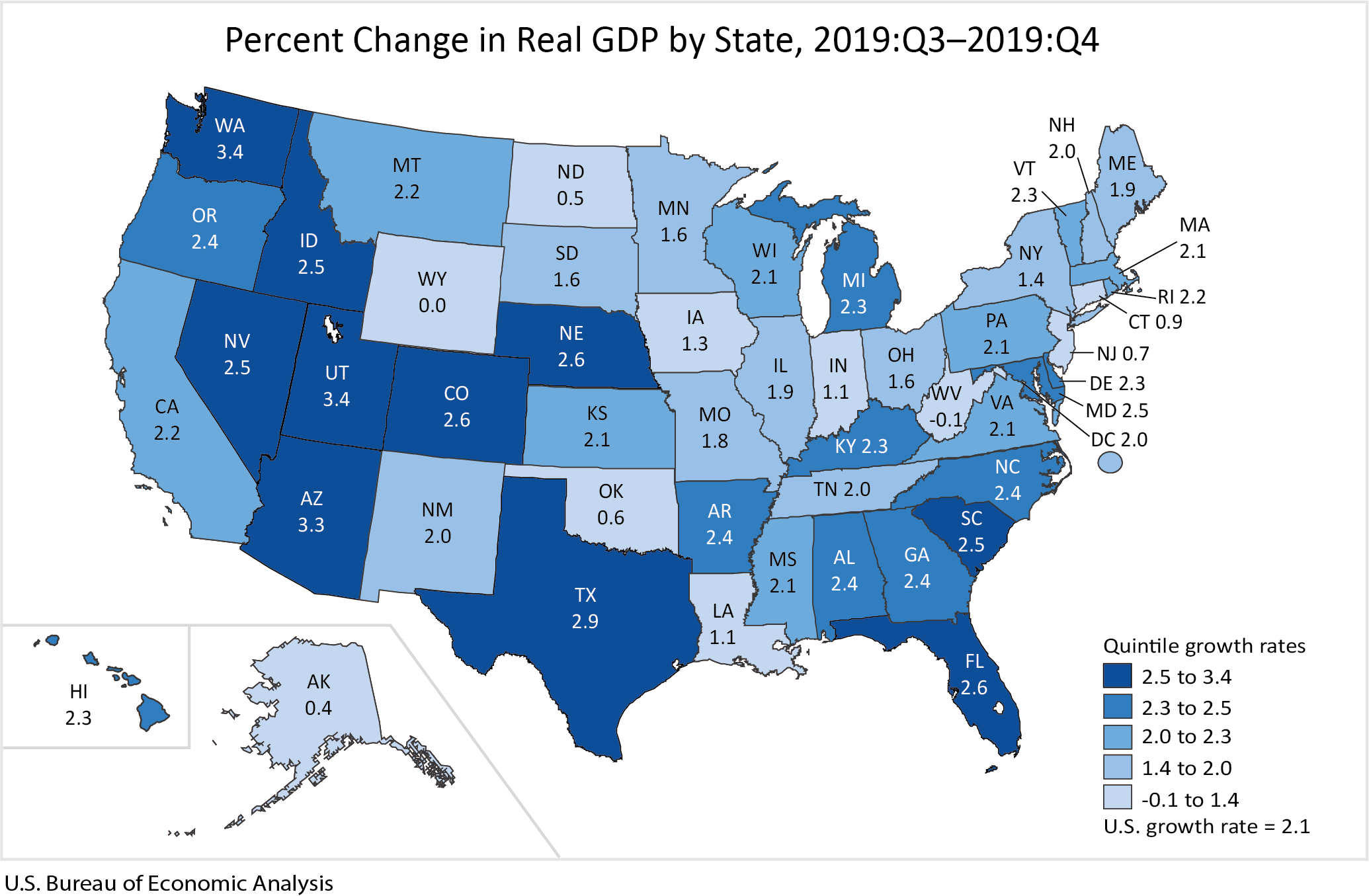
Retail trade; finance and insurance; government; and utilities were the leading contributors to the increase in real GDP nationally (table 2). Retail trade was the leading contributor to the increase in real GDP in Washington, the fastest growing state.
Other highlights
- Retail trade increased 7.4 percent nationally and contributed to growth in all 50 states and the District of Columbia (GDP by Industry table 1).
- Finance and insurance increased 5.1 percent nationally and contributed to growth in all 50 states and the District of Columbia. This industry was the leading contributor to growth in Arizona, the third fastest growing state.
- Government increased 2.7 percent nationally and contributed to growth in 49 states and the District of Columbia. This industry was the leading contributor to growth in Utah, the second fastest growing state.
- Utilities increased 23.3 percent nationally and contributed to growth in all 50 states and the District of Columbia.
Real GDP increased in all 50 states and the District of Columbia in 2019. The percent change in real GDP ranged from 4.4 percent in Texas to 0.6 percent in Nebraska (table 4).
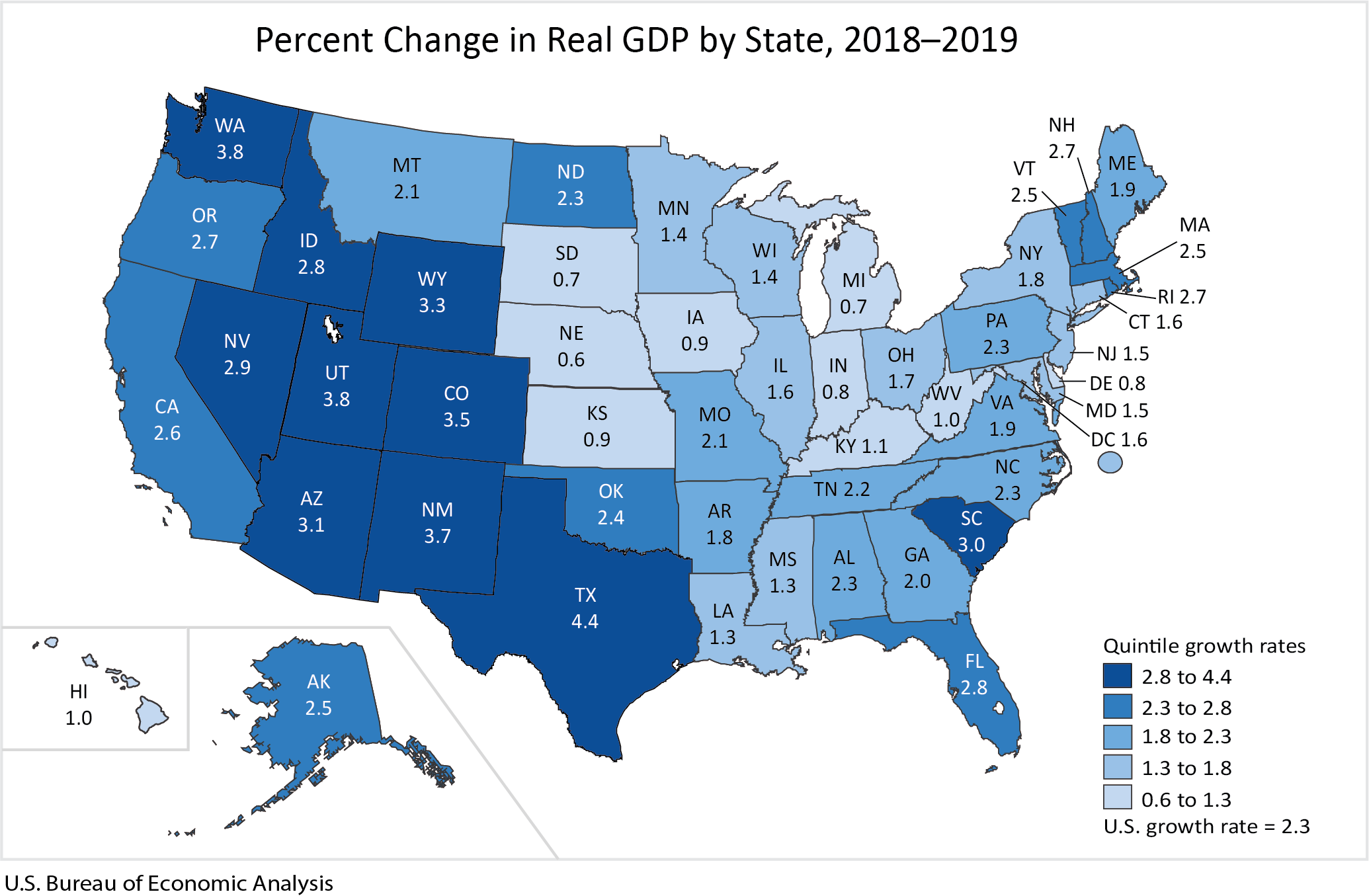
Professional, scientific, and technical services; finance and insurance; and information services were the leading contributors to the increase in real GDP nationally. Mining was the leading contributor to the increase in real GDP in Texas, the fastest growing state (table 5).
Other highlights
- Professional, scientific, and technical services contributed to growth in 48 states and the District of Columbia. This industry was also the leading contributor to growth in Utah, the third fastest growing state.
- Finance and insurance contributed to growth in 49 states and the District of Columbia.
- Information services contributed to growth in 48 states and the District of Columbia. This industry was the leading contributor to growth in Washington, the second fastest growing state.
CONSUMER CREDIT
FED. April 7, 2020. Consumer Credit
Notes about the Data
Starting with the April 2020 G.19 Consumer Credit statistical release, scheduled to be published on June 5, 2020, the release will no longer report the levels and flows of on-book loan balances and off-book securitized loan balances as separate line items. Instead, the release will report aggregate balances of total owned and managed receivables--the sum of on-book and off-book loan balances--for each sector. For more information, please see the announcement posted on March 6, 2020.
February 2020
In February, consumer credit increased at a seasonally adjusted annual rate of 6-1/2 percent. Revolving credit increased at a 4-1/2 percent annual rate, while nonrevolving credit increased at a 7 percent annual rate.
FULL DOCUMENT: https://www.federalreserve.gov/releases/g19/current/g19.pdf
________________
ECONOMIA BRASILEIRA / BRAZIL ECONOMICS
RELAÇÕES EXTERIORES
PR. 06/04/2020. RELAÇÕES EXTERIORES. Em cerimônia com o presidente da República, embaixadores recém-nomeados apresentam cartas credenciais. Jair Bolsonaro recebeu individualmente cada uma das sete comitivas. Cerimônia de apresentação de cartas credenciais de Embaixadores Estrangeiros ao Senhor Presidente da República
Nesta segunda-feira (6), o presidente da República, Jair Bolsonaro, recebeu, no Palácio do Planalto, em Brasília (DF), os recém-nomeados embaixadores na cerimônia de entrega de cartas credenciais.
O presidente recebeu cada um das sete comitivas individualmente e falou rapidamente de pautas de interesse dos países e deu as boas-vindas.
Na cerimônia realizada na sala de audiência do Palácio do Planalto, estiveram novos os embaixadores: da República Árabe do Egito; da República da Croácia, da República Italiana; da República de Honduras; da República da Polônia; da República Islâmica do Irã e dos Estados Unidos da América.

Carta Credencial
A carta credencial é uma carta formal enviada de um Chefe de Estado para outro, que formaliza o envio de um embaixador do país de origem ao país de acolhimento.
Os novos embaixadores são:
- Senhor Wael Ahmed Kamal Aboul Magd, Embaixador da República Árabe do Egito;
- Senhor Ranko Vilovic, Embaixador da República da Croácia;
- Senhor Francesco Azzarelo, Embaixador da República Italiana;
- Senhor Jorge Alberto Mila Reyes, Embaixador da República de Honduras;
- Senhor Jakub Tadeusz Skiba, Embaixador da República da Polônia;
- Senhor Hossein Gharibi, Embaixador da República Islâmica do Irã;
- Senhor Todd Crawford Chapman, Embaixador dos Estados Unidos da América.
CORONAVÍRUS
BACEN. 6 de abril de 2020. Pequenas e médias empresas terão acesso a financiamento emergencial de folha de pagamento por dois meses. Programa Emergencial de Suporte a Empregos vai oferecer crédito de R$40 bi e pode beneficiar até 12,2 milhões de trabalhadores em 1,4 milhão de pequenas e médias empresas.
Empresas com faturamento entre R$ 360 mil e R$ 10 milhões ao ano, as chamadas pequenas e médias empresas, terão acesso, por dois meses, a uma linha emergencial de financiamento de folha de pagamento. O valor total do crédito é de R$ 40 bilhões, sendo R$ 20 bilhões por mês, dos quais 85% provenientes do Tesouro Nacional e o restante das instituições financeiras participantes. A empresa que participar não poderá demitir trabalhadores durante o período que vai da contratação do crédito ao 60º dia após a empresa receber a última parcela. A medida tem o potencial de atingir até 12,2 milhões de empregados em 1,4 milhão de empresas.
O valor financiado por trabalhador será de até dois salários mínimos. O recurso do financiamento irá direto para a conta do trabalhador, como é feito hoje por meio das folhas de pagamento operadas pelas instituições financeiras. A empresa é responsável pela dívida. A medida prevê crédito extraordinário de R$ 34 bilhões a ser aportado no BNDES, que vai operacionalizar o programa. Os outros R$ 6 bilhões virão das instituições financeiras. Caberá ao Banco Central (BC) fiscalizar o cumprimento, pelas instituições financeiras participantes, das condições estabelecidas para as operações de crédito realizadas no âmbito do Programa.
“São operações com zero de spread. Ou seja, vai ser repassado exatamente com a taxa de juros (Selic), que é de 3,75% ao ano. Vale lembrar que pequenas e médias empresas, em geral, têm uma taxa de captação acima de 20%. Estamos falando de 3,75% ao ano, com 6 meses de carência e 30 meses para o pagamento, totalizando um prazo de 36 meses”, detalhou o presidente do BC, Roberto Campos Neto (foto).
Para assegurar a destinação dos recursos e o cumprimento dos objetivos do programa, empresas e sociedades beneficiárias deverão ter as respectivas folhas de pagamento processadas pelas instituições financeiras participantes, além de se comprometerem a prestar informações verídicas e a não utilizar os recursos para finalidades distintas do pagamento de seus empregados. Os recursos tomados serão depositados diretamente nas contas dos funcionário.
FGV. 06/04/2020. FGV - Impactos do COVID-19. Como mitigar a crise e as medidas do Banco Central
Desde o início da pandemia do coronavírus no Brasil, o Banco Central tem tomado diversas medidas para minimizar a crise na economia. Como emprestar dinheiro para os bancos para poderem comprar ativos, mitigando o impacto nas empresas e diminuindo os efeitos negativos do colapso econômico que se instala no país. Assista agora no FGV - Impactos do COVID-19.

FGV. 07/04/2020. FGV - Impactos do COVID-19. A importância da inteligência emocional no trabalho em tempos de crise

Empatia, habilidade nos relacionamentos e aceitação das diferenças são algumas das características fundamentais de inteligência emocional. Principalmente em tempos de crise global, como no caso da pandemia. Para falar sobre o comportamento no trabalho e como lidar com as emoções nesse período de confinamento, André Barcaui, Coordenador do MBA em Gerenciamento de Projetos da FGV Educação Executiva RJ, nos dá algumas dicas. Assista agora no FGV - Impactos do COVID-19.
VÍDEO: https://www.youtube.com/watch?v=ck_RCGEh180&feature=youtu.be
BACEN. 7 de abril de 2020. Boletim Conexão Real. Linha especial de liquidez ajuda a manutenção do normal funcionamento do mercado de crédito. BC vai passar a conceder empréstimos a instituições financeiras mediante a emissão de Letra Financeira Garantida.
Como medida de combate aos efeitos do coronavírus (Covid-19) na economia, as instituições financeiras ganharam mais uma opção de liquidez. Trata-se da Linha Temporária Especial de Liquidez (LTEL) baseada em Letras Financeiras Garantidas (LFG). Ao emitir essas letras, os bancos poderão tomar recursos emprestados no Banco Central (BC) em troca de garantias das suas carteiras de crédito.
“Temos visto aumento na demanda por liquidez das famílias e das empresas”, explica Bruno Serra, diretor de Política Monetária do BC. “É mais uma forma de fomentar a continuidade do normal funcionamento do mercado de crédito.”
A garantia deve ser cedida ao BC em registradora ou depositária central, aumentando a segurança para o BC
↓
BC avalia o valor das garantias e o montante disponibilizado para a instituição financeira
↓
Banco emite a letra financeira
↓
Coberto pela garantia, o BC empresta recursos para o banco, à taxa de Selic + 0,60% ao ano
O empréstimo será concedido por meio de liberações mensais de recursos (tranches): a primeira de até 50% do Patrimônio de Referência (PR) da instituição financeira, podendo chegar até 100% do PR até o fim do ano.
A partir de 13 de abril, as instituições financeiras poderão iniciar o processo de constituição das garantias e documentação, para, no dia 20, solicitar os empréstimos, que têm a previsão de serem liberados em até 2 dias úteis. As operações terão prazo de, no mínimo, 30 e, no máximo, 359 dias corridos.
Garantias
Para ter acesso ao recurso, o banco deve fornecer itens da sua carteira de crédito. Só serão aceitos ativos com boa avaliação de risco (AA, A e B). Em caso de inadimplência o BC poderá executar, total ou parcialmente, a alienação dos ativos financeiros ou valores mobiliários garantidores.
A garantia deve ter valor superior ao do empréstimo, de forma proporcional ao risco das operações de crédito ofertadas em garantia. Estima-se que a elegibilidade de créditos para a operação seja da ordem de R$650 bilhões.
A adoção de linhas especiais de liquidez por bancos centrais tendo como lastro operações de crédito tem sido instrumento amplamente anunciado e utilizado pelos principais BCs do mundo como uma das respostas à crise.
Legislação
A autorização para a emissão de LFG veio por meio da Resolução 4.795/2020, do Conselho Monetário Nacional (CMN). O BC regulamentou o procedimento na Circular 3.996/2020.
MERCADO DE TRABALHO
FGV. IBRE. 07/04/20. Sondagens e Índices de Confiança. IAEmp e ICD. Mercado de Trabalho: ICD avança e sinaliza ritmo forte da taxa de desemprego
Indicador Antecedente de Emprego
O Indicador Antecedente de Emprego (IAEmp) da Fundação Getulio Vargas caiu 9,4 pontos em março para 82,6 pontos, menor nível desde junho de 2016 (82,2 pontos). Apesar da queda, o resultado trimestral é 1,0 ponto superior ao trimestre anterior. Em médias móveis trimestrais, o indicador interrompe trajetória positiva ao recuar 2,4 pontos em relação a fevereiro.
“O resultado de março mostra os primeiros efeitos da pandemia de coronavírus na perspectiva sobre o mercado de trabalho. Essa foi a segunda maior queda da série histórica, ficando atrás apenas da ocorrida na crise de 2008-09. O cenário negativo deve persistir nos próximos meses, considerando o crescente aumento de incerteza no país”, afirma Rodolpho Tobler, economista da FGV IBRE.
Indicador Coincidente de Desemprego
O Indicador Coincidente de Desemprego (ICD) subiu 0,6 ponto em março, para 92,5 pontos. O ICD é um indicador com sinal semelhante ao da taxa de desemprego, ou seja, quanto maior o número, pior o resultado. Em médias móveis trimestrais, mantém-se tendência decrescente, ao recuar 0,9 ponto.
“O ICD registrou um aumento tímido após três meses de resultados positivos. Os efeitos do coronavírus ainda não geraram impacto significativo nos consumidores em março, considerando que as medidas de isolamento foram tomadas a partir do dia 15. Contudo, é possível supor uma piora do indicador nos próximos meses, à medida que for ficando mais claro os impactos na economia”, continua Rodolpho Tobler.
Destaques do IAEmp e ICD
Todos os sete componentes do IAEmp, recuaram em março, com cinco dos sete indicadores recuando pelo menos em 7,0 pontos. O destaque do mês é para o indicador de mede as expectativas para os próximos seis meses e o indicador que mede a situação corrente dos negócios, ambos no setor de Serviços, que recuaram 24,0 e 15,0 pontos, na margem, respectivamente.
No mesmo período, o aumento do ICD foi influenciado por três das quatro classes de renda familiar. A maior contribuição para o resultado do ICD foi dada pela classe familiar com renda entre R$ 2.100 e R$ 4.800, cujo Emprego Local Atual (invertido) variou negativamente em 4,6 pontos na margem.
DOCUMENTO: https://portalibre.fgv.br/navegacao-superior/noticias/mercado-de-trabalho-icd-avanca-e-sinaliza-ritmo-forte-da-taxa-de-desemprego-1.htm
AVIAÇÃO / AVIATION
IATA. 7 April 2020. 25 Million Jobs at Risk with Airline Shutdown
Geneva -The International Air Transport Association has released new analysis showing that some 25 million jobs are at risk of disappearing with plummeting demand for air travel amid the COVID-19 crisis.
Globally, the livelihoods of some 65.5 million people are dependent on the aviation industry, including sectors such as travel and tourism. Among these are 2.7 million airlines jobs. In a scenario of severe travel restrictions lasting for three months, IATA research calculates that 25 million jobs in aviation and related sectors are endangered across the world:
- 11.2 million jobs in Asia-Pacific
- 5.6 million jobs in Europe
- 2.9 million jobs in Latin America
- 2.0 million jobs in North America
- 2.0 million jobs in Africa
- 0.9 million jobs in the Middle East
Airlines are calling on governments to provide immediate financial aid to help airlines to remain viable businesses able to lead the recovery when the pandemic is contained. Specifically, IATA calls for:
- Direct financial support
- Loans, loan guarantees and support for the corporate bond market
- Tax relief
Looking Ahead: Re-booting the Industry
Alongside vital financial relief, the industry will also need careful planning and coordination to ensure that airlines are ready when the pandemic is contained.
“We have never shuttered the industry on this scale before. Consequently, we have no experience in starting it up. It will be complicated. At the practical level, we will need contingencies for licenses and certifications that have expired. We will have to adapt operations and processes to avoid reinfections via imported cases. And we must find a predictable and efficient approach to managing travel restrictions which need to be lifted before we can get back to work. These are just some of the major tasks that are ahead of us. And to be successful, industry and government must be aligned and working together,” said de Juniac.
IATA is scoping a comprehensive approach to re-booting the industry when governments and public health authorities allow. A multi-stakeholder approach will be essential. One initial step is a series of virtual meetings—or summits—on a regional basis, bringing together governments and industry stakeholders. The main objectives will be:
- Understanding what is needed to re-open closed borders, and
- Agreeing solutions that can be operationalized and scaled efficiently
INFLAÇÃO
FGV. IBRE. 07/04/20. Índices Gerais de Preços. IPC-3i. IPC-3i avança no primeiro trimestre de 2020
O Índice de Preços ao Consumidor da Terceira Idade (IPC-3i), que mede a variação da cesta de consumo de famílias majoritariamente compostas por indivíduos com mais de 60 anos de idade, registrou no primeiro trimestre de 2020, variação de 0,88%. Em 12 meses, o IPC-3i acumula alta de 3,55%. Com este resultado, a variação do indicador ficou acima da taxa acumulada pelo IPC-BR, que foi de 3,44%, no mesmo período.
Na passagem do quarto trimestre de 2019 para o primeiro trimestre de 2020, a taxa do IPC-3i registrou decréscimo de 0,31 ponto percentual, passando de 1,19% para 0,88%. Cinco das oito classes de despesa componentes do índice registraram decréscimo em suas taxas de variação. A principal contribuição partiu do grupo Transportes, cuja taxa passou de 2,47% para 0,42%. O item que mais influenciou o comportamento desta classe de despesa foi gasolina, que variou de -1,66 no primeiro trimestre, ante 5,69%, no anterior.
Contribuíram também para o decréscimo da taxa do IPC-3i os grupos: Despesas Diversas (6,73% para 0,38%), Alimentação (3,11% para 2,61%), Educação, Leitura e Recreação (1,29% para -0,42%) e Vestuário (0,80% para -0,17%). Nestas classes de despesa, vale destacar o comportamento dos itens: jogo lotérico (39,04% para 0,00%), carnes bovinas (26,03% para -5,87%), passagem aérea (11,93% para -12,62%) e roupas (1,07% para -0,53%).
Em contrapartida, os grupos Habitação (-0,66% para 0,25%), Saúde e Cuidados Pessoais (0,89% para 1,13%) e Comunicação (0,11% para 0,43%) apresentaram avanço em suas taxas de variação. Nestas classes de despesa, vale citar os itens: tarifa de eletricidade residencial (-6,05% para -1,28%), medicamentos em geral (-0,42% para 0,25%) e mensalidade para TV por assinatura (-0,48% para 1,56%).
DOCUMENTO: https://portalibre.fgv.br/navegacao-superior/noticias/ipc-3i-avanca-no-primeiro-trimestre-de-2020.htm
POUPANÇA
BACEN. 06 Abril 2020. BC divulga o Relatório de Poupança de março de 2020.
DOCUMENTO: https://www.bcb.gov.br/detalhenoticia/17036/nota
BACEN. REUTERS. 6 DE ABRIL DE 2020. Poupança tem entrada líquida recorde em março, de R$12,169 bi, diz BC
BRASÍLIA (Reuters) - A caderneta de poupança registrou entrada líquida de 12,169 bilhões de reais em março, recorde histórico para o mês na série histórica do Banco Central iniciada em 1995, se consolidando como porto para investidores num mês marcado por forte derretimento nos mercados por conta do coronavírus.
Segundo dados divulgados pelo Banco Central nesta segunda-feira, os depósitos superaram os saques em 8,249 bilhões de reais no Sistema Brasileiro de Poupança e Empréstimo (SBPE). Na poupança rural, o ingresso líquido foi de 3,920 bilhões de reais.
No primeiro trimestre deste ano, houve saída líquida de 3,759 bilhões de reais da poupança, bem abaixo dos 13,400 bilhões de reais retirados em igual período do ano passado.
O movimento de fortes depósitos em março ocorreu a despeito do baixo rendimento da aplicação. Por lei, toda vez que a Selic for igual ou inferior a 8,5%, a remuneração da poupança passa a ser de 70% da Selic acrescida da Taxa Referencial (TR), que atualmente está zerada.
Com a taxa básica de juros em 3,75% ao ano, a remuneração da poupança fica em 2,625% em 12 meses.
Por Marcela Ayres
COMÉRCIO VAREJISTA
IBGE. 07/04/2020. Em fevereiro, vendas no varejo crescem 1,2%
Em fevereiro de 2020, o comércio varejista nacional cresceu (1,2%) frente a janeiro, na série com ajuste sazonal, após queda de 1,4% em janeiro. A média móvel trimestral foi de -0,2% no trimestre encerrado em fevereiro. Na série sem ajuste sazonal, houve aumento de 4,7% na comparação com fevereiro de 2019. No acumulado no ano, contra igual período do ano anterior, o avanço foi de 3,0%. Já o acumulado nos últimos 12 meses foi de 1,9%
| Período | Varejo | Varejo Ampliado | ||
|---|---|---|---|---|
| Volume de vendas | Receita nominal | Volume de vendas | Receita nominal | |
| Fevereiro / Janeiro* | 1,2 | 1,0 | 0,7 | 0,9 |
| Média móvel trimestral* | -0,2 | 0,3 | 0,2 | 0,6 |
| Fevereiro 2020 / Fevereiro 2019 | 4,7 | 8,7 | 3,3 | 6,5 |
| Acumulado 2020 | 3,0 | 7,2 | 3,4 | 6,5 |
| Acumulado 12 meses | 1,9 | 5,1 | 3,6 | 6,1 |
| Fonte: IBGE, Diretoria de Pesquisas, Coordenação de Indústria *Série COM ajuste sazonal | ||||
No comércio varejista ampliado, que inclui veículos, motos, partes e peças e de Material de construção, o volume de vendas aumentou 0,7% em relação a janeiro, segundo mês consecutivo de variação positiva, contribuindo para que a média móvel do trimestre encerrado em fevereiro ficasse positiva: 0,2%, revertendo o recuo do trimestre encerrado em janeiro (-0,2).
Com o ganho de ritmo observado entre janeiro e fevereiro de 2020 (1,2%), o varejo nacional compensa parte da queda acumulada nos últimos dois meses e está 4,5% abaixo do ponto mais alto da série, atingido em outubro de 2014.
Considerando o varejo ampliado, a distância atual para o ponto mais alto da série, alcançado em agosto de 2012, é de 7,2%.
Cinco das oito atividades pesquisadas tiveram avanços
Na série com ajuste sazonal, o avanço de 1,2% no volume de vendas de janeiro para fevereiro foi resultado do avanço nas vendas em cinco atividades das oito pesquisadas. Os destaques positivos foram Móveis e eletrodomésticos (1,6%); Tecidos, vestuário e calçados (1,6%); Outros artigos de uso pessoal e doméstico (1,5%); Hipermercados, supermercados, produtos alimentícios, bebidas e fumo (1,5%) e Artigos farmacêuticos, médicos, ortopédicos, de perfumaria e cosméticos (0,6%).
Por outro lado, pressionaram negativamente o resultado de fevereiro os Livros, jornais, revistas e papelaria (-3,8%), os Equipamentos e material para escritório, informática e comunicação (-1,1%) e os Combustíveis e lubrificantes (-0,6%).
No comércio varejista ampliado, o volume de vendas cresceu 0,7% entre janeiro e fevereiro, na série com ajuste sazonal. Nessa comparação, os setores de Veículos, motos, partes e peças (0,9%) e Material de construção (0,1%) tiveram variação positiva, sendo que o primeiro havia crescido 8,5% e o segundo, recuado -0,1% no mês anterior.
Em relação a fevereiro de 2019, o comércio varejista cresceu 4,7%, com a predominância de taxas positivas atingindo seis das oito atividades pesquisadas, mesmo tendo fevereiro de 2020 (18 dias) dois dias úteis a menos que fevereiro de 2019 (20 dias). Entre as atividades com crescimento, destacaram-se Hipermercados, supermercados, produtos alimentícios, bebidas e fumo (4,1%); Móveis e eletrodomésticos (11,7%); Outros artigos de uso pessoal e doméstico (8,7%) e Artigos farmacêuticos, médicos, ortopédicos, de perfumaria e cosméticos (7,9%). Também registraram taxas positivas os Tecidos, vestuário e calçados (1,0%) e os Combustíveis e lubrificantes (0,2%).
Já as atividades de Equipamentos e material para escritório, informática e comunicação (-13,3%) e Livros, jornais, revistas e papelaria (-7,8%) tiveram resultados negativos.
Com avanço de 3,3% frente a fevereiro de 2019, o comércio varejista ampliado registrou décima primeira taxa positiva consecutiva, com o segmento de Veículos, motos, partes e peças mostrando avanço de 1,1%, enquanto o setor de Material de construção recuou 2,0%.
| BRASIL - INDICADORES DO VOLUME DE VENDAS DO COMÉRCIO VAREJISTA E COMÉRCIO VAREJISTA AMPLIADO, SEGUNDO GRUPOS DE ATIVIDADES: Fevereiro 2020 | ||||||||
|---|---|---|---|---|---|---|---|---|
| ATIVIDADES | MÊS/MÊS ANTERIOR (1) | MÊS/IGUAL MÊS DO ANO ANTERIOR | ACUMULADO | |||||
| Taxa de Variação (%) | Taxa de Variação (%) | Taxa de Variação (%) | ||||||
| DEZ | JAN | FEV | DEZ | JAN | FEV | NO ANO | 12 MESES | |
| COMÉRCIO VAREJISTA (2) | -0,3 | -1,4 | 1,2 | 2,6 | 1,4 | 4,7 | 3,0 | 1,9 |
| 1 - Combustíveis e lubrificantes | -0,5 | 0,0 | -0,6 | -1,0 | -0,6 | 0,2 | -0,2 | 0,2 |
| 2 - Hiper, supermercados, prods. alimentícios, bebidas e fumo | -1,4 | -1,8 | 1,5 | -3,0 | -2,7 | 4,1 | 0,6 | 0,2 |
| 2.1 - Super e hipermercados | -1,4 | -0,7 | 0,7 | -3,1 | -3,0 | 4,2 | 0,5 | 0,3 |
| 3 - Tecidos, vest. e calçados | -1,0 | 0,5 | 1,6 | -0,1 | 2,6 | 1,0 | 1,8 | -0,1 |
| 4 - Móveis e eletrodomésticos | 2,9 | -1,5 | 1,6 | 18,6 | 11,0 | 11,7 | 11,4 | 5,5 |
| 4.1 - Móveis | - | - | - | 14,2 | 9,8 | 8,2 | 9,1 | 6,9 |
| 4.2 - Eletrodomésticos | - | - | - | 20,6 | 11,8 | 12,0 | 11,9 | 4,9 |
| 5 - Artigos farmaceuticos, med., ortop. e de perfumaria | -2,3 | 0,2 | 0,6 | 7,0 | 7,1 | 7,9 | 7,5 | 6,6 |
| 6 - Livros, jornais, rev. e papelaria | 10,9 | -0,2 | -3,8 | 1,8 | 3,6 | -7,8 | -1,5 | -14,8 |
| 7 - Equip. e mat. para escritório, informatica e comunicação | -10,5 | -1,6 | -1,1 | 1,6 | -6,7 | -13,3 | -10,1 | -1,8 |
| 8 - Outros arts. de uso pessoal e doméstico | 0,0 | -0,1 | 1,5 | 13,1 | 7,6 | 8,7 | 8,1 | 6,1 |
| COMÉRCIO VAREJISTA AMPLIADO (3) | -0,8 | 0,6 | 0,7 | 4,1 | 3,5 | 3,3 | 3,4 | 3,6 |
| 9 - Veículos e motos, partes e peças | -5,3 | 8,7 | 0,9 | 9,8 | 9,9 | 1,1 | 5,6 | 8,7 |
| 10- Material de construção | -1,2 | -0,2 | 0,1 | 4,9 | 2,3 | -2,0 | 0,3 | 3,4 |
| Fonte: IBGE, Diretoria de Pesquisas, Coordenação de Serviços e Comércio. (1) Séries com ajuste sazonal. (2) O indicador do comércio varejista é composto pelos resultados das atividades numeradas de 1 a 8. (3) O indicador do comércio varejista ampliado é composto pelos resultados das atividades numeradas de 1 a 10 | ||||||||
Principais atividades
Hipermercados, supermercados, produtos alimentícios, bebidas e fumo exerceram o maior impacto positivo na formação da taxa global do varejo. Com aumento de 4,1% frente a fevereiro de 2019, a atividade inverte movimento registrado nos dois meses anteriores. No primeiro bimestre de 2020, esse segmento acumulou aumento de 0,6% frente a igual bimestre de 2019. No acumulado nos últimos doze meses, o setor volta a registrar aceleração na intensidade de crescimento (0,2%) após seis meses perdendo ritmo.
Móveis e eletrodomésticos foi o segmento que exerceu o segundo maior impacto positivo no indicador do varejo, após alcançar o sexto mês consecutivo de crescimento: 11,7% de aumento no volume de vendas em relação a fevereiro de 2019. No primeiro bimestre de 2020, acumula 11,4% de alta, em comparação a igual bimestre do ano anterior. O setor registra o quarto bimestre consecutivo de variações positivas, sendo a segunda taxa a dois dígitos (no 4º bimestre de 2019 o valor foi 11,7%). Em doze meses, acumula 5,5%.
Outros artigos de uso pessoal e doméstico, que engloba lojas de departamentos, óticas, joalherias, artigos esportivos, brinquedos, entre outros, cresceu 8,7% em relação a fevereiro de 2019, mostrando ganho de ritmo em relação ao resultado de janeiro (7,6%). No primeiro bimestre de 2020, houve alta de 8,1% frente a igual período de 2019. O acumulado de doze meses, 6,1%, monstra estabilidade perante a dezembro (6,1%) e janeiro (6,2%).
Artigos farmacêuticos, médicos, ortopédicos e de perfumaria, com alta de 7,9% frente a fevereiro de 2019, registrou a trigésima quarta variação positiva consecutiva nessa comparação, representando a série mais longa de crescimento entre todos os setores pesquisados desde 2017. No primeiro bimestre do ano, acumulou variação de 7,5% em relação ao mesmo período de 2019. Nos últimos doze meses, acumulou aumento de 6,8%.
Tecidos, vestuário e calçados, com aumento de 1,0% em relação a fevereiro de 2019, mostrou o segundo mês consecutivo de taxas positivas. O acumulado para o primeiro bimestre do ano ficou em 1,8%. No entanto, o indicador acumulado nos últimos doze meses, ao passar de 0,4% até janeiro para -0,1% em fevereiro, mostra redução de ritmo.
Combustíveis e lubrificantes mostrou variação positiva de 0,2% no volume de vendas em relação a fevereiro de 2019, interrompendo dois meses seguidos de queda. O acumulado no primeiro bimestre de 2020 foi de -0,2% e o nos últimos doze meses foi de 0,2%.
Equipamentos e material para escritório, informática e comunicação, em relação a igual mês de 2019, registrou recuo de 13,3%, em seu segundo mês consecutivo de queda. O setor foi o único a influenciar negativamente o indicador do varejo. O acumulado do ano para a atividade foi de -10,1%, o primeiro bimestre negativo desde julho-agosto de 2019, e o acumulado nos últimos doze meses de -1,8%, invertendo a trajetória, para essa comparação, que vinha sendo observada desde novembro de 2019.
Livros, jornais, revistas e papelaria apresentou recuo no volume de vendas de 7,8% frente a fevereiro de 2019, após dois meses de crescimento. Com isso, o segmento volta a apresentar comportamento de retração registrado até novembro de 2019. Ainda assim, na comparação com o primeiro bimestre do ano passado, a perda do setor foi de 1,5%, a menos intensa desde o terceiro bimestre de 2017. Nos últimos doze meses, o segmento acumula recuo de 14,8%, permanecendo negativo desde março de 2014 (-0,2%).
Varejo ampliado
Veículos, motos, partes e peças registrou aumento de 1,1% em relação a fevereiro de 2019, assinalando a décima primeira taxa positiva seguida. No primeiro bimestre, o setor acumulou avanço de 5,6% e, nos últimos doze meses, de 8,7%, mostrando perda de ritmo em relação a janeiro (10,1%), interrompendo uma trajetória de estabilidade que vinha sendo registrada desde novembro de 2019 com variações de até 0,2 p.p.
Material de Construção, com queda de -2,0% em relação a fevereiro de 2019, interrompe sequência de cinco meses de crescimento consecutivos. No acumulado do ano, a taxa foi de 0,3%. O indicador acumulado nos últimos doze meses, ao passar de 4,2% em janeiro para 3,4% em fevereiro, mostrou perda de ritmo voltando ao patamar de outubro (3,5%).
Vendas do comércio crescem em 21 das 27 Unidades da Federação
Na passagem de janeiro para fevereiro de 2020, na série com ajuste sazonal, a taxa média nacional de vendas do comércio varejista mostrou crescimento (1,2%) com predomínio de resultados positivos atingindo 21 das 27 Unidades da Federação. Nesse sentido, destacaram-se Tocantins (15,1%), Amazonas (3,5%) e Minas Gerais (2,7%). Já os principais destaques negativos ficaram por conta do Amapá (-3,8%), do Ceará (-1,7%) e de Rondônia (-0,5%). A Bahia registrou estabilidade (0,0%).
No comércio varejista ampliado, houve resultados positivos em 17 das 27 Unidades da Federação, com destaque para: Mato Grosso (5,6%), Tocantins (5,1%) e Minas Gerais (2,8%). Por outro lado, pressionando negativamente, figuram nove das 27 Unidades da Federação, com destaque para: Amapá (-5,9%), Roraima (-2,1%) e Ceará (-1,3%). Distrito Federal apresentou estabilidade nas vendas (0,0%) frente a dezembro de 2019.
Frente a fevereiro de 2019, o volume de vendas do comércio varejista nacional teve resultados positivos em 25 das 27 Unidades da Federação, com destaque para: Amazonas (13,6%), Paraíba (11,8%) e Tocantins (11,8%). Por outro lado, pressionando negativamente, figuram duas das 27 Unidades da Federação: Ceará (-4,5%) e Bahia (-0,7%).
Considerando o comércio varejista ampliado, ainda no confronto com fevereiro de 2019, o crescimento foi acompanhado por 19 das 27 Unidades da Federação, com destaque, em termos de volume de vendas, para Tocantins (9,4%), Amazonas (9,3%) e Roraima (9,1%). Por outro lado, pressionando negativamente, figuram oito dos 27 estados, com destaque para: Rio Grande do Norte (-3,2%), Bahia (-2,5%) e Piauí (-2,4%).
Após queda em janeiro, vendas no varejo crescem 1,2% em fevereiro. Crescimento de 1,5% do setor de hipermercados puxou alta do comércio em fevereiro
As vendas do comércio varejista cresceram 1,2% em fevereiro, na comparação com janeiro, de acordo com a Pesquisa Mensal de Comércio (PMC), divulgada hoje (7), pelo IBGE. É o melhor resultado para o mês de fevereiro desde 2016 (1,6%). Em relação a fevereiro do ano passado, a alta foi de 4,7%. O instituto também revisou a taxa de janeiro de -1% para -1,4%, principalmente, por conta de inclusões de dados primários no setor de combustíveis e lubrificantes.
Já no acumulado do primeiro bimestre de 2020 frente ao igual período de 2019, o varejo avançou 3%. Para o analista da pesquisa Cristiano Santos, o bimestre positivo com ao ano passado é uma continuidade à trajetória de recuperação, com taxa de crescimento em patamares similares aos últimos três bimestres de 2019 (2,8%, 3,3% e 2,8, respectivamente). “Esses números podem estar ligados à expansão do crédito e às quedas de taxas de juros que acontecem desde o segundo semestre do ano passado”, explica.
Dentre as oito atividades pesquisadas, cinco contribuíram para a alta, com destaque para hipermercados, supermercados, produtos alimentícios, bebidas e fumo (1,5%), móveis e eletrodomésticos (1,6%) e artigos farmacêuticos, médicos, ortopédicos, de perfumaria e cosméticos (0,6%). Tecidos, vestuário e calçados (1,6%) e outros artigos de uso pessoal e doméstico (1,5%) foram as outras atividades que apresentaram aumento frente a janeiro.
Já livros, jornais, revistas e papelaria (-3,8%), equipamentos e material para escritório, informática e comunicação (-1,1%) e combustíveis e lubrificantes (-0,6%) tiveram queda em comparação com janeiro, impedindo um crescimento maior.
No âmbito regional, houve predomínio de resultados positivos em 21 das 27 unidades da federação. Tocantins (15,1%), Amazonas (3,5%) e Minas Gerais (2,7%) foram os destaques positivos. Já Amapá (-3,8%) e Ceará (-1,7%) foram os estados que mais mostraram queda nas vendas do comércio varejista.
Para Cristiano, o resultado de fevereiro não apresenta influência da pandemia do novo coronavírus pois ainda não havia um indicativo real de que a doença atingiria seriamente o país. “Não acredito que tenha sido um fator de impacto aparente no aumento de receitas dos supermercados, por exemplo. O preço do dólar e a queda do petróleo contribuem, mas o fator coronavírus só deve começar a ser sentido a partir de março”, acredita.
Com o resultado, o setor está 4,5% abaixo do ponto mais alto, atingido em outubro de 2014. E distante do patamar de novembro de 2019 (-3,9%), o menor desde o pico.
Varejo ampliado volta a crescer e tem aumento de 0,7% em relação a janeiro
Já para comércio varejista ampliado, que contempla veículos e material de construção, o aumento foi de 0,7% em relação a janeiro de 2020, o segundo mês consecutivo de variação positiva. Frente a fevereiro de 2019, o setor avançou 3,3%, décimo primeiro aumento seguido. Assim, o varejo ampliado apresentou crescimento de 3,4% para o primeiro bimestre de 2020.
Na esfera regionalizada, houve predomínio de resultados positivos no comércio varejista ampliado em 17 das 27 unidades da federação, com destaque para Mato Grosso (5,6%), Tocantins (5,1%) e Minas Gerais (2,8%).
DOCUMENTO: https://agenciadenoticias.ibge.gov.br/agencia-sala-de-imprensa/2013-agencia-de-noticias/releases/27317-em-fevereiro-vendas-no-varejo-crescem-1-2
ABRAS. 06/04/2020. SUPERMERCADOS REGISTRAM CRESCIMENTO DE 4,61% EM FEVEREIRO
Os supermercados brasileiros registraram crescimento real de 4,61% em fevereiro na comparação com o mês de janeiro, de acordo com o Índice Nacional de Vendas ABRAS apurado pelo Departamento de Economia e Pesquisa da entidade nacional. O resultado, já deflacionado pelo IPCA/IBGE, foi ainda maior quando comparado a fevereiro do ano anterior, 15,88%. No acumulado anual o setor registra alta de 10,35%.
“O autosserviço iniciou 2020 com um dos maiores resultados dos últimos 9 anos, 5,11%, e em fevereiro continuou bem positivo, registrando 4,61% de crescimento. Desde 2012 que não registrávamos um número tão bom para o mês. Por ser ano bissexto, fevereiro teve um dia a mais, e contou com a composição de cinco sábados. O resultado também foi influenciado pelo Carnaval, que em 2019 foi no início de março”, destaca o presidente da Associação Brasileira de Supermercados (ABRAS), João Sanzovo Neto.
Covid-19
O mês de março foi atípico para o setor supermercadista brasileiro, marcou o início do combate a propagação do coronavírus (covid-19) no país. O crescimento no número de casos da doença e o isolamento social orientado pelo Ministério da Saúde e seguido por governadores de diversos estados impulsionou a população nas compras de abastecimento.
“Recebemos um número de clientes acima da média de 14 a 21 de março. A maioria com o objetivo de estocar comidas para ficar mais tempo em casa. Isso deverá refletir nos resultados do mês, que serão divulgados no Índice Nacional de Vendas de abril. O movimento dos supermercados tem se normalizado, estamos trabalhando para manter as mais de 90 mil lojas funcionando e bem abastecidas. A cadeia produtiva é bastante extensa, desde o produtor até às gôndolas tem muita gente envolvida, e todos estão trabalhando normalmente. A logística segue em pleno funcionamento. Tirando alguns produtos específicos no combate da covid-19, como o álcool gel, o restante tem chegado diariamente nas lojas do setor.”
Abrasmercado
O *Abrasmercado, indicador que analisa os preços dos 35 produtos mais consumidos nos supermercados do país, registrou queda de -0,52% em fevereiro na comparação com janeiro, passando de R$ 511,58 para R$ R$ 508,92. No acumulado dos 12 meses (fevereiro 2019/fevereiro 2020), o valor da cesta cresceu 7,04%.
As maiores quedas nos preços foram registradas nos produtos: carne traseiro (alcatra, filé mignon picanha, coxão mole, patinho, entre outras), -6,45%, batata, -4,49%, pernil, -3,47%, e queijo mussarela, -2,67%. E as maiores variações positivas foram observadas nos itens: biscoito cream cracker, 45,42%, tomate, 21,44%, biscoito maisena, 15,88%, e farinha de mandioca, 9,43%.
Regiões
Em fevereiro, as únicas regiões que apresentaram aumento no valor da cesta abrasmercado foram: Nordeste, 2,16%, que passou de R$ 438,10 registrados em janeiro, para R$ 447,55, e a Norte, 0,13%, que chegou a R$ 550,44 ante R$ 549,72, apurados no mês anterior. A Região Centro-Oeste foi a que apresentou maior variação negativa, -1,48%, chegando ao valor de R$ 480,45.
*A cesta Abrasmercado não é a cesta básica, mas, sim, uma cesta composta por 35 produtos mais consumidos nos supermercados: alimentos, incluindo cerveja e refrigerante, higiene, beleza e limpeza doméstica.
Histórico do indicador Abrasmercado
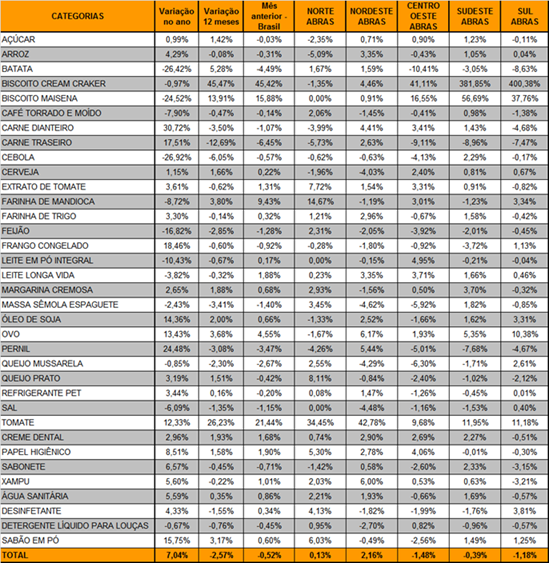
Índice de Confiança do Supermercadista
Os empresários do autosserviço estão menos otimistas em relação aos negócios, de acordo com o Índice de Confiança do Supermercadista, elaborado pela ABRAS em parceria com a GfK. Depois de uma alta, apresentada em dezembro, o indicador voltou a cair. A pesquisa registrou 57,6 pontos (numa escala de 0 a 100) na última avaliação, em fevereiro. Em dezembro, o índice estava em 63,6 pontos. Mesmo assim, o resultado continua positivo, isto é, acima dos 50 pontos, o que sinaliza boa expectativa para o ano. Os principais motivos dessa queda na confiança citados pelos supermercadistas da pesquisa estão a economia com crescimento lento e gradativo, e os impactos do coronavírus (covid-19) no mercado.
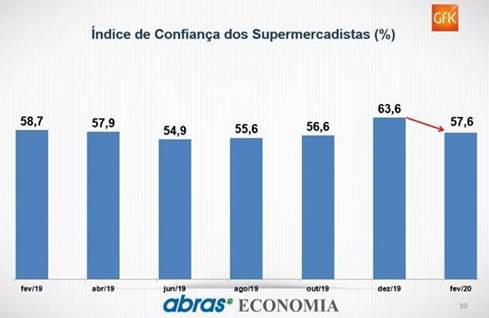
RELATÓRIO: http://static.abras.com.br/pdf/apresentacao-inv-2020-03.pdf
ARRECADAÇÃO
MEconomia. RFB. 06/04/2020. TRIBUTOS. Receita Federal arrecadou R$ 116,4 bilhões em fevereiro deste ano. No acumulado dos dois primeiros meses de 2020, o valor chegou a R$ 291,4 bilhões, acréscimo pelo IPCA de 1,61%
A arrecadação total das Receitas Federais atingiu, em fevereiro de 2020, o valor de R$ 116.430 milhões, registrando decréscimo real (IPCA) de 2,71% em relação a fevereiro de 2019. No período acumulado de janeiro a fevereiro de 2020, a arrecadação alcançou o valor de R$ 291.421 milhões, representando um acréscimo pelo IPCA de 1,61%.
Quanto às Receitas Administradas pela RFB, o valor arrecadado em fevereiro de 2020 foi de R$ 112.141 milhões, representando um decréscimo real (IPCA) de 4,55%, enquanto que no período acumulado de janeiro a fevereiro de 2020, a arrecadação alcançou R$ 276.089 milhões, registrando acréscimo real (IPCA) de 0,74%.
O resultado pode ser explicado, principalmente, pelos fatores não recorrentes, como a arrecadação do IRPJ/CSLL em fevereiro de 2019 e pelos recolhimentos extraordinários em janeiro de 2020. Acesse aqui, discriminados, os principais fatores que concorreram para o resultado do mês e do período acumulado de janeiro a fevereiro de 2020.
INDÚSTRIA
PORTAL G1. 07/04/2020. Consultorias veem queda do PIB industrial em 2020 mesmo com socorro do governo. Medidas precisam chegar logo às empresas para evitar falência generalizada.
Por Paula Salati, G1
As medidas econômicas anunciadas pelo governo federal não vão impedir com que o Produto Interno Bruto (PIB) industrial tenha queda este ano – ainda assim, essas ações precisam chegar com mais agilidade até às empresas e às famílias para evitar uma quebra generalizada dos negócios, afirmam analistas ouvidos pelo G1.
Antes da pandemia, eles esperavam, em média, um crescimento de 2% no PIB industrial este ano. Com a crise paralisando as atividades do país, as projeções foram revisadas para números negativos: as expectativas variam de -1,7% a -4%.
/i.s3.glbimg.com/v1/AUTH_59edd422c0c84a879bd37670ae4f538a/internal_photos/bs/2020/B/a/aWSoiVRGaVpBmMTBo6jQ/gd9ka-proje-es-para-o-pib-industrial-de-2020-caem.png)
Alessandra Ribeiro, economista da Tendências Consultoria, espera uma retração de 2,4% para o PIB industrial neste ano, puxada pela indústria de transformação (-3,3%) e construção civil (-3,9%). "O que salva dentro do PIB industrial é a extrativa (+0,6%) e as atividades industriais de eletricidade, água e esgoto (+0,1%)", diz.
Já o economista da 4E Consultoria, Juan Jensen, prevê queda de 1,7% para o setor e reforça que a indústria de transformação foi a primeira a suspender as atividades durante os dias iniciais da quarentena pelo país. A indústria automotiva, por exemplo, tem 64 das suas 65 fábricas paralisadas.
Para Fábio Silveira, sócio-diretor da MacroSetor, o desempenho das indústrias ligadas à cadeia da agricultura é o que vai impedir uma queda maior do setor. "Os preços do milho e da soja não caíram. E o dólar alto beneficia a receita que virá da exportação", afirma.
Medidas precisam chegar logo às industrias
Muitas medidas econômicas do governo federal para socorrer as empresas já foram anunciadas e algumas já estão vigor. Esse pacote vai desde prorrogação de pagamento de tributos e redução de contribuição, até flexibilização das leis trabalhistas e linha de crédito para pequenas e médias empresas financiarem a folha de pagamentos.
Mas, para o economista-chefe do Estudos para o Desenvolvimento Industrial (IEDI), Rafael Cagnin, elas precisam chegar logo ao setor privado e sem muitas dificuldades, principalmente as linhas de financiamento – que devem dar um "sobrefôlego" de caixa para as indústrias conseguirem sobreviver durante os meses de quarentena. "Do contrário, as medidas vão perder o efeito rapidamente”, diz.
O economista-chefe da Austin Rating, Alex Agostini, ressalta que o reforço de caixa para as indústrias neste momento tem o intuito de evitar uma “quebradeira generalizada” e, assim, facilitar o processo de recuperação da economia após a crise do coronavírus.
“As medidas servem para impedir com que os impactos da pandemia sejam duradouros na economia. Pois, se a gente tem falência e desemprego em uma proporção muito elevada, isso gera um problema na etapa de retomada”, diz Cagnin.
Os empréstimos para as pequenas e médias empresas pagarem folha de salário serão feitos pelos bancos públicos e privados. Porém, nos bancos privados, as empresas serão submetida à análise de crédito, o que, para Agostini, deve dificultar o caminho dos recursos até os pequenos negócios.
“A pequena empresa não tem um bom nível de governança. Não tem um balanço auditado. Vai ser mais difícil para ela conseguir essas linhas. A dinâmica para esse dinheiro chegar nas pequenas vai ser complicada”, diz Agostini.
Renata, do Ibre, diz que a pequena e média indústria representa “um pouco mais de 40%” das empresas das empresas do setor e que se o financiamento conseguir chegar este grupo já será meio caminho andado.
“Essas empresas, geralmente, não têm capital de giro para se manterem durante 3 meses. Se a gente não tivesse nenhum auxílio, poderíamos ver muita empresas fechada”, diz a economista.
Já para Cagnin, o Banco Central "saiu na frente" ao anunciar, logo no início da quarentena, a injeção de R$ 1,2 trilhão no sistema financeiro, mas tem dúvidas se os bancos vão repassar esses recursos às empresas.
"O quadro é tão incerto que há o risco de os bancos segurarem o dinheiro e não repassar ao tomador final. Foi o que aconteceu na crise de 2008. Parte do dinheiro ficou empoçado nas instituições financeiras", diz.
Demanda interna
A queda da demanda interna provocada pela pandemia tem um efeito indireto sobre as indústrias. Com as famílias reduzindo as compras, o faturamento do comércio e dos serviços caem, diminuindo, assim, os pedidos para o setor industrial.
Por isso, as medidas de socorro aos mais vulneráveis, como o auxílio de R$ 600 a informais, são vistas pelos especialistas como necessárias para a sobrevivência da indústria e retomada do setor após à crise da pandemia.
“A propensão da baixa renda em consumir é alta. A baixa renda gasta tudo o que ganha. Quando você interrompe o fluxo de renda dela, tem um impacto forte sobre a demanda”, reforça Cagnin.
“A demanda interna é o que tem garantido o crescimento do PIB. As medidas não vão evitar que a demanda seja ruim este ano. Mas segura um pouco e ajuda na recuperação da economia lá na frente”, diz ela. “Se as empresas, ao final desta crise, verem que não tem demanda, elas não vão ter confiança pra investir.
Indústria já estava em alerta
Segundo a economista do Ibre, a indústria já estava com o sinal de alerta ligado antes de março. “Os índices de expectativas da indústria já tinham caído em fevereiro. Os empresários já estavam com o sinal de alerta ligado e já previam uma queda no nível de produção e da demanda, mas, no mês de março, essa queda se aprofundou. O sinal de alerta virou um sinal de pessimismo”, diz Renata.
O Índice de Confiança da Indústria (ICI) da Fundação Getulio Vargas (FGV) chegou a cair 3,9 pontos em março, para 97,5 pontos, recuando em 14 dos 19 segmentos pesquisados. Foi a maior queda mensal desde março de 2015, quando começou as primeiras manifestações contra a ex-presidente, Dilma Rousseff.
As expectativas do setor recuaram para os próximos três e seis meses. “A indústria está se desfazendo de parte do seu estoque, sem aumentar a produção em face da retração da demanda”, acrescenta.
Com a pandemia do coronavírus paralisando boa parte dos serviços e do comércio pelo país, a demanda por produtos e serviços industriais já recuou para 79% das empresas, segundo um levantamento da Confederação Nacional da Indústria (CNI). Para 57% dessas empresas, a queda foi intensa.
COMÉRCIO EXTERIOR BRASILEIRO
CNI. 07/04/2020. CNI apoia redução do imposto de importação, mas alerta para insegurança jurídica. Governo já editou três resoluções sobre desabastecimento com base em tratado da Aladi, sem amparo na norma do Mercosul, negociada e assinada pelo Brasil. Até o início de abril, o governo reduziu o imposto de importação para produtos médico-hospitalares, devido à pandemia do coronavirus.
A Confederação Nacional da Indústria (CNI) apoia e acompanha com atenção as resoluções da Câmara de Comércio Exterior (CAMEX) para reduzir a zero o imposto de importação para produtos médico-hospitalares, devido à pandemia do coronavirus.
Entre 18 de março e 1º de abril, o governo reduziu as tarifas de 109 produtos (NCMs), entre eles máquinas e instrumentos mecânicos; máquinas, aparelhos e materiais elétricos; e alumínio e instrumentos médico-cirurgicos. A média tarifária passou de 14% para zero.
A CNI considera a medida importante para garantir o abastecimento desses produtos, em um momento de crise. Mas o que chama a atenção é que a mudança tenha sido feita por uma resolução que invoca um tratado da Associação Latino-Americana de Integração (Aladi) e não pelos instrumentos do Mercosul.
“É totalmente compreensível e necessário reduzir os impostos de importação desses produtos neste momento com o objetivo de suprir o mercado de suas necessidades essenciais. No entanto, o Acordo do Mercosul é o instrumento próprio do bloco a ser utilizado, pois foi criado para cuidar especificamente dos interesses do bloco. A melhor forma de reduzir tarifas nesse contexto é pela normativa do Mercosul de desabastecimento", explica o diretor de Desenvolvimento Industrial da CNI, Carlos Abijaodi.
Para Abijaodi, ações dessa natureza são justificáveis por se tratar de um momento de crise, porém, afirma, é importante utilizar sempre as regras do Mercosul para que todos estejam unidos no propósito de atender as demandas regionais nesse período emergencial.
CONTAS PÚBLICAS
MEconomia. STN. REUTERS. 7 DE ABRIL DE 2020. Setor público terá rombo fiscal de até R$500 bi em 2020, diz Mansueto
BRASÍLIA (Reuters) - O secretário do Tesouro, Mansueto Almeida, afirmou nesta terça-feira que o setor público brasileiro caminha para registrar um déficit primário de até 500 bilhões de reais neste ano por causa do impacto da crise do Covid-19.
Ele frisou, em evento virtual promovido pelos jornais O Globo e Valor Econômico, que o déficit é necessário, mas que o país não pode criar despesas desvinculadas da crise.
“O buraco fiscal no ano passado foi em torno de 61 bilhões de reais, este ano a gente está caminhando tranquilamente para algo em torno de 450-500 bilhões de reais”, afirmou Mansueto.
“Este ano isso é necessário, e a gente vai ter que aceitar isso de uma forma adulta. O que a gente não pode deixar, de forma alguma, é que em um período tão grave a gente abra mão e comece a criar despesas que não têm nada relacionado com essa crise econômica e social do coronavírus.”
Mansueto também destacou que o governo precisa pensar “fora da caixinha” para garantir que os recursos dos programas de enfrentamento da crise cheguem aos beneficiários o mais rápido possível.
Por Isabel Versiani
ENERGIA
PETROBRAS. 07/04/2020. Petrobras informa sobre produção de petróleo em abril
A Petrobras informa que aprovou um patamar de produção de petróleo no Brasil para o mês de abril de 2,07 milhões de barris por dia (bpd). A nova estimativa de produção mensal já inclui as reduções anunciadas em 26/03/2020 e 01/04/2020.
Dessa maneira, haverá um acompanhamento diário da projeção de produção, elevando ou diminuindo as restrições para garantir a produção média do volume de 2,07 milhões bpd em abril.
A companhia segue monitorando o mercado e, em caso de necessidade, realizará novos ajustes, sempre garantindo as condições de segurança para as pessoas, operações e processos.
A Petrobras manterá os mercados informados sobre futuros movimentos.
PETROBRAS. 07/04/2020. Petrobras faz descoberta de óleo na Bacia de Campos

A Petrobras informa que identificou a presença de óleo em poço exploratório do bloco Sudoeste de Tartaruga Verde, localizado na Bacia de Campos.
O poço, denominado informalmente de Natator, está localizado a 130 km da cidade de Macaé (RJ), em profundidade d’água de 1.080 metros, sendo constatada a descoberta de petróleo em reservatórios carbonáticos da seção pós-sal. Os dados do poço serão analisados para melhor direcionar as atividades exploratórias na área e avaliar o potencial da descoberta.
O bloco Sudoeste de Tartaruga Verde, adquirido na 5ª Rodada de Partilha de Produção em setembro de 2018, encontra-se inserido no denominado Polígono do Pré-sal, sob regime de partilha de produção. A Petrobras é operadora do bloco com 100% de participação, tendo a Pré-sal Petróleo S.A. (PPSA) como gestora.
EXXON. REUTERS. 7 DE ABRIL DE 2020. Exxon anuncia corte de 30% em investimentos devido ao coronavírus
HOUSTON (Reuters) - A Exxon Mobil disse nesta terça-feira que irá recuar de planos para acelerar investimentos em “shale”, gás natural liquefeito (GNL) e produção de petróleo em águas profundas, ao anunciar um corte de 30% dos aportes previstos para este ano por impactos do coronavírus sobre a demanda por energia e os preços do petróleo.
Petroleiras têm revisto os planos de investimento e de aumento de produção em média em 20% à medida que países têm limitado viagens aéreas, exigido o fechamento de empresas e pedido que pessoas fiquem em casa para conter a disseminação do vírus.
Os preços do petróleo já cerca de 50% neste ano e a demanda por combustíveis tem recuado acentuadamente.
“Nós nunca vimos nada como isso que estamos experimentando hoje”, disse o presidente da Exxon, Darren Woods, em uma teleconferência com a imprensa nesta terça-feira.
A maior produtora de petróleo dos Estados Unidos, que no mês passado prometeu “significativos” cortes de investimentos, definiu os aportes para 2020 em 23 bilhões de dólares, acrescentando que o valor pode cair mais se necessário.
A Exxon antes previa investir até 33 bilhões de dólares neste ano, após desembolsos de 26 bilhões de dólares no ano passado.
A companhia espera retomar o patamar de entre 30 bilhões e 35 bilhões de dólares nos próximos anos, mas em 2021 pode haver uma redução também, disse Woods.
A redução dos investimentos será mais rápida em “shale” nos EUA, onde a companhia desembolsou 6 bilhões de dólares em 2017 para arrendamentos de perfuração na Bacia de Permian e onde já opera 58 plataformas de perfuração.
O corte de 30% da Exxon é maior que o de rivais como BP, Chevron, Shell e Saudi Aramco, que fizeram reduções de entre 20% e 25%.
Por Jennifer Hiller em Houston e Arathy S Nair em Bangalore
________________
LGCJ.:

