US ECONOMICS
CORONAVIRUS
U.S. Department of State. 04/16/2020. UPDATE: The United States is Continuing to Lead the Humanitarian and Health Assistance Response to COVID-19
Office of the Spokesperson
The U.S. Government is leading the world’s humanitarian and health response to the COVID-19 pandemic even while we battle the virus at home. As part of this comprehensive and generous response from the American people, the U.S. Department of State and the U.S. Agency for International Development (USAID) have now committed nearly $508 million in emergency health, humanitarian, and economic assistance on top of the funding we already provide to multilateral and non-governmental organizations (NGOs) that are helping communities around the world deal with the pandemic. This funding will support critical activities to control the spread of this disease, such as rapid public-health information campaigns, water and sanitation, and preventing and controlling infections in health-care facilities.
Total U.S. government assistance in the global fight against COVID-19 provided to date includes nearly $200 million in emergency health assistance from USAID’s Global Health Emergency Reserve Fund for Contagious Infectious-Disease Outbreaks and Global Health Programs account, nearly $195 million in humanitarian assistance from USAID’s International Disaster Assistance (IDA) account, and $50 million from the Economic Support Funding (ESF), which will help governments and NGOs in more than 100 of the most affected and at-risk countries during this global pandemic. In addition, through the State Department’s Bureau of Population, Refugees, and Migration, which is responsible for the Migration and Refugee Assistance (MRA) account, we now have a country-by-country breakout of the previously announced $64 million in humanitarian assistance for the United Nations Refugee Agency (UNHCR) to address threats posed by the pandemic in existing humanitarian crisis situations for some of the world’s most vulnerable people as part of the UN’s Global Humanitarian Response Plan for COVID-19.
U.S. government departments and agencies are working together to prioritize foreign assistance based on in-country coordination and the potential for impact. With new and previously announced funds, the United States is providing the following specific assistance:
Africa:
- Angola: $570,000 in health assistance is helping provide risk-communications and water and sanitation, and prevent and control infections in key health facilities in Angola. This assistance comes on top of long-term U.S. investments in Angola, which total $1.48 billion over the past 20 years, including $613 million in health assistance.
- Botswana: $1.5 million in health assistance to address the outbreak. This new assistance builds on nearly $1.2 billion in total assistance in Botswana over the last 20 years, $1.1 billion of which was for health.
- Burkina Faso: More than $6 million in health and humanitarian funding will go toward risk-communications, water and sanitation, preventing and controlling infections in health facilities, public-health messaging, and more. This includes $2.5 million in health assistance, $1.5 million in IDA humanitarian assistance, and more than $2.1 million in MRA humanitarian assistance, which will help protect the health of refugees, internally displaced persons, and their host communities in Burkina Faso during the pandemic. Over the past 20 years, the United States has invested more than more than $2.4 billion total in Burkina Faso, $222 million in health alone.
- Cameroon: Nearly $8 million in health and humanitarian assistance will help provide infection-control in key health facilities, strengthen laboratories and surveillance, prepare communities, and bolster local messaging. This includes $6.1 million in health and IDA humanitarian assistance from USAID, in addition to nearly $1.9 million in MRA humanitarian assistance to support refugees, internally displaced persons (IDPs), and their host communities. This assistance builds upon more than $960 million in total U.S. investment in the country over the past 20 years, $390 million of which was in health.
- Central African Republic: $5.2 million in humanitarian assistance, including $3.5 million in IDA humanitarian assistance that will go toward risk-communications, preventing and controlling infections in health facilities, and safe water supply, and $1.7 million in MRA humanitarian assistance that will help protect the health of refugees, internally displaced persons, and their host communities in the Central African Republic during the pandemic. The U.S. Government has provided $822.6 million in total in the Central African Republic over the last 20 years, including $4.5 million in emergency health assistance in Fiscal Year (FY) 2019.
- Republic of Congo (ROC): $250,000 in health assistance will address the outbreak. The United States has invested in the Republic of Congo for decades, with more than $171.2 million in total U.S. assistance for the ROC over the last 20 years, $36.8 million of which was for health assistance.
- Chad: More than $3 million in humanitarian assistance, including $1 million in IDA for preventing and controlling infections in health facilities, raising community awareness of COVID-19, and improving hygiene, and more than $2 million in MRA humanitarian assistance to help protect the health of refugees and their host communities in Chad during the pandemic. This new assistance builds upon the foundation of nearly $2 billion in total U.S. assistance over the last 20 years, including more than $30 million in health assistance.
- Côte d’Ivoire: $1.6 million in health assistance to address the outbreak. Over the past 20 years, the United States has invested more than $2.1 billion in long-term development and other assistance in Côte d’Ivoire.
- Democratic Republic of the Congo: $14.4 million, including $14.0 million in health assistance and IDA humanitarian assistance that will improve the prevention and control of infections in health facilities, and support improved awareness of COVID-19, including by working with religious leaders and journalists on risk-communication messaging. An additional $400,000 in MRA humanitarian assistance will help protect the health of refugees, internally displaced persons, and their host communities in the Democratic Republic of the Congo during the pandemic. This builds upon more than $6.3 billion in total U.S. assistance over the past 20 years, including nearly $37 million in health.
- Djibouti: $500,000 in health assistance to address the outbreak. The United States has already invested more than $338 million total in Djibouti over the last 20 years.
- Eswatini: $750,000 in health assistance to address the outbreak. Funds will go to bolstering Eswatini’s emergency health response, which may include commodity procurement, contact tracing, laboratory diagnostics, and raising public awareness. This assistance builds upon the foundation of U.S. assistance in Eswatini, which totals more than $529 million in total assistance over the last 20 years, including more than $490 million in health assistance.
- Ethiopia: More than $9 million in assistance to counter COVID-19, including $8.3 million in health and IDA humanitarian assistance for risk-communications, the prevention and control of infections in health facilities, disease-surveillance, contact-tracing, and coordination; and $789,000 in MRA humanitarian assistance for refugees, internally displaced persons (IDPs), and their host communities. This assistance is in addition to the United States’ long-term investments in Ethiopia of more than $13 billion in total assistance, nearly $4 billion in health alone, over the past 20 years.
- Ghana: $1.6 million in health assistance to address the outbreak. This new assistance builds upon $3.8 billion in total U.S. assistance to Ghana over the last 20 years, including nearly $914 million in health assistance.
- Guinea: $500,000 in health assistance to address the outbreak. The United States has invested nearly $1 billion in total assistance for Guinea over the last 20 years, including $365.5 million in health assistance.
- Kenya: Nearly $4.5 million in health and humanitarian assistance, including $3.5 million in health assistance to bolster risk communication, prepare health-communication networks and media for a possible case, and help provide public health messaging for media, health workers, and communities; and $947,000 in MRA humanitarian assistance for refugees and host communities. This COVID-19 specific assistance comes on top of long-term U.S. investment in Kenya, which totals $3.8 billion in total U.S. assistance to Kenya over the last 20 years, including $6.7 billion in health assistance alone.
- Madagascar: $2.5 million in health assistance to address the outbreak. The United States has invested more than $1.5 billion in total assistance for Madagascar over the last 20 years, including nearly $722 million in health assistance alone.
- Malawi: $4.5 million in health assistance to address the outbreak. The United States has provided more than $3.6 billion in total assistance for Malawi over the past 20 years, including more than $1.7 billion in health assistance.
- Mali: $5.7 million in assistance for COVID-19 response includes $4.4 million in health and IDA humanitarian assistance for risk communication, infection prevention and control, and coordination, and nearly $1.3 million in MRA humanitarian assistance to support refugees, internally displaced persons, and their host communities in Mali during the pandemic. This new assistance builds upon decades of U.S. investments in Mali, which totals more than $3.2 billion in total assistance over the last 20 years, including more than $807 million in health assistance.
- Mauritania: $250,000 in health assistance to address the outbreak. The United States has provided more than $424 million in total assistance over the last 20 years for Mauritania, including more than $27 million in health, building a strong foundation for their pandemic response.
- Mauritius: $500,000 in health assistance to address the outbreak. This new assistance builds upon the foundation of more than $13 million in total U.S. assistance over the past 20 years, including $838,000 in health assistance.
- Mozambique: $5.8 million in health and IDA humanitarian funding will help provide risk communication, water and sanitation, and infection prevention and control in key health facilities in Mozambique. The United States has invested nearly $6 billion total investment over the past 20 years, including development and other assistance, including more than $3.8 billion in health assistance.
- Lesotho: $750,000 in health assistance to address the outbreak. This new assistance builds upon decades of U.S. investments in Lesotho, which totals more than $1 billion in total assistance over the last 20 years, including more than $834 million in health assistance.
- Liberia: $1 million in health assistance will provide critical aid for all 12 Liberian counties (emergency operation centers, training, contact tracing, hospitals, and community health services), support quarantine efforts, and provide community level support. The United States has helped lay a strong foundation for Liberia’s COVID-19 response through more than $4 billion in total assistance over the past 20 years, including more than $675 million in health assistance.
- Namibia: $750,000 in health assistance to address the outbreak. This new assistance comes in addition to nearly $1.5 billion in total U.S. assistance to Namibia over the past 20 years, including more than $970.5 million in long-term health assistance.
- Niger: Nearly $4 million in assistance includes nearly $2.8 million in health and IDA humanitarian assistance for risk communication, infection prevention and control, and coordination, and $1.2 million in MRA humanitarian assistance will support refugees and their host communities in Niger during the pandemic. This assistance comes on top of more than $2 billion in total U.S. assistance for Niger in the past 20 years, nearly $233 million in health assistance alone.
- Nigeria: Approximately $21.4 million in assistance includes nearly $20 million in health and IDA humanitarian funding for risk communication, water and sanitation activities, infection prevention, and coordination, and more than $1.4 million in MRA humanitarian assistance for refugees, internally displaced persons (IDPs), and their host communities. This assistance joins more than $8.1 billion in total assistance for Nigeria over the past 20 years, including more than $5.2 billion in U.S. health assistance.
- Rwanda: More than $2 million in assistance for Rwanda’s COVID-19 response includes $1.7 million in health assistance that will help with surveillance and case management efforts in response to COVID-19, and $474,000 in MRA humanitarian assistance to support UNHCR’s COVID-19 response for refugees and host communities in Rwanda. This comes on top of long-term U.S. investment in Rwanda totaling more than $2.6 billion in total assistance over the past 20 years, including more than $1.5 billion in health.
- Senegal: $3.9 million in health assistance to support risk communication, water and sanitation, infection prevention and control, public health messaging, and more. In Senegal, the U.S. has invested nearly $2.8 billion in total assistance over the past 20 years, nearly $880 million in health alone.
- Sierra Leone: $400,000 in health assistance to address the outbreak. This assistance joins decades of U.S. investments in Sierra Leone, totaling more than $5.2 billion in total assistance over the past 20 years, including nearly $260 million in health assistance.
- Somalia: Nearly $12.5 million in assistance for COVID-19 response includes $11.6 million in IDA humanitarian assistance to support risk communication, infection prevention and control, and case management, and more, as well as $892,000 in MRA humanitarian assistance to support UNHCR’s COVID-19 response in Somalia. This assistance comes in addition to $5.3 billion in total assistance for Somalia over the last 20 years, including nearly $30 million in health alone.
- South Africa: Approximately $8.4 million in health assistance to counter COVID-19 will support risk communication, water and sanitation, infection prevention and control, public health messaging, and more. This assistance joins more than $8 billion in total assistance by the United States for South Africa in the past 20 years, nearly $6 billion invested in health alone.
- South Sudan: $13.1 million in assistance for South Sudan’s COVID-19 response includes $11.5 million in IDA humanitarian assistance for case management, infection prevention and control, logistics, coordination efforts, risk communication, and water, sanitation and hygiene programs, and nearly $1.6 million in MRA humanitarian assistance will support refugees, internally displaced persons, and their host communities in South Sudan during the pandemic. This funding builds upon past U.S. investments in South Sudan totaling $6.4 billion for South Sudan over the past 20 years, including more than $405 million in health.
- Sudan: Nearly $13.7 million in assistance includes $13 million in IDA humanitarian assistance for risk communication, case management, disease surveillance, infection prevention and control, and water, sanitation and hygiene programs, and $671,000 in MRA humanitarian assistance to support refugees, internally displaced persons (IDPs), and their host communities. The United States has invested more than $3 million in health and more than $1.6 billion in total assistance for Sudan over the last 20 years.
- Tanzania: $1.4 million in health assistance supports risk communication, water and sanitation, infection prevention and control, public health messaging, and more. The United States has invested more than $7.5 billion total for Tanzania over the past 20 years, nearly $4.9 billion in health alone.
- Uganda: $3.6 million in assistance includes $2.3 million in health assistance to address the outbreak and nearly $1.3 million in MRA humanitarian assistance will support refugees and their host communities in Uganda during the pandemic. This assistance is provided in addition to the nearly $8 billion in total U.S. assistance for Uganda over the last 20 years and $4.7 billion in health assistance alone.
- Zambia: $3.4 million in health assistance supports risk communication, water and sanitation, infection prevention and control, public health messaging, and more. This new assistance joins $4.9 billion total U.S. assistance for Zambia over the past 20 years, nearly $3.9 billion in U.S. health assistance alone.
- Zimbabwe: Nearly $3 million in health and IDA humanitarian assistance will help to prepare laboratories for large-scale testing, support case-finding activities for influenza-like illnesses, implement a public-health emergency plan for points of entry, and more. This new assistance builds on a history of U.S. investments in Zimbabwe – nearly $3 billion total over the past 20 years, nearly $1.2 billion in health assistance.
- Albania: $1.2 million in health assistance is helping prepare laboratory systems, activate case-finding and event-based surveillance, support technical experts for response and preparedness, bolster risk communication, and more. Over the last 20 years, the United States has invested more than $693 million in total assistance to Albania, including more than $51.8 million in health assistance.
- Armenia: $1.7 million in health assistance is helping prepare laboratory systems, activate case-finding and event-based surveillance, support technical experts for response and preparedness, bolster risk communication, and more. The United States has invested more than $1.57 billion in total assistance to Armenia over the past 20 years, including nearly $106 million in health assistance.
- Azerbaijan: $1.7 million in health assistance is helping prepare laboratory systems, activate case-finding and event-based surveillance, support technical experts for response and preparedness, bolster risk communication, and more. Over the past 20 years, the United States has invested more than $894 million in total assistance to Azerbaijan, including nearly $41 million in health assistance.
- Belarus: $1.3 million in health funding is helping prepare laboratory systems, activate case-finding and event-based surveillance, support technical experts for response and preparedness, bolster risk communication, and more. This new assistance comes on top of decades of U.S. investment in Belarus, totaling more than $301 million in total U.S. assistance over the past 20 years, including nearly $1.5 million in health assistance.
- Bosnia and Herzegovina: $1.2 million in health assistance is helping prepare laboratory systems, activate case-finding and event-based surveillance, support technical experts for response and preparedness, bolster risk communication, and more. The United States has invested more than $1.1 billion in total assistance for Bosnia and Herzegovina over the past 20 years, including $200,000 in health assistance.
- Bulgaria: $500,000 in health assistance to address the outbreak. This new assistance builds on longstanding U.S. assistance for Bulgaria, which totals more than $558 million in total assistance over the past 20 years, including more than $6 million in health assistance.
- Georgia: $1.7 million in health funding is helping prepare laboratory systems, activate case-finding and event-based surveillance, support technical experts for response and preparedness, bolster risk communication, and more. The United States has provided more than $3.6 billion in total U.S. assistance over the past 20 years, including nearly $139 million in health assistance.
- Greece: $500,000 in MRA humanitarian assistance will support COVID-19 response efforts for migrants and refugees in Greece. This new assistance builds upon a foundation of U.S. support for Greece, which totals more than $202 million in total U.S. assistance over the last 20 years, including nearly $1.8 million in health assistance.
- Italy:S. support will include $50 million in economic assistance implemented by USAID to bolster Italy’s COVID-19 response. USAID will expand and supplement the work of public international organizations, non-governmental organizations, and faith-based groups responding to the pandemic in Italy and mitigating its social and community impact. USAID will also purchase health commodities that are not required for the U.S. domestic response; and work to support Italian companies engaged in developing and producing medical equipment and supplies for COVID-19.
- Kosovo: $1.1 million in health assistance is helping prepare laboratory systems, activate case-finding and event-based surveillance, support technical experts for response and preparedness, bolster risk communication, and more. This assistance to combat COVID-19 is in addition to long-term U.S. investments which total over $772 million in total assistance in Kosovo over the past 20 years, including more than $10 million in health assistance.
- Moldova: $1.2 million in health assistance is helping prepare laboratory systems, activate case-finding and event-based surveillance, support technical experts for response and preparedness, bolster risk communication, and more. This COVID-19 assistance builds upon U.S. investments of more than $1 billion in total assistance, which includes nearly $42 million in health assistance over the past 20 years.
- Montenegro: $300,000 in health assistance to address the outbreak. This new assistance joins long-term U.S. investment in Montenegro totaling more than $332 million, including more than $1 million for health assistance.
- North Macedonia: $1.1 million in health assistance is helping prepare laboratory systems, activate case-finding and event-based surveillance, support technical experts for response and preparedness, bolster risk communication, and more. Over the past 20 years, the United States has invested more than $738 million in total assistance for North Macedonia, including nearly $11.5 million in health assistance.
- Romania: $800,000 in health assistance to address the outbreak. In addition, the U.S. Government fully funded a NATO operation to transport PPE from South Korea to Romania, and U.S. military personnel were members of air crews manning two other flights delivering PPE to Romania using the NATO-supported Strategic Airlift Capability. The United States has invested in Romania for decades, totaling nearly $700 million in total U.S. assistance in the last 20 years, including more than $55 million in health assistance.
- Serbia: $1.2 million in health assistance is helping: expand testing, activate case-finding and event-based surveillance; deploy additional technical expertise for response and preparedness; bolster risk communication and community engagement; and improve hygiene practices in the home. In addition, USAID/Serbia has also redirected $150,000 to provide food and other essential support to Serbia’s most vulnerable families and groups, including the elderly. The United States has invested more than $1 billion in total assistance to Serbia over the past 20 years, including nearly $5.4 million in health assistance.
- Turkey: $800,000 in MRA humanitarian assistance will support COVID-19 response efforts for refugees and their host communities in Turkey. This new funding is in addition to the $18 million for Syrian refugee assistance inside Turkey announced March 3, and builds upon nearly $1.4 billion in total U.S. assistance to Turkey over the past 20 years, including more than $3 million in health assistance, helping lay the foundation for the current response.
- Ukraine: $9.1 million in health and IDA humanitarian assistance will help prepare laboratory systems, activate case-finding and event-based surveillance, support technical experts for response and preparedness, bolster risk communication, and more. Assistance will also prevent and control infection at targeted health facilities; and support water, sanitation and hygiene interventions for the most vulnerable populations in Donetsk and Luhansk. The United States has invested nearly $5 billion in total assistance to Ukraine over the past 20 years, including nearly $362 million in health assistance.
- Afghanistan: More than $18 million in total U.S. assistance for Afghanistan’s COVID-19 response includes more than $5.6 million in health and IDA humanitarian assistance to support detection and treatment of COVID-19 for internally displaced persons (IDPs), and nearly $2.4 million in MRA humanitarian assistance for Afghan returnees. This also includes $10 million in existing resources the United States Has redirected to support the United Nations Emergency Response Plan for COVID-19. This support will include surveillance, lab improvements, case management, infection prevention and control, community engagement, and technical assistance to the Government of Afghanistan.
- Bangladesh: Nearly $9.6 million in assistance includes $4.4 million in health and IDA humanitarian assistance to help with case management, surveillance activities, infection prevention and control, risk communication, and water, sanitation, and hygiene programs, and $5.2 million in MRA humanitarian assistance to support refugees and their host communities in Bangladesh during the pandemic. This builds upon nearly $4 billion in total U.S. assistance over the past 20 years, which includes more than $1 billion in health assistance alone.
- Bhutan: $500,000 in health assistance will strengthen diagnostic laboratory capabilities and clinical case management, provide virtual training for health care providers and lab personnel, and support risk communications materials. This assistance builds upon more than $6.5 million in total U.S. assistance over the past 20 years, including $847,000 in health assistance.
- Burma: Approximately $4.1 million in health and $3 million in IDA humanitarian funding goes toward COVID-19 infection prevention and control, case management, laboratory system strengthening, risk communications and community engagement, as well as water and sanitation supplies, including assistance to IDP camps that are facing shortages. This assistance comes on top of long-term U.S. investment in Burma including more than $1.3 billion in total U.S. assistance, which includes more than $176 million in health assistance, over the past 20 years.
- Cambodia: Approximately $4 million in health assistance is helping the government prepare laboratory systems, activate case-finding and event-based surveillance, communicate risk, support technical experts for response and preparedness, and more. The United States has invested long-term in Cambodia, providing more than $1.6 billion in total assistance, which includes more than $730 million in health assistance, over the past 20 years.
- India: Nearly $5.9 million in health assistance to help India slow the spread of COVID-19, provide care for the affected, disseminate essential public health messages to communities, strengthen case finding and surveillance, and mobilize innovative financing mechanisms for emergency preparedness and response to this pandemic. This builds on a foundation of nearly $2.8 billion in total assistance, which includes more than $1.4 billion in health assistance, the United States has provided to India over the last 20 years.
- Indonesia: Nearly $5 million includes more than $4.5 million in health assistance to help the government prepare laboratory systems, activate case-finding and event-based surveillance, and support technical experts for response and preparedness, and more. It also includes $400,000 in MRA humanitarian assistance. The United States has invested more than $5 billion in total assistance over the past 20 years, including more than $1 billion in health assistance.
- Kazakhstan: More than $1.6 million in health assistance will help prepare laboratory systems, activate case-finding and event-based surveillance, support technical experts for response and preparedness, bolster risk communication, and more. This new assistance builds upon U.S. investments of more than more than $2 billion in total assistance over the last 20 years, including $86 million in health assistance.
- Kyrgyzstan: Approximately $900,000 in health assistance will help prepare laboratory systems, activate case-finding and event-based surveillance, support technical experts for response and preparedness, bolster risk communication, and more. The United States has invested nearly $1.2 billion in total assistance for Kyrgyzstan over the past 20 years, including more than $120 million in health assistance.
- Laos: Nearly $3.5 million in health assistance is helping the government prepare laboratory systems, activate case-finding and event-based surveillance, support technical experts for response and preparedness, and more. This assistance builds upon U.S. investment in Laos over time, including more than $348 million total over the past decade, of which nearly $92 million was health assistance.
- Malaysia: $200,000 in MRA humanitarian assistance will support COVID-19 response efforts for refugees and asylum seekers in Malaysia. This assistance builds upon a foundation of decades of U.S. investment in Malaysia, totaling more than $288 million in total assistance over the past 20 years, including more than $3.6 million in health assistance.
- Mongolia: Nearly $1.2 million in health assistance is helping the government prepare laboratory systems, activate case-finding and event-based surveillance, and support technical experts for response and preparedness, and more. The United States has invested more than $1 billion in total assistance for Mongolia over the past 20 years, including nearly $106 million in health.
- Nepal: $1.8 million in health assistance is helping the government to conduct community-level risk communications, prepare laboratory systems, activate case-finding and event-based surveillance, support technical experts for response and preparedness, and more. Over the past 20 years, U.S. investment in Nepal totals more than $2 billion, including more than $603 million in health alone.
- Pacific Islands: $3.3 million total includes $2.3 million in health assistance which is helping governments prepare laboratory systems, activate case-finding and event-based surveillance, support technical experts for response and preparedness, and $1 million in IDA humanitarian assistance to support risk communication, infection prevention and control, logistics, coordination efforts, and more. Over the last 20 years, the United States has invested over $5.21 billion in assistance to the Pacific Islands. Over the last decade, the United States has invested more than $620 million in health assistance alone for the Pacific Islands.
- Papua New Guinea: $1.2 million in health assistance for Papua New Guinea is helping the government prepare laboratory systems, activate case-finding and event-based surveillance, and support technical experts for response and preparedness, risk communication, infection prevention and control, and more. The United States has invested over $108 million total in Papua New Guinea over the past 20 years, including more than $52 million in health alone.
- Pakistan: $9.4 million in new funding for Pakistan’s COVID-19 response includes $7 million in health assistance to help Pakistan strengthen monitoring and better prepare communities to identify potential outbreaks. In addition, $2.4 million in MRA humanitarian assistance will support COVID-19 response efforts for refugees in Pakistan. To bolster its national COVID-19 action plan, the United States has also redirected more than $1 million in existing funding for training of healthcare providers and other urgent needs. S. long-term investment in Pakistan over the past 20 years includes more than $18.4 billion in total assistance, which includes $1.1 billion in health alone.
- Philippines: More than $6 million in health and $2.8 million in IDA humanitarian assistance will help support laboratory and specimen-transport systems, intensify case-finding and event-based surveillance, support Philippine and international technical experts for response and preparedness, risk communication, infection prevention and control, handwashing and hygiene promotion, community-level preparedness and response, and more. The United States has invested more than $4.5 billion in total assistance over the past 20 years, which includes $582 million in the Philippines’ health alone.
- Sri Lanka: $1.3 million in health assistance is helping the government prepare laboratory systems, activate case-finding and event-based surveillance, support technical experts for response and preparedness, risk communication, infection prevention and control, and more. Over the past 20 years, U.S. investment in Sri Lanka has included more than $1 billion in total assistance, which includes $26 million in health alone.
- Tajikistan: Approximately $866,000 in health assistance is helping prepare laboratory systems, activate case-finding and event-based surveillance, support technical experts for response and preparedness, bolster risk communication, and more. This assistance builds on U.S. investments of more than $1 billion in total assistance over the past 20 years, which includes nearly $125 million in health
- Thailand: More than $2.7 million in health assistance will help the government prepare laboratory systems, activate case-finding and event-based surveillance, support technical experts for response and preparedness, risk communication, infection prevention and control, and more. This new assistance builds upon long-term U.S. assistance in Thailand including more than $1 billion in total assistance over the past 20 years, which includes nearly $213 million in health
- Turkmenistan: Approximately $920,000 in health assistance has been made available to help prepare laboratory systems, activate case-finding and event-based surveillance, support technical experts for response and preparedness, bolster risk communication, and more. Over the past 20 years, the United States has collaborated closely with the Government of Turkmenistan and local partners to implement bilateral and regional programs totaling more than $201 million, including over $21 million in health assistance, over the past 20 years.
- Timor-Leste: $1.1 million in health assistance is helping the government prepare laboratory systems, activate case-finding and event-based surveillance, support technical experts for response and preparedness, risk communication, infection prevention and control, and more. The United States has invested more than $542 million in total assistance for Timor-Leste since independence in 2002, including nearly $70 million in health assistance.
- Uzbekistan: Approximately $848,000 in health funding is helping prepare laboratory systems, activate case-finding and event-based surveillance, support technical experts for response and preparedness, bolster risk communication, and more. This COVID-19 response assistance builds upon long-term U.S. investment of more than $1 billion in total assistance over the past 20 years, including more than $122 million in health assistance.
- Vietnam: Nearly $4.5 million in health assistance to help the government prepare laboratory systems, activate case-finding and event-based surveillance, support technical experts for preparedness and response, risk communication, infection prevention and control, and more. Over the past 20 years, the United States has invested more than $1.8 billion in total assistance for Vietnam, including more than $706 million in health assistance.
- Regional Efforts in Asia: $800,000 in health assistance is helping governments across the region prepare laboratory systems, activate case-finding and event-based surveillance, support technical experts for response and preparedness, risk communication, infection prevention and control, and more. The United States has provided more than $226 million in health assistance regionally in addition to health assistance to individual countries in the region, and in total more than $3 billion in development and other assistance over the last 20 years.
- Belize: $300,000 in health assistance to address the outbreak and improve operational capacity and case management. This new assistance builds upon past U.S. investment in Belize, which totals more than $120 million over the past 20 years, including nearly $12 million in health assistance.
- Bolivia: $750,000 in health assistance to build capacity in COVID-19 diagnostics and improve epidemiological surveillance. This new assistance joins long-term U.S. investment in Bolivia, including nearly $2 billion in total U.S. assistance over the past 20 years, which includes $200 million in health assistance.
- The Eastern and Southern Caribbean: $1.7 million in previously announced funding is helping 10 countries in the Eastern and Southern Caribbean scale up their risk communication efforts, water and sanitation, prevent and control infections, manage COVID-19 cases, strengthen laboratories, and surveil the spread of the virus. This builds upon decades of strategic U.S. investment in the region, including more than $840 million total over the past 20 years, which includes $236 million in health.
- Colombia: More than $10.4 million in humanitarian assistance for Colombia’s COVID-19 response includes $8.5 million in previously announced IDA humanitarian assistance that is helping surveil the spread of the virus, provide water and sanitation supplies, manage COVID-19 cases, and more; and $1.9 million in MRA humanitarian assistance, which will support efforts to help refugees and their host communities in Colombia during the pandemic. Additionally, the United States has already redirected $6 million to address COVID-19-related impacts on the public health system, support mayors and communities to prevent the spread of the virus, and offer legal and psychosocial support to victims of domestic violence. In Colombia, the United States has invested nearly $12 billion in total assistance over the past 20 years, which includes approximately $32.5 million in health assistance.
- Dominican Republic: $1.4 million in previously announced health assistance to address the outbreak. The funding will support epidemiological analysis and forecasting, identification and follow-up of contact tracing, as well as pandemic surveillance. The United States has invested in the Dominican Republic’s long-term health and development through more than $1 billion in total U.S. assistance over the past 20 years, which includes nearly $298 million in health assistance.
- El Salvador: Nearly $2.6 million in new health assistance for El Salvador is helping to address the outbreak. Support will include infection prevention, control, and case management. Over the past 20 years, the United States has invested in El Salvador’s health and long-term development through more than $2.6 billion in total assistance, which includes $111 million in health assistance.
- Ecuador: $2 million in new health assistance will provide technical support and training in diagnostics, and technical assistance in clinical management. The United States’ long-term commitment to Ecuador includes more than $1 billion in total assistance, which includes nearly $36 million in health assistance over the last 20 years – helping Ecuador respond to major public health challenges such as Zika and Malaria.
- Guatemala: More than $2.4 million in health assistance for Guatemala will help address the outbreak. S. long-term investment in Guatemala’s health and development includes more than $2.6 billion in total U.S. assistance, which includes $564 million in health, over the past 20 years.
- Haiti: $13.2 million in health and IDA humanitarian assistance for Haiti will support risk communication efforts, improved water and sanitation, infection prevention, COVID-19 case management, laboratories, and more. The United States has invested nearly $6.7 billion in total assistance, including more than $1.8 billion in health in Haiti over the past 20 years.
- Honduras: More than $2.4 million in health assistance for Honduras will help address the outbreak. In addition, the United States has also redirected $1.8 million in existing resources to support the operation of migrant reception centers and adapt existing programs to respond to COVID-19. The United States has also invested nearly $1.9 billion in total assistance, which includes $178 million in health assistance, for Honduras over the past 20 years.
- Jamaica: $700,000 in previously announced health funding is supporting risk communication efforts, water and sanitation, COVID-19 prevention, control, and management, and virus surveillance. This assistance builds upon U.S. investments of nearly $619 million total over the past 20 years, including nearly $87 million in health assistance.
- Mexico: $500,000 in MRA humanitarian assistance will support COVID-19 response efforts to help refugees in Mexico. S. long-term investment in Mexico has helped build the foundation for their COVID-19 response – this adds up to nearly $4.8 billion in total U.S. assistance over the past 20 years, including more than $61 million in health assistance.
- Panama: $750,000 in health assistance will help address the outbreak for a strategic U.S. partner. Assistance will optimize country health system capacity to care for COVID-19 patients, protecting the most vulnerable. The United States has a history of investing in Panama’s health and long-term development with more than $425 million in total U.S. assistance over the past 20 years, including more than $33.5 million in health assistance.
- Paraguay: $1.3 million in new health assistance will support risk communication efforts, prevent and control infections, manage COVID-19 cases, strengthen laboratories, and surveil the spread of the virus. S. investment in Paraguay is long-term and totals more than $456 million total over the past 20 years, including more than $42 million in health assistance.
- Peru: $2.5 million in health assistance to provide technical assistance and training in surveillance, infection prevention and control, risk communication, and community engagement. The United States’ strong history of investing in Peru’s health and long-term development has laid the foundation for Peru’s response, with more than $3.5 billion in total U.S. assistance over the last 20 years, including nearly $265 million in health assistance.
- Venezuela: $9 million in IDA humanitarian assistance to the Venezuelan people is helping surveil the spread of the virus, provide water and sanitation supplies, manage COVID-19 cases, and more. In Venezuela, the U.S. has invested more than $278 million in total long-term assistance over the past 20 years, including more than $1.3 million in direct health assistance. In the last year, the U.S. provided additional lifesaving humanitarian assistance and development programming inside Venezuela that are not yet captured in these amounts.
- Regional Efforts in Latin America and the Caribbean: Additionally, $500,000 in MRA humanitarian assistance will support regional efforts to help Venezuelans in the region during the pandemic. In addition, the United States has also redirected $6.2 million in existing resources to support regional COVID-19 response in El Salvador, Guatemala, and Honduras.
- Algeria: $500,000 to support Algeria’s response to COVID-19 and mitigate its impact on Algerian society by strengthening risk communication and community engagement approaches under the GoA preparedness and response plan.
- Iraq: More than $25.6 million in COVID-19 assistance for Iraq includes more than $19.1 million in health and IDA humanitarian assistance that is helping prepare laboratories, implement a public-health emergency plan for points of entry, activate case-finding and event-based surveillance for influenza-like illnesses, and more. The funding includes $6.5 million in MRA humanitarian assistance to assist internally displaced Iraqis, refugees living in Iraq, and their host communities. This new assistance builds upon long-term investment in Iraq, which adds up to more than $70 billion in total U.S. assistance in the past 20 years, including nearly $4 billion in the health sector alone.
- Jordan: $8 million in assistance includes $6.5 million in MRA humanitarian assistance to support COVID-19 response efforts to help refugees in Jordan, and $1.5 million in health assistance, which will support infection prevention and control to stop the spread of the disease, as well as laboratory strengthening for large-scale testing of COVID-19. The United States also is spearheading donor support to the Government of Jordan, coordinating life-saving assistance and prioritizing investments to respond rapidly now and to plan ahead as the threat evolves. Our investments in the last 20 years alone total more than $18.9 billion in total assistance, including more than $1.8 billion in health assistance.
- Lebanon: $13.3 million in new assistance for Lebanon includes $5.3 million in IDA humanitarian assistance for COVID-19 response activities targeting vulnerable Lebanese, such as supporting private health facilities to properly triage, manage, and refer patients; ensure continuity of essential health services; carry out risk communication and community outreach activities, and increase access to water, sanitation, and hygiene. $8 million in MRA humanitarian assistance will support COVID-19 response efforts to help refugees and their host communities in Lebanon. This assistance builds upon the nearly $4.9 billion in bilateral assistance, including more than $187 million in health assistance, that the U.S. has provided for Lebanon in the last 20 years. In addition to the bilateral funding, the U.S. has provided more than $2.3 billion in humanitarian assistance to respond to the Syria crisis in Lebanon.
- Libya: $6 million in IDA humanitarian assistance is being provided for Libya to support risk communication, improve case management, bolster coordination for an effective COVID-19 response, and strengthen infection prevention and control.
- Morocco: Nearly $1.7 million in health assistance is helping prepare laboratory systems, activate case-finding and event-based surveillance, support technical experts for response and preparedness, bolster risk communication, and more. This assistance builds upon long-term U.S. investments in Morocco adding up to more than $2.6 billion in total assistance over the last 20 years, including $64.5 million in health assistance.
- Syria: Nearly $18 million for the COVID-19 response in Syria includes $16.8 million in IDA humanitarian assistance to support risk communication, disease surveillance, water, sanitation and hygiene programs, infection prevention and control. There is nearly $1.1 million in additional MRA humanitarian assistance. This assistance joins decades of U.S. investments for the Syrian people, including more than $10 billion in humanitarian assistance for people in need inside Syria, Syrian refugees, and their host communities since the beginning of the conflict. Humanitarian assistance, including medicines and medical supplies, is exempt from any current sanctions across all areas of Syria.
- Tunisia: $600,000 in health assistance will help prepare laboratory systems, activate case-finding and event-based surveillance, support technical experts for response and preparedness, bolster risk communication, and more. The United States has invested more than $1.3 billion in total U.S. assistance for Tunisia over the past 20 years, including more than $7 million in health assistance.
- West Bank/Gaza: Approximately $5 million in International Disaster Assistance is helping provide immediate, life-saving assistance in the West Bank.
- Yemen: $500,000 in MRA humanitarian assistance will support COVID-19 response efforts to help refugees and other vulnerable populations in Yemen. In the past 20 years, the United States has provided nearly $4 billion in total assistance for Yemen’s long-term development, including nearly $132 million in health assistance.
- Approximately $35.5 million in global and regional programming is being provided through international organizations and NGOs, including for programs that support supply-chain management, new partnerships, monitoring and evaluation, and more.
- $8 million in MRA humanitarian assistance for UNHCR’s global COVID-19 response to address the challenges posed by the pandemic in refugee, IDP, and hosting communities.
U.S. investments under the Global Health Security Agenda, including those we have contributed to this global crisis response, are designed to protect the American public by helping to minimize the spread of disease in affected countries and improve local and global responses to outbreaks of infectious pathogens.
Ongoing U.S. COVID-19 assistance builds on the United States’ record of leadership in global health and humanitarian assistance. This assistance is part of a larger USG global response package across multiple departments and agencies, including the Centers for Disease Control and Prevention (CDC). Since 2009, American taxpayers have generously funded more than $100 billion in health assistance and nearly $70 billion in humanitarian assistance globally. Our country continues to be the single largest health and humanitarian donor for both long-term development and capacity building efforts with partners, and emergency response efforts in the face of recurrent crises. These resources have saved lives, protected people who are most vulnerable to disease, built health institutions, and promoted the stability of communities and nations.
U.S. Department of State. 04/16/2020. Briefing With Dr. William Walters, Deputy Chief Medical Officer for Operations, Bureau of Medical Services; Deputy Assistant Secretary Hugo Yon, Bureau of Economic and Business Affairs; and Principal Deputy Assistant Secretary Ian Brownlee, Bureau of Consular Affairs On COVID-19: Updates on Health Impact and Assistance for American Citizens Abroad. Via Teleconference
- Dr. William Walters, Deputy Chief Medical Officer for Operations, Bureau of Medical Services
- Hugo Yon, Deputy Assistant Secretary for Transportation AffairsBureau of Economic and Business Affairs
- Ian G. Brownlee, Principal Deputy Assistant SecretaryBureau of Consular Affairs
Today we have three subject matter experts for this on-the-record briefing to help tell that extraordinary story: Ian Brownlee, our Principal Deputy Assistant Secretary from the Bureau of Consular Affairs; Dr. William Walters, the Deputy Chief Medical Officer for Operations from the Bureau of Medical Services; and Hugo Yon, Deputy Assistant Secretary of State for Transportation Affairs in our Bureau of Economic and Business Affairs.
Dr. Walters will begin with some opening remarks and turn it over to DAS Yon. Following that, PDAS Brownlee will give the latest repatriation figures, and then we’ll have time to take a few of your questions. A reminder that this briefing is embargoed until the end of the call.
Dr. Walters, please go ahead.
DR WALTERS: Thank you and good afternoon, colleagues. The Bureau of Medical Services continues to support the COVID response and the health and welfare of the workforce, and happy to say that our efforts and the efforts of the department in both social distancing and taking appropriate measures while continuing the meet the mission are paying off.
Current cases are 187 overseas with 125 recovered cases, and current cases domestically are 72. We’re showing four recovered cases, but part of the discrepancy there is likely cases that are picked up by state and local public health for monitoring, and so we anticipate that trend line is much closer to what you would see if you mapped out the overseas cases.
Overall, we have a healthy workforce, and look forward to taking your questions.
MR BROWN: DAS Yon, please go ahead.
MR YON: Okay. Good afternoon. Hey, I’m glad to be back along with Dr. Walters and Ian Brownlee. Last time I spoke with you, I highlighted a new way that we at the department have worked with the U.S. airline industry to deploy commercial rescue flights. Today I’ll quickly recap, provide a few examples, and note how we are putting the commercial rescue model in place as mass repatriation operations wind down country by country.
Since early March, the department’s Bureau of Economic and Business Affairs has been coordinating with our embassies and airlines to facilitate over 280 commercial rescue flights. These flights have been used to repatriate more than 27,000 American citizens, and at no cost to the U.S. taxpayer. That 27,000 is over 40 percent of all Americans repatriated from around the world.
Amid the worst crisis in the aviation industry’s history, our commercial carriers and other partners helped double the department’s capacity to repatriate Americans. Our airlines are exhibiting flexibility to stand up these unique commercial rescue flights in the face of unprecedented challenges in host countries, such as reduced airport functions, curfews and internal travel restrictions in those countries, and quarantine requirements. Their provision of these flights has allowed the department to prioritize resources to where they are needed the most.
This commercial rescue model has been particularly successful in Latin America and Caribbean countries, from which the vast majority of Americans were repatriated. I’ll provide you just a few examples.
From Honduras we were able to repatriate 4,600 American citizens on commercial rescue flights without the need for any State Department-funded charters. We worked with our embassy and United Airlines to provide commercial rescue flights within 48 hours of the Honduran Government’s orders to close the country’s borders and suspend international flights.
In Ecuador, despite increasingly challenging flight restrictions, we worked with our embassy to facilitate the vast majority of the 3,500 American repatriations on commercial rescue flights operated by Eastern Airlines, Swift Air, Sun Country Airlines, and United Airlines.
In Haiti, within just a few days of suspended scheduled service flights, commercial rescue operations operated by American Airlines, Eastern Airlines, and Jet Blue facilitated the repatriation of over 1,300 American citizens.
In Peru U.S. Embassy Lima has been – has helped repatriate over 7,200 U.S. citizens to date. We continue to help the U.S. citizens who remain there to return to the United States. Embassy Lima’s repatriation efforts just transitioned to facilitating commercial rescue flights, with one scheduled to depart today and more planned in the coming days. The embassy is offering repatriation loans for U.S. citizens who request assistance to help pay for the flight tickets.
Overall, we are winding down department-chartered flights in countries where the vast majority of Americans have already come home. As we do that, we are focusing on our ability to conduct more commercial rescue operations. Our embassies play a critical role in convincing countries to provide the necessary approvals to allow these on-demand repatriation flights to happen.
In addition to airlines operating large aircraft, airlines that operate smaller aircraft and private jets have also expressed a readiness to help, and we expect those airlines to play a larger role when numbers of Americans needing repatriation become smaller in each country.
That said, we can’t guarantee that there will be flights into an uncertain future, so Americans still overseas who want to come home should register with our embassies through the STEP program and get on available flights now.
I look forward to your questions. Thank you.
MR BROWNLEE: Good afternoon. Thanks very much for the opportunity to speak with all of you again. I’m really glad to be back here because today I have this wonderful opportunity. Any incisive questions you may have can be directed to my good friend and colleague Hugo Yon, please. It may seem like Groundhog Day to you and me as we come together yet again to discuss the same topic, but really day in and day out, our State Department teams around the world and back here at home have been getting up, going to work all over again, and working relentlessly to help Americans and to get this job done. It is truly, as Cale said, an incredible and historic accomplishment.
I want to take a moment to recognize individually a few of those posts around the world that have been doing so much to get our Americans home via air, land, and sea. For example, yesterday the final repatriation flight with Greg Mortimer cruise ship, which had been stranded in Uruguayan waters since March 27th, brought home the last U.S. – the last six U.S. citizen passengers. Our embassy team down there in Montevideo worked closely with the Government of Uruguay to repatriate over 130 citizens on seven different cruise ships. Despite other countries in the region closing their borders and refusing to allow cruise ship passengers to disembark, the Government of Uruguay continued to work closely with diplomatic missions to ensure an emergency sanitary corridor was put in place to move passengers in the port side to the airport for their onward flights. Our embassy in Montevideo worked with several U.S. Government agencies, the cruise ship companies, and the Government of Uruguay to ensure flights were made available for American passengers to depart Uruguay.
As I previewed to you in earlier briefings, and as Hugo just told us, we have now shifted to commercially managed flights in Peru. Our embassy in Lima is still supporting those efforts by providing logistical advice to Eastern Airlines and by issuing transit letters for U.S. citizens to present to Peruvian security officials at checkpoints. The first of these flights left Lima today and there’s another scheduled for Saturday. We are happy to report this transition has been a smooth one, and that with the help of private sector partners and foreign governments, there are sustainable, long-term transportation options for Americans abroad.
I also want to take this opportunity to highlight our team’s efforts on repatriations from Africa since we haven’t focused as much on that region in our briefings so far. The department has coordinated the repatriation of 10,878 U.S. citizens from Africa so far, and we continue to work closely with host governments and partners on these efforts. Providing help to U.S. citizens spread across such a vast continent, including some on remote islands, has posed a particular challenge when host countries have imposed severe internal travel restrictions.
For example, in Namibia, our embassy in Windhoek helped get 43 U.S. citizens home on a special commercial flight, the logistics of which required many sections of the embassy to pitch in. The regional security office worked with local police to make sure Americans coming from around the country could pass through checkpoints. At the same time, the consular section was hard at work sending messages through STEP, e-mail, FaceTime, WhatsApp, and making phone calls to keep the 43 passengers informed about logistics.
We will continue to be creative and pursue all possible solutions, but as the Secretary has said, our ability to assist U.S. citizens is limited by demand and resources. In some areas, local conditions such as quarantines or remoteness may compel Americans on the ground to shelter in place until the crisis is passed. Given these challenges, it is especially important that the U.S. citizens who are still abroad make sure they are registered in the Smart Traveler Enrollment Program, STEP, and make themselves known to the nearest U.S. embassy or consulate.
With that, I look forward to your questions. Thank you very much.
MR BROWN: Okay, for our first question, can you open the line of Matt Lee?
QUESTION: I’ll be very brief. For Doc Walters, I just wanted to check to make sure that the fatalities, the deaths, are still where they were when we last had a call.
And then kind of a more esoteric question for PDAS Brownlee. You mentioned remote islands off Africa. I remember kind of early on in this whole thing there was concern about Americans who might be stranded on Easter Island. Did anything ever come of that? Were there people actually there? And also in places like the Andaman Islands off of India, which are – I know that you’ve talked in the past about getting people out of base camp at Everest and other places, but in terms of those islands that are really out of the – off the beaten track, are there any examples of repatriation from there? Thank you.
DR WALTERS: Afternoon, Matt. No change in the deaths from previous report.
MR BROWNLEE: And Matt, Ian here. Yeah, we were hearing reports about folks on Easter Island. I’m not seeing anything, so I do not know. Either they weren’t there or they’ve made it back, because there were still commercial flights out of Santiago, so it could very well be that these folks managed to make their way back from Easter Island to the mainland and come on in.
And what I was really referring to was some – a young woman who was on one of the really remote islands in the Maldives, and there were complete inter-island restrictions imposed there, and so it took a great deal of effort to get her moved from where she was to the airport so she could get out. But I believe that has now been effected. I have not heard anything about the Andamans, but I wouldn’t be surprised. Over.
MR BROWN: Okay, for the next question, can we go to the line of Lara Jakes?
QUESTION: I was wondering – I think, Ian, this goes to you, but if somebody could explain to me whether there is a policy that requires embassy staff to book flights out before it’s offered to American citizens. I understand that’s happening and was just curious as to why.
MR BROWNLEE: I’m not sure I’m clear on the question. To book flights out before they’re made available; is that what you’re asking?
QUESTION: So – yes, embassy staff get first priority to leave on the flights before they’re open to American citizens in whatever country to book flights out.
MR BROWNLEE: No, we had – we are on worldwide authorized departure and ordered departure in some areas, and in some areas we are continuing to bring what we call chief of mission personnel, either employees or family members, out. This is an ongoing thing, so no, they’re not getting first dibs, because we’ve brought out whatever it is, 64,000 private U.S. citizens, and we’re still continuing to bring out some chief of mission personnel.
Does that answer the question?
MR BROWN: Yeah, I believe it does. Thanks. Let’s go to the line of Tracy Wilkinson.
QUESTION: Thanks. One of you – I think it was Hugo – mentioned repatriation loans that travelers can avail themselves of. Could you talk a little bit more about that? I mean, how do you qualify, how do you apply for that? I assume a traveler doesn’t have the money to pay for his or her ticket home and you guys lend that person the money, but how does it all work? I don’t know about —
MR BROWNLEE: Yes. Tracy, hi. This is Ian. That’s really a consular question.
QUESTION: Okay, thanks.
MR BROWNLEE: This is a long, longstanding program, and I’ve been at this for 31 years now, and I was doing repat loans back when I was a first-tour vice consul. So it’s been around for at least that long. And it wasn’t a new thing then, I don’t think. And essentially, what it says is, if we’ve got a U.S. citizen who is overseas and destitute, unable to pay their way home again, we may lend them the money to buy that ticket. And as I say, this is a program of longstanding, used many, many times a year around the world.
Now, obviously, in these circumstances with a near-complete shutdown of international air travel and the stranding of so many people, we are processing more repat loans than we previously did, but essentially, it is the same program that has existed for a long time. So we have people availing themselves of this program in – I know in Peru and in other places, in Africa, a great many places. Over.
MR BROWN: Great. For our next question, can we go to the line of Carol Morello?
QUESTION: (Inaudible.) Say, I saw on your repatriation website that you at one point got nine Americans on two flights out of Somalia. Are you still able to get Americans out of Somalia when it’s such small numbers and it’s such a difficult place to get someone out of? Can you still extract people from Somalia? Thank you.
DR WALTERS: This is Dr. Walters —
MR BROWNLEE: Hi, Carol. Ian here. It is an – yeah, I’ll let Doc Walters come in on the specifics of those nine, but let me just say that with regard to folks who are in many, many parts of Somalia, our ability to assist them is very limited given the dire security situation on the ground there. Our folks rarely leave the compound except to go to the airport. But with regard to the specifics, I’ll let Doc Walters answer.
DR WALTERS: Yeah. So the Bureau of Medical Services, working closely with posts and Diplomatic Security, maintains a contract aviation capability. As Ian pointed out, any operation inside of Somalia is dangerous and complex, but yes, we still have the ability to extract certainly chief of mission personnel, DOD service members, and in rare instances that can be carefully coordinated and choreographed, others that, again, coordinated carefully through the mission there in Mogadishu.
MR BROWNLEE: Ian here. What we have a hard time doing is assisting anybody who isn’t right within that – right within Mogadishu. Over.
MR BROWN: Okay, thanks. Next, can we go to the line of Courtney McBride?
QUESTION: Thanks. Just to return quickly to the cost question, do you have any details – and this may be something to take to the record – but on the cost to individual citizens for the various methods of repatriation, the commercial flights and charters?
And then on the repatriation loans, what account within the department covers that, and what are the terms or the timelines for repayment?
MR BROWNLEE: Let me take – Ian here. Let me take the last part, and I think Hugo is better placed to address the first part. There is a fund made available to the Bureau of Consular Affairs for repatriation loans. In normal times, it is at about a million dollars that gets replenished and – as they get drawn down. These are not entirely normal times in this respect, so I couldn’t tell you what the running balance is. What happens is somebody takes out the loan, we purchase the ticket, they come home again, and we pass the loan to another part of the State Department for a collection effort. We have a very high repayment rate on those loans, so it’s – I don’t know, does that answer your question?
DR WALTERS: And it’s Dr. Walters. I can take the first one, actually.
MR BROWNLEE: Okay.
DR WALTERS: The first part of the question was with regard to calculation of what amounts to a ticket price, right, what – on a repatriation flight that is not a commercial rescue, but a – what we would call a K Fund flight, the amount due for reimbursement legally required by the department to seek is the cost of a full-fare, Y-class economy ticket from that location back to whatever the destination is – in most cases, back to Washington, D.C. And so our office of transportation management goes back through the ticketing system, identifies what the price of that type of ticket would be – and essentially, this is the ticket you would get if you walked up to the counter prior to that – this global pandemic. And that is the amount of money that becomes the basis of a promissory note.
MR YON: Hi, this is Hugo. Let me add to that, is – so that’s for the K Fund flights and – so it’s – there’s a upper limit on what the charge is. For a commercial flight, the State Department doesn’t determine that price. That is a price that the airlines charge themselves. In this time of COVID-19 with the unprecedented response from multiple – all the countries around the world, there are a number of obstacles to normal flight. So these special flights have to overcome a number of obstacles, including our own K Fund flights, and those obstacles increase the risk and the cost of these flights.
And we understand that those are the factors that go into the pricing that the airlines price, and again, some of those hurdles severely reduced airport services due to internal host country curfews. There simply aren’t enough airline workers to service the airport.
Second, requirements to fly the planes empty to the country. As a country’s borders are closed, you can’t fly any passengers down, so there increases the cost.
Another one is the internal movement restrictions that can cause American citizens to not make it to the airport in time for their flight, so then you have people who don’t get on the planes, and that also increases price pressure. So that’s a little bit more on the commercial rescue side of the pricing. I hope that answers the question. Over.
MR BROWN: Okay. For our next question, can we go to the line of Conor Finnegan?
QUESTION: Hey, I have two questions. First, there are a handful of Americans who are working on one of Holland America’s cruise ships, the MS Volendam, and they’re unable to disembark in the Bahamas. What kind of consular service or advice would you have for them as they’re sort of trapped in that scenario? And generally, what kind of recommendations are you making for the hundreds of Americans, if not more, that are still out to sea on these cruise ships?
And then secondly, and this may not be relevant to what – it may not be a question the three of you can answer, but on Secretary Pompeo’s call yesterday with Yang Jiechi of China, he noted the importance of continued exportation of medical supplies. Are you seeing shortages here in terms of either particular medicines or equipment because of China’s export controls that they’ve put in place over COVID?
MR BROWN: We’ll tackle the second question as a taken question, but we can tackle the first one.
MR BROWNLEE: With regard to cruise ships, you are correct that I think almost all of the passengers are off almost all of the cruise ships by now. That one I mentioned at the top, the Greg Mortimer, was one of the last that I’m aware of. This does leave some number, some fairly significant number of U.S. citizen crew members on cruise ships. And there are a number of them around the world that are seeking to get into port and then to be able to disembark their crews.
We are working with governments where these ships are trying to put ashore so that U.S. citizens and likeminded government, fellow – other governments are working in the same ports to try to get their nationals off the ships. But what we’re finding is, in a great many places, the governments are simply refusing to allow the ships to come in and to dock. What we’re doing is continuing to press to let these folks get off the ships. In the meantime, they’re on board the ship, where they’re being fed and taken care of by the cruise line themselves. Over.
MR YON: Hi, this is Hugo. Let me try to address the second part of the question. In terms of the part of the question on the short supply, I want to defer you to FEMA. They are the ones tracking that, could give you a better answer.
What I can say is that we in the State Department and the Economic Bureau, along with other agencies in the White House, have been working very hard with the Chinese to keep cargo and critical cargo moving between our countries, including air cargo that carries this PPE that’s important in the battle against COVID-19. So we’ve had good communications and working on facilitating planes and crews to keep those kinds of goods moving. Over.
MR BROWN: Okay, for the next question, I think we have time for two more. Let’s go to the line of Said Arikat.
QUESTION: Thank you. I have a very quick question. Your call for all Americans to return includes security contractors that are maybe under contract with the U.S. military or foreign governments in places like Iraq and Afghanistan? Thank you.
MR BROWNLEE: My call is not necessarily for all Americans to return; it’s for all Americans to decide whether they seek our assistance in returning now, or to be prepared to ride out some indefinite stay where they are. Over.
MR BROWN: Nick? Okay, I hear nothing there. Let’s go to the line of Kylie Atwood.
QUESTION: Hi there. Thanks for doing this. Two questions. So when you guys are done, to the best of your ability, with these repatriation efforts, what does the task force plan to do? Like, how long will you guys be stood up, and is there another mission related to coronavirus that you guys will refocus on, I guess?
And then the second question is General Tod Wolters, commander of U.S. European Command, said that they got three Americans out of Kabul this week to treat them for COVID. And I’m just wondering, were any of them U.S. embassy officials? Thank you.
MR BROWNLEE: I’ll take the first part of that. We have no intention of pulling down or terminating this task force. This is going to be an ongoing effort. It may cease to be a 24-hour-a-day, seven-day-a-week, in-person operation at some point in the future – may cease to be that. We are beginning discussions as to what this should look like going out into the future. But it will continue. There’s no end date in mind. So we will not be turning to something else; we’ll be continuing to address the needs of U.S. citizens overseas as the pandemic hopefully wanes, but as it develops over the future months. Over.
DR WALTERS: Hi, this is Dr. Walters. The three individual – it’s tough to say for certain, so I would direct your question over to TRANSCOM. But I can confirm on the Afghanistan piece that they were not U.S. embassy personnel.
I would add to what PDAS Brownlee stated that from the Bureau of Medical Services has two separate task forces that are in addition to the repatriation task force, and I think that probably goes across the department. A number of bureaus have their own component to what is the most complex problem set weve seen in a very long time. And those efforts will continue. Our duties under occupational safety and health, and that MED HART task force and contact tracing and providing guidance will continue for the foreseeable future, and we will continue to focus very hard on the safety and security of our overseas embassy populations, managing complex logistics and supply chains not necessarily related to PPE, but everything else it takes to run an embassy in during a time, as DAS Yon pointed out, where the usual backbone of commercial flights and cargo flights has been significantly disrupted.
So theres going to be a lot of work to do for the various task forces at the State Department well after the repatriation flights start to slow down.
MR BROWN: Okay. It seems like Nick has gotten back on the line, if our briefers have time for one more.
MR BROWNLEE: Sure.
MR BROWN: Okay. Nick, go ahead.
QUESTION: Hey. Hey, thank you. Hugo, I was just hoping you could follow up on the answer you gave to Conor. You mentioned that the State Department is working hard with China to keep critical cargo moving between our countries. Can you at least indicate whether there has been some concern or delay about some of these Chinese measures resulting in exports to the U.S. being held up, and give us some sense of degree to which thats a challenge and a concern at the State Department? Thank you.
MR YON: Hi, Nick. Im sorry, on that one I personally have not been following that particular factor. The part that I and my team have been working on are the flight crew testing issues that have been that caused a block to a number of flights coming in. And that is getting resolved. In terms of the other factor you mentioned, I actually dont have that information. Sorry. Over.
MR BROWN: Okay, well take that as a taken question, Nick.
All right, thanks everyone. Thanks to our briefers for joining us again today, for your valuable time. Thanks, everybody for joining the call. Now that weve reached the end, the embargo on the call is lifted. Have a great day, everybody.
U.S. Department of State. 04/17/2020. Secretary Michael R. Pompeo With Hugh Hewitt of The Hugh Hewitt Show. Michael R. Pompeo, Secretary of State
QUESTION: Welcome back, America. I’m Hugh Hewitt. Thank you for listening. Joined now by United States Secretary of State Mike Pompeo. Mr. Secretary, welcome back. I hope everyone in the Pompeo clan is doing well.
SECRETARY POMPEO: Everyone’s good. I hope your family’s all well. Thanks for having me on the show, Hugh.
QUESTION: It’s great to have you back. I’ve always said State’s number-one job is to defend American interests abroad and to protect Americans abroad. How is the repatriation program going to get Americans home who want to come home?
SECRETARY POMPEO: Well, Hugh, as you know, when the world’s flights stopped moving and trains and buses all across the world closed down and countries closed their borders, we had lots of Americans who were traveling, some of them on mission trips, some of them on business, some of them on the family vacation of a lifetime – we’ve seen the cruise ship issues – but we had tens of thousands of Americans that were stranded.
We’ve now brought home over 65,000 people from 110 countries, 550-some flights. It’s been quite the exercise, but it’s been great to get these people home back to their families. We still have folks who are raising their hand saying they want to – their assistance getting home, and we’re going to work to get each one of them back to their families, back here safely so that they can get to the place they need to be and get to safety here in the United States.
QUESTION: Well, thank you to every consular official across the globe from the State Department. That’s impressive. A senior administration official from the Bush era, Mr. Secretary, once told me he thought the President was fine, but he worried about whether or not team Trump would do well in a crisis. You obviously have a crisis. You have been part of team Trump from day one at the CIA, now at State. How do you think the President and the team has done in this crisis?
SECRETARY POMPEO: I think we’ve done a fine job. Look, I’ll let others ultimately rate this, and history will reflect what we did, but if you stare at the problem set we were presented, a virus that began in Wuhan, China, that spread quickly across the world, we were among the first to make the decision, the difficult decision, to close down travel from China, then from the Schengen zone, then from the United Kingdom and Ireland. That saved thousands of American lives.
And now you’ve seen the policies that have been put in place as a result of the guidelines that the President and our CDC issued. And the American people have done good work too. We’ve reduced the risk. We’ve reduced the loss of life. That’s important. We’re not through it, there’s still work to do, and you saw yesterday the President begin to do the incredibly important work of getting the U.S. economy kickstarted and back on track.
QUESTION: Now, this morning in The Washington Post, Josh Rogin has written about the WHO in China, that it doesn’t have just a China problem, that the WHO has a dictator problem. Claudia Rosett wrote in her wonderful column, quote, “Either the WHO was clueless, or complicit – neither scenario” – works well – “reflects well on the WHO’s deceptive drumbeat, for weeks, that this novel coronavirus was no threat to the rest of the planet.” How much of this blame is the PRC’s CCP, the Communist Chinese Party, and how much of it is the WHO, Mr. Secretary?
SECRETARY POMPEO: Well, we’ll parcel accountability when the time is right, but it is very clear – hey, and President Trump talked about these multilateral institutions, things like the World Health Organization, from the time he was running his campaign. We’re happy to participate in it, but only if they deliver on their stated mission.
Clearly, the World Health Organization didn’t do that here. You’ve seen the statements where they – look, they’ve refused to declare it a pandemic, they talked about the Chinese Communist Party being transparent, when in fact the WHO knew that it was not being transparent. Those are the kind of things that run directly counter to their mission set. It’s why the President has asked us to stop funding the WHO, to pause, to review, to figure out how we can take the roughly $500 million a year that we contribute today to that organization and use it in a way that’s actually effective of keeping pandemics from springing up all across the world and keeping the American people safe. We’ll do that review and we’ll make an evaluation about how to achieve the outcomes that, frankly, the WHO failed to deliver not only for the world, but for the Chinese people too, Hugh.
QUESTION: I believe that the American public will support spending the same amount of money on world health, just not through the WHO, but that you will review.
Let me turn to the CCP. On a personal level, Mr. Secretary, not as Secretary of State, do you believe that the Communist Chinese Party has told us the truth on any significant issue in the last three months?
SECRETARY POMPEO: Well, I’m sure there have been things they’ve accurately described to us, but it’s pretty clear at this point that the Chinese Communist Party’s – one of its central challenges in any institution that is authoritarian is the absence of the ability for information to flow freely. You saw this, Hugh, in the weeks before this. They decided to kick out U.S. journalists, journalists from The Wall Street Journal, The New York Times, The Washington Post. You saw what happened when doctors raised their hand and said hey, I think we have a problem, I think we potentially have a human-to-human virus and it’s spread, and they suppressed that by coercion and worse.
Those are the kind of things that authoritarian regimes do. It’s the nature of those regimes. And as a result of that, the information didn’t get to the right places, and so for days and weeks, the world didn’t know what was confronting it, and in a virus like this, those first hours and days and weeks are the most critical in stopping the spread. And the Chinese Communist Party failed to do that properly.
I’ll say this too, Hugh: We still need transparency today. We need openness today. We are still in the middle of this. We still don’t know the precise source and origin spot of the virus. That will turn out to be important for epidemiologists and experts to help us get to the back side of this. We still need that kind of openness, and we urge every country that has information about the virus and data sets and is working on a vaccine or therapeutics to share that information broadly in the scientific community so the world can stop this pandemic from continuing to spread. We’re getting on top of this here in the United States, but the world is still at enormous risk and we need to have every piece of information, including from the Chinese Communist Party, available for scientists and researchers.
QUESTION: Yesterday, there was a long press conference in Beijing. The foreign ministry spokesperson, their senior spokesperson, rejected American journalism’s stories that Wuhan –virus originated in a Wuhan lab – and they rejected the story that a underground nuclear test, in violation of the nuclear test ban, had occurred. Do you reject the Chinese spokesperson’s rejection of both charges?
SECRETARY POMPEO: I don’t want to comment on the second one, but with respect to the first one, we don’t know the answer to the question about the precise origination point. But we do know this: We know that the first sightings of this occurred within miles of the Wuhan Institute of Virology. We know that this – the history of the facility, the first BSL-4 lab where there’s high-end virus research being conducted, took place at that site. We know that the Chinese Communist Party, when it began to evaluate what to do inside of Wuhan, considered whether the WIV was, in fact, the place where this came from.
And most importantly, we know they’ve not permitted the world’s scientists to go into that laboratory to evaluate what took place there, what’s happening there, what’s happening there even as we speak, Hugh. Even as we’re on the show this morning, we still have not had Western access to that facility so that we can properly evaluate what really has taken off all across the world and how that began.
Those are facts, those are important facts, and the Chinese Communist Party and the World Health Organization have a responsibility to the world to take those facts and take them to their logical conclusion and find out these answers, these important answers. These aren’t political. This is about science and health, and we need to get to the bottom of it.
QUESTION: Mr. Secretary, I don’t know what they teach at Harvard law, but at Michigan law they taught me that if a witness or a party lies about big things, you don’t believe them on anything. And on that theory, they’ve lied about some big things. I don’t know that I would trust them to put on the Olympic Games if they told us it was safe to do it. Do you think the Olympic Games scheduled for Beijing in 2022 ought to be moved?
SECRETARY POMPEO: We’ll have to take a look at that, but we’re really focused on today. But Hugh, you do have to go back to other things that the Chinese Communist Party has committed to. They promised there would be one country, two systems in Hong Kong, and yet they have expanded their repression there. They promised that what was going on in the west in Xinjiang wasn’t harming the Muslim population, the Uighurs there in the west. We know what’s taking place. It’s a humanitarian catastrophe. Xi himself, in the Rose Garden, promised that they wouldn’t arm islands all across the South Pacific. They’ve done that; they’ve put significant weaponry there.
This is a country that the whole world needs to ensure that we watch what they do and not what they say. They want to be a great power. They want to join the community of civilized nations. To do that, you have to be open. You have to be transparent; you have to tell the truth. That’s our expectation of the Chinese Communist Party, and it has fallen short of that too often.
QUESTION: Doesn’t the world, though, need to respond in a coherent way? And taking back the Olympics is, to me, the most obvious display of condemnation of their lack of transparency, Mr. Secretary. Are there things like that on the drawing board?
SECRETARY POMPEO: So I’ve been in lots of conversations over the past, oh, three weeks or four weeks with colleagues all around the world – the President too. He was on the call with all of the G7 nations yesterday. There is enormous frustration, and not just with this incidence, but with the growing challenges presented by a Chinese Communist Party that appears intent on failing to live up to its international obligations. I don’t know precisely what that response will be.
The time for accountability will come, and when we do that, we need to do it in a way that reflects the full scope of the problem set – not just what has occurred as a result of this pandemic, but the full problem set that it has presented. The President took it on. He saw that we had unfair – trade relationship. We worked diligently to fix that. There are many dimensions to this challenge, and the world, not just the United States, needs to confront them in a way that delivers for the American people.
QUESTION: Last question, Mr. Secretary: The Washington Post on April 8th wrote a story about the growth of online hate speech directed towards Asians and Asian Americans. I know you do not put up with anti-Chinese, anti-Asian speech at the State Department or anti-Chinese American or anti-Asian American actions and speech. But just – would you reiterate for the benefit of the public, this is the CCP we’re talking about, not China?
SECRETARY POMPEO: Go back and listen to what I’ve said even on your show this morning. The Chinese people have been harmed by this as much as any people all around the world. This is the Chinese Communist Party. This is the leadership there inside of China that has failed to deliver a government that could address this problem in a fair, open, and transparent way. The first people who were killed, the first people who went into lockdown, were several million people in Wuhan, in Hubei Province.
This is not about the Chinese people. This is not about Asians. This is about a regime that has failed to deliver on its most basic promises and commitments and needs to do so.
QUESTION: Secretary of State Mike Pompeo, thank you for the time this morning, and thanks for getting 65,000 Americans back. May you be successful in your continued efforts to get them all back.
SECRETARY POMPEO: Amen. Thank you, Hugh. Have a great day, sir.
QUESTION: Thank you, Mr. Secretary.
UNEMPLOYMENT
DoL. BLS. April 17, 2020. STATE EMPLOYMENT AND UNEMPLOYMENT -- MARCH 2020
Unemployment rates were higher in March in 29 states and the District of
Columbia, lower in 3 states, and stable in 18 states, the U.S. Bureau of
Labor Statistics reported today. Twenty-three states had jobless rate
increases from a year earlier, 3 states had decreases, and 24 states and
the District had little or no change. The national unemployment rate rose
by 0.9 percentage point over the month to 4.4 percent and was 0.6 point
higher than in March 2019.
Nonfarm payroll employment decreased in 31 states in March 2020 and was
essentially unchanged in 19 states and the District of Columbia. Over the
year, nonfarm payroll employment increased in 13 states, decreased in 2,
and was essentially unchanged in 35 states and the District.
This news release presents statistics from two monthly programs. The
civilian labor force and unemployment data are modeled based largely on
a survey of households. These data pertain to individuals by where they
reside. The employment data are from an establishment survey that measures
nonfarm employment, hours, and earnings by industry. These data pertain to
jobs on payrolls defined by where the establishments are located. For more
information about the concepts and statistical methodologies used by these
two programs, see the Technical Note.
Unemployment
North Dakota had the lowest unemployment rate in March, 2.2 percent, while
Louisiana had the highest rate, 6.9 percent. The rates in Alaska (5.6
percent) and Idaho (2.6 percent) set new series lows. (All state series
begin in 1976.) In total, 25 states had unemployment rates lower than the
U.S. figure of 4.4 percent, 13 states and the District of Columbia had higher
rates, and 12 states had rates that were not appreciably different from that
of the nation. (See tables A and 1.)
In March, the largest unemployment rate increases occurred in Nevada (+2.7
percentage points) and Colorado (+2.0 points). Rates rose over the month by
at least a full percentage point in 19 additional states. Alaska had the
largest jobless rate decrease from February (-0.2 percentage point). Eighteen
states had rates that were not notably different from those of a month
earlier, though some had changes that were at least as large numerically as
the significant changes. (See table B.)
The largest unemployment rate increases from March 2019 occurred in Louisiana
(+2.4 percentage points), Nevada (+2.2 points), and Pennsylvania (+1.9 points),
with another 12 states experiencing increases of a full point or more. The
largest unemployment rate decreases over the year were in Oregon and South
Carolina (-0.8 percentage point each). (See table C.)
Nonfarm Payroll Employment
Nonfarm payroll employment decreased in 31 states in March 2020. The largest
job declines occurred in California (-99,500), Texas (-50,900), and New York
(-41,700). The largest percentage declines occurred in Louisiana and Rhode
Island (-1.1 percent each), followed by Missouri and Vermont (-0.9 percent
each). (See tables D and 3.)
Thirteen states had over-the-year increases in nonfarm payroll employment in
March, 2 had decreases, and 35 states and the District of Columbia were
unchanged. The largest job gains occurred in Texas (+250,900), California
(+150,400), and Florida (+126,000). The largest percentage gains occurred in
Utah (+2.6 percent), Idaho (+2.4 percent), and Arizona (+2.2 percent).
Employment decreased in Vermont (-7,700, or -2.4 percent) and West Virginia
(-12,600, or -1.7 percent). (See table E.)
Coronavirus (COVID-19) Impact on March 2020 |
| Establishment and Household Survey Data |
| |
| March data from the establishment and household surveys broadly reflect |
| some of the early effects of the coronavirus (COVID-19) pandemic on the |
| labor market. We cannot precisely quantify the effects of the pandemic |
| on state and local job markets in March. However, it is clear that the |
| decreases in employment and hours and the increases in unemployment can |
| be ascribed to effects of the illness and efforts to contain the virus. |
| It is important to keep in mind that the March survey reference periods |
| for both surveys predated many coronavirus-related business and school |
| closures in the second half of the month. More information on the |
| impacts of the coronavirus on the surveys is available in the |
| “Frequently asked questions” document at |
| www.bls.gov/cps/employment-situation-covid19-faq-march-2020.pdf. |
| |
| For the March 2020 estimates of household employment and unemployment |
| from the Local Area Unemployment Statistics (LAUS) program, BLS |
| determined that no modifications to the model-based methodology were |
| necessary. Rather, the LAUS program implemented level-shift outliers |
| in employment and/or unemployment in many modeled areas based on |
| statistical evaluation of movements in each area's Current Population |
| Survey inputs. These level shifts preserved movements in published |
| estimates that the models otherwise would have discounted, without |
| requiring changes to how the models create estimates at other points |
| in the time series. Outlier detection and implementation of level |
| shifts are usual aspects of the LAUS modeling procedures. However, |
| until March 2020 these activities generally had been limited to annual |
| processing, following the completion of estimation for the full calendar |
| year. |
| |
| Due to the effects of the illness and efforts to contain the virus, |
| Puerto Rico was not able to conduct normal data collection for its |
| household survey in March 2020; therefore, its data were not published. |
| Household data for Puerto Rico are not modeled, but rather are derived |
| from a monthly household survey similar to the Current Population |
| Survey. |
| |
| In anticipation of issues due to the pandemic, BLS carefully reviewed |
| all estimation and methodological procedures for the establishment |
| survey, which included the review of data, estimation processes, the |
| application of the birth/death model, and seasonal adjustment. No |
| changes were made; the estimation process for the production of the |
| March 2020 establishment survey estimates followed standard protocol. |
| Outlier detection is a usual part of the seasonal adjustment process. |
| Outliers for seasonal adjustment are identified in the establishment |
| survey seasonal adjustment documentation, which is available at |
| www.bls.gov/sae/seasonal-adjustment/home.htm.
Table A. States with unemployment rates significantly different
from that of the U.S., March 2020, seasonally adjusted
--------------------------------------------------------------
                State                |          Rate(p)
--------------------------------------------------------------
United States (1) ...................|           4.4
                                     |
Alabama .............................|           3.5
Alaska ..............................|           5.6
Arizona .............................|           5.5
California ..........................|           5.3
Connecticut .........................|           3.7
Delaware ............................|           5.1
District of Columbia ................|           6.0
Hawaii ..............................|           2.6
Idaho ...............................|           2.6
Indiana .............................|           3.2
                                     |
Iowa ................................|           3.7
Kansas ..............................|           3.1
Kentucky ............................|           5.8
Louisiana ...........................|           6.9
Maine ...............................|           3.2
Maryland ............................|           3.3
Massachusetts .......................|           2.9
Minnesota ...........................|           3.1
Mississippi .........................|           5.3
Montana .............................|           3.5
                                     |
Nevada ..............................|           6.3
New Hampshire .......................|           2.6
New Jersey ..........................|           3.8
New Mexico ..........................|           5.9
North Dakota ........................|           2.2
Ohio ................................|           5.5
Oklahoma ............................|           3.1
Oregon ..............................|           3.3
Pennsylvania ........................|           6.0
South Carolina ......................|           2.6
                                     |
South Dakota ........................|           3.3
Tennessee ...........................|           3.5
Utah ................................|           3.6
Vermont .............................|           3.2
Virginia ............................|           3.3
Washington ..........................|           5.1
West Virginia .......................|           6.1
Wisconsin ...........................|           3.4
Wyoming .............................|           3.7
--------------------------------------------------------------
   (1) Data are not preliminary.
   (p) = preliminary.


Table B. States with statistically significant unemployment rate changes
from February 2020 to March 2020, seasonally adjusted
-------------------------------------------------------------------------
                                |          Rate         |
                                |-----------|-----------| Over-the-month
             State              |  February |   March   |    change(p)
                                |    2020   |  2020(p)  |
-------------------------------------------------------------------------
Alabama ........................|     2.7   |     3.5   |       0.8
Alaska .........................|     5.8   |     5.6   |       -.2
Arizona ........................|     4.5   |     5.5   |       1.0
Arkansas .......................|     3.5   |     4.8   |       1.3
California .....................|     3.9   |     5.3   |       1.4
Colorado .......................|     2.5   |     4.5   |       2.0
Delaware .......................|     3.9   |     5.1   |       1.2
District of Columbia ...........|     5.1   |     6.0   |        .9
Florida ........................|     2.8   |     4.3   |       1.5
Georgia ........................|     3.1   |     4.2   |       1.1
                                |           |           |
Idaho ..........................|     2.7   |     2.6   |       -.1
Illinois .......................|     3.4   |     4.6   |       1.2
Iowa ...........................|     2.8   |     3.7   |        .9
Kentucky .......................|     4.2   |     5.8   |       1.6
Louisiana ......................|     5.2   |     6.9   |       1.7
Michigan .......................|     3.6   |     4.1   |        .5
Missouri .......................|     3.5   |     4.5   |       1.0
Nebraska .......................|     2.9   |     4.2   |       1.3
Nevada .........................|     3.6   |     6.3   |       2.7
New Mexico .....................|     4.8   |     5.9   |       1.1
                                |           |           |
New York .......................|     3.7   |     4.5   |        .8
North Carolina .................|     3.6   |     4.4   |        .8
Ohio ...........................|     4.1   |     5.5   |       1.4
Oklahoma .......................|     3.2   |     3.1   |       -.1
Pennsylvania ...................|     4.7   |     6.0   |       1.3
Rhode Island ...................|     3.4   |     4.6   |       1.2
South Carolina .................|     2.5   |     2.6   |        .1
Texas ..........................|     3.5   |     4.7   |       1.2
Utah ...........................|     2.5   |     3.6   |       1.1
Vermont ........................|     2.4   |     3.2   |        .8
                                |           |           |
Virginia .......................|     2.6   |     3.3   |        .7
Washington .....................|     3.8   |     5.1   |       1.3
West Virginia ..................|     4.9   |     6.1   |       1.2
-------------------------------------------------------------------------
   (p) = preliminary.


Table C. States with statistically significant unemployment rate changes
from March 2019 to March 2020, seasonally adjusted
-------------------------------------------------------------------------
                                |          Rate         |
                                |-----------|-----------|  Over-the-year
             State              |   March   |   March   |    change(p)
                                |    2019   |  2020(p)  |
-------------------------------------------------------------------------
Arizona ........................|     4.8   |     5.5   |       0.7
Arkansas .......................|     3.5   |     4.8   |       1.3
California .....................|     4.2   |     5.3   |       1.1
Colorado .......................|     3.0   |     4.5   |       1.5
Delaware .......................|     3.6   |     5.1   |       1.5
Florida ........................|     3.4   |     4.3   |        .9
Georgia ........................|     3.7   |     4.2   |        .5
Idaho ..........................|     2.9   |     2.6   |       -.3
Iowa ...........................|     2.7   |     3.7   |       1.0
Kentucky .......................|     4.2   |     5.8   |       1.6
                                |           |           |
Louisiana ......................|     4.5   |     6.9   |       2.4
Missouri .......................|     3.2   |     4.5   |       1.3
Nebraska .......................|     3.1   |     4.2   |       1.1
Nevada .........................|     4.1   |     6.3   |       2.2
New Mexico .....................|     5.0   |     5.9   |        .9
New York .......................|     4.0   |     4.5   |        .5
Ohio ...........................|     4.1   |     5.5   |       1.4
Oregon .........................|     4.1   |     3.3   |       -.8
Pennsylvania ...................|     4.1   |     6.0   |       1.9
Rhode Island ...................|     3.6   |     4.6   |       1.0
                                |           |           |
South Carolina .................|     3.4   |     2.6   |       -.8
Texas ..........................|     3.5   |     4.7   |       1.2
Utah ...........................|     2.8   |     3.6   |        .8
Vermont ........................|     2.3   |     3.2   |        .9
Washington .....................|     4.5   |     5.1   |        .6
West Virginia ..................|     4.8   |     6.1   |       1.3
-------------------------------------------------------------------------
   (p) = preliminary.


Table D. States with statistically significant employment changes from
February 2020 to March 2020, seasonally adjusted
--------------------------------------------------------------------------------------
                              |             |             | Over-the-month change(p)
           State              |  February   |    March    |---------------------------
                              |     2020    |    2020(p)  |    Level    |   Percent
--------------------------------------------------------------------------------------
Alabama ......................|   2,085,000 |   2,078,000 |      -7,000 |      -0.3
Alaska .......................|     329,800 |     327,900 |      -1,900 |       -.6
Arkansas .....................|   1,281,600 |   1,273,900 |      -7,700 |       -.6
California ...................|  17,604,500 |  17,505,000 |     -99,500 |       -.6
Connecticut ..................|   1,699,500 |   1,691,900 |      -7,600 |       -.4
Delaware .....................|     472,400 |     469,500 |      -2,900 |       -.6
Florida ......................|   9,071,600 |   9,035,000 |     -36,600 |       -.4
Illinois .....................|   6,121,800 |   6,087,700 |     -34,100 |       -.6
Indiana ......................|   3,179,600 |   3,162,000 |     -17,600 |       -.6
Kansas .......................|   1,434,300 |   1,428,400 |      -5,900 |       -.4
                              |             |             |             |
Kentucky .....................|   1,947,000 |   1,939,900 |      -7,100 |       -.4
Louisiana ....................|   1,995,000 |   1,974,000 |     -21,000 |      -1.1
Maine ........................|     637,300 |     634,200 |      -3,100 |       -.5
Maryland .....................|   2,797,100 |   2,776,200 |     -20,900 |       -.7
Massachusetts ................|   3,712,600 |   3,694,600 |     -18,000 |       -.5
Michigan .....................|   4,461,500 |   4,437,200 |     -24,300 |       -.5
Minnesota ....................|   2,977,600 |   2,963,200 |     -14,400 |       -.5
Mississippi ..................|   1,163,200 |   1,155,800 |      -7,400 |       -.6
Missouri .....................|   2,912,600 |   2,887,000 |     -25,600 |       -.9
New Hampshire ................|     690,300 |     685,700 |      -4,600 |       -.7
                              |             |             |             |
New Jersey ...................|   4,241,900 |   4,210,100 |     -31,800 |       -.7
New York .....................|   9,847,300 |   9,805,600 |     -41,700 |       -.4
North Carolina ...............|   4,612,000 |   4,589,400 |     -22,600 |       -.5
Ohio .........................|   5,599,100 |   5,559,400 |     -39,700 |       -.7
Pennsylvania .................|   6,109,600 |   6,069,200 |     -40,400 |       -.7
Rhode Island .................|     508,400 |     502,800 |      -5,600 |      -1.1
South Carolina ...............|   2,217,100 |   2,203,700 |     -13,400 |       -.6
Texas ........................|  13,016,800 |  12,965,900 |     -50,900 |       -.4
Vermont ......................|     314,000 |     311,100 |      -2,900 |       -.9
Virginia .....................|   4,099,900 |   4,071,300 |     -28,600 |       -.7
Washington ...................|   3,520,800 |   3,509,700 |     -11,100 |       -.3
--------------------------------------------------------------------------------------
   (p) = preliminary.


Table E. States with statistically significant employment changes from
March 2019 to March 2020, seasonally adjusted
--------------------------------------------------------------------------------------
                              |             |             | Over-the-year change(p)
           State              |    March    |    March    |---------------------------
                              |     2019    |    2020(p)  |    Level    |    Percent
--------------------------------------------------------------------------------------
Arizona ......................|   2,914,200 |   2,979,200 |      65,000 |      2.2
California ...................|  17,354,600 |  17,505,000 |     150,400 |       .9
Colorado .....................|   2,765,600 |   2,809,500 |      43,900 |      1.6
Florida ......................|   8,909,000 |   9,035,000 |     126,000 |      1.4
Georgia ......................|   4,602,300 |   4,645,100 |      42,800 |       .9
Idaho ........................|     752,700 |     770,800 |      18,100 |      2.4
Montana ......................|     480,600 |     489,500 |       8,900 |      1.9
New Mexico ...................|     854,300 |     868,400 |      14,100 |      1.7
South Carolina ...............|   2,174,800 |   2,203,700 |      28,900 |      1.3
Tennessee ....................|   3,108,100 |   3,160,400 |      52,300 |      1.7
                              |             |             |             |
Texas ........................|  12,715,000 |  12,965,900 |     250,900 |      2.0
Utah .........................|   1,546,100 |   1,586,400 |      40,300 |      2.6
Vermont ......................|     318,800 |     311,100 |      -7,700 |     -2.4
Washington ...................|   3,445,500 |   3,509,700 |      64,200 |      1.9
West Virginia ................|     722,600 |     710,000 |     -12,600 |     -1.7
--------------------------------------------------------------------------------------
   (p) = preliminary.
FULL DOCUMENT: https://www.bls.gov/news.release/pdf/laus.pdf
ECONOMY
FED. REUTERS. 17 DE ABRIL DE 2020. Williams, do Fed de NY, diz que sofrimento econômico deve continuar por 'algum tempo'
(Reuters) - As paralisações adotadas para retardar a disseminação do coronavírus provavelmente afetarão a economia dos Estados Unidos por algum tempo, disse o presidente do Federal Reserve de Nova York, John Williams, em entrevista à CNBC nesta sexta-feira.
“Ainda acho que temos muito sofrimento econômico que estamos enfrentando hoje e que provavelmente continuará por algum tempo”, disse Williams. “Ainda acho que temos alguns dias difíceis pela frente, e é por isso que estamos trabalhando tão duro para apoiar a economia durante esse período.”
Williams também repetiu a visão de que pode levar alguns anos para que a economia norte-americana se recupere totalmente da crise causada pela pandemia de coronavírus, uma visão que ele compartilhou na quinta-feira durante um seminário online organizado pelo Clube Econômico de Nova York.
Por Jonnelle Marte
AVIATION
EUA. PORTAL G1. 16/04/2020. Crise provocada pelo coronavírus deixa 2,2 mil aviões parados nos EUA. Governo norte-americano já ofereceu ajuda de US$ 25 bilhões para 10 empresas aéreas do país. Em todo o mundo, a estimativa é que o setor tenha uma perda de US$ 314 bilhões em receita neste ano.
Por Ismar Madeira, TV Globo — Nova York
A crise econômica provocada pelo coronavírus tem transformado os aeroportos dos Estados Unidos em estacionamentos. Um levantamento mostrou que 2,2 mil aviões estavam parados no país até a semana passada. Em todo o mundo, a estimativa é que o setor tenha uma perda de US$ 314 bilhões em receita neste ano.
O governo dos EUA já ofereceu um socorro para as companhias aéreas. Prejudicadas pelas medidas de restrição de viagem para evitar a propagação do coronavírus, 10 empresas do setor devem receber US$ 25 bilhões. Segundo o presidente Donald Trump, a ajuda é destinada para custear a folha de pagamento.
Os recursos são parte do pacote de US$ 2 trilhões sancionado há quase três semanas por Trump. As maiores empresas vão receber entre US$ 4 bilhões e US$ 6 bilhões, em forma de subsídios e empréstimos a juros baixos com pagamento a longo prazo.
Em compensação, nenhuma empresa vai poder demitir funcionários nos próximos cinco meses, comprar as suas ações nem pagar dividendos para acionistas até setembro do ano que vem.
As companhias ajudadas ainda terão de limitar o pagamento para os executivos até o primeiro trimestre de 2022.
________________
ORGANISMS
CORONAVIRUS
IMF. April 15, 2020. IMF COUNTRY FOCUS. Six Charts Show How COVID-19 Is an Unprecedented Threat to Development in Sub-Saharan Africa
Sub-Saharan Africa is facing an unprecedented health and economic crisis. One that threatens to reverse the development progress of recent years. Furthermore, by exacting a heavy human toll, upending livelihoods, and damaging business and government balance sheets, the crisis threatens to slow the region’s growth prospects for years to come.
Overall, GDP is expected to contract by -1.6 percent in 2020, a downward revision of 5.2 percentage points compared to six months ago, the IMF says in its latest Regional Economic Outlook: Sub-Saharan Africa .
Comprehensive measures are needed to limit humanitarian and economic losses. Despite the limited space going into the crisis, timely fiscal support is crucial to protect vulnerable groups and ensure a quick recovery when the pandemic fades.
“The ability of sub-Saharan African countries to mount the necessary fiscal response will require ample external financing on grant and concessional terms from the international community,” says Abebe Aemro Selassie, Director of the IMF’s African Department.
Here are six charts that tell the story:
COVID-19 threatens to unleash an unprecedented health crisis in sub-Saharan Africa. As of April 13, over 7,800 cases of COVID-19 have been confirmed across 43 countries in the region. South Africa, Cameroon, and Burkina Faso are the most affected. The rapid spread of the virus, if left unchecked, threatens to overwhelm weak healthcare systems and exact a large humanitarian toll.
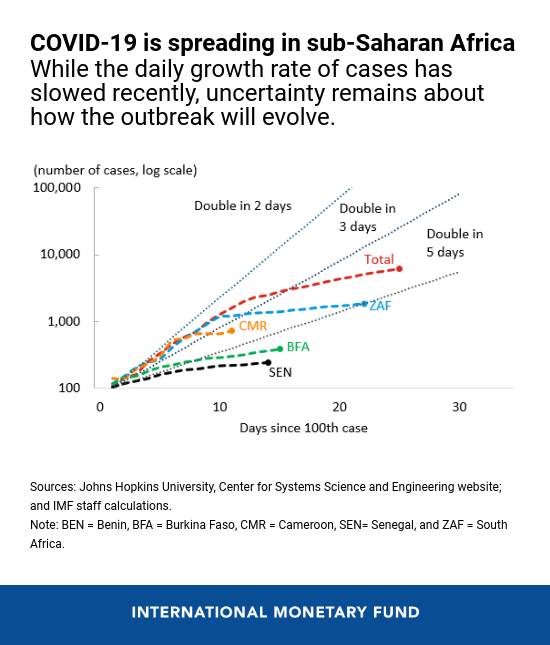
The health shock is precipitating an economic crisis and upending the livelihoods of already vulnerable groups. Containment and mitigation measures needed to slow the spread of the virus will severely impact economic activity. Furthermore, a lockdown can have devastating effects—for example, on food insecurity—on households who live hand-to-mouth and have limited access to social safety nets.
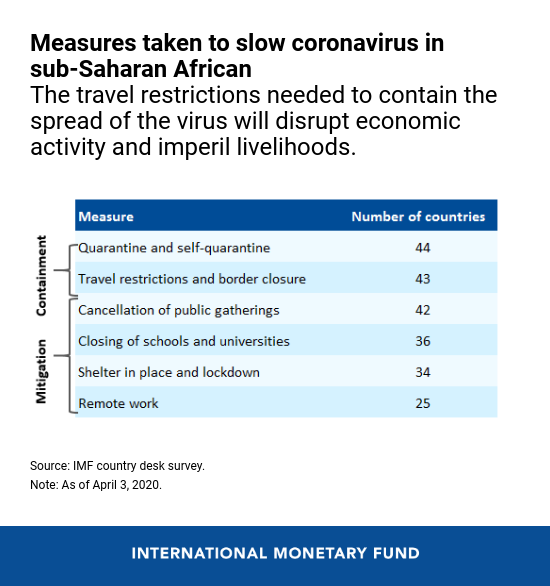
Spillovers from a rapidly deteriorating external environment are compounding the economic challenges facing sub-Saharan Africa. A sharp growth slowdown among key trading partners is reducing external demand. In addition, tightening global financial conditions are reducing investment flows and adding to external pressures. Finally, a sharp decline in commodity prices, especially oil, is exacerbating challenges in some of the region’s largest, resource-intensive economies.

GDP in sub-Saharan Africa is projected to contract by –1.6 percent this year—the worst reading on record. While the effect across countries is expected to differ depending on factors like extent of diversification and dependence on tourism, no country will be spared. Compared to projections made six months ago, growth for 2020 has been revised down for all countries in the region.
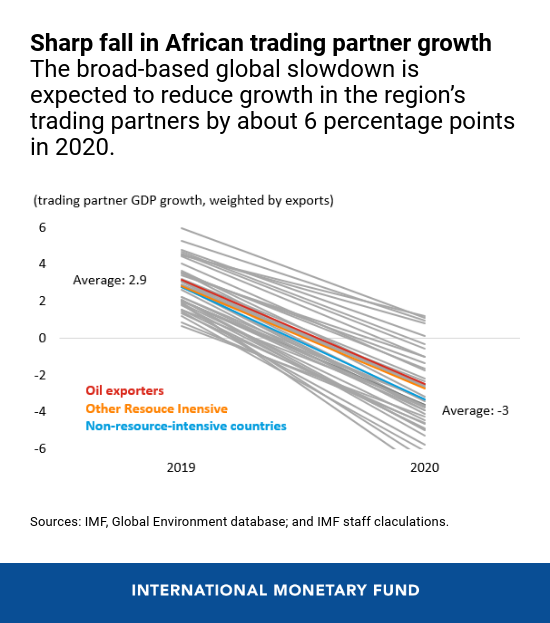
Timely fiscal support is crucial to limit humanitarian and economic losses. Stepping up health spending is essential, irrespective of fiscal space and debt levels. Given the large but temporary nature of the shock, some discretionary fiscal support is warranted, even in countries with limited space. The focus should be on targeted measures that alleviate liquidity constraints on vulnerable firms and households.
For countries facing financing constraints, especially oil exporters where the shock is likely to be more long-lasting, the aim should be to undertake well-paced, growth-friendly spending adjustments that seek to generate resources for social spending, while mobilizing additional financing from the donor community.

A comprehensive and coordinated effort by all development partners is essential to respond effectively to this crisis. The ability of countries to mount the required fiscal response is highly contingent on ample external financing and grant on concessional terms being made available by the international financial community. Without adequate financing, temporary liquidity issues could turn into solvency problems, resulting in the COVID-19 crisis having long-term effects on economic activity.
FULL DOCUMENT: https://www.imf.org/en/News/Articles/2020/04/13/na0413202-six-charts-show-how-covid-19-is-an-unprecedented-threat-to?utm_medium=email&utm_source=govdelivery

IMF. 04/17/2020. The last newsletter of our 2020 Virtual Spring Meetings
Thank you very much for your interest, time and engagement this past week. Did you find these daily updates useful? Send us a note directly with your feedback.
While this is our last update, we have much more to share.
In the coming days we will be launching new analytical chapters of the World Economic Outlook, Global Financial Stability Report and Fiscal Monitor Report—covering risky credit markets, banking stability in the current crisis, countering future recessions and the macroeconomic effects of global migration, among other themes. And soon we'll be publishing new podcasts, articles about specific countries dealing with the pandemic, and a new issue of our Finance & Development magazine.
To receive these updates, make sure you are subscribed to IMF Blog, F&D Magazine, podcasts and more. Click here to view all our newsletters—enter your email address to access your profile.
TODAY'S FOCUS
The Development Committee—a Joint Ministerial Committee of the Boards of Governors of the Bank and the Fund—just concluded their virtual meeting this morning. IMF Managing Director Kristalina Georgieva's statement will be posted shortly here. In the meantime, read the communique.
From 11:00 AM to 12:30 PM EDT, the IMF and World Bank Group will host a virtual high-level event titled ‘Mobilizing with Africa’, which will focus on efforts to support the fight against COVID-19 on the continent. Participants will include leaders from across Africa. representatives from several G20 countries, as well as the leaders of the African Union, United Nations, and WHO. Follow the latest IMF news to learn of the outcome.
In our broader roundup below, you'll find an updated list of key links, insights from yesterday's International Monetary and Financial Committee (IMFC) meeting, how best to stay informed of our latest research and analysis moving forward, how you can learn from IMF experts via online courses and much more.
MORE THAN EVER, WE MUST WORK TOGETHER
In an extraordinary virtual meeting of the International Monetary and Financial Committee yesterday, IMFC Chair and Governor of the South African Reserve Bank Lesetja Kganyago and IMF Managing Director Kristalina Georgieva stressed that exceptional times called for exceptional action. Read Managing Director Georgieva's remarks, Chair Kganyago's remarks, the IMFC Communiqué, and watch the press briefing.
GLOBAL ECONOMIC INSIGHTS
- Managing Director's Global Policy Agenda
- World Economic Outlook
- Global Financial Stability Report
- Fiscal Monitor Report
REGIONAL ECONOMIC INSIGHTS
- Sub-Saharan Africa Economic Outlook
- Middle East and Central Asia Economic Outlook
- Asia and Pacific Outlook
- Western Hemisphere Outlook
- European Outlook
IN CASE YOU MISSED IT
Earlier this week we broadcasted a virtual conversation between Managing Director Georgieva and Imperial College epidemiologists Neil Ferguson and Azra Ghani. They focused on how best to save lives and livelihoods. Watch the 25-min discussion.
During the recent G20 Finance Ministers and Central Bank Governors meeting, Managing Director Georgieva discussed ramping up the IMF's crisis response for emerging markets and developing countries: "To assist our low income countries, we plan to triple our concessional lending. We are therefore urgently seeking US$18 billion in new loan resources for the Poverty Reduction and Growth Trust, and will also likely need at least US$1.8 billion in subsidy resources." Read the full statement.
Don't forget to watch recent media interviews of Managing Director Georgieva with Bloomberg, Director of Fiscal Affairs Vitor Gaspar with Bloomberg, Director of the Asia and Pacific Department Changyong Rhee with Bloomberg, and Chief Economist Gita Gopinath with CNBC.
THE IMF AND COVID-19
We recently launched a hub for all of our COVID-19 content, including our latest analytical work on the economic impact of the pandemic, a global policy tracker that now covers 193 economies, a series of notes produced by IMF experts to help members address the economic effects of COVID-19, and recent news including press releases, announcements, speeches and more. If you are interested in the IMF's response to COVID-19, please read our latest Q&A.
The IMF also just approved immediate debt service relief to 25 member countries. "This provides grants to our poorest and most vulnerable members to cover their IMF debt obligations for an initial phase over the next six months and will help them channel more of their scarce financial resources towards vital emergency medical and other relief efforts," said Managing Director Kristalina Georgieva.
In addition, our new lending tracker showcases emergency assistance approved to member countries facing the economic impact of the pandemic. For upcoming discussions on emergency financing requests, see the meetings calendar of the Executive Board.
Lastly, to help member countries with strong fundamentals deal with pandemic, we just announced that our Executive Board has approved the creation of a new short-term liquidity line.
ONLINE LEARNING FROM THE IMF
To increase global access to IMF expertise during the pandemic, we just launched the IMF Institute Learning Channel on YouTube. Subscribe to learn more about our online courses and “bite-size” insights on a broad range of economic and financial issues.
For a deeper dive into economic policymaking, join our global community of over 64,000 current and future leaders by signing up to our free, self-paced online courses covering macroeconomic forecasting and diagnostics, financial development and inclusion, public financial management, central bank law, and more.
OCTOBER 2020 ANNUAL MEETINGS
We would love to keep you informed during our next global convening—the IMF-World Bank Annual Meetings in October 2020. If you do not want to receive a similar, two-week newsletter in the fall, please unsubscribe here. We will not email you with any other updates except to keep your profile current between now and the Annual Meetings should you remain on this list.
FINAL THOUGHT
Thank you again for your interest and engagement. This was our first time producing a daily Spring Meetings update so we would love to hear whether you enjoyed it and found it useful to keep track of the week. Please write to us with any feedback.
Take care and stay safe,
IMF Spring Meetings Team
P.S. We recently launched a new mobile app that houses our latest flagship reports in an easy-to-read format. Now you can search and discover our latest analysis on the go. Download now from the Apple App Store and the Google Play Store.
________________
ECONOMIA BRASILEIRA / BRAZIL ECONOMICS
CORONAVÍRUS
PR. 16/04/2020. Presidente Bolsonaro anuncia novo ministro da Saúde. O oncologista Nelson Teich foi apresentado, em coletiva à imprensa, como novo titular da pasta, substituindo Luiz Henrique Mandetta
O presidente da República, Jair Bolsonaro, anunciou nesta quinta-feira (16), durante coletiva à imprensa no Palácio do Planalto, que o oncologista Nelson Teich assumirá o Ministério da Saúde em substituição a Luiz Henrique Mandetta. “Foi um divórcio consensual, porque, acima de mim, como presidente, e dele, como ministro, está a saúde do povo brasileiro. A vida para todos nós está em primeiro lugar”, declarou Bolsonaro.
A nomeação de Teich para o cargo, junto à exoneração de Mandetta, foi publicada em edição extra do Diário Oficial da União desta quinta-feira.
De acordo com Bolsonaro, o novo chefe da Saúde vai trabalhar com equilíbrio e seriedade para que o remédio contra o novo coronavírus (Covid-19) não seja mais danoso que a doença. "Nós estamos juntos na defesa da vida do povo brasileiro. Na defesa dos empregos e também buscando levar tranquilidade e paz para o nosso povo", declarou.
O Presidente lembrou que cada país tem as suas especificidades, no que se refere à pandemia, e defendeu que, ao se falar em saúde, não se pode deixar de falar em emprego. "Uma pessoa desempregada está mais propensa a sofrer problemas de saúde do que uma outra empregada. E desde o começo da pandemia eu me dirigi a todos os ministros e falei da vida e do emprego. É como um paciente que tem duas doenças. A gente não pode abandonar uma a trata exclusivamente outra", explicou.
Linha de ação
Durante a coletiva, Nelson Teich ressaltou a importância da busca pela informação e lembrou a relação entre saúde e economia. Também apontou a necessidade do uso da inteligência no combate ao novo coronavírus. "Quanto menos informação você tem, mais aquilo é discutido na emoção, isso é absolutamente ineficiente."
Ele também defendeu a importância de se discutir saúde e economia como áreas complementares que não competem entre si. "Quando você polariza uma coisa, dessa você começa a tratar como se fosse pessoas versos dinheiro, o bem versus o mal, empregos versus pessoas doentes e não é nada disso."
O novo ministro da Saúde afirmou que a busca por medicamentos e vacinas será “tratada de forma absolutamente técnica e científica”. Teich apontou a necessidade de se investir em projetos de pesquisas para alcançar o necessário para se combater a doença. “Para conhecer a doença a gente vai ter que fazer um programa de teste. É fundamental que façamos uma avaliação do que é a doença hoje. A partir do momento em que isso acontecer e conseguirmos definir políticas e ações, a gente assume o comando do problema e será possível solucioná-lo.”
O que preserva saúde da sociedade, ressaltou, são, além dos cuidados na própria saúde, a estabilidade econômica, a educação, entre outros aspectos. "Uma coisa importante do desenvolvimento econômico é que ele arrasta as outras coisas. Quanto mais é desenvolvido economicamente um país, mais você investe em educação, mais você investe em saúde, mais você tem recurso para ajudar a sociedade."
Governo diferente
O presidente lembrou que, antes de o vírus chegar ao Brasil, o governo já estava apresentando resultados. "Estávamos praticamente voando, no final do último trimestre. Tudo estava indo muito bem. O Brasil tinha tudo para dar certo, num curto espaço de tempo. Esse dar certo agora acontecerá, mas em um tempo mais ampliado", destacou.
"Todos os ministros estão envolvidos na mesma causa, sem excessão. Nós estamos juntos em defesa da vida do povo brasileiro, em defesa dos empregos e também obviamente buscando levar tranquilidade e paz para o nosso povo", concluiu.
FGV. 17/04/2020. FGV - Impactos do COVID-19Como a pandemia alterou a logística do varejo

Com o fechamento do comércio devido à pandemia, qual a solução para os pequenos e médios varejistas? O delivery é uma opção. Mas a entrega dos produtos na casa do cliente gera uma série de programações e logísticas que desafiam os comerciantes que não estão habituados com este processo. Como, por exemplo, otimizar as entregas por região, prazo, cálculo de frete, garantir que o produto chegue com a mesma qualidade na casa do cliente, dentre outras. Quer saber mais sobre o assunto?
VÍDEO: https://www.youtube.com/watch?v=rMLbQkt7lIU&feature=youtu.be
FGV. IBRE. 16/04/20. Coronavírus
No dia 16 de março o chileno Sebastián Piñera venceu as ruas. Com a gravidade do coronavírus, conquistou o que o poder de seu cargo de presidente e a força repressora da polícia ainda não tinham alcançado em cinco meses: conter as manifestações massivas de chilenos por todo o país, que desde 18 de outubro marchavam por melhorias em sua condição de vida, especialmente de aposentadoria e serviços de saúde.
A partir desse dia, 13 depois do anúncio do primeiro caso de contaminação no Chile, foram proibidos eventos públicos de mais de 500 pessoas, ao que se seguiram medidas mais rígidas de isolamento para conter a propagação do vírus. E a trégua que o governo obteve em uma batalha logo foi substituída pela entrada em uma guerra comum aos demais países absorvidos pela pandemia, vitimando pessoas e a atividade econômica. No final de março, economistas de algumas instituições previam para o Chile um segundo trimestre de retração econômica na casa de 3% a 6,6%, e um PIB para 2020 negativo em até 2,4% - esta última, em consonância com a projeção do BC chileno, que em 1 de abril previu uma contração em 2020 entre 1,5% e 2,5%. "A atividade do país recém estava se recompondo dos efeitos das manifestações", lamenta Manuel Agosín, da Faculdade de Economia da Universidad de Chile, citando a queda de 2,9% na atividade no último trimestre de 2019, levando o PIB anual a fechar em 1,1%, o menor percentual em uma década, desde a crise financeira internacional.
Dia 31 de março, o Congresso chileno aprovou os primeiros projetos de lei com medidas emergenciais para o campo econômico, somando US$ 11,75 bilhões, equivalentes a 47% do PIB do país. Para a população de baixa renda e informal, o coronavoucher chileno distribuirá 50 mil pesos (cerca de US$ 58), a beneficiários de programas sociais, o que deverá alcançar 2 milhões de famílias, que poderiam receber, em média 100 mil pesos. O projeto também prevê uma capitalização de US$ 4,4 bilhões do BancoEstado para linhas de crédito a pessoas físicas e pequenas e médias empresas, cujas operações terão sua tributação zerada até o final de setembro. Ainda se aprovou a suspensão temporária do contrato de trabalho, por até seis meses, prazo em que o empregado terá acesso ao seguro cesantía (como o FGTS brasileiro), engordado pelo governo em US$ 2 bilhões, e o empregador mantém sua obrigação de manter o recolhimento para o fundo de pensão e seguro de saúde. A lei também prevê a redução da jornada de trabalho em até 50%, permitindo que o seguro cesantía complemente parte do salário perdido, garantindo um limite de renda.
Dia 8 de abril, o governo anunciou um grupo de novas medidas destinadas à proteção da atividade econômica - oferecendo até US$ 3 bilhões de garantias para operações de crédito de empresas com vendas anuais de até 1 milhão de UFs (equivalentes a US$ 32 milhões), que correspondem a 99,8% das empresas e 84% do emprego no país - e proteção à renda, com um fundo de US$ 2 bilhões, com uso flexível dependendo do avanço da pandemia, com o qual o governo espera beneficiar 3 milhões de pessoas.
Agosín considera a direção das medidas boa, “mas sua eficácia dependerá da extensão do isolamento”. No aspecto político, até agora a reação à crise sanitária tem colaborado para o presidente Sebastián Piñera recuperar seu nível de popularidade, fortemente impactado desde as manifestações de outubro de 2019. Pesquisa do instituto Plaza Pública-Cadem da segunda semana de abril aponta um aumento de 13 pontos percentuais em seu nível de aprovação desde o início de fevereiro, de 9% para 22%. "O presidente é reconhecido como pouco hábil politicamente, mas bom em gestão. A população tem uma memória positiva de seu trabalho na recuperação do país após o terremoto de 2010, organizado logo após sua posse, no primeiro mandato", afirma o analista político Hugo Eduardo Herrera, da Universidad Diego Portales.
Herrera lembra, entretanto, que a crise política está parcialmente adormecida, mas não morta. "O que permitiu ao governo a costura de uma concertação para se avançar em algumas reformas, bem como no caminho para uma Constituinte, foram os setores moderados. Se esse diálogo se rompe, pode-se deflagrar uma crise ainda mais intensa”, afirma.
E até o cenário mais otimista para o país, prevendo uma retomada da maior parte da atividade no segundo semestre, guarda componentes de intensificação da incerteza, já que isso significaria a reorganização do movimento por uma nova carta magna. O plebiscito que definiria a instalação ou não desse processo constituinte no Chile estava marcado para 26 de abril e foi postergado, a princípio, para 25 de outubro. A elaboração de uma nova Constituição foi uma das principais demandas desde o início das manifestações populares. “De antemão, considero muito difícil começar uma Constituição do zero - a atual já possui mais de vinte emendas, não é mais uma Carta da ditadura, inclusive é assinada por um presidente democrático, Ricardo Lagos. Bastava aprofundar essas mudanças, usando os mesmos instrumentos, o que aceleraria bastante o processo”, avalia Agosín. “Se além disso tivermos uma Convenção com representantes 100% novos, muitos com pouco conhecimento legal e inflamados em defender saúde, educação e moradia gratuitos, estenderemos esse manto de incerteza sobre a economia chilena por mais dois ou três anos. E isso não será bom”, conclui.
DOCUMENTO: https://portalibre.fgv.br/navegacao-superior/noticias/coronavirus-7.htm
CHINA. PORTAL G1. 16/04/2020. Com pandemia, economia da China encolhe 6,8% no 1º trimestre, primeira queda da série histórica. Foi a primeira queda do PIB do país desde 1992, quando dados trimestrais oficiais do PIB começaram a ser publicados no país.
A economia da China registrou a primeira contração em quase 30 anos. O Produto Interno Bruto (PIB) do gigante asiático desabou 6,8% no 1º trimestre, na comparação com o mesmo período do ano passado, confirmando os efeitos causados pela pandemia do novo coronavírus que parou o país no início de 2020.
É a primeira queda desde ao menos 1992, quando dados trimestrais oficiais do PIB começaram a ser publicados no país.
Em termos anuais, a última vez que a China registrou ma contração do PIB foi em 1976, no fim da Revolução Cultural.
Na comparação com o trimestre anterior, o PIB caiu 9,8% nos três primeiros meses do ano, informou a Agência Nacional de Estatísticas.
No último trimestre de 2019, o crescimento da segunda maior economia do mundo foi de 6% na comparação anual.
O desempenho do PIB da China desperta interesse devido ao peso do país na economia global.
"Os dados do PIB do primeiro trimestre ainda estão amplamente dentro das expectativas, refletindo as perdas da paralisação econômica quando toda a sociedade estava isolada", disse Lu Zhengwei, economista-chefe do Industrial Bank.
Em um esforço para conter a propagação do vírus, que causou oficialmente mais de 3.300 mortes no país, a China adotou medidas de contenção sem precedentes no final de janeiro que impediram a movimentação de trabalhadores, fecharam fábricas e lojas e afetaram duramente a economia.
FMI ainda prevê alta do PIB chinês em 2020
Em 2019, a economia da China, a segunda maior do mundo, cresceu 6,1%, um resultado modesto para um país acostumado a elevadas taxas de crescimento econômico nas últimas décadas.
Devido à incerteza associada à pandemia, a China ainda não divulgou a meta de crescimento para 2020. Nas últimas previsões, o Fundo Monetário Internacional (FMI) projetou um crescimento de 1,2% para o PIB chinês este ano.
"Para a próxima fase, a falta de demanda geral é a preocupação. A demanda doméstica não se recuperou totalmente uma vez que o consumo relacionado aos agrupamentos sociais ainda está proibido enquanto a demanda externa deve ser prejudicada enquanto a pandemia se espalha", destacou Lu Zhengwei.
O porta-voz da agência de estatísticas, Mao Shengyong, disse em entrevista à imprensa que o desempenho econômico da China no segundo trimestre deve ser muito melhor do que no primeiro.
Entretanto, o consumo doméstico mais fraco, que tem sido o grande motor do crescimento, continua sendo uma preocupação já que a renda desacelera e o resto do mundo cai em recessão.
A renda per capita disponível, após ajuste pela inflação, caiu 3,9% sobre o ano anterior no primeiro trimestre, mostraram os dados.
As vendas no varejo caíram novamente em março, para 15,8% no comparativo anual. A produção industrial, no entanto, caiu apenas 1,1%. Nos dois meses anteriores - a única estatística disponível -, as vendas no varejo caíram 20,5% e a produção industrial, 13,5%.
Já o investimento em ativo fixo perdeu 16,1% entre janeiro e março sobre o ano anterior.
Medidas de estímulo
Os líderes chineses já prometeram mais medidas para combater as perdas mas estão cientes das lições aprendidas em 2008-09, quando fortes estímulos pressionaram a economia com enormes dívidas.
No mês passado, o Politburo do Partido Comunista disse que está avaliando medidas como mais títulos especiais de governos locais e bônus especiais do Tesouro.
O banco central já afrouxou a política monetária para ajudar a liberar crédito para a economia, mas seu afrouxamento até agora tem sido menos agressivo do que durante a crise financeira.
O governo também contará com mais estímulo fiscal para alimentar o investimento em infraestrutura e consumo, o que pode levar o déficit orçamentário de 2020 a uma máxima recorde.
CHINA. REUTERS. 17 DE ABRIL DE 2020. Afetado por coronavírus, PIB da China no 1º tri encolhe pela primeira vez na série histórica
Por Gabriel Crossley e Kevin Yao
PEQUIM (Reuters) - A economia da China contraiu no primeiro trimestre pela primeira vez na série histórica uma vez que o coronavírus fechou fábricas e lojas e deixou milhões de pessoas sem trabalho.
O Produto Interno Bruto recuou 6,8% entre janeiro e março na comparação com o ano anterior, mostraram dados oficiais nesta sexta-feira, contra expectativa de analistas de queda de 6,5% e revertendo a expansão de 6% no quarto trimestre de 2019.
Foi a primeira contração da segunda maior economia do mundo desde ao menos 1992, quando dados trimestrais oficiais do PIB começaram a ser publicados.
Mas o lado bom foi uma queda muito menor do que a esperada na produção industrual de março, sugerindo que o alívio tributário e de crédito para empresas afetadas pelo vírus está ajudando a retomar partes da economia fechadas desde fevereiro.
Entretanto, analistas dizem que Pequim enfrenta uma dura batalha para reanimar o crescimento e acabar com as fortes perdas de emprego uma vez que a disseminação global do vírus devasta a demanda dos principais parceiros comerciais e o consumo local cai.
“Os dados do PIB do primeiro trimestre ainda estão amplamente dentro das expectativas, refletindo as perdas da paralisação econômica quando toda a sociedade estava isolada”, disse Lu Zhengwei, economista-chefe do Industrial Bank.
“Para a próxima fase, a falta de demanda geral é a preocupação. A demanda doméstica não se recuperou totalmente uma vez que o consumo relacionado aos agrupamentos sociais ainda está proibido enquanto a demanda externa deve ser prejudicada enquanto a pandemia se espalha.”
Na comparação trimestral, o PIB caiu 9,8% nos três primeiros meses do ano, informou a Agência Nacional de Estatísticas, contra expectativa de contração de 9,9% e ante crescimento de 1,5% no trimestre anterior.
O porta-voz da agência de estatísticas, Mao Shengyong, disse em entrevista à imprensa que o desempenho econômico da China no segundo trimestre deve ser muito melhor do que no primeiro.
Entretanto, o consumo doméstico mais fraco, que tem sido o grande motor do crescimento, continua sendo uma preocupação já que a renda desacelera e o resto do mundo cai em recessão.
A renda per capita disponível, após ajuste pela inflação, caiu 3,9% sobre o ano anterior no primeiro trimestre, mostraram os dados.
A produção industrual recuou 1,1% em março na comparação com o ano anterior, contra expectativa de contração de 7,3%. Mas destacando os desafios no consumo, as vendas no varejo perderam 15,8%, ante projeção de queda de 10%. O investimento em ativo fixo perdeu 16,1% entre janeiro e março sobre o ano anterior.
RESGATE
Os líderes chineses já prometeram mais medidas para combater as perdas mas estão cientes das lições aprendidas em 2008-09, quando fortes estímulos pressionaram a economia com enormes dívidas.
No mês passado, o Politburo do Partido Comunista disse que está avaliando medidas como mais títulos especiais de governos locais e bônus especiais do Tesouro.
O banco central já afrouxou a política monetária para ajudar a liberar crédito para a economia, mas seu afrouxamento até agora tem sido menos agressivo do que durante a crise financeira.
O governo também contará com mais estímulo fiscal para alimentar o investimento em infraestrutura e consumo, o que pode levar o déficit orçamentário de 2020 a uma máxima recorde.
Para 2020, a expectativa é de que o crescimento econômico da China caia para 2,5%, ritmo anual mais lento em quase meio século, mostrou pesquisa da Reuters esta semana.
REUTERS. 17 DE ABRIL DE 2020. Pacientes com Covid-19 respondem a medicamento Remdesivir da Gilead, diz site
(Reuters) - As ações da Gilead Sciences dispararam nas negociações ‘after market’ na quinta-feira, após reportagem detalhar dados parciais de testes com o medicamento remdesivir da empresa norte-americana em pacientes graves com Covid-19
Um hospital da Universidade de Chicago, que participa de um estudo sobre o medicamento antiviral, disse que está observando recuperação rápida em febre e sintomas respiratórios, com quase todos os pacientes recebendo alta em menos de uma semana, segundo o site de notícias médias STAT.
A Gilead, em um comunicado enviado por email, disse que “a totalidade dos dados precisa ser analisada para tirar conclusões do experimento”.
A UChicago Medicine, também em um email, disse que “dados parciais de um estudo clínico em andamento são por definição incompletos e nunca devem ser usados para tirar conclusões”.
A universidade disse que informações de um fórum interno para colegas de pesquisa sobre trabalhos em andamento foram divulgadas sem autorização .
A Gilead espera resultados de seu estudo de Fase 3 em pacientes com Covid-19 no final deste mês, e que dados adicionais de outros estudos sejam disponibilizados em maio
A Universidade de Chicago é um dos 152 locais que participam do experimento da Gilead envolvendo pacientes graves com Covid-19, que é “braço único”, o que significa que não mede o medicamento contra um grupo correspondente de pacientes tratados com placebo.
Atualmente, não há tratamentos aprovados para o Covid-19, a doença respiratória altamente contagiosa causada pelo novo coronavírus que já infectou mais de 2 milhões de pessoas em todo o mundo.
Reportagem de Ankur Banerjee em Bengaluru e Deena Beasley em Los Angeles
ABIMAPI. REUTERS. 17 DE ABRIL DE 2020. Coronavírus eleva demanda por pães, massas e biscoitos; setor repassará alta do trigo
Por Nayara Figueiredo
SÃO PAULO (Reuters) - A indústria de pães, massas e biscoitos do Brasil prepara reajustes de 12% a 30% em seu portfólio ao longo deste semestre, para repassar o aumento de custos com o trigo, ao mesmo tempo em que vê o consumo de seus produtos crescendo com os isolamentos contra o coronavírus, disse à Reuters um representante do setor.
A alta de preços pode até gerar uma desaceleração na demanda, em um primeiro momento, admitiu o presidente-executivo da Abimapi, Cláudio Zanão.
Mas ele destacou também que o setor está sendo beneficiado pelo isolamento domiciliar, pois vende produtos que oferecem facilidades aos consumidores, com a praticidade muitas vezes prevalecendo sobre os custos na hora da decisão de compra.
“Nós crescemos em consumo, mas não podemos comemorar pela situação que estamos enfrentando”, ponderou ele.
Zanão destacou que, em março, a indústria de pães, massas e bolos industrializados registrou alta de 15% a 20% no volume comercializado em relação ao igual período do ano anterior, no momento em que parte da população temeu pela eventual escassez de produtos por causa do isolamento.
“Macarrão é barato e um produto que sai ganhando quando a população passa a comer dentro de casa. O pão de forma também tem a demanda mantida porque as pessoas reduzem o deslocamento a padarias... Não acredito em perda de volume (de vendas) no ano.”
Ele ainda garantiu que não há ausência no abastecimento destes produtos para o comércio varejista.
A perspectiva de incremento na demanda desses industrializados decorrente do isolamento favorece a companhia M. Dias Branco, uma das maiores do setor no país, afirmou a Guide Investimentos em relatório divulgado na quinta-feira.
O bom desempenho do setor trouxe confiança para a Abimapi prever aumento de 3% a 5% nas vendas.
No ano passado, estes segmentos, juntos, movimentaram 36,7 bilhões de reais, 3,5% acima do valor alcançado no ano anterior, e 3,3 milhões de toneladas em volume de vendas, mesmo resultado obtido em 2018, informou a Abimapi com base em dados coletados pela consultoria Nielsen.
ALTA DO TRIGO
O aumento nas despesas com o trigo, matéria-prima da farinha usada nesses produtos industrializados, ocorrerá na esteira da valorização do câmbio ante o real, considerando que o Brasil precisa importar o cereal para complementar a oferta local.
Zanão explicou que os reajustes de preços dos produtos do portfólio ocorrem todos os anos, durante a entressafra do trigo, mas em 2020 eles serão mais intensos por causa do patamar histórico do dólar.
A moeda norte-americana fechou em alta de 0,27% na quinta-feira, a 5,2565 reais na venda, registrando ganhos de mais de 30% em 2020.
“O repasse (de custos) deve ser iniciado a partir deste mês... este aumento tende a ser gradual, pois não há espaço para elevar os preços de uma só vez para o consumidor final”, disse Zanão.
Segundo ele, as indústrias estão com estoque de trigo e produto acabado para cerca de dois a três meses, a depender do fabricante.
Isso significa que os fabricantes precisarão do cereal importado até meados de setembro, quando começa a colheita da safra nacional.
“Saímos de um dólar de 4 reais em janeiro para 5,25 reais, uma valorização de 31%. Das 11 milhões de toneladas de trigo consumidas por ano no Brasil, cerca da metade vêm principalmente da Argentina, este ano com 30% de aumento (de preço), em média”, estimou o executivo.
Os preços do trigo no mercado brasileiro seguiram o preço do produto importado, registrando alta no ano cerca de 30% no Paraná (principal produtor brasileiro), oscilando perto de patamares recordes nominais em torno de 1.150 reais por tonelada.
Segundo a associação, a farinha representa em torno de 70% do custo das massas, 60% nos pães e bolos e 30% nos biscoitos.
“Sendo assim, qualquer variação no preço do trigo tem impacto direto para os fabricantes.”
BALANÇO DE 2019
A indústria de biscoitos, que responde pela maior participação no faturamento do setor, fechou o ano passado com receita de 18,7 bilhões de reais, aumento de 1,7% ante 2018, e vendas de 1,47 milhão de toneladas, retração de 1,08% em volume.
Em 2019, as indústrias de pães movimentaram um total de 7 bilhões de reais, com aumento de 4,5% na receita, resultante da venda de 537 mil toneladas de produtos, com alta de 3,4%.
Já o mercado de bolos industrializados atingiu 1,1 bilhão de reais em faturamento, 1,5% a mais se comparado com 2018.
Por Nayara Figueiredo; edição de Roberto Samora
INFLAÇÃO
FGV. 17/04/20. Índices Gerais de Preços. IGP-M Segundo Decêndio. IGP-M varia 1,00% na 2ª prévia de abril
O Índice Geral de Preços - Mercado (IGP-M) subiu 1,00% no segundo decêndio de abril. No segundo decêndio de março, este índice apresentou taxa de 0,99%.
O Índice de Preços ao Produtor Amplo (IPA) passou de 1,41% no segundo decêndio de março para 1,36% no segundo decêndio de abril. Na análise por estágios de processamento, os preços dos Bens Finais caíram 0,02% em abril, após subir 0,97% em março. A maior contribuição para este resultado partiu do subgrupo combustíveis para o consumo, cuja taxa passou de -1,94% para -22,33%.
O índice referente a Bens Intermediários variou 0,23% no segundo decêndio de abril, ante -0,03% no mesmo período de março. O destaque coube ao subgrupo materiais e componentes para a manufatura, cuja taxa passou de 1,45% para 3,21%.
A taxa do grupo Matérias-Primas Brutas foi de 3,45% no segundo decêndio de março para 3,93% em igual período de abril. Contribuíram para o movimento do grupo os seguintes itens: minério de ferro (5,41% para 10,44%), soja (em grão) (3,50% para 8,26%) e café (em grão) (8,34% para 9,44%). Em sentido oposto, destacam-se os itens bovinos (4,11% para -3,07%), aves (1,89% para -4,39%) e suínos (3,13% para -7,44%).
O Índice de Preços ao Consumidor (IPC) subiu 0,28% no segundo decêndio de abril, ante 0,04% no mesmo período de coleta de março. Seis das oito classes de despesa componentes do índice registraram acréscimo em suas taxas de variação, com destaque para o grupo Alimentação (0,63% para 1,42%). Nesta classe de despesa, vale mencionar o comportamento do item hortaliças e legumes, cuja taxa passou de 4,65% para 8,99%.
Também foram computados acréscimos nas taxas de variação dos grupos Educação, Leitura e Recreação (-1,04% para 0,41%), Habitação (-0,13% para 0,38%), Despesas Diversas (-0,04% para 0,41%), Saúde e Cuidados Pessoais (0,33% para 0,46%) e Vestuário (-0,11% para -0,08%). Nestas classes de despesa, os maiores avanços foram observados nas taxas dos itens: passagem aérea (-11,24% para 6,82%), tarifa de eletricidade residencial (-0,97% para 0,47%), alimentos para animais domésticos (-1,77% para 2,30%), artigos de higiene e cuidado pessoal (0,32% para 0,85%) e roupas (-0,12% para 0,00%).
Em contrapartida, os grupos Transportes (-0,01% para -1,04%) e Comunicação (0,08% para 0,06%) apresentaram decréscimo em suas taxas de variação. Nestas classes de despesa, as maiores influências partiram dos seguintes itens: gasolina (-0,95% para -3,59%) e tarifa de telefone residencial (0,77% para 0,36%).
O Índice Nacional de Custo da Construção (INCC) variou 0,22% no segundo decêndio de abril. No mês anterior, o índice foi 0,37%. Os três grupos componentes do INCC apresentaram as seguintes variações na passagem do segundo decêndio de março para o segundo decêndio de abril: Materiais e Equipamentos (0,37% para 0,57%), Mão de Obra (0,40% para 0,00%) e Serviços, que repetiu a taxa do mês anterior, que foi de 0,15%.
DOCUMENTO: https://portalibre.fgv.br/navegacao-superior/noticias/igp-m-varia-1-00-na-2-previa-de-abril.htm
FGV. IBRE. 17/04/20. Índices Gerais de Preços. IPC-S Capitais. Inflação pelo IPC-S recua em seis das sete capitais pesquisadas
O IPC-S de 15 de abril de 2020 registrou variação de 0,34%, ficando 0,04 ponto percentual (p.p.) abaixo da taxa divulgada na última apuração. Seis das sete capitais pesquisadas registraram decréscimo em suas taxas de variação.
A tabela a seguir, apresenta as variações percentuais dos municípios das sete capitais componentes do índice, nesta e nas apurações anteriores.

DOCUMENTO: https://portalibre.fgv.br/navegacao-superior/noticias/inflacao-pelo-ipc-s-recua-em-seis-das-sete-capitais-pesquisadas-16.htm
FGV. IBRE. 17/04/20. Inflação
A alta do preço dos alimentos verificada no início do isolamento devido à covid-19 não deverá continuar na mesma velocidade, mas isso não significa que recuperará o nível observado antes da pandemia, afirma André Braz, coordenador do IPC do FGV IBRE. "Após o ajuste inicial da oferta à nova demanda, o efeito desse choque não deverá se repetir na mesma intensidade, mas não deixará de existir. E, além do efeito do coronavírus, o câmbio é outro fator que poderá manter esses preços em um nível mais elevado", diz.
No mês de março, a variação mensal dos alimentos no domicílio registrada pelo IPCA do IBGE foi de 1,40%. Pelo IPC-C1, calculado pelo FGV IBRE considerando a variação de preços na cesta de consumo de famílias com renda até 2,5 salários mínimos, o grupo alimentos registrou alta de 1,63%, contra 0,51% em fevereiro em relação ao mês anterior. Esse grupo responde por 22,5% do IPC-C1. "Mesmo quando observamos a variação anualizada, isenta de efeitos sazonais, vemos uma evolução muito maior dos alimentos, o que penaliza especialmente a camada da sociedade menos favorecida, o que se agrava em contexto de recessão", diz, ponderando que o maior desafio hoje, entretanto, é o desemprego. "Em geral, quando o problema é alta de preços, a tendência é que a fatia da população de mais baixa renda passe a substituir produtos por outros mais baratos. Mas, quando não há renda, não há opção."
A tendência de que os alimentos no domicílio se mantenham na linha de frente da variação do IPCA também responde a outros fatores. "Entre eles o cambial, e este não tem nos ajudado", afirma Braz, destacando que somente em março a desvalorização do real frente ao dólar foi de mais de 14%. "O câmbio afeta o preço de produtos básicos, do pão francês às proteínas animais, dependentes do preço do trigo, da soja e do milho. Uma taxa de câmbio mantida acima dos R$ 5 certamente afetará esses preços", lembra. Nas demais frentes, entretanto, ele ressalta a tendência de baixa que, para ele, levará o IPCA do ano fechar em torno de 2%. "Boa parcela dos serviços tem sua prestação comprometida e puxará a inflação para baixo. Na parte de bens duráveis, apesar juro baixo e crédito abundantes, é difícil que as pessoas queiram se comprometer no curto prazo. E no caso dos preços administrados, parte as tarifas públicas - que respondem por quase 30% do IPCA - tem tido seus reajustes postergados, em horizonte indefinido", enumera.
O desafio de medir
Braz comenta que manter o trabalho de verificação de preços em meio à paralisação de diversas atividades e restrições à circulação tem sido facilitado pelo investimento do FGV IBRE, nos últimos anos, em formas alternativas de coleta de preços. "Antes mesmo do coronavírus já investíamos em web scraping (uso de programas para recolhimento de dados de sites), além de pesquisa por email e telefone, em contato direto com respondentes. O que fizemos agora foi intensificar o modelo de pesquisa não-presencial", conta. Para isso, foi necessário adotar medidas como recompor a amostra da pesquisa, para substituir comércios sem operação na internet por aqueles que trabalham tanto com lojas físicas quanto online.
Outro cuidado da equipe do FGV IBRE, diz Braz, é o de intensificar o intercâmbio com instituições de outros países, para discutir a melhor forma de trabalhar com as limitações impostas pelo isolamento social. "Por exemplo, hoje há um debate intenso sobre como distribuir o peso de serviços que não estão sendo prestados - e por isso não há aferição - para o restante dos produtos do mesmo grupo. Por exemplo, da atividade hoteleira dentro do grupo de lazer. É algo importante, para garantir a integridade estatística caso as medidas de isolamento se prolonguem", afirma.
DOCUMENTO: https://portalibre.fgv.br/navegacao-superior/noticias/inflacao.htm
AGRICULTURA / CAFÉ
CONAB. CECAFÉ. PORTAL G1. REUTERS. 16/04/2020. Brasil tem um terço da safra 2020/21 de café arábica comercializada, diz Conab. Trata-se do maior nível de comercialização antecipada para a próxima temporada agrícola, entre as demais commodities do setor.
Favorecido pela valorização do dólar em relação ao real, o Brasil já comercializou um terço da safra 2020/21 de café arábica, que será colhida somente no ano que vem, de acordo com o presidente da Companhia Nacional de Abastecimento (Conab), Guilherme Soria.
Trata-se do maior nível de comercialização antecipada para a temporada de 2020/21, entre as demais commodities agrícolas brasileiras.
"No café arábica, estamos com 30,8% da safra que vem comercializada, um terço. No café conilon, 14% também já foram vendidos", disse Soria, em videoconferência na quarta-feira (15).
Na soja, principal grão exportado pelo Brasil, 19% da safra 2020/21 foram comercializados, 18% no algodão, 3% do milho primeira safra e 13% do milho safrinha.
"Isso mostra que, apesar da queda nos preços internacionais de algumas commodities, o câmbio mais do que compensou a venda antecipada para o produtor brasileiro."
Para ele, o milho deve ser um dos destaques para a próxima temporada, cultura que tem mostrado "incrementos incríveis de área plantada, ano após ano".
COMÉRCIO EXTERIOR BRASILEIRO
MEconomia. RFB. 17/04/2020. COVID-19. Receita dilata prazo para apresentação de Certificado de Origem nas importações. Instrução Normativa também amplia rol de produtos com desembaraço prioritário
A Receita Federal dilatou para 60 dias após o registro da Declaração de Importação o prazo de apresentação do Certificado de Origem. A medida é estabelecida pela Instrução Normativa nº 1936/2020, publicada nesta quarta-feira (15/4) no Diário Oficial da União. O Certificado de Origem é um documento que atesta a origem da mercadoria comercializada entre países que possuem acordos comerciais, o que resulta em benefícios tarifários para o importador.
A ampliação do prazo para a apresentação do documento deve-se à dificuldade encontrada pelos importadores brasileiros para obter o documento junto aos órgãos oficiais de países que estão em quarentena devido à pandemia do coronavírus. Para obter o benefício tarifário, a transação deverá vir amparada por uma declaração do próprio exportador, bem como um termo de responsabilidade do importador consignando os benefícios tributários recebidos.
A IN 1.936/2020 também ampliou o rol de produtos que terão seu despacho de importação realizado de maneira prioritária para auxiliar no combate à pandemia causada pelo novo coronavírus. Dentre os produtos incluídos estão equipamentos e matérias-primas para produção de máscaras de proteção e respiradores, além de medicamentos como o paracetamol. Esses produtos terão maior celeridade no trâmite aduaneiro, sendo permitida a entrega da mercadoria ao importador antes da conclusão da conferência aduaneira. Além disso, as declarações de importação envolvendo essas mercadorias deverão ter tratamento prioritário, tanto pelas unidades da Receita Federal, quanto pelo depositário responsável por sua custódia.
Com a nova norma, a Receita Federal busca manter um fluxo rápido de abastecimento de bens, mercadorias e matérias-primas destinadas ao combate à epidemia, e evitar gargalos nos recintos aduaneiros ao agilizar a entrega da carga e permitir sua utilização econômica para reforçar o combate ao vírus.
MEconomia. RFB. 17/04/2020. RECEITA FEDERAL. Alterada instrução normativa que trata sobre importações por encomenda. Novo texto busca sanar dúvidas do público externo e deixar norma mais clara
A Receita Federal alterou o texto da Instrução Normativa nº 1.861, de 2018, de maneira a deixá-lo mais claro e preciso, sem qualquer alteração material do disposto. A alteração, definida pela Instrução Normativa nº 1937, publicada nesta quarta-feira (15/4) em edição extra do Diário Oficial da União, foi feita no parágrafo 3º do artigo 3º da instrução normativa de 2018.
O novo texto prevê de forma expressa ser possível o encomendante predeterminado realizar pagamentos referente à revenda da mercadoria estrangeira ao importador por encomenda, seja total ou parcial, antes ou depois de qualquer etapa intermediária da operação, sem descaracterizar uma operação por encomenda.
Também foram suprimidos da IN 1.861 as alíneas “b” dos incisos II dos artigos 7º e 8º, que tratavam da obrigatoriedade do importador destacar na nota fiscal de saída o valor do ICMS recolhido. O ICMS incidente na importação é um recurso de competência dos Estados e do Distrito Federal.
MEconomia. RFB. 17/04/2020. COVID-19. Receita reduz a zero o imposto de produtos importados por remessa postal. Medida atinge produtos doados por pessoas de diversas partes do mundo e outros usados na produção de respiradores
Produtos destinados ao combate à pandemia causada pelo novo coronavírus que sejam importados por meio de remessa postal ou encomenda aérea internacional no valor de até US$ 10 mil terão suas alíquotas do Imposto de Importação zeradas até 30 de setembro. Além disso, essas mercadorias serão isentas do IPI e do PIS/Cofins.
A medida está prevista na Portaria nº 158, de 15 de abril de 2020, publicada pelo Ministério da Economia nesta quinta-feira (16/4) no Diário Oficial da União.
A portaria foi editada para que os produtos enviados pelo Regime de Tributação Simplificada, que é aplicado a remessas postais e encomendas aéreas, tenham o mesmo tratamento que as mercadorias despachadas por meio das Declarações de Importação tradicionais. Essa medida vai beneficiar, por exemplo, uma grande quantidade de produtos doados por pessoas de diversas partes do mundo e componentes necessários à produção de respiradores artificiais.
O regime de Tributação Simplificada normalmente prevê a aplicação da alíquota de 60% do Imposto de Importação sobre o valor da mercadoria, independentemente da classificação tarifária dos bens que compõem a remessa ou encomenda.
Dentre os produtos que terão a alíquota zerada estão medicamentos, equipamentos de proteção individual, como luvas e máscaras, e equipamentos hospitalares, tais como respiradores artificiais.
INOVAÇÃO
CNI. 17/04/2020. Inovação deve ser motor condutor para superar crise do coronavírus. Em reunião virtual, Mobilização Empresarial pela Inovação debateu pesquisa que revelou queda das atividades inovativas no Brasil e importância de investimentos na área para a superação da pandemia da covid-19. Pintec mostrou queda no percentual de empresas que fazem algum tipo de inovação em produtos ou processos
Mais de 200 integrantes da Mobilização Empresarial pela Inovação (MEI) se reúniram nesta quinta-feira (16) para debater os dados da Pesquisa de Inovação (Pintec) e a importância dos investimentos em ciência, tecnologia e inovação (CT&I) em meio à pandemia da covid-19.
Responsável por conduzir a reunião, o líder da MEI e presidente do Conselho de Administração do Grupo Ultra, Pedro Wongtschowski, alertou que, neste momento de crise, é imprescindível que o setor produtivo, o governo e o Congresso Nacional caminhem juntos para que o Brasil enfrente o coronavírus com medidas eficazes apoiadas pela inovação.
“A pandemia do coronavírus reforçou a importância da inovação e da definição de políticas de longo prazo para o país. As soluções inovadoras são decisivas para o Brasil e o mundo enfrentarem os efeitos da covid-19 sobre a saúde da população, minimizarem os prejuízos sociais e econômicos e, em uma segunda etapa, acelerarem a retomada da atividade e do crescimento da economia”, destacou Wongtschowski na abertura do Diálogos da MEI, que foi realizado pela primeira vez de forma virtual, em razão da pandemia.
Para a diretora de Inovação da Confederação Nacional da Indústria (CNI), Gianna Sagazio, a inovação vai ser o motor condutor para o enfrentamento ao coronavírus. A MEI, principal fórum de diálogo entre empresários e o governo, tem ampliado esforços neste período de crise. O grupo é coordenado pela CNI e conta com mais de 300 das principais lideranças empresariais do país. “Se a gente compara o que está acontecendo com o Brasil - estou falando antes da covid-19 – com o resto do mundo, notamos uma distância muito grande. O Brasil tem investido muito pouco e está mal posicionado em rankings como o Índice Global de Inovação. No atual contexto, a realidade está nos mostrando o tanto que esse investimento é importante”, enfatizou Gianna.
Pesquisa revela queda nas atividades de inovação
Divulgada nesta quinta pelo Instituto Brasileiro de Geografia e Estatística (IBGE), a Pintec mostrou queda no percentual de empresas que fazem algum tipo de inovação em produtos ou processos - caiu de 36%, em 2014, para 33,6%, em 2017. Os dados mostram também que o índice de empresas beneficiadas com algum incentivo do governo recuou de 39,9% para 26,2% no triênio.
O presidente do Conselho de Administração da Totvs e também líder da MEI, Laércio Cosentino, que coordena um grupo de trabalho da MEI sobre indicadores de inovação, alertou que o Brasil precisará investir cada vez mais em dados para conseguir trazer bons exemplos comparativos e aprimorar suas ações de CT&I. Ele defendeu que o país invista mais em profissionais da área de dados e em áreas como inteligência artificial e big data. “Para mudar a realidade do Brasil, precisamos de uma base de dados para comparar. Já temos o plano de comparar as empresas da MEI com as demais do Brasil, Estados Unidos, União Européia e China. E nesse trabalho seguiremos três pilares: base de comparação, formulação de política e melhores práticas”, detalhou.
Presente à reunião virtual, a presidente do IBGE, Susana Guerra, alertou para a importância da pesquisa por trazer uma radiografia completa da inovação no país. Ela pediu colaboração do setor privado para a próxima Pintec, que, segundo ela, será diferenciada em razão do dinamismo da inovação e da redução dos recursos do instituto. “O IBGE precisa de apoio para conduzir a transformação no modo como faz a pesquisa para acompanhar esse setor que tem um dinamismo tremendo. O caminho para o IBGE no futuro vai ser por meio de parcerias”, disse.
A pesquisa divulgada nesta quinta aponta que a indústria foi o segmento que mais sentiu o período de recessão econômica. Dos R$ 67,3 bilhões de investimentos em atividades inovativas, R$ 25,6 bilhões foram para atividades internas de P&D; R$ 7 bilhões em atividades externas de P&D; e R$ 21,2 bilhões na aquição de máquinas e equipamentos. “Entre os principais obstáculos à inovação estão os riscos econômicos excessivos, a elevação dos custos da inovação, a falta de pessoal qualificado e a escassez de fontes de financiamento”, destacou o gerente da Pintec, Flávio Peixoto..
Ações do Legislativo e Executivo em prol da inovação
O presidente da Frente Parlamentar Mista de Ciência, Tecnologia, Pesquisa e Inovação, senador Izalci Lucas, se colocou à disposição dos empresários para apoiar no Congresso Nacional proposições de lei que incentivem e desburocratizem a inovação. “É muito importante vocês subsidiarem os parlamentares porque, infelizmente, são poucos os que têm interesse em aprofundar o debate sobre a inovação. Peço que vocês acompanhem o que está sendo votado neste período no Senado e contribuam com propostas”, solicitou o senador.
O secretário-executivo do Ministério da Ciência, Tecnologia, Inovações e Comunicações (MCTIC), Julio Semeghini, observou, por sua vez, que o Poder Executivo vem identificando projetos capazes de recuperar a economia por meio de CT&I. Um exemplo, segundo ele, é a Lei de Informática. “É um excelente momento para aprovarmos leis com visão de longo prazo”, frisou.
Ele considera que a crise do coronavírus propiciará um mundo pós-pandemia com ampla capacidade de transformação digital. “A gente percebe muitas ações. Mas o melhor é notar que a capacidade das nossas instituições e do nosso ecossistema de inovação é muito forte. Contamos com muita gente boa, conectada com quase toda a parte do globo. A gente tem mais é que dar o valor que essa comunidade científica merece e aplicarmos de maneira integreda os recursos necessários públicos e privados para consolidar essa agenda”, acrescentou Semeghini.
ENERGIA
UNICA. PORTAL G1. REUTERS. 17/04/2020. Queda na demanda por etanol coloca usinas do país em 'modo de sobrevivência'. Empresas afirmam que estão reduzindo suas operações ou tentando aumentar sua capacidade de estoque, para não vender o combustível com valores baixos.
As empresas brasileiras de açúcar e etanol afirmam que estão entrando em "modo de sobrevivência", reduzindo as operações de colheita e buscando linhas de crédito para resistir à queda na demanda de combustível causada pela pandemia de coronavírus.
As restrições governamentais ao movimento e às empresas para conter a propagação do vírus têm prejudicado a demanda global. No Brasil, onde a maioria dos carros pode rodar com gasolina ou etanol, o setor foi atingido fortemente.
O país é o segundo produtor mundial de etanol atrás dos Estados Unidos, com produção de 35 bilhões de litros no ano passado.
As vendas de etanol na região centro-sul do Brasil caíram 20% na segunda quinzena de março, segundo a associação da indústria Unica.
Dada a crise, algumas empresas decidiram atrasar as operações de colheita.
Outros estão correndo para expandir a capacidade de armazenamento de etanol, à medida que as usinas buscam linhas de crédito adicionais e mais caras e reduzem alguns cuidados com o canavial, o que pode prejudicar a produção de cana do próximo ano.
"Esperamos vender apenas 30% ou 40% do volume normal em abril, e talvez 60% do normal em maio", disse Fabio Montechi, diretor financeiro da Santa Isabel, empresa com duas usinas no estado de São Paulo que moem cerca de 6 milhões de toneladas de cana por ano.
A companhia está construindo um tanque adicional para armazenar etanol e está montando uma linha de crédito rotativo.
O Itaú BBA, banco de investimento controlado pelo maior banco privado brasileiro, o Itaú Unibanco, estima que até 30% das empresas brasileiras de açúcar e etanol estão com dificuldades financeiras e podem ter que parar as operações.
"Todos os anos, essas usinas com condições de capital difíceis produzem mais etanol no início da colheita, para vender o combustível e levantar dinheiro para pagar os custos da colheita", disse Pedro Fernandes, diretor de agronegócios do Itaú BBA, acrescentando que a queda na demanda por etanol dificultaria esse modelo de negócio.
Os preços do etanol hidratado caíram 31% este ano em São Paulo, segundo o centro de pesquisas Cepea/Esalq, tendo caído de R$ 2,04 por litro para R$ 1,39 por litro.
Os preços do açúcar atingiram uma mínima de 1 ano e meio esta semana, à medida que as usinas brasileiras se preparam para produzir mais açúcar , impulsionando essa oferta.
Fluxo de caixa
Mesmo antes da crise do coronavírus, algumas usinas de açúcar brasileiras ainda lutavam para se recuperar de um longo período de preços subsidiados da gasolina entre 2012 e 2016, quando o governo tentou controlar a inflação.
Mais de 80 usinas pediram proteção contra falência durante ou logo após esse período.
A fábrica de Itajobi, no Estado de São Paulo, é uma das que estão com problemas financeiros.
O diretor do Itajobi, Henrique Dalkirane, disse que a unidade começou a esmagamento de cana no final do mês passado. A usina deve moer 2 milhões de toneladas de cana nesta temporada, mas está lutando para pagar as contas, disse ele.
"É um golpe direto para o fluxo de caixa", disse Dalkirane, acrescentando que para cada queda de 10 centavos no preço do etanol, as receitas anuais caem 10 milhões de reais.
Recentemente, a empresa reestruturou sua dívida para estender os vencimentos para o pagamento.
Agora, disse Dalkirane, a usina pode parar a colheita e qualquer pagamento de serviço de dívida é improvável neste ano.
Grupos maiores como Raízen, São Martinho e Bunge BP Bioenergia provavelmente resistirão às quedas, fazendo o máximo de açúcar possível e estocando etanol para vendas posteriores, disse Fabio Meneghin, analista de etanol da Agroconsult.
Mas isso não é uma opção para todos. Fernando Perri, diretor do Grupo Farias, que tem cinco usinas de etanol no Brasil, disse que sua empresa está adiando a colheita por pelo menos um mês para ver se os preços melhoram, em vez de produzir etanol que não é vendido.
"Corremos o risco de acabar deixando a cana no campo, mas acho que é melhor do que rodar a usina apenas para encher tanques de etanol", disse ele.
OPEP. PORTAL G1. REUTERS. 16/04/2020. Preços do petróleo fecham estáveis e mantém mínima de 18 anos. O Brent avançou 0,5%, para US$ 27,82 por barril, enquanto WTI fechou estável, a US$ 19,87 o barril.
Os preços do petróleo não tiveram direção comum nesta quinta-feira (16), com o Brent avançando modestamente e os contratos futuros do WTI terminando a sessão estáveis, após países europeus afirmarem que vão flexibilizar restrições causadas pelo coronavírus, mas a Opep reduzir sua estimativa para a demanda global pela commodity.
Os futuros do petróleo Brent avançaram 0,13 dólar, ou 0,5%, para 27,82 dólares por barril, enquanto o petróleo dos Estados Unidos fechou estável, a 19,87 dólares/barril, depois de ter registrado na véspera seu menor nível de fechamento desde fevereiro de 2002.
O mercado de petróleo não tem sido capaz de sustentar um rali desde que a Organização dos Países Exportadores de Petróleo (Opep) e aliados, que formam o grupo conhecido como Opep+, chegaram a um acordo para reduzir drasticamente a oferta global.
No entanto, operadores disseram que o fato de alguns países da Europa considerarem a flexibilização dos "lockdowns" pode apoiar uma recuperação na demanda por combustíveis. A Organização Mundial da Saúde (OMS) pediu que os países ajam com cautela extrema antes de relaxar as restrições.
Por outro lado, a Opep projetou em seu novo relatório mensal que a demanda global por petróleo deve apresentar contração de 6,9 milhões de barris por dia (bpd), ou 6,9%, em 2020, o que ajudou a atenuar o otimismo no mercado
ANP. REUTERS. 17 DE ABRIL DE 2020. Bolsonaro indica Symone Araújo para a diretoria da ANP
RIO DE JANEIRO (Reuters) - O presidente Jair Bolsonaro indicou a diretora do Departamento de Gás Natural do Ministério de Minas e Energia, Symone Araújo, para exercer o cargo de diretora da Agência Nacional do Petróleo, Gás Natural e Biocombustíveis (ANP), publicou nesta sexta-feira o Diário Oficial da União.
A indicação, que ainda demanda aprovação do Senado Federal, é para a cadeira ocupada antes por Aurélio Amaral, que deixou a autarquia no mês passado com a conclusão de seu mandato.
Graduada em Engenharia Química pela Universidade Federal de Sergipe, Symone Araújo é doutora em Ecologia, Conservação e Manejo de Recursos Naturais pela Universidade de Brasília. Está à frente do Departamento de Gás Natural do Ministério de Minas e Energia desde 2009.
________________
LGCJ.:

