US ECONOMICS
CORONAVIRUS
FED. April 09, 2020. Speech. COVID-19 and the Economy. Chair Jerome H. Powell. At the Hutchins Center on Fiscal and Monetary Policy, The Brookings Institution, Washington, D.C. (via webcast)
Good morning. The challenge we face today is different in scope and character from those we have faced before. The coronavirus has spread quickly around the world, leaving a tragic and growing toll of illness and lost lives. This is first and foremost a public health crisis, and the most important response is coming from those on the front lines in hospitals, emergency services, and care facilities. We watch in collective awe and gratitude as these dedicated individuals put themselves at risk in service to others and to our nation.
Like other countries, we are taking forceful measures to control the spread of the virus. Businesses have shuttered, workers are staying home, and we have suspended many basic social interactions. People have been asked to put their lives and livelihoods on hold, at significant economic and personal cost. We are moving with alarming speed from 50-year lows in unemployment to what will likely be very high, although temporary, levels.
All of us are affected, but the burdens are falling most heavily on those least able to carry them. It is worth remembering that the measures we are taking to contain the virus represent an essential investment in our individual and collective health. As a society, we should do everything we can to provide relief to those who are suffering for the public good.
The recently passed Cares Act is an important step in honoring that commitment, providing $2.2 trillion in relief to those who have lost their jobs, to low- and middle-income households, to employers of all sizes, to hospitals and health-care providers, and to state and local governments. And there are reports of additional legislation in the works. The critical task of delivering financial support directly to those most affected falls to elected officials, who use their powers of taxation and spending to make decisions about where we, as a society, should direct our collective resources.
The Fed can also contribute in important ways: by providing a measure of relief and stability during this period of constrained economic activity, and by using our tools to ensure that the eventual recovery is as vigorous as possible.
To those ends, we have lowered interest rates to near zero in order to bring down borrowing costs. We have also committed to keeping rates at this low level until we are confident that the economy has weathered the storm and is on track to achieve our maximum-employment and price-stability goals.
Even more importantly, we have acted to safeguard financial markets in order to provide stability to the financial system and support the flow of credit in the economy. As a result of the economic dislocations caused by the virus, some essential financial markets had begun to sink into dysfunction, and many channels that households, businesses, and state and local governments rely on for credit had simply stopped working. We acted forcefully to get our markets working again, and, as a result, market conditions have generally improved.
Many of the programs we are undertaking to support the flow of credit rely on emergency lending powers that are available only in very unusual circumstances—such as those we find ourselves in today—and only with the consent of the Secretary of the Treasury. We are deploying these lending powers to an unprecedented extent, enabled in large part by the financial backing from Congress and the Treasury. We will continue to use these powers forcefully, proactively, and aggressively until we are confident that we are solidly on the road to recovery.
I would stress that these are lending powers, not spending powers. The Fed is not authorized to grant money to particular beneficiaries. The Fed can only make secured loans to solvent entities with the expectation that the loans will be fully repaid. In the situation we face today, many borrowers will benefit from these programs, as will the overall economy. But there will also be entities of various kinds that need direct fiscal support rather than a loan they would struggle to repay.
Our emergency measures are reserved for truly rare circumstances, such as those we face today. When the economy is well on its way back to recovery, and private markets and institutions are once again able to perform their vital functions of channeling credit and supporting economic growth, we will put these emergency tools away.
None of us has the luxury of choosing our challenges; fate and history provide them for us. Our job is to meet the tests we are presented. At the Fed, we are doing all we can to help shepherd the economy through this difficult time. When the spread of the virus is under control, businesses will reopen, and people will come back to work. There is every reason to believe that the economic rebound, when it comes, can be robust. We entered this turbulent period on a strong economic footing, and that should help support the recovery. In the meantime, we are using our tools to help build a bridge from the solid economic foundation on which we entered this crisis to a position of regained economic strength on the other side.
I want to close by thanking the millions on the front lines: those working in health care, sanitation, transportation, grocery stores, warehouses, deliveries, security—including our own team at the Federal Reserve—and countless others. Day after day, you have put yourselves in harm's way for others: to care for us, to ensure we have access to the things we need, and to help us through this difficult time.
FED. April 09, 2020. Federal Reserve takes additional actions to provide up to $2.3 trillion in loans to support the economy
The Federal Reserve on Thursday took additional actions to provide up to $2.3 trillion in loans to support the economy. This funding will assist households and employers of all sizes and bolster the ability of state and local governments to deliver critical services during the coronavirus pandemic.
"Our country's highest priority must be to address this public health crisis, providing care for the ill and limiting the further spread of the virus," said Federal Reserve Board Chair Jerome H. Powell. "The Fed's role is to provide as much relief and stability as we can during this period of constrained economic activity, and our actions today will help ensure that the eventual recovery is as vigorous as possible."
The Federal Reserve's role is guided by its mandate from Congress to promote maximum employment and stable prices, along with its responsibilities to promote the stability of the financial system. In support of these goals, the Federal Reserve is using its full range of authorities to provide powerful support for the flow of credit in the economy.
The actions the Federal Reserve is taking today to support employers of all sizes and communities across the country will:
- Bolster the effectiveness of the Small Business Administration's Paycheck Protection Program (PPP) by supplying liquidity to participating financial institutions through term financing backed by PPP loans to small businesses. The PPP provides loans to small businesses so that they can keep their workers on the payroll. The Paycheck Protection Program Liquidity Facility (PPPLF) will extend credit to eligible financial institutions that originate PPP loans, taking the loans as collateral at face value;
- Ensure credit flows to small and mid-sized businesses with the purchase of up to $600 billion in loans through the Main Street Lending Program. The Department of the Treasury, using funding from the Coronavirus Aid, Relief, and Economic Security Act (CARES Act) will provide $75 billion in equity to the facility;
- Increase the flow of credit to households and businesses through capital markets, by expanding the size and scope of the Primary and Secondary Market Corporate Credit Facilities (PMCCF and SMCCF) as well as the Term Asset-Backed Securities Loan Facility (TALF). These three programs will now support up to $850 billion in credit backed by $85 billion in credit protection provided by the Treasury; and
- Help state and local governments manage cash flow stresses caused by the coronavirus pandemic by establishing a Municipal Liquidity Facility that will offer up to $500 billion in lending to states and municipalities. The Treasury will provide $35 billion of credit protection to the Federal Reserve for the Municipal Liquidity Facility using funds appropriated by the CARES Act.
The Federal Reserve and the Treasury recognize that businesses vary widely in their financing needs, particularly at this time, and, as the program is being finalized, will continue to seek input from lenders, borrowers, and other stakeholders to make sure the program supports the economy as effectively and efficiently as possible while also safeguarding taxpayer funds. Comments may be sent to the feedback form until April 16.
To support further credit flow to households and businesses, the Federal Reserve will broaden the range of assets that are eligible collateral for TALF. As detailed in an updated term sheet, TALF-eligible collateral will now include the triple-A rated tranches of both outstanding commercial mortgage-backed securities and newly issued collateralized loan obligations. The size of the facility will remain $100 billion, and TALF will continue to support the issuance of asset-backed securities that fund a wide range of lending, including student loans, auto loans, and credit card loans.
The Municipal Liquidity Facility will help state and local governments better manage cash flow pressures in order to continue to serve households and businesses in their communities. The facility will purchase up to $500 billion of short term notes directly from U.S. states (including the District of Columbia), U.S. counties with a population of at least two million residents, and U.S. cities with a population of at least one million residents. Eligible state-level issuers may use the proceeds to support additional counties and cities. In addition to the actions described above, the Federal Reserve will continue to closely monitor conditions in the primary and secondary markets for municipal securities and will evaluate whether additional measures are needed to support the flow of credit and liquidity to state and local governments.
All of the facilities mentioned above are established by the Federal Reserve under the authority of Section 13(3) of the Federal Reserve Act, with approval of the Treasury Secretary.
The Federal Reserve remains committed to using its full range of tools to support the flow of credit to households and businesses to counter the economic impact of the coronavirus pandemic and promote a swift recovery once the disruptions abate.
FULL DOCUMENT: https://www.federalreserve.gov/newsevents/pressreleases/monetary20200409a.htm
FED. April 09, 2020. Federal bank regulators issue interim final rule for Paycheck Protection Program Facility
- Board of Governors of the Federal Reserve System
- Federal Deposit Insurance Corporation
- Office of the Comptroller of the Currency
The interim final rule modifies the agencies' capital rules to neutralize the regulatory capital effects of participating in the Federal Reserve's PPP facility because there is no credit or market risk in association with PPP loans pledged to the facility. Consistent with the agencies' current capital rules and the CARES Act requirements, the interim final rule also clarifies that a zero percent risk weight applies to loans covered by the PPP for capital purposes.
The rule is effective immediately and comments will be accepted for 30 days after publication in the Federal Register.
FULL DOCUMENT: https://www.federalreserve.gov/newsevents/pressreleases/files/bcreg20200409a1.pdf
U.S. Department of State. 04/08/2020. Secretary Michael R. Pompeo With Guy Benson of The Guy Benson Show. Michael R. Pompeo, Secretary of State. Via Teleconference
QUESTION: And with that, we welcome to the program U.S. Secretary of State Mike Pompeo. Sir, great to have you back. Thanks for being here.
SECRETARY POMPEO: Thank you, Guy. Thanks for having me on the show today. Hope you’re well.
QUESTION: Likewise. I want to start with a really difficult challenge that you at the State Department and your whole team are dealing with right now. It’s an important one. It’s the repatriation of American citizens abroad in the middle of this pandemic. I can only imagine if I had a loved one overseas trying to get home. If you will just talk about the urgency of those efforts and then just the logistical project that it presents.
SECRETARY POMPEO: Well Guy, when this virus hit the world, it began in Wuhan and then spread. Many countries began to shut down travel, sometimes by government edict, sometimes just flights stopped going. And we had tens of thousands of Americans that were stranded all across the world, some of them on church mission trips, some of them there on business, some of them there with families on vacation. And we began to get calls saying, “Hey, we’re stuck,” and we started to build out infrastructure to get them all back home. We’re not done, there’s still work to do, but as of today, over 50,000 people the State Department’s managed to get back, 490-some flights across 70-some countries, inside of countries – we had folks stranded near Mount Everest; we had people in mountainous terrain in Peru – all across the world.
And we set out to build out an infrastructure where we could take in messages from people who were trapped or stranded or needed to get home and translate that into our workload, and then deliver buses, medicine, transportation, the things they needed to be safe and healthy, and then ultimately to get them back home. It’s been quite an undertaking. I’m very proud of the work the State Department team did to get these 50,000 Americans back home. We will stay at it until we’ve got the folks who want to come back here back home as well.
QUESTION: If there is someone listening right now who has someone in their life who might feel stranded or is getting concerned about this, is there a resource you can direct them to right now?
SECRETARY POMPEO: There is. Go to our website, the State Department’s website. There are phone numbers there as well. The program is called STEP; it’s easy to use. You can also reach out to – almost everyone who’s traveling will be able to easily reach to the U.S. embassy. You can call the local embassy in the country that you’re in. If you’re someplace where you’re really stuck, you can go to the local law enforcement. They can help you reach the embassy as well. All of those are tools that you can reach out and get to the State Department. We will have someone make sure and get a message back to you and then we’ll begin to tell you how to get to where you need to get so that we can find a way to find transportation to get you back home. It’s not always instantaneous, the logistics are incredibly complicated, but we are working to bring folks back from places as far as Honduras and from Africa and indeed from all across the world.
QUESTION: (Inaudible) some of these far-flung locations, are you finding that foreign governments are being generally pretty cooperative on this particular front, and is there any sort of work or partnership with the private sector? Like airplanes, for example, how’s that working?
SECRETARY POMPEO: Yeah, there have – we’ve had lots of partners. State Department team has led it, but we’ve had – a lot of these flights have been flown by commercial airlines – by American, United – who have agreed to help us and send down aircraft or found an aircraft that we could put somebody aboard. The military, Department of Defense, has been incredibly helpful as well. We have used every conveyance we can possibly find to get them not only from their location to an airport or air transportation, but then those aircraft to get them back home as well.
The host governments have all been very good. They’re often under enormous stress as well because of this virus, but they’ve been great about helping us getting flight clearances, all the things we need to do to move people around, right. In some places, there’s checkpoints. We’ve worked closely with those host governments, and I can’t think of a single country that hasn’t, when we raise the issue and present it to them, didn’t assist us in getting American citizens back home.
QUESTION: Trains, planes, and (inaudible).
SECRETARY POMPEO: (Laughter.) A little bit of everything, yes, sir.
QUESTION: So I want to ask you about – just changing gears to disinformation, and I saw this tweet yesterday from NBC News here in the U.S. It sort of knocked my socks off a little bit. This was the tweet: “U.S. reports 1,264 coronavirus deaths…over 24 hours. Meanwhile in China, where the pandemic broke out, not a single new coronavirus death was reported,” which is sort of like wow, look at what China’s accomplished, and compared to the U.S., that’s – ooh, maybe we’re sort of behind the curve here.
That tweet was sent literally days after the U.S. Intelligence Community that you’re very familiar with – your time at the CIA – assessed specifically that China is not telling the truth about their statistics. Have you been surprised? ABC News had a tweet today showing a video of a light show in Wuhan as they’re celebrating going back to normal, which is just propaganda, frankly. Are you surprised at the willingness of some Western media organizations to repeat or parrot disinformation from not just China but other countries as well?
SECRETARY POMPEO: Guy, you know this. In challenging times, when there’s a crisis, a moment like this, the American people need journalists, people who are writing, reporters to do good work, candid work that assesses situations accurately, that reflects reality. And so my ask of each of the people who have been talking to us about what’s taking place, how it’s been – it’s just – write what’s going on. Talk about the amazing work that the United States Government has done. We have to have – this idea of transparency is paramount. It still remains the case; this is not behind us. We’ve still got lots of work to do to identify how best to get our economy kick-started and get that going.
This will be an American effort, America will lead this effort, but we’ve got to get the whole world’s demand cycle back going. That will require every country not to hide data about the genetics of the disease, not to hide information about deaths and transmission. Every country has to be transparent and I’m counting on journalists, good reporters to go do that work in a way that shares with the world who is doing the right thing by the world and helping save lives and who is not sharing that information in a way that can ultimately drive the loss of life – certainly around the world but drive loss of life here – for the people that the President and I have signed up to make sure we defend and protect.
QUESTION: Yeah, and look, I’ve seen some of your comments regarding China, and the President as well. He did say something at the briefing the other day about some of the disinformation blaming this coronavirus outbreak on the U.S. military, which is completely baseless and false. It’s a lie. And the President was asked about, and he said well, that’s a mid-level person. We always want to assume the best about our counterparts in China and Chairman Xi and some of the top people in that government. And look, I don’t always assume the best about what the Chinese are up to, but I also understand there’s a diplomatic effort affront here as well, not just on coronavirus but also other priorities like trade and things like that. What’s the balance of speaking the truth when it’s uncomfortable for an adversary but also keeping important channels open?
SECRETARY POMPEO: Well, I think the President spoke the truth when the Chinese made a statement that somehow suggested that American soldiers – or there was an American connection to how this virus began and he just said, “Well, that’s just not right.” I think that’s absolutely the truth. I think he’s also speaking the truth when he says we’d like to find ways to cooperate and work with the Chinese people. That’s a good thing in a time of crisis. The first people that the United States repatriated from the world was from Wuhan to get about 800 or so Americans out of Wuhan. We needed Chinese cooperation to do that.
We should work with the Chinese, but to cooperate – Guy, you know this, right – to cooperate requires them to be truthful and to be transparent. We want to cooperate on figuring out what – where this virus began and how it began to spread. That means you have to share information so that the scientists from the United States and from Europe and the top scientists from all around the world have access to that information. And so we’re all about finding cooperation and places to move forward, but it requires truthful, candid information and sharing of data sets so that the professionals can get their arms around this virus.
QUESTION: Last question. It pertains to Iran. We’re seeing some commentary from I would say some of the usual suspects that it’s cruel of the United States to keep sanctions on Iran while they’re going through a very difficult time with coronavirus. I think they’ve been hit very hard and are being opaque about it. And it just – it sort of amazes me because there has been one example after another of outreach and offering of humanitarian help that would have nothing to do with these sanctions that Iran is rejecting. Why do some Americans keep conflating these two issues?
SECRETARY POMPEO: I can’t account for that; you’d have to ask them. The very first thing we did when we learned that Iran was being hit in a significant way with this virus was to reach out and offer humanitarian assistance. We did so publicly. You can see my statement and the State Department statements. We did so privately. We made very clear to them there was – there wasn’t a cost to this. We wanted to bring technical assistance and all the things that America can bring to help save Iranian lives. We’ve now facilitated assistance from other countries as well. We want good things for the Iranian people, but this is no reason to try and infuse cash to the Iranian regime. We’ve seen this before. That cash will go into the pockets of the corrupt leaders. That cash won’t go for medicine and food and supplies. If it was going to go to them, Guy, the money that they have already today wouldn’t be being used to transfer missiles around the world and to fund Hizballah.
QUESTION: Right.
SECRETARY POMPEO: They’ve got money; there are resources there. To suggest that sending cash to Iran right now is going to solve this humanitarian crisis is just a failure of logic. We hope that they’ll accept the humanitarian assistance (inaudible) that the Iranian people so desperately need, and there is no sanction in place today that prevents that from happening.
QUESTION: U.S. Secretary of State Mike Pompeo our guest here on the program. We have to leave it there. Mr. Secretary, stay healthy. Thank you for joining us today.
SECRETARY POMPEO: I will. Thank you, Guy. Bless you. So long. Happy Easter.
QUESTION: Likewise.
U.S. Department of State. 04/08/2020. Secretary Michael R. Pompeo With Jeff Katz of The Jeff Katz Show. Michael R. Pompeo, Secretary of State. Via Teleconference
QUESTION: Mr. Secretary, thank you for being here.
SECRETARY POMPEO: Jeff, it’s great to be with you today.
QUESTION: Tell me about that challenge, because at some point President Trump said, “We’ve got thousands of Americans overseas. Mike, handle this. Let’s fix it somehow.”
SECRETARY POMPEO: Yeah, Jeff, that’s about how it went, and then we also began to hear from these people in – with the virus, Jeff, that began in Wuhan and then spread across the world. We had airports closing, we had flights canceled, we had all kinds of programs being taken down, and so people were stuck. And we began to build out a team here at the State Department – it’s not our normal line of business – began to build out a team to respond to them, to make sure that they were first of all safe, had medicine if they needed it, they were able to get to someplace that was safe and secure until such time as we could get them out.
We have now since right around the 1st of February brought over 50,000 people back to the United States, a deeply coordinated effort – 90 countries, 480-plus flights all across the world. It’s often the case these people weren’t near airports and were stuck. We’d have to find a way to get them through checkpoints. These countries were largely closed down and they needed help, and so our team, as well as some great partners – commercial airlines helped us out a bunch; our Department of Defense brothers and sisters helped a great deal as well – the collective efforts of the United States Government have now returned 50,000 Americans to their families and back to the safety of the United States of America. It’s an amazing diplomatic accomplishment. I’m incredibly proud of our team here.
QUESTION: And well you should be. Secretary of State Mike Pompeo is joining us. Secretary Pompeo, do we know how many other Americans are still in foreign lands that are dealing with this?
SECRETARY POMPEO: So this will – number will change over time. We know there are still several thousand, but people are trying to figure it out. There are a handful that have decided they’re just going to ride it out where they are, that they think they’re better off staying in the country where they are. Some of them were there on business, people had gone for a vacation, others who’d gone on mission trips. The reasons for their international travel were quite varied.
But there will be other countries, too, that over time will begin to shut down, people we’ve not heard from yet, and what we’ve suggested is this: If you’re traveling overseas and you are intending to come back – that is, you don’t live there and you want to return – you ought to make your way back home here pretty quick, because if those airports close down and the roads shut down and bus and train transportation and rail inside those countries is closed, getting to you and getting you back home will prove increasingly difficult.
You can go to our website, go to state.gov. There’s a STEP program, or you can just call our local embassy and we’ll reach back out to you and we’ll help you find your way back home.
QUESTION: Excellent. Secretary of State Mike Pompeo is joining us this afternoon. Mr. Secretary, can we talk a little bit about the role that the World Health Organization and China have played in this? It just seems to many of us that they’ve never been honest with the outside world related to this, they’re still not being honest, and yet President Trump when he points it out somehow is the bad guy.
SECRETARY POMPEO: Yeah. In a time of crisis, you find out that the value of transparency and the ideas we have in America of liberty and freedom really matters. This information didn’t flow fast enough. As I said, the virus began there in China and days and hours mattered, and information about human-to-human spread and its transmission form and the nature of the disease mattered. And so it’s not even a matter of retribution. It’s a going forward challenge. We still need lots of information – information that’ll come from lots of countries around the world – and it has to be the world’s expectation that whether it’s China or another country or the World Health Organization itself, they have to do the work which they were designed to do. They have to get the data, they have to share that data with the world’s best scientists – many of which are often located right here in the United States – and allow that information to be transferred freely so that we can have a transparent response that will save lives.
This isn’t about appointing political blame. This is about saving the lives of Americans and citizens all across the world, and if countries hide data, they don’t share with us what’s really going on or they’re not transparent, people will lose their lives. And that’s just simply unacceptable, and so the World Health Organization has a responsibility to demand that every country comply with the international health rules that are set out, and when they don’t, they’ve got to go impose a cost on them for not having done so. I hope as we get a chance and we reflect on this that we will never put ourselves in a position again where we will count on entities that can’t deliver that transparency and data sets in an open and transparent way that we can, when confronted with a virus like this, respond in a way that meets the challenge of the day.
QUESTION: Well, that diplomatic language that you just expressed is probably one of the reasons that you are Secretary of State – handled brilliantly there. I wonder as well, Mr. Secretary, about the President. There are many of us obviously on the outside who look at him delivering these briefings on a daily basis – an hour, two hours – and I think to myself, gosh, going above and beyond, far above what would be expected of anybody else. Is he holding up okay through this?
SECRETARY POMPEO: I see him nearly every day or talk to him. He’s doing really good work, and the team – Vice President, his team on the task force – are doing really great work. This is a big challenge. It’s a big challenge for every American. We’re getting it right. The President’s doing remarkable work. He’s holding up just fine and he has turned to experts and policy makers across a broad swath both of the United States Government – and you see him. He interacted with the pharmaceutical companies, and with energy industry, and with manufacturers, and auto companies to get them making the equipment and goods that we need to keep Americans safe. He’s done that in a way that is delivering for the American people and he’s holding up just fine.
QUESTION: Excellent. Well, Mr. Secretary, we’re out of time. If we were not, I would ask you how is the cow, but next time I’m going to need an answer. All right, sir?
SECRETARY POMPEO: All right. I’ll either flesh it out from my memory or I’ll bring a notecard. Thank you, Jeff, for being with me. Have a blessed Easter.
U.S. Department of State. 04/08/2020. Secretary Michael R. Pompeo With Wendy Bell of The Wendy Bell Show. Michael R. Pompeo, Secretary of State. Via Teleconference
QUESTION: You think about all the times in the world, in history, to be the Secretary of State of the United States of America, to be the 4th in line to the presidency, right, to be the head of the Cabinet. And that is Mike Pompeo. I am so excited to join him live on the Disc Institute of Pittsburgh news line. Mr. Secretary, what an honor. Welcome to KDKA Radio.
SECRETARY POMPEO: Wendy, it’s great to be with you. Thanks for having me on today.
QUESTION: Oh my gosh, it is so great to hear your voice. Can you imagine what you’ve been going through with China, with all of this jazz? I cannot even fathom how busy you’ve been. Tell me what’s going on and the latest in China, because I know you’re calling for transparency, sir, and I’m feeling and a lot of Americans are feeling we’re not getting it.
SECRETARY POMPEO: Wendy, thank you, first of all, for having me on today, and it’s an incredible privilege to get to serve in this administration for President Trump as Secretary of State and to represent America across the world.
Look, we’ve been under this enormous challenge here with this virus. It began in Wuhan, China, and what we know, and I think all of your listeners know, is that transparency matters. It’s not about talking, it’s about actions. You need the data, you need the genetic sequence, you need to know where the cases are, you need to know how many, you need to know how they’re being transmitted. All of the core elements have to get into the hands of the world’s best scientists, which are often here, American scientists. And we tried to get into China, and we weren’t successful at the front end. And every nation has an obligation – even not looking backwards, even looking forward from today – to continue to share data so that we can save lives. When you don’t, when you hide, when you obfuscate, when you penalize people who come forward and who want to talk about what really happened – when those things happen inside of a country, you put lives at risk and that’s just unacceptable.
QUESTION: Amen.
SECRETARY POMPEO: No country can do that. We share, we do our best to collect the data every day and put it out so the whole world can see it. The President is very transparent. He gets on TV every night and answers questions from reporters. That kind of transparency is the hallmark of democracies and it’s also the way that when the world has a crisis moment, you see which nations are prepared to do what it takes to keep people alive and to keep them secure and to keep economies prosperous.
QUESTION: A lot of people don’t realize the behind-the-scenes of your department in getting so many Americans who are overseas all over the place, in dozens of countries, back home to America with these restrictions with travel. Is it true, 45,000 you guys have already been able to bring back? That’s huge.
SECRETARY POMPEO: Wendy, I’m sure many of your listeners have family that were traveling.
QUESTION: Right.
SECRETARY POMPEO: They’d taken the trip of a lifetime. We’ve all seen the cruise ships with people traveling all across the world. So when travel started shutting down, when buses and rail lines and countries started closing their borders, we found that there were tens of thousands of Americans stranded all across the world. So the State Department team dug in and built out a system, and we’ve now brought back a little over 50,000 Americans to their families from 90 countries. We put them on 400 different plane flights. We took medicine to people where we found them so that they had the medicine they needed if they got stuck. It’s been a remarkable undertaking to deliver for the American people when they were stuck in places they didn’t intend to be. And we’ve still got people we have to get home. We hope they’ll go if they’re – if they need help, they’ll either call the embassy there or they’ll go on our State Department website. We’ll get back to you, we’ll tell you how to stay safe and secure, and then we’ll do our level best to help you get back to the United States.
QUESTION: Talking to Secretary of State Mike Pompeo. I have to ask you, sir, do you believe that any of the embassies are going to close? Is that cool right now? Are we good right now, or are you feeling something’s imminent?
SECRETARY POMPEO: So we’ve initially brought all of our people home from Wuhan, China. We had a consulate there and so we brought everyone out of that location. It was not someplace we could stay. But I think at this point, we’re comfortable that at least our presence can continue in each of these embassies. It’s important when you’ve got Americans traveling abroad and working abroad that you have someone there, that they can at least talk to an American, get a friendly voice, and then begin to get assistance if they get themselves into a place where they really need it.
QUESTION: Sir, I’ve been reading some of the stories of these people who have been brought back home because of your efforts and that of the State Department. It’s maddening to me as a vocal and proud advocate of this President and the hell of a job he’s been doing, it is so infuriating that those are never the stories that you hear about. And it’s just wrong because you guys are doing some really incredible things.
SECRETARY POMPEO: Well, the President and Vice President have both been focused on the task force the Vice President is running and doing remarkable work making sure that we get equipment where it’s needed so that we can take care of people here in the United States as well.
Our task has been a couple fold, one of which he talked about was making sure we got just about every American back who wanted to be back. We’re working on that problem set. But we have also done good work all around the world making sure that they understood the threat to their country. We’ve taken some of America’s CDC officials to help provide technical assistance, to help train them, to talk to them about how they could do social distancing in their country, saving lives in those countries around the world. It benefits them, but of course, this is a global virus now and so if we can save lives and reduce risk there, it helps us in places like Pittsburgh and my home state of Kansas.
QUESTION: Do you believe, Mr. Secretary, that the Chinese Government is going to allow U.S. officials in to work in conjunction with their people? Because there’s such a level of distrust, I believe, by the American people. When you look and see that in a country of 1.4 billion, they’re saying only 3,300 have died. There’s a disconnect there, sir, right?
SECRETARY POMPEO: So every country has the responsibility to be accurate and transparent. They all sign up for it. It’s the promise they made when they became part of these international institutions. I hope every country, including China, will do that. It’s our responsibility to the world to be transparent and open about these challenges. I hope that they’ll begin to do that.
It’s been the case that we’ve now had more luck. We weren’t able to get in with our scientists at the very beginning. That was unfortunate. The President talked about the fact that at one point they were saying that this virus might have come from America or American soldiers. That made no sense. That’s just not the right way to be transparent and truthful. I hope that every country will fulfill its responsibility. It matters to them and it matters to the world.
QUESTION: To talk about the World Health Organization, sir, I know the President has been talking about them and about the money that we give to the – and it’s a valid organization, but there’s been some funny business going on there. And I think we’ve got a man in charge who finally is – finally we have a leader who’s like, enough – we’re tired of funding things if they don’t benefit us or if you’re going to give undue positive press to China in a time that it possibly shouldn’t be.
SECRETARY POMPEO: This is a perfect exemplar of what the President has been talking about since he started his campaign, was about making sure that when Americans were generous, as we always are to help people out when they’re in difficult places – if we’re going to be generous, then we have to make sure that that organization is delivering on its mission set. And here I think it’s pretty clear that the World Health Organization hasn’t lived up to its billing, it hasn’t been able to achieve what it was designed to achieve, and we just can’t continue to permit that to go on. We’ve got to find a way. It performs important functions, important global health and pandemic functions, and we can see in this case we haven’t been able to deliver on that. So we need a global health organization that can achieve that and if this one can’t do it, then it’s not appropriate for American taxpayer dollars to go towards it.
QUESTION: Amen. What a thrill and a delight to talk to you, Mr. Secretary. Thank you so much. Mike Pompeo, ladies and gentlemen.
SECRETARY POMPEO: Thank you very much, ma’am. Have a blessed Easter.
QUESTION: How about that? All right. Take good care. You too, sir.
SECRETARY POMPEO: Uh-huh. Bye-bye.
QUESTION: Bye-bye.
U.S. Department of State. 04/08/2020. Secretary Michael R. Pompeo’s Call with Israeli Prime Minister Benjamin Netanyahu
The following is attributable to Spokesperson Morgan Ortagus:
Secretary of State Michael R. Pompeo spoke today with Israeli Prime Minister Benjamin Netanyahu. Secretary Pompeo and Prime Minister Netanyahu discussed ongoing efforts to contain and mitigate COVID-19. They also discussed Iran’s destabilizing behavior and the unwavering U.S. commitment to Israel’s security.
INTEREST RATE
FED. April 08, 2020. Minutes of the Federal Open Market Committee, March 15, 2020
The Federal Reserve Board and the Federal Open Market Committee on Wednesday released the attached minutes of the Committee meeting held on March 15, 2020, and of the conference call held on March 2, 2020.
The minutes for each regularly scheduled meeting of the Committee ordinarily are made available three weeks after the day of the policy decision and subsequently are published in the Board's Annual Report. The descriptions of economic and financial conditions contained in these minutes are based solely on the information that was available to the Committee at the time of the meeting.
FOMC statement
The coronavirus outbreak has harmed communities and disrupted economic activity in many countries, including the United States. Global financial conditions have also been significantly affected. Available economic data show that the U.S. economy came into this challenging period on a strong footing. Information received since the Federal Open Market Committee met in January indicates that the labor market remained strong through February and economic activity rose at a moderate rate. Job gains have been solid, on average, in recent months, and the unemployment rate has remained low. Although household spending rose at a moderate pace, business fixed investment and exports remained weak. More recently, the energy sector has come under stress. On a 12‑month basis, overall inflation and inflation for items other than food and energy are running below 2 percent. Market-based measures of inflation compensation have declined; survey-based measures of longer-term inflation expectations are little changed.
Consistent with its statutory mandate, the Committee seeks to foster maximum employment and price stability. The effects of the coronavirus will weigh on economic activity in the near term and pose risks to the economic outlook. In light of these developments, the Committee decided to lower the target range for the federal funds rate to 0 to 1/4 percent. The Committee expects to maintain this target range until it is confident that the economy has weathered recent events and is on track to achieve its maximum employment and price stability goals. This action will help support economic activity, strong labor market conditions, and inflation returning to the Committee's symmetric 2 percent objective.
The Committee will continue to monitor the implications of incoming information for the economic outlook, including information related to public health, as well as global developments and muted inflation pressures, and will use its tools and act as appropriate to support the economy. In determining the timing and size of future adjustments to the stance of monetary policy, the Committee will assess realized and expected economic conditions relative to its maximum employment objective and its symmetric 2 percent inflation objective. This assessment will take into account a wide range of information, including measures of labor market conditions, indicators of inflation pressures and inflation expectations, and readings on financial and international developments.
The Federal Reserve is prepared to use its full range of tools to support the flow of credit to households and businesses and thereby promote its maximum employment and price stability goals. To support the smooth functioning of markets for Treasury securities and agency mortgage-backed securities that are central to the flow of credit to households and businesses, over coming months the Committee will increase its holdings of Treasury securities by at least $500 billion and its holdings of agency mortgage-backed securities by at least $200 billion. The Committee will also reinvest all principal payments from the Federal Reserve's holdings of agency debt and agency mortgage-backed securities in agency mortgage-backed securities. In addition, the Open Market Desk has recently expanded its overnight and term repurchase agreement operations. The Committee will continue to closely monitor market conditions and is prepared to adjust its plans as appropriate.
Voting for the monetary policy action were Jerome H. Powell, Chair; John C. Williams, Vice Chair; Michelle W. Bowman; Lael Brainard; Richard H. Clarida; Patrick Harker; Robert S. Kaplan; Neel Kashkari; and Randal K. Quarles. Voting against this action was Loretta J. Mester, who was fully supportive of all of the actions taken to promote the smooth functioning of markets and the flow of credit to households and businesses but preferred to reduce the target range for the federal funds rate to 1/2 to 3/4 percent at this meeting.
In a related set of actions to support the credit needs of households and businesses, the Federal Reserve announced measures related to the discount window, intraday credit, bank capital and liquidity buffers, reserve requirements, and—in coordination with other central banks—the U.S. dollar liquidity swap line arrangements. More information can be found on the Federal Reserve Board's website.
Implementation Note issued March 15, 2020
Decisions Regarding Monetary Policy Implementation
The Federal Reserve has made the following decisions to implement the monetary policy stance announced by the Federal Open Market Committee in its statement on March 15, 2020:
- The Board of Governors of the Federal Reserve System voted unanimously to set the interest rate paid on required and excess reserve balances at 0.10 percent, effective March 16, 2020.
- As part of its policy decision, the Federal Open Market Committee voted to authorize and direct the Open Market Desk at the Federal Reserve Bank of New York, until instructed otherwise, to execute transactions in the System Open Market Account in accordance with the following domestic policy directive:
- "Effective March 16, 2020, the Federal Open Market Committee directs the Desk to undertake open market operations as necessary to maintain the federal funds rate in a target range of 0 to 1/4 percent. The Committee directs the Desk to increase over coming months the System Open Market Account holdings of Treasury securities and agency mortgage-backed securities (MBS) by at least $500 billion and by at least $200 billion, respectively. The Committee instructs the Desk to conduct these purchases at a pace appropriate to support the smooth functioning of markets for Treasury securities and agency MBS.
- The Committee also directs the Desk to continue conducting term and overnight repurchase agreement operations to ensure that the supply of reserves remains ample and to support the smooth functioning of short-term U.S. dollar funding markets. In addition, the Committee directs the Desk to conduct overnight reverse repurchase operations (and reverse repurchase operations with maturities of more than one day when necessary to accommodate weekend, holiday, or similar trading conventions) at an offering rate of 0.00 percent, in amounts limited only by the value of Treasury securities held outright in the System Open Market Account that are available for such operations and by a per-counterparty limit of $30 billion per day.
- The Committee directs the Desk to continue rolling over at auction all principal payments from the Federal Reserve's holdings of Treasury securities and to reinvest all principal payments from the Federal Reserve's holdings of agency debt and agency mortgage-backed securities received during each calendar month in agency mortgage-backed securities. Small deviations from these amounts for operational reasons are acceptable.
- The Committee also directs the Desk to engage in dollar roll and coupon swap transactions as necessary to facilitate settlement of the Federal Reserve's agency mortgage-backed securities transactions.
- In a related action, the Board of Governors of the Federal Reserve System voted unanimously to approve a 1-1/2 percentage point decrease in the primary credit rate to 0.25 percent, effective March 16, 2020. In taking this action, the Board approved requests to establish that rate submitted by the Boards of Directors of the Federal Reserve Banks of Minneapolis and New York.
Federal Reserve actions to support the flow of credit to households and businesses
The Federal Reserve is carefully monitoring credit markets and is prepared to use its full range of tools to support the flow of credit to households and businesses and thereby promote its maximum employment and price stability goals. In addition to actions taken by the Federal Open Market Committee, including actions taken in coordination with other central banks, the Federal Reserve Board announced a series of actions in support of these goals. These actions are summarized below.
Discount Window
Federal Reserve lending to depository institutions (the "discount window") plays an important role in supporting the liquidity and stability of the banking system and the effective implementation of monetary policy. By providing ready access to funding, the discount window helps depository institutions manage their liquidity risks efficiently and avoid actions that have negative consequences for their customers, such as withdrawing credit during times of market stress. Thus, the discount window supports the smooth flow of credit to households and businesses. Providing liquidity in this way is one of the original purposes of the Federal Reserve System and other central banks around the world.
The Federal Reserve encourages depository institutions to turn to the discount window to help meet demands for credit from households and businesses at this time. In support of this goal, the Board today announced that it will lower the primary credit rate by 150 basis points to 0.25 percent, effective March 16, 2020. This reduction in the primary credit rate reflects both the 100 basis point reduction in the target range for the federal funds rate and a 50 basis point narrowing in the primary credit rate relative to the top of the target range. Narrowing the spread of the primary credit rate relative to the general level of overnight interest rates should help encourage more active use of the window by depository institutions to meet unexpected funding needs. To further enhance the role of the discount window as a tool for banks in addressing potential funding pressures, the Board also today announced that depository institutions may borrow from the discount window for periods as long as 90 days, prepayable and renewable by the borrower on a daily basis. The Federal Reserve continues to accept the same broad range of collateral for discount window loans.
Intraday Credit
The availability of intraday credit from the Federal Reserve supports the smooth functioning of payment systems and the settlement and clearing of transactions across a range of credit markets. The Federal Reserve encourages depository institutions to utilize intraday credit extended by Reserve Banks, on both a collateralized and uncollateralized basis, to support the provision of liquidity to households and businesses and the general smooth functioning of payment systems.
Bank Capital and Liquidity Buffers
The Federal Reserve is encouraging banks to use their capital and liquidity buffers as they lend to households and businesses who are affected by the coronavirus.
Since the global financial crisis of 2007-2008, U.S. bank holding companies have built up substantial levels of capital and liquidity in excess of regulatory minimums and buffers. The largest firms have $1.3 trillion in common equity and hold $2.9 trillion in high quality liquid assets. The U.S. banking agencies have also significantly increased capital and liquidity requirements, including improving the quality of regulatory capital, raising minimum capital requirements, establishing capital and liquidity buffers, and implementing annual capital stress tests.
These capital and liquidity buffers are designed to support the economy in adverse situations and allow banks to continue to serve households and businesses. The Federal Reserve supports firms that choose to use their capital and liquidity buffers to lend and undertake other supportive actions in a safe and sound manner.
Reserve Requirements
For many years, reserve requirements played a central role in the implementation of monetary policy by creating a stable demand for reserves. In January 2019, the FOMC announced its intention to implement monetary policy in an ample reserves regime. Reserve requirements do not play a significant role in this operating framework.
In light of the shift to an ample reserves regime, the Board has reduced reserve requirement ratios to zero percent effective on March 26, the beginning of the next reserve maintenance period. This action eliminates reserve requirements for thousands of depository institutions and will help to support lending to households and businesses.
Coordinated central bank action to enhance the provision of U.S. dollar liquidity
The Bank of Canada, the Bank of England, the Bank of Japan, the European Central Bank, the Federal Reserve, and the Swiss National Bank are today announcing a coordinated action to enhance the provision of liquidity via the standing U.S. dollar liquidity swap line arrangements.
These central banks have agreed to lower the pricing on the standing U.S. dollar liquidity swap arrangements by 25 basis points, so that the new rate will be the U.S. dollar overnight index swap (OIS) rate plus 25 basis points. To increase the swap lines' effectiveness in providing term liquidity, the foreign central banks with regular U.S. dollar liquidity operations have also agreed to begin offering U.S. dollars weekly in each jurisdiction with an 84-day maturity, in addition to the 1-week maturity operations currently offered. These changes will take effect with the next scheduled operations during the week of March 16.1 The new pricing and maturity offerings will remain in place as long as appropriate to support the smooth functioning of U.S. dollar funding markets.
The swap lines are available standing facilities and serve as an important liquidity backstop to ease strains in global funding markets, thereby helping to mitigate the effects of such strains on the supply of credit to households and businesses, both domestically and abroad.
Note
- Weekly operations are currently held by the Bank of England, the Bank of Japan, the European Central Bank, and the Swiss National Bank.
INFLATION
DoL. BLS. April 9, 2020. PRODUCER PRICE INDEXES - MARCH 2020
The Producer Price Index for final demand fell 0.2 percent in March, seasonally adjusted, the
U.S. Bureau of Labor Statistics reported today. Final demand prices declined 0.6 percent in
February and increased 0.5 percent in January. (See table A.) On an unadjusted basis, the final
demand index advanced 0.7 percent for the 12 months ended in March.
In March, the decrease in the final demand index can be traced to a 1.0-percent drop in prices for
final demand goods. The index for final demand services moved up 0.2 percent.
Prices for final demand less foods, energy, and trade services declined 0.2 percent in March, the
largest decrease since falling 0.2 percent in October 2015. For the 12 months ended in March,
the index for final demand less foods, energy, and trade services rose 1.0 percent.
Coronavirus (COVID-19) Impact on March 2020 Producer Price Index Survey Data
The Producer Price Index (PPI) pricing date was March 10. Response rates for March were consistent with those of February, and no changes in estimation procedures were necessary. Additional information is available at www.bls.gov/bls/effects-of-covid-19-pandemic-on-bls-price-indexes.htm#PPI.
Final Demand
Final demand goods: The index for final demand goods fell 1.0 percent in March, the largest
decline since moving down 1.1 percent in September 2015. The March decrease can be attributed to
prices for final demand energy, which dropped 6.7 percent. In contrast, the index for final demand
goods less foods and energy advanced 0.2 percent. Prices for final demand foods were unchanged.
Product detail: Eighty percent of the March decrease in the index for final demand goods can be
traced to prices for gasoline, which dropped 16.8 percent. The indexes for diesel fuel, meats, jet fuel,
liquefied petroleum gas, and industrial chemicals also moved lower. Conversely, prices for motor
vehicles rose 0.8 percent. The indexes for chicken eggs and frozen specialty foods also increased.
(See table 4.)
Final demand services: The index for final demand services rose 0.2 percent in March after
declining 0.3 percent in February. In March, the increase can be traced to margins for final demand
trade services, which moved up 1.4 percent. (Trade indexes measure changes in margins received by
wholesalers and retailers.) In contrast, the index for final demand transportation and warehousing
services decreased 3.3 percent. Prices for final demand services less trade, transportation, and
warehousing were unchanged.
Product detail: Leading the March increase in the index for final demand services, margins for
apparel, jewelry, footwear, and accessories retailing jumped 8.1 percent. The indexes for fuels and
lubricants retailing; securities brokerage, dealing, and investment advice; loan services (partial); food
retailing; and inpatient care also moved higher. Conversely, prices for airline passenger services
decreased 10.0 percent. The indexes for deposit services (partial) and health, beauty, and optical
goods retailing also declined.
| Month | Total final demand | Final demand less foods, energy, and trade | Final demand goods | Final demand services | Change in final demand from 12 months ago (unadj.) | Change in final demand less foods, energy, and trade from 12 mo. ago (unadj.) | ||||||
|---|---|---|---|---|---|---|---|---|---|---|---|---|
| Total | Foods | Energy | Less foods and energy | Total | Trade | Transportation and warehousing | Other | |||||
2019
| ||||||||||||
Mar.
| 0.4 | 0.1 | 0.9 | 0.3 | 4.5 | 0.1 | 0.2 | 0.3 | -0.2 | 0.2 | 2.0 | 2.2 |
Apr.
| 0.4 | 0.4 | 0.3 | -0.2 | 1.9 | 0.1 | 0.5 | 0.7 | 0.5 | 0.3 | 2.4 | 2.4 |
May
| 0.2 | 0.3 | -0.2 | -0.3 | -0.5 | -0.1 | 0.3 | 0.0 | 0.6 | 0.4 | 2.1 | 2.4 |
June
| -0.2 | -0.1 | -0.5 | 0.5 | -3.0 | -0.1 | 0.0 | 0.2 | 0.1 | -0.1 | 1.6 | 2.1 |
July
| 0.3 | 0.2 | 0.3 | 0.2 | 1.0 | 0.2 | 0.2 | 0.2 | 0.2 | 0.2 | 1.6 | 1.9 |
Aug.
| 0.1 | 0.1 | -0.3 | -0.6 | -1.4 | 0.0 | 0.3 | 0.9 | -0.2 | 0.2 | 1.9 | 1.9 |
Sept.
| -0.3 | 0.0 | -0.2 | 0.4 | -1.4 | -0.1 | -0.3 | -0.9 | -0.2 | 0.0 | 1.5 | 1.7 |
Oct.
| 0.3 | 0.0 | 0.5 | 1.4 | 1.8 | 0.1 | 0.2 | 0.5 | 0.4 | 0.0 | 1.0 | 1.5 |
Nov.(1)
| -0.1 | 0.1 | 0.3 | 1.3 | -0.1 | 0.1 | -0.3 | -1.2 | -0.2 | 0.1 | 1.0 | 1.4 |
Dec.(1)
| 0.2 | 0.1 | 0.3 | -0.5 | 2.1 | 0.1 | 0.1 | 0.3 | 2.0 | -0.1 | 1.3 | 1.5 |
2020
| ||||||||||||
Jan.
| 0.5 | 0.4 | 0.1 | 0.2 | -0.7 | 0.3 | 0.7 | 1.2 | -1.6 | 0.6 | 2.1 | 1.5 |
Feb.
| -0.6 | -0.1 | -0.9 | -1.6 | -3.6 | -0.1 | -0.3 | -0.7 | -0.6 | -0.1 | 1.3 | 1.4 |
Mar.
| -0.2 | -0.2 | -1.0 | 0.0 | -6.7 | 0.2 | 0.2 | 1.4 | -3.3 | 0.0 | 0.7 | 1.0 |
Footnotes
(1) Some of the figures shown above and elsewhere in this release may differ from those previously reported because data for November 2019 have been revised to reflect the availability of late reports and corrections by respondents. | ||||||||||||
Intermediate Demand by Commodity Type
Within intermediate demand in March, prices for processed goods fell 1.1 percent, the index for
unprocessed goods dropped 8.0 percent, and prices for services edged down 0.1 percent. (See tables
B and C.)
Processed goods for intermediate demand: The index for processed goods for intermediate
demand fell 1.1 percent in March, the largest decline since moving down 1.3 percent in December
2018. Most of the broad-based March decrease can be attributed to a 5.9-percent drop in prices for
processed energy goods. The indexes for processed foods and feeds and for processed materials less
foods and energy moved down 0.8 percent and 0.1 percent, respectively. For the 12 months ended in
March, prices for processed goods for intermediate demand declined 3.7 percent.
Product Detail: A major factor in the March decrease in prices for processed goods for intermediate
demand was the index for diesel fuel, which declined 12.6 percent. Prices for gasoline, industrial
chemicals, lubricating oil base stocks, jet fuel, and meats also fell. In contrast, the index for cold
rolled steel sheet and strip rose 4.1 percent. Prices for lumber and industrial electric power also
increased. (See table 5.)
Unprocessed goods for intermediate demand: The index for unprocessed goods for intermediate
demand fell 8.0 percent in March, the largest decrease since moving down 9.5 percent in January
2015. Over 80 percent of the March decline can be traced to a 19.1-percent drop in prices for
unprocessed energy materials. The index for unprocessed foodstuffs and feedstuffs moved down 3.6
percent. Conversely, prices for unprocessed nonfood materials less energy advanced 1.3 percent. For
the 12 months ended in March, the index for unprocessed goods for intermediate demand declined
15.4 percent, the largest decrease since a 16.4-percent drop in February 2016.
Product Detail: More than 80 percent of the March decrease in prices for unprocessed goods for
intermediate demand is attributable to a 34.6-percent drop in the index for crude petroleum. Prices
for slaughter cattle; slaughter chickens; coal; hay, hayseeds, and oilseeds; and copper base scrap also
declined. In contrast, the index for carbon steel scrap increased 3.8 percent. Prices for ungraded
chicken eggs and gold ores also rose.
| Month | Processed goods for intermediate demand | Unprocessed goods for intermediate demand | ||||||||
|---|---|---|---|---|---|---|---|---|---|---|
| Total | Foods and feeds | Energy goods | Less foods and energy | Total, change from 12 months ago (unadj.) | Total | Foodstuffs and feedstuffs | Energy materials | Nonfood materials less energy | Total, change from 12 months ago (unadj.) | |
2019
| ||||||||||
Mar.
| 0.6 | -0.3 | 3.5 | -0.1 | 1.2 | -0.1 | -2.0 | 0.7 | 1.6 | -3.8 |
Apr.
| 0.1 | 0.6 | 0.8 | -0.1 | 0.9 | 1.6 | 4.2 | 1.1 | -2.2 | -3.3 |
May
| -0.5 | -0.5 | -1.3 | -0.2 | -0.7 | -3.0 | -2.0 | -3.4 | -3.7 | -8.2 |
June
| -1.0 | -0.2 | -4.2 | -0.3 | -2.3 | -3.0 | -0.5 | -6.5 | -0.6 | -10.0 |
July
| 0.1 | 0.1 | 1.1 | -0.2 | -2.3 | 1.4 | 0.4 | 2.0 | 1.5 | -9.7 |
Aug.
| -0.5 | 0.3 | -1.4 | -0.3 | -3.0 | -1.6 | -0.5 | -3.1 | -0.6 | -7.7 |
Sept.
| -0.1 | 0.8 | -0.5 | -0.2 | -3.5 | 0.0 | -0.9 | 1.5 | -0.9 | -8.9 |
Oct.
| 0.3 | 0.4 | 0.1 | 0.3 | -3.8 | 0.3 | 5.4 | -4.1 | -0.8 | -11.2 |
Nov.(1)
| 0.2 | 1.4 | 1.4 | -0.2 | -2.9 | 3.1 | 0.6 | 7.8 | -0.1 | -5.1 |
Dec.(1)
| 0.1 | -0.1 | 1.7 | -0.4 | -1.7 | 1.3 | -0.6 | 2.4 | 2.7 | -7.3 |
2020
| ||||||||||
Jan.
| -0.3 | -0.1 | -2.1 | 0.3 | -1.0 | -0.6 | 0.9 | -5.7 | 5.6 | -3.2 |
Feb.
| -0.9 | -0.6 | -4.0 | -0.2 | -2.1 | -7.7 | -5.8 | -13.6 | -1.5 | -8.2 |
Mar.
| -1.1 | -0.8 | -5.9 | -0.1 | -3.7 | -8.0 | -3.6 | -19.1 | 1.3 | -15.4 |
Footnotes
(1) Some of the figures shown above and elsewhere in this release may differ from those previously reported because data for November 2019 have been revised to reflect the availability of late reports and corrections by respondents. | ||||||||||
Services for intermediate demand: The index for services for intermediate demand edged down 0.1
percent in March, the same as in February. Leading the March decline, prices for transportation and
warehousing services for intermediate demand fell 1.3 percent. The index for services less trade,
transportation, and warehousing for intermediate demand decreased 0.1 percent. Conversely, margins
for trade services for intermediate demand advanced 0.7 percent. For the 12 months ended in March,
the index for services for intermediate demand rose 1.0 percent.
Product detail: A 10.0-percent decline in the index for airline passenger services was a major factor
in the March decrease in prices for services for intermediate demand. The indexes for services related to securities brokerage and dealing (partial), deposit services (partial), marketing consulting services,
and machinery and equipment parts and supplies wholesaling also moved lower. In contrast, margins
for metals, minerals, and ores wholesaling climbed 3.0 percent. The indexes for securities brokerage,
dealing, and investment advice; business loans (partial); and fuels and lubricants retailing also
advanced.
| Month | Services for intermediate demand | ||||
|---|---|---|---|---|---|
| Total | Trade | Transportation and warehousing | Other | Total, change from 12 months ago (unadj.) | |
2019
| |||||
Mar.
| 0.5 | 1.1 | 0.1 | 0.3 | 2.7 |
Apr.
| 0.4 | 1.1 | 0.4 | 0.3 | 3.1 |
May
| 0.1 | -0.6 | 0.4 | 0.2 | 2.8 |
June
| 0.0 | -0.1 | 0.2 | 0.0 | 2.6 |
July
| 0.1 | 0.2 | 0.4 | 0.0 | 2.3 |
Aug.
| 0.4 | 1.4 | 0.2 | 0.2 | 2.7 |
Sept.
| 0.2 | 1.0 | 0.2 | 0.0 | 2.5 |
Oct.
| -0.6 | -0.8 | 0.1 | -0.6 | 1.4 |
Nov.(1)
| -0.1 | -0.3 | -0.1 | -0.1 | 1.3 |
Dec.(1)
| 0.6 | 1.1 | 1.2 | 0.3 | 1.8 |
2020
| |||||
Jan.
| 0.0 | 0.3 | -0.9 | 0.1 | 1.7 |
Feb.
| -0.1 | -0.4 | -0.2 | 0.0 | 1.4 |
Mar.
| -0.1 | 0.7 | -1.3 | -0.1 | 1.0 |
Footnotes
(1) Some of the figures shown above and elsewhere in this release may differ from those previously reported because data for November 2019 have been revised to reflect the availability of late reports and corrections by respondents. | |||||
Intermediate Demand by Production Flow
Stage 4 intermediate demand: Prices for stage 4 intermediate demand moved down 0.3 percent in
March, the third consecutive decline. In March, the index for total goods inputs to stage 4
intermediate demand fell 0.4 percent, while prices for total services inputs were unchanged. (See
table D.) Decreases in the indexes for diesel fuel, gasoline, services related to securities brokerage
and dealing (partial), deposit services (partial), machinery and equipment parts and supplies
wholesaling, and marketing consulting services outweighed rising prices for securities brokerage,
dealing, and investment advice; business loans (partial); and particleboard and fiberboard. (See table
6.) For the 12 months ended in March, the index for stage 4 intermediate demand advanced 0.2
percent.
Stage 3 intermediate demand: The index for stage 3 intermediate demand decreased 1.4 percent in
March, the same as in February. In March, prices for total goods inputs to stage 3 intermediate
demand dropped 2.9 percent. Conversely, the index for total services inputs increased 0.2 percent.
Falling prices for gasoline, slaughter cattle, slaughter chickens, diesel fuel, jet fuel, and services
related to securities brokerage and dealing (partial) outweighed advances in the indexes for securities
brokerage, dealing, and investment advice; ungraded chicken eggs; and slaughter hogs. For the 12
months ended in March, prices for stage 3 intermediate demand declined 2.5 percent, the largest 12-
month decrease since moving down 3.7 percent in August 2016.
Stage 2 intermediate demand: Prices for stage 2 intermediate demand moved down 2.6 percent in
March, the largest decline since dropping 4.4 percent in January 2015. In March, the index for total
goods inputs to stage 2 intermediate demand fell 6.3 percent, and prices for total services inputs
inched down 0.1 percent. Decreases in the indexes for crude petroleum, services related to securities
brokerage and dealing (partial), gas fuels, airline passenger services, marketing consulting services,
and coal outweighed rising prices for securities brokerage, dealing, and investment advice;
investment banking; and cold rolled steel sheet and strip. For the 12 months ended in March, the
index for stage 2 intermediate demand declined 5.6 percent, the largest decrease since dropping 8.3
percent for the 12 months ended December 2015.
Stage 1 intermediate demand: The index for stage 1 intermediate demand moved down 1.2 percent
in March following a 1.6-percent decline in February. In March, prices for total goods inputs to stage
1 intermediate demand decreased 2.2 percent, and the index for total services inputs fell 0.2 percent.
Lower prices for diesel fuel, crude petroleum, industrial chemicals, airline passenger services,
gasoline, and deposit services (partial) outweighed increases in the indexes for securities brokerage,
dealing, and investment advice; carbon steel scrap; and business loans (partial). For the 12 months
ended in March, the index for stage 1 intermediate demand declined 4.4 percent.
| Month | Stage 4 intermediate demand | Stage 3 intermediate demand | Stage 2 intermediate demand | Stage 1 intermediate demand | ||||||||
|---|---|---|---|---|---|---|---|---|---|---|---|---|
| Total | Goods inputs | Services inputs | Total | Goods inputs | Services inputs | Total | Goods inputs | Services inputs | Total | Goods inputs | Services inputs | |
2019
| ||||||||||||
Mar.
| 0.5 | 0.4 | 0.7 | 0.7 | 1.0 | 0.4 | 0.1 | -0.2 | 0.4 | 0.8 | 1.2 | 0.3 |
Apr.
| 0.3 | 0.1 | 0.6 | 1.0 | 1.7 | 0.3 | 0.4 | 0.2 | 0.5 | 0.0 | -0.5 | 0.6 |
May
| -0.1 | -0.3 | 0.1 | -0.3 | -0.6 | 0.0 | -0.5 | -1.7 | 0.4 | -1.0 | -1.7 | 0.0 |
June
| -0.2 | -0.4 | 0.1 | -0.9 | -2.0 | 0.2 | -1.3 | -2.8 | -0.3 | -1.2 | -2.3 | -0.1 |
July
| 0.3 | 0.4 | 0.2 | -0.1 | -0.2 | 0.1 | 0.4 | 0.6 | 0.2 | 0.3 | 0.5 | -0.2 |
Aug.
| 0.1 | -0.4 | 0.6 | 0.1 | -0.4 | 0.5 | -0.5 | -1.4 | 0.3 | -0.4 | -1.0 | 0.7 |
Sept.
| 0.1 | 0.1 | 0.2 | -0.3 | -0.9 | 0.3 | 0.3 | 0.5 | 0.1 | -0.2 | -0.5 | 0.3 |
Oct.
| -0.2 | 0.2 | -0.6 | 0.5 | 1.6 | -0.5 | -0.7 | -0.9 | -0.5 | -0.2 | 0.3 | -0.8 |
Nov.(1)
| 0.1 | 0.3 | -0.1 | 0.0 | 0.3 | -0.2 | 1.1 | 2.4 | 0.2 | 0.2 | 0.6 | -0.5 |
Dec.(1)
| 0.5 | 0.2 | 0.8 | 0.3 | 0.1 | 0.6 | 0.4 | 0.2 | 0.6 | 0.6 | 0.7 | 0.5 |
2020
| ||||||||||||
Jan.
| -0.1 | -0.1 | 0.0 | -0.1 | -0.1 | -0.1 | -0.6 | -1.5 | -0.1 | 0.3 | 0.5 | 0.1 |
Feb.
| -0.4 | -0.5 | -0.3 | -1.4 | -2.8 | -0.2 | -2.1 | -5.4 | 0.2 | -1.6 | -2.5 | -0.5 |
Mar.
| -0.3 | -0.4 | 0.0 | -1.4 | -2.9 | 0.2 | -2.6 | -6.3 | -0.1 | -1.2 | -2.2 | -0.2 |
Footnotes
(1) Some of the figures shown above and elsewhere in this release may differ from those previously reported because data for November 2019 have been revised to reflect the availability of late reports and corrections by respondents. | ||||||||||||
________________
ORGANISMS

IMF. 04/08/2020. Welcome to the Day 2 Briefing of our 2020 Virtual Spring Meetings newsletter.
WHAT'S HAPPENING TODAY?
Earlier this morning, Managing Director Kristalina Georgieva delivered her Curtain Raiser speech—Confronting the Crisis: Priorities for the Global Economy—ahead of the Spring Meetings next week. Please find select themes and excerpts of the speech below.
- Sharply negative growth: “We are still faced with extraordinary uncertainty about the depth and duration of this crisis. It is already clear, however, that global growth will turn sharply negative in 2020. In fact, we anticipate the worst economic fallout since the Great Depression. Just three months ago, we expected positive per capita income growth in over 160 of our member countries in 2020. Today, that number has been turned on its head: we now project that over 170 countries will experience negative per capita income growth this year.”
- Partial recovery: “If the pandemic fades in the second half of the year—thus allowing a gradual lifting of containment measures and reopening of the economy—our baseline assumption is for a partial recovery in 2021. But again, I stress there is tremendous uncertainty around the outlook: it could get worse depending on many variable factors, including the duration of the pandemic.”
- Emerging markets and low-income nations: “Just as the health crisis hits vulnerable people hardest, the economic crisis hits vulnerable countries hardest… In the last two months, portfolio outflows from emerging markets were about $100 billion—more than three times larger than for the same period of the global financial crisis.”
- Global response: “The encouraging news is that all governments have sprung into action and, indeed, there has been significant coordination. Our Fiscal Monitor next week will show that countries around the world have taken fiscal actions amounting to about $8 trillion. In addition, there have been massive monetary measures from the G20 and others.”
- “We have $1 trillion in lending capacity and are placing it at the service of our membership. We are responding to an unprecedented number of calls for emergency financing—from over 90 countries so far. Our Executive Board has just agreed to double access to our emergency facilities, which will allow us to meet the expected demand of about $100 billion in financing.
- “We are reviewing our tool kit…We are working with donors to increase our Catastrophe Containment and Relief Trust to $1.4 billion…And together with the World Bank, we are calling for a standstill of debt service to official bilateral creditors for the world’s poorest countries.”
Later this afternoon, Managing Director Georgieva will have a podcast conversation with editor-in-chief of The Economist Zanny Minton Beddoes. Don't worry, we'll include the audio link in tomorrow's briefing.
UPCOMING LIVESTREAM SCHEDULE
We have 10 livestreams coming up next week that will spotlight the launch of the World Economic Outlook, Regional Economic Outlooks, the Managing Director's Press Conference and much more. You can find the full schedule here. Next to each livestream is a calendar icon, which will allow you to add that particular webcast to your personal schedule—whether you use Apple, Google, Outlook or another calendar platform.
THE IMF AND COVID-19
We recently launched a hub for all of our COVID-19 content including our latest analytical work on the economic impact of the pandemic, a global policy tracker that now covers 193 economies, a series of notes produced by IMF experts to help members address the economic effects of COVID-19, and recent news including press releases, speeches and more.
WHAT'S HAPPENING TOMORROW?
Tomorrow we'll dig deeper into the many flagship reports being launched next week and provide more details about the livestream schedule. Don't forget to keep your profile updated to ensure you receive this newsletter and other tailored content in your preferred language. You will need to re-enter your email address to access your information.
FULL DOCUMENT: https://meetings.imf.org/en/2020/Spring?utm_medium=email&utm_source=govdelivery
CORONAVIRUS
CEPAL. 08/04/2020. Informe especial. América Latina y el Caribe ante la pandemia del COVID-19 Efectos económicos y sociales ABRIL 2020
La economía mundial vive una crisis sanitaria, humana y económica sin precedentes en el último siglo y que evoluciona continuamente. Ante la pandemia de la enfermedad por coronavirus (COVID-19), las economías se cierran y paralizan, y las sociedades entran en cuarentenas más o menos severas, medidas solo comparables a las de situaciones de guerra. Aunque no se sabe cuánto durará la crisis ni la forma que podría tener la recuperación, cuanto más rápida y contundente sea la respuesta, menores serán los efectos negativos. Algunos de los mecanismos tradicionales de mercado podrían no ser suficientes para enfrentarla debido a la interrupción de las actividades productivas y la consiguiente contracción de demanda.
Este Informe Especial es el primero de una serie que elaborará la Comisión Económica para América Latina y el Caribe (CEPAL) sobre la evolución y los efectos de la pandemia del COVID-19 en América Latina y el Caribe. Sus análisis económicos y sociales se actualizarán a medida que surja información relevante.


DESCRIPCIÓN
Este Informe Especial es el primero de una serie que elaborará la Comisión Económica para América Latina y el Caribe (CEPAL) sobre la evolución y los efectos de la pandemia del COVID-19 en América Latina y el Caribe. Sus análisis económicos y sociales se actualizarán a medida que surja información relevante. La Secretaria Ejecutiva de la CEPAL, Alicia Bárcena, dirige la elaboración de este Informe, con el apoyo técnico de la Oficina del Secretario Ejecutivo Adjunto, Mario Cimoli, las Divisiones sustantivas encargadas de los temas que aquí se tratan, y las sedes subregionales y oficinas nacionales de la CEPAL.
INFORME: https://repositorio.cepal.org/bitstream/handle/11362/45337/4/S2000264_es.pdf
________________
ECONOMIA BRASILEIRA / BRAZIL ECONOMICS
CORONAVÍRUS
FGV. 08/04/2020. FGV - Impactos do COVID-19. Os efeitos do coronavírus no setor elétrico

VÍDEO: https://www.youtube.com/watch?v=lBDXFM63mbM&feature=youtu.be
PR. 08/04/2020. COVID-19. Presidente da República fala sobre auxílio emergencial e hidroxicloroquina em pronunciamento. Jair Bolsonaro destacou as últimas ações realizadas pelo Governo Federal para minimizar os impactos da pandemia do novo coronavírus (Covid-19). Presidente da República fala sobre auxílio emergencial e hidroxicloroquina em pronunciamento
Na noite desta quarta-feira (8), o presidente da República, Jair Bolsonaro, fez pronunciamento em rede nacional de rádio e TV, e destacou as últimas ações do Governo Federal para minimizar os impactos da pandemia do novo coronavírus (Covid-19).
Bolsonaro frisou que o objetivo principal, em todas as medidas tomadas, sempre foi salvar vidas e que procura minimizar os impactos da pandemia atendendo a população da melhor maneira possível. “Sempre afirmei que tínhamos dois problemas a resolver, o vírus e o desemprego, que deveriam ser tratados simultaneamente”, afirmou.
O Presidente citou ainda os bons resultados do uso da hidroxicloroquina no tratamento da Covid-19 e fez um breve balanço das ações do Governo Federal no combate à pandemia.
- A partir desta quinta-feira (9), começam os pagamentos dos R$ 600,00 de auxílio emergencial para apoiar trabalhadores informais, desempregados e microempreendedores, durante três meses;
- Foi feita a isenção do pagamento da conta de energia elétrica aos beneficiários da tarifa social, por 3 meses, atendendo a mais de 9 milhões de famílias que tenham suas contas de até R$ 150,00;
- Micro, pequenas e médias empresas terão disponíveis 6 bilhões, via Caixa Econômica Federal, para capital de giro;
- Os beneficiários do Bolsa Família, que são quase 60 milhões de pessoas, também receberão um abono complementar do Auxílio Emergencial;
- Foi autorizado ainda, para junho, um saque de até R$ 1.045,00 aos que têm conta vinculada ao FGTS;
- Mais de 11.000 brasileiros que estavam no exterior, estão de volta ao País, em um esforço capitaneado pelo Itamaraty, Ministério da Defesa e Embratur.
O Governo Federal já investiu mais de R$ 703 milhões em compras públicas para o combate à Covid-19 desde 6 de fevereiro. As informações foram extraídas da nova ferramenta do Ministério da Economia (ME), desenvolvida especificamente para divulgação e monitoramento das compras relacionadas ao novo coronavírus e lançada nesta quinta-feira (9/4). A ferramenta informa detalhes das compras feitas com dispensa de licitação, com transparência e de forma a prevenir a corrupção.
Os dados revelam, ainda, que foram realizadas 997 dispensas de licitação para a aquisição de insumos de prevenção e enfrentamento à pandemia, como álcool em gel, sabonete líquido, termômetros digitais, máscaras e equipamentos mais complexos, como respiradores. A possibilidade de compra destes insumos via dispensa de licitação foi estabelecida pela Lei nº 13.979/2020.
“Este momento exige que as ações para aquisições de materiais e serviços para o combate ao novo coronavírus sejam ágeis para atender à demanda da pandemia. Porém, é essencial zelar pelo compromisso com a transparência das ações e o fortalecimento de iniciativas que ampliem o controle social”, explica Cristiano Heckert, secretário de Gestão do Ministério da Economia.
Por meio dessa nova ferramenta, a sociedade civil poderá verificar como os recursos do governo federal estão sendo investidos nos casos de dispensa de licitação para o enfrentamento da pandemia do novo coronavírus. Além de dados do Poder Executivo, também estão disponíveis informações sobre órgãos e entidades de outros entes da federação que utilizam o Sistema de Compras do Governo Federal (Comprasnet).
Qualquer cidadão interessado poderá filtrar a sua pesquisa por órgão, unidade da federação e data, sem necessidade de cadastro prévio. A partir da seleção, os usuários poderão obter dados como valores investidos, quantidades de itens adquiridos e detalhamento de cada aquisição ou serviço a ser prestado. É possível analisar também quais órgãos e em quais estados estão sendo realizadas as maiores aquisições.
Caso algum cidadão tenha interesse em realizar uma denúncia em relação às compras públicas divulgadas no portal, basta entrar na Ouvidoria da Controladoria-Geral de União (CGU) por meio do portal Fala.br.
Pandemia e compras públicas
O Ministério da Economia tem adaptado os procedimentos de compras públicas para oferecer ferramentas mais ágeis, que impactam no dia a dia dos fornecedores e cidadãos. As principais ações estão focadas em desburocratizar o acesso aos insumos de saúde e no incentivo à economia do país. Todas as orientações em logística pública no combate ao Covid-19 estão reunidas e podem ser encontradas no Portal de Compras Governamentais.
ECONOMIA
BACEN. 09 Abril 2020. Apresentação do Presidente do BC, Roberto Campos Neto, em reunião com Senadores por videoconferência
DOCUMENTO: https://www.bcb.gov.br/detalhenoticia/17042/nota
BACEN. 08 Abril 2020. BC divulga Fluxo cambial mensal: Movimento de câmbio contratado e a Posição de câmbio dos bancos no mercado à vista no mês de março de 2020.
DOCUMENTO: https://www.bcb.gov.br/detalhenoticia/17038/nota
DESENVOLVIMENTO
IPEA. 08/04/2020. Relatório aponta avanços do Brasil na implementação de metas de desenvolvimento sustentável. Temas como finanças, tecnologia, capacitação e comércio ainda carecem de dados oficiais
O fortalecimento dos meios de implementação e revitalização da parceria global para o desenvolvimento sustentável permanece como um dos principais desafios para o avanço da chamada Agenda 2030, definida em 2015 por 193 países. Relatório divulgado pelo Instituto de Pesquisa Econômica Aplicada (Ipea) mostra como o Brasil está no cumprimento deste 17º Objetivo de Desenvolvimento Sustentável (ODS).
O documento faz um diagnóstico de cada uma das 19 metas acordadas na ONU para o ODS 17 e as adaptações para o seu melhor acompanhamento no cenário brasileiro. Também há um breve relato das políticas públicas brasileiras associadas ao ODS 17, principalmente relacionadas aos mecanismos da governança nacional.
As 19 metas visam à cooperação internacional e às parcerias multissetoriais para sustentar e viabilizar as demais metas da Agenda 2030 e estão agrupadas em cinco temas complementares: finanças, tecnologia, capacitação, comércio e questões sistêmicas. O estudo do Ipea mostra que, mesmo com a redução da quantidade de ações e recursos, o Brasil permanece como um ator importante na cooperação internacional em ciência, tecnologia e capacitação. O relatório recomenda que essa posição seja reforçada, principalmente no atendimento aos países de menor desenvolvimento relativo.
A análise das metas ligadas à tecnologia demonstrou um aumento constante da qua¬lidade da banda larga no Brasil, embora este indicador possa ser considerado insuficiente para o acompanhamento do desenvolvimento tecnológico no Brasil e no mundo. Já a avaliação das metas financeiras do ODS 17 demonstra que o fraco desempenho da eco¬nomia brasileira nos anos imediatamente anteriores à implantação da Agenda 2030 também impactou o orçamento público. Houve redução dos investimentos diretos no país, aumento do serviço da dívida em proporção às exportações e volatilidade nos gastos com a cooperação internacional brasileira.
O relatório aponta a mobilização multissetorial - envolvendo governos, iniciativa privada, organizações sociais e indivíduos - como requisito essencial para o avanço do desenvolvimento humano. Outra conclusão refere-se à carência de dados sobre determinadas metas e à necessidade de construção de novos indicadores para uma análise completa do ODS 17. “O IBGE, o Ipea e as demais instituições produtoras de estatísticas e registros ad¬ministrativos terão papel fundamental nesse desafio”, diz o estudo.
Relatório: http://www.ipea.gov.br/portal/images/stories/PDFs/livros/livros/200408_Cadernos_ODS_17.pdf
INFLAÇÃO
IBGE. 09/04/2020. IPCA varia 0,07% em março
O Índice Nacional de Preços ao Consumidor Amplo (IPCA) variou 0,07% em março,o menor resultado para um mês de março desde o início do Plano Real (1994), e ficou 0,18 ponto percentual (p.p.)abaixo da taxa de fevereiro (0,25%). Em março de 2019, a taxa havia sido de 0,75%. O índice acumula no ano alta de 0,53% e, nos últimos 12 meses, de 3,30%. Dos nove grupos de produtos e serviços pesquisados, três tiveram deflação em março.
Para o cálculo do índice do mês, foram comparados os preços coletados no período de 3 a 30 de março de 2020 (referência) com os preços vigentes no período de 29 de janeiro a 2 de março de 2020 (base). Em virtude da pandemia do COVID-19, o IBGE suspendeu, no dia 18 de março, a coleta presencial de preços. A partir dessa data, os preços passaram a ser coletados por outros meios, como pesquisas em sites de internet, por telefone ou e-mail.
| Período | TAXA |
|---|---|
| Março de 2020 | 0,07% |
| Fevereiro de 2020 | 0,25% |
| Março de 2019 | 0,75% |
| Acumulado no ano | 0,53% |
| Acumulado nos 12 meses | 3,30% |
O grupo Alimentação e bebidas apresentou a maior variação, 1,13%, e o maior impacto, 0,22 ponto percentual (p.p.), no mês de março, mostrando aceleração em relação ao resultado de fevereiro (0,11%). Outros cinco grupos também registraram alta, com destaque para Educação (0,59%), que apresentou a segunda maior variação positiva, e Habitação (0,13%), que havia apresentado queda em fevereiro (-0,39%). No lado das quedas, embora a menor variação tenha sido a dos Artigos de residência (-1,08%), a maior contribuição negativa no índice do mês (-0,18 p.p.) veio dos Transportes (-0,90%). Os demais grupos ficaram entre a queda de 0,23% em Despesas pessoais e as altas de 0,21% em Vestuário e Saúde e cuidados pessoais.
| IPCA - Variação e Impacto por grupos - mensal | ||||
|---|---|---|---|---|
| Grupo | Variação (%) | Impacto (p.p.) | ||
| Fevereiro | Março | Fevereiro | Março | |
| Índice Geral | 0,25 | 0,07 | 0,25 | 0,07 |
| Alimentação e Bebidas | 0,11 | 1,13 | 0,02 | 0,22 |
| Habitação | -0,39 | 0,13 | -0,06 | 0,02 |
| Artigos de Residência | -0,08 | -1,08 | 0,00 | -0,04 |
| Vestuário | -0,73 | 0,21 | -0,03 | 0,01 |
| Transportes | -0,23 | -0,90 | -0,05 | -0,18 |
| Saúde e Cuidados Pessoais | 0,73 | 0,21 | 0,10 | 0,03 |
| Despesas Pessoais | 0,31 | -0,23 | 0,03 | -0,03 |
| Educação | 3,70 | 0,59 | 0,23 | 0,04 |
| Comunicação | 0,21 | 0,04 | 0,01 | 0,00 |
A aceleração do grupo Alimentação e bebidas (1,13%) foi influenciada principalmente pelo comportamento da alimentação no domicílio, que passou de 0,06% em fevereiro para 1,40% em março. Os destaques foram o ovo de galinha (4,67%), a batata-inglesa (8,16%), o tomate (15,74%), a cebola (20,31%) e a cenoura (20,39%). As carnes (-0,30%), por sua vez, apresentaram queda pelo terceiro mês consecutivo, embora o recuo nos preços tenha sido menos intenso na comparação com o mês anterior (-3,53%).
A alimentação fora do domicílio também acelerou na passagem de fevereiro (0,22%) para março (0,51%), puxada pela alta do lanche (1,90%). A refeição, por outro lado, registrou deflação (-0,10%), após a alta de 0,35% no IPCA de fevereiro.
No grupo Educação (0,59%), o maior impacto (0,04 p.p.) veio mais uma vez dos cursos regulares (0,74%), refletindo os reajustes normalmente praticados no início do ano letivo e incorporados no índice nos meses de fevereiro e março. Os cursos diversos, por sua vez, registraram queda (-0,27%), após a alta de 2,67% observada no mês anterior.
Após a queda de 0,39% em fevereiro, o grupo Habitação apresentou alta de 0,13% em março, influenciado pelas altas do gás de botijão (0,60%) e da energia elétrica (0,12%). No que diz respeito à energia elétrica, vale lembrar que, em março, houve a manutenção da bandeira tarifária verde, em que não há cobrança adicional na conta de luz.
As áreas apresentaram variações que foram desde a queda de 6,67% em Goiânia, onde houve redução de PIS/COFINS e da contribuição de iluminação pública, até a alta de 4,21% no Rio de Janeiro, onde foram praticados reajustes nas tarifas de duas concessionárias a partir de 15 de março. Já no caso do gás de botijão, a Petrobrás anunciou uma redução de 5,00% no preço do gás de botijão de 13 kg nas refinarias, a partir de 19 de março.
Ainda em Habitação, o resultado do item gás encanado (-0,42%) é consequência das quedas verificadas em São Paulo (-0,79%), onde houve redução de 0,85% em 2 de março, e no Rio de Janeiro (-0,11%), onde as tarifas foram reduzidas em 1,20% no dia 1º de fevereiro. Em Curitiba (0,75%), houve reajuste de 5,26%, aplicado a partir de 3 de fevereiro. Por fim, cabe mencionar que a variação positiva da taxa de água e esgoto (0,12%) decorre do reajuste médio de 6,23% em Porto Alegre (1,11%), em vigor desde 21 de março.
A maior contribuição negativa (-0,18 p.p.) no IPCA de março veio do grupo dos Transportes (-0,90%). Além da queda nos preços das passagens aéreas (-16,75%), todos os combustíveis (-1,88%) pesquisados apresentaram queda: etanol (-2,82%), óleo diesel (-2,55%), gasolina (-1,75%) e gás veicular (-0,78%). No caso da gasolina, ao longo do mês de março, a Petrobrás anunciou uma série de reduções nos preços desse combustível nas refinarias, sendo a última de 5,00% no dia 28 de março. À exceção de Salvador (2,14%), Campo Grande (0,52%) e São Luís (0,07%), todas as áreas registraram recuo nos preços, que foram desde os -3,45% em Vitória até o -0,51% em Belém.
No lado das altas dos Transportes, destaca-se o item ônibus urbano (0,32%), que foi influenciado pelos reajustes de 5,00% em Salvador (3,50%), vigente desde 12 de março, e de 8,82% em São Luís (4,52%), aplicado a partir de 16 de fevereiro. Já a variação positiva do item trem (0,08%) é consequência do reajuste de 2,17% nas passagens do Rio de Janeiro (0,21%), vigentes desde 2 de fevereiro.
No que concerne aos índices regionais, quatro das dezesseis áreas pesquisadas apresentaram deflação em março, conforme mostra a tabela a seguir. O menor índice ficou com o município de Goiânia (-0,74%), por conta das quedas nos preços da energia elétrica (-6,67%) e da gasolina (-3,25%). Já o maior resultado foi registrado no município de Campo Grande (0,56%), em função das altas no tomate (21,20%) e na gasolina (0,52%).
| IPCA - Variação por regiões - mensal e acumulada no ano e 12 meses | |||||
|---|---|---|---|---|---|
| Região | Peso Regional (%) | Variação (%) | Variação Acumulada (%) | Variação Acumulada (%) | |
| Fevereiro | Março | Ano | 12 meses | ||
| Campo Grande | 1,57 | 0,42 | 0,56 | 1,11 | 4,33 |
| Rio de Janeiro | 9,43 | -0,02 | 0,46 | 0,50 | 2,71 |
| Aracaju | 1,03 | 0,66 | 0,41 | 1,47 | 3,52 |
| São Luís | 1,62 | 0,18 | 0,37 | 0,36 | 2,72 |
| Recife | 3,92 | 0,38 | 0,31 | 0,99 | 2,99 |
| Fortaleza | 3,23 | 0,80 | 0,21 | 1,29 | 4,39 |
| Salvador | 5,99 | 0,16 | 0,17 | 0,67 | 3,27 |
| Curitiba | 8,09 | 0,08 | 0,13 | 0,26 | 3,18 |
| Vitória | 1,86 | 0,33 | 0,12 | 0,75 | 2,78 |
| São Paulo | 32,28 | 0,23 | 0,09 | 0,66 | 3,62 |
| Belo Horizonte | 9,69 | 0,50 | 0,05 | 0,75 | 3,41 |
| Rio Branco | 0,51 | 0,49 | 0,01 | 0,29 | 2,26 |
| Belém | 3,94 | 0,21 | -0,16 | 0,44 | 4,18 |
| Brasília | 4,06 | 0,35 | -0,22 | 0,00 | 2,93 |
| Porto Alegre | 8,61 | 0,16 | -0,32 | 0,01 | 2,64 |
| Goiânia | 4,17 | 0,18 | -0,74 | -0,47 | 3,04 |
| Brasil | 100,00 | 0,25 | 0,07 | 0,53 | 3,30 |
O IPCA é calculado pelo IBGE desde 1980, se refere às famílias com rendimento monetário de 01 a 40 salários mínimos, qualquer que seja a fonte, e abrange dez regiões metropolitanas do país, além dos municípios de Goiânia, Campo Grande, Rio Branco, São Luís, Aracaju e de Brasília.
INPC varia 0,18% em março
O Índice Nacional de Preços ao Consumidor - INPC do mês de março apresentou variação de 0,18%, enquanto, em fevereiro, havia registrado 0,17%. A variação acumulada no ano foi de 0,54% e, nos últimos doze meses, o índice apresentou alta de 3,31%, abaixo dos 3,92% registrados nos 12 meses imediatamente anteriores. Em março de 2019, a taxa foi de 0,77%.
Os produtos alimentícios tiveram alta de 1,12% em março enquanto, no mês anterior, registraram 0,13%. Já o agrupamento dos não alimentícios teve variação de -0,09%, enquanto, em fevereiro, havia registrado 0,18%.
No que diz respeito aos índices regionais, conforme mostra a tabela a seguir, o município de Campo Grande (0,62%) apresentou o maior índice, principalmente em função das altas do tomate (21,20%) e da gasolina (0,52%). Já o menor resultado ficou com o município de Goiânia (-0,67%), influenciado pela queda nos preços da energia elétrica (-6,74%) e da gasolina (-3,25%).
| INPC - Variação por regiões - mensal e acumulada no ano e 12 meses | |||||
|---|---|---|---|---|---|
| Região | Peso Regional (%) | Variação (%) | Variação Acumulada (%) | Variação Acumulada (%) | |
| Fevereiro | Março | Ano | 12 meses | ||
| Campo Grande | 1,73 | 0,35 | 0,62 | 1,12 | 4,25 |
| Rio de Janeiro | 9,38 | -0,21 | 0,57 | 0,19 | 2,27 |
| Recife | 5,60 | 0,42 | 0,52 | 1,19 | 2,78 |
| Aracaju | 1,29 | 0,49 | 0,51 | 1,31 | 3,24 |
| São Luís | 3,47 | 0,32 | 0,39 | 0,43 | 2,76 |
| Salvador | 7,92 | 0,16 | 0,29 | 0,77 | 3,39 |
| Curitiba | 7,37 | -0,06 | 0,24 | 0,17 | 3,26 |
| Fortaleza | 5,16 | 0,84 | 0,20 | 1,34 | 4,24 |
| São Paulo | 24,60 | 0,04 | 0,20 | 0,50 | 3,56 |
| Vitória | 1,91 | 0,36 | 0,19 | 0,80 | 2,53 |
| Belo Horizonte | 10,35 | 0,42 | 0,14 | 0,84 | 3,48 |
| Rio Branco | 0,72 | 0,64 | 0,04 | 0,53 | 2,53 |
| Belém | 6,95 | 0,16 | -0,12 | 0,59 | 4,53 |
| Brasília | 1,97 | 0,25 | -0,18 | 0,03 | 2,63 |
| Porto Alegre | 7,15 | 0,10 | -0,23 | 0,11 | 2,80 |
| Goiânia | 4,43 | 0,05 | -0,67 | -0,57 | 3,15 |
| Brasil | 100,00 | 0,17 | 0,18 | 0,54 | 3,31 |
Para o cálculo do índice do mês, foram comparados os preços coletados no período de 3 a 30 de março de 2020 (referência) com os preços vigentes no período de 29 de janeiro a 2 de março de 2020 (base).
O INPC é calculado pelo IBGE desde 1979, se refere às famílias com rendimento monetário de 01 a 05 salários mínimos, sendo o chefe assalariado, e abrange dez regiões metropolitanas do país, além dos municípios de Goiânia, Campo Grande, Rio Branco, São Luís, Aracaju e de Brasília.
Inflação desacelera para 0,07%, a menor para março desde o início do Plano Real. Preços da alimentação no domicílio subiram 1,40% em março
A inflação oficial do país desacelerou para 0,07% em março, depois de registrar alta de 0,25% em fevereiro, segundo o Índice de Preços ao Consumidor Amplo (IPCA), divulgado hoje (9) pelo IBGE. Esse é o menor resultado para o mês de março desde o início do Plano Real, em julho de 1994. No ano, o indicador acumula alta de 0,53% e, nos últimos 12 meses, 3,30%.
O IPCA mostra que comer em casa ficou mais caro. Os preços do grupo alimentos e bebidas aceleraram de 0,11% em fevereiro para 1,13% em março, principalmente por conta da alimentação no domicílio (1,40%). “Os números sugerem que as pessoas estão comprando mais para se alimentar em casa, o que indica que não estão saindo para comer”, comentou o gerente da pesquisa, Pedro Kislanov.
As maiores altas foram registradas nos preços da cenoura (20,39%), da cebola (20,31%), do tomate (15,74%), da batata-inglesa (8,16%), do ovo de galinha (4,67%). Já as carnes caíram (-0,30%) pelo terceiro mês consecutivo, embora o recuo nos preços tenha sido menos intenso na comparação com fevereiro (-3,53%).
A maioria dos outros grupos que compõem o indicador também registraram alta, com destaque para educação (0,59%), que apresentou a segunda maior variação positiva, seguida da habitação (0,13%), vestuário (0,21%), saúde e cuidados pessoais (0,21%) e comunicação (0,04%). Despesas pessoais recuou 0,23%.
IPCA - Variação mensal (%)
Clique e arraste para zoom
Fonte: IBGE - Índice Nacional de Preços ao Consumidor Amplo
Embora a maior deflação tenha sido registrada nos artigos de residência (-1,08%), a maior contribuição negativa (-0,18 p.p.), que puxou a inflação para baixo, foi do grupo dos transportes (-0,90%), com mais um recuo nos preços das passagens aéreas (-16,75%) e dos combustíveis (-1,88%). Todos os combustíveis caíram em março: etanol (-2,82%), óleo diesel (-2,55%), gasolina (-1,75%) e gás veicular (-0,78%).
Os preços das passagens aéreas já vinham em queda nos últimos meses. Por isso, ainda não é possível afirmar se o recuo deste mês tem relação com o coronavírus. “A variação de março reflete uma coleta de preços que foi feita em janeiro para quem ia viajar de avião no mês de março, portanto, não podemos afirmar se há relação com a pandemia. Parece que foi pela demanda mesmo”, disse Kislanov.
Quatro regiões tiveram deflação
Entre as 16 áreas pesquisadas pelo IBGE, quatro tiveram deflação em março. O menor índice ficou com Goiânia (-0,74%), por conta das quedas nos preços da energia elétrica (-6,67%) e da gasolina (-3,25%). Em seguida vem Porto Alegre (-0,32%), Brasília (-0,22%) e Belém (-0,16%).
Já o maior resultado foi registrado no município de Campo Grande (0,56%), em função das altas no tomate (21,20%) e na gasolina (0,52%). Rio de Janeiro (0,46%), Aracaju (0,41%), São Luís (0,37%) e Recife (0,31%) também apresentaram as maiores taxas de inflação.
INPC tem alta de 0,18% em março
O IBGE divulgou também o Índice Nacional de Preços ao Consumidor (INPC), referente às famílias com rendimento de um a cinco salários mínimos. O indicador teve alta de 0,18% em março, acima do 0,17% registrado em fevereiro. No acumulado do ano, o INPC variou 0,54% e, nos últimos 12 meses, teve alta de 3,31%.
Coleta de preços remota
Essa é primeira divulgação do IPCA e do INPC feita com preços coletados de forma remota. No último dia 18 de março, o IBGE suspendeu a coleta presencial nos locais de compra devido à pandemia do coronavírus. A partir dessa data, os preços passaram a ser coletados por outros meios, como pesquisas realizadas em sites de internet, por telefone ou por e-mail.
Segundo Pedro Kislanov, a suspensão da coleta presencial reduziu a quantidade de preços coletados, mas isso não gerou problemas para a análise. “Conseguimos contornar as dificuldades com a coleta remota. Em alguns casos, a resposta foi muito positiva, como nos postos de combustíveis, em que boa parte dos preços foram coletados por telefone. Assim como outros institutos de estatísticas do mundo, estamos buscando maneiras de evitar uma redução drástica da nossa amostra”, concluiu ele.
DOCUMENTO: https://agenciadenoticias.ibge.gov.br/agencia-sala-de-imprensa/2013-agencia-de-noticias/releases/27382-ipca-varia-0-07-em-marco
CONSTRUÇÃO CIVIL
IBGE. 09/04/2020. Índice Nacional da Construção Civil varia 0,35% em março
O Índice Nacional da Construção Civil (Sinapi) variou 0,35% em março, uma alta de 0,10 ponto percentual em relação ao mês anterior, quando registrou 0,25%. Em março de 2019, o índice foi de 0,52%. O acumulado do primeiro trimestre ficou em 0,90%. O Sinapi registrou o resultado de 3,77% nos últimos 12 meses, uma queda em relação aos 3,95% dos 12 meses imediatamente anteriores.
O custo nacional da construção, por metro quadrado, que em fevereiro fechou em R$ 1.165,13, passou em março para R$ 1.169,15, sendo R$ 613,81 relativos aos materiais e R$ 555,34 à mão de obra.
A parcela dos materiais apresentou variação de 0,20%, registrando queda tanto em relação ao mês anterior (0,53%), como em relação a março de 2019 (0,79%), 0,33 e 0,59 pontos percentuais, respectivamente. Já a mão de obra, com dois acordos coletivos observados, apresentou variação de 0,51%, registrando alta significativa, 0,57 ponto percentual, frente a taxa negativa de fevereiro (-0,06%). Já em relação a março de 2019, com taxa de 0,23%, a alta foi menos expressiva, 0,28 ponto percentual.
No primeiro trimestre do ano, os acumulados são 1,36% (materiais) e 0,39% (mão de obra), sendo que em doze meses ficaram em 4,35% (materiais) e 3,09% (mão de obra).
Região Nordeste registra maior variação mensal
A Região Nordeste, com alta na parcela dos materiais em sete dos nove estados que a compõem e acordo coletivo firmado na Bahia, ficou com a maior variação regional em março, 0,69%. As demais regiões apresentaram os seguintes resultados: 0,30% (Norte), 0,23% (Sudeste), 0,10% (Sul) e 0,15% (Centro-Oeste).
Os custos regionais, por metro quadrado, foram: R$ 1.179,62 (Norte); R$ 1.083,86 (Nordeste); R$ 1.216,75 (Sudeste); R$ 1.226,42 (Sul) e R$ 1.175,45 (Centro-Oeste).
Amapá é o estado com maior alta
Com alta na parcela dos materiais, e sob impacto de reajuste captado nas categorias profissionais, Amapá (2,54%) foi o estado que apresentou a maior variação mensal. Em seguida veio a Bahia (2,28%), também sob influência de acordo coletivo.
Sinapi - Março/2020
Com a desoneração da folha de pagamento de empresas do setor
Com a desoneração da folha de pagamento de empresas do setor
| ÁREAS GEOGRÁFICAS | CUSTOS MÉDIOS | NÚMEROS ÍNDICES | VARIAÇÕES PERCENTUAIS | ||
|---|---|---|---|---|---|
| R$/m2 | JUN/94=100 | MENSAL | NO ANO | 12 MESES | |
| BRASIL | 1169,15 | 585,19 | 0,35 | 0,90 | 3,77 |
| REGIÃO NORTE | 1179,62 | 587,80 | 0,30 | 0,87 | 4,47 |
| Rondonia | 1235,32 | 688,83 | 0,57 | 1,12 | 6,11 |
| Acre | 1297,30 | 688,58 | 0,12 | 0,74 | 4,55 |
| Amazonas | 1147,06 | 561,65 | 0,19 | 0,17 | 5,19 |
| Roraima | 1226,34 | 509,32 | -0,17 | 0,17 | 3,46 |
| Para | 1164,98 | 558,45 | 0,10 | 0,86 | 3,84 |
| Amapa | 1166,26 | 566,53 | 2,54 | 3,02 | 7,31 |
| Tocantins | 1193,31 | 627,36 | 0,01 | 1,45 | 2,46 |
| REGIÃO NORDESTE | 1083,86 | 585,48 | 0,69 | 1,52 | 3,65 |
| Maranhão | 1126,58 | 593,52 | 0,13 | 1,01 | 5,59 |
| Piaui | 1104,46 | 733,99 | 0,12 | 0,26 | 2,46 |
| Ceara | 1082,07 | 624,95 | -0,03 | 1,49 | 4,21 |
| Rio Grande do Norte | 1047,21 | 527,90 | 0,50 | 0,65 | 0,83 |
| Paraiba | 1110,86 | 614,45 | 0,04 | 0,85 | 2,26 |
| Pernambuco | 1046,16 | 559,38 | 0,01 | 1,02 | 3,14 |
| Alagoas | 1051,53 | 525,41 | 0,30 | 0,68 | 2,02 |
| Sergipe | 1002,65 | 532,80 | 0,01 | 1,49 | 2,02 |
| Bahia | 1097,60 | 580,99 | 2,28 | 2,80 | 4,23 |
| REGIÃO SUDESTE | 1216,75 | 582,61 | 0,23 | 0,65 | 3,32 |
| Minas Gerais | 1123,00 | 617,96 | 0,14 | 1,00 | 4,20 |
| Espirito Santo | 1057,10 | 586,33 | 0,02 | 0,56 | 3,55 |
| Rio de Janeiro | 1295,77 | 590,45 | 0,27 | 0,52 | 4,13 |
| São Paulo | 1254,32 | 566,60 | 0,28 | 0,52 | 2,50 |
| REGIÃO SUL | 1226,42 | 586,53 | 0,10 | 0,31 | 4,64 |
| Parana | 1191,00 | 569,51 | 0,23 | 0,05 | 4,05 |
| Santa Catarina | 1335,50 | 723,44 | 0,00 | 0,34 | 5,32 |
| Rio Grande do Sul | 1180,74 | 535,91 | -0,02 | 0,71 | 4,90 |
| REGIÃO CENTRO-OESTE | 1175,45 | 600,07 | 0,15 | 0,83 | 4,07 |
| Mato Grosso do Sul | 1123,90 | 528,58 | -0,01 | 0,55 | 2,97 |
| Mato Grosso | 1172,57 | 668,93 | 0,52 | 2,18 | 3,21 |
| Goias | 1165,38 | 615,61 | -0,30 | 0,41 | 5,57 |
| Distrito Federal | 1228,70 | 542,68 | 0,36 | -0,13 | 3,93 |
| Fonte: IBGE, Diretoria de Pesquisas, Coordenação de Índices de Preços. | |||||
Sinapi - Março/2020
Sem a desoneração da folha de pagamento de empresas do setor
Sem a desoneração da folha de pagamento de empresas do setor
| ÁREAS GEOGRÁFICAS | CUSTOS MÉDIOS | NÚMEROS ÍNDICES | VARIAÇÕES PERCENTUAIS | ||
|---|---|---|---|---|---|
| R$/m2 | JUN/94=100 | MENSAL | NO ANO | 12 MESES | |
| BRASIL | 1254,47 | 627,59 | 0,36 | 0,86 | 3,73 |
| REGIÃO NORTE | 1259,52 | 627,64 | 0,30 | 0,83 | 4,44 |
| Rondonia | 1319,73 | 735,82 | 0,56 | 1,09 | 6,12 |
| Acre | 1384,26 | 734,67 | 0,09 | 0,61 | 4,50 |
| Amazonas | 1225,77 | 600,37 | 0,18 | 0,16 | 5,13 |
| Roraima | 1317,85 | 547,17 | -0,15 | 0,17 | 3,37 |
| Para | 1242,33 | 595,28 | 0,09 | 0,81 | 3,80 |
| Amapa | 1245,67 | 604,97 | 2,67 | 3,12 | 7,45 |
| Tocantins | 1274,73 | 670,42 | 0,01 | 1,48 | 2,40 |
| REGIÃO NORDESTE | 1159,25 | 626,27 | 0,74 | 1,53 | 3,69 |
| Maranhão | 1201,84 | 633,32 | 0,13 | 0,94 | 5,47 |
| Piaui | 1179,65 | 783,76 | 0,11 | 0,25 | 2,54 |
| Ceara | 1153,93 | 666,04 | -0,02 | 1,45 | 4,29 |
| Rio Grande do Norte | 1117,68 | 563,20 | 0,48 | 0,64 | 0,72 |
| Paraiba | 1185,94 | 655,78 | 0,11 | 0,93 | 2,34 |
| Pernambuco | 1119,24 | 598,30 | 0,01 | 0,96 | 3,14 |
| Alagoas | 1124,38 | 561,87 | 0,29 | 0,67 | 2,19 |
| Sergipe | 1073,10 | 570,39 | 0,02 | 1,47 | 2,15 |
| Bahia | 1178,62 | 623,38 | 2,42 | 2,92 | 4,22 |
| REGIÃO SUDESTE | 1309,85 | 626,72 | 0,24 | 0,60 | 3,23 |
| Minas Gerais | 1203,86 | 662,21 | 0,22 | 0,90 | 4,07 |
| Espirito Santo | 1135,04 | 629,66 | 0,02 | 0,53 | 3,65 |
| Rio de Janeiro | 1397,96 | 637,45 | 0,24 | 0,49 | 4,19 |
| São Paulo | 1352,35 | 610,85 | 0,26 | 0,49 | 2,39 |
| REGIÃO SUL | 1320,62 | 631,41 | 0,06 | 0,22 | 4,60 |
| Parana | 1285,42 | 614,71 | 0,14 | -0,04 | 3,96 |
| Santa Catarina | 1441,88 | 781,05 | 0,01 | 0,26 | 5,29 |
| Rio Grande do Sul | 1262,84 | 573,23 | -0,02 | 0,66 | 5,00 |
| REGIÃO CENTRO-OESTE | 1255,71 | 640,99 | 0,14 | 0,79 | 4,06 |
| Mato Grosso do Sul | 1203,10 | 565,36 | 0,00 | 0,53 | 3,17 |
| Mato Grosso | 1251,88 | 714,08 | 0,49 | 2,04 | 2,94 |
| Goias | 1245,03 | 657,16 | -0,27 | 0,44 | 5,64 |
| Distrito Federal | 1311,86 | 579,40 | 0,34 | -0,13 | 4,03 |
| Fonte: IBGE, Diretoria de Pesquisas, Coordenação de Índices de Preços. | |||||
O Índice Nacional da Construção Civil (Sinapi), divulgado hoje (9) pelo IBGE, cresceu 0,35% em março, uma elevação de 0,10 ponto percentual (p.p.) em relação a fevereiro (0,25%). A alta foi influenciada principalmente pelos aumentos de salários na Bahia, estado de terceiro maior peso na taxa nacional, e no Amapá.
“A Bahia teve uma influência sobre o cálculo porque tanto o estado quanto a região Nordeste têm peso nacional. Com isso o acordo coletivo teve uma forte incidência em cima do resultado final nacional”, explica o analista da pesquisa Augusto Oliveira.
“Apesar do Amapá ter a maior variação que é 2,54%, ele está na 24ª posição em relação ao peso. Então esse peso no agregado final tanto regional quanto nacional é muito pequeno. Mas nesse mês, por causa do acordo coletivo, ele tem influência na variação nacional”, completa.
A parcela dos materiais variou 0,20%, uma queda tanto em relação ao mês anterior, quando apresentou 0,53%, como em relação a março de 2019 (0,79%). Já a parcela da mão de obra, devido aos dois acordos coletivos, variou 0,51%, alta de 0,57 p.p. em relação a taxa de fevereiro (-0,06%). Em comparação com março de 2019 (0,23%), a parcela de mão de obra cresceu 0,28 p.p.
A região Nordeste teve alta na parcela dos materiais em sete dos nove estados e com o acordo coletivo firmado na Bahia, apresentou a maior variação regional em março, com 0,69%. As demais regiões apresentaram os seguintes resultados: 0,30% (Norte), 0,23% (Sudeste), 0,10% (Sul) e 0,15% (Centro-Oeste).
Em termos nacionais, o custo médio da construção em março, por metro quadrado, foi de R$ 1.169,15, sendo R$ 613,81 relativos aos materiais e R$ 555,34 à mão de obra. O acumulado do terceiro trimestre ficou em 0,90%.
DOCUMENTO: https://agenciadenoticias.ibge.gov.br/agencia-sala-de-imprensa/2013-agencia-de-noticias/releases/27361-indice-nacional-da-construcao-civil-varia-0-35-em-marco
AGRICULTURA
IBGE. 09/04/2020. Em março, IBGE prevê alta de 1,5% na safra de grãos de 2020
A estimativa de março de 2020 para a safra nacional de cereais, leguminosas e oleaginosas teve redução em relação à última estimativa, mas se mantém no patamar de recorde na série histórica do IBGE, alcançando 245,2 milhões de toneladas, sendo 1,5% superior à obtida em 2019 (241,5 milhões de toneladas). O declínio de 3,9 milhões de toneladas representa um decréscimo de 1,6% em relação ao mês anterior.
| Estimativa de Março para 2020 | 245,2 milhões de toneladas |
| Variação safra 2020 / safra 2019 | 1,5% (241,5 milhões de toneladas) |
| Variação safra 2020 / 2ª estimativa 2020 | -1,6% (-3,9 milhões de toneladas) |
A área a ser colhida foi de 64,3 milhões de hectares, apresentando crescimento de 1,7% frente à área colhida em 2019, aumento de 1,1 milhão de hectares. Em relação ao mês anterior, a área a ser colhida é de 57,9 mil hectares a menos (-0,1%). O arroz, o milho e a soja são os três principais produtos deste grupo, que, somados, representam 93,1% da estimativa da produção e responderam por 87,3% da área a ser colhida. Em relação a 2019, houve acréscimos de 1,9% na área do milho (aumento de 4,4% na primeira safra e aumento de 1,0% na segunda), de 2,4% na da soja e de 1,1% na do algodão herbáceo, mas declínio de 1,6% na do arroz.
Na produção, são estimadas altas de 6,4% para a soja e de 3,6% para o arroz, mas quedas de 3,5% para o milho (+ 1,4% na primeira safra e -5,2% na segunda) e de 2,1% para o algodão herbáceo. Em números absolutos, são esperadas: 120,7 milhões de toneladas de soja, 97,0 milhões de toneladas de milho, 10,6 milhões de toneladas de arroz e 6,7 milhões de toneladas de algodão.
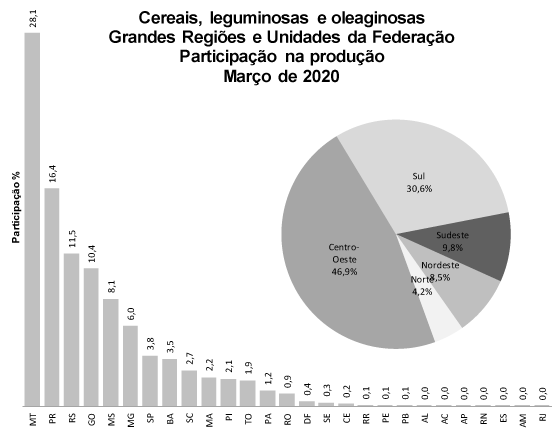
Em relação ao mês anterior, houve alta nas estimativas do cacau (17,7% ou 42,4 mil toneladas), do café canephora (4,0% ou 35,3 mil toneladas), do arroz (2,5% ou 259,7 mil toneladas), da cevada (2,5% ou 9,0 mil toneladas), do milho 2ª safra (1,8% ou 1,2 milhão de toneladas), da aveia (1,5% ou 13,6 mil toneladas) e do trigo (1,2% ou 57,7 mil toneladas).
Mas houve declínios nas da batata-inglesa 3ª safra (-0,8% ou 7,2 mil toneladas), do sorgo (-1,2% ou 31,4 mil toneladas), do feijão 2ª safra (-1,4% ou 17,8 mil toneladas), da batata-inglesa 2ª safra (-1,4% ou 16,7 mil toneladas), do feijão 3ª safra (-1,8% ou 8,5 mil toneladas), da batata-inglesa 1ª safra (-2,0% ou 33,4 mil toneladas), do milho 1ª safra (-2,7% ou 733,8 mil toneladas), da soja (-3,6% ou 4,5 milhões de toneladas), do tomate (-3,7% ou 146,4 mil toneladas), do algodão herbáceo (-3,8% ou 268,7 mil toneladas), e da uva (-5,7% ou 87,8 mil toneladas); além do café arábica (0,0% ou 354 toneladas) e do feijão 1ª safra (-0,3% ou 4,2 mil toneladas), que apresentaram certa estabilidade.
O Mato Grosso continua a liderar como maior produtor nacional de grãos, com uma participação de 28,1%, seguido pelo Paraná (15,4%), Rio Grande do Sul (11,5%), Goiás (10,4%), Mato Grosso do Sul (8,1%) e Minas Gerais (6,0%), que, somados, representaram 79,5% do total nacional. Entre as Regiões, a distribuição do volume da produção de cereais, leguminosas e oleaginosas foi: Centro-Oeste, 115,1 milhões de toneladas (46,9%); Sul, 75,0 milhões de toneladas (30,6%); Sudeste, 24,1 milhões de toneladas (9,8%); Nordeste, 20,7 milhões de toneladas (8,5%) e Norte, 10,2 milhões de toneladas (4,2%). Das Grandes Regiões, a produção cresceu no Centro-Oeste (3,2%), Norte (4,3%), Nordeste (8,1%) e no Sudeste (1,4%). A Região Sul apresentou declínio de 2,9%.
As variações positivas nas estimativas da produção ocorreram em Mato Grosso (1 965 947 t), no Paraná (560,8 mil toneladas), no Piauí (177,2 mil toneladas), em Goiás (152,5 mil toneladas), no Pará (86,9 mil toneladas), no Distrito Federal (77,5 mil toneladas), em Pernambuco (76,6 mil toneladas), no Ceará (24,2 mil toneladas) e no Espírito Santo (979 toneladas). Já as negativas ocorreram no Rio Grande do Sul (6,9 milhões de toneladas), na Bahia (85,4 mil toneladas), no Maranhão (28,7 mil toneladas), em Santa Catarina (3,6 mil toneladas) e no Rio de Janeiro (1,1 mil toneladas).
Destaques na estimativa de março de 2020
ALGODÃO HERBÁCEO (em caroço) – A terceira estimativa da produção de algodão foi de 6,7 milhões de toneladas, 3,8% abaixo da previsão de fevereiro. No Mato Grosso, maior produtor do País, a estimativa de produção é de 4,6 milhões de toneladas (-2,4% que a última estimativa). A Bahia, segundo maior produtor, estima produzir 1,4 milhão de toneladas (-9,2% frente a fevereiro). Comparada a 2019, a produção de algodão do País recuou 2,1%. O Mato Grosso deve colher 0,6% menos e a Bahia, 7,6% menos.
ARROZ (em casca) – A estimativa da produção, de 10,6 milhões de toneladas, aumentou 2,5% em relação ao mês anterior. As reavaliações da produção mais importantes foram verificadas no Rio Grande do Sul (+2,5% ou 185,1 mil toneladas) e Santa Catarina (+5,8% ou 62,1 mil toneladas), que respondem por mais de 80% da produção, e devem alcançar 7,5 e 1,1 milhão de toneladas, respectivamente. A estimativa da produção do Tocantins não mudou em relação ao mês anterior: 653,7 mil toneladas. Já a do Mato Grosso deve alcançar 377,7 mil toneladas (+3,1% em relação ao mês anterior). As produções maranhense e paranaense devem alcançar 157,8 e 140,6 mil toneladas, respectivamente, com a primeira crescendo 2,4% e a segunda decrescendo 8,4%.
Em relação a 2019, a estimativa da produção de arroz encontra-se 3,6% maior, apesar dos declínios de 2,5% na área plantada e de 1,6% na área a ser colhida.
BATATA-INGLESA – A produção brasileira deve alcançar 3,8 milhões de toneladas, declínio de 1,5% em relação ao mês anterior. Em relação a 2019, a produção recuou 2,1%.
A 1ª safra, com uma produção de 1,7 milhão de toneladas, apresenta declínio de 2,0% em relação ao mês anterior. A produção do Rio Grande do Sul foi de 334,1 mil toneladas, declínio de 9,6% em relação ao mês anterior, devido a uma prolongada estiagem.
A produção estimada para a 2ª safra foi de 1,2 milhão de toneladas, declínio de 1,4% em relação ao mês anterior. No Paraná, a produção estimada recuou 4,5%.
Com relação à 3ª safra, a estimativa encontra-se em 937,8 mil toneladas, declínio de 0,8%. A maior variação negativa foi informada por Goiás (-3,5%), que deve produzir 201,9 mil toneladas, declínio de 3,5%.
CACAU (em amêndoa) – A estimativa de produção encontra-se em 281,2 mil toneladas, crescimento de 17,7% em relação ao mês anterior. O rendimento médio encontra-se 12,5% maior. No Pará e na Bahia, maiores produtores (94,0% do total), houve reavaliação da estimativa da produção, com aumento de 27,1% e de 10,9%, respectivamente. No Pará, a área a ser colhida apresenta crescimento de 16,6%, enquanto que o rendimento médio aumentou 9,0%. Na Bahia, houve crescimento de 1,2% na área a ser colhida e de 9,5% no rendimento médio. Em relação ao ano anterior, a produção de cacau encontra-se 11,4% acima, havendo incrementos de 2,0% na área a ser colhida e de 9,1% no rendimento médio.
CAFÉ (em grão) – A estimativa da produção brasileira de café foi de 3,5 milhões de toneladas, ou 57,6 milhões de sacas de 60 kg, crescimento de 1,0% em relação ao mês anterior. Em relação ao ano anterior, a estimativa da produção foi 15,4% maior.
Para o café arábica, a produção estimada foi de 2,5 milhões de toneladas, ou 42,3 milhões de sacas de 60 kg, não havendo variação em relação ao mês anterior. Em relação a 2019, a estimativa da produção do café arábica cresceu 22,3%. Em Minas Gerais, principal produtor (74,0% do total), a estimativa da produção apresenta crescimento de 26,4%, devendo o rendimento médio aumentar 20,2% em relação ao ano anterior. A produção foi estimada em 1,9 milhão de toneladas, ou 31,2 milhões de sacas de 60 kg. Em São Paulo, a estimativa da produção cresceu 6,6% em relação a 2019, devendo ser colhida uma safra de 282,5 mil toneladas, ou 4,7 milhões de sacas de 60 kg. O rendimento médio deve crescer 4,8%.
Para o café canephora, mais conhecido como conillon, a estimativa da produção, de 920,5 mil toneladas, ou 15,3 milhões de sacas de 60 kg, apresenta crescimento de 4,0% em relação ao mês anterior. A estimativa da produção encontra-se 5,9% maior no Espírito Santo (68,8% do total nacional), em decorrência de igual aumento no rendimento médio. A produção estimada para Rondônia foi de 150,9 mil toneladas, e para a Bahia, 106,6 mil toneladas, ambas mantendo as previsões de fevereiro.
CEREAIS DE INVERNO (em grão) – Os principais cereais de inverno produzidos no Brasil são o trigo, a aveia branca e a cevada. A estimativa da produção do trigo foi de 4,9 milhões de toneladas, crescimento de 1,2% em relação ao mês anterior. Em relação ao ano anterior, a presente estimativa encontra-se 6,5% menor.
A região Sul responde por 85,6% da produção tritícola nacional. A produção gaúcha, de 1,9 milhão de toneladas, apresenta crescimento de 3,3% em relação ao mês anterior, com o rendimento médio aumentando nesse mesmo valor. No Paraná, a produção foi estimada em 2,1 milhões de toneladas e, em Santa Catarina, em 155,1 mil toneladas, mantendo as estimativas do mês anterior. No Sudeste, de 460,0 mil toneladas (MG com 190,7 mil toneladas e SP com 269,3 mil toneladas). No Centro-Oeste, as maiores produções são de Goiás, com 171,1 mil toneladas e Mato Grosso do Sul, com 51,4 mil toneladas.
A estimativa da produção da aveia foi de 917,3 mil toneladas, 1,5% acima do mês anterior. Os maiores produtores do cereal são Rio Grande do Sul, com 632,6 mil toneladas, e Paraná, com 176,7 mil toneladas. Em relação a 2019, a produção da aveia deve crescer 0,6%.
Para a cevada, a produção estimada encontra-se em 376,0 mil toneladas, crescimento de 2,5% em relação ao mês anterior. Os maiores produtores do cereal são Paraná, com 244,0 mil toneladas, e Rio Grande do Sul, com 117,0 mil toneladas. Em relação ao ano anterior, a produção de cevada deve apresentar declínio de 6,1%.
FEIJÃO (em grão) – A estimativa da produção nacional total foi de 3,1 milhões de toneladas, declínio de 1,0% em relação ao mês anterior. Os maiores produtores, somadas as três safras, são Paraná (24,7% do total nacional), Minas Gerais (16,2%) e Goiás (10,9%). Em relação à variação anual, a estimativa da produção aumentou 0,5%.
A 1ª safra de feijão está estimada em 1,3 milhão de toneladas, declínio de 0,3% frente a fevereiro, o que representa 4,2 mil toneladas. Destaques positivos para Pernambuco, com alta de 43,1%, e Ceará, com 8,0%. Os resultados são baseados no aumento do rendimento médio, que foi de 45,4% para Pernambuco e de 10,4% para o Ceará. Os destaques negativos ficaram com Santa Catarina (-14,0%) e Rio Grande do Sul (-10,3%), os dois com previsão de redução para o rendimento médio de 15,1% e 11,0%, respectivamente. Houve aumentos de 4,1% na estimativa de produção, em relação ao ano anterior.
A 2ª safra de feijão foi estimada em 1,3 milhão de toneladas, com uma redução de 1,4% frente à estimativa de fevereiro. Mato Grosso teve destaque este mês com declínio de 8,4% na estimativa de produção. Rio Grande do Sul e Paraná também aguardam uma diminuição de 6,7% e 2,1% na produção, respectivamente. Destaque positivo para Santa Catarina que prevê um aumento de 6,7% em sua estimativa de produção. Quanto à variação anual, a estimativa de produção indica aumento de 7,7% em relação a 2019.
Em relação à 3ª safra de feijão, a estimativa de produção foi de 461,4 mil toneladas, declínio de 1,8% frente a fevereiro. A área plantada também teve sua estimativa reduzida em 1,7%. Mato Grosso é a unidade da federação com maior influência nesse resultado, pois as estimativas indicam diminuição de 6,7% na área plantada, de 0,2% no rendimento médio e de 6,9% na produção. Em relação ao ano anterior, a estimativa de produção recuou 21,6%.
FUMO (em folhas) - A produção nacional de fumo em folhas foi estimada em 699,4 mil toneladas, uma redução de 6,1% em relação ao mês anterior, com queda de 5,7% na produtividade. A falta de chuvas que atingiu o Rio Grande do Sul, maior produtor nacional, foi o principal motivo para essa redução. O rendimento médio declinou 14,9% em relação aos dados divulgados em fevereiro. A estimativa da produção gaúcha foi de 291,4 mil toneladas, redução de 15,5%, ainda assim sendo responsável por cerca de 41,7% da safra nacional de fumo. A Região Sul, é responsável por cerca de 96,5% da produção nacional.
MILHO (em grão) – Em relação à última informação, a estimativa da produção cresceu 0,5%, totalizando 97,0 milhões de toneladas. Em relação ao ano anterior, a produção encontra-se 3,6 milhões de toneladas menor.
A primeira safra participa com 27,2% da produção brasileira de 2020, e a segunda safra com 72,8%. Na 1ª safra de milho, a produção alcançou 26,3 milhões de toneladas, decréscimo de 2,7% em relação ao mês anterior. Em relação a 2019, a produção foi 1,4% maior.
A produção informada pelo Rio Grande do Sul, de 4,6 milhões de toneladas, declinou 21,3% em relação ao mês anterior. Em relação ao ano anterior, a produção gaúcha encontra-se 19,3% menor. No Paraná, a produção de 3,5 milhões de toneladas, aumentou 4,4% em relação ao mês anterior.
No Nordeste, houve alta de 6,2% na produção em relação ao mês anterior, com destaque para o Piauí, onde a estimativa cresceu 12,9%, devendo produzir 2,1 milhões de toneladas.
Para a 2ª safra, a estimativa da produção foi de 70,7 milhões de toneladas, 1,8% superior ao mês anterior. Os maiores crescimentos nas estimativas de produção, em relação ao mês anterior, foram verificados no Mato Grosso (4,0% ou 1 171 015 toneladas), no Paraná (0,7% ou 81 500 toneladas), no Distrito Federal (13,4% ou 31 488 toneladas) e em Pernambuco (51,2% ou 9 974 toneladas). Para as Unidades da Federação que integram o “MATOPIBA”, apenas o Piauí renovou suas estimativas de produção, informando uma redução de 10,9%.
SOJA (em grão) – A terceira estimativa de produção de soja para 2020 totalizou 120,7 milhões de toneladas, o que representa um aumento de 6,4% em relação à safra anterior. Na atualização mensal, verificou-se uma redução de 3,6% no volume a ser colhido, resultado da forte influência dos dados levantados no Rio Grande do Sul em março, que registrou uma retração de 5,9 milhões de toneladas. Ainda assim, a produção nacional estimada para o ano é superior ao recorde registrado em 2018 que foi de 117,9 milhões de toneladas.
A produção gaúcha deve ter participação de 11,1% do total no País, com forte impacto na produção nacional. As chuvas irregulares no sul do Brasil também afetaram Santa Catarina, ocasionando retração de 3,6% no rendimento médio, e de 3,5% na produção estadual.
Em contrapartida, Mato Grosso, que em 2020 deve responder por 28,8% do volume de soja a ser produzido pelo País, estima colher 34,7 milhões de toneladas, acréscimo de 2,6% em relação ao mês anterior. A expectativa é de aumento de 7,6% na produção da safra 2020, comparativamente ao ano anterior.
O Paraná, segundo maior produtor nacional, também registrou aumento do rendimento médio de 1,7%, na comparação com o mês de fevereiro. Este ajuste impactou diretamente no volume de produção estadual, que deve totalizar 20,8 milhões de toneladas, aumento de 28,7% no comparativo com a safra anterior.
SORGO (grão) – A estimativa da produção foi de 2,7 milhões de toneladas, declínio de 1,2% em relação ao mês anterior. Na Região Centro-Oeste, Goiás reduziu sua estimativa de produção em 2,2%. Com uma produção de 1,3 milhão de toneladas, é o maior produtor brasileiro do cereal, devendo participar com 46,6% do total nacional.
Destaque positivo para a Região Nordeste com aumento de 8,0% na estimativa de produção, influenciado, principalmente, por Piauí (+36,5%), Ceará (+83,6%) e Pernambuco (+102,0%). A estimativa de produção do sorgo foi 3,7% superior a de 2019, influenciada pelo aumento do rendimento médio, estimado em 4,0%.
Diversas Unidades da Federação aumentaram as estimativas de produção, em relação a 2019, dentre eles: Ceará (150,0%), Pernambuco (104,9%), Bahia (22,7%), Mato Grosso (15,2%) e Goiás (14,4%).
TOMATE - A produção deve atingir 3,8 milhões de toneladas, uma redução de 3,7 % em relação ao divulgado em fevereiro. A queda na produção ocorreu em várias Unidades da Federação, como Goiás (-9,6%), Rio Grande do Sul (-1,7%), Pernambuco (-2,0%), Ceará (-1,7%), Paraná (-10,4%) e Rio de janeiro (-2,6%). Em relação ao ano anterior, a queda na produção chega a 6,9%, com redução de 6,5% na área plantada.
UVA – A estimativa da produção foi de 1 452,1 mil toneladas, declínio de 5,7% em relação ao mês anterior. No Rio Grande do Sul, houve declínio de 10,5% na estimativa de produção da fruta, tendo o rendimento médio caído 10,8%. A produção gaúcha responde por 51,5% da nacional. As videiras foram prejudicadas com a estiagem prolongada ocorrida na serra gaúcha, tendo como resultado a colheita de muitos frutos secos, menores e cachos menos fartos, além de possível perdas de parreirais nas propriedades mais atingidas.
Estimativa de março para safra 2020 cresce 1,5% e mantém recorde. Com alta na demanda e nos preços, safra de arroz tem estimativa elevada em 2,5%
A estimativa de março para a safra de grãos de 2020 segue recorde, ficando em 245,2 milhões de toneladas, 1,5% superior à obtida em 2019, a maior já registrada, quando foi de 241,5 milhões de toneladas. No entanto, a previsão para o ano caiu 1,6% em relação à divulgada em fevereiro, uma redução de 3,9 milhões de toneladas.
Os dados são do Levantamento Sistemático da Produção Agrícola (LSPA), divulgado hoje (9) pelo IBGE. Dentre as alterações mais importantes nessa que é a terceira estimativa do ano, houve redução no volume que era esperado para a soja e aumento para o arroz e o milho. Esses três grãos representam 93,1% da estimativa da produção e respondem por 87,3% da área a ser colhida.
“A estimativa para o milho de segunda safra foi elevada em 1,8% e a do arroz em 2,5% em março [em relação à estimativa divulgada em fevereiro]. Esses produtos, que têm grande consumo interno no país, têm subido de preço em decorrência do aumento da demanda, então aguarda-se também que cresçam os investimentos em tecnologia nessas lavouras”, comenta o gerente do LSPA, Carlos Antônio Barradas.
Quanto ao arroz, a estimativa da produção subiu para 10,6 milhões de toneladas, sendo um resultado 3,6% mais alto que o do ano anterior, apesar dos declínios de 2,5% na área plantada e de 1,6% na área a ser colhida. “O atual rendimento médio, de 6,4 quilos por hectare, é um dos maiores dos últimos anos, sendo 5,3% maior que o de 2019”, ressalta Barradas.
Já o milho teve um decréscimo na primeira safra, mas esta responde por apenas 27,2% da produção, enquanto a segunda safra representa 72,8%. As principais lavouras vêm sofrendo com a falta de chuvas, mas a expectativa para a segunda safra ficou mais otimista em março do que era em fevereiro e se espera alcançar uma produção na ordem de 70,7 milhões de toneladas.
O gerente da pesquisa destaca ainda a queda de 3,6% no volume a ser colhido de soja. “Isso se deve à prolongada estiagem no Rio Grande do Sul, que é o maior produtor nacional de soja e registrou uma retração de 5,9 milhões de toneladas em março. Por conta disso, rendimento médio esperado do grão teve queda de 29,8% na comparação com o mês anterior”, explica Barradas, acrescentando que a produção gaúcha deve ter participação de 11,1% do total no País, o que justifica o forte impacto na produção nacional.
Os efeitos das chuvas irregulares no sul do Brasil também afetaram Santa Catarina, que apresentou uma retração de 3,6% no rendimento médio esperado, impactando em 3,5% na produção estadual em comparação com o ano anterior. Ainda assim, a produção nacional estimada para o ano é superior ao recorde de volume de soja registrado em 2018 que foi de 117,9 milhões de toneladas.
DOCUMENTO: https://agenciadenoticias.ibge.gov.br/agencia-sala-de-imprensa/2013-agencia-de-noticias/releases/27379-em-marco-ibge-preve-alta-de-1-5-na-safra-de-graos-de-2020
CONAB. 09 de Abril de 2020. Safra de grãos supera pandemia e mantém produção com 251,8 milhões de t
A pandemia de COVID-19 enfrentada pelo mundo não afetou o andamento da safra brasileira. Os agricultores seguem as atividades dentro da normalidade, com adoção dos cuidados recomendados pelo Ministério da Saúde e a Organização Mundial de Saúde (OMS), além de continuar com os tratos culturais, como adubação e aplicação de defensivos no período recomendado. Com isso, a estimativa brasileira da produção de grãos passou de 251,9 milhões de toneladas para 251,8 milhões de toneladas. A queda total foi de cerca de 100 mil toneladas, mantendo ainda níveis recordes de colheita, como indicado pelo 7º Levantamento da Safra divulgado nesta quinta-feira (9) pela Companhia Nacional de Abastecimento (Conab).
Este volume deve ser registrado em uma área total cultivada de 65,1 milhões de hectares. A soja e o milho são os produtos que impulsionam o bom resultado. A oleaginosa deve apresentar uma produção de 122,1 milhões de toneladas. O maior desempenho já registrado da cultura acontece mesmo com os problemas climáticos ocorridos no Sul do país, sobretudo no Rio Grande do Sul. Nas demais regiões, o clima favoreceu e, aliado ao crescimento na área de 2,7% em relação à última temporada, a soja segue como um dos principais produtos da safra.
Outro grão de destaque, o milho deve apresentar uma colheita de 101,9 milhões de toneladas. A maior parte deste volume é esperada na segunda safra do cereal, quando se estima uma produção de 75,4 milhões de toneladas. A área tende a crescer em 4,5% comparada com a safra anterior e pode atingir 13,5 milhões de hectares. Vale destacar, ainda, que o plantio do grão encontra-se em estágio avançado. Mato Grosso, principal estado produtor, já finalizou a semeadura do milho, juntamente com Goiás, Tocantins e Maranhão. Paraná, Mato Grosso do Sul e Piauí têm mais de 90% da área semeada.
Além de milho e soja, algodão, arroz, feijão e sorgo devem registrar incremento na produção, o que influencia positivamente no número final da safra brasileira. No caso do arroz, este aumento acompanha uma queda de plantio do grão em área sequeira. Mas este movimento é seguido também de uma maior proporção do cultivo da cultura em áreas irrigadas, que geram maiores produtividades. Aliado a isso, o contínuo investimento do rizicultor em tecnologias permite a manutenção da produção, ajustada ao consumo nacional.
O algodão também deve apresentar a maior produção já registrada na série histórica, com uma colheita estimada em 2,88 milhões de toneladas da pluma do grão, influenciada pelos grandes investimentos no setor e pela expansão de área cultivada, aliada às boas condições climáticas encontradas nas principais regiões produtoras.
7º Levantamento – Safra 2019/20: https://www.conab.gov.br/info-agro/safras/graos/boletim-da-safra-de-graos
INDÚSTRIA
CNI. 08/04/2020. CNI lança boletim para ajudar micros e pequenas indústrias a enfrentar a crise. Primeira edição do Recupera MPMIndústria traz as medidas adotadas pelo governo e pela CNI com foco na sobrevivência da empresas e manutenção dos empregos
Em meio à crise econômica gerada pelo coronavírus, a Confederação Nacional da Indústria (CNI) lançou o informativo Recupera MPMIndústria, com informações para ajudar os empresários a manterem seus negócios e preservarem, ao máximo possível, os empregos. A primeira edição do documento apresentou as ações adotadas pela CNI bem como as medidas provisórias editadas pelo governo em apoio ao setor produtivo. Na segunda edição, informações sobre a MP 944, que institui o Programa Emergencial de Suporte a Empregos, e a suspensão do ICMS e ISS para micro e pequenas empresas inscritas no Simples.
“Para superar a crise do coronavírus, além das medidas do governo, que são absolutamente necessárias, as empresas têm um desafio de gestão também. É fundamental ter informações e orientação adequadas”, comentou o gerente-executivo de Política Industrial da CNI, João Emilio Gonçalves. Ele destaca o empenho da CNI em dar o suporte necessário para as micro, pequenas e médias empresas superarem a crise.
Última edição traz informações suspensão do ICMS e ISS para micro e pequenas empresas no Simples
A segunda edição do Recupera MPMIndústria detalha a Resolução nº 154 do Comitê Gestor do Simples Nacional, que posterga por 90 dias o prazo de recolhimento do ICMS e ISS apurados no Simples Nacional. Desta forma, as cobranças com vencimento original em 20/04, por exemplo, para a vencer em 20/10. Outra informação relevante que os micro e pequenos empresários podem encontrar na segunda edição do boletim diz respeito à MP 944, que institui o Programa Emergencial de Suporte a Empregos com uma linha de crédito especial exclusiva para folha de pagamento de empresas com receita bruta anual superior a R$ 360 mil e igual ou iferior a R$ 10 milhões.
Na primeira edição do Recupera MPMIndústria, há informações sobre a Medida Provisória 936/2020, que altera as relações de trabalho durante a crise da Covid-19 para permitir a redução da jornada de trabalho em até 70% com a diminuição proporcional do salário por até 90 dias. Durante esse período o trabalhador vai receber do governo o Benefício Emergencial de Preservação do Emprego e da Renda para minimizar o impacto financeiro. O informativo também trata da MP 931, que dispõem sobre a extensão do prazo para a realização de assembleias das S.As, Ltdas. e cooperativas em sete meses.
Na lista de ações adotadas pela CNI, destaque para a atuação dos Núcleos de Acesso ao Crédito (NAC), presentes em 20 estados, com profissionais aptos a orientar os empresários a captar as linhas de financiamento mais adequadas às necessidades de cada indústria. O informativo destaca ainda o apoio ao projeto de lei do senador Jorginho Mello que institui o Programa Especial de Regularização Tributária das Microempresas e Empresas de Pequeno Porte que tiverem redução de faturamento em decorrência do estado de calamidade pública em função da pandemia de COVID-19. Além do informativo, na página do NAC no Portal da Indústria, há uma série de publicações com opções de crérito.
Recupera MPMIndústria: https://drive.google.com/file/d/1pUOygpUwvPb0V7ETZHjlh7u8tR4xFVV9/view
DOCUMENTO: https://noticias.portaldaindustria.com.br/noticias/economia/cni-lanca-boletim-para-ajudar-micros-e-pequenas-industrias-a-enfrentar-a-crise/
ENERGIA
ANP. 07 de Abril de 2020. Coronavírus: ANP edita medidas relativas à produção de petróleo e gás
A ANP editou medidas a serem adotadas pelos operadores de campos de petróleo e gás natural enquanto durar a emergência de saúde pública decorrente do novo coronavírus (Covid-19). Elas são passíveis de implementação imediata, tratam de atividades relacionadas ao desenvolvimento da produção e à fiscalização da produção e estão previstas nos Despachos ANP nº 92/2020 e 262/2020.
As medidas flexibilizam o envio de revisões dos Planos de Desenvolvimento, Programas Anuais de Trabalho e Orçamento e de Produção, prorrogam os prazos para solicitações da ANP e de resposta dos concessionários sobre o Boletim Mensal da Produção, autorizam a postergação de atividades previstas para o ano de 2020 por até um ano e autorizam a queima extraordinária de gás natural até 100 mil m3/dia em campos de pequena produção. O envio do Boletim Mensal da Produção deve seguir os prazos contratuais, sem alteração. A ANP continuará monitorando os níveis de queima e poderá revogar a autorização de algum campo caso necessário.
Também está prevista a suspensão dos prazos relativos às seguintes rotinas operacionais no âmbito da medição da produção de petróleo e gás natural: coleta de amostra de gás; coleta de amostra de petróleo para determinação do fator de encolhimento e razão de solubilidade; calibração de medidores que não pode ser realizada in loco; calibração de elementos secundários, trenas e tanques; inspeção dimensional dos componentes dos sistemas de medição e tanques e verificação dos medidores de queima e teste de poços terrestres.
A iniciativa é fruto de uma primeira análise da ANP sobre as atividades de E&P passíveis de flexibilização durante o período da emergência de saúde pública decorrente do coronavírus. A Agência está avaliando a necessidade de outras medidas relacionadas a esse segmento e novas medidas poderão ser adotadas.
- Despacho nº 92/2020: http://www.anp.gov.br/images/arquivos/despachos/despacho-sdp-7-4-2020.pdf
- Despacho nº 262/2020: http://www.anp.gov.br/images/arquivos/despachos/despacho-nfp-7-4-2020.pdf
Em reunião realizada na última terça-feira (7/4), a Comissão Especial de Licitação (CEL) da Oferta Permanente aprovou a inscrição de mais duas empresas: Chevron Brasil Óleo e Gás Ltda. e Infra Construtora e Serviços Ltda. Com essas aprovações, que foram publicadas hoje (9/4) no Diário Oficial da União, a Oferta Permanente passa a contar com um total de 54 empresas inscritas.
Ao contrário das rodadas de licitações tradicionais da ANP, a Oferta Permanente não foi suspensa devido à pandemia de coronavírus e continua em andamento.
O processo de Oferta Permanente de áreas para exploração e produção de petróleo e gás natural prevê a oferta contínua de campos e blocos devolvidos (ou em processo de devolução) e de blocos exploratórios ofertados em rodadas anteriores e não arrematados. Nesta modalidade, as licitantes inscritas podem apresentar declaração de interesse, acompanhada de garantia de oferta, para quaisquer blocos ou áreas em oferta. Apresentada uma ou mais declarações de interesse, e aprovada toda a documentação, a CEL divulga cronograma para realização de um ciclo para apresentação de ofertas.
O 1º Ciclo foi realizado em 10/09/2019, resultado em 33 blocos e 12 áreas com acumulações marginais arrematadas. A ANP já promoveu a assinatura de 25 dos 45 contratos de concessão do Primeiro Ciclo da Oferta Permanente. Consulte aqui a relação dos 25 contratos assinados e os extratos publicados no DOU.
Lista completa. Oferta Permanente tem 47 empresas inscritas. Sessão pública do Primeiro Ciclo será em 10/9
A Comissão Especial de Licitação (CEL) aprovou ontem (29/7) as inscrições de mais 12 empresas para Oferta Permanente: Andorinha Petróleo Ltda., CNOOC Petroleum Brasil Ltda., Creative Energy Serviços e Exploração Ltda., Enauta Energia S.A, Exxonmobil Exploração Brasil Ltda., FE Intermodal EIRELI, FMT Serviços Indústria e Comércio Ltda., Perícia Engenharia e Construção Ltda., Petróleo Brasileiro S.A – Petrobras, Petromais Global Exploração e Produção Ltda., Petro Rio O&G Exploração e Produção de Petróleo Ltda., Shell Brasil Petróleo Ltda..
A aprovação foi publicada hoje (30/7) no Diário Oficial da União. Atualmente, há 47 empresas inscritas. A relação completa pode ser consultada aqui.
A ANP abriu o Primeiro Ciclo da Oferta Permanente com a aprovação, em 26/6, da garantia de oferta acompanhada da declaração de interesse para um dos setores em oferta, por uma das empresas já inscritas no processo. A sessão pública de apresentação de ofertas do Primeiro Ciclo será em 10 de setembro.
As demais empresas inscritas que tenham interesse em participar deste primeiro ciclo terão até o dia 07/08 para apresentar declarações de interesse acompanhadas de garantias de oferta. Os setores que estarão na sessão pública de apresentação de ofertas neste primeiro ciclo serão divulgados até o dia 16/08.
| Sociedade empresária | Inscrição | Ata da CEL | DOU | |
| 1 | AFV Empreendimentos e Participações Ltda. | Aprovada | Ata nº 16, de 05/12/2019 | 09/12/2019 |
| 2 | Andorinha Petróleo Ltda. | Aprovada | Ata nº 10, de 29/07/2019 | 30/07/2019 |
| 3 | Alvopetro S/A Extração de Petróleo e Gás Natural | Aprovada | Ata nº 08, de 26/06/2019 | 27/06/2019 |
| 4 | BP Energy do Brasil Ltda. | Aprovada | Ata nº 07, de 27/03/2019 | 28/03/2019 |
| 5 | Brasil Refinarias Ltda. | Aprovada | Ata nº 08, de 26/06/2019 | 27/06/2019 |
| 6 | Capricorn Brasil Petróleo e Gás Ltda. | Aprovada | Ata nº 03, de 14/09/2018 | 17/09/2018 |
| 7 | Central Resources do Brasil Produção de Petróleo Ltda. | Aprovada | Ata nº 06, de 16/01/2019 | 17/01/2019 |
| 8 | Chevron Brasil Óleo e Gás Ltda. | Aprovada | Ata nº 21, de 07/04/2020 | 09/04/2020 |
| 9 | Construtora Kamilos Ltda. | Aprovada | Ata nº 06, de 16/01/2019 | 17/01/2019 |
| 10 | CNOOC Petroleum Brasil Ltda. | Aprovada | Ata nº 10, de 29/07/2019 | 30/07/2019 |
| 11 | Creative Energy Serviços e Exploração Ltda. | Aprovada | Ata nº 10, de 29/07/2019 | 30/07/2019 |
| 12 | Guindastes Brasil Locação de Equipamentos Ltda. | Aprovada | Ata nº 06, de 16/01/2019 | 17/01/2019 |
| 13 | DBO Energy do Brasil | Aprovada | Ata nº 16, de 05/12/2019 | 09/12/2019 |
| 14 | DEA Deutsche Erdol AG | Aprovada | Ata nº 04, de 15/10/2018 | 15/10/2018 |
| 15 | Dimensional Engenharia Ltda. | Aprovada | Ata nº 03, de 14/09/2018 | 17/09/2018 |
| 16 | Eagle Exploração de Óleo e Gás Ltda. | Aprovada | Ata nº 06, de 16/01/2019 | 17/01/2019 |
| 17 | Enauta Energia S.A. | Aprovada | Ata nº 10, de 29/07/2019 | 30/07/2019 |
| 18 | Energizzi Energias do Brasil Ltda. | Aprovada | Ata nº 03, de 14/09/2018 | 17/09/2018 |
| 19 | Eneva S.A. | Aprovada | Ata nº 06, de 16/01/2019 | 17/01/2019 |
| 20 | Êxito Importadora e Exportadora S.A. | Aprovada | Ata nº 05, de 04/12/2018 | 05/12/2018 |
| 21 | Exxonmobil Exploração Brasil Ltda. | Aprovada | Ata nº 10, de 29/07/2019 | 30/07/2019 |
| 22 | FE Intermodal EIRELI | Aprovada | Ata nº 10, de 29/07/2019 | 30/07/2019 |
| 23 | FMT Serviços Indústria e Comércio Ltda. | Aprovada | Ata nº 10, de 29/07/2019 | 30/07/2019 |
| 24 | Geopark Brasil E&P de Petróleo e Gás Ltda. | Aprovada | Ata nº 05, de 04/12/2018 | 05/12/2018 |
| 25 | Great Energy S.A. | Aprovada | Ata nº 05, de 04/12/2018 | 05/12/2018 |
| 26 | Guindastes Brasil Óleo e Gás Ltda. | Aprovada | Ata nº 02, de 28/08/2018 | 29/08/2018 |
| 27 | Imetame Energia Ltda. | Aprovada | Ata nº 05, de 04/12/2018 | 05/12/2018 |
| 28 | Infra Construtora e Serviços Ltda. | Aprovada | Ata nº 21, de 07/04/2020 | 09/04/2020 |
| 29 | Karoon Petróleo e Gas Ltda. | Aprovada | Ata nº 05, de 04/12/2018 | 05/12/2018 |
| 30 | Murphy Exploration & Production Company | Aprovada | Ata nº 05, de 04/12/2018 | 05/12/2018 |
| 31 | Newo Óleo e Gás Ltda. | Aprovada | Ata nº 08, de 26/06/2019 | 27/06/2019 |
| 32 | NTF Óleo e Gás Ltda. | Aprovada | Ata nº 07, de 27/03/2019 | 28/03/2019 |
| 33 | Oil Group Exploração e Produção S.A. | Aprovada | Ata nº 05, de 04/12/2018 | 05/12/2018 |
| 34 | OP Energia Ltda. | Aprovada | Ata nº 16, de 05/12/2019 | 09/12/2019 |
| 35 | Partex Brasil Ltda. | Aprovada | Ata nº 05, de 04/12/2018 | 05/12/2018 |
| 36 | Perícia Engenharia e Construção Ltda. | Aprovada | Ata nº 10, de 29/07/2019 | 30/07/2019 |
| 37 | Petroborn Óleo e Gás S.A. | Aprovada | Ata nº 02, de 28/08/2018 | 29/08/2018 |
| 38 | Petroil Óleo e Gás Ltda. | Aprovada | Ata nº 07, de 27/03/2019 | 28/03/2019 |
| 39 | Petro Rio O&G Exploração e Produção de Petróleo Ltda. | Aprovada | Ata nº 10, de 29/07/2019 | 30/07/2019 |
| 40 | Petromais Exploração e Produção S.A.* | Aprovada | Ata nº 04, de 15/10/2018 | 15/10/2018 |
| 41 | Petróleo Brasileiro S.A. | Aprovada | Ata nº 10, de 29/07/2019 | 30/07/2019 |
| 42 | Petromais Global Exploração e Produção Ltda. | Aprovada | Ata nº 10, de 29/07/2019 | 30/07/2019 |
| 43 | Petrosynergy Ltda. | Aprovada | Ata nº 06, de 16/01/2019 | 17/01/2019 |
| 44 | Petro-Victory Energia Ltda. | Aprovada | Ata nº 06, de 16/01/2019 | 17/01/2019 |
| 45 | Phoenix Empreendimentos Ltda. | Aprovada | Ata nº 02, de 28/08/2018 | 29/08/2018 |
| 46 | Premier Oil do Brasil Petróleo e Gás Ltda. | Aprovada | Ata nº 16, de 05/12/2019 | 09/12/2019 |
| 47 | Repsol Exploração Brasil Ltda. | Aprovada | Ata nº 02, de 28/08/2018 | 29/08/2018 |
| 48 | Rosneft Brasil E&P Ltda. | Aprovada | Ata nº 08, de 26/06/2019 | 27/06/2019 |
| 49 | Shell Brasil Petróleo Ltda. | Aprovada | Ata nº 10, de 29/07/2019 | 30/07/2019 |
| 50 | Total E&P do Brasil Ltda. | Aprovada | Ata nº 16, de 05/12/2019 | 09/12/2019 |
| 51 | Tucano Serviços de Apoio a Óleo e Gás Eirelli | Aprovada | Ata nº 06, de 16/01/2019 | 17/01/2019 |
| 52 | Ubuntu Engenhria e Serviços Ltda. - ME | Aprovada | Ata nº 04, de 15/10/2018 | 15/10/2018 |
| 53 | Vipetro Petróleo S.A. | Aprovada | Ata nº 05, de 04/12/2018 | 05/12/2018 |
| 54 | Wintershall do Brasil Exploração e Produção Ltda. | Aprovada | Ata nº 06, de 16/01/2019 | 17/01/2019 |
*Em agosto de 2019, a razão social foi alterada de "Petrol Serviços de Sondagem Ltda. - EPP" para "Petromais Exploração e Produção S.A."
O que é a Oferta PermanenteO processo de Oferta Permanente de áreas para exploração e produção de petróleo e gás natural, prevê a oferta contínua de campos devolvidos (ou em processo de devolução), de blocos exploratórios ofertados em rodadas anteriores e não arrematados e também dos blocos devolvidos à Agência. De acordo com essa modalidade, as licitantes inscritas podem apresentar interesse para quaisquer blocos ou áreas, desde que apresentem declaração de interesse acompanhada de garantia de oferta. Apresentada uma ou mais declarações de interesse, e aprovada toda a documentação, a CEL da Oferta Permanente divulga cronograma para realização de um ciclo para apresentação de ofertas.
DOCUMENTO: http://www.anp.gov.br/noticias/5728-duas-novas-empresas-sao-inscritas-na-oferta-permanente
________________
LGCJ.:

