US ECONOMICS
CORONAVIRUS
U.S. Department of State. 03/30/2020. Briefing With Dr. William Walters, Deputy Chief Medical Officer for Operations, Bureau of Medical Services, and Principal Deputy Assistant Secretary Ian Brownlee, Bureau of Consular Affairs On Updates On Health Impact and Assistance For American Citizens Abroad
- Ian G. Brownlee, Principal Deputy Assistant SecretaryBureau of Consular Affairs
- Dr. William Walters
To help give you a more granular sense of the mission, we have joining us for today’s on-the-record call Principal Deputy Assistant Secretary from the Bureau of Consular Affairs Ian Brownlee, as well as Dr. William Walters, Deputy Chief Medical Officer for Operations in our Bureau of Medical Services. Dr. Walters will begin with some opening remarks and then turn it over to Principal Deputy Assistant Secretary Brownlee, and then we’ll take a few of your questions.
A reminder that this briefing is – the contents of this briefing are embargoed until the end of the call.
Dr. Walters, please go ahead.
MR WALTERS: Thanks for the opportunity to once again address my colleagues from the press. The department continues to sustain and protect our overseas workforce in over 200 locations around the world. With a large employee footprint, nearly 75,000 employees, our current caseload overseas is only 75 cases – five hospitalized, all locally employed. Domestically we have 30 cases in nine cities. Most cities are single case or two cases. We do not have a documented case of employee-to-employee transmission. We’re watching very closely to that. We’ve been very aggressive in identifying cases early, decontaminating or disinfecting any impacted spaces and getting those spaces back into operation to support State Department functions on behalf of the American people.
With that, I’ll yield to PDAS Brownlee.
MR BROWNLEE: Thanks very much, Dr. Walters. Good afternoon, everyone. Thank you for once again joining us here.
Our repatriation flights continued through the weekend, and I am pleased to report that we have thus far brought home over 25,000 Americans from over 50 countries. We are tracking over 100 additional flights over the next week, and we have identified an additional 9,000 U.S. citizens who have indicated interest in those flights. There is still space for more on those flights, though.
I know I’ve said this several times already, but we do not know how long commercial flights will remain available, nor do we know how long the U.S. Government will be able to facilitate additional flights where commercial options no longer exist. It is therefore imperative that U.S. citizens make plans now to avail themselves of these options. We are seeing more U.S. citizens decide to stay abroad and ride out this crisis where they are. If people decide not to take advantage of these flights now, they will also need to hunker down where they are.
Regarding Peru, to date approximately 2,800 U.S. citizens have been brought home. Two flights will be departing today, one each from Lima and Cusco. Buses are bringing U.S. citizens from outlying regions Ica and Trujillo to Lima for the citizens’ return to the United States. Approximately 120 who are in Arequipa have already reached the United States.
We are also aware of cases in Peru in which U.S. citizens were placed under quarantine in facilities where they are staying. Quarantine measures due to the outbreak of COVID-19 are enforced by Peru’s ministry of health, and exceptions are not made for international tourists. Principal Deputy Assistant Secretary of State for Western Hemisphere Affairs Julie Chung and Charge d’Affaires Denison Offutt spoke with Peruvian Government officials at the highest level to address this issue. We are working to ensure that travelers placed under quarantine have access to appropriate food and healthy living conditions.
In the meantime, we remind all U.S. citizens to adhere to the Peruvian Government’s quarantine measures. We continue to see the demand for repatriation assistance from U.S. citizens in Central and South America, and now we are seeing growing interest from U.S. citizens wanting to return from Asia, India, Bangladesh, and Indonesia. We had our first flight – repatriation flight out of Bangladesh today and are coordinating with the Indian Government to begin flights there.
I know I keep repeating this message, but I want to emphasize once again how important it is for U.S. citizens to enroll at step.state.gov so we can continue to get them the latest information. Our travel.state.gov website and embassy websites have a wealth of information and the latest traveler and health – travel and health alerts. If somebody isn’t getting their STEP alerts for some reason, they should look at the relevant websites for the country where they are located. All the information is there.
Our consular officers at home and abroad are working around the clock to bring home as many Americans as possible. From Dhaka, Bangladesh to Tegucigalpa, Honduras, our teams are on the ground coordinating these trips home for U.S. citizens. I am proud to represent these public servants as they work nonstop to get our fellow U.S. citizens back home.
With that, I will await your questions. Thank you very much.
OPERATOR: And once again, ladies and gentlemen, it is 1 followed by 0 if you’d like to queue up here for a question. It looks like our first question comes from the line of Jennifer Hansler of CNN. Your line is open.
QUESTION: Hi, thanks. I was wondering if you could get into a bit more detail about what you are telling those stranded travelers at that hostel in Peru about their situation, what they should do. There’s been some reported cases of positive tests in that hostel, and we’ve heard some concerns about the safety of the situation.
And then separately, are you aware of any deaths among the State Department staff due to coronavirus? Thanks.
MR BROWNLEE: With regard to the folks at the hostel, as I said, we are encouraging them to comply with the quarantine regulations. At the same time, we are actively working at the highest levels of the Peruvian Government to facilitate their move from that hostel to an area where we can bring them home again. In the meantime, we are encouraging the local health authorities to ensure that they are cared for well, that they are given sufficient food, and that any health needs they might have are met.
And I will turn it over to Dr. Walters for the other question about deaths.
MR WALTERS: So the department is aware of two locally employed staff – I don’t have locations and wouldn’t be able to provide further details – that have died overseas in their own country related to coronavirus. I don’t have any further details that I can pass on. There have been no deaths domestically or with any U.S. direct hires.
MR BROWN: Okay. Can we go to the line of Nick Wadhams for the next question?
QUESTION: Hi, thanks very much. I just wanted to check with you guys to get a little bit of context. The Europe restrictions by the Trump administration were put in place around March 11th or so, but the State Department Task Force on Repatriating Americans was not actually instituted until March 19th. In the calls that we’ve had so far, I haven’t really heard an explanation for why there was such a lag by the department to set up this task force. Was it a sense that there was not really a belief that there was going to be a flood of Americans? I mean, I know some of these airport closures happened quite suddenly, as you’ve mentioned before, but that seems sort of like a somewhat predictable response.
Can you give a little bit more context on why that took so long? Thanks.
MR BROWNLEE: Certainly. Ian Brownlee here. Yes, President Trump signed that 212(f) declaration with regard to the Schengen zone and followed up with regard to the UK before we set up a task force, but we have our Office of Overseas Citizens Services works at normal times round the clock to assist U.S. citizens seeking repatriation. The Office of Logistics Management in the Bureau of Administration is always available to assist with chartering aircraft to bring people home. So both of those offices, both of those bureaus and directorates, were already vigorously working this issue.
So for example, in the case of Morocco, we had flights – it seems like a long time ago now. We had, I think, brought 1,200 people out of Morocco. That was right at the time the task force was preparing to stand up. So that is a demonstration that even without the task force we were meeting the need to bring U.S. citizens home. Over.
MR WALTERS: Yeah, it’s Dr. Walters. I’d add to that the task force brought together a series of disparate operations under some great leadership, but remember when this outbreak started very early on, we were bringing American citizens out of Wuhan, we were bringing American citizens back from Yokohama. With every disaster, not just this one, the State Department has a mechanism that it follows for rescuing and evacuating American citizens. It’s just the scope of this – it kind of drove a deliberate super structure for it. There’s 57 international airports on the African continent. I would say almost all of them right now are closed. That’s unprecedented, and it’s not isolated to Africa. And so while we were keeping pace with the requirements, even when you look at China early on, the airports didn’t close. Like Wuhan closed down and Hubei closed down, but China, from an international air travel, continued on. They didn’t – that didn’t shut off completely, and so there were still mechanisms for American citizens to find their way home. But as this spread and, I would foreshadow, as this spreads into the Southern Hemisphere, the repatriation and evacuation of American citizens outside of what would normally be commercial air travel is going to continue to be a significant challenge.
MR BROWN: Sorry. For our next question, can we go to the line of Christina Ruffini?
QUESTION: Hi. Sorry, I couldn’t get my mute button off. I’m wondering if you guys can give us any kind of context as to the staffing at the embassies. I had heard from some folks in Central and South America who said that one of the problems is a lot of the staff themselves have gone home, so they’re trying to do this with minimal bodies not only in the office but working remotely as well. Can you give us any kind of numbers? Are they down by half? Are they down by a third? Does it depend on the region? Anything you can do to help out, that would be great. Thanks.
MR BROWNLEE: Some posts around the world are facing reduced staffs, but where needed, we are sending additional staff out to assist. So for example, in the case of Lima, we have – seven additional people have gone down there to help out. One is my counterpart from the Bureau of Western Hemisphere Affairs, Julie Chung, who is down there to assist with dealing with the high-level communications with the Government of Peru. We also sent down six consular officers to augment the staff in the consular section there. We’re going to have to get back to you with numbers around the world. It really is a post-by-post situation.
We have not found it necessary to send additional staff out to the other countries in Central America, where we’ve had such great demand in the past 10 days, nor in Ecuador. So I think that’s an indication that it’s very much a post-specific situation. Lima, yes, we did send additional staff. The other countries we did not. Over.
MR BROWN: Okay. For the next question, if we could go to Nick Schifrin.
QUESTION: Awesome. Wanted to focus to – my questions today on cases inside of State. It doesn’t look (inaudible) been updating, have updated in the last few days. So if you could just go over the number of positive cases pending tests both in the U.S. and overseas. And I want to specifically ask about the large number of overseas self-isolating. Just wanted to see whether that was indicative of any hot spots in any particular embassies or countries or any other context you can give on the fact that more than 1,700 are self-isolating. Thanks.
MR WALTERS: Yeah, your question broke up a little bit at the beginning, but from what I understand, I think you’re really just sort of digging into the statistics. Let me go over those that I have available for you now.
As stated earlier, positive cases domestically are 30 and 75. Important to remember that of the 75 overseas, 21 have recovered and we’re seeing that. We’re seeing people who had mild illness, were treated very well through the embassy health unit at home, and went on to recover and sort of return to the embassy community.
Yet we’re looking at persons under evaluation of 79 domestically and 488 overseas reflecting really two things: One, we have a much larger footprint globally than we have in the United States, because we are the lead federal foreign affairs agency. But second, we have a much lower threshold to sort of move someone out of the embassy community and into their home, in part because it is such a small community within those embassies that people are noticed right away and self-isolated right away to keep them away from or to socially distance them from what is otherwise a very small and sort of walled-in community. And so the threshold may be a little bit lower, even, and it’s not anything by policy, just by practice. Cases are recognized earlier, they’re isolated earlier, and with a much lower threshold to do so.
So we’re not seeing high numbers of cases. We’re not seeing a ton of Medevacs. I mean, we’ve done a total of two Medevacs, both with very mild symptoms, only 85 tests pending overseas. So what we’re doing seems to be working but we’re being very aggressive in self-isolation.
MR BROWN: Yeah, and we’ll update those statistics on the page this afternoon.
Okay, for the next question, can we go to Abbie Williams?
QUESTION: Hi, thanks for doing the call. Given the developments that are coming forward and the fact that it seems like even those outside of the special risk categories are not entirely immune from danger, has there been any consideration of expanding the mission-wide authorized departure to go a little broader to outside of just diplomats at high risk? And what is the current number of U.S. missions on ordered or authorized departure? Thanks so much.
MR BROWNLEE: I’m sorry, Ian Brownlee here. I am not aware of conversations about broadening the authorized or ordered departure list, and I am trying to find – and I may have to get back to you with that number, the number who are – the posts that are on authorized or ordered departure. I will have to take that question. I’m sorry.
MR WALTERS: Although what I would point out is the Secretary took sort of the unprecedented step of a global authorized for the most high-risk individuals. And so there – the safety of those Foreign Service officers at any post has been taken into consideration with the ability for either a no-cost curtailment or authorized departure no matter where they are, because what we recognize now that we didn’t recognize at the beginning of the outbreak because we didn’t have the epidemiology information from the Chinese from the early outbreak is that this is – this spreads very rapidly. And that’s – really there aren’t any posts that are immune to the spread of coronavirus.
MR BROWN: Okay. I think we have time for one more question, so if we could open the line of Deirdre Shesgreen from USA Today.
QUESTION: Hi, thanks so much for doing the call. You mentioned early on that you were paying for these repatriations through the K Fund. Can you say how much is – how much you’ve spent, how much is left, and any concern that you may run out of money? Any plans to go back to Congress to ask for more?
MR BROWNLEE: Ian Brownlee here. As to the specifics of that question, we’re going to have to get back to you. We don’t have anybody from the Office of Budget and Planning on this call.
I will say this: I’ve either been directly or participated in numerous call with both appropriators, authorizers, and other members of Congress over the last several weeks, and have found in every case a readiness to assist us in assisting our fellow U.S. citizens overseas in getting home. So at this point I’m not concerned about the K Fund running dry, but with regard to specifics, we’re going to have to get back to you with data coming from the Office of Budget and Planning. Over.
MR BROWN: Okay. Thanks, everyone, for joining today. I know that our briefers have other commitments that they’ve got to break away for. Thanks for joining. As we’ve reached the end of the call, the embargo on the contents is lifted on this on-the-record briefing. Thank you.
U.S. Department of State. 03/30/2020. Secretary Michael R. Pompeo With Sean Hannity of The Sean Hannity Show
QUESTION: Here with more on China as well as America’s behind-the-scenes effort to get thousands of Americans back home during this outbreak is Secretary of State Mike Pompeo. Mr. Secretary, I know for a fact that you have gotten people – we had people on missions – you’ve gotten them home safely, people all across the globe. You’ve been working 24/7. I want people to know what you’ve been doing behind the scenes.
SECRETARY POMPEO: Well, Sean, thanks. Thanks for having me on the show tonight. The State Department team has done amazing work. Over 25,000 Americans returned home when airports all across the world, roads across the world were closed, when health care facilities across the world were closed. These Americans wanted to come home. Twenty-five thousand Americans, 50 countries, some dozens and dozens of flights. We’ve got several thousand more people to get home, and the State Department is hard at work.
If you heard some of these stories, you just heard the story of the Comfort, the story from Samaritan’s Purse, if you heard the stories of what the State Department has done to get people out of places like Bhutan, an impossible place to get to. We had a sick American, an American citizen who was suffering. We got him out, we got him back, we got him to safety. Truly good work to bring Americans home. It’s the best of what the Trump administration has demonstrated in this enormous crisis.
QUESTION: Mr. Secretary, we’ve got to deal with this issue of China. Are you confident now? They have valuable intel and information that could help the world after they hid this, when you said the last time on this show, you would have gladly sent our experts over to help them.
SECRETARY POMPEO: Sean, President Trump and I have been committed to making sure that we had the best data available. When you hear Doctors Fauci and Birx talk about risk, talk about fatalities, trying to think about how to model, what they need is data.
They need data from Italy. They need data from China. They need data from Iran. We need every country to step up and provide accurate, transparent information. And if we can’t have that, if we have disinformation instead, there are more lives that will be at risk not only today but in the weeks ahead as we battle this enormous challenge.
We’ve asked every country to step up and tell us what they know so that the world can learn. America will then turn around and we will share the information we get, and we’ll keep people safe not only here in the United States but all across the world.
QUESTION: You’re having a problem with Iran. The last time on this program you actually said if they ask for help, you would give it. Tell us what’s going on.
SECRETARY POMPEO: We have repeatedly offered the people of Iran assistance. We want – this is a humanitarian crisis inside the Islamic Republic of Iran as well. We have offered to provide humanitarian assistance. We have offered to provide assistance, if they don’t want to take it from America, to help other countries get their assistance into the country. That offer stood then; that offer stands now. Sadly, the Islamic Republic of Iran’s regime, the leadership, has rejected those offers of humanitarian assistance from us here in America. It’s really unfortunate for the Iranian people. There will be Iranians who die.
QUESTION: A lot has been made over calling it the Wuhan virus, and you took issue with anybody saying sorry, we do that with a lot of other illnesses.
SECRETARY POMPEO: Yeah, President Trump was very clear. I think he even said it again this morning. Yes, he talked about it as being the Chinese coronavirus. But what we’ve been looking for here all along is we simply want to make sure we understand what’s happened so that we can prevent the loss of life moving forward. We’re looking to cooperate with every country. We’d love to cooperate with the Chinese as well to get the right information so that we can do all that’s needed to find therapeutics, to find a vaccine, to do everything we can to reduce the risk that there will be more lives lost as the world moves forward.
QUESTION: Mr. Secretary, thank you, and thank you for bringing home all of those Americans. That story will be tell – will be told over time.
FED. March 31, 2020. Federal Reserve announces establishment of a temporary FIMA Repo Facility to help support the smooth functioning of financial markets
The Federal Reserve on Tuesday announced the establishment of a temporary repurchase agreement facility for foreign and international monetary authorities (FIMA Repo Facility) to help support the smooth functioning of financial markets, including the U.S. Treasury market, and thus maintain the supply of credit to U.S. households and businesses. The FIMA Repo Facility will allow FIMA account holders, which consist of central banks and other international monetary authorities with accounts at the Federal Reserve Bank of New York, to enter into repurchase agreements with the Federal Reserve. In these transactions, FIMA account holders temporarily exchange their U.S. Treasury securities held with the Federal Reserve for U.S. dollars, which can then be made available to institutions in their jurisdictions. This facility should help support the smooth functioning of the U.S. Treasury market by providing an alternative temporary source of U.S. dollars other than sales of securities in the open market. It should also serve, along with the U.S. dollar liquidity swap lines the Federal Reserve has established with other central banks, to help ease strains in global U.S. dollar funding markets.
The Federal Reserve provides U.S. dollar-denominated banking services to FIMA account holders in support of Federal Reserve objectives and in recognition of the U.S. dollar's predominant role as an international currency. The FIMA Repo Facility, which adds to the range of services the Federal Reserve provides, will be available beginning April 6 and will continue for at least 6 months.
U.S. Department of State. 03/31/2020. The U.S. Role in International Organizations’ Response to COVID-19
“Whenever you see high quality, effective COVID-19 aid being delivered around the world by UN humanitarian and relief agencies, what you are seeing is the generosity of the American people and those who share our humanitarian values. We are by far the largest contributors to organizations like the UN Children’s Fund and the World Food Program because we believe in effective multilateralism that is focused on helping those in need, not scoring political points. This is what true global leadership looks like.”
***
The United States is by far the most generous and reliable contributor to crisis response and humanitarian action through the United Nations and dozens of international organizations. U.S. assistance, monetary and in-kind contributions, expertise and technology, are indispensable to the effort to combat COVID-19. Examples include:
— Secretary Michael R. Pompeo, March 27, 2020
U.S. Support to the World Health Organization (WHO)
- The United States has been the largest supporter of the World Health Organization since its creation in 1948. U.S. contributions to WHO in 2019 exceeded $400 million, almost double the 2nd largest member state contribution. China, in contrast, contributed $44 million.
- WHO is coordinating the global response to the COVID-19 pandemic, and is on the ground in 149 countries around the world. This broad-based effort would not be possible without U.S. support.
- The United States and other significant partners, such as Great Britain, Germany, Japan, and the Gates Foundation, have invested for decades in WHO’s emergency preparedness, response capacity, and expertise.
U.S. Support to the United Nations Children’s Fund (UNICEF)
- UNICEF was one of the first organizations to provide aid to the Chinese people during the COVID-19 pandemic. On January 29, for instance, UNICEF delivered 6 metric tons of respiratory masks and protective suits for health workers to Shanghai, for distribution in Wuhan.
- This effort would not have been possible without U.S. support. In 2019, the U.S. contributed more than $700 million to UNICEF, compared to China’s $16 million for UNICEF programs.
- UNICEF is engaged in emergency actions in dozens of countries across the globe to provide critical medical supplies, expand water, sanitation and hygiene services, and educate about means of preventing the spread of the virus.
- The United States continues to work vigorously with UNICEF to promote the health and well-being of children around the world.
U.S. Support to the United Nations Refugee Agency (UNHCR)
- Refugee populations are uniquely vulnerable to the COVID-19 pandemic, and U.S. support to UNHCR is unmatched.
- In 2019, the United States contributed nearly $1.7 billion to UNHCR, making it clear that we care about human suffering no matter where it occurs. China contributed $1.9 million.
U.S. Support to the World Food Program (WFP)
- The World Food Program, through its Humanitarian Response Department, has sent more than 85 shipments to 74 countries to assist in COVID-19 responses, including 1.4 million units of personal protection equipment such as health kits.
- In 2019, the United States provided 42% of WFP’s $8 billion in resources, making the U.S. the largest contributor, and four times the next largest member state donation. The PRC provided just $30 million.
- Even in the midst of the pandemic, WFP maintains its goal to reach 86 million food insecure people this year – thanks to American funding and food grown by American farmers.
U.S. Department of State. 03/31/2020. Secretary Pompeo’s Call with Indian External Affairs Minister Dr. S. Jaishankar
The below is attributable to Spokesperson Morgan Ortagus:
Secretary of State Michael R. Pompeo spoke with Indian External Affairs Minister Dr. S. Jaishankar by telephone today regarding coordination of efforts to respond to COVID-19. The Secretary highlighted the importance of continued close cooperation between the United States, India, and other close partners and allies to combat this international crisis, including strengthening global pharmaceutical and healthcare manufacturing and supply chains. He also reiterated the United States’ unwavering commitment to work with India to advance peace, prosperity, and security in the Indo-Pacific and around the globe.
U.S. Department of State. 03/31/2020. U.S. Support for ASEAN in Fighting COVID-19
As the leader in the global health and humanitarian response to COVID-19, the United States has acted swiftly to support our ASEAN partners in combating the COVID-19 virus. Since the outbreak began, the U.S. government has provided approximately $18.3 million in emergency health and humanitarian assistance to ASEAN Member States. Globally, as of March 26, 2020, the United States is providing an initial investment of nearly $274 million in emergency health and humanitarian assistance to help countries in need, on top of the funding we already provide to multilateral organizations such as the World Health Organization and UNICEF.
This total to date includes nearly $100 million in emergency health assistance from USAID’s Global Health Emergency Reserve Fund and $110 million in humanitarian assistance from USAID’s International Disaster Assistance account, to be provided for up to 64 of the most at-risk countries facing the threat of this global pandemic. Through the State Department’s Bureau of Population, Refugees, and Migration, the UN Refugee Agency (UNHCR) will receive $64 million in humanitarian assistance to help address the threats posed by COVID-19 in existing humanitarian crisis situations for some of the world’s most vulnerable people.
New Funding to Support ASEAN in Fighting COVID-19:
U.S. funding to ASEAN countries on COVID-19 supports the following goals:
- Prepare laboratories for large-scale testing for COVID-19;
- Infection prevention and control;
- Enable risk communication;
- Implement public-health emergency plans for border points of entry;
- Activate case-finding and event-based surveillance for influenza-like illnesses;
- Train and equip rapid-responders in investigation and contact-tracing;
- Update training materials for health workers.
U.S. government agencies spearheading out international response, including The Department of State, USAID, and the U.S. Centers for Disease Control and Prevention (CDC) are working closely to allocate funds based on COVID-19 hotspots and vulnerabilities. The United States also coordinates with other donors to complement assistance and avoid duplicating efforts.
America’s Leading Support for ASEAN’s Public Health
This emergency support is in addition to the nearly $3.5 billion dollars in public health assistance the United States has provided to ASEAN Member States over the last twenty years. The United States is the global leader in public health assistance, with more than $9.5 billion allocated in 2019 to support public health overseas, including in Southeast Asia. This amount includes funding to counter pandemic threats, HIV/AIDS, malaria, tuberculosis (TB), and other health needs. Since 2009, American taxpayers have generously funded more than $100 billion in health assistance and nearly $70 billion in humanitarian assistance globally. Our country continues to be the single largest health and humanitarian donor for both long-term development and capacity building efforts with partners, and emergency response efforts in the face of recurrent crises. This money has saved lives, protected people who are most vulnerable to disease, built health institutions, and promoted the stability of communities and nations.
U.S. Emergency COVID-19 Support for ASEAN Countries (by country, as of March 26):
The United States is providing both technical assistance and financial support to ASEAN Member States, initially $18.3 million. That support is outlined below:
Brunei:
- The Department of State conveyed Brunei’s request to U.S. companies for availability of respirators and Personal Protective Equipment (PPE) after U.S. domestic demands are met.
Cambodia:
- Approximately $2 million in health assistance will help the Cambodian government prepare laboratory systems, activate case-finding and event-based surveillance, and support technical experts for response and preparedness, and more.
- The CDC is assisting Cambodia with contact tracing clinical management, lab testing, surveillance, and infection control.
- A U.S. National Institutes of Health (NIH) infectious disease physician is assisting with clinical consultations, and developing clinical care guidelines for the Royal Phnom Penh Hospital (Cambodia’s designated treatment hospital).
- The United States has invested long-term in Cambodia, providing more than $730 million in health and more than $1.6 billion in total assistance over the past 20 years.
Indonesia:
- $2.3 million in health assistance will help the Indonesian government prepare laboratory systems, activate case-finding and event-based surveillance, and support technical experts for response and preparedness, and more.
- CDC has provided technical assistance to Indonesian health officials. The U.S. Army-led Armed Forces Research Institute of Medical Sciences (AFRIMS), based in Bangkok, provided reagents to run an additional 500 tests in March.
- The United States has invested more than $1 billion in health and more than $5 billion in total assistance over the past 20 years.
Laos:
- Nearly $2 million in health assistance will help the Lao government prepare laboratory systems, activate case-finding and event-based surveillance, and support technical experts for response and preparedness, and more. The Department of Defense (DOD) is working to provide additional testing equipment.
- Six CDC specialists traveled to Laos to provide epidemiology, surveillance, and lab training.
- The CDC and DOD led a table-top exercise and simulation with Laos government partners in March on COVID-19 mitigation. This included a simulation exercise on COVID-19 readiness and response at Wattay International Airport on 19-20 March
- Ongoing U.S. Defense Threat Reduction Agency (DTRA) support and training, particularly the Biological Threat Reduction Program, support Lao Ministry of Health capacity to professionally test for COVID-19.
- The United States has invested nearly $92 million in health and more than $348 million total over the past 20 years in Laos.
Malaysia:
- The Department of State is identifying U.S. companies that can supply the Malaysian government with ventilators and PPE after U.S. domestic demands are met.
- The Department of State is seeking to link the Malaysian Institute of Medical Research with appropriate companies and agencies for assistance with antigen testing and vaccine development training.
Myanmar:
- Approximately $3.8 million in health and humanitarian funding will go toward water and sanitation supplies, COVID-19 case management, event-based surveillance, coordination, and more.
- The CDC helped the Ministry of Health and Sports to launch a nationwide online tele-mentoring session on COVID-19, that is providing Myanmar’s frontline health workers with timely, accurate information on the outbreak at 100+ locations nationwide.
- The CDC is also providing technical assistance on epidemiology, surveillance and laboratory case detection to the Myanmar’s Central Epidemiology Unit and the National Health Laboratory, and organized two rounds of technical consultations.
- The United States has invested more than $176 million in health and more than $1.3 billion in total U.S. assistance over the past 20 years in Myanmar.
Philippines:
- Nearly $4 million in health assistance will help the Philippines government prepare laboratory systems, activate case-finding and event-based surveillance, support technical experts for response and preparedness, risk communication, infection prevention and control, and more. The United States has invested more than $582 million in the Philippines’ health alone and nearly $4.5 billion in total assistance over the past 20 years.
- The Department of Defense’s Defense Threat Reduction Agency (DTRA) provided locally sourced PPE, training, exercises, and laboratory equipment and materials.
Thailand:
- Approximately $1.2 million in health assistance will help the Thai government prepare laboratory systems, activate case-finding and event-based surveillance, support technical experts for response and preparedness, risk communication, infection prevention and control, and more.
- CDC in the United States and through its in-country team in U.S. Embassy Bangkok – have provided lab support and assistance with processing Thai national patients returning from Wuhan, China.
- CDC has provided advice on risk communication, translation of technical materials, information on non-medical public health measures, and screening procedures at ports of entry.
- The Department of Defense’s DTRA provided a genetic sequencer for diagnostic, surveillance, and locally sourced PPE.
- S. long term assistance in Thailand includes more than $213 million in health and more than $1 billion in total assistance over the past 20 years.
Vietnam:
- Nearly $3 million in health assistance will help the Vietnamese government prepare laboratory systems, activate case-finding and event-based surveillance, support technical experts for response and preparedness, risk communication, infection prevention and control, and more.
- The CDC provided training to 15 hospitals in conjunction with the WHO, and has helped train for 63 provinces on COVID-19 surveillance, reporting, and sample collection, and is supporting Vietnam in developing its National Infection Prevention and Control guidelines for COVID-19.
- The Vietnamese government has requested support for COVID-19 testing reagents, which is currently being coordinated with DTRA for local sourcing.
- Over the past 20 years, the United States has invested more than $706 million in health assistance and more than $1.8 billion in total assistance for Vietnam.
ASEAN-wide:
U.S. exchange programs have strengthened the expertise of the Southeast Asian medical professionals leading their countries’ fight against COVID-19. More than 1,400 physicians from ASEAN countries have been visiting scholars at U.S. universities and medical schools. Another 1,000 Southeast Asian medical and public health professionals are alumni of U.S.-sponsored exchange programs in their fields.
Regionally, the United States through NIH is active in supporting research in ASEAN countries key to countering pandemics, including on therapeutics, vaccines, and medical countermeasures. Examples include NIH work with ASEAN partners on malaria treatment and prevention, bat coronavirus spillover events, and other research of public health benefit.
The United States, through USAID and the CDC, has regional programs to boost ASEAN country capacity to prepare for outbreaks and build lab diagnostic capabilities. These include:
- CDC improvements to laboratory safety and biosecurity across ASEAN, by certifying high-standard biological safety cabinets.
- A CDC training course for Mekong countries (Burma, Laos, Cambodia, Vietnam and Thailand) on how to counter emerging influenza threats, held in November 2019
- Long-standing USAID support through the One Health Workforce – Next Generation project to ASEAN countries, including Indonesia, Vietnam, Malaysia, and Thailand, to prepare for, prevent, detect, and respond to public health emergencies before they pose an overwhelming pandemic threat. The project aims to transform the health workforce and university public health curricula. Since 2014, over 10,000 students and professionals have been trained in infectious disease topics through the Southeast Asia One Health University Network (SEAOHUN).
- USAID partnership with the Thailand Ministry of Public Health to build a Regional Public Health Laboratory (RPHL) network, sharing information and resources on emerging infectious diseases across ASEAN since the network’s launch in November 2019.
VENEZUELA
U.S. Department of State. 03/31/2020. Fact Sheets. Democratic Transition Framework for Venezuela
- Full return of all members of the National Assembly (AN); Supreme Court (TSJ) lifts order of contempt and restores all powers to the AN, including immunities for deputies; National Constituent Assembly (ANC) is dissolved. The U.S. lifts sanctions imposed on ANC members due to their membership in the ANC.
- All political prisoners are released immediately.
- All foreign security forces depart immediately unless authorized by 3/4 vote of the AN.
- AN elects new National Electoral Council (CNE) and TSJ members who are acceptable to all parties or coalitions of parties representing 25% or more of AN membership. (This would give both the PSUV and the multi-party Guaidó coalition a veto over personnel for any of these posts.) Upon the selection of a new CNE and TSJ, the U.S. lifts sanctions imposed on former CNE and TSJ members due to their membership in those bodies.
- AN approves “Council of State” Law, which creates a Council of State that becomes the executive branch. Each party or coalition of parties with 25% or more of AN membership selects two members of the Council of State, one of whom must be a state governor. The four members of the Council of State then select a fifth member, to be Secretary General, and who serves as Interim President until the elections and is not permitted to be a candidate for president in the elections. Council members may not be members of the AN or TSJ. Decisions of the Council of State will be reached by majority vote. One member of the National Armed Forces of Venezuela (FANB) will serve as Military Adviser to the Council of State.
- All of the powers assigned to the President by the Constitution will be vested exclusively in the Council of State. The U.S. and the EU will lift sanctions on those who claimed Presidential authorities which were imposed due to their holding their previous positions once the Council of State is functioning and those individuals renounce any further claims to hold executive positions and acknowledge the Council of State as the exclusive executive power.
- Once the Council of State is established and foreign security forces have departed (unless approved by 3/4 vote at the AN), U.S. sanctions on the Government of Venezuela, PDVSA, and the oil sector are suspended.
- Council of State appoints new cabinet. The U.S. lifts sanctions on former cabinet members due to their holding their previous positions. The U.S. also lifts sanctions on members of the FANB that are based on their position in the institution.
- The international community provides humanitarian, electoral, governance, development, security, and economic support, with special initial focus on medical care system, water and electricity supply. Existing social welfare programs, now to be supplemented with international support, must become equally accessible to all Venezuelan citizens. Negotiations begin with World Bank, IMF, and Inter-American Development Bank for major programs of support.
- A Truth and Reconciliation Commission is established with the task of investigating serious acts of violence that occurred since 1999, and reports to the nation on the responsibilities of perpetrators and the rehabilitation of victims and their families. The Commission has five members, who are selected by the Secretary General of the United Nations with the consent of the Council of State. The AN adopts amnesty law consistent with Venezuela’s international obligations, covering politically motivated crimes since 1999 except for crimes against humanity. Argentina, Canada, Colombia, Chile, Paraguay, and Peru withdraw support for the International Criminal Court referral.
- The Council of State sets a date for simultaneous Presidential and AN elections in 6-12 months. Any Venezuelan citizen eligible in accordance with the 1999 Constitution can compete in the election.
- Presidential and AN elections are held. With a consensus of international observers that elections were free and fair, remaining U.S. sanctions are lifted.
- Bi-partisan commission within the AN is developed to create long term solutions to rehabilitating the economy and refinancing the debt.
Guarantees
- The military high command (Defense Minister, Vice Defense Minister, CEOFANB Commander, and Service Chiefs) remains in place for the duration of the transitional government.
- State or local authorities remain in place for the duration of the transitional period.
U.S. Department of State. 03/31/2020. Briefing With Special Representative for Venezuela Elliott Abrams On the Democratic Transition Framework for Venezuela. Elliott Abrams, U.S. Special Representative for Venezuela. Via Teleconference
MR BROWN: Good afternoon, everyone. Thanks for joining. The United States is committed to fostering a bright, prosperous future for the Venezuelan people. Today, Secretary Pompeo proposed a pathway to resolving Venezuela’s crisis by means of a peaceful democratic transition. To help provide some added context to this announcement, we’re – have joining us today for this on-the-record briefing the U.S. Special Representative for Venezuela, Elliott Abrams. Special Representative Abrams will begin with some opening remarks, and then he’ll have time for your questions.
A reminder that this briefing is embargoed, or the contents are embargoed until the end of the call. With that, I’ll turn it over to you, Special Representative Abrams. Go ahead, sir.
MR ABRAMS: Good. Thanks, Cale. Let me – just a few minutes of remarks at the beginning. Venezuela’s terrible political and economic crisis must be brought to an end so that the country can return to democracy and begin to recover. And the millions of Venezuelans who’ve had to leave their country must have hope for a reason to return. The United States believes this cannot happen while the Maduro regime remains in power. And we also know that Venezuelans need to see a path forward that treats all parties fairly and provide guarantees for the future.
So today, the Secretary announced a framework for a democratic transition. The basic outline is simple: We call for a transitional government that would govern for nine to 12 months and hold free and fair presidential and parliamentary elections. The United States will recognize the results of a free and fair election no matter which party wins. What we oppose is the abuse of state power that enables one party to rule indefinitely.
The National Assembly would elect four members of a council of state – two from the democratic coalition led by Juan Guaido, and two from the PSUV – P-S-U-V – the governing Chavista party, with mutual vetoes on those selections. Each of the four must be acceptable to both sides. And those four select a fifth person who will act as interim president and may not run for president in the elections. This proposal follows on suggestions made by the team representing Guaido and the National Assembly last year and you may have seen repeated by Guaido in the last few days.
Venezuela also needs a renovation of its Supreme Court and National Electoral Commission. And the new members would also be chosen by the National Assembly, again, with each side having veto power. And the National Constituent Assembly would be dissolved.
Basic political rights would need to be respected. So no more censorship; freedom for all political prisoners; return of exiled members of the National Assembly; foreign security forces would have to leave the country. The U.S. would lift personal sanctions related to each individual officeholder’s position – for example, on the current Supreme Court – when a person left the position he or she had held. And that goes for cabinet members and the military and everyone else, when the sanctions are based on the position they held.
On the subject of prisoners, we did discuss this this morning a bit, but we are extremely concerned about the risk for the five U.S. citizens and one U.S. permanent resident from Citgo who are currently languishing in the notorious Helicoide prison in Caracas. And we strongly urge their release, the release of the Citgo 6, and the more than 300 political prisoners who are unlawfully detained in Venezuela.
I mean, the plan, once the council of state is in place and is governing and foreign security forces are gone – those two preconditions – the U.S. would suspend sanctions on the government, on PDVSA, the oil company, and on the oil sector. Those sanctions would be permanently revoked once the elections are held and observers agree they were free and fair.
The military will play an essential role in determining what this change looks like and in shaping the future of Venezuela. Today, the Venezuelan police and military are suffering as all citizens are. They can barely afford to feed their families, and they cannot afford medical care or medicines. Venezuela actually faces a great security challenge from drug traffickers, from terrorist groups, from criminal gangs, and it needs security forces that are better paid and trained and equipped to secure the nation’s borders and maintain peace. The armed forces support for the democratic transition framework would be a key step in this direction.
We also call – last thing – for a truth and reconciliation commission and an amnesty law, as have also been created in almost every country moving from dictatorship to democracy. And we urge that as soon as the council of state takes over as the interim government, the international community and the international financial institutions begin programs for Venezuela that will help cope with the crisis, especially focusing on water, electricity, and the medical system.
That’s the basic plan. There are more details, but that’s the basic plan. Many of the questions that arise in your minds I won’t answer – I won’t be able to answer – because they need to be decided by Venezuelans, as they work toward a better future.
Thank you. I’m happy to take questions.
OPERATOR: Ladies and gentlemen, if you wish to ask a question, please press 1 then 0 on your touchtone phone. You may remove yourself from queue at any time by pressing the 1 0 again. If using a speakerphone, please pick up the handset before pressing the numbers. Once again, for a question, it’s 1 then 0 at this time. And one moment for our first question.
MR BROWN: Yep. Can we open the line for Jessica Donati?
OPERATOR: All right. Jessica, your line is open. Please, go ahead.
QUESTION: Hi. Thank you. I was wondering if you could comment on a comment from Maduro saying that he’s in talks with moderate opposition figures but will not speak to Guaido. Do you have any reaction to that?
MR ABRAMS: The regime has been in talks for several months with a phony opposition that it is trying to create, which is known as the mesita, the little table, M-E-S-I-T-A. This is not the opposition. The opposition is led by Guaido and the multiparty coalition that he leads. The regime has tried to find one or two people here and there who are willing to cooperate with it. I must say that talking to Venezuelans, absolutely no one is fooled by this maneuver.
MR BROWN: Okay. For the second question, can we go to the line of Tracy Wilkinson?
OPERATOR: All right. Tracy Wilkinson, your line is open.
QUESTION: Oh, yes. Hi. Thank you. You – as you said, Elliott, this plan for a transitional government came up last year. But wasn’t it John Bolton who pretty vigorously rejected it then? So what has changed? And second of all, now because of the indictments, not that Maduro has a bounty on his head essentially, doesn’t he have even less incentive than ever to talk or to make a deal? Thanks.
MR ABRAMS: Thanks. This plan was raised – not exactly this plan, but the outlines of this plan were raised by the team representing Guaido and the National Assembly last year. And parts of it were seriously discussed. The problem – this was in Barbados. The problem was that obviously this plan requires that Maduro leaves power and the negotiating team for Maduro was not ready, not able to discuss that. They would not allow that to be put on the table.
So what has changed? Well, I’d say first the condition of the regime is much worse today. If you go back to last summer, they were producing something like 800,000, 900,000 barrels a day at the then prevailing market prices, which – I may be wrong, but I remember as being $50, $60 a barrel. Today, they’re producing under 500,000 barrels a day. And you know what’s happened to market prices and you know what’s happened to the supply. So for example, former purchasers in Asia can buy Saudi oil with lower transport costs. The income the regime is getting from the one thing it has to sell, which is oil, has dropped precipitously between the talks in Barbados and today. So we think there’s a lot more pressure on the regime.
Now, you asked about the indictment, and don’t the indictments mean Maduro will dig in. First, just – I mean, you all know this, but I should say it: The indictments come from our system of justice, from U.S. attorneys in New York and Florida, from grand juries in New York and Florida. They’re not a matter of policy in the way sanctions that are worked on by the State Department and the Treasury Department are.
But I would say our plan is in some ways less addressed to Maduro than it is addressed to every other Venezuelan. Clearly, by leaving the presidency, which we believe is – which we and 57 other countries believe is illegitimate anyway – by leaving power, Maduro loses a great deal. It’s obvious that Maduro is going to resist any plan that calls for him to leave power, but the framework that we’ve proposed we think protects the legitimate rights of the Chavista party to contest elections and to be treated absolutely fairly in a transitional government.
We think it protects the interests of the military. We think it protects a lot of people even within the regime. And we think there’ll be a lot of people in the regime and in the military and in the party who may look at this plan and say, “I’m okay here. We do pretty decently here. I mean, Maduro doesn’t, but we do.”
So the plan is not so much an effort to change Nicolas Maduro’s mind as it is to appeal to everyone else in Venezuela to change his mind for him.
MR BROWN: Okay. For the next question, can we go to the line of Nick Wadhams?
OPERATOR: Hi, Mr. Wadhams. Your line is open. Please, go ahead.
QUESTION: Hi, just to follow up, Elliott, to that question, the foreign ministry – Maduro’s foreign ministry is now out saying they wholeheartedly reject this plan. So I’m just trying to figure out if that changes your calculation at all. They’re calling this a false agreement and saying no such thing will distract the government from its current crisis. So it looks like they’re rejecting it out of the gate. Do you have a response to that?
MR ABRAMS: Yeah, it’s totally predictable, would have bet you a million dollars that that would happen and that it would happen immediately. And I think it’s not all that important. What’s important is the conversations that takes place – that take place privately within the military and within the regime and within the party and within Venezuela, in labor unions, in the business community. Those are the important conversations as they think about this. That Maduro would immediately come out and say no was completely predictable.
MR BROWN: Okay. For the next question, can we go to the line of Gabriela Perozo?
OPERATOR: All right. Ms. Perozo, your line is open.
QUESTION: Yes, thank you so much for the opportunity. I want to apologize with my colleagues, but I would like to ask if – can be possible an explanation in Spanish for the Venezuelan people, please? (In Spanish.)
MR BROWN: Excuse me, please. Sorry, this is – yes, if you could ask your question in English, I would appreciate it.
QUESTION: Okay. Okay. I will like to ask you, and can you send you a little message for the Venezuelan people in Spanish: Can you explain a little more about the details, like Guaido needs to quit before the government will be – create this council? And today, the attorney general, the Maduro attorney general, Tarek William Saab, says he needs to go there to speak with him. If he is arrested, this plan can be finished?
And another question: You said —
MR ABRAMS: Well —
QUESTION: — that you can – about the sanctions, Guaido tell us that he don’t want anyone related to narcotics or some violations. Can you explain a little more about that?
MR ABRAMS: Yeah. We’ll have to do Spanish some other time.
QUESTION: Okay.
MR ABRAMS: But let me say first about Juan Guaido: As you know, the Secretary addressed this earlier today. In our view and the view of 57 other countries, he is the legitimate interim president of Venezuela and he is the president of the National Assembly, and he remains that. If this plan were adopted and the National Assembly did in fact elect the council of state and the council of state was in existence and ready to govern Venezuela, then obviously Juan Guaido would step aside as interim president at that point down the road because someone else would be filling in as the interim president during this, let’s say, nine-month transition. Guaido, during that transition, would remain president of the National Assembly until there were elections, and in those elections it’s reasonable to think he might well run for president, because all the polls we’ve seen show that Guaido is the single most popular political figure in Venezuela.
So Guaido, I think – right now, Guaido does not do anything. He remains interim president and head of the National Assembly, and U.S. support and I think it’s fair to say international support for Guaido is not going to diminish one iota.
The request for – or order, whatever it is – for Guaido to show up at some ministry is illegal, because as a member of parliament under Venezuelan law, he has immunity, and they have with their phony Supreme Court made efforts to take that immunity away. It’s, again, something that everyone in democracies around the world understands is a completely illegitimate and tyrannical move, and it has forced more than 30 deputies to go into exile.
So they may try to do this. I don’t know what Guaido will do in response to this illegitimate order that has been made, but we remain committed to President Guaido and committed to doing all we can, and I think I speak for lots of other governments here, to securing his safety.
On the – you asked one other thing about drugs. I want to make it clear that personal sanctions, as I said, are lifted when those sanctions are related to employment status. So if you were sanctioned because you are, let’s say, a member of the Supreme Court or because you are a member of the Constituent Assembly and you stop being on the court or a member of the assembly, then the sanctions are lifted. Those are employment-based sanctions. Sanctions that relate to drug trafficking or human rights abuses or money laundering or pure, plain corruption are not automatically lifted just because you change jobs.
MR BROWN: Okay. For the next question, can you open the line of Carol Morello?
OPERATOR: All right. Carol Morello, your line is open.
QUESTION: Can you hear me?
MR ABRAMS: Yes.
QUESTION: Great. Do I understand this to mean that you would not lift sanctions against Maduro? And I was also hoping you could give a little bit of insight into your decision to do this. Were the indictments part of your strategy? And one other question I would just like to be clear on: When Secretary Pompeo says Maduro will never govern Venezuela, he – what – he also meant to say – he intended to say he will never allow him to run; is that correct? Thank you.
MR ABRAMS: Well on the latter point, we’ve – the United States always respects the results of free and fair elections. There are lots of free and fair elections around the world whose outcomes, whose results, we regret because we think the wrong guy one. We nevertheless respect the outcome, and we would do that in Venezuela.
If you look at the polls – and this is consistent now for certainly the more than a year now I’ve been looking at it – the level of support for Nicolas Maduro is something like 12 or 15 percent. One of the reasons I suppose he doesn’t want a free election is that he reads the same polls. There is no possible way that Nicolas Maduro remains in power if Venezuelans get to choose their own fate and get to elect their own leaders. That’s why we can be so sure that an – a free electoral system provides no possibilities for Maduro to actually win in a free election.
Now, previous question. First of all, again, the State Department does not indict people. The Treasury Department does not indict people. Indictments are not part of any policy. They’re the product of the system of justice. They’re a product of U.S. Attorneys’ work around the country. They’re the product of grand juries. So criminal indictments are not a foreign policy matter.
Now, we can all speculate as to the impact of those indictments. I think they certainly make Maduro and the other indicted more toxic around the world as governments and individuals look at them, but they are not part of a policy process. That’s our system of government. It’s sometimes difficult to explain to people from other systems where they are part of a policy process, even in some democracies, but that’s not how it works in the U.S. The Justice Department informs people about indictments that have occurred that – about indictments that have actually happened. They don’t confer with other agencies of government about it as a matter of foreign policy.
I’m not sure if I got your first question.
OPERATOR: And Ms. Morello, I’ve opened your line again if you want to repeat your first question.
QUESTION: Thank you. My first question is if you would ever lift sanctions against Maduro himself.
MR ABRAMS: Oh, well, to the extent that he is sanctioned for illegitimately holding the office of president – or claiming to hold it – yes, that sanction would be lifted. My memory is that he is sanctioned for various reasons, but the employment-based sanction would be lifted. Obviously, the indictment stays.
MR BROWN: Okay. I think we have time for maybe a couple more questions, if we could try to keep them down to maybe one question as opposed to a handful. If you could open the line of Robbie Gramer, please.
OPERATOR: All right. Robbie Gramer, your line is open.
QUESTION: Hi, thanks. I’m wondering how much the pandemic, with its economic impacts, plunging oil prices, factor into the timing of the release of this plan. Do you believe the knock-on effects of the pandemic could help drive Maduro to talk on this? And then quickly, do you see this proposal as a take-it-or-leave-it plan or as a starter? In other words, are you open to direct talks with Maduro? Thanks.
MR ABRAMS: The pandemic had nothing to do with the timing. We’ve been working on this for several months, and when we were finished with all the work and it was approved by the President, we published it. The only relevance of the pandemic is that it’s followed the collapse of oil prices due to the feud between the Russians and the Saudis that had so greatly increased supply. The effect of the pandemic narrowly in the oil market is, of course, to reduce demand further, so it creates greater difficulties for the Venezuelan regime, but it didn’t factor into this. I mean, we started thinking about whether the United States should put together and publish our view of a good path forward several months ago before any of us knew there was such a thing happening or about to happen, so it didn’t really figure in.
I would say on the latter part, this is a framework. This is a proposal. As you know if you’ve seen it, it’s about – I’d call it a one-pager – it’s actually about a page and a half with many, many things that would need to be decided by Venezuelans. It is certainly not take it or leave it. We’re not Venezuelans. What we’re hoping is that they will get into discussions of this plan or anything like it that would move the country forward toward free elections, a free presidential election, a return to democracy. If someone has an alternative plan that’s better, we would love to see it.
One of the problems here is that no plans have been put forward that people have really discussed except the proposal that the democratic parties put forward in Barbados. And so we looked at that very carefully and, in essence, built our framework around what we think are the bones of that plan. So it is structured on the basis of that proposal by the National Assembly team, the Guaido team, last year. But it’s not going to lead us into a negotiation, it’s not going to lead the United States into a negotiation with the Maduro regime.
Our hope is that Venezuelans talk to each other and work this out. We’ve said that if that happens, we, and I know many other governments, would want to be helpful, but this is not about a U.S.-Maduro negotiation. This is about Venezuelans solving their problems, and this is an American proposal for how we think they can do so in a way that treats both parties fairly.
MR BROWN: Okay, I think we have time for maybe, maybe one more. If you could open the line of Matt Spetalnick.
OPERATOR: All right. And your line is open. Please, go ahead.
QUESTION: Thank you very much. So another question about the indictment: There were more than a dozen charged along with Maduro. Is there anything in the plan that would prevent those others from – possibly Diosdado – or Cabello – for – to be part of the transitional administration in any way, shape, or form? And if not, what’s the cutoff for those who can and cannot participate as far as the U.S. is concerned?
MR ABRAMS: Well, we think we have – let me start again. If you look at the proposal that we have made, there are mutual vetoes. That is to say that the members of the Supreme Court, the Council of State, the National Electoral Commission have to be selected by the National Assembly with a supermajority, which means that both – each side, the democratic political parties led by Juan Guaido, and the Chavista party, the party of the regime, can veto people on the other side. I think it is as clear as it can be that if the regime side proposed Diosdado Cabello or some of these other people, they’d be rejected.
The reason we built it this way, built the proposal this way, is that we think it pushes toward moderation. That is, it pushes towards individuals who, though they are on one side or the other, are understood widely in the society as being able to talk to the other side, to be thoughtful people, to be reasonable people, to be decent people, so that each side is going to have a veto over the other’s selection of people who don’t fit that description. We think this is a way of getting the best people, people most likely to be able to reach agreement, people most likely be able to govern for a period of nine or 12 months in a decent fashion that has the support of most Venezuelans. So I don’t think we need to worry about people such as those being selected because the democratic parties in the National Assembly would, I think very clearly, not permit it.
MR BROWN: Okay. Thanks, everyone, for joining the call today. As this is the end of the call, the embargo on the contents is lifted. Thank you once again. Thanks to our briefer.
MR ABRAMS: Thank you. Bye-bye.
U.S. Department of State. 03/31/2020. The United States Proposes a Framework for a Peaceful Democratic Transition in Venezuela. Michael R. Pompeo, Secretary of State
On March 31, the United States proposed a pathway to resolving Venezuela’s crisis by means of a peaceful, democratic transition. This framework calls for the establishment of broadly acceptable transitional government to administer free and fair presidential elections and a pathway to lifting Venezuela-related U.S. sanctions. It builds on the proposals put forward by the interim Government of Venezuela headed by Juan Guaido.
U.S. and international pressure are important parts of the strategy. Our sanctions will remain in effect, and increase, until the Maduro regime accepts a genuine political transition.
The United States has long been committed to finding a solution to the man-made crisis in Venezuela. The urgency for this has become all the more serious in light of the Maduro regime’s failure to adequately prepare for and address the global COVID-19 pandemic. This framework demonstrates our commitment to helping Venezuela fully recover and ensures that the voice of the Venezuelan people is respected and included. We call on all Venezuelans, whether military or civilian, young or old, of all ideological tendencies and party affiliations, to consider this framework carefully and seriously.
We believe this framework protects the interests and equities of all Venezuelan people who desperately seek a resolution to their dire political, economic, and humanitarian crisis, and who know Venezuelans can have something better. This framework can provide a path that ends the suffering and opens the path to a brighter future for Venezuela.
INVESTIMENT
DoC. BEA. March 31, 2020. U.S. International Investment Position, Fourth Quarter and Year 2019
Fourth Quarter
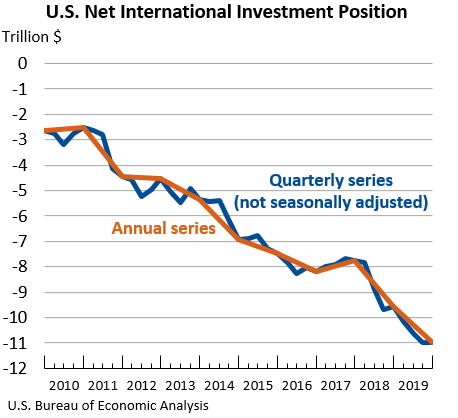
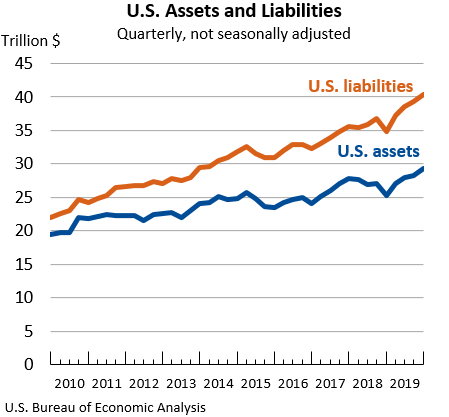
The U.S. net international investment position, the difference between U.S. residents’ foreign financial assets and liabilities, was –$10.99 trillion at the end of the fourth quarter of 2019, according to statistics released by the U.S. Bureau of Economic Analysis (BEA). Assets totaled $29.32 trillion and liabilities were $40.31 trillion.
At the end of the third quarter, the net investment position was –$10.98 trillion (Table 1).
U.S. Net International Investment Position: Quarterly, not seasonally adjusted
U.S. Assets and Liabilities: Quarterly, not seasonally adjusted
The –$14.1 billion change in the net investment position from the third quarter to the fourth quarter came from net financial transactions of –$91.2 billion and net other changes in position, such as price and exchange rate changes, of $77.1 billion (Table A).
Table A. Quarterly Change in the U.S. Net International Investment Position
Billions of dollars, not seasonally adjusted
Billions of dollars, not seasonally adjusted
| Position, 2019:III | Change in position in 2019:IV | Position, 2019:IV | |||
| Total | Attributable to: | ||||
| Financial transactions | Other changes in position 1 | ||||
| U.S. net international investment position | -10,977.3 | -14.1 | -91.2 | 77.1 | -10,991.4 |
| Net position excluding financial derivatives | -11,007.7 | -3.8 | -90.3 | 86.4 | -11,011.5 |
| Financial derivatives other than reserves, net | 30.4 | -10.2 | -0.9 | -9.3 | 20.2 |
| U.S. assets | 28,279.2 | 1,038.2 | (2) | (2) | 29,317.5 |
| Assets excluding financial derivatives | 26,201.0 | 1,326.1 | -24.5 | 1,350.6 | 27,527.1 |
| Financial derivatives other than reserves | 2,078.3 | -287.9 | (2) | (2) | 1,790.4 |
| U.S. liabilities | 39,256.5 | 1,052.3 | (2) | (2) | 40,308.8 |
| Liabilities excluding financial derivatives | 37,208.7 | 1,329.9 | 65.7 | 1,264.2 | 38,538.6 |
| Financial derivatives other than reserves | 2,047.9 | -277.6 | (2) | (2) | 1,770.3 |
| 1. Disaggregation of other changes in position into price changes, exchange rate changes, and other changes in volume and valuation is only presented for annual statistics released in June each year. 2. Financial transactions and other changes in financial derivatives positions are available only on a net basis; they are not separately available for U.S. assets and U.S. liabilities. | |||||
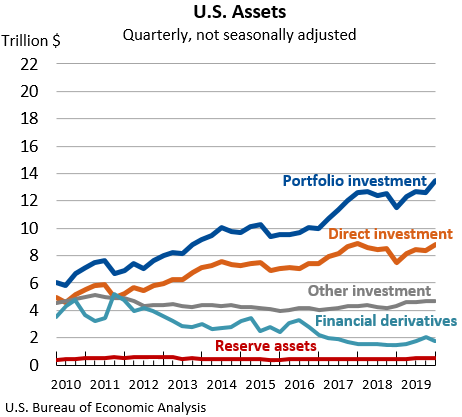
U.S. assets increased by $1.04 trillion, to a total of $29.32 trillion, at the end of the fourth quarter, mostly reflecting increases in portfolio investment and direct investment assets. Portfolio investment assets increased by $874.6 billion, to $13.51 trillion, and direct investment assets increased by $471.5 billion, to $8.84 trillion. These increases were driven mainly by foreign stock price increases and the appreciation of foreign currencies against the U.S. dollar that raised the value of these assets in dollar terms.
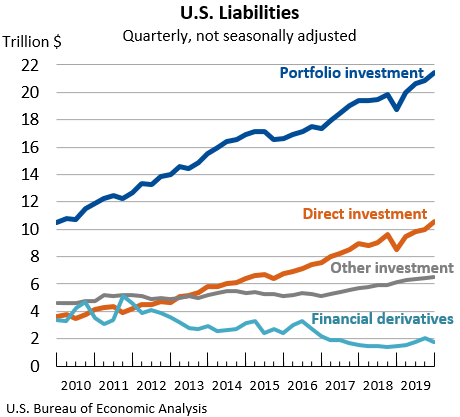
U.S. liabilities increased by $1.05 trillion, to a total of $40.31 trillion, at the end of the fourth quarter, mostly reflecting increases in direct investment and portfolio investment liabilities. Direct investment liabilities increased by $641.3 billion, to $10.58 trillion, and portfolio investment liabilities increased by $614.4 billion, to $21.48 trillion. These increases were driven mainly by U.S. stock price increases that raised the value of these liabilities.
U.S. Assets: Quarterly, not seasonally adjusted
U.S. Liabilities: Quarterly, not seasonally adjusted
Updates to Third Quarter 2019 International Investment Position Aggregates
Trillions of dollars, not seasonally adjusted
Trillions of dollars, not seasonally adjusted
| Preliminary estimate | Revised estimate | |
|---|---|---|
| U.S. net international investment position | -10.95 | -10.98 |
| U.S. assets | 28.26 | 28.28 |
| U.S. liabilities | 39.21 | 39.26 |
Year 2019
The U.S. net international investment position was –$10.99 trillion at the end of 2019 compared to –$9.55 trillion at the end of 2018 (Table 1).
The –$1.44 trillion change in the net investment position from the end of 2018 to the end of 2019 came from net financial transactions of –$395.9 billion and net other changes in position, such as price and exchange rate changes, of –$1.04 trillion (Table B).
Table B. Annual Change in the U.S. Net International Investment Position
Billions of dollars
Billions of dollars
| Position, 2018 | Change in position in 2019 | Position, 2019 | |||
| Total | Attributable to: | ||||
| Financial transactions | Other changes in position 1 | ||||
| U.S. net international investment position | -9,554.7 | -1,436.7 | -395.9 | -1,040.8 | -10,991.4 |
| Net position excluding financial derivatives | -9,592.4 | -1,419.1 | -357.5 | -1,061.6 | -11,011.5 |
| Financial derivatives other than reserves, net | 37.7 | -17.5 | -38.4 | 20.8 | 20.2 |
| U.S. assets | 25,241.5 | 4,076.0 | (2) | (2) | 29,317.5 |
| Assets excluding financial derivatives | 23,749.2 | 3,777.9 | 426.9 | 3,350.9 | 27,527.1 |
| Financial derivatives other than reserves | 1,492.3 | 298.1 | (2) | (2) | 1,790.4 |
| U.S. liabilities | 34,796.2 | 5,512.6 | (2) | (2) | 40,308.8 |
| Liabilities excluding financial derivatives | 33,341.6 | 5,197.0 | 784.4 | 4,412.5 | 38,538.6 |
| Financial derivatives other than reserves | 1,454.6 | 315.7 | (2) | (2) | 1,770.3 |
| 1. Disaggregation of other changes in position into price changes, exchange rate changes, and other changes in volume and valuation is only presented for annual statistics released in June each year. 2. Financial transactions and other changes in financial derivatives positions are available only on a net basis; they are not separately available for U.S. assets and U.S. liabilities. | |||||
U.S. assets increased by $4.08 trillion, to a total of $29.32 trillion, at the end of 2019, reflecting increases in all major categories of assets, particularly in portfolio investment and direct investment assets. Portfolio investment assets increased by $2.02 trillion, to $13.51 trillion, and direct investment assets increased by $1.33 trillion, to $8.84 trillion. These increases were driven mainly by foreign stock price increases that raised the value of these assets.
U.S. liabilities increased by $5.51 trillion, to a total of $40.31 trillion, at the end of 2019, reflecting increases in all major categories of liabilities, particularly in portfolio investment and direct investment liabilities. Portfolio investment liabilities increased by $2.76 trillion, to $21.48 trillion, and direct investment liabilities increased by $2.10 trillion, to $10.58 trillion. These increases were driven mainly by U.S. stock price increases that raised the value of these liabilities.
FULL DOCUMENT: https://www.bea.gov/sites/default/files/2020-03/intinv419_1.pdf
NATO
U.S. Department of State. 03/30/2020. Secretary Pompeo’s Call with NATO Secretary General Jens Stoltenberg
The below is attributable to Spokesperson Morgan Ortagus:
Secretary of State Michael R. Pompeo spoke today with NATO Secretary General Jens Stoltenberg to discuss Transatlantic cooperation and the upcoming NATO Foreign Ministerial. Secretary Pompeo emphasized U.S. support for NATO and the importance of Transatlantic unity. The Secretary and the Secretary General discussed how NATO is helping to coordinate Allied responses to the COVID-19 pandemic and the importance of countering efforts by the People’s Republic of China and Russia to spread disinformation and propaganda related to the virus. They also discussed the need for Afghan leaders to form an inclusive government that makes reaching a political settlement a priority and bolsters the security of the state. The Secretary thanked the Secretary General for his efforts to move the Ministerial to a virtual format, demonstrating NATO’s adaptability and ability to maintain strong communication among Allies even in times of crisis.
_________________
ORGANISMS
CORONAVIRUS
ECLAC. Mission on Washington, DC, USA. 03/31/2020. COVID-19/ The pandemic will have grave effects on the global economy and will impact the countries of Latin America and the Caribbean
ECLAC’s Executive Secretary, Alicia Bárcena, warned that the region’s economies will suffer the pandemic’s negative consequences via numerous channels, at an Inter-American Dialogue Conference Call on the Coronavirus and its Consequences for Latin American & Caribbean Economies on March 19.
Specifically, the Coronavirus would affect the region through five channels. 1) The decline in economic activity in several of the region’s main trading partners and the effects it will have on countries’ exports of goods. 2) Lower demand for tourism services, which would most sharply affect Caribbean countries. 3) The interruption of global value chains. 4) The drop in commodities prices, which is an important issue for South American countries that export raw materials. 5) Greater risk aversion on the part of investors and the worsening of global financial conditions.
ECLAC’s Executive secretary also stressed the importance of protecting the most vulnerable groups from the crisis, particularly the elderly, lower income sectors and the poor. At this time, ECLAC is estimating a contraction of -1.8% in regional GDP in 2020, which could lead to unemployment in the region rising by 10 percentage points. This could lead to the number of poor in the region rising from 185 million to 220 million people, out of 620 million inhabitants in total; and the number of people living in extreme poverty could increase from 67.4 million to 90 million.
Governments in the region are already taking measures to try to counteract the negative economic effects of the pandemic. These range from sanitary steps to reduce and prevent contagion, to social containment measures that seek to protect the most vulnerable groups. They are also taking economic, fiscal and monetary measures that involve increasing social spending, lowering interest rates, intervening in foreign exchange markets, suspending bank credit fees, providing lines of credit for the payment of company payrolls, freezing the reconnection fee for households that fail to pay their water bills, and actions to avoid depleted stocks of basic goods, among others.
Finally, she called for global and regional coordination and cooperation to cope with COVID-19. “No country will be able to fight this pandemic without global and regional cooperation. At the end of the day, what we really need to consider is what will happen to multilateralism. There must be more integration. Without a doubt, we must move towards greater coordination, and the policy priority must be how to address the current social and health crisis," she underscored.
“This pandemic has the potential to reshape geopolitical globalization, but it is also an opportunity to recall the benefits of multilateral action. That is what, for example, the United Nations Secretary-General António Guterres is trying to do: see how policy coordination can serve to support developing countries, since the asymmetries between developed and developing nations will be ever more clearly noticeable. We have already seen this with the movements of social discontent against these models of globalization that are not meeting people’s expectations,” she said.
“We need to rethink everything, the entire economy. We need a new vision to focus ourselves on how to cope with the extremely difficult scenario that lies before us,” Bárcena emphasized.
FULL DOCUMENT: https://www.cepal.org/en/pressreleases/covid-19-will-have-grave-effects-global-economy-and-will-impact-countries-latin?utm_source=cepal-news&utm_medium=email&utm_campaign=march_2020
IMF. MARCH 31, 2020. Maintaining Banking System Safety amid the COVID-19 Crisis
By Tobias Adrian and Aditya Narain
Today we face economic upheaval potentially more severe than we witnessed during the global financial crisis. The coronavirus pandemic is a different kind of shock. Never before have modern economies shut down at the drop of a hat. From one week to the next, many workers lost their jobs and paychecks. Restaurants, hotels, and airplanes all emptied. And consumers and businesses now face steep losses in income—and potentially widespread bankruptcies.
Pressure on the banking system is growing and higher defaults on debt are imminent. And many now expect a shock to the financial sector similar in magnitude to the 2008 crisis.
Like the health experts, bank supervisors are responding to a fast-moving and extraordinary situation.
The question on the minds of policymakers is how they should prepare for this.
Just over a decade ago, global policy makers came together in an unprecedented display of coordination to launch the development of a revamped regulatory framework for the financial sector. They significantly raised the minimum standards for the quality and quantity of bank capital and liquidity and succeeded in building a more resilient banking system designed to hold buffers above the minimum that could be safely drawn down in stressed conditions.
In the current crisis, national authorities are taking a host of measures to provide fiscal support, and central banks are opening new liquidity lines. How should bank supervisors respond to ensure continued trust and confidence in the banking system?
Banking system prescription
Like the health experts, bank supervisors are responding to a fast-moving and extraordinary situation. Supervisors must combine the tools from their playbooks for dealing with natural disasters, operational risk events, and bank stress episodes. With its global vantage point, and drawing from past experience, the IMF can offer some additional guidance on the way forward:
- Don’t change the rules. Doing this in the midst of a crisis will likely cause more confusion. Likewise, be prepared to give banks time to meet rules if they fall short, and hold off on implementing new initiatives—banks should remain focused on maintaining ongoing operations, given the increased difficulties of conducting such operations remotely.
- Use the buffers. Regulators have to communicate clearly that capital and liquidity buffers should support continued bank lending, without adverse consequences for bank management. Banks built these buffers well above Basel minimum standards to manage strains on liquidity and revenue loss from missed loan repayments.
- Encourage loan modification. Supervisors should clearly communicate to banks to be proactive in rescheduling their loan portfolio for those borrowers and sectors that have been hard hit by the severe, but temporary, shock. They should also remind banks about flexible credit risk management and the accounting standards for impairment in these situations. Accounting bodies have helpfully stepped in to clarify to auditors how such modifications should be viewed once the economy begins to recover.
- Don’t hide the losses. Banks, investors, shareholders and even taxpayers have to bear them. Transparency helps prepare all stakeholders; surprises only worsen their response, as was proven during the 2008 crisis.
- Clarify regulatory treatment of support measures. Clarifying upfront how banks and regulators should treat fiscal measures, including measures directly targeted at borrowers, credit guarantees, payment holidays, direct transfers and subsidies—beyond any current guidance in the Basel capital framework—would help with overall transparency.
- Strengthen communication. Encourage continuous dialogue between supervisors and banks, especially in this unprecedented situation of working remotely with colleagues, customers, and supervisors. Typically, reporting requirements in key areas, such as liquidity and creditor positions, are enhanced in a crisis, but given operational disruptions, deferring other reporting requirements less material to assessments of financial health may make sense.
- Coordinate across borders. Banking is a global business. Broad coordination among national regulators at the international level is imperative. This crisis will pass eventually, and the effects may take time to dissipate, but preserving the integrity of the international framework will be crucial for the credibility and integrity of the global financial system. International bodies like the Financial Stability Board and the Basel Committee on Banking Supervision are working night and day to do just this.
Will it be enough?
Simply put, it may be too early to tell. At this point, conditions in many countries are as severe as the adverse scenario of the stress tests that banking regulators commonly use to assess the strength of their banking systems.
And it might get worse.
All of this assumes that economic activity could restart later this year, but we have to also consider more adverse scenarios. Under more severely strained circumstances, we will have to rethink our playbook substantially. Some banking systems might have to be recapitalized or even restructured. The IMF has deep experience in helping countries rebuild distressed banking systems through its technical assistance programs, and will stand ready to help.
FULL DOCUMENT: https://blogs.imf.org/2020/03/31/maintaining-banking-system-safety-amid-the-covid-19-crisis/?utm_medium=email&utm_source=govdelivery
________________
ECONOMIA BRASILEIRA / BRAZIL ECONOMICS
CORONAVÍRUS
MRE. DCOM. NOTA-52. 30 de Março de 2020. Declaração dos Ministros de Comércio e Investimentos do G20 - 30 de março de 2020
Nós, Ministros do Comércio e de Investimentos do G20 e países convidados, estamos profundamente entristecidos com a devastadora tragédia humana causada pela propagação do COVID-19. A pandemia é um desafio global e requer uma resposta global coordenada. Os Líderes do G20, após sua Reunião Extraordinária realizada em 26 de março de 2020, comprometeram-se a "apresentar uma frente unida contra essa ameaça comum". Agora, mais do que nunca, é o momento de a comunidade internacional intensificar a cooperação e a coordenação para proteger a vida humana e lançar as bases para uma forte recuperação econômica e um crescimento sustentável, equilibrado e inclusivo após essa crise.
Começamos a monitorar e avaliar o impacto da pandemia no comércio, de acordo com a tarefa que nos foi confiada por nossos Líderes.
Estamos trabalhando ativamente para garantir o contínuo fluxo transfronteiriço de suprimentos e equipamentos médicos vitais, produtos agrícolas essenciais, bem como outros bens e serviços essenciais para apoiar a saúde de nossos cidadãos. De modo compatível com exigências nacionais, tomaremos medidas imediatas que se façam necessárias para facilitar o comércio desses bens essenciais. Apoiaremos a disponibilidade de suprimentos médicos e farmacêuticos essenciais e o acesso a eles a um preço acessível, de forma equitativa, onde forem mais necessários e da forma mais rápida possível, inclusive estimulando a produção adicional por meio de incentivos e investimentos direcionados, de acordo com as circunstâncias nacionais. Nós nos protegeremos contra lucros e aumentos injustificados de preços.
Estamos preocupados com o impacto da COVID-19 nos países em desenvolvimento e de menor desenvolvimento relativo vulneráveis, notadamente na África, e nos pequenos Estados insulares. Também estamos preocupados com os tremendos desafios que confrontam os trabalhadores e as empresas, especialmente os mais vulneráveis. Garantiremos que nossa resposta coletiva apoie as micro, pequenas e médias empresas e reconhecemos a importância de fortalecer o investimento internacional.
Concordamos que as medidas de emergência projetadas para combater a COVID-19, se necessárias, devem ser específicas, proporcionais, transparentes e temporárias, e que não devem criar barreiras desnecessárias ao comércio ou causar a interrupção das cadeias globais de suprimentos e que sejam compatíveis com as regras da OMC.
Implementaremos essas medidas mantendo o princípio da solidariedade internacional, considerando a evolução das necessidades de outros países por suprimentos de emergência e assistência humanitária. Enfatizamos a importância da transparência no atual ambiente e nosso compromisso de notificar à OMC quaisquer medidas comerciais adotadas, as quais permitirão que as cadeias globais de suprimentos continuem funcionando nesta crise, além de acelerar a recuperação que se seguirá.
À medida que combatemos a pandemia, individual e coletivamente, e buscamos mitigar seus impactos no comércio e no investimento internacional, continuaremos a trabalhar juntos para oferecer um ambiente comercial e de investimentos que seja livre, justo, não discriminatório, transparente e previsível e para manter nossos mercados abertos.
Asseguraremos a tranquila e contínua operação das redes de logística que servem como espinha dorsal das cadeias globais de suprimentos. Exploraremos formas de manter abertas as redes de logística pelas vias aérea, marítima e terrestre, bem como formas de facilitar o movimento essencial de profissionais de saúde e empresários através das fronteiras, sem comprometer os esforços para impedir a propagação do vírus.
Continuaremos a monitorar e avaliar o impacto da pandemia no comércio. Conclamamos as organizações internacionais a preparar uma análise aprofundada do impacto do COVID-19 no comércio mundial, no investimento e nas cadeias globais de valor. Continuaremos a trabalhar com eles para adotar enfoques coordenados, coletar e compartilhar boas práticas para facilitar o fluxo de bens e serviços essenciais.
Nós nos reuniremos novamente conforme necessário e instruímos o Grupo de Trabalho de Comércio e Investimento do G20 a tratar atentamente dessas questões e a identificar propostas de ações adicionais que possam ajudar a aliviar o amplo impacto da COVID-19, bem como ações de longo prazo que devam ser tomadas para apoiar o sistema multilateral de comércio e acelerar a recuperação econômica. A próxima presidência italiana do G20 (2021) está comprometida a continuar prestando a máxima atenção ao ambiente de comércio internacional nas discussões acerca de ações de longo prazo.
FGV. 30/03/2020. Economia e Direito na proteção de empregos

O Direito do Trabalho possui uma relação bastante estreita com a Economia. Em tempos de estabilidade econômica, a tendência é ter uma certa expansão do Direito do Trabalho ao passo que, em tempos de cenário econômico adverso, há retração dele. A própria disciplina costuma desenvolver mecanismos de enfretamento de crise econômica, como férias coletivas, redução da jornada de trabalho, entre outros. No momento atual, como estão sendo as medidas que o governo federal está tomando para tentar preservar as empresas e os empregos? Assista agora no FGV - Impactos do COVID-19.
VÍDEO: https://www.youtube.com/watch?v=khHkOsRTL_8&feature=youtu.be
FGV. 31/03/2020. Impactos do COVID-19. Como a pandemia afetará a economia brasileira
Os efeitos que a crise do coronavírus terão sobre a economia brasileira ainda estão difíceis de serem mensurados. Por isso, o coordenador do Centro de Macroeconomia Aplicada da FGV EESP, Emerson Marçal, e sua equipe desenvolveram um estudo com base em dois aspectos para tentar entender os possíveis desdobramentos da pandemia: Econometria e História Econômica. Saiba quais os cenários econômicos simulados no programa FGV - Impactos do COVID-19.

VIDEO: https://www.youtube.com/watch?v=-RLhz-Oy7II&feature=youtu.be
MEconomia. 31/03/2020. COVID-19. Governo já gastou 2,6% do PIB em medidas emergenciais para o combate à pandemia da Covid 19. Segundo o ministro Paulo Guedes, já são R$ 750 bilhões destinados à saúde dos brasileiros e à manutenção dos empregos
O ministro da Economia, Paulo Guedes, enfatizou nesta terça-feira (31/3) que o Brasil já atingiu 2,6% do PIB em medidas emergenciais para o combate à pandemia da Covid- 19. Ele destacou que esses recursos vão continuar subindo nos próximos dias de forma a garantir a saúde dos brasileiros e a manutenção dos empregos.
“Nós já passamos de R$ 750 bilhões mais ou menos de dinheiro mobilizado para receber essa primeira onda de impacto sobre a saúde (...) Não vamos deixar nenhum brasileiro para trás. Todos os recursos necessários para a defesa da saúde e dos empregos serão mobilizados”.
O ministro também mencionou a aprovação da Lei de Calamidade Pública – que dispensou o governo do cumprimento da meta de resultado primário neste ano – e que deu espaço para que o governo pudesse ampliar as despesas. Nesse contexto, ele citou a criação do auxílio emergencial de R$ 600 aos informais, estendido aos beneficiários do Bolsa Família, por três meses, aprovado pelo Senado Federal na noite desta segunda-feira (30/3).
O benefício tem como foco trabalhadores informais e intermitentes, desempregados e microempreendedores individuais (MEIs) que integrem famílias de baixa renda. Para Guedes, o benefício é a maior rede de proteção social já estendida no país. “São entre R$ 60 e 80 bilhões para a defesa da saúde do brasileiro”, destacou.
As afirmações do ministro foram feitas em entrevista coletiva na tarde desta terça-feira (31/3) no Palácio do Planalto ao lado dos ministros da Saúde, Luiz Henrique Mandetta, da Justiça, Sérgio Moro, e da Casa Civil, Walter Braga Neto.
Medidas
Durante sua fala, o ministro fez um balanço das iniciativas adotadas pelo governo até o momento para minimizar os efeitos da crise da Covid 19. “Assim que tomamos dimensão da gravidade do problema começamos a fazer as primeiras medidas”, afirmou.
Ele citou a redução dos compulsórios pelos bancos – ou seja a poupança que eles precisam deixar em caixa – de forma a permitir renegociação de empréstimos e permitir novas oferta de crédito no mercado; a alteração no pagamento de impostos (como a postergação do recolhimento de FGTS e do Simples pelas empresas); a antecipação do 13º de aposentados e pensionistas do INSS e a inclusão de 1,2 milhão de beneficiários no programa Bolsa Família.
Guedes também destacou o pacote de apoio a estados e municípios no valor de R$ 88 bilhões e a linha de crédito de R$ 40 bilhões para custear a folha de pagamento de pequenas e médias empresas, tendo como contrapartida a garantia de que não haverá demissões, além de R$ 50 bilhões para a complementação salarial dos trabalhadores que terão sua carga horária reduzida. De acordo com o ministro, são quase R$ 750 bilhões em fluxo de recursos destinados ao combate à pandemia.
Para viabilizar as medidas, o ministro mencionou uma Proposta de Emenda à Constituição (PEC) que está sendo construída em coordenação com o Congresso Nacional para regulamentar e regularizar todos esses atos.
PIB
FGV. IBRE. 30/03/20. Monitor do PIB FGV aponta crescimento de 0,7% na atividade econômica em janeiro
O Monitor do PIB-FGV aponta, na análise da série dessazonalizada, crescimento de 0,7%, na atividade econômica em janeiro, em comparação a dezembro e de 0,2% no trimestre móvel findo em janeiro, em comparação ao findo em outubro. Na comparação interanual a economia também apresentou crescimento de 1,2% tanto em janeiro quanto no trimestre móvel findo em janeiro.
“A economia inicia 2020 com resultado positivo em janeiro (1,1% na taxa acumulada em 12 meses) na comparação com dezembro evidenciando a continuidade da lenta e medíocre retomada que vinha tendo desde 2017, quando iniciou-se o período expansivo após a recessão iniciada em 2014. No entanto, mesmo o fraco crescimento econômico deste trimestre móvel findo em janeiro, que foi impulsionado tanto pelo consumo quanto pelo investimento, não se sustentará ao longo do ano frente aos desafios econômicos e sociais que estarão sendo sentidos a partir de março, com a chegada da Pandemia do COVID-19.” afirma Claudio Considera, coordenador do Monitor do PIB-FGV.
A economia cresceu 0,7% em janeiro, na comparação com dezembro, e 1,2%, na comparação com janeiro de 2019. Tanto na comparação ajustada sazonalmente, quanto na interanual, houve crescimento das três grandes atividades econômicas (agropecuária, indústria e serviços). Pela ótica da demanda, o único componente a apresentar retração nas duas bases de comparação foi a exportação.
ANÁLISE DESAGREGADA DOS COMPONENTES DA DEMANDA
A análise gráfica desagregada dos componentes da demanda foi feita usando a série trimestral interanual por apresentar menor volatilidade do que as taxas mensais e aquelas ajustadas sazonalmente permitindo melhor compreensão da trajetória de seus componentes.
Consumo das famílias
O consumo das famílias cresceu 1,4% no trimestre móvel findo em janeiro, em comparação ao mesmo trimestre do ano anterior. Destaca-se, neste resultado, que o consumo de produtos não duráveis (que representa cerca de 30% do consumo das famílias) passou a contribuir negativamente (-0,1 p.p.) para o total do consumo após ter contribuído positivamente em torno de 0,4 p.p., na segunda metade de 2019. Seu recuo de 0,2% no trimestre móvel é o principal responsável pela desaceleração observada no consumo das famílias; ele é explicado principalmente pela desaceleração do consumo de produtos de origem interna, notadamente por produtos de hipermercados.
Formação bruta de capital fixo (FBCF)
A FBCF retraiu 1,2% no trimestre móvel findo em janeiro, em comparação ao mesmo trimestre do ano anterior; esta é a segunda queda consecutiva dos investimentos com retrações nos componentes de máquinas e equipamentos e da construção. A retração de máquinas e equipamentos é, em grande parte, explicada pelos segmentos de tratores e de equipamentos de transporte em geral.
Exportação
A exportação apresentou queda de 8,8% no trimestre móvel findo em janeiro, em comparação com o mesmo trimestre do ano anterior. Essa é a maior retração, nesta comparação, desde o quarto trimestre de 2014. A exportação está em queda desde o trimestre móvel findo em julho e, no trimestre findo em janeiro, destacam-se as retrações significativas dos bens de capital, produtos agropecuários e bens intermediários. Apenas a exportação dos bens de consumo apresentou crescimento neste trimestre.
Importação
A importação retraiu 2,0% no trimestre móvel findo em janeiro, comparativamente ao mesmo trimestre do ano anterior. Houve retração nas importações de bens de capital e de serviços. Houve ainda desaceleração da importação de bens intermediários, que embora tenha crescido no trimestre (2,8%) está entre as taxas menores que as apresentadas em 2019. Estes três componentes foram os principais responsáveis pela retração das importações. Esse cenário, de certa forma, é similar ao que aconteceu no quarto trimestre de 2019 apenas com uma queda mais acentuada das importações.
MONITOR DO PIB-FGV EM VALORES
Em termos monetários, o PIB em valores correntes foi de aproximadamente 615 bilhões, 121 milhões de Reais em janeiro de 2020.
TAXA DE INVESTIMENTO
Destaca em duas linhas as médias das taxas de investimento: a de cima mostra a média das taxas de investimento mensais desde janeiro de 2000 (18,0%); a de baixo, a média das taxas de investimento mensais desde 2015 (15,7%). Observa-se que a taxa de investimento no mês de janeiro foi de 15,2%, na série a valores correntes. Apesar de estar um pouco acima da taxa de investimento mensal média desde janeiro de 2015, este resultado encontra-se abaixo da taxa de investimento mensal média desde janeiro de 2000.
APÊNDICE – NOTA EXPLICATIVA
O Monitor do PIB-FGV estima mensalmente o PIB brasileiro em volume e em valor. O objetivo de sua criação foi prover a sociedade de um indicador mensal do PIB, tendo como base a mesma metodologia das Contas Nacionais do IBGE. Sua série inicia-se em 2000 e incorpora todas as informações disponíveis das Contas Nacionais (Tabelas de Recursos e Usos, até 2017, último ano de divulgação) bem como as informações das Contas Nacionais Trimestrais, até o último trimestre divulgado (quarto trimestre de 2019).
O indicador é ajustado as Contas Nacionais Trimestrais sempre que há mudanças metodológicas e a cada trimestre divulgado. Ou seja, nos trimestres calendários, as médias trimestrais dos índices de volume do Monitor do PIB-FGV serão iguais aos indicadores trimestrais, sem ajuste sazonal, das Contas Nacionais Trimestrais. Nos trimestres calendário, são utilizados os mesmos modelos do IBGE para calcular todas as séries desagregadas com ajuste sazonal, tanto pela ótica da oferta, como da demanda. Para o ajuste sazonal mensal é utilizado o modelo mensal do IBC-Br, do Banco Central; para os trimestres móveis utiliza-se uma média desses ajustes mensais.
Assim, as estimativas do Monitor do PIB-FGV antecedem os resultados das Contas Nacionais Trimestrais nos meses em que este é divulgado. E, nos meses em que não há divulgação, o Monitor representa uma excelente antecipação para as tendências do PIB e seus componentes.
O Monitor do PIB-FGV compõe-se de um relatório descrevendo os principais resultados com ilustrações gráficas e de uma tabela Excel com informações de volume, em valores correntes, e a preços de 1995 das 12 atividades econômicas que agrupadas formam os 3 setores de atividade (agropecuária, indústria e serviços). Apresenta, ainda, o Valor Adicionado a preços básicos, os impostos sobre os produtos e o PIB e também os componentes do PIB pela ótica da demanda. Outro ponto a ser destacado é que o Monitor torna disponíveis desagregações que não são divulgadas pelo IBGE, mas que são relevantes para um melhor entendimento da absorção doméstica e da demanda externa. As desagregações disponibilizadas pelo Monitor são:
Consumo das Famílias: bens de consumo duráveis, semiduráveis, não duráveis e serviços. Adicionalmente eles são classificados em nacionais e importados;
Formação Bruta de Capital Fixo: em máquinas e equipamentos, construção e outros. Para máquinas e equipamentos e outros, há a desagregação entre nacionais e importados;
Exportações e Importações: em produtos agropecuários, produtos da extrativa mineral, produtos industrializados de consumo (duráveis, semiduráveis e não duráveis), produtos industrializados de uso intermediário, bens de capitais e serviços.
São divulgadas as séries de base móvel, séries encadeadas, séries encadeadas dessazonalizadas, as taxas mensais, trimestrais e anuais comparadas a igual período do ano anterior e as taxas mensais e trimestrais comparadas a período imediatamente anterior, e os valores nominais correntes e a preços de 1995.
Metodologia: https://portalibre.fgv.br/publicacoes/estudos-e-pesquisas/metodologias/metodologia-do-monitor-da-atividade-economica.htm
DOCUMENTO: https://portalibre.fgv.br/navegacao-superior/noticias/monitor-do-pib-fgv-aponta-crescimento-de-0-7-na-atividade-economica-em-janeiro.htm
IPEA. 30/03/2020. Ipea projeta queda no PIB em 2020 por conta do impacto do Covid-19 na economia brasileira. Pesquisadores analisaram cenários em que isolamento social duraria mais um, dois ou três meses
Diante da pandemia associada ao novo coronavírus (Covid-19), as previsões para o desempenho da economia mundial foram fortemente revistas para baixo. A partir da análise das medidas de política econômica apresentadas para mitigar os efeitos da crise aguda, os pesquisadores do Instituto de Pesquisa Econômica Aplicada (Ipea) apresentam previsões para a economia brasileira condicionadas ao tempo de isolamento social. A análise de conjuntura trimestral foi divulgada nesta segunda-feira (30).
No cenário de quarentena até o final de abril, a previsão é o PIB encerrar o ano com variação negativa de 0,4%. Nos cenários com isolamento por dois e três meses, o resultado do PIB seria de - 0,9% e - 1,8%, respectivamente. “Mantemos fixa a hipótese de rápida recuperação parcial da atividade econômica já no terceiro trimestre deste ano”, informa o diretor de Estudos e Políticas Macroeconômicas do Ipea, José Ronaldo DE Castro Souza Júnior. Ele ressalta, no entanto, que essa hipótese depende da efetividade das políticas econômicas mitigadoras sendo adotadas no Brasil e no mundo, e de um relativamente rápido avanço no controle da pandemia, que permitiria a retirada gradual das medidas restritivas.
O estudo do Ipea inclui uma revisão para baixo das projeções de inflação para 2020. Para o IPCA, a previsão passou de 3,3% para 2,9%. Já para os preços administrados, a expectativa recuou de 3,9% para 3,4%, enquanto a projeção de inflação de bens livres (exceto alimentos), antes de 1,7%, passou para 1,5%. No caso da inflação de alimentos, a previsão foi ajustada de 4,2% para 3,8%. Para o setor de Serviços, segmento mais impactado pela crise, a expectativa de alta de preços recuou de 3,3% para 2,8%.
Atividade econômica em queda
O Grupo de Conjuntura do Ipea também faz uma análise dos indicadores mensais. Apesar do ritmo de aceleração da economia no início de 2020, deve haver queda no desempenho dos indicadores a partir do mês de março, por conta dos efeitos da pandemia do Covid19. Para fevereiro, cujos números ainda não foram divulgados, a previsão dos pesquisadores é de alta de 0,3% na produção da indústria na comparação com janeiro, na série com ajuste sazonal. Há estimativa de alta de 0,4% para o comércio e recuo de 0,3% para os serviços (segmento que deve ser mais fortemente impactado) no mesmo período.
A pandemia do Covid-19 também deve impactar as indústrias extrativas, que encerraram 2019 com queda de 1,1% no PIB, ainda influenciada pelo desastre ocorrido na barragem de Brumadinho. O Ipea trabalhava com um cenário de recuperação para o setor, mas revisou a projeção de crescimento de 6,5% para 2,5% em 2020.
PIB Agro em alta
Sob a ótica da produção, as principais commodities agropecuárias brasileiras deverão sofrer pouco impacto decorrente da Covid-19. Levando em consideração a previsão de safra do IBGE e do Departamento de Agricultura dos Estados Unidos, o PIB agropecuário deve fechar 2020 com um crescimento de 3,8%. Mesmo com a simulação do impacto de choques negativos na economia em razão do novo Coronavírus, semelhantes à crise de 2008, a expectativa é positiva: alta de 2,5% sustentado pela estimativa de safra recorde de soja.
Estudos: http://www.ipea.gov.br/cartadeconjuntura/index.php/2020/03/30/visao-geral-da-conjuntura-6/
ECONOMIA
FGV. IBRE. 30/03/20. Indicador de Incerteza da Economia avança em março
O Indicador de Incerteza da Economia (IIE-Br) da Fundação Getulio Vargas subiu 52,0 pontos em março, para 167,1 pontos, maior nível da série histórica.Considerando-se a evolução em médias móveis semestrais, houve aumento de 8,4 pontos, para 120,6 pontos.
“Sob influência da pandemia de coronavírus e seu impacto devastador sobre a economia nacional, o Indicador de Incerteza da FGV bateu dois recordes neste mês. O primeiro foi o do nível mais alto da série histórica, 167,1 pontos, 30 pontos acima do recorde anterior, de setembro de 2015, período em que o país enfrentava forte recessão e logo após o Brasil perder grau de investimento, na avaliação de agências internacionais de risco. O segundo foi a maior alta mensal da série iniciada em 2000, ao superar em 18 pontos o salto de outubro de 2008, durante a crise financeira internacional. Ainda é cedo para se prever um alívio para o indicador nas próximas semanas face ao quadro indefinido quanto à evolução da doença no Brasil e ao impacto das medidas que vêm sendo anunciadas pelo Governo para atenuar os efeitos da crise”, afirma Aloisio Campelo Jr., Superintendente de Estatísticas da FGV IBRE.
Em março, os dois componentes do Indicador de Incerteza subiram fortemente. O componente de Mídia, subiu 48,0 pontos, para 161,0 pontos, contribuindo em 41,9 pontos para o comportamento do índice geral no mês. O componente de Expectativa, subiu 46,2 pontos, para 163,5 pontos, contribuindo em 10,1 pontos para a alta da incerteza.
DOCUMENTO: https://portalibre.fgv.br/navegacao-superior/noticias/indicador-de-incerteza-da-economia-avanca-em-marco.htm
INFLAÇÃO
FGV. IBRE. 30/03/20. Índices Gerais de Preços. IGP-M. IGP-M avança para 1,24% em março
O Índice Geral de Preços – Mercado (IGP-M) subiu 1,24% em março, percentual superior ao apurado em fevereiro, quando a taxa foi de -0,04%. Com este resultado, o índice acumula alta de 1,69% no ano e de 6,81% em 12 meses. Em março de 2019, o índice havia sido de 1,26% e acumulava alta de 8,27% em 12 meses.
O Índice de Preços ao Produtor Amplo (IPA) subiu 1,76% em março, após cair de 0,19% em fevereiro. Na análise por estágios de processamento, a taxa do grupo Bens Finais variou 0,77% em março, contra -0,55% no mês anterior. A principal contribuição para este resultado partiu do subgrupo alimentos processados, cuja taxa passou de -1,57% para 1,27%, no mesmo período. O índice relativo a Bens Finais (ex), que exclui os subgrupos alimentos in natura e combustíveis para o consumo, variou 0,62% em março, ante -0,40% no mês anterior.
A taxa de variação do grupo Bens Intermediários variou de -0,33% em fevereiro para -0,03% em março. O principal responsável por este movimento foi o subgrupo materiais e componentes para a manufatura, cujo percentual passou de 0,34% para 1,57%. O índice de Bens Intermediários (ex), obtido após a exclusão do subgrupo combustíveis e lubrificantes para a produção, subiu 1,39% em março, contra 0,30% em fevereiro.
O índice do grupo Matérias-Primas Brutas acelerou de 0,36% em fevereiro para 4,77% em março. Contribuíram para o avanço da taxa do grupo os seguintes itens: minério de ferro (-0,01% para 9,73%), soja (em grão) (-2,97% para 5,03%) e café (em grão) (-6,61% para 10,60%). Em sentido oposto, destacam-se os itens milho (em grão) (5,17% para 4,02%), mandioca (aipim) (4,93% para 2,16%) e arroz (em casca) (4,30% para 0,69%).
O Índice de Preços ao Consumidor (IPC) variou 0,12% em março, após alta de 0,21% em fevereiro. Cinco das oito classes de despesa componentes do índice registraram recuo em suas taxas de variação. A principal contribuição partiu do grupo Educação, Leitura e Recreação (1,04% para -1,01%). Nesta classe de despesa, vale citar o comportamento do item passagem aérea, cuja taxa passou de 0,34% para -10,26%.
Também apresentaram decréscimo em suas taxas de variação os grupos Saúde e Cuidados Pessoais (0,36% para 0,28%), Despesas Diversas (0,14% para 0,01%), Transportes (0,09% para 0,06%) e Vestuário (0,06% para -0,10%). Nestas classes de despesa, vale mencionar os seguintes itens: artigos de higiene e cuidado pessoal (0,50% para 0,18%), tarifa postal (9,04% para 3,39%), etanol (0,74% para -0,24%) e roupas (0,07% para -0,18%).
Em contrapartida, os grupos Alimentação (0,28% para 0,86%), Habitação (-0,10% para -0,02%) e Comunicação (0,05% para 0,09%) apresentaram acréscimo em suas taxas de variação. Nestas classes de despesa, os maiores avanços foram observados para os seguintes itens: carnes bovinas (-4,59% para -0,28%), tarifa de eletricidade residencial (-1,29% para -0,82%) e tarifa de telefone residencial (0,47% para 0,93%).
O Índice Nacional de Custo da Construção (INCC) subiu 0,38% em março, ante 0,35% no mês anterior. Os três grupos componentes do INCC registraram as seguintes variações na passagem de fevereiro para março: Materiais e Equipamentos (0,65% para 0,42%), Serviços (0,96% para 0,11%) e Mão de Obra (0,04% para 0,40%).
DOCUMENTO: https://portalibre.fgv.br/navegacao-superior/noticias/igp-m-avanca-para-1-24-em-marco.htm
SERVIÇOS
FGV. IBRE. 30/03/20. Sondagens e Índices de Confiança. Sondagem de Serviços. Índice de Confiança de Serviços recuou em março
O Índice de Confiança de Serviços (ICS), da Fundação Getulio Vargas, caiu 11,6 pontos em março, para 82,8 pontos, acumulando queda de 13,4 pontos no primeiro trimestre de 2020. Em médias móveis trimestrais, o índice recuou 4,5 pontos.
“A confiança de serviços, que já vinha apresentando resultados fracos nos primeiros meses do ano, despenca sob impacto do coronavírus. O resultado já mostra que mesmo em março o setor enfrentou dificuldades e o volume de serviços foi afetado. Mas o recuo realmente expressivo foi registrado nas expectativas dos empresários, sugerindo que o setor está muito assustado com este momento de muita incerteza e projeta mais dificuldades ainda para os negócios nos próximos meses”, avaliou Rodolpho Tobler, economista da FGV IBRE.
A variação negativa do ICS impactou todos os 13 segmentos da pesquisa e foi determinada pela deterioração das expectativas em relação aos próximos meses. O Índice de Situação Atual (ISA-S) caiu pelo terceiro mês consecutivo. A queda de 5,0 pontos levou o indicador a atingir 85,2 pontos, o menor nível desde dezembro de 2017 (84,7 pontos). O Índice de Expectativas (IE-S) despencou 18,1 pontos, para 80,8 pontos, o menor patamar desde junho de 2016 (78,0 pontos).
O Nível de Utilização da Capacidade Instalada (NUCI) do setor de serviços caiu 0,9 ponto percentual para 82% após duas altas consecutivas.
Nos primeiros três meses do ano, todos os índices-síntese do setor de serviços recuaram em comparação com último trimestre de 2019. O mesmo se deu na comparação interanual dos índices, destacando-se pela variação negativa de dois dígitos, principalmente do IE-S que despencou 15,6 pontos entre março do ano passado e março do ano atual. “O resultado trimestral confirma o momento difícil que o setor enfrenta e que o cenário que se desenha para os próximos meses é de maior dificuldade considerando o aumento de incerteza provocado pela pandemia”, analisa Rodolpho Tobler, economista da FGV IBRE.
Em termos setoriais, a maior contribuição para queda do ICS no primeiro trimestre do ano veio dos serviços de Transportes cuja confiança recuou 14,8 pontos após aumento de 0,8 ponto no trimestre anterior. Os serviços de Informação e Comunicação e os serviços Profissionais também acumularam quedas acima de dois dígitos após registrarem resultados positivos no quarto trimestre de 2019. Para os serviços prestados às Famílias e Outros Serviços, no entanto, o declínio foi mais suave com recuos de 4,2 pontos e 7,5 pontos no período atual.
DOCUMENTO: https://portalibre.fgv.br/navegacao-superior/noticias/indice-de-confianca-de-servicos-recuou-em-marco.htm
CONFIANÇA EMPRESARIAL
FGV. IBRE. 31/03/20. Sondagens e Índices de Confiança. Índice de Confiança Empresarial. Confiança Empresarial recuou em março
O Índice de Confiança Empresarial (ICE) da Fundação Getulio Vargas (FGV IBRE) caiu 6,5 pontos em março, para 89,5 pontos, menor nível desde setembro de 2017 (88,5 pontos). Com o resultado, a média do primeiro trimestre de 2020 terminou 1,1 ponto inferior à média do trimestre anterior. Em médias móveis trimestrais, o índice caiu 2,2 pontos e inverteu a tendência ascendente iniciada em agosto do ano passado.
“A pandemia de coronavírus impactou significativamente a confiança empresarial em março, levando o ICE à maior queda desde a recessão de 2008-09. Houve piora expressiva das expectativas em todos os setores, especialmente no Comércio e em Serviços, enquanto a percepção sobre a situação corrente piorou relativamente pouco. Ainda assim, segmentos que vinha evoluindo favoravelmente no ano, como a Indústria e a Construção, acusaram o baque e sinalizam redução do nível de atividade no mês. Enquanto persistirem os impactos da pandemia no país nos próximos meses, o cenário de confiança em queda deve se manter”, afirma Rodolpho Guedon Tobler, economista da FGV IBRE.
O Índice de Confiança Empresarial (ICE) consolida os índices de confiança dos quatro setores cobertos pelas Sondagens Empresariais produzidas pela FGV IBRE: Indústria, Serviços, Comércio e Construção.
O índice que retrata a situação corrente dos negócios (ISA-E) recuou 0,8 ponto em março, para 91,7 pontos. O Índice de Expectativas (IE-E) cedeu 14,9 pontos, a maior queda desde outubro de 2008, passando de 102,6 pontos, zona de neutralidade, para 87,7 pontos, zona de pessimismo. Além disso, neste mês, o IE-E fechou abaixo do ISA-E, algo que não acontecia desde setembro de 2015.
A confiança de todos os setores integrantes do ICE recuaram em março. As maiores quedas ocorreram nos setores de Serviços e Comércio, com recuos de 11,6 e 11,7 pontos, respectivamente, seguidos da Indústria e Construção, com variações negativas de 3,9 e 2,0 pontos. Todos os setores foram influenciados principalmente pela deterioração das expectativas, com destaque às do Comércio, que despencaram 24,3 pontos. Em médias móveis trimestrais, todos os setores também recuaram no mês.
Difusão da Confiança
A confiança recuou em 40 dos 49 segmentos que integram o ICE (82% do total), um número bem superior aos 21 do mês anterior (43%). A disseminação de alta dos segmentos se mostrou desanimadora nos quatro setores, com destaque para o Comércio e o setor de Serviços, em que a alta da confiança não ocorreu em nenhum segmento.
DOCUMENTO: https://portalibre.fgv.br/navegacao-superior/noticias/confianca-empresarial-recuou-em-marco.htm
DESEMPREGO
IBGE. 31/03/2020. PNAD Contínua: taxa de desocupação é de 11,6% e taxa de subutilização é 23,5% no trimestre encerrado em fevereiro de 2020
ERRAMOS: Foi identificado erro no cálculo das variações trimestrais e anuais do rendimento médio real e da massa de rendimento real. Os valores absolutos das estimativas não foram alterados. O arquivo com os quadros sintéticos foi corrigido e substituído, assim como as variações foram corrigidas no release e na notícia sobre a PNAD Contínua, publicados hoje na Agência IBGE Notícias.
A taxa de desocupação (11,6%) no trimestre móvel encerrado em fevereiro de 2020 cresceu 0,5 ponto percentual em relação ao trimestre de setembro a novembro de 2019 (11,2%) e caiu 0,8 ponto percentual frente ao mesmo trimestre do ano anterior (12,4%).
| Indicador/Período | Dez-Jan-Fev 2020 | Set-Out-Nov 2019 | Dez-Jan-Fev 2019 |
|---|---|---|---|
| Taxa de desocupação | 11,6% | 11,2% | 12,4% |
| Taxa de subutilização | 23,5% | 23,3% | 24,6% |
| Rendimento real habitual | R$ 2.375 | R$ 2.373 | R$ 2.381 |
| Variação do rendimento habitual em relação a: | 0,1% (estabilidade) | -0,3% (estabilidade) | |
A população desocupada (12,3 milhões de pessoas) teve aumento de 4,0% (479 mil pessoas a mais) em relação ao trimestre móvel anterior e -5,4% (711 mil pessoas a menos) em relação ao mesmo trimestre do ano anterior.
A população ocupada (93,7 milhões) mostrou redução de 0,7% em relação ao trimestre anterior (706 mil pessoas a menos). Já em relação ao mesmo trimestre do ano interior, houve alta de 2,0% (mais 1,8 milhão de pessoas).
A taxa de informalidade atingiu 40,6% da população ocupada, representando um contingente de 38,0 milhões de trabalhadores informais. No trimestre móvel anterior, essa taxa havia sido 41,1% e no mesmo trimestre do ano anterior, 40,7%.
A população fora da força de trabalho (65,9 milhões de pessoas) chegou ao seu maior nível na série histórica, iniciada em 2012, com alta de 1,3% (mais 815 mil pessoas) em relação ao trimestre móvel anterior e estabilidade em relação ao mesmo trimestre de 2019.
A taxa composta de subutilização da força de trabalho (23,5%) ficou estável em relação ao trimestre móvel anterior (23,3%) e teve redução de -1,1 p.p. em relação ao mesmo trimestre móvel do ano anterior (24,6%).
A população subutilizada (26,8 milhões de pessoas) ficou estável frente ao trimestre móvel anterior (26,6 milhões) e caiu -3,6% (menos 998 mil pessoas) frente ao mesmo trimestre de 2019.
A população desalentada (4,7 milhões) ficou estatisticamente estável em ambas as comparações, assim como o percentual de desalentados em relação à população na força de trabalho ou desalentada (4,2%).
O número de empregados com carteira de trabalho assinada no setor privado (exclusive trabalhadores domésticos), estimado em 33,6 milhões, ficou estável frente ao trimestre móvel anterior e cresceu 2,0% (mais 646 mil pessoas) contra o mesmo trimestre de 2019.
O contingente de empregados sem carteira assinada no setor privado (11,6 milhões de pessoas) ficou estável em relação ao trimestre móvel anterior e cresceu 5,1% ou mais 569 mil pessoas) comparado ao mesmo trimestre de 2019.
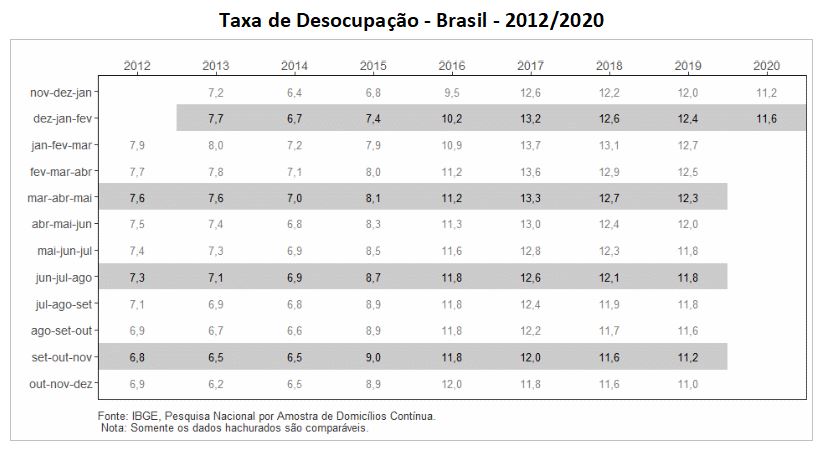
O número de trabalhadores por conta própria chegou a 24,5 milhões de pessoas e ficou estável em relação ao trimestre móvel anterior. Já em relação ao mesmo período de 2019, houve alta de 3,2% (mais 766 mil pessoas).
O rendimento médio real habitual (R$ 2.375) no trimestre móvel terminado em fevereiro cresceu ficou estável nas duas comparações.
A massa de rendimento real habitual (R$ 217,6 bilhões) ficou estável frente ao trimestre anterior e cresceu 6,2% 1,9% (ou mais R$ 12,7 bilhões R$ 1,9 bilhão) frente ao mesmo trimestre de 2019.
Quanto aos grupamentos de atividades, em relação ao trimestre móvel anterior, houve reduções em: Construção (-4,4%, ou menos 301 mil pessoas), Administração pública, defesa, seguridade social, educação, saúde humana e serviços sociais (-2,3%, ou menos 375 mil pessoas) e Serviços domésticos (-2,4%, ou menos 156 mil pessoas). Não houve variações significativas nos demais.
Em relação ao mesmo trimestre móvel de 2019, foi observado aumento nos grupamentos: Indústria geral (5,0%, ou mais 578 mil pessoas) e Outros serviços (4,8%, ou mais 235 mil pessoas). Os demais grupamentos não apresentaram variações significativas.
O nível da ocupação (percentual de pessoas ocupadas na população em idade de trabalhar) foi estimado em 54,5%, com redução de 0,6 ponto percentual frente ao trimestre móvel anterior (55,1%) e alta de 0,6 ponto percentual em relação a igual trimestre de 2019.
A força de trabalho (pessoas ocupadas e desocupadas), estimada em 106,1 milhões de pessoas, ficou estável em relação ao trimestre móvel anterior e cresceu 1,1% (mais 1,1 milhão de pessoas) frente ao mesmo trimestre de 2019. Já a força de trabalho potencial (8,0 milhões de pessoas) ficou estável nas duas comparações.
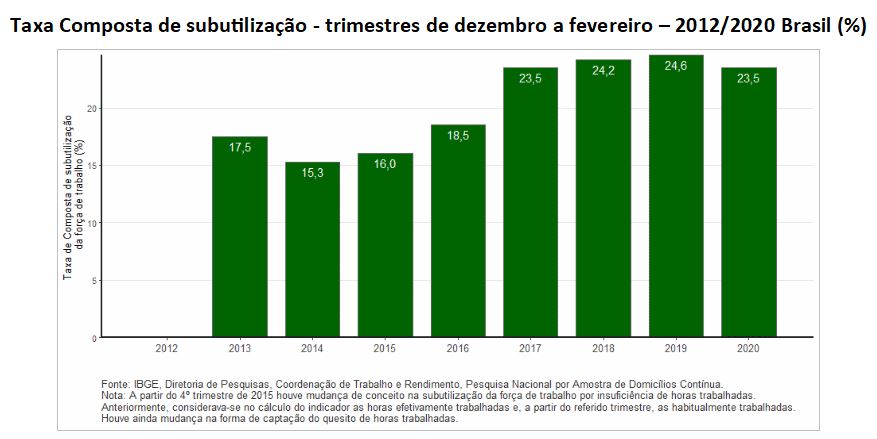
O número de subocupados por insuficiência de horas trabalhadas (6,5 milhões) recuou (-6,7%, ou menos 463 mil pessoas) frente ao trimestre móvel anterior e ficou estável em relação ao mesmo trimestre de 2019.
A categoria dos empregadores (4,4 milhões de pessoas) ficou estável frente ao trimestre móvel anterior e, também, em relação ao mesmo trimestre de 2019.
A categoria dos empregados no setor público (11,4 milhões de pessoas), que inclui servidores estatutários e militares, mostrou queda de 2,7% (menos 316 mil pessoas) frente ao trimestre anterior e estabilidade na comparação com o mesmo trimestre do ano anterior.
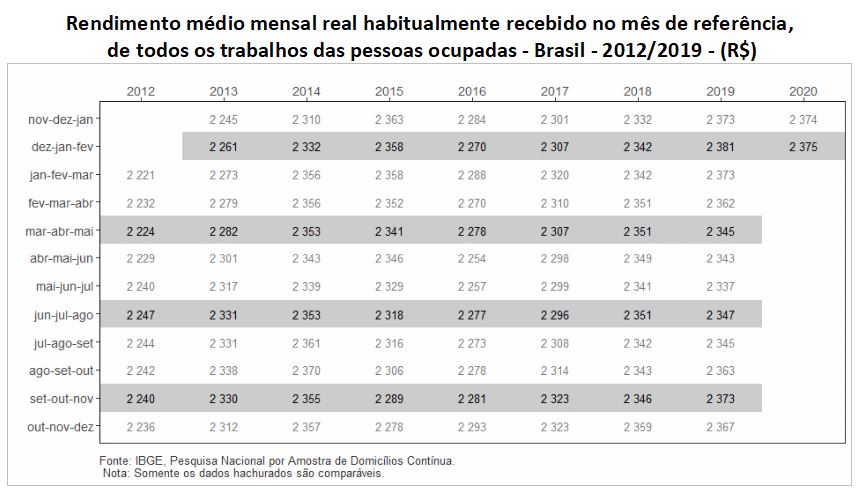
Desemprego aumenta para 11,6% no trimestre encerrado em fevereiro. País tem 12,3 milhões de desempregados e 38 milhões de trabalhadores informais
ERRAMOS: Foi identificado erro no cálculo das variações trimestrais e anuais do rendimento médio real e da massa de rendimento real. Os valores absolutos das estimativas não foram alterados. O arquivo com os quadros sintéticos foi corrigido e substituído, assim como as variações foram corrigidas no release e na notícia sobre a PNAD Contínua, publicados hoje na Agência IBGE Notícias.
A taxa de desocupação subiu para 11,6% no trimestre encerrado em fevereiro, atingindo 12,3 milhões de desempregados, segundo a PNAD Contínua, divulgada hoje (31) pelo IBGE. O aumento, na comparação com o trimestre terminado em novembro (11,2%), interrompeu dois trimestres seguidos de quedas estatisticamente significativas no desemprego.
“É normal que no início do ano ocorra essa interrupção, porque já vínhamos numa trajetória de taxas declinantes no fim do ano. Não tínhamos visto essa reversão em janeiro, no entanto, ela veio agora no mês de fevereiro, provocada por uma queda na quantidade de pessoas ocupadas e um aumento na procura por trabalho”, disse a analista da pesquisa, Adriana Beringuy.
Por outro lado, a taxa de desocupação continuou caindo na comparação com o trimestre encerrado em fevereiro de 2019, quando ficou em 12,4%. “O trimestre encerrado em fevereiro deste ano se apresenta com uma taxa inferior ao do mesmo período do ano passado. Essa queda foi causada pelo crescimento no número de pessoas ocupadas (1,8 milhão), o que impediu a taxa de crescer nessa comparação”, explica a pesquisadora.
Adriana observa, ainda, que o aumento na desocupação não veio do comércio, setor que, tradicionalmente, costuma demitir no início do ano os profissionais contratados temporariamente para o Natal. Desta vez, a alta na taxa foi puxada pelos setores de construção (-4,4%), administração pública (-2,3%) e também pelos serviços domésticos (-2,4%).
“A construção não sustentou o movimento de recuperação que ela vinha apresentando no fim do ano passado. Já a administração pública tem uma sazonalidade, pois ela dispensa pessoas no fim e no início do ano em função de términos nos contratos temporários das prefeituras, nas áreas de educação e saúde, retomando as contratações a partir de março, após a aprovação dos orçamentos municipais. O serviço doméstico está muito ligado ao período de férias das famílias, as dispensas das diaristas, já que muitas famílias viajam, interrompendo a demanda por esse serviço”, avalia Beringuy
Informalidade cai, mas atinge 38 milhões de pessoas
Já a taxa de informalidade caiu de 41,1% no trimestre de setembro a novembro de 2019 para 40,6% no trimestre encerrado em fevereiro deste ano, mais ainda representando um total de 38 milhões de informais. Nesse grupo estão os trabalhadores sem carteira, trabalhadores domésticos sem carteira, empregadores sem CNPJ, os conta própria sem CNPJ e trabalhadores familiares auxiliares.
De acordo com Adriana, essa queda da informalidade está concentrada na redução de contingentes de trabalhadores por conta própria sem CNPJ e também de trabalhadores empregados sem carteira.
“A gente ainda vive sob a influência do mês de dezembro, em que tivemos um desempenho muito bom das contratações com carteira trabalho. Muitas pessoas foram contratadas via carteira de trabalho no comércio, o que deu um pouco mais de consistência aos dados de formalidade. Isso pode estar contribuindo para a queda na quantidade de informais”, avaliou, lembrando que o rendimento médio real habitual (R$ 2.375) no trimestre terminado em fevereiro ficou estável nas duas comparações.
Ainda de acordo com a PNAD Contínua, o total de pessoas fora da força de trabalho chegou a 65,9 milhões, patamar recorde desde o início da pesquisa, no primeiro trimestre de 2012. São pessoas que não procuram trabalho, mas que não se enquadram no desalento (pessoas que desistiram de procurar emprego). Os desalentados somam 4,7 milhões, quadro estatisticamente estável em ambas as comparações.
Coronavírus: coleta por telefone
O IBGE está coletando os dados da PNAD Contínua somente por telefone durante o período de isolamento social, seguindo as orientações do Ministério da Saúde relacionadas ao quadro de emergência de saúde pública causado pelo novo coronavírus. Para confirmar a identidade do entrevistador durante a ligação, acesse o site Respondendo ao IBGE.
DOCUMENTO: https://agenciadenoticias.ibge.gov.br/agencia-sala-de-imprensa/2013-agencia-de-noticias/releases/27259-pnad-continua-taxa-de-desocupacao-e-de-11-6-e-taxa-de-subutilizacao-e-23-5-no-trimestre-encerrado-em-fevereiro-de-2020
CONTAS PÚBLICAS
MEconomia. 30/03/2020. CONTAS PÚBLICAS. Economia acumula superávit no 1º bimestre, mas Mansueto prevê piora nos próximos meses. Para o secretário do Tesouro Nacional, ajustes estruturais realizados em 2019 permitem ao país lidar melhor com a "gravíssima" crise mundial
O governo central do Brasil – que inclui as contas do Tesouro Nacional, do Banco Central e da Previdência Social – acumulou superávit primário, em valores nominais, de R$ 18,3 bilhões no primeiro bimestre de 2020, mesmo com um déficit de R$ 25,9 bilhões registrado no mês de fevereiro. Em 2019, o superávit dos primeiros dois meses havia sido de R$ 11,8 bilhões e o déficit de fevereiro foi de R$ 18,2 bilhões.
Em entrevista coletiva realizada de maneira remota nesta segunda-feira (30/3), o secretário do Tesouro Nacional do Ministério da Economia, Mansueto Almeida, ressaltou que os números indicam que a economia do país estava indo no caminho certo, devido aos ajustes fiscais estruturais.
“A piora no mês de fevereiro está relacionada ao aumento das transferências feitas para estados e municípios. Porém, quando se olha o acumulado do bimestre, temos um resultado muito melhor do que o do ano passado, com crescimento do superávit de quase 50%”, comparou.
Mansueto ressaltou que se a pandemia tivesse atingido o Brasil há um ano, os efeitos dela na economia seriam piores. “Ainda bem que estamos passando por isso depois de termos aprovado a Reforma da Previdência e feito ajustes importantes. Essa crise gravíssima chegou ao país em um cenário de arrecadação crescente e inflação e juros muito baixos. O Brasil estava no caminho do ajuste estrutural, o qual terá de ser retomado no próximo ano”, apontou.
Conjuntura
Ao apresentar a composição e a evolução dos indicadores econômicos do primeiro bimestre, bem como os fatores que as influenciaram, Mansueto fez um alerta para os próximos meses: em abril, maio e junho haverá uma sazonalidade extra muito além do normal, que vai impactar o déficit primário, devido à execução de políticas públicas de combate à crise.
Segundo ele, medidas que envolvem transferência de renda para pessoas na informalidade, subsídios para crédito às micro, pequenas e médias empresas e ampliação do orçamento para saúde levarão a uma pressão forte no lado das despesas e, eventualmente, a frustrações de receitas.
Questionado pela imprensa sobre as dificuldades para pagar contas extraordinárias, o secretário enfatizou o tamanho do desafio de gestão que o país terá pela frente, mas explicou que o momento é de pensar na execução das políticas, para salvar vidas e apoiar a economia.
“Os próximos três meses serão os que o país irá sentir de maneira mais forte os efeitos dessas políticas de combate ao coronavírus. Mas temos que pensar em cada problema na sua devida hora. Agora, o problema a ser resolvido é o de executar a política, depois veremos a melhor maneira de pagar (a conta), analisando como a economia irá reagir”, disse.
Mansueto destacou que a conjuntura atual é difícil e atípica, pois muitas pessoas perderam o “ganha pão” e a obrigação do governo é garantir a todos o acesso às políticas públicas. De acordo com ele, para assegurar apoio a todos, o déficit primário de 2020 poderá ser de R$ 350 bilhões, muito além dos R$ 124,1 bilhões previstos para o exercício.
Execução das políticas
Para Mansueto Almeida, a quantidade de regras fiscais contidas na Lei de Responsabilidade Fiscal (LRF) e na Lei de Diretrizes Orçamentárias (LDO) dificulta a execução de políticas públicas. Nesse sentido, o secretário elogiou a decisão do ministro do Supremo Tribunal Federal (STF) Alexandre de Moraes, de flexibilizar o cumprimento dessas regras no período de calamidade, atendendo ao pedido feito pela Advocacia Geral da União.
Ele considerou também importante a sintonia da equipe econômica com os presidentes da Câmara e do Senado, bem como com os líderes partidários. “As negociações para a aprovação da PEC (Proposta de Emenda Constitucional) que vem sendo chamada de PEC da Guerra estão boas. Agradeço ao Legislativo, que está engajado 24 horas por dia em diálogos com a Economia. O Congresso tem dado enorme contribuição, um esforço, de fato, de guerra”, frisou.
Para o secretário, o diálogo com o Congresso Nacional nesse contexto é ainda mais importante. “Em épocas como essa, pensar em duas ou três semanas, é pensar em longo prazo. Nas últimas décadas, o país não teve maturidade de controlar suas despesas obrigatórias e colocou empecilhos para aumento de outros gastos”, apontou, acrescentando que as regras atuais tornam quase impossível que decisões políticas se transformem em aumento de despesas com celeridade.
Transparência em período de crise
Mansueto Almeida reforçou, ainda, que é imprescindível nesse momento separar o que é o “orçamento da crise” do orçamento normal, para não contaminar as contas de 2021. Ele disse que gostaria que a coletiva aos jornalistas fosse feita de maneira presencial, para ouvir as ênfases de cada profissional da imprensa. Entretanto, devido à impossibilidade, o secretário sugeriu ampliar ainda mais a transparência na apresentação dos números.
“Podemos ampliar a frequência no uso desse canal virtual e tornar ainda mais fácil e amigável a apresentação dos números, para que todos possam acompanhar os custos relacionados a essa crise, com as políticas que estão sendo decididas e aprovadas com o apoio do Congresso”, finalizou.
- Apresentação com os dados: http://www.tesouro.fazenda.gov.br/documents/10180/246449/relatorio_fev20.pdf/eb67f6be-1f79-4963-8ca9-fbaedc42eeb1
- DOCUMENTO: https://www.gov.br/economia/pt-br/assuntos/noticias/2020/marco/economia-acumula-superavit-no-1o-bimestre-mas-mansueto-preve-piora-nos-proximos-meses
________________
LGCJ.:

