US ECONOMICS
CORONAVIRUS
U.S. Department of State. 03/26/2020. Briefing With USAID Deputy Administrator Bonnie Glick and Director of U.S. Foreign Assistance Resources James L. Richardson On U.S. Foreign Assistance in Response to COVID-19. Via Teleconference
- Bonnie Glick, USAID Deputy Administrator
- James L. Richardson, DirectorOffice of U.S. Foreign Assistance Resources
MS ORTAGUS: Well, let’s go ahead and get started, everybody. This is Morgan, spokesperson. I just want to remind everybody that everything that we discuss on this call is embargoed until the end of the call, and this call will be on the record.
So the U.S. Government is rapidly mobilizing unprecedented resources to respond to the COVID-19 pandemic both home and abroad. Today, I am pleased to announce that the United States has made available nearly 274 million in emergency health and humanitarian funding, continuing the American people’s leadership in responding to this pandemic.
To help expand and explain on this announcement further, we have joining us for this on-the-record call Bonnie Glick, Deputy Administrator of the U.S. Agency for International Development, and James Richardson, Director of the Department of State’s Office of Foreign Assistance Resources.
Bonnie will begin with some opening remarks and then turn it over to Jim, and then we’ll take a few questions. Ruben has given out his phone number, which you could go ahead and text if you’d like to ask a question. And just another reminder for a few people that dialed in late, this briefing is embargoed until the end of the call and it is on the record.
Bonnie.
MS GLICK: Morgan, thank you so much. Good afternoon, everyone. I hope that you’re all well and that everyone is feeling healthy today. It is weird to be giving a press briefing without being able to see all of you, but I trust that won’t dampen our spirits at all.
We wanted to talk to you today about a story that we feel hasn’t gotten enough attention, and that is how the United States is leading the global effort to combat the COVID-19 pandemic, specifically with regards to global health and humanitarian assistance.
Under the direction of President Trump, the United States Government is responding rapidly. The U.S. was among the first nations to offer help to the Chinese people, and we are the largest financial backers of the World Health Organization and UNICEF. In early February, the United States delivered more than 17 tons of medical supplies to China donated by the American people. These supplies included masks, gowns, gauze, respirators, and other vital materials.
Secretary Pompeo’s announcement today brings us to a total of $274 million in funding for 64 of the most at-risk countries facing the threat of this global pandemic, including the $100 million that Secretary Pompeo announced on February 2nd.
The announcement of $110 million from the International Disaster Assistance Account will be provided into at-risk countries through multilateral organizations and implementing partners to support humanitarian assistance needs resulting from the coronavirus outbreak. This funding will support countries by providing protective services, water, sanitation and hygiene, food security, livelihood assistance, and humanitarian response coordination in order to mitigate the broader economic stabilization and security effects of the outbreak.
This funding will target the following high-priority countries: Afghanistan, Angola, Indonesia, Iraq, Kazakhstan, Kenya, South Africa, Tajikistan, the Philippines, Turkmenistan, Uzbekistan, Zambia, Zimbabwe, Bangladesh, Burma, Cambodia, Ethiopia, the Kyrgyz Republic, Laos, Mongolia, Nepal, Nigeria, Pakistan, Thailand, and Vietnam.
This new assistance builds on the United States record of global health leadership. For decades, the United States has been the world’s largest provider of bilateral assistance in public health. The U.S. has saved lives, protected people who are most vulnerable to disease, built health institutions, and promoted the stability of communities and nations. In only the last 20 years, USAID and the Department of State have invested nearly $120 billion in public health worldwide. We’re on the front lines in the fight against Ebola. We support countries in their battles against HIV and AIDS, tuberculosis, and malaria. And we will drive the global response to the novel coronavirus disease even as we battle it on the home front. We welcome continued no-strings-attached contributions from other donors to further catalyze the global response efforts underway as we fight this deadly pathogen.
The United States and the American people represent the most generous nation in the world when it comes to foreign assistance. We represent this generosity through government, industry, foundations, nonprofits, the faith community, and every American. It’s who we are as a nation. In the battle against coronavirus, we are saving lives, not saving face.
With that, I’d like to turn it over now to you, Jim.
MR RICHARDSON: Great. Thank you, Bonnie. Again, this is Jim Richardson, director of foreign assistance here at the State Department. It really has been impressive to see the Department of State and USAID, and really the whole of government, under the leadership of President Trump and Secretary Pompeo, to come together to respond to this global pandemic. American leadership is critical at this time, and the foreign assistance funded today marks an important step forward as we combat COVID-19 both at home and abroad.
Of the 274 million that the Secretary announced today, Bonnie covered about 210 of that. The other $64 million will be provided in refugee assistance – or, sorry, humanitarian assistance for the UN High Commissioner for Refugees, UNHCR, to assist in its pandemic response efforts for some of the world’s most vulnerable populations. This new funding builds upon many decades of U.S. leadership in global health and humanitarian assistance. As Bonnie talked about, several of these countries, the initial 70 – or 64 countries identified were based on consultations with our amazing teams around the world, at missions and embassies, focused on need and prioritization as the global efforts of this virus rapidly evolves.
There is no doubt the American people are the greatest humanitarians the world has ever known, contributing almost $500 billion in official development assistance around the world just in the past 20 years alone, which – this is on top of the hundreds of billions Americans have contributed through corporate donations, NGOs, charitable organizations, and faith-based groups. We have demonstrated particular leadership when it comes to global health and humanitarian assistance, laying the foundations for countries to respond to this crisis by bolstering health systems and building country capacity over many decades. The numbers simply speak for themselves.
In this past decade alone, the American taxpayers have generously invested nearly $170 billion in health and humanitarian assistance globally. That is the frontline response to the COVID-19 pandemic. Without that investment, the world would be at a dramatically different place today.
But the U.S. is really in a league of – on its own. The United States contributes close to 40 percent of the world’s global health assistance every year, nearly five times larger than the next donor, which is the UK, and 30 times – and 30 percent of the world’s humanitarian assistance.
The U.S. Government is not alone in its contribution. The generosity of the American people is demonstrated above and beyond official development assistance that I’ve outlined here. As it address – with the COVID-19 response, so far we have seen in excess of $1.5 billion from the American people and donations from American businesses, NGOs, and religious and charitable organizations. We are truly mobilized as a nation to confront this daily – this deadly virus both here and abroad. As Bonnie said, we welcome high quality, transparent, no-strings-attached contributions from every other donor in the world. Please join us in our work to further catalyze the global response currently underway.
In the face of this virus, our global leadership will continue. It is once again underscored by today’s announcement by Secretary Pompeo.
With that, I’m glad to answer any of your questions.
MS ORTAGUS: Okay. Ruben, can you go ahead and start going through the queues, please?
Ruben, do we still have you? Apologies, everybody. We may have a technical difficulty here.
MS GLICK: I still hear you, Morgan. It’s Bonnie.
QUESTION: I still hear you, Morgan. It’s Lara Jakes at The New York Times and I have questions.
MS ORTAGUS: Great. Go ahead, Lara. I think we lost Ruben. Go ahead.
QUESTION: Okay. Fabulous, thanks. Bonnie, you mentioned the multilateral donations. I was wondering how much of this is going to the $2 billion pledge that – or not pledged, but appeal that UNOCHA announced the other day. And I was wondering: The United States and Secretary Pompeo have said several times that aid was offered to Iran, but it’s been rejected. I was wondering how much aid, and what was that aid for? Thank you.
MS GLICK: Jim, why don’t I toss that back to you? Lara, Jim is the guy with the numbers.
MR RICHARDSON: I’m happy to take that. So in each individual country, the way that we’d look at this is we want to make sure that the very best assistance ends up in the hands of the recipient in the host country, not necessarily through whatever organization. So yes, we do get appeals; yes, we are the largest donor to both WHO and to UNICEF. That will certainly continue. And in the fact sheet that you’ll get after this call, which will list every country with every level of – line of effort, you should be able to see in there sort of some of the potential implementing partners. But there are times where we want to use the WHO and there are times where – obviously, we’ve just announced $64 million for UNHCR.
But in every country, the technical experts are looking at the request, looking at how we can get the assistance fastest, most efficiently, most effectively. Sometimes that’s through a multilateral; sometimes that’s through our bilateral assistance. As you know, USAID and CDC have a network of on-the-ground technical experts all around the world through their daily work. We want to leverage those platforms, whether that be PEPFAR or malaria, the President’s Malaria Initiative. And so we’re really looking at the best mechanism for each individual piece. So it’d be hard for me to tell you exactly what the final disposition of the – of WHO or UNICEF appeal. We’ll see that as we finalize contracts. But what we are announcing here today is a topline number, number by country, and sort of what we are looking to invest in those – in that country.
QUESTION: Can I ask a question?
QUESTION: (Inaudible) Iran freeze? On the —
MR RICHARDSON: Oh, and on the – on Iran freeze, I’d have to – I’m not part of those conversations on Iran. We’d have to connect back with Brian Hook and see what are the status of those conversations. I’m not privy to that conversation.
MS GLICK: But Lara, for your readers, the bottom line on Iran is that they rejected American assistance.
QUESTION: Could I ask a question?
MR HARUTUNIAN: Everyone, I’m sorry. This is Ruben. I had dropped off the call. Abby Williams has the next question.
QUESTION: Hi. Thanks so much for doing the call. I was wondering if you could say if China has accepted the aid that has been given, and how they’ve used it, or how you’ve seen them use it. And also if the U.S. has as part of their reaching out other countries to ramp up production there’s any been – there’s been any discussion with China about them supplying the United States.
MS GLICK: So my understanding, Abby, is that China accepted large quantities of what were, at the time in February, private contributions from Americans, American companies, American foundations.
MR RICHARDSON: I would just add that obviously the U.S. has contributed through this – I think right now we’re looking at $11 million of direct contributions to WHO and UNICEF through this announcement, and we’ll continue to work with our partners to make sure that the resources go to the right place at the right time.
MR HARUTUNIAN: Nick Wadhams has the next question.
QUESTION: Hi. Thanks very much. I’m still slightly unclear. So the $274 million that’s announced today, that includes the $100 million that was announced on February 2nd? So aside from what you had mentioned, I believe the $64 million or so, what else is actually new funding here? And how much of that – you indicated I think would be financial contributions, so just to be clear, the United States is not currently offering materials such as protective equipment to other countries. Is that correct? Thanks.
MR RICHARDSON: So this is Jim. So on the PPE question, so where there is a critical shortfall in the United States, obviously, we can’t pay for donations of materials that we can’t actually procure, but there is actually a lot of requirements around the world that we are responding to, and we’ve worked with our country teams to make sure that we are getting the right materials that countries need. Now, obviously, we can’t give them everything that they are looking for, but as supplies become more plentiful here in the United States, we’ll look to obviously continue to ramp up assistance around the world.
QUESTION: (Inaudible), thank you.
MS GLICK: So Nick, for your specifics on that question, you did your – the math correctly, and so we were at about $110 million from the International Disaster Assistance account, and that’ll go – just to give you some specifics, apart from the PPE question, it’ll go for things like water, sanitation, and hygiene; food security, livelihood assistance. And a big piece of what we do is helping with the humanitarian response to coordinate efforts within countries to mitigate the broader economic impacts of the COVID-19 outbreaks.
MR RICHARDSON: Yeah, and then – and Nick, the other part of that is – so there’s the hundred million that the Secretary said we are going to spend up to, and then we made subsequent announcements of the breaking down of the funding, but we didn’t tell you exactly where around the world that funding was going. So as part of this announcement, we have country-by-country allocations of the 64 countries that are – we’re providing assistance to. That covers the original hundred that so far has just been sort of – a goal and clear that we’re going to spend that, plus the humanitarian of 110, plus the refugee funding of 64. So that gets you to your 274 – or 264 number – 74 number.
MR HARUTUNIAN: Okay. Nick Schifrin has the next question.
QUESTION: Hey, guys. Thanks for doing this. Can I just ask – go back to Abbie’s question about China and ask, kind of, what seems to me the elephant in the room? Bonnie, you said specifically in the battle against coronavirus, we are saving lives, not saving face, and you obviously mentioned no strings attached a couple of times. So are you guys criticizing the aid that China is offering? And what would you say to the European countries who have accepted some of this aid that is badly needed, including medical equipment that’s going from China to Italy? Thanks.
MR RICHARDSON: Yeah, this is Jim. I would just say that the Chinese Communist Party has a special responsibility to provide no-strings-attached assistance around the world and take responsibility for what everyone realizes is the result of the coverup that happened in Wuhan. I think every country around the world would be ecstatic and should be to receive high-quality, transparent contributions from every donor around the world, and we would just encourage all donors, but especially China – again, we think that they have a special responsibility in this – to provide that assistance, but it does need to make sure that it is high quality and that it does – is a no-strings-attached. We can’t burden financially difficult countries facing this pandemic in addition to their economic conditions. We should not ask them to take on more debt to keep their people healthy.
Bonnie, I don’t know if you have anything more to say.
MS GLICK: I would echo exactly what Jim said perfectly.
MR HARUTUNIAN: Last question is Said Arikat.
QUESTION: Yes, thank you, Ruben; thank you, Morgan; thank you, Bonnie and Jim. I wanted to ask, under this current unusual circumstances and dark conditions, would the U.S. reconsider its aid cutoff to Palestinian refugees, to UNRWA, by any amount of money? Thank you.
MR RICHARDSON: This is Jim. I think it’s —
QUESTION: Hi, Jim.
MR RICHARDSON: Yeah. So I would say that every country in – around the world, if – as needs are seen on the ground, they are working with our teams around the world to identify need and bring those requests to Washington. I would say that it’s important for countries to come forward if they have needs. I think this is what we saw particularly in China where the need was not apparent right away. So as – transparency is hugely important, so we would just encourage every government around the world, including the Palestinian Authority, to come forward with a request of assistance, and we will take that under consideration.
MS ORTAGUS: Great.
MS GLICK: One other short thing to add to that is we noted that the Govenrment of Qatar has generously offered assistance to the Palestinians. So recognizing that the United States is not the only donor in the world focusing on the COVID-19 outbreak, we’re grateful that other nations are rising to the task as well.
QUESTION: Thank you.
MS ORTAGUS: Great. Well, thank you, everybody, for dialing in. I know Jim and I think Bonnie both have to get on a call with the Hill. Oh, it looks like we have – Kylie wanted to ask one more. Do you – Jim and Bonnie, do you have time for one more from Kylie, or do you have to jump?
MR RICHARDSON: Always for Kylie.
MS ORTAGUS: Okay. Go ahead.
QUESTION: (Inaudible), appreciate it. It’s actually just two quick questions. So I just want to clarify: At this time, there’s no PPE being provided as part of the U.S. assistance? And just in that vein, given that you laid out that there was actual medical supplies provided to China earlier this year, is there any regret on the behalf of the U.S. for doing that?
And then the second question is: Jim, you mentioned strings being attached to aid. At this time, does the U.S. Government have any proof that there are strings being attached to the assistance that China is providing? Thank you.
MR RICHARDSON: On the strings attached, I mean, I’m not the intelligence folks, so I don’t know what exactly has been proven. I read the same articles that you do about demands that the Chinese Government placed, and I would just say – I mean, just look at the Belt and Road Initiative writ large. I mean, they request mineral rights, they request deep sea access ports, they request loyalty letters from governments. I mean, they request a lot of things in exchange for essentially loans, so it’s not even for grants. And so I think – I don’t have any hard proof besides the articles that I’ve seen, but that certainly rings true. If you – if anyone has spent time in the developing world where China is active, you see this happening time and time again.
In terms of the medical supplies, that’s – the medical supplies that Bonnie referenced is from private donors, so it wasn’t from the U.S. Government per se.
And then on the PPE question – so as a general principle, where there are shortages of critical medical supplies here in the United States, unfortunately we can’t provide that assistance and – through our mechanisms from the United States. There are other sources that people can get assistance. There are some sources of PPE and the like around the world, while in short supply, but I think under President Trump’s leadership, the manufacturing base of the United States is rapidly shifting to be able to produce PPE and ventilators and other critical medical supplies, so we do hope that in the near future we will be able to provide that assistance to countries all around the world.
Bonnie, did you have anything more to add on that question?
MS GLICK: No, I think that hits the nail on the head. Thanks, Jim.
QUESTION: Thank you.
MS ORTAGUS: Great. Well, thanks so much, Bonnie and Jim —
QUESTION: Thank you.
MS ORTAGUS: — for being on this call and for making this possible today. We will, of course, have another briefing tomorrow, so thanks, everybody. Bye.
U.S. Department of State. 03/27/2020. Briefing With Dr. William Walters, Deputy Chief Medical Officer for Operations, Bureau of Medical Services, and Principal Deputy Assistant Secretary Ian Brownlee, Bureau of Consular Affairs On COVID-19: Updates on Health Impact and Assistance for American Citizens Abroad. Via Teleconference
- Dr. William Walters, Deputy Chief Medical Officer for Operations, Bureau of Medical Services
- Ian G. Brownlee, Principal Deputy Assistant SecretaryBureau of Consular Affairs
MS ORTAGUS: Thanks, everybody, and sorry for our tardiness. We keep having a little bit of technical difficulties today, so we’ll try to allow for as many questions as possible. I believe you press 1 and 0 on this particular line if you’d like to ask a question, so please go ahead and do so.
And just a reminder, as with all of our calls, this is on the record but is embargoed until the end of the call, please.
The United States recognizes the critical importance of communicating clear, timely, and transparent information during a time of crisis such as the global outbreak of the COVID – excuse me, the global outbreak of the COVID-19 pandemic. It is in that spirit that we have conducted numerous briefings on this topic from the State Department already and are committed to continuing that pattern in the weeks ahead.
To help us on that, we have joining us for today’s on-the-record call our Principal Deputy Assistant Secretary from the Bureau of Consular Affairs Ian Brownlee as well as Dr. William Walters, Executive Director and Managing Director for Operational Medicine in our Bureau of Medical Services. They will provide an update on the State Department’s unprecedented and historic efforts to bring Americans home from all over the world as well as to give you a sense of the impact of the pandemic on the State Department’s global workforce. Doc Walters will begin with some opening remarks and then turn it over to PDAS Brownlee, then we’ll take a few questions. Just a reminder, again, that this call is embargoed until the end.
One thing that I would add is that all of you should have received from Ruben and his team the new one-pager that we’re updating every day. We’re trying to get that updated daily around 1 p.m., so you should be able to go to that link from here on out for – every afternoon for the newest facts and figures that we have from the State Department.
So let me go ahead and turn it over to Doc Walters in case you have any opening remarks.
MR WALTERS: Thank you, Morgan. Hello, everybody, and thanks for the opportunity to give you an update once again. The Bureau of Medical Services really within this outbreak context has two focuses. The first focus is protecting our workforce both domestically and overseas, and our second focus, equally important, is assisting Consular and the rest of the department in the repatriation of American citizens that find them stranded – find themselves stranded in a number of different places around the world.
I can report first on the – on our efforts to protect our workforce. I know there’s a desire to keep pace with sort of how our workforce is doing. I can report that in a workforce of roughly 75,000 people overseas, 220 locations, our current case – COVID-positive cases are at 68. We have one Medevac in transit or in process. That’s an individual who was mildly symptomatic, and we’re coordinating that evacuation back to the States.
And domestically, we have 25 current cases, and – in eight locations around the country, but all are doing well. And that’s about it on the dashboard for today.
With regard to evacuations, I’ll focus first on the medical evacuations. We recently completed a medical evacuation of a coronavirus victim on behalf of DOD out of Camp Lemonnier. That individual – critically ill – was evacuated using our biocontainment capability to Landstuhl Regional Medical Center and is doing very well.
An American citizen taken out of Bhutan maybe a week and a half ago and brought back to the United States is doing very well. A chief of mission person that was evacuated out of Ouagadougou was coronavirus-positive and was brought back to the States, is doing very well, and will be convalescing – is being discharged from the hospital and convalescing.
And we have one more that I reported on the dashboard, individual who was minimally symptomatic in south – in – not – in southern Africa, not South Africa – and will be brought back to the States in coming days.
We’re currently running through the State Department’s contracted aviation assets as opposed to charters. We conducted evacuations out of North Africa today, Tunis specifically, completed an evacuation flight out of – that went Ouagadougou to Monrovia, Liberia, and then up to Lisbon, and then back to the States. We’ll be launching more evacuation flights as early as tonight covering Dar es Salaam, Tanzania, into Madagascar. We’ll have one more stop in Africa that we’re working through right now, and then back to the States. And we’ll be conducting these operations over the next several days.
Pending your questions.
MS ORTAGUS: Okay, thanks. Let’s turn it over to Ian, please.
MR BROWNLEE: Thank you very much, Morgan. Thank you, Will. And thank you, all of you. It really is good to be back here to talk to all of you again today.
Our work to bring Americans home has continued apace as we last spoke. We have now brought home over 15,000 people from over 40 countries and are tracking at least 64 flights over the next week. We have identified 9,000 passengers – about 9,000 passengers – to go on those flights, though there’s space for more, so we need to continue to get the word out that these flights are available.
I want to emphasize again for your audiences how important it is that U.S. citizens abroad, while they still have commercial opportunities, if they’re not prepared to hunker down where they are now, act now to get home. Avail yourself of those commercial opportunities while they still exist. We are still working to connect people to commercial options where those flights are available and to lay on charter flights where they are not. In some countries we are seeing demand for repatriation already beginning to drop as we bring home hundreds or thousands of Americans. We strongly encourage those still overseas to take advantage of the flights we are coordinating while they remain available.
We continue to see the greatest demand for repatriation assistance from U.S. citizens in Central and South America. We have now brought home over 700 Americans from Ecuador and 2,000 from Guatemala, and our flights are continuing from both countries today and tomorrow and out into the future. Yesterday we had two flights out of Peru; today we have three. I think the third one is going wheels up right about as I speak. We have more planned right through the weekend. We are planning three flights a day, two from Lima, one from Cuzco through April 1st. If we need to continue beyond that, we will do so. In total, so far, we’ve brought more than 1,200 U.S. citizens home from Peru.
Meanwhile, we’re tracking increasing interest in other regions, across Africa but also particularly in India, as well as passengers on cruise ships across the globe. We recently had our first flight out of Jordan as well. We are continuing to work 24-7 to bring home as many Americans as we possibly can. I am very, very proud to be representing a global team of incredibly dedicated staff who are moving mountains every day and every night in every region to do something truly unprecedented (inaudible). And pending your questions, that’s it. Thank you.
MS ORTAGUS: Great. I think I’m leading off on the Q&A part, and I think that we have Jessica Donati first, Wall Street Journal.
QUESTION: Hi, thanks. We received some photos from the flight that departed Peru today that showed that the flights were mostly empty. I was wondering if you could speak to the logistical problems that are causing this to happen.
MR BROWNLEE: Yes, let me mumble for a moment, try to pull up the data I have here on the flights, how many people were on those flights. We got 243 on one flight, 146 on another flight which is wheels up already. The 146 certainly does not come anywhere near to filling the capacity of that plane. I think the difficulty is this – and I have reason to believe that it’s going to improve tomorrow, the next day, and out into the future – but the difficulty is this: Until really today, we did not have approval from the Peruvians on a timely basis. We now have that. They’ve approved three flights a day, for today and the next several days: two from Lima, one from Cuzco. We can now start building these manifests with enough anticipation that people can make it to the airports on time.
What we were facing before and what we – we’re still facing today was we were getting in touch with people and saying, “Hey, we have a plane tomorrow. Can you get to the airport?” And people just weren’t able to get to the airport on time. It’s regrettable that that many seats went empty, but I am hopeful that as we move forward through the rest of the weekend and into next week, we’ll be able to address this problem by giving people enough time to get to the airport, and that is thanks to the fact that the Peruvians finally gave us multiple days’ worth of flight approvals. Over.
MS ORTAGUS: Okay, thanks. Can we have Lara Jakes now, New York Times?
QUESTION: Hi, thanks. I had to take you guys off of double-mute. So my question is about a group of Americans who appear to be doubly stranded in Nepal. These are people who were approaching Base Camp Everest and they are worried about coming back down to Kathmandu for fear of catching COVID, and if they can’t get to Kathmandu, they obviously can’t get any flights out of Nepal.
So my question is: What kind of guidance would you give them at this point? Have there been any attempts to reach them? Has the Nepalese Government been helpful at all? I also understand other countries have been able to get similar doubly stranded trekkers out, so if you could just comment in any way. Appreciate it.
MR BROWNLEE: I confess I am not familiar with this particular group of trekkers. We’re going to have to take that question and get back to you. I’m sorry.
MS ORTAGUS: Okay. We’ll take that one, no worries. Carol of Washington Post.
QUESTION: Thank you very much. Say, Ian, I wanted to ask you a question about this doctor visas thing that you have on your web page. Are you moving medical professionals who can work on COVID-19 treatments basically to the front of the line or speeding up their processing or give them – giving them some sort of preference? And what would you say to people who say you’re essentially trying to poach people and you’re encouraging a brain drain? Thank you.
MR BROWNLEE: We had – excuse – thank you, Carol, for that question. We had some – I’ve got to confess maybe what we put up on the web page is not as clear as it might have been. We’re ready to work with people who are already accepted into existing U.S. programs and had otherwise planned to travel to the United States. We are not going out looking for others. These are people who were ready to come in. What we’ve done is around the world we have suspended routine visa services, but we are – we have not shut down visa services. We’ve suspended routine visa services, and our posts overseas are ready to work with applicants who are – who were already identified as being eligible for these visas. Does that answer your question?
Hello?
MS ORTAGUS: I think they probably closed her line. Yeah, they probably closed her line. That’s okay. Let’s go next to Christina Ruffini from CBS.
QUESTION: Hi, guys. Thanks so much. I wanted to follow up on the flights out of Cusco. We’ve been in touch with a young woman there who has heart problems and has been enrolled in everything she can, and as far as she knows, she is not getting anything but the regular updates. What would you say to Americans who are in these places and haven’t gotten any kind of direct contact from the State Department? Is there something else they should be doing?
And then I wanted to ask about the U.S. mission in Peru and in the region and around the world. Are you seeing a large amount of voluntary evacuations? Have all of those been authorized? And are you having any kind of problem with people self-voluntary evacuating themselves necessarily without permission? Thank you.
MR BROWNLEE: Yeah. Ian here. With regard to the young woman in Peru, and frankly, everybody else in Peru, we are pushing out or the embassy is pushing out three messages a day – morning, midday, and evening – and that is how we are communicating with these people. We simply don’t have the resources to be reaching individuals. We’re still dealing with a population of multiple thousands in Peru. So we are communicating through these messages and asking people to – excuse me – to let us know when they’re ready to travel so we can build up the manifests. I don’t know of this particular young woman you’re speaking, but that’s how we’re communicating.
With regard to your question about, if I understood you correctly, self-authorized departure, what – are you suggesting people are abandoning their posts? I’m sorry.
MS ORTAGUS: No, I think she was referring to Americans that are coming home maybe by booking their own chartered airplane or something like that.
MR BROWNLEE: Ah, ah, ah. Okay. Yes, yes, yes, quite right. Yes. What we have found is in a number of countries, people have found other ways to return to the United States. Haiti is a good example. It’s nearby and relatively easy to travel back to the States, so a number of people have traveled from there.
We have also found an increasing number of people who have decided that, all things considered, they’d just as soon hunker down where they are. So we’ve noticed that people who, a week ago, 10 days ago, had indicated a desire to be repatriated to the United States, in many cases, in quite a few cases, are now saying they’re going to stay where they are. We’ve seen this to a fairly high degree in Ecuador, for example. So we initially were tracking a number of some 7,000 who were going to seek to be repatriated. We’ve made our way through far fewer than that, maybe roughly a thousand, and we’re finding that demand is tapering off. So that’s what we’re seeing. Over.
MS ORTAGUS: Great, thanks. Abbie Williams, NBC.
QUESTION: Hi, thanks so much. You mentioned a particular interest from Americans in India. I wondered if you could give an estimate in the number of Americans there who are trying to come back to the U.S. with the suspension of flights. And also, could you possibly give an approximation of where we are from the 50,000 that was mentioned the day before?
And if I could, one more. Regarding Foreign Service officers abroad, is there a discussion of a broader plan to bring a mass of U.S. diplomats home when private U.S. citizens have come back to the United States?
MS ORTAGUS: Ian, did we lose you?
MR BROWNLEE: I’m sorry. I’m talking to a muted microphone. I apologize for that.
MS ORTAGUS: That’s okay. I do that all the time. Okay.
MR BROWNLEE: Not the first time. These are very rough numbers for India. We’re looking at 1,500 or so people in the New Delhi area who have identified themselves. We’re looking at multiple hundreds in the Mumbai area and another probably 6-, 700 in the Mumbai area who have identified themselves as being interested, and then another multiple hundreds – 3-, 400 range elsewhere in India who have identified themselves.
We are working with a multiplicity of options here. There is a church group that has chartered a large aircraft. We are facilitating the necessary permits for that aircraft. They’re ready to take out 150 or so Americans. We are working directly with both U.S. and foreign carriers to lay on aircraft direct from India to the United States.
The permitting is what’s complicated at the moment. We’re ready to act on this, but it’s the permitting that takes a while both in India and the United States. So we’re hopeful, and I think with reason we are hopeful, that those flights will begin within several days, within about three days or so.
You asked about the number of 50,000 that I cited whenever that last was we spoke. We are now tracking about 33,000. This is not because we’ve brought home 15,000 people in the meantime. It’s because – I’m going to be perfectly honest – some of that was some fat-fingering errors by a few of our posts. When we put out a data call asking people to tell us how many they were looking for, in one or two cases, an extra zero got added and that boosted the numbers way up. Once we did a scrub of the data, we got it down to where it should be.
But also, it’s the fact that, as I mentioned a little while ago, in some places, people have decided they’re just going to wait it out, wait out the curfew or wait out the quarantine where they are. And these, I guess, in many cases are the people who are expats resident overseas and they’ve just decided to wait it out in their home in whatever country they may be in at the moment. Over.
MS ORTAGUS: Thanks. For one of your questions that you asked Abbie about the numbers, all of that now is – you should have the link. I think Ruben sent it out to everyone. So you should be able – we tried to make it easy for all of you to check those numbers on a daily basis. I think we’re at just very close to 14,000 that we have repatriated since we started this, but again, you can check that link and get all of the statistics.
Okay, Humeyra.
QUESTION: My question is that – can I actually just follow up on Carol’s question about the visas with regards to the medical professionals? Thank you for the clarification, and I appreciate you saying the initial tweet maybe wasn’t clear enough. Can you – based on what you just said, can we just say now that there is actually an exception to medical professionals who already have their jobs secured but they need their visa to be processed? So can we say that State Department is actually processing those visas, because at the moment all other visas are suspended? And can you elaborate a little bit more on the motivation to process those visas over others? Thank you.
MR WALTERS: Well, let me clarify one point. All other visas are not suspended. They are not suspended. We have suspended routine visa services so that we can concentrate our efforts on assisting U.S. citizens. But all other visa services are by no means suspended. So for example, adoption visas. We are still processing visas for U.S. couples who are adopting children overseas. In some cases where there are immigrant visas where an applicant would be at risk of aging out under the law, we are still processing those visas. What we’ve done is substantially reduced our – the provision of visa services.
But let me just – for the sake of absolute clarity, I will read you the – what we are saying about these student – excuse me, about these doctors. The Department of State stands ready to work with doctors and other medical professionals who are already accepted into existing U.S. programs and otherwise expected to travel to the United States to work or study. Even though routine visa services are suspended, the Department and our post services are working to serve the most urgent visa applicants as resources and local government restrictions allow. We encourage medical professionals who already have an approved U.S. visa petition or certificate of eligibility in an approved exchange visitor program, particularly those working to treat or mitigate the effects of COVID-19, to consult with the relevant U.S. embassy or consulate to determine what services that post is currently able to provide. Over.
MS ORTAGUS: Great. Thank you so much. Appreciate that. Okay, let’s move over to – okay, let’s go over to Nick Schifrin.
QUESTION: Hey, guys. Thanks for doing this. You’d be happy to know we’ve been tracking three or four people all week – the piece runs tonight – and two of them have actually gotten back, and both of those – all those people say that the problems initially with communication have gotten better. One exception is the one that I brought up yesterday, Uganda. A missionary there says he’s been trying to get out and now has an offer from the embassy to get on a flight, but the tickets are $2,500 each and his family is seven people. So can you give me some context about why certain flights, whether you can talk about the Uganda case or not, but you can talk about why certain flights are so expensive? And for Will, can you talk about the 1,700 who are isolating – self-isolating across the world, whether any hot spots or just the fact that they’re following CDC guidelines? Thanks.
MR BROWNLEE: Yeah, Ian here. I’m not sure of the exact nature of that Uganda flight. If it is a State Department chartered flight, we are required by law to take a promissory note in the amount of the pre-crisis fare. So whatever the fare would have been on a commercial flight immediately prior to the crisis, not – I don’t know the exact circumstances, what it normally costs to get a flight from Uganda to the United States, but that could well be the explanation. If this is other than a State Department chartered plane, if it’s a commercial airline, it’s up to them to decide what they are going to charge for a flight. Over.
Have I lost everybody?
MR HARUTUNIAN: Morgan, did you drop?
MR BROWNLEE: Ian is still here.
MS THOMPSON: Okay. I think Morgan is having some technical difficulties here. So I guess we can go ahead and take – I think we are at about time. I guess we can take one more, maybe from I think Nick’s in queue, Nick Wadhams.
QUESTION: Hi, I just had a question for you guys on as to how long you anticipate doing these flights. Is there a time horizon after which you’re anticipating that you won’t be offering these flights anymore? Thanks.
MR BROWNLEE: Hey, Nick, thanks for the question. It’s very, very much country specific and demand specific. So we’re working to get everybody who wants to get out out of these places. A good example here is in Haiti where we are finding that demand is tailing off very quickly. We’re working with a contract carrier who will continue to offer flights through the weekend but has said they’re going to stop on Monday because they’re just seeing the – they’re seeing the demand go away. They’re prepared to stop – to start up again should demand return, but – I’m just pulling up my notes here – they don’t plan to offer any further service after Monday, March 30th. So they’re open to discussing future flights should demand resurge.
And so that’s just an example. We’re seeing something similar in Honduras, something similar in Guatemala. As other places come online, I mentioned India earlier – it will be a big deal for some period of time until we can deal with that. Very much driven by the circumstances of the particular country. Over.
MS THOMPSON: Okay, I think we can take a question now from Matt Lee from the Associated Press.
QUESTION: Hi there. I’m sorry, I’m still confused about this whole physician, medical professional visa thing. If in fact there’s no special treatment being given to them or you’re not specifically encouraging them, why did you put out this tweet or this statement that was also on the travel.state.gov? It wasn’t just a tweet. I don’t get it. It just seems to be – if there is no special treatment, it seems to be a bit tone deaf, considering this mad scramble that everyone else in the world is going through, and including in the U.S.
And then the other thing I’d just like to point out is for everyone else who got that fact sheet, which is great – thank you very much – but make sure you scroll down in the repatriation section, because you don’t see all of the countries at first, and I made that mistake just now. Anyway, thank you for doing this.
MS THOMPSON: Okay, I think we’ve got time for one more. We can take one from Roz Jordan of Al Jazeera.
MR HARUTUNIAN: Sorry, Ian didn’t answer Matt’s question.
QUESTION: Oh, I’m sorry.
MR BROWNLEE: I’m sorry. Once again, I had mute pressed. Matt, I – what I said to myself here was I’m going to have to take the question as to how this all came to pass. But we are still processing visas around the world for certain cases. These are one, certain H-2As are another. But otherwise I’m happy to take that question. Thank you.
MR BROWN: Okay, and we’re going to need to cut it off there, Nicole. Thanks, everybody, for joining the call. Remember this is provided on the record and now that we’re at the end of the call, the contents, the embargo on the contents is lifted. Thanks for joining, and we’ll look to continue these briefs next week.
U.S. Department of State. 03/27/2020. The United States is Leading the Humanitarian and Health Assistance Response to COVID-19
The U.S. government is leading the world’s humanitarian and health assistance response to the COVID-19 pandemic. We are mobilizing all necessary resources to respond rapidly, both at home and abroad. As part of this comprehensive and generous U.S. response, the State Department and USAID are providing an initial investment of nearly $274 million in emergency health and humanitarian assistance to help countries in need, on top of the funding we already provide to multilateral organizations such as the World Health Organization and UNICEF.
This total to date includes nearly $100 million in emergency health assistance from USAID’s Global Health Emergency Reserve Fund and $110 million in humanitarian assistance from USAID’s International Disaster Assistance account, to be provided for up to 64 of the most at-risk countries facing the threat of this global pandemic. Through the State Department’s Bureau of Population, Refugees, and Migration, the UN Refugee Agency (UNHCR) will receive $64 million in humanitarian assistance to help address the threats posed by COVID-19 in existing humanitarian crisis situations for some of the world’s most vulnerable people.
U.S. government agencies are working together to prioritize foreign assistance based on coordination and the potential for impact. With today’s new funds, the United States is providing the following specific assistance:
Africa:
- Angola: $570,000 in health assistance will help provide risk communication, water and sanitation, and infection prevention and control in key health facilities in Angola. This assistance comes on top of long-term U.S. investments in Angola including $613 million in health assistance and $1.48 billion total country investment over the past 20 years.
- Burkina Faso: Nearly $2.1 million in health and humanitarian funding will go toward risk communication, water and sanitation activities, infection prevention and control, public health messaging, and more. Over the past 20 years, the United States has invested more than $222 million in health alone and more than $2.4 billion total in Burkina Faso.
- Cameroon: $1.4 million in health assistance will help provide infection control in key health facilities, strengthen laboratories and surveillance, prepare communities, and bolster local messaging. This assistance builds upon more than $390 million in U.S. health assistance and more than $960 million total country investment over the past 20 years.
- Cote d’Ivoire: $1.6 million in health assistance to help the government prepare laboratory systems, activate case-finding and event-based surveillance, support technical experts for response and preparedness, risk communication, infection prevention and control, and more. Over the past 20 years, the United States has invested nearly $1.2 billion in Cote d’Ivoire’s health, and more than $2.1 billion in long term development and other assistance.
- Ethiopia: $1.85 million to counter COVID-19 will go toward risk communication, water and sanitation activities, infection prevention, and coordination. This assistance joins the long-term U.S. investment in Ethiopia, including nearly $4 billion in health alone and more than $13 billion in total assistance over the past 20 years.
- Kenya: $1 million in health assistance will bolster risk communication, prepare health-communication networks and media for a possible case, and help provide public health messaging for media, health workers, and communities. This COVID-19 specific assistance comes on top of long-term U.S. investment in Kenya, including $6.7 billion in health assistance alone, and more than $11.7 billion in development and other assistance over the last 20 years.
- Mozambique: $2.8 million in emergency health funding will help provide risk communication, water and sanitation, and infection prevention and control in key health facilities in Mozambique. The United States has invested more than $3.8 billion in health assistance and nearly $6 billion total investment, including development and other assistance, over the past 20 years.
- Nigeria: More than $7 million in health and humanitarian funding will go toward risk communication, water and sanitation activities, infection prevention, and coordination. This assistance joins more than $5.2 billion in U.S. health assistance and more than $8.1 billion in total assistance for Nigeria over the past 20 years.
- Rwanda: $1 million in health assistance will help with surveillance and case management efforts in response to COVID-19. This comes on top of long-term U.S. investment in Rwanda including more than $1.5 billion in health and more than $2.6 billion in total assistance over the past 20 years.
- Senegal: $1.9 million in health funding will go toward risk communication, water and sanitation, infection prevention and control, public health messaging, and more. In Senegal, the U.S. has invested nearly $880 million in health alone, and nearly $2.8 billion in total assistance over the past 20 years.
- South Africa: $2.77 million in health assistance to counter COVID-19 will support risk communication, water and sanitation, infection prevention and control, public health messaging, and more. This assistance joins nearly $6 billion invested in health, and more than $8 billion in total assistance, by the United States for South Africa in the past 20 years.
- Tanzania: $1 million in health assistance will help provide risk communication, water and sanitation, infection prevention and control, public health messaging, and more. The United States has invested nearly $4.9 billion in health alone and more than $7.5 billion total for Tanzania over the past 20 years.
- Zambia: $1.87 million in health assistance will go toward risk communication, water and sanitation, infection prevention and control, public health messaging, and more. This new assistance joins nearly $3.9 billion in U.S. health assistance and nearly $4.9 billion total U.S. assistance for Zambia over the past 20 years.
- Zimbabwe: $470,000 in health assistance will help the government to prepare laboratories for large-scale testing, support case-finding activities for influenza-like illnesses, and implement a public-health emergency plan for points of entry. This builds on a history of U.S. investments in Zimbabwe – nearly $1.2 billion in health alone, and nearly $3 billion total over the past 20 years.
- In addition to health assistance, humanitarian funding is being provided for Central African Republic ($3 million), Democratic Republic of the Congo ($6 million), Somalia ($7 million), South Sudan ($8 million), and Sudan ($8 million). This assistance will primarily provide health-related support and supplies to bolster water and sanitation activities. The United States has a long, generous history of investing in the health and welfare of these countries’ citizens, and this humanitarian assistance comes on top of U.S. assistance over the past 20 years: $4.5 million in health and $822.6 million total for the Central African Republic; nearly $1.6 billion in health and nearly $6.5 billion total for the Democratic Republic of the Congo; nearly $30 million in health and $5.3 billion total for Somalia; more than $405 million in health and more than nearly $6.4 billion total for South Sudan; and more than $3 million in health and more than $1.6 billion total for Sudan.
Europe and Eurasia:
- Albania: $700,000 in health assistance will help prepare laboratory systems, activate case-finding and event-based surveillance, support technical experts for response and preparedness, bolster risk communication, and more. Over the last 20 years, the United States has invested more than $51.8 million in health assistance for Albania, and more than $693 million in total assistance.
- Armenia: $1.1 million in health assistance will help prepare laboratory systems, activate case-finding and event-based surveillance, support technical experts for response and preparedness, bolster risk communication, and more. The United States has invested nearly $106 million in health assistance and $1.57 billion total for Armenia over the past 20 years.
- Azerbaijan: $1.7 million in health assistance will help prepare laboratory systems, activate case-finding and event-based surveillance, support technical experts for response and preparedness, bolster risk communication, and more. Over the past 20 years, the United States has invested nearly $41 million in health alone in Azerbaijan, and more than $890 million in total assistance.
- Belarus: $1.3 million in health funding will help prepare laboratory systems, activate case-finding and event-based surveillance, support technical experts for response and preparedness, bolster risk communication, and more. This new assistance comes on top of decades of U.S. investment in Belarus, including nearly $1.5 million in health alone and more than $301 million in total U.S. assistance over the past 20 years.
- Bosnia and Herzegovina: $1.2 million in health assistance will help prepare laboratory systems, activate case-finding and event-based surveillance, support technical experts for response and preparedness, bolster risk communication, and more. The United States has invested $200,000 in health assistance and more than $1.1 billion in total assistance for Bosnia and Herzegovina over the past 20 years.
- Georgia: $1.1 million in health funding will help prepare laboratory systems, activate case-finding and event-based surveillance, support technical experts for response and preparedness, bolster risk communication, and more. The United States has provided nearly $139 million in health assistance and more than $3.6 billion in total U.S. assistance over the past 20 years.
- Kosovo: $1.1 million in health assistance will help prepare laboratory systems, activate case-finding and event-based surveillance, support technical experts for response and preparedness, bolster risk communication, and more. This assistance to combat COVID-19 is in addition to long-term U.S. investments in Kosovo including more than $10 million in health assistance and nearly $773 million in total assistance over the past 20 years.
- Moldova: $1.2 million in health assistance will help prepare laboratory systems, activate case-finding and event-based surveillance, support technical experts for response and preparedness, bolster risk communication, and more. This COVID-19 assistance builds upon U.S. investments of nearly $42 million in health assistance and more than $1 billion in total assistance over the past 20 years.
- North Macedonia: $1.1 million will help prepare laboratory systems, activate case-finding and event-based surveillance, support technical experts for response and preparedness, bolster risk communication, and more. Over the past 20 years, the United States has invested nearly $11.5 million in health alone and more than $738 million in total assistance for North Macedonia.
- Serbia: $1.2 million in health assistance will help prepare laboratory systems, activate case-finding and event-based surveillance, support technical experts for response and preparedness, bolster risk communication, and more. The United States has invested nearly $5.4 million in health assistance and more than $1 billion in total assistance over the past 20 years.
- Ukraine: More than $1.2 million in health and humanitarian assistance will help prepare laboratory systems, activate case-finding and event-based surveillance, support technical experts for response and preparedness, bolster risk communication, and more. The United States has provided long-term health investments in Ukraine over the past 20 years totaling nearly $362 million, and total U.S. assistance of nearly $5 billion over the same time period.
- Uzbekistan: Approximately $848,000 in health funding will go to help prepare laboratory systems, activate case-finding and event-based surveillance, support technical experts for response and preparedness, bolster risk communication, and more. This new assistance builds upon long-term U.S. investment of more than $122 million in health and more than $962 million total assistance over the past 20 years.
Asia:
- Afghanistan: Approximately $5 million in health and humanitarian assistance will go to support detection and treatment of COVID-19 for internally displaced persons (IDPs). In addition, the United States has also redirected $10 million in existing resources to support of the United Nations (WHO) Emergency Response Plan for COVID-19. This support will include surveillance, lab improvements, case management, infection prevention and control, community engagement, and technical assistance to Government of Afghanistan.
- Bangladesh: $3.4 million in health assistance will help with case management and surveillance activities. This builds upon more than $1 billion in health assistance alone out of nearly $4 billion in total U.S. assistance over the past 20 years.
- Burma: Approximately $3.8 million in health and humanitarian funding will go toward water and sanitation supplies, COVID-19 case management, event-based surveillance, coordination, and more. This assistance comes on top of long-term U.S. investment in Burma including more than $176 million in health and more than $1.3 billion in total U.S. assistance over the past 20 years.
- Cambodia: Approximately $2 million in health assistance will help the government prepare laboratory systems, activate case-finding and event-based surveillance, and support technical experts for response and preparedness, and more. The United States has invested long-term in Cambodia, providing more than $730 million in health and more than $1.6 billion in total assistance over the past 20 years.
- India: $2.9 million to help the government prepare laboratory systems, activate case-finding and event-based surveillance, and support technical experts for response and preparedness, and more. This builds upon the foundation of more than $1.4 billion in health assistance out of the more than $2.8 billion in U.S. assistance for India over the last 20 years.
- Indonesia: $2.3 million in health assistance will help the government prepare laboratory systems, activate case-finding and event-based surveillance, and support technical experts for response and preparedness, and more. The United States has invested more than $1 billion in health and more than $5 billion in total assistance over the past 20 years.
- Kazakhstan: More than $800,000 in health assistance will help prepare laboratory systems, activate case-finding and event-based surveillance, support technical experts for response and preparedness, bolster risk communication, and more. This new assistance builds upon U.S. investments of more than $86 million in health and more than $2 billion in total assistance over the last 20 years.
- Kyrgyzstan: Approximately $883,000 in health assistance will help prepare laboratory systems, activate case-finding and event-based surveillance, support technical experts for response and preparedness, bolster risk communication, and more. The United States has invested more than $120 million in health assistance and nearly $1.2 billion in total assistance for Kyrgyzstan over the past 20 years.
- Laos: Nearly $2 million in health assistance will help the government prepare laboratory systems, activate case-finding and event-based surveillance, and support technical experts for response and preparedness, and more. This assistance builds upon U.S. investment in Laos over time, including nearly $92 million in health and more than $348 million total over the past 20 years.
- Mongolia: Nearly $1.2 million in health assistance will help the government prepare laboratory systems, activate case-finding and event-based surveillance, and support technical experts for response and preparedness, and more. The United States has invested nearly $106 million in health and more than $1 billion in total assistance for Mongolia over the past 20 years.
- Nepal: $1.8 million in health assistance will help the government prepare laboratory systems, activate case-finding and event-based surveillance, and support technical experts for response and preparedness, and more. Over the past 20 years, U.S. investment in Nepal includes more than $603 million in health alone out of more than $2 billion in total assistance.
- Papua New Guinea: $1.2 million for Papua New Guinea to help the government prepare laboratory systems, activate case-finding and event-based surveillance, support technical experts for response and preparedness, risk communication, infection prevention and control, and more. The United States has invested more than $52 million in Papua New Guinea’s health alone, and nearly $90 million total, over the past 20 years.
- Pacific Islands: $2.3 million to help governments prepare laboratory systems, activate case-finding and event-based surveillance, support technical experts for response and preparedness, risk communication, infection prevention and control, and more. Over the last decade, the United States has invested more than $620 million in health assistance for the Pacific Islands. Over the last 20 years, the United States has invested over $5.21 billion in assistance to the Pacific Islands.
- Pakistan: $1 million in health funding will help Pakistan strengthen monitoring and better prepare communities to identify potential outbreaks. To bolster its national COVID-19 action plan, the United States has also redirected more than $1 million in existing funding for training of healthcare providers and other urgent needs. S. long-term investment in Pakistan includes more than $1.1 billion in health alone and more than $18.4 billion in total assistance over the past 20 years.
- Philippines: Nearly $4 million in health assistance will help the government prepare laboratory systems, activate case-finding and event-based surveillance, support technical experts for response and preparedness, risk communication, infection prevention and control, and more. The United States has invested more than $582 million in the Philippines’ health alone and nearly $4.5 billion in total assistance over the past 20 years.
- Sri Lanka: $1.3 million will help the government prepare laboratory systems, activate case-finding and event-based surveillance, support technical experts for response and preparedness, risk communication, infection prevention and control, and more. Over the past 20 years, U.S. investment in Sri Lanka has included more than $26 million in health alone out of more than $1 billion in total assistance.
- Tajikistan: Approximately $866,000 in health assistance will help prepare laboratory systems, activate case-finding and event-based surveillance, support technical experts for response and preparedness, bolster risk communication, and more. This assistance builds on U.S. investments of nearly $125 million in health and more than $1 billion in total assistance over the past 20 years.
- Thailand: Approximately $1.2 million in health assistance will help the government prepare laboratory systems, activate case-finding and event-based surveillance, support technical experts for response and preparedness, risk communication, infection prevention and control, and more. This new assistance builds upon long-term U.S. assistance in Thailand including more than $213 million in health and more than $1 billion in total assistance over the past 20 years.
- Turkmenistan: Approximately $920,000 in health assistance has been made available to help prepare laboratory systems, activate case-finding and event-based surveillance, support technical experts for response and preparedness, bolster risk communication, and more. The United States has invested more than $21.5 million in health and more than $207 million in total assistance over the past 20 years.
- Timor Leste: $1.1 million will help the government prepare laboratory systems, activate case-finding and event-based surveillance, support technical experts for response and preparedness, risk communication, infection prevention and control, and more. The United States has invested nearly $70 million in health assistance and more than $542 million in total assistance for Timor-Leste over the past 20 years.
- Vietnam: Nearly $3 million in health assistance will help the government prepare laboratory systems, activate case-finding and event-based surveillance, support technical experts for response and preparedness, risk communication, infection prevention and control, and more. Over the past 20 years, the United States has invested more than $706 million in health assistance and more than $1.8 billion in total assistance for Vietnam.
- Regional Efforts in Asia: $1.6 million in health assistance will help governments across the region prepare laboratory systems, activate case-finding and event-based surveillance, support technical experts for response and preparedness, risk communication, infection prevention and control, and more. The United States has provided more than $226 million in health assistance regionally and in addition to health assistance to individual countries in the region, and in total more than $3 billion in development and other assistance over the last 20 years.
Latin America and the Caribbean:
- Jamaica: $700,000 in health funding will support risk communication efforts, water and sanitation, prevent and control infections, manage COVID-19 cases, strengthen laboratories, and surveil the spread of the virus. This assistance builds upon U.S. investments of nearly $87 million in health and nearly $619 million total over the past 20 years for Jamaica.
- Paraguay: $1.3 million in health assistance will support risk communication efforts, prevent and control infections, manage COVID-19 cases, strengthen laboratories, and surveil the spread of the virus. S. investment in Paraguay is long-term and includes more than $42 million in health and more than $456 million total over the past 20 years.
- Haiti: $2.2 million in health assistance will help the Haitian government scale up its risk communication efforts, water and sanitation, prevent and control infections, manage COVID-19 cases, strengthen laboratories, and more. The United States has invested $1.8 billion in health in Haiti and nearly $6.7 billion in total assistance over the past 20 years.
- The Caribbean: $1.7 million will help governments in the Eastern Caribbean scale up their risk communication efforts, water and sanitation, prevent and control infections, manage COVID-19 cases, strengthen laboratories, and surveil the spread of the virus. This builds upon decades of strategic U.S. investment in the region, including more than $236 million in health and more than $840 million total over the past 20 years.
- Additionally, humanitarian assistance is being provided to Colombia ($8.5 million) and Venezuela ($9 million) to surveil the spread of the virus, provide water and sanitation supplies, manage COVID-19 cases, and more. In Colombia, the United States has invested approximately $32.5 million in health over the past 20 years, and nearly $12 billion in total assistance in that same time frame. In Venezuela, the U.S. has invested more than $1.3 million in direct health assistance and more than $278 million in total long-term assistance over the past 20 years.
Middle East and North Africa:
- Morocco: $670,000 in health assistance will help prepare laboratory systems, activate case-finding and event-based surveillance, support technical experts for response and preparedness, bolster risk communication, and more. This assistance builds upon long-term U.S. investments in Morocco, including $64.5 million in health and more than $2.6 billion in total assistance over the last 20 years.
- Tunisia: $700,000 in health assistance will help prepare laboratory systems, activate case-finding and event-based surveillance, support technical experts for response and preparedness, bolster risk communication, and more. The United States has invested more than $7 million directly in health assistance and more than $1.3 billion in total U.S. assistance for Tunisia over the past 20 years.
- Iraq: More than $15.5 million in health and humanitarian assistance will help prepare laboratories, implement a public-health emergency plan for points of entry, activate case-finding and event-based surveillance for influenza-like illnesses, and more. This new assistance builds upon long-term investment in Iraq, including nearly $4 billion in health alone, and more than $70 billion in total U.S. assistance over the past 20 years.
- Humanitarian assistance is also being provided for Libya ($6 million) and Syria ($16.8 million). This assistance joins decades of U.S. investments in both countries’ health and overall development. The U.S. has invested more than $715 million in total assistance for Libya over the past 20 years, and more than $6.1 billion in total assistance for Syria in the same time frame.
UN Organizations and Agencies:
- $24.3 million in global and regional programming through international organizations like the WHO and UNICEF.
- $64 million for UNHCR’s portion of the UN’s COVID-19 Global Humanitarian Response Plan to address the challenges posed by the COVID-19 pandemic in refugee, IDP, and hosting communities in countries already facing complex humanitarian crises across Africa, Asia, the Middle East, and South America.
U.S. investments under the Global Health Security Agenda, including those we have contributed to this global crisis response, are designed to protect the American public by helping to minimize the spread of disease in affected countries and improve local and global responses to outbreaks of infectious pathogens.
This new assistance builds on the United States’ record of leadership in global health and humanitarian assistance. This assistance is part of a larger USG global response package across multiple departments and agencies, including the Centers for Disease Control and Prevention (CDC). Since 2009, American taxpayers have generously funded more than $100 billion in health assistance and nearly $70 billion in humanitarian assistance globally. Our country continues to be the single largest health and humanitarian donor for both long-term development and capacity building efforts with partners, and emergency response efforts in the face of recurrent crises. This money has saved lives, protected people who are most vulnerable to disease, built health institutions, and promoted the stability of communities and nations.
U.S. Department of State. 03/27/2020. Briefing With Special Envoy Lea Gabrielle, Global Engagement Center On Disinformation and Propaganda Related to COVID-19. Via Teleconference
- Lea Gabrielle, Special Envoy and Coordinator of the Global Engagement Center
MS ORTAGUS: Great. Okay, this record – excuse me, this phone call, this briefing is going to be on the record and embargoed until the end of the call, please. The outbreak of the COVID-19 pandemic throughout the world has demonstrated to all of us the critical importance of timely, transparent, and honest information sharing. The United States has taken this mission to heart. Unfortunately, not all global actors have embraced that edict, choosing instead to engage in subterfuge, coverups, and finger-pointing. To help expand on this and explain the dynamic further, we have joining us for this on-the-record briefing Lea Gabrielle, the U.S. special envoy and coordinator of the State Department’s Global Engagement Center. Lea will begin with some opening remarks and then we’ll take a few questions. Please, again, text Ruben at the number that was provided.
Just another reminder that this briefing is embargoed until the end of the call. Lea, go ahead with opening remarks, please.
MS GABRIELLE: All right. Well, thank you so very much, Morgan, and good afternoon everyone. Thanks so much for taking the time to join the call today. As Morgan mentioned, we’re going to be discussing foreign adversarial disinformation that’s being spread about the COVID-19 virus.
Before we get into that, I just want to ensure that you all have some general context about the State Department’s Global Engagement Center, or the GEC, as we call it. When the GEC was originally started, it focused solely on the counterterrorism mission, and at the time it was primarily focused on countering the propaganda used by ISIS. Congress through the 2017 National Defense Authorization Bill actually expanded the GEC’s mission that year to include countering disinformation spread by foreign countries that was intended to undermine the U.S. security or policies or that of our partners and our allies, and as you’d imagine, this is a huge expansion of our role and our mandate.
So the GEC then established three new teams, one focused on Russian disinformation, one on Chinese disinformation, and one on Iranian disinformation. And the GEC also has a counterterrorism team that continues to execute our original counterterrorism mission. We also have an analytics and research team with around 25 data scientists, also analysts and subject matter experts, so that we can use data science and make sure that we are taking a data-driven approach to all of our work. And we also have a technology engagement team that conducts outreach to different technology capabilities so that we are convening the interagency and the U.S. Government on capabilities that are being developed and those capabilities can be assessed. We have an ability to do a deeper dive on assessments of technologies being developed through a technology test bed, and we also use our technology engagement team to do outreach and coordination with different technology platforms, including the social media platforms.
So now that I’ve given you some very quick overview of what our team looks like, to get into the purpose of today’s call of course about the disinformation we’re seeing spread by foreign countries about the COVID-19 virus, I should first just let you know that since January the GEC has been tracking narratives promoted by Russian, Chinese, and Iranian-sponsored sites or different platforms related to the coronavirus. And one of our main responsibilities at the GEC is to keep the State Department leadership as well as the interagency and our partners informed so that they understand what we’re seeing in the global information landscape. So this gives our leadership a fuller picture so that they can continue to make well-informed decisions as we’re trying to tackle this issue.
In this case, it also positions the GEC to take actions to expose adversarial false narratives publicly to help audiences understand the need to be vigilant about the threat of disinformation. Over a month ago the GEC alerted the global public to the widespread disinformation campaign that the Kremlin launched in late January focusing on COVID-19. So through information – and I’m sorry, I’m getting another call, so just let me pause and decline that one for a second. So – I’m sorry. As I was saying, a month ago the GEC alerted the global public to what we were seeing from the Kremlin, where it had launched a disinformation campaign around COVID-19. Through information that we provided to the fact-checking center at AFP, the GEC detailed how the full Russian ecosystem of official state media, proxy news sites, and social media personas have been pushing multiple disinformation narratives.
Now, this Russian disinformation campaign is a known Russian tactic of perpetuating disinformation by capitalizing on the chaos and the uncertainty that health scares and pandemics engender, and we are still seeing the Kremlin continue its reckless attempts to propagate disinformation, endangering global health by undermining the efforts of governments; of health agencies and organizations that are in charge of disseminating accurate information about the virus, such as the World Health Organization. We’re also seeing Russia’s ecosystem promoting narratives advanced by China and Iran, often ones that were first advanced by Russia.
And I think we all here are aware at this point that this isn’t just a single act or issue. During the crisis, we’ve seen Russian, Chinese, and Iranian state disinformation and propaganda ecosystems all converge around some disinformation themes intended to promote their own agendas. So on China, over the course of the crisis we’ve monitored a couple of narrative tracks. One is malign disinformation to falsely blame the U.S. as the origin of the coronavirus and the second has been China’s effort to turn the crisis into a news story highlighting supremacy of the Chinese Communist Party in handling the health crisis. What we’ve seen is the CCP mobilizing its global messaging apparatus, which includes state media as well as Chinese diplomats, to push out selected and localized versions of the same overarching false narratives.
I will say that the information space is ever evolving. It’s been very fluid and China’s approach to it has been as well. And while we did see troubling remarks by Chinese officials, I want to stress my team has also recently seen initial indications of messaging refinement away from disinformation by Chinese officials on social media.
Now, in terms of Iran, several news outlets affiliated with Iran have published malicious, false stories alleging that the United States has weaponized the coronavirus, and senior Iranian officials have echoed these false allegations.
Now, just to tell you a little bit about the department’s and the GEC’s response. The State Department has alerted foreign audiences, as I mentioned, to the Russian COVID-19 disinformation campaign as well as others, and I had mentioned that through information provided to the fact-checking center AFP, the GEC detailed how that Russian disinformation ecosystem was operating.
Meanwhile, to counteract other global false narratives coming from state actors, the U.S. Government launched a full spectrum of activities, including public messaging at home and overseas, diplomatic engagement, and promotion of fact-based information to local audiences. So the GEC, working with other State Department offices and private sector partners, is monitoring and tracking propaganda and disinformation in real time that’s coming from state actors, and we’ve worked to ensure that overseas missions have access to information on trending narratives on COVID-19. The GEC also provides foundational knowledge about disinformation narratives for the Bureau of Global Public Affairs to develop its toolkit of responses for all missions around the world.
So I think that that probably gives you a pretty good overview, and I’ll stop there. I just wanted to give you a sense of what we’re seeing as well as a big picture of some of our efforts to expose the disinformation campaigns. The COVID-19 crisis has really provided an opportunity for malign actors to exploit the information space for harmful purposes, and really been providing unnecessary distractions from the global communities focused on this crisis. I think the fact that we’re seeing the Russian, Chinese, and the Iranian state information operations converging around the same disinformation narrative themes about COVID-19 is an important point. It’s something that we’ll be watching and that we’re going to continue to assess.
With that, I’m happy to answer your questions, and I’ll turn it back over to Spokesperson Ortagus.
MS ORTAGUS: Great. Thank you so much, Lea. That was excellent. Just to remind everyone to text Ruben if you have a question. Ruben, I’ll go ahead and let you call them since you everyone. We do have a 3:00 briefing, so we’ll try to get in – please try to ask one question if you can so we can get in as many as possible before we have to get on the other briefing.
MR HARUTUNIAN: Thanks very much. Matt Lee has the first question.
QUESTION: Hi there. Thank you. I got one question but it’s like two parts, and that is: One, do you have a metric or an ability to tell how successful these disinformation campaigns’ narratives are? And then whether you do or not, how concerned are you that these messages, this false narrative is taking hold? Thank you.
MS GABRIELLE: Thank you for that question. The answer is yes, we do have the ability to assess the information space with a number of different data science capabilities that we have with our analytics and research team to be able to assess the disinformation environment, including how well false narratives are taking hold.
So I just got some information from my team earlier that I think I can probably share. Specifically, we’ve seen some false narratives in Africa that were being used and were being pushed out by Chinese officials, and we’ve seen PRC officials shift from those narratives. We assessed that messaging, that the PRC officials messaging in Africa shows that they may have abandoned that disinformation campaign, specifically saying that coronavirus had originated in the U.S. Now those accusations that we were looking at, we looked at the space from March 13 to 15 on those and they received mostly negative reactions, and then they virtually died back down. So instead, PRC narratives seem to have shifted towards criticizing the U.S. for stigmatizing China and praising China’s actions. But again, we are able to look at kind of how the information environment is changing and what narratives are taking hold through a number of different data science tools.
And then how concerned am I about the messaging? I think that it is really sad to see state actors taking advantage of a global health crisis to try to push their own agendas. I think this is a time when the world is scared and when it’s very inappropriate to be using false narratives to push the individual agendas of state actors. And so I am concerned, but I think that we can all do our part. And I think a very important part of decreasing the vulnerability of audiences is by making them aware of how a disinformation environment can be manipulated, and you all are doing a very important part of that by making the public more aware of how disinformation is being used around COVID-19.
MR HARUTUNIAN: Shaun Tandon with the next question.
QUESTION: Thanks. I was just going to ask if you give some more detail on what you said, which is quite interesting about China moving away from this narrative. You mentioned Africa. Do you see it throughout the world? Do you think that there has been a shift in China with what was alleged with the conspiracy theory of U.S. involvement? And do you still see that at all from the Chinese side? Do you still see it in some places, or has it completely gone? And why do you think it is? You said that perhaps they weren’t getting the response they wanted. Is that the reason, or it was also U.S. pressure or U.S. – the U.S. summoning the ambassador, for example? Why do you think it is that they’ve moved with that? Thanks.
MS GABRIELLE: So I’d really like to stick to what I can best answer to, and I – as far as what the reasons are, that would take a much broader analysis than I’d be able to give from my perspective. But what I can tell you is what we’re seeing in the information space, and that we’ve seen in our most recent assessment China moving away from certain disinformation narratives and rather focusing on its global role in fighting COVID-19.
So I mentioned Africa. The GEC collected and analyzed social media posts from dozens of official Chinese Government and diplomatic accounts in Africa, specifically looking between the 1st of January and the 18th of March. And initially these accounts were silent on COVID-19, but by the end of the reporting period, discussion of COVID-19 accounted for about 60 percent of all posts from those accounts. And then we had seen China focusing on four prominent narratives from our analysis. One was China’s successful containment of the virus. A second was calls for international collaboration. A third was the World Health Organization’s praise of China. And a fourth was China’s economic resilience. Anti-U.S. tweets comprised a small subset, about .88 percent of the sample, and actually, as I mentioned, performed poorly as African audiences essentially rejected the claims that coronavirus had originated in the U.S., and that they also were rejecting claims that the term, quote, “Chinese virus” was a racist reference. They were rejecting that claim. So interestingly, we see that move away that I mentioned of messaging on disinformation, and rather, a refocus on praising China’s actions.
So we’re also seeing something similar in the Western Hemisphere. I’d say almost the same picture as what we’ve seen in Africa. So COVID-19-related topics account for about half of the content pushed by official Chinese accounts since the outbreak in early January in the Western Hemisphere. And we’ve seen China – they are relying on essentially a unified messaging apparatus. The PRC officials that we saw in Africa shifting their narratives, we’ve also seen that happening in Italy as well. So PRC officials have become really active and are showing concerted effort to systematically cater their messages to global audiences using hashtags, increasing their social media followers to convince people that they’re acting responsibly, rather, and providing aid.
MR HARUTUNIAN: Okay. Ed Wong from New York Times has the next question.
QUESTION: Hi, thank you. Thanks. So one question is what you’re seeing – we’re discussing the official counts and the very public statements that have come out and the shift in the narrative. What about more covert channels? Do you think that – there’s been a lot written, obviously, about Russian trolls and Russian bots and accounts that are Russian in origin but disguised as something else. Would China be doing something similar? Like could they be shifting the official narrative, the public narrative, but then in sort of a more gray zone they’re using disguised accounts to push the conspiracy theories or other narratives like that?
MS GABRIELLE: So we are seeing essentially ecosystems being developed by the different state actors that we assess, and those ecosystems use a variety of accounts from the state-sponsored accounts to online platforms. China has used its entire information apparatus that I mentioned earlier on the call, including its – including China’s ambassadors overseas, its state media, and then what we are seeing is this convergence of disinformation between different state actors. So a good example of this is we see Russia and Kremlin platforms pushing out false narratives, those false narratives being repeated by other state actors, including Beijing, and then Russia retweeting them again and pushing them out as though they originally came from those state actors. We saw that specifically – I’ve used an example in the past where Russia was quoting the head of the IRGC with a false narrative, but it’s a false narrative that Russia had originally pushed out. So that’s kind of how it’s working. It’s a convergence that we’re seeing.
MR HARUTUNIAN: Nick Wadhams has the next question.
QUESTION: Thank you. My question is whether you see the convergence in narratives between separate countries – Russia, Iran, China – as an organic thing, or whether there’s anything that leads you to believe there’s actually high-level coordination between the governments of those three countries to push those narratives. Thanks.
MS GABRIELLE: So I really want to just speak to the data that I’m seeing and the assessments that I’ve been able to see, and I can’t – I can’t give an explanation for why. I think that that would require a deeper analysis probably outside the space that I’m working in right now. What I can say is that I’m seeing certain narratives converge. So we’ve seen over the past several weeks a variety of different narratives, and then some become more prominent, and those really take hold and being pushed out by Russia, China, and Iran all around COVID-19.
MR HARUTUNIAN: Okay, next question is Jennifer Hansler.
QUESTION: Hey, thanks. How much are you working with private tech companies or private industry to try to combat these narratives? And then separately, we’ve seen Secretary Pompeo speak pretty extensively on China and somewhat on Iran, but less so on Russia. I was wondering if there’s a reason behind that.
MS GABRIELLE: Okay, so the first question was about our outreach with tech companies. So I mentioned earlier in the call we have a technology engagement team. We actually have a liaison that is out in Silicon Valley that can directly work with the different companies and social media platforms, but I would say our effort to connect is very robust. I do think that it’s important to understand that in best practices in countering disinformation, it takes a variety of approaches. And I think sometimes this is confused. We – depending on the situation, there’s just no cookie-cutter approach. We have to look at each situation individually and figure out what the best practices are. And so I think that there is a bit of misconception around this.
Tech companies are looking at their specific platforms, and they have very smart people who have created algorithms and who understand exactly how their platforms work and can best see what’s happening on their own platforms. But our data scientists are looking at the entire disinformation ecosystem, which goes across a number of different social media platforms and, as I’ve mentioned before, include official state platforms, proxy websites, as well as online false personas that cross the boundaries of social media platforms. So we’re looking at the entire picture, but we are certainly working with tech companies as it makes sense to do so.
And then I have to say I think for the second question you asked I (inaudible) —
MS ORTAGUS: I can – yeah, I can answer that, Lea, you don’t – yeah, I just don’t think that that’s based in facts. I think that he’s – he talks about Russia every single time he talks about disinformation. Chinese Government and Iranian Government officials are the ones who have – who were in the past two weeks – their official governments were the ones that were making the most statements, which is probably why they garnered more attention, but there’s never been an interview that I’ve sat in with him where he hasn’t also mentioned Russia. So let’s just make sure that we’re dealing in facts.
Okay. I think we have one last question.
MR HARUTUNIAN: Last question from Nick Schifrin.
QUESTION: Hey guys, thank you. Sorry (inaudible) mute. Thanks for doing this. Lea, I really appreciate this. Two quick ones, sorry. Derek Scissors is out with a accusation today, and we’ve heard it from elsewhere, but I want to (inaudible) specifically that China’s deliberately not measuring the number of COVID patients or deaths. Do you believe that’s true? And I just want to ask —
MS ORTAGUS: That – sorry, Nick, that’s outside her scope. She’s not going to answer that. But you can try another question.
QUESTION: Okay, fine. So the President, as we all saw, tweeted overnight after his conversation with Xi Jinping that “China has been through much and has developed a strong understanding of the virus”; they’re “working closely together.” So how should we see the ongoing efforts that you and others are making to call out Chinese propaganda and misinformation with the idea at least from this tweet that the United States and China are working together and that China has a strong understanding of the virus and is working with the U.S.? Thanks.
MS ORTAGUS: So before Lea answers, you should know it’s not the GEC’s mission to call out Chinese or Iranian or Russian disinformation. That’s my mission, that’s the Secretary’s mission. So that’s not the purpose of the GEC or why the Congress authorized it. But go ahead, Lea, you can answer.
MS GABRIELLE: So thank you, Morgan. And you’re right, the GEC’s mission is to counter foreign-state-sponsored propaganda and disinformation. And so countering takes a variety of different approaches, and sometimes the best approach for a specific disinformation narrative is, as Morgan just described, for herself or another U.S. Government official from an official platform to call it out. But sometimes publicly revealing what we’re seeing is actually counterproductive to higher-level efforts being made to build cooperation, and sometimes it’s a matter of making sure that our policy makers and our leaders are fully informed of what we’re seeing.
MS ORTAGUS: Great. Thanks, Lea.
DoC. March 27, 2020. Statement from Secretary of Commerce Wilbur Ross on President Donald J. Trump's Signing of the CARES Act
WASHINGTON – Thank you President Trump, Secretary Mnuchin, and our Congressional leaders of both parties for your work to pass today's historic legislation to bring much needed relief to the American people and our businesses. President Trump’s signing of the CARES Act today authorizes the rapid delivery of more than $2 trillion in critical aid for American workers, families, and businesses affected by the COVID-19 outbreak.
In support of President Trump’s whole-of-government approach to combatting this virus, the Commerce Department has immediately begun to implement the CARES Act. From technical assistance and development grants to export support and supply chain analysis, our Department will be at the forefront of providing American businesses and workers with the resources they need during this time.
Our nation will defeat this unprecedented health challenge together and today’s legislative achievement by the President and Congress sets the stage for a swift and strong American come-back.
PERSONAL INCOME
DoC. BEA. MARCH 27, 2020. Personal Income and Outlays: February 2020
Personal Income and Outlays: February 2020
- February 2020: 0.6 percent (personal income)
- January 2020: 0.6 percent (personal income)
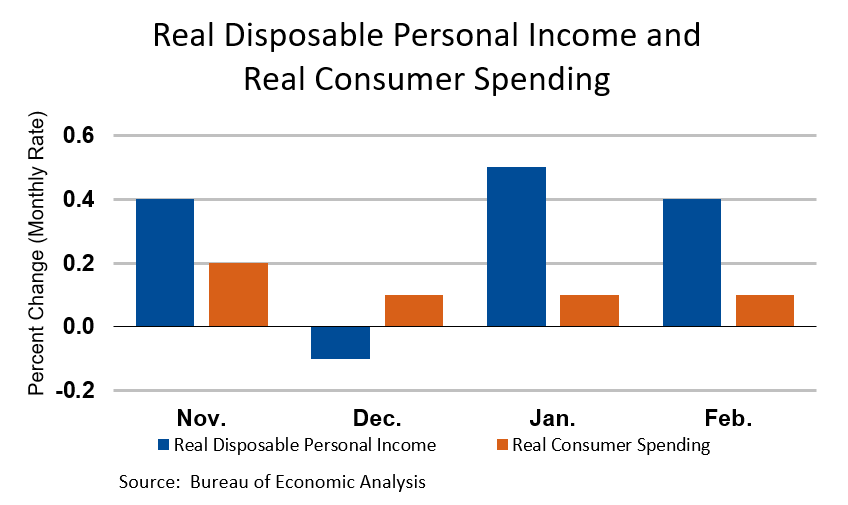
Personal income increased 0.6 percent in February, the same increase as in January. Wages and salaries, the largest component of personal income, increased 0.5 percent in February, also the same increase as in January.
Personal income increased $106.8 billion (0.6 percent) in February according to estimates released today by the Bureau of Economic Analysis (table 3 and table 5). Disposable personal income (DPI) increased $88.7 billion (0.5 percent) and personal consumption expenditures (PCE) increased $27.7 billion (0.2 percent).
Real DPI inincreased 0.4 percent in February and Real PCE increased 0.1 percent (table 5 and table 7). The PCE price index increased 0.1 percent. Excluding food and energy, the PCE price index increased 0.2 percent (table 9).
| 2019 | 2020 | ||||
|---|---|---|---|---|---|
| Oct. | Nov. | Dec. | Jan. | Feb. | |
| Percent change from preceding month | |||||
| Personal income: | |||||
| Current dollars | 0.1 | 0.5 | 0.2 | 0.6 | 0.6 |
| Disposable personal income: | |||||
| Current dollars | 0.0 | 0.4 | 0.2 | 0.6 | 0.5 |
| Chained (2012) dollars | -0.1 | 0.4 | -0.1 | 0.5 | 0.4 |
| Personal consumption expenditures (PCE): | |||||
| Current dollars | 0.3 | 0.3 | 0.4 | 0.2 | 0.2 |
| Chained (2012) dollars | 0.1 | 0.2 | 0.1 | 0.1 | 0.1 |
| Price indexes: | |||||
| PCE | 0.2 | 0.1 | 0.3 | 0.1 | 0.1 |
| PCE, excluding food and energy | 0.1 | 0.1 | 0.2 | 0.2 | 0.2 |
| Price indexes: | Percent change from month one year ago | ||||
| PCE | 1.3 | 1.3 | 1.6 | 1.8 | 1.8 |
| PCE, excluding food and energy | 1.6 | 1.5 | 1.6 | 1.7 | 1.8 |
The $13.0 billion increase in real PCE in February reflected a $18.3 billion increase in spending for services that was partly offset by a decrease of $7.7 billion in spending for goods (table 7). Within services, the leading contributor to the increase was spending on electricity and gas. Within goods, the leading contributors to the decrease were spending on motor vehicles and parts as well as recreational goods and vehicles. Detailed information on monthly real PCE spending can be found on Table 2.3.6U.
Personal outlays increased $28.4 billion in February (table 3). Personal saving was $1.38 trillion and the personal saving rate, personal saving as a percentage of disposable personal income, was 8.2 percent (table 1).
Updates to Personal Income and Outlays
Estimates have been updated for October through January. Revised and previously published changes from the preceding month for current-dollar personal income, and for current-dollar and chained (2012) dollar DPI and PCE, are shown below.
| Change from preceding month | ||||||||
|---|---|---|---|---|---|---|---|---|
| December | January | |||||||
| Previous | Revised | Previous | Revised | Previous | Revised | Previous | Revised | |
| (Billions of dollars) | (Percent) | (Billions of dollars) | (Percent) | |||||
| Personal income: | ||||||||
| Current dollars | 28.2 | 34.0 | 0.1 | 0.2 | 116.5 | 115.8 | 0.6 | 0.6 |
| Disposable personal income: | ||||||||
| Current dollars | 21.0 | 25.6 | 0.1 | 0.2 | 101.4 | 98.8 | 0.6 | 0.6 |
| Chained (2012) dollars | -18.9 | -17.5 | -0.1 | -0.1 | 76.2 | 68.1 | 0.5 | 0.5 |
| Personal consumption expenditures: | ||||||||
| Current dollars | 54.8 | 54.6 | 0.4 | 0.4 | 29.6 | 34.0 | 0.2 | 0.2 |
| Chained (2012) dollars | 16.0 | 13.3 | 0.1 | 0.1 | 12.9 | 11.9 | 0.1 | 0.1 |
FULL DOCUMENT: https://www.bea.gov/system/files/2020-03/pi0220_1.pdf
NATO
U.S. Department of State. 03/27/2020. North Macedonia Joins the NATO Alliance. Michael R. Pompeo, Secretary of State
On March 27, 2020, the United States, as a treaty depositary, received The Republic of North Macedonia’s instrument of accession to the North Atlantic Treaty, making North Macedonia the 30th NATO Ally. On March 30, North Macedonia’s flag will fly over NATO headquarters for the first time.
As President Trump has said, the NATO Alliance has been the bulwark of international peace and security for over 70 years. North Macedonia’s accession to NATO today represents the culmination of many years of effort by the government and people of North Macedonia to join the North Atlantic Alliance. North Macedonia’s NATO membership will support greater integration, democratic reform, trade, security, and stability across the region. North Macedonia’s accession also reaffirms to other aspirants that NATO’s door remains open to those countries willing and able to make the reforms necessary to meet NATO’s high standards, and to accept the responsibilities as well as benefits of membership. As NATO welcomes its 30th member, we reaffirm our commitment to collective defense under Article 5, the cornerstone of the Transatlantic Alliance.
FOREIGN POLICY
U.S. Department of State. 03/27/2020. Secretary Pompeo’s Call with EU High Representative for Foreign Affairs and Security Policy Borrell
The following is attributable to Spokesperson Morgan Ortagus:
Secretary of State Michael R. Pompeo spoke today with EU High Representative for Foreign Affairs and Security Policy Josep Borrell. Secretary Pompeo and High Representative Borrell jointly affirmed the critical role of the Transatlantic relationship in promoting global public health and in combatting COVID-19. The Secretary expressed concern at renewed fighting in Tripoli and welcomed the EU’s new operation to enforce the UN’s arms embargo in Libya. The Secretary and the High Representative also discussed key global issues, including Syria, Venezuela, and confronting malign state actors. The Secretary emphasized our shared interest in affirming the Euro-Atlantic perspective of the Western Balkans by welcoming the prospect of opening EU accession negotiations with North Macedonia and Albania.
________________
ECONOMIA BRASILEIRA / BRAZIL ECONOMICS
CORONAVÍRUS
PR. 27/03/2020. CORONAVÍRUS. Bancos federais baixam juros e aumentam crédito para dar liquidez à economia. Financiamento para Santas Casas também vai compor a cesta de ações do Governo Federal
Nesta sexta-feira (27), durante coletiva de imprensa no Palácio do Planalto, o presidente da Caixa Econômica Federal (CEF), Pedro Guimarães, anunciou que o banco já emprestou R$ 20 bilhões aos clientes para enfrentar a crise econômica em decorrência do coronavírus (Covid-19). Ao todo, a instituição já injetou na R$ 111 bilhões em recursos na economia. “Vamos continuar reduzindo juros, aumentando prazos para pagamento e dando liquidez para a economia. O banco de todos os brasileiros sempre vai ajudar a todos. Somos o banco, em especial, dos mais humildes”, enfatizou Guimarães.
Segundo o presidente da CEF, todas as linhas de crédito da instituição terão taxas reduzidas. “O cheque especial, que ninguém poderia admitir ser cobrado 14% ao mês, ontem chegou a 2,9% ao mês. É caro, queremos reduzir mais, mas fazemos matematicamente para não acontecer o que aconteceu há 10 anos, quando a Caixa precisou de dinheiro do Tesouro”, lembrou.
O rotativo do cartão de crédito também foi diminuído, para 2,9% ao ano. “Ainda está caro e provavelmente vamos diminuir mais. A população em geral vai ter mais dinheiro sobrando pra pagar contas”, afirmou Guimarães.
A Caixa também vai operacionalizar o pagamento do auxílio emergencial de três meses, no valor de R$ 600, destinado aos trabalhadores autônomos, informais e sem renda fixa durante a emergência de saúde pública de importância internacional em decorrência do coronavírus. A medida ainda precisa ser aprovada pelo Congresso Nacional e regulamentado por decreto presidencial.
Santas Casas
Dentre as novas medidas anunciadas pelo Governo Federal está a liberação de uma linha de financiamento da Caixa Econômica Federal de R$ 5 bilhões para as Santas Casas de todo o País, com uma taxa de juros anual de 10%. "Até pouco tempo [o juros para elas] era 20%. Agora, a taxa passará automaticamente para 10%", destacou o presidente da República, Jair Bolsonaro. “Vamos continuar reduzindo juros, aumentando prazos para o pagamento e dando liquidez para a economia”, complementou o presidente da Caixa, Pedro Guimarães.
Empresas de Saúde
O Banco Nacional de Desenvolvimento Econômico e Social (BNDES) vai liberar uma linha de crédito emergencial para as empresas de saúde. “Essa linha será disponibilizada na próxima semana e nós já temos 30 empresas mapeadas para receber esses recursos”, destacou o presidente do banco, Gustavo Montezano. Segundo ele, a grande vantagem dessa linha é uma flexibilização extrema em prazos, garantias e prazos.
PR. 27/03/2020. ECONOMIA. Pequenas e médias empresas terão ajuda do Governo Federal para pagar salários. O pacote econômico faz parte das ações de enfrentamento ao coronavírus
Nesta sexta-feira (27), o Governo Federal anunciou um pacote de medidas para atender às vítimas do coronavírus (Covid-19) e manter os empregos e as atividades econômicas. A ideia anunciada, durante pronunciamento, pelo presidente da República, Jair Bolsonaro, é que o governo financie por dois meses os salários dos funcionários de pequenas e médias empresas. O programa será uma parceria entre o Banco Central (Bacen), o Banco Nacional de Desenvolvimento Econômico e Social (BNDES), o Ministério da Economia e a Federação Brasileira de Bancos (Febraban).
Essa parceria prevê a disponibilização de uma linha de crédito emergencial para empresas com faturamento entre R$ 360 mil e R$ 10 milhões. "[A verba] se destina exclusivamente ao financiamento de folhas de pagamento", pontuou o presidente do Bancen, Roberto Campos Neto.
A medida vai financiar dois meses de folhas de pagamento e o montante será de R$ 20 bilhões por mês, totalizando R$ 40 bilhões ao final do período. “Isso deve beneficiar 1,4 milhão de empresas e 12,2 milhões de pessoas”, destacou Campos Neto.
De cada R$ 20 bilhões, R$ 17 bilhões serão do Tesouro Nacional e R$ 3 bilhões da Febraban. O programa é limitado a dois salários mínimos. Quem ganha um, continuará ganhando um. Quem ganha dois, continuará ganhando dois. Já quem ganha três, ganhará dois.
“É uma divisão de risco de 85% para o governo e 15% para a associação dos bancos. São operações com zero de spread. Nós estamos falando de uma taxa de [de juros] 3,75% ao ano”, disse Campos.
Os empresários terão seis meses de carência para começar a pagar o financiamento que poderá ser dividido em até 36 meses. O dinheiro vai direto para o CPF do funcionário. A empresa fica somente com a dívida. “Quem aderir ao programa de financiamento terá que assumir o compromisso de não demitir durante dois meses”, asseverou o presidente do Bacen.
O próximo passo será encaminhar uma medida provisória (MP) ao Congresso para começar os empréstimos.
MEconomia. 27/03/2020. ECONOMIA. Covid-19. Governo anuncia R$ 40 bilhões em linha de crédito para garantir empregos. Medida é voltada a pequenas e médias empresas; empregadores que aceitarem o financiamento não poderão demitir por dois meses
O governo federal anunciou, nesta sexta-feira (27/3), uma linha de crédito emergencial a juros reduzidos para pequenas e médias empresas no valor de R$ 40 bilhões. O objetivo da medida é financiar a folha de pagamento dessas empresas e garantir empregos. Pela iniciativa, o governo vai arcar com os salários de funcionários que ganham até dois salários mínimos (R$ 2.090) durante dois meses.
O anúncio foi feito pelo presidente da República, Jair Bolsonaro, e pelos presidentes do Banco Central, Roberto Campos Neto; da Caixa Econômica, Pedro Guimarães; e do Banco Nacional de Desenvolvimento Econômico e Social (BNDES), Gustavo Montezano.
Durante o anúncio, o presidente Bolsonaro destacou a preocupação do governo em proteger a população e atender as vítimas do coronavírus e em manter os empregos ameaçados em função das dificuldades enfrentadas diante da pandemia da Covid 19.
Durante esse período, a empresa que aceitar o financiamento não poderá demitir seus trabalhadores. A linha de crédito prevê juros de 3,75% ao ano, com zero de spread bancário, ou seja, não haverá lucros para os bancos nesta operação. Haverá também uma carência de seis meses para as empresas começarem a pagar o empréstimo, que poderá ser parcelado em até 36 meses.
A medida vai beneficiar, em todo o país, mais de 12 milhões de trabalhadores e 1,4 milhão de pequenas e médias empresas com faturamento anual de R$ 360 mil a R$10 milhões ao ano. Novas medidas para beneficiar trabalhadores informais e micro empresas também estão em estudo pelo governo.
O presidente do Banco Central, Roberto Campos Neto, enfatizou que o foco do pacote foi direcionado às pequenas e médias empresas porque são elas que precisavam de um socorro imediato, já que encontram maior dificuldade para contrair empréstimos no setor bancário, ao contrário das grandes. Campos Neto ainda destacou que esse público nunca teve acesso a uma taxa de juros tão baixa no Brasil.
Do total dos recursos do programa, 85% são provenientes do Tesouro Nacional (R$ 34 bilhões) e 15% dos bancos privados. O financiamento será operacionalizado pelos bancos com os quais os empresários já possuam relacionamento. Já os pagamentos dos salários serão direcionados diretamente para as contas dos trabalhadores e estarão ligados aos CPFs dos funcionários. Empregadores poderão fazer a complementação de funcionários com salários maiores.
Nesse sentido, o presidente da Caixa, Pedro Guimarães, destacou que o pacote foi pensado de forma responsável, de modo a garantir o equilíbrio financeiro da estatal. Segundo ele, as medidas anunciadas são um exemplo de que é possível utilizar o Tesouro Nacional para suportar 85% dos recursos destinados aos potenciais tomadores da modalidade de crédito.
Novas linhas de crédito
O governo também disponibilizará, via Caixa Econômica Federal, uma linha de financiamento de R$ 5 bilhões para as Santas Casas – que são entidades sem fins lucrativos – de todo o país a uma taxa de 10% ao ano. Até então, essa taxa era de 20%. Contratos antigos também serão revisados.
Foi concedida, ainda, outra uma linha de crédito a partir de recursos do BNDES para empresas de saúde, no valor de até R$2 bilhões Os juros aplicados serão de 10% ao ano. O presidente do BNDES, Gustavo Montezano, acrescentou que novas medidas serão anunciadas pelo banco nos próximos dias com foco, principalmente, em empresas de transporte aéreo e terrestre de passageiros.
A Caixa Econômica anunciou também nova redução de juros e aumentou prazos para pagamentos. Os juros do cheque especial e rotativo do cartão de crédito foram fixados em 2,9% ao mês
Outra medida adotada pela Caixa é o adiamento, por três meses, do pagamento das parcelas de quem tem financiamento imobiliário, beneficiando 800 mil famílias.
BACEN. 27 Março 2020. Medidas anunciadas pelo Presidente do BC, Roberto Campos Neto, em pronunciamento no Palácio do Planalto
- Linha emergencial de financiamento de R$ 40 bilhões para financiar dois meses de folha de pagamento (dois pagamentos de R$ 20 bilhões, o governo paga R$ 17 bilhões, os bancos pagam R$ 3 bilhões por mês);
- Empresas elegíveis: faturamento de R$ 360 mil a R$ 10 milhões por ano;
- Linha para pagar o salário dos trabalhadores nessas empresas limitado a dois salários mínimos por trabalhador. O valor financiável por trabalhador é até 2 salários mínimos. O dinheiro irá direto para a conta do trabalhador. A dívida é da empresa;
- A empresa que pegar a linha fica obrigada a manter o emprego durante os dois meses de programa;
- Potencial: 12,2 milhões de empregados e 1,4 milhão de empresas;
- O governo entra com 85% dos recursos, os bancos entram com 15%;
- O governo fica com 85% do risco de inadimplência e os bancos ficam com 15%;
- Operações repassadas ao custo do CDI, sem spread (3,75% ao ano);
- O prazo será de 30 meses e a carência de 6 meses;
- Medida Provisória: abertura de crédito extraordinário de R$ 34 bilhões por dois meses (R$ 17 bilhões por mês), criação de um fundo operacionalizado pelo BNDES, fiscalizado e supervisionado pelo Banco Central e com aporte de recursos do Tesouro Nacional. R$ 6 bilhões de recursos dos bancos privados completarão os R$ 40 bilhões do programa.
O Instituto de Pesquisa Econômica Aplicada (Ipea) projetou uma série de cenários, com o objetivo de potencializar o uso do Programa Bolsa Família (PBF) e do Cadastro Único para reduzir os prejuízos causados pela Covid-19 à população de baixa renda. Entre as medidas recomendadas, estão o fim da fila de espera do PBF – com a inclusão de 1,7 milhão de famílias habilitadas a receber os repasses –, o reajuste permanente dos pagamentos e das linhas de elegibilidade do programa em aproximadamente 29%, e a criação de um benefício extraordinário temporário para todas as famílias com dados atualizados no Cadastro Único que tenham renda familiar per capita inferior a meio salário mínimo (R$ 522,50).
Atualmente, o PBF atende famílias em situação de extrema pobreza (renda per capita de até R$ 89 por mês) e de pobreza (renda per capita de até R$ 178 mensais). Os autores do estudo propõem que as linhas de elegibilidade sejam reajustadas para pelo menos R$ 115 e R$ 230, respectivamente. Além disso, sugerem que, para todas as famílias do Cadastro Único com renda de até meio salário mínimo por pessoa (inclusive, mas não limitado, aos beneficiários do Bolsa Família), seja pago um benefício extraordinário de pelo menos R$ 450 por família, por um período de 6 meses, prorrogáveis. Com isso, 30% da população, concentrados entre os mais pobres, teriam algum nível de proteção contra a crise associada à Covid-19.
Caso seja adotada na folha de pagamentos do mês de abril e estendida até o final do ano, a decisão de zerar a fila do Bolsa Família teria um impacto de R$ 2,24 bilhões no orçamento, ou menos de 10% de aumento frente à situação atual. Como o valor já anunciado pelo governo para suplementação orçamentária do programa é de R$ 3 bilhões, ele está próximo ao necessário para outra medida considerada essencial: interromper os processos de averiguação e revisão cadastral (e, com isso, bloqueios, suspensões e cancelamentos) ao longo dos próximos meses, o que evitaria a aglomeração de famílias nos Centros de Referência em Assistência Social (Cras).
Essas três medidas – fim da fila do Bolsa Família, reajuste dos pagamentos e das linhas de elegibilidade, além da criação do benefício temporário – aumentariam em R$ 68,6 bilhões os gastos com transferências assistenciais em 2020. Porém, mais de 80% do custo adicional seria decorrente dos benefícios extraordinários temporários e, portanto, o impacto orçamentário para 2021 seria modesto –R$ 11,6 bilhões, isto é, menos de 0,2% do PIB brasileiro de 2019.
"O fundamental é partir da estrutura que já construímos para atender de imediato às famílias mais pobres. Caso contrário, o risco é de só conseguirmos operacionalizar o benefício tarde demais. Além disso, nossas simulações também mostram que é possível garantir uma renda mínima para as famílias vulneráveis com custos relativamente baixos, considerando a gravidade da situação", afirmou um dos autores da pesquisa, Pedro Ferreira de Souza, do Ipea.
Os pesquisadores realizaram 72 simulações de medidas protetivas. Proporcionalmente, tomando-se o PIB de 2019 como referência, o custo total com transferências (incluindo os meses de janeiro a março) subiria de 0,4% para algo entre 0,8% e 1,4% do PIB. Feito a pedido do Ministério da Economia, o estudo também ressalta que 39 países já utilizam alguma forma de transferência de renda como parte das respostas à Covid-19, alcançando pobres, trabalhadores autônomos, idosos e crianças.
“A cada dia, mais países adotam transferências de renda como parte da resposta à Covid-19, o que sinaliza o potencial que essa medida tem de funcionar no Brasil”, pondera o pesquisador Luís Henrique Paiva, também autor do estudo intitulado “Evitando a Pandemia da Pobreza: Possibilidades para o Programa Bolsa Família e para o Cadastro Único em Resposta à Covid-19”. As simulações se basearam em dados do Cadastro Único para Programas Sociais do governo federal, bem como na folha de pagamentos do Programa Bolsa Família.
Nota Técnica: http://www.ipea.gov.br/portal/index.php?option=com_content&view=article&id=35405&Itemid=9
FGV. 26/03/2020. O papel do Direito no combate à crise
O Direito possui funções essenciais diante de uma crise como a pandemia do coronavírus. Uma delas é apresentar os princípios fundamentais que devem orientar todas as ações do Estado.

VÍDEO: https://www.youtube.com/watch?v=nY3_yyn4rc8&feature=youtu.be
FGV. 27/03/2020. Recursos para o setor informal
Para tentar amainar os impactos da crise do coronavírus, o Ministério da Economia propôs uma série de medidas sobre a economia brasileira e a renda da população. As propostas envolvem antecipação de benefícios sociais, postergação de impostos, além da ampliação dos beneficiários do Bolsa Família. Porém, o grande desafio é atingir o setor informal da Economia. Como diminuir os efeitos da crise nesse segmento?

VÍDEO: https://www.youtube.com/watch?v=uEJu33a1eFs&feature=youtu.be
MEconomia. 27/03/2020. ECONOMIA. Covid-19. Carlos Da Costa defende incentivos às indústrias para manterem a produção. Secretário especial segue ouvindo o setor produtivo e buscando soluções para que bens essenciais cheguem à população
Dando continuidade ao diálogo com o setor produtivo, o secretário especial de Produtividade, Emprego e Competitividade do Ministério da Economia, Carlos Da Costa, participou na quinta-feira (26/3) de várias reuniões, por videoconferência, para receber os pleitos do setor no enfrentamento ao Covid-19.
“Estamos mantendo contato intenso com setor privado e organizando as várias sugestões que recebemos para garantir que os bens essenciais sejam produzidos e cheguem à população”, afirmou o secretário. “Precisamos seguir com responsabilidade e consciência para, juntos, superarmos mais esse desafio. O Brasil não pode parar”, enfatizou.
Em reunião com Taiza Krueder, ceo (diretora executiva) da YPO Global e outros membros da empresa, Carlos Da Costa destacou o trabalho da Secretária Especial de Produtividade, Emprego e Competitividade do Ministério da Economia (Sepec/ME) para aumentar a produção de ventiladores pulmonares, a quantidade de testes para serem realizados no menor tempo possível e a produção de álcool em gel e máscaras no nosso país.
Durante conversa com o titular do comitê da Cadeia Produtiva da Saúde e Biotecnologia da Federação das Indústrias de São Paulo (ComSaude/FIES), Ruy Baumer, o secretário reforçou a necessidade garantir o fornecimento de insumos necessários aos hospitais, como alimentação, itens de descontaminação e roupas, entre outros.
Da Costa também recebeu pleitos da indústria de vidro, que é parte da cadeia fundamental de produtos essenciais, como frascos de remédios, vidros de hospitais, entre outros que, segundo ele, estão no radar da Sepec/ME para que continuem sendo produzidos.
Ainda em conversa por videoconferência, com o presidente executivo da Associação Brasileira das Empresas de Tecnologia da Informação e Comunicação (Brassscom), Sérgio Paulo Gallindo, e lideranças do setor produtivo, Carlos Da Costa afirmou que está estudando uma série de medidas para que o impacto da pandemia sobre a produção seja o menor possível.
INDÚSTRIA
FGV. IBRE. 27/03/20. Sondagens e Índices de Confiança. Sondagem da Indústria. ICI de março recua e já mostra efeitos do coronavírus sobre a Confiança da Indústria
O Índice de Confiança da Indústria (ICI) da Fundação Getulio Vargas recuou 3,9 pontos em março, para 97,5 pontos. Apesar do resultado negativo, a média do ICI no primeiro trimestre de 2020 (99,9 pontos) é 2,7 pontos maior do que no quarto trimestre de 2019 (97,2 pontos).
“O resultado do mês mostra os primeiros efeitos da pandemia de coronavírus sobre a confiança da indústria. O ICI registrou a maior queda desde março de 2015 (6,6 pontos), quando ocorreram as primeiras manifestações contra o governo Dilma Rousseff. O NUCI e a percepção dos empresários sobre a demanda e a situação dos negócios sugerem que a produção industrial pode já ter sido impactada. Além disso, a forte deterioração das expectativas, principalmente de bens de consumo duráveis, chama atenção para o cenário de incerteza que desponta para os próximos meses”, comenta Renata de Mello Franco, economista da FGV-IBRE.
Em março, a confiança recuou em 14 dos 19 segmentos industriais pesquisados. O resultado negativo é reflexo da piora da percepção dos empresários sobre a situação atual, mas principalmente pela deterioração das expectativas para os próximos três e seis meses. O Índice de Expectativas (IE) caiu 5,6 pontos, para 96,2 pontos. Da mesma forma, o Índice de Situação Atual decresceu 2,1 pontos, para 98,8 pontos.
Neste mês, a maior contribuição para o IE veio da piora das expectativas dos empresários sobre a produção nos próximos três meses. O Indicador de produção prevista diminuiu 7,5 pontos, para 92,1 pontos, o menor valor desde abril de 2017 (92,0 pontos). Em relação aos demais indiciadores, os que medem a tendência dos negócios nos próximos seis meses e o volume de pessoal ocupado nos próximos três meses caíram, respectivamente, 6,6 pontos (para 98,3 pontos) e 2,4 pontos (98,6 pontos).
No tocante ao momento presente, apesar das avaliações do setor sobre o nível dos estoques ter melhorado (o indicador passou de 99,9 pontos para 104,2 pontos), houve deterioração em relação à demanda e à situação atual dos negócios. Ambos os indicadores apresentaram queda, com destaque para a variação de -5,8 pontos do indicador de demanda total, que atingiu 95,1 pontos, o menor valor desde agosto de 2017 (88,2 pontos).
O Nível de Utilização da Capacidade Instalada (NUCI) recuou 0,9 ponto percentual (p.p.), para 75,3%. Em médias móveis trimestrais, o NUCI permaneceu no nível de 75,6%.
DOCUMENTO: https://portalibre.fgv.br/navegacao-superior/noticias/ici-de-marco-recua-e-ja-mostra-efeitos-do-coronavirus-sobre-a-confianca-da-industria.htm
INFLAÇÃO
IBGE. 27/03/2020. Índice de Preços ao Produtor varia 0,70% em fevereiro
Os preços da indústria variaram 0,70% em fevereiro, número superior ao observado na comparação entre janeiro de 2020 e dezembro de 2019 (0,35%). O acumulado no ano atingiu 1,05%, contra 0,35% em janeiro/2020. O acumulado em 12 meses foi de 6,62%, contra 6,36% em janeiro/2020.
| Período | TAXA |
|---|---|
| Fevereiro 2020 | 0,70% |
| Janeiro 2020 | 0,35% |
| Fevereiro 2019 | 0,45% |
| Acumulado em 2020 | 1,05% |
| Acumulado 12 meses | 6,62% |
O Índice de Preços ao Produtor (IPP) das Indústrias Extrativas e de Transformação mede a evolução dos preços de produtos “na porta de fábrica”, sem impostos e fretes, e abrange informações por grandes categorias econômicas, ou seja, bens de capital, bens intermediários e bens de consumo (duráveis e semiduráveis e não duráveis).
| Índices de Preços ao Produtor, segundo Indústrias Extrativas e de Transformação (Indústria Geral) e Seções - Últimos três meses | |||||||||
|---|---|---|---|---|---|---|---|---|---|
| Indústria Geral e Seções | Variações (%) | ||||||||
| M/M-1 | Acumulado Ano | M/M-12 | |||||||
| DEZ/19 | JAN/20 | FEV/20 | DEZ/19 | JAN/20 | FEV/20 | DEZ/19 | JAN/20 | FEV/20 | |
| Indústria Geral | 0,65 | 0,35 | 0,70 | 5,19 | 0,35 | 1,05 | 5,19 | 6,36 | 6,62 |
| B - Indústrias Extrativas | -2,52 | 5,52 | 5,51 | 13,59 | 5,52 | 11,34 | 13,59 | 29,71 | 26,76 |
| C - Indústrias de Transformação | 0,80 | 0,10 | 0,46 | 4,83 | 0,10 | 0,56 | 4,83 | 5,41 | 5,74 |
| Fonte: IBGE, Diretoria de Pesquisas, Coordenação de Indústria | |||||||||
Na passagem de janeiro para fevereiro de 2020, 20 das 24 atividades tiveram variações positivas, contra 17 do mês anterior. As quatro maiores altas se deram entre os produtos compreendidos nas atividades de refino de petróleo e produtos de álcool (-6,34%), indústrias extrativas (5,51%), calçados e artigos de couro (3,40%) e metalurgia (2,81%). Em termos de influência, sobressaíram refino de petróleo e produtos de álcool (-0,68 p.p.), alimentos (0,37 p.p.), indústrias extrativas (0,26 p.p.) e metalurgia (0,17 p.p.).
O acumulado do ano (fevereiro de 2020 contra dezembro de 2019) atingiu 1,05%, contra 0,35% em janeiro. Entre as atividades que tiveram as maiores variações, sobressaíram indústrias extrativas (11,34%), metalurgia (5,89%), refino de petróleo e produtos de álcool (-5,73%) e outros equipamentos de transporte (4,18%). Neste indicador, os setores de maior influência foram refino de petróleo e produtos de álcool (-0,61 p.p.), indústrias extrativas (0,51 p.p.), metalurgia (0,34 p.p.) e veículos automotores (0,12 p.p.).
No acumulado em 12 meses (fevereiro de 2020 contra fevereiro de 2019), a variação foi de 6,62%, contra 6,36% em janeiro. As quatro maiores variações ocorreram em indústrias extrativas (26,76%), outros equipamentos de transporte (13,25%), alimentos (11,45%) e farmacêutica (10,12%). Neste indicador, os setores de maior influência foram alimentos (2,54 p.p.), indústrias extrativas (1,12 p.p.), refino de petróleo e produtos de álcool (0,76 p.p.) e metalurgia (0,41 p.p.).
Entre as grandes categorias econômicas, na perspectiva mensal, as variações foram de 0,85% em bens de capital; 0,98% em bens intermediários; e 0,28% em bens de consumo, sendo que 0,34% foi a variação observada em bens de consumo duráveis e 0,27% em bens de consumo semiduráveis e não duráveis.
Do resultado da indústria geral (0,70%), a influência das grandes categorias econômicas foi de 0,06 p.p. de bens de capital, 0,53 p.p. de bens intermediários e 0,11 p.p. de bens de consumo. No caso de bens de consumo, 0,09 p.p. se deveu às variações nos bens de consumo semiduráveis e não duráveis e 0,02 p.p. nos bens de consumo duráveis.
No acumulado no ano, as variações de preços acumularam 1,05% até fevereiro, sendo 2,33% a variação de bens de capital (com influência de 0,17 p.p.), 2,32% de bens intermediários (1,24 p.p.) e -0,94% de bens de consumo (-0,37 p.p.). No último caso, este resultado foi influenciado em 0,06 p.p. pelos produtos de bens de consumo duráveis e -0,43 p.p., pelos bens de consumo semiduráveis e não duráveis.
Na taxa anual, a variação de preços alcançou as seguintes variações: bens de capital, 7,57% (0,57 p.p.); bens intermediários, 5,89% (3,21 p.p.); e bens de consumo, 7,47% (2,84 p.p.), sendo que a influência de bens de consumo duráveis foi de 0,25 p.p. e a de bens de consumo semiduráveis e não duráveis de 2,58 p.p.
| Índices de Preços ao Produtor, segundo Indústrias Extrativas e de Transformação (Indústria Geral) e Grandes Categorias Econômicas - Últimos três meses | |||||||||
|---|---|---|---|---|---|---|---|---|---|
| Indústria Geral e Seções | Variações (%) | ||||||||
| M/M-1 | Acumulado Ano | M/M-12 | |||||||
| DEZ/19 | JAN/20 | FEV/20 | DEZ/19 | JAN/20 | FEV/20 | DEZ/19 | JAN/20 | FEV/20 | |
| Indústria Geral | 0,65 | 0,35 | 0,70 | 5,19 | 0,35 | 1,05 | 5,19 | 6,36 | 6,62 |
| Bens de Capital (BK) | 0,15 | 1,47 | 0,85 | 5,97 | 1,47 | 2,33 | 5,97 | 6,98 | 7,57 |
| Bens Intermediários (BI) | 0,16 | 1,33 | 0,98 | 2,87 | 1,33 | 2,32 | 2,87 | 5,58 | 5,89 |
| Bens de consumo (BC) | 1,42 | -1,22 | 0,28 | 8,39 | -1,22 | -0,94 | 8,39 | 7,34 | 7,47 |
| Bens de consumo duráveis (BCD) | -0,12 | 0,57 | 0,34 | 4,45 | 0,57 | 0,91 | 4,45 | 3,57 | 3,74 |
| Bens de consumo semiduráveis e não duráveis (BCND) | 1,74 | -1,58 | 0,27 | 9,23 | -1,58 | -1,32 | 9,23 | 8,16 | 8,28 |
| Fonte: IBGE, Diretoria de Pesquisas, Coordenação de Indústria | |||||||||
Destacaram-se os seguintes setores:
Indústrias extrativas: com a variação de 5,51% entre janeiro e fevereiro, o setor acumula 11,34% de aumento em 2020, o que o coloca em primeiro lugar, em termos de variação, entre toda a indústria, no acumulado no ano. Também é o primeiro na comparação fevereiro 2020/fevereiro 2019, com 26,76%. Estes resultados também levaram o setor a ser destaque em termos de influência: terceiro na comparação com janeiro de 2020 (0,26 p.p., em 0,70%; vale dizer que foi a segunda taxa em termos de variação); e segundo tanto no acumulado (0,51 p.p., em 1,05%) quanto no acumulado em 12 meses (1,12 p.p., em 6,62%).
Quando se olham os produtos destacados, preponderam as variações positivas nas três perspectivas analisadas. Os produtos são commodities importantes e, para além das características do comportamento de seus mercados, sofrem de perto os efeitos do câmbio, uma depreciação do real em fevereiro de 4,6%, no acumulado de 2020, de 5,6%, e, nos últimos 12 meses, de 16,6%.
Alimentos: a variação média de preços na comparação mês contra mês anterior foi de 1,60%, que substitui a variação negativa de janeiro (-1,91%), que havia interrompido uma série de cinco variações positivas. Em 2020, com o dado negativo de janeiro e o positivo de fevereiro, a variação acumulada é de -0,34%. Na perspectiva de 12 meses, os 11,45% só encontram uma variação superior, num mesmo mês, em fevereiro de 2016, 15,67%.
O destaque dado ao setor se deve principalmente à influência sobre o resultado das indústrias extrativas e de transformação. Foi o segundo na comparação com janeiro de 2020 (0,37 p.p., em 0,70%) e o primeiro no acumulado em 12 meses (2,54 p.p., em 6,62%). Apresentou, ainda, a terceira maior variação entre todos os setores da indústria, na perspectiva do acumulado em 12 meses.
Os quatro produtos que mais se destacaram em termos de influência na comparação fevereiro/janeiro responderam por 1,16 p.p., em 1,60%. Os produtos pertencem a dois grupos: “abate e fabricação de produtos de carne”, cuja variação foi de 1,32%, portanto abaixo do observado para o setor como um todo; e “fabricação e refino de açúcar”, com variação superior à média, 5,79%.
Refino de petróleo e produtos de álcool: em fevereiro, os preços do setor variaram, em média, -6,34%, a variação negativa mais intensa desde junho de 2019 (-7,24%). O acumulado nos dois primeiros meses de 2020 é de -5,73%. Ainda assim, os preços de fevereiro de 2020 estão 7,68% maiores do que os de fevereiro de 2019.
O destaque dado ao setor está ligado tanto ao fato de ter sido listado entre as maiores variações (a maior na comparação com janeiro de 2020, e a terceira no acumulado) quanto entre as maiores influências: primeiro na comparação com mês anterior (-0,68 p.p., em 0,70%) e no acumulado (-0,61 p.p., em 1,05%) e o terceiro no acumulado em 12 meses (0,76 p.p., em 6,62%).
As variações dos produtos ligados ao refino de petróleo foram, entre os produtos destacados, todas negativas. A única variação positiva, que leva o produto “álcool etílico (anidro ou hidratado)” a figurar entre as maiores influências, está ligada à entressafra da cana-de-açúcar.
Metalurgia: ao comparar os preços médios de fevereiro contra janeiro, houve uma variação de 2,81%, segunda maior variação positiva desde setembro de 2018. Essa variação foi muito semelhante a que ocorrera entre janeiro e dezembro, de 2,99%, trazendo o acumulado em 12 meses para 6,68%, resultado ainda assim inferior ao ocorrido em fevereiro de 2019 (8,13%), mas levando o acumulado no ano para 5,89%.
O resultado do mês foi obtido graças, principalmente, a três produtos, sendo um do grupo dos produtos do setor siderúrgico e dois do grupo de metalurgia de materiais não ferrosos. São eles: “lingotes, blocos, tarugos ou placas de aços ao carbono”, “ouro para usos não monetários” e “óxido de alumínio (alumina calcinada)”, todos naturalmente com influência positiva sobre o indicador mês contra mês imediatamente anterior. Junta-se a esses três produtos “bobinas ou chapas de aço inoxidáveis, inclusive tiras”, porém com variação negativa de preços. Os quatro produtos representam 2,00 p.p. da variação no mês, cabendo 0,81 p.p. aos demais 20 produtos.
Dos quatro produtos destacados em termos de influência no resultado do mês, dois são comuns tanto na análise do acumulado no ano quanto no acumulado em 12 meses, são eles: “bobinas a quente de aços ao carbono, não revestido” e “ouro para usos não monetários”. Já os produtos “lingotes, blocos, tarugos ou placas de aços ao carbono” e “óxido de alumínio (alumina calcinada)” foram destaques no acumulado do ano, enquanto “ferronióbio” e “chapas e tiras, de alumínio, de espessura superior a 0,2 mm” foram destaques no acumulado em 12 meses. Todos esses produtos tiveram variações positivas de preços.
Veículos automotores: em fevereiro, a variação observada no setor foi de 0,21%, quando comparada com o mês imediatamente anterior, seguindo a tendência de alta observada também nos cinco meses anteriores. Com este resultado do indicador mês contra mês imediatamente anterior de fevereiro, a variação acumulada no ano e a variação acumulada nos últimos 12 meses alcançaram, respectivamente, 1,46% e 4,65%.
Além de ser um dos setores de maior peso no cálculo do indicador geral, com uma contribuição de 8,52%, a atividade de veículos automotores também se destacou, dentre todos os setores pesquisados, por apresentar a quarta maior influência no indicador acumulado no ano (0,12 p.p., em 1,05%).
A “fabricação de automóveis, camionetas e utilitários”, grupo econômico analisado da atividade, apresentou, no mês de fevereiro, variação de -0,07% na comparação com janeiro, seguindo o caminho contrário da atividade. Esse foi o primeiro resultado negativo observado desde agosto de 2019 (quando variou -0,68%). Nos dois primeiros meses de 2020, esse grupo acumula uma variação de 1,14%, ao passo que, nos últimos 12 meses, o grupo apresenta um resultado de 4,02%.
Já em uma análise por produtos no setor, é possível observar que, entre os quatro produtos de maior influência na comparação com janeiro de 2020, três deles impactaram positivamente o índice: “caminhão-trator, para reboques e semirreboques”, “peças ou acessórios, para o sistema de motor de veículos automotores” e “sistemas de marcha e transmissão para veículos automotores”. Somente o produto “automóveis para passageiros, a gasolina ou bicombustível, de qualquer cilindrada”, justamente o produto de maior peso na atividade, influenciou negativamente o resultado. A influência desses quatro produtos que mais impactaram a variação do mês em relação ao mês imediatamente anterior foi de 0,11 p.p., ou seja, os demais 19 produtos da atividade contribuíram com 0,10 p.p.
Em relação ao indicadores de longo prazo, acumulado no ano e no acumulado em 12 meses, todos os quatro produtos de maior influência nos índices são comuns e os impactaram positivamente: “automóveis para passageiros, a gasolina ou bicombustível, de qualquer cilindrada”, “caminhão-trator, para reboques e semirreboques”, “caminhão diesel com capacidade superior a 5t” e “veículos para o transporte de mercadorias a gasolina e/ou álcool, de capacidade não superior a 5 t”.
Dólar alto pressiona preços da indústria, que sobem 0,70% em fevereiro. A maior influência negativa no índice veio do refino de petróleo e produtos de álcool, com queda de 6,34%
Os preços das indústrias extrativas e de transformação aumentaram 0,70% em fevereiro, em comparação a janeiro, quando a variação havia sido de 0,35%. As informações são do Índice de Preços ao Produtor (IPP), divulgado hoje (27) pelo IBGE. Os principais fatores que tiveram influência sobre o índice foram a valorização do dólar e a queda no preço do barril de petróleo no mercado mundial.
O IPP mede a oscilação dos preços dos produtos na “porta das fábricas”, sem impostos e frete, de 24 atividades das indústrias extrativas e de transformação. Em janeiro, 17 setores haviam apresentado alta de preços, subindo para 20 em fevereiro.
“Isso de deve, em grande parte, à depreciação de 4,7% do Real frente ao Dólar de janeiro para fevereiro. Setores que são muito intensivos em vendas para o exterior, como couro (3,40%) e fumo (2,38%), tiveram aumentos maiores de preços”, avalia o gerente da pesquisa, Alexandre Brandão.
Preços ao produtor - Variação mês/mês anterior (%)
Clique e arraste para zoom
Fonte: IBGE - Índice de Preços ao Produtor
Dentre os segmentos com maior peso no índice, como alimentos, derivados de petróleo, outros químicos, metalurgia e veículos, todos, com exceção de derivados de petróleo, tiveram aumento de preços. O maior impacto positivo veio de alimentos (0,37 p.p.), que, em janeiro, tinha registrado queda de preços em 1,91%, mas, em fevereiro, apresentou elevação de 1,60%.
Outras atividades que tiveram altas expressivas e influenciaram na variação positiva do IPP foram as de indústrias extrativas (5,51%), calçados e artigos de couro (3,40%) e metalurgia (2,81%). Vale destacar que o setor de outros químicos, que engloba adubos e fertilizantes, registrou taxa positiva (1,24%) depois de quatro meses de variações negativas.
Por outro lado, a maior influência negativa no índice veio do refino de petróleo e produtos de álcool, que, com baixa de 6,34%, registrou a menor taxa desde julho de 2019, quando foi de -7,24%. “Essa queda nos derivados de petróleo, segurou uma maior alta no índice geral”, comenta Alexandre Brandão.
Já no acumulado do ano, a variação dos preços da indústria foi de 1,05%. Na perspectiva desse indicador, destacaram-se as indústrias extrativas (11,34%), a metalurgia (5,89%), o refino de petróleo e produtos de álcool (-5,73%) e outros equipamentos de transporte (4,18%).
E na comparação entre fevereiro de 2020 e o mesmo mês de 2019, a variação de preços foi de 6,62%, contra 6,36% em janeiro de 2020. As quatro maiores altas de preços ocorreram em indústrias extrativas (26,76%), outros equipamentos de transporte (13,25%), alimentos (11,45%) e farmacêutica (10,12%).
DOCUMENTO: https://agenciadenoticias.ibge.gov.br/agencia-sala-de-imprensa/2013-agencia-de-noticias/releases/27222-indice-de-precos-ao-produtor-varia-0-70-em-fevereiro
ENERGIA
ANP. 25 de Março de 2020. ANP lança estudo sobre aproveitamento do gás do pré-sal
A ANP está lançando hoje (25/3) o “Estudo sobre o Aproveitamento do Gás Natural do Pré Sal”. A publicação tem como foco o aumento da comercialização e da participação do gás natural do Pré-Sal na matriz energética do País, em linha com as diretrizes estabelecidas nas Resoluções nºs 10/2016, 17/2017 e 16/2019 do Conselho Nacional de Política Energética (CNPE), assim como as diretrizes estabelecidas no Programa Novo Mercado de Gás. O estudo está disponível na página Publicações do site da ANP.
Coordenado pela ANP, o estudo foi desenvolvido pela Agência em conjunto como Ministério de Minas e Energia (MME), a Empresa de Pesquisa Energética (EPE), a Pré-Sal Petróleo SA (PPSA) e o BNDES. A Casa Civil da Presidência da República também acompanhou a evolução dos trabalhos por meio de representantes do Programa de Parcerias de Investimentos – PPI.
A oportunidade para o desenvolvimento da publicação surgiu com a forte tendência de alta dos níveis de reinjeção do gás natural dos reservatórios do Pré-Sal nos últimos anos e a expectativa de aumento considerável desses volumes no futuro.
O volume do gás natural reinjetado nos reservatórios do Pré-Sal era da ordem de 10 milhões de metros cúbicos por dia (m³/d) em 2013 (início do aumento de produção dos Campos de Lula e Sapinhoá). Para o ano de 2020 são esperados aproximadamente 42 milhões de m³/d, que devem subir para cerca de 60 milhões de m³/d em 2023. São volumes representativos que poderão atender às necessidades de consumo de diversos setores e indústrias, caso seja possível o escoamento para o mercado, excluindo-se o volume necessário para a manutenção da pressão nos reservatórios e tratamento do CO2 .
O estudo registra os principais fatores identificados como entraves para o aumento do aproveitamento comercial do gás do Pré-Sal. Aponta ainda linhas de ações governamentais de incentivo e de cunho regulatório, que visam atrair novos investimentos para o setor nos próximos anos, que resultarão em redução de custos na indústria, aumento da atividade econômica no país, geração de empregos e arrecadação de tributos.
_________________
LGCJ.:

