US ECONOMICS
CORONAVIRUS
U.S. Department of State. 03/26/2020. U.S. Foreign Assistance in Response to the COVID-19 Pandemic. Michael R. Pompeo, Secretary of State
The U.S. government has rapidly mobilized unprecedented resources to respond to the COVID-19 pandemic, both at home and abroad. Today, I am pleased to announce that the United States has made available nearly $274 million in emergency health and humanitarian funding. Along with the U.S. private sector, the American people continue to lead in responding to this pandemic.
Today’s $274 million will provide resources to 64 of the world’s most at-risk countries to better combat the pandemic and enable the UN High Commissioner on Refugees to assist some of the world’s most vulnerable populations. These new pledges include nearly $100 million in emergency health assistance. It also now includes $110 million in new international disaster assistance, which together with our emergency health funding, will be provided for up to 64 of the most at-risk countries. Importantly, our response adds $64 million in humanitarian assistance for the UN High Commissioner for Refugees (UNHCR) to assist in its pandemic response efforts for some of the world’s most vulnerable populations.
Today’s new funding builds upon decades of U.S. leadership in global health and humanitarian assistance. Since 2009, American taxpayers have generously funded more than $100 billion in health assistance and nearly $70 billion in humanitarian assistance globally. Our country continues to be the single largest health and humanitarian donor for both long-term development and capacity building efforts with partners, and emergency response efforts in the face of recurrent crises.
The United States will continue to take action to combat the COVID-19 pandemic. This funding is an initial investment, on top of the continuing funding we already provide to multilateral organizations such as the World Health Organization and UNICEF. In addition to today’s investments, on March 6, President Trump signed the Coronavirus Preparedness and Response Supplemental Appropriations Act, which includes $1.3 billion in additional U.S. foreign assistance to help countries around the world respond to this pandemic.
With more than $1.5 billion in donations and assistance provided by American businesses, NGOs, and charitable organizations, and the incredible ongoing work of implementing partners overseas, we are truly mobilizing as a nation to confront this deadly virus. We welcome continued, no-strings-attached contributions from other donors to further catalyze global response efforts underway.
Our leadership in the COVID-19 response is another example of how America—our government, our businesses and organizations, and our people—continues to be the world’s greatest humanitarians. Between existing resources, supplemental funding, the private sector, and the generous spirit of the American people, the United States is leading – and will continue to lead – the effort to combat this dangerous pathogen and its threat to global health and security.
FED. March 26, 2020. Joint Press Release
- Federal agencies encourage banks, savings associations and credit unions to offer responsible small-dollar loans to consumers and small businesses affected by COVID-19
- Board of Governors of the Federal Reserve System
- Consumer Financial Protection Bureau
- Federal Deposit Insurance Corporation
- National Credit Union Administration
- Office of the Comptroller of the Currency
The statement of the Board of Governors of the Federal Reserve System, Consumer Financial Protection Bureau, Federal Deposit Insurance Corporation, National Credit Union Administration, and Office of the Comptroller of the Currency recognizes that responsible small-dollar loans can play an important role in meeting customers' credit needs because of temporary cash-flow imbalances, unexpected expenses, or income disruptions during periods of economic stress or disaster recoveries. Such loans can be offered through a variety of structures including open-end lines of credit, closed-end installment loans, or appropriately structured single payment loans.
The agencies state that loans should be offered in a manner that provides fair treatment of consumers, complies with applicable laws and regulations, and is consistent with safe and sound practices.
For borrowers who experience unexpected circumstances and cannot repay a loan as structured, banks, savings associations and credit unions are further encouraged to consider workout strategies designed to help borrowers to repay the principal of the loan while mitigating the need to re-borrow.
This statement follows other actions taken by the agencies to encourage financial institutions to meet the financial services needs of their customers and members who have been affected by COVID-19. For example, the federal banking agencies issued a joint statement on March 19 informing institutions that the agencies will favorably consider retail banking and lending activities that meet the needs of affected low- and moderate-income individuals, small businesses, and small farms for Community Reinvestment Act purposes, that are consistent with safe and sound banking practices and applicable laws, including consumer protection laws.
In addition to today's statement, the agencies are working on future guidance and lending principles for responsible small-dollar loans to facilitate the ability of banks, credit unions, and saving associations to more effectively meet the ongoing credit needs of their customers, members, and communities.
U.S. Department of State. 03/25/2020. Briefing With Dr. William Walters, Executive Director and Managing Director for Operational Medicine, Bureau of Medical Services, and Principal Deputy Assistant Secretary Ian Brownlee, Bureau of Consular Affairs On COVID-19: Updates on Health Impact and Assistance for American Citizens Abroad. Via Teleconference
- Dr. William Walters, Executive Director and Managing Director for Operational Medicine, Bureau of Medical Services
- Ian G. Brownlee, Principal Deputy Assistant SecretaryBureau of Consular Affairs
This briefing is provided on the record and the contents are embargoed until the conclusion of the call. Our briefers will start with some opening remarks and then we’ll take your questions. If you want to get in the queue for the questions, as we just said, please press 1 and then 0. Since Doc Walters is on a little bit of a shortened timeline, sir, why don’t you go ahead and go first with some brief opening remarks?
MR WALTERS: Right. So Dr. Will Walters, I’m the deputy chief medical officer for operations at State. The State Department has long held responsibility for providing for medical evacuation of chief of mission personnel and assisting our consular colleagues during noncombatant evacuations or other operations after natural or manmade disasters. Obviously, this is an unprecedented time, and we’re working very closely with consular and with post to make certain that both chief of mission and American citizens make it back home where they can receive the appropriate care.
MS ORTAGUS: Okay, great. Thank you. Ian?
MR BROWNLEE: Thank you very much. Thank you, all of us, for joining us here again today. We are continuing our efforts to bring Americans home, working those efforts round the clock, literally 24/7 here at the department. We’ve now brought home over 9,000 people from some 28 countries, and we’re planning on another 66 flights over the next nine days or so. We have some 9,000 people scheduled on those – identified for those flights, and we hope to move those numbers up.
The total we’ve brought home, that 9,000, includes over a thousand brought home from Peru, and I’m pleased to say that there are two planes in the air as we speak coming – one from Lima, one from Cusco. In Peru, senior U.S. officials are maintaining constant communication with the Government of Peru and working around the clock to secure authorization for more flights this week, as well as authorization for U.S. citizens in more remote parts of Peru to travel to Lima by land or by air.
This is truly a global operation. We also recently had flights depart from Guatemala, Haiti, Cabo Verde, Ghana, and Ukraine, and we’re working today to charter more flights and bring Americans home from countries in every region of the world. Our posts around the world have received requests for assistance with getting back to the United States from over 50,000 U.S. citizens and we’re committed to bring home as many Americans as we possibly can.
I want to emphasize once again how important it is for U.S. citizens abroad to enroll at step.state.gov. Folks abroad should know that if you entered your trip abroad as having an end date, you will stop getting messages from us as of that date. So if you’re still abroad, perhaps longer than you anticipated, be sure to update your STEP account settings so we will continue to get the – get you the latest information.
These are truly extraordinary times and we want your audiences to know that the State Department is working tirelessly all around the globe to fulfill our oldest and most important mission: the safety and security of the American people. Thank you very much. Over.
MS ORTAGUS: Great. Thank you so much, and again, press 1 and then 0 if you’d like to get in the queue. Okay, can we start with Matt Lee, AP?
QUESTION: Hi there. Can you all hear me?
MS ORTAGUS: We can hear you.
QUESTION: Okay. And I apologize for Peppa Pig in the background, but that’s just the way it’s got to be. (Laughter.) Anyway, listen, I do want – I did want to ask a broad question, but I’m going to have – but in the interests of being short and only asking one, I just want to ask about Peru. So what was the logjam or what continues to be the logjam, and what did you do to overcome it for the specific problem in Peru?
MR BROWNLEE: Sure, thanks very much, Matt. The logjam there was a capacity issue on the part of the Peruvian Government. To reduce this to simplicity, we had commitment from the senior-most levels of the government – from the foreign minister, et cetera, the ministerial level – that yes, the flight yesterday Monday would be able to go forward – flights yesterday Monday would be able to go forward. That information didn’t efficiently trickle down to the people in the regulatory agencies that had to issue the permits, the landing permits for the planes, and so the American Airlines flight that was going into Lima literally turned around as it was preparing to enter Peruvian airspace because it didn’t have the permit necessary.
The difficulty arises there from the fact that there was some infections in the civil aviation authority and in the civilian side of the airport, and they just shut down that entire entity and they’re trying to run it on a bit of a shoestring from the military side of the airport. We’re helping them address this shortfall by – we’ve taken the INL, the International Narcotics and Law Enforcement hangar on the military side of the airport, taken everything out of it. We’re arranging chairs in there at socially distant appropriate spacing and we’re preparing to use that as a working space, a processing space to move people through. We’re also preparing to send down a flyaway team of consular officers and we have a senior officer from the Bureau of Western Hemisphere Affairs going down to assist as well.
So we’re doing what we can to help the Peruvians fill that sort of capacity gap, and we hope – we hope – that this will keep things moving more fluidly in the future. Out.
MS ORTAGUS: Thanks, Ian. We’ve got two people on from FOX, both Hunter and Ben Brown. Can one of you pick who’s going to speak for FOX and go ahead and ask your question?
OPERATOR: Hunter’s line is open.
QUESTION: Hi, yeah. So this is Hunter. I can speak for both of us from FOX. So I think my first question – it was one that was asked yesterday, so just kind of following up on it today. I’ve been talking to some Americans that are currently in Argentina. I was just wondering if I can get a confirmation of how many Americans we know of that are in Argentina as well as confirmation on whether or not there is a charter flight scheduled to get those Americans out of there. I think they said that there’s one scheduled this weekend, but just wanting to get some confirmation on that.
MR BROWNLEE: Hunter, that would be a question for me, and bear with me a moment, I’m going to see if I have information on that. I don’t know it off the top of my head, but if I keep talking, I might be able to fill the time. No. Just a moment, I’m going to see if I have any information on that. I’m sorry, I do not. I’m going to have to get back to you on that. I apologize.
MS ORTAGUS: No problem. We can make sure that we get – we can make sure that we follow up on that.
Fox, did you have anything else? Okay.
QUESTION: Mexico’s president relaxed —
MS ORTAGUS: Let me back up.
MR BROWNLEE: I’m sorry, this is Ian again. This is Ian again. Let me back up and ask Hunter a question instead. Hunter, are you asking about people who are U.S. citizens who are resident in Argentina or people coming off a cruise ship?
QUESTION: Asking about just any Americans. There are some that came off of a cruise ship. There’s also some others that were just traveling abroad in Argentina, but they are U.S. citizens.
MR BROWNLEE: Okay. We’re going to have to get you some information on the situation in Argentina. I’m sorry, I don’t have that at my fingertips.
MS ORTAGUS: No problem.
QUESTION: Okay. That’s okay. Can I ask a follow-up?
MS ORTAGUS: We’re going to try to – we have a tight timeline and we’re going to try to get – there’s a lot of people in the queue, so I will come back to you if we have more time.
Let’s go over to Ed Wong from The New York Times. Ed, you still on?
QUESTION: I’m right here.
MS ORTAGUS: Okay, great. Go ahead, Ed.
QUESTION: Okay, great. Yeah, as these countries are changing their policies on travel and many are shutting down their borders or ending – or telling commercial airlines not to fly anymore, are they giving you enough advance warning so that you can get messages out to Americans and telling them to get commercial flights or take – or leave some other way, or is it happening so suddenly that oftentimes you’re finding that Americans are caught unaware as the countries make their announcements and change their policies? And the one country to come across my radar just because I heard from an American there is Thailand, which is a major – probably the biggest travel hub in Asia. And it sounds like that they’re shutting things down fairly quickly and going to a state of emergency. I’m just wondering whether you have any thoughts on whether you’ll see a lot of stranded people there and when flights from there might end.
MR BROWNLEE: Ed, in fact, you’ve got it right. These – we’re getting notice in real time. We are not being told well in advance that this is coming. We often get the same – we really get the same notice that the public gets, 12 hours, 24, 36 hours, whatever it is in the case of a particular country. This is why the message we’ve been pumping out for well over a week now is so important to – I think it’s so important to people that if they’re in a place now where they’re not prepared to stay for an indefinite period of time, that if their home is somewhere else, they should get themselves home quickly while there still are options, because in so many cases, they’re finding out that tomorrow morning they’re not going to be able to get out.
In the case of Thailand, I think you’re absolutely correct. It is a hub for a great deal of air traffic and a lot of tourism there. Royal Thai Airlines is shutting down all of its operations. And again, I don’t have that – I don’t think I have that right in front of me, but they’re shutting down all of their operations on very, very short notice. And so, no, we are not getting a great deal of pre-notice. People need to think about what’s – what might be coming up soon. Over.
MS ORTAGUS: Great, thanks. Let’s go now to Jennifer Hansler from CNN.
QUESTION: Hi there. Can you give us an updated number of how many State Department staff have been tested positive for coronavirus and how many of those are domestic, how many are abroad? And then, separately, how many Americans are you currently tracking who are still seeking assistance overseas? How are you prioritizing where to perhaps escalate the situation to sending military aircraft? Is there any criteria for that? And then —
MS ORTAGUS: All right, that’s two. Thanks, Jennifer. Let’s try to get this – we only have a few more minutes.
MR WALTERS: This is Dr. Walters.
MS ORTAGUS: Dr. Walters, do you want to start? Yeah, go ahead.
MR WALTERS: Yeah, I’ll take the first. So it’s important to remember that the State Department is about 75,000 – a 75,000-person workforce overseas. We’re tracking 58 current cases in our overseas workforce, spread across the – each – one to 11 cases – I’m sorry, 33 cases is the largest number in any particular regional bureau. But at 58 cases, that’s less than one in 1,000, and that’s a direct result of aggressive actions through the Bureau of Medical Services, through the chiefs of mission at post, and implementing social distancing and telework and all the things that the department has been working so hard at over the past several weeks.
Domestically, we’re tracking 16 cases in five cities, the largest at just eight. So that’s 16 cases across thousands of employees. Again, the department has taken this very seriously, has implemented just the right non-pharmaceutical interventions to keep that workforce safe.
MS ORTAGUS: Great.
MR BROWNLEE: Yeah, Ian Brownlee here. I can try to address the other questions. At the moment, we are keeping a running tally of the number of U.S. citizens we estimate will seek our help in returning to the United States. This number changes daily, hourly. At the moment, we’re tracking approximately 50,000 we think might seek to return to the United States.
With regard to MILAIR, we’re talking to the Department of Defense as to how they might assist us particularly in terms of contracting authorities. As we seek to contract aircraft to travel to one country or another to bring U.S. citizens home, this is fairly complex contractual work and inasmuch as this is a truly unprecedented event, the State Department’s capacity to do this is being strained. We’re talking with the Department of Defense as to whether they can essentially help us out in lining up aircraft. These would be what are called – in the industry known as whitetails. They would be contracted civil aviation planes that would go in, but we would – if this comes to pass, we would be getting help from the Department of Defense in arranging those contracts. Over.
MS ORTAGUS: Great, thank you. Nick Schifrin, PBS.
QUESTION: Hey, thanks so much for doing this. Ian, forgive the anecdotal nature of these questions, but of course this is what we hear from various Americans. I’ve talked to about half a dozen today, a handful in Peru and then one in Uganda. And so the question about Peru is: How are you deciding who gets on these flights? There was a message among the Americans in Peru that it was supposed to be the elderly or the people who have underlying conditions, but some of the people in Peru noticed that some younger people got on the flights. So that’s the first question: How are you deciding who gets on the flights?
And on Uganda, a specific case but maybe it applies elsewhere: This one American was facilitated a flight through the embassy and Qatar Airways tried to charge him $5,000 a person in his family. In general, have you seen price gouging, have you heard of that case in particular, and how do you prevent price gouging? Thanks.
MR BROWNLEE: Trying to press un-mute. Thanks very much, Nick. We are prioritizing the more vulnerable populations. I do not know exactly the demographics, et cetera, of the people that are on those planes out of Lima and Cuzco today. I do know that there were – some quite elderly and ill people were put on the plane out of Cuzco. Whether there were some others who would not necessarily fit that definition, I’m not sure. But that is – our policy is prioritize the more vulnerable populations. Part of it comes down to who is available at the airport at the time the manifest is being built up, so that could be an explanation. I’m not certain it is.
With regard to the possibility of price gouging, I don’t know the particular case out of Uganda where that airline might have charged that much. Some – in some cases people go in and it turns out the only seat available on the plane is at one of the more expensive classes. I don’t know if that’s the case in this case. I was happy to be on a call a couple of hours ago, a domestic call where the Department of Justice was decrying and saying they were going to be prosecuting in the United States people who were engaging in hoarding, price gouging, et cetera as a result of this pandemic. We have heard stories from overseas about people being over – apparently being overcharged for services, but I don’t know that particular case. Over.
MS ORTAGUS: Thanks. Jessica Donati, Wall Street Journal.
QUESTION: Hi. On a different topic, would you be able to update us on the status of H-2A visas? Because consular officers last week were doing hundreds of face-to-face interviews, which is not really in line with the social distancing guidelines, and yet State said that they would continue to process them. So I was wondering where we are.
MR BROWNLEE: Yes, I can address that. We recognized the importance of the H-2 visa worker pool to the U.S. agricultural industry and to the food supply in the United States. That said, we also recognize the serious importance of preventing the spread of this disease. And you are absolutely correct, moving a thousand, two thousand people a day to the U.S. consulate in Monterey, Mexico doesn’t really satisfy the latter criterion. What we are doing is we are seeking to the greatest extent possible to waive visa interviews. Under the law, we’re permitted to waive interviews for broad categories of people, and we are seeking the broadest possible application of that waiver authority.
We’re also facing a bit of an issue in some of these places in that our officers have been ordered out of the country or have availed themselves of the opportunity to depart the country because they have family members who are in vulnerable populations.
Put it all together and we expect some diminution in the issuance of H-2As, but that said, we are committed to the greatest extent possible to continuing processing H-2As in Mexico, Central America, and the other main sending countries. Over.
MS ORTAGUS: Thanks. I’m trying to cram one or two more in. We’re going to have to go soon. I’ve got a Hannah Critchfield from Phoenix New Times.
QUESTION: Hi, yeah. My question actually really mirrors Hunter’s from Fox. It was just if you had any exact numbers on the number of people who are U.S. citizens who are trying to get home from Honduras currently. But it sounds like that might be something you would have to follow up with me on later.
MS ORTAGUS: Ian? Did we lose Ian?
MR BROWNLEE: No, I’m sorry. I’m speaking with a – I’m sorry. I was speaking with my mike muted. We are – hang on a sec. I’ve got a number here somewhere. I think we’re looking at several thousand out of Honduras.
MS ORTAGUS: We’ll make —
MR BROWNLEE: We can look it up as we speak.
MS ORTAGUS: Okay, great.
MR BROWNLEE: We’ll have to get back to you. We’re looking at several thousand. We – Honduras is one of those countries where we’ve been quite successful to date. The Honduran Government has been very good about allowing commercial aircraft in, and so there’s been a steady flow of people out of Honduras, out of both Tegucigalpa and San Pedro Sula. So while the number going in was quite large, it seems to be coming down fairly quickly. We had multiple flights today. So for example, today, there were – there was – there were two United Airlines flights, one out of Tegus, one out of San Pedro Sula. They’re coming – people are coming out of there at the rates of the upper hundreds a day. I hope that answers your question. Over.
MS ORTAGUS: Great. Okay. I think we have time for one more. I apologize, everybody, that we can’t get to everyone today, but it looks like I have Conor Finnegan from ABC up next.
QUESTION: Hey, just two quick questions, then. The U.S. embassy in Peru tweeted that there were 4,000 Americans left to be repatriated there. Is that the largest number? Can you give us a sense of what other countries have numbers in that magnitude?
And then just generally, I think a lot of us have heard from many Americans who are angry, frustrated, confused by the process that you all are undertaking, that the U.S. seemed initially unwilling to arrange flights or embassies were referring people to commercial airliners that were no longer able to have flights. Can you just respond to some of that – to the frustration and the anger?
MR BROWNLEE: Sorry, I pressed the wrong button again. Yes, we were referring people to commercial air – commercial means while those still existed in the hopes that people would get themselves home before the commercial option went away. We are also still, in some cases, referring people to the commercial option even in places where most air traffic has been shut down, because we’ve been successful in helping commercial carriers go into countries – go in empty in order to bring people out again. So we’ve seen that. That’s what happened today in Peru. We’ve seen that in some other places as well. Honduras, we’ve seen that, that the companies have been willing to go in empty – Haiti is another example – companies are willing to go in empty and bring people back out. So we are referring people to those carriers as a way to get home.
And I’m sorry, I missed the first part of your question. I’ve forgotten it. What was it?
QUESTION: I don’t know if you can still hear me.
MS ORTAGUS: Yeah, we hear you.
MR BROWNLEE: Yes, go ahead.
QUESTION: Just that the U.S. embassy in Peru said that there were 4,000 Americans left (inaudible) —
MR BROWNLEE: Yes, yes, I’m sorry. Yeah, that’s probably about right. That’s consistent with the number – we’re tracking that number. We’re looking at a very large number in Ecuador as well, and we’re beginning – we’re helping people get out of Ecuador now. There are some commercial options coming out of Ecuador and we’re seeking to enhance those, and also to look at charter flights going into Ecuador beginning very soon. In Ecuador, we’re looking at something more than that, something in the 5 to 7,000 range. Over.
MS ORTAGUS: Great. Well, guys, we’re going to continue these daily briefings. I can see that Ian is popular. We’ll try to bring him back as soon as he’s able to do so. We’ll see all of you tomorrow, and thank you for dialing in.
MR BROWNLEE: Let me just say I apologize for being late. I was stuck in a call with the Hill, so I’m sorry to keep you all waiting.
U.S. Department of State. 03/26/2020. Secretary Michael R. Pompeo With Hugh Hewitt of The Hugh Hewitt Show. Michael R. Pompeo, Secretary of State
QUESTION: Welcome back, America. It’s Hugh Hewitt, the Mandalorian of the radio, joined by United States Secretary of State Michael Pompeo. Good morning, Mr. Secretary. How are you and your family?
SECRETARY POMPEO: We’re all good, Hugh. I hope your family is good, too. It’s great to be with you this morning.
QUESTION: Thank you. My mandatory two disclosures: My son works at State – that’s about the hundredth time I’ve said that – but the new disclosure is that after you and Mrs. Pompeo bought a jigsaw puzzle and put it on Instagram, the fetching Mrs. Hewitt bought one, so I have a grudge against you now.
SECRETARY POMPEO: (Laughter.) Yes, I understand that’s not your favorite pastime, so I apologize for that.
QUESTION: First, bravo to the men and women of State around the world holding the line in some countries where the virus is on a rampage, not blinking. It’s like your old CIA colleagues and your old comrades-in-arm in the military. Just thank you and to everyone at State.
SECRETARY POMPEO: Hugh, thank you. The team has responded in a way that’s in the finest tradition of American diplomacy. Our team is out there taking care of Americans, keeping our own team safe, and we’ve now brought over 10,000 Americans back home from places where they were stranded through no fault of their own.
There’s still a lot of work to do. We’ve got a lot of people who are trying to get back this way, and with travel shut down in many of these countries without any notice or little notice, there’s still a major undertaking. But the team has marshalled the resources. It’s an airlift back home like we’ve not seen in an awfully long time, and I’m really proud of the way our team has responded.
QUESTION: No, it’s a major story within a story that no one is covering but I’ve heard about. Congratulations. Thank you for their courage to all of them.
Your trip to Afghanistan: Is the deal with the Taliban holding, in your opinion?
SECRETARY POMPEO: So like every effort at peace after now a couple decades of fighting, with Americans – 40 years all in all in Afghanistan – we knew it would be a rocky path. We’ve made some progress. It looks like there’s going to be the first prisoner release. That was a key part of getting the parties back to the negotiating table.
That’s our mission set, to get the Afghans to resolve this thing. We all know there’s not an answer through the continued fighting. We need to reduce the risk, to protect American interests, make sure there’s not a attack on America from Afghanistan – that’s the mission the President has set out for us – and at the same time, to reduce the risk to our men and women there. I think we can accomplish both of those. We’ve made some progress, but it’s going to be – it’s going to be a big challenge and one that the State Department team is up to.
QUESTION: Topic two before we get to China is Iran. We see what is happening in Iran. The regime is apparently adopting a sort of theocratic fatalism about its people. Who knows how many will die because of this savage indifference? I am curious: Do you believe that the previous American administration could possibly not have known the nature of this regime, or were they simply appeasers and afraid of it?
SECRETARY POMPEO: Hugh, it’s difficult to know what they were thinking, but it is absolutely clear that the approach that the United States took to the Islamic Republic of Iran in the previous administration set up America for risk, set up the world for a pathway to a nuclear weapon there. You see the way they’re treating their people, the way the regime is treating their people in this time of enormous crisis. You see the way that they continue to spend money. Even overnight, Katusha rockets fired inside of Iraq by militias trained, assisted, support provided, by the Iranian regime.
So there’s the – there are demands that somehow Iran be provided with more resources, more money. I have to tell you, until they conclude that they are not going to spend money on things like their nuclear program, things like the Shia militias, and I can’t fail to mention – you saw the statement by the Levinson family last night. This administration is committed to making sure we get Mr. Levinson home.
When you see the kind of things they’re doing, still taking Americans, holding them hostage, this is a rogue regime and one that I, for the life of me, can’t understand the previous administration’s policy of appeasement with respect to them.
QUESTION: Neither can I. Let me move to China. Can you confirm the report that the G7 disagrees with you over your belief we ought to call this the Wuhan virus?
SECRETARY POMPEO: So different countries take different approaches. I will say this: I was actually pleased yesterday. The EU countries that are part of the G7 made very clear, as did my Japanese counterpart, that the Chinese disinformation campaign that the Chinese are actively engaged in even as we speak, trying to defer blame, trying to claim that they are the solution to this and in fact they weren’t the nation that, at the very beginning of this, had the – one country that had the opportunity and the data set that could have put this virus in a much better place than we are today and failed to do so.
The G7 countries yesterday were unanimous in saying we understand that this is a risk, that this is a problem both to the EU and to the United States and the world, and they agreed to jointly work alongside us to push back against this disinformation campaign.
QUESTION: But on a name they cannot agree?
SECRETARY POMPEO: Everybody’s got a different theory. My theory is we should always be accurate with respect to how we identify something. This virus began in Wuhan; I’ve referred to it as the Wuhan virus. It is important that the world understands how this began because we need transparency to save lives, Hugh. It’s that simple. We need facts and data. China has a special responsibility to be transparent because the outbreak started in China, in Wuhan, and the Chinese Government was the first to know about it.
QUESTION: Does General Secretary Xi owe the world an apology and an explanation?
SECRETARY POMPEO: I’ll leave that to him. What I can tell you are the facts. You’ll recall, Hugh, that at the very onset of this, when America first learned about this, we did our best to make sure that we had transparency and information. We offered to send our expert medical providers in. We offered to make sure that we could provide whatever support they needed. And instead of cracking down on the virus in a timely fashion, they cracked down on information flow. They kicked journalists out. They punished those who were speaking about this inside of their own country.
When you have challenges, when you have crises like this one, the most important thing at the onset is to make sure that the world gets access to the data that they need to prevent this, to prevent the spread of this, and the Chinese Government did not act in a way that’s consistent with that global need, that global demand.
QUESTION: I wish to play for your Dr. Fauci on CNN last night, a quick clip, cut number 23: “Italy got hit very badly because they had a large number of importations from China by Chinese tourists.” Do you agree with that, Secretary Pompeo?
SECRETARY POMPEO: I do. That’s factually accurate. I think if I heard the clip right, that was Italy he was referring to.
QUESTION: Yes.
SECRETARY POMPEO: That’s also the case in Iran that there were many flights between China and Iran, and we think that there are, in fact, many nations that had their outbreak begin with transit from China. And it’s important to know, too, it was the case at the onset of this there were countries that wanted to close their doors to Chinese travel, to the Chinese, and the Chinese Government pushed back against them, asking them to keep their airports open in an effort to protect China from the stigma that might be attached with having transportation closed down.
President Trump made a very different decision. He made a decision early on that we were going to protect America by reducing transit from China into the United States. It was a really good decision that gave us some window, some opportunity, to save lives here in the United States. I regret that other countries weren’t as quick and as responsive to that risk.
QUESTION: I regret that at the time, Vice President Biden and others denounced that as xenophobic and racist.
SECRETARY POMPEO: It was a sound policy based on good data and protected American lives.
QUESTION: Mr. Secretary, your friend and mine, Senator Cotton – as well as Admiral Stavridis, also your friend – early to the bell on this virus, as you were, as the President was. Now, Senator Cotton and Congressman Gallagher want dramatic action on dependence on Chinese-manufactured pharmaceuticals, not only for us but for the free world. Secretary of Energy Brouillette, my friend Dan Poneman, who was the deputy secretary of energy under President Obama, they want America to lead on nuclear again, because China and Russia are taking away that from us. We’ve got to get back our mining, processing, enriching cycle.
Do you and the President share these goals about pharma and nuclear power and getting off of the China and sometimes Russian dependence?
SECRETARY POMPEO: Absolutely. There – in fact, Hugh, I would go further in the sense of I think those are absolutely critical things. I’ll say two more things about this.
When it comes to important material things that the United States needs for its own security – you identified pharma, you identified nuclear material – I would add rare earth minerals, I would add a host of other things that are really central to American security. We need to fundamentally review our supply chains and make sure that we know those supply chains and have control over them for moments just like this.
And second, Hugh, I have to tell you I’ve heard from lots of businesses, big American companies, medium-sized American companies, who are doing business inside of China. I think they can see this, too. You know this, Hugh. Companies can deal with commercial risk. They can deal with economic risk. They can’t deal with political risk. And I think they now all see – I think they knew it, but I think they can now all see more clearly the risk from doing significant business having their supply chains depend on the Chinese Communist Party. And I think you will see coming out of this, I think you’ll see businesses make decisions that are very different from the ones they were making before this event.
QUESTION: The Senate passed a $2 trillion bill last night. It will pass the House tomorrow. There is very little, if anything, about a strategic response to China. Should a phase four bill address this strategic competition and particularly these supply chain issues head on?
SECRETARY POMPEO: I hope that they can do that. Look, I have enormous sympathy for what they’re trying to do. They’re trying to move quickly, trying to resolve the immediate problem that America faces. So I applaud them for doing that.
There will come a day and when the responsibility that each of us has as a leader here in the United States to take on these threats, to secure the American people, to protect American lives, will be very real. And I hope that the Congress will, on a – in a bipartisan way, and I expect that can happen – in a bipartisan way take a hard look at these supply chain issues, ensure that we’re getting – doing right by America. Whether that can be part of phase four or needs to wait a little longer I’ll leave to them, but it’s something we need to turn our attention to just as quickly as we can.
QUESTION: Now, Mr. Secretary, just a few more questions. The President has unleashed a Marshall Plan along with the Congress for ourselves. We have strategic partners in India, the Philippines, Malaysia, Indonesia, all around the South China Sea. Are we going to be able to help them? Because they are simply not as equipped as we are to deal with this pandemic.
SECRETARY POMPEO: Well, we’re certainly going to make sure that we do right by America and make sure we have the resources that we need here, but the people all across the country should know the State Department is out doing what you just described even today. So we have already provided support to many, many countries. We have experts on the ground in Central Asia and in Africa, places where the health care infrastructure is very weak.
You talked about Southeast Asia. Some of those countries have done remarkably well on their own. Singapore has done a fantastic job. We are there trying to help some of the other nations where they need assistance, technical assistance and the like, to ensure that we can provide that.
And as we come out of this, I know Americans, in the way we always are, Hugh, will be incredibly generous and willing to make sure that the people of those countries have an opportunity to move out of this crisis in the same way that I am confident that America is going to in the coming weeks as well.
QUESTION: Harvard’s Graham Ellison has written about the Thucydides Trap, Michael Pillsbury about the Hundred-Year Marathon. Do you think we have clarity about the People’s Republic of China yet as an adversary, hopefully one that does not lead to war but certainly will be in positions of conflict with us for generations to come?
SECRETARY POMPEO: I’m counting on it. The American people have always risen to meet challenges. There are real opportunities with the Chinese people, but the direction that the Chinese Communist Party has begun to take that country does present enormous challenges for the United States.
And I’m very confident, Hugh, like we have always done in America, that we’ll rise to meet those challenges. We’ll do so in a way that’s in the finest traditions of America. This won’t be about war. This will be an America marshalling its fundamental ideas about freedom and liberty and hard work and risk-taking and entrepreneurs, all of those things that have always made America the nation that every country in the world looks to. I am confident that will be the case and that the Chinese Communist Party will find that their authoritarian direction that they are taking that country doesn’t serve their people well, nor does it place them well in the community of nations.
QUESTION: Two final questions. One’s country specific. Venezuela was already on the brink. When the virus arrives there, and it probably already has, they will not be able to cope. What is the plan for that shattered country?
SECRETARY POMPEO: In countries like Venezuela – North Korea would be in a similar situation – we’re doing our best to ensure that humanitarian assistance can make its way in. As we’ve seen before, Hugh, in some of these countries, when humanitarian assistance is offered – we have offered assistance for Iran – they’ll often reject it. I think it’s indicative of these leaders who care so little about their people they execute plans that are corrupt. They take care of the leadership but don’t take care of their own people. I hope that we can do better in each of these three places to help those people make their way through this challenge as well.
QUESTION: It’s pretty clear President Trump is in command, comfortable being so. Did the impeachment folly hurt him or just the country?
SECRETARY POMPEO: Oh, Hugh, I watched the President work his way through that impeachment trial. He did so in a way that made sure that the data set was available and that we were clear about the things that mattered to the American people. I think you saw, as the impeachment wound down, I think you saw President Trump make clear to the American people, “This is why I ran for President. These are the things I’m going to deliver for you.” And these are the reasons that, as far as the national security team, we’re going to deliver on the American security imperative the President laid down even when he was campaigning.
QUESTION: Now finally, last night it was reported that some networks are considering not carrying the task force briefings and the President. State-controlled media is awful. We denounce it as freedom-loving Americans. But now we have a media trying to control the state. What would you say to a foreign government where a freely elected government is holding briefings and the media decided not to carry it?
SECRETARY POMPEO: Hugh, I’ve watched this as this has unfolded in the Chinese – in the Chinese Communist Party, where they kicked out reporters from The Wall Street Journal, The New York Times, and The Washington Post. We need more information; we need good information; we need information that is accurate. I’ve watched as nations have responded to this Wuhan virus in different ways. What the United States needs is a media that will help tell this story in an accurate way to the American people, and allowing the President to speak directly to them is a very fine way to do that.
QUESTION: And a very last question: Any message for our enemies, Mr. Secretary?
SECRETARY POMPEO: Yes, they should know that even in this time of a crisis associated with the Wuhan virus that the United States, its military, its State Department, are still watching all the challenges around the world. We’re not taking our eye off the things that protect the American people around the world. We’ll never do that. We’re very focused on pushing back against the challenge here inside the United States, but we remain vigilant and are standing ready to make sure we protect America’s interest all across the world.
QUESTION: Secretary of State Mike Pompeo, always a pleasure. The best to the Pompeo family and every person at State.
SECRETARY POMPEO: Thank you, Hugh. So long, sir.
QUESTION: Thank you.
FED. March 26, 2020. Federal Reserve offers regulatory reporting relief to small financial institutions affected by the coronavirus
The Federal Reserve recognizes that small financial institutions may need additional time to submit certain regulatory reports in light of staffing priorities and disruptions caused by the Coronavirus Disease 2019 (COVID-19). The Federal Reserve will not take action against a financial institution with $5 billion or less in total assets for submitting its March 31, 2020, Consolidated Financial Statements for Bank Holding Companies (FR Y-9C) or Financial Statements of U.S. Nonbank Subsidiaries of U.S. Bank Holding Companies (FR Y-11) after the official filing deadline, as long as the applicable report is submitted within 30 days of the official filing due date. Institutions are encouraged to contact their Reserve Bank in advance of the official filing deadline if they anticipate a delayed submission. Institutions anticipating difficulty submitting their reports within the 30 days following the official filing due date, or experiencing challenges in obtaining director attestations, should likewise contact their Reserve Bank.
On March 25, the federal financial institution regulators and state regulators offered similar reporting relief to financial institutions affected by COVID-19 for their March 31, 2020 Reports of Condition and Income (Call Reports).
U.S. Department of State. 03/26/2020. Joint Statement of Special Presidential Envoy Richard Grenell, Ambassador Philip Kosnett, and Special Representative for the Western Balkans Matthew Palmer on Kosovo
The United States stands with the people of Kosovo. We commend the continued efforts of the health professionals and others who are working hard, at great risk, to reduce the progress of COVID-19 in Kosovo. In this time of uncertainty, we urge Kosovo’s leaders to follow Kosovo’s Constitution and the rule of law. We are committed to working with any government formed through the constitutional process.
In addition, we continue to urge Kosovo’s leaders to lift the tariffs completely. We believe the tariffs are harming the people of Kosovo by hindering regional cooperation against COVID-19 – including by delaying the entry into Kosovo of needed supplies – and hindering economic growth.
We want to make clear there is no secret plan for land swaps between Kosovo and Serbia, as some have speculated. Special Presidential Envoy Richard Grenell has never seen nor discussed such a plan. The U.S. Government’s focus on supporting the recent agreements to re-establish air, rail, and highway connections between Kosovo and Serbia aims to improve the economy and create economic momentum. We believe this momentum will give new energy to a dialogue process that would lead to mutual recognition.
EMPLOYMENT
DoL. REUTERS. 26 DE MARÇO DE 2020. EUA se preparam para salto recorde nos pedidos de auxílio-desemprego em maio ao coronavírus
Por Lucia Mutikani
WASHINGTON (Reuters) - O número de norte-americanos que entraram com pedidos de auxílio-desemprego provavelmente disparou para um recorde de até 4 milhões na semana passada uma vez que as fortes medidas para conter a pandemia do coronavírus levaram o país a uma parada súbita, provocando uma onda de dispensas.
O relatório semanal de pedidos de auxílio-desemprego do Departamento do Trabalho nesta quinta-feira vai oferecer a evidência mais clara sobre o devastador impacto do coronavírus na economia, que forçou o Federal Reserve a adotar medidas extraordinárias e levou o Congresso a correr para aprovar um pacote de estímulo de 2 trilhões de dólares.
Economistas dizem que a economia já está em recessão e que o relatório fornecerá uma prova disso.
De acordo com a mediana na pesquisa da Reuters com economistas, os pedidos iniciais de auxílio-desemprego provavelmente saltaram para uma taxa sazonalmente ajustada de 1 milhão na semana encerrada em 21 de março, o que ofuscará o recorde anterior de 695 mil em 1982.
As estimativas na pesquisa chegaram aos 4 milhões.
“Os esforços de contenção em resposta ao coronavírus resultaram em uma mudança bastante repentina e dramática em apenas poucos dias”, disse Stephen Gallagher, economista-chefe do Société Générale.
“As dispensas fizeram parte dessa mudança e os trabalhadores parecem ter lotado as agências de emissão de seguro-desemprego dentro de um pequeno espaço de tempo.”
INTERNATIONAL TRADE
DoC. U.S. Census Bureau. 03/26/2020. Advance U.S. International Trade in Goods
The advance international trade deficit in goods decreased to $59.9 billion in February from $65.9 billion in January as exports increased and imports decreased.
- February 2020: 59.9° $ billion
- January 2020: 65.9° $ billion
(°) Statistical significance is not applicable or not measurable for these surveys. The Manufacturers’ Shipments, Inventories and Orders estimates are not based on a probability sample, so we can neither measure the sampling error of these estimates nor compute confidence intervals.
(r) Revised.
All estimates are seasonally adjusted except for the Rental Vacancy Rate, Home Ownership Rate, Quarterly Financial Report for Retail Trade, and Quarterly Services Survey. None of the estimates are adjusted for price changes.
DoC. March 25, 2020. Department of Commerce Extends Public Comment Period for Input on Huawei Temporary General License Extensions
WASHINGTON – Today, the Department of Commerce Bureau of Industry and Security (BIS) announced an extension of the public comment period on Huawei Temporary General License Extensions through April 22, 2020. BIS is seeking input on the continuing need for, and scope of, possible future extensions of the Temporary General License (TGL) for Huawei Technologies Co. Ltd. and its non-U.S. affiliates on the Entity List.
The Department has received requests from industry to allow for additional comments, and is
granting this request in support of robust consideration of future extensions of the TGL.
Earlier this month, the Department extended the TGL through May 15, 2020. That date remains in place.
GDP
DoC. BEA. March 26, 2020. Gross Domestic Product, Fourth Quarter and Year 2019 (Third Estimate); Corporate Profits, Fourth Quarter and Year 2019
Real gross domestic product (GDP) increased at an annual rate of 2.1 percent in the fourth quarter of 2019 (table 1), according to the "third" estimate released by the Bureau of Economic Analysis. In the third quarter, real GDP also increased 2.1 percent.
The GDP estimate released today is based on more complete source data than were available for the "second" estimate issued last month. In the second estimate, the increase in real GDP was also 2.1 percent. In the third estimate, an upward revision to personal consumption expenditures (PCE) was largely offset by downward revisions to federal government spending and nonresidential fixed investment (see "Updates to GDP" on page 2).
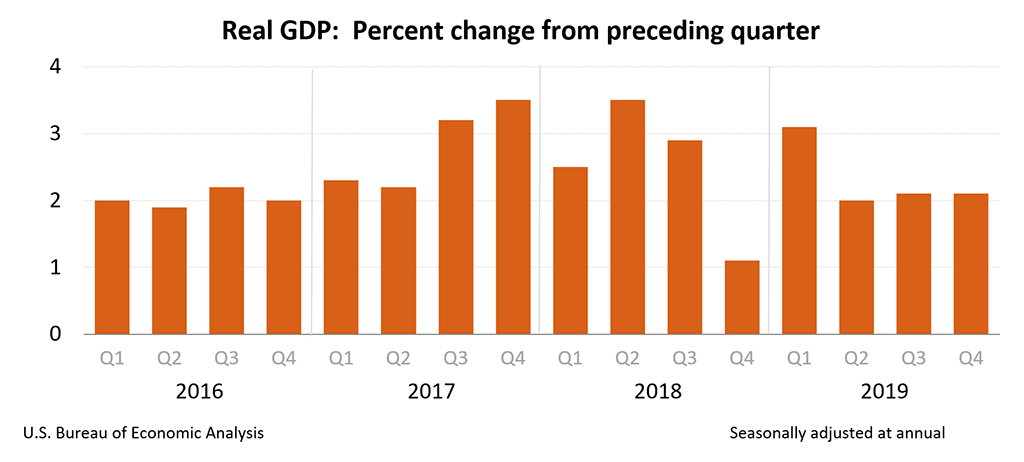
The increase in real GDP in the fourth quarter reflected positive contributions from PCE, exports, residential fixed investment, federal government spending, and state and local government spending that were partly offset by negative contributions from private inventory investment and nonresidential fixed investment. Imports, which are a subtraction in the calculation of GDP, decreased (table 2).
Real GDP growth in the fourth quarter was the same as that in the third. In the fourth quarter, a downturn in imports and an acceleration in government spending were offset by a larger decrease in private inventory investment and a slowdown in PCE.
Real gross domestic income (GDI) increased 2.6 percent in the fourth quarter, compared with an increase of 1.2 percent in the third quarter. The average of real GDP and real GDI, a supplemental measure of U.S. economic activity that equally weights GDP and GDI, increased 2.4 percent in the fourth quarter, compared with an increase of 1.7 percent in the third quarter (table 1).
Current‑dollar GDP increased 3.5 percent, or $186.6 billion, in the fourth quarter to a level of $21.73 trillion. In the third quarter, current-dollar GDP increased 3.8 percent, or $202.2 billion (tables 1 and 3).
The price index for gross domestic purchases increased 1.4 percent in the fourth quarter, the same increase as in the third quarter (table 4). The PCE price index increased 1.4 percent, compared with an increase of 1.5 percent. Excluding food and energy prices, the PCE price index increased 1.3 percent, compared with an increase of 2.1 percent.
More information on the source data that underlie the estimates is available in the "Key Source Data and Assumptions" file on BEA's website.
Updates to GDP
In the third estimate, the fourth-quarter growth rate in real GDP was unrevised from the second estimate. PCE, residential investment, and state and local government spending were revised up. These upward revisions were offset by downward revisions to federal government spending and nonresidential fixed investment as well as an upward revision to imports. For more information, see the Technical Note. For information on updates to GDP, see the "Additional Information" section that follows.
| Advance Estimate | Second Estimate | Third Estimate | |
|---|---|---|---|
| (Percent change from preceding quarter) | |||
| Real GDP | 2.1 | 2.1 | 2.1 |
| Current-dollar GDP | 3.6 | 3.5 | 3.5 |
| Real GDI | ... | ... | 2.6 |
| Average of Real GDP and Real GDI | ... | ... | 2.4 |
| Gross domestic purchases price index | 1.5 | 1.4 | 1.4 |
| PCE price index | 1.6 | 1.3 | 1.4 |
| PCE price index excluding food and energy | 1.3 | 1.2 | 1.3 |
GDP for 2019
Real GDP increased 2.3 percent in 2019 (from the 2018 annual level to the 2019 annual level), compared with an increase of 2.9 percent in 2018 (table 1).
The increase in real GDP in 2019 reflected positive contributions from PCE, nonresidential fixed investment, federal government spending, state and local government spending, and private inventory investment that were partly offset by a negative contribution from residential fixed investment. Imports increased (table 2).
The deceleration in real GDP in 2019, compared to 2018, primarily reflected decelerations in nonresidential fixed investment, exports, and PCE which were partly offset by accelerations in both state and local and federal government spending. Imports increased less in 2019 than in 2018.
Current-dollar GDP increased 4.1 percent, or $847.5 billion, in 2019 to a level of $21.43 trillion, compared with an increase of 5.4 percent, or $1,060.8 billion, in 2018 (table 1 and table 3).
Real GDI increased 1.9 percent in 2019, compared with an increase of 2.5 percent in 2018 (table 1).
The price index for gross domestic purchases increased 1.5 percent in 2019, compared with an increase of 2.4 percent in 2018 (table 4). The PCE price index increased 1.4 percent, compared with an increase of 2.1 percent. Excluding food and energy prices, the PCE price index increased 1.6 percent, compared with an increase of 1.9 percent (table 4).
Measured from the fourth quarter of 2018 to the fourth quarter of 2019, real GDP increased 2.3 percent during the period. That compared with an increase of 2.5 percent during 2018. Real GDI, as measured from the fourth quarter of 2018 to the fourth quarter of 2019, increased 2.0 percent during 2019. That compared with an increase of 2.3 percent during 2018 (table 6).
The price index for gross domestic purchases, as measured from the fourth quarter of 2018 to the fourth quarter of 2019, increased 1.4 percent during 2019. That compared with an increase of 2.2 percent during 2018. The PCE price index increased 1.4 percent, compared with an increase of 1.9 percent. Excluding food and energy, the PCE price index increased 1.6 percent, compared with an increase of 1.9 percent (table 6).
Corporate Profits, Fourth Quarter and 2019
Profits from current production (corporate profits with inventory valuation and capital consumption adjustments) increased $53.0 billion in the fourth quarter, in contrast to a decrease of $4.7 billion in the third quarter (table 10).
Profits of domestic financial corporations increased $0.7 billion in the fourth quarter, in contrast to a decrease of $4.7 billion in the third quarter. Profits of domestic nonfinancial corporations increased $53.7 billion, in contrast to a decrease of $5.5 billion. Rest-of-the-world profits decreased $1.4 billion, in contrast to an increase of $5.5 billion. In the fourth quarter, receipts increased $3.4 billion, and payments increased $4.8 billion.
In 2019, profits from current production were unchanged, compared with an increase of $68.7 billion in 2018. Profits of domestic financial corporations increased $7.1 billion, compared with an increase of $11.1 billion. Profits of domestic nonfinancial corporations decreased $36.4 billion, in contrast to an increase of $10.0 billion. Rest-of-the-world profits increased $29.3 billion, compared with an increase of $47.6 billion.
FULL DOCUMENT: https://www.bea.gov/system/files/2020-03/gdp4q19_3rd.pdf
VENEZUELA
U.S. Department of State. 03/26/2020. Department of State Offers Rewards for Information to Bring Venezuelan Drug Traffickers to Justice. Michael R. Pompeo, Secretary of State
Today the U. S. Department of State announced a series of rewards for information leading to the arrest and/or conviction of Venezuelan nationals for whom the Department of Justice unsealed indictments today for their roles in international narcotics trafficking: Nicolás Maduro Moros, Diosdado Cabello Rondón, Hugo Carvajal Barrios, Clíver Alcalá Cordones, and Tareck Zaidan El Aissami Maddah.
The Venezuelan people deserve a transparent, responsible, representative government that serves the needs of the people – and that does not betray the trust of the people by condoning or employing public officials that engage in illicit narcotics trafficking. The United States is committed to helping the Venezuelan people restore their democracy through free and fair presidential elections that will provide them with honest and competent national leadership.
The Department is offering a reward of up to $15 million for information related to Nicolás Maduro Moros. The Department is also offering rewards of up to $10 million each for information related to: Diosdado Cabello Rondón, President of the illegitimate National Constituent Assembly; General (retired) Hugo Carvajal Barrios, former Director of Venezuela’s military intelligence (DGCOM); Clíver Alcalá Cordones, Major General (retired) in Venezuela’s Army; and Tareck Zaidan El Aissami Maddah, Minister for Industry and National Production. While holding key positions in the Maduro regime, these individuals violated the public trust by facilitating shipments of narcotics from Venezuela, including control over planes that leave from a Venezuelan air base, as well as control of drug routes through the ports in Venezuela.
These rewards are offered under the Department of State’s Narcotics Rewards Program (NRP). More than 75 major narcotics traffickers have been brought to justice under the NRP since it began in 1986. The Department has paid more than $130 million in rewards for information leading to those apprehensions.
The Bureau of International Narcotics and Law Enforcement Affairs manages the NRP in close coordination with the Drug Enforcement Administration (DEA), the Federal Bureau of Investigation (FBI), the U.S. Immigration and Customs Enforcement/Homeland Security Investigations (ICE/HSI), and other U.S. government agencies. These actions demonstrate the Department’s commitment to supporting law enforcement efforts and a whole of government approach to combatting drug trafficking and transnational organized crime.
UE
U.S. Department of State. 03/26/2020. The European Union’s Decision on Albania and North Macedonia. Michael R. Pompeo, Secretary of State
The United States welcomes the European Union’s decision to open accession negotiations with Albania and North Macedonia. We look forward to deepening our strategic partnership with Albania and North Macedonia as they begin the next steps on their Western path.
This decision further solidifies Albania and North Macedonia’s European futures. It also underscores the importance of the historic Prespa Agreement which allows North Macedonia to advance its European Union and Transatlantic goals. The United States will remain a steadfast partner as both governments undertake the necessary reforms to strengthen the rule of law, further anti-corruption efforts, grow their economies, and enhance the fight against organized crime.
Both nations must remain committed to their respective reform agendas, and the United States will continue its unwavering support for their efforts in this regard.
________________
ECONOMIA BRASILEIRA / BRAZIL ECONOMICS
CORONAVÍRUS / G20
MRE. DCOM. NOTA-51. 26 de Março de 2020. Cúpula extraordinária dos líderes do G20 - Declaração sobre COVID-19
A pandemia sem precedentes do COVID-19 é um lembrete poderoso de nossa interconectividade e vulnerabilidade. O vírus não respeita fronteiras. O combate a esta pandemia exige uma resposta global com espírito de solidariedade, que seja transparente, robusta, coordenada, de larga escala e baseada na ciência. Estamos fortemente comprometidos a apresentar uma frente unida contra essa ameaça comum.
Estamos profundamente tristes com a trágica perda de vidas e o sofrimento enfrentado pelas pessoas em todo o mundo. Enfrentar a pandemia e seus impactos interligados nas áreas de saúde, social e econômica é nossa prioridade absoluta. Expressamos nossa gratidão e apoio a todos os profissionais de saúde na linha de frente, enquanto continuamos a combater a pandemia.
O G20 está comprometido a fazer o que for necessário para superar a pandemia, juntamente com a Organização Mundial da Saúde (OMS), o Fundo Monetário Internacional (FMI), o Grupo Banco Mundial, a Organização das Nações Unidas (ONU) e outras organizações internacionais, trabalhando dentro de seus mandatos existentes. Estamos determinados a não poupar esforços, individuais ou coletivos, para:
- Proteger vidas;
- Salvaguardar os empregos e a renda das pessoas;
- Restaurar a confiança, preservar a estabilidade financeira, reativar o crescimento e recuperar-se mais forte;
- Minimizar interrupções no comércio e nas cadeias de suprimentos globais;
- Prestar ajuda a todos os países que precisem de assistência;
- Coordenar medidas de saúde pública e financeiras.
Luta contra a pandemia
Comprometemo-nos a tomar todas as medidas de saúde necessárias e buscar garantir financiamento adequado para conter a pandemia e proteger as pessoas, especialmente as mais vulneráveis. Compartilharemos informações oportunas e transparentes; trocaremos dados epidemiológicos e clínicos; compartilharemos materiais necessários para pesquisa e desenvolvimento; e fortaleceremos os sistemas de saúde em todo o mundo, inclusive por meio do apoio à plena implementação do Regulamento Sanitário Internacional da OMS (RSI 2005). Expandiremos a capacidade manufatureira para atender às crescentes necessidades de suprimentos médicos e garantiremos que tais insumos sejam disponibilizados a preço acessível de forma ampla e equitativa, onde forem mais necessários e o mais rapidamente possível. Ressaltamos a importância da comunicação responsável com o público durante esta crise global de saúde. Encarregamos nossos Ministros da Saúde de se reunirem, conforme necessário, para compartilhar as melhores práticas nacionais e desenvolver um conjunto de ações urgentes do G20 para combater conjuntamente a pandemia até a sua reunião ministerial em abril.
Apoiamos totalmente e nos comprometemos a fortalecer ainda mais o mandato da OMS na coordenação da luta internacional contra a pandemia, incluindo a proteção dos profissionais de saúde da linha de frente e a entrega de suprimentos médicos, em especial kits de diagnóstico, tratamentos, medicamentos e vacinas. Reconhecemos a necessidade de ações urgentes de curto prazo para intensificar os esforços globais para combater a crise do COVID-19. Trabalharemos rapidamente juntos e com as partes interessadas para reduzir a lacuna de financiamento no Plano Estratégico de Preparo e Resposta da OMS. Comprometemo-nos ainda a fornecer, voluntariamente, recursos imediatos ao Fundo de Resposta de Solidariedade COVID-19 da OMS, à Coalizão de Preparo e Inovação para Epidemias (CEPI) e à GAVI, a Aliança Global pra as Vacinas. Apelamos a todos os países, organizações internacionais, setor privado, filantropia e indivíduos a contribuírem para esses esforços.
Para salvaguardar o futuro, comprometemo-nos a fortalecer as capacidades nacionais, regionais e globais para responder a possíveis surtos de doenças infecciosas, aumentando substancialmente nossos gastos com preparação para epidemias. Isso aumentará a proteção de todos, especialmente grupos vulneráveis que são desproporcionalmente afetados por doenças infecciosas. Comprometemo-nos ainda a trabalharmos juntos para aumentar o financiamento de pesquisa e desenvolvimento para vacinas e medicamentos, alavancar tecnologias digitais e fortalecer a cooperação científica internacional. Reforçaremos nossa coordenação, inclusive com o setor privado, em direção ao rápido desenvolvimento, fabricação e distribuição de diagnósticos, medicamentos antivirais e vacinas, aderindo aos objetivos de eficácia, segurança, equidade, acessibilidade e acessibilidade.
Rogamos à OMS, em cooperação com organizações relevantes, que avalie lacunas na preparação para pandemia e relate os resultados em uma reunião conjunta de Ministros de Finanças e Saúde nos próximos meses, com o objetivo de estabelecer uma iniciativa global sobre preparação e resposta a pandemia. Essa iniciativa se beneficiará de programas preexistentes para alinhar prioridades na preparação global e funcionará como uma plataforma universal, eficiente e sustentável de financiamento e coordenação para acelerar o desenvolvimento e a entrega de vacinas, diagnósticos e tratamentos.
Salvaguardando a economia global
Comprometemo-nos a fazer o que for preciso e a usar todas as ferramentas políticas disponíveis para minimizar os danos econômicos e sociais decorrentes da pandemia, restaurar o crescimento global, manter a estabilidade do mercado e fortalecer a resiliência.
Atualmente, estamos adotando medidas imediatas e vigorosas para apoiar nossas economias; proteger trabalhadores, empresas - especialmente micro, pequenas e médias empresas - e os setores mais afetados; e amparar os vulneráveis com proteção social adequada. Estamos injetando mais de 4.8 trilhões de dólares na economia global, como parte de medidas econômicas e fiscais específicas e de esquemas de garantia para combater os impactos sociais, econômicos e financeiros da pandemia.
Continuaremos a administrar apoio fiscal ousado e em larga escala. A ação coletiva do G20 ampliará seu impacto, garantirá coerência e aproveitará sinergias. A magnitude e o alcance dessa resposta recuperarão a economia global e estabelecerão uma base sólida para a proteção dos empregos e a recuperação do crescimento. Solicitamos que nossos Ministros das Finanças e governadores de Bancos Centrais se oordenem regularmente para desenvolver um plano de ação coordenado pelo G20 em resposta ao COVID-19 e trabalhem em estreita colaboração com organizações internacionais para fornecer rapidamente a assistência financeira internacional apropriada.
Apoiamos as medidas extraordinárias adotadas pelos Bancos Centrais, consistentes com seus mandatos. Banco Centrais atuaram para apoiar o fluxo de crédito para famílias e empresas; promover a estabilidade financeira; e aumentar a liquidez nos mercados globais. Congratulamo-nos com a extensão das linhas de swap que nossos bancos centrais estabeleceram. Também apoiamos medidas regulatórias e de supervisão adotadas para garantir que o sistema financeiro continue apoiando a economia e saudamos a coordenação de tais medidas anunciada pelo Conselho de Estabilidade Financeira (FSB).
Saudamos também as medidas adotadas pelo FMI e pelo Banco Mundial para apoiar países necessitados, fazendo máximo uso de todos os instrumentos disponíveis como parte de uma resposta global coordenada, e solicitamos que atualizem regularmente o G20 sobre os impactos da pandemia, sua resposta e recomendações de políticas. Continuaremos a responder aos riscos de vulnerabilidade por dívida decorrentes da pandemia em países de baixa renda. Também pedimos à Organização Internacional do Trabalho (OIT) e à Organização para Cooperação e Desenvolvimento Econômico (OCDE) que monitorem o impacto da pandemia no emprego.
Respondendo às interrupções do comércio internacional
Tendo em conta as necessidades de nossos cidadãos, trabalharemos para garantir o fluxo transfronteiriço de suprimentos médicos vitais, produtos agrícolas essenciais e outros bens e serviços e trabalharemos para solucionar as interrupções nas cadeias globais de suprimentos, para apoiar a saúde e o bem-estar de todas as pessoas.
Comprometemo-nos a continuar trabalhando juntos para facilitar o comércio internacional e coordenar as respostas de maneira a evitar interferências desnecessárias no tráfego e no comércio internacional. As medidas de emergência destinadas a proteger a saúde serão específicas, proporcionais, transparentes e temporárias. Encarregamos nossos Ministros do Comércio de avaliar o impacto da pandemia no comércio.
Reiteramos nosso objetivo de criar um ambiente de comércio e investimento que seja livre, justo, não discriminatório, transparente, previsível e estável, e de manter nossos mercados abertos.
Aprimorando a cooperação global
Trabalharemos rápida e decisivamente com organizações internacionais na linha de frente, especialmente a OMS, o FMI, o Banco Mundial e os bancos multilaterais e regionais de desenvolvimento, a fim de adotar um pacote financeiro robusto, coerente, coordenado e rápido e de solucionar quaisquer lacunas em seus instrumentos de políticas. Estamos prontos para fortalecer as redes de segurança financeira global. Conclamamos todas essas organizações a intensificar ainda mais a coordenação de suas ações, inclusive com o setor privado, para apoiar os países emergentes e em desenvolvimento que enfrentem choques decorrentes da COVID-19 nas áreas de saúde, econômica e social.
Estamos profundamente preocupados com os sérios riscos enfrentados por todos os países, particularmente países em desenvolvimento e de menor desenvolvimento relativo, notadamente na África e pequenos Estados insulares, onde os sistemas de saúde e as economias podem ser menos capazes de lidar com o desafio, bem como com o especial risco que correm os refugiados e os deslocados. Fortaleceremos a capacitação e a assistência técnica, especialmente às comunidades em risco. Estamos prontos para mobilizar o financiamento ao desenvolvimento e à assistência humanitária.
Encarregamos nossos funcionários de alto nível pertinentes de coordenar estreitamente o apoio aos esforços globais para combater os impactos da pandemia, inclusive por meio de medidas proporcionais de gerenciamento de fronteiras que estejam de acordo com regulamentos nacionais, e de fornecer assistência sempre que necessário para repatriar cidadãos.
Valorizamos os esforços para salvaguardar a saúde de nosso povo por meio do adiamento de grandes eventos públicos, em particular a decisão do Comitê Olímpico Internacional de reagendar os Jogos Olímpicos para data não posterior ao verão de 2021. Felicitamos a determinação do Japão de sediar os Jogos Olímpicos e Paraolímpicos de Tóquio 2020 em sua totalidade como um símbolo da resiliência humana.
Estamos prontos para reagir prontamente e tomar qualquer outra ação que possa ser necessária. Expressamos nossa disposição de nos reunirmos novamente, conforme a situação exigir. Ação internacional, solidariedade e cooperação internacional são mais do que nunca necessárias para lidar com essa pandemia. Estamos confiantes de que, trabalhando em conjunto, vamos superar isso. Protegeremos a vida humana, restabeleceremos a estabilidade econômica mundial e estabeleceremos bases sólidas para um crescimento forte, sustentável, equilibrado e inclusivo.
COMÉRCIO EXTERIOR BRASILEIRO / CORONAVÍRUS
MEconomia. 26/03/2020. ECONOMIA. COVID-19. Camex zera Imposto de Importação de mais 61 produtos para combate ao coronavírus. Medida inclui kits para testes da doença, equipamentos e aparelhos farmacêuticos e médico-hospitalares, drogas e outros itens
A Câmara de Comércio Exterior (Camex) do Ministério da Economia zerou, nesta quarta-feira (25/3), as tarifas de importação de mais 61 produtos farmacêuticos e médico-hospitalares utilizados no combate à Covid-19. Durante reunião virtual do Comitê-Executivo de Gestão da Camex (Gecex), também foi decidida a suspensão temporária, por razões de interesse público, dos direitos antidumping aplicados às importações brasileiras de seringas descartáveis e de tubos de plástico para coleta de sangue.
A redução a zero das alíquotas inclui kits para testes de coronavírus, equipamentos e aparelhos médico-hospitalares, e drogas como cloroquina, hidroxicloroquina, azitromicina e imunoglobulina. Também são relacionados, dentre outros, itens como álcool etílico, cloreto de sódio puro, oxigênio e dióxido de carbono medicinais; gaze, água oxigenada, lençóis de papel, luvas de proteção, esterilizadores e agulhas; equipamentos de oxigenação e de intubação, aparelhos de respiração artificial, termômetros, instrumentos e aparelhos para diagnóstico.Os detalhes dessa medida estão na Resolução nº 22, publicada nesta quinta-feira (26/3) no Diário Oficial da União.
A nova lista foi elaborada pelos ministérios da Saúde e da Economia, em conjunto com a Agência Nacional de Vigilância Sanitária (Anvisa). Ela abrange 51 códigos da Nomenclatura Comum do Mercosul (NCM), em um total de 61 produtos que tinham tarifas de importação de até 35%, maior nível tarifário aplicado pelo Brasil para bens industriais.
A decisão do Gecex amplia a relação de produtos do Anexo Único da Resolução Nº 17, de 17 de março de 2020, que já havia zerado a alíquota de importação de 50 produtos, incluindo itens como luvas médico-hospitalares, álcool em gel, máscaras, termômetros clínicos, roupas de proteção contra agentes infectantes, óculos de segurança e equipamentos respiradores, dentre outros. As alíquotas ficarão zeradas até 30 de setembro de 2020.
Antidumping
Com base em proposta do Ministério da Saúde, o Ministério da Economia editou a Resolução nº 23, publicada nesta quinta-feira (26/3) no Diário Oficial da União, que suspende até a mesma data, por razões de interesse público, direitos antidumping aplicados às importações de seringas descartáveis de uso geral, de plástico, com capacidade de 1 ml, 3 ml, 5 ml, 10 ml ou 20 ml, com ou sem agulhas, originárias da China, e às importações brasileiras de tubos de plástico para coleta de sangue a vácuo, originários da Alemanha, China, Estados Unidos e Reino Unido. Os direitos antidumping são valores adicionais ao Imposto de Importação, que podem ser cobrados quando uma empresa exporta ao Brasil a preço inferior ao praticado em seu mercado de origem.
As medidas entraram em vigor a partir da publicação no Diário Oficial da União, nesta quinta-feira (26/03).
PIB
BACEN. 26 Março 2020. BC divulga o Índice de Atividade Econômica do Banco Central (IBC-Br) de janeiro de 2020.
DOCUMENTO: https://www.bcb.gov.br/detalhenoticia/17018/nota
BACEN. PORTAL G1. 26/03/2020. Banco Central passa a prever PIB estável em 2020 em meio à pandemia de coronavírus. Expectativa anterior, divulgada em dezembro, previa alta de 2,2%. BC observou que pandemia está provocando 'desaceleração significativa da atividade econômica'.
Por Alexandro Martello, G1 — Brasília
O Banco Central (BC) revisou sua projeção para a economia brasileira em 2020 e passou a projetar estabilidade para o nível de atividade, ou seja, sem alta nem queda do Produto Interno Bruto (PIB). A previsão anterior, divulgada em dezembro, era de expansão de 2,2%.
A nova estimativa consta do relatório trimestral de inflação e foi divulgada nesta quinta-feira (26).
O PIB é a soma de todos os bens e serviços feitos no país, independentemente da nacionalidade de quem os produz, e serve para medir o comportamento da economia brasileira.
A mudança na projeção decorre dos impactos da pandemia do coronavírus, que têm interrompido a atividade econômica ao redor do mundo e aumentado o desemprego.
"A economia mundial, incluindo a brasileira, passa por momento de elevado grau de incerteza em decorrência da pandemia de coronavírus, que está provocando desaceleração significativa da atividade econômica, queda nos preços das 'commodities' [produtos básicos com cotação internacional, como petróleo e minério de ferros] e aumento da volatilidade nos preços de ativos financeiros", informou o BC no relatório de inflação.
O Banco Central também reafirmou, no documento, que "continuará fazendo uso de todo o seu arsenal de medidas de políticas monetária [relativas à taxa básica de juros e injeção e liquidez nos mercados], cambial [evitar distorções no mercado de câmbio] e de estabilidade financeira [acompanhamento da situação das instituições financeiras] no enfrentamento da crise atual".
A nova previsão do BC ainda é mais otimista do que algumas instituições financeiras que já esperam retração econômica neste ano.
Na semana passada, o Ministério da Economia estimou uma expansão de apenas 0,02% do PIB em 2020, ou seja, um cenário ainda de estabilidade. Porém, a pasta também informou que está sendo previso cenário de recessão técnica em 2020, quando há queda do PIB por dois trimestres seguidos.
O Banco Central avaliou que "perseverar no processo de reformas e ajustes necessários na economia brasileira é essencial para permitir a recuperação sustentável da economia".
Em 2019, segundo dados do Instituto Brasileiro de Geografia e Estatística (IBGE), o PIB cresceu 1,1%. Foi o desempenho mais fraco em três anos, com o resultado afetado principalmente pela perda de ritmo do consumo das famílias e dos investimentos privados. Em 2017 e 2018 o crescimento foi de 1,3% em ambos os anos.
Inflação e taxa de juros
O BC também informou que a sua estimativa de inflação para 2020, medida pelo Índice Nacional de Preços ao Consumidor Amplo (IPCA), recuou de 3,5% (em dezembro do ano passado) para 2,6%.
Essa previsão considera a trajetória estimada pelo mercado financeiro para a taxa de juros e de câmbio neste ano e no próximo.
Em outro cenário, que considera taxa de juros (Selic) e câmbio estáveis, por sua vez, a previsão do Banco Central para a inflação oficial deste ano recuou de 3,6% para 3%.
As previsões estão em linha com as metas de inflação. Neste ano, a meta central de inflação é de 4% e terá sido oficialmente cumprida se o IPCA oscilar de 2,5% a 5,5%.
Quando as estimativas para a inflação estão em linha com as metas, o BC pode reduzir os juros. Quando estão acima da trajetória esperada, a taxa Selic é elevada.
O mercado prevê que a inflação oficial fique em 3,10% este ano e em 3,65% para 2021 – projeções em linha com as metas.
Para 2021 e 2022, no cenário de mercado (Selic e câmbio projetados pelos bancos), o Banco Central projetou uma inflação de 3,2% e 3,3%, respectivamente. Em dezembro do ano passado, no relatório de inflação anterior, ambas ass projeções estavam em 3,4%.
Sobre a taxa básica de juros, que está na mínima histórica de 3,75% ao ano, o BC informou que vê como "adequada" a manutenção da taxa Selic em seu atual patamar.
"No entanto, o Comitê [de Política Monetária do BC, que define a taxa Selic] reconhece que se elevou a variância do seu balanço de riscos e novas informações sobre a conjuntura econômica serão essenciais para definir seus próximos passos", acrescentou a instituição.
Medidas anunciadas
Nos últimos dias, a área econômica do governo tem anunciado uma série de medidas para garantir a prestação de serviços de saúde em meio à pandemia e para tentar frear os efeito da crise na economia e no nível de emprego:
- Em 12 de março, o governo anunciou a antecipação do pagamento do 13º salário de aposentados e pensionistas, e a prova da suspensão de vida dos aposentados, entre outras.
- Em 16 de março, anunciou três meses para depósito de FGTS, a antecipação da segunda parcela do 13º do INSS e o reforço Bolsa Família.
- No dia 18 de março, informou que será liberado auxílio mensal de R$ 200 a autônomos e informais, em pacote de R$ 15 bi a "pessoas desassistidas".
- Em 19 de março, informou que pagará os primeiros 15 dias para trabalhador doente pelo coronavírus, e que planeja pagar um auxílio para os trabalhadores que recebem até dois salários mínimos afetados pela redução de jornada e salários.
- No dia 23 de março, a área econômica anunciou que o governo vai implementar um plano de mais de R$ 85 bilhões para fortalecer os estados e os municípios.
BACEN. REUTERS. 26 DE MARÇO DE 2020. Atividade econômica tem alta de 0,2% em janeiro, mostra BC
SÃO PAULO (Reuters) - O Índice de Atividade Econômica do Banco Central (IBC-Br), sinalizador do Produto Interno Bruto (PIB), registrou alta de 0,24% em janeiro na comparação com o mês anterior, segundo dados dessazonalizados divulgados pelo BC nesta quinta-feira.
Na comparação com janeiro de 2019, o IBC-Br apresentou ganho de 0,69% e, no acumulado em 12 meses, teve avanço de 0,86%, segundo números observados.
Por Camila Moreira
INFLAÇÃO
BACEN. 26 Março 2020. O Banco Central divulgou o Relatório Trimestral de Inflação do primeiro trimestre de 2020.
- VÍDEO: https://www.youtube.com/watch?v=ZJ47yE3jK0o&feature=youtu.be
- APRESENTAÇÃO: https://www.bcb.gov.br/conteudo/home-ptbr/TextosApresentacoes/Coletiva_RI_26.3.2020.pdf
- DOCUMENTO: https://www.bcb.gov.br/content/ri/relatorioinflacao/202003/ri202003p.pdf
Sumário executivo
A economia mundial, incluindo a brasileira, passa por momento de elevado grau de incerteza em decorrência da pandemia de coronavírus, que está provocando desaceleração significativa da atividade econômica, queda nos preços das commodities e aumento da volatilidade nos preços de ativos financeiros. Nesse contexto, apesar da provisão adicional de estímulo monetário pelas principais economias, o ambiente para as economias emergentes tornou-se desafiador, com o aumento de aversão ao risco e a consequente realocação de ativos provocando substancial aperto
nas condições financeiras.
Internamente, dados divulgados desde a reunião do Comitê de Política Monetária (Copom) de fevereiro (228ª reunião) vinham em linha com o processo de recuperação gradual da economia brasileira. Entretanto, esses dados ainda não refletem os impactos da pandemia de COVID-19 na economia brasileira.
O crescimento do Produto Interno Bruto (PIB) no quarto trimestre de 2019 e as informações setoriais referentes aos primeiros meses deste ano corroboravam o cenário básico do Copom, de recuperação gradual da atividade. Contudo, o efeito contracionista da atual pandemia ensejou revisão da projeção de crescimento do PIB em 2020. Embora haja elevado grau de incerteza nessa projeção, ela foi revisada de 2,2%, publicada no Relatório de Inflação em dezembro, para estabilidade.
Diversas medidas de inflação subjacente se encontram em níveis compatíveis com o cumprimento da meta para a inflação no horizonte relevante para a política monetária.
As projeções de curto prazo foram influenciadas significativamente pelos movimentos recentes nas cotações de commodities, em particular pelas expressivas retrações dos preços internacionais de petróleo, que repercutem rapidamente sobre os preços domésticos de combustíveis. As implicações da pandemia sobre o segmento de serviços, notadamente, sobre os preços de passagens aéreas, provavelmente irão se refletir nas leituras mensais de inflação, sobretudo a partir de maio.
As expectativas de inflação para 2020, 2021 e 2022 apuradas pela pesquisa Focus encontram-se em torno de 3,1%, 3,65% e 3,5%, respectivamente. No que se refere às projeções condicionais de inflação, no cenário híbrido, com trajetória para a taxa de juros extraída da pesquisa Focus e taxa de câmbio constante a R$4,75/US$, as projeções do Copom situam-se em torno de 3,0% para 2020 e 3,6% para 2021. Esse cenário supõe trajetória de juros que encerra 2020 em 3,75% a.a. e se eleva até 5,25% a.a. em 2021. No cenário com taxa de juros constante a 4,25% a.a. e taxa de câmbio constante a R$4,75/US$, as projeções situam-se em torno de 3,0% para 2020 e 3,6% para 2021.
As projeções apresentadas utilizam o conjunto de informações disponíveis até a reunião do Copom realizada em 17 e 18.3.2020 (229ª reunião). Para os condicionantes utilizados nas projeções, em especial os advindos da pesquisa Focus, realizada pelo Banco Central do Brasil, a data de corte é 13.3.2019, a menos de indicação contrária.
Em sua reunião mais recente (229ª reunião), o Copom decidiu, por unanimidade, pela redução da taxa básica de juros em 0,5 ponto percentual, para 3,75% a.a. O Comitê entende que essa decisão reflete seu cenário básico e um balanço de riscos de variância maior do que a usual para a inflação prospectiva e é compatível com a convergência da inflação para a meta no horizonte relevante, que inclui o ano-calendário 2020 e, principalmente, de 2021.
Na ocasião, o Copom comunicou que seu cenário básico para a inflação envolve fatores de risco em ambas as direções. Por um lado, o nível de ociosidade pode produzir trajetória de inflação abaixo do esperado. Esse risco se intensifica caso um agravamento da pandemia provoque aumento da incerteza e redução da demanda com maior magnitude ou duração do que o estimado.
Por outro lado, o aumento da potência da política monetária, a deterioração do cenário externo ou frustrações em relação à continuidade das reformas podem elevar os prêmios de risco e gerar uma trajetória da inflação acima do projetado no horizonte relevante para a política monetária.
O Copom reitera que a conjuntura econômica prescreve política monetária estimulativa, ou seja, com taxas de juros abaixo da taxa estrutural.
O Copom enfatiza que perseverar no processo de reformas e ajustes necessários na economia brasileira é essencial para permitir a recuperação sustentável da economia. O Comitê ressalta, ainda, que questionamentos sobre a continuidade das reformas e alterações de caráter permanente no processo de ajuste das contas públicas têm o potencial de elevar a taxa de juros estrutural da economia. Nessa situação, relaxamentos monetários adicionais podem tornar-se contraproducentes se resultarem em aperto nas condições financeiras.
O Copom entende que a atual conjuntura prescreve cautela na condução da política monetária, e neste momento vê como adequada a manutenção da taxa Selic em seu novo patamar. No entanto, o Comitê reconhece que se elevou a variância do seu balanço de riscos e novas informações sobre a conjuntura econômica serão essenciais para definir seus próximos passos.
O Banco Central do Brasil ressalta que continuará fazendo uso de todo o seu arsenal de medidas de políticas monetária, cambial e de estabilidade financeira no enfrentamento da crise atual.
CORONAVÍRUS
FGV. 26/03/2020. QUAL A RELAÇÃO ENTRE O CORONAVÍRUS E A POLÍTICA EDUCACIONAL?
Atualmente, 29% dos jovens do 3º ano do Ensino Médio possuem aprendizado adequado em Português e apenas 9,1% em Matemática, um cenário que já apresenta insuficiência. Diante da pandemia do coronavírus, com a reclusão da população e a possibilidade dos alunos ficarem muitos dias sem aula, quais os esforços em termos de políticas educacionais que estão sendo feitos para controlar essa situação? Assista agora no programa FGV – Impactos do Covid-19.

VÍDEO: https://www.youtube.com/watch?v=sLePpY5SUvQ&feature=youtu.be
CONSTRUÇÃO CIVIL
FGV. IBRE. 26/03/20. Índices Gerais de Preços. INCC-M. INCC-M subiu 0,38% em março
O Índice Nacional de Custo da Construção – M (INCC-M) subiu 0,38% em março, percentual superior ao apurado no mês anterior, quando o índice registrou alta de 0,35%. A taxa do índice relativo a Materiais, Equipamentos e Serviços variou 0,35% em março, após alta de 0,71% em fevereiro. O índice referente à Mão de Obra subiu 0,40% em março. No mês anterior a taxa foi de 0,04%.
Materiais, Equipamentos e Serviços
No grupo Materiais, Equipamentos e Serviços, a variação correspondente a Materiais e Equipamentos foi de 0,42%, contra 0,65% no mês anterior. Três dos quatro subgrupos componentes apresentaram decréscimo em suas taxas de variação, destacando-se equipamentos para transporte de pessoas, cuja taxa passou de 1,21% para 0,16%.
A variação relativa a Serviços passou de 0,96% em fevereiro para 0,11% em março. Neste grupo, vale destacar o recuo da taxa do item taxas de serviços e licenciamentos, que passou de 2,80% para 0,00%.
Mão de obra
O índice referente à Mão de Obra subiu 0,40% em março. No mês anterior, este grupo apresentou taxa de 0,04%.
Capitais
Três capitais apresentaram aceleração em suas taxas de variação: Salvador, Rio de Janeiro e Porto Alegre. Em contrapartida, Brasília, Belo Horizonte, Recife e São Paulo apresentaram decréscimos em suas taxas de variação.
DOCUMENTO: https://portalibre.fgv.br/navegacao-superior/noticias/indice-nacional-de-custo-da-construcao-m-subiu-0-38-em-marco.htm
CNI. 26/03/2020. Nível de atividade e emprego recuam na indústria da construção. Sondagem também mostra que empresários reduziram expectativas para os próximos meses. Níveis de atividade e emprego na indústria da construção brasileira recuaram em fevereiro em relação a janeiro
Pesquisa da Confederação Nacional da Indústria (CNI) mostra que, em fevereiro, o nível de atividade e o emprego na indústria da construção brasileira recuaram em relação a janeiro. O indicador de evolução da atividade registrou 47,5 pontos. Valores abaixo de 50 pontos indicam queda na atividade. O índice de evolução do número de empregados (47,7 pontos) também está abaixo da linha divisória dos 50 pontos, o que mostra queda no número de empregados.
Na comparação com fevereiro de 2019, verifica-se uma redução no ritmo de queda da indústria da construção. No ano passado, os indicadores estavam mais distantes da linha de 50 pontos: 44,3 pontos, no caso do indicador de evolução do nível de atividade, e 42,9 pontos no caso do indicador de evolução do número de empregados.
Os dados constam da Sondagem Indústria da Construção, divulgada pela CNI nesta terça-feira (24). Os índices variam de 0 a 100 pontos, e valores abaixo de 50 pontos sinalizam queda no indicador ante o mês anterior. Quanto mais abaixo da linha divisória, maior e mais disseminada foi a queda.
A pesquisa ouviu 470 empresas de pequeno, médio e grande porte entre 2 e 11 de março, antes de a Organização Mundial de Saúde (OMS) declarar pandemia do novo coronavírus.

Empresas de pequeno e médio portes registram queda na Utilização da Capacidade Operacional
A sondagem revela também que a Utilização da Capacidade Operacional (UCO) registrou 60% em fevereiro, mesmo valor observado em janeiro e quatro pontos percentuais (p.p.) acima do registrado há um ano.
As grandes empresas são as que apresentaram maior utilização entre os diferentes portes, registrando 65% de UCO, aumento de um ponto percentual em relação a janeiro. O percentual superou em sete pontos percentuais o observado em fevereiro de 2019 e foi o maior valor para o mês desde 2014. Por outro, as empresas de pequeno e médio portes registraram queda na UCO entre janeiro e fevereiro de 2020.

Empresários demonstram confiança em março, mas menos que no mês anterior
O Índice de Confiança do Empresário da Construção (ICEI-Construção) registrou 59,3 pontos em março, 3,6 pontos a menos do que o registrado em fevereiro. Apesar do recuo, o indicador permaneceu 5,4 pontos acima de sua média histórica e acima da linha divisória de 50 pontos, demonstrando confiança. A queda nesse valor foi puxada tanto pelos indicadores de Condições Atuais quanto pelos de Expectativas.
Empresários reduzem otimismo para os próximos meses
Os empresários reduziram em março seu otimismo para os próximos meses, tanto para o nível de atividade, quanto para a construção de novos empreendimentos. Esses índices recuaram 1,0 ponto e 1,2 ponto, respectivamente, na comparação mensal, e ficaram em 58,1 pontos e 56,8 pontos.
Os indicadores de expectativas de compras de insumos e matérias-primas e do número de empregados recuaram, ambos, 1,0 ponto na mesma base de comparação, e atingiram 56,0 pontos e 55,5 pontos, respectivamente. Apesar do recuo, todos os indicadores de expectativas seguiram acima da linha divisória de 50 pontos, sugerindo otimismo, ainda que menor.
O índice de intenção de investimento também recuou em março. O indicador ficou em 42,6 pontos no mês, 1,8 ponto abaixo do registrado em fevereiro. Apesar da queda, o índice superou em 8,6 pontos o valor registrado há um ano e apresentou o maior valor alcançado no mês de março desde 2014. O índice seguiu 8,3 pontos acima da média histórica, de 34,3 pontos. O índice de intenção de investimento varia de 0 a 100 pontos e quanto maior o índice, maior a intenção de investir.
DOCUMENTO: https://noticias.portaldaindustria.com.br/noticias/economia/nivel-de-atividade-e-emprego-recuam-na-industria-da-construcao-/
AGRICULTURA
IBGE. 26/03/2020. IBGE divulga Monitoramento da Cobertura e Uso da Terra do Brasil para 2018
O IBGE divulga hoje o Monitoramento da Cobertura e Uso da Terra do Brasil para 2018, ampliando a série histórica que já abrange os anos 2000, 2010, 2012, 2014 e 2016. A análise da série histórica permite observar a evolução e os padrões de ocupação do território brasileiro. O objetivo do trabalho é acompanhar a dinâmica do território, seus processos de ocupação e suas transformações, através de um monitoramento espacial e quantitativo da cobertura vegetal e do uso da terra em todo o país. Desde 2010, este estudo vem sendo feito pelo IBGE a cada dois anos.
Os dados estão disponíveis para download na Plataforma Geográfica Interativa (PGI) e no Portal IBGE e ainda podem ser consultados no Mapas Interativos e no Banco de Dados de Informações Ambientais (BDiA), onde é possível a combinação com outros temas ambientais produzidos pelo IBGE.
Entre 2016 e 2018, cerca de 1% do território brasileiro sofreu alguma mudança na cobertura e uso da terra. De forma geral, prossegue a substituição das áreas de vegetação natural por áreas antrópicas; ou seja, há um avanço da ação do homem sobre novas áreas. Além disso, observa-se uma priorização da agricultura em detrimento da pastagem com manejo.
Em 2018, as áreas agrícolas apresentaram crescimento de 3,3% em relação a 2016. Certas regiões apresentaram destaque no crescimento da área agrícola como a porção nordeste do Mato Grosso; a região de Santarém (PA), Paragominas (PA) e Imperatriz (MA); o eixo entre os municípios de Campo Grande e Cassilândia (MS); e a região da campanha gaúcha (RS).
Entre 2000 e 2018, houve uma expansão de cerca de 27% nas áreas destinadas às pastagens com manejo, principalmente na borda leste do bioma Amazônia, de 45% da área agrícola e 70% da área de silvicultura.
Entre 2000 e 2012, cerca de 20% das novas áreas agrícolas vieram da conversão de pastagens com manejo, 53% de vegetação nativa (florestal e campestre) e o restante de outras classes de cobertura e uso da terra. A partir de 2012, observa-se uma alteração na dinâmica, com 53% das novas áreas agrícolas sendo provenientes da conversão de pastagem com manejo, 26% de vegetação nativa (florestal e campestre) e o restante de outras classes de cobertura e uso da terra.
Interpretação visual de imagens de satélite e campanhas de campo
O Monitoramento da Cobertura e Uso da Terra tem como objetivo espacializar e quantificar a cobertura e uso da terra do Brasil, em períodos regulares, a partir do mapeamento sistemático. A metodologia envolve interpretação visual de imagens de satélite, campanhas de campo e consulta a informações complementares. Os dados são divulgados em Grade Estatística, que cobre o território brasileiro com células de 1km². Como produtos, são disponibilizados os mapas, gráficos e tabelas de Contas Físicas e Matriz de Mudanças ocorridas nos períodos analisados.
| CLASSES | Área Artificial | Área Agrícola | Pastagem com Manejo | Mosaico de Ocupações em Área Florestal | Silvicultura | Vegetação Florestal | Área Úmida | Vegetação Campestre | Mosaico de Ocupações em Área Campestre | Corpo d'água Continental | Corpo d'água Costeiro | Área Descoberta |
|---|---|---|---|---|---|---|---|---|---|---|---|---|
| ESTOQUES (km2) | ||||||||||||
| Estoque (2000) | 34.567 | 458.975 | 885.186 | 847.721 | 50.543 | 4.017.505 | 34.297 | 1.834.153 | 234.729 | 128.749 | 222.461 | 3.680 |
| Total de adições ao estoque | 1.650 | 99.400 | 237.614 | 81.785 | 21.535 | 1.617 | 104 | 1.219 | 18.632 | 0 | 0 | 19 |
| Total de redução do estoque | 0 | 2.143 | 23.769 | 98.645 | 2.234 | 216.404 | 115 | 109.588 | 10.673 | 0 | 0 | 4 |
| Estoque (2010) | 36.217 | 556.232 | 1.099.031 | 830.861 | 69.844 | 3.802.718 | 34.286 | 1.725.784 | 242.688 | 128.749 | 222.461 | 3.695 |
| Total de adições ao estoque | 513 | 28.329 | 36.210 | 24.164 | 8.310 | 722 | 62 | 723 | 10.285 | 0 | 0 | 8 |
| Total de redução do estoque | 0 | 793 | 9.135 | 24.367 | 2.083 | 36.610 | 140 | 32.570 | 3.621 | 0 | 0 | 7 |
| Estoque (2012) | 36.730 | 583.768 | 1.126.106 | 830.658 | 76.071 | 3.766.830 | 34.208 | 1.693.937 | 249.352 | 128.749 | 222.461 | 3.696 |
| Total de adições ao estoque | 731 | 42.328 | 22.634 | 15.303 | 6.566 | 1.950 | 206 | 1.447 | 6.092 | 0 | 0 | 4 |
| Total de redução do estoque | 0 | 1.464 | 24.916 | 17.943 | 501 | 24.316 | 232 | 24.519 | 3.369 | 0 | 0 | 1 |
| Estoque (2014) | 37.461 | 624.632 | 1.123.824 | 828.018 | 82.136 | 3.744.464 | 34.182 | 1.670.865 | 252.075 | 128.749 | 222.461 | 3.699 |
| Total de adições ao estoque | 312 | 19.764 | 9.016 | 25.164 | 1.775 | 1.022 | 202 | 849 | 4.694 | 0 | 0 | 45 |
| Total de redução do estoque | 0 | 627 | 13.947 | 9.255 | 265 | 25.685 | 102 | 10.656 | 2.306 | 0 | 0 | 0 |
| Estoque (2016) | 37.773 | 643.769 | 1.118.893 | 843.927 | 83.646 | 3.719.801 | 34.282 | 1.661.058 | 254.463 | 128.749 | 222.461 | 3.744 |
| Total de adições ao estoque | 550 | 24.239 | 25.994 | 16.797 | 3.065 | 10.959 | 0 | 1.933 | 3.689 | 153 | 0 | 5 |
| Total de redução do estoque | 29 | 3.224 | 19.693 | 27.558 | 760 | 18.702 | 5 | 13.414 | 3.999 | 0 | 0 | 0 |
| Estoque (2018) | 38.294 | 664.784 | 1.125.194 | 833.166 | 85.951 | 3.712.058 | 34.277 | 1.649.577 | 254.153 | 128.902 | 222.461 | 3.749 |
Além dos dados cartográficos e dos textos explicativos, o monitoramento produz as Contas Físicas de Cobertura e Uso da Terra e a Matriz de Mudanças, que traduzem os resultados em valores numéricos agregados. A tabela das Contas Físicas mostra, em km², os estoques iniciais, reduções, adições e os estoques finais para cada uma das classes de cobertura e uso da terra em cada período analisado. Já a Matriz de Mudanças apresenta, também em km², todas as conversões entre os diferentes tipos de cobertura e uso da terra, permitindo a realização de diversas análises.
Cobertura e uso da terra. Área agrícola cresce em dois anos e ocupa 7,6% do território nacional em 2018. Área agrícola brasileira cresceu 44,8% de 2000 a 2018, passando a ocupar 664.784 km² do território
A área agrícola do Brasil cresceu 3,3% entre 2016 e 2018, como aponta o Monitoramento da Cobertura e Uso da Terra, divulgado hoje (26) pelo IBGE, e disponível na Plataforma Geográfica Interativa. Desde o início da série histórica da pesquisa, em 2000, a área agrícola cresceu 44,8%, chegando a 664.784 km² em 2018, o equivalente a 7,6% do território nacional, considerando a parte terrestre e marítima do país.
Entre 2000 e 2012, cerca de 20% das novas áreas agrícolas vieram da conversão de pastagem com manejo, mas, a partir de 2012, esse número subiu para 53%. “De todas as mudanças de cobertura e uso que aconteceram de 2016 a 2018,16% delas foram conversão de pasto com manejo para área agrícola”, destaca o gerente de Recursos Naturais do IBGE, Fernando Peres, explicando que esse tipo de pastagem é caracterizado pela limpeza, adubação, aplicação de herbicidas e plantio.
Segundo o pesquisador do IBGE, a conversão de pastagem com manejo para área agrícola é um método habitual entre os produtores brasileiros. “Temos observado que a dinâmica de ocupação, tanto em áreas florestais como de cerrado, segue uma sequência. Primeiro vem a retirada da vegetação nativa, seguida da instalação de pastagens e, depois de alguns anos, a implantação de áreas agrícolas”, explica.
Entre as regiões que se destacam no crescimento de área agrícola estão o nordeste do Mato Grosso, as cidades de Santarém e Paragominas, no Pará, e Imperatriz, no Maranhão, todas regiões com aumento no plantio de soja, afirma Fernando.
A expansão agrícola, no entanto, apresentou um ritmo mais lento que o observado em levantamentos anteriores. O maior crescimento das áreas agrícolas foi verificado entre 2012 e 2014, quando subiu 7%, ao passo que o menor foi entre os anos de 2014 e 2016, com 3,1%.
O estudo também mostra que, em 18 anos, o Brasil perdeu 7,6% de sua vegetação florestal. A área, que era de 4.017.505 km² em 2000, passou a ser de 3.712.058 km² em 2018, equivalente a 42,4% do território. Já a vegetação campestre, que corresponde às áreas de Cerrado, de Caatinga e dos Pampas, perdeu 10,1% de sua área nesse mesmo período.
O Monitoramento da Cobertura e Uso da Terra é o único estudo de geociências do IBGE que tem uma série histórica desde 2000, o que permite a observação da evolução e dos padrões de ocupação do território brasileiro. Ele tem o objetivo de espacializar e quantificar a cobertura da terra, em períodos regulares, a partir do mapeamento sistemático.
DOCUMENTO: https://agenciadenoticias.ibge.gov.br/agencia-sala-de-imprensa/2013-agencia-de-noticias/releases/27187-ibge-divulga-monitoramento-da-cobertura-e-uso-da-terra-do-brasil-para-2018
ABIMAQ. REUTERS. 26 DE MARÇO DE 2020. Setor de máquina agrícola espera reação à frente após perdas irreparáveis por vírus
Por Nayara Figueiredo
SÃO PAULO (Reuters) - Com as vendas prejudicadas pelo cancelamento de feiras e demais efeitos do coronavírus, o setor de máquinas agrícolas no Brasil aposta no segundo semestre para recuperar uma parcela significativa do faturamento do ano, enquanto os negócios para a infraestrutura da fazenda, como silos, já sofreram perdas irreparáveis.
“Cerca de 60% das vendas são realizadas no segundo semestre, de máquinas que serão usadas na próxima safra de verão... Se não houver um grande problema no mercado, esperamos recuperar parte disso este ano”, disse representante da Associação Brasileira da Indústria de Máquinas e Equipamentos (Abimaq) e diretor institucional da Jacto, Pedro Estevão Bastos.
Sazonalmente, a comercialização de tratores, colheitadeiras e demais implementos utilizados no plantio e colheita se intensificam entre junho e outubro, para a safra de verão, e passam por uma nova rodada de negociações entre abril e maio, para utilização nas culturas de inverno.
Segundo Bastos, a expectativa inicial da Abimaq era aumentar em 7% no faturamento de máquinas agrícolas neste ano. Em 2019, a receita atingiu 16,7 bilhões de reais.
Além do cancelamento de pedidos de venda e do fechamento de concessionárias, fornecedores pararam de fabricar peças e, em consequência, levaram à suspensão nas atividades de montadoras.
Nesta semana, as companhias de máquinas agrícolas Jacto e John Deere anunciaram suspensões das operações em fábricas no Brasil —no caso da Deere, paralisações estão previstas em cinco unidades.
Neste cenário, o vice-presidente da Associação Nacional dos Fabricantes de Veículos Automotores (Anfavea), Alfredo Miguel Neto, afirmou que há preocupação em manter ao menos o atendimento aos produtores rurais.
“Mesmo que haja individualmente um plano de fechamento (entre as indústrias), (estamos) montando todo o esquema para poder atender o pós-venda, ou seja, os produtores, nossos clientes, na produção de peças e na assistência técnica.”
INFRAESTRUTURA NA LAVOURA
Enquanto a indústria de máquinas e implementos agrícolas ainda tem chance de recuperar parte dos resultados previsto para o ano, setores como o de armazenagem e irrigação podem amargar perdas irreparáveis, pois são compostos por projetos de médio e longo prazo.
O presidente do Grupo de Trabalho de Armazenagem de Grãos da Abimaq, Paulo Bertolini, conta que o setor já vinha prejudicado, desde novembro, pelo término dos recursos do Programa para Construção e Ampliação de Armazéns (PCA).
Para o ciclo de 2019/2020, o Ministério da Agricultura destinou 1,815 bilhão de reais para o PCA, a taxas de juros entre 6% e 7% ao ano, pelo Plano Safra.
Agora, Bertolini acredita que as incertezas econômicas devem fazer o setor “sofrer bastante”.
Uma vez instalada na propriedade rural, uma infraestrutura de armazenagem demora de oito a dez anos para ser amortizada e precisar de renovação.
Segundo Bertolini, os produtores se apoiam a este argumento para postergar este tipo de investimento e, então, a safra de grãos cresce a níveis mais elevados do que a capacidade de armazenagem do país.
Dados da Companhia Nacional de Abastecimento (Conab) indicam que o Brasil colherá 251,9 milhões de toneladas de grãos na safra de 2019/2020, um recorde. Em contrapartida, Bertolini calcula que o déficit de armazenagem, atualmente, chega a 90 milhões de toneladas.
Em resposta à crise do coronavírus, a Kepler Weber, maior fabricante de equipamentos para armazenagem de grãos da América Latina, informou que os funcionários da planta de Panambi (RS) e de Campo Grande (MS) terão férias coletivas por 20 dias.
Impulsionada pela recente ocorrência de seca em algumas regiões do país, como o Rio Grande do Sul, e pelo alto patamar de capitalização dos produtores rurais, a perspectiva para o setor de irrigação vinha positiva até a eclosão da crise do coronavírus.
“Prevíamos um crescimento de 10% no mercado para 2020, ante a média de 1,4 bilhão de reais de faturamento registrada no ano passado. Agora, se conseguirmos estabilidade no resultado de 2020 significa que contornamos bem a crise”, disse o diretor presidente da Valmont no Brasil e presidente da Câmara Setorial de Irrigação da Abimaq, Renato da Silva.
“Estamos vivendo uma crise financeira que já está impactando todos os setores. Esse ambiente de incerteza não é favorável para qualquer tipo de negócio... só é cedo para mensurar a dimensão disso (na irrigação)”, acrescentou.
Por Nayara Figueiredo
TRANSPORTE RODOVIÁRIO
NTC&Logística. REUTERS. 26 DE MARÇO DE 2020. Pesquisa vê queda de 26% no volume de cargas de caminhões no país por coronavírus
SÃO PAULO (Reuters) - O Brasil registrou uma queda de 26% no volume de cargas transportadas por caminhões nos dias 23 e 24 em relação ao movimento normal antes das medidas contra o coronavírus, que determinaram o fechamento de várias empresas e serviços não essenciais, de acordo com pesquisa realizada pela Associação de empresas de transporte NTC&Logística.
A pesquisa, com quase 600 empresas transportadoras, mostrou ainda queda de 29,8% no transporte de cargas fracionadas, que atendem distribuidores, lojas e supermercados; e redução de 22,9% em cargas lotação, que ocupam toda a capacidade dos veículos, demonstrando desaceleração de setores do agronegócio, do comércio geral e de grande parte da indústria.
Considerando apenas o agronegócio, a queda na demanda por transporte é de 11,5%, pressionada mais por produtos perecíveis, como flores e hortaliças, uma vez que o escoamento da safra de soja tem garantido firmeza na procura por caminhões que transportam grãos, disse à Reuters o responsável pela pesquisa, Lauro Valdivia.
“Esse número inclui todos os produtos do agronegócio, não é só grãos. Inclui flores, que parou. Mas a gente sabe que o agronegócio, o transporte de grãos não parou”, afirmou.
Por Roberto Samora
AVIAÇÃO
EMBRAER. 26/03/2020. Embraer divulga resultados do 4º trimestre e do ano de 2019
DESTAQUES
- No 4T19, a Embraer entregou 35 aeronaves comerciais e 46 executivas (20 jatos leves e 26 grandes) e em 2019 foram 89 aeronaves comerciais e 109 executivas (62 jatos leves e 47 grandes), dentro das estimativas da Companhia;
- A carteira de pedidos firmes da Companhia atingiu US$ 16,8 bilhões no final do 4T19, apresentando crescimento em relação aos US$ 16,2 bilhões do 3T19 e dos US$ 16,3 bilhões do 4T18;
- A Receita líquida atingiu R$ 8.585,5 milhões no 4T19 e R$ 21.802,1 milhões (US$ 5,5 bilhões) no ano, ficando em linha com a estimativa da Companhia de US$ 5,3 a US$ 5,7 bilhões;
- No 4T19, o EBIT1 e EBITDA² ajustados foram de R$ 17,4 milhões e R$ 270,7 milhões, respectivamente, levando a uma margem de 0,2%% e 3,2%.
- No ano, o EBIT e o EBITDA ajustados foram de R$ (15,6) milhões e R$ 725,6 milhões, com margens ajustadas de -0,1% e 3,3%, respectivamente. A margem EBIT ajustada ficou dentro da estimativa da Embraer, de aproximadamente zero;
- No 4T19, a Embraer apresentou Prejuízo líquido de R$ 867,8 milhões e Prejuízo por ação de R$ 1,18. O Prejuízo líquido ajustado (excluindo-se impostos diferidos e itens especiais) foi de R$ 383,6 milhões e o Prejuízo por ação ajustado ficou em R$ 0,52. Em 2019, a Embraer reportou um Prejuízo líquido ajustado de R$ 862,7 milhões e um Prejuízo por ação ajustado de R$ 1,17;
- No 4T19, a Embraer reportou um recorde na Geração livre de caixa ajustado de R$ 3.042,1 milhões, encerrando o ano dentro de sua estimativa, com um Uso livre de caixa ajustado de R$ 434,6 milhões.
- A Companhia terminou 2019 com forte liquidez e uma posição de caixa total de R$ 11.204,9 milhões. A dívida total da Embraer no 4T19 era de R$ 13.673,3 milhões com um prazo médio de quase cinco anos, perfazendo uma dívida líquida de R$ 2.468,4 milhões, comparada à dívida líquida de R$ 5.610,6 milhões ao final do 3T19;
- Devido à incerteza relacionada ao impacto da propagação do vírus COVID-19, a Companhia está suspendendo suas estimativas para 2020. Para mais informações consulte a página 2.
ENERGIA
PETROBRAS. 26/03/2020. Petrobras adota ações para reforçar resiliência
A Petrobras informa sobre as medidas que vêm adotando, tendo em vista os impactos da pandemia do COVID-19 (coronavírus) e do choque de preços do petróleo.
A companhia anunciou uma série de medidas para preservar a saúde de seus colaboradores e apoiar na prevenção do coronavírus em suas áreas operacionais e administrativas. As iniciativas estão alinhadas às recomendações da Organização Mundial da Saúde (OMS) e do Ministério da Saúde e visam contribuir com os esforços da população e das autoridades brasileiras para mitigar os riscos da doença. Com o suporte de um comitê especial, estamos acompanhando diariamente a evolução do coronavírus e avaliando a necessidade de novas medidas.
Adicionalmente, a Petrobras doou ao Sistema Único de Saúde (SUS) 600 mil testes para diagnóstico de Covid-19, que foram importados dos Estados Unidos e chegarão ao Brasil em abril. A companhia também criou um grupo multidisciplinar de profissionais de seu centro de pesquisas (Cenpes) para avaliar e propor soluções em parceria com universidades, empresas e instituições que possam ajudar no combate ao coronavírus.
Como resultado da redução abrupta dos preços e demanda de petróleo e combustíveis, a companhia está adotando uma série de medidas para redução de desembolso e preservação do caixa neste cenário de incertezas, a fim de reforçar sua solidez financeira e resiliência dos seus negócios, dentre as quais destacamos:
- Desembolso das linhas de crédito compromissadas (Revolving Credit Lines), no montante de cerca de US$ 8 bilhões, conforme anunciado em 20/03/2020, que entraram no caixa essa semana.
- Desembolso de duas novas linhas que somam R$ 3,5 bilhões.
- Postergação para 15/12/2020 do pagamento de dividendos anunciado em 19/02/2020 com base no resultado anual de 2019, no valor de R$ 1,7 bilhão. Essa proposta será submetida à aprovação da Assembleia Geral Ordinária, que foi reagendada de 22/04/2020 para 27/04/2020.
- Redução e postergação de gastos com recursos humanos, no valor total de R$ 2,4 bilhões:
- adiamento do pagamento do Programa de Prêmio por Performance 2019;
- postergação do pagamento de horas-extras;
- postergação do recolhimento de FGTS e do pagamento de gratificação de férias, conforme Medida Provisória n° 927, de 2020;
- postergação do pagamento de 30% da remuneração mensal total do Presidente, Diretores, Gerentes Executivos e Gerentes Gerais;
- cancelamento dos processos de avanço de nível e promoção para os empregados e avanço de nível de funções gratificadas de 2020;
- redução de 50% no número de empregados em sobreaviso parcial nos próximos três meses e suspensão temporária de todos os treinamentos.
- Otimizações do capital de giro
- Redução dos investimentos programados para 2020 de US$ 12 bilhões para US$ 8,5 bilhões (sendo US$ 7 bilhões na visão caixa), em função principalmente de postergações de atividades exploratórias, interligação de poços e construção de instalações de produção e refino, e da desvalorização do Real frente ao dólar americano.
- Aceleração da redução dos gastos operacionais, com uma diminuição adicional de US$ 2 bilhões, destacando:
- Hibernação das plataformas em operação em campos de águas rasas, com custo de extração por barril mais elevado, que em virtude da queda dos preços do petróleo passaram a ter fluxo de caixa negativo. A produção atual de óleo desses campos é de 23 mil bpd e os desinvestimentos nesses ativos continuam em andamento.
- Menores gastos com intervenções em poços e otimização da logística de produção.
- Postergação de novas contratações relevantes pelo prazo de 90 dias.
Como resultado da implementação das medidas descritas, a companhia estima que equilibrará seu fluxo de caixa no ano de 2020.
Em relação à comercialização de petróleo e derivados, a Petrobras está continuamente monitorando o mercado interno e externo, bem como fazendo a gestão dos estoques e processamento em suas refinarias, em alinhamento com as variações das demandas do mercado. A crise do COVID-19 tem provocado reduções significativas de demandas de derivados, especialmente de diesel, gasolina e QAV no Brasil e no mundo.
Nesse sentido, a companhia decidiu reduzir um total de 100 mil bpd da sua produção de óleo até o final de março, em função da sobreoferta deste produto no mercado externo e pela redução da demanda mundial de petróleo causada pelo efeito do COVID-19. A companhia avaliará as condições do mercado e, em caso de necessidade, realizará novos ajustes na produção de petróleo, sempre garantindo as condições de segurança para as pessoas, operações e processos.
A companhia continua a explorar oportunidades para cortes adicionais de custos administrativos e operacionais. Dado o alto grau de incerteza prevalecente na economia global, entendemos ser prematuro fazer revisões do cenário base e projeções de preços de petróleo. Tais revisões serão feitas quando as incertezas e a consequente volatilidade de preços diminuírem.
A Petrobras reforça seu compromisso com a gestão de seu portfolio e com sua estratégia sustentada pelos cinco pilares: maximização do retorno sobre o capital, redução do custo de capital, busca incessante por custos baixos, meritocracia e respeito às pessoas, meio ambiente e segurança. A crise atual realça a importância destes pilares que devem continuar a ser implementados ainda com mais foco e intensidade.
Refletindo seu compromisso com a transparência, a Petrobras manterá os mercados informados sobre futuros movimentos.
PETROBRAS. 26/03/2020. Petrobras informa sobre pagamento de dividendos e AGO
A Petrobras informa que seu Conselho de Administração, em reunião realizada ontem (25/3), aprovou a alteração da data de pagamento da remuneração remanescente aos acionistas sob a forma de dividendos do exercício de 2019, que estava sujeita à deliberação da Assembleia Geral Ordinária (AGO), de 20/05/2020 para 15/12/2020.
O Conselho também aprovou a alteração da data da realização da AGO do dia 22/04/2020 para o dia 27/04/2020.
A postergação do pagamento dos dividendos é uma das medidas adotadas pela companhia para preservação de seu caixa, em função da pandemia do COVID-19 (coronavírus) e do choque de preços de petróleo.
Conforme divulgado em 20/02/2020, o montante total a ser pago é de R$ 1,7 bilhão para as ações ordinárias (R$ 0,233649 por ação) e R$ 2,5 milhões para as ações preferenciais (R$ 0,000449 por ação) em circulação, com base no resultado anual de 2019.
Os acionistas terão direito a esta remuneração na seguinte forma:
- A data de corte para os detentores de ações de emissão da Petrobras negociadas na B3 será o dia da Assembleia Geral Ordinária, ou seja, 27/04/2020, e o record date para os detentores de American Depositary Receipts (ADRs) negociadas na New York Stock Exchange – NYSE será o dia 29/04/2020.
- As ações da Petrobras serão negociadas ex-direitos na B3 e na NYSE a partir do dia 28/04/2020. Todos os valores serão atualizados pela variação da taxa Selic de 31/12/2019 até a data do pagamento.
Política de Remuneração aos Acionistas: http://www.petrobras.com.br/ri
________________
LGCJ.:

