US ECONOMICS
ECONOMY
FED. November 27, 2019. Beige Book. Summary of Commentary on Current Economic Conditions by Federal Reserve District
Commonly known as the Beige Book, this report is published eight times per year. Each Federal Reserve Bank gathers anecdotal information on current economic conditions in its District through reports from Bank and Branch directors and interviews with key business contacts, economists, market experts, and other sources. The Beige Book summarizes this information by District and sector. An overall summary of the twelve district reports is prepared by a designated Federal Reserve Bank on a rotating basis.
This report was prepared at the Federal Reserve Bank of Dallas based on information collected on or before November 18, 2019. This document summarizes comments received from contacts outside the Federal Reserve System and is not a commentary on the views of Federal Reserve officials.
Overall Economic Activity
Economic activity expanded modestly from October through mid-November, similar to the pace of growth seen over the prior reporting period. Most Districts reported stable to moderately growing consumer spending, and increases in auto sales and tourism were seen across several Districts. In manufacturing, more Districts reported an expansion in the current period than the previous one, though the majority continued to experience no growth. The picture for nonfinancial services remained quite positive, with most Districts reporting modest to moderate growth. Transportation activity was rather mixed across Districts. Reports from the banking sector indicated continued but slightly slower growth in loan volumes. Home sales were mostly flat to up, and residential construction experienced more widespread growth compared to the prior report. Construction and leasing activity of nonresidential real estate continued to increase at a modest pace. Agricultural conditions were little changed overall, remaining strained by weather and low crop prices. Activity in the energy sector deteriorated modestly among reporting Districts. Outlooks generally remained positive, with some contacts expecting the current pace of growth to continue into next year.
Employment and Wages
Employment continued to rise slightly overall, even as labor markets remained tight across the U.S. Several Districts noted relatively strong job gains in professional and technical services as well as healthcare. Reports were mixed for employment in manufacturing, with some Districts noting rising headcounts while others noted stable employment levels and one District reported layoffs. There were scattered reports of labor reductions in retail and wholesale trade. The vast majority of Districts continued to note difficulty hiring driven by a lack of qualified applicants as the labor market remained very tight. The shortage of workers spanned most industries and skill levels, and some contacts noted that their inability to fill vacancies was constraining business growth. Moderate wage growth continued across most Districts. Wage pressures intensified for low-skill positions.
Prices
Prices rose at a modest pace during the reporting period. Reports regarding input costs and selling prices in the manufacturing sector were mixed, with some Districts noting deceleration in prices, while others cited increased cost pressures and a few indicated little to no change. Retailers mentioned higher costs, which contacts in some Districts attributed to tariffs. Firms' ability to raise prices to cover higher costs remained limited, though a few Districts noted that companies affected by the tariffs were more inclined to pass on cost increases. Service sector prices in reporting Districts were mostly flat to up. Energy and steel prices were flat to down, while reports on construction materials and agricultural commodity prices were mixed. Overall, firms generally expected higher prices going forward.
FULL DOCUMENT: https://www.federalreserve.gov/monetarypolicy/beigebook201911.htm
VENEZUELA
U.S. Department of State. 11/27/2019. Special Representative for Venezuela Elliott Abrams. Elliott Abrams, U.S. Special Representative for Venezuela. Washington, D.C. Press Briefing Room
MS ORTAGUS: Good afternoon, a man who needs no introduction, Elliott Abrams, but I wanted to say happy Thanksgiving to all of you. I’m so thankful for our State Department press corps. (Laughter.) Most of you.
MR ABRAMS: Hello. Happy Thanksgiving. A few things to lead off with.
First, it has now been two years that the Maduro regime has kept six Citgo employees in a Venezuelan military prison in deplorable conditions and without due process. The employees are scheduled to have a hearing next week on December 2nd, and the United States will be closely following that. This should not be another pro forma step. Seventeen hearings have been canceled to date. These six men face cumulative health problems given their lack of consistent access to food, sunlight, and exercise. Their detention should end.
Second, next week, on December 3rd, signatory countries of the Rio Treaty will meet in Bogota, Colombia, to consider and we hope adopt coordinated regional travel restrictions and visa denials against several dozen Maduro regime officials. These are new steps in growing regional efforts against the regime and in support of a return to democracy.
Finally, on the socioeconomic situation and U.S. sanctions, it’s very clear that every social and economic indicator began to fall precipitously in 2014 and even more so in 2017. As a Brookings-Harvard study this year put it, quote, “The bulk of the deterioration of living standards occurred long before sanctions were enacted in 2017,” closed quote. That’s the truth. Severe economic decline and shortages of basic goods began long before sanctions.
The Venezuelan people have never benefited from oil revenues under the Maduro regime, which has used Venezuelan crude to pay for tools to repress its own people and siphon billions of dollars to provide for regime members’ bank accounts. In the course of this year as an example, it has signed contracts for $209 million in military purchases from Russia: Sukhoi fighter jets, military helicopters, and other things.
As you know, the United States has given more than $650 million to ease the plight of Venezuelans inside and outside their country. Our sanctions, in this case and always, do not cover food and medicine. The regime in Caracas can buy all the food and medicine it wants, including in the United States, and in fact, it has been buying food in the United States throughout this year. The problem for Venezuelans is it has not been buying enough. It has the money.
The regime paid the Russian oil company Rosneft over a billion and a half dollars to reduce debt. It has reduced that debt a billion and a half dollars this year. It has sent China just under $3 billion worth of oil, much of it to reduce debts. It has sent about $900 million worth of oil to Cuba. That’s about $5 billion that could have been spent on food and medicine but was not. And the regime steals more and more money. In July, the Treasury accountant – the Treasury Department sanctioned three stepsons of Nicolas Maduro for stealing money from the program that provides food for the poorest Venezuelans. Hundreds of millions of dollars went to no-bid and overvalued contracts that Treasury called profiting from starvation.
And the regime uses those food programs for control of the people. The UN high commissioner for human rights, in her report a few months ago, said that food program was used, quote, “in a discriminatory manner, based on political grounds, and as an instrument of social control.” My point is there are resources available to the regime, but it chooses to steal them or use them to pay China, Russia, and Cuba rather than to procure food and medicine, and it uses food to control the population. There can be no solution to the terrible problems faced daily by Venezuelans while the Maduro regime is in power, because the Maduro regime created those problems and is exacerbating them.
We look forward to the day when democracy has returned, and we will join with other nations, NGOs, international organizations, and the people of Venezuela to solve those problems. Until then, we’ll work with other donors to do something the Maduro regime will not do: try as best we can to help ameliorate the humanitarian situation while we work for change in Venezuela.
MS ORTAGUS: Okay, great. Let’s start with some of our foreign journalists. Go ahead.
QUESTION: David Alandete from ABC Spain. I wanted to ask you, Ambassador Abrams, about a recent meeting that was held, according to the Venezuelan opposition, of some leaders of FARC – the dissident part of FARC – and some Chilean opposition leaders with the idea of keeping alive the ideas of the Forum of Sao Paulo, and creating unrest, political unrest, within the continent. This question would be framed in the major problems of digital interference in this crisis, and if you think that Venezuela may be a factor, not of the discontent but of aggravating crisis with interference. Like, close to 30 Venezuelans were expelled from Colombia recently, so I wanted to know your opinion on that.
MR ABRAMS: I don’t know about that particular meeting. It’s clear from the public record that Cuba and Venezuela did a lot of broadcasting, tweeting, speaking in an effort to exacerbate the problems that have existed in the last let’s say month or so in a number of South American countries. That’s obvious. And there is some evidence – you cite, for example, the expulsions. We know of other cases where people were arrested. There was a case in Bolivia with $100,000 in cash – Cubans. So there is evidence beginning to build of an effort by the regimes in Cuba and Venezuela to exacerbate problems in South America.
MS ORTAGUS: Yellow tie. Sorry, I don’t know your name.
QUESTION: Ambassador, Jorge from Voice of America Spanish. My question is: Is there a change in the U.S. policy on Venezuela? And I ask this because it’s been, like, a month – a lot of months without having these briefings here to talk on – about Venezuela. If so, or no, what is next in the policy?
MR ABRAMS: There’s no change. There’s no change, and there is no change not only in policy, but in the level of very intense interest on the part of the President and the Vice President and the Secretary of State. What is next is, I would say, a continuation of the current policy. We think we have the right policy. We think – we are confident we have the support of the Venezuelan people. You saw it when hundreds of thousands of them went to the streets on November 16th to protest against the regime that’s in power and to demand change. So the policy that you see – economic pressure, diplomatic pressure, an effort to get more and more countries in this region and in Europe to join in these efforts to restore democracy to Venezuela – that policy will continue.
MS ORTAGUS: Yes, you.
QUESTION: Hi. I – from El Pais. Hugo Carvajal is still missing, and I want to know if you have talked with the Spanish authorities, and if there’s any update about this issue?
MR ABRAMS: No update. I have not talked to the Spanish authorities about it. I would assume that those more directly in line, American law enforcement authorities, people in the U.S. embassy, will surely have been in regular contact with Spanish authorities. But I have no new information as to the whereabouts of Carvajal.
MS ORTAGUS: Next over, yeah.
QUESTION: Yeah, just a follow up. Juan Camilo Merlano, Caracol TV, Colombia. We have our sixth day of national strike in Colombia. Are you concerned that the Maduro government is intervening on our national protests? And the second one: Are you concerned with the change of the ambassador – Guaido ambassador in Bogota, Humberto Calderón Berti?
MR ABRAMS: On the change, no, that’s a decision that Interim President Guaido makes. Other ambassadors have been changed over time, so it’s not a matter of concern to us. As to Colombia, I would look to the public statements from Cuba and Venezuela, which are – which have, over the last weeks, in essence, tried to promote more strife everywhere, and just leave it at that. I think it’s clear that they favor it, they want it, and they keep talking about it.
QUESTION: But are you looking at that closely in Colombia?
MR ABRAMS: We look at it everywhere. I mean, we follow very closely what the Cubans and Venezuelans are doing in all of South America.
MS ORTAGUS: In the lavender.
QUESTION: Morgan, Mr. Abrams, thank you. Emiliana Molina with NTN-24 and Noticias RCN in Colombia as well. Trump is planning to designate Mexican cartels as terrorist groups. Would this be applied to as well, or are you considering applying it to terrorist cartels in Venezuela, for example, or in Colombia, for example, El Cartel de Los Soles in Venezuela?
MR ABRAMS: Well, on Venezuela, we view the FARC and ELN as terrorist groups. On anything to do with Mexico, you’ve got the wrong guy. I just do Venezuela.
MS ORTAGUS: Carol.
QUESTION: Mr. Abrams, as I’m sure you know, there’s been a perceived slippage of support for Mr. Guaido from mid 50s to the low 40s, and some of the demonstrations have been smaller than anticipated. Are you concerned that this – about a sort of a perceived lack of momentum by the opposition?
And one other question. Some critics have said that the United States really does not have a Plan B if Maduro didn’t leave quickly, and that the sanctions on the oil industry in particular could hamper the ability, should he – should Maduro ever leave, hamper the ability to recover. Could you – what would you say to those critics?
MR ABRAMS: Thanks. I do not agree with the notion there is a slippage of momentum. I read it, and then – go back. Remember the High Commissioner for Human Rights Michelle Bachelet wrote a report this year saying that in the last year – the last year, 2018 to ’19 – more than 6,000 Venezuelans have been murdered, executed by the regime. That’s in her report. Nevertheless, take that 6,000, add the number of thousands who have been jailed or beaten. Nevertheless, hundreds of thousands go out to demonstrate on November 16th in defiance of the regime and with a good degree of danger.
I don’t think that shows a diminution of support. I think the people of Venezuela do not believe that it is their fate and their future to live in starvation and penury under a brutal dictatorship forever. And we certainly support them in that view.
So I don’t see a diminution in support, and I would say to you that if you look at the opinion polls, every poll I’ve seen – and there are a lot of polls over time – shows that the single most popular person in Venezuela is Juan Guaido, the highest approval rating in Venezuela is Juan Guaido.
No, we don’t have a Plan B. We have a Plan A. We think it will work. That is, we’re supporting the people of Venezuela. We are joining with what is now nearly 60 countries supporting the people of Venezuela and calling for a restoration of democracy, and we believe that will happen.
As to the recovery of the oil industry, the oil sector in Venezuela is quite – is in quite bad shape, because it’s years and years of disinvestment and underinvestment, and there have been a number of stories about this in the U.S. and world press. One of the reasons that we have, I guess twice now, given a license to Chevron and a number of service companies is precisely to make it easier for them to help in the recovery of oil production after the regime is replaced and there is a return to democracy. But I think we shouldn’t be under any illusions; it’s going to be a multiyear project because the amount of investment by this regime has been pitiful.
MS ORTAGUS: In the back. Yeah.
QUESTION: Yes. Protesters in Colombia are asking for President Duque to resign. Are you going to step by President Duque and support him in his presidency?
MR ABRAMS: Well, I could answer that off the record, but I’ll give you the same answer. I’m the special representative for Venezuela, and I have tried to stay pretty carefully in my lane.
MS ORTAGUS: Yes.
QUESTION: Thank you, Morgan. I’d like to talk to you about Venezuela. It seems like currently South Korea’s situations, like Venezuela’s Maduro government, many people are resisting the Moon Jae-in regime in South Korea now. How is the United States watching this? Will you watching happily this situation in South Korea?
MR ABRAMS: This is an easy one. I’m the special rep for Venezuela. (Laughter.)
MS ORTAGUS: Jessica.
QUESTION: I have two questions. One, I was wondering, so the AFP had a reporter on the day of the protest earlier this week, and they said that there was just 5,000 protesters there, and they also showed that the video that was being virally shared about the protest was fake, and even though it was tweeted by, like, Marco Rubio and others, it was really a video of the protest from Jan. 23. So where are you getting your data that there was hundreds of thousands on the streets when that’s contradicted by reporters that were there? Second question. The oil sanctions regime is still allowing for a lot of slippage, and it hasn’t cut off resources from the government, and the economy seems to be stabilizing, so what is – are you satisfied with the way that the sanctions regime is working, and is there any plan to reinforce the effort?
MR ABRAMS: On the sanctions, there are plans to reinforce the effort. The purpose of the effort is to diminish the resources available to the regime, which as I said, doesn’t use them to feed people or to buy medicine; it uses them for repression and for theft. So we would like to see, obviously, the sanctions work better, and there are a number of companies around the world and individuals around the world that try sanction busting, which is why the Treasury keeps finding new targets for our sanctions. But we think that the funds available to the regime are diminishing. The gravy train days that they had 10 years ago are over. So we will continue our sanctions program and try to make it work better and better.
On the numbers, frankly, I’m astonished by the number of 5,000, which I think is absurd. It’s completely ridiculous. We have photos that many, many people on the ground sent us. I can make them available to you because it’s not just Caracas. These demonstrations took place, obviously smaller demonstrations than in Caracas, all over the country in something like 20 different cities around the country. We have lots of photos that were taken that day. You can find them – most of the time they were censored inside Venezuela. There was a little bit of coverage by a couple of Venezuelan TV stations that will also show just huge crowds of people in this demonstration. I have never seen that number. Frankly, the regime’s propaganda has had a larger number than that, so I just – I think that’s really bad reporting.
MODERATOR: Okay, Abbie, last question.
QUESTION: Thanks so much for doing this. I wondered if you’re concerned at all about the President’s lawyer representing a Venezuelan energy executive who is accused of money laundering, and if you feel that that undermines your sanctions program or your case against – of corruption against Maduro, and if you spoke with him about the case.
MR ABRAMS: I would – I just – I’m going to stay away from anything that’s sort of politics, House hearings, Giuliani, impeachment. I’m just not going there.
MODERATOR: Okay, it’s a good way to end it. Happy Thanksgiving.
MR ABRAMS: Thanks. Happy Thanksgiving.
QUESTION: Thank you.
COLOMBIA
U.S. Department of State. 11/27/2019. Secretary Michael R. Pompeo’s Call with Colombian President Ivan Duque
The below is attributable to Spokesperson Morgan Ortagus:
Secretary of State Michael R. Pompeo spoke today with Colombian President Ivan Duque. Secretary Pompeo welcomed the national conversation that President Duque has convened in Colombia in response to recent demonstrations, recognizing it as an opportunity for the Colombian people to work together to advance peace, security, and prosperity. Secretary Pompeo reaffirmed the United States’ steadfast support for the government of Colombia in its efforts to facilitate peaceful democratic expression.
________________
ORGANISMS
VENEZUELA
THE WORLD BANK GROUP. NOVEMBER 26, 2019. Venezuelan Migration: The 4,500-Kilometer Gap Between Desperation and Opportunity
Venezuelan migration is not abating. Since 2016, more than 4.6 million people have fled the country, mostly to other Latin American countries like Peru. How can these recipient communities not just deal with the influx but take advantage of the potential?
How many kilometers are you prepared to walk to flee hunger? For Venezuelans, no distance is too great to escape their country’s economic and social collapse.
Latin America has a long history of migration, but today an unprecedented exodus is unfolding. Between 2016 and November 2019, more than 4.6 million men, women, and children have left Venezuela in search of a better future, according to data from the United Nations High Commissioner for Refugees (UNHCR).
Venezuelan migration is the largest human mobilization in the region’s recent history. Migrants are fleeing a humanitarian and economic crisis that has exacerbated a decline in public safety and living standards.
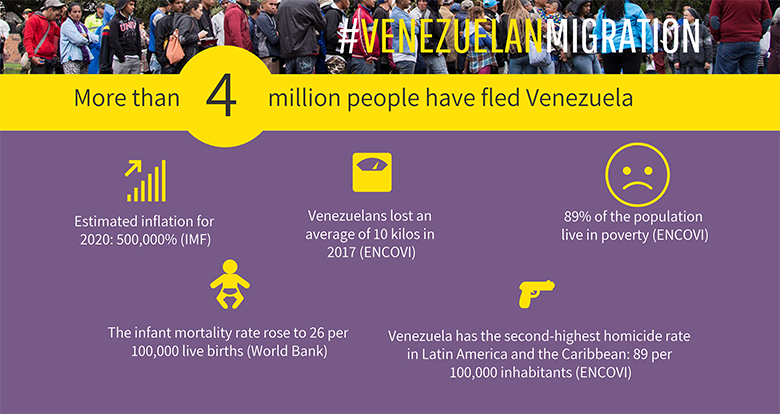
According to the UNHCR, between 4,000 and 5,000 Venezuelans leave the country every day. Most of them travel on foot without really knowing where they will wind up, but they go anyway with the hope of a better future for their families. This exodus is changing the face of Latin America and the Caribbean forever.
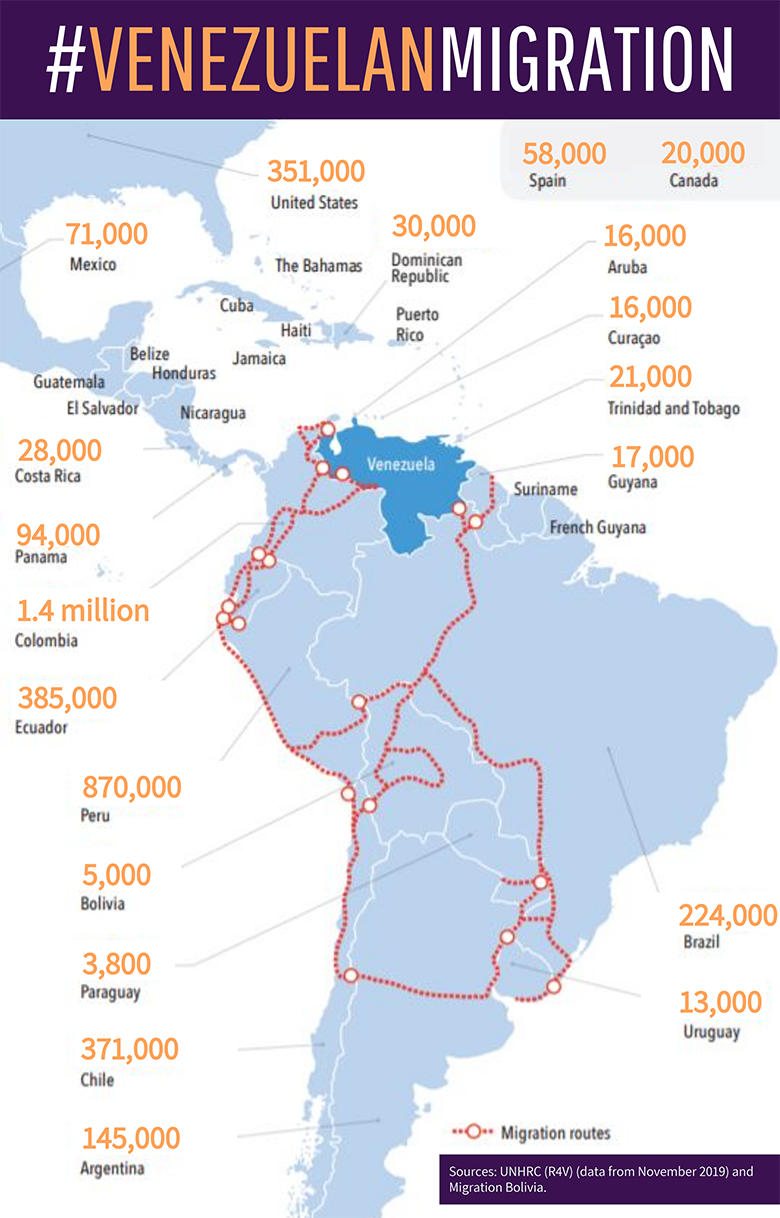
Colombia, Peru, and Ecuador are the main destinations for these migrants.
Historically, LAC has had large migration flows, especially during the first half of the twentieth century. Italians and Spaniards moved to Argentina, Japanese to Brazil, and Chinese to Peru. Since the 1960s, the migration wave has grown within the region and to the United States, especially from Central America.
Venezuela’s migration crisis is different because its sheer magnitude is exerting enormous pressure on recipient countries, particularly in education, employment, and health.
Myths and realities
It has become so critical that 11 countries in the region have increased their entry requirements for Venezuelan migrants and refugees. This has not stemmed the influx, however. It has only affected its legality.
One of these countries is Peru. A total of 870,000 Venezuelan migrants have traveled 4,500 kilometers to reach that country, and more are expected to come. According to a new World Bank report (Spanish), successfully addressing the influx begins with integrating the migrants and harnessing their potential to drive new growth opportunities.
It won’t be easy. Myths exist with respect to Venezuelans in Peru, engendering xenophobia and hindering their inclusion: “If we close the borders no more will come”; “All the Venezuelans in my country are criminals”; “My country can’t take in so many people”; “Venezuelans are taking away our jobs.”
According to the WB study “negative attitudes toward the Venezuelan population are more prevalent in Peru than in other recipient countries, and they are likely to increase.”
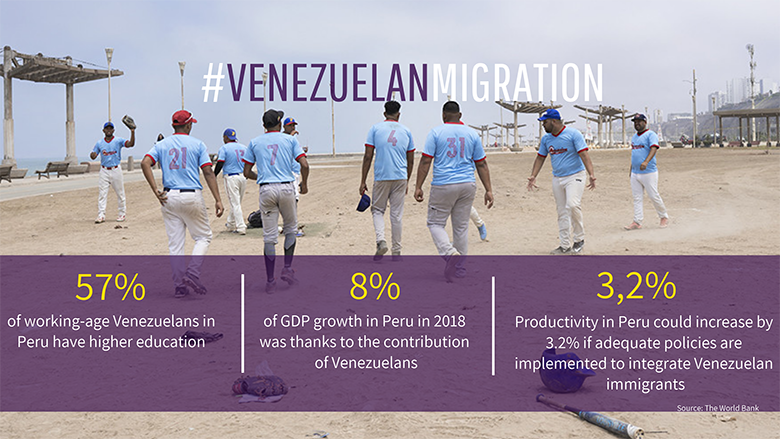
The study, part of a series on Venezuelan migration in Latin America and the Caribbean, also found that the Venezuelan population in Peru is mainly young – 42% are between the ages of 18 and 29 – and most of them come from urban areas. Most are families as well, including 117,000 children. The migrants are also highly qualified: 57% of working-age Venezuelans in Peru have higher education, and of these, half have a university degree.
How can this potential be put to use? If these migrants are incorporated into Peru’s formal labor market, estimates suggest that labor productivity could increase by 3.2%. Even when Venezuelan migrants are in the informal sector – half of them work in services – and receive lower wages than local workers, they can generate tax revenue of some 2.25 billion soles (about US$670 million) per year thanks to the increase in aggregate demand and tax collection. That is equivalent to more than 12 percent of the government’s budget for the health sector in 2019.
This is hard cash that the migrants can use to purchase goods and services in Peru, contributing to the economy’s growth.
What jobs do Venezuelans have in Peru?
“Good morning, hija. How did you sleep?” That’s what Paola Soto’s father asks her every morning by WhatsApp – from three countries away. A year and a half ago, this surgeon fled her native Venezuela and with a lot of determination managed to join the Peruvian labor market.
The clinic where she works is staffed by people of different nationalities. She works with Cuban physicians, Peruvian nurses, and Colombian health professionals. And while her relationship with her family is only online now, Paola’s education and professional experience is put to the service of the patients she sees today.
To take advantage of the benefits of migration, such as Paola’s education and experience, the integration between Peruvians and Venezuelans must be a priority on the public policy agenda.
The World Bank report urges Peru to design and implement a multisector response that includes:
- Adapting the institutional and legal system to facilitate the integration of migrants and refugees;
- Expanding the supply of services for everyone in the main recipient areas;
- Increasing support for the most vulnerable migrant population; and
- Dispelling myths that engender discrimination and xenophobia.
- The exodus is inevitable. Never before have so many people left a country in such a short time, but despite this Latin America can transform this crisis into an opportunity.
________________
ECONOMIA BRASILEIRA / BRAZIL ECONOMICS
INFLAÇÃO
FGV. IBRE. 28/11/19. Índices Gerais de Preços. IGP-M. IGP-M varia 0,30% em novembro
O Índice Geral de Preços – Mercado (IGP-M) variou 0,30% em novembro, percentual inferior ao apurado em outubro, quando a taxa foi de 0,68%. Com este resultado, o IGP-M acumulada alta de 5,11% no ano e de 3,97% nos últimos 12 meses. Em novembro de 2018, o índice havia caído 0,49% no mês e acumulava alta de 9,68% em 12 meses.
O Índice de Preços ao Produtor Amplo (IPA) variou 0,36% em novembro, após alta de 1,02% em outubro. Na análise por estágios de processamento, a taxa do grupo Bens Finais subiu 0,77% em novembro, contra 0,17% no mês anterior. A principal contribuição para este resultado partiu do subgrupo alimentos processados, cuja taxa passou de 0,50% para 2,66%, no mesmo período. O índice relativo a Bens Finais (ex), que exclui os subgrupos alimentos in natura e combustíveis para o consumo, subiu 1,10% em novembro, ante 0,23% no mês anterior.
A taxa de variação do grupo Bens Intermediários passou de 1,24% em outubro para 0,49% em novembro. O principal responsável por este movimento foi o subgrupo combustíveis e lubrificantes para a produção, cujo percentual passou de 7,19% para 0,68%. O índice de Bens Intermediários (ex), obtido após a exclusão do subgrupo combustíveis e lubrificantes para a produção, subiu 0,45% em novembro, contra alta de 0,23% em outubro.
O índice do grupo Matérias-Primas Brutas variou de 1,72% em outubro para -0,23% em novembro. Contribuíram para o recuo da taxa do grupo os seguintes itens: minério de ferro (1,58% para -11,21%), arroz (em casca) (3,43% para 1,85%) e cacau (8,56% para 0,56%). Em sentido oposto, destacam-se os itens bovinos (2,13% para 8,02%), mandioca (aipim) (3,41% para 9,55%) e cana-de-açúcar (-0,15% para 1,22%).
O Índice de Preços ao Consumidor (IPC) subiu 0,20% em novembro, após queda de 0,05% em outubro. Seis das oito classes de despesa componentes do índice registraram avanço em suas taxas de variação. A principal contribuição partiu do grupo Habitação (-0,21% para 0,19%). Nesta classe de despesa, vale citar o comportamento do item tarifa de eletricidade residencial, cuja taxa passou -2,07% para 0,49%.
Também apresentaram acréscimo em suas taxas de variação os grupos Alimentação (-0,36% para -0,04%), Despesas Diversas (0,26% para 1,69%), Educação, Leitura e Recreação (0,06% para 0,28%), Saúde e Cuidados Pessoais (0,24% para 0,30%) e Vestuário (0,16% para 0,29%). As principais influências para a aceleração dos grupos partiram dos seguintes itens: carnes bovinas (0,85% para 3,76%), jogo lotérico (0,00% para 12,74%), passagem aérea (-1,92% para 3,42%), artigos de higiene e cuidado pessoal (0,10% para 0,54%) e roupas (0,29% para 0,44%).
Em contrapartida, os grupos Comunicação (0,11% para -0,01%) e Transportes (0,22% para 0,21%) apresentaram decréscimo em suas taxas de variação. Nestas classes de despesa, os maiores recuos foram observados para os seguintes itens: tarifa de telefone móvel (0,36% para -0,02%) e gasolina (1,00% para 0,61%).
O Índice Nacional de Custo da Construção (INCC) variou 0,15% em novembro, ante alta de 0,12% no mês anterior. Os três grupos componentes do INCC registraram as seguintes variações na passagem de outubro para novembro: Materiais e Equipamentos (0,37% para 0,31%), Serviços (-0,08% para 0,36%) e Mão de Obra não variou pelo segundo mês consecutivo.
DOCUMENTO: https://portalibre.fgv.br/navegacao-superior/noticias/igp-m-varia-0-30-em-novembro.htm
INDÚSTRIA
FGV. IBRE. 28/11/19. Sondagens e Índices de Confiança. Sondagem da Indústria. Confiança da Indústria avança em novembro
O Índice de Confiança da Indústria (ICI) da Fundação Getulio Vargas avançou 1,7 ponto em novembro, na comparação com o mês anterior, para 96,3 pontos, maior nível desde maio de 2018 (97,2 pontos). Em médias móveis trimestrais, o índice subiu pela primeira vez desde março de 2019, ao passar de 95,3 pontos para 95,5 pontos.
“Embora o ICI permaneça em nível baixo em termos históricos, o avanço de novembro foi expressivo e bastante disseminado entre os setores industriais. Por esse ponto de vista, o resultado parece favorável, mas há que se considerar que esse movimento se respalda essencialmente na melhora das expectativas, e que a confiança ainda permanece em patamar baixo em termos históricos. Contudo, vale ressaltar que a maioria dos indicadores sem ajuste também avançaram na comparação interanual, sugerindo que o quarto trimestre de 2019 será melhor do que 2018”, comenta Renata de Mello Franco, economista da FGV/IBRE.
A confiança avançou em 15 dos 19 segmentos industriais pesquisados em novembro. O Índice de Expectativas subiu 2,9 pontos, para 96,8 pontos, o maior nível desde abril de 2019 (97,4 pontos), enquanto o Índice de Situação Atual (ISA) variou 0,4 ponto, para 95,8 pontos.
O indicador que mede o otimismo dos empresários com a evolução do ambiente de negócios nos seis meses seguintes voltou a crescer, passando para 96,3 pontos. Neste mês, a parcela de empresas que preveem melhora aumentou de 34,0% para 37,1%, enquanto a das que projetam piora caiu de 16,6% para 13,1%. No mesmo sentido, os indicadores de produção e emprego previstos para os próximos três meses também apresentaram melhora, com altas de 1,9 ponto e 3,3 pontos, respectivamente.
Em relação ao ISA, seus componentes apresentaram movimentos distintos. Apesar da piora no indicador de estoques (98,1 pontos para 97,2 pontos) e estabilidade do nível de demanda (95,1 pontos para 95,2 pontos), houve melhora da percepção sobre a situação atual dos negócios (de 93,4 pontos para 95,2 pontos). A parcela das empresas que a avaliam como boa caiu de 15,5% para 14,7% no mês, contudo, a proporção das que a avaliam como ruim reduziu em maior magnitude, de 25,0% para 20,5% do total.
O Nível de Utilização da Capacidade Instalada (NUCI) recuou 0,5 ponto percentual (p.p.), para 75,3%. Em médias móveis trimestrais, houve queda do NUCI pela primeira vez após sete altas consecutivas, passando de 75,7% em outubro para 75,5% em novembro.
DOCUMENTO: https://portalibre.fgv.br/navegacao-superior/noticias/confianca-da-industria-avanca-em-novembro.htm
________________
LGCJ.:

