US ECONOMICS
BRAZIL
DoC. AMCHAM CENTENNIAL. July 30, 2019. Remarks by Commerce Secretary Wilbur L. Ross at AMCHAM Centennial
Wilbur Ross
SAO PAULO, BRAZIL - Intro by Mr. Luiz Pretti, Chairman of the Board of AmCham-Brasil and President of Cargill Brazil
Thank you for the kind words.
It’s great to be here for the Chamber’s centennial celebration. AmCham-Sao Paulo has long been an important partner for the Department of Commerce in promoting economic ties.
Thank you.
100 years is an impressive accomplishment. To put it in context, 1919 is the year the Treaty of Versailles was signed to end WWI. In the United States, Prohibition went into effect, and Congress passed the 19th Amendment to give women the right to vote. As evidence of an already important bilateral trade relationship, the Ford Motor Company founded its subsidiary Ford Brasil to import Model T cars.
And, importantly, Brazil won the 1919 South American football (soccer) championship. The U.S.-Brazil relationship is even older— The United States was the first nation to recognize Brazil’s independence in 1824. Today, the U.S.-Brazil close and long-standing relationship is stronger than ever before. The United States and Brazil are the two largest democracies and economies in the Western Hemisphere. In fact, the United States is the largest, and Brazil the ninth largest, economy in the world.
President Trump is committed to a strong and dynamic relationship with Brazil, one that promotes democracy, commerce, and regional stability. One of President Bolsonaro’s first acts as Brazil’s new president was to declare a desire for the United States to become Brazil’s number one trade and investment partner.
Currently, Brazil is our 13th largest trade partner globally and 3rd in the Western Hemisphere after Canada and Mexico. U.S. merchandise exports to Brazil were valued at $39.6 billion in 2018, and Brazilian imports at $31.1 billion in 2108. Our services trade is also substantial, with exports of $26.4 billion in 2017 (latest available) and imports of $7.2 billion. The total stock of Brazilian direct investment in the United States is valued at $47.8 billion (2017, UBO), and the total stock of U.S. investment in Brazil is valued at $68.3 billion (2017, FP). We can expand on these economic and commercial ties.
President Trump and President Bolsonaro are both committed to reducing trade barriers and facilitating investment across a range of industries, especially energy, infrastructure, agriculture, and technology. During their meeting this past March, they agreed to build a Prosperity Partnership to increase jobs and open new opportunities. The two leaders decided to enhance the work of the U.S.-Brazil Commission on Economic and Trade Relations. The Commission will explore new initiatives to facilitate trade, investment, and good regulator practices.
The Presidents also instructed their teams to negotiate a Mutual Recognition Agreement concerning their Trusted Trader programs. This will reduce costs for American and Brazilian companies by making movement of goods across our borders safer and more efficient.
The importance of U.S. cooperation on defense was also discussed. President Trump supported Brazil’s designation as a Major Non-Nato Ally, which became effective in June. Some of the advantages of Major Non-NATO Ally status include collaboration on the development of defense technologies; privileged access to the U.S. defense industry; and increase joint military exchanges, exercise, and training, as well as special access to military equipment financing. Total annual U.S. exports of aerospace and defense products to Brazil rose to $5.8 billion in 2018, including civilian aircraft. We recently held the 3rd formal meeting of the Brazil-U.S. Defense Industry Dialogue, which will continue to work to grow our defense commercial relationship under this new status.
These initiatives were made possible largely through the foundational work of the U.S.-Brazil Commercial Dialogue, which has been ongoing for nearly 15 years. The Commercial Dialogue is informed by an advisory board of U.S. and Brazilian executives who make up the U.S.-Brazil CEO Forum. The Presidents announced a new phase of the U.S.-Brazil CEO Forum, which I will be co-chairing the next meeting in Washington this November. Both presidents also welcomed the creation of a $100 million Biodiversity Impact Investment Fund that will catalyze sustainable investment in the Amazon region.
As leaders of two of the fastest-growing energy suppliers in the world, they agreed to establish a United States-Brazil Energy Forum to facilitate energy-related trade and investment. The Energy Forum is on track for a November launch in Rio de Janeiro. We will be working closely with the Department of Energy to develop a strong private sector component of the Forum.
The United States and Brazil signed a Technology Safeguards Agreement (TSA) in March 2019 during President Bolsonaro’s visit. Once ratified by the Brazilian Congress, the TSA will allow for the use of U.S. launch technology from the Alcantara Space Launch Center. We look forward to U.S. commercial collaboration with Brazil, as it enters the global space economy, a fast-growing sector well on its way to becoming a (US) $1 trillion industry.
The Department of Commerce is responsible for U.S. commercialization of space. The Commerce Department also is party to the U.S.-Brazil Memorandum of Cooperation on Infrastructure Development. Tomorrow, I will attend the 17th Latin American Infrastructure Leadership Forum in Brasilia to support U.S. company participation in regional infrastructure development projects. Together, our countries have established a bold vision and an ambitious commercial agenda – one that will have regional and potential hemispheric impact.
Because of Brazil’s ongoing economic reforms, President Trump supports Brazil’s entry into the OECD. Commensurate with its status as a global leader, President Bolsonaro agreed that Brazil will begin to forgo special and differential treatment in World Trade Organization negotiations. There is a tremendous potential for us to increase mutually beneficial bilateral trade and investment. Our commercial agenda clearly reflects this desire to achieve mutual – reciprocal – growth in our economic relationship.
U.S. companies are entrepreneurial and agile. They produce some of the most innovative, high quality goods and services in the world. They are competitive anywhere on a level playing field. At the Commerce Department, we are working closely with Brazil and other Latin American governments – engaging at all levels – to build a dynamic hemisphere economy.
We are advocating a business environment based on predictability, transparency, and rule of law. This includes enforcement of anti-bribery laws and conventions (UN Convention Against Corruption and OECD Anti-bribery Convention), open and transparent procurement systems, and corporate codes of conduct. It also includes good regulatory practices based on transparency and effectiveness that are not unnecessary barriers to trade and investment. That’s the environment where trade and commerce can flourish.
We want data to flow freely across borders and ensure secure IT networks and supply chains. We are addressing trade facilitation by fast-tracking World Trade Organization commitments to eliminate unnecessary “red tape” and expedite the movement and release of goods. These commitments include publication of customs procedures, forms and documents to the Internet and notification by Customs official when goods at borders are detained. These high standards are reflected in our regional trade agreements – including the USMCA—which contains the highest standards in all these disciplines and more.
Intra South American trade is only half the percentage of intra regional trade in Southeast Asia largely because of excessive costs and delays at the borders. And, while we have several strong financing programs in Latin America, we are looking at ways to give U.S. companies more financing tools to compete head-to-head against foreign rivals.
The new Development Finance Corporation lending authority puts the former Overseas Private Investment Corporation’s lending authority to $60 billion, permits equity investment, and merges in additional financing resources from USAID. The DFC is expected to come online by October. I will remain on the DFC and ExIm boards.
We have Commercial Service officers in more than 100 U.S. cities and over 70 countries throughout the world, including 14 countries in the Western Hemisphere. In addition to Commercial Service officers, we have placed U.S. Patent and Trademark Office attaches throughout the region. They provide training on intellectual property law, promote IP rights, and coordinate IPR enforcement initiatives with local governments
We also have digital attaches working to support greater data and trade flows between our countries in ways that will not compromise the national security of either nation.
And, we have standards attaches, working to promote the use of international standards. We want to ensure that standards, testing, and conformity assessment requirements do not act as barriers to trade in the region.
Here in Brazil, my team of 50 people, spread out over five offices, constitutes one of our top three USG commercial networks in the world! They work with U.S. companies, large and small, seeking access, connections, and the tools needed to succeed in foreign markets. The United States wishes to be the preferred partner for projects in Brazil and the Latin American region because we know our companies offer the cutting-edge innovation and expertise that these projects demand. And we know that such partnerships will be mutually beneficial.
The United States also welcomes direct foreign investment that creates and opportunities in both countries. As a follow-up to our SelectUSA Investment Summit held in Washington in June, our SelectUSA team will be hosting a Facilitated Investment Mission from August 26th to the 30th in Brazil.
Brazil is a truly global country, competing and succeeding in the global marketplace. It is the 8th fastest growing source of investment in the United States in sectors including steel, aircraft manufacturing, IT, and construction. The total stock of Brazilian direct investment in the U.S. is valued at nearly $43 billion (2017).
Brazil’s 14-member delegation at our recent Summit included the CEO of Solfintec, an agriculture precision company, that has FDI stock in the U.S totaling nearly $43 billion. Our SelectUSA investment road show will be stopping here in Sao Paulo, and three other cities (Campinas, Belo Horizonte, and Florianopolis). The mission includes representatives of U.S. economic development organizations eager to meet with Brazilian companies.
We in the Americas need to continue building strategic partnerships and regional economic frameworks to promote jobs, prosperity, and peace throughout the region. The Administration’s goal is to make the Western Hemisphere the strongest and most competitive economic force in the world. Working together, we can help our people, our countries, and our region reach that goal.
Again, it has been an honor to be here for your centennial celebration. Keep up the good work. And best wishes for another successful 100 years!
Thank you, and now I’ll be joining your CEO of AmCham-Brasil for a moderated discussion based on your questions.
INTEREST RATE
FED. July 31, 2019. Federal Reserve issues FOMC statement
Information received since the Federal Open Market Committee met in June indicates that the labor market remains strong and that economic activity has been rising at a moderate rate. Job gains have been solid, on average, in recent months, and the unemployment rate has remained low. Although growth of household spending has picked up from earlier in the year, growth of business fixed investment has been soft. On a 12-month basis, overall inflation and inflation for items other than food and energy are running below 2 percent. Market-based measures of inflation compensation remain low; survey-based measures of longer-term inflation expectations are little changed.
Consistent with its statutory mandate, the Committee seeks to foster maximum employment and price stability. In light of the implications of global developments for the economic outlook as well as muted inflation pressures, the Committee decided to lower the target range for the federal funds rate to 2 to 2-1/4 percent. This action supports the Committee's view that sustained expansion of economic activity, strong labor market conditions, and inflation near the Committee's symmetric 2 percent objective are the most likely outcomes, but uncertainties about this outlook remain. As the Committee contemplates the future path of the target range for the federal funds rate, it will continue to monitor the implications of incoming information for the economic outlook and will act as appropriate to sustain the expansion, with a strong labor market and inflation near its symmetric 2 percent objective.
In determining the timing and size of future adjustments to the target range for the federal funds rate, the Committee will assess realized and expected economic conditions relative to its maximum employment objective and its symmetric 2 percent inflation objective. This assessment will take into account a wide range of information, including measures of labor market conditions, indicators of inflation pressures and inflation expectations, and readings on financial and international developments.
The Committee will conclude the reduction of its aggregate securities holdings in the System Open Market Account in August, two months earlier than previously indicated.
Voting for the monetary policy action were Jerome H. Powell, Chair; John C. Williams, Vice Chair; Michelle W. Bowman; Lael Brainard; James Bullard; Richard H. Clarida; Charles L. Evans; and Randal K. Quarles. Voting against the action were Esther L. George and Eric S. Rosengren, who preferred at this meeting to maintain the target range for the federal funds rate at 2-1/4 to 2-1/2 percent.
Implementation Note issued July 31, 2019. Decisions Regarding Monetary Policy Implementation
The Federal Reserve has made the following decisions to implement the monetary policy stance announced by the Federal Open Market Committee in its statement on July 31, 2019:
- The Board of Governors of the Federal Reserve System voted unanimously to lower the interest rate paid on required and excess reserve balances to 2.10 percent, effective August 1, 2019.
- As part of its policy decision, the Federal Open Market Committee voted to authorize and direct the Open Market Desk at the Federal Reserve Bank of New York, until instructed otherwise, to execute transactions in the System Open Market Account in accordance with the following domestic policy directive:
- "Effective August 1, 2019, the Federal Open Market Committee directs the Desk to undertake open market operations as necessary to maintain the federal funds rate in a target range of 2 to 2-1/4 percent, including overnight reverse repurchase operations (and reverse repurchase operations with maturities of more than one day when necessary to accommodate weekend, holiday, or similar trading conventions) at an offering rate of 2.00 percent, in amounts limited only by the value of Treasury securities held outright in the System Open Market Account that are available for such operations and by a per-counterparty limit of $30 billion per day.
- Effective August 1, 2019, the Committee directs the Desk to roll over at auction all principal payments from the Federal Reserve's holdings of Treasury securities and to reinvest all principal payments from the Federal Reserve's holdings of agency debt and agency mortgage-backed securities received during each calendar month. Principal payments from agency debt and agency mortgage-backed securities up to $20 billion per month will be reinvested in Treasury securities to roughly match the maturity composition of Treasury securities outstanding; principal payments in excess of $20 billion per month will continue to be reinvested in agency mortgage-backed securities. Small deviations from these amounts for operational reasons are acceptable.
- The Committee also directs the Desk to engage in dollar roll and coupon swap transactions as necessary to facilitate settlement of the Federal Reserve's agency mortgage-backed securities transactions."
- In a related action, the Board of Governors of the Federal Reserve System voted unanimously to approve a 1/4 percentage point decrease in the primary credit rate to 2.75 percent, effective August 1, 2019. In taking this action, the Board approved requests to establish that rate submitted by the Boards of Directors of the Federal Reserve Banks of Philadelphia, Chicago, St. Louis, Dallas, and San Francisco.
This information will be updated as appropriate to reflect decisions of the Federal Open Market Committee or the Board of Governors regarding details of the Federal Reserve's operational tools and approach used to implement monetary policy.
INTERNATIONAL TRADE
DoC. USITC. July 30, 2019. U.S. Department of Commerce Initiates Antidumping Duty and Countervailing Duty Investigations of Imports of Utility Scale Wind Towers from Canada, Indonesia, and Vietnam
WASHINGTON – Today, the U.S. Department of Commerce announced the initiation of new antidumping duty (AD) and countervailing duty (CVD) investigations to determine whether utility scale wind towers from Canada, Indonesia, Korea, and Vietnam are being dumped in the United States, and to find if producers in Canada, Indonesia, and Vietnam are receiving unfair subsidies. Although there is already an existing AD order on utility scale wind towers from Vietnam, the petition was filed with respect to one company that was excluded from the current order.
These investigations were initiated based on petitions filed by the Wind Tower Trade Coalition, the members of which are Arcosa Wind Towers Inc. (Dallas, TX) and Broadwind Towers, Inc. (Manitowoc, WI).
The alleged dumping margins are:
- Canada – 53.63 to 61.59 percent
- Indonesia – 26.00 to 47.19 percent
- Korea – 280.69 to 331.26 percent
- Vietnam – 39.97 to 65.96 percent
If Commerce makes affirmative findings in these investigations, and if the U.S. International Trade Commission (ITC) determines that dumped and/or unfairly subsidized U.S. imports of utility scale wind towers from Canada, Indonesia, Korea, and/or Vietnam are causing injury to the U.S. industry, Commerce will impose duties on those imports in the amount of dumping and/or unfair subsidization found to exist.
In 2018, imports of utility scale wind towers from Canada, Indonesia, Korea, and Vietnam were valued at an estimated $60.2 million, $37.4 million, $50 million, and $21.4 million, respectively.
Next Steps:
During Commerce’s investigations into whether utility scale wind towers from Canada, Indonesia, Korea, and Vietnam are being dumped and/or unfairly subsidized, the ITC will conduct its own investigations into whether the U.S. industry and its workforce are being harmed by such imports. The ITC will make its preliminary determinations on or before August 23, 2019. If the ITC preliminarily determines that there is injury or threat of injury, then Commerce’s investigations will continue, with the preliminary CVD determinations scheduled for October 2, 2019, and preliminary AD determinations scheduled for December 16, 2019, unless these deadlines are extended.
If Commerce preliminarily determines that dumping and/or unfair subsidization is occurring, then it will instruct U.S. Customs and Border Protection to start collecting cash deposits from all U.S. companies importing utility scale wind towers from Canada, Indonesia, Korea, and Vietnam.
Final determinations by Commerce in these cases are scheduled for December 16, 2019 for the CVD investigations and March 2, 2020 for the AD investigations, but these dates may be extended. If Commerce finds that products are not being dumped and/or unfairly subsidized, or the ITC finds in its final determinations there is no harm to the U.S. industry, then the investigations will be terminated and no duties will be applied.
The strict enforcement of U.S. trade law is a primary focus of the Trump Administration. Since the beginning of the current Administration, Commerce has initiated 179 new antidumping and countervailing duty investigations – this is a 231 percent increase from the comparable period in the previous administration.
Antidumping and countervailing duty laws provide American businesses and workers with an internationally accepted mechanism to seek relief from the harmful effects of the unfair pricing of imports into the United States. Commerce currently maintains 492 antidumping and countervailing duty orders which provide relief to American companies and industries impacted by unfair trade.
The U.S. Department of Commerce’s Enforcement and Compliance unit within the International Trade Administration is responsible for vigorously enforcing U.S. trade law and does so through an impartial, transparent process that abides by international law and is based on factual evidence provided on the record.
Foreign companies that price their products in the U.S. market below the cost of production or below prices in their home markets are subject to antidumping duties. Companies that receive unfair subsidies from their governments, such as grants, loans, equity infusions, tax breaks, or production inputs, are subject to countervailing duties aimed at directly countering those subsidies.
Fact sheet: https://enforcement.trade.gov/download/factsheets/factsheet-multiple-utility-scale-window-towers-ad-cvd-initiation-073019.pdf
DoC. USITC. July 30, 2019. U.S. Department of Commerce Issues Affirmative Preliminary Antidumping Duty Determinations on Acetone from Singapore and Spain
WASHINGTON – Today, the U.S. Department of Commerce announced the affirmative preliminary determinations in the antidumping duty (AD) investigations of imports of acetone from Singapore and Spain, finding that exporters from Singapore have dumped acetone in the United States at margins ranging from 66.42 percent to 131.75 percent. Commerce also determined that exporters from Spain have dumped acetone in the United States at margins ranging from 137.39 percent to 171.81 percent.
As a result of today’s decisions, Commerce will instruct U.S. Customs and Border Protection to collect cash deposits from importers of acetone from Singapore and Spain based on these preliminary rates.
In 2018, imports of acetone from Singapore and Spain were valued at an estimated $8.5 million and $17 million, respectively.
The petitioner is the Coalition for Acetone Fair Trade. The members of the Coalition for Acetone Fair Trade are AdvanSix Inc. (Parsippany, NJ), Altivia Petrochemicals, LLC (Haverhill, OH), and Olin Corporation (Clayton, MO).
The strict enforcement of U.S. trade law is a primary focus of the Trump Administration. Since the beginning of the current Administration, Commerce has initiated 179 new antidumping and countervailing duty investigations – this is a 231 percent increase from the comparable period in the previous administration.
Antidumping and countervailing duty laws provide American businesses and workers with an internationally accepted mechanism to seek relief from the harmful effects of the unfair pricing of imports into the United States. Commerce currently maintains 492 antidumping and countervailing duty orders which provide relief to American companies and industries impacted by unfair trade.
Commerce is scheduled to announce the final determinations on or about October 16, 2019.
If Commerce’s final determinations are affirmative, the U.S. International Trade Commission (ITC) will be scheduled to make its final injury determinations on or about November 29, 2019. If Commerce makes affirmative final determinations of dumping, and the ITC makes affirmative final injury determinations, Commerce will issue AD orders. If Commerce makes negative final determinations of dumping, or the ITC makes negative final determinations of injury, the investigations will be terminated and no orders will be issued.
The U.S. Department of Commerce’s Enforcement and Compliance unit within the International Trade Administration is responsible for vigorously enforcing U.S. trade law and does so through an impartial, transparent process that abides by international law and is based on factual evidence provided on the record.
Foreign companies that price their products in the U.S. market below the cost of production or below prices in their home markets are subject to antidumping duties. Companies that receive unfair subsidies from their governments, such as grants, loans, equity infusions, tax breaks, or production inputs, are subject to countervailing duties aimed at directly countering those subsidies.
Fact sheet: https://enforcement.trade.gov/download/factsheets/factsheet-multiple-acetone-ad-prelim-073019.pdf
Doc. USITC. July 30, 2019 . U.S. Department of Commerce Finds Dumping of Imports of Glycine from Thailand
WASHINGTON – The U.S. Department of Commerce announced an affirmative final determination in the antidumping duty (AD) investigation, and a negative final determination in the countervailing duty (CVD) investigation of imports of glycine from Thailand. Commerce found that exporters from Thailand have sold glycine at less than fair value in the United States at rates from 201.59 to 227.27 percent, and determined that exporters from Thailand received de minimis countervailable subsidies.
On April 24, 2019, Commerce took the extraordinary step of postponing the final determinations in these investigations beyond the statutory deadline to investigate an alleged transshipment scheme of Chinese-origin glycine through Thailand, in order to avoid duties of glycine from China.
Based on our extended investigations, Commerce found that Newtrend Food Ingredient (Thailand) Co., Ltd withheld critical information with respect to its reported costs of production for glycine, such that its reported cost data could not be relied upon for AD margin calculation purposes in the final determination. As a result, Commerce applied to Newtrend a final dumping margin based on the adverse facts available, equal to 227.27 percent. This finding does not apply to the CVD investigation, as Commerce’s methodology to calculate subsidy rates does not involve the cost of production.
In 2018, imports of glycine from Thailand were valued at an estimated $8.7 million.
The petitioners are GEO Specialty Chemicals, Inc. (Lafayette, IN) and Chattem Chemicals, Inc. (Chattanooga, TN).
The strict enforcement of U.S. trade law is a primary focus of the Trump Administration. Since the beginning of the current Administration, Commerce has initiated 179 new antidumping and countervailing duty investigations – this is a 231 percent increase from the comparable period in the previous administration.
Antidumping and countervailing duty laws provide American businesses and workers with an internationally accepted mechanism to seek relief from the harmful effects of the unfair pricing of imports into the United States. Commerce currently maintains 492 antidumping and countervailing duty orders which provide relief to American companies and industries impacted by unfair trade.
The U.S. International Trade Commission (ITC) is currently scheduled to make its final injury determination in the AD investigation on or about September 12, 2019. If the ITC makes an affirmative final injury determination, Commerce will issue an AD order. If the ITC makes a negative final determination of injury, the AD investigation will be terminated and no order will be issued. Because Commerce has made a negative final determination in the CVD investigation, the CVD proceeding is terminated, and the ITC will not be making a final injury determination in that investigation.
The strict enforcement of U.S. trade law is a primary focus of the Trump Administration. Since the beginning of the current Administration, Commerce has initiated 179 new antidumping and countervailing duty investigations – this is a 231 percent increase from the comparable period in the previous administration.
Antidumping and countervailing duty laws provide American businesses and workers with an internationally accepted mechanism to seek relief from the harmful effects of the unfair pricing of imports into the United States. Commerce currently maintains 492 antidumping and countervailing duty orders which provide relief to American companies and industries impacted by unfair trade.
Fact sheet: https://enforcement.trade.gov/download/factsheets/factsheet-thailand-glycine-ad-cvd-final-073019.pdf
REFUNDING
U.S. Department of the Treasury. 07/31/2019. QUARTERLY REFUNDING STATEMENT OF DEPUTY ASSISTANT SECRETARY FOR FEDERAL FINANCE BRIAN SMITH
WASHINGTON — The U.S. Department of the Treasury is offering $84 billion of Treasury securities to refund approximately $57.3 billion of privately-held Treasury notes and bonds maturing on August 15, 2019. This issuance will raise new cash of approximately $26.7 billion. The securities are:
- A 3-year note in the amount of $38 billion, maturing August 15, 2022;
- A 10-year note in the amount of $27 billion, maturing August 15, 2029; and
- A 30-year bond in the amount of $19 billion, maturing August 15, 2049.
The 3-year note will be auctioned on a yield basis at 1:00 p.m. EDT on Tuesday, August 6, 2019. The 10-year note will be auctioned on a yield basis at 1:00 p.m. EDT on Wednesday, August 7, 2019. The 30-year bond will be auctioned on a yield basis at 1:00 p.m. EDT on Thursday, August 8, 2019. All of these auctions will settle on Thursday, August 15, 2019.
The balance of Treasury financing requirements over the quarter will be met with the weekly bill auctions, cash management bills, the monthly note auctions, the August 30-year Treasury Inflation-Protected Securities (TIPS) reopening auction, the September 10-year TIPS reopening auction, the new October 5-year TIPS auction, and the regular monthly 2-year Floating Rate Note (FRN) auctions.
Projected Financing Needs: Coupons and FRNs
Based on recent forecasts, Treasury is announcing no increase to nominal coupon and FRN auction sizes over the upcoming quarter, and currently anticipates no further changes in issuance sizes for nominal coupon and FRNs for the remainder of the 2019 calendar year. Treasury plans to address any seasonal or unexpected variations in borrowing needs over the next quarter through changes in regular bill auction sizes and/or cash management bills.
Projected Financing Needs: Bills
Bill issuance has gradually declined in response to seasonal factors, as well as constraints on marketable borrowing imposed by the debt limit impasse. Since the most recent quarterly refunding announcement, aggregate bill supply has fallen by nearly $180 billion.
Since 2015, Treasury has attempted to maintain a prudent level of cash generally sufficient to cover one week of outflows in the Treasury General Account, subject to a minimum balance of $150 billion. This policy was implemented to protect Treasury against potential interruptions in market access. The debt limit impasse has precluded Treasury from being able to maintain prudent cash balance levels in a manner consistent with Treasury’s stated cash balance policy.
The House of Representatives recently approved legislation that suspends the debt limit through July 31, 2021. Once legislation suspending the debt limit is enacted into law, Treasury will begin the process of raising its cash balance back to levels consistent with its prudent cash balance policy, primarily through sizable increases in Treasury bill issuance.
We anticipate that the increase in bill issuance through the end of September 2019 (in order to achieve the end-of-September cash balance estimate announced on July 29, 2019) will be comparable to the increase in bill issuance that occurred in the summer of 2018. The amount of bills outstanding is expected to gradually approach levels by September that are comparable to levels last seen in May. This measured pace of increase is consistent with primary dealer expectations and assessments of market capacity.
Unexpected changes in financing needs could result in a deviation from this projected change in bill supply.
Projected Financing Needs: TIPS
Treasury continues to implement the enhancements to the TIPS program announced in November 2018. Over the next refunding quarter, Treasury expects to increase the August TIPS 30-year reopening auction size to $7 billion, to increase the September 10-year TIPS reopening auction size to $12 billion, and to introduce the new October 5-year TIPS at an auction size of $17 billion, consistent with the sizing of the most recent April 5-year TIPS auction. The increase in TIPS issuance is consistent with Treasury’s prior guidance on this matter.
As always, Treasury will continue to evaluate the fiscal outlook and assess the need to make further adjustments to auction sizes at the next quarterly refunding announcement at the end of October 2019.
Continued Outreach on Possible New Instrument
Treasury continues to evaluate the possibility of issuing a Treasury FRN linked to the Secured Overnight Financing Rate (SOFR), and at this point no decision has been made. Treasury is conducting broad market outreach, studying the potential risks and benefits of such a product, and considering how it might further our mission of financing the government at the least cost over time. Treasury welcomes comments on this matter.
ECONOMY
U.S. Department of the Treasury. 07/31/2019. Report to the Secretary of the Treasury from the Treasury Borrowing Advisory Committee of the Securities Industry and Financial Markets Association
July 30, 2019
Letter to the Secretary
Dear Mr. Secretary:
Economic activity grew at a moderate pace in the second quarter, with a 2.1% annualized increase in real GDP. Real GDP rose 2.3% over the past four quarters, somewhat above estimates of the economy’s longer run potential. Going forward, the easing in financial conditions since the start of this year will likely provide a boost to growth, while the slowdown in global growth and further fading of the fiscal boost will likely be headwinds in the remainder of the year.
Since the Committee last met in April, the Federal Open Market Committee (FOMC) held the target range for the federal funds rate at 2.25%-2.50%, but Fed officials have strongly indicated that a rate cut is likely at the upcoming July meeting. Overall financial conditions have eased further since the last refunding. Equity prices have more than fully reversed their May decline over the last two months, with the S&P 500 now up roughly 20% so far this year to new highs. The 2-year Treasury yield declined further as the Fed indicated that rate cuts are likely in the near term, and the 10-year Treasury yield declined as well. The trade-weighted value of the dollar has changed little on net since the last refunding.
Consumer spending grew at a 4.3% annualized rate in the second quarter, considerably stronger than in prior quarters and the fastest pace since 2017. The strength was broad-based, with durable goods spending rising at a 12.9% rate, non-durables goods spending increasing at a 6.0% rate, and services spending increasing at a 2.5% rate. The monthly household spending data have shown strong momentum, and consumer confidence and consumer sentiment remain at high levels. Solid job growth and the continued increase in equity prices are likely to provide further momentum for consumer spending in the coming quarters.
Business fixed investment slowed in the second quarter, declining at a 0.6% annualized rate. Structures investment fell sharply at a 10.6% annualized rate and equipment purchases grew at a soft 0.7% annualized rate, weighed down by the Boeing 737-MAX grounding. Investment in intellectual property products decelerated to a 4.7% annualized pace after rising at an 11.3% pace over the last two quarters. The change in inventory investment subtracted 0.9 percentage points from GDP growth in the second quarter. Regional manufacturing surveys so far in July have been mixed, and have overall declined over the last several months.
Residential investment fell at a 1.5% annualized rate in the second quarter, its sixth consecutive quarterly decline. New home sales, housing starts, and permits remain somewhat low, although surveys of home builders have indicated increased optimism since the start of the year. Rising interest rates likely contributed to the weakness in the housing sector last year, but the decline in mortgage rates this year should provide a boost to housing activity going forward.
Net exports subtracted 0.7 percentage points from real GDP growth in the second quarter, as real exports declined sharply at a 5.2% annualized rate, while imports were little changed from the prior quarter. The Federal Reserve’s Beige Book noted that contacts continued to report that uncertainty surrounding trade and tariffs is weighing on the outlook.
Federal spending increased at a 7.9% annualized rate in the second quarter, in part reflecting a bounce-back from the government shutdown that depressed spending in Q1, an effect that contributed about 0.4 percentage points to Q2 GDP growth. State and local spending increased at a 3.2% rate. The Office of Management and Budget’s most recent deficit projections estimate a 4.7% budget deficit in fiscal year 2019. The White House and congressional leadership recently announced an agreement to suspend the debt limit through July 2021 and raise spending caps, with the bill still subject to approval from the Senate.
The labor market has remained solid, with nonfarm payroll growth averaging 172,000 per month since the beginning of the year. The unemployment rate has edged down to 3.7% since the last meeting, close to the lowest level in the last 50 years, and the labor force participation rate remained at 63.0% in June, near the upper end of the range over the last five years. Other labor market indicators such as the quits rate, jobless claims, job openings, and anecdotes from the Federal Reserve’s Beige Book all point to a strong labor market. Average hourly earnings rose at a 3.1% pace over the last year, a slight deceleration relative to the first quarter of the year.
Consumer price inflation has remained somewhat soft. While the total personal consumption expenditures price index rose at a 2.3% annualized rate in the second quarter, the core measure excluding food and energy rose at only a 1.8% rate. The core measure rose 1.5% over the last four quarters. Many Fed officials have expressed increasing concern about inflation remaining below the 2% target and low inflation expectations, with several officials citing soft inflation as a key reason for lowering the funds rate.
FOMC participants made significant downward revisions to their interest rate projections at the June meeting. Roughly half of FOMC participants thought it would be appropriate to lower the funds rate in 2019, and the post-meeting statement emphasized increased uncertainties about the outlook and muted inflation pressures. Fed communication since the June meeting has further reinforced the likelihood of a cut in the funds rate. Financial markets and survey forecasters have moved down their projections for the funds rate over the next year, with a cut of at least 25bp at the upcoming meeting seen as a near certainty.
The FOMC has also indicated that an early end to balance sheet runoff at the upcoming July meeting is likely, with Fed officials strongly suggesting runoff will conclude should the FOMC deliver a rate cut. The balance sheet will thus likely remain steady at roughly $3.8bn until it begins growing again at a future date, although bank reserve balances will continue to shrink gradually due to the growth of non-reserve liabilities such as currency in circulation.
In light of this financial and economic backdrop, the Committee reviewed Treasury’s August 2019 Quarterly Refunding Presentation to the TBAC. FY 2019 year-to-date receipts were $68 billion (3%) higher than the comparable period in 2018. Increases in customs duties (due to new tariffs) and withheld income and FICA taxes, as well as lower refunds, were the largest drivers partially offset by a decline in Federal Reserve earnings due to higher short term interest rates and lower corporate taxes. Total outlays over the same period were $205 billion higher, an increase of 7% after calendar adjustments. Based on the Quarterly Borrowing Estimate, Treasury’s Office of Fiscal Projections currently projects a net privately-held marketable borrowing need of $433 billion for Q4 FY 2019, with an end-of-September cash balance of $350 billion, assuming the proposed debt limit suspension bill passes the Senate and is signed by the President. Treasury noted that this borrowing estimate implies about $160 billion of net bill issuance over the remainder of the quarter, or roughly half as large as the $330 billion increase in bills outstanding in March 2018 over a similar time frame.
For Q1 FY 2020, the net privately-held marketable borrowing need is estimated to be larger at $381 billion, with a cash balance of $410 billion at the end of December. It was noted that privately-held marketable borrowing excludes rollovers of Treasury securities held in the Federal Reserve’s System Open Market Account (SOMA), but includes financing required due to SOMA redemptions. The Committee also reviewed the path of expected growth of the SOMA portfolio assuming SOMA redemptions cease in September as originally planned. It was noted that if the SOMA redemptions ended shortly after the upcoming July FOMC meeting, that would reduce FY 2019 financing needs by approximately $28 billion.
Members were pleased that you were able to negotiate a debt limit suspension bill with Congress well in advance of the deadline and are optimistic that the bill will become law in short order. It was noted, however, that this would mark the 7th debt limit suspension in less than 7 years. As debt limit suspensions expire, Treasury has been required to employ extraordinary measures - increasing market volatility, operational risk and ultimately taxpayer cost. The Committee strongly believes that discussions on total borrowing are more appropriately considered when making appropriations rather than when funding previously approved appropriations. The Committee unanimously urged Congress to consider a repeal of the debt limit well ahead of the proposed 2021 expiration of the suspension.
Treasury reviewed the responses to the primary dealer questionnaire. On balance, dealers expected that the Bill supply would increase $178 billion over the following 8 weeks once debt limit concerns were resolved. Of note, dealers anticipated market capacity of $210 billion over that same period without causing significant price distortions in the front end of the curve. The Committee discussed at length the speed with which Treasury should replenish the cash balance. The Committee generally agreed that Treasury should increase issuance at a moderate pace, taking into account seasonal factors, potential market impact of rapid Bill issuance, and operational risk of running below the recommended target cash balance for a prolonged period.
Based on current fiscal projections, and in line with the May recommendations, the Committee suggested no change to coupon issue sizes for this quarter, and expected little or no change to nominal issuance for much of FY 2020, based on current forecasts. The Committee agreed that maintaining current coupon sizes was most consistent with Treasury’s regular and predictable issuance strategy to provide lowest cost to the taxpayers over time, but noted that 2021 could require further coupon increases given current fiscal projections despite a likely return to SOMA portfolio growth. The Committee briefly discussed recent cheapening of Treasury securities relative to swaps and agreed levels warranted close monitoring.
The Committee recommended increasing TIPS issuance sizes for Q4 of FY 2019 given the pre-announced change in the auction schedule. Specifically, the Committee recommended increasing the August 30- year reopening by $2bn to $7bn, increasing the September 10- year reopening by $1bn to $12bn, and a new issue size of $17bn for the inaugural new issue 5- year TIPS in October. This issuance strategy would be broadly consistent with TBAC’s prior recommendation that TIPS issuance increase by $20-30bn in 2019, and maintain TIPS share of overall debt. Given the significant but anticipated change in the TIPS issuance pattern this quarter, the Committee encouraged Treasury to continue to closely monitor market demand and liquidity for TIPS.
Given the uncertainty inherent in fiscal projections and Fed balance sheet policy, Treasury will need to retain flexibility in its issuance path to respond to any changes in funding needs and to accommodate historically large auction sizes. Members agreed that decisions taken to date afford Treasury significant flexibility to respond to potential changes in fiscal projections or Fed policy including potential composition changes in the SOMA portfolio.
Primary dealers also commented on the potential costs and benefits of the official sector encouraging broader use of central clearing for Treasury securities as suggested by the recent TMPG white paper on Treasury clearing and settlement risks. On the benefits side, transparency and centralized risk should allow for participants to better understand their exposures, may reduce un-margined credit risk and may minimize market disruptions due to a participant default. On the costs side, centralized clearing would increase concentration risk to a single counterparty and may increase transactions costs. The Committee was supportive of Treasury continuing to study the potential for increased usage of central clearing of Treasuries.
The Committee next reviewed a charge comparing a hypothetical introduction of 1- year SOFR FRN to a 1- year T-Bill FRN, and an increase in 1- year T-Bill issuances. Based on current market data, using both forward rates and GSE issuance as a baseline, the Committee expected Treasury could price SOFR FRNs reasonably in line with or perhaps better than the existing T-Bill FRN pricing. The presenter suggested that demand for a 1- year FRN would be higher than for increased 1- year T-Bill auctions given 2a7 fund WAM considerations. Further, the presenter highlighted benefits of a 1-year SOFR FRN relative to a 1- year T-Bill FRN, notably larger demand for a daily resetting floater and diversification by using an index that is not self-referential. Several areas were recommended for further study in consultation with market participants including technical design of a possible SOFR FRN, ongoing demand for the 2- year FRN, sizing of potential 1- or 2- year issuance, and standardization of indices across FRNs, amongst others.
The Committee again agreed that introduction of a Treasury SOFR FRN would be a significant step forward in boosting the liquidity of the SOFR market and could help expedite the overall market transition away from LIBOR. The Committee unanimously agreed that Treasury should play a prominent role in developing the SOFR market by considering SOFR-linked FRN issuance, particularly if it does not come at an increased cost to taxpayers. The Committee noted that Treasury issuance of a SOFR-linked FRN was unlikely to be imminent given operational issues and design choices.
Respectfully,
Beth Hammack, Chair, Treasury Borrowing Advisory Committee
Daniel Dufresne, Vice Chair, Treasury Borrowing Advisory Committee
U.S. Department of the Treasury. July 31, 2019. Minutes of the Meeting of the Treasury Borrowing Advisory Committee of the Securities Industry and Financial Markets Association July 30, 2019
The Committee convened in a closed session at the Department of the Treasury at 9:15 a.m. All members were present. Deputy Secretary Justin Muzinich, Deputy Assistant Secretary for Small Business, Community Development, and Affordable Housing Policy Kipp Kranbuhl, Deputy Assistant Secretary for Federal Finance Brian Smith, Director of the Office of Debt Management Fred Pietrangeli, and Deputy Director of the Office of Debt Management Nick Steele welcomed the Committee. Other members of Treasury staff present were Ayeh Bandeh-Ahmadi, Chris Cameron, Dave Chung, Courtney Demartini, Bernadette Goodwin, Brendan Griffiths, Daniel Harty, Sarah Hirsch, Tom Katzenbach, Tim Khang, Mary Kolesar, Devin O’Malley, Peter Phelan, Samira Salha, Renee Tang, and Brandon Taylor. Federal Reserve Bank of New York staff members Nathaniel Wuerffel, Susan McLaughlin, and Matt Lieber were also present.
Director Pietrangeli began by providing an overview of the fiscal situation. Pietrangeli noted that FY2019 year-to-date receipts totaled $2.6 trillion, or $68 billion (3%) higher than the comparable period last year. The increase reflected gains in withheld and non-withheld taxes, excise taxes and customs duties, and reduced tax refunds, partially offset by declines in Federal Reserve earnings and corporate taxes. Meanwhile, year-to-date outlays totaled $3.4 trillion, or $205 billion (7%) higher relative to the comparable period last year.
Next, Pietrangeli discussed borrowing estimates recently released by Treasury. He began by noting that bill issuance had gradually declined in the April-to-June 2019 quarter in response to seasonal factors, as well as constraints on marketable borrowing resulting from the recent debt limit impasse. As a result, bill supply had fallen by nearly $180 billion since the May refunding announcement.
Looking ahead to the July-to-September 2019 quarter, Pietrangeli highlighted the recent agreement and legislation approved by the House of Representatives to suspend the debt limit through July 2021. As a result, Treasury increased its cash balance target for the end of September to $350 billion. Treasury plans to rebuild its cash balance back to levels consistent with its prudent cash balance policy, primarily through increases in bill issuance. Assuming that coupon sizes remain unchanged, and given the paydown in bills since the end of June, bill issuance through the end of September is projected to increase on net by roughly $160 billion. He noted that this change in bill supply is about half that during Q1 CY2018, when the Treasury replenished its cash balance following debt ceiling-related negotiations. It was also noted that while some primary dealers expect redemptions from the System Open Market Account (SOMA) portfolio to cease in August, sooner than the previously announced cessation in October, such a change would reduce Treasury’s need to borrow from the private sector by about $28 billion in Q4 FY2019.
Pietrangeli next reviewed the longer term financing outlook, highlighting the most recent annual marketable borrowing estimates from the Office of Management and Budget (OMB), the Congressional Budget Office (CBO), and the primary dealers. Pietrangeli also discussed the potential effects of the legislation to increase spending caps on the various estimates.
He noted that Treasury is well funded for the remainder of FY2019 and into the first part of FY2020, but that significant funding gaps are projected starting in FY2021. The substantial increase in funding needs in FY2021 reflects, in part, large amounts of maturing 2-year and 3-year notes that need to be refinanced. Pietrangeli acknowledged the importance of monitoring the Federal Reserve’s balance sheet policy announcements and their potential implications for Treasury financing plans. Pietrangeli estimated that reinvestment of maturing MBS proceeds into Treasuries and potential Federal Reserve balance sheet growth could reduce financing needs from the public by an additional $100 to $200 billion annually over the next several years.
Deputy Assistant Secretary Smith then summarized for the Committee the feedback from primary dealers on Treasury’s financing needs and the outlook for Federal Reserve policy. The consensus from primary dealers was that Treasury was well funded for the rest of the year, and primary dealers did not expect any change to coupon sizes this quarter. Some speculated about the need to increase auction sizes towards the end of FY2020, but there was no consensus on the timing. The majority of primary dealers expected the Federal Reserve to make a 25 basis point cut to the target range for the federal funds rate and to end balance sheet normalization early.
Debt Manager Katzenbach then summarized Treasury’s cash balance policy and primary dealers’ views on bill supply following the resolution of the current debt ceiling impasse. He began by reiterating Treasury’s cash balance policy, which was introduced in May 2015. Under the policy, Treasury holds a level of cash generally sufficient to cover one week of expected outflows in the Treasury General Account to help protect against a potential interruption in market access. As part of the policy, Treasury has set a minimum balance of roughly $150 billion in cases where expected outflows are less than that amount. He noted that over the 12-month period ending June 30, 2019, the minimum cash balance that would be consistent with this policy was, on average, about $232 billion, with the top 20% of instances averaging $365 billion.
With this cash management policy in mind, Katzenbach then reviewed feedback from primary dealers on bill supply. A trimmed mean of primary dealer responses indicated that Treasury is anticipated to increase the supply of Treasury bills outstanding by $178 billion over the eight-week period following resolution of the current debt ceiling impasse. In comparison, primary dealers estimated market capacity to digest bill issuance without a significant price adjustment or deviation from fair value over the same period to be $210 billion. Furthermore, the primary dealers generally expected Treasury to resume meeting its cash balance policy at some point between September mid-month, related to the receipt of corporate taxes, and the end of the month. Committee members discussed the Treasury’s cash management policy, noting both the policy’s benefits related to risk management as well as the potential market disruptions that could occur if bill supply were increased too rapidly. Smith emphasized that Treasury carefully balances these considerations when making its issuance decisions. The Committee generally agreed that Treasury’s projected measured increases in bill supply balanced these factors well.
Deputy Director Steele then discussed primary dealers’ responses to a quarterly refunding survey question regarding the appropriate role for the official sector in considering increased central clearing for Treasury securities. Primary dealers broadly acknowledged the risks associated with bilateral clearing identified by the Treasury Market Practices Group (TMPG) in their updated best practices document and supported efforts to mitigate these risks. Many primary dealers expressed support for expanded central clearing in the Treasury market and suggested the official sector consider playing a role in encouraging central clearing. Other primary dealers expressed concerns about such policies and their costs, including the potential for higher trading costs, potential differential effects on different types of Treasury market participants, and concentration of risk in larger dealers and central counterparties. Steele noted that Treasury is sensitive to these potential costs and appreciates the wide range of market participants in the Treasury market. The Committee noted that Treasury should continue to gather feedback from a range of market participants and evaluate this topic.
Next, Steele led a discussion on the ongoing enhancements to the Treasury Inflation Protected Securities (TIPS) issuance calendar, noting that feedback from market participants continued to be positive. He then reviewed primary dealers’ views on TIPS auction sizes noting that dealer recommendations were consistent with previous Committee recommendations for a gradual increase of $20-30 billion in the annual TIPS issuance calendar in CY2019. After discussion, the Committee recommended a $7 billion August 30-year reopening in order to partially offset the decrease in overall 30-year TIPS issuance this year. The Committee viewed a $12 billion 10-year TIPS September reopening as consistent with the July 10-year new issue size of $14 billion. Lastly, a $17 billion 5-year TIPS new issue in October was viewed as prudent for the inaugural October 5-year maturity, keeping it the same size as the April new 5-year TIPS issue. The Committee viewed these sizes as maintaining sufficient flexibility to continue to assess the supply and demand dynamics into FY2020.
The Committee then turned to a presentation on the potential introduction of a 1-year final maturity floating rate note (FRN). The presenting member considered demand, pricing, and secondary market liquidity for a hypothetical 1-year FRN indexed to the Secured Overnight Finance Rate (SOFR), a 1-year FRN indexed to the 3-month Treasury bill, and an increase in 1-year Treasury bill issuance. Treasury’s FRN program has been a success, and growth in money market funds and other cash balances has generated increased demand for both FRN and Treasury bill issuance in recent years. The presenting member’s analysis of expected investor demand argued for adding a 1-year FRN issuance point. Furthermore, the analysis suggested that demand is expected to be highest for a 1-year FRN indexed to SOFR relative to a 1-year FRN indexed to the 3-month Treasury bill or a 1-year Treasury bill. This analysis identified securities lending participants and investors looking for a repo alternative as potential sources of new demand.
The presenting member argued that a 1-year SOFR FRN should price similarly to a 1-year Treasury bill FRN and may diversify the Treasury’s funding costs. While the mission of lowest cost of financing was the primary consideration, it was seen as an additional positive that a 1-year SOFR FRN would likely support the development of the SOFR issuance market and an orderly transition away from LIBOR in the market overall. However, it was noted that the introduction of a 1-year SOFR FRN may affect existing demand for the 2-year FRN indexed to the 3-month Treasury bill. The Committee recommended that Treasury should consider issuing a 1-year FRN indexed to the SOFR, but that the potential effects on the 3-month Treasury bill FRN should be studied further.
In the subsequent discussion of the presenting member’s presentation, Smith noted that the Treasury has not made any decisions regarding such a product and will continue to evaluate this recommendation.
The Committee adjourned at 12:00 p.m. for lunch.
The Committee reconvened at 1:45 p.m. and briefly discussed several market developments, including recent changes in relative pricing of Treasuries versus swaps, futures, and other asset classes. It was suggested by some members of the Committee that Treasury further study the drivers of these pricing relationships.
The Committee adjourned at 2:15 p.m.
The Committee reconvened at the Department of the Treasury at 4:30 p.m. All Committee members were present. The Chair presented the Committee report to Deputy Secretary Muzinich. A brief discussion followed the Chair’s presentation, but did not raise significant questions regarding the report’s content.
The Committee adjourned at 5:20 p.m.
Brian Smith, Deputy Assistant Secretary for Federal Finance, United States Department of the Treasury
EMPLOYMENT
ADP. REUTERS. 31 DE JULHO DE 2019. Setor privado dos EUA cria 156 mil novas vagas de emprego em julho
(Reuters) - Empregadores do setor privado dos Estados Unidos criaram 156 mil novos empregos em julho, acima das expectativas dos economistas e apoiando a visão de um forte mercado de trabalho doméstico, mostrou relatório divulgado nesta quarta-feira.
Economistas consultados pela Reuters previam que o Relatório Nacional de Empregos da ADP mostraria um aumento de 150 mil vagas, com estimativas variando de 100 mil a 185 mil.
A criação de vagas de trabalho do mês anterior foi revisada para 112 mil, de 102 mil informadas originalmente.
O relatório é desenvolvido em conjunto com a Moody’s Analytics.
Por Richard Leong
USA
THE WHITE HOUSE. July 30, 2019. What happened 400 years ago today
Celebration of the 400 years of American democracy: https://twitter.com/WhiteHouse/status/1156256476413005824
The great American Experiment of government by the people was born on July 4, 1776, when the Continental Congress approved the Declaration of Independence. But the groundwork for that fateful day was laid 157 years earlier at a small church in Virginia.
On July 30, 1619, the first legislative assembly in what would become the United States of America met in Jamestown. Known as “the oldest continuous law-making body in the New World,” the House of Burgesses is now known as the Virginia General Assembly.
“On this day in 1619, just a mile south of where we are gathered now, 22 newly elected members of the House of Burgesses assembled in a small wooden church,” President Trump said today in Williamsburg, Virginia. “They were adventurers and explorers, farmers and planters, soldiers, scholars, and clergymen. All had struggled, all had suffered, and all had sacrificed in pursuit of one wild and very improbable dream.”
They called that dream “Virginia,” the President added.
The Jamestown settlers’ story is well-known to most American schoolchildren, but it’s worth reflecting on just how daunting the challenges that faced these pioneers were. They arrived in America during what we now know was one of the worst droughts in over seven centuries. In their third winter in the New World, known as the “Starving Time,” a population of around 500 settlers was reduced to 60. The rest didn’t make it to spring.
“Together, the settlers forged what would become the timeless traits of the American character,” President Trump said. “They worked hard. They had courage in abundance and a wealth of self-reliance.”
When the Virginia Colony formed that first legislative body 400 years ago today, it laid the groundwork for what would become the greatest nation on Earth—with democracy at its core. From city councils and state capitols to the halls of Congress, legislative bodies across America continue to deliberate and represent the will of the people.
“In our time, we must vigorously defend those cherished democratic traditions that have made our beloved Republic the envy of the entire world,” President Trump says.
STATEMENTS & RELEASES. Presidential Message on the 400th Anniversary of the First Legislative Assembly in America
On this day in 1619, statesmen from the Colony of Virginia gathered in Jamestown as the first deliberative body in what would become the United States of America. Four hundred years later, the same sense of representative democracy that motivated these statesmen continues to drive our Nation forward and ensures that America is a beacon of hope and opportunity for all.
Known as “the oldest continuous law-making body in the New World,” the House of Burgesses, now known as the Virginia General Assembly, was formed as a unicameral body of individuals elected by settlements throughout the colony who served alongside people appointed by the Virginia Company of London. The Burgesses came from a variety of backgrounds—soldiers, clergymen, farmers, and planters. They were united in their cause for a better future for the brave settlers who had crossed the Atlantic for God and Country and for their descendants. From modest beginnings, the first legislative assembly in America would usher in a new era of government that derives its power from the consent of the people.
Four centuries later, the great American Experiment of democratic principles that began in Jamestown continues to thrive. From local city councils and State capitols to the halls of Congress, legislative bodies across our country continue to deliberate and represent the will of the people. Today, we recognize the pioneering and unrelenting spirit of Jamestown, which has shaped the character of our Nation, and we celebrate the abundant blessings of freedom we continue to protect and cherish.
May God bless the United States of America.
Official White House Photo by Shealah Craighead. The Mace of the Virginia House of Delegates is seen as President Donald J. Trump delivers remarks to commemorate the 400th Anniversary of the First Representative Legislative Assembly at the Jamestown Settlement Museum

________________
ECONOMIA BRASILEIRA / BRAZIL ECONOMICS
BRASIL - EUA
BRASIL. EUA. PORTAL G1. 30/07/2019. Bolsonaro busca acordo comercial abrangente com EUA. João Borges comenta fala de Trump sobre acordo de livre comércio com o Brasil
Por João Borges, Comentarista da GloboNews. Trabalhou em 'O Estado de S. Paulo', 'O Globo' e Banco Central
As primeiras conversas sobre o acordo comercial entre Brasil e Estados Unidos ocorreram durante a viagem de Jair Bolsonaro a Washington, em março. O objetivo do presidente é buscar um acordo abrangente, que envolva liberalização do comércio, facilitação de investimentos, propriedade intelectual e defesa.
O modelo de acordo discutido no momento, contudo, é entre Estados Unidos e Mercosul, não apenas com o Brasil. De acordo com fontes consultadas pelo blog, o presidente da Argentina, Mauricio Macri, é favorável às negociações.
Na visita de Bolsonaro a Washington, em março, o tema chegou a ser abordado numa conversa entre o ministro da Economia, Paulo Guedes, e o secretário de Comércio, Wilbur Ross. Guedes e Ross se conheceram antes de ocupar cargos públicos e se reunirão nesta quarta (31) em Brasília.
Trump se mostra aberto a acordo comercial com Brasil e elogia: ‘Tenho uma ótima relação’
Um acordo com os Estados Unidos que envolva tarifas precisa envolver o Mercosul, pois os quatro países do bloco formam uma união aduaneira.
Um eventual acordo bilateral Brasil-Estados Unidos poderia abranger investimentos, propriedade intelectual e outros itens que podem fortalecer a relação entre os dois países.
A evolução das negociações vai depender muito do calendário eleitoral. Na Argentina, Mauricio Macri disputará a reeleição em outubro, e a disputa deve ser acirrada em razão da chapa peronista de Alberto Fernandez ( presidente) e Cristina Kirchner (vice-presidente).
Donald Trump
Donald Trump tem a seu favor o Trade Promotion Authority, autorização legislativa para negociar acordos comerciais.
Uma vez feito o acordo, cabe ao Congresso aprovar ou rejeitar. Os parlamentares não podem modificá-lo. O mecanismo permite agilizar as negociações.
Mas, na visão de fontes envolvidas nas negociações, dificilmente um acordo abrangente e ambicioso será alcançado antes da eleição presidencial americana, marcada para o ano que vem.
Outros acordos
O Brasil também negocia acordos comerciais com Coreia e Japão.
O Mercosul também negocia com os países da associação europeia de livre comércio (EFTA), bloco formado por Suíça, Noruega, Islândia e Liechtenstein. A expectativa é que esse acordo seja assinado ainda este ano.
BRASIL. EUA. PORTAL G1. 30/07/2019. Brasil deve cuidar para que acerto Mercosul-UE não prejudique acordo de comércio com EUA, diz secretário americano. Wilbur Ross está no Brasil e destacou que Estados Unidos e União Europeia têm divergências em setores como farmacêutico, químico e de alimentos.
Por Luísa Melo, G1
O secretário de Comércio dos Estados Unidos, Wilbur Ross, disse nesta terça-feira (30) que o Brasil precisa garantir que nenhum termo do acerto firmado entre o Mercosul e a União Europeia seja prejudicial a um possível acordo de livre comércio com os Estados Unidos.
"É importante que não haja nada nesse acordo que seja contraditório a um acordo de livre comércio com os Estados Unidos”, disse a jornalistas após evento em São Paulo.
Pela manhã, Donald Trump, disse a repórteres na Casa Branca que vai "trabalhar em um acordo de livre comércio com o Brasil". Ele também fez elogios a Bolsonaro.
Segundo Ross, a fala do presidente americano é "o sinal mais tangível de que algo está por vir" e isso tornou sua visita ao Brasil "mais agradável".
Ele afirmou que o estreitamento dos laços com os americanos começou durante o encontro do presidente Jair Bolsonaro com Trump, em junho, e que ambos vêm trabalhando para melhorar as relações comerciais desde então. Porém, ele não deu detalhes sobre a negociação para um possível acordo de livre comércio.
Nas palavras do secretário, Trump está "comprometido com uma relação comercial dinâmica e forte com o Brasil".
Reformas
Ross disse que, para desenvolver a economia, o Brasil deveria considerar fazer uma reforma regulatória, além da reforma tributária e da Previdência. Segundo ele, esse tipo de reforma melhora o ambiente de negócios do país e "ajuda a se livrar da corrupção".
"Quanto menos regulação, menos vezes as autoridades vão se sentir tentadas a fazer algo para contornar a regulação", disse.
Sobre as mudanças no sistema previdenciário, especificamente, ele disse que "é uma coisa que o governo Bolsonaro está enfrentando e que envia uma mensagem clara: a economia está se tornando mais eficiente. Torne a economia mais eficiente e você estará lidando com o problema do desemprego."
Antes de acordo
Segundo o secretário, há "diversos componentes no diálogo comercial" que devem ser realizados previamente a um acordo amplo, citando que os dois países nunca concluíram um modelo final para um acordo de investimentos, por exemplo.
Dentre esses componentes, Ross citou o acordo Mercosul-UE. Ele destacou que os Estados Unidos têm divergências com a comunidade europeia em importantes setores de comércio, como farmacêutico, químico, de alimentos e automóveis e mencionou também questões fitossanitárias.
Mercosul e União Europeia fecharam em junho um acordo comercial que vinha sendo negociado há 20 anos. Os termos detalhados do acerto ainda estão sendo definidos pelos dois blocos e não há previsão para uma conclusão. A França vem criticando o teor do tratado, principalmente questões ligadas ao agronegócio e ao meio ambiente.
Ross disse também, que antes que um acordo comercial saia, os governos do Brasil e Estados Unidos podem cooperar mais. Ele citou o negócio entre Boeing e Embraer como um bom exemplo de cooperação.
Parceria econômica
Ross participou de evento organizado pela Câmara Americana de Comércio (Amcham), em São Paulo.
Na ocasião, a entidade apresentou ao secretário dez propostas para ampliar a parceria econômica entre Brasil e EUA, dentre elas a conclusão de um acordo de livre comércio, a assinatura de um acordo de investimentos e a continuidade do apoio dos americanos ao ingresso do Brasil na Organização para a Cooperação e Desenvolvimento Econômico (OCDE).
Durante seu discurso, Ross disse que o apoio de Trump à entrada do Brasil no grupo se deve ao andamento das reformas no país.
O chairman da Amcham, Luiz Pretti, se disse surpreso com a fala de Ross sobre o acordo Mercosul-UE, mas amenizou o tom do recado.
"Mais do que '[uma mensagem de] ou eles ou a gente', vejo como um alerta para que nosso acordo com a UE não venha a impedir um acordo mais amplo de livre comércio com os EUA", afirmou a jornalistas, completando que esse acerto seria o "sonho" da Câmara Americana.
Durante seu discurso no evento, Ross chegou a classificar esses possíveis impasses no acordo Mercosul-UE como "poison pills" (pílulas de veneno) inseridas no tratado.
O secretário descartou um possível acordo entre Estados Unidos e Mercosul e disse que, neste momento, o bloco está "muito ocupado" consolidando o tratado com a União Europeia.
Embaixada dos EUA
Ross se recusou a comentar a indicação de Eduardo Bolsonaro, filho do presidente Jair Bolsonaro, para ser embaixador em Washington.
"Cabe ao Brasil decidir quem será seu embaixador, assim como cabe aos EUA definir quem será seu embaixador", disse.
Guerra comercial EUA e China
Sobre a retomada das negociações dos Estados Unidos com a China nesta semana, em Xangai, Ross disse que ainda há pontos de discordância entre os dois países que precisam ser resolvidos.
Ele mencionou a exigência de que a China compre mais produtos agrícolas dos EUA e ponderou que "vender mais produtos [para os chineses] é fácil, difícil é fazer com que o país faça reformas estruturais na economia".
Ele também disse que a China precisa respeitar a propriedade intelectual dos americanos e que, se houver uma nova rodada de negociações após a atual, ela deverá acontecer em Washington.
Comércio Brasil x EUA
Os Estados Unidos são o maior parceiro comercial do Brasil, como origem e destino de bens e serviços. E, para os americanos, o Brasil foi o 9º maior mercado exportador em 2018.
Em 2018, o comércio de bens e serviços entre os dois países somou US$ 103,9 bilhões, segundo dados do governo norte-americano.
Desse total, US$ 66,4 bilhões foram em exportações americanas para o Brasil e US$ 37,5 bilhões em exportações de produtos brasileiros para os EUA.
Os principais produtos comercializados entre os dois são minério, aviões, maquinário, máquinas elétricas e plásticos.
Segundo o Departamento de Comércio dos EUA, a exportação de produtos e serviços para o Brasil apoiou a geração de cerca de 308 mil empregos no país em 2015 (dados mais recentes).
TAXA BÁSICA DE JUROS SELIC
BACEN. PORTAL G1. 31/07/2019. Após 16 meses do último corte, Copom deve voltar a reduzir nesta quarta-feira a taxa básica de juros. Previsão do mercado é de que taxa Selic recue de 6,5% ao ano para 6,25% ou 6%. Se a queda dos juros se confirmar, aplicações financeiras em renda fixa e poupança renderão menos.
Por Alexandro Martello, G1 — Brasília
O Comitê de Política Monetária (Copom) do Banco Central deve retomar nesta quarta-feira (31), em uma reunião em Brasília, o processo de corte da taxa básica de juros, avalia grande parte dos economistas do mercado financeiro. A última redução da taxa Selic promovida pelo Banco Central ocorreu em março de 2018 – ou seja, há mais de 16 meses.
/s.glbimg.com/jo/g1/f/original/2019/03/20/taxa-selic-20-mar-feed.png)
Os analistas de mercado, porém, se dividem sobre a intensidade do corte. Uma parcela deles acredita em uma redução de 0,25 ponto percentual, com a taxa básica recuando dos atuais 6,5% para 6,25% ao ano. Outra parte prevê um corte maior, de 0,5 ponto percentual, para 6% ao ano.
Se confirmada uma nova redução, a taxa Selic atingirá o menor patamar em 30 anos, desde que o Banco Central deu início, em 1986, à série histórica da taxa básica de juros. A expectativa dos analistas é de que os juros básicos estejam no patamar de 5,5% ao ano no final de 2019.
Com base nesta avaliação, a perspectiva do mercado é de que os cortes nos juros continuem nos próximos encontros do Copom.
"O avanço das reformas era uma das medidas necessárias para permitir a redução das taxas de juros, e a reforma da Previdência avançou no Congresso, embora não tenha sido aprovada definitivamente. Por outro lado, o baixo crescimento [da economia] associado ao comportamento estável dos preços permite uma queda na taxa de juros", pondera Pedro Raffy Vartania, professor de pós-graduação em Economia da Universidade Presbiteriana Mackenzie.
Impacto nas aplicações financeiras
A eventual redução dos juros básicos da economia afetará algumas aplicações financeiras, como a caderneta de poupança e os investimentos em renda fixa, como, por exemplo, fundos, títulos públicos e CDB's. Em consequência da provável queda da taxa Selic, esses investimentos passarão a render menos.
No caso da poupança, a regra atual de remuneração – em vigor desde 2012 –, prevê que seus rendimentos estão atrelados aos juros básicos sempre que a Selic estiver abaixo de 8,5% ao ano.
Neste cenário, a correção anual das cadernetas fica limitada a um percentual equivalente a 70% da Selic, mais a Taxa Referencial, calculada pelo Banco Central. A norma vale apenas para depósitos feitos a partir de 4 de maio de 2012.
Se o juro básico da economia recuar para 6,25% ao ano, a correção da poupança seria de 70% desse valor – o equivalente a 4,375% ao ano, mais Taxa Referencial.
O mesmo percentual será aplicado se os juros recuarem para 6% ao ano. Nesse caso, a poupança passará a render 4,2% ao ano, mais TR.
"A caderneta de poupança vai permanecer interessante frente aos fundos de investimentos de Renda Fixa tributados, que apresentem taxas de administração não inferiores a 1% ao ano", afirmou o professor de Cenários Econômicos e Macroeconomia dos cursos de MBA da Faculdade Fipecafi, Silvio Paixão.
Juros bancários altos
Mesmo com a taxa Selic no menor patamar em décadas, os juros bancários seguem em níveis elevados para padrões internacionais.
Em junho, segundo dados do Banco Central, a taxa bancária média (pessoa física e jurídica) somou 38,3% ao ano, enquanto que, para as pessoas físicas, totalizou 53,2% ao ano.
Em alguns casos, como no cheque especial e no cartão de crédito rotativo, estão acima de 300% ao ano em um ambiente de inadimplência baixa.
Segundo análise do diretor-executivo da Associação Nacional dos Executivos de Finanças, Administração e Contabilidade (Anefac), Miguel Ribeiro, as taxas bancárias só tendem a cair de forma relevante quando a economia voltar a crescer com mais intensidade.
"Se o país não cresce, os bancos sentam em cima de dinheiro [aplicando em títulos públicos e recebendo a Selic de remuneração]. Ninguém vai emprestar em um ambiente de incertezas. Em ambiente em que o país cresce, gera emprego e renda, isso provoca uma disputa maior pelo cliente. Com isso, há uma redução mais forte da taxa de juros", analisou Miguel Ribeiro.
Para o analista, falta concorrência entre as instituições financeiras, uma vez que cerca de 85% do crédito disponibilizado está nas mãos de cinco bancos, que registram lucros elevados.
"Não é que não há competição. Há, mas quando há mais competição, melhora a oferta de serviços e mais barato fica o custo do crédito. Há uma concentração [do mercado de crédito]. Se competem, é só entre eles [os cinco maiores]. Nos Estados Unidos e na Europa, você tem uma competição maior", acrescentou o diretor da Anefac.
Ribeiro destacou ainda que o governo e o Banco Central já vêm adotando algumas medidas para estimular a redução dos juros bancários, como aprovação do Cadastro Positivo no Congresso, redução de depósitos compulsórios e regulamentação das Fintechs. Também recomendou a redução de tributos sobre intermediação financeira, como o IOF.
"As taxas [bancárias] vão cair lentamente, vai demorar um tempo [...] Esse ano, não vão cair muito. Cai um pouco aqui e ali, mas para termos juros mais baixos, é uma coisa de médio prazo. Se estivermos crescendo bem no ano que vem, reduzindo compulsório e o desemprego, teria um ambiente melhor pra baixar os juros bancários", concluiu o dirigente da Anefac.
PR. BACEN. REUTERS. 31 DE JULHO DE 2019. Bolsonaro defende contingenciamento e diz torcer por corte na Selic
BRASÍLIA (Reuters) - O presidente Jair Bolsonaro defendeu nesta quarta-feira o congelamento adicional de 1,4 bilhão de reais nos gastos do Executivo anunciado pelo governo, e disse que não teve escolha ou seria enquadrado na Lei de Responsabilidade Fiscal.
“Não é corte, é contingenciamento, tem uma diferença grande. Se eu não fizer isso, eu entro na Lei de Responsabilidade Fiscal, é pedalada, eu vou para o impeachment. Dá para entender? Eu não quero cortar ninguém. Sou um cara que não sou adepto a isso, mas um orçamento geralmente é superestimado”, afirmou o presidente em entrevista ao sair do Palácio da Alvorada para uma viagem a Anápolis (GO).
A equipe econômica divulgou na noite de terça-feira o detalhamento das áreas atingidas por mais esse contingenciamento. Os ministérios da Cidadania e Educação tiveram os maiores bloqueios, com 619,2 milhões de reais e 348,4 milhões de reais, respectivamente.
Na soma dos três contingenciamentos feitos este ano, os Ministérios da Educação e da Defesa tiveram os maiores bloqueios: 6,2 bilhões na Educação e 5,8 bilhões na Defesa.
Os bloqueios anteriores na área da educação —somados a declarações polêmicas do ministro da Economia, Abraham Weintraub, que chegou a dizer que os cortes seriam feitos nas universidades públicas que não controlassem a “balbúrdia” em seus campi— levaram às maiores manifestações contra o governo Bolsonaro até agora.
Questionado se não temia as críticas por mais um corte duro na área, Bolsonaro disse que precisava escolher entre a crítica e o impeachment.
“Entre uma crítica e o impeachment, quer que eu prefira o quê? Eu tenho que fazer uma opção, cara. E a opção, infelizmente, é essa. Ontem discuti novamente, um corte relativamente pequeno perto da monstruosidade do orçamento, vou ser obrigado a fazer. Tem uma lei e eu tenho que seguir a lei, não sou ditador, pô”, disse.
JUROS
Bolsonaro disse também que torce para que a reunião do Conselho de Política Monetária (Copom) na noite desta quarta decida por mais um corte na taxa Selic, mas que não vai tentar influenciar a decisão.
“Estou torcendo apenas que caia a taxa de juros. Cada 1 por cento da taxa de juros são 40 bilhões a mais que a gente gasta por ano”, afirmou.
“Eu estou torcendo, mas eu não vou influenciar lá. Eu não sou o Dilmo de calça comprida”, acrescentou, fazendo referência à ex-presidente Dilma Rousseff.
Reportagem de Lisandra Paraguassu
DESEMPREGO
IBGE. 31/07/2019. PNAD Contínua: taxa de desocupação é de 12,0% e taxa de subutilização é 24,8% no trimestre encerrado em junho de 2019
No trimestre encerrado em junho de 2019, a taxa de desocupação (12,0%) recuou 0,7 pontos percentuais (p.p.) em relação ao trimestre de janeiro a março de 2019 (12,7%) e caiu 0,4 p.p. na comparação com o mesmo trimestre de 2018 (12,4%).
| Indicador / Período | Abr-mai-jun 2019 | Jan-fev-mar 2019 | Abr-mai-jun 2018 |
|---|---|---|---|
| Taxa de desocupação | 12,0% | 12,7% | 12,4% |
| Taxa de subutilização | 24,8% | 25,0% | 24,5% |
| Rendimento real habitual | R$2.290 | R$2.321 | R$2.295 |
| Variação do rendimento real habitual em relação a: | -1,3% (queda) | -0,2% (estabilidade) | |
A população desocupada (12,8 milhões de pessoas) recuou (-4,6%, ou menos 621 mil pessoas em busca de trabalho) frente ao trimestre anterior e ficou estatisticamente estável em relação a igual período de 2018.
A população ocupada (93,3 milhões de pessoas) cresceu em ambas as comparações: 1,6% (mais 1.479 mil pessoas) em relação ao trimestre anterior e 2,6% (mais 2.401 mil pessoas) na comparação como o mesmo período de 2018.
A população fora da força de trabalho (64,8 milhões de pessoas) recuou em ambas as comparações: -0,8%, ou menos 494 mil pessoas frente ao trimestre anterior e -1,0%, ou menos 621 mil pessoas frente ao mesmo trimestre do ano anterior.
A taxa composta de subutilização da força de trabalho (24,8%) não teve variação estatisticamente significativa tanto em relação ao trimestre anterior (25,0%) quanto ao mesmo trimestre móvel de 2018 (24,5%).
A população subutilizada (28,4 milhões) não teve variação significativa frente ao trimestre anterior e subiu 3,4% (mais 923 mil pessoas) frente ao mesmo tri de 2018.
O número de pessoas desalentadas (4,9 milhões) não mostrou variação significativa em ambas as comparações. O percentual de pessoas desalentadas em relação à população na força de trabalho ou desalentada foi de 4,4%, repetindo o recorde da série e mantendo estabilidade em ambas as comparações.
O número de empregados no setor privado com carteira assinada (exclusive trabalhadores domésticos) foi de 33,2 milhões de pessoas, subindo em ambas as comparações: 0,9% (mais 294 mil pessoas) frente ao trimestre anterior e 1,4% (mais 450 mil pessoas) frente ao mesmo período de 2018. Mas o número de empregados sem carteira assinada (11,5 milhões de pessoas) também subiu em ambas as comparações: 3,4% (mais 376 mil pessoas) frente ao trimestre anterior e 5,2% (mais 565 mil pessoas) em relação ao mesmo trimestre de 2018.
O número de trabalhadores por conta própria (24,1 milhões) bateu novo recorde da série histórica e subiu nas duas comparações: 1,6% (mais 391 mil pessoas) frente ao trimestre anterior e 5,0% (mais 1.156 mil pessoas) frente ao mesmo período de 2018.
O rendimento médio real habitual (R$ 2.290) caiu 1,3% frente ao trimestre anterior e não teve variação significativa frente ao mesmo trimestre de 2018. Já a massa de rendimento real habitual (R$ 208,4 bilhões) ficou estável em relação ao trimestre anterior e cresceu 2,4% (mais R$ 4,8 bilhões) frente ao mesmo período de 2018.
Taxa de Desocupação - Brasil - 2012/2019
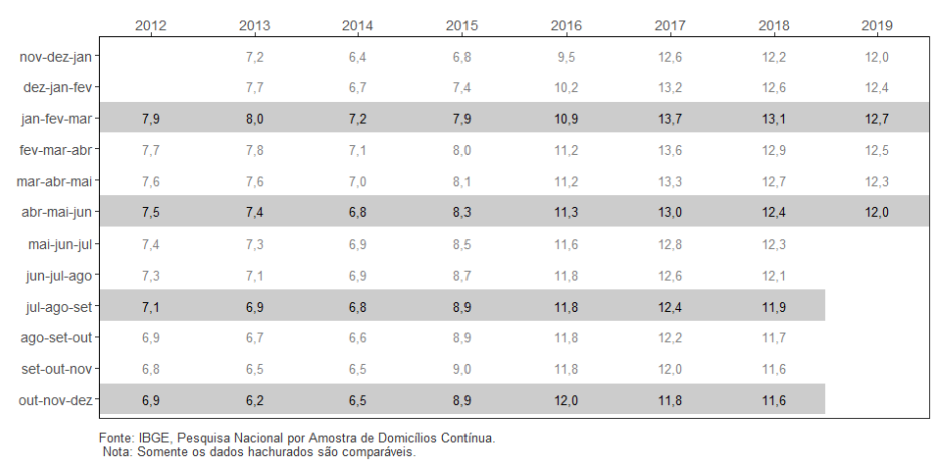
A taxa de desocupação foi estimada em 12,0% para o trimestre móvel de abril a junho de 2019 e caiu 0,7 pontos percentuais (p.p.) em relação ao trimestre de janeiro a março de 2019 (12,7%). Na comparação com o mesmo trimestre móvel de 2018, quando a taxa foi estimada em 12,4%, também houve queda (-0,4 ponto percentual).
No trimestre móvel de abril a junho de 2019, havia aproximadamente 12,8 milhões de pessoas desocupadas no Brasil. Este contingente recuou (-4,6%, ou menos 621 mil pessoas em busca de trabalho) frente ao trimestre anterior e ficou estatisticamente estável em relação a igual período de 2018.
A taxa composta de subutilização da força de trabalho foi estimada em 24,8% no trimestre móvel de abril a junho de 2019 e não mostrou variação estatisticamente significativa em ambas as comparações: nem em relação ao trimestre de janeiro a março de 2019 (25,0%) quanto ao mesmo trimestre móvel de 2018 (24,5%).
Taxa Composta de subutilização - trimestres de abril a junho – 2012/2019 Brasil (%)
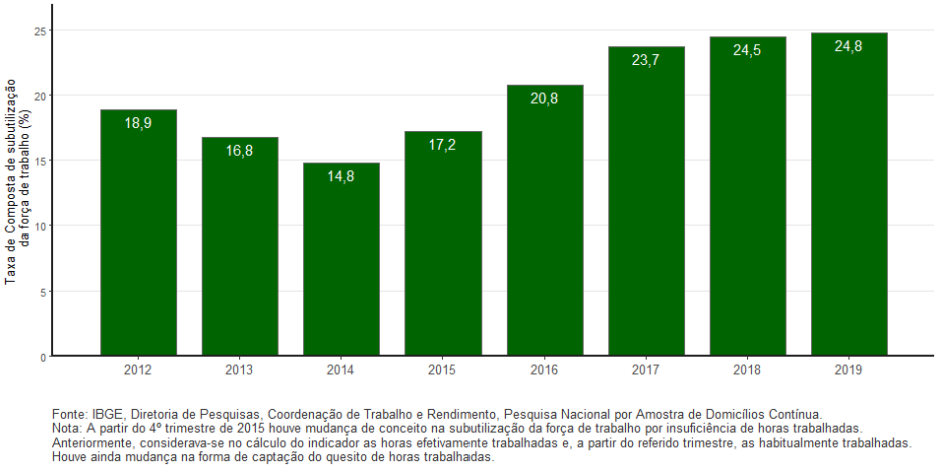
O número de pessoas subutilizadas no Brasil chegou a 28,4 milhões no trimestre de abril a junho de 2019, sem mostrar variação significativa frente ao trimestre de janeiro a março de 2019. No confronto com igual trimestre de 2018, esta estimativa cresceu 3,4%, ou mais 923 mil pessoas subutilizadas.
O número de pessoas subocupadas por insuficiência de horas trabalhadas chegou a cerca de 7,4 milhões no trimestre de abril a junho de 2019, um recorde da série histórica. Houve um aumento de 8,7% em relação ao trimestre anterior, ou mais 587 mil subocupados. Em relação ao mesmo trimestre do ano anterior houve uma alta de 13,8%, o equivalente a mais 892 mil pessoas subocupadas.
O contingente na força de trabalho potencial, no trimestre de abril a junho de 2019, foi estimado em 8,3 milhões de pessoas e permaneceu estável em ambas as comparações.
O contingente fora da força de trabalho, no trimestre de abril a junho de 2019 chegou a 64,8 milhões de pessoas, com quedas em ambas as comparações: -0,8% (menos 494 mil pessoas) contra o trimestre anterior e -1,0% (menos 621 mil pessoas) frente ao mesmo trimestre de 2019.
O contingente de pessoas desalentadas foi estimado 4,877 milhões no trimestre de março a maio de 2019. Houve estabilidade em ambas as comparações. Já o percentual de pessoas desalentadas em relação à população na força de trabalho ou desalentada foi estimado em 4,4% e repetiu o recorde da série histórica, ficando estável em ambas as comparações.
A força de trabalho (pessoas ocupadas e desocupadas), no trimestre de abril a junho de 2019, foi estimado em 106,1 milhões de pessoas. Esta população apresentou um incremento de 858 mil pessoas (0,8%), comparada com o trimestre anterior. Frente ao mesmo trimestre de 2018, houve alta de 2,2% (mais 2,2 milhões de pessoas).
A população ocupada foi estimada em aproximadamente 93,3 milhões. Houve aumentos em ambas as comparações: de 1,6% (mais 1.479 mil pessoas) em relação ao trimestre anterior e de 2,6% (mais 2.401 mil pessoas) contra o mesmo trimestre de 2019.
O nível da ocupação (percentual de pessoas ocupadas na população em idade de trabalhar) chegou a 54,6% no trimestre de abril a junho de 2019 e cresceu em ambas as comparações: 0,8 p.p. frente ao trimestre anterior e 0,9 p.p. comparado ao mesmo trimestre de 2018.
O contingente de empregados no setor privado com carteira de trabalho assinada (exclusive trabalhadores domésticos), estimado em 33,2 milhões de pessoas, cresceu em ambas as comparações: 0,9% (o equivalente a 294 mil pessoas) frente ao trimestre anterior e 1,4% (mais 450 mil pessoas) frente ao mesmo trimestre do ano anterior.
O número de empregados no setor privado sem carteira de trabalho assinada (11,5 milhões de pessoas) também cresceu em ambas as comparações: 3,4% (um incremento de 376 mil pessoas) em relação ao trimestre anterior e 5,2% (mais 565 mil pessoas) em relação ao mesmo trimestre do ano anterior.
O contingente de trabalhadores por conta própria chegou a 24,1 milhões de pessoas, o recorde da série histórica. Houve crescimento em ambas as comparações: 1,6% (mais 391 mil pessoas) frente ao trimestre anterior e 5,0% (mais 1,2 milhão de pessoas) em relação ao mesmo trimestre de 2018.
A categoria dos empregadores chegou a 4,4 milhões de pessoas, sem variações significativas em ambas as comparações.
O número de trabalhadores domésticos, estimado em 6,3 milhões de pessoas, cresceu 2,4% em relação ao trimestre anterior e ficou estável frente ao mesmo trimestre de 2018.
O grupo dos empregados no setor público (inclusive servidores estatutários e militares), estimado em 11,7 milhões de pessoas, apresentou aumento de 2,6% frente ao trimestre anterior. Na comparação com o mesmo trimestre de 2018, não houve variação estatisticamente significativa.
O rendimento médio real habitualmente recebido em todos os trabalhos pelas pessoas ocupadas foi estimado em R$ 2 290 no trimestre de abril a junho de 2019, com queda de 1,3% frente ao trimestre anterior e estabilidade em relação ao mesmo trimestre do ano anterior.
A massa de rendimento real habitualmente recebido em todos os trabalhos pelas pessoas ocupadas foi estimada, para o trimestre móvel de abril a junho de 2019, em R$ 208,4 bilhões de reais. Houve estabilidade em relação ao trimestre anterior e alta de 2,4% frente ao mesmo trimestre de 2018, o que representa um acréscimo de R$ 4,8 bilhões na massa de rendimentos.
Rendimento médio mensal real habitualmente recebido no mês de referência, de todos os trabalhos das pessoas ocupadas - Brasil - 2012/2019 - (R$)
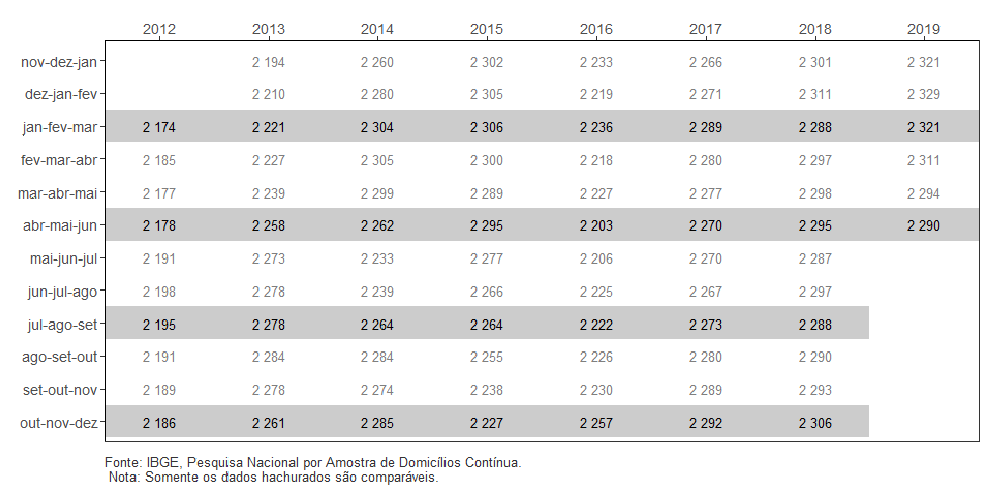
Desemprego recua para 12%, mas população subocupada é a maior desde 2012. Empregos com carteira tiveram o maior crescimento desde o 2º trimestre de 2014
A taxa de desocupação no país caiu de 12,7%, no primeiro trimestre do ano, para 12%, no trimestre de abril a junho, de acordo com a Pesquisa Nacional por Amostra de Domicílios Contínua (PNAD Contínua), divulgada hoje pelo IBGE.
O segundo trimestre fechou com dois recordes na série histórica iniciada em 2012. A população subocupada, aquela disponível para trabalhar mais horas, atingiu a marca de 7,4 milhões de pessoas e o número de trabalhadores por conta própria aumentou 1,6% e chegou a 24,1 milhões.
Foram preenchidas mais 294 mil vagas com carteira assinada, um aumento de 0,9% na comparação com o trimestre anterior, totalizando 33,2 milhões de trabalhadores com carteira. Por outro lado, a população sem carteira chegou a 11,5 milhões de empregados, um aumento de 3,4% nessa mesma comparação.
Pessoas de 14 anos ou mais com carteira assinada
Clique e arraste para zoom
Fonte: IBGE - Pesquisa Nacional por Amostra de Domicílios Contínua mensal
O diretor-adjunto de Pesquisas do IBGE, Cimar Azeredo, ressalta alguns pontos positivos dos indicadores divulgados. “O número de empregados com carteira assinada nunca cresceu tanto desde o trimestre terminado em junho de 2014. É uma variação significativa”, afirma. Ele também destaca o crescimento da população ocupada, o maior na comparação anual, com aumento de 2,4 milhões de pessoas.
Os resultados positivos, segundo Cimar, são “soluços de crescimento”, ou seja, indicam pequenas recuperações após um cenário desfavorável no mercado de trabalho. “Ainda há muita informalidade e um déficit expressivo de postos de trabalho com carteira assinada”, analisa.
No segundo trimestre do ano, a subutilização atingia 28,4 milhões de pessoas, grupo que reúne os desocupados, os subocupados (disponíveis para trabalhar mais horas), os desalentados (que desistiram de buscar emprego) e uma parcela que não consegue procurar trabalho por motivos diversos. Entre essas pessoas, 12,8 milhões estavam procurando emprego e 4,9 milhões estavam desalentadas.
DOCUMENTO: https://agenciadenoticias.ibge.gov.br/agencia-sala-de-imprensa/2013-agencia-de-noticias/releases/25092-pnad-continua-taxa-de-desocupacao-e-de-12-0-e-taxa-de-subutilizacao-e-24-8-no-trimestre-encerrado-em-junho-de-2019
ECONOMIA
FGV. IBRE. 31/07/19. Indicador de Incerteza da Economia. Indicador de Incerteza da Economia. Incerteza da Economia atinge menor nível desde fevereiro de 2018
O Indicador de Incerteza da Economia (IIE-Br) da Fundação Getulio Vargas recuou 10,7 pontos entre junho e julho de 2019, ao passar de 119,1 pontos para 108,4 pontos, o menor nível desde fevereiro de 2018 (104,3 pts).
“Embora não se disponha de evidência empírica irrefutável, a redução da incerteza econômica em julho parece estar relacionada com a aprovação do texto da Reforma da Previdência em primeiro turno na Câmara e a subsequente divulgação de novos itens da agenda econômica. No front externo, o aumento da probabilidade de uma redução de juros nos EUA também contribuiu para um ambiente menos incerto. Apesar do retorno do IIE-Br à região de incerteza moderadamente elevada, deve-se ressaltar que este indicador não vem apresentando um comportamento muito estável nos últimos anos“, afirma Aloisio Campelo Jr, Superintendente de Estatísticas Públicas da FGV IBRE
O recuo do IIE-Br foi influenciado por todos os seus componentes. O componente de Mídia, recuou 9,2 pontos entre junho e julho de 2019, contribuindo com -8,1 pontos para o resultado agregado. O componente de Expectativa também registrou queda no valor de 12,1 pontos no mesmo período, contribuindo com -2,6 pontos para o comportamento final do indicador.
DOCUMENTO: https://portalibre.fgv.br/navegacao-superior/noticias/incerteza-da-economia-atinge-menor-nivel-desde-fevereiro-de-2018.htm
INFLAÇÃO
IBGE. 31/07/2019. Índice de Preços ao Produtor (IPP) de junho cai 1,14%
Em junho de 2019, os preços da indústria geral caíram 1,14% em relação a maio, abaixo do observado entre maio e abril (1,39%). Em relação a maio de 2019, 8 das 24 atividades tiveram variações positivas de preços. Em junho de 2018, o resultado havia sido 2,27%. O acumulado no ano chegou a 2,76% e nos 12 meses, a 3,75%. Consulte o material de apoio do Índice de Preços ao Produtor (IPP) para mais informações.
| Período | Taxa |
|---|---|
| jun/19 | -1,14% |
| mai/19 | 1,39% |
| jun/18 | 2,27% |
| Acumulado em 2019 | 2,76% |
| Acumulado em 12 meses | 3,75% |
As quatro maiores variações em junho de 2019 foram nas seguintes atividades industriais: refino de petróleo e produtos de álcool (-7,24%), papel e celulose (-4,65%), calçados e artigos de couro (-3,56%) e fumo (-2,91%). Já as maiores influências vieram de refino de petróleo e produtos de álcool (-0,78 p.p.), alimentos (-0,19 p.p.), papel e celulose (-0,16 p.p.) e farmacêutica (0,08 p.p.).
| Índices de Preços ao Produtor, segundo Indústrias Extrativas e de Transformação (Indústria Geral) e Seções - Últimos três meses | |||||||||
|---|---|---|---|---|---|---|---|---|---|
| Indústria Geral e Seções | Variações (%) | ||||||||
| M/M-1 | Acumulado Ano | M/M-12 | |||||||
| ABR/19 | MAI/19 | JUN/19 | ABR/19 | MAI/19 | JUN/19 | ABR/19 | MAI/19 | JUN/19 | |
| Indústria Geral | 1,22 | 1,39 | -1,14 | 2,52 | 3,95 | 2,76 | 8,55 | 7,32 | 3,75 |
| B - Indústrias Extrativas | 3,02 | 6,50 | -0,10 | 15,25 | 22,75 | 22,63 | 28,83 | 36,10 | 28,61 |
| C - Indústrias de Transformação | 1,13 | 1,14 | -1,19 | 1,97 | 3,13 | 1,90 | 7,70 | 6,14 | 2,69 |
| Fonte: IBGE, Diretoria de Pesquisas, Coordenação de Indústria | |||||||||
Em junho de 2019, o acumulado no ano atingiu 2,76%. Entre as atividades que acumularam as maiores variações foram indústrias extrativas (22,63%), refino de petróleo e produtos de álcool (11,23%), farmacêutica (9,35%) e papel e celulose (-6,09%). Já os setores de maior influência foram: refino de petróleo e produtos de álcool (1,05 p.p.), indústrias extrativas (0,94 p.p.), farmacêutica (0,29 p.p.) e alimentos (0,27 p.p.).
Em relação a junho de 2018, a variação de preços ocorrida foi de 3,75% em junho de 2019, contra 7,32% em maio de 2019. As quatro maiores variações de preços ocorreram em indústrias extrativas (28,61%), farmacêutica (11,26%), fabricação de máquinas e equipamentos (9,37%) e móveis (8,13%).
Entre as grandes categorias econômica, a queda de 1,14% em junho repercutiu da seguinte maneira: -0,56% em bens de capital; -1,15% em bens intermediários; e -1,24% em bens de consumo, sendo que 0,04% foi a variação observada em bens de consumo duráveis e -1,51% em bens de consumo semiduráveis e não duráveis. Já a influência das Grandes Categorias Econômicas foi de -0,04 p.p. de bens de capital, -0,63 p.p. de bens intermediários e -0,47 p.p. de bens de consumo.
No acumulado no ano até junho, houve alta de 2,76%, sendo 2,77% a variação de bens de capital (com influência de 0,21 p.p.), 2,59% de bens intermediários (1,41 p.p.) e 3,02% de bens de consumo (1,14 p.p.). No último caso, este resultado foi influenciado em 0,19 p.p. pelos produtos de bens de consumo duráveis e 0,96 p.p., pelos bens de consumo semiduráveis e não duráveis.
| Índices de Preços ao Produtor, segundo Indústrias Extrativas e de Transformação (Indústria Geral) e Grandes Categorias Econômicas - Últimos três meses | |||||||||
|---|---|---|---|---|---|---|---|---|---|
| Indústria Geral e Seções | Variações (%) | ||||||||
| M/M-1 | Acumulado Ano | M/M-12 | |||||||
| ABR/19 | MAI/19 | JUN/19 | ABR/19 | MAI/19 | JUN/19 | ABR/19 | MAI/19 | JUN/19 | |
| Indústria Geral | 1,22 | 1,39 | -1,14 | 2,52 | 3,95 | 2,76 | 8,55 | 7,32 | 3,75 |
| Bens de Capital (BK) | 0,80 | 0,77 | -0,56 | 2,56 | 3,35 | 2,77 | 10,25 | 9,47 | 7,77 |
| Bens Intermediários (BI) | 0,95 | 1,80 | -1,15 | 1,94 | 3,78 | 2,59 | 9,16 | 7,46 | 3,28 |
| Bens de consumo(BC) | 1,70 | 0,93 | -1,24 | 3,35 | 4,31 | 3,02 | 6,85 | 6,43 | 3,50 |
| Bens de consumo duráveis (BCD) | 1,02 | 0,15 | 0,04 | 2,61 | 2,76 | 2,80 | 7,11 | 6,78 | 6,44 |
| Bens de consumo semiduráveis e não duráveis (BCND) | 1,84 | 1,10 | -1,51 | 3,51 | 4,65 | 3,07 | 6,68 | 6,14 | 2,57 |
| Fonte: IBGE, Diretoria de Pesquisas, Coordenação de Indústria | |||||||||
A seguir os principais destaques:
Indústrias extrativas: em junho, os preços variaram negativamente (-0,10%) em relação ao mês anterior. Com isso, inverteu-se a tendência de alta que vinha sendo observada nos últimos quatro meses. Os indicadores acumulados no ano e de doze meses tiveram variações de 22,63% e 28,61%, respectivamente. Ambas as variações se destacaram como as principais na indústria geral. Na influência, o setor destacou-se no indicador acumulado do ano (0,94 p.p. sobre 2,76% da indústria geral).
Alimentos: em relação a maio, a variação de preços do setor foi de -0,88%, a primeira negativa depois de três positivas consecutivas. Com esse resultado, o acumulado recuou de 2,09% para 1,20% (em junho de 2018, era de 8,93%). Na comparação com igual mês do ano anterior, a variação foi de 0,56%, menor resultado nesse tipo de comparação desde maio de 2018 (2,12%). O setor teve destaque em termos de influência, sendo a segunda mais intensa na comparação junho contra maio (-0,19 p.p., em -1,14%) e a quarta no acumulado (0,27 p.p., em 2,76%).
Entre os produtos listados como maiores variações e maiores influências, apenas um aparece nas duas listas: “leite esterilizado / UHT / Longa Vida”, no caso, com impacto negativo. A influência dos quatro produtos selecionados foi de -0,64 p.p., na variação de -0,88%, ou seja, a influência dos demais 39 produtos foi de -0,24 p.p.
Papel e celulose: a fabricação de papel e celulose apresentou variação média de preços de -4,65% em relação a maio. Esta foi a maior queda observada no setor em toda a série histórica, com início em janeiro de 2010. Com este resultado, a atividade apresentou uma variação acumulada no ano de -6,09% (menor resultado observado para o mês de junho) e uma variação acumulada em 12 meses de -5,06% (segundo menor resultado em junho, atrás apenas de junho de 2011, cuja variação havia sido -6,73%).
Na comparação com maio, os produtos que mais influenciaram o resultado foram “pastas químicas de madeira, à soda ou ao sulfato, exceto pastas para dissolução” (que são as celuloses, produto de maior peso no setor), “papel kraft para embalagem não revestido”, “papel para usos na escrita, impressão e outros fins gráficos: ofsete, bíblia, etc., não revestido” e “papel-cartão ou cartolina não revestido, ou revestido com substâncias inorgânicas”, todos com variação negativa. Estes quatro produtos, somados, totalizaram -4,64 p.p. Ou seja, os demais sete produtos da atividade contribuíram com -0,01 p.p.
Refino de petróleo e produtos de álcool: a variação de preços na passagem de maio para junho foi de -7,24%, primeira negativa no ano (a última havia sido em dezembro de 2018, -9,36%). Com este resultado, o acumulado no ano recuou de 19,91%, em maio, para 11,23% em junho. Na comparação contra igual mês do ano anterior, a variação foi de 2,40%, menor resultado nesta perspectiva desde agosto de 2017, 6,45%.
Em relação aos produtos destacados em termos de variação e de influência, há uma coincidência quase total, sendo que “álcool etílico (anidro ou hidratado)” aparece entre as maiores influências, mas não entre as maiores variações (“querosene de aviação”). Todos os produtos destacados em termos de influência tiveram variações negativas de preços, a influência conjunta deles é de -7,45 p.p., portanto os demais seis produtos tiveram influência positiva de 0,21 p.p.
Outros produtos químicos: a variação de preços observada no setor foi, na comparação de junho contra maio, 0,78%, quarto resultado positivo consecutivo no ano. Com isso, o acumulado no ano saiu de -3,17%, em maio, para -2,42%, em junho. Na comparação junho 2019/junho2018, a variação foi de 1,18%, menor resultado nesse tipo de comparação desde setembro de 2017 (1,92%). Entre os produtos destacados em termos de influência, apenas um deles teve variação negativa de preços, “adubos ou fertilizantes à base de NPK”.
Farmacêutica: a variação de preços no mês de junho foi de 2,39%, sendo que este índice tem sido positivo desde fevereiro/2019.
O setor farmacêutico destacou-se neste mês por apresentar a terceira maior variação média de preços na indústria geral no acumulado do ano e a segunda maior nos últimos 12 meses, 9,35% e 11,26%, respectivamente. O índice de 9,35% no acumulado do ano é o maior desde o início da série histórica (janeiro/2010) para o mês de junho. Além disso, a variação acumulada dos últimos 12 meses (11,26%) também foi a maior da série histórica.
Os quatro produtos com maior influência neste mês contra mês anterior contribuíram com 2,27 p.p., na variação de 2,39%, e os demais oito produtos, com 0,12 p.p.
Veículos automotores: em junho, a variação observada no setor foi de 0,08%, quando comparada com o mês imediatamente anterior, seguindo a tendência de alta observada também nos seis meses anteriores. Com este resultado, a variação acumulada no ano e a variação acumulada nos últimos 12 meses alcançaram, respectivamente, 2,34% e 5,57%.
Entre os quatro produtos de maior influência entre maio e junho, três impactaram positivamente o índice: “automóveis para passageiros, a gasolina ou bicombustível, de qualquer cilindrada”, “filtros de ar, óleo ou combustível para motores de veículos automotores” e “sistemas de marcha e transmissão para veículos automotores”. Somente “peças ou acessórios, para o sistema de motor de veículos automotores” teve impacto negativo. A influência desses quatro produtos que mais impactaram a variação do mês em relação ao mês imediatamente anterior foi de 0,04 p.p., ou seja, os demais 19 produtos da atividade também contribuíram com os mesmos 0,04 p.p.
Preços na indústria caem 1,14% em junho após quatro meses de alta. O principal impacto negativo no IPP partiu dos derivados de petróleo
Influenciada pela valorização do real frente ao dólar em junho, os preços da indústria tiveram deflação de 1,14% na comparação com maio, quando teve alta de 1,39%. É a primeira queda após quatro taxas positivas seguidas desde fevereiro. Os principais impactos negativos vieram dos produtos derivados de petróleo e de biocombustíveis e do setor de alimentos.
As informações são do Índice de Preços ao Produtor (IPP), divulgado hoje pelo IBGE. A pesquisa mede a variação dos preços dos produtos na "porta das fábricas", sem impostos e frete, de 24 atividades das indústrias extrativas e de transformação.
IPP - Variação mensal (mês/mês anterior)
Clique e arraste para zoom
Fonte: IBGE - Índice de Preços ao Produtor
“No caso do petróleo, internacionalmente os preços estão caindo. Além disso, no mês de junho tivemos uma valorização do real [frente ao dólar] que impactou na baixa dos preços internos. Assim, no caso do petróleo, bem como de todos seus derivados, os preços caem internacionalmente devido ao efeito câmbio”, explica o gerente do IPP, Alexandre Brandão.
Em relação aos alimentos, os destaques negativos foram carne bovina e leite, enquanto resíduos da extração de soja tiveram impacto positivo.
“Nos meses passados, estávamos exportando bastante carne, em função do aumento da importação da China. Mas, em junho, houve um problema circunstancial de exportação dessas carnes. Então, tivemos uma maior oferta para o mercado interno e os preços caíram”, afirma Brandão.
A queda do preço do leite foi fruto de uma menor demanda pelo produto no mercado interno, o que gerou um aumento de estoque e uma consequente diminuição dos preços. Já o aumento de preço dos resíduos da extração de soja tem relação com problemas na colheita de soja nos Estados Unidos, fator que provocou elevação do preço do produto no mercado internacional.
Apenas oito das 24 atividades industriais investigadas tiveram variações positivas de preços na comparação com maio.
DOCUMENTO: https://agenciadenoticias.ibge.gov.br/agencia-sala-de-imprensa/2013-agencia-de-noticias/releases/25094-indice-de-precos-ao-produtor-ipp-de-junho-cai-1-14
COMÉRCIO
CNDL. 31/07/2019. Sete em cada dez brasileiros tiveram de fazer cortes no orçamento no primeiro semestre, apontam CNDL/SPC Brasil
Para metade dos entrevistados, desempenho da economia no período foi pior do que o esperado. Ainda assim, 60% conseguiram manter pagamento das contas em dia. Maioria acha que terá dificuldades de realizar algum projeto planejado para 2019
Embora quase metade dos brasileiros (44%) tenha começado o ano de 2019 com expectativas positivas em relação à economia do país para o primeiro semestre, o desenrolar dos fatos só manteve o otimismo de 13%, que avaliaram o período como acima do esperado. Enquanto isso, 49% consideraram o desempenho pior quanto à perspectiva inicial.
A sensação de decepção pode ter origem no impacto gerado pela situação macroeconômica do país nas finanças pessoais do brasileiro. Segundo levantamento realizado nas 27 capitais pela Confederação Nacional de Dirigentes Lojistas (CNDL) e pelo Serviço de Proteção ao Crédito (SPC Brasil), três em cada dez consumidores (30%) sentiram uma piora em sua situação financeira no primeiro semestre do ano – em grande parte motivados pela alta dos preços (54%) e pela diminuição da renda familiar (38%).
Isso explica por que sete em cada dez consumidores (69%) tiveram de realizar cortes no orçamento no primeiro semestre de 2019, enquanto 53% acabaram recorrendo a bicos e trabalhos adicionais para complementar a renda. Outras situações comuns vivenciadas foram o desemprego (do próprio ou de alguém da família), com 46% de citações, passar vários meses no vermelho (45%) e ter o CPF negativado por não pagar alguma conta (34%). Há ainda 33% que recorreram a um empréstimo para organizar o orçamento e 27% que chegaram ao ponto de ter que vender bens para conseguir dinheiro.
Aperto no orçamento obrigou brasileiros a diminuir, principalmente, as saídas e apostar mais em programas caseiros
A redução nas despesas teve impacto direto no lazer do brasileiro: seis em cada dez (56%) dos entrevistados que tiveram que frear o consumo no primeiro semestre afirmaram ter cortado as refeições fora de casa, enquanto 54% diminuíram as idas a bares e casas noturnas, 51% deixaram de comprar roupas, calçados e acessórios, 50% restringiram as viagens e 50% reduziram as idas ao cinema e ao teatro.
Com o orçamento restrito, seis (59%) em cada dez brasileiros acreditam que será mais difícil concretizar projetos planejados para este ano, sendo a formação de uma reserva financeira (41%), realização de uma grande viagem (34%), reforma a casa (34%) e compra deum carro (30%) os mais afetados.
“Na hora de apertar o cinto, é natural que o consumidor acabe priorizando o pagamento de despesas básicas e essenciais, como aluguel e contas de luz e água, deixando os gastos considerados supérfluos em segundo plano. É inevitável que os momentos de diversão fora de casa acabem comprometidos em alguma medida”, pondera o educador financeiro do SPC Brasil, José Vignoli.
29% dos entrevistados acham que economia ainda não retomou crescimento esperado. Para maioria, geração de empregos deve ser prioridade do governo nos próximos quatro anos
Mas nem só de experiências negativas se fez o primeiro semestre de 2019: apesar das adversidades, seis em cada dez (60%) entrevistados conseguiram manter o pagamento das contas em dia, 35% conseguiram guardar dinheiro e 30% ainda disseram ter chegado a realizar um sonho de consumo nesse período.
O maior controle sobre o orçamento doméstico reflete-se na percepção dos otimistas quanto ao cenário do primeiro semestre do ano: três em cada dez entrevistados (28%) acreditam que sua situação financeira melhorou durante esse período, com aumento de nove pontos percentuais em relação ao ano anterior. Para a maioria (39%), no entanto, tudo continua na mesma.
A pesquisa mostra ainda que três em cada dez brasileiros (29%) consideram que a economia do país ainda não retomou o crescimento esperado e que vai demorar para fazê-lo, enquanto outros 29% acreditam que o crescimento será retomado em breve e 27% creem que o crescimento já foi retomado, mas de forma lenta.
Além disso, seis em cada dez entrevistados (58%) disseram não sentir os efeitos diretos da melhora da economia na sua vida desde o fim da recessão em 2017, enquanto 42% afirmaram sentir diferença em aspectos como preço de produtos, juros, taxa de desemprego e renda – com aumento de 19 pontos percentuais frente a sondagem do último ano.
No entanto, 46% acreditam que haverá uma retomada no crescimento para o segundo semestre do ano, número próximo aos 43% que creem em melhora nas finanças pessoais, especialmente motivados pelo otimismo de que coisas boas estão por vir (68%) e por terem sido bem-sucedidos na organização de seu orçamento (41%).
“Tecnicamente, o ciclo de recessão iniciado em 2014 no Brasil acabou no final de 2016. Mas o país ainda não se recuperou de alguns dos efeitos da crise e da retração na economia, e a sombra daquele período esteve afetando diretamente o orçamento do brasileiro. Consequentemente, sua percepção sobre o primeiro semestre de 2019 e suas expectativas em relação ao futuro”, explica o presidente do SPC Brasil, Roque Pellizzaro Júnior.
O levantamento também quis saber a opinião dos brasileiros sobre as prioridades do governo para os próximos quatro anos. A geração de empregos (68%), o combate à corrupção (63%) e a melhoria da educação pública (55%) foram as preocupações mais destacadas pelas pessoas ouvidas.
Metodologia
A pesquisa ouviu 800 consumidores de ambos os sexos, todas as classes sociais e acima de 18 anos nas 27 capitais. A margem de erro é de 3,50 pontos percentuais para um intervalo de confiança de 95%.
Pesquisa: https://www.spcbrasil.org.br/imprensa/pesquisas
COMÉRCIO INTERNACIONAL
EUA. CHINA. REUTERS. 31 DE JULHO DE 2019. Negociações entre EUA e China foram "construtivas", diz Pequim
Por Brenda Goh e David Stanway
XANGAI (Reuters) - Negociadores norte-americanos e chineses concluíram nesta quarta-feira uma breve rodada de negociações comerciais que a China descreveu como “construtiva”, incluindo discussões sobre novas compras de produtos agrícolas dos Estados Unidos e um acordo para uma nova reunião presencial em setembro.
As reuniões desta semana, as primeiras conversas presenciais desde a trégua estabelecida no G20 no mês passado, renderam um jantar de trabalho na terça-feira no histórico Fairmont Peace Hotel, em Xangai, e meio dia de negociações nesta quarta-feira, antes do representante comercial dos EUA, Robert Lighthizer, e do secretário do Tesouro norte-americano, Steven Mnuchin, irem embora.
“Ambos os lados, de acordo com a trégua estabelecida pelos dois líderes em Osaka, tiverem uma troca sincera, altamente efetiva, construtiva e profunda sobre grandes questões comerciais e econômicas de interesse mútuo”, disse o Ministério do Comércio da China em um comunicado após a delegação norte-americana deixar Xangai.
O comunicado disse que os negociadores discutiram mais compras chinesas de produtos agrícolas dos EUA, que se tornaram um ponto de discórdia depois que o presidente dos EUA, Donald Trump, disse que a China não estava cumprindo com suas promessas de compra.
As conversas começaram em meio a baixas expectativas, com Trump na terça-feira acusando a China de não se movimentar e alertando sobre resultados piores para o país asiático caso não houvesse avanços.
Nesta quarta-feira, a porta-voz do Ministério das Relações Exteriores da China, Hua Chunying, disse que não estava ciente dos últimos desdobramentos durante as negociações, mas que estava claro que foram os Estados Unidos que continuaram a “voltar atrás”.
“Acredito que não faz sentido para os EUA exercer sua campanha de pressão máxima neste momento”, disse Hua em entrevista coletiva em resposta a uma pergunta sobre as afirmações de Trump.
“É inútil dizer aos outros para tomar medicação quando você é quem está doente”, disse ela.
Os dois lados vão se reunir em setembro nos Estados Unidos, informou o Ministério do Comércio.
O lado norte-americano não fez uma declaração imediata.
MERCOSUL
MRE. AIG. NOTA-202. 30 de Julho de 2019. Entrada em vigor do Protocolo de Cooperação e Facilitação de Investimentos Intra-MERCOSUL
Entrou em vigor, em 30/7, para Brasil e Uruguai, o Protocolo de Cooperação e Facilitação de Investimentos Intra-MERCOSUL (PCFI).
O acordo passará a valer para Argentina e Paraguai quando vier a ser concluída a incorporação do instrumento aos respectivos ordenamentos jurídicos.
O PCFI cria mecanismos para ajudar o investidor na resolução de dificuldades práticas, bem como no acesso a informações e a procedimentos necessários à efetivação de seus investimentos.
O PCFI contribui para expandir a rede de instrumentos dessa natureza firmados pelo Brasil e para estimular a atração de investimentos estrangeiros e a internacionalização das empresas brasileiras.
ORÇAMENTO
MEconomia. 31/07/2019. ECONOMIA. Decreto de Programação Orçamentária e Financeira
O Decreto nº 9.943 de 30 de Julho de 2019, propõe a alteração do Decreto nº 9.711, de 15 de fevereiro de 2019, que dispõe sobre a programação orçamentária e financeira e estabelece o cronograma mensal de desembolso do Poder Executivo Federal para o exercício de 2019.
A referida alteração atende ao disposto no caput do art. 9º da Lei Complementar nº 101, de 4 de maio de 2000, Lei de Responsabilidade Fiscal - LRF, e nos §§ 1º e 12, inciso I, do art. 59 da Lei nº 13.707, de 14 de agosto de 2018, Lei de Diretrizes Orçamentárias para 2019, LDO-2019, tendo em vista que a avaliação de receitas e despesas do terceiro bimestre indicou a necessidade de se proceder à limitação de empenho e movimentação financeira das despesas primárias discricionárias do Poder Executivo, no montante de R$ 2.251,8 milhões, para fins de cumprimento da meta de resultado primário do Governo Central, conforme demonstrado em Relatório enviado ao Congresso Nacional, por meio da Mensagem nº 312, de 22 de julho de 2019.
Destaque-se que, para compor o valor a ser contido, utilizou-se o restante da reserva orçamentária, no montante de R$ 809,0 milhões, restando, portando, R$ 1.442,8 milhões para ser contingenciado nas despesas dos órgãos setoriais.
Em relação ao valor limitado no Relatório atual, R$ 1,442,8 milhões, e ainda aos contingenciamentos já efetuados anteriormente, a tabela a seguir detalha tal distribuição por órgão:

TURISMO
MTurismo. 30 de Julho de 2019. Avança acordo de cooperação técnica entre o Brasil e a OMT. Projeto prevê a realização de uma competição focada em tecnologia e qualificação para a alta gestão do turismo brasileiro. Reunião entre MTur e membros da OMT foi realizada na sede da entidade, em Madri, na Espanha.
Comitiva técnica do Ministério do Turismo do Brasil finaliza últimos detalhes para o Brasil assinar termo de cooperação técnica com a Organização Mundial do Turismo (OMT), agência da Organização das Nações Unidas (ONU) especializada no setor de viagens. Em missão à sede da OMT, em Madri, técnicos do MTur definiram os termos para a instalação no Brasil de um hub de inovação para o turismo, a realização, em dezembro, de uma competição de tecnologia (hackathon), e um curso voltado para o uso de ferramentas digitais para melhorar a gestão pública do turismo.
“Vamos aproveitar a experiência de programas bem-sucedidos realizados em diversas partes do mundo para acelerar a curva de aprendizado e desenvolver o turismo brasileiro”, comentou o secretário-adjunto da Secretaria Executiva do Ministério do Turismo, Higino Brito. Entre os países que já realizaram eventos semelhantes estão Espanha, Chile, Colômbia e Argentina.
Pelo termo de cooperação técnica a ser assinado pelo ministro do Turismo, Marcelo Álvaro Antônio, e o secretário-geral da OMT, Zurab Pololikashvili, a agência internacional ficará responsável pela organização do evento em dezembro e pela instalação no Brasil de uma incubadora de startups focada no setor de viagens. Ainda em dezembro, será realizado um programa de qualificação para 50 gestores públicos do turismo no país. A ideia é compartilhar boas práticas já implementadas no mundo para alavancar o turismo.
A comitiva brasileira encontrou-se com Natalia Bayona, especialista sênior em Transformação e Inovação Digital da OMT; Martín Rodriguez Jugo, diretor da IE Business School, uma das mais reconhecidas escolas de negócio do mundo; e Miguel Angel Susino, da Consultoria Jurídica da OMT. Na pauta, também incluído o apoio do MTur para uma possível instalação de um escritório da OMT no Brasil. Na última década, o turismo foi responsável por um em cada cinco empregos gerados no mundo. Atualmente o setor responde por 10,4% do PIB mundial e 319 milhões de empregos.
ENERGIA
OPEP. REUTERS. 31 DE JULHO DE 2019. PESQUISA. Petróleo deve ficar estável com temor sobre demanda compensando risco de oferta
Por Sumita Layek e Asha Sistla
(Reuters) - Os preços do petróleo devem flutuar em intervalos próximos ao atual nível neste ano, com um crescimento econômico mais lento e disputas comerciais restringindo a demanda, mostrou uma pesquisa mensal da Reuters, o que compensará possíveis ganhos com cortes de produção e a tensão no Oriente Médio.
Uma pesquisa com 54 economistas e analistas projetou que o preço do Brent deve ficar em média em 67,47 dólares o barril em 2019, próximo dos 67,59 dólares vistos na pesquisa do mês passado. Até o momento neste ano, a média foi de 65,88 dólares.
Na quarta-feira, o Brent era negociado perto de 65 dólares o barril.
“A demanda mundial segue sem brilho e está sujeita a significativos riscos de revisões para baixo devido às preocupações com a guerra comercial e dados econômicos frustrantes”, disse a analista Daniela Corsini, da Intesa Sanpaolo.
Mais cedo em julho, a Organização dos Países Exportadores de Petróleo (Opep) e aliados incluindo a Rússia concordaram em prorrogar cortes de produção até março de 2020, buscando elevar os preços.
Mas a efetividade dos cortes da Opep “está começando a se dissipar e terá um impacto limitado no equilíbrio (do mercado) até 2020”, disse Edward Bell, do Emirates NBD Bank.
Os analistas na pesquisa da Reuters projetaram que a demanda global por petróleo deve crescer entre 0,8 e 1,4 milhão de barris por dia (bpd) em 2019, ante entre 0,9 e 1,3 milhão na previsão de junho, continuando a ver mercados emergentes na Ásia como principais fatores guiando a demanda.
A pesquisa projetou que o petróleo nos EUA deve ficar em média em 59,29 dólares por barril em 2019, ante 59,30 dólares na previsão do mês passado.
________________
LGCJ.:

