US ECONOMICS
VENEZUELA
DoS. REUTERS. 8 DE MAIO DE 2019. Pompeo se diz indignado por apoio de políticos a Maduro no Reino Unido e nos EUA
LONDRES (Reuters) - O secretário de Estado norte-americano, Mike Pompeo, disse nesta quarta-feira que fica indignado em ver que políticos britânicos e dos Estados Unidos continuam a apoiar o presidente da Venezuela, Nicolás Maduro.
“É desanimador ver líderes não só no Reino Unido, mas também nos Estados Unidos, que continuam a apoiar o ditador assassino Maduro”, disse Pompeo a repórteres quando questionado sobre o apoio do líder do Partido Trabalhista, da oposição britânica, Jeremy Corbyn, ao governo da Venezuela.
Na mesma coletiva de imprensa, o ministro das Relações Exteriores britânico, Jeremy Hunt, criticou o número dois do Partido Trabalhista, John McDonnell, por apoiar Maduro.
Reportagem de Guy Faulconbridge e Kate Holton
U.S. Department of State. May 8, 2019. Press Availability With British Foreign Secretary Jeremy Hunt. Michael R. Pompeo, Secretary of State. U.K. Foreign and Commonwealth Office. London, United Kingdom
FOREIGN SECRETARY HUNT: Good afternoon, ladies and gentlemen. I’m delighted to welcome Secretary Mike Pompeo to the foreign office for his first bilateral visit to Britain, and it is a privilege to reaffirm the strength of the friendship between our two countries. The Anglo-American alliance was forged in the greatest struggle against tyranny the world has ever known. We’ll soon commemorate the 75th anniversary of the Normandy landings when Britain and America joined forces with our allies to begin the liberation of Europe. We look forward to welcoming President Trump to mark that occasion, and it’s fitting that Secretary Pompeo should be our guest on V-E Day.
I’m proud to say that in defense and security, Britain and America cooperate more closely than any two countries in the world. We keep our peoples safe, we entrust one another with intelligence that saves lives on both sides of the Atlantic. Just last year when the Russian state used a chemical weapon in Salisbury, America responded by expelling 60 Russian officials, more than any other country, an act of friendship for which I repeat my thanks.
We stand together in defense of the values upon which our nations were founded. Today, Secretary Pompeo and I met faith leaders, including the Archbishop of Canterbury, to discuss how we can better protect freedom of religion in a world where people of all faiths, including 245 million Christians, face persecution for practicing their beliefs. This is an issue close to both our hearts. The recent atrocities in New Zealand and Sri Lanka remind us just why.
And I’m thankful that today we have a glimmer of light with the news that Asia Bibi will be able to embark on a new chapter of her life. I welcome the Government of Pakistan’s commitment to uphold the rule of law following the decision of its supreme court to confirm her acquittal. Britain’s primary concern has always been the safety of Asia Bibi and her family, and we’ve been in contact with our partners to help ensure she gets the freedom and security she deserves.
Today, the prime minister and I have had excellent discussions with Secretary Pompeo on a range of global challenges including China and the situations in Yemen and Iran. Let me focus on two of those.
First, Iran: The UK and U.S. work incredibly closely on Iran, including to counter Iran’s destabilizing activity in the Middle East. Whilst we both agree that Iran must never be able to acquire a nuclear weapon, it’s no secret that we have a different approach on how best to achieve that. The UK has continued to support the nuclear deal, which is a key achievement of the global nonproliferation architecture, because we believe it’s in our shared security interests.
But today’s announcement from Tehran about its commitments under the deal is an unwelcome step. I urge Iran not to take further escalatory steps and to stand by its commitments. Sanctions were lifted in exchange for restrictions on Iran’s nuclear program. Should Iran cease to observe its nuclear commitments, there would, of course, be consequences. For as long as Iran keeps its commitments, then so too will the United Kingdom.
Turning to Venezuela, I’m deeply concerned by the plight of the Venezuelan people, who have suffered so much at the hands of Maduro, and we must intensify pressure on the regime, including through potential further sanctions and condemn those who are propping up Maduro, particularly Russia, whose deployment of military personnel in Caracas will achieve nothing except prolong the suffering of the Venezuelan people. So that’s why earlier today, the foreign office expressed our deep concern about the Kremlin’s actions to the Russian charge d’affaires.
As we respond to these challenges, Britain and America are united by the values that have always been at the heart of our alliance. Our countries cherish the same beliefs in liberty, democracy, and the rule of law. The anniversary of D-Day reminds us how the valor and sacrifice of a previous generation saved those values from tyranny, and our duty is to follow humbly in that great tradition.
So let me close by repeating my welcome to Mike, who is a great friend of the UK. We are proud to stand shoulder to shoulder with the United States to defend our common values.
SECRETARY POMPEO: Thank you. Thank you, Foreign Secretary Hunt. This is my first trip to the United Kingdom as Secretary of State, but Jeremy and I have met many times at many different places in the world, and we talk frequently by phone. You’ve truly become a great friend and I know that you’re a great partner to our collective desire to keep our two countries safe.
It was my privilege to meet with you and with Prime Minister May. President Trump is very much looking forward to his visit here next month and commemorating D-Day with our great allies.
It was evident in my conversations both with Jeremy and with Prime Minister May that the Special Relationship doesn’t simply endure; it’s thriving, despite what you might read in the papers, and we’re ready to meet new challenges and face them together and seize on new opportunities together as well.
Brexit has obviously been a hot topic here. I reiterated to the prime minister as well as to Foreign Secretary Hunt that it’s the United Kingdom’s sovereign and democratic choice on how it will proceed, but also that no matter what happens, the United States will continue our strong relationship with both the United Kingdom and the EU. Our great hope is that Brexit can be resolved soon because President Trump is eager to strike a bilateral trade agreement that expands on our number-one trade relationship.
I’ve had the privilege as both CIA director and now as the Secretary of State to observe how the UK has been amongst our most reliable partners on a broad range of security issues. We are grateful for your support of our diplomacy and pressure against North Korea, your eagerness to contribute to the strength of the NATO alliance, and your leadership to resolve crises in Syria and in Yemen. The United Kingdom also has contributed mightily to the Coalition to Defeat ISIS and, as the attacks in Sri Lanka showed, we need to keep up that fight against radical Islamic terrorism. A key part of that fight is that every coalition member must take back terrorist fighters captured on the battlefield.
Our nations have also stood side-by-side in confronting Russian aggression. We jointly held Russia accountable for the chemical weapons attacks in Salisbury of last year, and together we will continue to disrupt the hostile activities of Russian intelligence networks, uphold the prohibition of chemical weapons use, and defend our peoples against all forms of Russian aggression.
The United States and the UK cooperate a great deal on regional security in Asia as well. That cooperation will be all the more necessary as China tries to shift the global balance of power in its favor. As a historic maritime power, Britain has shown leadership in standing up to China’s unlawful behavior in the South China Sea, and we urge the British Government to be equally vigilant and vocal against a host of other Chinese activities that undermine the sovereignty of all nations.
China’s Belt and Road Initiative is just one of these problems. China peddles corrupt infrastructure deals in exchange for political influence. Its bribe-fueled debt-trap diplomacy undermines good governance and threatens to upend the free-market economic model on which so many countries depend, and which has lifted up hundreds of millions of people out of poverty. If China can’t conduct BRI with maximum transparency, it shouldn’t do it at all. We hope the UK will insist on the same.
We also discussed at some length the importance of secure 5G networks. I’ll have a little more to say on that this afternoon, but I’m confident that each of our two nations will choose a path which will ensure security of our networks.
Elsewhere in Asia, the United States unequivocally supports UK sovereignty over the British Indian Ocean Territory. Its status as a UK territory is essential to the value of the joint U.S.-UK base on Diego Garcia and our shared security interests.
We also had a forthright conversation on the Islamic Republic of Iran, and as Jeremy said, we share the same perception of the Iranian threat and we are together trying to find new ways to work closely to combat that threat.
Finally, and following up on the roundtable discussion that we had with faith leaders this morning, the foreign secretary and I discussed the importance of religious freedom. This is just one example of the commitment to shared values on which this historic relationship depends. We will continue to cooperate to protect the God-given right of human beings in all parts of the world to believe what they want to believe. We look forward to seeing the UK at the second annual Ministerial to Advance Religious Freedom, which I’ll host in July.
Thank you again, Foreign Secretary Hunt, for your hospitality, and I look forward to continuing to meet the challenges of our time together.
MR HOULSBY: Okay. We have time for a few short questions. First, James Landale from the BBC.
QUESTION: Good afternoon. Foreign Secretary, can the Iran nuclear deal survive? What are you prepared to do to keep the Iran nuclear deal alive? And whose side are you on here, Tehran or Washington?
And Mr. Secretary, if Iran enriches more uranium, what will the United States do? What sanctions are you – further sanctions are you prepared to contemplate? And is there not a danger here that the greater – the more pressure the United States places on Iran ends up not with Iran changing its behavior, but an increasing risk of war? Are you really prepared to contemplate the risk of war in Iran?
FOREIGN SECRETARY HUNT: I’ll go first. On the Iran nuclear deal, it is a very important achievement of Western diplomacy. Despite all the problems that we have in the Middle East today, Iran does not have nuclear weapons and its neighbors have not responded by getting their own nuclear weapons. And Secretary Pompeo and I are at one in agreeing that it will be a massive step back for that region if it became nuclearized.
The JCPOA is a deal, and in return for the lifting of sanctions Iran has agreed to vital compliance measures. If they break that deal, then there will be consequences in terms of how European powers react. So we urge the Iranians to think very long and hard before they break that deal. It is in no one’s interest, it is certainly not in their interest because the moment they go nuclear, their neighbors will as well. And so that’s why this is a very serious moment, and we strongly urge them to reconsider what they said in their letter.
SECRETARY POMPEO: So not far from here are the Churchill War Rooms, where a leader of this great country stared evil in the face and recognized the threat which – that that evil presented to the entire world. We’re working together to push back against that threat. Your question about whose side are you on – this is a parlor game that gets played. We’re on the same side. We’re on the side of values-driven democracy, we’re on the side of freedom, we’re on the side of creating a nation for the Iranian people where they can have religious freedom and they can have a democracy. We’re on the side of Europe so that it can exist without assassination campaigns being conducted in its own capitals. We’re on this side together. We’re on the side of urging a nation not to underwrite Hizballah, which presents risks to Israel.
These are things that Jeremy and I and our two countries share and have in common, and we are each determined to ensure that that outcome is ultimately achieved.
MS ORTAGUS: Courtney McBride, Wall Street Journal.
QUESTION: Thank you both. Mr. Secretary, what does the selective noncompliance announcement from Iran specifically mean for the U.S.? I mean, does it change anything? I mean, are – is – are you concerned that this removes remaining safeguards against nuclear activity?
And for you, Mr. Foreign Secretary, are you ruling out immediate sanctions? You sound as though you’re urging Iran to resume or remain in compliance. Are you ruling out an immediate response from the UK and from Europe more broadly? And beyond that, is there a red line?
SECRETARY POMPEO: So as for the United States, first of all, I’ve seen the reporting, I’ve seen the letter that’s been sent. I think it was intentionally ambiguous. We’ll have to wait to see what Iran’s actions actually are. They’ve made a number of statements about actions they threatened to do in order to get the world to jump. We’ll see what they actually do. The United States will wait to observe that. And when we do, we’ll make good decisions. We’ve – obviously we’ve made a decision different than the United Kingdom has with respect to the JCPOA. And so they – Iran’s decision to depart from the JCPOA for us mostly is about their decision to work on their nuclear program to create pathways which might reduce their breakout time. These are the things that are essential for us to continue to work and to observe, and I am confident that as we watch Iran’s activity that the United Kingdom and our European partners will move forward together to ensure that Iran has no pathway for a nuclear weapon system.
FOREIGN SECRETARY HUNT: According to the letter that we’ve received this morning, there is a 60-day window before Iran plans to do anything, and they need to be very clear that if they don’t comply with the JCPOA, there will be consequences. And I’m sure that I’m speaking for my European colleagues in that respect as well. This is a very big moment for Iran. Their economy is in a state of severe distress; it’s the last thing they should be doing for the Iranian people, to be investing money in re-nuclearizing, and it will make them less secure, not more secure.
MR HOULSBY: Larissa Brown from the Daily Mail.
QUESTION: Thank you, Mr. Secretary. If Britain gives partial access to Huawei to its 5G network, will that affect your special relationship with Britain, and how concerned are you? If I may, are you frustrated by Britain’s reluctance to take back its foreign fighters from Syria? And Secretary of State, is this Huawei deal worth risking Britain’s special relationship with America? Thank you.
SECRETARY POMPEO: So I have great confidence that the United Kingdom will never take an action that will break the special relationship, just so you should know upfront more broadly. With respect to 5G, we’re continuing to have technical discussions. We’re making our views very well known. From America’s perspective, each country has a sovereign right to make its own decision about how to deal with the challenge.
The United States has an obligation to ensure that places where we will operate, places where American information is, places where we have our national security at risk, that they operate inside trusted networks, and we will – that’s what we’ll do.
With respect to the foreign fighters, yes, we have an expectation that every country will work to take back their foreign fighters and continue to hold those foreign fighters, and we think that’s essential. There are challenges that even go beyond that today. There are some 70,000 people at a camp there, some women and children. We’ve got to sort through that. There’s very real risk.
When I was in Baghdad last night, I spent a great deal of time talking with the Iraqi leadership about this and how we can all move forward together to ensure that our children and our grandchildren never have to fight these same terrorists again. We’ve rounded them up. They are now detained, and they need to continue to be detained so they cannot present additional risk to anyone anywhere in the world.
FOREIGN SECRETARY HUNT: All right. Just on that last issue, this is obviously a very important issue that we’re working through very closely. We have to keep an eye on both the security of the United Kingdom, but also make sure there is due process, and we are looking at all the options available to us in this situation.
With respect to Huawei and 5G, we have not made our final decision as a government. We are considering the evidence very carefully, but we would never take a decision that compromised our ability to share intelligence with our Five Eyes colleagues or particularly with the United States. And we are absolutely clear that the security relationship that we have with the United States is what has underpinned the international order since 1945 and has led to unparalleled peace and prosperity, and the preservation of that is our number one foreign policy priority.
MS ORTAGUS: Katie Pavlich, Townhall.
QUESTION: Secretary Pompeo, what is your reaction to the European countries that remain in the JCPOA setting up special financial channels for Iran to continue doing business while avoiding the triggering of U.S. sanctions especially given Iran’s threats today of noncompliance with that deal? And Foreign Minister Hunt, where does the UK stand on Nicolas Maduro and the current crisis in Venezuela? Is the UK willing to go beyond condemnation and sanctioning if Maduro decides to stay? And I’d like to get your reaction to the endorsement of Maduro’s dictatorship by labor leader Jeremy Corbyn.
SECRETARY POMPEO: I’d actually rather answer your second question. (Laughter.) Yeah, I will. I’m happy to address the question you put to me. Look, we’ve talked with the UK, Germany, and France about INSTEX. There are provisions in the sanctions we put in place that allow humanitarian aid and certain products to get into the country. We’ve said so long as that is the vehicle – that is a vehicle being used for that limited purpose, that non-sanctioned purpose, it’s, of course, unobjectionable. When transactions move beyond that, it doesn’t matter what vehicle’s out there, if the transaction is sanctionable, we will evaluate it, review it, and if appropriate, levy sanctions against those that were involved in that transaction. It’s very straightforward.
As for your second question, it is disgusting to see leaders in not only the United Kingdom, but in the United States as well, who continue to support the murderous dictator Maduro. And it is not in either of our country’s best interest for those leaders to continue to advocate on their behalf – the Venezuela people have spoken through their constitutional mechanism. They have put Juan Guaido as their interim president, and he is the duly elected leader there, and Maduro is on borrowed time. And to see American leaders or leaders from this country continue to provide support and comfort to a regime that has created so much devastation, so much destruction – I was in Colombia, I saw those families who had to make choices about whether to feed their children on even days or odd days. That is a direct result of Nicolas Maduro. And no leader in a country with Western democratic values ought to stand behind them.
FOREIGN SECRETARY HUNT: This is a country where 3 million people have fled the country. GDP’s gone down by 40 percent in the last four years. People can’t access basic meds, and people are rifling through rubbish bags to get food in the streets. And John McDonnell describes this as socialism in action, and I think people need to draw their own conclusions about what his own plans might be for the UK.
MR HOULSBY: Ladies and gentlemen, thank you very much. I’m afraid that’s all we’ve got time for today. Thank you.
U.S. Department of State. May 8, 2019. The Special Relationship. Michael R. Pompeo, Secretary of State. Lancaster House. London, United Kingdom
MR SAATCHI: Good afternoon, everyone. I’m Maurice Saatchi, and on behalf of the distinguished board of directors of the Center for Policy Studies, the outstanding teams from the CPS, the UK Foreign Office, the U.S. State Department, the U.S. embassy, and Ambassador Johnson, thank you all and welcome.
It was in this very room in Lancaster House that the inaugural CPS Margaret Thatcher Lecture was delivered by Rupert Murdoch, and next month I hope we will welcome you all again to the Guildhall for the Thatcher Conference on Britain and America. It’s my honor today to greet our illustrious Foreign Secretary Jeremy Hunt, who will then introduce our guest speaker, the U.S. Secretary of State Mike Pompeo.
Before we begin, will you join me in congratulating the latest symbol of Anglo-American cooperation, the royal baby? (Applause.) We will build on that Special Relationship today. (Laughter.)
May I give you the backstory for this event? Let’s put it like this: How do you become an icon? That is the question. U.S. President Kennedy knew. If he had left Dallas that fateful day, he would have told us in six words. Reviewing America’s place in the world, he would have said conformity and complacency will not do. He had no interest in the status quo, and neither did Mrs. Thatcher. They shared the conviction that an individual acting alone, or almost single-handed, can make what seems highly improbable in fact happen. For them, the whole point of being an icon – of being alive – is to change the world.
So it was 40 years ago that Margaret Thatcher won the first of her three historic election victories. As leader of the opposition, she had worked out that general elections are an intellectual battle and that the winner is the one with the best arguments. So she founded the CPS to do the job. In the first CPS office, Mrs. Thatcher sat on the floor, wiring the kettle, but as her official biographer explains, she wasn’t wiring the kettle. She was rewiring conservatism.
Henry Kissinger has told us how they first met. Officials in the State Department in Washington told him about her and suggested that when he was next in Britain he should meet her. As the minister for education, she was astonished that the national security advisor for the United States of America would want to see her. Dr. Kissinger describes how after a while he said to her, “So you’ll be moving to the center ground, will you?” Her reply was, “No, I’m not moving to the center ground, I’m moving the center ground to where I’m standing.”
The Iron Lady also agreed with President Kennedy that to win a war you need more than air power or financial power or even manpower. It requires brain power, the mastery of the inside of people’s minds. With President Reagan, Mrs. Thatcher understood the point of moral leadership, something good in the moral sense. They did not think this talk of morality was mumbo jumbo, philosophical claptrap, or pie in the sky. On the contrary, they agreed with our great General Slim, whose statue stands right opposite the gates of 10 Downing Street, that you cannot win a war unless your troops believe they are fighting for a noble object. That is how Mrs. Thatcher and President Reagan brought down the Berlin Wall, and as we know, consigned Soviet communism to the ash heap of history.
However, times change, and now defensive prefixes atone for free-market capitalism: inclusive capitalism, caring capitalism, compassionate capitalism, progressive capitalism, and so on. And now we all look to the Chinese version of state capitalism with bewilderment.
So, dear all, everyone knows the great line of the American Declaration of Independence: “We the people hold these truths to be self-evident.” But less quoted, I think, is the most beautiful last line: “We pledge to each other our lives, our fortunes, and our sacred honor.”
I would say to you, all my friends, American intellectual self-confidence has been the heartbeat of Western civilization, and I’m sure today we will learn again how America deserved and won that iconic status.
Please, would you welcome the Foreign Secretary Jeremy Hunt to introduce our guest of honor. (Applause.)
FOREIGN SECRETARY HUNT: Thank you, Maurice, and I’m delighted and honored to have this opportunity to introduce Secretary of State Mike Pompeo here in Lancaster House. Your job, Mike, was created in 1790, and you are the 70th Secretary of State. My job was created in 1782 and I am the 64th foreign secretary. (Laughter.) And the first task of the first foreign secretary, Charles James Fox, was to decide whether to recognize the independence of the United States of America. I’m delighted to say that that first foreign secretary was an ardent supporter of the American Revolution. Indeed, Fox was so keen to recognize American independence that his enthusiasm outran the government’s official position and he resigned in protest. (Laughter.) But he got his way in the end.
So there’s no one else in the world who can say this, Mike, but my job created your job. (Laughter.) Welcome to being Secretary of State. (Applause.)
And this shows that the friendship between Britain and America is woven into the very fabric of the offices that you and I hold, and in our meetings today I voiced my pride in the role that Britain and America play in the world. Whether we’re combating Daesh in the Middle East, taking military action to degrade chemical weapon use, exposing cyber attacks, we strive side by side to make the world a safer place. And Mike, you have been at the forefront of this, and I commend your leadership.
When Margaret Thatcher visited President Reagan soon after he was inaugurated in 1981, she said, “Your problems will be our problems, and when you look for friends, we shall be there.” They reshaped the world in the 1980s, accelerating the downfall of communism and helping millions to win their freedom. They had the occasional differences. The invasion of Granada was one, and there’s a famous story that when Margaret Thatcher called President Reagan to complain, during the tongue-lashing that he was getting on the phone, he put his hand on the receiver, held it away, and said to his officials, “Isn’t she wonderful?” (Laughter.)
But in that great tradition, I’m delighted that Mike will address us today on the enduring friendship between our two countries and America’s role as a force for good in the world. Ladies and gentlemen, give a big hand for Secretary Pompeo. (Applause.)
SECRETARY POMPEO: Thank you. Good afternoon, everyone. Serious matters at hand. I hope we find some joy and some fun as I move through my remarks today. Jeremy, you reminded me I’m the 70th Secretary of State, and I’m mindful that President Trump is number 45, so turnover in my job is a lot higher. (Laughter.) And so I hope I get it right today.
Thanks for the kind introduction. I first met Jeremy – I think it was your first day. We were in Brussels, if I recall. And it brought to mind that – I could see – I knew a little bit about you, and it brought to mind Churchill’s famous quote that Jeremy “has all the virtues I dislike and none of the vices” that I so admire. (Laughter.) We are – I hope to live up to your skills and your talents.
It’s great to be back in Britain too. I’ve visited here as a private citizen many times, but it’s another thing altogether to be here representing the United States of America. Thank you to the British people and the British Government for the warm welcome you have given me today. I’m grateful, too, for the incredible privilege to speak here in this amazing room, in this historic space. Thank you so much for giving me this glorious opportunity to speak on behalf of the United States of America. And I want to thank her majesty’s government for sharing this national treasure with all of us today.
I see a handful of members of parliament here today, and others in the audience. Thank you for joining, and I would be remiss if I didn’t say congratulations. You stole my joke. But I do want to say thank you to the duke and duchess of Sussex on the new addition to their family. This was good news on both sides of the Atlantic.
To deliver the Margaret Thatcher lecture is truly humbling for me.
I didn’t invent this, but when I was in private sector in Kansas, I worked diligently on something we called the Kansas Public Policy Institute. It was a small free-market think tank in Kansas and we raised a little money and caused havoc in the capital of Kansas, Topeka, driving our government in Kansas to be smaller and more responsive to the people of Kansas. Her co-founding of this and the little bit of work I was able to do there were in the same vein, and so Lord Saatchi, thank you for your kind remarks today, to Robert Colvile, thank you too for offering me this opportunity.
It’s amazing. You talked about this. This is now the 40th anniversary of her election. I have a son who is 28 who doesn’t always remember these times and would have read about them in the history books, and I see some of you look like you were reading about them in the books too. But those of us who were around know that this Special Relationship is a direct result of some of the most remarkable leadership that Britain has ever had during her time in office.
As she remarked on the 200th anniversary of our diplomatic ties, she said, quote, “There is a union of mind and purpose between our peoples which is remarkable, and which makes our relationship truly special.” “It just is and that is that.” Indeed.
Our two nations are united by a common history and cultural heritage. But even more importantly, we share a set of common values, respect for the rule of law and for property rights, protection of basic freedoms, an unwavering belief in human dignity. These sturdy pillars of our societies form the basis of our mutual success and our independent success. And like anything of value – if you’ll allow a former Army man to say it bluntly – they must be vigilantly protected. They must be worked at.
I mentioned earlier I am from Kansas. It’s a small state, rectangular, right in the center of our country. There was another great American who came from that place: Dwight D. Eisenhower. He was from a little place called Abilene. He told an audience in this very city in June of 1945 – he said, quote, “To preserve his freedom of worship, his equality before the law, his liberty to speak and act as he sees fit…..the Londoner will fight. So will the citizen of Abilene. When we consider these things, then the valley of Thames draws closer to the farms of Kansas and the plains of Texas.” We live in the footsteps of great leaders like this. Our relationship is built upon great leaders who recognize this. How fitting it is for me to be able to recite these words as someone from Kansas on the 74th anniversary of Victory in Europe Day.
I’m sure for many of you, like many back in the States, it’s easy to forget just how special the relationship is between our two countries.
We have a robust defense partnership, in truly every sense of the word. Your sailors have berths on American ships. The United Kingdom was spending 2 percent of GDP on defense well before President Trump demanded it of every NATO member. But even the vast sums of money are a pittance compared to the British blood that has been spilled fighting alongside us for decades. For this, the American people are immensely grateful.
There’s our intelligence relationship too as well as our diplomatic partnership. I saw firsthand when I was the director of the United States Central Intelligence Agency every day the incredible value of our British partners: MI-6, MI-5, GCHQ, each of them delivering to keep the American people more safe and secure. In fact, I’m sure they were listening to me on my flight in. (Laughter.) That’ll come back to haunt me. (Laughter.)
As Secretary of State, look, I see it in too – I’ve been doing this now – I’ve been a year and a couple weeks as Secretary of State. I see your diplomats, who are free to enter our headquarters in Washington, D.C. wearing the very same badges that we do. No other country has a privilege that special. Nor can I forget about the massive educational and cultural exchanges, which have blessed both of our peoples over so many years. Indeed, in her younger years, Margaret Thatcher participated in a program that’s still around today. It’s called the State Department’s International Visitor Leadership program. We try to train people around the world about American values. I am confident we learned more from her than she did from us. (Laughter.)
And not the least of all between our two countries is the incredibly important economic relationship that we have. This economic cooperation is a model for the rest of the world to emulate. We’re the world’s largest economy; yours is the fifth-largest. The volume of trade between our two nations is staggering. We collectively set the standards for innovation, for entrepreneurship, and also, importantly, for human striving. Our economies are the envy of the world, and I’ll come back to that.
As I read the history, it is absolutely unmistakable, and one cannot challenge the idea that we have accomplished so much together over these past decades. But there’s an awful lot more to do especially in a world that’s changing as rapidly as the one in which we live in today.
As the Secretary of State, I see a landscape that is far more complex than the one that we faced together in the Cold War. We faced Islamist terrorism as Londoners, and those who live in Manchester know so well. We faced the re-emergence of great power competition in the likes of China and Russia and the Islamic Republic of Iran.
We, too, face the swings and roundabouts of our politics as every democracy does.
And I want you to know, because this is so important, that it is now the actual opposite of the right time to go wobbly, and I’ll come back to that. We must stand together to address the challenges of our time.
We’ve already stood fast together in regard to Russia. After the chemical weapons attack that took place here in Salisbury, along with our other allies, we pushed back, we punished Russia with important sanctions. We wanted the world to know that the use of chemical weapons is unacceptable and will not be tolerated by nations like ours who value the rule of law.
You recognize, too, that Russia wants Nord Stream 2 to use energy as leverage over Europe – we shouldn’t allow it to proceed. We must continue our close cooperation in that regard.
I traveled in last night from Baghdad. In the Middle East, the Royal Air Force supported the Syrian Democratic Forces that dismantled the ISIS caliphate in Iraq and Syria.
And in Yemen, the United Kingdom has led the efforts to find a diplomatic solution to this Iranian proxy war. The 770 million pounds in aid that your country has committed to that conflict to help feed starving people in Yemen is remarkable and something you should be incredibly proud of. I made clear in remarks I gave in Cairo, Egypt, now several months back, that resolving Middle East challenges demands a strong network of allies and partners, and I appreciate that the United Kingdom is right out in front.
President Trump has led tough diplomacy towards the final, fully-verified denuclearization of North Korea. You’ve supported this. That mission is important, and the pressure campaign that the world has engaged in must continue. This is an outcome that is imperative for the security of the world. The Royal Navy, too, has deployed to the Pacific to deter illicit ship-to-ship transfers on North Korean fuel that would have undermined those sanctions. We thank you for that. This must continue.
In China, we face a new kind of challenge. It’s an authoritarian regime that’s integrated economically into the West in ways the Soviet Union never was. President Trump is in the midst of trade talks. I hope they’re resolved successfully, but it is important that we get these trade relationships right.
But separately, separately it’s important that we speak honestly about the nature of the Chinese regime. I’ve been talking to other audiences about the more than one million Chinese Muslims detained in camps in Xinjiang. That’s the same province in China that pioneered a credit system in which users trade freedom and privacy for government benefits. And it’s the same province that’s the beginning of the Belt and Road. It’s the future China wants for China and for the world.
Britain has first-hand experience with this challenge. In the cyber-realm, the A.P.T. 10 Group acted on behalf of the Chinese Ministry of State Security to steal intellectual property and sensitive commercial data from Europe and from Asia and from the United States. We appreciate the United Kingdom publicly calling out China for that cyber attack. There will be more and we must be ever vigilant.
Even more in plain sight, China steals intellectual property for military purposes. It wants to dominate AI, space technology, ballistic missiles, and many other areas. China’s growing capacity is matched by its appetite for expansion. I just gave a major speech in the Arctic Council warning against China’s incursions in the Arctic. We can’t let the High North – or any other area – go the way of the South China Sea.
Ask yourself – ask yourself this: Would the Iron Lady be silent when China violates the sovereignty of nations through corruption and coercion? Would she have welcomed the Belt and Road Initiative without demanding absolute transparency and the highest standards? Would she allow China to control the internet of the future?
Look, I know it’s a sensitive topic, but we have to talk about sensitive things as friends. As a matter of Chinese law, the Chinese Government can rightfully demand access to data flowing through Huawei and ZTE systems. Why would anyone grant such power to a regime that has already grossly violated cyberspace? What can her majesty’s government do to make sure sensitive technologies don’t become open doors for Beijing’s spymasters?
This is a discussion that extends far beyond technology and trade, although it’s often couched that way. Insufficient security will impede the United States ability to share certain information with trusted networks.
This is exactly what China wants; they want to divide Western alliances through bits and bytes, not bullets and bombs. We know that 5G is a sovereign decision – we respect every nation’s right to make its own choices – but it must be made in the broader context, the broader strategic context of China’s efforts throughout the world.
And finally, there’s the subject of the Islamic Republic of Iran. There is no daylight between our two countries on the threat emanating from the Iranian regime. We agree that they’re operating in defiance of the UN’s ballistic missile resolution. We agree they fund terror across the Middle East, and across the world. We agree that they take hostages, and repress their own people. I urge the United Kingdom to stand with us to rein in the regime’s bloodletting and lawlessness, not soothe the ayatollahs angry at our decision to pull out of a nuclear deal. If this is about something like commerce, let’s open markets together. I know that we can.
And that brings me to the next point. You are our partner, our best partner in promoting free enterprise.
The world can look at our prosperous trade relationship and see the fruits of democratic capitalism. How’s that for a hyphen before capitalism? (Laughter.) Let’s keep the West’s wellspring of innovation alive.
Again, as often, Mrs. Thatcher’s wisdom applies. She said, quote, “Government should create the right framework of sound money, low taxes, light regulation, and flexible markets – including labor markets – to allow prosperity and employment to grow,” and for nations to prosper. We encourage the United Kingdom to liberate its economy and take advantage of its untapped energy resources as well. Freedom brings wealth, and growth, and human dignity. The energy revolution is one American revolution that the British can actually welcome. Shale exploration has created waves of wealth and jobs in the United States. It could do so here too.
There’s one more big item on the table, and I’d be remiss if I didn’t address it. President Trump is eager for a new free trade agreement that will take our number-one trade relationship to unlimited new heights. And I spoke with both Foreign Secretary Hunt and Prime Minister May about this this morning. We’ve filed all the papers we can at this point, and we are ready to go.
But we can’t make progress on a new agreement until Brexit gets resolved – Godspeed and good luck. (Laughter.) How it turns out is, of course, your sovereign choice, but whatever happens you should know we will honor that decision. Look, our relationship has been amazing and strong before Brexit, and it will be strong after it. Ultimately, when all is settled, you’ll be first in line for a new trade deal, not at the end of the queue.
Finally, I’d like to address the shared values we hold so dear. I’m troubled by the anti-Semitism that’s emerging again in our society, and in yours. We must stop this cancer before it metastasizes even further.
In a free society, a yarmulke should not be a scarlet letter. And hatred of the Jewish State is just as bad. As I said in a speech now several weeks back, anti-Zionism is anti-Semitism.
As I close today, I’ll say simply this: The Special Relationship is the beating heart of the entire free world. President Trump has called it “a bond that is like no other.”
Theresa May was the first foreign leader that was welcomed to the White House. Less than a month from today, he’ll have the privilege to pay a visit here, and gather with other transatlantic allies to commemorate D-Day. We will remember the courage shown by Britons and Americans alike in that fateful hour.
But I also remind you of the diplomatic cooperation that helped win that war, as any good secretary of state would.
In 1941, the new American ambassador, John G. Winant, got off the plane in the dark of night at Bristol Airport. His first words were modest: “There is no place I would rather be at this time than in England.” Those words were conveying his solidarity with your nation right from the get-go. He chose not to live in the official ambassador’s residence – that seems unimaginable, having just left Winchester. (Laughter.) Instead, a modest flat was where he took his residence. He ate the same rations as Londoners. He joined them in the shelters during air raids. Day in and day out, he worked closely with Churchill, helping to coordinate urgent lines of effort.
We all know how that story ended: We won the war. When he and Churchill met for the last time, Churchill described him this way, quote, “He is a friend of Britain, but he is more than a friend of Britain. He’s a friend of justice, of freedom, and of truth.” Nothing has changed, literally nothing. As Secretary of State and a representative of President Trump, I tell the people of the United Kingdom that America will remain a friend to you and a friend of justice, freedom, and truth. Let our nations go forward in that same spirit. Let’s recognize how special this relationship really is. Let’s tend to it; let’s expand it. And as Mrs. Thatcher once toasted President Reagan, let us look forward with confidence to the next 200 years of Anglo-American friendship, to an enduring and confident alliance, and to peace and freedom for today’s and future generations. Thank you, and may God bless you. (Applause.)
U.S. Department of State. May 8, 2019. Interview With Adam Boulton of Sky News. Michael R. Pompeo, Secretary of State. Lancaster House. London, United Kingdom
QUESTION: Secretary of State, some politicians – both English and American, or British and American – are rather coy about using that phrase, special events – our Special Relationship. But you dropped right in talking about a truly Special Relationship. What does that mean to you?
SECRETARY POMPEO: So I’ve read the books, the history books. I know of the greatness that our two nations have achieved together. I know our history where we parted as well, but it has been a remarkable last couple hundred years where we have achieved great outcomes in two world wars. In the battles of today, we work alongside each other in Afghanistan and in Syria. These are important undertakings, we have deep commercial ties, and I know of no other nation that has this unique, Special Relationship that is lasting and as special as the one that our two countries have.
QUESTION: And a special dimension now that we’ve got Americans in the royal family.
SECRETARY POMPEO: (Laughter.) Yes. A wonderful addition to the Special Relationship.
QUESTION: Do you think Donald Trump will be bringing an American passport for the new baby when he comes over next time? (Laughter.)
SECRETARY POMPEO: I guess I do issue passports, but I’ll leave that to others.
QUESTION: But you’d like to, because you --
SECRETARY POMPEO: All in good time, we’ll work on these issues. We’re happy for the new Duchess of Sussex.
QUESTION: Now I suppose the serious, the top issue for you on this particular visit has been Iran.
SECRETARY POMPEO: Mm-hmm.
QUESTION: You went by short notice to Iraq this week. What is the major threat you see from Iran?
SECRETARY POMPEO: So my trip to Baghdad was to talk with the Iraqi leadership, based on some very specific threats we had about Iranian activity that was taking place that put at substantial risk our facilities, our men and women who are serving in Iraq. And I wanted to make very clear to them that they needed to be kept secure, and the Iraqi leadership was great, and have done that. They’re – they have certainly made that commitment. But we also wanted to talk to them about the fact that we know they’re – Iraq is a neighbor of Iran, but we want to do all the things we can to make sure that Iraq has the opportunity to be independent and sovereign and free from interference from any nation.
QUESTION: But in a sense, your visit, the moving in of the Abraham Lincoln aircraft carrier, seems to think – you think there is, to use that phrase, some kind of clear and present danger from Iran.
SECRETARY POMPEO: We’ve seen reporting that suggests we need to ensure that we are prepared to protect Americans wherever they are.
QUESTION: That is one area where the United Kingdom has sided with the other Europeans against the Americans since the Obama – since the Obama administration was replaced by the Trump administration. Do you think – would you like the British to switch sides and join the Americans?
SECRETARY POMPEO: Yeah, I don’t see it that way. We’re on the same side. When I talk to Foreign Secretary Hunt, when I talk to Prime Minister May, they understand the evil that emanates from the Islamic Republic of Iran. We’ve gone our different paths with respect to a particular deal related to one component of the threat, the nuclear file. But in every dimension we jointly understand the risk of missiles coming from Iran. We understand the risk from Islamic terror being spread by this revolutionary regime and – through Hizballah, through Shia militias in Iraq, through arming and firing – providing missile technology to Houthis in Yemen. We’re in complete agreement on those risks, and we’re working side-by-side along them, and we’ll find a way to work forward together to make sure Iran doesn’t get a nuclear weapon as well.
QUESTION: I mean, the United Kingdom – on the question of relations with Iran and also more significantly economically in terms of relations with China – is in a different position from the United States. It’s not a competitor. It’s a trading nation. It wants to trade with both sides. Do you understand that, or do you think there is a choice facing Britain on, for example, Huawei, which you talked about?
SECRETARY POMPEO: Well, I’m happy to talk about Huawei specifically, but look, we have a big trading relationship with China as well. We want China to be a successful --
QUESTION: Well, some say you’ve got a trade war.
SECRETARY POMPEO: We want the economic expansion in China for the Chinese people as well. But we want that trade to be open, fair, free, transparent. We want trade deals not to be national security deals under a patina of commerce. China is a different nation. When it goes to Africa and offers infrastructure, it is almost always the case that it has a national security element to it. We don’t compete that way. The United Kingdom doesn’t compete that way. And we want to make sure those nations, when they choose China, know that there may be some cheap deal or something that appears cheap, but we want to make sure they know that that threat is real and that if China loans you money, they may well foreclose.
QUESTION: So how does that mean the UK should respond? Does that mean we shouldn’t, we should be very wary of closer economic ties or a Huawei deal with China?
SECRETARY POMPEO: Well, when it comes to Huawei and ZTE, the United States has been crystal clear: We don’t believe you can have those technology in your systems and still have a trusted network. We’re happy to continue to look at technology and see ways we might achieve that, but the United States for its part will only participate in trusted networks. We will only share America’s information with those networks that we are confident aren’t under the control of China or China’s government. And so there’s real risk, if countries choose that path, that we won’t be able to participate in those networks --
QUESTION: So potentially, this could threaten Britain’s security relationship with the United States?
SECRETARY POMPEO: We’ll find a way, I’m very confident. We’re too important of partners. But we certainly will never put America’s national security sequence in a network that we don’t have confidence in. We never have. We’ve faced these risks before. And we never will.
QUESTION: Could you do business with a United Kingdom led by Jeremy Corbyn?
SECRETARY POMPEO: Yeah, I don’t want to weigh into that subject. They’re a great partner. They have a special relationship. It has survived transitions of power on both sides of the Atlantic. I’m confident that our nations would continue to move forward together. Our relationship is with Britain and I’m confident that we will continue to have a special relationship.
QUESTION: I mean, the reason why I’m asking you this is because you said, for example, something close to Jeremy Corbyn’s position on Venezuela is disgusting.
SECRETARY POMPEO: It is.
QUESTION: That’s a strong word to use.
SECRETARY POMPEO: It’s disgusting. I repeat that. Look, this is supporting an individual, Maduro, who has for years systemically looted Venezuela and caused women to not be able to feed their babies and to provide medical care for their children. The medicine sits on their very border. The food sits on their very border. The European Union and American taxpayers were incredibly gracious --
QUESTION: Jeremy Corbyn said there just shouldn’t be outside interference in Venezuela.
SECRETARY POMPEO: Yes, well, providing food to starving children isn’t interference. It’s support; it’s what we do. It’s in our deepest traditions of humanitarian assistance. The interference has taken place; the Cubans are there. They’ve interfered. So I hope Mr. Corbyn will ask the Cubans to cease their interference in Venezuela.
QUESTION: You also just said that you believe anti-Zionism is the same as anti-Semitism. Now, there are many on the left who dispute that, who say that you can have reservations about Israel and particularly the behavior of the Israeli Government and not be anti-Semitic.
SECRETARY POMPEO: Critiquing the policies of the Government of Israel is completely in bounds. Calling for the destruction of Israel, seeking actions that will lead to its destruction, that’s not acceptable. This is what I mean. It’s not anti-Zionism to critique an Israeli policy set. It is anti-Zionism to take positions which ultimately undermine the democracy that exists there in Israel and the human rights of those Israeli --
QUESTION: You sound as if you’re worried that the two are getting blurred.
SECRETARY POMPEO: They are, and we need to make sure that we’re crystal clear about that.
QUESTION: Finally, is it going to be easier for the United States, or more importantly, the Trump administration, to have a relationship, a good relationship with the UK once Brexit is completed?
SECRETARY POMPEO: I am very confident we’ll have a great relationship. We’re – as I said in my remarks this afternoon, we’re ready to go to get a free trade agreement once Brexit is complete. It’s an incredibly important trading relationship, and we look forward to the day we can begin to work together to develop so that we can grow each of our economies together.
QUESTION: But Trump supporters are Brexiteers, aren’t they?
SECRETARY POMPEO: I’m sure there’s some that are and some that aren’t.
QUESTION: Thank you very much.
SECRETARY POMPEO: Thank you, sir.
INTERNATIONAL TRADE
DoC. USITC. May 7, 2019 . U.S. Department of Commerce Announces the Termination of the Suspension Agreement on Fresh Tomatoes from Mexico
WASHINGTON – The Department of Commerce announced the termination of the 2013 Suspension Agreement on Fresh Tomatoes from Mexico, and that negotiations will continue regarding a possible revised agreement acceptable to the Mexican signatories which also addresses the concerns of the U.S. industry to the extent permissible by U.S. trade law. During the negotiations, Commerce will continue with the investigation and instruct Customs and Border Protection (CBP) to collect cash deposits or bonds based on the preliminary determination by Commerce, which was issued in 1996. Any deposits collected will be refunded if a revised agreement is reached, or the U.S. International Trade Commission (ITC) determines there is no injury based on its own independent investigation.
“The Department of Commerce remains committed to ensuring that American domestic industries are protected from unfair trading practices,” said Secretary of Commerce Wilbur Ross. “We remain optimistic that there will be a negotiated solution.”
On November 14, 2018, representatives of the domestic tomato industry requested that the Department of Commerce terminate the 2013 Suspension Agreement on Fresh Tomatoes from Mexico. On February 6, 2019, the Department notified the Mexican signatories that Commerce intends to withdraw from the Agreement, consistent with Section VI.B. which states, “{t}he signatories or the Department may withdraw from this Agreement upon ninety days written notice to the other party.” Today, 90 days after Commerce notified the Mexican signatories, the Department is withdrawing from the Agreement. As a consequence of withdrawal, the Agreement terminates today.
Termination of the Agreement will result in the continuation of the suspended investigation. Commerce will continue with its investigation and notify the ITC of its final determination. If Commerce continues to find sales made at less than fair value in its final determination, the ITC will then complete its own investigation and make a final determination with respect to injury. If both Commerce and the ITC issue affirmative final determinations, an antidumping duty order will be issued.
Commerce opened negotiations with the Mexican signatories in January 2018 and is continuing the discussion to reach an agreement that is satisfactory to both Mexican growers and producers, as well as U.S. industry. Should an agreement be reached, Commerce and the Mexican signatories could enter into a new agreement, subject to the 30-day notification period as outlined in the statute.
MONETARY POLICY
FED. May 08, 2019. Speech. "Fed Listens" in Richmond: How Does Monetary Policy Affect Your Community? Governor Lael Brainard. At the Federal Reserve Bank of Richmond, Richmond Community Listening Session, Richmond, Virginia
It is good to be here in Richmond today.1 I appreciate my colleague, Tom Barkin, leading this event, and it is a pleasure to also be with Sherrie Brach Armstrong, CEO of the Community Foundation for a greater Richmond; Tim Davey, Timmons Group economic development manager; Shawn Smith, director of workforce development at Goodwill of Central and Coastal Virginia; and Robert Ukrop, chairman and CEO of Ukrop's Homestyle Foods.
Today's community listening session is part of a series called "Fed Listens." The Federal Reserve is undertaking a review to make sure we are carrying out the monetary policy goals assigned to us by the Congress in the most effective way we can.2 In conducting this review, we are reaching out to communities around the country in sessions like this to understand how you are experiencing the economy day to day.
Two Goals
So what are the monetary policy goals the Congress assigned us? Congress has assigned the Federal Reserve to use monetary policy to achieve maximum employment and price stability. These two goals are what we refer to as our dual mandate. By price stability we mean moderate and stable inflation. Specifically, the Federal Open Market Committee (FOMC)—the group at the Fed responsible for determining monetary policy—has announced that our goal is to keep inflation around 2 percent over time. The maximum employment part of our dual mandate is straightforward: The Congress has directed us to achieve the highest level of employment—and thus the lowest level of unemployment—that is consistent with price stability.
While the Congress has specified the goals for monetary policy and a set of tools or authorities to pursue them, it has allowed the FOMC to determine how to best go about achieving those goals.
Reviewing How We Conduct Monetary Policy
Last year, core inflation was very close to our goal. And the unemployment rate is at a 50-year low. We are undertaking our review to ensure we are well positioned to meet our goals for many years to come.
We also want to make sure that the way we are setting monetary policy is keeping up with the way the economy is changing, which I have been referring to as the "new normal."3 There are a few key features of that new normal. For example, interest rates have stayed very low in recent years not only in the United States, but also in many other advanced economies. For a variety of reasons, it seems likely that equilibrium interest rates will remain low in the future. Low interest rates present a challenge for the traditional ways of conducting monetary policy. That is especially true in recessions when, in the past, the Federal Reserve has typically cut interest rates by 4 to 5 percentage points in order to support household spending and business investment. But when equilibrium interest rates are low, we have less room to cut interest rates and thus less room to buffer the economy using our conventional tool. For example, following the most recent recession in 2008 and 2009, we kept interest rates as low as the Committee thought they could go, which was close to zero, for many years.
Another big change in the economy is that inflation doesn't move as much with economic activity and employment as it has in the past. This is what economists mean when they say the Phillips curve is very flat. In many ways, the flatter Phillips curve has advantages: It means that the labor market can strengthen a lot and pull many workers that may have been sidelined back into productive employment without an acceleration in inflation, unlike what we saw in the 1960s and 1970s. Similarly, inflation doesn't fall as much in recessions.
But there is an important risk with today's low sensitivity of inflation to slack: It makes it more difficult to boost inflation to our objective of 2 percent on a sustainable basis. And, as we know from other countries, if inflation consistently falls short of the central bank's objective, lower inflation tends to get embedded in people's expectations. Expectations that inflation will remain low in turn can create a self-fulfilling dynamic with actual inflation, making it even more difficult for the central bank to boost inflation. And because inflation is reflected in nominal interest rates, that, in turn, can also reduce the amount of policy space the central bank has available to prevent the economy from slipping into recession.
In fact, in recent years, central banks around the world have had to use a larger variety of policy tools than they traditionally used to respond to the financial crisis and support economic expansion.
Some Issues to Explore
Given the new normal of low equilibrium interest rates and low sensitivity of inflation to slack, it is prudent to assess how well various approaches worked both here and around the world, with a view to identifying the best ways to promote the goals the Congress assigned to us. As such, we will be looking widely at our tools and strategies, assessing not just the various approaches that were undertaken, but also approaches that have been proposed but not tried.
One of those is the idea that the Federal Reserve should explicitly promise to "make up" for the fact that interest rates can't be cut as much as during past recessions. The Federal Reserve could hold interest rates lower after a recession is over, perhaps by promising not to raise interest rates until inflation or the unemployment rate have reached a particular level.
A related idea is average inflation targeting, meaning the Fed would aim to achieve its inflation objective on average over a longer period of time—perhaps over the business cycle. So if inflation fell short during a recession, the Federal Reserve would aim at inflation above target during the recovery and expansion. This approach would also have aspects of a make-up policy, as policy would likely be kept easier—that is, more accommodative—than otherwise during the period where inflation is above target.
While such approaches sound quite appealing on their face, they have not yet been implemented in practice. There is some skepticism that a central bank would in fact prove able to support above-target inflation over a sustained period without becoming concerned that inflation might accelerate and inflation expectations might rise too high.
Another idea I would like to hear more about involves targeting the yield on specific securities so that once the short-term interest rates we traditionally target have hit zero, we might turn to targeting slightly longer-term interest rates—initially one-year interest rates, for example, and if more stimulus is needed, perhaps moving out the curve to two-year rates. Under this policy, the Federal Reserve would stand ready to use its balance sheet to hit the targeted interest rate, but unlike the asset purchases that were undertaken in the recent recession, there would be no specific commitments with regard to purchases of Treasury securities. Similar to make-up policies, such an approach could help communicate publicly how long the Federal Reserve is planning to keep rates low.
I should emphasize that these are just a few ideas; there may be other good ideas, and part of the process we are engaged in involves looking around for other ideas. Most, if not all, of the ideas have both advantages and disadvantages, and we will have to consider them carefully as our review progresses. Of course, we may find that the preferred approach is modest enhancements to the tools that proved their worth during the crisis.
Listening
Now, how does today's event fit into all of this? Just as the Federal Reserve Bank of Richmond is sponsoring today's event with representatives of its local community, so too are other Reserve Banks sponsoring similar events. We are making sure to hear from people across the country. We will also hold a national-level conference in Chicago in June. And, in addition to presentations from prominent outside experts, we made sure to add panels to hear from community organizations, training institutions, and other groups that can give us insights on how monetary policy is affecting Main Street.
Since I arrived at the Fed, I have put a premium on visiting communities all over the country to get a direct sense of how they are experiencing the economy. In fact, my first such visit was in this District with community development staff from the Federal Reserve Bank of Richmond. Due to the wisdom of the Fed's original architects, the Federal Reserve System derives tremendous value from interacting with communities from all around the country. In 2015, we created a Community Advisory Council at the Federal Reserve Board, where we hear from a broad variety of community groups and others. And many of the regional Federal Reserve Banks have similar councils, including the Richmond Fed's Community Investment Council.
In our review this year, we are listening broadly and are seeking perspectives at the community level. So today we want to hear from you. How is your community experiencing today's economy? Is everyone who wants a job able to get one? Can they get the necessary training? Are businesses finding it relatively easy to hire the workers they need? What about inflation and pricing power? And what about the availability and cost of credit—whether it be to start or expand a small business, buy a car to get to work, or invest in owning a home or getting a degree? I look forward to hearing your views on these and other questions.
Notes
- I am grateful to John Roberts of the Federal Reserve Board for his assistance in preparing this text. These remarks represent my own views, which do not necessarily represent those of the Federal Reserve Board or the Federal Open Market Committee.
- Janet L. Yellen, "Revolution and Evolution in Central Bank Communications," remarks at the Haas School of Business, University of California, Berkeley, Berkeley, California, November 13, 2012. Richard H. Clarida, "The Federal Reserve's Review of Its Monetary Policy Strategy, Tools, and Communication Practices," remarks at the 2019 U.S. Monetary Policy Forum, sponsored by the Initiative on Global Markets at the University of Chicago Booth School of Business, New York, New York, February 22, 2019. Jerome H. Powell, "Monetary Policy: Normalization and the Road Ahead," remarks at the 2019 SIEPR Economic Summit, Stanford Institute of Economic Policy Research, Stanford, California, March 8, 2019.
- Lael Brainard, "The "New Normal" and What It Means for Monetary Policy," remarks at the Chicago Council on Global Affairs, Chicago, Illinois, September 12, 2016.
________________
ECONOMICA BRASILEIRA
INFLAÇÃO
FGV. IBRE. 08/05/19. Índices Gerais de Preços. IGP-DI. IGP-DI varia 0,90% em abril
O Índice Geral de Preços – Disponibilidade Interna (IGP-DI) subiu 0,90% em abril, percentual inferior ao apurado no mês anterior, quando a taxa havia sido de 1,07%. Com este resultado, o índice acumula alta de 3,33% no ano e de 8,25% em 12 meses. Em abril de 2018, o índice havia subido 0,93% e acumulava elevação de 2,97% em 12 meses.
O Índice de Preços ao Produtor Amplo (IPA) subiu 1,09% em abril. Em março, a taxa foi de 1,35%. Na análise por estágios de processamento, a taxa do grupo Bens Finais variou 1,21% em abril após registrar alta de 1,70% em março. O principal responsável por este recuo foi o subgrupo alimentos in natura, cuja taxa passou de 8,13% para 0,50%. O índice de Bens Finais (ex), que resulta da exclusão de alimentos in natura e combustíveis para o consumo, subiu 0,83% em abril, ante alta de 0,35% em março.
A taxa do grupo Bens Intermediários passou de 0,68% em março para 0,89% em abril. O principal responsável por estemovimento foi o subgrupo materiais e componentes para a manufatura, cuja taxa passou de 0,31% para 0,73%. O índice de Bens Intermediários (ex), calculado após a exclusão de combustíveis e lubrificantes para a produção, subiu 0,60% em abril, contra alta de 0,26% no mês anterior.
O estágio das Matérias-Primas Brutas variou 1,19% em abril. Em março, a taxa havia subido 1,75%. Contribuíram para o recuo da taxa do grupo os seguintes itens: soja (em grão) (2,13% para -1,88%), milho (em grão) (1,13% para -6,39%) e mandioca (aipim) (4,96% para -4,33%). Em sentido oposto, vale citar minério de ferro (0,10% para 7,06%), arroz (em casca) (-2,00% para 3,54%) e cana-de-açúcar (0,70% para 1,02%).
O Índice de Preços ao Consumidor (IPC) variou 0,63% em abril, ante 0,65% no mês anterior. Três das oito classes de despesa componentes do índice registraram decréscimo em suas taxas de variação. A principal contribuição para a redução da taxa do IPC partiu do grupo Alimentação (1,10% para 0,63%). Nesta classe de despesa, vale mencionar o comportamento do item hortaliças e legumes, cuja taxa passou de 13,42% para 8,15%.
Também apresentaram decréscimo em suas taxas de variação os grupos Transportes (1,22% para 0,99%) e Comunicação (0,19% para 0,07%). Nestas classes de despesa, as principais influências observadas partiram dos seguintes itens: etanol (5,77% para 1,47%) e pacotes de telefonia fixa e internet (0,98% para 0,12%).
Em contrapartida, os grupos Saúde e Cuidados Pessoais (0,37% para 0,84%), Educação, Leitura e Recreação (0,02% para 0,50%), Despesas Diversas (-0,04% para 0,61%), Vestuário (0,50% para 0,89%) e Habitação (0,36% para 0,37%) apresentaram acréscimo em suas taxas de variação. Nestas classes de despesa, os maiores avanços foram observados nas taxas dos seguintes itens: medicamentos em geral (0,15% para 1,74%), passagem aérea (-5,59% para -1,14%), bilhete lotérico (1,29% para 31,63%), roupas (0,72% para 0,87%) e móveis para residência (-0,53% para 0,63%).
O núcleo do IPC registrou taxa de 0,41% em abril, ante 0,32% no mês anterior. Dos 85 itens componentes do IPC, 42 foram excluídos do cálculo do núcleo. Destes, 24 apresentaram taxas abaixo de 0,13%, linha de corte inferior, e 18 registraram variações acima de 0,73%, linha de corte superior. Em abril, o índice de difusão, que mede a proporção de itens com taxa de variação positiva, foi de 65,98%, ficando 0,88 ponto percentual abaixo do registrado em março, quando o índice foi de 66,86%.
O Índice Nacional de Custo da Construção (INCC) subiu 0,38% em abril, ante 0,31% no mês anterior. Os três grupos componentes do INCC registraram as seguintes variações na passagem de março para abril: Materiais e Equipamentos (0,56% para 0,63%), Serviços (0,49% para 0,42%) e Mão de Obra (0,12% para 0,20%).
DOCUMENTO: https://portalibre.fgv.br/navegacao-superior/noticias/noticias-1504.htm
FGV. IBRE. 08/05/19. Índices Gerais de Preços. IPC-S. Inflação pelo IPC-S recua na primeira semana de maio
O IPC-S de 07 de maio de 2019 variou 0,57%, ficando 0,06 ponto percentual (p.p) abaixo da taxa registrada na última divulgação.
Nesta apuração, seis das oito classes de despesa componentes do índice registraram decréscimo em suas taxas de variação. A maior contribuição partiu do grupo Alimentação (0,63% para 0,45%). Nesta classe de despesa, cabe mencionar o comportamento do item hortaliças e legumes, cuja taxa passou de 8,15% para 6,38%.
Também registraram decréscimo em suas taxas de variação os grupos: Habitação (0,37% para 0,28%), Educação, Leitura e Recreação (0,50% para 0,38%), Vestuário (0,89% para 0,85%), Comunicação (0,07% para 0,05%) e Transportes (0,99% para 0,98%). Nestas classes de despesa, vale destacar o comportamento dos itens: móveis para residência (0,63% para 0,18%), passagem aérea (-1,14% para -1,89%), acessórios do vestuário (2,11% para 1,13%), pacotes de telefonia fixa e internet (0,12% para -0,09%) e serviço de reparo em automóvel (0,88% para 0,23%).
Em contrapartida, os grupos Saúde e Cuidados Pessoais (0,84% para 0,93%) e Despesas Diversas (0,61% para 0,75%) apresentaram avanço em suas taxas de variação. Nestas classes de despesa, vale citar os itens: medicamentos em geral (1,74% para 2,13%) e cartório (-0,19% para 0,28%).
DOCUMENTO: https://portalibre.fgv.br/navegacao-superior/noticias/noticias-1503.htm
TAXA BÁSICA DE JUROS SELIC
BACEN. PORTAL G1. 08/05/2019. Com economia estagnada e dólar em alta, Copom deve manter juros em 6,5% ao ano. Selic está no menor patamar da série história e, se for mantida em 6,5% ao ano, será a nona manutenção seguida. Decisão deve ser anunciada por volta das 18h.
Por Alexandro Martello, G1 — Brasília
O Comitê de Política Monetária (Copom) do Banco Central (BC) se reunirá nesta quarta-feira (8), e a expectativa do mercado financeiro é que a taxa básica de juros, a Selic, seja mantida em 6,5% ao ano.
Se confirmada, esta será a nona manutenção seguida da taxa Selic, que permanecerá no menor patamar da série histórica. A decisão será anunciada por volta das 18h.
Taxa Selic
considerando as datas de reunião do Copom
mar/16
● taxa de juros: 14,25
● taxa de juros: 14,25
Fonte: BC
A principal missão do Banco Central é controlar a inflação, e a base é o sistema de metas.
Para este ano, por exemplo, a meta central de inflação é de 4,25%, podendo oscilar entre 2,75% a 5,75%. Para 2020, a estimativa é de 4% – com oscilação de 2,5% e 5,5%.
Quando as estimativas para a inflação estão em linha com as metas, o BC reduz os juros. Quando estão acima da trajetória esperada, a taxa Selic é elevada.
Cenário econômico
A reunião do Copom acontece em um momento conturbado na economia brasileira e no cenário externo.
O crescimento da economia segue em ritmo lento, o que contém as pressões inflacionárias. O desemprego, por exemplo, subiu para 12,7% em março, e atingiu 13,4 milhões de brasileiros.
Diante desse cenário, o mercado financeiro passou a prever que o crescimento do Produto Interno Bruto (PIB) ficará em 1,49% em 2019. No começo deste ano, o mercado estimava uma expansão maior da economia no período: de 2,6%.
Além disso, aumentaram os riscos de desaceleração da economia global em razão da tensão comercial entre Estados Unidos e China. No último domingo (5), o presidente Donald Trump anunciou nova sobretaxa a produtos chineses.
Por outro lado, fatores como a alta do dólar, a febre suína e o aumento no preço dos combustíveis, entre outros, têm pressionado o aumento da inflação.
Alta do dólar e do combustível
A moeda norte-americana, que chegou a bater em R$ 4 nesta terça-feira (7), poderia ter impacto inflacionário em razão dos insumos, e dos produtos e serviços importados. Com a alta do dólar, eles ficariam mais caros. Analistas, porém, avaliam que esse repasse é limitado.
"As moedas reagem contra as falas belicosas de Trump e o imbróglio comercial com os chineses. Com a moeda norte-americana lá nos R$ 4,00 o mercado doméstico vai aos poucos tirando do radar a hipótese de corte de juros", avaliou André Perfeito, economista-chefe da Necton. Ele projeta o dólar em R$ 4,10 no fim deste ano.
Os combustíveis também figuram entre os principais agentes da inflação em março e na prévia do mês de abril. Os preços dos combustíveis estão relacionados com o valor do petróleo no mercado externo e do dólar, entre outros.
Um novo fator analisado por economistas é o impacto da febre suína, na China. Em artigo, o economista-chefe do banco ABC Brasil, Luis Otavio de Souza Leal, avalia que a redução da oferta chinesa afetaria todo o "complexo de carne", o que englobaria também frangos.
O analista estimou um repasse de 1,2 ponto percentual no IPCA, a inflação oficial brasileira, sendo 25% desse impacto no último trimestre deste ano (0,30 ponto percentual) e, o restante, ao longo de 2020 - ou seja, 0,9 ponto percentual na inflação do ano que vem.
O Copom tem informado, nos comunicados das últimas decisões sobre a taxa de juros, que adotará "cautela e serenidade" no futuro, sinalizando juros estáveis nos próximos meses. O mercado prevê que a taxa permanecerá em 6,5% ao ano até julho de 2020.
Juros elevados
Embora os juros básicos estejam no menor patamar da série histórica do Banco Central, as taxas cobradas pelas instituições financeiras ainda seguem em patamares elevados.
Reduzir os juros bancários é um dos desafios apontados por economistas para o governo.
Dados oficiais mostram que, em março, os juros bancários médios nas operações com pessoas físicas somaram para 53,7%. Em algumas modalidades, como no cheque especial e no cartão de crédito rotativo, os juros ficaram ao redor de 300% ao ano.
As altas taxas de juros, atualmente cobradas pelos bancos, inibem o consumo e também os investimentos na economia brasileira, avaliam analistas.
Dados do BC mostram que os quatro maiores conglomerados bancários do país detinham, no fim de 2017, 78% de todas as operações de crédito feitas por instituições financeiras no país.
No ano passado, a rentabilidade dos bancos brasileiros foi a maior em sete anos, e o seu lucro bateu recorde.
Rendimento da poupança
Se confirmada a nova manutenção dos juros nesta quarta-feira, o rendimento da poupança também deverá permanecer o mesmo.
Pela regra atual, em vigor desde 2012, os rendimentos da poupança estão atrelados aos juros básicos sempre que a Selic estiver abaixo de 8,5% ao ano.
Nessa situação, a correção anual das cadernetas fica limitada a um percentual equivalente a 70% da Selic, mais a Taxa Referencial, calculada pelo BC. A norma vale apenas para depósitos feitos a partir de 4 de maio de 2012.
Se o juro básico da economia continuar em 6,50% ao ano, a correção da poupança permanecerá sendo de 70% desse valor – o equivalente a 4,55% ao ano, mais Taxa Referencial.
OCDE
OCDE. EUA. BRASIL. PORTAL G1. 08/05/2019. EUA mantêm bloqueio na OCDE e não cumprem
'barganha' com o Brasil
Por Assis Moreira
Os Estados Unidos mantiveram ontem o impasse sobre a adesão de novos
membros na Organização para Cooperação e Desenvolvimento Econômico
(OCDE). Ao mesmo tempo, o governo de Donald Trump elogiou a "posição de
liderança" do Brasil em abrir mão do Tratamento Especial e Diferenciado
(TED) em acordos da Organização Mundial do Comércio (OMC).
Significa que a barganha feita entre Jair Bolsonaro e Donald Trump está
desequilibrada até o momento. Em 19 de março, em Washington, o presidente
brasileiro anunciou que o Brasil começaria a abrir mão do TED, que dá mais
flexibilidade na implementação de acordos comerciais. Em contrapartida,
Trump prometeu dar "apoio para que o Brasil inicie o processo de acessão
com vistas a tornar-se membro pleno da OCDE".
A expectativa nos meios diplomáticos era de o governo Trump aproveitar a reunião do Conselho de Representantes na
OCDE, ocorrida ontem, a última que antecede a conferência ministerial de 22 e 23 deste mês em Paris, para enfim
desbloquear a demanda brasileira e de outros países para aderir à organização. Isso é considerado importante para
impulsionar reformas e integrar mais o Brasil na economia global.
O Valor apurou, porém, que a delegação americana mais uma vez repetiu que "não tinha instruções" para uma decisão do
conselho sobre possível adesão de novos membros.
Os americanos reafirmam a representantes brasileiros que o governo Trump apoia a entrada do Brasil na OCDE. Mas que o
alargamento da entidade deve vir num contexto de sua modernização, sem dizer exatamente o que isso quer dizer.
O que continua na mesa, oficialmente, é a proposta que Washington apresentou em dezembro, na qual apoiava a entrada
da Argentina e, para assegurar isso, aceitava ao mesmo tempo a adesão da Romênia impulsionada pela União Europeia
(UE).
Até o momento Washington não mudou seu documento, para incluir o Brasil em sua proposta ao lado dos argentinos. O
que parece certo é que os europeus vão querer emplacar o mesmo número de países que os americanos. Além da Romênia,
a Bulgária está na lista para negociar adesão.
Agora as atenções vão estar voltadas para a conferência ministerial da OCDE, dentro de duas semanas. O ministro da
Fazenda, Paulo Guedes, é esperado como um dos participantes convidados.
Por sua vez, também ontem, em Genebra, na OMC a delegação americana voltou a se posicionar pelo desmantelamento do
Tratamento Especial e Diferenciado como existe hoje e não poupou elogios à posição do Brasil nas discussões do tema.
Em sua intervenção, o Brasil reiterou que não vai alterar seu status de país em desenvolvimento, mas não pedirá TED em
negociações de acordos em curso ou no futuro. No entanto, frisou que vantagens obtidas por meio do TED no passado, e
em vigor, serão mantidas.
08/05/2019 EUA mantêm bloqueio na OCDE e não cumprem 'barganha' com o Brasil
https://www.valor.com.br/imprimir/noticia/6244717/brasil/6244717/eua-mantem-bloqueio-na-ocde-e-nao-cumprem-barganha-com-o-brasil 2/2
Já países como Paquistão insistiram que o TED é inegociável e rejeitaram inclusive uma proposta moderada feita pela
Noruega.
INVESTIMENTO
IBGE. 08/05/2019. Formação Bruta de Capital Fixo do Governo tem queda de 13,3% em 2017
A Formação Bruta de Capital Fixo, medida pela Conta Intermediária de Governo caiu de R$ 92,7 bilhões, em 2016, para R$ 80,3 bilhões em 2017 (-13,3%). Pelas Estatísticas de Finanças Públicas, a necessidade de financiamento do governo atingiu R$ 551,3 bilhões. Esse valor correspondeu a 8,4% do Produto Interno Bruto do país naquele ano. Em relação a 2016, houve um aumento de 1,2 ponto percentual do PIB nessa necessidade de financiamento. Essas são algumas das informações das Estatísticas de Finanças Públicas e Conta Intermediária de Governo 2017, elaboradas pelo IBGE em parceria com a Secretaria do Tesouro Nacional (STN) e o Banco Central do Brasil. A publicação completa pode ser acessada à direita desta página.
Em 2017, a Necessidade de Financiamento Líquida do Governo Geral (que se refere conjuntamente às finanças das administrações municipais, estaduais e a federal) atingiu R$ 551,3 bilhões, o que equivaleu a 8,4% do PIB desse ano, representando um aumento de 1,2 ponto percentual do PIB relação a 2016.
Demonstrativo de Finanças Públicas
| Demonstrativo de Operações - Governo Geral1 | Valores correntes (1 000 000 R$) (em 31.12) | |||||
|---|---|---|---|---|---|---|
| Governo Central | Governos Estaduais | Governos Municipais | Coluna de Consolidação | Governo Geral | ||
| Transações que afetam o patrimônio líquido | ||||||
| 1. Receita | 1.837.251 | 801.612 | 578.394 | -584.801 | 2.632.455 | |
| 1.1. Impostos | 888.514 | 502.398 | 116.965 | 0 | 1.507.876 | |
| 1.2. Contribuições sociais | 622.680 | 40.555 | 57.273 | 0 | 720.508 | |
| 1.3. Transferências / Doações | 1.217 | 214.455 | 325.245 | -540.876 | 42 | |
| 1.4. Outras receitas | 324.841 | 44.203 | 78.911 | -43.925 | 404.029 | |
| 2. Despesa | 2.387.199 | 845.779 | 566.025 | -584.801 | 3.214.202 | |
| 2.1. Remuneração de empregados | 277.318 | 313.440 | 279.950 | 0 | 870.708 | |
| 2.2. Uso de bens e serviços | 73.543 | 107.247 | 167.059 | 0 | 347.849 | |
| 2.3. Consumo de capital fixo | 33.203 | 35.662 | 32.539 | 0 | 101.403 | |
| 2.4. Juros | 573.634 | 54.313 | 5.175 | -43.925 | 589.197 | |
| 2.5. Subsídios | 21.952 | 824 | 355 | 0 | 23.131 | |
| 2.6. Transferências / Doações | 403.272 | 140.475 | 738 | -540.876 | 3.608 | |
| 2.7. Benefícios sociais | 992.917 | 160.148 | 45.925 | 0 | 1.198.990 | |
| 2.8. Outras despesas | 11.360 | 33.670 | 34.284 | 0 | 79.315 | |
| Resultado operacional bruto - ROB (1-2+23) | -516.745 | -8.506 | 44.908 | 0 | -480.344 | |
| Resultado operacional líquido - ROL (1-2) | -549.948 | -44.167 | 12.369 | 0 | -581.747 | |
| Transações com ativos não financeiros | ||||||
| 31. Investimento líquido em ativos não financeiros | -17.468 | -3.295 | -9.712 | 0 | -30.474 | |
| 311. Ativos fixos | -9.869 | -3.376 | -9.745 | 0 | -22.990 | |
| 312. Estoques | 1.081 | 81 | 33 | 0 | 1.195 | |
| 313. Objetos de valor | 51 | 0 | 0 | 0 | 51 | |
| 314. Ativos não produzidos | -8.730 | 0 | 0 | 0 | -8.730 | |
| Capacidade (+) / Necessidade(-) líquida de financiamento (1-2-31) | -532.480 | -40.872 | 22.081 | 0 | -551.272 | |
| Itens de memorando | ||||||
| 1. Despesa, excluindo consumo de capital fixo | 2.353.997 | 810.118 | 533.486 | -584.801 | 3.112.799 | |
| 2. Aquisição bruta de ativos fixos | 23.334 | 32.285 | 22.794 | 0 | 78.413 | |
| 3. Capacidade (+)/Necessidade(-) líquida de financiamento primária | -157.262 | 8.636 | 12.019 | 0 | -136.607 | |
| Fontes: 1. Ministério da Economia, Secretaria do Tesouro Nacional. 2. IBGE. 3. Banco Central do Brasil. Nota 1: Informações metodológicas estão disponíveis nas notas técnicas da publicação. | ||||||
Em 2017, o resultado foi influenciado principalmente pelo aumento dos benefícios sociais (cerca de 13%), das remunerações (cerca de 7%), e das despesas líquidas (despesas menos receitas) com juros, que passaram de R$ 375,1 bilhões em 2016 para R$ 414,7 bilhões em 2017, uma variação de 10,5%.
Esse ritmo de crescimento das despesas não foi acompanhado pelas receitas de impostos e contribuições sociais (5,5% e 4,7%, respectivamente), principais categorias da receita do governo geral. Para o crescimento nas receitas de impostos, contribuíram principalmente os impostos sobre bens e serviços (7,7%) e sobre a propriedade (7,5%). Entre os impostos sobre a renda, lucros e ganhos de capital, destaca-se a queda de 6,8% na arrecadação de impostos sobre a renda pagos por corporações e outras empresas. A queda se deve à alta base de comparação em 2016, com aumento de arrecadação em decorrência do Regime Especial de Regularização Cambial e Tributária (RERCT), que viabilizou a repatriação de recursos do exterior. Este regime especial teve impacto não apenas nas receitas de impostos sobre a renda, mas também sobre as Outras Receitas, que apresentaram variações negativas.
Pelos dados da Conta Intermediária de Governo, o aumento nos benefícios sociais foi mais intenso na esfera federal, devido ao impacto dos saques de contas inativas do FGTS. Entre 2016 e 2017, a categoria Outros Benefícios de Seguro Social, que engloba os saques do FGTS, teve crescimento de 20,4%, enquanto os Benefícios da Seguridade Social, que consideram principalmente os benefícios do Regime Geral de Previdência Social, apresentaram variação positiva de 8,9%.
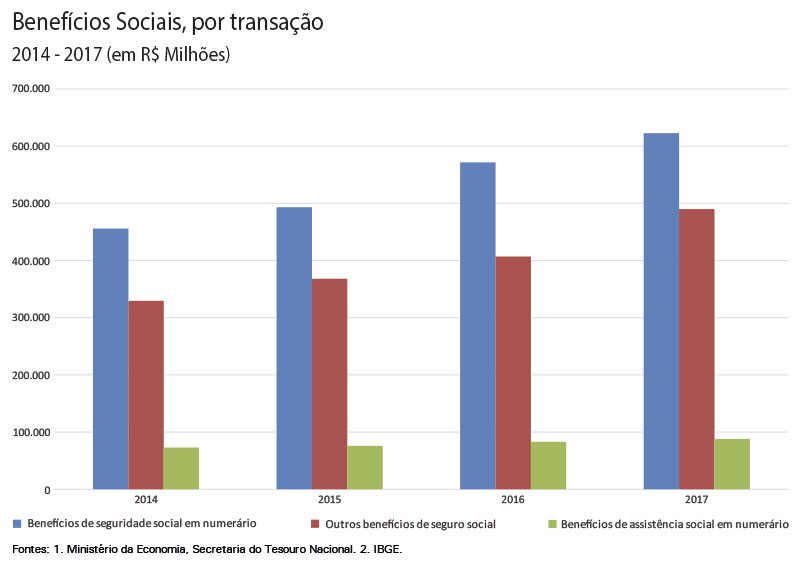
A Formação Bruta de Capital Fixo (FBCF) do governo (ainda abrangendo as três esferas administrativas) manteve a trajetória de queda, passando de R$ 92,7 bilhões em 2016 para R$ 80,3 bilhões em 2017, o que representou uma redução nominal de 13,3%. A principal influência foi a queda de cerca de 40% nos investimentos dos governos municipais. Entretanto, houve recuperação dos investimentos nas esferas estadual (alta de 8,8%, frente à queda de 13,5% em 2016) e federal (alta de 0,9%, frente à queda de 9,1% em 2016).
Em 2017, o valor adicionado do governo alcançou R$ 969,7 bilhões, um crescimento nominal de 6,6% em relação a 2016. Esta variação foi positiva em todas as esferas, mas de forma mais acentuada na esfera federal: com participação de 31,1% em 2016, passou a 32,0% em 2017. Ainda na passagem de 2016 para 2017, a participação estadual teve ligeira queda (de 36,9% para 35,9%) e a municipal manteve-se estável, com 32,1%.
A participação dos governos municipais no valor adicionado era de 31,6% em 2014, recuou para 31,4% em 2015 e subiu para 32,1% em 2016. As esferas federal e estadual perderam, cada uma, 0,3% em participação no mesmo período de 2015 para 2016.
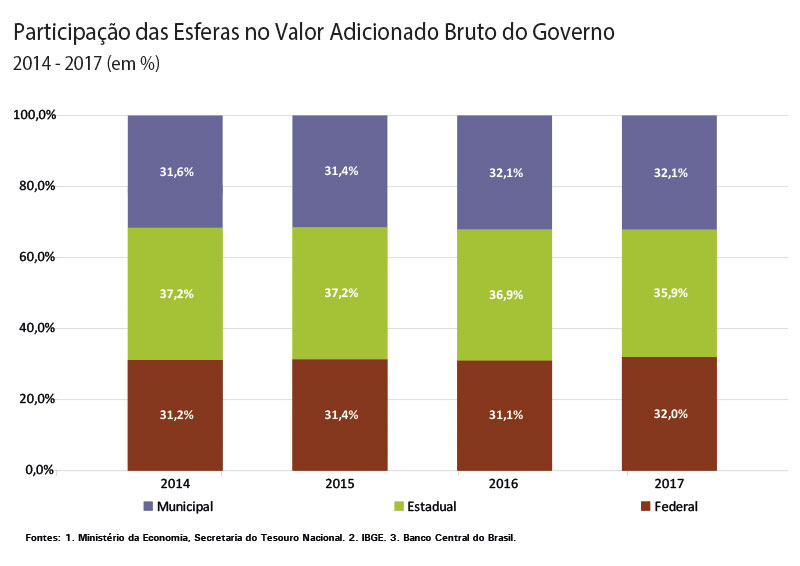
DOCUMENTO: https://agenciadenoticias.ibge.gov.br/agencia-sala-de-imprensa/2013-agencia-de-noticias/releases/24345-financas-publicas-formacao-bruta-de-capital-fixo-do-governo-tem-queda-de-13-3-em-2017
INDÚSTRIA
IBGE. 08/05/2019. Em março, indústria cai em nove dos 15 locais pesquisados
No recuo de 1,3% da indústria nacional em março (série com ajuste sazonal), nove dos 15 locais pesquisados tiveram taxas negativas. As quedas mais intensas foram no Pará (-11,3%) e na Bahia (-10,1%). Região Nordeste (-7,5%), Mato Grosso (-6,6%), Pernambuco (-6,0%), Minas Gerais (-2,2%) e Ceará (-1,7%) também tiveram quedas mais acentuadas do que a média nacional (-1,3%), enquanto São Paulo (-1,3%) e Amazonas (-0,5%) completaram o conjunto de locais com índices negativos. Por outro lado, Espírito Santo (3,6%), Rio de Janeiro (2,9%) e Goiás (2,3%) tiveram as maiores altas. As demais taxas positivas foram no Paraná (1,5%), Santa Catarina (1,2%) e Rio Grande do Sul (1,0%).
Indicadores Conjunturais da IndústriaResultados Regionais - Março de 2019
| ||||
|---|---|---|---|---|
| Locais | Variação (%) | |||
| Março 2019/ Fevereiro 2019* | Março 2019/ Março 2018 | Acumulado Janeiro-Março | Acumulado nos Últimos 12 Meses | |
| Amazonas | -0,5 | -10,8 | -5,1 | -2,1 |
| Pará | -11,3 | -12,5 | -0,7 | 7,2 |
| Região Nordeste | -7,5 | -7,0 | -4,4 | -0,7 |
| Ceará | -1,7 | -5,4 | 0,3 | -0,1 |
| Pernambuco | -6,0 | -4,4 | -2,4 | 3,3 |
| Bahia | -10,1 | -6,6 | -3,5 | -0,3 |
| Minas Gerais | -2,2 | -8,2 | -2,5 | -1,3 |
| Espírito Santo | 3,6 | -11,1 | -8,5 | -2,3 |
| Rio de Janeiro | 2,9 | -1,4 | -1,5 | 1,0 |
| São Paulo | -1,3 | -7,3 | -2,6 | -0,9 |
| Paraná | 1,5 | 2,4 | 7,8 | 4,0 |
| Santa Catarina | 1,2 | 3,0 | 2,8 | 3,7 |
| Rio Grande do Sul | 1,0 | 3,4 | 5,5 | 6,7 |
| Mato Grosso | -6,6 | -12,3 | -5,0 | -1,4 |
| Goiás | 2,3 | -1,1 | 2,3 | -4,1 |
| Brasil | -1,3 | -6,1 | -2,2 | -0,1 |
| Fonte: IBGE, Diretoria de Pesquisas, Coordenação de Indústria * Série com Ajuste Sazonal | ||||
Ainda na série com ajuste sazonal, a média móvel trimestral para o total da indústria recuou 0,5% no trimestre encerrado em março de 2019 frente ao nível do mês anterior e manteve a trajetória predominantemente descendente iniciada em agosto de 2018. Em termos regionais, nove dos 15 locais pesquisados tiveram taxas negativas, com destaque para os recuos mais acentuados no Pará (-3,7%), Espírito Santo (-3,4%), Mato Grosso (-2,9%), Bahia (-2,2%) e Minas Gerais (-2,1%). Por outro lado, Amazonas (2,5%), Paraná (1,5%), Pernambuco (1,2%), Santa Catarina (1,1%) e Rio Grande do Sul (0,8%) tiveram os maiores avanços.
Na comparação com março de 2018, o setor industrial caiu 6,1% em março de 2019, com 12 dos 15 locais pesquisados registrando resultados negativos. Vale citar que março de 2019 (19 dias) teve dois dias úteis a menos do que igual mês do ano anterior (21). Nesse mês, os recuos mais intensos foram no Pará (-12,5%), Mato Grosso (-12,3%), Espírito Santo (-11,1%) e Amazonas (-10,8%), pressionados pelos setores de indústrias extrativas (minérios de ferro em bruto ou beneficiados), no primeiro local; de produtos alimentícios (carnes de bovinos frescas, refrigeradas e congeladas), no segundo; de celulose, papel e produtos de papel (celulose), indústrias extrativas (óleos brutos de petróleo) e produtos alimentícios (bombons e chocolates em barras, carnes de bovinos frescas, refrigeradas e congeladas e queijos), no terceiro; e de equipamentos de informática, produtos eletrônicos e ópticos (televisores), no último. Minas Gerais (-8,2%), São Paulo (-7,3%), Região Nordeste (-7,0%) e Bahia (-6,6%) também registraram taxas negativas mais acentuadas do que a média nacional (-6,1%), enquanto Ceará (-5,4%), Pernambuco (-4,4%), Rio de Janeiro (-1,4%) e Goiás (-1,1%) completaram o conjunto de locais com recuo na produção.
Por outro lado, Rio Grande do Sul (3,4%), Santa Catarina (3,0%) e Paraná (2,4%) tiveram avanços, impulsionados pelas atividades de bebidas (vinhos de uva, cervejas, chope e refrigerantes) e veículos automotores, reboques e carrocerias (carrocerias para ônibus e reboques e semirreboques), no primeiro local; de máquinas, aparelhos e materiais elétricos (refrigeradores ou congeladores para uso doméstico e transformadores) e máquinas e equipamentos (silos metálicos para cereais), no segundo; e de produtos alimentícios (açúcar cristal, carnes e miudezas de aves congeladas, rações e carnes de bovinos congeladas), coque, produtos derivados do petróleo e biocombustíveis (óleo diesel, gasolina automotiva e álcool etílico) e máquinas e equipamentos (máquinas para colheita), no último.
No acumulado para o período janeiro-março de 2019, frente a igual período do ano anterior, dez dos 15 locais pesquisados tiveram quedas, com destaque para o Espírito Santo (-8,5%). Amazonas (-5,1%), Mato Grosso (-5,0%), Região Nordeste (-4,4%), Bahia (-3,5%), São Paulo (-2,6%), Minas Gerais (-2,5%) e Pernambuco (-2,4%) também registraram taxas negativas mais intensas do que a média da indústria (-2,2%), enquanto Rio de Janeiro (-1,5%) e Pará (-0,7%) completaram o conjunto de locais com recuo na produção no fechamento dos três primeiros meses de 2019. Por outro lado, Paraná (7,8%) e Rio Grande do Sul (5,5%) tiveram os maiores avanços. Santa Catarina (2,8%), Goiás (2,3%) e Ceará (0,3%) também mostraram taxas positivas.
Ainda no índice acumulado do primeiro trimestre de 2019, o setor industrial, ao recuar 2,2%, intensificou a queda verificada no quarto trimestre de 2018 (-1,2%) e permaneceu com a clara perda de ritmo iniciada no último trimestre de 2017 (5,0%), todas as comparações contra igual período do ano anterior. Em termos regionais, dez dos 15 locais pesquisados mostraram perda de dinamismo, com destaque para Espírito Santo (de 3,6% para -8,5%), Pará (de 9,0% para -0,7%), Bahia (de 2,6% para -3,5%), Rio Grande do Sul (de 8,8% para 5,5%), Minas Gerais (de 0,4% para -2,5%), Região Nordeste (de -1,6% para -4,4%) e Mato Grosso (de -2,5% para -5,0%). Por outro lado, Goiás (de -8,0% para 2,3%) e Paraná (de 0,7 para 7,8%) tiveram os avanços mais acentuados entre os dois períodos.
O acumulado nos últimos 12 meses, ao registrar variação negativa de 0,1% em março de 2019, mostrou o primeiro resultado negativo desde agosto de 2017 e permaneceu com a trajetória descendente iniciada em julho de 2018 (3,3%). Em termos regionais, nove dos 15 locais pesquisados tiveram quedas, mas onze mostraram menor dinamismo frente aos índices de fevereiro. Entre os locais, Amazonas (de 0,7% para -2,1%), Pará (de 9,1% para 7,2%), Mato Grosso (de -0,2% para -1,4%), São Paulo (de 0,0% para -0,9%), Espírito Santo (de -1,6% para -2,3%) e Ceará (de 0,4% para -0,1%) assinalaram as principais perdas de ritmo entre fevereiro e março de 2019, enquanto Rio Grande do Sul (de 6,1% para 6,7%) e Paraná (de 3,5% para 4,0%) registraram os principais ganhos entre os dois períodos.
Queda na produção de São Paulo e Pará pressiona indústria nacional em março. Nove dos 15 locais pesquisados tiveram queda na produção em março
A queda de 11,3% na produção industrial paraense e de 1,3% na indústria paulista, em março, foram as principais influências para o resultado de -1,3% da indústria nacional, segundo o resultado da Pesquisa Industrial Mensal – Regional, divulgada hoje pelo IBGE.
O gerente da Pesquisa, Bernardo Almeida, explica que a extração de minério de ferro representa cerca de 86% do total da indústria no Pará. “Por conta da alta concentração nessa atividade, o resultado no estado fica vulnerável a oscilações na produção”, afirma.
Em São Paulo, a indústria de veículos automotores mostrou queda devido às chuvas de março que alagaram os pátios das empresas localizados na região do ABC paulista, atrapalhando a produção, e por conta da ocorrência de greves. “Houve, também, uma antecipação da produção para fevereiro, em razão do carnaval ter caído em março neste ano”, ressalta Bernardo.
Produção Industrial (mês/mês anterior)
Clique e arraste para zoom
Fonte: IBGE - Pesquisa Industrial Mensal - Produção Física
Bahia (-10,1%), Região Nordeste (-7,5%), Mato Grosso (-6,6%), Pernambuco (-6,0%), Minas Gerais (-2,2%) e Ceará (-1,7%) também apontaram reduções mais elevadas do que a média nacional (-1,3%), enquanto o Amazonas (-0,5%) completou o conjunto de locais com índices negativos em março. Espírito Santo (3,6%), Rio de Janeiro (2,9%) e Goiás (2,3%) assinalaram os avanços mais intensos nesse mês.
“O resultado da indústria está sendo determinado pelo alto nível de desemprego e pelo ambiente político, que acarretam cautela na decisão de investimento por parte dos empresários e no consumo por parte das famílias”, conclui o gerente da pesquisa.
Indústria perde dinamismo em 10 dos 15 locais pesquisados no trimestre
No primeiro trimestre do ano, a indústria teve retração de 2,2%, intensificando a queda de 1,2% verificada no quarto trimestre de 2018. Dez dos 15 locais pesquisados tiveram perda de dinamismo entre os dois últimos trimestres, com destaque para Espírito Santo (de 3,6% para -8,5%), Pará (de 9% para -0,7%), Bahia (de 2,6% para -3,5%), Rio Grande do Sul (de 8,8% para 5,5%), Minas Gerais (de 0,4% para -2,5%), Região Nordeste (de -1,6% para -4,4%) e Mato Grosso (de -2,5% para -5%).
DOCUMENTO: https://agenciadenoticias.ibge.gov.br/agencia-sala-de-imprensa/2013-agencia-de-noticias/releases/24346-em-marco-industria-cai-em-nove-dos-15-locais-pesquisados
COMÉRCIO INTERNACIONAL
EUA. CHINA. REUTERS. 8 DE MAIO DE 2019. EUA vão elevar tarifas sobre US$200 bi em produtos chineses, diz Federal Register
WASHINGTON (Reuters) - Os Estados Unidos vão elevar as tarifas sobre 200 bilhões de dólares em produtos chineses para 25 por cento, de 10 por cento já em vigor, a partir de sexta-feira, de acordo com o Federal Register, diário oficial do país, nesta quarta-feira.
O gabinete do representante comercial dos EUA vai estabelecer um processo para excluir certos produtos das tarifas adicionais, informou o Federal Register.
Por Makini Brice
EUA. CHINA. REUTERS. 8 DE MAIO DE 2019. Trump diz que ficará feliz em manter tarifas sobre importações chinesas em vigor
WASHINGTON (Reuters) - O presidente dos Estados Unidos, Donald Trump, disse nesta quarta-feira que ficará feliz em manter as tarifas sobre as importações chinesas, acrescentando que a China está equivocada se espera negociar o comércio mais tarde com uma administração presidencial democrata.
“A razão para a revisão dos termos da China e a tentativa de renegociação do acordo comercial é a sincera esperança de que eles possam negociar com Joe Biden ou um dos democratas muito fracos”, publicou Trump no Twitter.
“Adivinhe, isso não vai acontecer! A China acaba de nos informar que eles (vice-premiê) estão chegando aos EUA para fazer um acordo. Vamos ver, mas estou muito feliz com mais de 100 bilhões de dólares por ano em tarifas enchendo os cofres dos EUA”, acrescentou.
Os Estados Unidos anunciaram nesta quarta-feira que elevarão as tarifas sobre 200 bilhões de dólares em importações chinesas de 10 para 25 por cento na sexta-feira, de acordo com o Federal Register, diário oficial do país.
Fontes com conhecimento das negociações disseram à Reuters que a China buscou alterar questões previamente acordadas especificando mudanças nas leis chinesas, o que afeta quase todos os capítulos do um acordo comercial de 150 páginas entre Washington e Pequim.
As mudanças solicitadas pela China criarão grandes obstáculos para chegar a um acordo em dois dias de negociações com o vice-primeiro-ministro chinês, Liu He, nesta semana, antes que o aumento tarifário entre em vigor.
Por Makini Brice e David Lawder
EUA. CHINA. REUTERS. 8 DE MAIO DE 2019. Exportações da China têm queda inesperada em abril mas importações se recuperam
Por Yawen Chen e Kevin Yao
PEQUIM (Reuters) - As exportações da China caíram inesperadamente em abril mas as importações surpreenderam com sua primeira alta em cinco meses, pintando um cenário misto da economia no momento que os Estados Unidos reforçam a pressão sobre Pequim com ameaças de mais tarifas.
Negociadores chineses e dos EUA vão se encontrar em Washington nos próximos dois dias, conforme Pequim tenta evitar um forte aumento das tarifas sobre seus produtos ordenado pelo presidente Donald Trump para entrar em vigor na sexta-feira.
Investidores esperavam que os dados comerciais de abril da China ampliassem os sinais de que a economia está começando a se estabilizar, aliviando preocupações sobre a desaceleração do crescimento global.
Mas as exportações caíram 2,7 por cento sobre o ano anterior, mostraram dados da alfândega nesta quarta-feira.
O ANZ estimou que mais de 80 por cento do declínio se devem à forte queda nos embarques para os EUA, enquanto as exportações de alta tecnologia continuam a ser pressionadas pela fraca demanda global por smartphones e outros gadgets.
Economistas consultados pela Reuters esperavam que o crescimento desacertasse a 2,3 por cento após salto em março de 14,2 por cento, que alguns analistas acreditam ter sido provocado por fatores sazonais e distorções temporárias relacionadas a um corte no imposto sobre valor agregado a partir de 1 de abril.
“O cenário para as exportações chinesas é desafiador. Se Trump avançar com sua última ameaça de tarifas, achamos que isso vai pesar sobre o crescimento das exportações em dois a três pontos percentuais”, disse a Capital Economias em nota.
As importações, entretanto, superaram as expectativas com uma alta de 4 por cento na comparação anual, ante expectativa de analistas de queda de 3,6 por cento e recuo de 7,6 por cento em março.
O aumento foi o primeiro desde novembro, sugerindo que a demanda doméstica está começando a se recuperar conforme Pequim adota mais medidas de estímulo.
A China registrou um superáveis comercial de 13,84 bilhões de dólares em abril, contra previsão de 35 bilhões de dólares.
O superáveis comercial com os EUA aumentou para 21,01 bilhões de dólares em abril, de 20,5 bilhões em março. As importações chinesas dos EUA caíram quase 26 por cento, enquanto as exportações para os EUA recuaram pouco mais de 13 por cento.
EUA. CHINA. REUTERS. 8 DE MAIO DE 2019. EXCLUSIVO-China volta atrás em quase todos os aspectos do acordo comercial com os EUA, dizem fontes
Por David Lawder e Jeff Mason e Michael Martina
WASHINGTON/PEQUIM (Reuters) - Pequim enviou a Washington na sexta-feira à noite mudanças sistemáticas ao esboço de quase 150 páginas do acordo comercial que acabaria com meses de negociações entre as duas maiores econômicas do mundo, de acordo com três fontes do governo dos Estados Unidos e três fontes do setor privado com conhecimento das negociações.
O documento estava cheio de mudanças em que a China voltava atrás em itens que afetaram as principais demandas dos EUA, disseram as fontes à Reuters.
Em cada um dos sete capítulos do esboço do acordo comercial a China retirou seus compromissos para mudar leis que resolveriam as principais reclamações que levaram os EUA a lançarem uma guerra comercial: roubo de propriedade intelectual e segredos comerciais dos EUA, transferências forçadas de tecnologia, acesso a serviços financeiros e manipulação cambial.
O presidente dos EUA, Donald Trump, respondeu no Twitter no domingo com a promessa de elevar as tarifas sobre 200 bilhões de dólares em produtos chineses de 10 a 25 por cento na sexta-feira —calculado para acontecer no meio de uma visita do vice-premiê chinês, Liu He, a Washington para continuar com as negociações comerciais.
A retirada de linguagem legal vinculativa do esboço afetou diretamente a mais alta prioridade do representante de Comércio dos EUA, Robert Lighthizer —para quem mudanças nas leis chinesas são essenciais para verificar o cumprimento das medidas após anos do que autoridades norte-americanas chamaram de promessas vazias de reformas.
Lighthizer pressionou muito por um regime de cumprimento mais parecido com aqueles usados para sanções econômicas —como as adotadas sobre a Coreia do Norte ou Irã — do que um acordo comercial típico.
“Isso prejudica a arquitetura principal do acordo”, disse uma fonte de Washington com conhecimento das discussões.
“PROCESSO DE NEGOCIAÇÃO”
Porta-vozes da Casa Branca, do Representante Comercial dos EUA e do Departamento do Tesouro dos EUA não responderam imediatamente aos pedidos de comentários.
O porta-voz do Ministério das Relações Exteriores da China, Geng Shuang, disse em uma entrevista nesta quarta-feira que resolver as divergências sobre a guerra comercial é um “processo de negociação” e que a China não está “evitando problemas”.
Geng encaminhou questionamentos específicos sobre as negociações comerciais para o Ministério do Comércio, que também não respondeu imediatamente a perguntas enviadas por fax pela Reuters.
Lighthizer e o secretário do Tesouro dos EUA, Steven Mnuchin, foram surpreendidos com a extensão das mudanças no esboço. Na segunda-feira, as duas autoridades disseram a repórteres que o fato de a China ter voltado atrás havia motivado a ordem de aumento das tarifas por Trump, mas não forneceram detalhes sobre a profundidade e a amplitude das revisões.
Na semana passada, Liu disse a Lighthizer e a Mnuchin que eles precisavam confiar na China para cumprir suas promessas por meio de mudanças administrativas e regulatórias, disseram duas das fontes. Tanto Mnuchin quanto Lighthizer consideraram isso inaceitável, dada a história da China de não cumprir as promessas de reforma.
Uma fonte do setor privado informada sobre as discussões disse que a última rodada de negociações foi muito ruim porque “a China ficou gananciosa”.
“A China renegou uma dúzia de coisas, se não mais ... As negociações foram tão ruins que a verdadeira surpresa é que Trump demorou até domingo para explodir”, disse a fonte.
“Depois de 20 anos fazendo o mesmo com os EUA, a China ainda parece estar errando com essa administração.”
MINERAÇÃO
CIA VALE DO RIO DOCE. 08/05/2019. Produção e vendas da Vale no 1T19. Destaques de Produção e Vendas
A produção de finos de minério de ferro da Vale totalizou 72,9 Mt no 1T19, ficando 28% e 11% menor do que no 4T18 e 1T18, respectivamente, principalmente em função dos impactos decorrentes da ruptura da barragem de Brumadinho e da sazonalidade climática mais forte do que o normal.
A produção de pelotas¹ da Vale totalizou 12,2 Mt no 1T19, ficando 23% e 5% menor do que no 4T18 e 1T18, respectivamente, devido principalmente às paradas nas usinas de pelotização, após a ruptura da barragem de Brumadinho, bem como às manutenções programadas em Tubarão e Omã.
O volume de vendas de finos e pelotas de minério de ferro atingiu de 67,7 Mt no 1T19, ficando 30% e 20% menor do que no 4T18 e 1T18, respectivamente. A redução em relação ao 4T18 foi decorrente dos seguintes efeitos: (a) sazonalidade usual (14 Mt); (b) impacto de paradas de produção após a ruptura da barragem de Brumadinho (7 Mt); (c) novos procedimentos de gerenciamento de estoque nos portos chineses, que impactaram o tempo de reconhecimento da receita de vendas (6 Mt); (d) chuvas anormais impactando os embarques do porto de Ponta da Madeira, no Sistema Norte (5 Mt); os quais foram parcialmente compensados pela utilização de estoques nos portos chineses no 1T19 (3 Mt).
Com relação aos procedimentos de gerenciamento de estoques mencionados acima e de acordo com as práticas anteriores, uma vez que um acordo comercial era pactuado, a propriedade do produto em nossos centros de blendagem era transferida para o cliente e a receita era reconhecida, independentemente da retirada do minério pelo cliente. Consequentemente, o minério vendido tinha que ser segregado no porto que aguardava retirada da carga e, portanto, a capacidade operacional do porto era limitada devido à falta de flexibilidade do pátio de estocagem.
De acordo com as novas práticas comerciais, a propriedade do produto e, portanto, o reconhecimento de receita só é concedido mediante a retirada de carga, o que afeta o momento do reconhecimento da receita de vendas.
A participação dos produtos premium² nas vendas totais foi de 81% no 1T19, ficando praticamente em linha com o 4T18. Os prêmios de qualidade de finos de minério de ferro e pelotas alcançaram US$10,7/t[3] no 1T19 contra US$ 11,5/t no 4T18, principalmente devido aos menores prêmios de mercado para os finos de Carajás, que foram parcialmente compensados pelo impacto positivo dos novos termos para os contratos de vendas de pelotas.
A produção de níquel acabado alcançou 54.800 t no 1T19, ficando 14,4% menor do que no 4T18 e 6,5% abaixo do 1T18. A redução deveu-se, principalmente, à menor produção de: (a) PTVI, devido à parada programada de manutenção na refinaria de Matsusaka, no Japão; (b) VNC, devido à manutenção programada na refinaria de Dalian, na China; (c) Sudbury, devido a diferenças temporais na cadeia de processamento de níquel.
A produção de cobre atingiu 93.800 t no 1T19, ficando 14,6% abaixo do 4T18 e em linha com o 1T18. A produção diminuiu, principalmente, devido aos menores teores de feed e à menor produtividade da planta em várias operações.
A produção de carvão totalizou 2,2 Mt no 1T19, ficando 29% e 9% abaixo do 4T18 e do 1T18, respectivamente, como resultado das fortes chuvas ao longo do trimestre.


DOCUMENTO: http://www.vale.com/PT/investors/information-market/quarterly-results/ResultadosTrimestrais/PREPORT1T19_p.pdf
ENERGIA
PETROBRÁS. 8 DE MAIO DE 2019. Produção da Petrobras se recupera e está acima de 2,8 mi boe/d em maio, diz diretor
RIO DE JANEIRO (Reuters) - A produção de petróleo e gás da Petrobras está em recuperação no segundo trimestre, com nível acima de 2,8 milhões de barris de óleo equivalente por dia em maio, afirmou nesta quarta-feira o diretor de exploração e produção da petroleira Carlos Alberto de Oliveira, que manteve a meta para o ano.
O avanço ocorre após a empresa ter registrado queda na produção no Brasil e no exterior no primeiro trimestre, para 2,538 milhões de boe/d, ante 2,68 milhões de boe/d no mesmo período do ano passado, com impactos de venda de ativos e manutenção em plataformas.
A meta para o ano é produzir 2,8 milhões de boe/d no Brasil e no exterior, ante 2,7 milhões de boe/d em 2018.
Mas a empresa garante o aumento da produção devido às sete plataformas colocadas em operação nos últimos 11 meses. Até a última semana de abril, a produção já havia retornado ao patamar de 2,7 milhões de boe/d.
Por Marta Nogueira
TURISMO
EMBRATUR. 07/05/2019. Embratur prevê ações de promoção do potencial brasileiro no Enoturismo. Comitiva de Bento Gonçalves apresenta Festa Nacional do Vinho e ressalta potencial do turismo brasileiro para atração de turistas internacionais no segmento
O presidente da Embratur, Leônidas de Oliveira, recebeu nesta segunda-feira, uma comitiva de Bento Gonçalves, Rio Grande do Sul, para debater possíveis ações de promoção dos atrativos da Região Sul para o Enoturismo, segmento que se baseia na viagem motivada pela apreciação do sabor e aroma dos vinhos e das tradições e cultura das localidades produtoras. O prefeito da cidade, Guilherme Pasin, convidou o presidente do instituto para participar da a 29ª ExpoBento e a 16ª Fenavinho (Festa Nacional do Vinho), que acontecem em junho.
Segundo Leônidas Oliveira, o Enoturismo é mais um exemplo da diversificação da oferta turística do Brasil e colocou o instituto à disposição para ações de promoção dos eventos e do segmento no exterior. “A apreciação do vinho está mais popular no Brasil e atrai turistas de todo o mundo. A Serra Gaúcha tem potencial para competir com destinos que desenvolveram este nicho como Mendoza, na Argentina, além da Califórnia e da Espanha”, pondera o presidente da Embratur.
O prefeito de Bento Gonçalves, Guilherme Pasin destacou a importância dos dois eventos para a economia e para o turismo da região que acontecem entre os dias 13 e 23 de junho. Segundo ele, a 29ª edição da ExpoBento marca a retomada da Festa do Vinho e os eventos combinados contam com 470 expositores e devem receber mais de 200 mil pessoas.
“Os eventos têm foco no fechamento de negócios. O vinho é o produto indutor da atividade turística na região. Bento Gonçalves é um destino diferenciado onde o turista internacional degusta vinhos, espumantes e uma gastronomia rica, além de ter contato com montanhas, serras, vales, morros e até com o frio, “ressalta.
O secretário de Turismo do município, Rodrigo Parisotto destacou a infraestrutura turística de Bento Gonçalves que conta com 41 hotéis e pousadas e 3,2 mil leitos. “Recebemos 1,5 milhão de visitantes nacionais e internacionais por ano e a meta é chegar a 4 mil leitos em 2021. O posicionamento é promover o turismo durante o ano todo. Já que somos o primeiro destino enoturístico do Brasil”, afirma.
COMITÊ DESCUBRA BRASIL
No final de abril, Bento Gonçalves participou do 7º Workshop Brasil Sensacional, promovido pela Embratur, em Lima, no Peru, em conjunto com o Setor de Promoção Comercial da Embaixada do Brasil no país e o Comitê Descubra Brasil.
A meta da ação é atrair mais turistas do país sul-americano com a divulgação de destinos brasileiros para os profissionais do setor peruanos que vendem produtos turísticos. Mais de 400 operadores de turismo e agentes de viagem do Peru participaram da ação do instituto e puderam conhecer detalhes de destinos como Foz do Iguaçu, Gramado e Salvador, além de Bento Gonçalves.
Foram realizadas rodadas de negócios, seminários e distribuição de material informativo sobre os produtos do Brasil. O Peru é considerado um mercado promissor pela proximidade com o Brasil. Cerca de 120 mil turistas deste país visitam os destinos brasileiros por ano e a expectativa é que este número aumente em 2019, especialmente, pela realização da Copa América 2019 nas cidades de São Paulo, Rio de Janeiro, Belo Horizonte, Porto Alegre e Salvador.
Atualmente, são operados 188 voos diretos por mês entre a capital Lima e as cidades brasileiras de São Paulo, Rio de Janeiro, Porto Alegre e Foz do Iguaçu, com capacidade para transportar mais de 38 mil pessoas no período.
BRASIL - VIETNÃ
MRE. AIG. NOTA-118. 08 de Mai de 2019. Comemoração dos 30 anos de relações diplomáticas Brasil-Vietnã – 8 de maio de 2019
Brasil e Vietnã celebram hoje o 30º aniversário do estabelecimento de relações diplomáticas. Em 1994, foi inaugurada a Embaixada do Brasil em Hanói, a primeira de um país latino-americano na capital vietnamita e, no ano 2000, a Embaixada do Vietnã em Brasília foi estabelecida.
São três décadas de aprofundamento contínuo das relações bilaterais. Em 2018, o comércio do Brasil com o Vietnã foi superior a US$ 4,2 bilhões, seu maior nível histórico. No último ano, o Vietnã foi o 5º maior parceiro comercial do Brasil na Ásia. Empresas brasileiras dos setores de arquitetura e de produção de couros, entre outras, mantêm investimentos no Vietnã.
Brasil e Vietnã contam com acordos nos mais diversos campos, como os de ciência e tecnologia; cultura; esportes; produção e uso de etanol combustível; e saúde. Nos últimos anos, os dois países firmaram, ainda, atos sobre serviços aéreos; transportes marítimos; cooperação entre think tanks; e treinamento de diplomatas.
Os dois países trabalham hoje para expandir e diversificar o já significativo comércio bilateral, bem como ampliar investimentos recíprocos. A promoção do conhecimento mútuo das sociedades brasileira e vietnamita, por meio, por exemplo, da intensificação dos fluxos de turismo, é também importante objetivo nas relações bilaterais.
O governo brasileiro congratula-se com o governo vietnamita pela profícua cooperação desenvolvida ao longo dessas três décadas, manifesta a expectativa de continuado adensamento das relações e transmite votos de prosperidade ao governo e ao povo do Vietnã.
Relações bilaterais
As relações diplomáticas entre Brasil e Vietnã foram estabelecidas em 1989. A Embaixada do Brasil em Hanói foi aberta em 1994, e o Vietnã inaugurou Embaixada em Brasília em 2000. O expressivo desempenho do comércio bilateral – que saltou de US$ 47,1 milhões em 2003 para US$ 3,918 bilhões em 2017, seu maior nível histórico – demonstra o potencial de expansão das trocas entre os dois países. Em 2017, o Vietnã foi o segundo maior parceiro comercial do Brasil dentre os países que integram a Associação de Nações do Sudeste Asiático (ASEAN).
O interesse vietnamita em conhecer as políticas públicas brasileiras se reflete na grande quantidade de visitas – as mais altas autoridades do país asiático já estiveram o Brasil, assim como delegações parlamentares, acadêmicas e técnicas, em áreas variadas, como previdência social, proteção do meio ambiente, eficiência energética, relações de trabalho, preparação de quadros negociadores na OMC, entre outras.
Brasil e Vietnã contam com dois mecanismos regulares de diálogo, a saber, as Consultas sobre Assuntos de Interesse Comum (Consultas Políticas) e a Comissão Mista. Cabe menção, ainda, ao Grupo de Amizade Parlamentar Vietnã-Brasil, criado em 2005. Estão em vigor instrumentos bilaterais nas áreas de saúde e ciências médicas; cooperação técnica para produção e uso de etanol combustível; cooperação científica e tecnológica; cooperação cultural; luta contra a fome e a pobreza; e cooperação esportiva.
Brasil e Vietnã têm cooperado em foros multilaterais, o que é exemplificado pelo apoio oficial do Vietnã a um assento permanente para o Brasil em um Conselho de Segurança das Nações Unidas reformado.
Cronologia das relações bilaterais
1989 – Estabelecimento de relações diplomáticas (maio)
1993 – Visita do Vice-Ministro dos Negócios Estrangeiros, Le Mai (outubro)
1994 – Visita da primeira missão empresarial brasileira ao Vietnã (abril)
1994 – Visita do Vice-Primeiro-Ministro Phan Van Khai (junho)
1994 – Instalação da Embaixada em Hanói (setembro)
1995 – Visita do Presidente do Vietnã, Le Duc Anh (outubro)
1997 – Abertura do Consulado-Geral do Vietnã em São Paulo
1998 – Primeira Reunião de Consultas Brasil-Vietnã (maio)
2000 – Abertura da Embaixada residente do Vietnã em Brasília (outubro)
2003 – II Reunião de Consultas Brasil-Vietnã (outubro)
2003 – Visita do Ministro da Defesa do Vietnã, Pham Van Tra (novembro)
2004 – Visita do Vice-Presidente da Comissão Parlamentar de Relações Exteriores do Vietnã (janeiro)
2004 – Visita ao Brasil do Vice-Ministro Le Van Bang e III Reunião de Consultas Brasil-Vietnã (outubro)
2004 – Visita ao Brasil do Presidente do Vietnã, Tran Duc Luong (novembro)
2004 – Realização, em São Paulo, do 1º “Fórum Empresarial Brasil-Vietnã” (novembro)
2005 – Criação do Grupo de Amizade Parlamentar Brasil-Vietnã
2006 – Visita do Presidente da Assembleia Nacional do Vietnã, Nguyen Van An (março)
2007 – Visita do Secretário-Geral do Partido Comunista, Nong Duc Manh (maio)
2007 – Missão chefiada pelo Secretário-Executivo do Ministério do Desenvolvimento Indústria e Comércio Exterior (MDIC), Ivan Ramalho (outubro)
2007 – IV Sessão de Consultas Brasil-Vietnã, em Hanói (novembro)
2008 – Visita a Hanói do Chanceler Celso Amorim (fevereiro)
2008 – Visita do Ministro do Desenvolvimento Social e Combate à Fome, Patrus Ananias (março)
2008 – Visita ao Vietnã do Presidente da Comissão de Relações Exteriores e Defesa Nacional do Senado Federal, Senador Heráclito Fortes (março)
2008 – Visita oficial ao Vietnã do Presidente Luiz Inácio Lula da Silva (julho)
2008 – Visita do Chanceler e Vice-Primeiro-Ministro, Pham Gia Khiem, a Brasília, por ocasião da I Reunião Ministerial Mercosul-Asean (novembro)
2008 – Visita do Vice-Ministro do Comércio e Indústria do Vietnã, Do Huu Hao, para a reunião de instalação da Comissão Mista e para Conferência Internacional sobre Biocombustíveis (novembro)
2009 – Visita do Vice-Ministro da Indústria e do Comércio Exterior do Vietnã, Do Huu Hao para I Reunião da Comissão Mista Brasil-Vietnã (maio)
2009 – Visita do Ministro da Cultura, Esportes e Turismo, Hoang Tuan Anh, para participar da celebração dos 20 anos de relações, em Brasília (outubro)
2010 – Visita a Brasília do Vice-Chanceler, atual titular da pasta, Pham Binh Minh, para chefiar a delegação vietnamita à V Reunião de Consultas Políticas (maio)
2010 – Criação da Associação de Amizade e Cooperação Vietnã-Brasil (seção vietnamita)
2010 – Participação do Vice-Primeiro-Ministro e Ministro da Educação do Vietnam, Nguyen Thien Nhan, na 34ª Sessão do Comitê do Patrimônio Mundial, em Brasília (julho)
2010 – Visita a Hanói da Subsecretária-Geral Política-II do Ministério das Relações Exteiores, Embaixadora Maria Edileuza Fontenele Reis (novembro)
2011 – Visita do Vice-Ministro de Ciência e Tecnologia, Nguyen Van Lang (junho)
2012 – Visita do Vice-Ministro de Ciência e Tecnologia, Nguyen Van Lang (abril)
2012 – Criação da seção brasileira da Associação de Amizade e Cooperação Brasil-Vietnã
2012 – Visita do Vice-Ministro da Indústria e Comércio, Tran Tuan Anh, chefiando a delegação vietnamita à II Reunião da Comissão Mista (abril)
2012 – Participação do Vice-Primeiro-Ministro Nguyen Thien Nhan na Rio+20 (junho)
2012 – Visita a Hanói do Ministro das Relações Exteriores, Antonio de Aguiar Patriota (6 e 7 de julho)
2012 – Visita do Vice-Ministro Permanente das Finanças do Vietnã, Nguyen Cong Nghiep (novembro)
2013 – Visita de inteligência comercial da APEX a Hanói e Ho Chi Minh (março)
2013 – Missão de inspeção do Ministério da Agricultura, Pecuária e Abastecimento e do Ministério da Pesca e Aquicultura ao Vietnã (março)
2013 – Visita ao Brasil do Diretor do Departamento de Informação ao Estrangeiro do PCV (julho)
2014 – Visita ao Brasil de missão empresarial vietnamita, organizada pela Câmara de Comércio e Indústria do Vietnã (março)
2014 – Visita ao Brasil do Vice-Ministro de Informação e Comunicação do Vietnam, Senhor Tran Duc Lai (outubro)
2014 – Missão de inspeção do Ministério da Agricultura, Pecuária e Abastecimento e do Ministério da Pesca e Aquicultura ao Vietnã (novembro)
2015 – Visita ao Vietnã de delegação brasileira de parlamentares, para participar da 132ª Assembleia Geral da União Interparlamentar (março)
2015 – Visita ao Brasil da Vice Presidente do Vietnã, Senhora Nguyen Thi Doan (14 a 16 de maio)
2015 – Viagem do Ministro das Relações Exteriores a Singapura, Timor-Leste, Vietnã e Japão (22 a 29 de julho)
2015 – Viagem da Presidenta da República ao Vietnã (Hanói, 1 e 2 de dezembro)
2017 – O secretário-geral do Itamaraty, embaixador Marcos Galvão, participa do ASEAN Day (29 de agosto) [50 anos da ASEAN] [Comunicado de imprensa da segunda reunião Ministerial ASEAN-Mercosul]
2017 – Viagem do ministro Aloysio Nunes Ferreira ao Vietnã (11 de setembro)
2018 – Visita ao Brasil do vice-primeiro-ministro do Vietnã, Vuong Dinh Hue (2 e 3 de julho) [Atos assinados]
BRASIL - HUNGRIA
MRE. AIG. NOTA-119. 08 de Mai de 2019. Visita de trabalho do Senhor Ministro de Estado à Hungria – 9 de maio de 2019
O Ministro das Relações Exteriores, Ernesto Araújo, realizará visita de trabalho à Hungria em 9 de maio próximo.
A visita constitui oportunidade para imprimir nova dinâmica às relações bilaterais, em seguimento à visita do Primeiro-Ministro Viktor Orbán ao Brasil, por ocasião da posse do Presidente da República Jair Bolsonaro.
Na capital húngara, o Ministro de Estado Ernesto Araújo manterá reunião de trabalho com o Ministro dos Negócios Estrangeiros e Comércio Exterior da Hungria, Péter Szijjártó, e com o Presidente do Parlamento, László Kövér, e proferirá palestra no Instituto de Negócios Estrangeiros e Comércio Exterior (IFAT).
Os Ministros discutirão temas da agenda internacional e formas de incrementar as relações bilaterais, em especial nos campos de economia e comércio, cooperação política, defesa, ciência e tecnologia e inovação. O Ministro Ernesto Araújo firmará, em Budapeste, o Tratado de Extradição Brasil-Hungria, instrumento que fortalece a cooperação jurídica entre os dois países.
A corrente de comércio entre Brasil e Hungria alcançou, em 2015, o pico de US$ 656 milhões. Em 2018, somou US$ 480 milhões.
________________
LGCJ.:

