US ECONOMICS
GDP
DoC. BEA. April 26, 2019. Gross Domestic Product, First Quarter 2019 (Advance Estimate)
Real gross domestic product (GDP) increased at an annual rate of 3.2 percent in the first quarter of 2019 (table 1), according to the "advance" estimate released by the Bureau of Economic Analysis. In the fourth quarter of 2018, real GDP increased 2.2 percent.
The Bureau’s first-quarter advance estimate released today is based on source data that are incomplete or subject to further revision by the source agency (see “Source Data for the Advance Estimate” on page 2). The "second" estimate for the first quarter, based on more complete data, will be released on May 30, 2019.
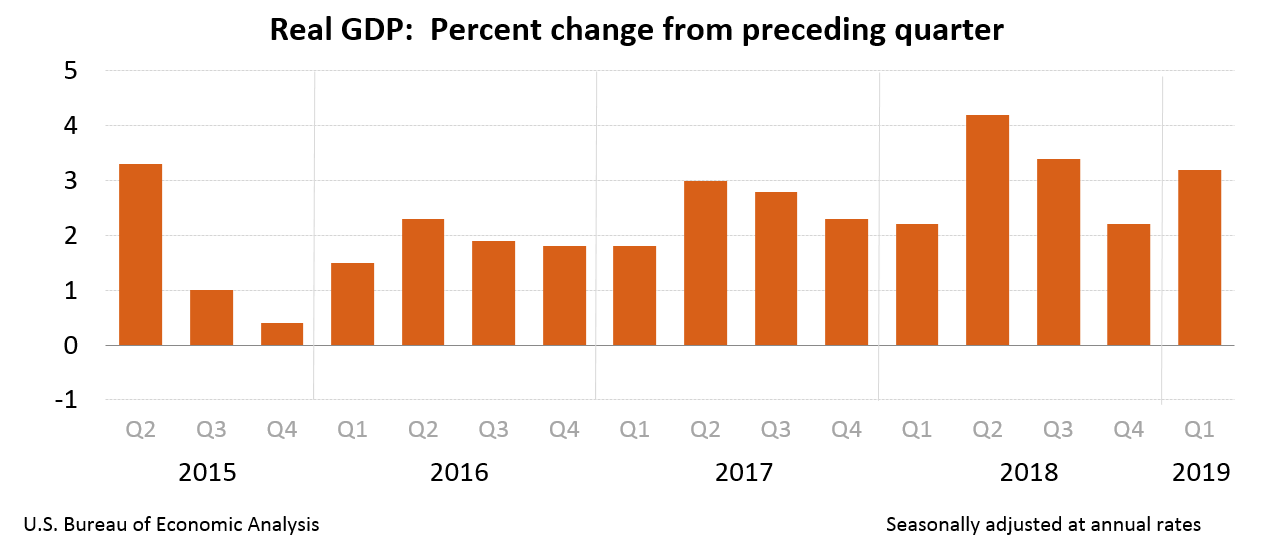
The increase in real GDP in the first quarter reflected positive contributions from personal consumption expenditures (PCE), private inventory investment, exports, state and local government spending, and nonresidential fixed investment. Imports, which are a subtraction in the calculation of GDP, decreased (table 2). These contributions were partly offset by a decrease in residential investment.
The acceleration in real GDP growth in the first quarter reflected an upturn in state and local government spending, accelerations in private inventory investment and in exports, and a smaller decrease in residential investment. These movements were partly offset by decelerations in PCE and nonresidential fixed investment, and a downturn in federal government spending. Imports, which are a subtraction in the calculation of GDP, turned down.
Current dollar GDP increased 3.8 percent, or $197.6 billion, in the first quarter to a level of $21.06 trillion. In the fourth quarter, current-dollar GDP increased 4.1 percent, or $206.9 billion (table 1 and table 3).
The price index for gross domestic purchases increased 0.8 percent in the first quarter, compared with an increase of 1.7 percent in the fourth quarter (table 4). The PCE price index increased 0.6 percent, compared with an increase of 1.5 percent. Excluding food and energy prices, the PCE price index increased 1.3 percent, compared with an increase of 1.8 percent.
Personal Income (table 8)
Current-dollar personal income increased $147.2 billion in the first quarter, compared with an increase of $229.0 billion in the fourth quarter. The deceleration reflected downturns in personal interest income, personal dividend income, and proprietors’ income that were partly offset by an acceleration in personal current transfer receipts.
Disposable personal income increased $116.0 billion, or 3.0 percent, in the first quarter, compared with an increase of $222.9 billion, or 5.8 percent, in the fourth quarter. Real disposable personal income increased 2.4 percent, compared with an increase of 4.3 percent.
Personal saving was $1.11 trillion in the first quarter, compared with $1.07 trillion in the fourth quarter. The personal saving rate -- personal saving as a percentage of disposable personal income -- was 7.0 percent in the first quarter, compared with 6.8 percent in the fourth quarter.
Source Data for the Advance Estimate
Information on the source data and key assumptions used for unavailable source data in the advance estimate is provided in a Technical Note that is posted with the news release on BEA’s Web site. A detailed "Key Source Data and Assumptions" file is also posted for each release. For information on updates to GDP, see the "Additional Information" section that follows.
FULL DOCUMENT: https://www.bea.gov/system/files/2019-04/gdp1q19_adv.pdf
THE WHITE HOUSE. 04/26/2019. US Economy Grows by 3.2% in the First Quarter, Topping Expectations
“The U.S. economy grew at a faster pace than expected in the first quarter and posted its best growth to start a year in four years,” Fred Imbert reports for CNBC.
“First-quarter gross domestic product expanded by 3.2%, the Bureau of Economic Analysis said Friday in its initial read of the economy for that period. Economists polled by Dow Jones expected growth of 2.5%.”
DoC. 04/26/2019. Statement from U.S. Secretary of Commerce Wilbur Ross on Q1 2019 GDP Growth. U.S. Economy Grows 3.2 Percent in First Quarter
WASHINGTON – Today, the U.S. Department of Commerce’s Bureau of Economic Analysis (BEA) released the first quarter 2019 Gross Domestic Product (GDP) numbers. The Bureau found that the real gross domestic product increased at an annual rate of 3.2 percent in the first quarter of 2019.
“This blockbuster GDP report shows that President Donald J. Trump’s policies are unleashing the vitality of the American economy, fulfilling the President’s promise for 3 percent economic growth and benefiting American workers in the form of better jobs and higher wages,” said Secretary of Commerce Wilbur Ross. “The Trump economy has repeatedly defied the skeptics who predicted an economic downturn and has restored America’s position in the world as a consistent source of economic growth.”
The U.S. economy has gotten off to a strong start so far in 2019. In January and February of 2019, the two months for which data is available, the U.S. trade deficit dropped well below expectations. This trend continued as exports alone drove nearly half a percentage point of overall GDP growth in the first quarter.
After starting off the year by adding over 300,000 jobs in January, the economy ended the first quarter at a 3.8 percent unemployment rate. In February, annual wage growth for hourly workers increased by 3.4 percent, the fastest rate since early 2009.
As they have since the start of his term in office, President Trump’s actions have yielded real results for American businesses, workers, and families, increasing incomes while cutting taxes and regulations.
CHINA
U.S. Department of State. April 26, 2019. China's New Road in the Americas: Beyond Silk and Silver. Remarks. Kimberly Breier, Assistant Secretary, Bureau of Western Hemisphere Affairs. Washington, DC
Thank you, Eric, and thank you to the Council for hosting me today. It’s a great honor for me to be here and to give these first remarks as Eric noted. This is a conversation that could not be more timely. Earlier this month, I accompanied Secretary Pompeo on a trip to South America – a productive trip to Chile, Paraguay, Peru, and Colombia – where he reaffirmed our partnership with these countries and focused on addressing shared challenges in the hemisphere.
This was a historic trip for many reasons, the fifth visit to Latin America by Secretary Pompeo in under a year in the job, the first visit to Paraguay by a sitting Secretary of State since 1965, and that reflects a unique moment in South America and in U.S. relations with the region. In no other part of the world do we have the privilege of strengthening our ties with a region where the interests of our partners relate so directly to our own. As we traveled from Santiago to Asunción, from Lima to Cúcuta on Colombia’s border with Venezuela, I felt, and I think we all felt, the palpable synergy among the United States and these four strong South American partners. We met with four heads of state – with each, we found a sense of shared purpose. We all see the Western Hemisphere as a hemisphere of freedom. “The people of the Americas have a right to democracy and their governments have an obligation to promote and defend it.” That is a quote that comes directly from the Inter-American Democratic Charter, and we work with these and other partners to bring these words to life, because we all know that our peoples deserve democracy, and the opportunity to build our own prosperous futures.
We could see first-hand how the Pacific Alliance and ProSur bring to life the region’s commitment to transparency and good business practices, a commitment that will advance regional prosperity; and how Chile, leading APEC this year, is bringing this Western Hemisphere vision of positive economic engagement to the entire Pacific region.
We found we share – absolutely – a common purpose as together we confront Nicolás Maduro’s destruction of Venezuela, and work together to help the Venezuelan people face down the illegitimate, corrupt, and criminal cohort surrounding Maduro and to help them as they work to restore democracy in their country. We share a common purpose as well as we confront the horrific humanitarian and regional crises Maduro has imposed on the Venezuelan people and on the nearly every country in our hemisphere.
We also found that we share a common purpose as we discussed the scourge of corruption and how the disregard for rule of law risks undermining the region’s efforts to grow its economies and provide security for its citizens.
Our message for the hemisphere, the Secretary’s message during his recent travels, and during his speech in Santiago, and my message for you today is that the United States is deepening its engagement in the region, and joining with the rest of the hemisphere to create an engine for economic vitality, innovation, and growth.
Our economic ties with the countries of Latin America and the Caribbean support livelihoods throughout the hemisphere and reinforce our shared values. Many of you are aware that this region is home to 12 of the 20 countries with whom the United States enjoys free trade agreements.
We remain committed to market-driven, private sector led model of economic development and to fostering long-term prosperity and stability, and the U.S. government is working to support this vision, using tools of economic statecraft, in partnership with U.S. businesses.
Let me offer a few examples of how we support this vision.
Last year President Trump signed the BUILD Act, which will double the amount of development finance we offer around the world, to $60 billion dollars. We plan to leverage this financing in key markets in Latin America and the Caribbean and strengthen U.S. ties with these important neighbors.
The Administration’s America Crece or “Growth in the Americas” program seeks to catalyze private sector energy and infrastructure investments in Latin America and the Caribbean. Since August 2018, we have signed MOUs with Panama, Chile, Argentina, and Jamaica under this initiative; additional agreements are in the works.
None of this can take place in a vacuum. Our companies, many of you, are ready to engage, but they need a level playing field.
This is why we continue to press for market access for U.S. companies, and for fair and reciprocal trade. This is why we continue to demand that all economic actors operating here in the Americas adhere to the highest standards for transparency, anti-corruption, debt sustainability, labor rights, and environmental protection. This is why we support strengthening of legal regimes and the rule of law and support for democratic governance.
However, we know that not everyone plays by the same rules or respects the same norms. Secretary Pompeo addressed this challenge when he said unequivocally that China’s economic engagement in Latin America and the Caribbean has created new challenges; and we want to ensure that our partners consider the risks inherent in closer ties with China. The Trump administration will always base our approach to foreign policy with a clear-eyed view of what is actually happening in the world.
We recognize the obvious: China is and will remain a significant trade partner for the United States and for many other countries in the region. President Trump has prioritized ensuring fair and reciprocal trade with China, and we have seen that when China plays by international standards, it can play an important role in helping countries develop their own potential. However, in Latin America and the Caribbean, we have seen that China too often departs from these international standards, and when it does, its opaque practices enable corruption, erode good governance, and challenge state sovereignty.
We’re all getting over the hangover left by gross corruption; we understand how it steals money from the pockets of taxpayers, distorts public spending, undermines faith in politics and public institutions, and hurts the men and women determined to put in an honest day’s work and earn an honest return for their efforts. Peru led the way in making that the message of last year’s Summit of the Americas. It’s a good message. As we work together to clean up corruption in the Americas, we must guard against it from entering from abroad.
The government of China, and Chinese firms, have engaged in behavior in the hemisphere that undermines the sovereignty and national security of both the United States and democratic partners in the Americas.
As the President’s National Security Strategy (NSS) states: “For decades, U.S. policy was rooted in the belief that support for China’s rise and its integration into the post-war international order would liberalize China. Contrary to our hopes, China expanded its power at the expense of the sovereignty of others. China gathers and exploits data on an unrivaled scale and spreads features of its authoritarian system, including corruption and the use of surveillance.”
Since China joined the WTO in 2001, we have been waiting for it to subscribe and follow international best practices that support good governance, like our Foreign Corrupt Practices Act. These are rules that many companies and entrepreneurs throughout Latin America, regardless of market share or size – strive to emulate.
Repeatedly, we have seen China fail to meet those expectations. China has blocked other countries from access to its markets, even as it seeks to expand in countries around the world. The Chinese government forces foreign firms that want to operate in China to share proprietary information and transfer technology.
Chinese firms steal intellectual property. Our Department of Justice has recently revealed examples of this behavior, including Huawei officials stealing proprietary information from a major U.S. telecom provider.
This behavior persists in the region, even as the hard work and research of people in our country, and throughout the hemisphere, is stolen, copied, and abused. The United States asks its partners in the Americas to hold China and others to account and not to allow China to play by its own rules.
To do otherwise would be like showing up to a soccer match and sitting idly by while the referee pulls only yellow and red cards on your team, while looking the other way as the opponent hacks away at your star players.
The Chinese Government abuses legal due process. As if stealing intellectual property were not enough, when the United States attempted to hold the perpetrators of such crimes to account, and issued an international warrant in the case of Ms. Meng, China reacted by making a mockery of international law and due process. After Canada detained Ms. Meng on a warrant, China reacted by arbitrarily arresting two Canadian citizens and resentencing a third to death on drug charges. Moreover, it sought to damage Canada’s economy by limiting agricultural imports, all in an effort to force Canada to release Ms. Meng. The international community cannot yield to such manipulation, wherein China retaliates for legitimate law enforcement actions by arbitrarily arresting and prosecuting our citizens. It would sound like a poor movie script, were it not completely true. The U.S. has promised, and will ensure, that Ms. Meng is given every due process and right under our laws.
As we look ahead toward an increasingly digital, and interconnected world economy, attempts to exploit open economic markets to illicitly transfer technology, gather data on an unprecedented scale for exploitative and coercive purposes, or export the pervasive use of surveillance technologies to repress human rights pose an existential threat to the freedoms and to our societies.
Our economies depend on connectivity and high-speed internet and unparalleled processing of vast volumes of data. And with this digital economy, the Administration has taken a very close look at the next generation of technology with a focus on national security.
Given the transformational nature of 5G technology, procurement and deployment decisions made now will have a generational impact on national security, on our economies and our societies. As such, we encourage partners – in this hemisphere and globally - not to commit to any one system or vendor until they are able to compare and contrast available technologies, and fully factor security and national security into procurement decisions. The United States seeks to promote a global 5G ecosystem that supports our shared interests and values. And our administration is not alone in this approach.
Australia, New Zealand, Japan, and the Czech Republic have incorporated national security concerns when developing regulations to safeguard the integrity of their telecommunications networks and critical infrastructure. Our close ally Canada is conducting a robust 5G security review. I’m aware that several of our partners in Latin America are also considering implementing similar regulations or review processes into their procurement and foreign direct investment screening practices as well. We applaud that effort and the United States stands ready to assist.
China’s view of government control over networks and information flows is vastly different from the open, democratic traditions of the United States and most countries in the Western Hemisphere, including the promotion and defense of free speech and human rights.
We have significant concerns over the intimate relationship between China’s intelligence services and its businesses. When we look at China’s National Intelligence Law, it provides that “any organization or citizen shall support, assist, and cooperate with state intelligence work in accordance with the law, and maintain the secrecy of all knowledge of national intelligence work.”
Let me reiterate this point. China’s national intelligence law compels any Chinese company to cooperate with China’s intelligence service. With none of the checks and balances that countries like ours have – independent courts, opposition parties, free press. This means that any data transiting through China or processed by a Chinese company is potentially available to the Chinese government, by law, with total secrecy and no legal limitations on its collection or subsequent use.
Citizens living in democracies in the Western Hemisphere could potentially have their entire digital identity under the control and surveillance of an authoritarian government. For example, as cities purchase closed-circuit television systems and surveillance tools to enhance transportation and security, like through China’s Smart Cities initiative, that information is potentially available to the Chinese government. Other governments relying on those same technologies with so many strings attached need to rethink whether they want Chinese firms and, indeed, the Chinese government to replicate some of those same practices, and in so doing, erode protection of human rights in the hemisphere and cede national sovereignty.
In contrast to China’s systematic manipulation of data and internet traffic for state purposes, the United States supports and defends the multi-stakeholder model of Internet governance against attempts – by any nation - to develop state-centric governance models.
Similarly, development finance should not result in unsustainable debt. Beijing uses debt diplomacy to create dependencies, which may seem negligible today but will eventually constitute a very real leverage over governments and societies and pose a challenge to state sovereignty. We have seen in other regions of the world China launching initiatives aimed to create alternatives to Western models of development and governance.
In the Western Hemisphere, we expect –and should demand- that infrastructure development projects feature transparent procurement processes, uphold environmental and social safeguards, and foster inclusive growth in line with the high standards of international financial institutions.
As a hemisphere of predominantly open economies, and private sector-driven free enterprise, it’s important to remember that China does not operate that way.
The government outright owns many of China’s largest companies and investment groups. Even many private Chinese firms generally align with state priorities because they are required to comply with national industrial policies and laws that have incentives to pursue state-articulated industrial policy objectives. The Government of China, and Chinese companies, simply operate by fundamentally different norms and ideology than do the Americas.
When a U.S. company shows up overseas, governments know that the Foreign Corrupt Practices Act binds them. They are not showing up with bags of cash and false promises of massive infrastructure projects delivered on the cheap. Our courts would hold violators accountable for such actions. We have strong institutions, strong referees, and civil society that holds officials and the private sector accountable.
Chinese firms quite simply do not adhere to the same standards of behavior.
You saw this quite clearly at the Coca Codo Sinclair dam in the jungles of Ecuador. Built by a Chinese state-owned company, the dam was supposed to solve Ecuador’s energy needs.
The dam now runs at half capacity. The project included Chinese government loans. China also received 80 percent of Ecuador’s oil at a discount and then resold that oil at a profit.
Nearly every top Ecuadorian official involved in the dam’s construction is either imprisoned or the Ecuadoran courts have sentenced them on bribery charges. Ecuador is now looking for assistance to pay off or buy out the Chinese debt.
We applaud the swift action by President Moreno’s government to bring to justice those responsible for enriching themselves at the expense of the people. We hope that others look to this example, to fight corruption and impunity.
I would be remiss if I did not mention Venezuela, particularly how China’s practices are playing out in that country. Venezuela continues to face an immense humanitarian crisis caused by years of corruption and mismanagement by the former Maduro regime.
The United States and our regional partners, including the Organization of American States, and the Lima Group, have declared our solidarity with interim President Juan Guaidó, the National Assembly and the Venezuelan people. In total 54 countries around the world support Juan Guaidó and a democratic transition in Venezuela.
And yet, China continues to prop up Nicolás Maduro, despite his complete failure to secure the welfare of the Venezuelan people.
China is one of Venezuela’s top foreign creditors. It is estimated to have given Venezuela more than $60 billion dollars in loans since 2007, flouting the oversight of the Venezuela National Assembly. China made these loans in an effort to gain access to oil resources and construction contracts.
Venezuela has been forced to repay much of this lending in the form of in-kind shipments of oil, further exacerbating its production crisis and constraining the resources available for helping the Venezuelan people get out of the current, government-made economic catastrophe.
Chinese firms are supporting Maduro in other subtly pernicious ways. According to media reports, Chinese telecom giant ZTE helped the Maduro regime build a database and create a mobile payment system for use as a voter identification card. The “fatherland card” has become a tool for Maduro to monitor citizens and allocate scarce resources to his loyalists.
The fatherland card illustrates how China exports technological know-how that can help authoritarian governments track, reward, and punish citizens through a system of digital surveillance. The use of a sole identity card in Venezuela as a tool of control and repression is similar to the Communist Party’s worsening crackdown on ethnic and religious minorities including the Uighurs in Xinjiang Province, China. Since April 2017, one million Muslims and ethnic minorities have been detained in internment camps. The Communist Party has exhibited extreme hostility to all religious faiths since its founding. We have received reports of deaths and allegations of torture from within these camps. With China’s ubiquitous and arbitrary use of intrusive high-tech surveillance systems, collection of biodata, and increased numbers of embedded security personnel in the region, the Communist Party has clearly turned Xinjiang into a “police state.” We will continue to call attention to, and demand accountability for, those who commit human rights violations.
While touting “non-intervention,” China has hypocritically intervened by supporting corrupt business practices and cronyism in Venezuela, precipitating and prolonging the suffering of the Venezuelan people. Even as the Venezuelan people demand change, even as the Lima Group condemns Chinese interference in Venezuela, China stands by Maduro and his brutal gang of thugs. Chinese lending has helped destroy what was once one of the region’s greatest economic successes. This should serve as a powerful lesson to us all of the corrosive power of China’s so-called “unconditional” lending.
To conclude, I would like to emphasize that not every Chinese investment project is malign or comes at the expense of sovereignty. If Chinese companies operate on a level playing field with foreign companies within China , internationally, in ways where they play by the rules, respect environmental and labor standards, avoid predatory loans, and breed more – not less – stability, we – and I think the Americas - would welcome fair competition with China. A mere promise of “high-quality development” won’t cut it when China’s track record is so poor.
I want to end today with a positive example of how the region is coming together to advance shared goals for economic prosperity and good governance, of how the Americas have signaled this region will set its own rules and drive its own future.
Last month there were two important votes at the Inter-American Development Bank: one to recognize Venezuela’s Juan Guaidó administration representative, and one to insist that representative have the right to participate freely in their annual meeting.
We saw regional and international partners step up to support international democratic norms and the participation of Guaidó’s representative. Instead of working in consensus with IDB members, China refused to recognize recognizing Guaidó’s representative. In response, the region came together and cancelled the annual Board of Governors meeting of the Inter-American Development Bank that was scheduled to host in Chengdu, China.
Thankfully, we will hold the next IDB annual meeting here in the Western Hemisphere – in Guayaquil, Ecuador this summer. We support these efforts by our partners in the hemisphere to look after their long-term economic interests.
Every government in the region has the right to make decisions about their own economic prosperity as sovereign nations. And they have decisions to make about the investment climates they seek to foster and the strength they wish to instill in their democratic institutions. Those decisions are theirs to make without malign foreign interference.
Our positive vision is to forge and strengthen partnerships that build on our shared values and common goals – making our region more prosperous, more secure, and more democratic. We can and must harness this positive momentum to grow our economies and face regional and global challenges together.
Thank you.
VENEZUELA
U.S. Department of State. April 25, 2019. Remarks on Venezuela. Elliott Abrams. U.S. Special Representative for Venezuela. The Atlantic Council. Washington, DC
Thank you. I am delighted to be here at the Atlantic Council today to discuss the crisis in Venezuela.
But I would actually like to do more than describe that crisis. Venezuelans deserve to hear our views not only about today’s Venezuela but also about tomorrow’s.
Today, Venezuelans obviously face enormous challenges – such as lack of food and medicine, electricity and clean water, widespread poverty, lost work opportunities, and government oppression. Very few countries have ever seen such a political, social, and economic calamity befall them after decades of democracy and prosperity.
The suffering in Venezuela is almost unbelievable. When I first began to work on Latin American affairs almost forty years ago, Venezuela was one of only two democracies in Latin America, along with Costa Rica, and it was the richest nation in the region. It was an anchor of stability in what was often a turbulent region. It was not only the birthplace of Bolivar but a beacon of his ideals. Venezuela supported the struggling democratic movements across the hemisphere. Its government and its political opposition were the model for many democratic actors.
Just as it helped others achieve freedom, it was generous with its wealth and took in migrants and refugees from across the hemisphere and from Europe. Hundreds of thousands of immigrants brought their talent to Venezuela where they were able to thrive and contribute to the country’s future.
The current state of affairs is not normal for Venezuela, it is not acceptable for Venezuelans, and I am absolutely convinced it is not Venezuela’s destiny.
The nation’s history reminds us of the tremendous potential Venezuela has and the country it will be when it escapes the current disaster.
Painting the Future of Venezuela
What does that new Venezuela look like?
- Imagine a Venezuela where you can pay for dinner using the bolivars you have in your pocket.
- Imagine a Venezuela where there are no blackouts and clean water pours out of the tap.
- Imagine a Venezuela where eggs are no longer a luxury but part of the diet of all families.
- Imagine a Venezuela with 5G internet, and no government censorship.
- Imagine a Venezuela – the country with the largest proven oil reserves – where you do not have to wait in line for hours to fill your gas tank.
- Imagine a Venezuela where you can walk with your family at night without fear, and where well trained community police care for your safety.
- Imagine graduating from university, buying a car, and knowing that you will be able to work and save and someday buy a house.
- Imagine a Venezuela without preventable and debilitating diseases, and with some of the best doctors and hospitals in the world.
- Imagine being able to travel throughout the hemisphere and the world, not as a refugee, but as a tourist.
- Imagine Venezuela’s leaders respected again across the hemisphere and the world, their voices raised in the OAS and United Nations in defense of democracy and human rights, not in defense of the most abusive regimes in the world.
That Venezuela is not a mirage and will not take a miracle. That Venezuela will once again attract the doctors, engineers, and teachers who have fled abroad, to help rebuild the country. And it will attract foreigners freely bringing their talents and skills to help rebuild – not foreigners bringing new methods of surveillance, censorship, and oppression.
That future Venezuelan society will have room for the full participation of every citizen – laborers and business owners, government workers and private sector employees, Chavistas and non-Chavistas, military officers and police, teachers and nurses, rich and poor, urban and rural. In that society the major decisions will be made freely and democratically by elections.
So what is standing between the people of Venezuela and this future? What is stopping the beginning of rebuilding and reconciliation? Some questions are hard; that one is easy. The short answer is Nicolas Maduro.
Recovering from the level of theft and misrule that Venezuelans have suffered under will not be an easy or quick project, but yes, it is possible – possible for us to visualize here today and possible to achieve.
This future will come with the full support of the international community, and as you know more than 50 countries have announced their support for interim president Guaidó and his vision of a Venezuela where liberty reigns. The United States is committed to working with Venezuela through the transition and to seeing prosperity return. So are Venezuela’s neighbors. There is humanitarian assistance at the borders ready to flow. We were pleased to see humanitarian aid enter Venezuela last week facilitated by the International Federation of the Red Cross. We hope this aid is just the beginning of more critical support to the Venezuelan people.
In the future, billions of dollars will be invested in Venezuela to rebuild the agricultural and industrial sectors. International Financial Institutions are making plans to lend billions more –in fact, every estimate I have seen speaks of tens of billions-- which will be used to increase production and consumption, get the economy moving again, and provide the basis for recovery.
No, not overnight. Let’s be clear: humanitarian supplies such as medicine will start entering immediately, and skilled workers will seek to restore electricity, clean water, and oil production. It will take years of steady work and considerable investment to bring the country back to where it stood decades ago, yet there is strong reason for optimism: Venezuela sits on the world’s largest proven reserves of petroleum, and it has another giant and invaluable reservoir: millions of skilled and dedicated Venezuelans, both at home and residing overseas, who can and will dedicate themselves to that effort. They love their country and they are ready to start rebuilding it.
But that recovery can only start when there is a fully inclusive government that represents all Venezuelans. They will not agree on everything: there will be a loud and healthy debate over all issues through the country’s democratic institutions, as there are in all democracies. But decisions will be made by the many, not just the few, and the will of the people will not be circumvented by force. To rebuild Venezuela, violent colectivos, carnets de la patria, and the imprisonment of political opponents must end, so the path can be open to a new, democratic future.
Let me address what I see as the three elements of change in Venezuela: political participation, the role of the military, and economic progress.
Inclusive Participation
First let’s speak about politics. I used the term fully inclusive government. What does that mean? Here I have a message to the PSUV and to followers of the late President Chávez:
You are watching the Maduro regime destroy his legacy. That is not my concern; I met Hugo Chávez once, about fifteen years ago, and since I am a Republican you can conclude correctly that I would never have voted for him. But it should be your concern. Nicolas Maduro was selected as president of the PSUV by a very small group of self-interested individuals who, like him, continue to have access to all the food and medicine they want. Many regime officials have sent their children and wives and mistresses abroad, where they live like multi-millionaires because they are. While Venezuelans struggle to buy harina pan and chicken to make a reina pepiada, the people in power are living a life of luxury.
We believe the Maduro regime must come to an end for Venezuela to recover democracy and prosperity. But like all of the country’s citizens, the PSUV is entitled to a role in rebuilding your country. Interim President Guaidó recently said that “free elections are the mechanism that allow the people to express and attain their longing for change,” and we agree. You are entitled to run in free elections and try to convince your fellow citizens of the value of your policies. As we saw in the last free elections in Venezuela, the National Assembly elections of 2015, there remains a strong base of support for your party; you won 55 seats. Take those seats, join the national debate not only tomorrow but right now, today. Engage with the other parties in the parliament with a spirit of mutual respect.
In a recent National Assembly session, three PSUV state legislators from Zulia conveyed how they were expelled from their party after criticizing the former Minister of Energy for the power outages. Interim President Guaido welcomed them to the National Assembly, and the country and the world listened. PSUV members, this is the time to demand a democratic process within your own party. One or two individuals should not have the power to censor members who demand basic services on behalf of their constituents.
Once Venezuela is free of the Maduro regime, its Cuban enforcers, and its thugs, and censorship is ended and political prisoners are freed, the time will have arrived to prepare for free elections. But the time to join a free debate about the future is now, and it must include young chavistas before this regime tries to silence them as well. If you want chavismo to be part of your country’s future and not just its past, it cannot be imposed by force. When the PSUV accepts that it must act solely as a democratic political party, and seek the votes of citizens in free elections solely through argument and debate, Venezuela will be well on the way to democracy.
How will the United States react to your participation in what I called politics that are fully inclusive? I can speak from my own experience. I spent years in the 1980s working to prevent a violent takeover of El Salvador by the FMLN assisted by Cuba and Russia. But when the FMLN won free elections in 2009, and again in 2014 and that time under the leadership of a former FMLN rebel leader, the United States respected and accepted the outcome--and indeed continued our foreign aid program there. We did not pick El Salvador’s president in those elections and we will not pick who is elected president in Venezuela.
We want to see all Venezuelans deciding the fate of their country, in free elections, instead of all the key decisions made by someone who stole an election in 2018 and rules by brutality and exclusion. Venezuela needs a peaceful transition negotiated among all its people, between friends and neighbors, in every community. You are all in this together and your politics must reflect that fact.
Role of the Military in Transition
Second, in that future Venezuela what is the role of the military? The armed forces would hold a place of responsibility in society, and without being involved in politics would represent and protect the security interests of the country.
Venezuelans deserve to be protected by a professional military institution – and not have their leaders rely on armed gangs or on foreign powers who send thousands of soldiers or intelligence agents to surveil, abuse, and imprison patriotic Venezuelan military officers and enlisted men and women. Venezuela will need a truly professional and well-trained armed force to rebuild the country and guarantee its security. Interim President Guaidó has reiterated multiple times that a transition to a secure and democratic country will require the support of military officers. And that is what we believe: Venezuela’s military and security forces need to be stronger, better paid, trained and armed, and ready to face the challenge of criminals who traffic in drugs and persons, and that of protecting the nation’s thousands of miles of land and sea borders, and protecting Venezuela from dangers foreign and domestic.
Let us be candid: The country will need to confront the deeds of some who have so badly abused their office or position that there needs to be an accounting. The National Assembly is working on these issues now and with great care.
These are not new issues; many democratic transitions have had to grapple with the issue of amnesties or protections for former officials. We saw this in Poland and elsewhere in Eastern Europe after the fall of Communism, South Africa after apartheid, El Salvador after the civil war, and Chile and Argentina after military rule. Venezuelans will have to work this out. We in the United States recognize this, and as we have done in all those cases I mentioned, it is the intention of the United States to respect the agreement made among Venezuelans as part of the transition to democracy to the extent consistent with applicable law.
Inclusive Economy
Third is the question of a free and inclusive economy. Like all questions about the future of Venezuela, the structure of the economy will have to be debated by all Venezuelans, represented by their elected representatives in the National Assembly. Decisions about the economy cannot be made by one man or a small group whose goal is to steal resources, reward sycophants, and above all use money to stay in power.
There will be hard decisions to be make, and there will still be many sacrifices in the coming years. The transition will not be easy and in some ways the situation even may get worse before it improves. The Venezuelan economy has contracted by nearly 70 percent because of the mismanagement and theft of the current regime. The currency has been reduced to worthlessness, an example of hyperinflation that will be studied in universities a century from now. The country will need everything -- new infrastructure, a new health system, schools, the rebuilding of the agricultural sector. The list is long and it will take time; economic recovery cannot be achieved overnight, not even in a country with huge oil reserves. But interim president Guaidó and the National Assembly are committed, as they have made clear in Plan Pais, to build an economy that works for all Venezuelans.
That means an economy that uses the country’s natural wealth to benefit all the people, not just a few who hold political power. That means an economy that truly provides for the most vulnerable members of society. That means a stable currency that allows families to plan for the future. It means an economy that is open to the world and embraces the opportunities the world offers. It means an agricultural sector that can again provide for the basic needs of Venezuelans by allowing farmers to plant and harvest without government control, but with the government providing much of the infrastructure that facilitates that production. Venezuela can be prosperous again, and can climb out of the despair into which it has fallen, when the rules are fair, the laws are just and enforced and treat all citizens equally, when corruption is punished and a free press can expose it, when private property is protected, and when labor is fairly rewarded. This isn’t magic; these are the bases of economic growth.
How do we Get There?
These three components of the democratic transition – an inclusive, democratic government, professional security forces, and a free and inclusive economy, are all possible and are all key ingredients to rebuilding Venezuela. Interim President Guaidó and the National Assembly have begun the critical work that will lead Venezuela back from ruin to liberty and prosperity. We support his leadership fully. And everyone who is committed to a democratic future must join forces to make this new Venezuela a reality as quickly as possible.
I believe that what Bolivar said is true: “A people that loves freedom will in the end be free.” The United States will not waver in its support for freedom in Venezuela, and we are certain we will see again a Venezuela that is democratic, prosperous, and reconnected to the world. We are certain the corruption and incompetence, the repression, brutality, and despair that have marked the Maduro years will be replaced by a Venezuela that is recovering its place in its region, this Hemisphere, and the world. The United States wishes to be Venezuela’s partner in this great effort and we are confident that Venezuelans will in the end be free.
U.S. Department of State. April 26, 2019. The United States Sanctions Maduro-Aligned Individuals
Washington, DC - Today, the United States sanctioned two officials aligned with the former Maduro regime pursuant to Executive Order 13962, which allows for the designation of any person determined to be a current or former official of the Government of Venezuela. Jorge Alberto Arreaza Montserrat was the Minister of Foreign Affairs and Carol Bealexis Padilla de Arretureta is a judge associated with the March 21 detainment of Interim President Juan Guaido’s Chief of Staff Roberto Marrero.
Arreaza is at the forefront of the former Maduro regime’s attempts within the international community to thwart the democratic aspirations of the Venezuelan people. Padilla’s designation is a reminder that the ongoing detention of Roberto Marrero and the acts of intimidation against President Guaido and his supporters by the former Maduro regime will have consequences. We demand his immediate release.
If Nicolas Maduro and those aligned with him continue to use imprisonment and intimidation against the legitimate government and people of Venezuela, the United States will respond. With our democratic partners in the region and around the world, the United States will continue to support interim President Guaido, the National Assembly, and the people of Venezuela.
U.S. Department of the Treasury. 04/26/2019. Treasury Sanctions Venezuelan Minister of Foreign Affairs
Washington – Today, the Department of the Treasury’s Office of Foreign Assets Control (OFAC) designated, pursuant to E.O. 13692, as amended, Jorge Alberto Arreaza Montserrat, the Venezuelan Minister of Foreign Affairs, and Carol Bealexis Padilla de Arretureta, both of whom were determined to be current or former officials of the Government of Venezuela.
“The United States will not stand by and watch as the illegitimate Maduro regime starves the Venezuelan people of their wealth, humanity, and right to democracy,” said Treasury Secretary Steven T. Mnuchin. “Treasury will continue to target corrupt Maduro insiders, including those tasked with conducting diplomacy and carrying out justice on behalf of this illegitimate regime. This Administration stands with the Venezuelan people, and alongside an international coalition committed to holding accountable those who are responsible for Venezuela’s tragic decline.”
Today, OFAC designated the following persons:
- Jorge Alberto Arreaza Montserrat was appointed the Venezuelan Minister of Popular Power for Foreign Affairs in August 2017. Arreaza also held the following official positions prior to his appointment as Venezuela’s Foreign Minister: from 2010 to 2011, Arreaza was the Vice Minister of Scientific and Technological Development of the Ministry of Popular Power for Science, Technology, and Intermediate Industries; from 2011 until 2013, Arreaza was the Minister of Popular Power for Science, Technology, and Innovation; between 2013 and 2016, Arreaza was the Executive Vice President of Venezuela; in 2017, Arreaza was appointed the Minister of the People’s Power of Ecological Mining Development.
- Carol Bealexis Padilla de Arretureta is the judge in charge of the First Special Court of First Instance in Control Functions. In December 2017, she was appointed as a substitute judge of the Court of Appeals of the criminal judicial circuit of the metropolitan area of Caracas.
For information about the methods that Venezuelan senior political figures, their associates, and front persons use to move and hide corrupt proceeds, including how they try to exploit the U.S. financial system and real estate market, please refer to Treasury’s Financial Crimes Enforcement Network (FinCEN) advisories FIN-2017-A006, “Advisory on Widespread Public Corruption in Venezuela;” FIN-2017-A003, “Advisory to Financial Institutions and Real Estate Firms and Professionals;” and FIN-2018-A003, “Advisory on Human Rights Abuses Enabled by Corrupt Senior Foreign Political Figures and their Financial Facilitators.”
As a result of today’s action, all property and interests in property of these individuals, and any entity that is owned, directly or indirectly, 50 percent or more by the designated individuals, that are in the United States or in the possession or control of U.S. persons are blocked and must be reported to OFAC. OFAC’s regulations generally prohibit all dealings by U.S. persons or within (or transiting) the United States that involve any property or interests in property of blocked or designated persons.
U.S. sanctions need not be permanent; sanctions are intended to bring about a positive change of behavior. The United States has made clear that the removal of sanctions is available for persons designated under E.O. 13692 or E.O. 13850, both as amended, who take concrete and meaningful actions to restore democratic order, refuse to take part in human rights abuses, speak out against abuses committed by the illegitimate Maduro regime, and combat corruption in Venezuela.
Venezuela-related Designations
OFFICE OF FOREIGN ASSETS CONTROL
Specially Designated Nationals List Update
The following individuals have been added to OFAC's SDN List:
ARREAZA MONTSERRAT, Jorge Alberto (a.k.a. ARREAZA, Jorge), Caracas, Capital District, Venezuela; DOB 06 Jun 1973; Gender Male; Cedula No. 11945178 (Venezuela) (individual) [VENEZUELA].
PADILLA DE ARRETURETA, Carol Bealexis, Caracas, Capital District, Venezuela; DOB 19 Feb 1972; Gender Female; Cedula No. 11763586 (Venezuela) (individual) [VENEZUELA].
COSTA RICA
U.S. Department of State. April 25, 2019. Secretary Pompeo's Meeting With Costa Rican Foreign Minister Manuel Ventura
Washington, DC - The below is attributable to Spokesperson Morgan Ortagus:
Secretary of State Michael R. Pompeo met today with Costa Rican Foreign Minister Manuel Ventura. Costa Rica is a strong partner, whose cooperation is increasingly vital to counternarcotics efforts and regional stability. The Secretary thanked Foreign Minister Ventura for Costa Rica’s leadership on Venezuela. The Secretary and Foreign Minister also discussed Costa Rica’s important role in support for democracy in Nicaragua, as well as the welcome Costa Rica is providing to those Nicaraguans who have fled the oppression of the Ortega regime and sought refuge within Costa Rica.
INTERNATIONAL TRADE
DoC. USITC. 04/26/2019. U.S. Department of Commerce Finds Dumping and Countervailable Subsidization of Imports of Glycine from India, China, and Japan
WASHINGTON – Today, the U.S. Department of Commerce announced the affirmative final determinations in the antidumping duty (AD) and countervailing duty (CVD) investigations of imports of glycine from India (AD and CVD), China, (CVD only), and Japan (AD only), finding that exporters from India and Japan have sold glycine at less than fair value in the United States at the following rates:
- India – 7.75 to 10.86 percent
- Japan – 53.66 to 86.22 percent
Commerce also determined that exporters from India and China received countervailable subsidies at rates of:
- India – 3.03 to 6.99 percent
- China – 144.01 percent
In 2017, U.S. imports of glycine from China, India, and Japan were valued at an estimated $1.1 million, $6.7 million, and $9.5 million, respectively. The values for China include imports from Cambodia, which U.S. Customs and Border Protection determined, in its December 2017 interim measures in an Enforcement and Protection Act duty evasion investigation, were transshipments of Chinese glycine.
The petitioners are GEO Specialty Chemicals, Inc. (Lafayette, IN) and Chattem Chemicals, Inc. (Chattanooga, TN).
The strict enforcement of U.S. trade law is a primary focus of the Trump Administration. Since the beginning of the current Administration, Commerce has initiated 158 new antidumping and countervailing duty investigations – this is a 216 percent increase from the comparable period in the previous administration.
Antidumping and countervailing duty laws provide American businesses and workers with an internationally accepted mechanism to seek relief from the harmful effects of the unfair pricing of imports into the United States. Commerce currently maintains 476 antidumping and countervailing duty orders which provide relief to American companies and industries impacted by unfair trade.
The U.S. International Trade Commission (ITC) is currently scheduled to make its final injury determinations on or about June 10, 2019. If the ITC makes affirmative final injury determinations, Commerce will issue AD and CVD orders. If the ITC makes negative final determinations of injury, the investigations will be terminated and no orders will be issued.
The U.S. Department of Commerce’s Enforcement and Compliance unit within the International Trade Administration is responsible for vigorously enforcing U.S. trade law and does so through an impartial, transparent process that abides by international law and is based on factual evidence provided on the record.
Foreign companies that price their products in the U.S. market below the cost of production or below prices in their home markets are subject to antidumping duties. Companies that receive unfair subsidies from their governments, such as grants, loans, equity infusions, tax breaks, or production inputs, are subject to countervailing duties aimed at directly countering those subsidies.
Fact sheet: https://enforcement.trade.gov/download/factsheets/factsheet-multiple-glycine-ad-cvd-final-042519.pdf
FOREIGN POLICY
U.S. Department of State. April 26, 2019. One Team, One Mission: Introducing Our Ethos. Remarks. Michael R. Pompeo, Secretary of State. State Department. Washington, DC
SECRETARY POMPEO: Well, good morning, everyone. It's great to see you all. Especially glad to see our newest diplomats with the 75 members of our A-100 class. Where are you all at? Congratulations. (Applause.)
So one year ago today, I stood almost exactly – some of you are going, one year. I can see it in your faces, yes. (Laughter.) That day, I – literally, I left here, I jumped on a plane to Brussels. And I remember how much work I knew had gone into preparing for that, work I had not been a part of, work I’d not had a chance to see, and I saw the great work. I landed. Everything was ready – the paper, the plane, all the team around me. It was truly remarkable. The success I had that day – I still hear good things about my visit to Brussels that first time. The foreign ministers around the world were marveled – were amazed at the fact that I was there just a few hours after having been sworn in. And in fact – you all know this – all the credit goes to you, to our team, and not to me.
I think this year has been an enormous success, and I’ll talk for a minute about why I think that. But most importantly I have to tell you how proud I am to be a colleague of yours, to have been able to have this year working along the most important cabinet agency there is, an agency that is now almost 230 years old. (Applause.)
Now, I’m looking around to see if there’s any of my fellow cabinet members who won’t be happy with that statement. (Laughter.) But I have to tell you I believe it. I believe it with all my heart. There’s no agency that can deliver America’s foreign policy and keep Americans safe like the agency that we are a part of. When we do our job right, the soldiers don’t have to deploy; they don’t have to put themselves at risk. And we get the outcomes that we want, that America needs, by executing our diplomatic mission.
I went back and I watched the remarks I made that day. I made several commitments. I want to talk about those – some complete; some we still have work to do. But I made a handful of commitments to you all. One was that we would, in fact, be the premier agency delivering on behalf of the President of the United States. We’ve made that happen. You have made that happen. (Applause.)
A second one was I promised you that day I would communicate to you, that you wouldn’t – it wouldn’t be somebody holed up on the seventh floor, who you never saw or heard from, that didn't have any idea what the heck he was doing or what his team was doing. I’ve had a chance to get to meet so many of you at embassies around the world. Just this week, we had another “Meet with Mike.” The first 60 people to respond to an email came and got a chance to ask me great questions, important questions, provide me their feedback, tough questions. I hope that you’ve all seen that. Whenever I go on a trip, even if it’s just to Rosslyn, I write a little email that talks about “Miles with Mike,” talking to you about the things I was doing, why I did them, what we hoped to have gained from that gathering.
I also told you that we would get the team back on the field. And I remember where this agency was a year ago, and I told you that we needed everyone in their place, working on the mission, if we were going to achieve this mission on behalf of the President, on behalf of the United States. We’ve lifted the hiring freeze. We’ve got new senior leadership; 59 people confirmed since my first day. More work to do there for sure. We’ve recognized four seniors, David Hale, Phil Goldberg, Michele Sison, Dan Smith as career ambassadors, a truly remarkable team and a very telling thing for the President to have designated them about the importance of what we’re doing. Promotion rates in the Foreign Service, which now – which had been cut by 40 to 50 percent – we’re now growing again. You can see this in the big group of young people down here in this current A-100 class. We’ve got new Foreign Service officer classes, specialist classes. I’ve done lots of the swearing-in ceremonies. It’s a lot of fun, and it also reminds me how old I am. (Laughter.)
And I’ve also taken it as an important part of our mission to take trips here in the United States to tell the story of American diplomats to the people here at home, the people we represent, our first client, and to talk to them about the promise of this place, the work that we do, the importance it has to them in their everyday lives. And I’ve also used a moment there to make sure we continue to do what you all have seen this organization do so well, is to make sure we bring in the most talented people who are interested in a life of service to come be officers here in the State Department.
I also promised – I made a third promise that there wouldn't be any tribes here. I’ve welcomed debate. I’ve engaged with multiple State Department leaders with whom there are disagreements. We don’t have a process that’s controlled by a handful of people here in the State Department. We create an idea, “One Team, One Mission, One Future.” And Deputy Secretary Sullivan spoke about this when Dan Smith was sworn in to lead the Foreign Service Institute, which I’ll return to in a moment. Our mission is too important to have a fragmented State Department.
So now today, one year on, I want to take the next step, something we’ve been working on for a while. My experience leading organizations tells me that it’s incredibly important that we have a common set of understandings about the expectation for every individual, be they a Foreign Service officer, a locally employed staff, Civil Servant. And that’s what I’m going to unveil here in just a minute is the new Ethos initiative. It’s a statement. You’ll see it.
We want to define the Ethos of people who have given their lives to serve in this incredibly important place. It’s an effort to make sure that – the effort – the work that we do has a really strong foundation, to make sure we’ve all got the same idea about the way we go about doing our jobs. And it’s about reinvesting in the Department of State to make sure that you all have the resources and the training and the skills and the colleagues to deliver our diplomacy effectively.
So beginning really last fall, after listening to you all at a town hall meeting, we set about this course. We had conversations with Civil Servants; I toured a few embassies. And I could see the incredible strong culture of integrity inside the State Department, and I wanted to make sure we spread that. I wanted to make sure, too, that we were an organization that was thoughtful, that we didn’t shoot first and ask questions later; we did the hard work that goes with executing our diplomatic mission.
These principles – these will now be the operating principles of our department. They’re a guide for each and every one of you. And it’s what we can be proud of right off the bat: having a professional Ethos is unique to the State Department. It’s tailored to our unique mission and our distinctive role in the American government.
We’ve put it down. You’ll see it in just a moment, in an inspirational, aspirational and unifying statement that captures the attitude that I hope will become part of the State Department DNA. And so without further ado, I’d like to unveil it here. (Applause.)
For those of you with vision as good as mine, I’m going to read it to you. (Laughter.) It goes as follows:
I am a champion of American diplomacy.
My colleagues and I proudly serve the United States and the American people at the Department of State, America’s first executive department.
We support and defend the Constitution of the United States.
We protect the American people and promote their interests and values around the world by leading our nation’s foreign policy.
As a member of this team, I serve with unfailing professionalism, in both my demeanor and my actions, even in the face of adversity.
I act with uncompromising personal and professional integrity.
I take ownership of and responsibility for my actions and decisions.
And I show unstinting respect in word and deed for my colleagues and all who serve alongside of me.
Together, we are the United States Department of State. (Applause.) Thank you.
I want to be clear. There was a lot of work, a lot of time spent to defining and crafting this statement. Many of the folks responsible for the hard work are standing up here, right behind me. I know many of you here participated in the effort as well. We pored over every single word of this and made extensive consultations in writing it. You are staring at draft 30-something. (Laughter.)
I want to talk about just eight words – eight words that form the core of this Ethos.
The first is champion – intentionally chosen. We need to have the competitive mentality of a team trying to win a championship. Inside the department, we should have a healthy competition of ideas in which the best idea is victorious. And outside of it, we need to win the battle of competing ideologies. Our mission is to champion the American way of life.
The second word is diplomacy. It almost goes without saying, but we needed definitely to say it. It’s our DNA; it’s who we are. It’s why we come to work every day. We need to keep this at the forefront of everything that we do.
The third is actually two words – American people. Never forget who it is that we work for. Their interests, not ours, not yours, not those with whom we’re interacting, unless they’re Americans – the American people are whose interests we must protect.
And of course every one of us, when we were sworn in, took an oath to the Constitution. It sets forth the foundational principles of American life. It guarantees our rights. It must guide our work. We have to support and defend it in everything that we do.
The fifth idea contained in the Ethos is professionalism – adhering to a set of common commitments to be best. Professionalism isn’t dependent on position or salary. It’s about disagreeing without being uncivil, and building up our institution, not tearing it down, marching forward as a team.
Six is integrity. This goes for all of us, every single one. Honesty and trust are absolutely essential to everything that we do, and a high-performing team has never existed without a deep understanding of a common effort to have integrity in everything that we do.
Responsibility. I hope you’ve seen this. We’re putting a awful lot of effort into ensuring a new focus on personal accountability. Let’s do the job right, let’s hold ourselves accountable, each and every one of us, and hold others around us accountable for their efforts as well.
And finally, I’d like to talk about respect. I actually think we do this well. We need to make sure we show unfailing respect for each other, simply because we are all human beings created by God. And if we don’t, our mission will splinter. It’ll fall apart.
Okay, so you’re all standing here saying, “Hey, what’s the million-dollar question? What is this? What will happen differently as a result of this Ethos?” Look, I must say, I already see a great deal of this – many of these concepts you all know. You came here because they were part of who you are. But I think by highlighting these principles and this Ethos, we can encourage each other and hold each other responsible to these standards and take it to the next level.
You should recognize too there are a huge array of different jobs and responsibilities. There are – we tackle so many different mission sets. But the Ethos gives us a common foundation for all of the work we do across this broad spectrum of our mission sets. I hope, too, this starts a chain reaction. Greater respect and accountability will continue to boost our esprit de corps, and a greater team spirit will build our confidence, the swagger I spoke about a year ago, with a major positive impact on our capacity to deliver around the world.
So a few ideas that I’ve heard along the way and that I’m confident we will now begin to further unleash: First, a common training for everyone. This is something that the State Department can do much better. We have different categories of people: Foreign Service, Civil Service, locally employed staff, political appointees. I appreciate those distinctions; it’s appropriate. But we must be on the same page in our mission, so we’re going to have a common set of training in addition to what is already given. Dan Smith behind me and his team are already developing this training package, and I think we’ll have a training set, a pilot ready to roll out in the months ahead.
We’ve also developed a new Ethos award, one unique department award given to one person a year who best embodies what it is I’ve been talking about this morning. And you will see more concrete mechanisms rolled out by Dan and by Carol at DGHR. Many of them will be performance-based and aligned with the Ethos initiative that we’ve been speaking about this morning.
I said earlier that we’re a special agency. I bragged about our greatness and our importance. It’s not an original thought. Franklin, Madison, Jefferson, Adams created our department first. They did it before they created the department that works with money, Treasury, or the department prepared to fight America’s battles, the Department of Defense. They believed that diplomacy should come before battle and before money. And we know that if we do this well, we can improve every outcome for the American people.
In a handful of weeks we’ll have the chance on July 29th to celebrate 230 years as a State Department institution. We’re going to make it really special, because we are a very special team and this is an incredibly special place. I want you all to be your very best, and I’m confident that your – you, our country, will stay the best in the world if we can all execute against this.
Thank you for being here this morning. Dan and Carol are each going to say a few words, and I really appreciate you taking on board this professional Ethos. Thank you. (Applause.)
AMBASSADOR SMITH: Thank you, Mr. Secretary. There is nothing like being asked to follow the Secretary of State in an event like this.
I want to underscore the importance of the mandate that the Secretary has given us to create what we are calling at the Foreign Service Institute the “One Team” course. That course, which will rest first and foremost on the Ethos statement, will introduce our new employees – Foreign Service, Civil Service, and non-career employees, political appointees – to the role and unique history of this proud institution, as well as to our principles and the behavior we expect of all of us with regard to one another and our professional conduct.
The training will supplement, particularly in the case of the Foreign Service, but not supplant our existing training. But with regard to Civil Service and non-career staff, it will represent an important departure from the past insofar as many of our Civil Service and non-career colleagues receive no training upon entry into the State Department.
As the Secretary noted, we will be unveiling this pilot of this “One Team” course later this summer. You’ll look forward for more introductions, more announcements related to that, but we’re also going to be looking for other ways that we can reach important constituencies of the Department of State, and in particular our new locally employed staff, who are a critical component of our overseas presence.
As I say, this is an important departure from the past. It will be, as we say in the bureaucracy, a heavy lift. We are eager to meet the challenge the Secretary has given us. I think it’s a great opportunity for the Foreign Service Institute, but also for the Department of State, and it will help realize the Secretary’s vision of “One Team, One Mission, One Future.” Thank you all very much. (Applause.)
AMBASSADOR PEREZ: Mr. Secretary, thank you very much for letting me be here as part of your first birthday party, and thank you also to Ambassador Smith.
We also in HR are delighted to work with the Secretary and all of you on how to make sure that the Ethos is a part of our culture and our ideals. It already is, as the Secretary mentioned. The qualities, the words that were chosen mean so much. They are who we are and how we do our work every day. I’d like to remind you that diversity is important, so the Secretary talked about Foreign Service, Civil Service, career, non-career, family members, contractors, locally engaged staff.
From HR’s perspective, we also are going to do something that’s new, and that is the Ethos award, which we will be rolling out later this summer, which will be eligible to everybody. We are looking for a person who embodies the spirit of the Ethos. And we have so many people that do this every day, and some of them are contractors and are generally not eligible for awards of this magnitude.
So we are looking to recognize our colleagues who really care about this institution, who support the institution, who support these ideals, and respect the institution and the culture. As the Secretary said, we are “One Team, One Mission,” and the Ethos is a way for us to recognize those members of our team that are supporting this one mission. Thank you very much. (Applause.)
SECRETARY POMPEO: Thank you, everyone. Have a great day. (Applause.)
________________
ORGANISMS
ENERGY
IMF. APRIL 26, 2019. CHART OF THE WEEK. Falling Costs Make Wind, Solar More Affordable
By Christian Bogmans
Harnessing wind and solar energy for low-carbon electric power generation was once considered uneconomical. Now, rapidly falling costs for these technologies are boosting global renewable energy capacity. Renewable energy sources can help reduce carbon emissions substantially and the effects of global warming.
As the Chart of the Week from the April World Economic Outlook shows, solar and onshore wind turbines saw the biggest price declines among low-carbon energy sources between 2009 and 2017. Prices dropped 76 percent for solar panels and 34 percent for turbines during that time, making them competitive alternatives to fossil fuels and more traditional low-carbon energy sources such as hydropower and nuclear.

The numbers are based on the so-called levelized cost of electricity, a method of calculating the cost per unit of power that would be needed to recover the investment in building and operating different generating technologies.
Global investment in renewable energy capacity has accelerated in the past decade, as wind and solar have emerged as cost-effective power sources. While hydropower attracted the most investment in renewable energy up to 2008, wind turbines took the lead in 2009, and solar panels became the dominant investment choice by 2016. In 2017, more was invested in solar than in all other low-carbon technologies combined.
Solar and onshore wind turbines saw the biggest price declines among low-carbon energy sources between 2009 and 2017.
While the cost of wind and solar power generation declined, nuclear and hydropower costs rose 21 percent and 9 percent, respectively, during the same period. Unlike wind and solar power, nuclear and hydro are mature technologies that require large investment in structures with low standardization, similar to other large-scale civil engineering projects such as bridges and railroads. These factors tend to limit the potential for cost reduction for these kinds of projects.
In contrast, research and development in solar and wind technologies, their standardization, and economies of scale in manufacturing have resulted in increasingly efficient solar panels and larger wind turbines.
While predictions are difficult, the experience with wind and solar technologies may suggest a similar path for the cost of producing electric batteries, whose production could become significantly more efficient with standardization and economies of scale.
FULL DOCUMENT: https://blogs.imf.org/2019/04/26/falling-costs-make-wind-solar-more-affordable/?utm_medium=email&utm_source=govdelivery
INTEGRACIÓN CENTROAMERICANA
CEPAL. 26/04/2019. Logros y desafíos de la integración centroamericana: aportes de la CEPAL, ABRIL DE 2019
Jorge Mario Martínez Piva (Editor)
El proyecto de integración centroamericana empezó en 1951 de la mano de las propuestas intelectuales y el apoyo técnico de la CEPAL. Desde entonces, la Comisión ha trabajado con los países centroamericanos en la elaboración de propuestas para su desarrollo, entrelazadas con el planteamiento de integración regional.
En su septuagésimo aniversario, la CEPAL publica este libro, poniendo énfasis en las áreas en las que colabora con la región, y subraya los avances más importantes y los desafíos para el futuro.
La CEPAL quiere contribuir a la permanente renovación de la propuesta de desarrollo e integración para Centroamérica, con énfasis en el cambio estructural progresivo que se puede impulsar desde diversos frentes que se abordan en este libro: el sector social, la energía, los retos del cambio climático, la infraestructura, la coordinación fiscal, el comercio, la integración productiva y la innovación. Estas nuevas ideas se construyen sobre la fructífera experiencia histórica y vislumbran nuevas áreas de colaboración con la integración centroamericana.
DESCRIPCIÓN
El proyecto de integración centroamericana empezó en 1951 de la mano de las propuestas intelectuales y el apoyo técnico de la Comisión Económica para América Latina y el Caribe (CEPAL). Desde entonces, la CEPAL ha trabajado con los países centroamericanos en la elaboración de propuestas para su desarrollo, entrelazadas con el planteamiento de integración regional.
En su septuagésimo aniversario, la CEPAL publica este libro sobre la integración centroamericana, poniendo énfasis en las áreas en las que colabora con la región, y subraya los avances más importantes y los desafíos para el futuro. En esta publicación se hace un inventario del aporte de la CEPAL al proceso de integración centroamericana y se muestra su relevancia como instrumento de desarrollo.
La CEPAL quiere contribuir a la permanente renovación de la propuesta de desarrollo e integración para Centroamérica, con énfasis en el cambio estructural progresivo que se puede impulsar desde diversos frentes que se abordan en este libro: el sector social, la energía, los retos del cambio climático, la infraestructura, la coordinación fiscal, el comercio, la integración productiva y la innovación. Estas nuevas ideas se construyen sobre la fructífera experiencia histórica y vislumbran nuevas áreas de colaboración con la integración centroamericana.
ÍNDICE
Prólogo .-- Introducción / Jorge Mario Martínez Piva .-- Capítulo I. La Comisión Económica para América Latina y el Caribe (CEPAL) en la historia de la integración centroamericana / Rómulo Caballeros .-- Capítulo II. El modelo de desarrollo subyacente de la integración centroamericana / Jorge Mario Martínez Piva .-- Capítulo III. Evolución del comercio de Centroamérica / Martha Cordero Sánchez, Jorge Mario Martínez Piva .-- Capítulo IV. El potencial dinamizador de las exportaciones en Centroamérica y la República Dominicana: evidencia empírica a partir del análisis de matrices insumo-producto / Rodolfo Minzer Parnes, Roberto Carlos Orozco .-- Capítulo V. Integración productiva regional: las cadenas regionales de valor / Olaf de Groot .-- Capítulo VI. La Unión Aduanera Centroamericana: probables impactos económicos y sociales / José Durán Lima .-- Capítulo VII. La coordinación fiscal como primer paso para el logro de la integración fiscal en Centroamérica / María Concepción Castro Mazariegos, Juan Carlos Rivas Valdivia .-- Capítulo VIII. Infraestructura logística y movilidad: las arterias de la integración centroamericana / Gabriel Pérez-Salas, Ricardo J. Sánchez .-- Capítulo IX. La energía en la integración centroamericana / Víctor Hugo Ventura Ruiz .-- Capítulo X. La respuesta al cambio climático: transversalización sectorial en el Sistema de la Integración Centroamericana / Julie Lennox .-- Capítulo XI. La dimensión social de la integración centroamericana / Humberto Soto de la Rosa, Maria Luisa Marinho, Citlalli Lamotte, Elsa Gutiérrez .-- Capítulo XII. La integración centroamericana en materia de ciencia, tecnología e innovación / Leda Peralta Quesada, Ramón Padilla Pérez .-- Capítulo XIII. A modo de conclusión: con la mirada puesta en el futuro de la integración / Hugo E. Beteta, Jorge Mario Martínez Piva.
PUBLICACIÓN: https://www.cepal.org/es/publicaciones/44590-logros-desafios-la-integracion-centroamericana-aportes-la-cepal?utm_source=CiviCRM&utm_medium=email&utm_campaign=20190425_integracion_centroamericana_LBC156
________________
ECONOMIA BRASILEIRA / BRAZIL ECONOMICS
POLÍTICA EXTERNA BRASILEIRA
MRE. AIG. 25 de abr de 2019. Ministro Ernesto Araújo abre o seminário "Agro em Questão"
Seminário Agro em Questão - China e Brasil: Agricultura e Biotecnologia para uma Nova Relação Bilateral. Auditório da Confederação da Agricultura e Pecuária do Brasil – CNA
VÍDEO: https://www.youtube.com/watch?v=TthSu6wSoHc&feature=youtu.be
MOÇAMBIQUE
MRE. AIG. NOTA-104. 26 de Abril de 2019. Brasil envia equipe de busca e salvamento às áreas afetadas pelo ciclone Kenneth em Moçambique
O governo brasileiro tomou conhecimento da passagem, na noite de ontem, 25/04, do ciclone Kenneth pela província de Cabo Delgado, em Moçambique, causando mortes e destruição, pouco mais de um mês após a devastação provocada pelo ciclone Idai na região central do país. Ao lamentar essa nova calamidade natural, o governo brasileiro se solidariza com a população e o governo moçambicano.
Em atenção a pedido de ajuda do governo de Moçambique, o Brasil está deslocando a equipe humanitária brasileira já presente no país para as regiões afetadas pelo ciclone Kenneth, a fim de atuar em missões de busca e salvamento. Composta por 40 bombeiros militares da Força Nacional de Segurança Pública e do Corpo de Bombeiros Militar do estado de Minas Gerais, aquela equipe é o único contingente internacional com treinamento específico em busca e salvamento que se encontra atualmente em Moçambique.
Para auxiliar nas operações, o governo brasileiro também fornecerá a Moçambique mapas das regiões afetadas, obtidos da rede de satélites da “International Charter Space and Major Disasters”.
SUÍÇA
MRE. AIG. NOTA-102. 26 de Abril de 2019. Visita oficial ao Brasil do Conselheiro Federal de Assuntos Estrangeiros da Suíça, Ignazio Cassis – 25 e 26 de abril de 2019
O conselheiro federal de Assuntos Estrangeiros da Suíça, Ignazio Cassis, realizará visita oficial ao Brasil nos dias 25 e 26 de abril corrente.
Em Brasília, o conselheiro federal será recebido pelo ministro de Estado das Relações Exteriores, Ernesto Araújo, em reunião de trabalho. Os chanceleres reafirmarão a parceria estratégica entre Brasil e Suíça, estabelecida em 2008, com o objetivo de promover o diálogo e a cooperação bilaterais.
A visita também constituirá ocasião para dar impulso às negociações do Acordo entre o MERCOSUL e a Associação Europeia de Livre Comércio (EFTA), tratar do processo de acessão do Brasil à Organização para a Cooperação e o Desenvolvimento Econômico (OCDE) e discutir fortalecimento da fluida cooperação bilateral em matéria judiciária e tributária, importante ferramenta para o combate à corrupção, bem como tratar das perspectivas de cooperação na área de inovação.
Em 2018, a corrente de comércio Brasil-Suíça atingiu cerca de US$ 3 bilhões. Os investimentos têm especial importância nas relações econômico-comerciais. Mais de 600 empresas suíças mantêm operações no Brasil.
POLÍTICA MONETÁRIA
BACEN. 26/04/2019. Estatísticas monetárias e de crédito
1. Operações de crédito
O saldo das operações de crédito do sistema financeiro nacional (SFN) alcançou R$3,3 trilhões em março, com expansão de 0,7% no mês. O saldo destinado a pessoas jurídicas cresceu 0,8%, somando R$1,4 trilhão, enquanto a carteira de pessoas físicas aumentou 0,6%, totalizando R$1,8 trilhão. No primeiro trimestre do ano, o saldo de crédito cresceu 0,3%. Nos últimos doze meses, houve expansão de 5,7%, 9,2% no crédito às famílias e 1,6% no crédito às empresas.

As operações de crédito com recursos livres a pessoas físicas alcançaram saldo de R$971 bilhões (aumentos de 0,9% no mês e de 12,6% em doze meses). No mês, destacaram-se as operações de crédito pessoal (consignado e não consignado) e os financiamentos de veículos. Nas operações com recursos direcionados, o crédito às famílias cresceu 0,4% no mês e 5,5% em doze meses, alcançando R$857 bilhões, destacando-se os financiamentos imobiliários com taxas reguladas.
O crédito livre para pessoas jurídicas atingiu R$807 bilhões (+1,9% no mês e + 10,3% em doze meses). As modalidades que mais se destacaram foram o desconto de duplicatas e recebíveis, a antecipação de faturas de cartão, a aquisição de veículos e os adiantamentos sobre contratos de câmbio. O crédito às empresas com recursos direcionados se manteve em declínio: 0,5% no mês e 7,7% em doze meses, totalizando R$633 bilhões.

As concessões de crédito somaram R$319 bilhões em março (+4,4% no mês). No acumulado do ano, comparativamente ao mesmo período do ano anterior, houve crescimento de 9,9% (+10,3% para pessoas físicas e +9,5% para pessoas jurídicas). Considerando-se a série dessazonalizada, as concessões totais cresceram 0,6% no mês (+4,4% no crédito às famílias e -1,8% no crédito às empresas).

O Indicador de Custo do Crédito (ICC), média do custo de toda a carteira do SFN, situou-se em 21% a.a. em março, com reduções de 0,1 p.p. no mês e de 0,5 p.p. em doze meses. No crédito livre não rotativo, o ICC recuou 0,1 p.p. no mês, situando-se em 29%. O spread geral do ICC situou-se em 14,3 p.p. (-0,1 p.p. no mês e -0,1 p.p. em doze meses).

A taxa média de juros das operações contratadas em março alcançou 25,3% a.a., registrando aumento de 0,3 p.p. no mês e redução de 0,8 p.p. na comparação interanual. A elevação mensal refletiu o aumento nas operações livres a pessoas físicas de 0,6 p.p., cuja taxa média de juros atingiu 53,7% a.a., com aumentos em cheque especial (4,8 p.p.), crédito pessoal não consignado (1,2 p.p.), cartão de crédito rotativo (4 p.p.) e cartão de crédito parcelado (7,9 p.p.). No crédito livre a empresas, a taxa média das concessões permaneceu estável em 19,8% a.a.
Excluindo-se as operações rotativas, a taxa de juros do crédito livre situou-se em 29,4% a.a., com variações de +0,1 p.p. no mês e -0,6 p.p. em doze meses.
O spread bancário médio referente às concessões totais do mês atingiu 19,2 p.p., com aumento mensal de 0,2 p.p. e queda de 0,7 p.p. na comparação interanual.
2. Agregados monetários
A base monetária alcançou R$286,7 bilhões em março, com redução de 1,2% no mês e expansão de 4,2% em doze meses, refletindo, na evolução mensal, a queda de 1,9% no papel moeda emitido e o aumento de 2,4% em reservas bancárias. Entre os fluxos mensais dos fatores condicionantes da base monetária, as operações com títulos públicos federais exerceram impacto contracionista de R$38,3 bilhões, com vendas líquidas de R$36,6 bilhões no mercado secundário e colocações líquidas de R$1,7 bilhão no mercado primário. Em contrapartida, foram expansionistas as operações do setor externo (R$12,6 bilhões), que refletem, especialmente, a recompra de divisas no mercado interbancário a termo, os ajustes nas operações com derivativos (R$12 bilhões) e as operações do Tesouro Nacional (R$10,2 bilhões).
Os meios de pagamento restritos (M1) alcançaram R$371,6 bilhões em março, queda de 0,4% no mês, destacando-se a redução de 0,5% no estoque do papel moeda em poder do público. O M2 situou-se em R$2,8 trilhões, com expansão mensal de 1,2%, resultado que refletiu os crescimentos de 1,8% nos títulos privados, saldo de R$1,6 trilhão, e de 0,6% nos depósitos de poupança, que somaram R$796,2 bilhões. No mês, ocorreram captações líquidas de R$14,7 bilhões nos depósitos a prazo e de R$1,9 bilhão na poupança. O M3 permaneceu estável no mês em R$6,3 trilhões. O M4 elevou-se 0,6% no mês e 7,4% nos últimos doze meses, totalizando R$6,8 trilhões, com crescimento de 8,9% no estoque de títulos federais adquiridos em operações definitivas pelo público não financeiro.
DOCUMENTO: https://www.bcb.gov.br/content/estatisticas/Documents/Estatisticas_mensais/Monetaria_credito/Nota%20para%20a%20imprensa%20-%20Estat%C3%ADsticas%20Monet%C3%A1rias%20e%20de%20Cr%C3%A9dito.pdf
CONTAS PÚBLICAS
MEconomia. 26/04/2019. Dívida pública. Estoque da Dívida Pública Federal totalizou R$ 3,918 trilhões em março. Tesouro Direto registrou segundo menor valor médio de operações de toda a série histórica
O Tesouro Nacional divulgou, nesta sexta-feira (26/04), o Relatório Mensal da Dívida Pública Federal (DPF) do mês março. O estoque da dívida apresentou acréscimo, em termos nominais, de 1,15%, passando de R$ 3,874 trilhões em fevereiro para R$ 3,918 trilhões.
A Dívida Pública Mobiliária Federal Interna (DPMFi) teve seu estoque ampliado em 0,87%, passando de R$ 3,732 trilhões para R$ 3,764 trilhões. O acréscimo se deu devido à emissão líquida de R$ 2,94 bilhões e à apropriação positiva de juros, no valor de R$ 29,69 bilhões.
Em março, as emissões da DPMFi alcançaram R$ 71,73 bilhões, dos quais R$ 32,32 bilhões são em títulos com remuneração prefixada, R$ 7,23 bilhões remunerados por índice de preços e R$ 32,16 bilhões em títulos indexados à taxa flutuante. Desse total, foram emitidos R$ 69,33 bilhões nos leilões tradicionais, R$ 2,37 bilhões relativos às vendas de títulos do Programa Tesouro Direto e R$ 30 milhões referentes às emissões diretas.
O custo médio das emissões de oferta pública de DPMFi acumulado em 12 meses foi de 7,3% ao ano. Este valor representa a trigésima queda consecutiva do índice e, também, o menor de toda a séria histórica.
Com relação ao estoque da Dívida Pública Federal externa (DPFe) houve aumento de 8,30% sobre o apurado em fevereiro, encerrando o mês de março em R$ 153,70 bilhões. Desse total, R$ 139 bilhões são referentes à dívida mobiliária e R$ 14,70 bilhões à dívida contratual.
Mercados em março e abril
“No mês de março, o cenário externo foi negativo [em relação fevereiro], influenciado principalmente pelas preocupações com o crescimento global, por exemplo, relacionado à atividade chinesa, o que gerou algum peso sobre o mercado”, destacou o coordenador-geral de Operações da Dívida Pública, Luis Felipe Vital, durante a apresentação do relatório mensal.
Especificamente sobre o mercado de emergentes, o coordenador-geral chamou a atenção para o aumento da percepção de risco, gerado, entre outros, por instabilidades criadas relacionadas à Turquia e ao México.
Por outro lado, também segundo Vital, “alguns outros pontos do tiveram a intensidade de preocupação reduzida como, por exemplo, a guerra comercial”.
No mercado doméstico, o início de março se deu com quedas nas taxas de juros, que foram compensadas pelos aumentos no final do mesmo mês, encerrando março com relativa estabilidade. Para Vital, a reversão da queda no decorrer do mês se deu, principalmente, devido às incertezas relacionadas à reforma da Previdência no final do mês que acabaram por exercer algum peso sobre o mercado.
Já para abril, os indicadores têm se apresentado melhores que o esperado, provavelmente devido à continuidade da queda das preocupações com a desaceleração do crescimento global.
No âmbito doméstico em abril, a volatilidade na curva de juros local tem recuado ao longo do mês, o que é sintoma de que os investidores estão se ajustando às expectativas sobre o tempo de tramitação da proposta de reforma da previdência, já sob o impacto da aprovação da Nova Previdência no âmbito da Comissão de Constituição e Justiça da Câmara dos Deputados na última terça-feira (23/4).
Detentores
Os não-residentes apresentaram aumento de R$ 6,27 bilhões em seu estoque, o que elevou a participação relativa desse grupo, que subiu de 12,18% para 12,24%. O grupo Governo teve uma participação relativa de 4,35%. O estoque das Seguradoras encerrou o mês em R$ 149,72 bilhões.
No grupo Previdência, houve tênue variação negativa de estoque, que foi de R$ 916,38 bilhões para R$ 908,95 bilhões.
Instituições financeira aumentaram o estoque em R$ 15,91 bilhões, atingindo R$ 840,59 bilhões no mês. No grupo Fundos de Investimento também houve aumento de estoque, que passou de R$ 1,016 trilhão para 1,025 bilhões.
Tesouro direto
Excetuado janeiro de 2002, que é natural ‘ponto fora da curva’ por ter sido o mês de lançamento do programa — o valor médio das operações do Tesouro Direto atingiram o menor valor médio de toda a série histórica.
“Essa média baixa por operação reforça o caráter democrático, pulverizado, que é o que buscamos com o Tesouro Direito. E reforça, ainda, que o programa tem atingido os objetivos tanto de ‘alcançar’ o pequeno investidor como, também, de ‘educar’ este pequeno investidor”, comentou Vital.
A venda de títulos foi de R$ 2,37 bilhões e resgates correspondem R$ 1,35 bilhão. O título mais demandado foi o Tesouro Selic (47,1%).
O estoque do Tesouro Direto encerrou o mês em de R$ 57,6 bilhões, o que representa aumento de 21,1% em relação a março de 2018.
Operações até R$ 5 mil responderam por 85,6% das vendas de títulos do Tesouro Direto, que registrou 210 mil novos investidores cadastrados, dos quais 53 mil efetivamente compraram título já no primeiro mês de participação no programa.
Dívida Pública Federal: http://www.tesouro.fazenda.gov.br/en/relatorio-mensal-da-divida
COMÉRCIO
FGV. IBRE. 26/04/19. Sondagens e Índices de Confiança. Sondagem do Comércio. Confiança do Comércio permanece estável em abril
O Índice de Confiança do Comércio (ICOM) da Fundação Getulio Vargas ficou estável em abril, em 96,8 pontos. O número se mantém como o menor valor desde outubro de 2018 (94,4 pontos). Em médias móveis trimestrais, o indicador recuou 2,3 pontos, segunda queda seguida.
“Apesar da estabilidade da confiança em abril, o resultado da Sondagem do Comércio sugere que os empresários do Comércio continuam revendo suas expectativas para o ano. A queda adicional do Índice de Expectativas para um nível próximo aos 100 pontos indica que o setor trocou a postura otimista do início do ano por uma mais cautelosa em relação aos próximos meses. Como mostra a alta do Índice de Situação Atual no mês, o cenário ainda é de recuperação, mas esta tende a ser gradual, sob influência dos altos níveis de incerteza e da baixa confiança do consumidor”, avalia Rodolpho Tobler, Coordenador da Sondagem do Comércio da FGV IBRE.
Em abril, a confiança caiu em 9 dos 13 segmentos. A estabilidade do índice ocorreu devido a melhor da percepção dos empresários com relação ao momento presente e pela piora das expectativas. O Índice de Situação Atual (ISA-COM) subiu 3,3 pontos, para 92,3 pontos. Já o Índice de Expectativas (IE-COM), recuou 3,2 pontos, ao passar de 104,6 pontos para 101,4 pontos, menor valor desde outubro de 2018 (97,6 pontos).
Confiança de duráveis e não duráveis
A segunda queda do ICOM em médias móveis trimestrais teve influência tanto dos segmentos ligados a revenda de bens duráveis quanto de não duráveis. A dinâmica dos dois grupos de segmentos é muito parecida ao longo dos últimos meses, ambos evoluíram até o início de 2018 e voltaram a ceder entre o 2º trimestre do ano passado e o final do período eleitoral. A diferença entre eles começa ao final das eleições, onde, apesar da evolução de ambos, os segmentos de não duráveis evoluíram com uma intensidade muito maior. Ao início de 2019, ambos indicadores recuaram, mas encontram-se com patamares muito mais próximos (próximo a 5,0 pontos de diferença nos últimos 2 meses), o que não acontecia desde maio de 2017.
A edição de abril de 2019 coletou informações de 853 empresas entre os dias 1 e 24 deste mês.
DOCUMENTO: https://portalibre.fgv.br/navegacao-superior/noticias/noticias-1485.htm
INDÚSTRIA
CNI. PORTAL G1. 26/04/2019. Ritmo da economia reduz intenção de investimento do setor de construção, diz pesquisa da CNI. Sondagem Indústria da Construção ouviu 483 empresas entre 1º e 12 de abril. De acordo com a CNI, fraco desempenho da economia está 'frustrando' expectativas dos empresários.
Sondagem da Indústria da Construção, divulgada nesta sexta-feira (26) pela Confederação Nacional da Indústria (CNI), mostra queda no índice de intenção de investimento dos empresários do setor. O levantamento foi feito com 483 empresas, entre 1º e 12 de abril.
De acordo com a entidade, o indicador de investimentos da construção civil passou de 34 pontos, em fevereiro, para 32,8 pontos no mês passado. De zero a 100 pontos, quanto menor o índice, menor é a disposição para investir, explicou a CNI.
O indicador ainda permanece acima da média histórica, em 0,9 ponto, mas as quedas nos últimos meses mostram, de acordo com a CNI, "que a disposição a investir do empresário da construção está diminuindo rapidamente".
"O fraco desempenho da economia brasileira frustrou as expectativas da indústria da construção e derrubou o apetite dos empresários para investir nos próximos seis meses", avaliou a entidade, com base na pesquisa.
Nas últimas semanas, o mercado financeiro tem reduzido sua estimativa de alta do Produto Interno Bruto (PIB) neste ano. Na semana passada, estimou um crescimento de 1,7% para este ano, abaixo dos 2% de expansão projetados um mês antes.
Segundo Dea Fioravante, economista da CNI, a indústria da construção tem enfrentado problemas que são reflexo da baixa atividade econômica do Brasil.
"Com expectativas frustradas, os empresários se tornaram menos dispostos a assumir riscos, o que comprometeu os investimentos na indústria da construção”, afirmou.
Atividade e emprego
Apesar da queda no índice de intenção de investimentos, a pesquisa mostrou melhora em março nos índices de atividade e emprego, na comparação com fevereiro.
O índice do nível de atividade passou de 44,3 pontos para 44,5 pontos e o de emprego, de 42,9 pontos para 43,7 pontos. Em uma escala que varia de zero a 100 pontos, valores abaixo de 50 indicam queda no nível de atividade.
"Assim, apesar da leve melhora, os indicadores ainda refletem dificuldade de recuperação", avaliou a CNI.
Expectativas
Segundo a CNI, a pesquisa também revela que os empresários da indústria da construção estão menos otimistas em relação aos próximos seis meses.
Os indicadores de expectativa de nível de atividade e novos empreendimentos e serviços caíram 2,5 e 2,9 pontos, registrando 53,6 e 53,2 pontos, respectivamente.
As expectativas de compras de insumos e matérias-primas e do número de empregados também diminuíram em 2,1 e 2,4 pontos, atingindo 52,4 e 52,1 pontos, respectivamente.
De acordo com a entidade, as expectativas permanecem acima da linha divisória de 50 pontos, "sugerindo que ainda há otimismo por parte dos empresários do setor quanto aos temas abordados".
"No entanto, a queda generalizada indica que há uma frustração evidente entre os empresários do setor que está minando as expectativas em relação aos próximos meses", concluiu.
MERCADO DE IMÓVEIS
FGV. IBRE. 26/04/19. Sondagens e Índices de Confiança. Sondagem da Construção. Confiança da Construção se mantém no mesmo patamar
O Índice de Confiança da Construção (ICST), da Fundação Getulio Vargas, ficou estável em abril, permanecendo em 82,5 pontos. Em médias móveis trimestrais, o ICST recuou pelo segundo mês consecutivo, ao cair 1,0 ponto em abril.
“A percepção dominante entre os empresários é de que a atividade se mantém no mesmo patamar de um ano atrás. O pessimismo com os negócios está aumentando. Enfim, a sondagem de abril reforça a percepção de que o setor não está conseguindo deslanchar como se esperava, refletindo um cenário bastante incerto para o investimento em 2019”, avaliou Ana Maria Castelo, Coordenadora de Projetos da Construção da FGV IBRE.
A estabilidade do ICST foi garantida pela melhora da situação atual. O Índice de Situação Atual (ISA-CST) subiu 1,0 ponto em abril, para 73,0 pontos, retornando ao nível de outubro de 2018 (73, pontos).
O resultado positivo do ISA-CST foi dado pelo indicador que mede o grau de satisfação com a situação atual dos negócios, que avançou 2,0 pontos, para 75,6 pontos.
O Índice de Expectativas (IE-CST) caiu 1,1 ponto, passando para 92,4 pontos. O movimento refletiu a diminuição do otimismo com a situação dos negócios para os próximos seis meses, que registrou redução de 3,0 pontos, atingindo 92,8 pontos.
O Nível de Utilização da Capacidade (NUCI) do setor avançou 0,9 ponto percentual, para 66,2% em abril. Tanto o NUCI para Máquinas e Equipamentos quanto o NUCI para Mão de Obra também subiram 0,3 e 1,0 ponto percentual.
Crédito
Em abril, houve pequena melhora no acesso geral ao crédito, mas o indicador permanece em patamar muito abaixo da média histórica. O quadro é mais grave no segmento de edificações residenciais, onde houve queda do indicador, e quase 50% dos empresários assinalaram dificuldade de acesso ao crédito. “Desde o ano passado, a oferta de crédito habitacional para as pessoas físicas voltou a se expandir, no entanto permanece difícil para as empresas. Vale notar que esse é o segundo principal fator limitativo à melhoria dos negócios das empresas do segmento, ficando atrás apenas das dificuldades com a falta de demanda”, observou Ana Maria Castelo.
A edição de abril de 2019 coletou informações de 556 empresas entre os dias 01 e 22 deste mês.
DOCUMENTO: https://portalibre.fgv.br/navegacao-superior/noticias/noticias-1486.htm
FGV. IBRE. 26/04/19. Índices Gerais de Preços. INCC-M. INCC-M avança para 0,49% em abril
O Índice Nacional de Custo da Construção – M (INCC-M) subiu 0,49% em abril, percentual superior ao apurado no mês anterior, quando a taxa foi de 0,19%. A taxa do índice relativo a Materiais, Equipamentos e Serviços variou 0,67% em abril, ante 0,41% em março. O índice referente à Mão de Obra subiu 0,33% em abril, após não registrar variação no mês anterior.
Materiais, Equipamentos e Serviços
No grupo Materiais, Equipamentos e Serviços, a variação correspondente a Materiais e Equipamentos foi de 0,71%, contra 0,38% no mês anterior. Dois dos quatro subgrupos componentes apresentaram acréscimo em suas taxas de variação, destacando-se materiais para estrutura, cuja taxa passou de 0,47% para 1,00%.
A variação relativa a Serviços passou de 0,52% em março para 0,53% em abril. Neste grupo, vale destacar o avanço da taxa do item vale transporte, que passou de 0,60% para 1,30%.
Mão de obra
O índice referente à Mão de Obra subiu 0,33% em abril. No mês anterior, este grupo não apresentou variação.
Capitais
Todas as capitais apresentaram aceleração em suas taxas de variação: Salvador, Brasília, Belo Horizonte, Recife, Rio de Janeiro, Porto Alegre e São Paulo.
DOCUMENTO: https://portalibre.fgv.br/navegacao-superior/noticias/noticias-1487.htm
ENERGIA
PETROBRAS. 26/04/2019. Petrobras aprova novas diretrizes para a gestão do seu portfólio
A Petrobras informa que o Conselho de Administração, em reunião realizada hoje (26/4), aprovou as novas diretrizes para a gestão do portfólio de ativos. As orientações estão em linha com o Plano de Resiliência, divulgado em 08/03/2019, sendo parte do processo de elaboração do Plano de Negócios e Gestão 2020-2024, que tem previsão de aprovação e divulgação no 4º trimestre de 2019.
As novas diretrizes consideram a venda de ativos com destaque para o segmento de Refino e Distribuição, incluindo a venda integral da PUDSA, rede de postos no Uruguai, oito refinarias que totalizam capacidade de refino de 1,1 milhão de barris por dia, e a venda adicional de participação na Petrobras Distribuidora (BR), permanecendo a Petrobras como acionista relevante. Os ativos de refino incluídos neste programa de desinvestimento são: Refinaria Abreu e Lima (RNEST), Unidade de Industrialização do Xisto (SIX), Refinaria Landulpho Alves (RLAM), Refinaria Gabriel Passos (REGAP), Refinaria Presidente Getúlio Vargas (REPAR), Refinaria Alberto Pasqualini (REFAP), Refinaria Isaac Sabbá (REMAN) e Lubrificantes e Derivados de Petróleo do Nordeste (LUBNOR).
Os projetos de desinvestimento das refinarias, além do reposicionamento do portfólio da companhia em ativos de maior rentabilidade, possibilitarão também dar maior competitividade e transparência ao segmento de refino no Brasil, em linha com o posicionamento da Agência Nacional do Petróleo, Gás Natural e Biocombustíveis (ANP) e recomendações do Conselho Administrativo de Defesa Econômica (Cade). Os projetos seguirão a Sistemática de Desinvestimentos da Petrobras e terão suas principais etapas divulgadas oportunamente ao mercado.
No caso da BR Distribuidora, encontra-se em estudo a realização de uma oferta pública secundária de ações (follow-on). Atualmente a participação da Petrobras no capital da BR Distribuidora é de 71%.
As diretrizes estão de acordo com os pilares estratégicos da companhia que têm como objetivo a maximização de valor para o acionista, através do foco em ativos em que a Petrobras é a dona natural visando à melhoria da alocação do capital, aumento do retorno do capital empregado e redução de seu custo de capital.
________________
LGCJ.:

