US ECONOMICS
PERSONAL INCOME
DoC. BEA. June 26, 2020. Personal Income and Outlays: May 2020
Personal income decreased $874.2 billion (4.2 percent) in May according to estimates released today by the Bureau of Economic Analysis (tables 3 and 5). Disposable personal income (DPI) decreased $911.1 billion (4.9 percent) and personal consumption expenditures (PCE) increased $994.5 billion (8.2 percent).
Real DPI decreased 5.0 percent in May and Real PCE increased 8.1 percent (tables 5 and 7). The PCE price index increased 0.1 percent. Excluding food and energy, the PCE price index increased 0.1 percent.
Coronavirus (COVID-19) Impact on May 2020 Personal Income and Outlays
The May estimate for personal income and outlays was impacted by the response to the spread of COVID-19. Federal economic recovery payments continued but were at a lower level than in April, and government “stay-at-home” orders were partially lifted in May. The full economic effects of the COVID-19 pandemic cannot be quantified in the personal income and outlays estimate for May because the impacts are generally embedded in source data and cannot be separately identified. For more information, see the “highlights” file and the Effects of Selected Federal Pandemic Response Programs on Personal Income table.
The decrease in personal income in May primarily reflected a decrease in government social benefits to persons as payments made to individuals from federal economic recovery programs in response to the COVID-19 pandemic continued, but at a lower level than in April (table 3). For more information, see “How are the economic impact payments for individuals authorized by the CARES Act of 2020 recorded in the NIPAs?”.
| 2020 | |||||
|---|---|---|---|---|---|
| Jan. | Feb. | Mar. | Apr. | May | |
| Percent change from preceding month | |||||
| Personal income: | |||||
| Current dollars | 0.6 | 0.5 | -2.2 | 10.8 | -4.2 |
| Disposable personal income: | |||||
| Current dollars | 0.6 | 0.5 | -2.1 | 13.1 | -4.9 |
| Chained (2012) dollars | 0.5 | 0.4 | -1.8 | 13.6 | -5.0 |
| Personal consumption expenditures (PCE): | |||||
| Current dollars | 0.4 | 0.0 | -6.6 | -12.6 | 8.2 |
| Chained (2012) dollars | 0.3 | -0.1 | -6.4 | -12.2 | 8.1 |
| Price indexes: | |||||
| PCE | 0.1 | 0.1 | -0.2 | -0.5 | 0.1 |
| PCE, excluding food and energy | 0.2 | 0.2 | -0.1 | -0.4 | 0.1 |
| Price indexes: | Percent change from month one year ago | ||||
| PCE | 1.8 | 1.8 | 1.3 | 0.6 | 0.5 |
| PCE, excluding food and energy | 1.7 | 1.8 | 1.7 | 1.0 | 1.0 |
Partially offsetting the decrease in other government social benefits was an increase in unemployment insurance benefits, based primarily on unemployment claims data from the Department of Labor’s Employment and Training Administration. For more information, see “How will the expansion of unemployment benefits in response to the COVID-19 pandemic be recorded in the NIPAs?”.
The $892.6 billion increase in real PCE in May reflected an increase of $590.4 billion in spending for goods and a $363.8 billion increase in spending for services (table 7). Within goods, spending on motor vehicles and parts as well as recreational goods and vehicles were the leading contributors to the increase. Within services, the largest contributors to the increase were spending for health care as well as food services and accommodations. Detailed information on monthly real PCE spending can be found on Table 2.3.6U.
Personal outlays increased $989.9 billion in May (table 3). Personal saving was $4.12 trillion in May and the personal saving rate—personal saving as a percentage of disposable personal income—was 23.2 percent (table 1).
Updates to Personal Income and Outlays
Estimates have been updated for January through April. Revised and previously published changes from the preceding month for current-dollar personal income, and for current-dollar and chained (2012) dollar DPI and PCE, are shown below.
| Change from preceding month | ||||||||
|---|---|---|---|---|---|---|---|---|
| March | April | |||||||
| Previous | Revised | Previous | Revised | Previous | Revised | Previous | Revised | |
| (Billions of dollars) | (Percent) | (Billions of dollars) | (Percent) | |||||
| Personal income: | ||||||||
| Current dollars | -413.8 | -422.9 | -2.2 | -2.2 | 1,965.9 | 2,018.8 | 10.5 | 10.8 |
| Disposable personal income: | ||||||||
| Current dollars | -349.0 | -353.1 | -2.1 | -2.1 | 2,127.8 | 2,167.9 | 12.9 | 13.1 |
| Chained (2012) dollars | -280.9 | -281.9 | -1.8 | -1.8 | 2,005.4 | 2,039.9 | 13.4 | 13.6 |
| Personal consumption expenditures: | ||||||||
| Current dollars | -1,031.7 | -988.5 | -6.9 | -6.6 | -1,893.5 | -1,757.6 | -13.6 | -12.6 |
| Chained (2012) dollars | -902.7 | -861.3 | -6.7 | -6.4 | -1,662.1 | -1,539.8 | -13.2 | -12.2 |
FULL DOCUMENT: https://www.bea.gov/sites/default/files/2020-06/pi0520_0.pdf
US - EU
U.S. Department of State. 06/25/2020. A New Transatlantic Dialogue. Michael R. Pompeo, Secretary of State. Washington, D.C. German Marshall Fund’s Brussels Forum
MR LESSER: Good morning, and good afternoon from Brussels. Welcome back to Brussels Forum 2020 in its 15th edition. And today we’re very pleased and honored to welcome U.S. Secretary of State Michael Pompeo for a special conversation with us. We’ve hosted the Secretary with us before in Brussels in 2018. We’re very pleased to have him back again for what is sure to be a closely watched conversation on critical challenges facing us in foreign policy terms on both sides of the Atlantic and transatlantic relations.
As always, let me say a word of thanks to our partners in Brussels Forum: to our founding partners, Daimler and the Belgian Ministry of Foreign Affairs; to our foreign partner Deloitte; and to all our associate and supporting knowledge partners. We’re very grateful to all of them. Let me also say a very special thank you to the U.S. Mission to the European Union, and in fact to all three U.S. missions here in Brussels for their consistent partnership and support.
Let me just also say a word about our founding partners, Daimler and the Belgian Ministry of Foreign Affairs; to our foreign partner Deloitte; and to all our associate and supporting knowledge partners. We’re very grateful to all of them. Let me also say a very special thank you to the U.S. Mission to the European Union, and in fact to all three U.S. missions here in Brussels for their consistent partnership and support.
Let me just also say a word about our format today. The Secretary will make some brief remarks to begin with, and then we’re pleased to be able to turn this over for a conversation to Bojan Pancevski, who is Germany correspondent for The Wall Street Journal. He will have a conversation with the Secretary, and then the Secretary’s kindly agreed to take a few questions from our virtual audience as well. So once again, Mr. Secretary, thank you for being with us in Brussels. Thanks to all of you for joining. Over to you, Bojan.
MR PANCEVSKI: Thank you very much, Ian, and welcome, Secretary of State. Welcome to our viewers. We’ll just I think let the Secretary of State have some opening remarks, tell us what’s on his mind, what’s keeping him busy, and then we’ll proceed with the discussion, and we’ll take some questions from the audience. So Secretary of State, please, go ahead.
SECRETARY POMPEO: Bojan, thank you. And Ian, thank you for inviting me to be with you all. Sorry I couldn’t do this in person. Hello to everyone’s who’s logged in to watch this today.
A few brief remarks: As Ian referred to, 18 months ago in Brussels I made the case to you all that multilateral institutions aren’t an end of themselves. We have to honestly assess what they do or don’t achieve. We have to see them for what they are, not what we wish them to be.
I don’t think that was a favorite among the European press. But you should know that privately, many of my counterparts told me that they agreed with me. They’re realistic about the state of these institutions and they too want to fix them.
I’m starting to see even more realism on the continent as it relates to the threat of the Communist Party in China. We should address that challenge together – as transatlantic partners have met many challenges. And that’s what I want to focus on today.
First, data. The truth. We need to acknowledge what’s happening.
I spoke this month with the EU foreign ministers, and then last Friday at an audience in Copenhagen. In both places, I listened to a lot of feedback about the Chinese Communist Party. And I laid out a series of facts:
I talked about the People’s Liberation Army’s provocative military actions. They include its continued aggression in the South China Sea, deadly border confrontations in India, an opaque nuclear program, and threats against peaceful neighbors.
I talked about how the CCP has broken multiple international commitments, including those to the WHO, the WTO, the United Nations, and the people of Hong Kong.
I talked too about the CCP’s predatory economic practices, such as trying to force nations to do business with Huawei, an arm of the Chinese Communist Party’s surveillance state.
And I talked about many of its violations of European sovereignty, including its browbeating of companies like HSBC.
I talked about Beijing’s legion human rights abuses, which continue to shock us all.
That’s it; just the facts. But they lead to a conclusion, in our judgment:
The United States is not forcing Europe to choose between the free world or China’s authoritarian vision. China is making that choice between freedom and democracy.
Look, the United States was slow to recognize this reality of the rising authoritarian regime and the implications it had for us here to our free society. Europe was slow, too.
But the CCP’s coverup of the coronavirus, an outbreak that began in Wuhan, China – which has now killed tens of thousands of our people, and hundreds of thousands of people across the world – I think it’s accelerated everyone’s awakening.
Europeans, like Americans, are starting to find their voice:
The Commission and the External Action Service last spring identified China as a “systemic rival” – a very important acknowledgment.
The Lithuanian intelligence services’ National Threat Assessment identified China as a potential threat for the first time in 2019, and did so again here in 2020.
The G7 condemned China’s national security law targeting Hong Kong.
I greatly appreciated, too, how the EU has called out China for its disinformation campaigns surrounding the pandemic.
It’s also not just words:
The new Inter-Parliamentary Alliance on China – many of its European leaders – is gaining steam.
The United Kingdom has a strong stand – has taken a strong stand against the CCP’s intent to crush Hong Kongers’ autonomy.
The Czech Republic has led the charge in encouraging countries to adopt principles of secure networks, clean networks, in 5G.
And my friend, Secretary General Stoltenberg, has issued a welcome call to NATO to make China a greater part of the alliance’s focus.
Clearly, there is a transatlantic awakening to the truth of what’s happening.
Concerns are rightly growing about the CCP’s exploration – exploitation of multilateral bodies, too:
To give you just a single example, Chinese leaders at the International Telecommunications Union and the International Civil Aviation Organization have leveraged their positions to advance China’s narrow interests.
Certainly, the United States and many of our free-world friends have our differences on the subject of multilateralism.
But we can all agree that these institutions should be rooted in democratic values, hew to their missions, and reflect the interests of all member states.
Look, we’ve already done some good work. This spring, I led a global diplomatic effort to make sure that the next director general of the World Intellectual Property Organization be one who protects intellectual property rights on behalf of the world, not on behalf of China.
The transatlantic world has thrived like no other part of the world since World War II, so much in part because our countries protect intellectual property.
I want to thank our friends in France and the UK, with whom we worked closely, for their efforts in securing that important and good outcome. We should keep protecting multilateral bodies as transatlantic partners.
My message today to all of you, Bojan – my message today is this: We have to work together to continue the transatlantic awakening to the China challenge in the interest of preserving our free societies, our prosperity, and our future.
It won’t be easy. It’s tempting for many, particularly in our business communities, who make money in China to say we must calm tensions and simply accept an increasingly belligerent CCP. That’s nonsense.
I don’t accept that argument.
There is no compromise between freedom and authoritarianism.
I don’t want the future to be shaped by the CCP, and I’d wager no one on this call wants that either.
To that end, today I’m pleased to announce that the United States has accepted High Representative Borrell’s proposal to create a U.S.-EU Dialogue on China – I’m excited about this – a new mechanism for discussing the concerns we have about the threat China poses to the West and our shared democratic ideals. I look forward to kicking that off with High Representative Borrell just as soon as we can pull it together.
My invitation to America’s friends in Europe is to defend these values in our time, that they may shape the world for the good in the future just as they have done in the past. We’ll defend these values together.
Bojan, with that – Bojan, with that, I’m happy to take questions from you and from others as well.
MR PANCEVSKI: Thank you very much, Secretary of State. That’s an exciting piece of news. I know that your EU counterpart Borrell proposed that last week, I believe. How is it going to work? Could you tell me what kind of a dialogue – is it you and him directly? Is it going to be linked via Brussels? Does it include bilateral communication as well? How is it going to work?
SECRETARY POMPEO: So you’re right, this is new in the sense of the proposal came from High Representative Borrell just within the last handful of days, but you should know we were very interested in it. We put a big team on working together to begin to outline the shape of what this would look like, and I’m very hopeful that I’ll be able to travel to Europe here in just a handful of weeks to go kick that off. So we will certainly start it at a – as the – a senior level, where we will outline the mission set. And then while I don’t know exactly what shape it’ll take, I’m confident that we will set up a structure that will enhance our collective shared knowledge and our collective responses to ensuring that we protect freedom for every democracy on both sides of the Atlantic.
MR PANCEVSKI: Is there a time frame for this? Where do you expect it to really kick off and start operating?
SECRETARY POMPEO: Look, I’m hopeful it becomes very real just in the next few weeks. It’s a little more difficult because we’re all a little stuck in terms of our capacity to travel, but I would expect that we will have teams in place identified in the next weeks and then real work to begin. It’s something that has a starting point that we want to kick off, but I don’t know that there’s an end point, right. This is something I expect will go on for an extended period of time because the challenge that we are jointly trying to solve for is how do we preserve freedom and democracy on both sides of the Atlantic and protect our citizens – EU citizens and American citizens alike – from the very fact set that I laid out at the beginning of my remarks today.
MR PANCEVSKI: And knowing the European Union – I myself have covered it for over a decade – I know that these people love a good committee. Are you concerned that this might sort of bog down the real action on the pressing challenges and sort of draw out this lengthy debate which will become technical and so on? The EU loves these things and it has shown in the past a sort of a tendency towards more sort of discussion and little action. Do you fear that that could be the outcome?
SECRETARY POMPEO: Well, I’m realistic. You should know, Bojan, that people in America sometimes love good committees too. The United States Government’s not immune to that bureaucratic phenomenon, so we’re guilty too of that from time to time. I’m very hopeful that this will be different from that. Indeed, what I’m hopeful is – here, back up. The first thing we all have to do is make sure we have a collective data set. Can’t take collective action unless you have a shared understanding of the core facts. I don’t think anybody would dispute what I just laid out. We should build on that.
Once we’re confident that we have a shared understanding of the threat that is posed by the Chinese Communist Party, then we can begin to take action. And there’s a lot of work that’s been done already. There’s a lot of information sharing that has already taken place. What we’re counting on is this dialogue won’t be a resistance or, as you described, an outlet for energy with no action, but rather a catalyst for action. So on our side, we will work to make sure we have a shared set of facts and then create a set of proposals for things that we can do together.
Look, we know this too, Bojan: Not everybody in the EU will share – there’ll be – there’ll be two dozen different views, right. This is true on many issues. But I believe that by doing this we can form a collective judgment and find a set of places where there is significant overlap and then begin to execute the correct responses the same way the transatlantic alliance has always preserved democracy and freedom – a set of collective responses that will preserve and protect those very freedoms that the Chinese Communist Party wants to undermine each and every day.
MR PANCEVSKI: I think in outlining this you made two very important points – first, that there is an awakening in Europe about the role of China and how it shapes the global order today, and also that a lot of people are making a lot of money in China, and there is a sort of a tension between these two – these two issues. China is responsible for much of the growth in the European Union, especially for its biggest economy, Germany. And I remember last year when President Trump was at the height of the negotiation with China over a new trade arrangement, Chancellor Merkel traveled to Beijing with a bunch of CEOs in tow, and it sort of was seen in some American circles as slightly undermining the American argument when Europe is doing business with China and America is trying to reconfigure the whole relationship.
And your counterpart, Mr. Borrell himself, I think said quite recently that Europe – he sort of took cue from Frank Sinatra. So he explained the foreign policy as a sort of a “we have it our way, it’s a third way, it won’t be the American way, it won’t be the Chinese way. We’ll try to kind of straddle the line.” And what you’re saying is basically, I think, you can’t do that. You have to – at one point you will have to wake up to the reality of things.
What, though, if Europe continues to attempt to straddle this divide, as the divide widens? And a lot of people fear that divide will widen, given what’s happening over COVID and so on. Is there a contingency plan on your behalf, on the behalf of administration? What happens if the Europeans just sort of stubbornly go to the middle?
SECRETARY POMPEO: So we have a big trade relationship with China too. It’s a market of a billion-plus people. That’s important to the United States economy. It is not necessarily an either/or, but what is required is that the ruleset on which that trade engages has to be reciprocal. It has to be fair. The Europeans know this too.
Make no mistake, the Chinese have stolen a lot of German secrets, and the German people are worse off for that. Billions of dollars of intellectual property stolen by the Chinese Communist Party, outside of Germany. The hardworking German people created that intellectual property, worked hard for that intellectual property, built that, protected it in their system, and the Chinese came and stole it. And they’ve done it all across Europe and they continue to do it; they’re doing it in the United States as well.
That’s a place where we can work very closely together. It is not you have to choose business over confronting the Chinese Communist Party. Indeed, confronting the Chinese Communist Party creates the opportunity for increased wealth creation in Europe and in the United States of America.
And so I’ll – the last thing to say about this is recall that China needs markets too. And this is what President Trump figured out that, frankly, no president had been willing to undertake before, was that China needs access to Western knowledge, Western knowhow. We need to make sure that they do that through the system of the rules-based order that has served the transatlantic so well for all of these years.
So I think the people of Europe will demand the same thing that the people of the United States of America are demanding, is that we no longer allow the Chinese Communist Party to dictate the rules and terms and conditions of those relationships when they’re not fair and equitable to our peoples. That’s what President Trump has been seeking, and I’m confident that’s what the Europeans will seek from their leaders as well.
MR PANCEVSKI: Thank you. And if we go beyond the issue of China and move on to another issue which is crucial for the transatlantic relationship at the moment, you yourself had served during the Cold War in Germany when I think there were around 300,000 U.S. troops on the ground there. There are (inaudible) and President Trump has announced that he will pull out around 10,000 of those troops because of a number of issues, including Germany’s economic ties in the energy domain with Russia, Germany’s failure to reach 2 percent of budget payments for NATO, et cetera.
What do you – I mean, how would you explain this strategic decision? Because we know that U.S. strategy, strategic analysis from the Pentagon and everywhere else, has concluded since 2014 that Russia does sort of pose a threat to Europe and to the United States interests. How would you explain this to your counterparts in Europe, who were sort of surprised? I think we even saw the Polish President Duda yesterday, who visited the White House and whose country stands to gain from this move in terms of getting some troops over to Poland – he himself pleaded with the President not to do this, not to pull those troops out.
So what would be your strategic analysis here? Why is this – how does this help the American interest?
SECRETARY POMPEO: So several thoughts for you. First, we do consider Russia to be a serious threat. Spending 1 percent of your GDP on defense, as Germany does, acknowledges that they may well not take it as serious a threat as the United States of America takes it. They need to. They need to live up not to a commitment that the United States made on their behalf or not the commitment that the EU drove through them. It’s a commitment that Germany made that it would live up to, and it has to date chosen not to do that. The President has been very clear that that doesn’t show the resolve that Vladimir Putin needs to see from Germany.
You referenced briefly the Nord Stream 2 pipeline, where Germany is now going to have a significant piece of their energy connected to Russia in such a deep and fundamental way that Vladimir Putin, who appears to now, going to be in power for quite some time, is going to have the capacity to have a real – a capacity to inflict real costs on Germany if he chose to do so or threatened to do so.
As for our decision, President Trump has spoken to this. Secretary Esper will be in London today and in Brussels I think tomorrow. He’ll talk about our plan and how we’re thinking about delivering it. But you should understand this, and I hope the – our European partners will understand this as well: When you see what we ultimately conclude and we ultimately deliver on the statements that the President has made, that they’re aimed squarely at what we believe to be democracies’ fundamental interests, and certainly America’s most fundamental interest.
It’s been a long time since there has been a strategic review of our force posture all across the world. We undertook that starting about two and a half years ago, whether that was our forces in Africa, our forces in Asia, the forces we have in the Middle East, and in Europe. We began to say these are often decisions that were made in a different time; should we reallocate those in a different way; should we have a different composition of those forces? Everyone always wants to talk about ground troops. I get it. I was a young tank officer – you described that – and there’s nothing I like as much as a good M1 tank. But it’s often the case that the capacity to deter Russia or other adversaries isn’t determined any longer by just having a bunch of folks garrisoned someplace.
And so we really want back, fundamentally relook – what is the nature of the conflict? What’s the nature of the threat and how should we allocate our resources, whether that’s our resources in the Intelligence Community, our resources from the Air Force and the Marines and Army? Our broad set of allocation of security apparatus, our ability to counter cyber threats – how do we allocate them? What’s the best way to do this? And the decision that you see the President made with respect to Germany is an outcome from a collective set of decisions about how we’re going to posture our resources around the world.
I’ll close with this last thought on – in answer to your question. This is going to dictate that in certain places there will be fewer American resources. There’ll be other places – I just talked about the threat from the Chinese Communist Party, so now threats to India, threats to Vietnam, threats to Malaysia, Indonesia, South China Sea challenges, the Philippines. We’re going to make sure we’re postured appropriately to counter the PLA. We think that’s the challenge of our time, and we’re going to make sure we have resources in place to do that.
To the extent that that change, the difference in what the United States decides to do, impacts adversely a threat someplace, it may be that other nations need to step up and take responsibility for their own defense in ways that they hadn’t done previously. So we want to do this in full consultation with all of our partners all around the world, and certainly our friends in Europe.
MR PANCEVSKI: And another issue that similarly is sort of chipping away at the confidence in the transatlantic relationship here in Europe is the issue of Iran, which I think you’re also directly involved in. Is there any sort of contingency planning for the eventuality that Iran will actually restart the nuclear program? I think the maximum pressure campaign – some people have said it works, but it also may well lead, and it seems to be leading, to Tehran going back to what was – the whole point of this agreement was to avoid them striving to achieve – to create a nuclear weapon. What would you do in that sense? I mean, I think you said earlier on CBS in an interview that you’re confident they will not go there. But they seem to be suggesting they are going there. What would you do if they went there?
SECRETARY POMPEO: Well —
MR PANCEVSKI: And the Europeans are not on board, it would appear.
SECRETARY POMPEO: Well, the Europeans just have a different view of how to achieve that. We fundamentally think they’re wrong. We’ve had this conversation now for three and a half years with them. We continue to have a disagreement there. Yeah, no, there’s no doubt the maximum pressure campaign has been successful. The – Hizballah has got fewer resources. We’ve depleted their capacity to build out systems that they would have built out if we’d have continued to do business and throw wealth and money and resources at the ayatollah. We’ve constrained them. We’ve built out a big coalition to counter Iran in the Gulf States and all across the region. So I’m very confident that the approach that our administration has taken is correct.
It’s also true that the Iranians have chosen now to violate their commitments under the JCPOA. It was their sovereign decision to do so. In October of this year, the arms embargo will expire. That can’t happen, or the Iranians will be permitted to buy weapons systems. They’ll become one of the largest sellers of weapons systems around the world. They’ll be able to buy Chinese jets and Russian jets. I can’t imagine that a citizen of Slovenia or Germany or Greece or any other European country would conclude that it was wise to allow the Iranians to have that capability and the capacity to generate wealth by selling those weapon systems.
And so the United States is going to make sure that doesn’t happen. We have a UN Security Council resolution that we’ll present in the coming weeks. We are hopeful that we will convince all of the partners on the UN Security Council that extending the arms embargo on Iran makes sense. It was one of the central failures of the nuclear deal that after just a handful of years, three years-plus, four years-plus, we’re having to contemplate the expiration of that provision, which is central to European security, not just the security of the American people.
As for their nuclear program, we’re watching it closely. I won’t say any more than we are confident that we have the capability collectively to ensure that Iran never gets a nuclear weapon.
MR PANCEVSKI: And do you have the confidence that you will not be alone in this? Is there an alliance of the willing, including European nations, to actually take more significant action in this regard?
SECRETARY POMPEO: Look, I don’t know – I think the Europeans will have a very difficult argument to make to the world that they’re not prepared to do what it takes to extend this arms embargo. I don’t think any freedom-loving nation should stand by when they have the capacity, a tool, a legal mechanism, to extend this arms embargo. I’m very hopeful that the Europeans, as the weeks tick by here, will conclude the same thing that the United States did. It’s an imperative that this arms embargo be extended.
And as for the coalition, there are many countries, many European countries that are with us. It’s not only the case that France, Germany, and the United Kingdom have a say in this. There are many European countries that share our view. And there’s lots of countries in the region – Israel, the Gulf states – all of whom understand that the world’s largest state sponsor of terror – terrorism sits squarely in Tehran, and they’re prepared to be alongside of taking the actions that we need to ensure that there’s never a nuclear weapon in the hands of the ayatollah, a very dangerous thing for the world.
MR PANCEVSKI: You mentioned the COVID-19 crisis, and that’s basically the reason why we’re doing this in this kind of virtual online way. There’s a lot of concern about transatlantic travel, which obviously has been obstructed by this. Initially the United States closed borders for Europeans and now the Europeans are drafting plans to reopen their borders, but it would appear there’s a lot of reporting and discussions that they, the European Union, could sort of impose restrictions on travel from the United States because of the levels of infection. Is there any way to get around this? I mean, you see now that the holiday season is coming, obviously business is eager to restart movement. Is there any – I mean, you’ve spoken to your counterparts about this. Is there any solution that you’ve discussed?
SECRETARY POMPEO: So it’s a real challenge. It’s a challenge for all of us to decide how and when to open up our economies and our societies. Everybody’s trying to figure that out, from city councilmen to mayors, county commissioners, provincial leaders across the world, governors here in the United States. So there are enormously complex issues about what the appropriate level of activity and travel is in order to both ensure that we get our economies going again and provide protection and safety for our people. We’re working with our European counterparts to get that right. Both today – both – we’ve denied travel to Europe and vice versa. That’s the posture that we all sit in now, and I think we’re all taking seriously the need to figure out how to get this open. We need to get our global economy back going again. There’s enormous destruction of wealth that’s created, and poverty yields bad health outcomes in many parts of the world. We need to get our economies back going again.
We’ll work closely with our European friends, broadly, because I know there’s different views, again, inside the European Union. We’ve heard from a dozen or more countries that have very different views about their willingness to open up their borders to anyone, not only folks from the United States of America. We’ll work to get this right. We want to make sure it’s science-based, health-based, that our transportation team, Homeland Security team, as well as the State Department, deliver a process and set of tools so that not only are nations comfortable opening their borders up again, but individuals who are making the choice to travel are comfortable, that have – that they are being protected in a way that’s adequate so that we will in fact not only allow travel again, but actually have people who choose to travel again as well.
MR PANCEVSKI: Great, thank you. Let’s take some questions of the audience because we’re running short of time. Mr. Steven Erlanger from The New York Times, diplomatic editor. He’s got a question on Syria. He says the Turks are building up their presence there. They’ve got up to 10,000 troops. American troops are still there, so it appears that we’ve got more leverage with Russia to get to talk seriously about Syria. Are you going to try to do that, and what are the Russians saying?
SECRETARY POMPEO: I appreciate that question. So Ambassador Jeffrey and our team are working diligently to move forward the UN Security Council process, the constitutional committee. We’re making progress; it’s been terribly slow. But the question suggests – talked about leverage. Look, our troop presence there is designed to work diligently to continue to make sure that the work that we did to destroy the caliphate in Syria isn’t diminished, that we continue to have the capacity to conduct counterterrorism operations in the region. We have made very clear to the Russians, clear to the Iranians as well, that they need to leave this. The millions of people who have had to flee Syria are a direct result of Iranian and Russian decisions.
We passed – it came into effect just this week – an incredible, broad set of sanctions on the Syrian regime. It’s had an impact already. You can – you need look no further than the valuation of the Syrian currency and the financial challenges this is presenting to the Assad regime. We hope that each of these actions that the United States has taken – and we’ve done so with great partners from some European countries as well – but each of these actions we have taken lead to a political resolution that can ultimately lead to an outcome in Syria where not only can we begin the long effort to do the reconstruction work that will need to be done, but all of the places that are so burdened by the Syrian refugees that live in such terrible conditions – whether that’s in Jordan or in Lebanon or in Turkey, living under very, very difficult circumstances – have the opportunity one day to return to their country again. That’s the mission statement that we have set out for our diplomatic team, and I hope that in the coming months we can make real progress on that.
MR PANCEVSKI: We’ve got another question from Mr. Hiro Akita from Nikkei. He’s asking, how do you assess the result of your meeting with China State Councilor Mr. Yang in Honolulu. Were there any – was there any progress on South China Sea, Hong Kong, North Korea, COVID-19, or anything of note at all?
SECRETARY POMPEO: Well, I’ve talked a little bit about the meeting. I don’t want to say much more about the actual conversations, but suffice it to say what I read to you this morning about the challenges of the Chinese Communist Party still exist even after that gathering. I think we were able to make clear some of the actions that the United States is prepared to take.
I also think that the Chinese took away from this that the world is now – this isn’t the United States confronting China – that the world is now confronting China. While I was sitting there, the G7 statement on Hong Kong came out. Literally, someone slipped him a note telling him that the statement had come out. He wanted to say this was just the United States coming after them for the national security law that is – law that’s pending there. It’s not. The challenges in the South China Sea – this isn’t the United States and the United States alone. It’s a dozen-plus Southeast Asian countries and Asian countries who understand the threat.
So we were able to share that. There were no major breakthroughs. The – he shared that they have every intention of completing our – the first part of the trade deal that we negotiated with them. We hope that that’s the case. We hope they’ll fulfill all of their commitments there.
MR PANCEVSKI: And we’ve got another China question from a viewer called Danny (inaudible). He’s asking: What proof do you have specifically that Huawei is an arm of the CCP surveillance states, something which you’ve said now and you’ve said that before as well.
SECRETARY POMPEO: Well, there’s many things that I can’t share in an open setting, but I am highly confident that anybody who stares at Huawei for very long – you don’t have to go very far. We know that if you go to the top floors of Huawei’s commercial building inside of China that there are members of the Chinese security apparatus working there.
More simply, you can just get online and look at Chinese security laws. It requires companies like Huawei to share any information that they have. That includes the private information, whether that’s health care information or other personal information of a citizen from the Czech Republic or a citizen of Germany or France. That information, if it transits a Huawei system and Huawei captures that information, they don’t need a back door. They don’t need secret access. They own the joint, right? They don’t need a key to the – they own the infrastructure. And if that information passes across that infrastructure and Huawei has the capacity to capture it – the most egregious privacy violations in the world – that information will be in the hands of the Chinese Communist Party if the Chinese Communist Party deems it necessary to have that information. Huawei has a legal obligation to provide it to them.
That’s different than, I think, anyplace else in the world, certainly any country that has the capacity to have this much infrastructure inside of Western democracies’ telecommunication systems. It’s simply unacceptable.
MR PANCEVSKI: A bunch of China questions pouring in. This one is from Chris (inaudible). He’s asking whether there are any shared interests with China that could be pursued in parallel to your campaign, basically, to contain China and redefine the relationship.
And I would add to this question, if I may abuse my privilege as moderator: Is there anything you can add as an incentive to the Europeans to come along with you on this journey? Because so far, it’s been a lot of friction and it doesn’t seem to have been very effective. Is there any incentive that you can actually offer to them?
SECRETARY POMPEO: I think the Europeans have every incentive to do precisely what it is the United States is doing, which is to protect their own people, to demand reciprocity, to demand fair treatment, to no longer say to the Chinese Communist Party, “Look, you have a billion people, we’re going to do it your way.” That’s been the model in the West for an awfully long time now. I think the Europeans have every incentive to get this right not for the United States, not for the good of the world, but for the good of their own people. So I think there’s plenty of incentives that already exist.
This will have to be the last question. I want to take the first part of that because it’s an important question. Yes, there are a whole lot of things that we hope we can work on with the Chinese Communist Party, but they get a vote. They get to decide, right? We haven’t said we won’t trade with them. We’ve simply said we’re going to trade on a fair set of conditions. We haven’t said, “Hey, we’re not going to do business with you.” We’ve said, “Stop stealing our intellectual property.” So yes, there’s a wide field that we can choose to work on projects with them, but they have to decide. Are they going to continue to abuse the Western system? Are they going to continue to behave in ways that no other nation behaves when it comes to global commerce?
We’ve seen what they do at the World Trade Organization, right? They still hold out their claim that they’re a developed country and they’re one of the largest economies in the world. It’s not fair. That’s not fair not only to Americans and to Brits and to the Dutch; it’s not fair to the developed nations who actually, as the WTO was formed, were – this system was designed for. And so yes, I think there’s lots of places we can work together.
Sadly, I don’t see that the Chinese Communist Party has a heck of a lot of intention of behaving in a way consistent with what we demand from each other in the transatlantic alliance. We do our level best to compete and to operate with a rules-based order, where you can go to our court systems and make a claim that is truly adjudicated in a fair and impartial way, absent politics. That doesn’t exist today. Foreign direct investment inside of Europe operates under – for China operates under a wholly different set of rules than European investment inside of China. That’s not right. They have access to our capital markets in ways we don’t have access to theirs.
We can work on all of these things with them, but they’ve got to make the decision that they conclude that that’s in their best interest. They’ve not done so to date.
MR PANCEVSKI: Thank you. Did you say there was time for another question or was that it?
SECRETARY POMPEO: Bojan, I’m sorry. I’m going to have to run off. I apologize.
MR PANCEVSKI: Good. Well, thank you so much for being with us.
SECRETARY POMPEO: Great, Bojan. Thank you very much. Thank you for helping. Thanks, everyone, for joining me today. So long.
CHINA / HONG KONG
U.S. Department of State. 06/26/2020. U.S. Department of State Imposes Visa Restrictions on Chinese Communist Party Officials for Undermining Hong Kong’s High Degree of Autonomy and Restricting Human Rights. Michael R. Pompeo, Secretary of State
President Trump promised to punish the Chinese Communist Party (CCP) officials who were responsible for eviscerating Hong Kong’s freedoms. Today, we are taking action to do just that.
The CCP has stepped up efforts to undermine Hong Kong’s high degree of autonomy by announcing Beijing’s authority to “supervise” Hong Kong’s governance, accusing at least one member of Hong Kong’s Legislative Council of misconduct, and moving to unilaterally and arbitrarily impose national security legislation on Hong Kong. Beijing’s continued actions undermine its commitments and obligations in the Sino-British Joint Declaration to respect Hong Kong’s high degree of autonomy. At the same time, Beijing continues to undermine human rights and fundamental freedoms in Hong Kong by putting pressure on local authorities to arrest pro-democracy activists and disqualify pro-democracy electoral candidates.
Today, I am announcing visa restrictions on current and former CCP officials who are believed to be responsible for, or complicit in, undermining Hong Kong’s high degree of autonomy, as guaranteed in the 1984 Sino-British Joint Declaration, or undermining human rights and fundamental freedoms in Hong Kong. Family members of such persons may also be subject to these restrictions.
The United States calls on China to honor its commitments and obligations in the Sino-British Joint Declaration – namely that Hong Kong will “enjoy a high degree of autonomy” and that human rights and fundamental freedoms, including the freedoms of expression and peaceful assembly, will be protected by law and respected by governing authorities in Hong Kong. Hong Kong’s high degree of autonomy and the full implementation of the Sino-British Joint Declaration, as well as respect for human rights, are of fundamental importance. The United States will continue to review its authorities to respond to these concerns.
EMPLOYMENT
DoC. US CENSUS. JUNE 25, 2020. Population. Working-Age Population Not Keeping Pace With Growth in Older Americans. Shift in Working-Age Population Relative to Older and Younger Americans
- LUKE ROGERS, Chief of the Census Bureau’s Population Estimates Branch.
- KRISTIE WILDER, Demographer in the Population Estimates Branch.
In counties across the United States, the dependency ratio has increased, according to U.S. Census Bureau population estimates released today.
Over the last decade, the growth of the non-working-age (dependent) population – ages 0 to 14 and 65 and older – has outpaced the growth of the working-age population.
A dependency ratio looks at the size of the population under the age of 15 (60,570,846 in 2019) and the 65-and-older population (54,058,263) and how their combined size compares to the population aged 15 to 64 (213,610,414).
America’s population is aging. Since 2010, there has been a sizable 34% increase in the 65-and-older population, a growth of approximately 13.8 million people.
During this period, the median age (the age at which half the population is younger and half is older) also increased from 37.2 to 38.4 years. In 2019, more than half the states had a median age greater than 38.4.
Every state in the Northeast had a median age higher than that of the nation.
Along with increased aging, there have been changes in the population’s age structure. Most notably: the growth of the 65-and-older population and the shrinking of the population aged 14 and under.
The aging of baby boomers, those born between 1946 and 1964, who were aged 55 to 73 in 2019, is partly driving the growth in the older population. The slow decline of the younger population, which has decreased by 657,000 people (1.1%) since 2010, is in part due to a general decrease in fertility, ongoing since 2007.
An interesting pattern emerges when comparing changes in the younger population, older population and the working-age population (those aged 15 to 64) between 2010 and 2019.
Over the last decade, the growth of the non-working-age (dependent) population – those aged 0 to 14 and 65 and older – has outpaced the growth of the working-age population.
The non-working-age population grew by 13.1 million, a 12.9% increase, while the working-age population increased by a modest 6.4 million or 3.1%.
Two maps highlight this shift by showing the dependency ratio in counties across the nation.
A lower ratio means there are fewer dependent-age people relative to the size of the working-age population. In contrast, a higher ratio indicates there are more dependent-age people relative to those of working age.
In 2010, the dependency ratio for the nation as a whole was 49.0, meaning that for every 100 working-age people there were 49 dependent-age people. By 2019, this dependency ratio increased to 53.7, driven by the growth of the 65-and-older population.
The geographic patterns and magnitude of change in dependency ratios are varied. In 2010, the ratios were highest in the Great Plains and parts of Florida. Still, numerous counties in 2010 had dependency ratios lower than the 2019 national ratio.

working-age-populations-not-keeping-pace-with-growth-in-older-americans-map-01
By 2019, high dependency ratios were more widespread. Fewer counties had dependency ratios lower than that of the nation, and many of those counties were in or near metropolitan areas.

working-age-populations-not-keeping-pace-with-growth-in-older-americans-map-02
Dependency ratios offer a unique way of looking at the impact of the nation’s aging since 2010 and insights into how America will change in the future.
FULL DOCUMENT: https://www.census.gov/library/stories/2020/06/working-age-population-not-keeping-pace-with-growth-in-older-americans.html
________________
ORGANISMS
EMPLOYMENT
RODHIUM GROUP. June 23, 2020. Capturing New Jobs and New Business: Growth Opportunities from Direct Air Capture Scale-Up
John Larsen, Whitney Herndon, and Galen Hiltbrand
In the US, meeting the goal of net-zero emissions by 2050 will require not only a rapid reduction in carbon dioxide (CO2) and other greenhouse gas emissions (GHGs), but large-scale removal of CO2 from the atmosphere as well. Direct air capture (DAC) technology, which removes CO2 directly from the air, can play a pivotal role in balancing emissions across difficult-to-decarbonize sectors.
Commercial DAC projects are already under development in the US, but more capture capacity is needed. Previous Rhodium research found that 689 to 2,260 million tons of capture capacity is necessary to achieve net-zero emissions by 2050. This scale-up of the DAC industry could create significant employment and business opportunities across its supply chain.
The Linden Trust for Conservation commissioned Rhodium Group to conduct an independent assessment of the potential employment and business opportunities associated with the scale-up of DAC technology in the US. Using the scenarios above, we’ve quantified the number of potential new jobs and other opportunities for growth in major markets like construction, steel, cement, chemicals, electricity, and natural gas, resulting from broader DAC deployment.
DAC technology is commercially ready, with hundreds of millions of dollars in investor backing, and large-scale projects in the pipeline. However, a full and rapid scale-up of DAC technology will only occur with ambitious federal policy action both in the near and long-term. New federal policy is required to drive initial deployment of DAC because early-stage costs are higher than existing revenue opportunities. And long-term federal policy frameworks are needed for DAC to scale by mid-century. More policy action sooner can accelerate employment and business opportunities. For more information on policy support, see our previous report, Capturing Leadership.
New business opportunities
If DAC reaches full scale, manufacturers of key inputs in the supply chain will see a surge in demand. Equipment and steel markets have the most to gain. Equipment demand (turbines, pumping equipment, air contactor equipment, and other general purpose machinery) for DAC facilities alone could exceed the total existing US demand for this equipment. The same is true for the steel industry—additional demand for DAC facilities could exceed the current total US demand. DAC scale-up also represents a major new growth market for cement, chemicals, electricity, and natural gas.
New job opportunities
If DAC reaches full scale, workers in key trades will also see a surge in demand. A typical 1 megaton capacity DAC plant can generate roughly 3,500 jobs across the sectors in the DAC supply chain. Sector-wide, the construction, engineering, and equipment manufacturing sectors combined could see at least 300,000 new jobs with DAC at full scale. Cement and steel employment could increase by at least 50% relative to current levels. Operation and maintenance jobs at DAC plants could be a major source of jobs for the communities that host them. And DAC represents a major new job growth opportunity for chemicals and natural gas workers. Most of these employment opportunities associated with DAC are high wage jobs.
FULL DOCUMENT: https://rhg.com/research/capturing-new-jobs-and-new-business/
CORONAVIRUS / GLOBAL ECONOMY / RECOVERY
THE WORLD BANK GROUP. 06/25/2020. Debt Service Suspension Initiative could save countries around $12 billion
Since the COVID-19 outbreak, developing economies have suffered unprecedented capital outflows. The World Bank Group has created a virtual one-stop for the latest information about Debt Service Suspension Initiative (DSSI). It highlights the potential savings for each eligible country—both in dollar terms and as a percentage of GDP. Explore the data!
Saving lives: The World Bank Group is assisting 100 countries, home to 70% of the world’s population, with their COVID-19 responses. 2/3 of these projects are health operations including emergency needs. Here are some of these projects.
Forced displacement: The economic and social impacts of coronavirus are likely to deeply affect both refugees and host communities in developing countries, exacerbating their pre-existing vulnerability and dependence on overstretched humanitarian assistance.
Education: School closures due to COVID-19 have left over a billion students out of school. A new World Bank report finds that the pandemic could lead to permanent loss in learning and trillions of dollars in lost earnings over time for this generation of students.
Building a balanced future: In cities, it’s not all about density. Cities must think in terms of economic geography to help contain the spread of COVID-19. This crisis is exposing inequalities that urgently need to be addressed. Read how the World Bank is deploying AI in 15 cities across the globe to support the most vulnerable.
Geospatial innovation: While investments in healthcare are obvious, geospatial investments — such as those planned in Kosovo — are also critical, as they can support different sectors of the economy, including healthcare.
New normal: We will be living with COVID-19 and its consequences for a long time to come. What will be the new normal for health systems and universal health coverage?
South Asia: As COVID-19 ravages lives and economies across South Asia, millions of women and men in the region are engaged in a relentless fight to curb the spread of the coronavirus and support their communities.
It takes a village: Acute food insecurity is projected to double in 2020, exacerbated by COVID-19. Members of the World Bank-supported S4YE Youth Advisory Group (YAG) have stepped up to help manage the food crisis in their respective local communities.
FULL DOCUMENT: https://blogs.worldbank.org/voices/june-19-2020-debt-and-investment-transparency-better-outcomes?cid=ECR_E_NewsletterWeekly_EN_EXT&deliveryName=DM69174
________________
ECONOMIA BRASILEIRA / BRAZIL ECONOMICS
CORONAVIRUS
BACEN. 25 de junho de 2020. Boletim Conexão Real com o BC, Ano 5, Edição 263. Banco Central anuncia pacote de medidas de combate aos efeitos da Covid-19 na economia. BC anuncia pacote de medidas de combate aos efeitos da Covid-19 na economia. Ações são voltadas às micro e pequenas empresas do país.
“O desafio agora é manter as micro, pequenas e médias empresas em funcionamento. Uma crise nunca antes vista exige um esforço nunca antes feito”. Com essas palavras, Roberto Campos Neto destacou o principal objetivo das medidas anunciadas na entrevista coletiva de terça-feira (23).
Campos Neto enfatizou que o BC atua basicamente em três dimensões. Em primeiro lugar, a autoridade monetária tem o objetivo de manter o Sistema Financeiro sólido, com liquidez e com capital, de forma que o crédito esteja fluindo normalmente. Além disso, deve haver direcionamento para que o crédito alcance setores que têm mais necessidade no atual momento. O terceiro grupo de medidas visa garantir a estabilidade dos mercados.
O presidente do BC (foto) disse ainda que as medidas anteriormente tomadas pelo BC foram importantes para mitigar os efeitos iniciais da Covid-19 na economia e que, agora, as medidas anunciadas têm foco no direcionamento do crédito e da liquidez para as empresas de pequeno e médio porte. Clique na imagem abaixo para assistir a um resumo da coletiva.
Redução do requerimento de capital das instituições de menor porte
Temporariamente, as instituições do segmento S5 passam a ter menor requerimento de capital. A ação, que beneficiará principalmente as cooperativas e outras pequenas instituições, tem o potencial de liberar até R$1,3 bilhão da exigibilidade de capital, além de permitir o aumento na capacidade de concessão de crédito em até R$16,5 bilhões.
Capital de Giro para Preservação de Empresas (CGPE)
A medida é complementar e auxiliar aos programas já anunciados pelo Governo no que se refere a capital de giro, provendo crédito para as micro, pequenas e médias empresas. A ideia é que os ativos do setor decorrentes de diferenças temporárias tenham um tratamento que permita a otimização do uso de capital pelos bancos. Os empréstimos terão prazo mínimo de três anos, com carência de seis meses. O risco de crédito dessas operações será integralmente assumido pelas instituições financeiras. A medida tem o potencial de concessão de novos empréstimos no montante de até R$127 bilhões.
Compra de títulos privados
Na coletiva, também foi anunciada a regulamentação da compra de títulos privados pelo Banco Central no mercado secundário (possibilidade aberta após a aprovação da Emenda Constitucional nº 106). O propósito é dar liquidez ao mercado de crédito privado, permitindo um melhor funcionamento do setor. Circular nº 4.028.
Com isso, a autoridade monetária pretende minimizar os efeitos da pandemia no mercado de crédito privado, onde o impacto foi significativo. “O diferencial é que o BC vai atuar diretamente no mercado. O objetivo é aumentar a liquidez de forma abrangente”, explicou o diretor de Política Monetária do BC, Bruno Serra Fernandes, enfatizando que a compra de títulos privados pelo BC é mais um instrumento disponível, não havendo obrigatoriedade de uso dessa modalidade de atuação. Eventuais operações dessa natureza serão analisadas caso a caso, de forma minuciosa, pela Diretoria Colegiada do Banco Central.
Para atender às exigências de transparência contidas na EC nº 106, o BC divulgará, diariamente, em sua página na internet, as operações liquidadas de forma individualizada, incluindo a identificação dos beneficiários.
Compulsório
Outra medida permite que as instituições financeiras deduzam as operações de crédito para micro e pequenas empresas e também o saldo de aplicações em DPGE, em montante de até 30%, do saldo dos depósitos compulsórios de poupança. Circular N° 4.029.
A iniciativa tem o potencial para direcionar até R$55,8 bilhões em crédito para as micro e pequenas empresas e em DPGE. “As operações de crédito para financiamento de capital de giro destinam-se a empresas com faturamento anual de até R$50 milhões”, explicou o diretor de Fiscalização do BC, Paulo Souza.
A dedução no recolhimento compulsório de poupança pelas IFs poderá ser feita por até três anos. As instituições financeiras que descumprirem os requerimentos mínimos de destinação de recursos para capital de giro para pequenas empresas perderão a remuneração sobre os 30% do saldo do compulsório de poupança.
Para as IFs que não conseguirem colocar a medida em prática, existe a possibilidade de aplicação dos recursos em Depósito a Prazo com Garantia Especial (DPGE) em instituições dos segmentos S3, S4 e S5.
Ponderação de risco
O Fator de Ponderação de Risco (FPR) nas operações de Depósito a Prazo com Garantia Especial (DPGE) foi reduzido de 50% para 35%. Para isso, o depositante precisa ser instituição associada ao Fundo Garantidor de Crédito (FGC). Clique para ler a Circular N° 4.030. Ela pode liberar R$12,7 bilhões.
“Há potencial de aumento da capacidade de concessão de crédito de até R$12,7 bilhões”, afirmou o diretor de Organização do Sistema Financeiro e de Resolução, João Manoel Pinho de Mello.
O BC considera que a medida pode promover incentivos que viabilizem o fluxo de recursos para garantir as condições de liquidez das instituições financeiras de pequeno porte, que muitas vezes atuam em segmentos pouco atendidos pelas maiores instituições do setor bancário.
Imóvel como garantia de mais de um empréstimo
A medida prevê que pessoas que tenham pago parte de seu financiamento imobiliário possam utilizar o mesmo imóvel como garantia em outras operações de crédito, incluindo ou não um financiamento para a aquisição de imóvel, com a mesma taxa de juros do financiamento imobiliário original. Em caso de inadimplemento de uma das operações garantidas, as demais vencem antecipadamente.
O potencial é a geração de um volume de crédito de até R$60 bilhões. “Quem já pagou parte de um imóvel pode utilizar esse imóvel como garantia em outra operação bancária”, explicou o diretor de Regulação do BC, Otávio Ribeiro Damaso.
APRESENTAÇÃO: https://www.bcb.gov.br/acessoinformacao/medidasdecombate_covid19
PR. 26/06/2020. MEDIDA PROVISÓRIA. Presidente libera R$ 300 milhões para reforço hospitalar no combate à Covid-19. Crédito extraordinário atenderá unidades militares de saúde na aquisição de equipamentos, medicamentos e operações de segurança nas fronteiras
Opresidente da República, Jair Bolsonaro, editou Medida Provisória que abre crédito extraordinário, no valor de R$ 300 milhões, para utilização do Ministério da Defesa em apoio às ações governamentais no combate à pandemia do novo coronavírus (Covid-19). O crédito fica disponível somente durante pandemia e uso é exclusivo para atendimento à situação de emergência.
Recurso será aplicado na aquisição de veículos e equipamentos para novas unidades militares de tratamento intensivo (UTI), no reforço do estoque de medicamentos, insumos e equipamentos hospitalares, bem como na realização de operações relativas à segurança de fronteiras.
CNI. 26/06/2020. Política pública terá de mudar para fortalecer produção nacional no pós-pandemia. Papel das agências reguladoras e fomento à inovação estão entre os temas a serem repensados, na avaliação de participantes de bate-papo promovido pela Mobilização Empresarial pela Inovação realizado nesta quinta-feira (25). A avaliação é que o Brasil terá de voltar a produzir não apenas medicamentos e itens de proteção à saúde, mas insumos e componentes de outras áreas estratégicas
A indústria brasileira reagiu de forma rápida e efetiva às necessidades impostas pelo novo coronavírus, mas é necessária uma agenda de política pública voltada à produção local no mundo pós-pandemia, afirmaram participantes de bate-papo da Mobilização Empresarial pela Inovação (MEI) realizado, nesta quinta-feira (25), no Youtube e no LinkedIm da Confederação Nacional da Indústria (CNI). A avaliação é que o Brasil terá de voltar a produzir internamente não apenas medicamentos e itens de proteção à saúde, mas insumos e componentes de outras áreas estratégicas para evitar a dependência de produtos importados.
O diretor-geral do Serviço Nacional de Aprendizagem Industrial (SENAI), Rafael Lucchesi, avaliou que é preciso alterar o arcabouço institucional brasileiro e a legislação em algumas áreas para fortalecer a produção nacional. “Teremos de repensar as agências reguladoras, a Lei de Informática com um enfoque mais forte para a produção industrial brasileira, tendo uma agenda com maior ambição para a produção local”, avaliou ele, durante o bate-papo.
“Será preciso ‘carregar tinta’ em fontes de recursos, que estejam nas agências reguladoras, na agenda de política pública para fazer política industrial com evidências e fortalecer a estrutura de agregação de valor no Brasil”, defendeu.
O entendimento é que, por precaução, as cadeias de suprimento longas, com fornecedores estrangeiros prontos a entregar insumos e baixos estoques dará lugar a cadeias mais curtas, nacionais. “Durante muitos anos, as indústrias e os países privilegiaram a eficiência sobre a resiliência, com cadeias muito longas de suprimento e concentração de determinados insumos por competitividade. A discussão será de encurtamento dessas cadeias e políticas públicas que tragam de volta indústrias ou cadeias de valor que hoje estão fora”, analisou o diretor global de Inovação e Tecnologia da Braskem, Gilfranque Leite.
Além do custo, fatores como a proximidade vão ditar as decisões de negócio das empresas. “Outros fatores que não apenas a lógica de mercado serão relevantes, como a existência de infraestrutura muito perto da indústria apoiando a indústria com inovação aberta”, acredita Rafael Lucchesi.
Embrapii negocia novo modelo de atuação com startups
Nesse sentido, a rede de 27 de Institutos SENAI de Inovação e a Empresa Brasileira de Pesquisa e Inovação Industrial (Embrapii) demostraram, durante a pandemia, que são estruturas essenciais para a indústria no mundo pós-Covid, afirmou o presidente do Conselho de Administração da Ultrapar, Pedro Wongtschowski, um dos líderes da MEI.
“Os Institutos SENAI de Inovação têm tido um papel muito importante de disseminar o conhecimento por todo o parque industrial brasileiro e o modelo Embrapii se revelou um grande sucesso pelo enorme número de projetos já executados, pela demanda de pesquisa por parte do setor industrial e principalmente pela melhoria do padrão das unidades Embrapii”, avaliou ele, durante o bate-papo, do qual foi mediador.
O diretor-presidente da Embrapii, Jorge Guimarães, contou que a empresa já está trabalhando em um novo modelo de atuação, com ênfase na atuação colaborativa entre startups e grandes empresas, a fim de atender às necessidades do mundo pós-Covid. Segundo ele, está em negociação com o Ministério da Ciência, Tecnologia e Inovações projeto para retomada da economia com foco na nacionalização de componentes. A proposta, inspirada no programa Rota 2030, vai prever que, para realizar projetos com a Embrapii, uma grande companhia deve estar associada a uma pequena empresa ou startup.
“As nossas 56 unidades estão prontas para isso. Teremos projetos mais colaborativos, especialmente no caso de pequenas e médias empresas, e adotando um ciclo completo para o apoio às startups, em toda a faixa de demanda operacional: prova de conceito, produção de lotes-piloto, certificação e homologação, propriedade intelectual, incumbação e aceleração de startups”, anunciou Guimarães.
Segundo o presidente da Embrapii, a empresa também está apostando nas tecnologias da chamada Indústria 4.0, especialmente nos segmentos em que o Brasil tem grande déficit na balança comercial: química, nanotecnologia e biotecnologia.
SENAI prestou apoio à indústria têxtil para produzir mais EPIs
Os dirigentes das instituições também apresentaram iniciativas que foram adotadas para enfrentar a pandemia de Covid-19. O SENAI prestou apoio, por exemplo, à indústria têxtil para reconversão de plantas industriais a fim de fabricar equipamentos de proteção individual (EPIs) e realizou projetos inovadores que geraram patentes, como novo espessante para produção de álcool em gel.
Segundo Jorge Guimarães, a resposta imediata aos desafios impostos pelo coronavírus ocorreu porque a organização já estava preparada. Do portfólio da Embrapii, por exemplo, 110 projetos (12% do total) são na área médico-hospitalar. “Entramos na crise com uma vantagem enorme de já ter unidades com experiência, empresas que entendiam qual era a necessidade mais urgente, o que põe um contraponto em um setor em que o Brasil está bastante fragilizado, que é o setor da biologia e da biotecnologia de saúde”, analisou.
POLÍTICA MONETÁRIA
BACEN. 26/06/2020. Estatísticas monetárias e de crédito
1. Crédito ampliado ao setor não financeiro
Em maio, o crédito ampliado ao setor não financeiro alcançou R$10,9 trilhões (150,1% do PIB), aumentando 0,9% no mês. A variação mensal refletiu crescimentos de 1,9% nos títulos de dívida, com aumento nos títulos públicos, e de 0,3% nos empréstimos e financiamentos. A carteira de dívida externa registrou estabilidade no mês, -0,1%. Na comparação interanual, o crédito ampliado cresceu 13,5%, resultado dos aumentos na dívida externa, títulos de dívida e empréstimos e financiamentos, respectivamente, 22%, 12,8% e 9,2%.
O crédito ampliado a empresas e famílias alcançou R$6,3 trilhões (86,7% do PIB), variação de -0,1% no mês e de 15,9% em doze meses. No mês, os empréstimos e financiamentos cresceram 0,3%, enquanto os instrumentos do mercado de capitais doméstico e o estoque das captações externas declinaram 1% e 0,4%, respectivamente. No período de doze meses, o crescimento do crédito ampliado a empresas e famílias distribui-se por seus principais componentes: dívida externa, 34,1%, estimulada pela desvalorização cambial; títulos de dívida, 13,6%; e empréstimos e financiamentos, 9,1%.
2. Operações de crédito do Sistema Financeiro Nacional (SFN)
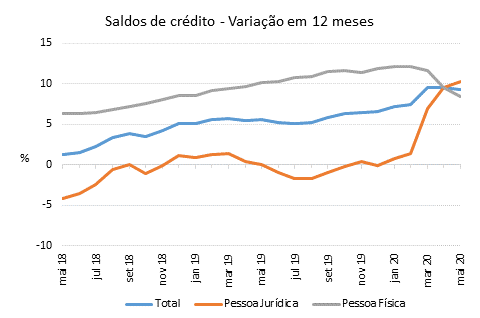
O saldo das operações de crédito do SFN totalizou R$3,6 trilhões em maio, aumento de 0,3% no mês, com crescimento de 0,7% na carteira de pessoas jurídicas (saldo de R$1,6 trilhão) e estabilidade na de pessoas físicas (R$2 trilhões). Em doze meses, o crescimento da carteira total passou de 9,6% para 9,3%, estimuladas pelas operações com pessoas jurídicas, que aumentaram 10,3%, superando a expansão com pessoas físicas, 8,5%.
O crédito livre para pessoas jurídicas alcançou R$1 trilhão, crescendo 0,7% no mês e 24,2% em doze meses, com destaque para o capital de giro. O crédito livre a pessoas físicas totalizou R$1,1 trilhão, queda de 0,5% no mês e aumento de 9,0% em doze meses, com reduções em diversas modalidades, como cheque especial, crédito pessoal não consignado, aquisição de veículos e cartão de crédito à vista.
No crédito direcionado, a carteira de pessoas físicas alcançou R$929 bilhões, expansões de 0,5% no mês e de 7,9% em doze meses. O saldo das operações com pessoas jurídicas cresceu 0,6% no mês e manteve contração na comparação interanual, -8,0%, situando-se em R$565 bilhões em maio.
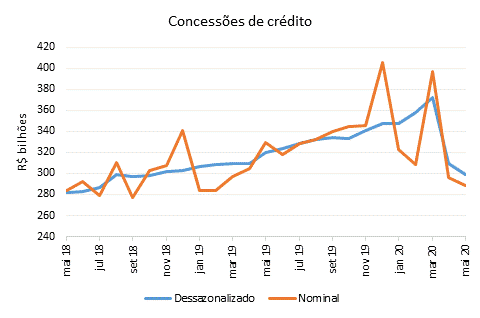
As concessões totais de crédito somaram R$289 bilhões em maio. Na série com ajuste sazonal, houve redução de 3,3% em relação a abril, variações de -6,1% nas empresas e de 1% nas famílias. No acumulado do ano, comparado ao mesmo período do ano anterior, as concessões totais cresceram 7,6%, refletindo a elevação em pessoas jurídicas, 17,7%, e a queda em pessoas físicas, -0,9%.
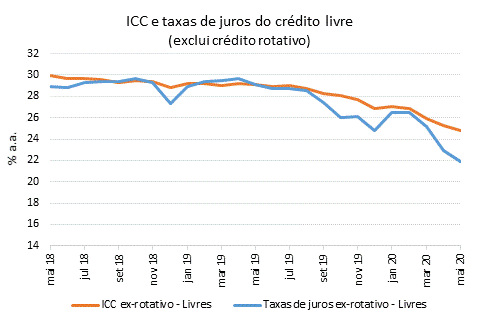
O Indicador de Custo do Crédito (ICC), que mede o custo médio de todo o crédito do SFN, situou-se em 19,2% a.a. em maio, após declínios de 0,5 p.p. no mês e de 1,9 p.p. na comparação interanual. No crédito livre não rotativo, ocorreram reduções de -0,5 p.p. e -4,3 p.p., nas mesmas bases de comparação, alcançando 24,8%. O spread geral do ICC alcançou 13,7 p.p., diminuindo em todos os períodos comparativos.
A taxa média de juros das operações contratadas em maio alcançou 20,4% a.a., com quedas de 1,1 p.p. no mês e de 4,5 p.p. em doze meses. O spread geral das taxas de juros das concessões situou-se em 16,4 p.p., com declínios de 0,8 p.p. e de 2,4 p.p., nos mesmos períodos.
No crédito livre, a taxa média de juros das concessões atingiu 29,5% a.a., reduzindo-se 1,8 p.p. no mês e 8,4 p.p. na comparação interanual. No segmento de famílias, a taxa média de juros atingiu 42,7% a.a., declínio de 1,9 p.p. no mês, ocorrendo reduções em diversas modalidades, destacando-se cartão de crédito rotativo regular, 25,1 p.p., cartão parcelado, 10,3 p.p., e crédito não consignado, 5,5 p.p. No crédito livre às empresas, a taxa média de juros diminuiu 1,5 p.p. em maio, para 14,2% a.a., destacando-se reduções nas modalidades capital de giro, 1,2 p.p., e conta garantida, 0,9 p.p. Excluindo-se as operações rotativas, a taxa média de juros do crédito livre registrou declínios de 1 p.p. no mês e 7,2 p.p. em doze meses, situando-se em 21,9% em maio.
3. Agregados monetários
A base monetária atingiu R$368,1 bilhões em maio, crescimento de 9,3% no mês e de 32,5% em doze meses. No mês, o papel-moeda emitido cresceu 8,2% e as reservas bancárias, 16,4%. Entre os fluxos mensais dos fatores condicionantes da base monetária, impactaram de forma expansionista as operações do Tesouro Nacional, R$108,2 bilhões, as operações da Linha Temporária Especial de Liquidez com Letras Financeiras Garantidas, R$20,6 bilhões, e as operações do setor externo, R$14,5 bilhões, destacando-se as de recompra a termo. Registraram fluxo contracionista as operações com títulos públicos federais, R$89,4 bilhões (colocações líquidas de R$70 bilhões no mercado primário e vendas líquidas de R$19,4 bilhões no mercado secundário), os depósitos de instituições financeiras, R$17,7 bilhões, e as operações com derivativos, R$3,5 bilhões.
Os meios de pagamento restritos (M1) alcançaram R$490,2 bilhões, elevação de 5,6% no mês, com crescimentos em seus componentes: 7,9% no papel-moeda em poder do público e 3,3% nos depósitos à vista. Considerando-se dados dessazonalizados, o M1 avançou 5,3% no mês.
O M2 aumentou 4,0% no mês, totalizando R$3,5 trilhões, destacando-se elevações de 6% no saldo dos depósitos a prazo e de 4% nos depósitos de poupança. No mês, foram registradas captações líquidas de R$77,0 bilhões nos depósitos a prazo e de R$37,2 bilhões nos depósitos de poupança. O M3 cresceu 2,3% no mês, atingindo R$7,2 trilhões, refletindo principalmente o crescimento do M2. O saldo das quotas de fundos do mercado monetário cresceu 0,6% em maio, totalizando R$3,5 trilhões. O M4 registrou aumento de 1,3% no mês e de 10,4% na comparação em doze meses, totalizando R$7,6 trilhões.
4. Concessões ajustadas sazonalmente

DOCUMENTO: https://www.bcb.gov.br/content/estatisticas/docs_estatisticasmonetariascredito/Nota%20para%20a%20imprensa%20-%20Estat%C3%ADsticas%20Monet%C3%A1rias%20e%20de%20Cr%C3%A9dito.pdf
COMÉRCIO VAREJISTA
FGV. IBRE. 26/06/2020. Confiança do Comércio registra a maior queda trimestral da série histórica em junho
O Índice de Confiança do Comércio (ICOM) da Fundação Getulio Vargas subiu 17,0 pontos em junho, passando de 67,4 para 84,4 pontos. Em médias móveis trimestrais, o indicador manteve trajetória de queda pelo terceiro mês consecutivo (1,2 pontos), ainda influenciado pelo dado de abril, quando foi registrado o mínimo histórico.
“A segunda alta consecutiva da confiança do comércio sugere que o pior momento do setor nessa pandemia pode ter sido em abril. Apesar da melhora do setor nesses últimos dois últimos meses, esse resultado ainda precisa ser visto com cautela, por dois motivos: a recuperação representa 60% do que foi perdido entre março e abril; e ainda tem sido muito mais influenciado pela evolução mais forte das expectativas, o que é normal dado o baixo nível de comparação. Para os próximos meses, a elevada incerteza e a fragilidade do mercado de trabalho não permitem observar um cenário de consistente retomada. “, avalia Rodolpho Tobler, Coordenador da Sondagem do Comércio da FGV IBRE.
Em junho, a confiança subiu em todos os seis principais segmentos do Comércio. Do ponto de vista de horizontes temporais, houve melhora na percepção do momento presente e das expectativas, que se tornaram menos pessimistas. O Índice de Situação Atual (ISA-COM) avançou 12,7 pontos, para 82,0 pontos. O Índice de Expectativas (IE-COM) subiu 20,6 pontos para 87,5 pontos.
Maior queda trimestral da série histórica
O forte resultado negativo de abril contribuiu para que a média trimestral do ICOM sofresse forte queda no 2° trimestre de 2020. Desde o final de 2019 havia um caminho de recuperação gradual que o setor vinha percorrendo e se aproximando cada vez mais dos 100 pontos. Já no 1° trimestre desse ano, a pandemia já começava a afetar as expectativas nos dados de março dando indícios do que estava por vir. “Como os dados pontuais dos últimos dois meses mostraram recuperação, a expectativa para o terceiro trimestre é de uma melhora marginal, mas ainda potencialmente abaixo do patamar observado no primeiro trimestre”, completa Rodolpho.
DOCUMENTO: https://portalibre.fgv.br/noticias/confianca-do-comercio-registra-maior-queda-trimestral-da-serie-historica-em-junho
COMÉRCIO EXTERIOR BRASILEIRO
MRE. DCOM. NOTA-67. 25 de Junho de 2020. Acordo sobre o Livre Comércio de Veículos Pesados entre Brasil e México – Nota Conjunta do Ministério das Relações Exteriores e do Ministério da Economia
Brasil e México chegaram, em 25 de junho, a um acordo político acerca do Sétimo Protocolo Adicional ao Apêndice II do Acordo de Complementação Econômica Nº 55 (ACE 55), o qual estabelece o livre comércio de veículos pesados (caminhões e ônibus) e suas autopeças entre os dois países. A conclusão da negociação, que ocorre em meio a uma conjuntura econômica mundial complexa em virtude da pandemia do novo coronavírus (COVID-19), ressalta o compromisso de Brasil e México em ampliar e fortalecer o comércio bilateral.
Pelo novo instrumento, o comércio de veículos pesados será desgravado progressivamente, sendo a margem de preferência de 20% a partir de 1º de julho de 2020 ou da data de sua entrada em vigor, de 40% a partir de 1º de julho 2021, de 70% a partir de 1º de julho de 2020, alcançando a liberalização total em 1º de julho de 2023. No caso das autopeças de veículos pesados, o livre comércio terá início imediato, já a partir de 1º de julho de 2020 ou da data de entrada em vigor do protocolo.
Como resposta às dificuldades enfrentadas pelas empresas em decorrência da pandemia, o novo Protocolo Adicional estende ainda o prazo de 2 anos (24 meses) para 30 meses para que as exportações de ambos os países se beneficiem de índices de conteúdo regional mais flexíveis, apenas para o caso de novos modelos lançados entre abril de 2018 e dezembro de 2019. O novo protocolo prevê, adicionalmente, consultas e trabalhos técnicos entre os dois países em matéria de regulamentos técnicos, as quais deverão ter início no terceiro trimestre de 2020.
Atualmente, Brasil e México já contam com importante e dinâmico comércio de produtos automotivos. O setor automotivo tem participação importante na balança comercial entre os dois países, sendo o México o terceiro parceiro comercial do Brasil nesse segmento, superado apenas por Argentina e Estados Unidos, em 2018 e 2019. Em 2019, a corrente de comércio de produtos automotivos entre os dois países registrou US$ 3,8 bilhões, com exportações no valor de US$ 1,8 bilhão e importações no valor de US$ 1,9 bilhão.
Brasil e México já se beneficiam de livre comércio no intercâmbio comercial de automóveis, veículos comerciais leves e suas autopeças. Estima-se que, ao promover o livre comércio também de caminhões, ônibus e suas autopeças, o novo acordo gerará aumento importante das exportações brasileiras para o México nos próximos anos, tendo em vista a reconhecida competitividade do Brasil no segmento de veículos pesados.
O acordo se encontra atualmente em processo de revisão legal. Após a assinatura do novo Protocolo Adicional, que deverá ocorrer em breve, será enviado para depósito junto à ALADI. Em seguida, para que entre em vigor, o instrumento necessita ser incorporado aos ordenamentos jurídicos dos dois países.
O Governo brasileiro considera que o comércio bilateral entre Brasil e México ainda está muito aquém do potencial de integração das duas maiores economias da América Latina, razão pela qual este acordo simboliza o início de um processo de avanços na abertura comercial bilateral. Nesse sentido, os dois países estão empenhados, atualmente, em aprofundar, modernizar e ampliar o escopo dos Acordos de Complementação Econômica nº 53 e 55, que regem o intercâmbio comercial entre eles. Atualmente, apenas 10% das linhas tarifárias brasileiras gozam de livre comércio no âmbito desses dois Acordos, e sua ampliação permitirá que mais produtos e setores econômicos possam se beneficiar do comércio bilateral de forma mais efetiva, o que também ocorrerá por meio da adequação de suas regras a dispositivos mais modernos que foram negociados em acordos comerciais mais recentes.
EMPREENDEDORISMO
IBGE. 26/06/2020. PAC 2018: Brasil tem 1,5 milhão de empresas comerciais gerando receita de R$ 3,7 trilhões
Entre 2009 e 2018, o pessoal ocupado em atividades comerciais aumentou 19,7%, passando de 8,5 milhões para 10,2 milhões. O número de empresas comerciais cresceu 5,2%, indo de 1,4 milhão para 1,5 milhão. Já a quantidade de unidades locais (lojas) subiu de 1,5 milhão para 1,7 milhão em dez anos. Em relação a 2017, o número de empregados no setor subiu 0,3% (ou 28,8 mil). Por outro lado, caíram a quantidade de empresas (2,2%, ou 34, 2 mil) e unidades locais (1,2% ou 19,8 mil).
Em dez anos, a média de pessoas ocupadas no comércio passou de seis para sete por empresa, no período. No varejo, que em 2018 ocupava 74,5% dos trabalhadores do comércio no Brasil, essa média passou de seis para sete pessoas empregadas por empresa, enquanto o atacado foi de nove para oito e o comércio de veículos e peças manteve-se em seis pessoas. A única atividade em que esse número aumentou de forma significativa foi a de hipermercados e supermercados, que passou de 82 para 99 pessoas ocupadas.
Em 2018, a atividade comercial no país gerou R$ 3,7 trilhões de receita operacional líquida (receita bruta menos as deduções, tais como cancelamentos, descontos e impostos) e R$ 613,5 bilhões de valor adicionado bruto. O setor pagou R$ 237,4 bilhões em salários, retiradas e outras remunerações, mantendo a estabilidade da remuneração média das pessoas empregadas em empresas comerciais, que foi de 1,8 salário mínimo em 2009 e 1,9 em 2018.
A margem do comércio, definida pela diferença entre a receita líquida de revenda e o custo de mercadorias vendidas, chegou a R$ 817,5 bilhões em 2018. Desse total, o varejo foi responsável por 56,1%, o atacado por 36,5% e o comércio de veículos, peças e motocicletas por 7,4%.
Em 2018, o Sudeste gerou 50,3% da receita bruta de revenda e deteve 49,4% das unidades locais do país, contra 52,4% e 48,1%, respectivamente, em 2009. Essas e outras informações estão na Pesquisa Anual do Comércio (PAC) 2018, que traz os principais resultados das empresas comerciais brasileiras, cujas atividades se dividem em comércio de veículos, peças e motocicletas; comércio por atacado; e comércio varejista. As informações incluem a caracterização do faturamento das empresas, da margem de comercialização, da estrutura de concentração e do perfil do emprego nas empresas comerciais.
| Série histórica de variáveis selecionadas da Pesquisa Anual de Comércio – Brasil – 2018 | ||||||||||
|---|---|---|---|---|---|---|---|---|---|---|
| 2009 | 2010 | 2011 | 2012 | 2013 | 2014 | 2015 | 2016 | 2017 | 2018 | |
| Pessoal ocupado | 8529415 | 9039952 | 9592590 | 10025453 | 10418819 | 10633156 | 10296459 | 10112020 | 10183586 | 10212427 |
| Número de empresas | 1425993 | 1540430 | 1630558 | 1621778 | 1624888 | 1611448 | 1595265 | 1569580 | 1534770 | 1500583 |
| Número de unidades locais (lojas) | 1518428 | 1639266 | 1731486 | 1731411 | 1742825 | 1737984 | 1720471 | 1704659 | 1672417 | 1652660 |
Participação do varejo na receita líquida cresce de 41,4% para 45,8%
Em 2018, o comércio gerou R$ 3,7 trilhões de receita operacional líquida (receita bruta menos as deduções, como vendas canceladas, abatimentos, descontos, impostos sobre vendas e outros impostos e contribuições) e R$ 613,5 bilhões de valor adicionado bruto (conjunto das receitas geradas menos os gastos realizados no processo). O setor empregou cerca de 10,2 milhões de pessoas, pagando R$ 237,4 bilhões em salários, retiradas e outras remunerações. Esses valores foram gerados por 1,5 milhão de empresas, englobando um total de 1,7 milhão de unidades locais comerciais (lojas).
A participação do comércio varejista na receita operacional líquida cresceu 4,4 pontos percentuais (p.p) em 2018 (45,8%) em relação a 2009 (41,4%). O atacado também subiu de 43,4% para 44,9% em 2018. Já o comércio de veículos, peças e motocicletas perdeu participação de 5,9 p.p na receita líquida, passando de 15,2% para 9,3% em dez anos.
Entre as atividades comerciais que tiveram os maiores ganhos de participação na receita líquida no período, destaca-se o segmento de hipermercados e supermercados, que subiu de 10,5% para 13,2%. As outras atividades que cresceram no período foram o comércio por atacado de matérias-primas agrícolas e animais vivos (de 2,8% para 4,3%) e o comércio varejista de produtos alimentícios, bebidas e fumo (de 3,1% para 4,1%).
Por outro lado, o comércio de veículos automotores concentrou queda de 4,8 p.p. na participação da receita líquida entre 2009 e 2018, passando de 10,8% para 6%. Os outros setores com as maiores perdas foram o comércio de peças para veículos, que caiu de 3,4% para 2,8%, e o comércio varejista de material de construção, de 3,8% para 3,3%.
Varejo tem mais da metade da margem do comércio
A margem do comércio, definida pela diferença entre a receita líquida de revenda e o custo de mercadorias vendidas, foi de R$ 817,5 bilhões em 2018. Desse total, o varejo foi responsável por 56,1%, o atacado por 36,5% e o comércio de veículos, peças e motocicletas por 7,4%.
Dividindo-se a margem pelo custo de mercadorias vendidas, obtém-se a taxa de margem de comercialização, que indica o quanto, em termos relativos, determinado setor é capaz de definir sua receita líquida de vendas acima dos seus custos com aquisição de mercadorias para revenda e variação de estoques. Entre 2009 e 2018, a taxa de margem do varejo subiu de 35,5% para 37,6% e a do comércio de veículos, peças e motocicletas de 18,2% para 22,4%, enquanto a do atacado ficou praticamente estável em 23,0%.
Entre as 22 atividades que compõem o comércio, o segmento varejista de tecidos, vestuário, calçados e armarinho continuou em primeiro lugar no ranking com a maior taxa de margem tanto em 2018 (86,0%), maior crescimento desse indicador desde 2009 (72,2%). Já o comércio por atacado de combustíveis e lubrificantes permaneceu na última posição, com a menor taxa de margem (6,9%).
Destacam-se também as variações no comércio varejista de informática, comunicação e artigos de uso doméstico (55,4%), com uma ampliação de 7,8 p.p. no período; e no comércio por atacado de madeira, ferragens, ferramentas, materiais elétricos e material de construção (44,4%), que apresentou 9,2 p.p. de aumento.
Concentração do comércio fica em 10%
O IBGE analisa a concentração no comércio usando o indicador “razão de concentração de ordem 8” (R8), que mostra a porcentagem de receita líquida de revenda correspondente às oito maiores empresas do setor. A concentração da atividade comercial entre as oito maiores empresas foi de 10,0% em 2018, permanecendo praticamente inalterada em relação a 2009.
O comércio atacadista registrou uma redução de 2,5 p.p. no indicador de concentração, indo de 21,4% em 2009 para 18,9% em 2018. Entre as atividades, destaque para as maiores concentrações no comércio por atacado de combustíveis e lubrificantes (64,5%), no comércio por atacado de mercadorias em geral (33,4%) e no comércio por atacado de matérias-primas agrícolas e animais vivos (30,6%). O varejo teve um pequeno aumento no grau de concentração, de 9,1% para 9,6%. O mesmo aconteceu com o comércio de veículos, peças e motocicletas (3,8% em 2009 para 4,1% em 2018).
Mais de 74% dos empregados do comércio atuam no varejo
O comércio empregou 10,2 milhões de pessoas em 2018, sendo 74,5% no comércio varejista, 16,6% no comércio por atacado e 8,9% no comércio de veículos peças e motociclistas.
O avanço de 1,5 p.p do varejo consolidou o setor como o maior empregadora do comércio e o único dos três segmentos a avançar entre 2009 e 2018. Destaca-se ainda o avanço de 3,2 p.p. de hipermercados e supermercados, que passou do terceiro para o primeiro lugar no ranking de participação no emprego. Esse segmento inverteu posição com o comércio varejista de tecidos, vestuário, calçados e armarinho, que representou 15,9% e sofreu retração de 2,4 p.p. no período de 10 anos.
O comércio atacadista, por sua vez, reduziu a sua participação no total do comércio em 0,3 p.p., assim como o setor de veículos, peças e motocicletas, que recuou 1,2 p.p. em todo o emprego gerado no comércio.
Ocupação média dos hiper e supermercados sobe de 82 para 99 pessoas
O número médio de pessoas empregadas no comércio ficou em sete pessoas por empresa em 2018, ante uma média de seis pessoas em 2009. Essa estabilidade é replicada, inclusive, dentro dos segmentos. Entre os seus agrupamentos, entretanto, a PAC revela grande heterogeneidade em termos de porte médio.
Os hipermercados e supermercados, por exemplo, incrementaram sua ocupação média de 82 para 99 pessoas por empresa nos últimos dez anos, tendo sido a única atividade a aumentar significativamente o tamanho médio de suas empresas no período.
Já as maiores reduções ocorreram no comércio atacadista: as empresas que representam o comércio por atacado de máquinas, aparelhos e equipamentos, inclusive TI e comunicação, reduziram seu porte médio em três pessoas por empresa, enquanto aquelas do comércio por atacado de mercadorias em geral o encolheram em onze pessoas por empresa.
Rendimento médio do comércio fica estável em dez anos
Em 2018, as empresas comerciais pagaram, em média, 1,9 salário mínimo (s.m.), indicando certa estabilidade em relação a 2009 (1,8 s.m.). No comércio de veículos, peças e motocicletas, pagou-se 2,0 s.m., ante a remuneração média mensal de 2.1 s.m de 2009. Destaca-se a redução salarial no segmento do comércio de veículos automotores, que passou de 3,2 s.m. em 2009 para 2,8 s.m. em 2018.
No setor atacadista, por outro lado, o salário médio mensal foi de 2,8 s.m. em 2018, também demonstrando certa estabilidade em relação a 2009 (2,9 s.m.). O segmento varejista, cuja remuneração média é mais baixa, também permaneceu estável, pagando cerca de 1,6 s.m. ante 1,5 s.m em 2009. Isso ocorreu mesmo diante da expansão do porte dessas empresas no período analisado.
Sudeste concentra quase metade das lojas do país
Entre as grandes regiões, o Sudeste foi responsável pela maior parcela da receita bruta de revenda, do número de unidades locais, do pessoal ocupado e dos salários, retiradas e outras remunerações. A região Sul aparece na segunda posição, seguida por Nordeste, Centro-Oeste e Norte. As posições se mantiveram inalteradas no período, mas houve um movimento de desconcentração regional, com perda de participação do Sudeste e ganho do Norte, Nordeste e Centro-Oeste.
Em 2018, o Sudeste gerou 50,3% da receita bruta de revenda e deteve 49,4% das unidades locais do país, contra 52,4% e 48,1%, respectivamente, em 2009. Já a receita bruta de revenda do Sul passou de 19,9% para 20,7%, apesar da queda em termos do número de unidades locais, de 23,1% para 21,6% do total. O Centro-Oeste também obteve um crescimento da participação, saltando de 9,0%, em 2009, para 10,0%, em 2018.
O Sudeste empregou a maioria do pessoal ocupado no comércio do país em 2018, com 51,6% do total, indicando estabilidade nos últimos 10 anos (51,7% em 2009). Já no Nordeste ocorreu um aumento da fatia em termos de pessoal ocupado, que passou de 16,4%, em 2009, para 17,0%, em 2018.
Em relação às diferenças salariais, Sul e Sudeste apresentaram salários médios mensais, mensurado em salários mínimos, acima da média nacional, com 1,9 s.m. e 2,0 s.m., respectivamente. As demais regiões, Norte (1,7 s.m.), Nordeste (1,5 s.m.) e Centro-Oeste (1,7 s.m.), pagaram salários inferiores à média do nacional.
São Paulo detém 61,5% da receita bruta da região Sudeste
Analisando-se a distribuição percentual da receita bruta de revenda entre as unidades da federação dentro de cada grande região em 2018, o Sudeste apresentou uma grande concentração da atividade comercial em São Paulo, que respondeu por 61,5% dessa variável na região. Minas Gerais vem em seguida, com Rio de Janeiro e Espírito Santo. Na comparação com 2009, houve ligeira queda de participação do Rio de Janeiro (-0,8 p.p.), enquanto Minas Gerais foi o estado que mais avançou (1,1 p.p.).
O Sul, por sua vez, caracterizou-se por mais homogeneidade na representatividade do comércio, com maior importância do Paraná (37,7%) e Rio Grande do Sul (34,5%), seguidos, um pouco mais distante, por Santa Catarina (27,8%). O principal destaque foi o avanço de Santa Catarina de 2,8 p.p. no período, enquanto os demais estados perderam participação: Rio Grande do Sul e Paraná recuaram 2,6 p.p. e 0,2 p.p, respectivamente.
Já no Norte, os estados do Amazonas e Pará foram responsáveis por 63,3% da receita bruta de revenda da região em 2018, embora Amazonas tenha perdido 7,4 p.p. de participação regional na comparação com 2009, em contraposição ao ganho do Pará (2,7 p.p.). O principal destaque foi a ampliação de importância do Tocantins (6,7 p.p.), que se vale da localização estratégica para se consolidar como um importante corredor logístico na região.
No Nordeste, 63,7% da receita bruta de revenda estava concentrada nos estados da Bahia, Pernambuco e Ceará, por ordem no ranking regional. Essa concentração aumentou ligeiramente em relação a 2009 (63,3%), com Pernambuco ampliando sua importância em 0,9 p.p., Bahia se mantendo estável, enquanto Ceará perdeu relevância (-0,5 p.p.).
Por fim, no Centro-Oeste, os estados de Goiás e do Mato Grosso responderam por 33,8% e 31,7% da receita bruta de revenda, respectivamente, em 2018. Vale destacar que, nos últimos dez anos, Mato Grosso aumentou sua relevância em 7,5 p.p., enquanto o Distrito Federal perdeu 5,8 p.p. no total da região.
PAC. Supermercados lideraram receita e geração de empregos em 2018. O setor de hipermercados e supermercados respondeu por 13,2% da receita do comércio em 2018
O setor de hiper e supermercados foi o que gerou mais empregos em 2018, ocupando 45,7 mil pessoas a mais em relação a 2017, totalizando 1,4 milhão de trabalhadores, além de liderar com 13,2% a participação na receita operacional líquida do comércio no ano. Com isso, o segmento de comércio por atacado de combustíveis foi para a segunda posição no ranking de participação. Os dados são da Pesquisa Anual do Comércio (PAC), divulgada hoje (26) pelo IBGE.
A gerente de análise e disseminação do IBGE, Synthia Santana, explica que o aumento da ocupação nos hipermercados se destaca no contexto em que o varejo se manteve estável. “O volume de pessoas ocupadas nessa atividade aumentou apenas 3,5%, mas é uma característica dos hipermercados ter um porte elevado de pessoas por empresa, então mesmo pequenos ganhos tornam-se grandes diante das demais atividades”, analisa.
O setor de hipermercados e supermercados, também, foi o único a aumentar o tamanho médio das empresas em dez anos, com ocupação média passando de 82 para 99 pessoas por empresa. “É importante destacar que a classificação de supermercado é de uma empresa com área superior a 300 m², então a gente já está falando de importantes ganhos de escala na existência desse mercado”, complementa.
Entre 2017 e 2018, o número de empregados no Comércio como um todo subiu 0,3%, o que representa 28,8 mil pessoas a mais trabalhando no setor. Mas no mesmo período houve diminuição de 2,2% na quantidade de empresas e de 1,2% nas unidades locais, como lojas e filiais. Ao todo, o setor ocupou cerca de 10,2 milhões de pessoas e pagou R$ 237,4 bilhões em remunerações. A atividade de Comércio gerou no total R$3,7 trilhões de receita operacional líquida, que é a receita bruta após as deduções, como impostos e cancelamentos.
A pesquisa divide as atividades comerciais em três segmentos: comércio de veículos, peças e motocicletas, comércio por atacado e comércio varejista. Entre 2017 e 2018, as maiores quedas foram no varejo, que teve, por exemplo, redução de 2% no número de unidades locais.
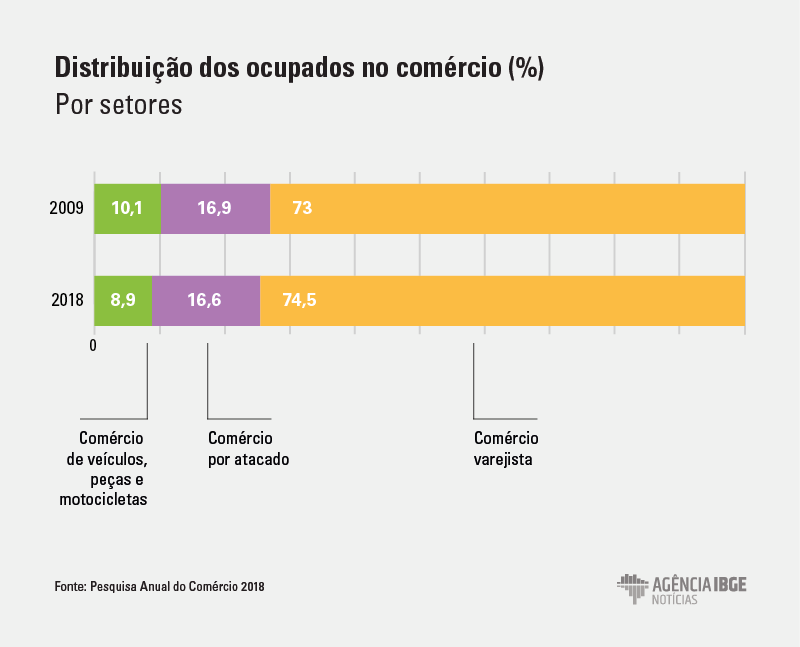
Das 10,2 milhões de pessoas ocupadas no comércio em 2018, 7,6 milhões (74,5%) estavam no varejo, 1,7 milhão (16,6%) estava no atacado e 894 mil (8,9%) eram empregados no setor de veículos. Em comparação com 2017, os três segmentos avançaram no número de pessoas ocupadas. “Em 2018, o país ensaiava os primeiros passos em direção a retomada do crescimento econômico, baseado praticamente no consumo das famílias, o que é muito importante. Só que a gente percebe que essa retomada do crescimento tem sido bastante lenta”, explica Synthia.
“Se tomamos como exemplo o varejo, que é o principal empregador do comércio, responsável por 75% do volume de pessoas empregadas na atividade comercial, o volume de pessoas ocupadas nesse segmento se manteve praticamente estável entre 2017 e 2018 e o número de unidades locais caiu em 2%. Então isto é um forte indicativo do modo como as empresas têm reagido diante do cenário de crise”, conclui.
DOCUMENTO: https://agenciadenoticias.ibge.gov.br/agencia-sala-de-imprensa/2013-agencia-de-noticias/releases/28074-pac-2018-brasil-tem-1-5-milhao-de-empresas-comerciais-gerando-receita-de-r-3-7-trilhoes
INDÚSTRIA
FGV. IBRE. 25/06/2020. Confiança do Consumidor e da Indústria no Brasil são as mais baixas entre os países analisados
Pesquisa divulgada pelo Instituto Brasileiro de Economia da Fundação Getulio Vargas (FGV IBRE) mostra que o Brasil atingiu o patamar mais baixo entre os países analisados, tanto no Índice de Confiança do Consumidor (ICC) quanto no Índice de Confiança da Indústria (ICI). Na confiança do Consumidor, a queda foi mais intensa do que em países gravemente afetados pela pandemia de Convid-19, como Itália, Espanha e China.
De acordo com os dados, em abril, o ICC e o ICI da Fundação Getulio Vargas no Brasil, registraram perdas recordes de 39,3 pontos e 22,0 pontos, respectivamente, atingindo valores mínimos históricos. Já os resultados de maio e a prévia de junho sinalizam o movimento na tendência de recuperação pela redução do pessimismo. O estudo mostra também que no âmbito do consumidor, a queda da confiança no Brasil foi bem mais intensa, tanto na comparação com os desenvolvidos quanto com os emergentes e com uma recuperação lenta até o momento.
Os resultados da indústria Brasileira mostram que o país é o que apresenta maior dificuldade na recuperação até maio, recuperando apenas 8% das perdas ocorridas desde o início da pandemia. A Espanha recuperou apenas 4%, enquanto Portugal e Coreia do Sul ainda registram valores mínimos em maio, porém nenhum deles teve queda tão expressiva quanto o Brasil. Por outro lado, a China que perdeu mais de 40 pontos de confiança nesse período, hoje já se encontra em patamar superior ao período pré-crise. O cenário no curto prazo ainda é difícil para o país, considerando a elevada e resiliente incerteza, que também é recorde entre os países, e também considerando que a situação anterior à pandemia era de uma recuperação lenta e gradual.
DOCUMENTO: https://portalibre.fgv.br/noticias/confianca-do-consumidor-e-da-industria-no-brasil-sao-mais-baixas-entre-os-paises
DESEMPREGO
MEconomia. 25/06/2020. TRABALHO. Pedidos de seguro-desemprego recuam 22,9% na primeira quinzena de junho. Solicitações somaram 351.315 no período, enquanto que na segunda quinzena de maio foram 455.911
Os pedidos de seguro-desemprego, na modalidade trabalhador formal, somaram 351.315 na primeira quinzena de junho deste ano. O número representa uma queda de 22,9% na comparação com o registrado na segunda quinzena de maio (455.911) e um aumento de 35% em relação ao mesmo período do ano passado (260.228).
Do total de requerimentos no período, 250.880 (71,4%) foram realizados pela internet. Os três estados com maior número de pedidos foram São Paulo (109.278), Minas Gerais (37.130) e Rio de Janeiro (28.507).
No acumulado de 2020, foram contabilizados 3.648.762 pedidos. O número é 14,2% maior ao registrado no mesmo período de 2019 (3.194.122).
Atendimento
As Superintendências Regionais do Trabalho do Governo Federal ampliaram os esforços para garantir o atendimento não presencial aos cidadãos durante o período da pandemia da covid-19. Foram disponibilizados canais adicionais de atendimento remoto.
Para dúvidas e esclarecimentos, o empregado pode acionar as superintendências regionais do trabalho por meio de formulário online ou ainda pelos telefones que podem ser verificados na página.
Neste site, há mais informações sobre as estatísticas do seguro-desemprego e é possível acessar boletins mensais, tabelas de séries históricas e notas conceituais.
APRESENTAÇÃO: https://www.gov.br/economia/pt-br/centrais-de-conteudo/apresentacoes/2020/junho/apresentacao_dados-sd_quinzenal-1-junho.pdf/view
BRASIL - CHILE
MRE. DCOM. NOTA-68. 26 de Junho de 2020. Declaração Conjunta Brasil-Chile sobre Cooperação entre o Instituto Rio Branco e a Academia Diplomática Andrés Bello
O Ministério das Relações Exteriores do Brasil e o Ministério de Relações Exteriores do Chile acordaram firmar Memorando de Entendimento para aprofundar a cooperação entre o Instituto Rio Branco e a Academia Diplomática Andrés Bello para a formação e a capacitação prática de diplomatas de ambos os países.
A decisão fundamenta-se nos laços sólidos e históricos entre os dois Países; na convergência de valores entre suas sociedades, entre os quais a defesa da liberdade e da democracia; e nos avanços recentes nas relações políticas, econômicas e culturais entre Brasil e Chile, que ensejam o aprofundamento dos laços entre suas Chancelarias.
O Memorando de Entendimento, valendo-se da satisfatória experiência alcançada por meio do “Acordo entre os Governos da República Federativa do Brasil e da República do Chile sobre Cooperação entre as Academias Diplomáticas de ambos os Países”, de 1996, prevê o intercâmbio de alunos e diplomatas, incluindo a participação em seus respectivos programas de formação de diplomatas; o intercâmbio de informações sobre programas de estudo e pesquisa, cursos, seminários e demais atividades acadêmicas; o acesso dos alunos das respectivas academias diplomáticas a cursos avançados dos idiomas Português e Espanhol; a troca de informações sobre tendências em matéria de estudo e pesquisa, bem como ferramentas relativas à educação informatizada; e o intercâmbio de publicações nacionais e internacionais.
________________
LGCJ.:

