US ECONOMICS
FOREIGN POLICY / WERSTERN HEMISPHERE
U.S. Department of State. 04/24/2020. Briefing With Acting Assistant Secretary Michael Kozak, Bureau of Western Hemisphere Affairs On Developments in the Western Hemisphere. Michael G. Kozak, Acting Assistant SecretaryBureau of Western Hemisphere Affairs
MR BROWN: Hey, good morning, everybody. Happy Friday. Welcome this on the record briefing with Acting Secretary Michael Kozak, who heads our Bureau of Western Hemisphere Affairs. We wanted to take an opportunity to update you on developments in Venezuela, Cuba, and Guyana. Ambassador Kozak is also prepared to offer his thoughts on a full range of political and economic developments across the hemisphere. Ambassador Kozak will begin with some opening remarks, and then we’ll have time for a few questions. As a reminder, this briefing is embargoed until the end of the call. Ambassador Kozak, please go ahead.
AMBASSADOR KOZAK: Well, thanks, Cale, and good morning. Thank you all for joining us today. This is a hemisphere of freedom. As a family of likeminded countries, we’ll get through this together. It’s times like this that show the importance of our unity.
I want to begin by talking about the challenge that we’re fighting together. It begins with our commitment to health and humanitarian aid, which spans many decades, many successes in health care, and many billions of dollars. The United States continues to demonstrate global leadership in the face of the COVID-19 pandemic, helping people all over the world. In the Western Hemisphere, the U.S. Government has devoted a total of more than $64 million to more than 30 countries to help them fight the coronavirus in a number of ways.
But our support isn’t simply monetary. American generosity isn’t limited to our assistance that comes directly from the United States Government. Our businesses, our NGOs, charity, all faith groups, are all deeply engaged. This is an all-of-America approach to saving lives all across the world, and it helps protect us right here at home as well. We estimate that the American people have given nearly $3 billion in donations and assistance just to fight this particular virus. The U.S. Government has no higher priority than the protection of American citizens. I want to express our thanks to governments across the regions for being such great partners in our efforts to get Americans home. Our good friends like Brazil, Uruguay, and Chile allowed hundreds of Americans to disembark from cruise ships in their ports and fly home. The Government of Panama and the Panama Canal Authority have shown enormous flexibility and compassion as they devised a way to allow cruise ships to make their way to the U.S. while at the same time protecting Canal workers. In the Dominican Republic, the government worked with us to keep commercial flights running and available to U.S. citizens seeking to return home. In Peru, our embassy and Peruvian officials have cooperated to support repatriation of more than 8,000 Americans, by far the most in the hemisphere and globally. The staff at our embassies and consulates have been in the front lines in these efforts. To date, we’ve repatriated over 64,000 Americans worldwide, including nearly 35,000 in this hemisphere.
And while our team is rising to meet the historic challenge posed by the COVID-19 pandemic, the work of diplomacy still goes on.
In Venezuela, our policy of maximum pressure on the former Maduro regime remains. Earlier this week, the Treasury Department announced a new, narrowly limited, seven-month license for U.S. oil companies in Venezuela to wind down operations and engage only in those transactions necessary for the limited maintenance of essential operations, safety of employees, and preservation of assets in Venezuela. This license does not allow for business as usual. Maduro will get no money and no benefit from these operations. The space to operate in the Venezuela oil sector is narrowing and others should take notice.
We also remain steadfast in our support for the Cuban people and for holding the Cuban regime accountable for its human rights abuses.
The Cuban regime has taken advantage of the COVID-19 pandemic to continue its exploitation of Cuban medical workers, so we will continue to stand up for the rights of Cuban medical personnel and to oppose their exploitation and abuse, particularly in this moment where we must protect doctors more than ever. The Cuban regime takes up to 90 percent of what they charge doctors – other countries for each doctor, pocketing considerable revenues and exploiting the doctors who receive but a pittance. We applaud leaders in Brazil, Bolivia, Ecuador, and other countries that refuse to turn a blind eye to these abuses by the Cuban regime.
Finally, it has been more than seven weeks since Guyana’s elections. There has been still no credible outcome. The Guyana Elections Commission has a preliminary work plan for a recount but has not issued a timeline. We remain gravely concerned that so much time has passed without a credible result. Further delays violate the Guyanese people’s rights to a transparent, credible, and timely electoral process.
The relations we have with the governments and the people of the Western Hemisphere are very important to this administration. We will continue to stand with our friends as we confront the challenge of COVID-19, extend freedom throughout the region, and work to reignite economic prosperity for our citizens. There are a lot of important issues we can talk about, and I’m happy to take your questions now.
MR BROWN: Okay, if you have —
OPERATOR: And ladies and gentlemen, if you wish to ask a question, please do press 1, then 0.
MR BROWN: Okay. For our first question, can we open the line of Matt Lee?
OPERATOR: And please, go ahead, Matt Lee.
QUESTION: Can you hear me?
AMBASSADOR KOZAK: Yes.
QUESTION: Yeah, okay. Thanks, and good morning. I have a question about Cuba. The Cubans have been expressing an interest recently – well, for a long time now, but more stridently since the virus outbreak – about restarting a working group on pandemic illness. What’s the status of that? And does the U.S. have a interest in doing that, considering the tens of thousands of people who are dying? Thank you.
AMBASSADOR KOZAK: Thank you, and I believe that working group was established with – I believe it was HHS. So – and I’m not sure of the status right now. I must say I’m skeptical of the good faith of Cuba on any of these things, but let us find out if there’s any activity on that front and we’ll get back with you.
MR BROWN: Okay. We’ll take that for a future later response. Let’s go to the line of Tracy Wilkinson.
QUESTION: A couple questions, one on El Salvador and then one on the maquiladoras in Mexico.
On El Salvador, I have not seen any criticism from you folks as Bukele increasingly is using the military to round up people and kind of arbitrarily put them in detention, which his own supreme court has told him to stop and he refuses. So I’m – I just wonder if you guys are at all concerned that Bukele is kind of using COVID to become an autocratic president, returning to the black – negative past of El Salvador.
And then on the maquiladoras, I wondered if what you guys – what the United States is doing to get those back to work, because I know the Pentagon and others have been agitating for them to get back to work, but there are a lot of sick people and the conditions aren’t great, so I wondered what the United States is doing. Thanks.
AMBASSADOR KOZAK: Thank you. Well, on El Salvador, first, let me say that we have been in touch with all three branches of the government there. They all have an important role to play in fighting the COVID virus. And as with most democratic governments with strong institutions, you sometimes find tensions and differences of opinion amongst different branches of government. But our embassy has been in close touch with all of them. We’re urging them to work together to find the best way forward.
President Bukele is a democratically elected president. He’s got extremely high popularity ratings so far for his handling of the crisis. And some of these court issues and so on have gone to under what conditions does he have authority versus the national assembly having authority over it.
So we’re not seeing anything that would lead to trying to suppress a dissident political opinion or political speech or something like that. It’s differences of opinion over how best to handle quarantine and social distancing issues in the country. So we’re giving lots of constructive advice to all the different parts of the government, but we’ve chosen not to make public comments about it for that reason.
On Mexico, I think what you’ve seen is on – there was a common agreement between the United States, Mexico, and Canada for that matter about keeping open cross-border activities, commerce, and so on. But each country then has got – has its own standards for what kinds of industries and commercial activity it considers essential or vital. Mexico has in practice had a much more – excuse me – restrictive set of criteria than we have. Our embassy and here in Washington has been working very closely with Mexico, advocating for American firms that are part of the – some of this is just very difficult to understand for people in government to drill down and see what activity actually affects the supply chain for a different activity. And I think we’re making progress on that.
We’re never going to have exactly the same standards, but there’s a lot of goodwill and a lot of cooperation and collaboration and information exchange going on to see if we can get the balance right between stopping the spread of the virus, and at the same time ensuring that things that are essential for security, for medical well-being, and so on are not impeded by gaps in the supply chain.
MR BROWN: Okay. For the next question, can we go to the line of Conor Finnegan?
QUESTION: Two quick questions, if I could. First, the administration has continued to deport immigrants to Guatemala and Haiti who have later tested positive for coronavirus. In the case of Guatemala, officials there say it could be in the dozens. You talked about helping U.S. partners in the region. Why wouldn’t you halt these deportation flights until there’s proper testing in place to ensure you aren’t creating new clusters of the virus down there?
And then secondly, on Ecuador, there are reports that the death toll is exponentially higher than what the government has so far reported. What’s the U.S. assessment of what the death toll is there?
AMBASSADOR KOZAK: Okay. On the first question, the reason we were so keen to work with partner nations to get their citizens back home, was precisely so as not to leave them in immigration detention facilities where they’re – been pressed together and cannot easily do the kind of social distancing that they should be; in other words, that they would be much safer to be back home in their homes with their families, and not in a closed environment like that. So this has been an effort that not only benefits us, but it also benefits the health of the people in those countries. We’ve had really good cooperation throughout.
Obviously, the policy of the Department of Homeland Security is not to remove anyone who is ill. But you let them recover, and then you take them home. The problem, of course, is with this virus that people who can be – appear perfectly fine turn out – even sometimes people who have been tested can turn out later to be positive. So I would refer you to DHS for exactly what their procedures are, but they have followed certain protocols. Those have been shared with the partner countries. DHS has – constantly working on that as more testing equipment and so on becomes available. They’re improving their protocols.
So our commitment is to make as sure as we can that people who are going back are healthy. But the reason they’re going back is so that they’ll stay healthy, and not be kept for a long period of time in a confined environment.
On Ecuador, I know the situation in Guayaquil, in Guayas Province is really pretty horrendous. I’ve seen a lot of anecdotal on that, but I’m not sure we have any figures different from those of the government, and I’m not sure the government is trying to minimize the degree of the illness there. They are quite concerned about it themselves in all the conversations we’ve had with them. So there’s reporting gaps in all of this, but it’s – it is a serious problem, in Guayaquil particularly.
MR BROWN: Okay. Everyone, if you could try to limit your questions to just one. There’s a lot of people in the queue and we want to get to as many people as we can. So for the next question, can we go to the line of Michele Kelemen?
QUESTION: A question about Mexico: The – I wonder if you’re worried at all about kind of the lack of a stimulus plan for the economy there. Are you concerned that Mexico’s economy could take a hit, and that could lead to further migration? And then real quickly on Venezuela, do you have any indication that these not-so-secret secret talks are making any progress?
AMBASSADOR KOZAK: Well, on the first, with respect to Mexico, I mean, yes, the Mexican economy is taking a hit, our economy is taking a hit, and everybody else’s is as well. I think the Mexican Government is working that. Everybody’s going to make their own decisions on what they think is the best way to recover from this. We are trying to work with the international financial institutions to help countries construct the best packages they can. Each country has a different set of problems. So no, at this stage I wouldn’t say we’re trying to urge Mexico to do anything particular, but we are working with them, collaborating with them as they try to figure out the best way to reopen their economy, and we’ll be by their side as they try to deal with these issues going forward. We’re all going to have plenty to deal with as a consequence of this on the economic front.
And on the – on Venezuela, I’m not so sure what you’re talking about, not so secret secret talks. The U.S. is not conducting any secret talks with Venezuela, so I’m just not clear about the reference.
MR BROWN: Okay, let’s move on and open the line of Daphne from Reuters, please.
QUESTION: (Inaudible) plane shipment from Iran. What is the administration’s view of this kind of cooperation between two heavily sanctioned governments, and what, if any, further details have U.S. officials picked up on the scope of this activity?
AMBASSADOR KOZAK: Yeah, this is a reference to Mahan Air flights in and out. It is interesting how governments that isolate themselves from the rest of the world, they end up coming together and then it’s a little bit of a shell game where each one is trying to save the other one from some consequence and they can’t really do it because they don’t have the capacity. So, I mean, the air flight is – or that airline has been sanctioned precisely because it is aiding and abetting the Qods Force, which is – and so it’s a designated terrorist entity. What they are trying to help the Venezuelans with God only knows, but we’ll be monitoring it, and it just shows the danger, though, of somebody like Maduro where his best friends are terrorist organizations like the IGRC or the ELN, the FARC dissidents and so on. They seem to have a great affinity for terrorist organizations.
MR BROWN: Okay. Let’s next go to Ali Rogin from PBS.
QUESTION: (Inaudible) spoke to the leaders of both El Salvador and Honduras and that he would be providing ventilators to them, praising their cooperation on the southern border. They are, of course, two Northern Triangle countries who have continued to accept deportation flights. It appears that he has not offered the same support, provision of ventilators to Guatemala, who as you know has temporarily suspended deportation flights a few times during – since the beginning of the pandemic. First, are you aware of what program these ventilators will be provided under? Is it a State Department-sanctioned program? And second, are these ventilators being provided on the condition of countries continuing to accept deportation flights given that the President tweeted his – he’s going to provide them to El Salvador and Honduras and there does not seem to be a tweet for Guatemala?
AMBASSADOR KOZAK: Yeah. Well, I think the President has been talking about these issues to leaders who have asked to talk to him, and it’s not just Northern Triangle countries; there are other countries in the region have also called and made requests.
I mean, it’s been – this is something we’ve been dealing with over the last several weeks where governments were saying look, we know you have to take care of your own needs first but keep us very much in mind as you’re able to start exporting stuff again. I think this is largely a function of the task force, the White House task force. It’s been looking at – as we ramped up production – you’ve heard the President talk about General Motors and others now building ventilators – that we’re seeing our own needs met, we can become an exporter again. I think in many of these cases, the countries concerned just want to buy them. They aren’t asking us for financing. In other cases, we are, as I mentioned, giving a significant amount of financing to battle COVID in the region and perhaps they would be able to turn it to those kinds of purchases, but I think it’s more of an allocation thing.
I don’t know that President Giammattei has called and asked the President for any help on this front as yet. That could change in the next days or so. We have been working closely with Guatemala. It’s not that we haven’t had a cooperative relationship with them, it’s just they’ve run into some snags and we’re working through that with them. But anyway, I think, as you’ve seen, there isn’t some hard linkage here between cooperation on removals and ventilators. We’re trying to get medicine and medical supplies to anybody who needs them, including countries that we have not particularly good relations with. We mentioned Venezuela and Cuba earlier and the U.S. has actually allocated I think $9 million for COVID aid inside Venezuela. Our problem there is getting the regime to give us access so that assistance can actually get distributed on a needs-based basis rather than on a politicized basis, which is what the regime tends to do, or that the regime takes the – we saw recently where they got some test kits and they exported them to another country to get a vote from them in a multilateral forum. So it’s not a good bet to just give stuff to the Maduro regime.
But we do want to see it get to the Venezuelan people. We want to see assistance getting to the Cuban people. We have – this administration has yet to turn down a single request for purchase of medical supplies from Cuba in all the time that they’ve been in office, so millions of dollars have flowed there worth of medicine and medical supplies and hundreds of millions of dollars have been authorized if the Cubans had chosen to use it. So basically I think what you see is we’re not politicizing necessary equipment or medicines for dealing with the COVID crisis.
MR BROWN: Thanks for that. For our next question, let’s go to the line of Kim Dozier.
QUESTION: (Inaudible) the recent economic moves against the Maduro —
AMBASSADOR KOZAK: You just came on. I didn’t get the first part of your question, so please repeat.
QUESTION: Okay. Sorry. Thank you. Can you give us some of your view of the positive strategic effects achieved by some of the recent economic moves against the Maduro regime? And also can you give us an update on the Citgo 6? Have you had contact with them? Are – the prison they’re being held in has had cases of COVID and that was as of two weeks ago.
AMBASSADOR KOZAK: Yeah, on the moves vis-a-vis Maduro, I mean, I think what you’ve seen over the last weeks has been a significant tightening up of our economic pressures on the regime. It is a campaign of maximum economic pressure. And it’s designed to deprive the regime of the revenue that it uses to engage in repression and corruption. None of our sanctions go to food, medicine, or anything like that, but we have tightened up substantially on them.
At the same time, we – the Secretary proposed the framework for a democratic transition, which has gotten a lot of support around the world. We had countries ranging from the entire EU to the Lima Group and others, so people on both sides of – or who had different views as to what was the best way to resolve this have come out in strong support of that framework and that proposal. So I think that’s had a powerful effect too in terms of we not only hear it being discussed internationally but within Venezuela. Within the regime people are talking about it, and what they’re saying is look, if we engage in a democratic transition, we – even the people who are part of the Chavista movement – would come out of this in very good shape. Their political rights would be respected, they’d have a free and fair opportunity to run for office, their party would continue on, nobody is – would be punished for anything except the most serious crimes. So it’s a pretty good deal unless you’re Maduro and just want to stay in power forever.
But I think at the same time what the sanctions do is show people there is no hope of anything getting better as long as he remains in power. As long as he’s there, the sanctions are going to be on. The question that we’ve always been asked was what would it take to lift the sanctions, and the democratic framework is the answer to that question. If you follow a process like this and you come to an outcome like this, the sanctions get lifted in phases and everybody comes out of it in pretty good shape, except that Maduro and his immediate cronies don’t remain in power, where they have completely botched it for the country.
On the Citgo 6, yes, we have been concerned about their health for some time and being kept in – not just from COVID. Even before the COVID crisis, these are not people who are necessarily in the prime of health. They are being held for no reason at all as the government keeps postponing any kind of trial dates and so on so that they don’t have to put any evidence forward. So our attitude is they just should let them go. This is hostage-taking, pure and simple, and they’re not going to get anything in the way of concessions from us, but they can get a lot more difficulties for themselves if they persist in this.
MR BROWN: Okay. I want to be respectful of your time, Ambassador Kozak. Do you have time for one or two more?
AMBASSADOR KOZAK: Sure, you go ahead and pick them.
MR BROWN: Okay. For the next question, let’s go to the line of Shaun Tandon, please.
QUESTION: Bolivia. The elections were set to be next week; of course they’re postponed because of coronavirus concerns. What’s your assessment now about where things stand in Bolivia? Is there any concern about legitimacy of the interim president, Ms. Anez, in light of this delay?
And if I could just briefly, there are reports that Haftar, the Libyan strongman – that his jet was spotted in Caracas overnight. Is that something that you have any information on?
AMBASSADOR KOZAK: Last one first, no, but it’s wild what – who shows up there.
With respect to Bolivia, my understanding – I mean, the original timetable and so on for the elections was set by the National Assembly, which includes a majority of MAS representatives, and my understanding is that they have been meeting and trying to come to an agreement on what would be an appropriate date given the necessity of delaying the election because of the virus. So I – the way I’m seeing it, this is still both sides in Bolivia cooperating. They’re not trying to delegitimize the government. They are trying to find a way to move to free elections and that will determine who will be the government in the country going forward, but so far they seem to be working this together even though they obviously have their differences on policy and so on.
MR BROWN: Okay. For our last question, let’s go to the line of Jennifer Hansler.
QUESTION: Hi, thanks so much. Following up on Ali’s question, can you provide an estimate of how many ventilators are going to each of these respective countries – Ecuador, Honduras, and El Salvador? And then secondly, because Guatemala has suspended these repatriation flights for deportees, there was a presidential memo a few weeks ago that suggested there might be visa sanctions in retaliation for this. Is this something that the U.S. is preparing to levy against Guatemala or any other countries in the Western Hemisphere? Thank you.
AMBASSADOR KOZAK: Okay, thank you. On the first, I think I would refer you to the White House task force. Again, as I say, I don’t think the President is negotiating numbers of ventilators with people. He’s hearing out his colleagues in the other countries, saying, “What are your needs?” and so on. And then they will – that’ll be assessed by the experts on the task force, and the effort is going to try to be sure that everybody gets what they need and not more than they need but also not less than they need. So it’s a very sort of scientific process as best I can tell of trying to allocate available resources against demonstrated needs.
With respect to visa sanctions, yes, there is a provision in U.S. immigration law that says that a country that refuses or unreasonably delays taking back its own citizens, if the DHS Secretary advises the Secretary of State that that’s happening, we are required to cut off the visa issuance in those countries. But that’s – that’s what the statute says. I think it’s absolutely hypothetical at this point to be talking about whether it would be applicable to any given situation. As I said earlier, we’re working with all the countries in the region. We’ve hit snags here and there. Obviously they’ve got – we’re trying to help them, too, build their capacity on the other end. If they take people back and are holding them in quarantine facilities, what can we do to help them make those more robust and make their own process more robust at the other end? So this is very much a work in progress and a lot of cooperation going on. I wouldn’t be speculating about punishments at this point.
MR BROWN: Okay. Ambassador Kozak, thank you for being so gracious with your time. Thanks everybody for joining the call. Unfortunately couldn’t get to everybody today. This is the end of the call. The contents – and the embargo on the contents is lifted. You guys have a great day and a super weekend. All right, thank you.
AMBASSADOR KOZAK: Yes, thank you all. Have a great day.
IRGC
CORONAVIRUS
U.S. Department of State. 04/23/2020. Secretary Pompeo’s Call with Egyptian Foreign Minister Shoukry
The below is attributable to Spokesperson Morgan Ortagus:
Secretary of State Michael R. Pompeo spoke today with Egyptian Foreign Minister Sameh Shoukry. Secretary Pompeo and Foreign Minister Shoukry discussed the importance of continued collaboration on key regional issues and bilateral COVID-19 assistance. The Secretary emphasized that detained U.S. citizens be kept safe and provided consular access during the COVID-19 pandemic.
U.S. Department of State. 04/23/2020. Secretary Michael R. Pompeo With Sean Hannity of Fox News. Michael R. Pompeo, Secretary of State. Washington, D.C.
QUESTION: Here’s our Secretary of State Mike Pompeo, who joins us. Mr. Secretary, I’ve seen a lot. I wrote a book, Deliver Us from Evil, in 2004. It talked about over a hundred million people killed in the last century alone. And I look at this – when they stopped travel from Wuhan to the rest of China, from China to Wuhan, but they left it open internationally, then they scooped up all of the protective gear and now profiteering, and then they kept the virus and lied to the world, and it hurt all of us, and all these people dying, when you said to me you would have helped them, I am so angry words cannot describe my anger.
SECRETARY POMPEO: Yeah, Sean, that’s appropriate that you’re angry. I think many of us are angry. I know the President feels the same way. China caused an enormous amount of pain, loss of life, and now a huge challenge for the global economy and the American economy as well, by not sharing the information they had.
Sean, you should know we still don’t have full transparency from the Chinese Communist Party. I’m still concerned that there are things we don’t know. We don’t know the history. We haven’t been able to get our team on the ground to do the work that it needs to do. This is an ongoing challenge, and the Chinese Communist Party and the World Health Organization have failed to do the things they have responsibility to do when there is a pandemic inside of their country.
QUESTION: Okay. Now the question is: How do we get them to make up for this, make good on this? Now, they do hold a lot of our debt. My – look, I’m not involved in what you do. You’re a lot smarter than me – number one in West Point. Okay, so I will cede this territory to you. My feeling is we shouldn’t pay it back. Maybe that’s impossible.
SECRETARY POMPEO: Sean, I am very confident that the Chinese Communist Party will pay a price for what they did here, certainly from the United States. I don’t know exactly what form that will take. Our focus today isn’t on that. It’s on making sure we keep Americans safe, take down the health risk, keep people healthy as we can, and get this economy going back.
But I am very confident. I talk to business people all around the country. I talk to ordinary citizens – people who have put their lives at risk over the last weeks. They know that this is a result of this virus that originated in Wuhan, China, and they know that the Chinese Government didn’t do the things it needed to do. There will be a cost associated with that.
We need to focus on the here and now, and there will be a time to make sure that we get this right, to make sure that we’re not dependent on China for our pharmaceutical goods and all the things that we’ve seen that we just didn’t have right and that President Trump had identified early on as things we needed to fix in the relationship between the United States and China.
QUESTION: He knew pretty early and was probably the loudest critic of China. You probably can’t answer this, so I won’t waste a lot of time on it. Private conversations – how direct are you and the President being with China?
SECRETARY POMPEO: Very direct. They know precisely what it is that we have observed. We know what we’ve – they know what we’ve asked them to do to try and make sure that we don’t have an ongoing problem. Remember, Sean, there are multiple virus labs inside of China. We need to make sure we understand what’s going on in all of those – the one in Wuhan and elsewhere too. We have to make sure that we don’t have this problem yet again coming from China.
This is a very dangerous situation. We have made clear our expectations. I’ve seen the President do it.
QUESTION: Any update on Iran and the ships – these boats, these – wreaking havoc? The President laid out his order very clearly.
SECRETARY POMPEO: This administration behaves totally different than the previous one. You’ll recall when they took our Navy sailors, made them kneel down, and Secretary Kerry apologized to get them back. This President has taken a completely different approach. He has told the Iranian regime enough, we’re not going to permit this, we’re going to defend our soldiers, our sailors, our airmen, and Marines. I think the Iranians understand that as well.
QUESTION: Last, any update on Kim Jong-un and the reports about his health that you could share? You probably can’t, but I’ve got to try. I mean, give me credit for trying.
SECRETARY POMPEO: No, I don’t – I appreciate the question. I don’t have anything I can share with you tonight, but the American people should know we’re watching the situation very keenly.
QUESTION: All right, Mike Pompeo, we always appreciate you.
SECRETARY POMPEO: Sean, thank you. You have a good evening, sir.
QUESTION: Have a great evening, sir.
U.S. Department of State. 04/24/2020. Secretary Michael R. Pompeo With David Brody of Faith Nation with David Brody, CBN. Michael R. Pompeo, Secretary of State
QUESTION: Secretary Mike Pompeo, Secretary of State, thank you so much for being with us today. Appreciate it.
SECRETARY POMPEO: Thank you, David. It’s great to be with you again. Hope you’re doing well.
QUESTION: Hanging in there. I know you are too, and there’s a lot to talk about. I want to get to, obviously, China and the coronavirus. You made it clear that China has some explaining to do on this. I know you said that you don’t know if the virus started in a lab in China, and maybe not the wet market in Wuhan, but either way, do you believe the Chinese Communist Party is lying to the world right now?
SECRETARY POMPEO: David, it’s incredibly important, even as we sit here today, that we get to the bottom of what transpired and that the Chinese Communist Party come clean about how this all began. Look, we now it started in Wuhan, China; that’s the origination of the virus. We need to figure out how it happened. It’s not just about political retribution or accountability. It’s important today. We need to know this so we can save lives going forward. We need our scientists, our academics, our epidemiologists all to have access to the data, access to a sample of the virus, access to the places it might have come to. Those are all things that matter so that we can solve this problem, get our country back to work, and save lives.
QUESTION: So the Chinese ambassador – just recently, the Chinese ambassador to the United States called for a serious rethinking of the relationship. Would you agree? I mean, has this situation fundamentally changed our working relationship with China?
SECRETARY POMPEO: Well, there’s places that we work alongside China, and there’s a lot of places where the President of the United States has said look, we just weren’t being treated fairly. The obvious example is trade. President Trump made very clear from – shoot, from the time of his campaign, even before he was elected, that the trade relationship between the two countries wasn’t fair, it wasn’t reciprocal, and we needed to fix that for American workers so that we’d have jobs here in the United States that wouldn’t go someplace else because of unfair trade rules.
We’re very concerned about what China’s doing in the South China Sea. We watch as a company called Huawei, a Chinese telecommunications company that is controlled by the Chinese Government, comes to countries around the world where American citizens’ data may be subjected to scrutiny by the Chinese Government. Those are things that existed before this virus, those challenges will remain, and President Trump is committed to protecting American people and keeping them safe and getting the trade relationships right so that we can have jobs here in America.
QUESTION: Speaking of relationships, you have emphatically stated about China, Iran, and Russia that they’re using this coronavirus crisis to launch a propaganda and disinformation onslaught against the United States. Do you believe they are in cahoots with one another on this? In other words, is this a coordinated effort by those countries?
SECRETARY POMPEO: Boy, it’s hard to know the answer to that. What you can say is they’re observing what the others are doing and then they’re responding in a group. That is, they are taking information being provided by one and others are promoting it online and elsewhere too. This information, David – this disinformation campaign matters. The American people, people all across the world go to sources to get information – information for their safety, information for their health and that of their family members – it is nasty when a government runs a disinformation campaign and it puts those peoples’ lives at risk and their health at risk. We’ve done our best here in the United States, and frankly we’ve had other countries around the world call out this fake news, this disinformation. It is disingenuous, it is dangerous, and these governments need to stop, and they need to stop doing it in a coordinated way as well, if that’s what’s actually taking place.
QUESTION: So you’re not necessarily discounting the fact that it could be a coordinated effort. You think more investigation is needed on this, then.
SECRETARY POMPEO: Look, we see very similar messages propagated by a very similar means. It’s difficult to know the level of coordination.
QUESTION: Okay. Let me ask you about Joe Biden real quick. He did say the other day that the President – if he were president he would have made sure we got American health experts into China early to find out what was going on with the virus, to prevent its global spread. I’m curious to get your comments on that, maybe not from a political standpoint – I know you have to be careful on that – but that’s the criticism that he’s leveling.
SECRETARY POMPEO: Two things to say. First, this President and this administration worked diligently to work to get Americans on the ground there in China, to help to the World Health Organization try to get in there as well. We were rebuffed. The Chinese Government wouldn’t let it happen, indeed just the opposite of transparency. They kicked American journalists out and denied access to American and other Western scientists at the time that it was frankly most critical that we understand what was going on there.
My second thought is: I’ve seen the difference in how this administration relates to the Chinese Communist Party. The previous administration allowed China to walk all over us and gain trade, great opportunities, create wealth and trade benefits for China. This President has taken fundamentally a hundred and eighty degrees different approach with respect to how we respond to the challenge that China presents to American security.
QUESTION: So you’re suggesting that the previous administration was soft on China or dealing with them?
SECRETARY POMPEO: Relative to this administration, they were wildly soft. It wasn’t just trade. It was during the previous administration that the Chinese Government began to arm the South China Sea, something that General Secretary Xi said he would not do. The previous administration didn’t respond. It allowed them to continue to develop their capacity to move their People’s Liberation Army – excuse me – People’s Liberation Navy out and around in the South China Sea. That was the kind of things that the previous administration permitted, and this administration has worked very hard to turn that around and make sure that everywhere there was an American interest we strongly protected it.
QUESTION: I want to turn to the World Health Organization. What would get the WHO back in good standing with the United States at this point? I mean, in other words, what needs to happen?
SECRETARY POMPEO: Boy, David, it’s hard to know. It’s important that your viewers understand the history of the World Health Organization as well. This is not the first time that that institution has failed to protect the world. You may recall SARS. The same kind of thing happened, where the WHO was unable to do its primary function – stopping a pandemic from spreading across the world. And this time they were unable to; you can see it. They said don’t close your borders. President Trump made the decision to do that and keep American people safe.
They were too slow in declaring that this was something that could transmit from human to human. Those are the kind of things that the WHO has failed in. It’s nothing against any individual that may work at the WHO. It’s about an institution that has fundamentally failed to do its primary task, keeping people all across the world – and in our case, the thing that matters most: keeping Americans safe.
QUESTION: Mr. Secretary, I want to get to Iran, obviously, in a moment, very important. But on Saudi Arabia and oil, I know there have been some Republican lawmakers sent a letter to you. They’re upset at Saudi Arabia. They say basically we’re under direct threat from them as they continue to send oil here to the U.S., oil that we don’t need basically, basically accusing the Saudis of trying to kill the American oil industry through over supply. What are your thoughts about that?
SECRETARY POMPEO: Well, full disclosure, before I came to Congress I worked in a company that sold equipment in that industry. I know the Kansas oil patch and the Oklahoma and Texas oil patch pretty well. We were a small company, but I know how these companies have been impacted by what has been the largest decline in demand for crude oil products in recent history. What President Trump’s been focused on is two things: getting stability back in the marketplace – he was centrally involved in talking to the King and the Crown Prince of Saudi Arabia and with President Putin and ultimately with the Mexican Government as well. I was working on it, too. And the President got them to a place where they reduced their output.
The second thing we’ve got to do is we’ve got to get the American economy back up and we’ve got to get demand back. When that demand begins to come back, you’ll see prices start to get back to a good place, and then you’ll see the American energy industry begin to thrive once again. I know these people. They are tough; they are strong. President Trump’s committed to making sure that they have everything they need to make sure that this industry comes out on the other side of this virus in a way that allows them to continue to do the important function of providing more independence for America on foreign energy sources.
QUESTION: So no harsh words right now, at least, for Saudi Arabia on this. So it’s a wait-and-see approach?
SECRETARY POMPEO: Look, we’ve got to get it right. The President was very clear what his expectations are for the – were for the Kingdom of Saudi Arabia as well. He wanted to make sure that they engaged in a thoughtful way in those negotiations. And he got a really good outcome there, a real serious reduction in the total output that would come not only from Saudi Arabia but the other Arab OPEC nations as well, in addition to Russia.
QUESTION: Fair enough. On Iran, I know it’s something you’ve worked on for a very long time as a congressman, of course the Secretary of State, CIA, all of that. Iran’s Revolutionary Guard, obviously been designated a terrorist group by the United States. Now we know they launched this military satellite into orbit. You said that Iran needs to be held accountable for what they’ve done. How exactly might that happen going forward, Mr. Secretary?
SECRETARY POMPEO: Boy, it was really jarring yesterday to see that the Iranians had lied once again. They told the world that they didn’t have a military program that was involved in missiles and satellites, and yesterday the IRGC, the cutting edge of the Iranian military, announced that they had launched a satellite into low Earth orbit. What we intend to do is to gather the nations across the world. The French put out a statement today. They, too, know how dangerous and destabilizing what Iran did. I’m confident that there will now be more countries that understand what President Trump has understood since he first came into office, that the Iran deal was a crazy, bad deal, that we all need to move away from it, that the world needs to disassociate itself from Iran, and that the community of nations needs to come together and convince the Iranian regime to cease their activity, which has led to them being the world’s largest state sponsor of terror for so many years.
We’ve done that; we’ve put real pressure on the regime. We continue to do that. We have to deny them the resources to conduct the activities that you saw them undertake just yesterday.
QUESTION: Secretary of State Mike Pompeo, always good to see you.
SECRETARY POMPEO: Thank you.
QUESTION: Stay healthy. Stay safe there in the world.
SECRETARY POMPEO: Thank you, David. You stay safe and healthy, too. Bless you.
INVESTMENT
DoC. REUTERS. 24 DE ABRIL DE 2020. Encomendas de núcleo de bens de capital nos EUA aumentam inesperadamente em março
(Reuters) - Os novos pedidos de bens de capital fabricados nos Estados Unidos subiram inesperadamente em março, mas os ganhos provavelmente são insustentáveis em meio ao novo surto de coronavírus, que interrompeu abruptamente a economia e contribuiu para o colapso dos preços do petróleo.
As encomendas de bens de capital excluindo aeronaves e o setor de defesa, medida observada de perto para planos de gastos empresariais, subiram 0,1% no mês passado, informou o Departamento de Comércio.
Os dados de fevereiro foram revisados para mostrar que o chamado núcleo de pedidos de bens de capital caíram 0,8% em vez da queda de 0,9% informada anteriormente.
Os economistas consultados pela Reuters previam que o núcleo de pedidos de bens de capital cairiam 6,0% em março.
Reportagem de Lucia Mutikani
________________
ORGANISMS
INTERNATIONAL TRADE
WTO. IMF. April 24, 2020. WTO and IMF heads call for lifting trade restrictions on medical supplies and food
As our members grapple with their response to the global health and economic crisis, we call for more attention to the role of open trade policies in defeating the virus, restoring jobs, and reinvigorating economic growth. In particular, we are concerned by supply disruptions from the growing use of export restrictions and other actions that limit trade of key medical supplies and food.
Trade has made cutting-edge medical products available throughout the world at competitive prices. Last year global imports of crucial goods needed in the fight against COVID-19, such as face masks and gloves, hand soap and sanitizer, protective gear, oxygen masks, ventilators, and pulse oximeters, totalled nearly $300 billion. Recognizing the importance of this trade, governments have taken dozens of measures to facilitate imports of COVID-related medical products—cutting import duties, curbing customs-clearance processes, and streamlining licensing and approval requirements.
We welcome these actions. Accelerating imports of critical medical supplies translates into saving lives and livelihoods. Similar attention should be paid to facilitating exports of key items like drugs, protective gear, and ventilators. Anticipating governments’ need to address domestic crises, World Trade Organization (WTO) rules allow for temporary export restrictions "applied to prevent or relieve critical shortages" in the exporting country. We urge governments to exercise caution when implementing such measures in the present circumstances.
This time is different
Taken collectively, export restrictions can be dangerously counterproductive. What makes sense in an isolated emergency can be severely damaging in a global crisis. Such measures disrupt supply chains, depress production, and misdirect scarce, critical products and workers away from where they are most needed. Other governments counter with their own restrictions. The result is to prolong and exacerbate the health and economic crisis—with the most serious effects likely on the poorer and more vulnerable countries.
To ramp up the production of medical supplies, it is essential to build on existing cross-border production and distribution networks.
Trade finance and food items
We are also concerned by the decline in the supply of trade finance. Adequate trade finance is important to ensure that imports of food and essential medical equipment reach the economies where they are most needed. Our institutions are tracking developments and engaging with key suppliers of trade finance.
In addition to restrictions on medical goods, curbs on some food items are starting to appear, despite strong supply. The experience in the global financial crisis showed that food export restrictions multiply rapidly across countries and lead to ever greater uncertainties and price increases. We are also concerned that if critical agricultural workers are not able to move to where the harvest is, crops could rot in the fields. Where new cropping seasons are starting, planting could be hampered, lowering both domestic and international supplies and increasing food insecurity. We urge governments to address these challenges in a safe and proportionate manner.
Cooperative effort needed
Amid the unfolding global financial crisis, global economic leaders in 2008 jointly committed to refrain for a year from new import, export, and investment restrictions. This pledge helped to avoid widespread trade restrictions that would have worsened the crisis and delayed recovery—just as trade restrictions deepened and prolonged the Great Depression of the 1930’s.
A similarly bold step is needed today. We call on governments to refrain from imposing or intensifying export and other trade restrictions and to work to promptly remove those put in place since the start of the year. The WTO and the G20 offer two forums for global policy coordination on these important matters.
History has taught us that keeping markets open helps everyone – especially the world’s poorest people. Let’s act on the lessons we have learned.
FULL DOCUMENT: https://www.imf.org/en/News/Articles/2020/04/24/pr20187-wto-and-imf-joint-statement-on-trade-and-the-covid-19-response
________________
ECONOMIA BRASILEIRA / BRAZIL ECONOMICS
PROGRAMA PRÓ-BRASIL
MEconomia. REUTERS. 24 DE ABRIL DE 2020. Pró-Brasil é visto como bomba fiscal por equipe econômica e traição de Marinho, dizem fontes
Por Rodrigo Viga Gaier e Marcela Ayres
RIO DE JANEIRO/BRASÍLIA (Reuters) - O plano Pró-Brasil para impulsionar a retomada do país com investimentos públicos após a crise do coronavírus foi visto como bomba fiscal pela equipe econômica e como uma traição do ministro do Desenvolvimento Regional, Rogério Marinho, que antes de assumir a pasta era peça proeminente do time do ministro Paulo Guedes, disseram fontes do Ministério da Economia.
Após a mobilização necessária junto ao Senado para desarmar ajuda aos governadores que tinha sido aprovada na Câmara dos Deputados e considerada um cheque em branco, a avaliação da equipe econômica é que Marinho teria procurado ministros para colher sugestões de gastos para saída da crise.
“Então aparece o ‘Plano Marshall’ PAC do Marinho, disparando expectativas adversas de pauta bomba fiscal”, disse uma das fontes em condição de anonimato.
O Programa de Aceleração de Crescimento (PAC) foi tocado em governos petistas para promoção de grandes obras de infraestrutura. Dentro da atual equipe econômica, ele é considerado um erro, já que empregou recursos públicos maciços, mas não alavancou a atividade econômica de maneira sustentável.
Guedes é um árduo defensor da indução do crescimento por investimentos privados e seus secretários têm vindo a público nesta semana para bater nessa tecla, reiterando a importância das reformas passada a fase aguda da crise com o coronavírus.
Uma segunda fonte pontuou que a investida de Marinho representou uma decepção para a equipe econômica porque, quando ainda secretário especial de Previdência e Trabalho do Ministério da Economia, ele foi elogiado diversas vezes por Guedes pela aprovação da reforma previdenciária.
Sua ida para o Desenvolvimento Regional foi apoiada pelo ministro da Economia, que viu na mudança uma janela para aumentar o alinhamento econômico com outras pastas da Esplanada.
Agora, a percepção é que Marinho teria “girado a chave” com propósitos políticos, mirando beneficiar o Nordeste com a promoção de obras públicas, disse a segunda fonte. Marinho, que relatou a reforma trabalhista aprovada no governo do ex-presidente Michel Temer, tentou se reeleger sem sucesso deputado federal pelo PSDB no Rio Grande do Norte, em 2018.
Procurado, o Ministério do Desenvolvimento Regional informou, via assessoria de imprensa, que cada pasta está levando sua sugestão de obras para um grupo de trabalho que ainda vai fechar a proposta.
Segundo a Reuters apurou, o MDR tem um levantamento de obras que seriam retomadas a um custo de cerca de 180 bilhões de reais até 2024.
CNI. 24/04/2020. Estudo da FINDES mostra como países retomaram a economia após crise do coronavírus. O Instituto de Desenvolvimento Educacional e Industrial do Espírito Santo reuniu as principais medidas dos outros países para a retomada das atividades econômicas
A Federação das Indústrias do Espírito Santo (FINDES), por meio do Instituto de Desenvolvimento Educacional e Industrial do Espírito Santo (Ideies), realizou um estudo que identifica as principais medidas adotadas em diversos países para a retomada da atividade econômica, depois da crise do coronavírus.
As medidas se dividem em categorias como: mobilidade urbana, escolas, estabelecimentos, empresas e saúde pública. De acordo com o diretor executivo do Ideies, Marcelo Saintive, o principal objetivo do estudo é buscar em outros países referencias de enfrentamento da crise e estabelecer estratégias assertivas para a retomada das atividades produtivas.
“A transição para o fim do período de distanciamento social requer que a capacidade instalada da rede saúde pública e privada esteja preparada para receber os infectados pelo novo coronavírus, de alta complexidade. Deve haver também uma conscientização por parte da sociedade capixaba das medidas de higiene e segurança da saúde em tempos pandemia. A retomada das atividades econômicas deve estar intimamente ligada ao acompanhamento acurado do desenvolvimento da epidemia e à adoção de medidas de política de segurança da saúde, para contê-la. Essas medidas incluem, por exemplo, as cartilhas setoriais para o combate ao novo coronavírus elaboradas pelo SESI/ES”, explicou Saintive.
A União Europeia (UE), por exemplo, revelou que fará uma saída gradual do confinamento, para proteger a economia sem colocar em risco a saúde dos cidadãos. Nos países da região, o fim do isolamento social será baseado em três critérios: uma redução considerável da propagação, um sistema de saúde suficientemente equipado e a capacidade de realizar testes de detecção em larga escala. Áustria e Dinamarca lideram o retorno à normalidade na UE.
Sem calendário de saída
O estudo não propõe um calendário específico para o fim do confinamento, e sim pautas e recomendações que diversos países estão adotando para uma retomada gradual e segura. Na Eslováquia, a recomendação é que os idosos e portadores de doenças crônicas devem permanecer confinados por mais tempo. Para funcionamento de estabelecimentos comerciais, somente as lojas que adotarem medidas higiênicas mais rigorosas poderão abrir. O número de pessoas dentro da loja será limitado e a desinfecção será necessária ao entrar. Caso as regras não sejam cumpridas, o estabelecimento será novamente fechado.
Iniciativas da FINDES para enfrentar o coronavírus
Desde o início da crise a FINDES adotou uma série de medidas para superar este momento. No dia 15 de março foi instituído um Comitê de Crise, coordenado pelo presidente da Federação, Léo de Castro, para deliberar sobre as principais questões.
Algumas medidas
- Protocolo de orientações às empresas de todos os setores da indústria: Por meio do Serviço Social da Indústria (SESI), a federação elaborou uma série de orientações para as empresas capixabas para que elas funcionem de maneira segura, longe da contaminação do coronavírus. O objetivo principal do protocolo é dar sugestões e orientações para cada um dos 13 setores industriais do Estado, em seus processos específicos, levando informações valiosas para afastar a pandemia do Covid-19 reduzindo ao máximo a propagação do vírus.
- Boletim diários do Ideies: O Ideies está acompanhando diariamente a evolução dos casos de Covid-19 no Espírito Santo, Brasil e Mundo. Esse trabalho tem resultado em boletins analíticos sobre o assunto. Já foram mais de 30 edições.
- Indústria do Bem: A indústria do Espírito Santo está mobilizada desde o primeiro momento para ajudar a sociedade capixaba e o governo estadual a enfrentar a crise do coronavírus. Para facilitar a ação que diversas empresas já vinham adotando e estimular a participação de outras, a FINDES organizou o movimento #industriadobem. O movimento identifica as principais demandas do sistema público de saúde e estabelece a conexão com empresas, trabalhadores e a população, em geral, para que todos possam colaborar e atender a demanda. Os recursos são todos colocados à disposição do governo do Estado, que conhece as necessidades da rede pública de saúde e faz a alocação das contribuições de acordo com as carências de cada área.
DOCUMENTO: https://noticias.portaldaindustria.com.br/noticias/economia/estudo-da-findes-mostra-como-paises-retomaram-a-economia-apos-crise-do-coronavirus/
SETOR EXTERNO
BACEN. 24 Abril 2020. BC divulga Estatísticas do Setor Externo com os dados atualizados até março de 2020.
1. Balanço de pagamentos
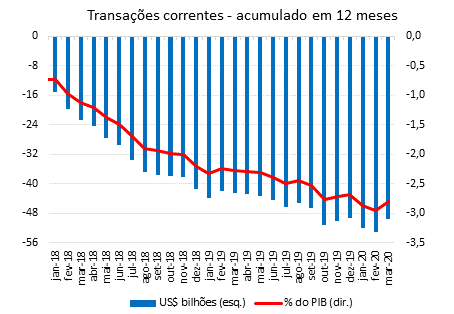
Em março de 2020, as transações correntes apresentaram superávit de US$868 milhões, ante déficit de US$2,7 bilhões, no mesmo mês de 2019. Esse foi o primeiro superávit desde junho de 2017 (US$431 milhões). Na comparação com março de 2019, a mudança no sinal das transações correntes decorreu, principalmente, do recuo do déficit na renda primária, US$2,7 bilhões. Também houve incremento de US$360 milhões no superávit da balança comercial de bens e redução no déficit na conta de serviços, US$569 milhões. O déficit em transações correntes do primeiro trimestre de 2020 somou US$15,2 bilhões, ligeiramente acima dos US$15,0 bilhões ocorridos em período correspondente, de 2019. O déficit em transações correntes nos doze meses encerrados em março de 2020 somou US$49,7 bilhões (2,80% do PIB), ante US$53,2 bilhões (2,96% do PIB), em fevereiro de 2020.
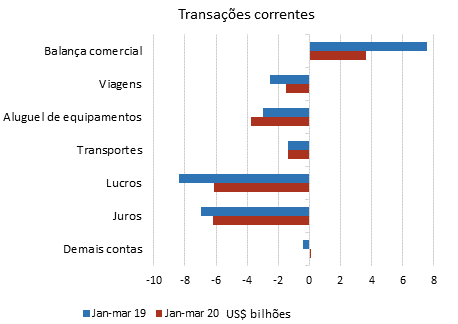
As exportações de bens totalizaram US$19,3 bilhões em março, aumento de 10,6% em relação ao mês correspondente de 2019. Na mesma base de comparação, as importações de bens aumentaram 10,9%, para US$15,1 bilhões. As importações líquidas de bens no âmbito do Repetro foram estimadas em US$274 milhões em março de 2020, não tendo havido operações similares em março de 2019. Na comparação entre os primeiros trimestres de 2020 e 2019, as exportações reduziram 3,0% para US$49,7 bilhões, enquanto as importações aumentaram 5,4%, totalizando US$46,0 bilhões. No primeiro trimestre de 2020, as importações líquidas no Repetro foram estimadas em US$2,4 bilhões, ante US$797 milhões estimadas para o período equivalente de 2019. O superávit comercial de bens do primeiro trimestre de 2020 atingiu US$3,6 bilhões, redução de 51,9% comparativamente aos US$7,6 bilhões observados no primeiro trimestre de 2019.
O déficit na conta de serviços atingiu US$1,8 bilhão no mês, 24,2% inferior ao resultado de março de 2019, US$2,3 bilhões. A maior contribuição para esse recuo veio da redução de 70,2% nas despesas líquidas de viagens, que totalizaram US$227 milhões em março de 2020 (US$760 milhões em março de 2019). Os impactos da pandemia de Covid-19 e das medidas para a sua contenção reduziram o fluxo de viajantes, contribuindo para o recuo interanual de 32,1% e de 53,9%, nas receitas e despesas de viagens, na ordem. A elevação nas receitas líquidas de outros serviços de negócios, de US$491 milhões para US$725 milhões, também auxiliou a redução do déficit em serviços. Em sentido oposto, destacou-se o incremento nas despesas líquidas de aluguel de equipamentos, de US$1,1 bilhão para US$1,3 bilhão.
Em março de 2020, o déficit em renda primária recuou 61,9% na comparação com março de 2019, atingindo US$1,6 bilhão. Os gastos líquidos com juros somaram US$837 milhões no mês, queda de 37,3% na comparação interanual, com retração tanto das despesas quanto das receitas. As despesas líquidas de lucros e dividendos foram estimadas em US$809 milhões, redução de 72,9% ante os US$3,0 bilhões observados em março de 2019, explicando a maior parte da redução do déficit em renda primária. Na mesma base de comparação, as receitas totais de lucros (remetidas e reinvestidas) passaram de US$1,5 bilhão para US$257 milhões, e as despesas totais de lucros (remetidas e reinvestidas) decresceram de US$4,5 bilhões para US$1,1 bilhão.

Os ingressos líquidos em investimentos diretos no país (IDP) somaram US$7,6 bilhões no mês, ante US$4,8 bilhões em março de 2019. O fluxo foi composto por ingressos líquidos de US$2,3 bilhões em participação no capital e de US$5,3 bilhões em operações intercompanhia, nos quais destacam-se os ingressos líquidos de US$4,0 bilhões em investimento reverso (filial no exterior e matriz no Brasil). Nos doze meses encerrados em março de 2020, o IDP totalizou US$79,5 bilhões, correspondendo a 4,49% do PIB, em comparação a US$76,7 bilhões (4,27% do PIB) no mês anterior.
Em março de 2020, os fluxos líquidos de investimentos diretos no exterior (IDE) apresentaram regressos líquidos ao país (desinvestimentos) de US$5,4 bilhões, ante aplicações líquidas de US$1,7 bilhão no exterior, no mês equivalente de 2019.

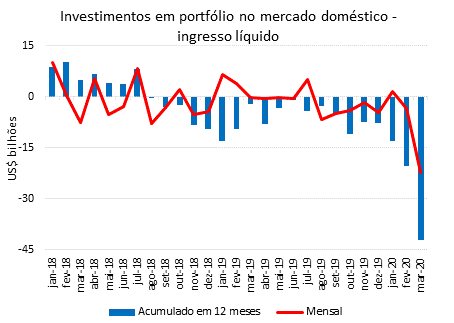
No mês, a saída líquida de investimento em portfólio no mercado doméstico somou US$22,2 bilhões, recorde da série, com saídas líquidas de US$14,6 bilhões em títulos de dívida e de US$7,6 bilhões em ações e fundos de investimento. No primeiro trimestre de 2020 houve saídas líquidas de US$24,1 bilhões em instrumentos de portfólio negociados no mercado doméstico, comparativamente a ingressos líquidos de US$10,5 bilhões observados em período similar do ano anterior. Nos doze meses encerrados em março de 2020, a saída líquida de investimento em portfólio no mercado doméstico somou US$42,2 bilhões.
2. Reservas internacionais
O estoque de reservas internacionais atingiu US$343,2 bilhões em março de 2020. O decréscimo de US$19,3 bilhões, relativamente à posição de fevereiro, decorreu principalmente da liquidação de US$22,5 bilhões em intervenções no mercado de câmbio, compostas por US$10,7 bilhões em vendas à vista, US$7,7 bilhões de concessões líquidas em linhas com recompra, e US$4,2 bilhões em concessões líquidas nas operações compromissadas em moeda estrangeira. A variação por preço e a receita de juros contribuíram, na ordem, para elevar o estoque de reservas em US$2,7 bilhões e em US$568 milhões.
3. Posição de Investimento Internacional (PII)
A PII apresenta, a cada data-base, os estoques de ativos e passivos financeiros entre residentes e não residentes no país. A diferença entre esses estoques é denominada PII líquida, com valores negativos expressando o maior volume de investimentos de não residentes realizados no país, quando comparados aos efetuados no exterior por residentes.
A PII líquida devedora de março de 2020 foi estimada em US$348,4 bilhões (19,7% do PIB). Comparativamente à estimativa para fevereiro de 2020, US$567,8 bilhões (31,6% do PIB), a posição tornou-se menos devedora em US$219,4 bilhões, concentrados na redução do estoque de passivos. Apesar das saídas líquidas de investidores não residentes em instrumentos de portfólio negociados no país, o recuo das posições de passivos na comparação entre março e fevereiro decorreu, em maioria, de variações por preço e paridade. A depreciação da moeda doméstica reduziu o estoque de passivos externos denominados em moeda nacional, tais como IDP – Participação no capital e títulos e ações negociados no mercado interno, com efeito total estimado em US$104 bilhões. A variação de preço para passivos em ações, empresas de IDP, e títulos soberanos no mercado internacional, foi estimada em US$106 bilhões.
4. Revisões – exportação de bens
A Secretaria de Comércio Exterior (Secex) do Ministério da Economia revisou as estatísticas de exportações de bens para janeiro e fevereiro de 2020, o que implicou redução de US$521 milhões no saldo comercial do primeiro bimestre do ano.
Essa revisão, decorrente da revisão nas informações prestadas, é classificada como uma revisão ordinária de curto prazo e efetuada na mesma periodicidade em que essa estatística é publicada, nos termos da Política de Revisão das Estatísticas Econômicas Oficiais Compiladas pelo Departamento de Estatísticas (DSTAT) do Banco Central do Brasil (BCB), de outubro de 2019. Dessa forma, nesta divulgação, as estatísticas de exportações de bens das transações correntes do balanço de pagamentos estão sendo revisadas para o mesmo período e nos mesmos montantes em que houve a revisão realizada pela Secex.
5. Estimativas e parciais
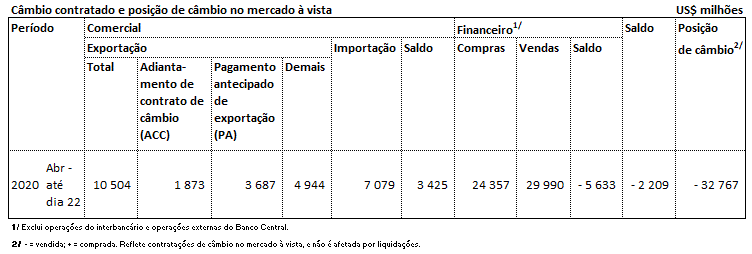
Devido à suspensão da entrevista coletiva para a divulgação das estatísticas do setor externo, as estimativas e as parciais para o corrente mês passam a ser informadas no texto da Nota para a Imprensa.
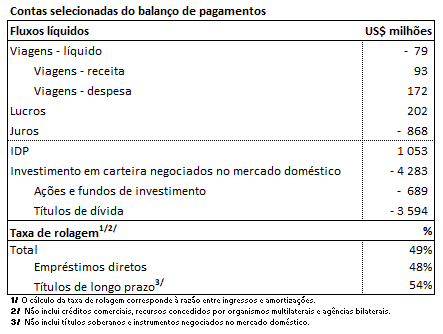
Para o mês de abril, a estimativa para o resultado em transações correntes é de superávit de US$2,0 bilhões, enquanto a de IDP é de ingressos líquidos de US$1,5 bilhão.
As parciais para o mês de abril, até o dia 22, são apresentadas nas tabelas a seguir:
COMÉRCIO EXTERIOR BRASILEIRO
ABPA. PORTAL G1. REUTERS. 24/04/2020. Cortes na produção de carnes dos EUA por coronavírus podem favorecer vendas do Brasil à China. Companhias brasileiras afirmam não ter, pelo menos por ora, contaminação em massa de funcionários pela Covid-19 como ocorre nos Estados Unidos.
A paralisação de várias grandes processadoras de carnes nos EUA por causa do coronavírus deve fazer com que o país priorize a abastecimento interno e reduza embarques para a China, abrindo espaço para o Brasil avançar nestes mercados, de acordo com lideranças do setor.
Os EUA são os principais concorrentes do Brasil, maior exportador de carne bovina e de frangos e o quarto do mundo em cortes suínos. E as companhias brasileiras não verificam, pelo menos por ora, os problemas relevantes devido ao coronavírus que atingem a indústria norte-americana.
A estrutura de produção brasileira, muito mais pulverizada e com plantas menores que nos EUA, seria uma vantagem competitiva, já que menos trabalhadores por planta estariam expostos à doença.
O segmento brasileiro de suínos tende a ser o mais beneficiado, seguido pelo da proteína bovina, considerando que os fechamentos de plantas americanas foram nessas áreas.
"Podemos pegar uma fatia de mercado que é dos americanos na China e Ásia... Sobra para nós um espaço (para aumentar as exportações) em suínos, porque eles (EUA) deixam de exportar tanto no atual cenário", disse o presidente da Associação Brasileira de Proteína Animal (ABPA), Francisco Turra.
O chefe da ABPA evitou fazer uma projeção de quanto o Brasil poderia embarcar a mais para o mercado da China, que já é de longe o maior comprador de carnes brasileiras.
Um executivo de uma grande indústria de carne bovina do Brasil concordou que a conjuntura favorece os brasileiros
"O fechamento das plantas americanas pode ajudar na competitividade (do Brasil) com China. Os EUA vão privilegiar o mercado interno no caso de redução da oferta", afirmou ele, na condição de anonimato.
Dados do Departamento de Agricultura dos Estados Unidos (USDA) divulgados nesta quinta-feira mostraram redução nas vendas semanais de exportação de carnes suína e bovina do país, com destaque para diminuição nas vendas aos asiáticos.
Ainda não há clareza, entretanto, se esta redução das vendas semanais está associada aos fechamentos de unidades, que se acentuaram nesta semana.
Fechamento de fábricas
A Tyson Foods anunciou na quarta-feira a suspensão por prazo indefinido das operações de sua maior unidade de suínos nos EUA, em Waterloo, Iowa, em meio a casos de coronavírus entre os trabalhadores. Outra unidade de suínos da empresa, em Logansport, em Indiana, também será fechada.
Nesta quinta-feira, maior produtora de carnes dos EUA, anunciou o fechamento temporário de uma unidade de bovinos no Estado de Washington, para que funcionários possam ser testados.
Também nesta semana, a concorrente JBS USA anunciou o fechamento por período indeterminado de uma instalação de abates de suínos localizada em Minnesota, que produz nada menos que cerca de 5% da carne suína do país, devido à pandemia.
Ainda no segmento de suínos, a Smithfield Foods fechou fábricas por decorrência do contágio do vírus entre os funcionários. A JBS e a National Beef encerraram as atividades de unidades produtoras de carne bovina.
Exportações americanas em queda
O relatório do USDA mostrou que os exportadores norte-americanos venderam 39,8 mil toneladas da proteína suína na semana encerrada no dia 16 de abril, recuo de 13% em relação à semana anterior e de 11% ante a média das últimas quatro semanas.
A China foi a segunda maior compradora e adquiriu 25% do total comercializado pelos EUA na semana até o dia 16, com 9,7 mil toneladas. No entanto, este volume representa queda de 40,8% em relação às 16,4 mil toneladas adquiridas na semana anterior.
As vendas de exportação norte-americanas de carne bovina caíram 45% na semana até o dia 16, em relação à semana anterior, para 11,2 mil toneladas. Ante a média das últimas quatro semanas, a baixa foi de 35%, informou o relatório do USDA.
"A redução da participação dos americanos no mercado internacional ajuda o Brasil... Só não acredito que falte carne para o consumo interno nos EUA ou que possam demandar a proteína brasileira para complementar a oferta local americana", avaliou o sócio diretor da consultoria Athenagro, Maurício Palma Nogueira.
"Pode faltar algum corte de preferência, mas a chance de desabastecimento mais sério é minúscula. As unidades que foram fechadas também não ficarão nessa situação para sempre", pontuou.
Covid-19 não deve causar paralisação no Brasil
Apesar da pandemia da Covid-19 também ter atingido o Brasil, o diretor da Athenagro ressaltou que é baixa a possibilidade de que a situação dos frigoríficos norte-americanos se replique na indústria brasileira.
"No Brasil, trabalhamos com muita ociosidade e as plantas são de tamanho menor, em relação às americanas... Não passamos por esse risco", disse Nogueira sobre a hipótese de mudança na pauta de exportações para garantir o abastecimento interno.
Já o presidente da BRF, Lorival Luz, foi mais cauteloso que o analista e o dirigente da ABPA. Ele disse à Reuters nesta semana que não descarta que em algum momento possa haver uma redução no volume de produção de cortes de frango, medida que serviria para proteger a saúde das pessoas em caso de confirmação de casos de coronavírus em alguma planta.
Procuradas pela Reuters para comentar o efeito dos fechamentos de frigoríficos nos EUA para os exportadores brasileiros, as companhias JBS, BRF, Minerva Foods e Aurora Alimentos não quiseram se posicionar.
A Marfrig Global Foods informou, por meio da assessoria de imprensa, que os fechamentos de plantas nos EUA não têm "repercussão até o momento" para o mercado brasileiro.
A Associação Brasileira das Indústrias Exportadoras de Carnes (Abiec), que representa os frigoríficos, também não quis comentar o assunto.
INDÚSTRIA
FGV. IBRE. 24/04/20. Sondagens e Índices de Confiança. Prévia da Sondagem da Indústria. Prévia da Sondagem da Indústria sinaliza recuo em abril
A prévia da Sondagem da Indústria de abril de 2020 indica recuo de 39,5 pontos do Índice de Confiança da Indústria (ICI) em relação ao número final de março, para 58,0 pontos. Caso esse resultado se confirme, essa será a maior queda mensal, com o índice alcançando o menor valor da série histórica
A queda da confiança em abril é resultado da forte deterioração da percepção dos empresários em relação à situação atual, e do pessimismo em relação aos próximos três e seis meses. O Índice de Expectativas apresenta queda de 47,3 pontos, para 48,9 pontos, enquanto o Índice de Situação Atual aponta recuo de 31,0 pontos, para 67,8 pontos.
O resultado preliminar de abril indica diminuição de 17,8 pontos percentuais do Nível de Utilização da Capacidade Instalada da Indústria (NUCI), para 57,5%, o menor valor da série histórica.
DOCUMENTO: https://portalibre.fgv.br/navegacao-superior/noticias/previa-da-sondagem-da-industria-sinaliza-recuo-em-abril.htm
INFLAÇÃO
FGV. IBRE. 24/04/20. Sondagens e Índices de Confiança. Indicador de Expectativa de Inflação dos Consumidores. Expectativa de Inflação dos Consumidores cresce em abril
A expectativa de inflação dos consumidores brasileiros para os próximos 12 meses subiu 0,3 ponto percentual em abril, para 5,1%, o maior valor desde julho de 2019 (5,3%). Em relação ao mesmo mês do ano anterior, houve redução de 0,2 ponto percentual.
“A antecipação de compras para formação de estoques a partir da segunda quinzena de março, quando muitas grandes cidades iniciaram medidas de isolamento social, pressionou os preços de alimentos, levando consumidores a rever para cima suas expectativas de inflação. Este resultado deve ser passageiro, considerando que o nível de atividade continuará muito fraco por um tempo mantendo baixa também a inflação”, afirma Viviane Seda Bittencourt, Coordenadora das Sondagens da FGV IBRE.
Analisando a frequência da inflação prevista por faixas de respostas, 45,6% dos consumidores projetaram valores abaixo da meta de inflação (4,0%) em abril, a menor parcela dos últimos seis meses. Por outro lado, a proporção de consumidores projetando acima do limite superior da meta de inflação (acima de 5,5%) para 2020 aumentou de 30,4% para 35,9%, a maior parcela nos últimos seis meses.
Na análise por faixas de renda, todas as famílias, principalmente as de menor poder aquisitivo, aumentaram suas expectativas medianas para a inflação nos 12 meses seguintes. Para as famílias com renda até R$ 2,1 mil houve aumento de 5,9% para 6,2% enquanto para as famílias com renda entre R$ 2,1 mil e R$ 4,8 mil as expectativas subiram de 5,0% para 5,6%. Quanto às famílias de renda acima de R$ 9,6 mil, suas expectativas cresceram 0,1% após permanecer sete meses no mínimo valor histórico (4,0%).
DOCUMENTO: https://portalibre.fgv.br/navegacao-superior/noticias/expectativa-de-inflacao-dos-consumidores-cresce-em-abril.htm
FGV. IBRE. 24/04/20. Índices Gerais de Preços. IPC-S Capitais. Inflação pelo IPC-S recua em todas as sete capitais pesquisadas
O IPC-S de 22 de abril de 2020 registrou variação de 0,07%, ficando 0,27 ponto percentual (p.p.) abaixo da taxa divulgada na última apuração. Todas as sete capitais pesquisadas registraram decréscimo em suas taxas de variação.
A tabela a seguir, apresenta as variações percentuais dos municípios das sete capitais componentes do índice, nesta e nas apurações anteriores.

DOCUMENTO: https://portalibre.fgv.br/navegacao-superior/noticias/inflacao-pelo-ipc-s-recua-em-todas-as-sete-capitais-pesquisadas-6.htm
SIDERURGIA
IABr. REUTERS. 24 DE ABRIL DE 2020. Produção brasileira de aço bruto em março cai 8,2%, venda tomba 10,7%, diz IABr
SÃO PAULO, 24 Abr (Reuters) - - A produção brasileira de aço bruto em março somou 2,635 milhões de toneladas, queda de 8,2% sobre o resultado de um ano antes, informou nesta sexta-feira o Instituto Aço Brasil (IABr).
As vendas de aço no mercado interno, enquanto isso, foram de 1,471 milhão de toneladas, recuo de 10,7% na comparação anual.
As exportações, porém, dispararam 71,4% em março, para 1,39 milhão de toneladas, ajudando a reduzir a queda no acumulado do primeiro trimestre para 1,3%, a 3,25 milhões de toneladas.
AVIAÇÃO
EMBRAER. BOEING. REUTERS. 24 DE ABRIL DE 2020. Acordo Boeing-Embraer atinge obstáculo perto de prazo, dizem fontes
Por Tim Hepher e Marcelo Rochabrun e Tatiana Bautzer
PARIS/SÃO PAULO (Reuters) - O acordo de 4,2 bilhões de dólares para a Boeing comprar o controle da divisão de aviação comercial da Embraer atingiu um obstáculo para implementação, criando incertezas sobre o negócio a menos que um avanço seja obtido rapidamente, afirmaram fontes com conhecimento das discussões.
As companhias mantêm conversas para determinar se várias condições contratuais foram cumpridas para a implementação da venda, incluindo a forma pela qual a joint-venture 80% controlada pela Boeing vai ser criada e financiada. As partes têm até o final desta sexta-feira para resolver a questão.
O acordo também depende de aprovação da União Europeia, que afirmou anteriormente que precisa aguardar até agosto para completar uma análise sobre a transação. Mas a aprovação das autoridades europeias não é considerada como o principal obstáculo para a conclusão do negócio.
Representantes das duas empresas não comentaram o assunto.
Sob um acordo preliminar assinado no início do ano passado, Boeing e Embraer tinham até esta sexta-feira - 15 meses após a assinatura inicial - para concluir o acordo e implementar uma série de termos e condições de ambos os lados.
Pessoas familiarizadas com o assunto enfatizaram que o prazo termina à meia-noite de São Paulo e que ainda pode ser alcançado um acordo para resolver diferenças pendentes, embora duas fontes tenham dito que as negociações não estavam avançando rápido.
A Embraer disse nesta semana que negociava com a Boeing para estender o prazo de 24 de abril para fechar o acordo e que não havia garantias sobre se ou quando poderia ser concluído.
A ação da Embraer caía cerca de 11%, em dia forte queda do Ibovespa, após o ministro da Justiça, Sergio Moro se demitir acusando o presidente Jair Bolsonaro de interferência política na Polícia Federal.
A Reuters publicou no mês passado que mercados fracos levantaram questões urgentes sobre o rumo do acordo da Boeing com a Embraer. A queda nas ações da Embraer e as preocupações com o caixa da Boeing, na esteira do impacto da epidemia de coronavírus nas viagens aéreas, minaram os fundamentos econômicos da transação.
Uma fonte familiarizada com as negociações disse que a Boeing segue comprometida com o negócio e que seria complexo reverter a divisão do braço comercial da Embraer, cujos jatos regionais E2 competem com o Airbus A220.
Analistas não descartam uma segunda tentativa de concluir o acordo estratégico se o negócio fracassar.
O contrato tem uma multa de rescisão de 75 milhões de dólares, subindo para 100 milhões de dólares se for por motivos antitruste, de acordo com uma cópia do acordo enviado às autoridades dos EUA.
BOEING. REUTERS. 24 DE ABRIL DE 2020. Boeing planeja cortar produção do 787 Dreamliner e empregos, diz Bloomberg
BANGALORE, Índia (Reuters) - A Boeing planeja reduzir pela metade a produção do 787 Dreamliner e anunciar cortes de empregos por ocasião da divulgação dos resultados de primeiro trimestre, informou a Bloomberg.
Os detalhes das alterações de produção da linha comercial da Boeing ainda estão sendo finalizados e determinarão o número de funcionários cortados, acrescentou a reportagem.
A Boeing não respondeu imediatamente a um pedido da Reuters para comentar.
Por Maria Ponnezhath
ENERGIA
EUA. REUTERS. 24 DE ABRIL DE 2020. EUA consideram assumir fatias em empresas de energia do país, diz Mnuchin
WASHINGTON (Reuters) - O governo Donald Trump está considerando assumir participações em empresas de energia dos Estados Unidos como uma opção possível, à medida que tenta ajudar o setor de óleo e gás do país em meio à pandemia de coronavírus, disse nesta sexta-feira o secretário do Tesouro norte-americano, Steven Mnuchin.
O presidente Trump, falando ao lado de Mnuchin em um evento na Casa Branca, afirmou que deseja ajudar a indústria de óleo e gás, e sugeriu que o governo federal pode comprar combustível para o país de forma antecipada, bem como adquirir passagens aéreas antecipadamente.
“Estamos analisando uma série de alternativas”, disse Mnuchin.
Trump afirmou ainda que Rússia e Arábia Saudita podem fazer novos cortes à produção de petróleo, diante do excesso de oferta verificado no mercado da commodity em meio à pandemia, acrescentando que Texas, Oklahoma e Dakota do Norte estão reduzindo bombeamento, assim como o Canadá.
“Vai ser algo natural, a essa altura”, disse Trump sobre os cortes.
Reportagem de Jeff Mason e Lisa Lambert
OPEP. REUTERS. 24 DE ABRIL DE 2020. Fretes de superpetroleiros recuam após disparada, mas podem ter novos saltos
Por Roslan Khasawneh
CINGAPURA (Reuters) - Taxas de fretamento de superpetroleiros recuaram nesta semana, diante de uma esfriada na crescente demanda por armazenamento flutuante e por sinais de que a produção de petróleo deve diminuir, embora as taxas possam voltar a subir à medida que a disponibilidade de embarcações caia e com traders tentando se aproveitar dos preços baixos da commodity, disseram fontes.
As taxas tiveram forte alta no início da semana, após o contrato maio do petróleo dos Estados Unidos ter operado na segunda-feira em território negativo —pela primeira vez na história— antes do vencimento, conforme operadores desesperados pagavam para se livrar dos barris, desencadeando uma disparada na demanda por navios-tanque para armazenamento.
Nos últimos dias, as taxas para navios do tipo VLCC (Very Large Crude Carrier, em inglês) operaram entre 120.000 dólares e 130.000 dólares por dia para um período de afretamento de seis meses, de acordo com fontes.
Antes de o petróleo WTI passar ao campo negativo, as taxas eram de cerca de 85.000 dólares por dia para um período de seis meses, ainda segundo as fontes.
As taxas de navios VLCC em rotas do Oriente Médio para a China estavam em cerca de 9,8 milhões de dólares nesta sexta-feira, abaixo dos 11,5 milhões na quinta-feira, mas acima dos 8,9 milhões da segunda-feira, antes do colapso nos preços do petróleo dos EUA, segundo fontes comerciais.
“Depois de o WTI se recuperar de seu colapso para território negativo, o ‘contango’ diminuiu consideravelmente e o incentivo para armazenamento também caiu em alguma medida, empurrando as taxas dos navios-tanque um pouco para baixo”, disse Ashok Sharma, diretor-administrativo da corretora BRS Baxi em Cingapura.
A diminuição do bombeamento em importantes países produtores também contribuiu para que as taxas recuassem, afirmaram fontes de corretoras.
Apesar dos cortes, no entanto, as taxas para navios-tanque podem voltar a subir em meio ao crescente excesso de oferta de petróleo que pode forçar o armazenamento de mais cargas “sem destino”.
“Em uma média global, um VLCC voltaria ao trabalho após 2 ou 3 meses do carregamento. Mas agora, por causa desse cenário para armazenamento flutuante, não temos certeza de quando um VLCC envolvido em um contrato de estocagem poderá voltar ao mercado e se apresentar para recontratação”, disse Sharma.
________________
LGCJ.:

