US ECONOMICS
BRAZIL
THE WHITE HOUSE. March 6, 2020. Statement by the Press Secretary on the Meeting with President Jair Bolsonaro of Brazil
President Donald J. Trump will meet President Jair Bolsonaro of Brazil at Mar-a-Lago on Saturday, March 7, 2020. President Trump and President Bolsonaro will discuss opportunities to build a more prosperous, secure, and democratic world. As leaders of the Hemisphere’s two largest economies, they will also discuss opportunities for restoring democracy in Venezuela, bringing peace to the Middle East, implementing pro-growth trade policies, and investing in infrastructure. The President will use this meeting as an opportunity to thank Brazil for its strong alliance with the United States.
U.S. Department of State. 03/06/2020. THE UNITED STATES AND BRAZIL: PARTNERS FOR A PROSPEROUS HEMISPHERE
The U.S.-Brazil relationship is stronger than ever. President Jair Bolsonaro will visit Florida March 7-10, and President Trump will host him at Mar-a-Lago. The U.S.-Brazil partnership is key to the President’s vision to achieve a free and democratic Western Hemisphere where economic prosperity can flourish throughout, and this visit enables our countries to advance these shared interests.
U.S.-BRAZIL ECONOMIC TIES ADVANCE PROSPERITY FOR BOTH NATIONS
As the two largest economies in the Western Hemisphere, the United States and Brazil share a bilateral trade relationship valued at more than $100 billion, and the United States is Brazil’s largest trading partner in value-added goods. Our economic relationship is rooted in principles of fair trade, market liberalization, and healthy competition. Both countries share a vision of expanding bilateral trade and investment, with an aim to ease the transfer of goods and services in a safe and sustainable way. Since Presidents Trump and Bolsonaro last met in March 2019, both countries have taken real actions to promote prosperity.
- The United States supports an immediate invitation from the OECD for Brazil to initiate the accession process.
- Brazil ratified the Technology Safeguards Agreement (TSA) to support the launch of U.S.-licensed satellites and space vehicles from the Alcantara Space Center in Brazil.
- The Althelia Biodiversity Fund (ABF), whose development was supported by USAID, was officially launched and has targeted raising $100 million for “impact investing” in Amazon-based conservation enterprises.
- Brazil expanded access to its wheat market by establishing a 750,000 ton duty-free quota for imported wheat.
- We made travel between the United States and Brazil easier. The United States launched the DHS Trusted Traveler Global Entry pilot program and Brazil exempted U.S. citizens from tourist visa requirements, saving U.S. tourists and business travelers tens of millions of dollars and leading to a 39 percent increase in U.S. travelers to Brazil since implementation.
- Brazilians studying in the United States increased by almost 12 percent in 2018 and 10 percent in 2019, making Brazil the 9th largest sender of foreign students to the United States. S. students studying in Brazil increased over 29 percent in 2019.
- The United States and Brazil held the U.S.-Brazil Commercial Dialogue (September 2019), resumed the U.S.-Brazil CEO Forum (November 2019), and launched the new U.S.-Brazil Energy Forum (February 2020) with private sector participation.
- Our countries are increasing cooperation on infrastructure project financing, including under the America Cresce (Growth in the Americas) initiative.
OUR PARTNERSHIP ADVANCES DEMOCRACY IN THE REGION
As the two largest democracies in the hemisphere, we are deepening our cooperation to promote human rights and democracy across the region. The United States applauds Brazil for its leadership in supporting a restoration of democracy and an end to the humanitarian crisis in Venezuela, as well as Brazil’s steadfast support for democracy in Bolivia and Nicaragua.
- Brazil imposed a travel ban on 130 corrupt former Maduro regime officials and on March 5 announced they are pulling Brazilian diplomats from Venezuela.
- Brazil’s program for welcoming and integrating vulnerable Venezuelans, Operacao Acolhida, is a model for the region.
- Since Fiscal Year 2017, the United States has provided $46 million (of which nearly $42 million is for humanitarian assistance) to support Brazil’s efforts to provide services for vulnerable Venezuelan migrants and refugees.
THE UNITED STATES AND BRAZIL COOPERATE ON SECURITY IN THE HEMISPHERE
The United States and Brazil share long-standing cooperation on security issues and our defense cooperation is at the strongest level it has been in many years. We are expanding our collaboration on addressing challenges such as narcotics and weapons trafficking, terrorism, cybercrimes, and money laundering.
- President Trump designated Brazil as a Major Non-NATO Ally in July 2019, opening further opportunities for defense cooperation.
- The United States hosted the U.S.-Brazil Permanent Security Forum plenary in October 2019.
- The United States and Brazil are working to schedule a peacekeeping technical level dialogue to identify opportunities for collaboratively building the capacity of third-party countries to effectively deploy peacekeeping forces.
EMPLOYMENT
DoC. BLS. March 6, 2020. THE EMPLOYMENT SITUATION -- FEBRUARY 2020
Total nonfarm payroll employment rose by 273,000 in February, and the unemployment
rate was little changed at 3.5 percent, the U.S. Bureau of Labor Statistics
reported today. Notable job gains occurred in health care and social assistance,
food services and drinking places, government, construction, professional and
technical services, and financial activities.
This news release presents statistics from two monthly surveys. The household
survey measures labor force status, including unemployment, by demographic
characteristics. The establishment survey measures nonfarm employment, hours, and
earnings by industry. For more information about the concepts and statistical
methodology used in these two surveys, see the Technical Note.
Household Survey Data
Both the unemployment rate, at 3.5 percent, and the number of unemployed persons,
at 5.8 million, changed little in February. The unemployment rate has been either
3.5 percent or 3.6 percent for the past 6 months. (See table A-1.)
Among the major worker groups, the unemployment rate for Asians declined to 2.5
percent in February. The rates for adult men (3.3 percent), adult women (3.1 percent),
teenagers (11.0 percent), Whites (3.1 percent), Blacks (5.8 percent), and Hispanics
(4.4 percent) showed little or no change over the month. (See tables A-1, A-2, and
A-3.)
The number of long-term unemployed (those jobless for 27 weeks or more), at 1.1
million, changed little in February and accounted for 19.2 percent of the unemployed.
(See table A-12.)
The labor force participation rate remained at 63.4 percent in February. The
employment-population ratio, at 61.1 percent, changed little over the month but was
up by 0.4 percentage point over the year. (See table A-1.)
The number of persons employed part time for economic reasons, at 4.3 million,
changed little in February. These individuals, who would have preferred full-time
employment, were working part time because their hours had been reduced or they
were unable to find full-time jobs. (See table A-8.)
In February, 1.4 million persons were marginally attached to the labor force,
little changed from the previous month. These individuals were not in the labor
force, wanted and were available for work, and had looked for a job sometime in the
prior 12 months but had not looked for work in the 4 weeks prior to the survey.
Discouraged workers, a subset of the marginally attached who believed that no
jobs were available for them, numbered 405,000 in February, little different
from the previous month. (See Summary table A.)
Establishment Survey Data
Total nonfarm payroll employment rose by 273,000 in February, after an increase of
the same magnitude in January. In 2019, job growth averaged 178,000 per month. In
February, notable job gains occurred in health care and social assistance, food
services and drinking places, government, construction, professional and technical
services, and financial activities. (See table B-1.)
Employment in health care and social assistance increased by 57,000 in February.
Health care added 32,000 jobs, with gains in offices of physicians (+10,000), home
health care services (+10,000), and hospitals (+8,000). Employment in social assistance
increased by 25,000, with a majority of the gain in individual and family services
(+18,000). Over the past 12 months, employment increased by 368,000 in health care and
by 191,000 in social assistance.
Food services and drinking places added 53,000 jobs in February. Employment in the
industry has increased by 252,000 over the past 7 months, following a lull in job growth
earlier in 2019.
In February, government employment increased by 45,000, led by a gain in state government
education (+16,000). Federal employment increased by 8,000, reflecting the hiring of
7,000 temporary workers for the 2020 Census.
Construction added 42,000 jobs in February, following a similar gain in January (+49,000).
In 2019, job gains averaged 13,000 per month. In February, employment gains occurred
in specialty trade contractors (+26,000) and residential building (+10,000).
In February, employment in professional and technical services increased by 32,000. Job
growth occurred in architectural and engineering services (+10,000) and in scientific
research and development services (+5,000). Employment continued to trend up in computer
systems design and related services (+8,000). Over the past 12 months, professional and
technical services has added 285,000 jobs.
Employment in financial activities increased by 26,000 in February, with gains in real
estate (+8,000) and in credit intermediation and related activities (+6,000). Over the
past 12 months, financial activities has added 160,000 jobs.
Employment in other major industries, including mining, manufacturing, wholesale trade,
retail trade, transportation and warehousing, and information, changed little over the
month.
In February, average hourly earnings for all employees on private nonfarm payrolls
increased by 9 cents to $28.52. Over the past 12 months, average hourly earnings have
increased by 3.0 percent. Average hourly earnings of private-sector production and
nonsupervisory employees increased by 8 cents to $23.96 in February. (See tables B-3
and B-8.)
The average workweek for all employees on private nonfarm payrolls rose by 0.1 hour to
34.4 hours in February. In manufacturing, the workweek increased by 0.2 hour to 40.7
hours, and overtime edged up by 0.1 hour to 3.2 hours. The average workweek for production
and nonsupervisory employees on private nonfarm payrolls increased by 0.1 hour to 33.7
hours. (See tables B-2 and B-7.)
The change in total nonfarm payroll employment for December was revised up by 37,000 from
+147,000 to +184,000, and the change for January was revised up by 48,000 from +225,000
to +273,000. With these revisions, employment gains in December and January combined were
85,000 higher than previously reported. (Monthly revisions result from additional reports
received from businesses and government agencies since the last published estimates and
from the recalculation of seasonal factors.) After revisions, job gains have averaged
243,000 per month over the last 3 months.
FULL DOCUMENT: https://www.bls.gov/news.release/pdf/empsit.pdf
INTERNATIONAL TRADE
DoC. BEA. US CENSUS. MARCH 6, 2020. U.S. International Trade in Goods and Services, January 2020
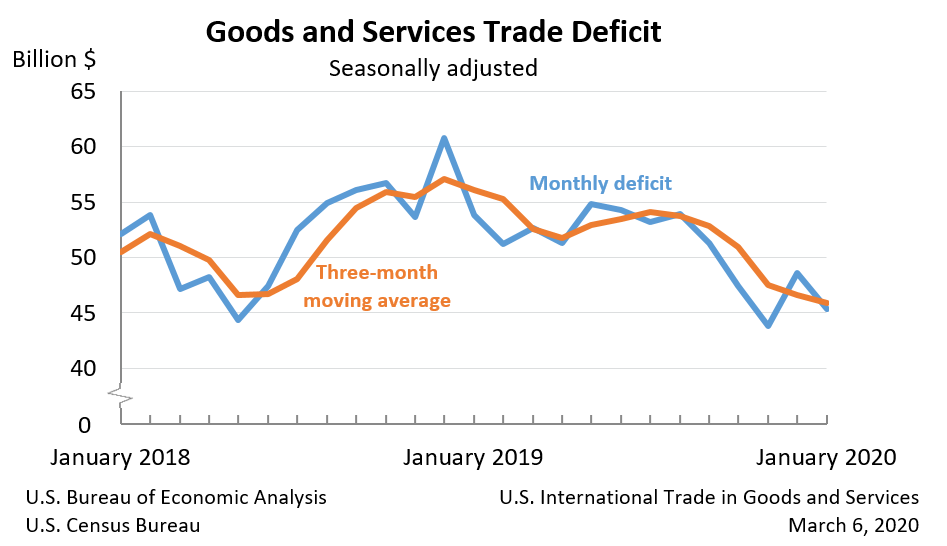
The U.S. Census Bureau and the U.S. Bureau of Economic Analysis announced today that the goods and services deficit was $45.3 billion in January, down $3.3 billion from $48.6 billion in December, revised.
| Deficit: | $45.3 Billion | -6.7%° |
| Exports: | $208.6 Billion | -0.4%° |
| Imports: | $253.9 Billion | -1.6%° |
Next release: April 2, 2020
(°) Statistical significance is not applicable or not measurable.
Data adjusted for seasonality but not price changes
Source: U.S. Census Bureau, U.S. Bureau of Economic Analysis; U.S. International Trade in Goods and Services, March 6, 2020
| ||
Exports, Imports, and Balance (exhibit 1)
January exports were $208.6 billion, $0.9 billion less than December exports. January imports were $253.9 billion, $4.2 billion less than December imports.
The January decrease in the goods and services deficit reflected a decrease in the goods deficit of $2.6 billion to $67.0 billion and an increase in the services surplus of $0.6 billion to $21.7 billion.
Year-over-year, the goods and services deficit decreased $8.5 billion, or 15.8 percent, from January 2019. Exports increased $2.3 billion or 1.1 percent. Imports decreased $6.2 billion or 2.4 percent.
Three-Month Moving Averages (exhibit 2)
The average goods and services deficit decreased $0.7 billion to $45.9 billion for the three months ending in January.
Average exports increased $0.7 billion to $208.6 billion in January.
Average imports decreased less than $0.1 billion to $254.5 billion in January.
Year-over-year, the average goods and services deficit decreased $10.2 billion from the three months ending in January 2019.
Average exports increased $1.9 billion from January 2019.
Average imports decreased $8.2 billion from January 2019.
Exports (exhibits 3, 6, and 7)
Exports of goods decreased $1.4 billion to $136.4 billion in January.
Exports of goods on a Census basis decreased $1.4 billion.
Capital goods decreased $1.0 billion.
Civilian aircraft decreased $1.7 billion.
Industrial supplies and materials decreased $1.0 billion..
Crude oil decreased $0.8 billion.
Fuel oil decreased $0.6 billion.
Other goods decreased $0.9 billion.
Automotive vehicles, parts, and engines increased $0.9 billion.
Net balance of payments adjustments decreased less than $0.1 billion.
Exports of services increased $0.5 billion to $72.2 billion in January.
Other business services increased $0.1 billion.
Financial services increased $0.1 billion.
Maintenance and repair services increased $0.1 billion.
Transport increased $0.1 billion.
Imports (exhibits 4, 6, and 8)
Imports of goods decreased $4.1 billion to $203.4 billion in January.
Imports of goods on a Census basis decreased $4.0 billion.
Industrial supplies and materials decreased $2.4 billion.
Nonmonetary gold decreased $1.3 billion.
Other petroleum products decreased $0.6 billion.
Other goods decreased $1.4 billion.
Net balance of payments adjustments decreased $0.1 billion.
Imports of services decreased $0.1 billion to $50.5 billion in January.
Transport decreased $0.2 billion.
Real Goods in 2012 Dollars – Census Basis (exhibit 11)
The real goods deficit decreased $2.3 billion to $77.7 billion in January.
Real exports of goods decreased $2.7 billion to $146.9 billion.
Real imports of goods decreased $5.1 billion to $224.6 billion.
Revisions
Exports and imports of goods and services were revised for July through December 2019 to incorporate more comprehensive and updated quarterly and monthly data. In addition to these revisions, seasonally adjusted data for all months in 2019 were revised so that the totals of the seasonally adjusted months equal the annual totals.
Revisions to December exports
Exports of goods were revised up less than $0.1 billion.
Exports of services were revised down $0.2 billion.
Revisions to December imports
Imports of goods were revised down less than $0.1 billion.
Imports of services were revised down $0.4 billion.
Goods by Selected Countries and Areas: Monthly – Census Basis (exhibit 19)
The January figures show surpluses, in billions of dollars, with South and Central America ($5.8), Hong Kong ($1.8), Brazil ($1.7), United Kingdom ($1.6), and OPEC ($1.3). Deficits were recorded, in billions of dollars, with China ($23.7), European Union ($13.5), Mexico ($9.2), Germany ($5.6), Japan ($5.3), Italy ($2.6), Taiwan ($1.8), India ($1.7), Canada ($0.7), France ($0.7), South Korea ($0.6), Singapore ($0.1), and Saudi Arabia (less than $0.1).
The deficit with Canada decreased $3.7 billion to $0.7 billion in January. Exports increased $0.7 billion to $24.6 billion and imports decreased $2.9 billion to $25.3 billion.
The deficit with China decreased $2.1 billion to $23.7 billion in January. Exports increased $0.2 billion to $7.7 billion and imports decreased $1.8 billion to $31.4 billion.
The deficit with Japan increased $0.9 billion to $5.3 billion in January. Exports decreased $1.1 billion to $5.7 billion and imports decreased $0.2 billion to $10.9 billion.
Goods and Services by Selected Countries and Areas: Quarterly – Balance of Payments Basis (exhibit 20)
Statistics on trade in goods and services by country and area are only available quarterly, with a one-month lag. With this release, fourth-quarter figures are now available.
The fourth-quarter figures show surpluses, in billions of dollars, with South and Central America ($20.5), Brazil ($8.7), OPEC ($7.8), Hong Kong ($6.4), United Kingdom ($5.5), Singapore ($4.8), and Saudi Arabia ($3.6). Deficits were recorded, in billions of dollars, with China ($69.4), European Union ($26.9), Mexico ($25.5), Germany ($14.8), Japan ($11.3), Italy ($9.0), India ($6.7), Taiwan ($5.0), Canada ($3.9), France ($2.9), and South Korea ($1.6).
The deficit with the European Union decreased $8.1 billion to $26.9 billion in the fourth quarter. Exports increased $1.9 billion to $152.7 billion and imports decreased $6.2 billion to $179.6 billion.
The deficit with China decreased $7.9 billion to $69.4 billion in the fourth quarter. Exports decreased $4.1 billion to $38.0 billion and imports decreased $12.0 billion to $107.5 billion.
The deficit with Canada increased $1.9 billion to $3.9 billion in the fourth quarter. Exports decreased $1.6 billion to $88.2 billion and imports increased $0.3 billion to $92.1 billion.
FULL DOCUMENT: https://www.bea.gov/system/files/2020-03/trad0120.pdf
CONSUMER CREDIT
Notes about the Data
Starting with the April 2020 G.19 Consumer Credit statistical release, scheduled to be published on June 5, 2020, the release will no longer report the levels and flows of on-book loan balances and off-book securitized loan balances as separate line items. Instead, the release will report aggregate balances of total owned and managed receivables--the sum of on-book and off-book loan balances--for each sector. For more information, please see the announcement posted on March 6, 2020.
January 2020
In January, consumer credit increased at a seasonally adjusted annual rate of 3-1/2 percent. Revolving credit decreased at an annual rate of 3-1/4 percent, while nonrevolving credit increased at an annual rate of 5-3/4 percent.
FULL DOCUMENT: https://www.federalreserve.gov/releases/g19/current/default.htm
PERU
U.S. Department of State. 03/06/2020. Condolences on the Death of Former UN Secretary-General Javier Perez de Cuellar. Michael R. Pompeo, Secretary of State
On behalf of the people of the United States, I extend my deepest condolences on the passing of former UN Secretary-General Javier Perez de Cuellar to his family. Javier Perez de Cuellar was an adept Peruvian statesman and a tenacious advocate for peace. He led the UN for two terms with distinction and honor during a historic and challenging period. The United States awarded him the highest civilian honor of the U.S. Presidential Medal of Freedom in 1991 for his extraordinary diplomatic efforts to obtain the release of American hostages from Lebanon. We mark his passing by remembering his exceptional life.
UN
U.S. Department of State. 03/06/2020. Secretary Michael R. Pompeo’s Meeting with United Nations Secretary-General Antonio Guterres
The below is attributable to Spokesperson Morgan Ortagus:
Secretary of State Michael R. Pompeo met today with UN Secretary-General Antonio Guterres in New York. Secretary Pompeo and Secretary-General Guterres discussed the recent progress towards a political settlement in Afghanistan, as well as ongoing developments in Yemen, Libya and Syria. With respect to Syria, they discussed the importance of an enduring ceasefire and continuing UN authorized cross-border aid deliveries.
Secretary Pompeo also reiterated his outrage at the decision by UN High Commissioner for Human Rights Michelle Bachelet to publish a database of companies operating in Israeli-controlled territories. The Secretary made clear that the United States will continue to engage UN officials and member states on this matter, will not tolerate the reckless mistreatment of U.S. companies, and will respond to actions harmful to our business community.
CORONAVIRUS
THE WHITE HOUSE. March 6, 2020. REMARKS. HEALTHCARE. Remarks by President Trump at Signing of the Coronavirus Preparedness and Response Supplemental Appropriations Act, 2020
THE PRESIDENT: Good morning, everybody. Good morning. I’m going to Tennessee to meet with the governor and a lot of people. And it’s something. It’s really something. I guess some of you are coming along, I assume. Is that right?
Q No.
THE PRESIDENT: You going?
Q There’s a crew out at Andrews waiting on you.
THE PRESIDENT: Okay.
So we’re signing the $8.3 billion. I asked for 2.5 and I got 8.3, and I’ll take it.
(The bill is signed.)
Okay? So here we are, $8.3 billion. We’re doing very well. But it’s an unforeseen problem. What a problem. Came out of nowhere, but we’re taking care of it.
We have big news on the ship. And a lot of things are happening on the ship. People are being tested right now. And I just spoke to the governor of California, Gavin Newsom. We had a good conversation. We’re both working on the ship together. It’s close to 5,000 people. So, it’s a big ship. But we’re doing testing on those people. Okay?
Could I have those others papers I’m going to sign, please? These are additional papers relevant to various things.
Okay, this is it?
AIDE: Yes.
(The document is signed.)
THE PRESIDENT: Okay, give me the other one.
AIDE: These are the (inaudible) designations for the bill. There’s two of them.
(The document is signed.)
Do you have anything you want to say to the press?
SECRETARY AZAR: I just want to make it — make it clear that in terms of tests, we have provided all the tests to the State of Washington and the State of California that they’ve asked for. The production and shipping of tests that we’ve talked about all week is completely on schedule.
All of the CDC tests — the tests that are available to test up to 75,000 people — CDC has shipped to America’s public health labs. Those are out.
Then, IDT, the private contractor working with CDC to ship to the private sector and hospitals, has already shipped enough tests for 700,000 tests. And the remaining lots are arriving at CDC this morning for quality control and should get out, as we forecast, this weekend.
And then next week, we’ll keep ramping up production. So as many as 4 million tests next week are going to be driving forward.
So everything is on schedule for the tests.
Q Mr. President, why aren’t you going to CDC today?
SECRETARY AZAR: He’s actually sent me. I’m going to go down.
THE PRESIDENT: You — you can tell them.
SECRETARY AZAR: Yeah. He sent —
THE PRESIDENT: We may — we may go. There was a — they thought there was a problem at CDC with somebody that had the virus. It turned out negative, so we’re seeing if we can do it. But yesterday afternoon, we were informed that there may have been a person with — with the virus, and they now find out that that was a negative test. They’ve tested the person very fully, and it was a negative test.
So I may be going. We’re going to see if they can turn it around with Secret Service.
Q (Inaudible.)
THE PRESIDENT: Yeah, we may —
Q You may go?
THE PRESIDENT: We may we may be going. Here, Steve, this is for you after covering me so well. (Laughter.)
Q How big a — how big a hit to the economy —
THE PRESIDENT: It’s the first time I’ve ever done that to a reporter.
Q How big a hit to the economy are you expecting (inaudible)?
THE PRESIDENT: Well, job numbers just came out and they’re incredible. The job numbers were tremendous. And we picked up close to 80,000 new jobs from the last report. And if you add that up, it’s over 350,000 jobs. The job numbers just came out a little while ago, and they were shocking to the people that were analyzing them.
Q Do you expect more gyrations in the stock market?
THE PRESIDENT: No, I think — I think, you know, a lot of people are staying here and they’re going to be doing their business here. They’re going to be traveling here. And they’ll be going to resorts here. And, you know, we have a great place. That’s where — so, foreign people come, but we’re going to have Americans staying home instead of going and spending the money in other countries. And maybe that’s one of the reasons the job numbers are so good. We’ve had a lot of travel inside the USA.
Q Do you think that Congress or your administration needs to take more action to diminish the risk of recession?
THE PRESIDENT: Well, all we can do is do what we do. I mean, we’re getting a lot of business from people staying. In other words, they’re — it’s — I’ve always liked anyway; you’ve known that for a long time. But people are staying here and spending their money here, as opposed to going to Europe and other places.
Now, that’ll change when this goes away, and hopefully that will be sooner rather than later.
But people were — I would say virtually everybody — you saw the job numbers, I guess — people were shocked, because you add another 80 or whatever it is, a lot of — a lot of numbers from last month, where they upgraded. So the job numbers were at a level that nobody thought possible. They were really incredible.
Q No stimulus needed?
THE PRESIDENT: I don’t know. I mean, we’re going to see whether or not the Fed wants to stimulate. In my opinion, they should because Europe is, and China is, and everybody is but us. We have a Fed that is not exactly proactive. I’m being very nice when I say that.
Q But no fiscal stimulus?
THE PRESIDENT: I think what happens is the Fed should cut and the Fed should stimulate. And they should do that because other countries are doing it, and it puts us at a competitive disadvantage. And we have the most prime. We are considered by far the most prime. And it’s our dollar that everybody uses. The Fed should stimulate and the Fed — they should cut.
And why should Germany have an advantage over us with interest rates? So Germany — you know, Germany, just announced that they’re stimulating and they’re cutting.
Asia is. All over Asia they are. China is. China is tremendously.
And we’re really not. And we pay higher interest; we have a higher rate. And it’s ridiculous, frankly. We should have the lowest rate by far, and instead we pay more than other countries. Other countries are paying zero and less than zero. You know it very well. And we’re paying interest, which is a very conservative approach, but it’s not a good approach because we’re also competing against other countries, whether we like it or not. Even our friends, we’re competing against.
Q Mr. President, on Afghanistan, are you afraid that once the U.S. pulls out, that the Taliban will basically just overrun the Afghan government?
THE PRESIDENT: Well, you know, eventually countries have to take care of themselves. We can’t be there for the next — another 20 years. We’ve been there for 20 years, and we’ve been protecting the country. But we can’t be there for the next — eventually, they’re going to have to protect themselves.
You know, this should have been done a long time ago. But you can only hold somebody’s hand for so long. We have to get back to running our country too. So you understand that.
Q So do you think the Afghan government will be capable, in the long term, of defending itself?
THE PRESIDENT: I’ll let you know later. You know, we’ll have to see what happens. I hope they are, but I don’t know. I can’t answer that question.
Q Mr. President, any concern that the coronavirus is —
THE PRESIDENT: It’s not supposed to happen that way, but it possibly will.
Q Any concern that the virus is more widespread than originally thought because of the lack of testing? Is that any reason why you’re not going to Atlanta today?
THE PRESIDENT: No, no, no. They had one person who was potentially infected.
And speaking of that, I’d like to go. So you guys are trying to work that out. I was going to Tennessee first, in any event, and then I was stopping in Atlanta, then going down to Florida for meetings. I think that they are trying to work it out that I do go.
No, I hadn’t heard that. I heard “one person.” And because of the one person at a high level — because of the one person, they didn’t want me going. But I would prefer going. And now that the person — the test came out negative, we’re going to try and go.
The most powerful man in all of the media. Come on over here, please. He has a little something to do with the Wall Street Journal. I don’t know if you know. This is real power. Right? (Laughter.) You used to do what they did.
MR. THOMSON: Yeah.
THE PRESIDENT: Right? And he did it — he did it so well that he’s the boss at News Corp. Of course, Rupert has something to say with that, I guess. Right? Lachlan.
It’s good to have you. It’s good to have you. They treat me very nicely — the media. Right? Except for the Wall Street Journal, but that’s okay.
Q How do you keep people from panicking from (inaudible)?
THE PRESIDENT: I don’t think they’re panicking. I don’t think people are panicking. I said last night — we did an interview on Fox last night, a town hall. I think it was very good. And I said, “Calm. You have to be calm.” It’ll go away.
We do have a situation where we have this massive ship with 5,000 people and we have to make a decision. You know, that’s a big decision because we have very low numbers compared to major countries throughout the world. Our numbers are lower than just about anybody.
And in terms of deaths, I don’t know what the count is today. Is it 11? Eleven people? And in terms of cases, it’s very, very few. When you look at other countries, it’s a very tiny fraction because we’ve been very strong at the borders. But then you have a ship with a lot of Americans on it. It’s got 5,000 people on it. It’s a massive ship and — you know, and they want to come in. So we have to make a decision. We’re working with the governor of California on that.
Q Are you meeting with President Bolsonaro this weekend, sir?
THE PRESIDENT: Yeah, I am. We’re having dinner at Mar-a-Lago. He wanted to have dinner in Florida, if that was possible — the President of Brazil. So we’ll be doing that today.
Q Do you think the financial markets are overreacting?
THE PRESIDENT: I think financial markets will bounce back as soon as this — really bounce back. Don’t forget, they’re down probably 10 or 11 percent from, you know, where they were, but they were up 70 percent. So, you know, it’s only a — it’s a relatively small piece. I don’t like to see it happen because I was looking for 30,000 very soon. You were — you were — it seemed days away from 30,000. And now we have a little more room to make up.
But I think financially — I think the country is so strong. We’re so strong as a country now. We have never been like this. The consumer is generating so much because of the tax cuts, the regulation cuts, and, you know, the things we’ve done. So I think we’re in great shape. I mean, I think we’re in great shape.
This came unexpectedly a number of months ago. I heard about it in China. It came out of China, and I heard about it. And made a good move: We closed it down; we stopped it. Otherwise — the head of CDC said last night that you would have thousands of more problems if we didn’t shut it down very early. That was a very early shutdown, which is something we got right. Okay?
Q So looking at the Super Tuesday results, are you worried the Democratic Party is unifying around Joe Biden and that will take away your argument about Democrats being too left wing and too socialist?
THE PRESIDENT: Well, he’s left wing and he’s got all people that are left wing. And in many ways, he’s worse than Bernie. Look at what he did with guns; he put Beto in charge of guns. Beto wants to get rid of guns, right? So that’s a bad — that’s a bad stance.
And he’s got a lot of people that are left wing, and they’ll be running the government. He’s not going to be running anything. If he ever got in, they’ll be running the government. They’ve got people further left wing than what Bernie has. So, not — not going to be good. Wouldn’t be good for Wall Street, I can tell you that.
Plus, if you look at his taxes, he’s going to raise taxes incredibly. He’s going to raise taxes more than Bernie. I looked at — and he’s open about it. Bernie doesn’t like to — doesn’t like to talk about it.
I mean, Joe Biden, his tax increases are — they’re staggering. It’s ridiculous. He’ll destroy everything that’s been built.
Q Do you think sexism was a factor in Elizabeth Warren pulling out? And do you believe you will see a female President in your lifetime?
THE PRESIDENT: No, I think lack of talent was her problem. She had a tremendous lack of talent. She was a good debater.
She destroyed Mike Bloomberg very quickly, like it was nothing. That was easy for her. But people don’t like her. She’s a very mean person, and people don’t like her. People don’t want that. They like a person like me, that’s not mean.
Okay, I’ll see you guys. Bye, bye everybody.
END
U.S. Department of State. 03/06/2020. Secretary Michael R. Pompeo With Joe Kernan, Becky Quick, and Andrew Ross Sorkin of CNBC Squawk Box. Michael R. Pompeo, Secretary of State
QUESTION: Well, with the coronavirus hitting countries around the world, the U.S. State Department has issued travel advisories for American citizens, including for China, Italy, South Korea. The advisory for China is a Level 4. Americans should not travel there. This comes as the number of infections in the United States has topped 200, with 12 deaths. Joining us now with more on the U.S. response to the virus, Secretary of State Mike Pompeo. Mr. Secretary, it’s great to have you in, especially in studio here with us.
SECRETARY POMPEO: Great to be with you.
QUESTION: The testing kits. I know we – that seems to be paramount on what we’re trying to do, and I know the Vice President is heading things up. And we were looking at some lofty numbers, goals that we were told we would hit that we are now not going to hit. What’s the holdup, and can we really address this without many, many more testing kits?
SECRETARY POMPEO: So I’m not involved in the testing kits directly. I’m trying to work on the things outside the United States to make sure we get it right there.
QUESTION: You hear —
SECRETARY POMPEO: But I’ve seen – I’ve certainly seen the work that’s going on. They’re trying to get the private sector ramped up to get the rate right so that we can do all the testing that’s needed. We’ll work hard at that. We have taken this incredibly seriously; we’ll continue to do that. The testing kits are one element of America’s effort to reduce risk.
QUESTION: South Korea is testing hundreds of thousands of people, and we – was it the original – oh, you’re not an – I don’t know if you’re the person to ask, but it was the original reagent from the CDC that they didn’t realize wasn’t – didn’t work properly? Or —
SECRETARY POMPEO: Yeah, I’m not the right person to ask.
QUESTION: Okay.
SECRETARY POMPEO: I’m not – I’ve not been involved in that level of detail, Joe.
QUESTION: All right. But you would concede that’s something that we have to —
SECRETARY POMPEO: We’ve got to get it – we’ve got to get it right.
QUESTION: We’ve got to —
SECRETARY POMPEO: Yes, sir.
QUESTION: Here’s something you might be able to address, and that is: I’m hearing from Eunice that the restaurants – Eunice Yoon, our reporter in Beijing —
QUESTION: Eunice Yoon is based in Beijing.
QUESTION: The restaurants are – there’s people in restaurants again. People are going back to work. It almost looks like China has had some success in dealing with this and capping it. We would hope that that could happen in other countries around the world including the United States, but we’re told that we don’t have the same type of capability to quarantine people because we’re not as authoritarian as the Chinese Government, as the Communist Party. Could we have a similar success here with our civil liberties that we take for granted?
SECRETARY POMPEO: Yeah, I’m confident we can handle it here. I’m confident that we’ll handle it better than any nation in the world. I’m happy you complimented the Chinese Communist Party today, but remember this is the —
QUESTION: Oh, I’m not complimenting.
SECRETARY POMPEO: — this is the Wuhan coronavirus —
QUESTION: Right, right.
SECRETARY POMPEO: — that’s caused this, and the information that we got at the front end of this thing wasn’t perfect and has led us now to a place where much of the challenge we face today has put us behind the curve. And that’s not the right – it’s not the way infectious disease doctors tell me it should work. It’s not the way America works with the transparency and openness and the sharing of the information that needs to take place. It has proven incredibly frustrating to work with the Chinese Communist Party to get our hands around the data set which will ultimately be the solution to both getting the vaccine and attacking this risk.
QUESTION: The Chinese Government is now pushing back, and again, Eunice Yoon has been reporting some of what they’ve put in the state-run media, where they say that it’s not clear that this even came from China at this point, and that they’re mad at the United States for not thanking them for the efforts they’ve taken to try and slow it down to this point. What do you say to that?
SECRETARY POMPEO: I’m happy about the efforts that they have taken, but no less authority than the Chinese Communist Party said it came from Wuhan. So don’t take Mike Pompeo’s word for it. We have pretty high confidence that we know where this began, and we have high confidence too that there was information that could have been made available more quickly and data that could have been provided and shared among health professionals across the world. It’s most unfortunate.
QUESTION: Let me ask you about travel, though. There was a producer from Vice News who took to Twitter yesterday who had flown in from Italy, gone through customs at JFK, and said that she was not asked at all about her medical situation or whether she had been exposed to the virus or anything like that. What type of confidence should we have when you hear reports like that? She had been coming in not necessarily from an area, I think, that was the epicenter of this, but nonetheless, I think people are looking to try and understand sort of what – not travel bans, per se, but how customs is looking at this as people are coming in and out of the country.
SECRETARY POMPEO: So those are reasonable questions. I would urge everyone not to rely on anecdote stories that one hears about a particular instance, but look at the actions that we’re taking.
So you’re right, Italy is something that we’ve handled in a nuanced way. There are pockets of Italy where there are real challenges, other places less so, and we’ve tried to get the State Department’s role there, the travel advisories for American citizens traveling there, to get the level right. And then the Vice President’s team are trying to get right the piece which is folks coming back not just from Milan or from Naples, but from all parts of the world to make sure that we have the testing right, that we have the restrictions right.
We also don’t want to overreact. We don’t want to get this wrong in ways that are disconnected from the science and the reality. So we work every day to make sure all across the United States Government – indeed, our CDC and healthcare professionals working all across the world – to share information both to reduce risk here —
QUESTION: Right.
SECRETARY POMPEO: — and then begin the important work on the vaccine as well.
QUESTION: At this – you just have opinions like every – go ahead, Andrew. You want to follow up on that?
QUESTION: Well, no, no, the only follow-up I was going to ask about that is do you want people self-quarantining when they’re coming – I mean, we had heard a story yesterday – again, all these are anecdotes. There was somebody who actually had the virus on a plane – there were something like 223 people on a commercial plane – and apparently, everybody on that plane has now been asked to quarantine themselves. The question is how long do those quarantines go on. Should schools get shut if people on that plane have children? I mean, it becomes very complicated very, very quickly.
SECRETARY POMPEO: It does. It gets quick – complicated very quickly. Here’s what I’d urge all your viewers: Go to CDC.gov. Go to the sites where the best data available to the smartest, hardest-working people in the world on infectious disease live and work. That’s the American CDC. They will make very clear what the U.S. Government’s recommendations are, and that’s the place to go. There’s a lot of websites out there saying a lot of things with a lot of anecdotes. The data often turns out to just be —
QUESTION: But at the same time, so much of what the CDC is doing has been criticized. There was that nurse yesterday who came out publicly who was very upset.
QUESTION: From the Seattle area, yeah.
QUESTION: I mean, again, all anecdotal and you’re hearing these one-off stories, but —
SECRETARY POMPEO: Yeah.
QUESTION: To the extent that we’re trying to inspire confidence or you want to have confidence in all of this —
SECRETARY POMPEO: It’s a complicated world. People can go on social media and say a lot of things. I’ve watched the U.S. Government’s response to this since literally the day we first learned, the day the State Department was asked to go rescue Americans from the center, the heartbeat of where this began in Wuhan and Hubei province, and the excellence of our team, our medical professionals, my team, my diplomats that rescued hundreds of Americans. I’ve watched the U.S. Government respond. This response has been serious, robust, and will continue to be.
QUESTION: I have a personal question for you. I have a personal question for you. When you walked in, I said, “Are you shaking hands?” And you shake hands with lots of people from international places. And you said you still were shaking hands. Tell me what you know about the virus, because you’ve been spending a lot of time with people at the CDC.
SECRETARY POMPEO: I do what the CDC tells me to do. I wash my hands. I take all of the precautions. I’m behaving the way that the CDC is asking every American and everybody around the world to behave.
QUESTION: So no fist-bump for you?
SECRETARY POMPEO: We – I’m happy to fist-bump too. I saw my son last night. That’s what we did. (Laughter.)
QUESTION: At the town hall the President had last night, he stayed after and then he addressed how much he doesn’t like shaking hands his whole life.
QUESTION: He never has. I mean, that’s – yeah, right.
QUESTION: And he shook – he said that I will shake as many hands as anybody wants to shake my hand here tonight, I’m going to shake their hand. We shook hands, actually.
SECRETARY POMPEO: We did shake hands.
QUESTION: We didn’t hug, did we? No, because I’m mad at you for Wichita State, actually, for that recommendation.
SECRETARY POMPEO: I watched the game last night, too. I’m working my way through it. A lot of anxiety.
QUESTION: Yeah, yeah. Can we just – since we – Secretary of State, there’s a few other things that you’re dealing with, all right? Actually, I want to you ask you: Is Secretary Azar, is he still a point man? He was pulled from some of the appearances –
SECRETARY POMPEO: No, so —
QUESTION: — today over the weekend. There’s no —
SECRETARY POMPEO: He is still – he is still —
QUESTION: He is not thought of less favorably?
SECRETARY POMPEO: He is the person that the State Department primarily interacts with. We sent to work with the Vice President a woman named Deborah Birx, who works for me at the State Department, who has been working on global health issues for most of her life, to help the team. But the entire team is still working on this, and Secretary Azar is a big part of it.
QUESTION: What do you hear from the heads of state or from your counterparts in other countries right now? What’s —
SECRETARY POMPEO: So as I have traveled these past weeks, what they want is American help, American help in three dimensions. First, information. What do we know? How are we responding? How should they think about it in their country? Second, and this is especially true for countries that have long borders with either Iran or China, they’re very worried about the transmission across the border, across their boundaries, and they want our assistance in how they should think about that. And then third, we’ve tried to help these countries with supplies as well to make sure that they had supply chains that they could access. They often have health care infrastructures that aren’t remotely like ours, and so they’re looking for our assistance to think about how to build that resistance out inside their country.
QUESTION: We have seen some – just one quick.
QUESTION: No, go ahead.
QUESTION: We have seen some hoarding on different places where every nation starts to care about their own citizens too, like with India this week saying that they were going to hold back 10 percent of the raw materials for pharmaceuticals that they’ve been sending to us to this point. So how do you deal with that where there are mask shortages everywhere? I mean, every country wants to help, but they also want to protect their own citizens, too.
SECRETARY POMPEO: Oh yes, every leader has a first responsibility to take care of the citizens of their own country. But when you have a complex situation like we have today, it’s often the case that assisting people in other countries where there are real serious outbreaks has the reflective benefit of helping people in your own country, too.
QUESTION: Right.
SECRETARY POMPEO: So we watch this. We watch these supply chains very closely. We’re working to build out capacity here in the United States so we can be sure to do the things we need to do for the American —
QUESTION: To the extent that you’re worried about systemic risk in any of these countries, in terms of what could happen to their economies if things continue apace, what are you worried most about? Because investors right now are trying to game out, dare I say, sort of how this plays itself out and really where the risks lie.
SECRETARY POMPEO: Yeah. Well, look, you first look to the places where there’s big economies that are deeply connected to America’s economy. That first place is China, with a billion plus people and enormous economic connectivity to the United States.
QUESTION: But do you worry about their banking systems? Do you worry about the Italian banking system, for example?
SECRETARY POMPEO: I worry about banking systems in lots of places around the world lots of days. Secretary Mnuchin has the con on that, but I watch how we think about risk to the financial systems. But honestly, we’ll get a labor report this morning. We’ve got the lowest unemployment rate. This is an economy that was in a good place. We now – for good or for bad, we’ve got Brent Crude trading at 47 dollars a barrel. Americans will benefit from lower gasoline prices.
So there are changes that will take place in the economy, but the mission set is to work to take down risk and be transparent so that decision makers, whether they’re economic decision makers or medical decision makers, have data sets upon which they can act, and not basing their decisions on an anecdote.
QUESTION: I think last night the President actually got quite a bit of applause after answering the Taliban question, which – it’s a tough one for the average American to get his head around, that we’re in some type of talking about peace but we’re – the confrontation seems to – military has stepped up over the last week and a half after we got closer, apparently, to some type of deal. What really is happening? The President said, look, eventually, after 20 years, we’ve just got to bring our guys home. So – and I understand the President actually talked to the —
SECRETARY POMPEO: He did. He spoke —
QUESTION: — head of the Taliban. First time ever.
SECRETARY POMPEO: He spoke to Mullah Barader earlier this week. Look, President gave me two missions sets. The first mission set was to reduce the risk and cost to the United States of America. We have 13,000 young men and women who are there. You know them. It’s fifth – fourth, fifth, sixth, seventh tour in Afghanistan. It’s time to reduce that risk. We spend $25, $30 billion a year. That’s an awful lot of money.
The second mission set was to make sure that America is never attacked from Afghanistan today, and so this is what we’ve been working on. And so a – an important component of that is getting all the parties in Afghanistan – and that includes some really bad actors, including Taliban actors – all the parties to come sit down and begin to have a political resolution to this conflict that, in their country, has been going on for 40 years. We’re determined to do that.
Your point, Joe, about the violence levels, they’re still lower than they have been in the last five or six years. The Taliban have made clear to us their expectations that their folks are going to stop fighting. They don’t – it’s not a unitary entity, but we see the path forward towards a peace and reconciliation opportunity. But in the end, the Afghan people are going to have to make their decision.
QUESTION: Before you go, real quick, it’s a cabinet question. There have been reports that Alex Azar has been effectively sidelined by the President.
QUESTION: You heard me ask that, right?
QUESTION: And I didn’t – I didn’t hear him ask that.
QUESTION: You didn’t hear me ask that —
QUESTION: I completely apologize.
SECRETARY POMPEO: And I denied that there’s any accuracy to that, yes.
QUESTION: He denied —
QUESTION: I completely missed it.
QUESTION: He said that that’s who State actually interacts with most.
QUESTION: Every once in a while, I —
QUESTION: And every once in a while, you ask a really good question, and I completely missed it.
QUESTION: You miss them all.
SECRETARY POMPEO: This is why I love being on your show.
(Laughter.)
QUESTION: Yeah, all right. Anyway, Mr. Secretary, we appreciate it. Thank you.
SECRETARY POMPEO: Joe, thank you all.
QUESTION: Thank you very much, Secretary.
QUESTION: Thank you.
________________
ORGANISMS
CORONAVIRUS
IMF. MARCH 5, 2020. Fiscal Policies to Protect People During the Coronavirus Outbreak
By Vitor Gaspar and Paolo Mauro
A key role of government is to protect the well-being of its people—most crucially and visibly during emergencies such as the recent outbreak of the coronavirus. The IMF has $50 billion available in rapid-disbursing emergency financing to help countries suffering from the virus. As Managing Director Kristalina Georgieva said, what we want is to guarantee that people are not going to die because of a lack of money.
Saving Lives
The priority for governments and the global community is to prevent people from contracting the disease and to cure those who do. More health spending can save lives both at home and globally.
Given the virus’ rapid contagion, action can help ensure that countries’ health systems—including those that have limited capacity—do not become overwhelmed.
The health spending must occur regardless of how much room in the budget a country may have. Low-income countries urgently need grants or zero-interest loans to finance the health spending they might not otherwise be able to afford. Experience with past epidemics, such as Ebola, shows that speed in deploying concessional finance is essential to contain the spread of the disease.
Developing an effective vaccine also requires public money.
More health spending will save lives.
A plan to protect people and firms
Governments should protect people from the economic impact of this global health crisis. Those who are hit the hardest should not go bankrupt and lose their livelihood through no fault of their own. A family-operated restaurant in a tourism-reliant country, or the employees of a factory shut down because of a local quarantine will need support to weather the crisis.
Depending on their administrative capacity, governments can help people and firms right now in several ways:
1. Spend money to prevent, detect, control, treat, and contain the virus, and to provide basic services to people that have to be quarantined and to the businesses affected. For example, national governments can allocate money for local governments to spend in these areas or mobilize clinics and medical personnel to affected places, as China and Korea have done.
2. Provide timely, targeted, and temporary cash flow relief to the people and firms that are most affected, until the emergency abates.
- Give wage subsidies to people and firms to help curb contagion. For example, France, Japan, and Korea are providing subsidies to firms and individuals for leave taken to stay home to care for children during school closings. France is offering sick leave to people directly affected by the virus who have to self-quarantine.
- Expand and extend transfers—both cash and in-kind, especially for vulnerable groups. China is accelerating payments of unemployment insurance benefits and expanding social safety nets. Korea is increasing job seeker’s allowances for young adults and expanding them for low-income households.
- Provide tax relief for people and businesses who can’t afford to pay. China is easing the tax burden for firms in the most vulnerable regions and sectors, including transportation, tourism, and hotels. Korea is providing income and VAT tax extensions to businesses in the affected industries. China, Italy, and Vietnam are offering tax extensions to cash-strapped businesses. Iran is simplifying taxation for corporations and businesses. China is allowing for a temporary suspension of social security contributions for firms.
3. Create a business continuity plan. Whether you are a ministry of finance or a tax or customs administration, you need to provide services to citizens, taxpayers, and importers in case of widespread contagion, relying as much as possible on electronic means. For example, in the United States, the Federal Emergency Management Agency coordinates the continuity of operations and activities in the federal government.
Some of these measures can occur through administrative means and others would require an emergency budget, which would also take stock of the overall fiscal cost.
It is also important to communicate to the public how emergency action and changes to original budgets are compatible with stability and sustainability. IMF capacity development can help countries to strengthen their administrative emergency response capacities in public financial management and revenue administration.
To support governments requiring financial assistance, several facilities are available from the IMF and the global community, as highlighted by the IMFC.
Right now, the most effective fiscal support measures to the economy are the ones we discuss above. These will prevent or limit the spread of the disease and protect the people and firms most affected. Countries’ so-called automatic stabilizers—the fall in taxes and rise in unemployment and other benefits for those whose incomes and profits decline—would also kick in.
The next IMF Fiscal Monitor in April 2020 will return to these issues and provide further details on policies undertaken until then by our member countries.
FULL DOCUMENT: https://blogs.imf.org/2020/03/05/fiscal-policies-to-protect-people-during-the-coronavirus-outbreak/?utm_medium=email&utm_source=govdelivery
________________
ECONOMIA BRASILEIRA / BRAZIL ECONOMICS
MERCADO DE TRABALHO
FGV. IBRE. 06/03/20. Sondagens e Índices de Confiança. IAEmp e ICD. Mercado de Trabalho: terceira queda consecutiva do ICD sugere continuidade da queda de desemprego
Indicador Antecedente de Emprego
O Indicador Antecedente de Emprego (IAEmp) da Fundação Getulio Vargas cedeu 0,3 ponto em fevereiro para 92,0 pontos, após subir nos últimos três meses. Em médias móveis trimestrais, o indicador segue trajetória positiva pelo quarto mês consecutivo, crescendo 1,2 ponto em relação ao mês anterior.
“Depois de três altas consecutivas, o IAEmp acomodou em nível acima dos 90 pontos. O resultado mostra que apesar da trajetória positiva do mercado de trabalho nos últimos meses, a ligeira queda pode sugerir cautela com a continuidade da recuperação considerando o cenário de alta incerteza econômica ”, afirma Rodolpho Tobler, economista da FGV IBRE.
Indicador Coincidente de Desemprego
O Indicador Coincidente de Desemprego (ICD) caiu 0,6 ponto em fevereiro, para 91,9 pontos, menor nível desde agosto de 2015 (89,5 pontos). O ICD é um indicador com sinal semelhante ao da taxa de desemprego, ou seja, quanto menor o número, melhor o resultado. Em médias móveis trimestrais, houve o segundo recuo consecutivo, agora em 1,4 ponto.
“A terceira queda consecutiva do ICD sugere continuidade da queda da taxa de desemprego no início de 2020. O indicador se aproxima dos níveis do início da última recessão, mas se encontra em patamar elevado, mostrando que ainda há um longo caminho de recuperação”, continua Rodolpho Tobler.
Destaques do IAEmp e ICD
Dentre os componentes que compõem o IAEmp, quatro dos sete contribuíram para o recuo de fevereiro. O destaque do mês foi a queda de 4,6 pontos, na margem, do indicador que mede o grau de otimismo em relação ao emprego para consumidores nos próximos seis meses, seguido dos indicadores de Tendência dos Negócios e do Emprego Previsto no setor de Serviços, que recuaram 2,6 e 2,2 pontos, respectivamente.
No mesmo período, a queda do ICD foi influenciada por duas das quatro classes de renda familiar. A maior contribuição foi dada pela classe familiar com renda superior a R$ 9.600.00, cujo Emprego Local Atual (invertido) variou 2,6 pontos na margem, seguido da classe familiar com renda entre R$ 2.100.00 e R$ 4.800.00, cuja variação do indicador de emprego (invertido) foi de 1,4 ponto.
DOCUMENTO: https://portalibre.fgv.br/navegacao-superior/noticias/mercado-de-trabalho-terceira-queda-consecutiva-do-icd-sugere-continuidade-da-queda-da-taxa-de-desem.htm
SETOR AUTOMOBILÍSTICO
ANFAVEA. PORTAL G1. 06/03/2020. Produção de veículos cai 20,8% em fevereiro, diz Anfavea. Resultado é na comparação com mesmo período do ano passado, sendo que o carnaval em 2019 aconteceu em março. Entidade diz que coronavírus pode afetar a produção nos próximos meses e que monitora os riscos.
Por Luciana de Oliveira e Rafael Miotto, G1
A produção de veículo no Brasil teve queda de 20,8% em fevereiro, informou a associação das montadoras, a Anfavea, nesta sexta-feira (6). E o surto de coronavírus, que tem interferido no ritmo de importações de peças da China, principal fornecedor, traz o risco de que a produção em algumas fábricas tenha de ser interrompida ou reduzida.
“Todas as montadoras estão monitorando. Tem risco de parada na produção (de algumas empresas) no fim de março, em abril? Sim”, disse o presidente da Anfavea, Luiz Carlos Moraes. "Existe o risco, mas estamos administrando esse risco."
Moraes afirmou que, além da fabricação de autopeças na China, país onde se originou o surto do novo coronavírus, pode haver problemas com o embarque desses itens nos portos. Segundo ele, as montadoras estudam alternativas como o transporte aéreo das peças importadas. O país asiático é o maior fornecedor do Brasil.
Mas o problema seria pontual, na visão do executivo. "Supondo que alguma montadora possa parar, a gente recupera no mês seguinte. A gente consegue reajustar, diferente do setor de serviço que, se perdeu uma viagem, não tem como. Podemos produzir mais no outro mês, (na outra) semana", afirmou Moraes.
Carnaval
Em fevereiro, foram produzidos 204.197 automóveis, comerciais leves (picapes e furgões), caminhões e ônibus. O volume ficou abaixo das 257.939 unidades do mesmo período de 2019 — naquele ano, o carnaval aconteceu em março, o que prejudica essa comparação já que no ano passado fevereiro teve mais dias úteis do que neste.
Porém, em relação ao mesmo período de 2018, quando a festa também ocorreu em fevereiro, a produção deste ano ficou 4,3% abaixo.
Com 395.928 unidades produzidas no ano, a indústria automotiva registra queda de 13,4%, na comparação com o mesmo período de 2019. Naquela época, o setor tinha produzido 457.084 unidades em janeiro e fevereiro.
"Esperamos um 2º semestre melhor, como aconteceu nos últimos anos", afirmou Moraes.
Vendas sobem; exportações caem
Os emplacamentos de veículos subiram 1,2% no mês, conforme já tinha informado a federação dos concessionários, a Fenabrave.
As exportações seguem em queda no ano, o que também afeta a produção.
Em fevereiro, quantidade de veículos enviados ao exterior caiu 7% em relação ao mesmo mês do ano passado. Foram 37.677 unidades em fevereiro de 2020, contra 40.510 no mesmo mês de 2019.
No acumulado, o volume está 11,2% menor. "As dificuldades são as mesmas: Argentina, México, Colômbia e Chile estão em queda. Exportação continua sendo um desafio para o setor", disse Moraes.
Dólar e juros
O presidente da Anfavea vê volatilidade acima do normal no dólar e diz que "alguma coisa precisa ser feita”, pedindo "menos barulho em Brasília".
A associação das montadoras calcula que, se o dólar se mantiver no patamar atual, acarretará um gasto de US$ 8 bilhões a mais para as fabricantes (no custo de importações). “Seria um custo de R$ 2,6 mil por carro”, afirmou Moraes. Ele disse que o repasse desse valor ao consumidor dependeria de cada empresa.
O executivo também questionou a situação atual dos juros para o consumidor final (CDC), que voltou a subir neste ano. “Não entendo. A Selic está caindo, a inadimplência está sob controle...”, avaliou.
No mesmo evento em que divulgou os números do setor, a Anfavea anunciou o adiamento do Salão do Automóvel de São Paulo, marcado para novembro, para o ano que vem. O motivo, segundo Moraes, é a necessidade de reduzir custos e repensar o formato.
O evento bienal, que tem atraído cerca de 700 mil visitantes nas últimas edições, completaria 60 anos neste ano.
CARTA DA ANFAVEA: http://www.anfavea.com.br/carta_digital/2020/marco/index.html
________________
LGCJ.:

