US ECONOMICS
INTERNATIONAL TRADE
DoC. BEA. US CENSUS BUREAU. January 7, 2020. U.S. International Trade in Goods and Services, November 2019
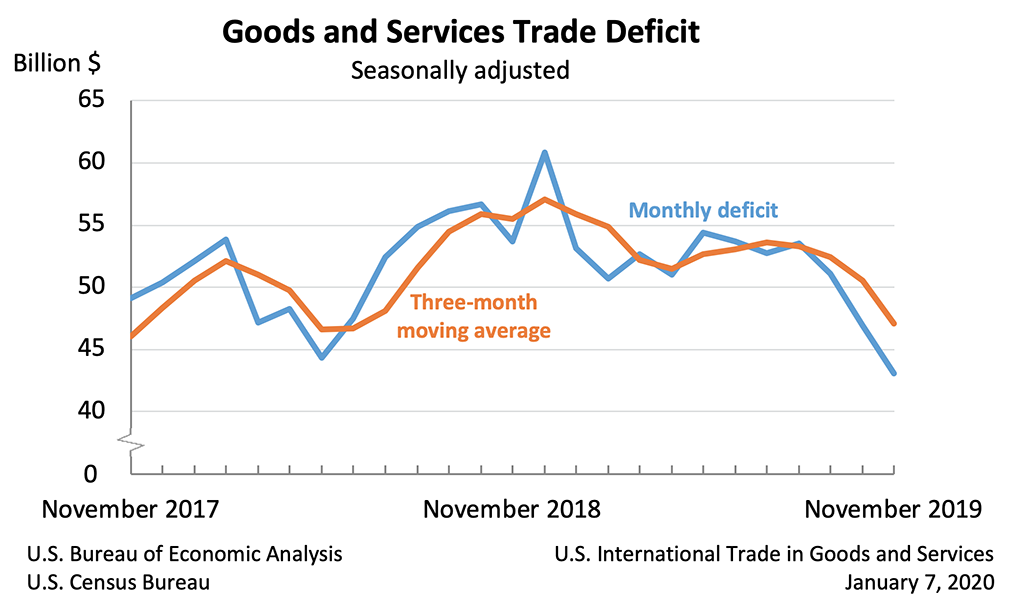
The U.S. Census Bureau and the U.S. Bureau of Economic Analysis announced today that the goods and services deficit was $43.1 billion in November, down $3.9 billion from $46.9 billion in October, revised.
| Deficit: | $43.1 Billion | -8.2%° |
| Exports: | $208.6 Billion | +0.7%° |
| Imports: | $251.7 Billion | -1.0%° |
Next release: February 5, 2020
(°) Statistical significance is not applicable or not measurable. Data adjusted for seasonality but not price changes
Source: U.S. Census Bureau, U.S. Bureau of Economic Analysis; U.S. International Trade in Goods and Services, January 7, 2020
| ||
Exports, Imports, and Balance (exhibit 1)
November exports were $208.6 billion, $1.4 billion more than October exports. November imports were $251.7 billion, $2.5 billion less than October imports.
The November decrease in the goods and services deficit reflected a decrease in the goods deficit of $3.9 billion to $63.9 billion and a decrease in the services surplus of less than $0.1 billion to $20.8 billion.
Year-to-date, the goods and services deficit decreased $3.9 billion, or 0.7 percent, from the same period in 2018. Exports decreased less than $0.1 billion or less than 0.1 percent. Imports decreased $3.9 billion or 0.1 percent.
Three-Month Moving Averages (exhibit 2)
The average goods and services deficit decreased $3.5 billion to $47.0 billion for the three months ending in November.
Average exports decreased $0.2 billion to $207.8 billion in November.
Average imports decreased $3.7 billion to $254.9 billion in November.
Year-over-year, the average goods and services deficit decreased $8.4 billion from the three months ending in November 2018.
Average exports decreased $1.5 billion from November 2018.
Average imports decreased $9.9 billion from November 2018.
Exports (exhibits 3, 6, and 7)
Exports of goods increased $1.0 billion to $137.2 billion in November.
Exports of goods on a Census basis increased $1.0 billion.
Capital goods increased $0.6 billion.
Drilling and oilfield equipment increased $0.4 billion.
Civilian aircraft engines increased $0.3 billion.
Consumer goods increased $0.5 billion.
Jewelry increased $0.4 billion.
Gem diamonds increased $0.3 billion.
Automotive vehicles, parts, and engines increased $0.4 billion.
Other goods decreased $0.5 billion.
Net balance of payments adjustments decreased less than $0.1 billion.
Exports of services increased $0.4 billion to $71.5 billion in November.
Other business services increased $0.1 billion.
Transport increased $0.1 billion.
Travel increased $0.1 billion.
Imports (exhibits 4, 6, and 8)
Imports of goods decreased $2.9 billion to $201.1 billion in November.
Imports of goods on a Census basis decreased $2.7 billion.
Capital goods decreased $1.2 billion.
Civilian aircraft decreased $0.6 billion.
Computers decreased $0.6 billion.
Consumer goods decreased $1.0 billion.
Cell phones and other household goods decreased $0.5 billion.
Artwork and other collectibles decreased $0.3 billion.
Other goods decreased $0.8 billion.
Industrial supplies and materials decreased $0.6 billion.
Automotive vehicles, parts, and engines increased $1.1 billion.
Automotive parts and accessories increased $0.5 billion.
Trucks, buses, and special purpose vehicles increased $0.3 billion.
Net balance of payments adjustments decreased $0.2 billion.
Imports of services increased $0.4 billion to $50.7 billion in November.
Travel increased $0.1 billion.
Transport increased $0.1 billion.
Real Goods in 2012 Dollars – Census Basis (exhibit 11)
The real goods deficit decreased $3.7 billion to $75.3 billion in November.
Real exports of goods increased $0.7 billion to $148.7 billion.
Real imports of goods decreased $3.0 billion to $224.0 billion.
Revisions
Revisions to October exports
Exports of goods were revised up $0.1 billion.
Exports of services were revised up less than $0.1 billion.
Revisions to October imports
Imports of goods were revised down $0.1 billion.
Imports of services were revised up less than $0.1 billion.
Goods by Selected Countries and Areas: Monthly – Census Basis (exhibit 19)
The November figures show surpluses, in billions of dollars, with South and Central America ($4.9), Hong Kong ($1.8), Brazil ($1.7), United Kingdom ($1.3), OPEC ($0.7), Singapore ($0.6), and Saudi Arabia ($0.1). Deficits were recorded, in billions of dollars, with China ($25.6), European Union ($13.5), Mexico ($8.5), Japan ($5.7), Germany ($5.2), India ($2.4), Italy ($2.3), Taiwan ($1.7), Canada ($1.7), South Korea ($1.2), and France ($1.2).
The deficit with China decreased $2.2 billion to $25.6 billion in November. Exports increased $1.4 billion to $8.9 billion and imports decreased $0.8 billion to $34.5 billion.
The deficit with Canada decreased $1.6 billion to $1.7 billion in November. Exports increased $0.1 billion to $24.0 billion and imports decreased $1.5 billion to $25.7 billion.
The deficit with Japan increased $1.3 billion to $5.7 billion in November. Exports decreased $0.6 billion to $5.8 billion and imports increased $0.7 billion to $11.6 billion.
FULL DOCUMENT: https://www.bea.gov/system/files/2020-01/trad1119.pdf
FOREIGN POLICY
U.S. Department of State. 01/07/2020. Secretary Michael R. Pompeo Remarks to the Press. Michael R. Pompeo, Secretary of State. Washington, D.C. Press Briefing Room
SECRETARY POMPEO: Good morning, everyone. Happy New Year. I haven’t been down here in the new year yet. I want to just take a moment, send out my personal condolences to former Congressman Mike Fitzpatrick. He was a friend of mine who I served alongside. He passed away earlier this week, leaving a lovely wife and a family. I wanted to express my condolences to him. His service to America was noble. As a member of Congress, we worked together on pro-life issues during my time in Congress.
I know lots of you have questions about the Middle East and Iraq. I’ll certainly take some questions today. But first, too, I want to offer my condolences to the people of Australia for the tragic loss of life and property caused by the devastating wildfires across that region. America’s thoughts and prayers are with the victims, their families, and the emergency service personnel putting themselves in harm’s way. And the same goes, too, for the dozens of U.S. firefighting personnel who are standing side by side with our Australian friends, fighting the flames together. As I said when I was in Sydney just this past summer, we have a truly unbreakable alliance. They are great friends, and we’re happy to be able to help the Aussies in this time of need.
Staying in Asia, we noted the appointment of Luo Huining, the new head of the Hong Kong Chinese Central Government Liaison Office. He’s expressed hopes that Hong Kong will return to the, quote, “right path,” end of quote. The right path, as I’ve said before, is for the Chinese Communist Party to honor its commitments made to Hong Kong in the Sino-British Joint Declaration filed at the United Nations, a commitment that guarantees the territory’s independent rule of law and freedoms that the Chinese living on the mainland unfortunately do not enjoy.
The United States will continue to work with Hong Kong and the Chinese Communist Party officials to protect human rights and fundamental freedoms in Hong Kong, and to promote Hong Kong’s high degree of autonomy.
In Afghanistan, there was an aspect of that conflict that deserves more attention, and that is the Islamic Republic of Iran’s involvement there. Iran has refused to join the regional and international consensus for peace and is, in fact, today actively working to undermine the peace process by continuing its long global efforts to support militant groups there. Most people know about Iran’s proxy networks in the Arab world, but the regime also has a relationship with the Taliban and related groups, such as the Haqqanis, the Tora Bora, and the Mullah Dadullah group. The Taliban’s entanglement in Iran’s dirty work will only harm the Afghanistan peace process.
A couple items here in the hemisphere. In Venezuela, I want to thank and congratulate Juan Guaido on his reelection as the president of the Venezuelan National Assembly, a legitimate reelection by a quorum of 100 deputies. The Maduro regime’s campaign of arrests, intimidation, and bribery could not derail Venezuelan democracy, nor could its use of military forces to physically bar the National Assembly from accessing the parliament building. I applaud how Venezuela’s political parties came together to support Guaido’s reelection. The United States will continue to support President Guaido and the Venezuelan people, and we will continue to rally all other freedom-loving nations across the globe to do that same thing.
We support the Venezuelan people because we believe the Western Hemisphere should be a hemisphere with freedom everywhere.
I also want to highlight the work of the OAS, which has been an instrumental tool in moving the region in that direction. It’s an example of truly outstanding, effective multilateralism. Secretary-General Luis Almagro is the leader we need for the OAS to continue proactively addressing the central challenges facing the region: promoting democracy, upholding human rights, advancing security, and fostering economic development throughout it.
I have more to say about the OAS and the multilateral forum in the coming weeks.
On the theme of basic freedoms, I want to commend members of Bahrain’s Council of Representatives for their January 2nd statement, in which they expressed deep concern over the inhumane and painful conditions to which Uighur Muslims in China are subjected. Bahrain is recognizing what I’ve been saying for months: the Chinese Communist Party is committing mass human rights violations and abuses against Uighurs, ethnic Kazakhs, Kyrgyz, and other Muslims held in detention in Xinjiang. We’re happy with what Bahrain did, and we ask all countries, particularly those belonging to the Organization of Islamic Cooperation and the Arab League, to denounce the Chinese Communist Party’s brutal treatment of Uighurs, which is part of the party’s broader war on faith.
Moving to Europe. As many of you know, Prime Minister Mitsotakis is in town this week. I’m looking forward to welcoming him here. I’ll be with him today at the White House, alongside President Trump.
I also want to announce that our Under Secretary for Political Affairs, David Hale, will be traveling to Brussels later this week, where he’ll have conversations with 28 European counterparts. This is a recurring meeting that happens about every six months. This particular gathering is important because it immediately precedes an EU foreign ministerial on Iran that has just been scheduled. And it shows, too, once again, our close cooperation with our European partners on issues of mutual concern.
I’m sure, while David’s there, the issue of Iran and Iraq will feature prominently in their conversations, and they’ll have an opportunity also to discuss priorities such as Syria, North Korea, and China as well.
Finally, one more personnel matter. I want to thank Ambassador John Bass, who I’ve come to know in my time in service both as the director of the Central Intelligence Agency and now as Secretary of State. His two-year tour of service in Kabul was remarkable. It’s one of our most important missions. Ambassador Bass is a respected strategic thinker, a man of incredible integrity. He’s helped that country move forward to a brighter, more peaceful, and more secure future for all the Afghan people.
And I, too, want to welcome our new 11 ambassadors, and two ambassadors-at-large, who were confirmed since the end of November, including Ambassador Sullivan, who will be heading off to Russia before too long. I’m glad they’re finally getting out to the field, and we hope to have more follow them out there.
With that, I’m happy to take a few questions.
MS ORTAGUS: Matt.
QUESTION: Thank you. Happy New Year, Mr. Secretary.
SECRETARY POMPEO: Hello, Matt.
QUESTION: And in honor of the new year, I have exactly 2,020 questions to ask you. (Laughter.) But I’ll pare them down for the sake of brevity.
SECRETARY POMPEO: Thank you, sir.
QUESTION: One is there continue to be questions about the nature of the intelligence that led to the strike on – that killed General Soleimani. Can you be at all more specific about how imminent this was, what exactly it was? Secondly, why not allow Foreign Minister Zarif to come to the UN to speak at the Security Council? And then lastly, did the situation in Iran have any – contribute at all to your decision not to run for the Senate from Kansas? Thanks.
SECRETARY POMPEO: Thank you. Last one’s easy. I said the same thing yesterday that I said for months – no real news there. I’ve said that I’m going to stay serving as Secretary of State so long as President Trump shall have me. So, no, if I – you can accuse me of being inconsistent elsewise, but not on that one.
Second, we don’t comment on visa matters, those traveling here to the United States on visas, so I can’t add much more to this issue of Foreign Minister Zarif’s travel to the United States. I’ll say only this: We will always comply with our obligations under the UN requirements and the Headquarters Agreement, and we will do so in this particular instance and more broadly every day.
And finally, there’s been much made about this question of intelligence and imminence. I answered it multiple times on Sunday. I’m happy to walk through it again. Anytime a president makes a decision of this magnitude there are multiple pieces of information that come before us. We presented that to him, in all its broad detail. We gave him all the best information that came not only from the intelligence community but for those of us who have teams in the field. We evaluated the relevant risks and the opportunity that we thought might present itself at some point.
And we could see clearly that not only had Soleimani done all of the things that we have recounted – right, hundreds of thousands – a massacre in Syria, enormous destruction of countries like Lebanon and Iraq, where they’ve denied them sovereignty, and the Iranians have really denied people in those two countries what it is they want, right, sovereignty, independence and freedom. This is all Soleimani’s handiwork. And then we’d watch as he was continuing the terror campaign in the region. We know what happened at the end of last year, in December, ultimately leading to the death of an American. So if you’re looking for imminence, you need to look no further than the days that led up to the strike that was taken against Soleimani.
And then you, in addition to that, have what we could clearly see were continuing efforts on behalf of this terrorist to build out a network of campaign activities that were going to lead potentially to the death of many more Americans. It was the right decision. We got it right. The Department of Defense did excellent work. And the President had an entirely legal, appropriate, and a basis, as well as a decision that fit perfectly within our strategy and how to counter the threat of malign activity from Iran more broadly.
MS ORTAGUS: Kyra.
QUESTION: Thank you, Mr. Secretary.
SECRETARY POMPEO: Yes, ma’am.
QUESTION: Two questions, if you don’t mind. Iran’s Foreign Affairs Minister Zarif granted an interview saying that Soleimani was on a diplomatic visit to Iraq, that the U.S. strike to take him out was state terrorism, that President Trump has prepared to commit war crimes, and that Iranians are enraged. First – that’s the first question. I’d like your reaction to that.
Second question. President Trump has indicated that Iran’s cultural sites could be targeted. Is that true? Are they on the target list, and if so, do you consider that a war crime?
SECRETARY POMPEO: So, let’s see – so Zarif’s statement. His first statement that Soleimani was traveling to Baghdad on a diplomatic mission – anybody here believe that? Is there any history that would indicate that it was remotely possible that this kind gentleman, this diplomat of great order, Qasem Soleimani, had traveled to Baghdad for the idea of conducting a peace mission? I made you reporters laugh this morning. That’s fantastic. We know that wasn’t true. We not only know the history, we know in that moment that was not true.
Zarif is a propagandist of the first order, and most of what you suggested in his text message or email or message that you laid out there was, indeed, Iranian propaganda. It’s not new. We’ve heard these same lies before. It’s fundamentally false. He was not there on a diplomatic mission trying to resolve a problem. I know there’s been some story that he was there representing a Saudi peace deal. I’ve spoken to my Saudi counterparts at great length. I’ll leave to them what the contents of their messages may be. But I can assure you that they will share my view, that he was not there representing some kind of agreement that was going to reduce risk or reduce the risks to the lives of Americans when he was on that trip.
Your last piece was about cultural sites. I said on Sunday – I will reiterate it again – every target that’s being reviewed, every effort that’s being made will always be conducted inside the international laws of war. I’ve seen it. I’ve worked on this project, and I’m very confident of that.
MS ORTAGUS: David Brunnstrom.
QUESTION: Thank you.
SECRETARY POMPEO: Yes, sir.
QUESTION: Mr. Secretary, it’s an election year, and you’re now facing two nuclear-related crises in – with Iran and North Korea. Are you optimistic about resolving either of those without them sort of blowing up, so to speak, at inopportune moments?
And on the Iran front, Iran’s breakout time when you came into office was considered to be about a year. Is it now longer or shorter?
SECRETARY POMPEO: I’ll leave it to the intelligence team to talk to you about the details of Iran’s breakout time for the moment, but President Trump could not be more clear. On our watch, Iran will not get a nuclear weapon, and as we came into office, Iran was on a pathway that had been provided by the nuclear deal, which clearly gave them the opportunity to have those nuclear weapons. We won’t let that happen.
As for the first question, which was more broadly, what President Trump laid out is a national security strategy, with respect to both North Korea and Iran, is the plan that we have executed, the strategy that we have executed for this past three years. We have put Iran in a place that it has never been before, where they’ve had to make some very difficult choices – choices about how to pay for and underwrite their proxy militias around the region, whether and how to build out their missile program. This is a flip from where we were eight years before. It’s not political. Previous administration made a different choice. They chose to underwrite and appease. We have chosen to confront and contain. Those are different strategies. We believe ours is successful, and we ultimately believe it will be successful at making Iran behave like a normal nation, will deny them the capacity to build out their nuclear program and threaten not only Americans and our lives – to keep Americans safe, which is our mission set – but also to create enhanced stability throughout the Middle East. We’re confident that that’s the case.
On North Korea, which you asked about, we still are hopeful that we will be able to head down a path. I was here with you all in December sometime when there was lots of talk about what might happen at the end of the year. We’ve not seen that yet. We still remain engaged and hopeful that we could have a conversation about how to get the denuclearization that Chairman Kim promised to President Trump back in 2018.
Take one more.
MS ORTAGUS: Okay. James.
QUESTION: Thank you very much. Mr. Secretary, two quick things here on the Soleimani strike. Since the Trump administration withdrew the United States from the Iran nuclear deal – what, about two years ago or so – the Trump administration has said repeatedly that it is pursuing against Iran a maximum pressure campaign. First question: The Soleimani operation, was that part of the maximum pressure campaign?
SECRETARY POMPEO: Do you have a second one?
QUESTION: Yeah, let’s – we’ll come back to it if you —
SECRETARY POMPEO: If you’d just ask them both, then I’ll tackle them both together.
QUESTION: To your knowledge, was any legal counsel in the Executive Branch consulted for his or her input surrounding the legal aspects of the strike prior to its execution?
SECRETARY POMPEO: Yeah, I’ll leave to others to comment on that, but I can say, as a pattern of practice, I have never seen this administration engage in an activity of this nature without a thorough and complete legal review of what the bases would be if the President were to make a series of decisions. Often, the lawyers review all of the options that are being presented to the President of the United States in advance of them being presented, such that every option that is presented to him has been fully vetted through the legal process. I – I’m confident that that was the case here, although I don’t have specific knowledge of that. I’m confident that that was the case.
Second, you asked about the scope of the – the strategy and the maximum pressure campaign that we’ve had in place. It has a diplomatic component, it has had an economic component, and it has had a military component. And what you have seen over the course of these past – May 2018 when we withdrew from the Iran nuclear deal – you’ve seen us execute that with enormous vigor and energy. You’ve seen it diplomatically. We’ve built out coalitions around the region – with the Israelis, with the Gulf states – on certain files, on the missile file and on the terror file, with our European partners as well, not just the E3. Go back and look from May of last year, go look at the statement that was made in Warsaw, a united statement centering the instability in the Middle East on the Islamic Republic of Iran. We’ve got a coalition now in the Straits of Hormuz. We’ve diplomatically isolated the Iranian regime.
Second, economically, we’ve all seen the sanctions put in place. It’s now over some thousand sanctions. We’ve watched the regime struggle to figure out how it was they were going to make it through 2020. They’ve got a budget that will fall short by a significant amount in 2020 as a direct result of the pressure that we’ve put on the regime. And then you saw, over not just this past week but over the last year, you’ve seen our security component to this. You’ve seen us reinforce allies in the region by ensuring that the Emirates and the Saudis and all of the others were prepared for what might happen if Iran decided to make choices that were bad for the Iranian people. And then you saw more tactically, just these last few days, the President’s response when the Iranians made a bad decision to kill an American. We hope they won’t make another bad decision just like that one.
QUESTION: So just to be clear, the Soleimani strike was part of the administration’s maximum pressure campaign, and going forward, the Iranians should understand, as they develop their calculus, that similar actions such as the Soleimani strike could well continue to be a feature of this maximum pressure campaign?
SECRETARY POMPEO: I think the President’s been unambiguous in his – both the remarks he made down in Florida as well as the tweets that he’s put out – about the seriousness with which we take this, the risk attendant that we are deeply aware of, and the preparations we’ve made to prevent those risks, as well as our determination that in the event the Iranians make another bad choice, that the President will respond in a way that he did last week, which was decisive, serious, and messaged Iran about the constraints that we are going to place on that regime so that it doesn’t continue to put American lives at risk.
At the end, our Iran policy is about protecting and defending the homeland and securing American lives. I know that the efforts that we have taken not only last week with the strike against Soleimani, but the strategy that we’ve employed, has saved American lives. I’m highly confident in that.
QUESTION: Thank you.
QUESTION: On – on Nasrallah?
QUESTION: (Off-mike.)
SECRETARY POMPEO: I can take one more. Take one more.
MS ORTAGUS: Andrea.
SECRETARY POMPEO: Yeah.
QUESTION: Mr. Secretary —
SECRETARY POMPEO: Andrea, yes, ma’am. How are you?
QUESTION: Mr. Secretary, thank you very much. A question about the issue of cultural sites, because the President said on Air Force One coming back, after you had been on the Sunday talk shows, that “They’re allowed to kill our people. They’re allowed to torture and maim our people. They’re allowed to use roadside bombs and blow up our people. And we’re not allowed to touch their cultural sites. It doesn’t work that way.”
Defense Secretary Esper has made it clear that he would not follow an order to hit a cultural site, would – would be a war crime. I’m wondering whether you would also push back in your advice or in your role. And secondly —
SECRETARY POMPEO: You’re not really wondering, Andrea. You’re not really wondering.
QUESTION: Well, the President is saying this repeatedly —
SECRETARY POMPEO: I was unambiguous on Sunday. It is completely consistent with what the President has said.
QUESTION: No, but the President has —
SECRETARY POMPEO: We will take – every action we take will be consistent with the international rule of law. And you – the American people can rest assured that that’s the case.
QUESTION: But are cultural sites ruled out, sir?
SECRETARY POMPEO: Let me tell you who’s done damage to the Persian culture. It’s not the United States of America; it’s the ayatollah. If you want to look at who has denied religious freedom, if you want to know who has denied – the Persian culture is rich and steeped in history and intellect and they’ve denied the capacity for that culture to continue. If you go back and look at the holidays around Cyrus and Nowruz, they’ve not permitted people to celebrate. They’ve not allowed people that they’ve killed – that Qasem Soleimani killed – they’ve not allowed them to go mourn their family members. The real risk to Persian culture does not come from the United States of America.
QUESTION: Can I ask a —
QUESTION: Sir, could I follow up? And so —
SECRETARY POMPEO: That – there is no mistake about that.
QUESTION: (Off-mike.)
SECRETARY POMPEO: Thank you, all. Everybody have a good day.
QUESTION: (Off-mike.)
VENEZUELA
DoS. JANUARY 6, 2020. Special Representative for Venezuela Elliott Abrams. SPECIAL BRIEFING. ELLIOTT ABRAMS, U.S. SPECIAL REPRESENTATIVE FOR VENEZUELA. PRESS BRIEFING ROOM. WASHINGTON, D.C.
VIDEO: https://www.state.gov/special-representative-for-venezuela-elliott-abrams-3/
MODERATOR: Good afternoon, everyone. Thank you all for being here. As you all are aware, there were significant developments in Venezuela over the weekend. So here to discuss them today is our Special Representative for Venezuela, Elliott Abrams. He’ll begin with a statement and then have time for a few of your questions. Sir?
MR ABRAMS: Thank you. Thanks, and good afternoon. Yesterday Juan Guaido was re-elected president of Venezuela’s National Assembly with 100 votes – not only a clear majority of the 167-member legislature, but also, obviously, a quorum. We congratulate him.
As you recall, we have been warning about the Maduro dictatorship’s efforts to steal the vote through bribery, jailings, and intimidation. More than 30 deputies are in hiding, in prison, or in exile. Others were bought.
And yet this brutal and corrupt campaign failed. Obviously, if the regime had had the votes, it would not have ordered soldiers to keep elected deputies out of the National Assembly in shameful scenes you’ve probably all seen in videos. Those actions have been condemned and rejected by countries all over the world.
The new Foreign Minister of Argentina said, quote, “To impede by force the functioning of the legislative assembly is to condemn oneself to international isolation.” And Argentina called the regime’s actions, quote, “unacceptable.”
Mexico said, quote, “The legitimate functioning of the legislative power is inviolable in democracies.”
Brazil said it would, quote, “not recognize any result of this violence and affront to democracy.”
The Lima Group – Latin American countries, plus Canada – congratulated Guaido on his re-election and said it, quote, “condemns the use of force and intimidation tactics against members of the National Assembly,” and condemns, quote, “the systematic violations of human rights committed by the illegitimate and dictatorial regime of Nicolas Maduro.”
The EU said it, quote, “continues to recognize Juan Guaido as the legitimate president of the National Assembly.”
We look forward to working this year with Juan Guaido, with the firm majority of the Venezuelan parliament, who continue to support democracy, with Venezuela’s democratic political parties, and with the millions of Venezuelans who want the dictatorship to end.
We applaud Guaido’s decision to leave the leadership of the Voluntad Popular Party, and to work instead on building a broad alliance of civil society groups, NGOs, trade unions, and all Venezuelans who want the end of a dictatorship that has brought economic ruin and oppression.
We look forward, as well, to working with democracies around the world in support of democracy in Venezuela. This is a struggle against a regime that, as we saw yesterday, will do anything to prevent the return of democracy. So we will be asking democratic parties and governments and NGOs to step up and do more in support of democrats and democratic institutions in Venezuela.
The United States will also be doing more in support of the National Assembly and its legitimate leadership, and of the Venezuelan people’s efforts through greater pressure on the dictatorship and its leaders and supporters inside and outside of Venezuela, and more direct help to the forces of freedom there. We have no doubt that Venezuelans will win their struggle and return their country to democracy.
Thanks.
MODERATOR: Matt.
QUESTION: Yeah, hi, thanks for doing this. Can I just ask, though, where does this leave your efforts? Just what happened yesterday – I mean, this chaos at the beginning, the vote that you guys say was farcical, and then having to leave and go to a newspaper, and then reelect Guaido —
MR ABRAMS: What’s the criticism? Of going to a newspaper? Is that the problem here?
QUESTION: No, no. I think that’s a good thing.
MR ABRAMS: That’s the good part.
QUESTION: But no, no – but, I mean, where does this leave the situation? You say you’re going to do more, more pressure, but it’s been now —
MR ABRAMS: A year.
QUESTION: — a year.
MR ABRAMS: Yep.
QUESTION: And Maduro’s still there. And it doesn’t look like his grip is any less firm.
MR ABRAMS: I think we saw something interesting – we saw many interesting things yesterday, but one of them was the regime, which has the total control of the ability to intimidate, to jail, to exile, to bribe, failed. It failed to be able to change the votes of 100 members of the National Assembly who wanted to support Juan Guaido, every one of them knowing that he or she could be arrested tomorrow. And it didn’t work.
Think of what happened. You have this chaos at the National Assembly, all these deputies get the word: “We are going to El Nacional, and we’re going to vote.” The National Assembly isn’t a building; it’s a body elected by the people of Venezuela. So I think that was an extraordinary show of opposition, courage, and unity. It really – in a way, it doesn’t change anything for us. The policy continues.
But we will be looking at new additional measures, positive measures to support democrats in Venezuela, and try to get more support from countries, democratic parties, parliaments around the world, the democratic world, and also more pressure on those who are continuing to support the regime.
I think what you saw yesterday was something the regime didn’t want to do. Initially they wanted a vote, and they wanted to win the vote in the National Assembly, and they couldn’t do it. With weeks and months of effort, they couldn’t do it, and they were forced to this last desperate resort of using the military, knowing that what we saw has actually happened, which is they’ve been condemned everywhere.
So I don’t think they come out of yesterday stronger. I think they come out of yesterday weaker.
MODERATOR: Lara.
QUESTION: So, I’ll bite. You’ve now mentioned twice that there is going to be more American help to the forces of freedom. What specifically are you talking about, and what kind of confidence do you have that that will change the yearlong standoff there?
MR ABRAMS: Well, we’re look at, I guess I would say, positive and negative things we can do. On the positive side, Congress has voted a fair amount of money to help the democratic opposition in Venezuela. And we will be thinking of ways to use those funds, and to try to get other countries to give political support, diplomatic support, financial support to the forces of freedom in Venezuela.
And on the negative side, we are looking at additional sanctions, personal sanctions, economic sanctions that we think will bring more pressure yet on the regime.
QUESTION: How much money, and what is that being used for currently?
MR ABRAMS: I’m a little reluctant to go into detail on that, because I don’t remember the exact numbers – the final, final number. But we have got an agreement with the legitimate government of Venezuela, development agreement, and we are able to do things to help, for example, the free press in Venezuela, to help people keep publishing and to keep broadcasting. We have some funds that we can use for the National Assembly.
So there are a variety of things – this is really – this is all being done through – or not all, mostly being done through AID, but also the Democracy and Human Rights Bureau here at State.
MODERATOR: Jessica.
QUESTION: I was wondering if you could comment on how much you think Russia has played into this. There’s been some reporting over the fact that it might have been to rubberstamp Russian oil deals. How important do you think that might have been? And also, do you think that having two presidents and two assemblies now, as opposed to two and one, makes it —
MR ABRAMS: Well, let me correct that. There aren’t two assemblies. There is one National Assembly that was elected in 2015. And, as we saw yesterday, a clear majority of 100 supports Juan Guaido and voted to reelect him. There’s only one National Assembly.
QUESTION: Sorry, assembly presidents.
MR ABRAMS: Well, we will see what happens tomorrow. Guaido has publicly stated that he will go to the National Assembly tomorrow. Now, as you know from all those videos yesterday, soldiers physically prevented him from going in. Will they tomorrow? We’ll see.
What can this phony new leadership of the National Assembly do? They don’t have the votes. There’s a clear majority out of the 2015 election for Guaido and for the democratic opposition. So I think it’s impossible to say yet how that will turn out on Russia.
As the regime has become more and more desperate, they have – in the course of 2019, they have relied more and more on Russia. And the Russian role in the economy, particularly the oil economy, is larger and larger. Russian companies are now handling more than two-thirds, more than 70 percent, of Venezuelan oil. They market it, they finance it, they hide it, ship-to-ship transfers, changing the name of boats, turning off transponders. They sell gasoline and diluents. So the Russian role is increasingly important.
I would note that the Russians, as far as I’m aware, have been silent today. And I would think that allies – there aren’t very many, but allies of Maduro such as Russia must be thinking twice today when they see the regime has so little support left that there is nothing they can do but send troops to the National Assembly.
MODERATOR: Okay. ABC Spain.
QUESTION: David Alandete from ABC Spain. I wanted to ask you about the statements from the U.S. Government recently on the fact that some factions of the regime could still work with the opposition. After yesterday’s events, do you still believe that there are parts of the regime that could be able to be part of the transition – a transition that the United States could support anyways?
MR ABRAMS: The – I have to assume that there are some people inside the government, inside the executive branch, who think that what was done yesterday was a terrible mistake, was disgraceful, was shameful. Of course, they can’t say so, because if they say so, they will be arrested or worse. I have to believe that there are people in the military who understand that the goal of the military is to protect the country, not to prevent elected deputies from the going to the National Assembly to vote. They too know that if they speak up, they face arrest or worse.
There are certainly people who used to support Hugo Chavez, who have as recently as yesterday and today made their disgust at what happened yesterday known. We would have to judge that question of who we can work with and who we can’t work with when we get to that point.
MODERATOR: Let’s go to the back. Financial Times.
QUESTION: Katrina Manson, Financial Times. Thank you. Do you think Venezuela’s neighbors are considering a military solution, and what would be the U.S. position on that?
MR ABRAMS: I don’t think they are considering a military solution. They’re worried very much about the refugee flows, which continue at a very – pardon me – at a very high level, perhaps 5 million, getting to 6 million. If it goes on for another year, it will be a greater refugee crisis than Syria. But I’m unaware of any discussions – this would be the Brazilians and the Colombians, really – of a – of taking military steps, except conceivably in self-defense.
MODERATOR: Yeah, Tracy.
QUESTION: Hi. Thank you. Elliott, when asked how yesterday – the events of yesterday leaves your efforts, the U.S. efforts, you said it doesn’t change things for us. But we heard today from some of the Venezuelan congressmen that they’re sort of entering a period of self-criticism and re-examining their mistakes and making changes, and so I wondered if U.S. policy also was going to be going through a sort of reassessment – what worked, what didn’t, what can we do differently – that kind of thing?
MR ABRAMS: I don’t think that’s anything new. I mean, Guaido has spoken over the last three months in answer to questions – why are we still here in September, October, November – and has talked about things that didn’t go as well as he had hoped, for example, the reaction from the military. We do this all the time too – that is, we don’t sort of have an annual review at which we say, “What are we doing right and what are we doing wrong?” We think all the time about how to do better. And I think – I’ve said to a number of people that we underestimated the importance of the Cuban and Russian support for the regime, which has proved, I think, to be the two most important pillars of support for the regime and without which it wouldn’t be there, it wouldn’t be in power.
MODERATOR: One or two more?
MR ABRAMS: Yeah.
MODERATOR: Okay. Yeah, right there.
QUESTION: Juan Camilo Merlano, Caracol TV Colombia. You highlighted the statements from Argentina and Mexico. Is the U.S. looking forward to, I don’t know, bring those countries to maybe the Lima Group or to other block of countries to make a higher pressure against the Maduro regime?
MR ABRAMS: No. I highlighted those really for the obvious reason, which was that —
QUESTION: They agreed with you.
MR ABRAMS: No. They all agreed with us. Everybody agreed with us. I mean, I have a list here – I could read out the list of countries.
Why did I use Mexico and Argentina and not Colombia? We know of the very strong support in Colombia for democracy in Venezuela and for Juan Guaido. You have a new government in Argentina that has taken a slightly different position and, obviously, so has Mexico. They have not taken the same position as the United States. So it was very interesting when on the same day, without hesitation, both of them really called what happened yesterday in Caracas unacceptable and rejected it, and I think that’s really quite striking. And Maduro must be asking himself today, “Do I have any allies left?” They’re not going to support those kinds of measures. They’re going to denounce those kinds of measures.
He is left with Cuba, Russia, China, and a few odd dictatorships around the world, but he is losing the support not only on the right, not only in the center, but on the left in Latin America.
MODERATOR: Okay, last question. (Inaudible).
QUESTION: Under what conditions would the United States recognize a result of the legislative elections expected this year and the opposition be wise to boycott those?
MR ABRAMS: Well, we would recognize the result if it’s a free and fair election. I pointed out to people in the Government of Venezuela, the regime, I’ve pointed it out to others in Latin America. The United States recognizes results of free elections. We recognized the result when the FMLN won in El Salvador because they won a free election. We’ve recognized the result when the Sandinistas won a free election in Nicaragua, and we recognize the results of free elections even if we don’t love the outcome. So that’s the answer to that part.
If it’s a free and fair election, then not only we, but I think other democracies around the world would support it. Should they participate in the election? I think the key answer to that is we’re not Venezuelans. They have to make that decision for themselves, the democratic parties in Venezuela. As of today, they cannot compete. As of today, Juan Guaido, for example, would not be allowed to run for re-election. As of today, most of the democratic parties in Venezuela have been called illegal. So as of today, you couldn’t possibly have a free election. You would need significantly to change the conditions.
What are the conditions that would lead the Venezuelan opposition to participate? There are international standards for free elections, and they’re all the obvious ones – no censorship; free access to media; ability to campaign; access to – equal access to TV; deputies who are, in the case of Venezuela, who are in prison or in exile allowed to return and run for re-election; fair and free counting of the vote.
In Bolivia, for example, I believe it’s fair to say the campaign was pretty free, and then it was on election day that the votes were stolen and manipulated. So there’s a combination of things. There are international standards that all sorts of organizations, IFES being probably the most famous of them, can give all of us. That’s what we’re hoping for. That’s what we’re working for, that those conditions would prevail in Venezuela so that there can be free presidential elections and free National Assembly elections. National Assembly elections alone will not solve the Venezuelan crisis. They need presidential elections to be able to get out of the crisis they’re in.
Thank you.
MODERATOR: All right, thank you.
QUESTION: Thanks.
________________
ECONOMIA BRASILEIRA / BRAZIL ECONOMICS
VENEZUELA
MRE. DCOM. NOTA-4. 06 de Janeiro de 2020. Declaração do Grupo de Lima
Os governos da Bolívia, do Brasil, do Canadá, do Chile, da Colômbia, da Costa Rica, da Guatemala, de Honduras, do Panamá, do Peru e da Venezuela, membros do Grupo de Lima:
1. Saúdam a reeleição de Juan Guaidó como Presidente da Assembleia Nacional e Presidente Encarregado da Venezuela e reiteram seu apoio aos esforços realizados sob sua liderança para buscar uma solução pacífica, conduzida pelos próprios venezuelanos, com o objetivo de restaurar a democracia e a ordem constitucional nesse país.
2. Condenam o uso da força e as práticas intimidatórias contra os parlamentares da Assembleia Nacional e rejeitam qualquer ação que vise a prejudicar o apoio a ela ou a seu Presidente. A votação de hoje pela maioria parlamentar a favor da reeleição de Juan Guaidó, respeitando a Constituição e a lei, representa uma rejeição às ações imprudentes do regime de Nicolás Maduro que buscaram impedir sua nomeação.
3. Renovam o apelo ao pronto retorno da democracia na Venezuela e, nesse sentido, reafirmam a necessidade de realizar eleições gerais inclusivas, livres, justas e transparentes, conduzidas por um Conselho Nacional Eleitoral e um Supremo Tribunal de Justiça renovados e independentes e com a presença de observadores internacionais independentes.
4. Reafirmam a condenação às violações sistemáticas de direitos humanos cometidas pelo regime ilegítimo e ditatorial de Nicolás Maduro e fazem um apelo para o envio imediato à Venezuela da Missão de Determinação de Fatos criada pelo Conselho de Direitos Humanos das Nações Unidas.
5. Reiteram sua preocupação com o agravamento da crise econômica, social, humanitária e ambiental na Venezuela e, por conta da dimensão do êxodo de migrantes provenientes desse país, pedem não seja politizada o acolhimento e a concessão de assistência à população e urgem o incremento da cooperação internacional, especialmente financeira, para ajudar os migrantes venezuelanos e os países de acolhida a lidar com essa situação crítica sem precedentes na região.
6. Saúdam a incorporação do Estado Plurinacional da Bolívia ao Grupo Lima e valorizam a contribuição que este Estado proporcionará aos esforços conjuntos de vários países da região para o retorno da democracia na Venezuela.
7. Fazem um apelo à comunidade internacional para acompanhar e trabalhar de maneira conjunta em apoio ao restabelecimento do estado de direito e da ordem constitucional na Venezuela.
5 de janeiro de 2020.
Declaración del Grupo de Lima
Los gobiernos de Bolivia, Brasil, Canadá, Chile, Colombia, Costa Rica, Guatemala, Honduras, Panamá, Paraguay, Perú y Venezuela, miembros del Grupo de Lima:
1. Saludan la reelección de Juan Guaidó como Presidente de la Asamblea Nacional y Presidente Encargado de Venezuela y reiteran su respaldo a los esfuerzos realizados bajo su conducción para tender a una solución pacífica, liderada por los propios venezolanos, encaminada a restaurar la democracia y el orden constitucional en ese país.
2. Condenan el uso de la fuerza y las prácticas intimidatorias contra los parlamentarios de la Asamblea Nacional y rechazan toda acción orientada a socavar el apoyo a ésta o a su Presidente. La votación de hoy por la mayoría parlamentaria en favor de la reelección de Juan Guaidó, ciñéndose a la Constitución y la ley, representan un rechazo a las acciones temerarias del régimen de Nicolás Maduro que buscaron impedir su designación.
3. Renuevan el llamado al pronto retorno a la democracia en Venezuela y, en ese sentido, se reafirman en la necesidad de celebrar elecciones generales incluyentes, libres, justas y transparentes, conducidas por un Consejo Nacional Electoral y un Tribunal Supremo de Justicia renovados e independientes y con la presencia de observadores internacionales independientes.
4. Reafirman su condena a las sistemáticas violaciones de derechos humanos cometidas por el régimen ilegítimo y dictatorial de Nicolás Maduro y urgen el envío inmediato a Venezuela de la Misión de Determinación de Hechos creada por el Consejo de Derechos Humanos de las Naciones Unidas.
5. Reiteran su preocupación por el agravamiento de la crisis económica, social, humanitaria y medioambiental en Venezuela, y por la dimensión del éxodo de migrantes provenientes de ese país; piden no politizar la recepción de asistencia a la población y urgen a incrementar la cooperación internacional, especialmente financiera, para ayudar a los migrantes venezolanos y a los países de acogida para atender esta crítica situación sin precedentes en la región.
6. Saludan la incorporación del Estado Plurinacional de Bolivia al Grupo de Lima y valoran la colaboración que dicho Estado proporcionará a los esfuerzos conjuntos interpuestos por varios países de la región en aras del retorno a la democracia en Venezuela.
7. Instan a la comunidad internacional a acompañar y trabajar de manera conjunta en apoyo al restablecimiento del Estado de Derecho y el orden constitucional en Venezuela.
5 de enero de 2020.
MRE. DCOM. NOTA-3. 05 de Janeiro de 2020. Declaração do Grupo de Lima
Os governos da Bolívia, do Brasil, do Canadá, do Chile, da Colômbia, da Costa Rica, da Guatemala, da Guiana, de Honduras, do Panamá, do Paraguai, do Peru, de Santa Lúcia e da Venezuela, países do Grupo de Lima, condenam o uso da força pelo regime ditatorial de Nicolás Maduro para impedir que os deputados da Assembleia Nacional possam ingressar livremente na sessão, convocada para hoje, 5 de janeiro, para eleger democraticamente a sua Mesa Diretora.
A Assembleia Nacional tem o direito constitucional de reunir-se sem intimidações nem interferências para eleger o seu Presidente e Mesa Diretora, em razão do que não reconhecemos o resultado de eleição que não respeita esses direitos e que se deu sem a plena participação dos deputados que desejavam participar da sessão.
O Grupo de Lima acompanha com extrema preocupação os eventos na Venezuela e faz um apelo à comunidade internacional para trabalhar de maneira conjunta em apoio à recuperação da democracia e ao restabelecimento do estado de direito nesse país.
5 de janeiro de 2020
Declaración del Grupo de Lima
Los gobiernos de Bolivia, Brasil, Canadá, Chile, Colombia, Costa Rica, Guatemala, Guyana, Honduras, Panamá, Paraguay, Perú, Santa Lucía y Venezuela, países del Grupo de Lima, condenan el uso de la fuerza por el régimen dictatorial de Nicolás Maduro para impedir que los diputados de la Asamblea Nacional puedan acceder libremente a la sesión, convocada para hoy 5 de enero, para elegir democráticamente a su Mesa Directiva.
La Asamblea Nacional tiene el derecho constitucional de reunirse sin intimidaciones ni interferencias para elegir a su Presidente y directiva, por lo que desconocemos el resultado de una elección que vulnera esos derechos y que se ha dado sin la plena participación de los diputados que acudieron a la sesión
El Grupo de Lima sigue con extrema preocupación los eventos que se suceden en Venezuela y hace un llamado a la comunidad internacional para trabajar de manera conjunta en apoyo a la recuperación de la democracia y el restablecimiento del Estado de derecho en ese país.
5 de enero de 2020
BOLÍVIA
MRE. DCOM. NOTA-2. 05 de Janeiro de 2020. Convocação de eleições na Bolívia
O Governo brasileiro felicita o Estado Plurinacional da Bolívia pela convocação oficial, por seu Tribunal Supremo Eleitoral, de novas eleições nacionais para o próximo dia 3 de maio.
O Brasil saúda a Presidente Constitucional Jeanine Añez pela determinação em fazer cumprir seu compromisso de pacificar o país e de garantir aos bolivianos o direito à escolha livre, transparente e soberana de seus dirigentes.
O Brasil permanece pronto a cooperar com o povo-irmão da Bolívia em todas as áreas e especificamente na consolidação e promoção da democracia, segurança e prosperidade em nossos países e em toda a região.
MERCADO DE TRABALHO
FGV. IBRE. 07/01/20. Sondagens e Índices de Confiança. IAEmp e ICD. Mercado de Trabalho: Indicador Antecedente de Emprego encerra 2019 em trajetória positiva
Indicador Antecedente de Emprego
O Indicador Antecedente de Emprego (IAEmp) da Fundação Getulio Vargas subiu 1,5 ponto em dezembro para 89,9 pontos, o maior nível desde abril (92,5 pontos). Em média móvel trimestral, o indicador segue em trajetória positiva pelo segundo mês consecutivo, aumentando 0,9 ponto em relação ao mês anterior.
“O IAEmp encerra 2019 em trajetória positiva. Depois de passar por alguns meses sem mostrar uma reação clara, o indicador sugere que as expectativas para o mercado de trabalho se tornaram mais favoráveis no último trimestre. Contudo, o patamar ainda baixo do indicador mostra que ainda há um longo caminho pela frente e que o cenário de recuperação gradual se mantém para o início de 2020”, afirma Rodolpho Tobler, economista da FGV IBRE.
Indicador Coincidente de Desemprego
O Indicador Coincidente de Desemprego (ICD) caiu 0,8 ponto em dezembro, para 95,3 pontos. O ICD é um indicador com sinal semelhante ao da taxa de desemprego, ou seja, quanto menor o número, melhor o resultado. Em médias móveis trimestrais, o indicador continua apresentando trajetória ascendente ao subir pelo terceiro mês seguido, desta vez em 0,8 ponto.
“A queda do ICD no mês não foi suficiente para recuperar a alta de novembro. Apesar disso, o resultado positivo de dezembro mantém a expectativa de redução lenta e gradual da taxa de desemprego nos próximos meses”, continua Rodolpho Tobler.
Destaques do IAEmp e ICD
Em dezembro, quatro dos sete indicadores contribuíram positivamente para o resultado do IAEmp, com destaque para a Situação Atual dos Negócios no setor de Serviços, que subiu 5,0 pontos na margem.
No mesmo período, o aumento do ICD foi influenciado por três das quatro classes de renda familiar, com exceção das famílias que recebem entre R$ 4.800.00 e R$ 9.600.00, cujo resultado foi em sentido contrário. Em dezembro, as duas primeiras classes de renda familiar – renda de até R$ 2.100.00 e entre R$ 2.100.00 e R$ 4.800.00 – foram as que exerceram maior contribuição sob o ICD, ao variarem 1,6 e 2,5 pontos na margem.
DOCUMENTO: https://portalibre.fgv.br/navegacao-superior/noticias/mercado-de-trabalho-indicador-antecedente-de-emprego-encerra-2019-em-trajetoria-positiva.htm
COMÉRCIO EXTERIOR BRASILEIRO
MEconomia. 02/01/2020. ECONOMIA. COMÉRCIO EXTERIOR. Corrente de comércio do Brasil chegou a US$ 401,363 bilhões em 2019. Balança comercial fecha 2019 com superávit de US$ 46,674 bilhões, com impactos da conjuntura externa, como a guerra comercial, as crises da Argentina e a febre suína na China
A balança comercial brasileira fechou 2019 com uma corrente de comércio de US$ 401,363 bilhões e superávit de US$ 46,674 bilhões. Os dados foram divulgados nesta quinta-feira (2/1) pela Secretaria Especial de Comércio Exterior e Assuntos Internacionais do Ministério da Economia (Secint/ME), em Brasília.
Na corrente de comércio, houve recuo de 5,7% sobre os US$ 420,495 bilhões do ano anterior, enquanto o saldo comercial diminuiu 20,5%, pela média diária, em relação ao de 2018, quando ficou em US$ 58,033 bilhões.
No acumulado de 2019, as exportações brasileiras chegaram a US$ 224,018 bilhões, 7,5% abaixo de 2018, quando totalizaram US$ 239,264 bilhões. As importações em 2019 somaram US$ 177,344 bilhões, com uma diminuição de 3,3% sobre os US$ 181,231 bilhões de 2018.

Conjuntura em 2019
Segundo o secretário de Comércio Exterior da Secint, Lucas Ferraz, o desempenho da balança comercial brasileira em 2019 refletiu aspectos adversos da conjuntura internacional, como o menor crescimento do PIB mundial – de 3,5% em 2018 para 3% no ano passado – e do comércio mundial – de 3,7% para 1,2%. “O crescimento do comércio global em 2019 é o menor em uma década, desde 2009”, salientou.
Além disso, o Brasil sentiu diretamente os impactos do aprofundamento da crise argentina, que afetou as exportações de manufaturados, principalmente automóveis e autopeças, com redução de US$ 5,2 bilhões. Outro problema foi a crise da febre suína na China, que teve impacto negativo de US$ 6,7 bilhões sobre as exportações de soja, “nem de longe compensado pelo aumento das exportações de carne”.
Sem esses dois fatores, o volume das exportações brasileiras sairia de uma redução de 0,3% para uma alta de 2% em 2019, superando o crescimento médio mundial, de 1,2%. “Quando medimos o comércio em volume embarcado por toneladas e neutralizamos os choques de curto prazo, vemos que estamos crescendo 67% acima do desempenho mundial”, demonstrou Ferraz.
Ele destacou também que o foco central da agenda de comércio do governo não passa pela obtenção de saldos comerciais. “É importante ter em mente que agenda de comércio internacional do governo pretende ser uma dimensão a mais, um alicerce a mais, no que é entendido como necessário para o crescimento a longo prazo da economia brasileira e que está estagnado há 40 anos. Essa variável se chama produtividade”, frisou.
“O nosso objetivo fundamental é aumentar o grau de integração da economia brasileira e, com isso, contribuir para o aumento da nossa produtividade, para o crescimento de longo prazo e para a geração de emprego e renda”, explicou.
O principal, segundo Ferraz, é o aumento da corrente de comércio – soma das exportações e importações – sobre o Produto Interno Bruto (PIB). Hoje, esse número gira ao redor de 24%, muito aquém do que se esperaria para uma economia com as dimensões da brasileira. “Essa é a nossa métrica, a métrica da integração”, afirmou.
Destaques das exportações de 2019
As exportações apresentaram diminuição nas vendas das três categorias de produtos: manufaturados (-11,1%), para US$ 77,452 bilhões; semimanufaturados (-8%), para US$ 28,378 bilhões; e básicos (-2%), para US$ 118,180 bilhões. Nos manufaturados, além da retração em plataforma para extração de petróleo (-51,4%), destaca-se a diminuição das vendas de veículos de carga (-35,3%), automóveis de passageiros (-27,5%), laminados planos de ferro/aço (-22,8%), autopeças (-18,8%) e polímeros plásticos (-14,1%).
Já nos semimanufaturados, as maiores quedas ocorreram nas vendas de óleo de soja em bruto (-36,9%), couros e peles (-21,3%), semimanufaturados de ferro/aço (-17,9%), açúcar em bruto (-17,1%), celulose (-10,3%) e madeira serrada ou fendida (-10,2%). Nos produtos básicos, houve diminuição da receita de soja em grãos (-21,3%), minério de cobre (-15,7%), farelo de soja (-12,9%) e petróleo em bruto (-7,1%).
Destinos
Os principais países de destino das exportações brasileiras em 2019 foram China, Hong Kong e Macau (US$ 65,389 bilhões); Estados Unidos (US$ 29,556 bilhões); Países Baixos (US$ 10,100 bilhões); Argentina (US$ 9,714 bilhões); e Japão (US$ 5,410 bilhões). Por mercados compradores, cresceram as vendas para Oceania (+12,8%), Oriente Médio (+9,1%) e Estados Unidos (+1,8%).
A crise argentina impactou as vendas para o Mercosul, que caíram 30,6%, sendo que para a Argentina a redução foi de 35,6%, por conta de automóveis de passageiros, veículos de carga, autopeças, tratores, minério de ferro, laminados planos de ferro/aço, soja em grãos e óleos combustíveis.
Para a América Central e Caribe (-20,1%), União Europeia (-16,4%), África (-8,1%) e Ásia (-1,8%) também houve retração nas vendas. Só para China, Hong Kong e Macau a redução foi de 3,1%, para US$ 65,4 bilhões, por conta de soja em grãos, celulose, couros e peles, aviões, hidrocarbonetos e derivados halogenados, bombas, compressores e partes, farelo de soja e minério de alumínio.
Destaques das importações de 2019
No acumulado de janeiro a dezembro de 2019, quando comparado com igual período anterior, houve queda nas importações de bens de capital (-12,8%), bens de consumo (-4,5%) e combustíveis e lubrificantes (-7,3%). Por outro lado, cresceram as compras de bens intermediários (+0,4%).
Por mercados fornecedores, houve redução nas compras de América Central e Caribe (-33,3%), África (-16,6%), Oceania (-14,8%), União Europeia (-5,2%), Mercosul (-4,1%), Oriente Médio (-3%) e Ásia (-1,4%). Por outro lado, aumentaram as importações originárias dos Estados Unidos (+2,6%).
Os principais países de origem das importações foram China, Hong Kong e Macau (US$ 35,881 bilhões), Estados Unidos (US$ 30,086 bilhões), Argentina (US$ 10,552 bilhões), Alemanha (US$ 10,281 bilhões) e Coreia do Sul (US$ 4,706 bilhões).
Destaques de dezembro
Considerando apenas o mês de dezembro, as exportações chegaram a US$ 18,155 bilhões, uma retração de 10,6% em relação a dezembro de 2018, e de 1,7% na comparação com novembro de 2019. Já as importações totalizaram US$ 12,555 bilhões, uma diminuição de 7,4% sobre igual período do ano anterior e de 15,6% sobre novembro de 2019.
No período, a corrente de comércio alcançou valor de US$ 30,710 bilhões, apresentando uma queda de 9,3% sobre dezembro de 2018, enquanto o saldo comercial do mês apresentou superávit de US$ 5,599 bilhões, valor 17,0% inferior, pela média diária, ao alcançado em igual período de 2018, de US$ 6,428 bilhões.
No mês, as exportações por fator agregado alcançaram os seguintes valores: básicos (US$ 10,050 bilhões), manufaturados (US$ 6,037 bilhões) e semimanufaturados (US$ 2,069 bilhões). Sobre o ano anterior, diminuíram as exportações de produtos semimanufaturados (-25,0%), manufaturados (-17,7%) e básicos (-1,7%).
Já nas importações, e. m dezembro, houve redução em combustíveis e lubrificantes (-27,6%), bens intermediários (-7,4%) e bens de capital (-1,7%), enquanto cresceram as importações de bens de consumo (+12,1%).
ABPA. 07/01/2020. Receita de embarques de carne de frango cresce 6,4% em 2019. Dezembro registra melhor desempenho mensal do ano
As vendas das exportações brasileiras de carne de frango (considerando todos produtos, entre in natura e processados) encerraram 2019 com saldo positivo em volume e receita, informa a Associação Brasileira de Proteína Animal (ABPA).
Ao todo, foram exportadas 4,212 milhões de toneladas nos 12 meses do ano, volume 2,8% superior ao registrado ao longo de 2018, com 4,1 milhões de toneladas.
Apenas em dezembro, foram embarcadas 391,9 mil toneladas, número 11,2% superior às 352,5 mil toneladas efetivadas no último mês de 2018. O número é o melhor desempenho mensal registrado ao longo de 2019.
Em receita, as vendas do setor em 2019 totalizaram US$ 6,994 bilhões, número 6,4% superior ao alcançado em 2018, com US$ 6,570 bilhões. Considerando apenas o mês de dezembro, a alta nas exportações chegou a 9,6%, com US$ 636 milhões no último mês de 2019, contra US$ 580,1 milhões registrados em dezembro de 2018.
A China assumiu em 2019 a liderança entre os destinos internacionais da carne de frango do Brasil, com importações totais de 585,3 mil toneladas, volume 34% superior ao realizado em 2018, com 438 mil toneladas. Apenas em dezembro, o país asiático importou 72 mil toneladas, volume 94% superior ao efetivado no último mês de 2018.
“A crise sanitária que impactou a suinocultura chinesa também influenciou o aumento das exportações de carne de frango. É o maior volume anual já exportado para a China desde a abertura do mercado em 2009 e houve uma notável elevação do ritmo no fim de ano”, destaca Ricardo Santin, diretor-executivo da ABPA.
Também na Ásia, o Japão incrementou suas compras em 7% em 2019, com volume total de 424 mil toneladas.
Já no Oriente Médio, os Emirados Árabes Unidos (EAU) foram destaque no ano, com importações totais de 341,1 mil toneladas, volume 10% superior ao realizado no ano anterior.
O Iêmen também elevou suas importações da carne frango do Brasil, com total de 105,9 mil toneladas, um incremento de 24% em relação à 2018.
“O fluxo das exportações, em especial para a Ásia e Oriente Médio, deve seguir positivo em 2020. O mercado internacional de proteína animal está pressionado pela demanda da Ásia, em especial”, analisa Francisco Turra, presidente da ABPA.
ABPA
A ABPA é a representação político-institucional da avicultura e da suinocultura do Brasil. Congrega mais de 140 empresas e entidades dos vários elos da avicultura e da suinocultura do Brasil, responsáveis por uma pauta exportadora superior a US$ 8 bilhões.
Sob a tutela da ABPA está a gestão, em parceria com a Apex-Brasil, das três marcas setoriais das exportações brasileiras de aves, ovos e suínos: Brazilian Chicken, Brazilian Egg e Brazilian Pork.
Por meio de suas marcas setoriais, a ABPA promove ações especiais em mercados-alvo e divulga os diferenciais dos produtos avícolas e suinícolas do Brasil – como a qualidade, o status sanitário e a sustentabilidade da produção – e fomenta novos negócios para a cadeia exportadora de ovos e de carne de frangos e de suínos.
ABPA. 06/01/2020. Exportações de carne suína batem recorde em 2019. Vendas de dezembro registram maior volume mensal já registrado em um mês
As vendas de carne suína do Brasil (considerando todos os produtos entre in natura e processados) alcançaram volume recorde em 2019, de acordo com números revelados hoje pela Associação Brasileira de Proteína Animal (ABPA).
Ao todo, foram embarcadas 750,3 mil toneladas ao longo dos 12 meses do ano passado. O saldo é 16,2% superior ao registrado em 2018, quando foram embarcadas 646 mil toneladas.
Apenas em dezembro, foram embarcadas 76 mil toneladas, volume 35,1% maior em relação ao mesmo período de 2018, com 56,2 mil toneladas. É o maior embarque mensal já registrado na história do setor.
Em receita, o saldo das vendas alcançou US$ 1,597 bilhão, número 31,9% maior que o resultado de 2018, com US$ 1,2 bilhão. Em dezembro, as vendas chegaram a US$ 183,6 milhões – maior saldo mensal já alcançado pelo setor.
As vendas para a Ásia – região fortemente impactada por focos de Peste Suína Africana (PSA) - foram o grande impulso das exportações de 2019. A China, que assumiu o primeiro lugar nas importações já no primeiro mês do ano passado, importou 248,80 mil toneladas, volume 61% superior ao total embarcado em 2018.
Também impactado pela PSA, o Vietnã aumentou suas importações em 82,6%, com total de 13,54 mil toneladas em 2019.
“A crise sanitária na Ásia reconfigurou o comércio internacional de proteína animal. A China, que foi a maior afetada, ampliou sua capacidade de importação de carne suína brasileira com a habilitação de novas plantas em novembro de 2019. Este é um dos fatores que devem favorecer o aumento das vendas brasileiras em 2020, já que os indicadores de instituições como o Rabobank demonstram que este quadro deve perdurar no mínimo ao longo do ano”, analisa Ricardo Santin, diretor-executivo da ABPA.
Na América do Sul, o Uruguai foi o principal destino, com 40,48 mil toneladas importadas, volume 12,8% maior em relação ao saldo de 2018. Também o Chile se destacou, com importação de 44,54 mil toneladas (+28,9%). No Leste Europeu, a Rússia importou 35,28 mil toneladas
“Crescemos nossas vendas não apenas na Ásia, mas em outras regiões importadoras, como a América do Sul. Nossos esforços estarão concentrados, agora, no fortalecimento destas parcerias e busca de novos mercados”, ressalta Francisco Turra, presidente da ABPA.
SETOR AUTOMOTIVO
ANFAVEA. PORTAL G1. 07/01/2020. Produção de veículos no Brasil cresce 2% em 2019, diz Anfavea. As exportações registraram a maior queda desde 2017, de 31,9%. Comparações são com o ano de 2018.
A produção de veículos no Brasil subiu 2,3% em 2019, na comparação com o ano anterior, divulgou a associação das fabricantes, a Anfavea, nesta terça-feira (7). No total, foram feitos 2.944.962 carros, caminhões e ônibus no ano passado, contra 2.879.809 em 2018.
Apesar de ser o terceiro ano consecutivo de crescimento, o patamar ainda é está abaixo do visto em 2013, quando chegou a 3.712.736 unidades e o setor bateu o ser recorde histórico anual.
A Anfavea diz que os resultados ficaram em linha com as previsões feitas ao longo do ano. “O impacto da (crise da) Argentina continua significativo”, disse Luiz Carlos Moraes, presidente da associação. O país vizinho é o maior cliente das exportações de veículos brasileiros.
/i.s3.glbimg.com/v1/AUTH_59edd422c0c84a879bd37670ae4f538a/internal_photos/bs/2020/a/O/oe4WKgSbevBK1BdZRQnw/ftij6-produ-o-de-ve-culos-no-brasil.png)
Baixa no mês a mês
Considerando apenas o último mês de dezembro, a produção registrou quedas. Em relação a dezembro de 2018, o número de veículos produzidos foi 3,9% menor. Já em relação a novembro de 2019 a redução foi ainda maior, de 25%.
As exportações também caíram no mês a mês, porém menos do que a produção. Os números foram 8,6% menores relação a novembro de 2019 e 8,5% menores comparando com dezembro do ano retrasado.
Exportações
Um dos motivos para o recuo é a queda nas exportações, especialmente para a Argentina, que também registrou a maior queda desde 2017 e o pior resultado desde 2015. Em relação a 2018, o número de veículos enviados ao exterior em 2019 caiu 31,9% - passou de 629.175 para 428.198.
O segmento mais afetado pelas exportações baixas foi o de caminhões, com redução de 45% entre o acumulado dos anos. O segundo foi o dos veículos leves, que inclui carros e comerciais leves, com 31,6% a menos.
/i.s3.glbimg.com/v1/AUTH_59edd422c0c84a879bd37670ae4f538a/internal_photos/bs/2020/h/S/7gj5AIRuGohFAyDDUeBQ/xlrkn-exporta-o-de-ve-culos-no-brasil-2-.png)
Empregos
Também segundo a Anfavea, o número de pessoas empregadas na indústria automotiva brasileira caiu 3,7% em dezembro, comparando com o mesmo mês de 2018. No ano passado, havia 125.596 trabalhadores ativos, contra 130.451 no ano retrasado.
Além da crise econômica e demais fatores, um ponto que contribuiu para a queda no número de empregados foi o encerramento das atividades da fábrica da Ford em São Bernardo do Campo (SP).
Previsões para 2020
Para a Anfavea, há expectativa de crescimento de 9,4% nas vendas em 2020, voltando ao patamar de 3 milhões de unidades que não é visto desde 2014.
Também é esperado que a produção volte a esse nível, mas com crescimento menor do que as vendas, de 7,3%, tendo em conta a projeção de uma nova queda nas exportações.
A associação estima que as exportações caiam 11% sobre 2019, para 381 mil unidades, que seria o pior número desde 2014. Além da crise argentina, Luiz Carlos Moraes atribuiu a previsão conservadora ao alto custo de produção de veículos no Brasil.
“Temos montadoras com chance de perder produtos para outras unidades. Se não resolvermos o problema do custo Brasil, não só não vamos exportar mais, mas menos ainda”, disse.
“Nossas exportações em maioria são de itens básicos: soja, milho... Não tenho nada contra, mas alguma coisa está errada”, afirmou o presidente da Anfavea. “Tem um problema estrutural que precisamos atacar.”
O executivo destacou melhorias na economia, mas disse que é preciso “mais ambição”. “Estamos celebrando as grandes conquistas, mas precisamos atacar e continuar nas reformas”, afirmou Moraes. “Se não, teremos um voo de galinha. Precisamos ser mais ambiciosos.”
CARTA DA ANFAVEA: http://www.anfavea.com.br/cartas/carta404.pdf
ANFAVEA. REUTERS. 7 DE JANEIRO DE 2020. Indústria de veículos do Brasil espera alta de vendas e produção em 2020
SÃO PAULO (Reuters) - As montadoras de veículos do Brasil trabalham com um cenário de crescimento de vendas e produção no país em 2020 e nova queda de dois dígitos nas exportações, ainda pressionadas pela crise na Argentina e distúrbios em outros mercados como o Chile, afirmou nesta terça-feira a associação que representa o setor, Anfavea.
A entidade estimou crescimento de 9,4% nos licenciamentos, para 3,05 milhões de veículos este ano, e alta de 7,3% na produção, para 3,16 milhões de unidades. Para as exportações, porém, a Anfavea espera queda de 11%, para 381 mil veículos, depois de despencarem quase 32% no ano passado.
As projeções baseiam-se na expectativa de crescimento no PIB brasileiro de 2,5% em 2020, considerando o cenário de manutenção da queda dos juros nos financiamentos das vendas e sinais de melhora no nível de emprego. Para o cenário externo, a previsão é de que não haverá retomada do mercado argentino, disse o presidente da Anfavea, Luiz Carlos Moraes, a jornalistas.
Em 2019, os emplacamentos no Brasil subiram 8,6%, para 2,79 milhões de veículos, melhor desempenho desde 2014, enquanto a produção cresceu 2,3%, para 2,94 milhões de unidades. Com esse desempenho, a Anfavea avalia que o Brasil subiu no ano passado da oitava para a sexta posição entre os maiores mercados de veículos do mundo, superando França e Reino Unido, segundo números preliminares da entidade.
Apesar do crescimento em 2019 e da perspectiva para 2020, Moraes disse que as vendas da indústria previstas para este ano ainda estão 750 mil unidades abaixo do pico registrado em 2012.
“750 mil unidades são três meses de faturamento do setor... Foi uma crise muito profunda e longa e a recuperação é lenta”, disse o executivo, oriundo da Mercedes-Benz, citando o fundo do poço nessa indústria em 2016, quando a produção recuou a 2,18 milhões de veículos e as vendas caíram a 2 milhões de unidades.
“Do ponto de vista econômico, entendemos que 2020 começa em condições melhores que 2019, tem mais tendência de consumo, certa tendência de alta para a produção, mas a gente não pode permitir que este otimismo moderado atrase a continuidade das reformas estruturais, caso contrário vamos ter mais um voo de galinha”, disse Moraes.
O executivo defendeu que o Congresso não fique paralisado a partir de maio por conta das eleições municipais deste ano, o que poderia trazer riscos de atrasos em reformas como a tributária e afetar as perspectivas de crescimento econômico.
Uma das pautas da Anfavea este ano é a revisão no Reintegra, mecanismo de compensação fiscal para exportações. Atualmente esta compensação está em 0,1%, apesar da entidade ter entregue ao governo em dezembro estudo que afirma que os resíduos tributários nas exportações do setor são de 12%. “Sabemos que o governo tem problema de déficit fiscal... mas esperamos tocar no tema (Reintegra) de novo com o governo neste ano”, disse Moraes.
As montadoras no Brasil fecharam 2019 com 125.596 postos de trabalho ocupados, recuo de 3,7% sobre 2018 e menor nível desde 2009, quando empregavam 124.478 pessoas. A queda foi atribuída por Moraes ao fechamento de fábrica de caminhões da Ford em São Bernardo do Campo (SP) e a ajustes de pessoal em outras empresas devido à queda nas exportações.
O pico do emprego no setor foi atingido em 2013, com 156.970 postos ocupados. Moraes disse que pode até haver um crescimento de emprego da indústria automotiva neste ano, mas que uma recuperação significativa somente ocorrerá com um avanço maior do mercado interno e expansão das exportações.
“Aumento de emprego no setor no Brasil virá quando tivermos avanços estruturais que permitam um aumento muito maior das vendas e exportações robustas. Vai ter crescimento do emprego, mas talvez não na mesma dimensão que vimos lá atrás”, disse ele.
Por Alberto Alerigi Jr.
POUPANÇA
BACEN. REUTERS. 7 DE JANEIRO DE 2020. Poupança fecha 2019 com entrada líquida de R$13,327 bi, pior dado em 3 anos
BRASÍLIA (Reuters) - A caderneta de poupança registrou entrada líquida de 13,327 bilhões de reais em 2019, pior resultado para a caderneta desde 2016 (-40,702 bilhões de reais), divulgou o Banco Central nesta terça-feira.
Em dezembro, mês tradicionalmente positivo, houve captação líquida de 17,211 bilhões de reais, melhor dado para o mês desde 2017 (+19,373 bilhões de reais).
No consolidado do ano, os depósitos superaram os saques em 12,390 bilhões de reais no Sistema Brasileiro de Poupança e Empréstimo (SBPE), enquanto na poupança rural houve ingresso líquido de 937,497 milhões de reais.
Por Marcela Ayres
DOCUMENTO: https://www.bcb.gov.br/detalhenoticia/16945/nota
INFLAÇÃO
USP. FIPE. REUTERS. 7 DE JANEIRO DE 2020. IPC-Fipe sobe 0,94% em dezembro e fecha 2019 com alta de 4,40%
SÃO PAULO (Reuters) - O Índice de Preços ao Consumidor (IPC) de São Paulo terminou dezembro com alta de 0,94%, acumulando em 2019 avanço de 4,40%, de acordo com os dados divulgados nesta terça-feira pela Fundação Instituto de Pesquisas Econômicas (Fipe).
Em 2018, o IPC-Fipe acumulou alta de 3,02%.
Em 2019, os preços de Alimentação foram os que mais subiram, 6,87%, seguidos pela alta acumulada de 5,71% de Saúde.
Já a leitura de dezembro mostrou que Alimentação e Habitação tiveram os maiores pesos no índice do mês, respectivamente com altas de 2,96% e 0,23%.
O IPC-Fipe mede as variações quadrissemanais dos preços às famílias paulistanas com renda mensal entre 1 e 10 salários mínimos.
Por Camila Moreira
________________
LGCJ.:

