US ECONOMICS
EMPLOYMENT
DoL. BLS. August 2, 2019. THE EMPLOYMENT SITUATION -- JULY 2019
Total nonfarm payroll employment rose by 164,000 in July, and the unemployment
rate was unchanged at 3.7 percent, the U.S. Bureau of Labor Statistics reported
today. Notable job gains occurred in professional and technical services,
health care, social assistance, and financial activities.
This news release presents statistics from two monthly surveys. The household
survey measures labor force status, including unemployment, by demographic
characteristics. The establishment survey measures nonfarm employment, hours,
and earnings by industry. For more information about the concepts and statistical
methodology used in these two surveys, see the Technical Note.
Household Survey Data
The unemployment rate held at 3.7 percent in July, and the number of unemployed
persons was little changed at 6.1 million. (See table A-1.)
Among the major worker groups, the unemployment rate for Asians increased to
2.8 percent in July. The jobless rates for adult men (3.4 percent), adult women
(3.4 percent), teenagers (12.8 percent), Whites (3.3 percent), Blacks (6.0
percent), and Hispanics (4.5 percent) showed little or no change over the month.
(See tables A-1, A-2, and A-3.)
In July, the number of persons unemployed less than 5 weeks increased by 240,000
to 2.2 million, while the number of long-term unemployed (those jobless for 27
weeks or more) declined by 248,000 to 1.2 million. The long-term unemployed
accounted for 19.2 percent of the unemployed. (See table A-12.)
In July, the labor force participation rate was 63.0 percent, and the employment-
population ratio was 60.7 percent. Both measures were little changed over the
month and over the year. (See table A-1.)
The number of persons employed part time for economic reasons (sometimes referred
to as involuntary part-time workers) declined by 363,000 in July to 4.0 million.
These individuals, who would have preferred full-time employment, were working
part time because their hours had been reduced or they were unable to find full-
time jobs. Over the past 12 months, the number of involuntary part-time workers
has declined by 604,000. (See table A-8.)
In July, 1.5 million persons were marginally attached to the labor force,
essentially unchanged from a year earlier. (Data are not seasonally adjusted.)
These individuals were not in the labor force, wanted and were available for work,
and had looked for a job sometime in the prior 12 months. They were not counted
as unemployed because they had not searched for work in the 4 weeks preceding
the survey. (See table A-16.)
Among the marginally attached, there were 368,000 discouraged workers in July,
down by 144,000 from a year earlier. (Data are not seasonally adjusted.)
Discouraged workers are persons not currently looking for work because they
believe no jobs are available for them. The remaining 1.1 million persons
marginally attached to the labor force in July had not searched for work for
reasons such as school attendance or family responsibilities. (See table A-16.)
Establishment Survey Data
Total nonfarm payroll employment increased by 164,000 in July, in line with
average employment growth in the first 6 months of the year. In 2018, employment
gains had averaged 223,000 per month. In July, notable job gains occurred in
professional and technical services (+31,000), health care (+30,000), social
assistance (+20,000), and financial activities (+18,000). (See table B-1.)
Professional and technical services added 31,000 jobs in July, bringing the
12-month job gain to 300,000. In July, employment increased by 11,000 in computer
systems design and related services; this industry accounted for about one-third
of employment growth in professional and technical services both over the month
and over the year.
Employment in health care rose by 30,000 over the month, reflecting a gain in
ambulatory health care services (+29,000). Health care employment has increased
by 405,000 over the year, with ambulatory health care services accounting for
about two-thirds of the gain.
Social assistance added 20,000 jobs in July. Employment in this industry has
increased by 143,000 over the year.
In July, financial activities employment rose by 18,000, with most of the gain
occurring in insurance carriers and related activities (+11,000).
Mining employment declined by 5,000 in July, after showing little net change
in recent months.
Manufacturing employment changed little in July (+16,000) and thus far in 2019.
Job gains in the industry had averaged 22,000 per month in 2018.
Employment in other major industries, including construction, wholesale trade,
retail trade, transportation and warehousing, information, leisure and hospitality,
and government, changed little over the month.
In July, average hourly earnings for all employees on private nonfarm payrolls
rose by 8 cents to $27.98, following an 8-cent gain in June. Over the past 12
months, average hourly earnings have increased by 3.2 percent. In July, average
hourly earnings of private-sector production and nonsupervisory employees rose
by 4 cents to $23.46. (See tables B-3 and B-8.)
The average workweek for all employees on private nonfarm payrolls decreased by
0.1 hour to 34.3 hours in July. In manufacturing, the average workweek decreased
by 0.3 hour to 40.4 hours, and overtime declined by 0.2 hour to 3.2 hours. The
average workweek of private-sector production and nonsupervisory employees
declined by 0.1 hour to 33.5 hours. (See tables B-2 and B-7.)
The change in total nonfarm payroll employment for May was revised down by 10,000
from +72,000 to +62,000, and the change for June was revised down by 31,000 from
+224,000 to +193,000. With these revisions, employment gains in May and June
combined were 41,000 less than previously reported. (Monthly revisions result
from additional reports received from businesses and government agencies since
the last published estimates and from the recalculation of seasonal factors.)
After revisions, job gains have averaged +140,000 per month over the last 3 months.
FULL DOCUMENT: https://www.bls.gov/news.release/pdf/empsit.pdf
VENEZUELA
U.S. Department of State. 08/02/2019. The United States Publicly Designates Venezuela’s Rafael Enrique Bastardo Mendoza and Ivan Rafael Hernandez Dala for Gross Violations of Human Rights
The United States is publicly designating Rafael Enrique Bastardo Mendoza, Commander of Venezuela’s police special forces (the FAES), and Ivan Rafael Hernandez Dala, Commander of military counter intelligence (the DGCIM), for their involvement in gross violations of human rights.
The security and intelligence organizations led by Bastardo and Hernandez have been implicated for their human rights violations and abuses and the repression of civil society and the democratic opposition. These acts were documented extensively in the July 5, 2019 report by the United Nations High Commissioner for Human Rights, as well as credible reports by other human rights organizations. The United Nations High Commissioner for Human Rights report noted at least 7,523 extrajudicial killings documented by a Venezuelan non-governmental organization.
This designation, taken under Section 7031(c) of the FY 2019 Department of State, Foreign Operations, and Related Programs Act, is in addition to the U.S. government’s action on February 15, 2019 to financially sanction Bastardo and Hernandez pursuant to Executive Order 13692 for their involvement in human rights abuses, repression and corruption.
In accordance with the law, in addition to the designation of Bastardo and Hernandez, I am publicly designating Bastardo’s spouse, Jeisy Catherine Leal Andarcia, and Hernandez’s spouse, Luzbel Carolina Colmenares Morales, as well as the minor children of both officials.
Section 7031(c) allows the Department of State to revoke visas for foreign officials and their immediate family members in cases where the Secretary of State has credible information that those officials have been involved in significant corruption or a gross violation of human rights. Such individuals and their immediate family members are ineligible for entry into the United States.
The United States strongly supports the peaceful, democratic transition in Venezuela led by interim President Juan Guaido and the National Assembly. We will continue to pursue diplomatic and economic initiatives in support of that transition.
INTERNATIONAL TRADE
DoC. BEA. US CENSUS. AUGUST 2, 2019. U.S. International Trade in Goods and Services, June 2019
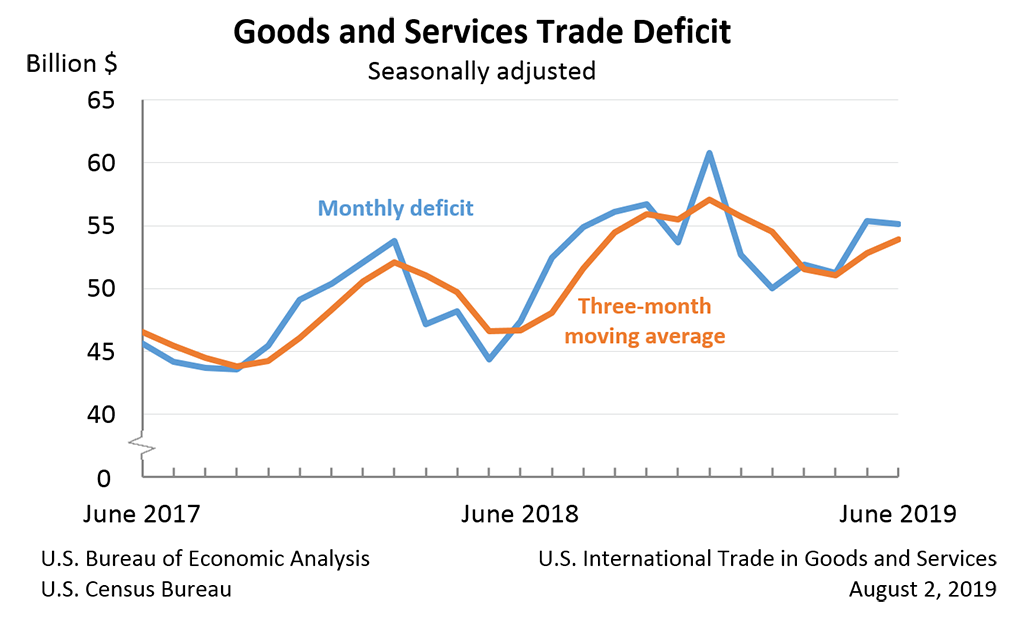
The U.S. Census Bureau and the U.S. Bureau of Economic Analysis announced today that the goods and services deficit was $55.2 billion in June, down $0.2 billion from $55.3 billion in May, revised.
| Deficit: | $55.2 Billion | -0.3%° |
| Exports: | $206.3 Billion | -2.1%° |
| Imports: | $261.5 Billion | -1.7%° |
Next release: September 4, 2019
(°) Statistical significance is not applicable or not measurable. Data adjusted for seasonality but not price changes
Source: U.S. Census Bureau, U.S. Bureau of Economic Analysis; U.S. International Trade in Goods and Services, August 2, 2019
| ||
Exports, Imports, and Balance (exhibit 1)
June exports were $206.3 billion, $4.4 billion less than May exports. June imports were $261.5 billion, $4.6 billion less than May imports.
The June decrease in the goods and services deficit reflected a decrease in the goods deficit of $0.8 billion to $75.1 billion and a decrease in the services surplus of $0.6 billion to $20.0 billion.
Year-to-date, the goods and services deficit increased $23.2 billion, or 7.9 percent, from the same period in 2018. Exports increased $0.5 billion or less than 0.1 percent. Imports increased $23.8 billion or 1.5 percent.
Three-Month Moving Averages (exhibit 2)
The average goods and services deficit increased $1.1 billion to $53.9 billion for the three months ending in June.
- Average exports decreased $1.7 billion to $207.8 billion in June.
- Average imports decreased $0.6 billion to $261.7 billion in June.
Year-over-year, the average goods and services deficit increased $7.2 billion from the three months ending in June 2018.
- Average exports decreased $3.3 billion from June 2018.
- Average imports increased $4.0 billion from June 2018.
Exports (exhibits 3, 6, and 7)
Exports of goods decreased $3.9 billion to $137.1 billion in June.
Exports of goods on a Census basis decreased $3.8 billion.
- Consumer goods decreased $1.9 billion.
- Gem diamonds decreased $0.8 billion.
- Pharmaceutical preparations decreased $0.5 billion.
- Jewelry decreased $0.4 billion.
- Capital goods decreased $1.2 billion.
- Computer accessories decreased $0.4 billion.
- Other industrial machinery decreased $0.2 billion.
- Telecommunications equipment decreased $0.2 billion.
- Automotive vehicles, parts, and engines decreased $0.5 billion.
Net balance of payments adjustments decreased $0.1 billion.
Exports of services decreased $0.5 billion to $69.2 billion in June.
- Travel (for all purposes including education) decreased $0.4 billion.
- Transport decreased $0.1 billion.
Imports (exhibits 4, 6, and 8)
Imports of goods decreased $4.7 billion to $212.3 billion in June.
Imports of goods on a Census basis decreased $4.4 billion.
- Industrial supplies and materials decreased $3.2 billion.
- Crude oil decreased $1.4 billion.
- Other petroleum products decreased $1.0 billion.
- Fuel oil decreased $0.3 billion.
- Consumer goods decreased $0.9 billion.
Pharmaceutical preparations increased $0.6 billion.
Net balance of payments adjustments decreased $0.2 billion.
Imports of services increased $0.1 billion to $49.2 billion in June, reflecting small (less than $50 million) changes in all major service categories.
Real Goods in 2012 Dollars – Census Basis (exhibit 11)
The real goods deficit decreased $0.3 billion to $86.1 billion in June.
- Real exports of goods decreased $2.8 billion to $148.1 billion.
- Real imports of goods decreased $3.1 billion to $234.2 billion.
Revisions
Revisions to May exports
- Exports of goods were revised up $0.2 billion.
- Exports of services were revised down $0.1 billion.
Revisions to May imports
- Imports of goods were revised down less than $0.1 billion.
- Imports of services were revised down $0.1 billion.
Goods by Selected Countries and Areas: Monthly – Census Basis (exhibit 19)
The June figures show surpluses, in billions of dollars, with South and Central America ($4.8), Hong Kong ($2.3), Brazil ($1.3), and United Kingdom ($0.1). Deficits were recorded, in billions of dollars, with China ($30.2), European Union ($15.9), Mexico ($9.2), Japan ($6.2), Germany ($5.2), Canada ($3.3), Italy ($2.6), France ($1.9), Taiwan ($1.7), India ($1.6), South Korea ($1.4), OPEC ($0.3), Saudi Arabia ($0.3), and Singapore ($0.1).
- The deficit with the European Union decreased $1.0 billion to $15.9 billion in June. Exports decreased $0.5 billion to $26.7 billion and imports decreased $1.5 billion to $42.7 billion.
- The surplus with Brazil increased $0.8 billion to $1.3 billion in June. Exports increased $0.3 billion to $3.9 billion and imports decreased $0.5 billion to $2.6 billion.
- The balance with Singapore shifted from a surplus of $0.6 billion to a deficit of $0.1 billion in June. Exports decreased $0.2 billion to $2.5 billion and imports increased $0.4 billion to $2.6 billion.
FULL DOCUMENT: https://www.bea.gov/system/files/2019-08/trad0619_0.pdf
DoC. USITC. August 1, 2019. U.S. Department of Commerce Issues Affirmative Preliminary Antidumping Duty Determination on Carbon and Alloy Steel Threaded Rod from Thailand
WASHINGTON – The U.S. Department of Commerce announced an affirmative preliminary determination in the antidumping duty (AD) investigation of imports of carbon and alloy steel threaded rod from Thailand, finding that exporters from Thailand have dumped steel threaded rod in the United States at a margin of 20.83 percent.
As a result of today’s decision, Commerce will instruct U.S. Customs and Border Protection (CBP) to collect cash deposits from importers of carbon and alloy steel threaded rod from Thailand based on the preliminary rate noted above. Because Commerce also preliminarily determined that critical circumstances exist, we will instruct CBP to begin suspending entries 90 days before the publication of the preliminary determination in the Federal Register.
In 2018, imports of carbon and alloy steel threaded rod from Thailand were valued at an estimated $5.8 million.
The petitioner is Vulcan Threaded Products Inc. (Pelham, AL).
The strict enforcement of U.S. trade law is a primary focus of the Trump Administration. Since the beginning of the current Administration, Commerce has initiated 179 new antidumping and countervailing duty investigations – this is a 231 percent increase from the comparable period in the previous administration.
Antidumping and countervailing duty laws provide American businesses and workers with an internationally accepted mechanism to seek relief from the harmful effects of the unfair pricing of imports into the United States. Commerce currently maintains 489 antidumping and countervailing duty orders which provide relief to American companies and industries impacted by unfair trade.
Commerce is scheduled to announce the final determination on or about October 15, 2019.
If Commerce’s final determination is affirmative, the U.S. International Trade Commission (ITC) will be scheduled to make its final injury determination on or about November 28, 2019. If Commerce makes an affirmative final determination of dumping, and the ITC makes an affirmative final injury determination, Commerce will issue an AD order. If Commerce makes a negative final determination of dumping, or the ITC makes a negative final determination of injury, the investigation will be terminated and no order will be issued.
The U.S. Department of Commerce’s Enforcement and Compliance unit within the International Trade Administration is responsible for vigorously enforcing U.S. trade law and does so through an impartial, transparent process that abides by international law and is based on factual evidence provided on the record.
Foreign companies that price their products in the U.S. market below the cost of production or below prices in their home markets are subject to antidumping duties. Companies that receive unfair subsidies from their governments, such as grants, loans, equity infusions, tax breaks, or production inputs, are subject to countervailing duties aimed at directly countering those subsidies.
Fact sheet: https://enforcement.trade.gov/download/factsheets/factsheet-thailand-carbon-alloy-steel-threaded-rods-ad-prelim-080119.pdf
ASEAN
U.S. Department of State. 08/02/2019. The United States and ASEAN: An Enduring Partnership
With a population of 650 million, average GDP growth of five percent nearing $3 trillion, and a young, tech-savvy demographic, the ten ASEAN countries make up one of the world’s most dynamic regions. Over the past 42 years, the United States and ASEAN have worked together to promote peace, stability, and prosperity. The U.S.-ASEAN relationship began in 1977 and was elevated to a strategic partnership in 2015. We see strong convergence between the principles enshrined in ASEAN’s Indo-Pacific Outlook—inclusivity, openness, a region based on rule of law, good governance, and respect for international law—and the vision of the United States for a free and open Indo-Pacific, as well as the regional approaches of our allies, partners, and friends.
Strong U.S. and ASEAN Economic Ties
ASEAN’s dynamic economies and high growth rates make it a key market for U.S. exports and investment.
- ASEAN is the number one U.S. investment destination in the Indo-Pacific. S. investment (cumulatively $329 billion) is larger than U.S. FDI in China, Japan, Republic of Korea, and India combined.
- ASEAN is the 4th largest export market for U.S. goods. S. exports to ASEAN support an estimated 500,000 jobs. The United States is ASEAN’s 4th largest trading partner.
- The ASEAN Single Window (ASW) Initiative, developed with U.S. technical assistance in 2008, has helped ASEAN reduce the cost of doing business and streamline trade in goods. USAID has provided assistance to upgrade technical software and reform laws for the ASW, allowing for easier exchange of customs information between ASEAN countries and the United States.
- The U.S. Infrastructure Transaction and Assistance Network (ITAN) promotes high-quality and financially sustainable infrastructure in the Indo-Pacific to help ASEAN’s infrastructure investment needs. The ITAN provides technical assistance to the Philippines, helps Vietnam implement its Power Development Plan and attract private sector investment, and partners with Indonesia’s state electric company to help modernize power grids and diversify energy sources.
- The ITAN Transaction Advisory Fund, announced in July 2018, will provide legal advisory services and technical assistance to ASEAN countries to assess potential infrastructure projects. Specific projects will be announced by the end of 2019.
- The Overseas Private Investment Corporation is prioritizing projects in Indonesia, Philippines, Vietnam, Thailand, and Myanmar. Current projects include a $10 million effort in Myanmar to connect lenders with agricultural suppliers, and a $160 million initiative to develop a wind farm in Indonesia.
U.S.-ASEAN Smart Cities Partnership (USASCP) – Investing in the Innovative
Smart Cities – cities using data-driven technology to innovate and manage city resources – are a key to sustainable development in both the United States and ASEAN.
- The inaugural USASCP event was held in Washington, D.C. in July with representatives of the 26 pilot cities in the ASEAN Smart Cities Network exchanging views with public and private sector smart city experts and exploring U.S. commercial solutions to smart city challenges. The initial U.S. commitment to this partnership is $10 million.
Building Capacity in the ASEAN Digital World
ASEAN’s digital economy is a key driver of regional economic growth, but the region still faces connectivity and cybersecurity challenges that U.S. expertise is helping to address.
- Building on the Digital Connectivity and Cybersecurity Partnership (DCCP) and the 2018 U.S.-ASEAN Leaders’ Statement on Cybersecurity Cooperation, the United States is planning the first S.-ASEAN Cyber Policy Dialogue during the Singapore International Cyber Week from October 1-3.
- As part of the DCCP, USTDA has supported a range of information and communications technology activities across the region, including funding for a technical assistance grant to help the Philippines implement its National Broadband Network Project. The assistance will help refine technical and operational design plans to provide broadband access to underserved markets throughout the Philippines.
- The S.–Singapore Third Country Training Program , USASEAN Connect, and DCCP aim to bridge development gaps in the region, training officials from all 10 ASEAN countries and Timor-Leste on digital connectivity, cybersecurity, and emerging technologies. This year, the United States supported capacity development on best practices in national cyber policy formation, by improving incident response capabilities and cybersecurity awareness and developing a cyber-workforce.
- S.-ASEAN Connect’s Digital Economy Series connects ASEAN policymakers and leading U.S. technology companies to share best practices in the digital sector, and by helping to facilitate an open and innovative digital space.
Partners in Energy Security
Southeast Asia’s energy demand is projected to increase by more than two-thirds by 2040. U.S. support is critical to meeting the needs of these growing markets and technological advances.
- The S.-ASEAN Energy Cooperation Work Plan supports ASEAN’s regional energy ambitions and objectives, including advancement of regional markets for electricity and natural gas, deployment of advanced and clean energy technologies, and the promotion of energy efficiency.
- Under the Clean Power Asia Program, the United States seeks to mobilize $750 million in clean energy investments over a five-year period by training select ASEAN governments to run reverse auctions for renewable energy tenders, a tool that uses competition to lower costs and deploy renewable capacity.
- The U.S.-initiated Asia EDGE (Enhancing Development and Growth through Energy) will support the ASEAN Council on Petroleum on best practices for cross-border pipeline management and natural gas quality standardization, a key to ASEAN energy integration.
Maritime Assistance for ASEAN Security
A strong, capable ASEAN at the heart of the Indo-Pacific region is critical to advancing a regional architecture that supports democratic governance and resolves disputes peacefully, through international law.
- The United States trains Coast Guards and other stakeholders through the Southeast Asia Maritime Lane Enforcement Initiative (formally the Gulf of Thailand initiative) to improve inoperability and information sharing.
- Security assistance programs, such as Foreign Military Financing, International Military Education and Training and the Maritime Security Initiative, support the professionalization of individual ASEAN countries’ militaries and enhance their maritime security and maritime domain awareness.
- In September, the United States and Thailand will co-host the inaugural ASEAN-U.S. Maritime Exercise. This exercise will build capacity in maritime domain awareness, information sharing, and sea interdiction.
Promoting Youth Leadership through People-to-People Ties
65% of ASEAN’s population is under the age of 35. Mobilizing young and emerging leaders to take ownership of the ASEAN community will ensure continued peace and prosperity.
- ASEAN visitors add $5 billion to the U.S. economy annually.
- ASEAN students contribute more than $2 billion to the U.S. economy annually.
- The U.S. Young Southeast Asian Leaders Initiative (YSEALI) has trained nearly 5000 emerging leaders since 2013. More than 142,000 young people aged 18-35 have become YSEALI virtual members.
- The YSEALI Seeds for the Future small grants competition has dedicated more than $1.6 million since 2015 in seed funding for community improvement projects.
- Nearly 60,000 students from ASEAN countries study in the United States annually.
- Since 2017, the Fulbright ASEAN Research Program for U.S. Scholars has awarded 14 scholarships to conduct collaborative U.S.-ASEAN research.
U.S. Department of State. 08/02/2019. Strengthening the U.S.-Mekong Partnership
The Mekong Matters to America
The Mekong region – Cambodia, Lao PDR, Myanmar, Thailand, and Vietnam – is strategically important to the United States. The region is a focus of the U.S. Indo-Pacific Strategy, and integral to our engagement with ASEAN. The United States aims to uphold sovereignty, transparency, good governance, ASEAN centrality, and a rules-based order, in conjunction with our Mekong partners. America’s ties with the Mekong region run deep:
- Over the last 10 years, U.S. agencies have provided more than $3.5 billion in assistance to the countries of the Mekong.
- S. direct investment position in the region reached $17 billion in 2017, up from $10 billion a decade ago. Two-way trade stood at $109 billion in 2018.
- S. exports to the Mekong countries have created more than 1.4 million American jobs since 1999 in industries such as electronics, agricultural products, and machinery.
- More than 33,000 students from the region enrolled in U.S. colleges and universities in 2018. More than 72,000 of the region’s youth are members of theS.-led Young Southeast Asian Leaders Initiative since its official launch in Manila in December 2013.
- Thailand is America’s oldest ally in the Indo-Pacific, with a relationship stretching back two centuries. The U.S.-Vietnam relationship is of increasingly strategic import.
Lower Mekong Initiative: A Decade of Building Human Capital
Since its launch in 2009, the Secretary of State has met annually with his five Mekong country counterparts through the Lower Mekong Initiative (LMI). Over the past decade, LMI programs have helped Mekong countries better address transboundary challenges on water security, smart hydropower, energy and infrastructure planning, and STEM education. LMI projects have delivered tangible improvements to the lives of the people of the Mekong region by:
- Giving 340,000 people access to clean drinking water, 27,000 to improved sanitation;
- Training 1,000 teachers (of 80,000 students) in STEM curriculum;
- Partnering with Singapore to train 1,200 Mekong country officials on regulatory issues concerning connectivity and sustainable development, through the Third Country Training Program;
- Raising technical English standards for 3,800 officials, teachers, and students;
- Supporting hundreds of women business owners through three entrepreneurship centers;
- Enhancing regional capacity to respond to and recover from emergency situations through the annual Pacific Resilience Disaster Response Exercise and Exchange, organized by the U.S. Army Corps of Engineers,
Other LMI programs include:
- The Mekong Water Data Initiative, which is developing an advanced, secure platform to strengthen the role of the Mekong River Commission in sharing data to improve flood and drought forecasting;
- The Sustainable Infrastructure Partnership, which provides technical and scientific assistance for environmentally sound infrastructure, clean energy, and land and water use;
- The LMI Quality Infrastructure Training Program, which works to improve public sector capacity to design projects to international standards;
- The LMI Young Scientist Program, which researches innovative solutions to vector borne diseases.
New Challenges
The Mekong region is facing new challenges, including debt dependency; a spree of dam-building that concentrates control over downstream flows; plans to blast and dredge riverbeds; extraterritorial river patrols; and a push by some to mold new rules to govern the river in ways that undermine existing institutions. The United States is committed to working with the Mekong countries to meet these new challenges.
The United States is also aligning our efforts with the “Friends of the Lower Mekong” to improve donor coordination with the Asian Development Bank, Australia, the European Union, Japan, New Zealand, the Republic of Korea, and the World Bank. Together with the LMI countries, we are coordinating our programs based on shared values, principles, and vision for the region.
Expanding U.S. Engagement
The United States continues to promote infrastructure, energy, and the digital economy through programs launched under the U.S. Indo-Pacific Strategy. Today, Secretary Pompeo announced that the United States, working with Congress, intends to provide approximately $45 million in additional resources to expand our engagement in the strategically important Mekong region, including:
- Japan-U.S. Mekong Power Partnership: $29.5 million to promote and develop principles-based, sustainable Mekong regional energy infrastructure.
- The dedication of $14 million in additional resources to counter transnational crime and trafficking in drugs, people, and wildlife.
- A partnership with experts from the World Bank, Australia, France, and Japan to conduct dam safety reviews for 55 dams in Lao PDR.
- Support for energy and infrastructure projects to advance liquefied natural gas import terminal sites and gas-to-power projects in Vietnam, and wind and solar power generation.
- A partnership with the Republic of Korea to apply satellite technology to better assess trends in flooding and droughts.
- Support for Ayeyawady-Chao Praya-Mekong Economic Cooperation Strategy (ACMECS) as a development partner, and ensuring LMI programs align with ACMECS goals.
We look forward to many more years of partnership and collaboration to ensure a peaceful, secure, and prosperous region.
U.S. Department of State. 08/02/2019. Secretary of State Michael R. Pompeo On The U.S. In Asia: Economic Engagement for Good
SECRETARY POMPEO: Good morning, everyone. Peter, thank you for the kind introduction. I also want to thank the Siam Society and your president for hosting me. I know too we have many prominent businesspeople here in the room with us today.
I want to recognize Greg Bastion, the president of AmCham Thailand. He’s a West Point grad, so that’s always good.
I especially want to thank the incoming Thai ambassador to the United States as well for joining us here today. Thank you for being here, sir.
And there’s no bigger VIP than my wife, Susan, who’s sitting in the front row as well. (Laughter.) All right, I hit my mark on that one, it’s all good. (Laughter.)
This is my first visit to Bangkok as the Secretary of State. I’ve been here before. I’ve been in the region many, many times. It’s special to be here in this place at this time. The United States has a long, cherished relationship, as the charge said, of 200 years. And I know we will remain great and good friends for the next two centuries as well.
This place that we’re standing today has a motto. Siam Society’s motto is, quote, “Knowledge gives rise to friendship.” In that spirit, I’d like to share with you today my perspective on our economic engagement in the region. I don’t know that any element of our relationship could be more important. It is a history that has been forgotten at times, and worse, distorted by those who don’t have our mutual best interests at heart.
It’s a story of partnerships which were once unimaginable, but are now absolutely indispensible to all of us.
It’s the story of a country that really seeks win-win propositions.
It’s a story of American principles and Asian prosperity.
Let me tell you about the Anurak family from right here in Thailand. Not so long ago, Mr. Anurak was a foreman at a construction company and his wife was a nurse. A nice middle class life, yes. But they wanted something more. They wanted something more for their children, as all families do. They started a small chicken farm.
In 2006, the American company Cargill, which was invested in Thailand beginning in 1968, discovered them.
They worked with the family to improve productivity, to improve efficiency, to help them with management techniques.
That partnership with America worked out pretty darn well. Today, that one farm has become five, and they earn an average of $78,000 each and every month.
And when they’re ready to grow further, they know they have a solid partner in that great American business.
This astounding prosperity is a far cry from the devastation and uncertainty that engulfed Asia after World War II, which really wasn’t that long ago.
Back then, the Indo-Pacific was a place of prosperity – wasn’t a place of prosperity, not anything like what we know today. For many decades, nations here struggled to find their path.
India won its independence from the British Empire, and then Pakistan and Bangladesh went their separate ways. Singapore and Malaysia parted paths. Taiwan and Mainland China diverged. Communist ideology was on the march on the Korean Peninsula, and in Vietnam and in Indonesia as well.
But look how times have changed:
Seoul is home to world-class companies like Samsung and LG.
Singapore serves as the regional headquarters to Facebook, Microsoft, Pfizer, and a lot of lawyers.
Hanoi hums with motorbikes and cars zipping around.
Bangalore provides IT solutions to the entire world.
Taipei’s skyline – its skyline is dominated by Taipei 101, one of the world’s tallest buildings.
And even Beijing and Shanghai have become economic engines.
And of course, the right question for the future is to ask: How did this all happen?
It wasn’t an economic miracle, and in fact, it wasn’t preordained.
This prosperity happened because of two very earthly factors: trade and freedom.
Now, I’m an Army guy, and I don’t like to give the Navy credit for much of anything, but the truth is – the truth is the key shipping lanes of the Indo-Pacific were and are today protected by American sailors. And where colonial powers once demanded submission, America offered security.
Economically, it’s true. It’s true that governments created some national championship companies, but that’s only part of the story. State-led growth only gets you so far.
Because in the end, human flourishing only really blossoms when governments step back. The Indo-Pacific region only really took off when nations adopted the formula that I talked about at the Global Entrepreneurship Summit in Amsterdam this past summer. It’s really very simple: property rights, the rule of law, lower taxes, an overall lighter touch from government regulation.
That’s when the Asian tigers roared and cubs stood on their own.
That was as true in Mainland China as it was in Singapore, as it was in Taiwan, and now here in Thailand.
Homegrown giants like Samsung, Honda, Taiwan Semiconductor, Mahindra & Mahindra, and so many more emerged.
And the United States was there. It was there with you all the way and it will be, helping you grow and forging ever-closer ties. We built APEC, we built ASEAN, and the Lower Mekong Initiative, and we did so with you, alongside of you.
Importantly too, we invested in your human capital. Our educational programs and universities have nurtured thousands of Asian leaders for decades, from local leaders to heads of state.
And some of our most important ambassadors – private businesses – grew alongside you to our mutual benefit. I told you the story about Cargill. Look at how Chevron has spurred prosperity here, or Texas Instruments in the Philippines.
Today, more than 4,200 American companies operate within ASEAN, employing, training, investing in millions of people all across the region. U.S. companies have over a trillion dollars invested in the region. There is no other country anywhere that even comes close.
They say, at least in America, that money doesn’t grow on trees. Perhaps it does elsewhere. But I will tell you this: Money does take root in this region when governments work hard to set the conditions for it to do so. And leaders from government and businesses will talk about how to grow prosperity further today in the meetings we’ll have and then at the Indo-Pacific Business Forum this November, held right here in Bangkok.
We should be proud of this. This is a great story, and it’s one the Thai people have lived firsthand.
The poverty rate here has declined from 67 percent back in 1986 to 7.8 percent in 2017. That’s remarkable. Thailand now has the 20th largest economy in the world. Think about that.
We want to see this kind of growth across all of Southeast Asia, for countries big and small. And we know – we know because we’ve seen that regional prosperity goes hand-in-hand with innovation, with good governance, and with the rule of law.
And so the Trump administration is invested in the sovereignty, in the resilience, and prosperity of every Southeast Asian nation. And not only that, not only that, we want to strengthen and expand our relationship here.
And don’t believe anyone who tries to tell you otherwise. Nearly two years ago, President Trump recommitted the United States to economic ties, and the formula for success has been borne out by history. It’s the one that I just described. We know in the end that liberty is the true source of rejuvenation. We want a free and open Indo-Pacific that’s marked by the core tenants of the rule of law, of openness, of transparency, of good governance, of respect for sovereignty of each and every nation, true partnerships.
It’s why we supported the BUILD Act in our Congress, which has more than doubled America’s development finance capacity to $60 billion.
In the end, we believe in democracy, and we commend the – our Thai friends for returning to the democratic fold.
We also believe in human rights and freedom. The current unrest in Hong Kong clearly shows that the will and the voice of the governed will always be heard.
And we want free and fair trade, not trade that undermines competition.
We want the trillions of dollars in uninvested private capital all around the world to be put to work in this region. We’ve seen this. Private investors have exponentially more money than any one government could ever bestow on any other country to build bridges, or ports, or electricity grids.
Our investments don’t serve a government, and our investments here don’t serve a political party, or frankly, a country’s imperial ambitions.
No, we are building roads to pave our national sovereignty. We don’t fund bridges to close gaps of loyalty.
Our companies are incentivized to do high-quality work that benefits consumers and citizens.
Ask yourself this, ask yourself: Who really puts the people’s interests first, a trading power that respects your sovereignty, or one that scoffs at it?
Ask yourself this: Who really fosters innovation and reform, private sector companies, or state-owned enterprises?
Ask yourself this: Who really encourages self-sufficiency and not dependence, investors who are working to meet your consumers’ needs, or those who entrap you in debt?
The United States today has the strongest economy in the world, and our consumers are driving demand for your products. In contrast, China’s economy is entering a new normal – a new normal of ever-slower growth.
China’s problems are homegrown, but President Trump’s confrontation of China’s unfair trade practices has helped shine a light on them. We’d like our trade matters resolved as quickly as possible. All we want, all President Trump has ever asked for, is for China to compete on a level playing field with everyone, not just with the United States. This will benefit not only us, but you, and the global trading system as well.
The time is right to do more together, using the model that has stood the test of time, using the formula that’s made America a force for good in this region – permanently.
One analysis of UN data estimates and predicts that for the first time since the 19th century, Asian economies in 2020 will be larger than the rest of the world combined. Indeed, the Asian middle class has exploded. Asia has truly come of age. Now we must protect those gains.
Let’s keep trade free and fair.
Let’s insist on transparent, high-standard investment that creates local jobs.
Let’s stand up for the sovereign rights of nations and peoples.
As I close today, I’m looking forward to taking questions and talking about issues that are on your mind. As I close, I can’t help but think of how fitting it is to put forth these ideas right here in Bangkok, Thailand. Thailand is our oldest treaty partner in Asia. You’ve proudly maintained your independence.
You’ve held to the path of sovereignty and national autonomy.
And America and Americans have proudly supported your rise for more than two centuries.
In 1835, a man named Dan Beach Bradley first came to the Kingdom of Siam as a missionary physician.
Dr. Bradley brought with him Western medical practices and served the royal court. He gained the trust and friendship of the future king of Siam, after treating the prince’s serious illness.
He also brought the first Thai script printing press to Siam and founded the first newspaper, The Bangkok Recorder.
But most importantly, he brought knowledge that gave rise to friendship.
Dan’s legacy is bigger than that, because it didn’t stop there.
His daughter Sophia opened a small school in her home to offer equal educational opportunities to girls. It grew, and to this day the Dara Academy is a well-respected private school right here in Thailand.
The anecdote points to this: For centuries, America’s legacy has been of our partnership – and not just through our government.
America builds things for mutual good.
And we build them to last.
President Trump and our administration will continue that commitment.
God bless you, and I look forward to taking some questions.
Thank you all for being here with me this morning. (Applause.)
MS AMIN: Good morning, Secretary Pompeo. Welcome back, your third trip to Asia. That shows some commitment to the region after what’s been said.
You talked about building ties with Southeast Asia, with Asia, deepening ties and deepening trade. And yet, this morning we woke up to President Trump intending to slap 10 percent tariffs on additional $300 billion worth of Chinese goods. That doesn’t bode well for the world, not for Asia, not for Southeast Asia.
What happened during those talks? Which people say something was achieved because there are plans for the talks in September. How bad were they?
SECRETARY POMPEO: So there are talks that will begin in Washington in September. But back to first principles. For decades, China has taken advantage of trade, taking advantage of trade versus the United States of America, and taking advantage of trade versus countries in Asia and Southeast Asia, and it’s time for that to stop. And President Trump has said we’re going to fix this, and to fix it requires determination, and that’s, I think, what you saw this morning. The President is determined to achieve this outcome.
What we’re asking for is really easy. Indeed, the Chinese had agreed to it at one point, and then walked away from the deal.
MS AMIN: So what is it? Is it Huawei at the crux of it? Can there be a compromise?
SECRETARY POMPEO: No, no. It’s not about – this is far bigger than that. This is about the central premise of how trade will be conducted around the world. Is it okay for a nation that was once developing to continue to take the advantages when they’re no longer in that status? Is it okay for a nation to put on enormous tariffs when the other counter-party to the trading arrangement won’t do that? Is it acceptable to put tariffs and barriers on American companies investing in China when the United States is wide open to those investments?
All we have asked for – it’s really simple. It’s what you – it’s the golden rule. It’s what you teach your kids, right? Do unto others. We want fairness, evenness, reciprocity. These are core concepts. They’re what I spoke about. And when that happens, Asia will thrive, Southeast Asia will thrive, the United States global trading system will thrive. But it cannot be the case that a nation uses protectionism to protect its own goods and uses predatory tactics to deny others’ economies the chances to grow.
MS AMIN: At what cost? We’re seeing PMIs around the world already easing. We’re seeing countries around the world – well, revising downwards growth projection. I mean yes, the U.S. is in a good position leading global growth, but with Trump, President Trump is saying that he will tax the hell out of China. There are negative implications.
SECRETARY POMPEO: There have been negative implications of decades of bad behavior on the part of China.
MS AMIN: When you take a look at how the U.S. —
SECRETARY POMPEO: Negative implications for every business in this room, and we’ll fix it.
MS AMIN: There’s greater scrutiny right now on Chinese companies, especially through the Committee on Foreign Investment in the U.S., of which you play a huge role. When you take a look at the Bloomberg data, it suggests that there are about 173 Chinese companies worth about $750 billion actively listed in the U.S., 750 – just Chinese companies in the U.S. Could you be sending a negative message to these companies who are interested in putting money in your country?
SECRETARY POMPEO: No. We welcome capital that comes to America every day, all day. What we want to make sure is the basis on which that capital flows into the United States. We want to make sure that American capital that wants to come to this region, to China, can do so on a fair and even basis, and we want to make sure that capital doesn’t pose a national security threat to the United States of America. Those are – that’s a low bar. Those are simple standards. They’re what every nation must do to protect its own sovereignty.
And so no, the message we’re sending them is, “Come. Come to America. Participate. Do so with the rule of law. Do so through transparency. Don’t subsidize those countries. Don’t create champions through – with political objectives. Make them economic objectives. And when you do, many Chinese companies will come to America, compete, and be very, very successful. And we welcome that.
MS AMIN: Some (inaudible), however, say that the crux of this U.S.-China trade tensions is actually a fundamental misunderstanding of how the U.S. views China, that China today is different from the China of 20 years ago, and that China today needs time to reform and reform in its own time. Is there a misconception in those views?
SECRETARY POMPEO: Well, I’m not sure how to respond to – the other night – I had a chance to be with Dr. Kissinger the other day. He came to the State Department to celebrate our 230th anniversary, and we were talking about this very issue, this idea that China would, if their economy opened up, that they would begin to compete in a fair, transparent way. Well, that hasn’t happened, and so that’s what we’re driving for. It’s really elemental.
MS AMIN: In your conversations, if there is one thing China needs to do right now to avert further tariffs, what would that be?
SECRETARY POMPEO: Yeah —
MS AMIN: If just one first step that needs to be taken.
SECRETARY POMPEO: Look, I’m not directly involved in the trade negotiations, but there was an agreement on the table that would have put us in a really, really good place. So as a starting point, they could come back to at least where they were that day.
MS AMIN: You touched on Hong Kong earlier, and you talked about how the government needs to listen. There are murmurings out there suggesting that perhaps there is a congregation of troops just on the border waiting to make its way if things turn for the worse. Can you envision that happening?
SECRETARY POMPEO: So I think President Trump has been pretty clear. We’ve asked China simply to do the right thing. America has a long tradition of making sure that every citizen has the right to express their conscience, their views. We hope that’s the case all around the world, and that is true in China as well.
And so I hope that the way things proceed in Hong Kong will proceed in a way that is not violent. That’s not constructive for any of the parties in the region. And we hope that everywhere citizens want to voice their views – whether those are in support of a particular government or in opposition to a particular government – they’ll be permitted to do so.
MS AMIN: But President Trump also made it clear that it is a Chinese issue, it’s a Hong Kong issue. Should the PLA make its way across the border into Hong Kong, into the streets of Hong Kong, would the U.S. exercise any military presence? Would it exercise its own judgment to make its way and defend Hong Kong?
SECRETARY POMPEO: One thing this administration has been really good about is not tipping our hand to what we will or won’t do, and I’m going to do that here this morning.
MS AMIN: (Laughter.) Okay, I’ll take that. (Laughter.)
Now, let’s touch on North Korea. It does seem like President Trump has given a lot of face and a lot of face time to North Korea. There have been two summits. He’s made his way to North Korea. The first U.S. – sitting U.S. president to do that. He’s also made suggestions about inviting Kim to D.C. That seems like a lot to give for very little in return, because we’re back to square one with North Korea greeting your presence in Asia with a series of missile launches. Your take on that?
SECRETARY POMPEO: Yeah, I think you fundamentally mischaracterized. Having a meeting with Chairman Kim didn’t give him a darn thing. It was an attempt that is ongoing to engage with them diplomatically to achieve an outcome that for decades has not been achieved. Many paths have been tried, but they’ve all been unsuccessful. And so I was the first – when I was the director of Central Intelligence, the first one to travel to meet with Chairman Kim to begin this opportunity. We’re still engaged in it. We hope that they will put their working group back together and meet with us before too long.
But remember, the UN Security Council still has the most stringent sanctions ever imposed on North Korea fully in place, and we are working with countries all across the world, many in this region are doing great work to enforce those, in an effort to make sure that we have the capacity to ultimately deliver what Chairman Kim committed to back in June in Singapore, June a year ago back in Singapore, which is to fully denuclearize his country in exchange for – President Trump describes – a brighter future for the North Korean people.
MS AMIN: Those launches are against UN resolutions. I mean, how patient can the U.S. be? At what stage will you decide to tighten those sanctions and do something about it and send a message to North Korea that it is not acceptable?
SECRETARY POMPEO: So you should never doubt what we may be communicating to the North Koreans. There are conversations going on, goodness, even as we speak. But the diplomatic path is often fraught with bumps, tos and fros, forward and backward. We are still fully committed to achieving the outcome that we have laid out – the fully verified denuclearization of North Korea – and to do so through the use of diplomacy.
MS AMIN: How confident are you you will get there?
SECRETARY POMPEO: We keep working at it.
MS AMIN: (Laughter.) Is there a timeframe you’re looking at? I mean, conversations can’t go on forever. At what stage will you take action, a tougher stance on North Korea?
SECRETARY POMPEO: I think we’ve taken the toughest stance in all of recorded history.
MS AMIN: Have you been —
SECRETARY POMPEO: So when you say a tougher stance, if you go look at the list of Security Council resolutions and you look not only at the resolutions themselves but the world’s effectiveness at enforcing them, I think it’s difficult to imagine that there would be a set of tougher sanctions put in place.
So to give the moment so that we can have this opportunity. It’s the right thing for the world. To continue this diplomatic effort is the right approach. It’s the right approach today, and President Trump and I and our national security team will continue to evaluate that alongside of all of our partners in Japan and South Korea, the Chinese, the Russians. All of those who have a vested interest in seeing North Korea denuclearized will continue to work on this problem set.
MS AMIN: Are we looking at a third summit anytime soon?
SECRETARY POMPEO: Stay tuned.
MS AMIN: (Laughter.) Have you been disappointed that your North Korean counterpart didn’t make it here, missing out on the chance to negotiate?
SECRETARY POMPEO: I always look forward to a chance to talk with him. I wish they’d have come here. I think it would have given us an opportunity to have another set of conversations, and I hope it won’t be too long before I have a chance to do that.
MS AMIN: But how do you expect to, I guess, get negotiations going when your own counterpart isn’t willing to make himself available to talk?
SECRETARY POMPEO: Lots of conversations taking place.
MS AMIN: How concerned are you about how Kim Jong-un is carrying out his, I guess, missile program?
SECRETARY POMPEO: Yeah, so we’re always – we’re always concerned, right? President Trump has made nuclear nonproliferation a centerpiece of the work that we do, whether that’s the work that we’re doing with Iran, the work that we’re doing in North Korea. President Trump understands – we’re working to engage in a strategic security dialogue with the Russians.
All have a central theme, which is this risk from nuclear weapons and their proliferation is real and serious. And so yes, I want very much these discussions to proceed with the North Koreans. We want to really get past the discussions and get to execution on the ground. That’s our charge. That’s the mission the President has laid out for me, and we’re working diligently to get there just as quickly as we can.
MS AMIN: What role do you think China can play in this?
SECRETARY POMPEO: A big role. And they have. I actually applaud the enforcement efforts that the Chinese have undertaken under the UN Security Council resolution. They have truly been a bulwark. They have been helpful. I met with my counterpart foreign minister yesterday. We talked about this again. They reiterated their goal for there to be a diplomatic resolution to this as well and their continued commitment to enforce the UN Security Council resolutions.
MS AMIN: Secretary Pompeo, I was told to wrap up, but just one final question. Since you touched on Iran, I mean, the U.S. has been trying to put a lid on Iranian oil exports, yet there are concerns out there that perhaps your Asian allies are still importing Iranian oil. What are your thoughts on that, and are you intending to take any action?
SECRETARY POMPEO: Simple math. Before the sanctions regime was put in place, there were 2.7-ish million barrels of oil a day being shipped by Iran to all around the world. The number for June and July, each of those two months, was less than a half a million barrels, could have been closer to zero than to half a million. The sanctions have been very effective, and we will enforce them everywhere. We’ll enforce them against any company, any country, that continues to violate those sanctions. We’ve already imposed sanctions on one company inside of China. We will continue to do that. It is absolutely imperative that we deny the ayatollah and the Islamic Republic of Iran from having the wealth and resources to build a nuclear program that could threaten anyone in the world.
MS AMIN: On that note, Secretary Pompeo, thank you so much for your time today.
SECRETARY POMPEO: Thank you very much.
MS AMIN: Thank you for your insights.
SECRETARY POMPEO: Thank you.
MS AMIN: And ladies and gentlemen, thank you for joining us. (Applause.)
________________
ECONOMIA BRASILEIRA / BRAZIL ECONOMICS
INFLAÇÃO
FGV. IPRE. 02/08/19. Índices Gerais de Preços. IPC-S Capitais. Inflação pelo IPC-S avança nas sete capitais pesquisadas
O IPC-S de 31 de julho de 2019 registrou variação de 0,31%, ficando 0,13 ponto percentual (p.p.) acima da taxa divulgada na última apuração. Todas as sete capitais pesquisadas registraram acréscimo em suas taxas de variação.
A tabela a seguir, apresenta as variações percentuais dos municípios das sete capitais componentes do índice, nesta e nas apurações anteriores.
DOCUMENTO: https://portalibre.fgv.br/navegacao-superior/noticias/inflacao-pelo-ipc-s-avanca-nas-sete-capitais-pesquisadas.htm
INDÚSTRIA
IBGE. 01/08/2019. Produção industrial varia -0,6% em junho
Em junho de 2019, a produção industrial nacional caiu 0,6% frente a maio (série com ajuste sazonal), segundo resultado negativo consecutivo. A perda acumulada nesse período foi de 0,7%. No confronto com junho de 2018 (série sem ajuste sazonal), a indústria recuou 5,9%, após registrar expansão de 7,4% em maio, quando interrompeu dois meses consecutivos de queda: março (-6,2%) e abril (-3,9%).
| Período | Produção industrial |
|---|---|
| Junho / Maio 2019 | -0,6% |
| Junho 2019 / Junho 2018 | -5,9% |
| Acumulado em 2019 | -1,6% |
| Acumulado em 12 meses | -0,8% |
| Média móvel trimestral | -0,1% |
O setor industrial acumulou queda de 1,6% nos seis primeiros meses de 2019. O acumulado nos últimos doze meses (-0,8%) mostrou perda de ritmo frente ao resultado de maio (0,0%) e permaneceu com a trajetória predominantemente descendente iniciada em julho de 2018 (3,3%). Os dados são da Pesquisa Industrial Mensal - Produção Física (PIM-PF) Brasil.
| Indicadores da Produção Industrial por Grandes Categorias Econômicas Brasil - Junho de 2019 | ||||
|---|---|---|---|---|
| Grandes Categorias Econômicas | Variação (%) | |||
| Junho 2019 / Maio 2019* | Junho 2019 / Junho 2018 | Acumulado Janeiro-Junho | Acumulado nos Últimos 12 Meses | |
| Bens de Capital | -0,4 | -3,5 | 0,9 | 3,1 |
| Bens Intermediários | -0,3 | -6,4 | -2,7 | -1,6 |
| Bens de Consumo | -0,8 | -5,3 | 0,5 | 0,2 |
| Duráveis | -0,6 | -6,1 | 1,8 | 2,1 |
| Semiduráveis e não Duráveis | -1,2 | -5,0 | 0,1 | -0,3 |
| Indústria Geral | -0,6 | -5,9 | -1,6 | -0,8 |
| Fonte: IBGE, Diretoria de Pesquisas, Coordenação de Indústria *Série com ajuste sazonal | ||||
17 dos 26 ramos pesquisados registraram queda em junho
No recuo de 0,6% da atividade industrial na passagem de maio para junho de 2019, as quatro grandes categorias econômicas e 17 dos 26 ramos pesquisados mostraram redução na produção. Entre as atividades, as principais influências negativas foram registradas por produtos alimentícios (-2,1%), máquinas e equipamentos (-6,5%) e veículos automotores, reboques e carrocerias (-1,7%), com todas apontando o segundo mês seguido de queda na produção e acumulando nesse período, respectivamente, perdas de 2,3%, 8,7% e 5,3%.
Outras contribuições negativas relevantes foram: metalurgia (-1,7%), produtos farmoquímicos e farmacêuticos (-3,8%), celulose, papel e produtos de papel (-2,2%), outros equipamentos de transporte (-6,5%), manutenção, reparação e instalação de máquinas e equipamentos (-5,0%), coque, produtos derivados do petróleo e biocombustíveis (-0,6%) e máquinas, aparelhos e materiais elétricos (-2,0%). Por outro lado, entre os nove ramos que ampliaram a produção, o desempenho de maior importância foi registrado por indústrias extrativas, que avançou 1,4%, segunda taxa positiva consecutiva, acumulando, assim, alta de 11,0%. Esses resultados positivos interromperam quatro meses seguidos de queda na produção, período em que acumulou redução de 25,6%. Outros impactos positivos relevantes foram assinalados pelos setores de produtos de madeira (7,5%), de bebidas (1,5%) e de outros produtos químicos (0,7%).
Entre as grandes categorias econômicas, bens de consumo semi e não-duráveis (-1,2%) mostrou a queda mais acentuada em junho de 2019 e o segundo resultado negativo consecutivo, acumulando nesse período queda de 2,8%. Os segmentos de bens de consumo duráveis (-0,6%), de bens de capital (-0,4%) e de bens intermediários (-0,3%) também assinalaram taxas negativas. Bens de consumo duráveis registrou o segundo mês seguido de queda, acumulando perda de 3,0%; bens de capital interrompeu quatro meses consecutivos de crescimento na produção, período em que acumulou ganho de 9,9%; e bens intermediários eliminou parte do ganho de 1,4% registrado em maio, quando interrompeu quatro meses consecutivos de recuo na produção, período em que acumulou queda de 4,3%.
Média móvel trimestral varia -0,1%
Ainda na série com ajuste sazonal, a média móvel trimestral mostrou variação de -0,1% no trimestre encerrado em junho de 2019 e manteve a trajetória predominantemente descendente iniciada em agosto de 2018. Entre as grandes categorias econômicas, bens intermediários (-0,2%) e bens de consumo semi e não-duráveis (-0,1%) apontaram as taxas negativas. Bens intermediários registrou o quinto resultado negativo consecutivo, acumulando nesse período redução de 3,4%; e bens de consumo semi e não-duráveis voltou a recuar após crescer em abril (0,8%) e maio (0,1%).
Por outro lado, os setores produtores de bens de capital (1,1%) e de bens de consumo duráveis (0,2%) assinalaram os avanços de junho de 2019. Bens de capital marcou o quarto mês seguido de crescimento, acumulando expansão de 7,1% nesse período; e bens de consumo duráveis permaneceu com a trajetória ascendente iniciada em janeiro de 2019.
Produção industrial recua 5,9% em relação a junho de 2018
Na comparação com junho de 2018, a indústria caiu 5,9%, com resultados negativos nas quatro grandes categorias econômicas, 20 dos 26 ramos, 56 dos 79 grupos e 61,2% dos 805 produtos pesquisados. Junho de 2019 (19 dias) teve dois dias úteis a menos do que junho de 2018 (21).
Entre as atividades, indústrias extrativas (-16,3%) exerceu a maior influência negativa. Vale destacar também as seguintes contribuições negativas: produtos alimentícios (-5,9%), veículos automotores, reboques e carrocerias (-9,3%), de coque, produtos derivados do petróleo e biocombustíveis (-4,4%), celulose, papel e produtos de papel (-6,1%), manutenção, reparação e instalação de máquinas e equipamentos (-16,0%), perfumaria, sabões, produtos de limpeza e de higiene pessoal (-12,5%), bebidas (-5,6%), produtos de minerais não-metálicos (-5,6%), produtos de borracha e de material plástico (-5,4%), outros equipamentos de transporte (-11,7%), couro, artigos para viagem e calçados (-6,8%) e móveis (-8,6%). Por outro lado, entre as seis atividades que apontaram ampliação na produção, as principais influências foram: produtos farmoquímicos e farmacêuticos (4,9%), impressão e reprodução de gravações (11,2%) e equipamentos de informática, produtos eletrônicos e ópticos (3,2%).
Bens intermediários (-6,4%) e bens de consumo duráveis (-6,1%) assinalaram os recuos mais acentuados entre as grandes categorias econômicas. Os setores produtores de bens de consumo semi e não-duráveis (-5,0%) e de bens de capital (-3,5%) também apontaram taxas negativas, mas que foram menos elevadas do que a média nacional (-5,9%).
O setor de bens intermediários recuou 6,4%, após avançar 2,7% em maio, quando interrompeu oito meses consecutivos de taxas negativas. O resultado de junho foi explicado, principalmente, pelas quedas em: indústrias extrativas (-16,3%), coque, produtos derivados do petróleo e biocombustíveis (-5,0%), produtos alimentícios (-4,6%), veículos automotores, reboques e carrocerias (-6,7%), produtos de minerais não-metálicos (-5,6%), celulose, papel e produtos de papel (-5,8%), máquinas e equipamentos (-9,0%), produtos de borracha e de material plástico (-4,3%), produtos de metal (-2,3%) e metalurgia (-0,2%), enquanto as pressões positivas foram registradas por outros produtos químicos (1,0%) e produtos têxteis (0,7%). Vale citar também os resultados negativos dos grupamentos de insumos típicos para construção civil (-4,0%), que interrompeu dois meses consecutivos de crescimento na produção; e de embalagens (-3,4%), que apontou o primeiro recuo em 2019.
O segmento de bens de consumo duráveis recuou 6,1%, após registrar resultados positivos em abril (1,0%) e maio (28,1%). Em junho de 2019, o setor foi particularmente pressionado pela queda na fabricação de automóveis (-14,9%). Vale citar também a redução no grupamento de móveis (-8,7%). Já os principais impactos positivos foram: eletrodomésticos da “linha marrom” (28,4%) e da “linha branca” (13,1%), motocicletas (35,5%) e outros eletrodomésticos (6,5%).
O setor de bens de consumo semi e não-duráveis recuou 5,0%, após crescer 11,5% no mês anterior, quando interrompeu dois meses consecutivos de queda: março (-5,3%) e abril (-0,8%). O desempenho em junho de 2019 foi explicado, em grande parte, pela redução no grupamento de alimentos e bebidas elaborados para consumo doméstico (-7,3%). Vale citar também os resultados negativos assinalados pelos grupamentos de semiduráveis (-4,8%), de carburantes (-3,4%) e de não-duráveis (-1,8%).
A produção de bens de capital caiu 3,5%, após avançar 22,0% em maio, quando interrompeu dois meses consecutivos de queda na produção: março (-11,0%) e abril (-0,2%). Em junho de 2019, o segmento foi influenciado, em grande medida, pelo recuo no grupamento de bens de capital para equipamentos de transporte (-8,3%). As demais taxas negativas foram: bens de capital agrícolas (-11,9%), energia elétrica (-10,4%), de uso misto (-5,3%) e construção (-5,7%). Por outro lado, o único impacto positivo foi assinalado pelo grupamento de bens de capital para fins industriais (1,2%).
Indústria recua 1,0% no segundo trimestre de 2019
A indústria, ao recuar 1,0% no segundo trimestre de 2019, permaneceu com o comportamento negativo observado no último trimestre de 2018 (-1,2%) e no primeiro de 2019 (-2,3%), todas as comparações contra igual período do ano anterior. A redução na intensidade de perda na passagem do primeiro para o segundo trimestre de 2019 foi explicada pelo ganho de ritmo verificado em três das quatro grandes categorias econômicas, com destaque para bens de consumo duráveis (de -3,2% para 6,9%) e bens de capital (de -3,8% para 5,5%). Bens de consumo semi e não-duráveis (de -1,5% para 1,6%) também fez esse movimento, enquanto bens intermediários (de -2,0% para -3,2%) foi o único que mostrou perda de dinamismo.
Em 2019, indústria acumula queda de 1,6%
No índice acumulado para janeiro-junho de 2019, frente a igual período do ano anterior, a indústria recuou 1,6%, com resultados negativos em uma das quatro grandes categorias econômicas, 15 dos 26 ramos, 39 dos 79 grupos e 52,3% dos 805 produtos pesquisados.
Entre as atividades, indústrias extrativas (-13,7%) exerceu a maior influência negativa. Vale destacar também as contribuições negativas de ramos de equipamentos de informática, produtos eletrônicos e ópticos (-6,6%), de manutenção, reparação e instalação de máquinas e equipamentos (-10,4%), de outros equipamentos de transporte (-11,2%), de produtos farmoquímicos e farmacêuticos (-4,1%) e de produtos de madeira (-5,3%). Por outro lado, entre as onze atividades que cresceram, a principal influência foi veículos automotores, reboques e carrocerias (3,5%). Outras contribuições positivas relevantes vieram de bebidas (5,7%), de produtos de metal (5,8%), de produtos de minerais não-metálicos (2,9%), de outros produtos químicos (1,5%) e de máquinas e equipamentos (1,5%).
Entre as grandes categorias econômicas, o perfil dos resultados para os seis primeiros meses de 2019 mostrou menor dinamismo para bens intermediários (-2,7%), pressionada, sobretudo, pela redução em indústrias extrativas (-13,7%). Por outro lado, os setores produtores de bens de consumo duráveis (1,8%), de bens de capital (0,9%) e de bens de consumo semi e não-duráveis (0,1%) assinalaram as taxas positivas no índice acumulado no ano.
Produção industrial cai 0,6% em junho e tem segundo mês negativo seguido. O setor fechou o segundo trimestre com queda de 1%, na comparação com o mesmo período de 2018
A queda de 0,6% na produção em junho levou a indústria nacional ao segundo mês negativo seguido, após recuo de 0,1% em maio. A perda de ritmo do setor, na comparação com maio, reflete a redução da produção em 17 das 26 atividades e em todas as grandes categorias econômicas de bens intermediários, de consumo e de capital.
Com esse resultado, a indústria está 17,9% abaixo do recorde alcançado em maio de 2011. As informações são da Pesquisa Industrial Mensal, divulgada hoje pelo IBGE. No fechamento do segundo trimestre, o setor teve queda de 1%, na comparação com o mesmo trimestre de 2018.
Na comparação com junho de 2018, a queda da indústria foi mais acentuada, de 5,9%, acumulando -1,6% no primeiro semestre do ano. Além da redução de ritmo, o efeito calendário contribuiu negativamente, já que junho de 2019 teve dois dias úteis a menos que junho do ano passado.
A pesquisa apontou resultados negativos também nos últimos 12 meses, com recuo de 0,8%, mantendo a trajetória descendente iniciada em julho do ano passado.
Produção industrial (mês/mês anterior)
Clique e arraste para zoom
Fonte: IBGE - Pesquisa Industrial Mensal - Produção Física
Entre as 17 atividades que puxaram a produção para baixo, na comparação com maio, estão produtos alimentícios (-2,1%), máquinas e equipamentos (-6,5%) e veículos automotores, reboques e carrocerias (-1,7%).
Essas três atividades representam cerca de um terço da produção total e seguiram o comportamento da indústria, com seu segundo mês de queda. “São segmentos importantes que precisam de uma demanda doméstica mais fortalecida e que são diretamente afetados por um mercado de trabalho ainda longe de uma recuperação consistente”, explica o gerente da pesquisa, André Macedo.
Ainda em relação ao mês anterior, houve perdas em todas as grandes categorias econômicas, sendo a mais intensa de 1,2% em bens de consumo semi e não duráveis. As demais taxas negativas foram em bens de consumo duráveis (-0,6%), de capital (-0,4%) e intermediários (-0,3%).
Indústria extrativa tem alta de 1,4%, mas ainda sente efeitos de Brumadinho
Entre os nove ramos que ampliaram a produção em junho, destaque para as indústrias extrativas. O setor avançou 1,4% em relação a maio, a segunda taxa positiva consecutiva, interrompendo quatro meses de queda, quando acumulou -25,6%.
Já na comparação com junho de 2018, o setor extrativo caiu 16,3% e exerceu a maior influência negativa, ainda pressionado pelos efeitos do rompimento da barragem de rejeitos em Brumadinho (MG).
“Há um aperto na legislação que faz com que algumas atividades extrativas deixem de funcionar ou operem em ritmo menor. É a atividade com a principal influência negativa na comparação anual, seja frente a junho de 2018, seja no acumulado no ano”, avalia o gerente da pesquisa.
DOCUMENTO: https://agenciadenoticias.ibge.gov.br/agencia-sala-de-imprensa/2013-agencia-de-noticias/releases/25121-producao-industrial-varia-0-6-em-junho
COMÉRCIO EXTERIOR BRASILEIRO
MEconomia. 02/08/2019. ECONOMIA. Comércio exterior. Ministério da Economia zera Imposto de Importação de 281 máquinas e equipamentos. Medida facilita compra de bens de capital (BK) e de informática e telecomunicações (BIT) sem produção nacional; em 2019, redução já atinge 1.189 produtos para incentivar investimentos
A Secretaria de Comércio Exterior e Assuntos Internacionais (Secint) do Ministério da Economia (ME) aprovou nesta sexta-feira (2/8) 281 ex-tarifários para máquinas e equipamentos sem produção no Brasil. A medida zera, temporariamente, as alíquotas do Imposto de Importação de 261 bens de capital (BK, conforme nomenclatura da Tarifa Externa Comum do Mercosul) e 20 bens de informática e telecomunicações (BIT).
A redução consta em duas portarias da Secint publicadas hoje no Diário Oficial da União (DOU). A Portaria nº 510 diminui de 14% para zero a alíquota de 261 BK, incluindo 240 novos e 21 renovações. Já a Portaria nº 511 define 20 novos ex-tarifários para BIT, que terão a alíquota reduzida de 16% para zero.
Segundo a Subsecretaria de Estratégia Comercial da Secretaria Executiva da Câmara de Comércio Exterior (Camex) da Secint, somente em 2019 já foram concedidos um total de 1.189 ex-tarifários para BK e BIT. O objetivo é promover a atração de investimentos para o Brasil, desonerando os aportes direcionados a empreendimentos produtivos.
A Secretaria de Desenvolvimento da Indústria, Comércio, Serviços e Inovação (SDIC) do Ministério da Economia realizou os trâmites e as análises das duas portarias de acordo com a Resolução Camex nº 66/2014. Ainda não foram utilizados os novos procedimentos e critérios introduzidos pela Portaria nº 309/2019 do Ministério da Economia, que expandem a possibilidade de concessões de ex-tarifários, porque eles dependem de regulamentação da SDIC.
Saiba mais
O regime de ex-tarifário consiste na redução temporária da alíquota do Imposto de Importação de bens de capital (BK) e de bens de informática e telecomunicação (BIT) – conforme grafia da Tarifa Externa Comum do Mercosul (TEC) –, quando não houver a produção nacional equivalente.
Atualmente, o Ministério da Economia tem promovido a redução a zero, amparada pelo regime de ex-tarifário.
Sem a aplicação desse regime, as importações de BK têm uma incidência de 14% de Imposto de Importação, e as de BIT, de 16%.
ENERGIA
ANP. 02 de Agosto de 2019. Pré-sal se mantém como maior produtor de petróleo e gás em junho
A produção de petróleo e gás natural em junho de 2019 totalizou em torno de 3,257 milhões de barris de óleo equivalente por dia (boe/d), sendo 59,8% da produção (1,946 milhões de boe/dia) oriundos de campos do Pré-sal.
A produção de petróleo alcançou o volume de 2,557 milhões de barris por dia (bbl/d), uma redução de 6,4%, se comparada com o mês anterior, e de 1,3%, se comparada com o mesmo mês em 2018.
Já a produção de gás natural foi de 111 milhões de metros cúbicos por dia (m³/d), queda de 5,8%, se comparada ao mês anterior, e de 3,3%, se comparada ao mesmo mês em 2018.
A principal razão para a redução da produção de petróleo e gás natural foi a parada para manutenção da plataforma FPSO Cidade de Mangaratiba, operando no campo de Lula.
Os dados de produção de junho estão disponíveis na página do Boletim Mensal da Produção de Petróleo e Gás Natural.
Pré-sal
A produção do Pré-sal, oriunda de 99 poços, foi de 1,551 milhão de barris diários (bbl/d) de petróleo de petróleo e 62,8 milhões de metros cúbicos (m³/d), de gás natural, totalizando 1,946 milhões de barris de petróleo equivalente por dia (boe/d). Houve redução de 7,6% em relação ao mês anterior e aumento de 10,4% se comparada ao mesmo mês de 2018. A produção do Pré-sal correspondeu a 59,8% do total produzido no Brasil.
Aproveitamento do gás natural
Em junho, o aproveitamento de gás natural foi de 96,4%. Foram disponibilizados ao mercado 54,8 milhões de m³/dia. A queima de gás no mês foi de 4,1 milhões de m³/d. A queima reduziu 17,4%, se comparada ao mês anterior, e 2,4%, se comparada ao mesmo mês em 2018.
Campos produtores
Lula, na Bacia de Santos, foi o que mais produziu petróleo, uma média de 799 mil de bbl/d. Também foi o maior produtor de gás natural: média de 33 milhões de m³/dia.
Origem da produção
Os campos marítimos produziram 96,1% do petróleo e 80,8% do gás natural. Os campos operados pela Petrobras produziram 93,5% do petróleo e do gás natural. A produção nacional ocorreu em 7.103 poços, sendo 645 marítimos e 6.458 terrestres.
Destaques
Estreito, na Bacia Potiguar, teve o maior número de poços produtores: 1.098.
Marlim Sul, na Bacia de Campos, foi o campo marítimo com maior número de poços produtores: 70.
A Plataforma FPSO Cidade de Maricá, produzindo no Campo de Lula por meio de oito poços a ela interligados, produziu 150,3 Mbbl/d e foi a instalação com maior produção de petróleo.
A instalação Polo Arara, produzindo nos Campos de Arara Azul, Araracanga, Carapanaúba, Cupiúba, Rio Urucu e Sudoeste Urucu, por meio de 35 poços a ela interligados, produziu 8,9 MMm³/d e foi a instalação com maior produção de gás natural.
Campos de Acumulações Marginais
Esses campos produziram 71,5 barris de petróleo por dia e 9,6 mil metros cúbicos de gás natural. O campo de Iraí, operado pela Petroborn, foi o maior produtor, com 57,4 barris de óleo equivalente por dia.
Outras informações
Em junho de 2019, 297 áreas concedidas, duas áreas de cessão onerosa e cinco de partilha, operadas por 33 empresas, foram responsáveis pela produção nacional. Destas, 74 são marítimas e 230 terrestres. Do total das áreas produtoras, 11 são relativas a contratos de áreas contendo acumulações marginais.
O grau API médio foi de 27,4 sendo 35,5% da produção considerada óleo leve (>=31°API), 53,3% óleo médio (>=22 API e <31 11="" api="" e="" leo="" p="" pesado="">
As bacias maduras terrestres (campos/testes de longa duração das bacias do Espírito Santo, Potiguar, Recôncavo, Sergipe e Alagoas) produziram 103,6 mil boe/d, sendo 81,9 mil bbl/d de petróleo e 3,5 milhões de m³/d de gás natural. Desse total, 97,1 mil boe/d foram produzidos pela Petrobras e 6,6 mil boe/d foram produzidos por concessões não operadas pela Petrobras, dos quais: 371 boe/d em Alagoas, 3.409 boe/d na Bahia, 22 boe/d no Espírito Santo, 2.567 boe/d no Rio Grande do Norte e 227 boe/d em Sergipe.
PETROBRAS. 01/08/2019. Petrobras alcança resultado trimestral recorde. Lucro líquido de R$ 18,9 bilhões é 368% superior ao primeiro trimestre de 2019
A Petrobras registrou lucro líquido de R$ 18,9 bilhões no segundo trimestre de 2019, um recorde histórico para a companhia. Esse resultado representa um aumento de 368% em relação ao lucro líquido registrado no primeiro trimestre de 2019, que foi de R$ 4 bilhões, e 87% comparado ao segundo trimestre de 2018, que foi de R$ 10,1 bilhões.
A principal explicação para esse desempenho foi a conclusão da venda de 90% da participação da Petrobras na Transportadora Associada de Gás S.A.(TAG), no valor de R$ 33,5 bilhões, sendo R$ 2 bilhões destinados à liquidação da dívida da transportadora com o BNDES. O aumento das cotações internacionais do petróleo e a valorização do dólar frente ao real também impactaram positivamente os resultados da companhia.
A Petrobras registrou um Ebitda ajustado de R$ 32,7 bilhões, representando um crescimento de 19% em relação ao trimestre anterior, em função de maiores preços do petróleo, maior volume de venda de diesel e incremento nas margens de gasolina, nafta e gás natural. Além disso, o fluxo de caixa livre foi positivo pelo 17º trimestre consecutivo, totalizando R$ 11,3 bilhões.
A dívida líquida continuou sua trajetória decrescente, fechando em US$ 83,7 bilhões no segundo trimestre deste ano, uma redução de 12% em relação ao trimestre anterior. Com uma gestão ativa da dívida, também foi possível aumentar o prazo médio de vencimento de 9 para 10 anos, com a manutenção da taxa média de juros em 6% a.a. O índice de dívida líquida/Ebitda ajustado também caiu para 2,69x, 16% inferior ao registrado no primeiro trimestre de 2019.
Os investimentos totalizaram US$ 2,6 bilhões, sendo 82% em atividades de exploração e produção. Em benefício da transparência e da eficiência da alocação de capital, revisamos os investimentos de 2019 de US$ 16 bilhões para o intervalo de US$ 10 a US$ 11 bilhões.
No segundo trimestre de 2019, reduzimos a taxa de acidentados registráveis de 1,02 acidentado por milhão de horas trabalhadas no primeiro trimestre deste ano para 0,88 acidentado por milhão de horas trabalhadas, abaixo do limite de alerta de 1,0.
“Apresentamos um bom resultado financeiro no segundo trimestre, beneficiado principalmente pela venda da TAG, com lucro líquido alcançando um recorde histórico de R$ 19 bilhões. Continuaremos nossa trajetória de geração de valor, com foco nos ativos de maior retorno, como o pré-sal, e busca incessante para redução de custos”, disse o presidente da Petrobras, Roberto Castello Branco.
Resultados operacionais no segundo trimestre
A produção de petróleo, gás natural e LGN da companhia alcançou 2 milhões 633 mil barris de óleo equivalente (boe) por dia no segundo trimestre, um aumento de 3,8% em relação ao primeiro trimestre deste ano. Somente nos campos do pré-sal, a produção cresceu 12,7%, com 1 milhão 168 mil barris de petróleo por dia (bpd) no segundo trimestre.
Esse aumento reflete ao crescimento progressivo da produção (ramp up) das plataformas que entraram em operação em 2018 – P-69, P-74, P-75 e Cidade de Campos dos Goytacazes - e 2019 - P-67, P-76 e P-77. Essas unidades contribuíram com 436 mil boed no segundo trimestre, sendo que têm capacidade para produzir até 1 milhão 5 mil bpd, quando estiverem a plena carga. Graças a esse desempenho consistente, o pré-sal saltou de 48% da produção total de óleo no Brasil no segundo trimestre de 2018 para 57% no segundo trimestre de 2019. Além disso, conseguimos neste trimestre reduzir o custo de extração do pré-sal para a marca de US$ 6/boe.
Apesar dos resultados positivos, decidimos revisar a meta de produção de 2019 para 2,7 milhões de barris de óleo equivalente por dia (sendo 2,1 milhões de barris por dia de produção de óleo), com variação de +/- 2,5%. Apesar do aumento da produção na comparação trimestral, os resultados foram inferiores ao planejado, em decorrência principalmente da complexidade na estabilização das plantas de gás das plataformas do campo de Búzios.
No segundo trimestre, as vendas de derivados aumentaram 0,5% no mercado brasileiro em comparação ao primeiro trimestre, com destaque para as vendas de diesel, que aumentaram 4,9%. A produção de derivados e o fator de utilização também aumentaram, refletindo o aumento das vendas no mercado brasileiro e a sazonalidade da demanda de diesel.
Gestão de portfólio
Em linha com a estratégia de concentração nos ativos de maior retorno financeiro, o volume de desinvestimentos da Petrobras alcançou US$ 15,1 bilhões até julho deste ano. A transação de maior valor foi a venda de 90% da TAG por R$ 33,5 bilhões, seguida pela oferta de ações da Petrobras Distribuidora por R$ 9,6 bilhões.
________________
LGCJ.:

