US ECONOMICS
CUBA
U.S. Department of State. 07/26/2019. Visa Actions Against Cuban Officials
The Cuban government engages in exploitative and coercive labor practices while it earns money on the backs of its citizens through its overseas medical missions program. To address this labor abuse, the Department has imposed visa restrictions on certain Cuban officials and other individuals responsible for these coercive labor practices under the Immigration and Nationality Act Section 212(a)(3)(C). These practices include working long hours, housing in unsafe areas, and compelling Cuban medical professionals to advance the regime’s political agenda. Such visa restrictions could include immediate family members of these individuals.
U.S. Department of State. 07/26/2019. State Department Updates the Cuba Restricted List
The State Department has updated the Cuba Restricted List to add four sub-entities owned by the Cuban military. The changes take effect today, July 26, as Cuba celebrates more than 60 years since the start of the Cuban Revolution. Sixty years after Castro promised to improve the lives of the Cuban people, the revolution continues to fail its people by squandering Cuba’s economic potential through mismanagement and oppressing brave Cubans that continue the fight for freedom. The Department remains committed to ensuring U.S. funds do not directly support Cuba’s state security apparatus, which not only violates the human rights of the Cuban people, but also exports this repression to Venezuela to support the corrupt Maduro regime.
In accordance with the June 2017 National Security Presidential Memorandum-5, “Strengthening the Policy of the United States Toward Cuba,” the U.S. government generally prohibits direct financial transactions with listed entities and sub-entities because they would disproportionately benefit the Cuban military, intelligence, and security services or personnel at the expense of the Cuban people or private enterprise in Cuba.
For more information on the regulations prohibiting direct financial transactions with entities and sub-entities on the Cuba Restricted List, please refer to the November 2017 regulatory amendments by the Departments of the Treasury (31 CFR part 515) and Commerce (15 CFR parts 730-774).
VENEZUELA
U.S. Department of State. 07/25/2019. The United States Takes Action Against Corruption Network of Maduro-Aligned Associates
On July 25, the United States sanctioned five individuals involved in a complex network of bribery and money laundering that has been stealing from the people of Venezuela for years, as well as an additional five individuals and 13 entities connected to these corrupt actors. Among the individuals involved were Maduro’s three stepsons (Walter, Yosser and Yoswal), and Colombian businessman, Alex Saab, the orchestrator of the corruption network, and sons of First Lady Cilia Flores.
Using a social welfare program that many Venezuelans are forced to depend on for their survival, Maduro and his cronies turned the program into a political weapon and self-enriching mechanism. As noted in the UN Office of the High Commissioner and Human Rights July 5 report, the former Maduro regime’s misallocation of resources and corruption have contributed to the economic and humanitarian crisis in Venezuela.. While Maduro’s stepsons and other criminal associates used a food allocation program to steal hundreds of millions of dollars, many Venezuelans eat once or at most twice per day, with few proteins and vitamins.
Meanwhile, Interim President Juan Guaido and the National Assembly are leading efforts that respond directly to the peoples’ needs. Since January 23, organizations and volunteers have responded to Guaido’s call through weekend health fairs and humanitarian camps that have delivered urgent medical and hygiene care to over 130,000 Venezuelans in all 24 states.
With our democratic partners in the region and around the world, the United States will continue to support interim President Guaido, the National Assembly, and the people of Venezuela.
U.S. Department of the Treasury. 07/25/2019. Treasury Disrupts Corruption Network Stealing From Venezuela’s Food Distribution Program, CLAP. Alex Saab bribed stepsons of Nicolás Maduro and exploited no-bid contracts to loot hundreds of millions of dollars from starving Venezuelans
Washington – Today, the U.S. Department of the Treasury’s Office of Foreign Assets Control (OFAC) sanctioned Colombian national Alex Nain Saab Moran (Saab), a profiteer orchestrating a vast corruption network that has enabled former President Nicolás Maduro (Maduro) and his regime to significantly profit from food imports and distribution in Venezuela. Saab has personally profited from overvalued contracts, including the Government’s food subsidy program titled the Local Committees for Supply and Production, or Los Comités Locales de Abastecimiento y Producción, commonly known as CLAP. Through a sophisticated network of shell companies, business partners, and family members, Saab laundered hundreds of millions of dollars in corruption proceeds around the world. Also targeted today are Maduro’s three stepsons, Walter, Yosser, and Yoswal, to whom Saab funneled money in exchange for access to contracts with the Government of Venezuela, including its food subsidy program.
“Alex Saab engaged with Maduro insiders to run a wide scale corruption network they callously used to exploit Venezuela’s starving population. Treasury is targeting those behind Maduro’s sophisticated corruption schemes, as well as the global network of shell companies that profit from the former regime’s military-controlled food distribution program,” said Treasury Secretary Steven Mnuchin. “The corruption network that operates the CLAP program has allowed Maduro and his family members to steal from the Venezuelan people. They use food as a form of social control, to reward political supporters and punish opponents, all the while pocketing hundreds of millions of dollars through a number of fraudulent schemes.”
The Start of a Corrupt Relationship
Since as early as 2009, Saab exploited his corrupt ties to Maduro regime insiders, frequently paying bribes and kickbacks to Government of Venezuela officials, to win overvalued government contracts. Saab and his business partner, Alvaro Enrique Pulido Vargas (Pulido), created a company in 2009 to bid on a Government of Venezuela housing contract. After a year of lobbying, the Government of Venezuela awarded a housing contract to Saab and Pulido’s company to build 25,000 homes in Venezuela; the contract paid Saab and Pulido three to four times the actual cost of building each low-income home, which were intended for Venezuela’s more vulnerable populations.
Saab Meets “Los Chamos”
In 2011, Saab gave Cilia Adela Flores de Maduro’s (Flores) three sons Walter, Yosser, and Yoswal (also known as “Los Chamos”) and their cousin, Carlos Erica Malpica Flores (Malpica), a contract to clear land for the construction of homes in the Venezuelan State of Vargas. Flores was designated on September 25, 2018 pursuant to E.O. 13692, as amended, for being a current or former official of the Government of Venezuela; Malpica was designated on July 26, 2017 pursuant to E.O. 13692, as amended, for being a current or former official of the Government of Venezuela. Saab’s relationship with Flores, Los Chamos, and Malpica was key for Saab and Pulido’s access to Government of Venezuela officials, allowing them to pay the requisite bribes and kickbacks to obtain government contracts. Los Chamos would also receive kickbacks from Saab’s companies in return for government contracts. Los Chamos had frequent access to Maduro and Tareck Zaidan El Aissami Maddah (El Aissami), who was designated on February 13, 2017 pursuant to the Foreign Narcotics Kingpin Designation Act for playing a significant role in international narcotics trafficking; El Aissami is the current Minister of Industries and National Production and former Executive Vice President of Venezuela. As a result, Los Chamos were able to manipulate the recipients of government contracts, and Saab had the opportunity to work with the highest levels of the Venezuelan government.
Profiting from Starvation
The former Maduro regime created the CLAP program in 2016 for the stated purpose of providing subsidized food ration boxes to poor Venezuelans. Rather than ensure that this vulnerable population receives the food it desperately needs, the regime uses the CLAP program as a political tool to reward support and punish political criticism. By offering food through this program, the former regime is able to maintain its influence because many Venezuelan citizens do not have enough money to buy food and therefore depend on the rations CLAP provides to survive.
Saab’s involvement with the CLAP program started in 2016 when he and Pulido devised a corporate structure to acquire the food from a foreign distributor, assemble it in a foreign country, and ship it to Venezuela, all at the most profitable rate for themselves. Under Maduro’s watch, Saab reaped substantial profits and imported only a fraction of the food needed for the CLAP program.
Once the food was purchased, Saab and Pulido aggregated the food at processing plants and assembled it for shipping. Saab and Pulido used businesses in Mexico, relying on companies they already controlled, such as Group Grand Limited (which is headquartered in Hong Kong and also registered in Mexico in order to operate in the food industry). In Mexico, Group Grand Limited, S.A. de C.V. is owned or controlled by Pulido’s son, Emmanuel Enrique Rubio Gonzalez.) To maximize profits, Saab sought to use a Venezuelan state owned company located in the state of Táchira, Venezuela, which was exempt from import taxes.
Saab used some of his profits from corrupt food contracts to pay bribes to government officials for the importation of food through the State of Táchira, including to Jose Gregorio Vielma Mora (Vielma Mora), who was the Governor of the Venezuelan State of Táchira at the time, and to Rodolfo Clemente Marco Torres (Marco Torres), who was the Minister of Food in Venezuela. Marco Torres was designated on January 5, 2018 pursuant to E.O. 13692, as amended, for being a current or former official of the Government of Venezuela. Vielma Mora and Marco Torres helped Saab and Pulido obtain winning bids for CLAP food contracts. Saab also continued to provide kickbacks to Los Chamos from the profits of the CLAP program to maintain access to Government of Venezuela officials and continue to win lucrative government contracts.
Several companies Saab and Pulido own or control were used in Saab and Pulido’s food corruption scheme, including Asasi Food FZE, Mulberry Proje Yatirim Anonim Sirketi (Mulberry), and the Group Grand Limited companies. Since 2016, when Saab met with Los Chamos and Maduro to discuss importing food on behalf of the Government of Venezuela, Saab and Pulido have made hundreds of millions of dollars from the profits of this corrupt scheme.
The System That Corrupted the Program
The below individuals enriched themselves by capitalizing on a network of corruption to obtain lucrative business contracts with the Government of Venezuela. These individuals were able to obtain CLAP-related, no-bid, and overvalued contracts from senior Venezuelan political figures through front and shell companies. Having successfully obtained no-bid contracts, these front and shell companies would then receive approval from the Venezuelan Corporation of Foreign Trade (CORPOVEX) to import food into Venezuela. OFAC designated Illiana Josefa Ruzza Terán on April 17, 2019 pursuant to E.O. 13692, as amended, for being a current or former official of the Government of Venezuela, as a Director on the Board of Directors of CORPOVEX, as well as a Director of the Central Bank of Venezuela and the Vice President of Finance of Petroleos de Venezuela, S.A. (PdVSA). PdVSA was designated on January 28, 2019 pursuant to E.O. 13850, for operating in the oil sector of the Venezuelan economy.
In many cases, the front or shell companies would receive a prepayment from the Government of Venezuela, after which they would distribute the funds as kickbacks to government officials that were party to the corrupt scheme. To do this, the CLAP-contracted shell or front companies would divert the kickback funds and subtract commissions into nested corporate accounts controlled through their ownership and control of other front and shell companies. To further obscure the money’s origin, these front and shell companies would send a portion of the stolen money to business accounts of related companies whose financial activity was not related to food supply or logistics. Finally, using these accounts, the co-conspirators would send a portion of the stolen money to corrupt Venezuelan senior political figures, their family members, or associates.
The CLAP-contracted companies would then create fraudulent invoices reflecting a purchase of goods worth an amount aligned with the value from the original, overvalued contract. In many cases, the CLAP-contracted companies would sub-contract with other companies to fulfill the terms of the contract, such as purchasing food or assembling food boxes often at substandard nutritional value. The CLAP-contracted companies worked with shipping and insurance companies controlled by corrupt Venezuelan government officials or their business associates to organize the physical transport of food to Venezuelan ports.
Illicit Operations in the Venezuelan Gold Sector
From early 2018, as the Government of Venezuela’s shortage of foreign exchange became increasingly acute, the Government started using gold resources to pay some contracts, to include CLAP food contracts, and Saab began working with Simon Alejandro Zerpa Delgado (Zerpa) to help the Government liquidate gold mined in Venezuela and convert it into foreign currency. Zerpa was designated on July 26, 2017 pursuant to E.O. 13692 for being a current or former official of the Government of Venezuela. Saab, in turn, worked with members of the Venezuelan government including El Aissami, the current Minister of Industries and National Production and former Executive Vice President, to create a structure for the Government of Venezuela to sell gold to Turkey. As a result of the Government of Venezuela’s corrupt operations in the gold sector, and to prevent Maduro and his corrupt associates from further exploiting Venezuela’s people and resources, the gold sector of the Venezuelan economy was identified as subject to sanctions by Secretary Mnuchin in November 2018.
Saab signed a contract with Banco de Desarrollo Económico y Social de Venezuela (BANDES) to acquire Venezuelan currency to purchase gold from local miners, and the Government of Venezuelan pressured miners to sell gold to Saab at an inflated official market rate, instead of on the black market. BANDES was designated on March 22, 2019 pursuant to E.O. 13850, as amended, for operating in the financial sector of the Venezuelan economy.
Some of the gold was sent to Caracas to be refined, then sold to the Central Bank of Venezuela (Banco Central de Venezuela or BCV), and subsequently exported out of Venezuela. The BCV was designated on April 17, 2019 pursuant to E.O. 13850, as amended, for operating in the financial sector of the Venezuelan economy. The gold was then flown to destinations such as the United Arab Emirates and Turkey. Turkish entities would purchase gold from the Government of Venezuela, depositing money in accounts in Turkey, which in turn would transfer funds to an account held by the BCV in Turkey. Saab’s company in Turkey, Mulberry, purchased goods in Turkey on behalf of Venezuelan clients, marking up prices before being sold back to Venezuela.
A Network of Corruption and Nepotism
The individuals designated today are determined to be responsible for or complicit in, or directly or indirectly engaged in, a transaction or series of transactions involving deceptive practices and corruption and the Government of Venezuela or projects or programs administered by the Government of Venezuela, or are immediate adult family members of such persons, or operate in the gold sector of the Venezuelan economy, or are current or former officials of the Government of Venezuela:
- Alex Nain Saab Moran (Saab) is a Colombian national who, along with his business partner, Pulido, oversees a sophisticated network of front and shell companies used to acquire, assemble, and ship food to Venezuela in support of CLAP contracts, all at the most profitable rate for themselves. Saab used the profits generated from CLAP food boxes to bribe government officials to maintain his access to government contracts. Saab bribed several individuals, including Vielma Mora and Marco Torres. Saab also provided kickbacks to Maduro’s stepsons, Walter, Yosser, and Yoswal (“Los Chamos”).
- Alvaro Enrique Pulido Vargas (Pulido) (previously known as German Enrique Rubio-Salas) is a Colombian national who serves as Saab’s primary business partner. Along with Saab, Pulido helped devise the complex corporate structure of front and shell companies that Saab and Pulido used to profit from the acquiring, assembling, distribution, and shipment of food to Venezuela.
- Emmanuel Enrique Rubio Gonzalez (Rubio) is the son of Pulido. Rubio owns or controls one of the key food packing companies involved in the corruption network that abuses the CLAP program, Group Grand Limited S.A. de C.V., which facilitated the shipment of non-perishable food from Mexico to Venezuela.
- Walter Jacob Gavidia Flores is the oldest stepson of Maduro and, along with his two younger brothers Yosser and Yoswal, received bribes and kickbacks from Saab in exchange for giving Saab access to overvalued Venezuelan government contracts, such as the CLAP program.
- Yosser Daniel Gavidia Flores is the second oldest stepson of Maduro and, along with his two brothers Walter and Yoswal, received bribes and kickbacks from Saab in exchange for giving Saab access to overvalued Venezuelan government contracts, such as the CLAP program.
- Yoswal Alexander Gavidia Flores is the youngest stepson of Maduro and, along with his two older brothers Walter and Yosser, received bribes and kickbacks from Saab in exchange for giving Saab access to overvalued Venezuelan government contracts, such as the CLAP progam.
- Jose Gregorio Vielma Mora (Vielma Mora) is the former Minister of Foreign Trade and International Investment of the Government of Venezuela. He is also the former Governor of the Venezuelan State of Táchira.
- Shadi Nain Saab Certain (Shadi) is a son of Alex Nain Saab Moran. Shadi was listed as a Director of Group Grand Limited from 2015 to 2017 in the company’s registration documents.
- Isham Ali Saab Certain is a son of Alex Nain Saab Moran.
- Mariana Andrea Staudinger Lemoine is the wife of Yosser Daniel Gavidia Flores.
Global Network of Front and Shell Companies
Several individuals designated today played a role in establishing a global structure of front and shell companies to skim significant sums of money from commercial contracts and business activity created through the scheme. By utilizing such a structure of offshore entities to support CLAP operations, it makes it more difficult for U.S. financial institutions to identify corrupt activity related to CLAP-related food operations.
The following companies were designated or blocked today for being owned or controlled by the aforementioned individuals, or for being responsible for or complicit in, or for being directly or indirectly involved in, any transaction or series of transactions involving deceptive practices or corruption and the Government of Venezuela or projects or programs administered by the Government of Venezuela. This action also includes the identification of a luxury apartment in Miami, Florida, as blocked property in the interest of one of these companies.
- Asasi Food FZE is registered in the UAE and is owned or controlled by Saab. Asasi Foods FZE received money from food companies in Venezuela that were receiving food imports and paying money to food providers in Mexico as a means to facilitate the CLAP corruption scheme.
- Group Grand Limited is registered in Hong Kong and is owned or controlled by Saab. The company served as a primary entity in the global network of shell and front companies used by both Saab and Pulido to facilitate the CLAP corruption scheme.
- Group Grand Limited, S.A. de C.V. is registered in Mexico and is owned or controlled by Rubio. It is part of the network of shell and front companies used by Pulido and Saab to facilitate the CLAP corruption scheme. The company has a warehouse that was used to receive food from different suppliers and assemble the food into boxes that were shipped from Mexico and sold in Venezuela as a part of the CLAP corruption scheme. The timing of today’s action by the Treasury Department was synchronized with an action by the Government of Mexico.
- Group Grand Limited General Trading is registered in the UAE and is owned or controlled by Saab. It is a part of the global network of front and shell companies used by Saab and Pulido to facilitate the CLAP corruption scheme.
- Mulberry Proje Yatirim Anonim Sirketi (Mulberry) is registered in Turkey and is responsible for or complicit in, or directly or indirectly involved in, a transaction or series of transactions involving deceptive practices or corruption and the Government of Venezuela or projects or programs administered by the Government of Venezuela. Mulberry was used to facilitate payments made as a part of Saab’s CLAP corruption network for the sale of gold in Turkey.
- Seafire Foundation is registered in Panama and is owned or controlled by Saab. Saab and his direct family members were the beneficiaries of the entity that facilitated payments to Saab as a part of the CLAP corruption scheme.
- C I Fondo Global De Alimentos LTDA is registered in Colombia and is owned or controlled by Rubio.
- Emmr & CIA. S.A.S. is registered in Colombia and is owned or controlled by Rubio.
- Global Structure, S.A. is registered in Panama and is owned or controlled by Rubio.
- Multitex International Trading, S.A. is registered in Panama and is owned or controlled by Rubio.
- Sun Properties LLC is registered in Delaware and is owned or controlled by Rubio.
- Clio Management Corp. is registered in Panama and is owned or controlled by Pulido.
- Silver Bay Partners FZE (Silver) is registered in the UAE and is responsible for or complicit in, or directly or indirectly involved in, a transaction or series of transactions involving deceptive practices or corruption and the Government of Venezuela or projects or programs administered by the Government of Venezuela.
As a result of these actions, all property and interests in property of the individuals and entities designated today, and of any entities that are owned, directly or indirectly, 50 percent or more by those individuals or entities, that are in the United States or in the possession or control of U.S. persons are blocked and must be reported to OFAC. OFAC’s regulations generally prohibit all dealings by U.S. persons or within (or transiting) the United States that involve any property of blocked or designated persons.
U.S. sanctions need not be permanent; sanctions are intended to change behavior. The United States has made it clear that we will consider lifting sanctions for persons designated under E.O. 13692 or E.O. 13850, each as amended, who take concrete and meaningful actions to restore democratic order, refuse to take part in human rights abuses, speak out against abuses committed by the Government of Venezuela, and combat corruption in Venezuela.
Venezuela-related Designations. OFFICE OF FOREIGN ASSETS CONTROL. Specially Designated Nationals List Update
The following individuals have been added to OFAC's SDN List:
GAVIDIA FLORES, Walter Jacob (a.k.a. GAVIDIA-FLORES, Walter), Caracas, Capital District, Venezuela; DOB 15 Dec 1978; citizen Venezuela; Gender Male; Cedula No. 14407259 (Venezuela); Passport 113561269 (Venezuela) expires 28 Jan 2020 (individual) [VENEZUELA-EO13850].
GAVIDIA FLORES, Yosser Daniel (a.k.a. GAVIDIA-FLORES, Yosser), Caracas, Capital District, Venezuela; DOB 11 Oct 1988; citizen Venezuela; Gender Male; Cedula No. 18815328 (Venezuela); Passport 135713284 (Venezuela) expires 31 May 2021 (individual) [VENEZUELA-EO13850].
GAVIDIA FLORES, Yoswal Alexander, Caracas, Capital District, Venezuela; DOB 06 Aug 1990; citizen Venezuela; Gender Male; Cedula No. 19733466 (Venezuela); Passport 134559177 (Venezuela) expires 11 May 2021 (individual) [VENEZUELA-EO13850].
PULIDO VARGAS, Alvaro Enrique (a.k.a. PULIDO VARGAS, Alvaro (Latin: PULIDO VARGAS, Álvaro); a.k.a. RUBIO SALAS, German Enrique); DOB 10 Dec 1963; citizen Colombia; Gender Male; Cedula No. 79324956 (Colombia) (individual) [VENEZUELA-EO13850].
RUBIO GONZALEZ, Emmanuel Enrique (a.k.a. RUBIO-GONZALEZ, Emmanuel Enrique); DOB 06 Jan 1989; POB Bogota, Colombia; nationality Colombia; Gender Male; Cedula No. 21807689; Passport AM807340 (Colombia); alt. Passport PE139553 (Colombia); alt. Passport 087105100 (Venezuela); National ID No. 1015410162 (Colombia) (individual) [VENEZUELA-EO13850] (Linked To: PULIDO VARGAS, Alvaro Enrique).
SAAB CERTAIN, Isham Ali; DOB 14 Apr 1999; POB Barranquilla, Colombia; citizen Colombia; Gender Male; Passport AS005095 (Colombia); National ID No. 99041408126 (Colombia) (individual) [VENEZUELA-EO13850] (Linked To: SAAB MORAN, Alex Nain).
SAAB CERTAIN, Shadi Nain (a.k.a. SAAB, Shadi; a.k.a. SAAB, Shadi Nain); DOB 25 Apr 1996; POB Barranquilla, Colombia; citizen Colombia; Gender Male; Passport PE097209 (Colombia); National ID No. 1045738303 (Colombia) (individual) [VENEZUELA-EO13850] (Linked To: SAAB MORAN, Alex Nain).
SAAB MORAN, Alex Nain (a.k.a. SAAB MORAN, Alex (Latin: SAAB MORÁN, Alex); a.k.a. SAAB, Alex); DOB 21 Dec 1971; Gender Male; Cedula No. 72180017 (Colombia); Passport PE085897 (Colombia); alt. Passport 085635076 (Venezuela); alt. Passport D010302 (Antigua and Barbuda) (individual) [VENEZUELA-EO13850].
STAUDINGER LEMOINE, Mariana Andrea, Caracas, Capital District, Venezuela; DOB 23 Apr 1990; citizen Venezuela; Gender Female; Cedula No. 19195336 (Venezuela) (individual) [VENEZUELA-EO13850] (Linked To: GAVIDIA FLORES, Yosser Daniel).
VIELMA MORA, Jose Gregorio, Caracas, Capital District, Venezuela; DOB 26 Oct 1964; Gender Male; Cedula No. 6206038 (Venezuela) (individual) [VENEZUELA].
The following entities have been added to OFAC's SDN List:
ASASI FOOD FZE (a.k.a. ASASI FOODS FZC), Rakeem Building, Ras Al Khaimah Economic Zone, Ras-Al-Khaimah, United Arab Emirates; P.O. Box 40803, Ras-Al-Khaimah, United Arab Emirates; P.O. Box 0843-01732, Panama [VENEZUELA-EO13850] (Linked To: SAAB MORAN, Alex Nain).
C I FONDO GLOBAL DE ALIMENTOS LTDA, Calle 128 B 78 90, Bogota, D.C. 1103, Colombia; NIT # 9002234401 (Colombia) [VENEZUELA-EO13850] (Linked To: RUBIO GONZALEZ, Emmanuel Enrique).
CLIO MANAGEMENT CORP., Panama; Folio Mercantil No. 724213 (Panama) [VENEZUELA-EO13850] (Linked To: PULIDO VARGAS, Alvaro Enrique).
EMMR & CIA. S.A.S. (a.k.a. EMMR AND CIA. S.A.S.; a.k.a. EMMR Y CIA. S.A.S.; a.k.a. EMMR Y COMPANIA S A S), Calle 79 42 318, Barranquilla, Atlantico, Colombia; NIT # 9005964804 (Colombia) [VENEZUELA-EO13850] (Linked To: RUBIO GONZALEZ, Emmanuel Enrique).
GLOBAL STRUCTURE, S.A., Panama City, Panama; Folio Mercantil No. 844394 (Panama) [VENEZUELA-EO13850] (Linked To: RUBIO GONZALEZ, Emmanuel Enrique).
GROUP GRAND LIMITED (a.k.a. GROUP GRAND LIMITED GENERAL TRADING; a.k.a. GROUP GRAND LTD.), Room C, 25/F Cheuk Nang Plaza, 250 Hennessy Road, Wan Chai, Hong Kong; Registration Number 1871367 (Hong Kong) [VENEZUELA-EO13850] (Linked To: SAAB MORAN, Alex Nain).
GROUP GRAND LIMITED GENERAL TRADING, Dubai, United Arab Emirates [VENEZUELA-EO13850] (Linked To: SAAB MORAN, Alex Nain).
GROUP GRAND LIMITED, S.A. DE C.V. (a.k.a. GROUP GRAND LIMITED), Mexico City, Mexico; Folio Mercantil No. N-2017034206 (Mexico) [VENEZUELA-EO13850] (Linked To: RUBIO GONZALEZ, Emmanuel Enrique).
MULBERRY PROJE YATIRIM ANONIM SIRKETI (a.k.a. MULBERRY PROJE YATIRIM; a.k.a. MULBERRY PROJE YATIRIM A.S.), Istanbul, Turkey; Cihannuma Mah. Dortyuzlucesme Sk. Gunes, Apt. 2/6, Besiktas, Istanbul, Turkey [VENEZUELA-EO13850].
MULTITEX INTERNATIONAL TRADING, S.A., Panama City, Panama; Folio Mercantil No. 844396 (Panama) [VENEZUELA-EO13850] (Linked To: RUBIO GONZALEZ, Emmanuel Enrique).
SEAFIRE FOUNDATION, Panama City, Panama; Identification Number 56437 (Panama) [VENEZUELA-EO13850] (Linked To: SAAB MORAN, Alex Nain).
SILVER BAY PARTNERS FZE, Manara Industrial Zone, Ras Al Khaimah Economic Zone, Ras Al Khaimah, United Arab Emirates; Flexi Office, Business Center, Rakez Business Zone, Ras Al Khaimah, United Arab Emirates [VENEZUELA-EO13850].
SUN PROPERTIES LLC, DE, United States; 801 South Miami Ave, Unit PH5803, Miami, FL, United States; File Number 6096108 (United States) [VENEZUELA-EO13850] (Linked To: RUBIO GONZALEZ, Emmanuel Enrique).
DOMINICAN REPUBLIC
U.S. Department of State. 07/25/2019. Dominican Republic President Medina’s Decision
The United States welcomes Dominican President Medina’s announcement not to seek an extension of constitutionally mandated term limits that shows trust in the will of the people and bodes well for the future of the country. We hope future leaders of the Dominican Republic and leaders throughout the region will look to President Medina as an example of statesmanship and deference to a system of governance by and for the people. The United States supports the Dominican people and their democratic future.
GDP
DoC. BEA. July 26, 2019. Gross Domestic Product, Second Quarter 2019 (Advance Estimate) and Annual Update
Real gross domestic product (GDP) increased at an annual rate of 2.1 percent in the second quarter of 2019 (table 1), according to the "advance" estimate released by the Bureau of Economic Analysis. In the first quarter, real GDP increased 3.1 percent.
The Bureau's second-quarter advance estimate released today is based on source data that are incomplete or subject to further revision by the source agency (see "Source Data for the Advance Estimate" on page 2). The "second" estimate for the second quarter, based on more complete data, will be released on August 29, 2019.
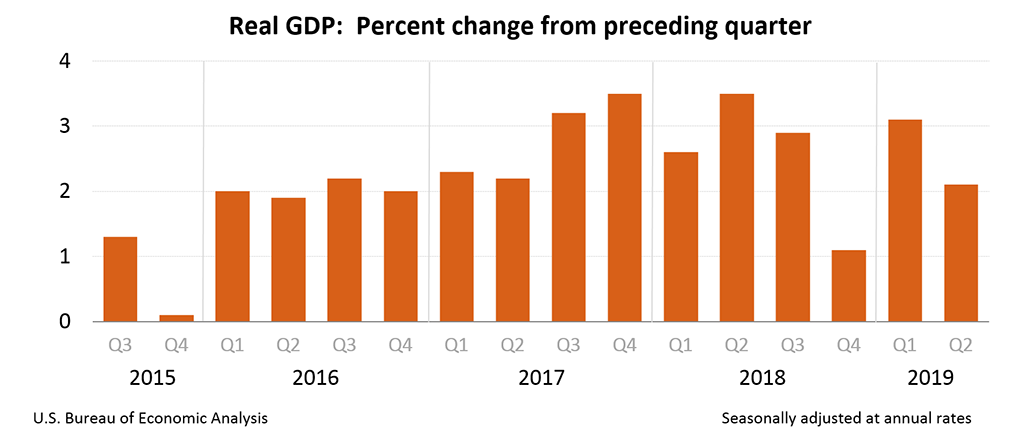
The increase in real GDP in the second quarter reflected positive contributions from personal consumption expenditures (PCE), federal government spending, and state and local government spending that were partly offset by negative contributions from private inventory investment, exports, nonresidential fixed investment and residential fixed investment. Imports, which are a subtraction in the calculation of GDP, increased (table 2).
The deceleration in real GDP in the second quarter reflected downturns in inventory investment, exports, and nonresidential fixed investment. These downturns were partly offset by accelerations in PCE and federal government spending.
Current-dollar GDP increased 4.6 percent, or $239.1 billion, in the second quarter to a level of $21.34 trillion. In the first quarter, current-dollar GDP increased 3.9 percent, or $201.0 billion (table 1 and table 3).
The price index for gross domestic purchases increased 2.2 percent in the second quarter, compared with an increase of 0.8 percent in the first quarter (table 4). The PCE price index increased 2.3 percent, compared with an increase of 0.4 percent. Excluding food and energy prices, the PCE price index increased 1.8 percent, compared with an increase of 1.1 percent.
Personal Income (table 8)
Current-dollar personal income increased $244.2 billion in the second quarter, compared with an increase of $269.8 billion in the first quarter. Decelerations in compensation and in personal current transfer receipts were partly offset by an upturn in personal income receipts on assets and a deceleration in contributions for government social insurance (a subtraction in the calculation of personal income).
Disposable personal income increased $193.4 billion, or 4.9 percent, in the second quarter, compared with an increase of $190.6 billion, or 4.8 percent, in the first quarter. Real disposable personal income increased 2.5 percent, compared with an increase of 4.4 percent.
Personal saving was $1.32 trillion in the second quarter, compared with $1.37 trillion in the first quarter. The personal saving rate -- personal saving as a percentage of disposable personal income -- was 8.1 percent in the second quarter, compared with 8.5 percent in the first quarter.
Source Data for the Advance Estimate
Information on the source data and key assumptions used for unavailable source data in the advance estimate is provided in a Technical Note that is posted with the news release on BEA's Web site. A detailed "Key Source Data and Assumptions" file is also posted for each release. For information on updates to GDP, see the "Additional Information" section that follows.
Annual Update of the National Income and Product Accounts
The estimates released today also reflect the results of the Annual Update of the National Income and Product Accounts (NIPAs). The update covers the first quarter of 2014 through the first quarter of 2019.
With today's release, most NIPA tables are available through BEA's Interactive Data application on the BEA Web site (www.bea.gov). See "Information on Updates to the National Income and Product Accounts" for the complete table release schedule and a summary of results for 2014 through 2018, which includes a discussion of methodology changes. A table showing the major current‑dollar revisions and their sources for each component of GDP, national income, and personal income is also provided. The August 2019 Survey of Current Business will contain an article describing the update in more detail.
Previously published estimates, which are superseded by today's release, are found in BEA's archives.
Updates for the first quarter of 2019
For the first quarter of 2019, real GDP is estimated to have increased 3.1 percent (table 1), the same as previously published. Downward revisions to exports, state and local government spending, and private inventory investment were offset by upward revisions to PCE and federal government spending.
For the period of expansion from the second quarter of 2009 to the first quarter of 2019, real GDP increased at an annual rate of 2.3 percent, the same as previously published.
Real GDI is now estimated to have increased 3.2 percent in the first quarter (table 1); in the previously published estimates, first-quarter GDI was estimated to have increased 1.0 percent.
| First Quarter 2019 | |||||
|---|---|---|---|---|---|
| Previous Estimate | Revised | ||||
| Percent change from preceding quarter | |||||
| Real GDP | 3.1 | 3.1 | |||
| Current-dollar GDP | 3.8 | 3.9 | |||
| Real GDI | 1.0 | 3.2 | |||
| Average of Real GDP and GDI | 2.1 | 3.1 | |||
| Gross domestic purchases price index | 0.8 | 0.8 | |||
| PCE price index | 0.5 | 0.4 | |||
DoC. USITC. July 26, 2019. Statement from U.S. Secretary of Commerce Wilbur Ross on Q2 GDP: Economy Grows 2.1% in Q2
Today, the Department of Commerce’s Bureau of Economic Analysis (BEA) released the second quarter gross domestic product (GDP) numbers, finding that the real gross domestic product increased at an annual rate of 2.1% percent in the second quarter.
“The Trump economy is growing strong and, on the heels of 3.1 percent growth in the first quarter, is poised to continue expanding,” said Secretary of Commerce Wilbur Ross. “President Trump’s ambitious agenda of deregulation, tax reform, and job creation is making the U.S. the premier place for business, and is restoring our position as an economic leader on the world stage.”
The Trump Administration’s policies have delivered repeated wins for American workers. In July, the current economic expansion became the largest in U.S. history – a testament to the strength of President Trump’s business-friendly policies.
In the second quarter, consumer spending, the engine of the U.S. economy, surged at a 4.3% annual rate, as spending on goods rose at the fastest rate since the first quarter of 2006.
The economy beat expectations again in June by adding 224,000 jobs, the last month of the second quarter, and averaging 129,000 jobs added per month over the past year. Since the President’s election, the country has added nearly 5 million jobs, while the manufacturing industry alone has added more than 500,000. The tight labor market benefitted American workers in another way in June as nominal average hourly earnings rose by 3.1 percent over the previous 12 months, meeting or surpassing 3.0 percent growth for the 11th month in a row. Before 2018, nominal average hourly wage gains had not reached 3.0 percent since 2009.
DoC. BEA. July 25, 2019. Gross Domestic Product by State, First Quarter 2019. West Virginia Had the Fastest Growth in the First Quarter
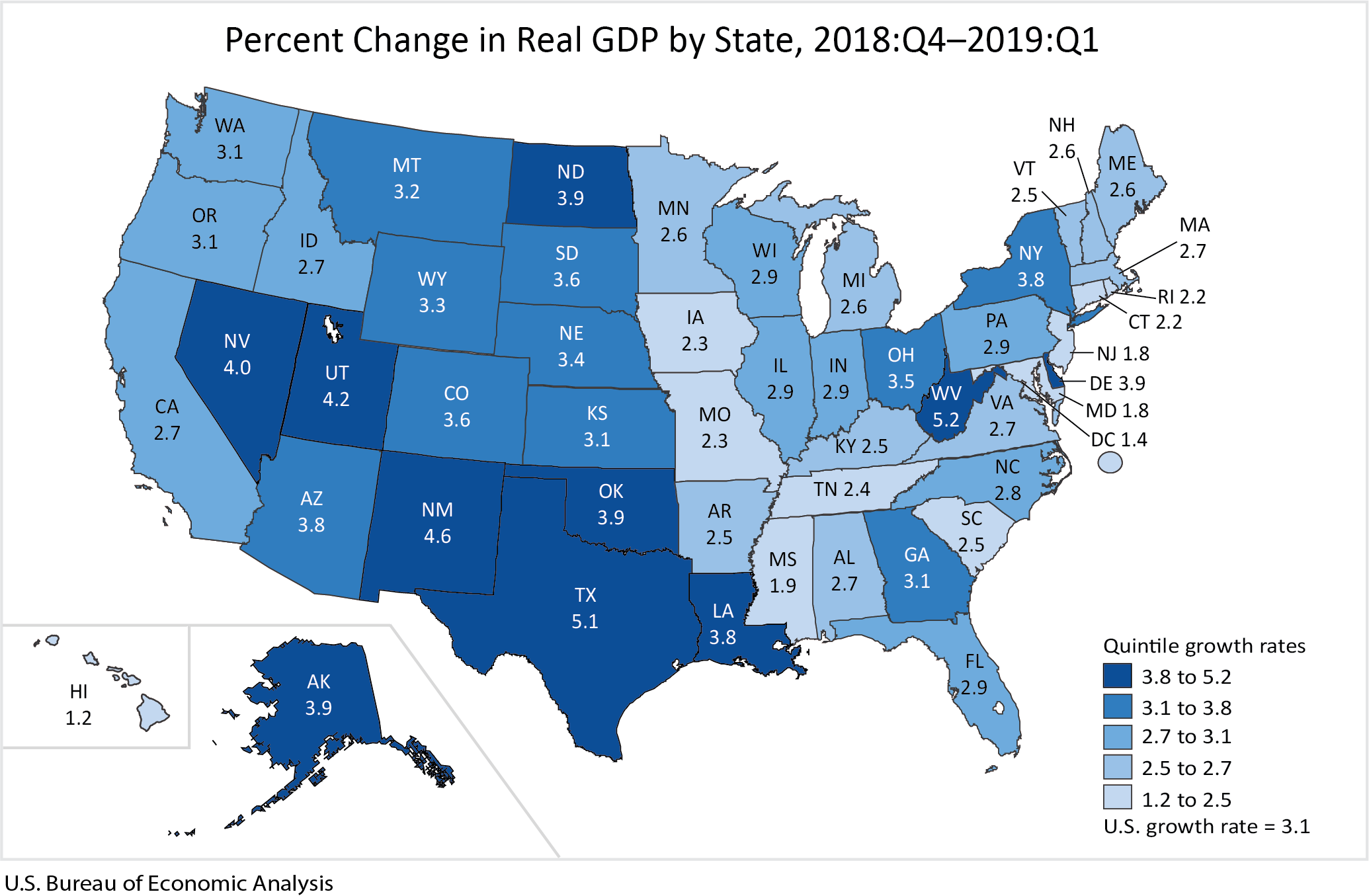
Real gross domestic product (GDP) increased in all 50 states and the District of Columbia in the first quarter of 2019, according to statistics released today by the U.S. Bureau of Economic Analysis. The percent change in real GDP in the first quarter ranged from 5.2 percent in West Virginia to 1.2 percent in Hawaii (table 1).
Highlights
- Finance and insurance, retail trade, and health care and social assistance were the leading contributors to the increase in real GDP nationally (table 2). These industries increased 9.5 percent, 11.9 percent, and 6.2 percent, respectively (GDP by Industry table 1), and contributed to growth in all 50 states and the District of Columbia.
- Mining for the nation increased 26.5 percent, after increasing 38.0 percent in the fourth quarter. This industry was the leading contributor to growth in several states, including the three fastest growing states of West Virginia, Texas, and New Mexico.
- The government sector decreased 1.1 percent nationally and slowed growth in most states, especially in the District of Columbia. The decrease was partly due to the partial federal government shutdown in January 2019.
FULL DOCUMENT: https://www.bea.gov/system/files/2019-07/qgdpstate0719.pdf
INTERNATIONAL TRADE
DoC. USITC. July 25, 2019. U.S. Department of Commerce Issues Preliminary Determination in the Antidumping and Countervailing Duty Investigations of Imports of Vertical Metal File Cabinets from China
WASHINGTON – The U.S. Department of Commerce announced the affirmative preliminary determinations in the antidumping (AD) countervailing duty (CVD) investigations of imports of vertical metal file cabinets from China, finding that exporters received antidumping duty rates of 198.50 percent and countervailable subsidies of 227.10 percent.
Based on these preliminary determinations, the Department of Commerce will instruct U.S. Customs and Border Protection to collect cash deposits from importers of vertical metal file cabinets from China based on these preliminary rates.
In 2018, imports of vertical metal file cabinets from China were valued at an estimated $45.2 million.
The petitioner is Hirsh Industries LLC (West Des Moines, IA).
The strict enforcement of U.S. trade law is a primary focus of the Trump Administration. Since the beginning of the current Administration, Commerce has initiated 172 new antidumping and countervailing duty investigations – this is a 219 percent increase from the comparable period in the previous administration.
Antidumping and countervailing duty laws provide American businesses and workers with an internationally accepted mechanism to seek relief from the harmful effects of the unfair pricing of imports into the United States. Commerce currently maintains 492 antidumping and countervailing duty orders which provide relief to American companies and industries impacted by unfair trade.
Commerce is currently scheduled to announce its final AD and CVD determinations on or about October 8, 2019.
If Commerce makes affirmative final determinations, the U.S. International Trade Commission (ITC) will be scheduled to make its final injury determinations on or about November 21, 2019. If Commerce makes affirmative final determinations in these investigations, and the ITC makes affirmative final injury determinations, Commerce will issue AD and CVD orders. If Commerce makes negative final determinations, or the ITC makes negative final determinations of injury, the investigations will be terminated and no orders will be issued.
The U.S. Department of Commerce’s Enforcement and Compliance unit within the International Trade Administration is responsible for vigorously enforcing U.S. trade law and does so through an impartial, transparent process that abides by international law and is based on factual evidence provided on the record.
Foreign companies that price their products in the U.S. market below the cost of production or below prices in their home markets are subject to antidumping duties. Companies that receive unfair subsidies from their governments, such as grants, loans, equity infusions, tax breaks, or production inputs, are subject to countervailing duties aimed at directly countering those subsidies.
Fact sheet: https://enforcement.trade.gov/download/factsheets/factsheet-prc-vertical-metal-file-cabinets-ad-cvd-prelim-072519.pdf
U.S. Census Bureau. 07/25/2019. Advance U.S. International Trade in Goods
The advance international trade deficit in goods decreased to $74.2 billion in June from $75.0 billion in May as imports decreased more than exports.
- June 2019: 74.2° $ billion
- May 2019: 75.0° $ billion
(*) The 90% confidence interval includes zero. The Census Bureau does not have sufficient statistical evidence to conclude that the actual change is different from zero.
(°) Statistical significance is not applicable or not measurable for these surveys. The Manufacturers’ Shipments, Inventories and Orders estimates are not based on a probability sample, so we can neither measure the sampling error of these estimates nor compute confidence intervals.
(r) Revised.
All estimates are seasonally adjusted except for the Rental Vacancy Rate, Home Ownership Rate, Quarterly Financial Report for Retail Trade, and Quarterly Services Survey. None of the estimates are adjusted for price changes.
IADB
U.S. Department of State. 07/25/2019. Secretary Pompeo’s Meeting with Inter-American Development Bank President Luis Alberto Moreno
The below is attributable to Spokesperson Morgan Ortagus:
Secretary Michael R. Pompeo met yesterday in Washington, DC with Inter-American Development Bank (IDB) President Luis Alberto Moreno. They discussed IDB programs in the region and ways to support development, economic growth, and prosperity in Latin America and the Caribbean.
________________
ORGANISMS
CURRENCY
IMF. 07/25/2019. US$100 Bill on the Rise
A curious thing has happened in US currency: the $100 bill recently overtook the ubiquitous $1 bill in circulation volume, for the first time in history. In other words, the most valuable banknote in the United States became the most widely circulated.
As we show in our chart of the week, based on an article in the IMF’s Finance & Development magazine, there are more $100 bills circulating now than ever before, roughly doubling in volume since the global financial crisis.

So what explains this boom in Benjamins, as the bills are known, especially when cashless options are increasing by the day? In this age of digital everything, are Americans suddenly growing nostalgic for greenbacks in high denominations?
Not exactly. While overall demand for US currency is indeed on the rise, most $100 bills are held abroad. According to the Federal Reserve Bank of Chicago, nearly 80 percent of $100 bills—and more than 60 percent of all US bills—are overseas, up from roughly 30 percent in 1980.
The most valuable banknote in the United States became the most widely circulated.
Geopolitical instability could be one reason behind the surge in $100 bills, according to Fed economist Ruth Judson. “Overseas demand for US dollars is likely driven by its status as a safe asset,” Judson told the Richmond Fed’s Econ Focus in 2018.
According to a 2017 paper by Judson, international demand for US dollars increased over the 1990s and into the early 2000s, and then stabilized or declined after the 2002 debut of the cash euro. This decline in demand continued until late 2008, when the global financial crisis triggered renewed demand for US banknotes.
Harvard University’s Kenneth Rogoff says big banknotes and illicit activity are closely linked. “Worldwide, high-value currency notes are mainly used to avoid taxes and regulation, and for illegal activity,” he observes. “Apartments and houses in major cities all over the world are paid for with suitcases of cash every day, and it is not because the buyers are afraid of bank failures.”
Another factor may be at play, Rogoff says. “Underground demand for paper currency has been surely rising in part because interest rates and inflation are exceptionally low.”
But why the dollar? Its role as the dominant international reserve currency may be the key, according to Rogoff.
FULL DOCUMENT: https://blogs.imf.org/2019/07/25/us100-bill-on-the-rise/?utm_medium=email&utm_source=govdelivery
________________
ECONOMIA BRASILEIRA / BRAZIL ECONOMICS
COMÉRCIO
FGV. IBRE. 25/07/19. Sondagens e Índices de Confiança. Sondagem do Comércio. Confiança do Comércio avança mas patamar se mantém baixo
O Índice de Confiança do Comércio (ICOM) da Fundação Getulio Vargas subiu 2,3 pontos em julho, ao passar de 93,2 para 95,5 pontos. Esse foi a segunda alta consecutiva, mas ainda insuficiente para mudar a tendência do índice em médias móveis trimestrais, que recuou pelo quinto mês seguido (-0,4 ponto).
“O segundo semestre começa com resultados positivos na confiança do comércio. A melhora dos indicadores de situação atual mostra que os empresários percebem alguma evolução no ritmo de vendas do setor no mês, mas vale ressaltar que o patamar se mantém baixo. Além dos bons resultados no presente, as expectativas com os próximos meses voltaram a subir sugerindo que o cenário de recuperação do setor deve se manter, mas ainda em ritmo gradual dado a persistência dos níveis altos de desemprego e da dificuldade de recuperação da confiança dos consumidores. ”, avalia Rodolpho Tobler, Coordenador da Sondagem do Comércio da FGV IBRE.
Em julho, a confiança subiu em 9 dos 13 segmentos. A melhora do índice ocorreu devido a um avanço tanto do Índice de Expectativas (IE-COM) quanto do Índice de Situação Atual (ISA-COM). O IE-COM avançou 2,7 pontos, voltando a ficar acima de 100 pontos depois de 2 meses (102,6 pontos) ao mesmo tempo que o ISA-COM subiu 1,8 ponto, registrando 88,6 pontos.
Resultado trimestral
Apesar do segundo resultado positivo, o ICOM em médias móveis trimestrais ainda apresentou queda em julho e não é homogêneo. Depois de quatro quedas consecutivas, o ICOM dos revendedores de duráveis parou de cair (com alta de 0,1 ponto), enquanto o de ICOM de não duráveis voltou a cair pela quinta vez seguida (-1,1 ponto). O resultado mostra que apesar da alta pontual em julho, a recuperação do setor continua em ritmo lento até o momento.
DOCUMENTO: https://portalibre.fgv.br/navegacao-superior/noticias/confianca-do-comercio-avanca-mas-patamar-se-mantem-baixo.htm
CONSTRUÇÃO CIVIL
FGV. IBRE. 26/07/19. Índices Gerais de Preços. INCC-M. INCC-M avança para 0,91% em julho
O Índice Nacional de Custo da Construção -M (INCC-M) subiu 0,91% em julho, percentual superior ao apurado no mês anterior, quando a taxa foi de 0,44%. A taxa do índice relativo a Materiais, Equipamentos e Serviços variou 0,07% em julho, ante 0,11% em junho. O índice referente à Mão de Obra subiu 1,63% em julho, após registrar alta de 0,72% no mês anterior.
Materiais, Equipamentos e Serviços
No grupo Materiais, Equipamentos e Serviços, a variação correspondente a Materiais e Equipamentos foi 0,04%, contra 0,09% no mês anterior. Dois dos quatro subgrupos componentes apresentaram decréscimo em suas taxas de variação, destacando-se materiais para estrutura cuja taxa passou de 0,07% para 0,01%.
A variação relativa a Serviços repetiu a taxa apurada em junho, que foi de 0,20%. Neste grupo, vale destacar, no sentido descendente, o item projetos (0,47% para 0,00%) e, em sentido ascendente, aluguel de máquinas e equipamentos (0,14% para 0,59%).
Mão de Obra
O índice referente à Mão de Obra subiu 1,63% em julho. No mês anterior, este grupo apresentou variação de 0,72%.
Capitais
Cinco capitais apresentaram aceleração em suas taxas de variação: Belo Horizonte, Recife, Rio de Janeiro, Porto Alegre e São Paulo.
DOCUMENTO: https://portalibre.fgv.br/navegacao-superior/noticias/incc-m-avanca-para-0-91-em-julho.htm
FGV. IBRE. 26/07/19. Sondagens e Índices de Confiança. Sondagem da Construção. Confiança da Construção inicia segundo semestre em alta
O Índice de Confiança da Construção (ICST), da Fundação Getulio Vargas, subiu 2,6 pontos em julho, para 85,4 pontos, voltando ao nível observado em dezembro de 2018 (85,4 pontos). Em médias móveis trimestrais, o ICST avançou 1,0 ponto.
“O segundo semestre inicia com alta da confiança, a segunda consecutiva, refletindo uma melhora no ambiente de negócios corrente e expectativas de curto prazo mais favoráveis. A iminência de aprovação da reforma da Previdência e a retomada das obras do Programa Minha Casa Minha Vida certamente contribuíram para a melhora do cenário nesses dois últimos meses. No entanto, se a adoção de uma política para incentivar o consumo comprometer a fonte de financiamento do programa habitacional, não haverá sustentação nessa melhora a médio e longo prazo”, observou Ana Maria Castelo, Coordenadora de Projetos da Construção da FGV IBRE.
Em julho, o ICST subiu pelo segundo mês consecutivo, influenciado tanto pela melhora da situação corrente quanto pelas expectativas do curto prazo. O Índice da Situação Atual (ISA-CST) avançou 1,5 ponto, para 75,1 pontos, retornando ao mesmo nível de janeiro de 2019 (75,1 pontos).
A contribuição do resultado positivo ISA-CST veio do indicador que mede a percepção sobre a situação atual da carteira de contratos, que avançou 1,4 ponto, para 73,5 pontos, e do indicador da situação atual dos negócios, que subiu 1,6 ponto, para 76,9 pontos.
O Índice de Expectativas (IE-CST) subiu 3,5 pontos, passando para 96,0 pontos, nível abaixo do observado em dezembro de 2018 (96,5 pontos). Os dois quesitos deste índice contribuíram positivamente para o resultado. O indicador de demanda prevista nos próximos três meses avançou 2,3 pontos, para 95,5 pontos, maior nível desde dezembro de 2018 (97,2 pontos), e o indicador de tendência dos negócios nos próximos seis meses aumentou 4,7 pontos, para 96,6 pontos.
O Nível de Utilização da Capacidade (NUCI) do setor registrou a quarta alta seguida ao variar 0,6 ponto percentual em julho, para 68,9%, maior patamar desde julho de 2015 (69,4%). Tanto o NUCI para Máquinas e Equipamentos quanto o NUCI para Mão de Obra variaram 0,4 e 0,7 pontos percentuais respectivamente.
Expectativas setoriais
Na comparação interanual, o ICST aumentou 4,4 pontos. A abertura por segmentos aponta que foi o segmento de Obras de Infraestruturas que registrou a maior elevação do índice. Especialmente o Índice de Expectativas registra forte alta nessa comparação, impulsionado pelo quesito demanda prevista do segmento de Obras de Infraestrutura. “Possivelmente as incertezas sobre a continuidade do Programa Minha Casa Minha Vida tenham arrefecido as expectativas dos empresários do segmento de Edificações. Por outro lado, a perspectiva de melhora no ambiente de negócios trouxe maior ânimo aos empresários do segmento de Obras de Infraestrutura. No entanto, ainda não se tem elementos que permitam vislumbrar uma melhora robusta na atividade no curto prazo”, observou Ana Maria Castelo.
DOCUMENTO: https://portalibre.fgv.br/navegacao-superior/noticias/confianca-da-construcao-inicia-segundo-semestre-em-alta.htm
________________
LGCJ.:

