US ECONOMICS
ARGENTINA
U.S. Department of State. 07/19/2019. Secretary of State Michael R. Pompeo With Laureano Perez Izquierdo of Infobae
QUESTION: Mr. Secretary, thank you for receiving us.
SECRETARY POMPEO: It’s great to be with you. Thank you.
QUESTION: You have just concluded your meeting with President Macri. What are the differences between the U.S.-Argentina relations now as compared with the Kirchnerist years?
SECRETARY POMPEO: Yeah, it’s night and day. It’s truly a new era of relationship between our two countries. We work cooperatively together economically, we work on security issues together, we work on a whole range of issues to make life better for the people here in Argentina and the people in the United States. It’s a great level of cooperation, one that will benefit our two countries for years and years to come.
QUESTION: What are your views on today’s polarized political landscape toward the October election here in Argentina?
SECRETARY POMPEO: Well, I mean, I’ll leave it to the Argentinian people, but I’ve watched up close President Macri make great decisions about the economy. They’re tough sometimes, but he’s made the right decision, which will spur growth, create opportunity, take down risk to the Argentinian economy. That’s great for the Argentinian people; it’s great for the relationship between our two countries as well. The opportunities for increased trade and for people-to-people exchanges, all the things that our two countries can do together, are definitely increased because of the relationship and the tough, hard, smart work that the president has done.
QUESTION: I move you to Venezuela. What is your opinion about the talks currently developing in Barbados between the representatives of the Maduro regime and the Venezuelan opposition?
SECRETARY POMPEO: So I always live in hope, but in the end, the conversation can only be about one thing, that Maduro must leave. He’s wreaked devastation on the Venezuelan people, now impacting people all over South America. There’s tens of thousands of refugees here in Argentina, Colombia, Peru, Chile – all are experiencing challenges. From people who have had to flee their homes, people who wanted to live in Venezuela who couldn’t find or make a living for themselves and for their children. That’s unacceptable, and the cause of that is Maduro and his cronies. They need to leave Venezuela, and then we can begin to do the work to rebuild that country democratically, with free and fair elections, in a way that will truly restore the greatness that Venezuela once had.
QUESTION: The United Nations Human Rights Council report was accurate and tough.
SECRETARY POMPEO: Yeah, it was devastating.
QUESTION: Yes.
SECRETARY POMPEO: The description of what’s taken place there is truly devastating.
QUESTION: The atrocities of the regime is terrible. So how much longer can this dictatorship survive, remain in power?
SECRETARY POMPEO: That’s the question everybody wants to know the answer to. I can’t do timeline. I can say this: Maduro can’t govern that country again, and I believe he knows that, and I think all the Venezuelan people know that and all those around him know it. In the end, I think the Cubans are going to have a very difficult decision to make. They have propped up this regime for an awfully long time. They need to leave. They need to go back. When they do that, the Venezuelan people will rise, they’ll vote, they’ll pick – they’ll elect someone. I don’t know who they’ll elect, but they’ll have had the opportunity to have a free and fair election and they can start the rebuilding that needs to take place. It will take months and months and months to begin to rebuild the Venezuelan economy, and we need to start that. It can’t be started with the Cubans still controlling the security services and running the intelligence operations inside of Venezuela.
QUESTION: Cuba is key, but Russia, China, and Iran are also in Venezuela and Latin America. What is your message for them?
SECRETARY POMPEO: Well, we hope every foreign power will leave. We want the Venezuelan people to control their own destiny. We think that would be best. In the end, I’m confident that the Venezuelan people will take back their country.
QUESTION: About one of them, Iran, to what extent can the political tension escalate, and is there a red line that Tehran must not cross?
SECRETARY POMPEO: Here today, sitting in Argentina, we had an enormous moment where we reflected 25 years after Iran had conducted a terrorist campaign right here at the AMIA facility, killing 85 people, people from – not just from Argentina but citizens of other countries as well. I think this is an indicator. It’s why we came here to work on counterterrorism today, was the purpose of my visit to Argentina: to help the whole region take down the threat of terror from a number of sources, but certainly from Iran. I was very happy to see the country’s decision, President Macri’s decision to designate Hizballah a terrorist organization.
We’re doing everything we can in the United States to de-escalate with Iran. We want them simply to cease being the world’s largest state sponsor of terror.
QUESTION: China is other of the regimes with presence in the region, and now the Chinese company Huawei wants to deploy its own 5G network in Latin America. What is your opinion about that?
SECRETARY POMPEO: America’s view is very clear: We don’t want American citizens to have their information stolen by the Chinese Government, the Chinese Communist Party. We feel the same way about citizens in Argentina and all throughout South America. These systems are controlled by the state in China and we think it would be a poor decision for the citizens of Argentina to be exposed to having their information, their data stored on Chinese technology which, by the Chinese own constitution, if they ask for it has to be turned over to the government. So we’re urging every country to think carefully about that and make good decisions so that their people can have confidence that their networks aren’t controlled by China and the Chinese Communist Party.
QUESTION: Russia today said that it will support Ortega regime in Nicaragua.
SECRETARY POMPEO: Yeah, they’ve got the wrong end of the stick. The Nicaraguan people know better, that the Ortega regime is also headed in a bad direction, and we hope that he and his wife will both make a decision to leave Nicaragua and allow the Nicaraguan people to have the opportunity that they so richly deserve.
QUESTION: And lastly, what country in Latin America besides Venezuela concerns you the most?
SECRETARY POMPEO: Oh, goodness, there’s challenges everywhere. But frankly, when I look at South America today, I don’t see challenges, I see enormous opportunity. I see this new era where countries like Argentina with President Macri and Brazil with President Bolsonaro and Chile, Peru, all moving in the right direction towards growing economies, less government influence driving the economy, real opportunity for their citizens in ways that South America hasn’t had for an awfully long time. So as I stare at the opportunities here in South America, they far outweigh all of those very challenges.
QUESTION: Mr. Secretary, thank you very much.
SECRETARY POMPEO: Thank you very much, sir.
U.S. Department of State. 07/19/2019. Secretary Pompeo’s Meeting with Argentine President Macri
The below is attributable to Spokesperson Morgan Ortagus:
Secretary Michael R. Pompeo met today with Argentine President Mauricio Macri in Buenos Aires. The two leaders committed to further expanding cooperation on a range of bilateral and global issues, including security, democracy, and trade and investment. Secretary Pompeo commended Argentina for its regional leadership in hosting the Western Hemisphere Counterterrorism Ministerial, and the two leaders pledged to continue cooperation to combat transnational crime and terrorism. The Secretary praised Argentina for designating Hizballah as a terrorist organization in its entirety, emphasizing its military and financial wings. Secretary Pompeo reaffirmed U.S. support for Argentina’s economic reform agenda. They also discussed cooperation on promoting human rights and democracy in the region, including in Venezuela, Cuba, and Nicaragua.
U.S. Department of State. 07/19/2019. Secretary of State Michael R. Pompeo and Argentine Foreign Minister Jorge Faurie at a Press Availability at the Western Hemisphere Counterterrorism Ministerial Plenary
FOREIGN MINISTER FAURIE: (Via Interpreter) So first of all, good afternoon to all of you. Basically, we will have a press statement with Secretary Pompeo. I would like to say that today, before coming to start the second conference of the fight against terrorism, we had all the secretary of state of different countries, Secretary Pompeo. So we had a ceremony with the AMIA, when we commemorated the 25th anniversary of something that the Argentines know very well, where 85 of our people died. It was a moment in which not only did we remember, and we try not to forget and have justice. 17 countries signed the honor book, so the commitment is clearly stated.
So during the morning, we had a second session, something that was started in Washington last year. And right now we agreed that we would meet again in Colombia at the anniversary of the terrorist attack in Colombia at the beginning of this year. January 16 and 17 of next year, we will hold this meeting. And we agree that the fight against terrorism calls for coordination. The terrorist threat is something that affects all of us. It doesn’t make any differences what ideology you follow. And we have to work very hard in Latin America to fund the financing that these organizations receive, and we know that there are some terrorist organizations that help recruit people and they look for financing in our area.
The countries of the region agreed, most of us, on the danger of Hizballah to our hemisphere. Hizballah, because of the link which they have with other terrorist organizations, the concern that we share in South America and the ELN in Colombia, and right now within Venezuela. The concern that Peru has regarding the Shining Path resurgence, but the linkage of these groups to Hizballah make this relationship so much deeper because they look for funding and recruit people. That’s why, for President Macri, the fight against terrorism – our security is one of the main issues of his administration. And that’s why yesterday he issued the registry for people and organizations’ links to terrorism, and Hizballah is one of them. And we think that this is a very important step forward.
We all – some minutes ago we had a bilateral meeting, and not only did we thank the Secretary to come here and be with us during this conference and the ceremony at AMIA, we had – we talked about different issues regarding bilateral issues, policy, economic – the concern that we have of issues that we face in this region, and other issues at a global level, and everything that we face these days.
We agreed to renew and to keep a strategic dialogue at the highest level. Personally, I would like to thank you regarding a case that is of concern to Argentina, which is the Saldano case, but we addressed during our dialogue. We are true friends. And Argentina, we see the very, very good support from the U.S. Government and also from President Trump, especially right now that we are facing some financial difficulties.
SECRETARY POMPEO: Thank you, Foreign Minister Faurie. It is a pleasure to be back here in beautiful Argentina again. Thank you to my fellow foreign ministers who are joining us here today as will.
Under the leadership of President Trump, our administration has made a concerted effort to re-engage with our partners in the hemisphere. Indeed, we believe this is a new era in relationships between the United States and South America. As I said in Santiago in April, we have an enormous opportunity to help each other continue to have prosperity and security.
And the U.S. is backing up those statements with action. So I was excited again – I’m planning to come be part of the second Western Hemisphere Counterterrorism Ministerial. Thank you to my counterparts for hosing this important event. We won’t back down from the challenge of terrorism – not now, not ever.
I was especially moved this morning, the ceremony that we gathered at to remember the 85 victims of the AMIA bombing which occurred 25 years ago yesterday. The memorial was a powerful prologue to today’s ministerial, a reminder that the hemisphere is not immune from the sting of a foreign terror. The AMIA bombing was carried out by Hizballah with the full support of the regime in Tehran. As they announced at the ministerial, the United States Government is taking actions against Salman Raouf Salman, a top Hizballah operative, for his role as the on-the-ground coordinator for that attack. He continues today to conduct terrorism on behalf of Hizballah.
The United States Department of Treasury has designated Salman as a specially designated global terrorist, and we believe this action will deny him all access to the U.S. financial system. We also announced today up to $7 million as a reward for information leading to his identification or location. We want this killer brought to justice.
Of course, the primary focus of our ministerial was on thwarting future attacks. Hizballah maintains a strong presence in South America and in this region. It is determined to retain the ability to attack anyone anywhere, just like it did 25 years ago. It also continued to exploit the hemisphere for fundraising. That’s why I want to commend Argentina for designating Hizballah as a terrorist organization yesterday. We call on countries throughout the world and throughout this hemisphere to follow Argentina’s example.
We also know that Hizballah is not the only foreign-born terror group active in this region. Although we destroyed its physical caliphate, ISIS continues to plot and inspire attacks around the globe. At the same time, al-Qaida is seeking to re-establish itself as the vanguard of global jihadist movement.
To prevent terror attacks, every peace-loving nation in this hemisphere must defend its security interests and work with other nations to do the same. We made strides today towards that very cooperation. Foreign Minister Faurie will announce one new initiative here in just a moment.
Finally, the foreign minister and I also met today to discuss U.S. and Argentina’s great partnership. Even as it works to solve its economic challenges at home, Argentina has revitalized its role on the global stage, impressing the world with its presidency at the G20, its energy vision, and its leadership in the Lima Group, and many, many more ways.
The U.S. wants to be a resource and a friend for this revitalization. That’s why I’m pleased to announce a U.S.-Argentina strategic partnership dialogue, which will allow our two countries to expand our cooperation in areas of security, human rights, democracy, and economic development. Argentina’s commitment to democratic process is also evident in its support for President Juan Guaido and for the people of Venezuela. Argentina and its people have shown great generosity to the more than 150,000 Venezuelan refugees who have fled here. The world admires you for that generosity and so do I.
Venezuela also serves as another reminder of Iran’s willingness to sow destruction and death in our hemisphere. The foreign minister – excuse me, Foreign Minister Zarif recently traveled to Venezuela in support of the Maduro regime.
Beyond Venezuela, the U.S. will continue to work with Argentina to condemn the Ortega regime for its campaign of violence and repression, and to continue the long struggle to promote democracy in Cuba.
In closing, the United States is back, and our partnership is here to stay. We look forward to continuing our work with Argentina to advance regional security, expand our economic ties, and address the many challenges that we face in our region. We’ll do so together. Thank you.
(Applause.)
FOREIGN MINISTER FAURIE: (Via interpreter) As the Secretary noted, we have a little announcement before our questions. I will invite my colleague from Paraguay and the deputy foreign minister of Brazil to join us here for the announcement regarding the decision all four countries have made – Argentina, Brazil, the U.S., and Paraguay – to establish a regional security mechanism for political and diplomatic coordination of efforts in the fight against illicit activities in the region, as well as possible linkages to transnational crime and the financing of terrorism, in particular.
This mechanism will materialize through semiannual meetings coordinated by all four foreign ministries and with the support of all agencies which in each of our countries are responsible in this field, and the first meeting will be held before the end of this year in Asuncion, Paraguay.
Very good. And now we are willing to take two questions with Secretary Pompeo. These are called one and one.
MODERATOR: (Via interpreter) Natalio Cosoy, France 24 in Spanish, selected journalist on behalf of Argentines.
QUESTION: Secretary Pompeo, after the meeting (inaudible), Latin America have committed to fighting terrorism in the region and have decided to declare Hizballah a terrorist organization following Argentina. Which countries do you feel are not doing enough in the region?
And as you mentioned Venezuela, I want to know, has the situation in Venezuela stalled? What can the U.S. do now after sanctions to seek change in that country?
SECRETARY POMPEO: Thank you, and thank you for your questions. Your second question is the easiest. Which countries aren’t doing enough? None of us. We all can do more. We can do more individually. There are still many activities, places we can improve our justice systems, places we can improve information sharing and collection. All of the elements that deliver a counterterrorism campaign that truly takes down networks and increases risk for the people here in Argentina and all around the region – there’s just always so much more that every country can do.
No country has announced that they were going to follow Argentina today, but it’s my every expectation that many will do the same. They will review the risk, they will see the threat, and they will come to their own sovereign conclusion that that’s in their best interest.
And as for Venezuela, Maduro will never govern that country again. It will not happen. He may rule, he may for a moment control its military at some level, but he will never govern those people and he has destroyed their way of life. He has created a humanitarian crisis that is unequaled, and we collectively – the OAS, the Lima Group, our European partners, the United States – 54 countries now have made clear that the Maduro regime is finished. It is only a matter of time before we can all begin to help the Venezuelans restore their democracy and restore their economy.
MS ORTAGUS: Courtney McBride, Wall Street Journal.
QUESTION: Thank you. Good afternoon. I have a question for each gentleman. To the foreign minister, your country has listed Hizballah as a terrorist organization. Can you just give us a little bit more information on what that entails, perhaps beyond denying them access to the financial system, and what other future steps we might expect?
And to Mr. Secretary, turning to Iran, Iran continues to deny that the U.S. downed its unmanned aerial system over the Strait of Hormuz, and Foreign Minister Zarif has reportedly said he would meet with U.S. lawmakers and is promising to exchange perhaps inspections for sanctions relief. Are these positive steps? Are they plausible?
FOREIGN MINISTER FAURIE: Okay, to the first question --
(Via interpreter) Regarding your first question, our listing will not only allow the freezing of assets or anything linked to the economic and financial activity of the organization or individual included in the list, but we will also be able to order their expulsion, ban their entry depending on the organization or individual involved. This is a comprehensive view of the situation of all persons linked to terrorism, and this information is shared internationally, so it reduces very significantly the ability to act of those included in the list.
SECRETARY POMPEO: So your first question was about the Iranian response to the announcement yesterday that the USS Boxer shot down or took down a UAV in the Strait of Hormuz. It went down, and the fact that Foreign Minister Zarif either didn’t know or lied about it I can’t account for. It happened.
Second, it’s interesting that you focused on Iran as we sit here in Argentina. Today what you saw – the announcement from Argentina, the work that we did – is that we have many nations around the world now speaking the truth about the Islamic Republic of Iran, about its global campaign of terror and the malign activity that it has taken around the world.
So I saw Foreign Minister Zarif’s comments in New York yesterday. I would welcome the chance to get access to the Iranian media in the same way he gets access to the American media. I think that’d be fantastic. I’m looking forward to it, indeed. Zarif – Foreign Minister Zarif has met with American members of Congress for many years, and during those many years, they’ve continued to build out their missile program, conduct terror around the world, and continued to advance their capacity to build out a nuclear weapons program that threatens the world.
So Foreign Minister Zarif can talk to members of Congress. That’s fantastic. In the end, President Trump will make the decision about how to proceed. He’s made clear we’re prepared to conduct negotiations with no preconditions. The Iranians continue to say, well, they’ll talk, but only – if and only if the United States does something. We need them to come to the table. It’s the right way to resolve these challenges.
MODERATOR: Thank you very much.
U.S. Department of State. 07/19/2019. Secretary of State Michael R. Pompeo at the Counterterrorism Ministerial Plenary
MODERATOR: (Via interpreter) We shall hear an address by the Secretary of State of the United States of America, Michael Pompeo.
SECRETARY POMPEO: Thank you, Foreign Minister Faurie, for those remarks and for welcoming us to your country to discuss terrorism, a true threat to the Western Hemisphere. As many of you know, my previous job was as the director of the Central Intelligence Agency. I learned in that job the importance of working together, never underestimating the threats around you, and making sure that all of the world’s partners fighting against terrorism are working together.
We were proud to have the opportunity to host, in the United States, the first meeting of the ministerial, and we appreciate Argentina’s leadership here today, demonstrated in building on the progress we have made together. It was truly an honor for me to be with you all in remembering the victims of the AMIA bombing of 25 years ago yesterday. It was a moving reminder that our discussion today isn’t abstract. It’s not theoretical. The risk from terrorism is real for each and every one of us and each and every one of our citizens.
Many countries represented here have suffered devastating attacks from local nationalist terrorist groups such as ELN, the Shining Path, and the FARC. But international terrorism, rooted in extremist Islamic ideologies, is also a persistent threat.
The roots of these terror groups may be many miles away, but their branches twist around the globe – raising funds, seeking recruits, probing for our weaknesses, challenging our defenses. Today al-Qaida and ISIS continue to seek a lasting presence in our hemisphere. A cell inspired by ISIS was arrested in Trinidad and Tobago in early 2018 as they plotted an attack on the Carnival. Additionally, homegrown terrorists, radicalized by their online propaganda, have cropped up in several of our countries.
But I want to pay special attention today to another terrorist organization, the Iran-backed Hizballah, the perpetrator of the AMIA attack. In the quarter century since that horrible day, Hizballah has been active throughout the Western Hemisphere in terrorism, drug trafficking, and money laundering. That is why I would like to commend Argentina for designating Hizballah as a terrorist organization yesterday. This action will block its access to your country’s financial system and greatly diminish its capacity to fundraise throughout the region. We hope others here today will follow Argentina’s lead and its example, for I think everyone in this room know that Hizballah continues to remain a threat.
In May of this year, a Hizballah member was convicted in United States court of surveilling United States targets. Another remains in custody for gathering intelligence inside of the United States and in Panama. Last year Argentina froze the assets of 14 people suspected of financing Hizballah. They operated in the tri-border area shared between Argentina, Brazil, and Paraguay, an area where Hizballah and other illicit actors have long been active. Today Peru is currently prosecuting an alleged Hizballah member on terrorism charges, and a key Hizballah financier is currently sitting in jail in Brazil awaiting extradition to Paraguay.
We must not shrink in the face of these challenges and of these threats. We can never become complacent. I said at this morning’s memorial that the U.S. was recommitting to the cause of justice for those killed in the AMIA bombing, and I mean it. Today I’m announcing two actions against a top Hizballah operative for his role in the attack. Salman Rauf Salman served as the on-the-ground coordinator for the AMIA bombing and remains a wanted man who continues plotting terrorism on behalf of Hizballah. The State Department’s Rewards for Justice program is offering up to $7 million for information leading to his identification or his arrest. And the United States Department of Treasury is also designating Salman as a specially designated global terrorist, which denies him access to the United States financial system.
More broadly, the Trump administration has intensified U.S. actions against Iran and its terrorism proxies worldwide. In April, I designated the Islamic Revolutionary Guard Corps, including its Qods Force, as a foreign terrorist organization. This was the first time we’ve ever designated part of a foreign government as an FTO. And also in April, the State Department offered up to $10 million for information leading to the disruption of Hizballah financing.
This is all part of our broader effort to hit Hizballah in the wallet. The U.S. government has designated more than 150 entities and individuals tied to that terrorist group, including more than 50 just since 2018. We’ve imposed historic sanctions aimed at squeezing it out of the international financial system. We call on all nations to take similar actions. In the face of a global threat like Hizballah, it is every sovereign nation’s obligation and responsibility to comply with sanctions designed to keep all of us safe.
Further, we also want to see more countries put in place the necessary tools to cut off the flow of money to terrorist groups, including through their own designations and targeted sanctions. We commend Argentina for adopting such a regime this week, and we are dedicating additional resources to assisting our partners in developing and implementing these programs. Solidarity is the antidote to the terror threat. That’s why being here today, part of this ministerial, is so important. Our shared safety depends on it, and our security measures come from strength of us working together. I’m very encouraged that we’ve already found opportunities to cooperate in a variety of fora, including the Global Coalition to Defeat ISIS, the Caribbean and Latin American Financial Action Task Forces, and the OAS Inter-American Committee Against Terrorism.
In a very recent example of hemispheric cooperation, just last month, Paraguay extradited Nader Farhat, another Hizballah supporter, to the United States to face federal money laundering charges in Florida. Let’s keep that cooperation going. Each of your delegations has traveled here because you recognize, as America does, that global terrorist threats are evolving every day. Our governments have vital experiences and information to share with one another, and the only way to counter the serious threat that remains is in fact by working together.
The United States is prepared to lead on this front, and part of that means continuing to learn from each of you. Terrorist groups and individuals they radicalize are constantly learning and adapting, seeking new ways to exploit our weaknesses. A single weak point can let the enemy inside of our gates. That’s why protecting our own individual countries requires protecting the entire region. It requires dedicated teamwork. The United States is proud to be with you all here today. We’re here to stay. We look forward to the progress that I know lies ahead. Thank you all very much. (Applause.)
FOREIGN MINISTER FAURIE: (Via interpreter) Once again, good morning to all of you. Before we start to say something in connection with the second Western Hemisphere Counterterrorism Ministerial conference, I would like to begin by thanking each of the foreign ministers and heads of delegation who have traveled to Buenos Aires for their kindness in joining us along with the officials of AMIA to mark the 25th anniversary of the tragedy that was the bombing of the AMIA Jewish community center. This is a very significant gesture that shows respect for memory and respect and recognition for all Argentines. I would like to thank you for having accepted our invitation after our first meeting in Washington.
The topic that we will be dealing with during the course of this morning will be how to coordinate efforts in the fight against terrorism. For many of our countries in the region, terrorism used to be something remote, something that we used to watch on television and which we regarded as a distant and abstract reality. Today terrorism is clearly a global threat, a constant threat that goes across all borders. The language of violence and hatred has a translation into all languages, and that translation is clearly suffering and pain.
Many of us at different times in our national histories have had to suffer terrorism. This has been a wakeup call that woke us up out of that false sense of security. We thought we were safe because we were not involved in geopolitical conflicts. The problem is that when the wakeup call goes off, terrorism has the sound of bombs and the roar shaking up entire cities, and its sound is the shouting and screaming of victims and the tears of many destroyed, shattered families.
This building is just 200 meters away from the place where the Israeli embassy used to stand, and the bombing of which even shook up the foundations of this building. And that day Argentina woke up to terrorism and to such a crude reality as AMIA in 1994 and 9/11 in New York in 2001. But if we look around this table, each one of our countries may probably point to an act of violence or terrorist attack that was obviously unfairly and unwarrantedly launched on their fellow citizens.
We Argentines have an expression. We say when we wake up that it’s like a bucket of cold water. Now, terrorism is a bucket of blood and the tears of the people who are left behind. And this transforms nations, transforms each of our fellow citizens. This reality which we suffered – again, in 1994 – was a turning point. We lost the lives of 85 fellow citizens in addition to over 300 people injured. Argentina will not cease in its struggle to ensure that the Iranian citizens charged with the commission of this crime are brought to justice in Argentina.
The Jewish community has many symbols, and one of them is the tree of life. The tree of life is the one we need to water and protect. We, those of us who are here to protect it, must cut down the tree of death which is terrorism. Its branches are violence and tragedy. Its fruits, suffering and pain. And terrorism leaves indelible marks on the collective consciousness of our societies. Our duty as states, as governments and political officials, is to cut down the tree of terrorism. We need to dry up its roots – financing. We need to dry up its land. We need to prevent the sheltering of terrorism. We need to prevent it from producing seeds infected by its hatred. We need to especially control the use of new technologies that help disseminate these ideas of hatred and poison.
I welcome this meeting because the fight against terrorism depends on multilateral cooperation and on us all being well informed and alert and on us exchanging and sharing solutions to eradicate this bloody development of terrorism. And we are honored to host the conference here.
This is why, at the OAS, we promoted the creation of the Inter-American Committee Against Terrorism, which Argentina will be chairing until May. We think that terrorism needs to be combated with tools within the rule of law, but with a lot of international cooperation and collaboration.
We are concerned in our region because we see individuals who are acting to keep links to terrorist organizations and other radicalized elements, and in our region they seek financing. Argentina and President Macri, interpreting the feelings of our population, of our people, made the fight against terrorism a pillar of our administration in the sphere of security, and we are seeking hemispheric and domestic cooperation.
I am joined by the highest officials of the country in these fields. We have the minister of security, representatives of the Federal Intelligence Agency, the head of the Financial Information Unit, and the attorney general as well, in addition to the deputy minister of justice and human rights. This is something that requires a joint effort by all of society to fight this scourge that hit us twice but is also spreading across the world and also wants to take root in our region.
You had meetings over the course of yesterday, and the conclusions of each of the groups we will hear about in a few moments, and we will share them with the plenary. I would especially like to thank the Secretary of State of the U.S., Mike Pompeo, for having traveled to the other end of the hemisphere to highlight the importance of this fight. And I would like to thank each of the foreign ministers of the Americas of our sister nations for the day-to-day efforts we share and for the efforts in coming here to showcase the importance of us all together fighting terrorism.
I think we all need to continue working to fight terrorism, and we need to do so for the sake of defending life, so that in doing so we show freedom, respect, and prosperity. We need to cooperate, all of us together, in order to achieve this, and in so doing, we will be able to vanquish terrorism. Thank you very much. (Applause.)
MODERATOR: (Via interpreter) Next we shall hear an address by the Minister of Security of Argentina, Patricia Bullrich.
MINISTER BULLRICH: (Via interpreter) Mr. Foreign Minister of Argentina, Jorge Faurie, Mr. Secretary of State of the United States, Michael Pompeo, foreign ministers, high authorities of all delegations present, Madam Secretary of the Inter-American Committee Against Terrorism, Alison Treppel, authorities and agencies of the Argentine government, and ladies and gentlemen present at this important meeting – and it is also very important that it should be taking place in Argentina on a date that is so dear to the Argentine people.
First of all, as you all know, our country suffered the irrationality of fundamentalist terrorism. And this is why, after many years, we have decided, consistent with what we said on different occasions and yesterday on panels, and the foreign minister stated this too, we have made significant progress since we decided that the radical and terrorist spirit of organizations that have hit Argentina or that may try to do so will be on this list of terrorist organizations. And the Financial Information Unit of Argentina yesterday added Hizballah.
Yesterday we talked a lot and worked a lot on our panel on regional security and law enforcement, and we were discussing the threats we have in our continent, from the North all the way to the South of our Americas. First of all, one new thing we see in our continent is the link between terrorism and related offenses like narco-terrorism, financial fraud, and asset laundering. As illustrated by Secretary of State Pompeo, the operation launched against the Barakat Clan, which was a very successful operation conducted by all three countries, Paraguay, Brazil, and Argentina, which led to the freezing of the assets and to the arrest of the individuals who were sending funds to the terrorist organization.
Our position in this regard – and I would say this was illustrated by the meeting attended yesterday by the Department of Justice of the U.S., the minister of the interior of Paraguay, the national police force of Peru, and our own security ministry – clearly noted that all of these crimes must be combated and we must work day to day to neutralize them. We know that given the new state of play in the Middle East, many have thought that the links are now weaker. But we do not see it that way. We think that we need to remain vigilant every day at all times.
Today, and this was also discussed yesterday, we see the use of different methodologies and technologies for terrorist purposes. The internet, social networks, the deep web, encrypted messaging, the different ways they use to try and succeed – also, the type of organization, by seeking safe havens using front companies that are seemingly legal and a whole training system and preparation system for which they use these new methodologies, such as lone wolves, who are actually often part of a network.
In Argentina, we’ve had a number of cases, and we’ve worked within a network of countries that provided information to us. This is why the panel we took part on set some key goals specifically to deal with the institution organizational structure. We need to ensure rapid and effective information exchanges. We need to continue to analyze migration and cross-border flows. Information can’t be even one second too late as that can mean tragedy to any of the countries in our hemisphere. We need to persecute these specific cells that may be working using front companies, businesses, or other facades that attempt to conceal themselves amidst communities. This is why convergence is so important as well as coordinating information and ensuring swift information exchanges.
We must also understand that, at least as far as Latin America is concerned, we have clear links between drug trafficking and terrorism. So going after drug trafficking also leads us to the funding sources. Another important issue discussed here has been to keep an eye on the way South American citizens are attracted. We have seen this during the Olympic Games in Brazil and on other occasions, and it is important to work together and ensure that citizens from our own continent are not trained or prepared either here or in countries that prepare or train terrorism. We need to be alert and remain vigilant to prevent this kind of recruitment.
It is also very important to advance in building up all biometrics and all the data we can possibly gather, specifically looking closely at passports. In Argentina recently, we had the case of two Iranian citizens who came in on recently stolen Israeli passports. We were fortunately able to detect them, and they are now in the process of being sentenced here in Argentina.
We need to advance in the field of facial recognition, biometrics, to really have the ability to identify those who may wish to enter our country for terrorist purposes. Argentina, and obviously representing this panel, let me say that Argentina is working with great dedication to detect any potential cells, and we have sent out information to many countries in the region and have also received information, both from the region as well as from other continents.
We are proud of the work done by our government. It was very important to take this step, especially with regard to Hizballah, which hit our territory and killed Argentine citizens, then actually attacked Israeli territory – this was the bombing of the embassy which was destroyed – and so many other attacks that were being planned and that we were able to neutralize. And we must also remember the Argentines who were killed in Manhattan. That was also very sad and tough for us. And that has been the case with all those who have lost their lives. And the most brutal case our world got to witness was, obviously, 9/11, the Twin Towers, and what that meant to all countries around the world.
Let me say that Argentina is firmly committed to this fight. We will continue to protect our citizens, and we will help protect the citizens of the world, citizens in our hemisphere, to ensure that if terrorism is part of organized crime, we will organize even better and more. If crime is organized, we need to be even better organized and be smarter. Thank you very much. (Applause.)
U.S. Department of State. 07/19/2019. Secretary of State Michael R. Pompeo At the Counterterrorism Ministerial Opening Event
MR EICHBAUM: (Via interpretation) Minster of Foreign Affairs and Worship of the Nation of Argentina, Mr. Faurie, Secretary of State of the United States of America Mike Pompeo, ministers, foreign ministers, high dignitaries of the countries of the American continent who are here present today, welcome. Welcome to the reconstructed seat of the AMIA.
Exactly in this space in which we have gathered today laid the historic building of our institution attacked by a car bomb on the 18th of July, 1994, 25 years ago. Today, this memorial site is a space destined to the remembrance and tribute to the 85 fatal victims of that horrendous terrorist attack. For AMIA to welcome you as participants of the Western Hemisphere Counterterrorism Ministerial conference in Buenos Aires is a true honor. It is a true honor and highly significant to have a hemisphere counterterrorism conference and to render homage here in this site.
AMIA is an institution which was incepted 125 years ago, founded by immigrants who came, escaping from misery and hunger, from persecution, from all over the world, and flourished in this country that rendered refuge to them, together with the Jewish community, and in a permanent interaction, a coordinated action in many cases by civil society as a whole. This institution, AMIA, Jewish community, 25 years ago works every day putting in action, as I said before, yesterday, in our speech, the sacred tenet to repair the world.
It is a moral imperative of the Jewish community to try to repair the world. How do we do that? By providing solidarity in response to those that are most in need with social, cultural, educational projects that benefit thousands and thousands of people. From our community and the entire Argentine society, those values of repairing the world, as we say it, is exactly what terrorism attempted to destroy 25 years ago. But these values remain in our souls and allow us to get back on our feet and reconstruct (inaudible) institutional work that is developed (inaudible). To continue demanding justice, repairing the world, as we say, is a way of making justice as well.
The Argentine nation, the Argentine people, is an example of construction based on different identities. Here, we have a peaceful cohabitation – all religions of the world. We have no ethnic problems in Argentina. There is an island of harmony and peace, which is called Argentina. It is a country that has provided refuge to all those who have needed a place to live in the last century, and we can show the world the peaceful cohabitation in diversity.
The judicial investigation of the bombing against the AMIA established clearly from the very beginning that it was perpetrated by a car bomb and that Iran, its diplomats, and Hizballah terrorist organization were responsible for it. INTERPOL validated international arrest warrants ordered by the judge in the case against several Iranians and one member of Hizballah from Lebanon, granting higher priority with red notices, and in spite of constant requests or efforts of Iran to dismiss these red flag – they have been renewed once and again. Every year, red notices being renewed.
Today, I would like to request the foreign ministers and dignitaries present here, the international community needs to understand that these people are being pursued by the Argentine justice to respond for their actions and crimes they have committed. The Argentine justice is a democratic republic that offers all the constitutional guarantees to be able to bring them to justice, and we need urgently the support of all and each one of the countries of the world, especially in our continent. Otherwise, they will continue to circumventing the red notices, and we will not have a possibility to bring them to justice.
The Hizballah is also a terrorist organization which is fully active in many countries of our continent. We know that its networks have expanded to include several illicit activities whose main purpose is to raise funding for their terrorist campaigns. For that reason, I want to point out again to you – and probably thank and manifest to all of you – that we consider appropriate and important and fundamental to have given such a firm step in the fight against terrorism in the region with the creation and the decree signed by President Macri in the last days, with the creation of a registry of persons and terrorist organizations, and that Hizballah has been included in that registry.
I want to recognize the leadership of the United States of America in these – designation of terrorist organizations as an emblem of – we have always upheld with terrorism: We do not negotiate; we condemn and we report. It is indispensable that all our neighbor countries and all our sister countries may do the same. Let’s follow this path. We request that to you. We request that as its additional witnesses of the hell that terrorism has caused here, as present witnesses of that horrendous morning of the 18th of July, 1994. Only with the consensus of all the joint and coordinated actions among the societies of goodwill, we will be able to effectively combat terrorism and to curtail its sources of financing in our continent.
The attacks in Argentina were an early precedent of what years later started to afflict many other capitals and countries of the world. Unlike what happened in the rest of the world where they were pursued, punished, prosecuted, those culprits were brought to justice, but here we continue to demand justice. But we have no doubt that the path that has been taken by these new regulations that condemns terrorism and seizes its account is the right path to take.
Terrorism across all frontiers making its killing arm get and arrive to the different corners of the planet and challenging freedom and democracy, not recognizing any gender, age, religion, or nationality, and it is a global threat of which we need to have a real dimension of. Of the dark clouds of powder and smoke left by the bombs and attacks suffered here, we can only endure by honoring the memory of all the victims and the fortitude of each one of the survivors.
We can only succeed by demanding democratic countries and its leaders a greater commitment to point to and condemn energetically those whose support, fund, and accompany terrorist organizations. Regardless of whether they are called or claim to be political parties, they have terrorist actions, so they are terrorist organizations. We can only be able to succeed by denouncing and reporting the violations of the basic rights of any social minority, ethnic, collective group, or religious group that may be threatened. We can only succeed by defending the life and the search for justice. We can only succeed if we go along a peace path.
And now I want to welcome you again and thank you very much for accompanying us today.
(Applause.)
MODERATOR: Thank you very much, Ariel Eichbaum, President of AMIA. I would like to invite the Secretary of State of the United States of America, Mike Pompeo, to share his words with us.
SECRETARY POMPEO: Good morning. I want to thank Foreign Minister Faurie for bringing us together for this solemn, important occasion. My thanks as well, Mr. Eichbaum, for hosting us, and for working every day to carry on the legacy of those lost 25 years ago yesterday.
On that quiet July morning, 5-year old Sebastian was walking down the street just steps from right where we’re standing. He was holding his mother’s hand. He was set to graduate kindergarten soon and he dreamed of becoming president of Argentina. Inside the building beside him was a woman named Susy who was interviewing a single mother named Silvia for a job. Susy taught the Torah in her spare time and Silvia was saving up to send her teenage daughter on a trip to Israel.
Nearby, an electrician and father of six named Martin was collecting his paycheck. He was planning to take his family on their first-ever vacation that next week. Each of these innocent people was killed that morning in a single savage act, a savage act of hate, along with 81 others. More than 300 were injured, many of whom continue to suffer today.
Unsurprisingly, in a nation like this, the victims were diverse. There were citizens of Argentina, Bolivia, Chile, and Poland. They were Jewish, they were Catholic, they were children, grandparents, doctors, janitors. They were killed by members of the terrorist group Hizballah who sought not only to murder as many Jews as possible, but to stoke fears in the heart of all Jews all around the world.
Hizballah had help that day from the Islamic Republic of Iran, which provided the logistical support and funding for the attack through its Revolutionary Guard Corps. This was not the first time, sadly, that Hizballah had targeted Argentina. Two years earlier, its terrorists bombed the Israeli embassy in Buenos Aires, that time killing 29. But the attack here, the attack here, the attack here at AMIA would go down as the deadliest ever in this country, and it stands today as a grave reminder that terrorism in the Western Hemisphere is not a theoretical threat, but a historical reality.
In the now-quarter century since, justice continues to elude the families of those lost. INTERPOL still maintains six red notices for the rest of the Iranian thugs and Hizballah terrorists suspected of participating in that attack. And today, the United States joins with all of you in rededicating ourselves to justice. There is no retrievable dignity for Hizballah.
Scripture tells God’s people: “Be strong and courageous. Do not fear or be in dread for them, for it is the Lord your God who goes with you.” We remind the families of Sebastian, of Susy, of Silvia, of Martin, and all of those killed that they do not grieve alone. God is with them, the United States is with them, all of us here today are with them. We have not forgotten and we never will.
Thank you. (Applause.)
MODERATOR: (Via interpreter) We want to thank Mike Pompeo, Secretary of State of the United States of America. We would like to invite Jorge Faurie, Minister of Foreign Affairs and Worship of the Argentine Nation, to transmit his message.
FOREIGN MINISTER FAURIE: (Via interpreter) Good morning. I would like to thank for the presence of all the foreign ministers who have gathered here today with us and with the representatives of the Jewish community of AMIA Jewish community center in this commemoration of the 25 years of the tragedy that the entire country lived. We do that with profound gravity and respect.
Elie Wiesel said that “to forget the dead would be akin to killing them a second time,” for in the end, it is all about memory, its painful sources, its magnitude, and of course its present consequences. In the case of the AMIA bombing, its (inaudible). They are very concrete, adamant – the inescapable need for justice, clearly.
By gathering here today, we are keeping alive the memory of the victims and their pain and their families’ pain, as well as of the entire people attacked. Demanding justice, we continue to work tirelessly so that someday we may attain justice. The attack on AMIA was not only a strike against the Jewish community of Argentina, it was a strike against democracy, freedom, and the entire Argentine society. They chose a particularly active and well-integrated symbol of our nation, community. The Jewish community is a vital part of the social, cultural, industrial, academic tissue of Argentina. It is one of the largest Jewish communities of the diaspora in the world, and something that we are very proud of for all Argentines. The Jewish immigration came to Argentina at the end of the 19th century and was always a key engine of our nation.
We need to remember that this attack occurred 100 years after the mutual Jewish community was created. Exactly 100 years later, terrorists tried to destroy that peaceful integration through horror afflicted on that day in 1994. Eighty-five dead people and more than 300 injured – that is an irrational blow against innocent people that Argentine people cannot forget, as well as the attack on the Israeli embassy two years before that.
Today we commemorate the 25th year’s anniversary of this atrocity. We have requested this year that the Argentine representations around the world, together with the World Jewish Congress, could conduct ceremonies of this kind because we believe it is inevitable to maintain the memory alive. It is all about memory, and memory is there to maintain the inevitable consequence, which is to attain justice, for which President Macri is firmly committed and for which we will continue to work in order to be able to prosecute the suspects, for them to be brought to the Argentine justice system, and this is not negotiable for President Macri. It is our commitment to carry this forward and it is what we know. We who are diplomats know it is the only thing that will help us build the security we need to live in peace and defeat terrorism.
This encounter which we started with this act is a ratification of that commitment that we want to work, all the countries in the region, in order to consolidate hemispheric security and to work in coordination against this scourge which is terrorism.
In these few days we have conducted internal administrative actions of high relevance. Yesterday a day of mourning was declared and the system of compensation for victims was reviewed for the AMIA victims, and what’s most important, decree, executive decree, for the identification of persons and entities linked to terrorism and financing was issued, but our commitment is always going beyond that, because (inaudible) the anti-Semitism is translated into terrorism. Anti-Semitism is a seed for hatred that generates violence. Therefore, we need to work to eradicate that, and to do so with tenacity.
We are full members of the international alliance for the memory – remembrance of Holocaust, and President Macri has transferred 140,000 historic documents and photos to Israel to strengthen the Holocaust remembrance. In the Jewish Kabbalah, number 25 of this anniversary, is associated with a word, number 25th of the Torah, the Old Testament, and that word is “light.” Let it be light.
So this anniversary, 25 years after the tragedy, needs to inspire us so that this may be light that may bring back the truth, light that may bring back justice to us. Thank you very much. (Applause.)
MODERATOR: (Via interpreter) I would like to invite you now – thank you very much, Minister of Foreign Affairs. I would like to invite now the joint declaration signature that was transcribed to the visitors book of AMIA. This book was actually rescued from the debris of the old building of AMIA days after the explosion. We would like to invite now Jorge Faurie, Minister of Foreign Affairs of the Argentine Nation.
Thank you. Next I would like to invite the Secretary of State of the United States of America Mike Pompeo to sign the book.
Next, President of AMIA Ariel Eichbaum.
Next, Minister of Security of the Argentine Nation Patricia Bullrich.
We would like to invite the Minister of Foreign Affairs of Bahamas Honorable Darren Henfield.
Minister of Foreign Affairs of Chile Teodoro Javier Ribera Neumann.
Minister of Foreign Affairs of Paraguay Ambassador Luis Alberto Castiglioni Soria.
(The declaration was signed.)
Thank you. The text of the declaration says, “The undersigned, in representation of the participating countries of the hemispheric counterterrorism ministerial conference held in Buenos Aires today, render homage to the victims of the bombing to the Mutual Argentine Association in the 18th of July, 1994, and we ratify the repudiation of terrorism in all its forms while maintaining our commitment to reinforce cooperation amongst our countries to effectively face this scourge and to help build a future of peace for all. Buenos Aires, 19th of July, 2019.”
Now we will have an official photo for this meeting.
(The photo was taken.)
Now I would like to thank deeply for each of you’s presence reaffirming commitment to truth, memory, and justice. Thank you very much. Good morning. (Applause.)
CHILE
U.S. Department of State. 07/19/2019. Secretary Pompeo’s Meeting with Chilean Foreign Minister Ribera
The below is attributable to Spokesperson Morgan Ortagus:
Secretary Michael R. Pompeo met today in Buenos Aires, Argentina with Chilean Foreign Minister Teodoro Ribera, on the margins of the Second Western Hemisphere Counterterrorism Ministerial. Secretary Pompeo thanked Chile for its decisive leadership to address the ongoing crisis in Venezuela. The Secretary and the Foreign Minister agreed on further steps to defend democracy and human rights in the region. Secretary Pompeo commended Chile for chairing APEC during 2019, culminating in the Leadership Summit in November, and reaffirmed the two nations’ shared commitment to free market principles and transparency in commercial relations.
BAHAMAS
U.S. Department of State. 07/19/2019. Secretary Pompeo’s Meeting with Bahamas Foreign Minister Henfield
The below is attributable to Spokesperson Morgan Ortagus:
Secretary of State Michael R. Pompeo met today with Bahamas Foreign Minister Darren Henfield in Buenos Aires, Argentina. The two discussed bilateral security cooperation through Operation Bahamas, Turks & Caicos and the Caribbean Basin Security Initiative, and the Secretary expressed appreciation for the role The Bahamas has played in making the Caribbean safer. The Secretary also thanked the Foreign Minister for the strong leadership of The Bahamas in preserving democracy in the region, particularly in Venezuela and Nicaragua.
VENEZUELA
U.S. Department of the Treasury. 07/19/2019. Treasury Sanctions Officials of Venezuela’s Military Counterintelligence Agency
Washington – Today, the U.S. Department of the Treasury’s Office of Foreign Assets Control (OFAC) designated four officials of the General Directorate of Military Counterintelligence (DGCIM). The DGCIM, including these officials, has been accused of systemic human rights abuses and repressing dissent and was sanctioned on July 11, 2019 pursuant to Executive Order (E.O.) 13850, as amended. This action follows the arrest, physical abuse, and death of Venezuelan Navy Captain Rafael Acosta Arévalo. The four DGCIM officials targeted include: Division General Rafael Ramón Blanco Marrero, Colonel Hannover Esteban Guerrero Mijares, Major Alexander Enrique Granko Arteaga, and Colonel Rafael Antonio Franco Quintero.
“The United States will continue to hold individuals accountable who are involved in the former Maduro regime’s use of intimidation and repression to target and silence political opponents, innocent civilians, and members of the military,” said Treasury Secretary Steven Mnuchin. “The United States will use all of its authorities to target those who have helped the illegitimate Maduro regime repress dissent, free speech, and the will of the Venezuelan people.”
The following individuals were designated pursuant to E.O. 13692, as amended, for being current or former officials of the Government of Venezuela:
- Division General Rafael Ramón Blanco Marrero (Blanco) is the Deputy Director of the DGCIM. Blanco was promoted to the rank of Division General on July 5, 2019, only six days after the death of Captain Acosta.
- Colonel Hannover Esteban Guerrero Mijares (Guerrero) is the DGCIM’s Director of Investigations, where he oversees the DGCIM’s headquarters in Boleíta. Guerrero works under the supervision of DGCIM Director Ivan Rafael Hernandez Dala, whom OFAC designated pursuant to E.O. 13692, as amended, on February 15, 2019.
- Major Alexander Enrique Granko Arteaga (Granko) is the head of the DGCIM’s Special Affairs Unit.
- Colonel Rafael Antonio Franco Quintero (Franco) is the DGCIM’s former Director of Investigations, who previously commanded the DGCIM headquarters in Boleíta.
As a result of today’s action, all property and interests in property of these individuals, and of any entities that are owned, directly or indirectly, 50 percent or more by these individuals, that are in the United States or in the possession or control of U.S. persons are blocked and must be reported to OFAC. OFAC’s regulations generally prohibit all dealings by U.S. persons or within (or transiting) the United States that involve any property or interests in property of blocked or designated persons.
U.S. sanctions need not be permanent; sanctions are intended to bring about a positive change of behavior. The United States has made clear that we will consider lifting sanctions for persons designated under E.O. 13692 or E.O. 13850 who take concrete and meaningful actions to restore democratic order, refuse to take part in human rights abuses, speak out against abuses committed by the government, and combat corruption in Venezuela. The Department of the Treasury demonstrated this to be the case on May 7, 2019, when it removed sanctions it had imposed on Major General Manuel Ricardo Christopher Figuera, the former head of Venezuela’s National Intelligence Service (SEBIN). We urge all DGCIM officials to take note of this example, and to distance themselves from the illegitimate Maduro regime.
For information about the methods that Venezuelan senior political figures, their associates, and front persons use to move and hide corrupt proceeds, including how they try to exploit the U.S. financial system and real estate market, please refer to Treasury’s Financial Crimes Enforcement Network (FinCEN) advisories FIN-2019-A002, “Updated Advisory on Widespread Public Corruption in Venezuela,” FIN-2017-A006, “Advisory to Financial Institutions and Real Estate Firms and Professionals” and FIN-2018-A003, “Advisory on Human Rights Abuses Enabled by Corrupt Senior Foreign Political Figures and their Financial Facilitators.”
Iran-related Designations; Counter Terrorism Designations. OFFICE OF FOREIGN ASSETS CONTROL. Specially Designated Nationals List Update
The following individuals have been added to OFAC's SDN List:
'ABD AL-HAMID AL-ASADI, Makki Kazim (a.k.a. ABDUL HAMEED AL ASADI, Makki Kadhim), Basrah, Iraq; DOB 10 Oct 1957; Additional Sanctions Information - Subject to Secondary Sanctions (individual) [SDGT] [IRGC] [IFSR] (Linked To: ISLAMIC REVOLUTIONARY GUARD CORPS (IRGC)-QODS FORCE).
SALIH AL HASANI, Mohammed Hussein (a.k.a. AL-HUSAYNI, Mohammed Hossein); DOB 01 Jul 1954; Additional Sanctions Information - Subject to Secondary Sanctions; Passport A9298980 (Iraq) (individual) [SDGT] [IFSR] (Linked To: SOUTH WEALTH RESOURCES COMPANY).
The following entity has been added to OFAC's SDN List:
SOUTH WEALTH RESOURCES COMPANY (a.k.a. MANABEA THARWAT AL-JANOOB GENERAL TRADING COMPANY, LLC; a.k.a. SHIRKAT MANABI' THARAWAT AL-JANUB LILTIJARAH AL-'AMMAH; a.k.a. SOUTH WEALTH RESOURCES LTD.), Al Jadriya District, Baghdad, Iraq; Additional Sanctions Information - Subject to Secondary Sanctions [SDGT] [IRGC] [IFSR] (Linked To: ISLAMIC REVOLUTIONARY GUARD CORPS (IRGC)-QODS FORCE).
U.S. Department of State. 07/19/2019. The United States Sanctions Maduro-aligned Officials of Venezuela’s Military Counterintelligence Agency Priority.
On July 19, the United States sanctioned four officials of the Maduro-aligned General Directorate of Military Counterintelligence, known as DGCIM, pursuant to E.O. 13692, as amended, for being current or former Maduro-aligned officials. They are Division General Rafael Ramon Blanco Marrero, Colonel Hannover Esteban Guerrero Mijare, Major Alexander Enrique Granko Arteaga, and Colonel Rafael Antonio Franco Quintero.
Nicolas Maduro and his associates continue their involvement in human rights abuses and promote those who carry out these abuses, in spite of the findings and recommendations of the UN’s Office of the High Commissioner for Human Rights (OHCHR) July 5 report. For example, Blanco was promoted to the rank of Division General just six days after Venezuelan Navy Captain Acosta’s alleged torture and death while in the custody of Maduro’s security forces.
Similar to the OHCHR report, Human Rights Watch and NGO Foro Penal reported in January on the use of asphyxiation, electric shocks, food deprivation, and death threats against soldiers accused of plotting against Maduro. Additionally, last week there were reports that ten female prisoners in DGCIM custody were taken from their cells and moved to an unknown location. Their whereabouts remain unknown.
Meanwhile, 107 military officers are listed by Foro Penal as political prisoners of the former Maduro regime.
Venezuelans deserve a government that honors and respects its military and security forces and empowers them to uphold the constitution.
The United States will stand by interim President Juan Guaido and the National Assembly until all the people of Venezuela are free from repression and democracy is restored.
GDP
DoC. BEA. July 19, 2019. Gross Domestic Product by Industry: First Quarter 2019
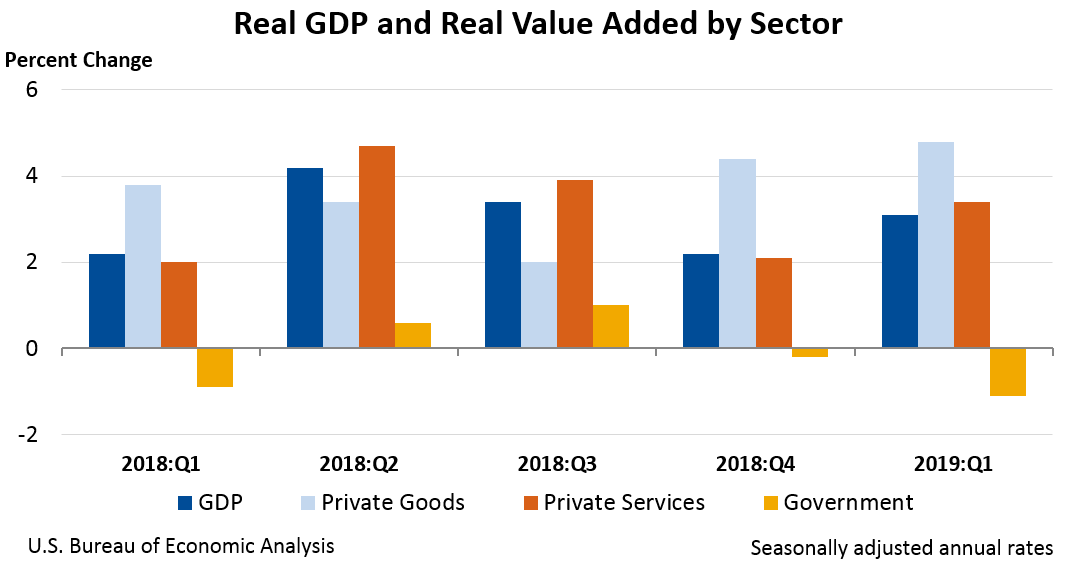
Finance and insurance; retail trade; and health care and social assistance were the leading contributors to the increase in U.S. economic growth in the first quarter of 2019. According to gross domestic product (GDP) by industry statistics released by the Bureau of Economic Analysis, 16 of 22 industry groups contributed to the overall 3.1 percent increase in real GDP in the first quarter.
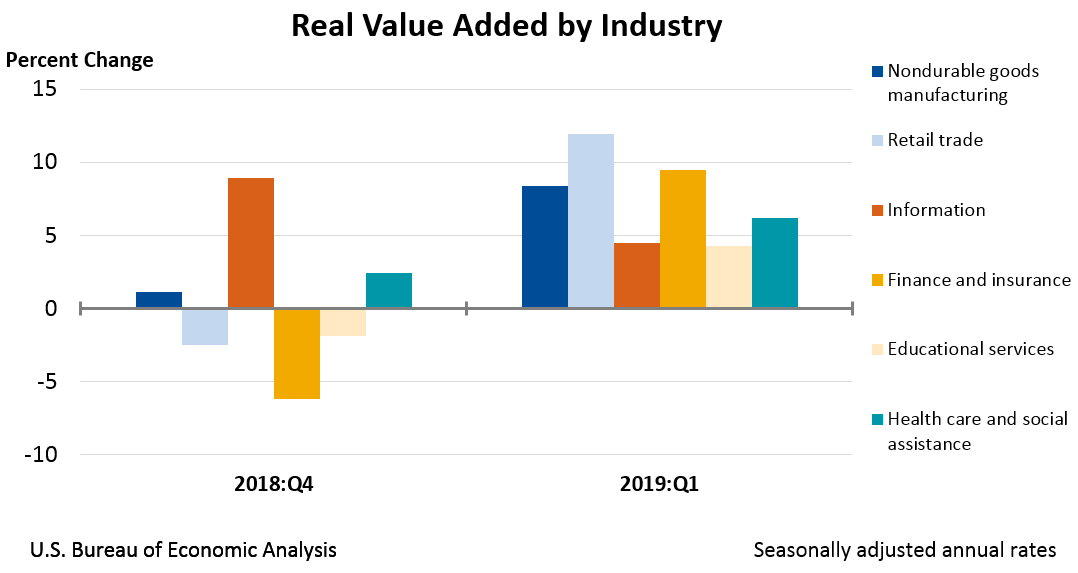
- For the finance and insurance industry group, real value added—a measure of an industry’s contribution to GDP—increased 9.5 percent in the first quarter, after decreasing 6.2 percent in the fourth quarter. The first quarter growth primarily reflected an increase in insurance carriers and related activities.
- Retail trade increased 11.9 percent in the first quarter, after decreasing 2.5 percent in the fourth. This primarily reflected an increase in other retail, which includes gasoline stations and pharmacies and drug stores.
- Health care and social assistance increased 6.2 percent, after increasing 2.4 percent. This was the largest increase since the fourth quarter of 2008.
Other highlights
- Nondurable goods manufacturing increased 8.4 percent in the first quarter, after increasing 1.1 percent in the fourth quarter. The first quarter growth primarily reflected increases in petroleum and coal products.
- Information services increased 4.5 percent, after increasing 8.9 percent. The first quarter growth primarily reflected increases in data processing, internet publishing, and other information services, as well as publishing industries.
- Education services increased 4.3 percent, after decreasing 1.9 percent.
Gross output by industry
Economy-wide, real gross output—principally a measure of an industry’s sales or receipts, which includes sales to final users in the economy (GDP) and sales to other industries (intermediate inputs)—increased 1.6 percent in the first quarter. This reflected an increase of 2.8 percent for the private goods-producing sector, 1.3 percent for the private services-producing sector, and 0.3 percent for the government sector. Overall, 14 of 22 industry groups contributed to the increase in real gross output.
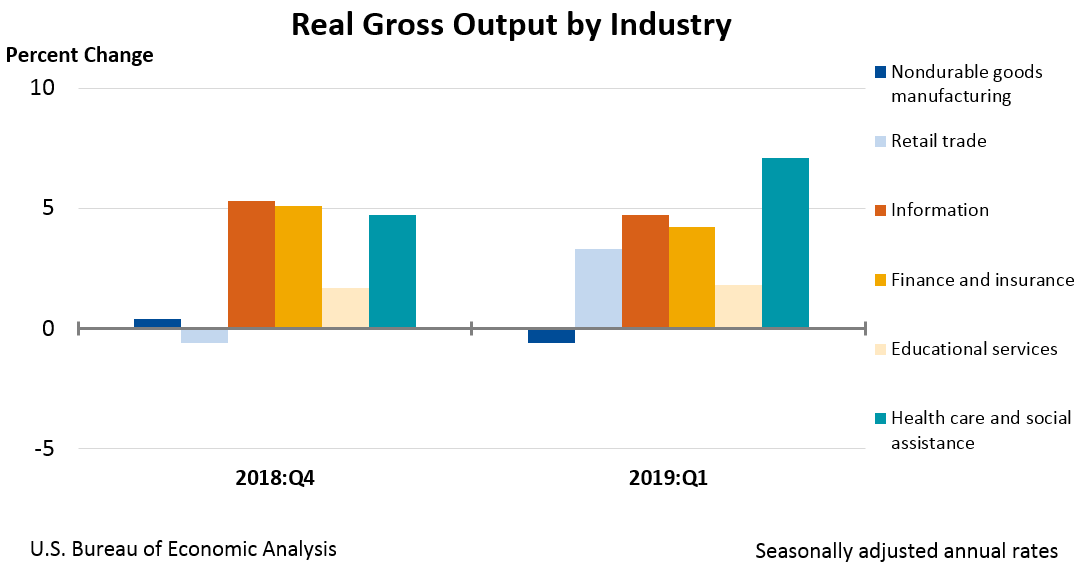
- Real gross output for information services increased 4.7 percent in the first quarter, after increasing 5.3 percent in the fourth quarter. The increase was primarily attributed to the publishing industry, which includes software.
- Finance and insurance increased 4.2 percent, after increasing 5.1 percent.
- Health care and social assistance increased 7.1 percent, after increasing 4.7 percent. The first quarter growth reflected increases in hospitals and ambulatory health care services.
FULL DOCUMENT: https://www.bea.gov/system/files/2019-07/gdpind119.pdf
INTERNATIONAL TRADE
DoC. USITC. July 18, 2019. U.S. Department of Commerce Finds Dumping and Countervailable Subsidization of Imports of Steel Racks from China
WASHINGTON – The U.S. Department of Commerce announced the affirmative final determinations in the antidumping duty (AD) and countervailing duty (CVD) investigations of imports of steel racks and parts thereof from China, finding that exporters from China have sold steel racks and parts at less than fair value in the United States at rates from 18.06 to 144.50 percent. In addition, Commerce determined that exporters from China received countervailable subsidies at rates from 1.50 to 102.23 percent.
In 2017, imports of steel racks from China were valued at an estimated $200 million.
The petitioner is the Coalition for Fair Rack Imports, whose members are Bulldog Rack Company (Weirton, WV), Hannibal Industries, Inc. (Los Angeles, CA), Husky Rack and Wire (Denver, NC), Ridg-U-Rak, Inc. (North East, PA), SpaceRak (Marysville, MI), Speedrack Products Group, Ltd. (Sparta, MI), Steel King Industries, Inc. (Stevens Point, WI), Tri-Boro Shelving & Partition Corp. (Farmville, VA), and UNARCO Material Handling, Inc. (Springfield, TN).
The strict enforcement of U.S. trade law is a primary focus of the Trump Administration. Since the beginning of the current Administration, Commerce has initiated 172 new antidumping and countervailing duty investigations – this is a 219 percent increase from the comparable period in the previous administration.
Antidumping and countervailing duty laws provide American businesses and workers with an internationally accepted mechanism to seek relief from the harmful effects of the unfair pricing of imports into the United States. Commerce currently maintains 491 antidumping and countervailing duty orders which provide relief to American companies and industries impacted by unfair trade.
The U.S. International Trade Commission (ITC) is currently scheduled to make its final injury determinations on or about September 3, 2019. If the ITC makes affirmative final injury determinations, Commerce will issue AD and CVD orders. If the ITC makes negative final determinations of injury, the investigations will be terminated and no orders will be issued.
The U.S. Department of Commerce’s Enforcement and Compliance unit within the International Trade Administration is responsible for vigorously enforcing U.S. trade law and does so through an impartial, transparent process that abides by international law and is based on factual evidence provided on the record.
Foreign companies that price their products in the U.S. market below the cost of production or below prices in their home markets are subject to antidumping duties. Companies that receive unfair subsidies from their governments, such as grants, loans, equity infusions, tax breaks, or production inputs, are subject to countervailing duties aimed at directly countering those subsidies.
Fact sheet: https://enforcement.trade.gov/download/factsheets/factsheet-prc-steel-racks-ad-cvd-final-071819.pdf
TOURISM
U.S. Department of Commerce. July 16, 2019. Export and investment promotion. Remarks by U.S. Commerce Secretary Wilbur L. Ross at the U.S. Travel and Tourism Advisory Board
Thank you, Brian, for that kind introduction. Good afternoon everyone, and welcome to the Commerce Department. It’s great to see you again. Thank you for your dedication to the U.S. Travel and Tourism Advisory Board. Thanks also to John and Kurt for your leadership of the Board.
The Board’s policy recommendations on a range of issues will guide our actions as we move forward. Your industry is essential to the U.S. economy. Last year, it generated a trade surplus of more than $69 billion, and supported almost 8 million American jobs.
Overall, travel and tourism accounted for 31 percent of U.S. services exports and 10 percent of total U.S. exports. In 2018, almost 80 million international visitors spent $256 billion in the United States, both yearly records. These visits for business, medical, education, and leisure, supported 1.2 million jobs across the country.
Last December, your Board made recommendations to generate more travel to and within the United States. On June 25th, I discussed these recommendations with the Tourism Policy Council and its representatives from the Departments of State, Homeland Security, Transportation, Interior, Agriculture, Labor, SBA, and the White House National Economic Council.
At that meeting, the TPC agreed with your recommendation for a new annual goal of $445 billion of spending by 116 million international visitors by the end of 2028.
The National Travel and Tourism Office is working with those agencies to revise the National Travel and Tourism Strategy. We look forward to updating you on our progress at the next T-TAB meeting.
Last year, I also asked for your recommendations about a national workforce strategy.
I was especially interested in how technology is affecting your industry’s workforce needs, and in learning about best practices for training and recruitment. Several of your recent recommendations connect directly with those being generated by the National Workforce Policy Advisory Board to the White House National Council for the American Worker, which I co-chair with Ivanka Trump.
The Workforce Advisory Board is studying and developing recommendations to: Develop a campaign to promote multiple pathways to career success; Increase data transparency to better match American workers with American jobs; Modernize candidate recruitment and training practices; And measure and encourage employer-led training investments.
The Trump Administration has launched a new “Industry-Recognized Apprenticeship System,” a major effort to spur employer-led training. Thank you for supporting this new system, as well as the existing Registered Apprenticeship program run by the Department of Labor and its state partners.
As you note in your recommendations, additional public funding can help establish new apprenticeship programs in the travel and tourism industry. The Department of Labor has $100 million in funding available for about 30 apprenticeship grants. These will go to public / private partnerships to develop new apprenticeship models and expand existing apprenticeship programs.
The funding source is the fees companies pay to hire foreign workers under the H-1B visa program. These fees are then provided as grants for training American workers in the occupations for which employers are hiring H-1B workers, such as IT jobs.
The Department of Labor is expanding its apprenticeship programs to include cybersecurity and artificial intelligence, since every sector of the economy requires workers with these skillsets. I encourage you to consider how companies and associations in the travel and tourism industry might partner with training organizations applying for these grants.
I also encourage your associations, unions, and education partners to consider applying to be a Standards Recognition Entity. These entities are the core of the new Industry-Recognized Apprenticeship Program. They will set standards for training and curricula in relevant industries and occupations.
I also appreciate your recommendation that the government create a website to educate the public about travel-related careers and apprenticeship programs. This recommendation is an example of a much broader lack of information — or even mis-information — about good career opportunities in your industry.
Under the leadership of CEOs Tim Cook of Apple and Ginni Rometty of IBM, one of the working groups of the American Workforce Policy Advisory Board is creating a national marketing campaign to promote the pathways to available jobs and careers. Specific recommendations on this campaign will be described at the September meeting of the Workforce Advisory Board.
My staff will be pleased to brief you on those recommendations to ensure that the travel and tourism industry is represented in these efforts. Your final set of recommendations involve the U.S. Government implementing a biometric entry and exit system at our ports of entry.
The Commerce Department is working with Customs and Border Protection to determine how the public and private sectors can work together to accelerate progress. There are representatives here today from the Departments of State, Homeland Security and Labor to provide you with information and feedback on these recommendations. The State Department also has updates on current efforts related to visas, and on efforts to negotiate bilateral open-skies agreements. The Department of Homeland Security will provide you with background on its travel facilitation initiatives, including implementation of the biometric entry / exit process. And the Department of Labor will provide information on its apprenticeship and certification programs for the travel and tourism industry.
Finally, President Trump is exploring the possibility of rejoining the United Nations’ World Tourism Organization on terms that are beneficial to the United States. We are supporting the State Department’s Bureau of International Organization Affairs, which is responsible for U.S. engagement with UN organizations.
Rejoining the UN-WTO could provide an opportunity for the United States to leverage the organization’s strengths in support of global travel and tourism. We ask your advice on the potential advantages of rejoining the UN-WTO. Include ideas in which the public and private sectors can work together to leverage U.S. membership, particularly in the areas of global policy development, innovation, and investment in emerging markets.
So — with that — as you can see, there is a lot going on, and there is more work ahead: Challenges and opportunities are never in short supply.
I ask John Sprouls, our Board Chairman, to provide us with comments about these issues and others that will be discussed today.
________________
ORGANISMS
PARAGUAY
FMI. 19/07/2019. Paraguay procura una nueva transformación después de 15 años de crecimiento rápido
Por Bas Bakker y Natasha Che
En los últimos 15 años, Paraguay ha sido una de las economías con crecimiento más rápido de Sudamérica, lo que ha permitido reducir los niveles de pobreza del país de un 58% en 2002 al actual 26%.
El crecimiento del PIB real fue de más de un 4,5% anual, muy superior al promedio de 1¾% correspondiente a América Latina en conjunto. Además, el ingreso per cápita aumentó de USD 1.300 en 2002 a casi USD 6.000 en 2018.
Sin embargo, mantener este crecimiento sólido podría resultar más difícil, puesto que los factores que apuntalaron el crecimiento en el pasado serán menos favorables en el futuro. Las políticas que impulsan la inversión y la productividad pueden ayudar a Paraguay a sostener el crecimiento inclusivo para las generaciones futuras.

Transformación económica
Los extraordinarios resultados del crecimiento han dejado huellas claras en Asunción, la capital de la nación. Han surgido resplandecientes edificios de apartamentos y ajetreados centros comerciales. Hoteles de estilo industrial elegante y nuevas sedes de empresas irradian una atmósfera cosmopolita. El crecimiento ha sido tan rápido que los embotellamientos de tráfico, poco comunes hace 15 años, ahora son una realidad cotidiana para los residentes de la ciudad.
Asimismo, si bien el ciclo económico de Paraguay solía seguir la tendencia de sus vecinos, durante la década pasada el país se ha vuelto mucho más resistente y ha continuado creciendo frente a una volatilidad y a shocks externos significativos. Cuando Brasil —uno de sus principales socios comerciales— sufrió una de sus más profundas recesiones en 2015 y 2016, Paraguay creció a una tasa de casi el 4%.

La razón del vigoroso crecimiento
Entonces, ¿por qué ha sido tan rápido el crecimiento, y qué perspectivas tiene de continuar?
En parte, el crecimiento sólido fue el resultado de una recuperación de una crisis anterior. A fines de los años 1990 y principios de los años 2000, Paraguay se vio afectado por una crisis bancaria, una recesión profunda y una depreciación aguda del tipo de cambio. Para 2003, los ingresos per cápita eran menores que en 1980.
La recuperación fue favorecida por un cambio de rumbo en las políticas económicas. En primer lugar, se restableció la estabilidad económica, con la ayuda de dos programas del FMI. Luego las políticas económicas se mantuvieron prudentes, incluso durante los buenos tiempos. La inflación y la volatilidad del tipo de cambio descendieron cuando el banco central comenzó a fijar metas de inflación. Se disminuyó el déficit fiscal y se redujo la deuda pública de un 52% del PIB en 2002 hasta alrededor del 20% del PIB en la actualidad. En 2015 entró en vigor una ley de responsabilidad fiscal con el fin de mantener bajos los déficits y la deuda. Como resultado, Paraguay evitó el ciclo de auge y caída que afectaba a otros países de la región.

El auge de los precios de la soja y otras materias primas agrícolas impulsó aún más el crecimiento. Los precios en dólares de las exportaciones de soja se triplicaron entre 2000 y 2014. Esto no solo originó un acentuado aumento de los valores de las exportaciones, sino que también desencadenó un considerable aumento de sus volúmenes, puesto que la inversión agrícola se volvió muy rentable. El auge de las exportaciones se propagó al resto de la economía gracias a una apreciación del tipo de cambio real, que impulsó los ingresos reales y la demanda interna.

El desafío de mantener un fuerte crecimiento
Mantener un crecimiento firme podría resultar más difícil, puesto que los factores que sustentaron el crecimiento en el pasado serán menos favorables en el futuro. En 2014, los precios de la soja llegaron a su nivel más alto y desde entonces han descendido en un tercio. Las tierras agrícolas destinadas a los cultivos principales se han duplicado en los últimos 15 años, y resultará difícil que se produzcan nuevos aumentos significativos.
Además, en gran medida, el crecimiento se ha originado en la utilización de más insumos en lugar de un uso más eficaz de ellos. El empleo ha crecido con rapidez, pero el crecimiento de la productividad se ha mantenido moderado.
Continuando con la transformación
Dado que es probable que el sector agrícola crezca con mayor lentitud que en el pasado, el crecimiento rápido solo continuará si otros sectores pueden progresar. El aspecto positivo es que están comenzando a surgir nuevos sectores exportadores, como las exportaciones de la industria manufacturera en virtud del régimen de maquila. No obstante, aún son reducidas. Las exportaciones no agrícolas y de energía no hidroeléctrica alcanzan solo el 7% de las exportaciones totales.
Hacer de Paraguay un destino de inversión más atractivo podría contribuir a acelerar la transformación. Como se analizó en la última evaluación económica para Paraguay y sus documentos de referencia adjuntos , una mejora del clima de negocios y de los indicadores de gobernanza facilitaría la diversificación y el crecimiento de la productividad. Serían de particular utilidad políticas que se centraran en mejorar la infraestructura de transporte, el Estado de derecho y la gobernanza, y la calidad de la educación.
Política fiscal
Algunas de las reformas costarán dinero. Los niveles de gasto público en Paraguay son bajos. Establecer nuevas prioridades en el gasto podría crear algunas posibilidades, puesto que la composición del gasto es desequilibrada, con una proporción importante destinada a los salarios. El aumento de los ingresos crearía un mayor margen para el gasto relacionado con las reformas y las necesidades de inversión. Las tasas de impuestos en Paraguay son bajas, pero los ingresos tributarios son aún más bajos de lo que se esperaría, dadas las tasas. La tasa del impuesto sobre las personas físicas es del 10%, pero la recaudación tributaria corresponde solo al 0,1% del PIB, como resultado de las exenciones y las deducciones. Sería de ayuda una reforma tributaria que se centrara en reducir las exenciones y las deducciones y en mejorar el cumplimiento tributario.
Cuando de política fiscal se trata, no solo es importante considerar el corto plazo, sino también los desafíos a más largo plazo. La población de Paraguay aún es joven. Sin embargo, dado que la población está envejeciendo gradualmente, en el futuro surgirán déficits elevados en el sistema de pensiones. Para evitar esto, sería más adecuado realizar ahora pequeños cambios en el sistema de pensiones (por ejemplo, un aumento moderado en la edad de jubilación) que grandes cambios en el futuro.
Hacia el futuro
Paraguay ha tenido un buen desempeño en los últimos 15 años. Se recuperó de una crisis anterior, se desacopló de sus vecinos más importantes y logró grandes avances en la reducción de la pobreza. Estos logros se vieron favorecidos por un cambio de rumbo en las políticas macroeconómicas, así como también por una escalada de precios de las materias primas agrícolas. Si sigue aplicando lo que ha funcionado bien (políticas macroeconómicas prudentes), implementando al mismo tiempo otras reformas que se centren en el lado de la oferta, es posible que continúe el crecimiento sólido.
Cuando la gente piensa en países pequeños, sin litoral y económicamente exitosos con mucha energía hidroeléctrica, suele pensar en Suiza. Sin embargo, si sus extraordinarios resultados económicos se mantienen, pronto la gente podrá pensar en Paraguay.
DOCUMENTO COMPLETO: https://blog-dialogoafondo.imf.org/?p=11616&utm_medium=email&utm_source=govdelivery
________________
ECONOMIA BRASILEIRA / BRAZIL ECONOMICS
INVESTIMENTO
FGV. IBRE. PORTAL G1. 19/07/2019. Taxa de investimentos é a menor em mais de 50 anos e fica mais dependente do setor privado. Indicador caiu para 15,5% do PIB no 1º trimestre de 2019, ante 20,9% em 2013. Rombo das contas governamentais limita investimento público, que perdeu peso na taxa total.
Por Darlan Alvarenga, G1
A taxa de investimentos no Brasil caiu para o menor nível em mais de 50 anos e, em meio ao rombo das contas públicas e colapso dos orçamentos governamentais, o ritmo de recuperação tende a ficar ainda mais dependente da participação e apetite do setor privado.
No 1º trimestre de 2019, a taxa de investimentos (também chamada de formação bruta de capital fixo - FBCF), que inclui o que se investe em máquinas e equipamentos, construção civil e inovação, recuou para 15,5% do PIB (Produto Interno Bruto), contra 15,8% no trimestre anterior. No final de 2013, antes do início da recessão, estava em 20,9%.
Levantamento do economista Manoel Pires, coordenador do Observatório de Política Fiscal do Instituto Brasileiro de Economia da Fundação Getulio Vargas (Ibre/FGV), mostra que a taxa de investimentos públicos caiu de 4,06% em 2013 para 1,85% em 2017 (nível mais baixo já registrado no país), passando para 2,43% em 2018. Já a taxa de investimentos privados caiu nos últimos 5 anos, recuando de 16,85% em 2013 para 13,39% em 2018. Veja gráfico abaixo:
/i.s3.glbimg.com/v1/AUTH_59edd422c0c84a879bd37670ae4f538a/internal_photos/bs/2019/O/Q/pHvAr4TB6niN9MxJXreA/investimento-v3.jpg)
Em termos de composição do indicador, o setor privado passou a ter um peso ainda maior no total dos investimentos feitos no país, ao redor de 85%. A participação do setor público na taxa de investimentos caiu de 19,4% em 2013 para 11,8% em 2018, subindo para 15,4% em 2018. Em 2010, os governos chegaram a responder por 22% do total da FBCF. Na década de 70, chegou a passar de 40%.
Outro estudo do Ibre, dos economistas Marcel Balassiano e Juliana Trece, que utilizou uma média móvel de 4 anos, aponta que a taxa de investimento no quadriênio terminado no 1º trimestre de 2019 atingiu 15,5% do PIB, o menor nível em mais de 50 anos (mesma taxa registrada em 1967).
Os pesquisadores apontam que, no ano passado, 152 de um total de 172 países registraram uma taxa de investimento maior que a do Brasil, e que a taxa média global (26,2%) foi 10 pontos percentuais maior que a brasileira 2018. Quando a comparação é com os países emergentes, a taxa de investimento foi mais que o dobro da do Brasil.
A reversão desse quadro é apontada como fundamental para que a economia possa reagir e se recuperar num ritmo mais robusto e, com isso, aumentar a geração de empregos.
Sem recuperação em '3 ou 4 anos'
O secretario do Tesouro Nacional, Mansueto Almeida, afirmou recentemente que, mesmo com a aprovação da reforma da Previdência, a administração pública não irá recuperar sua capacidade de investimento "nos próximos três ou quatro anos".
A reforma da Previdência é um passo importante para melhorar a confiança de empresas. Os economistas destacam, porém, que para garantir um crescimento robusto sustentado ao longo dos próximos anos, o Brasil precisa avançar também em outras reformas, como a tributária, além de melhorar o ambiente de negócios e avançar nos projetos de infraestrutura.
Composição dos investimentos em 2018
Taxa ficou em 15,8% do PIB; setor privado respondeu por 85% do indicador
setor privado
13,39
13,39
Fonte: Observatório de Política Fiscal/FGV-Ibre
Longo caminho para recuperar patamar pré-recessão
Diante das limitações orçamentárias e restrições impostas pela lei de teto de gastos, o governo busca atrair mais investimentos privados, sobretudo na área de infraestrutura, através de uma maior abertura da economia, em setores como o mercado de gás natural, e ampliação dos projetos de concessões e privatizações.
Apesar da perspectiva de melhora da atividade econômica e do ambiente de negócios, a partir da aprovação da reforma da Previdência, os economistas avaliam que ainda vai demorar para a taxa de investimentos recuperar o patamar pré-recessão, em razão do nível ainda elevado de incertezas e capacidade ociosa no parque industrial, além de persistentes dificuldades e entraves regulatórios para tirar do papel projetos de transferência de ativos para a iniciativa privada.
"O ano de 2019 ainda vai ser ruim para o investimento. Talvez 2020 seja um pouco melhor", afirma Pires. "Mesmo que se aprove a reforma da Previdência, ninguém sabe muito bem quais serão os próximos passos [da política econômica]. O ponto de interrogação continua sendo a recuperação da demanda, porque tem incertezas jogando para baixo e uma perspectiva muito ruim para a expansão da capacidade produtiva. Precisa preencher esta capacidade ociosa primeiro para ter investimentos mais expressivos”.
A consultoria Tendencias estima que a taxa de investimentos ficará praticamente estável em 2019, em 15,9% do PIB, subindo para 17,5% do PIB em 2022, sustentada principalmente pelo aumento do consumo de máquinas e equipamentos e pelos impactos esperados, a partir de 2021, pelo programa federal de concessões e privatizações.
"Em nosso cenário de 10 anos, ainda não teremos recuperado a taxa de investimentos de 20,9% do PIB visto em 2013", afirma a economista da Tendencias Alessandra Ribeiro, que projeta uma taxa de 19,9% do PIB em 2029.
Segundo a analista, o ritmo de recuperação dos investimentos nos próximos anos será ditado pela dinâmica privada, uma vez que as contas do governo só deverão voltar a registrar superávit (receitas maiores que as despesas, excetuando os gastos com pagamento de juros) a partir de 2024.
“Considerando a retomada do crescimento, os impactos iniciais da Previdência, medidas adicionais do lado do gasto público e receitas extraordinárias com concessões e privatizações, o resultado primário fica equilibrado (ou seja, zero), só em 2023", estima a economista.
Componente construção civil puxa queda
O tombo da taxa de investimentos nos últimos anos foi puxado principalmente pelo componente de construção civil, que inclui também infraestrutura.
No período entre 2010 e 2019, todos os componentes da taxa declinaram, mas a perda em construção chegou a 3 pontos percentuais, enquanto que em máquinas e equipamentos e outros o recuo foi de 1,9 p.p. e 0,2 p.p., respectivamente, apontam Balassiano e Trece. No item "outros" estão gastos com inovação, pesquisa e desenvolvimento e outros ativos fixos.
A construção, que sempre respondeu pela maior fatia dos investimentos, vem diminuindo seu peso na taxa desde o inicio dos anos 2000. No 1º trimestre de 2019, respondeu por 47,4% da taxa de investimento, enquanto máquinas e equipamentos ficaram com 38,3%.
"À medida que os governos saíram de cena, os investimentos em construção civil sofreram um baque. Soma-se a isso a questão das grandes empreiteiras que saíram do mercado ou ficaram inviabilizadas com as investigações da Lava Jato”, observa Pires, citando também as mudanças no modelo de financiamento dos investimentos no país, com a redução da participação do BNDES, cujos desembolsos caíram em 2018 para o menor valor em 5 anos.
/i.s3.glbimg.com/v1/AUTH_59edd422c0c84a879bd37670ae4f538a/internal_photos/bs/2019/y/T/ag4kA1QsmtiRsU11GffA/taxa.jpg)
Amarras para recuperação
A recuperação do nível de investimento é importante tanto para garantir um crescimento mais robusto do PIB como também para melhorar a infraestrutura do país.
"Para que a economia sustente expansão do PIB da ordem de 3% ao ano ao longo do tempo é necessário que o nível de investimentos caminhe para 21% do PIB. A reativação dos investimentos ampliaria as possibilidades de crescimento da economia brasileira, com estímulo tanto sobre a demanda agregada, dado o efeito multiplicador sobre o produto e o emprego, quanto sobre a oferta, via ampliação de infraestrutura e de produtividade", avaliou, em relatório mensal, a Instituição Fiscal Independente (IFI), órgão do Senado Federal.
Para que a recuperação aconteça mais rapidamente e com bases mais sólidas, parte dos analistas defende também um maior debate sobre a recuperação da capacidade de investimentos dos governos, incluindo uma eventual flexibilização do teto de gastos, para que se abra um espaço fiscal para políticas públicas de desenvolvimento e até mesmo para a retomada e conclusão mair rápida de obras paralisadas ou projetos interrompidos.
"O crescimento do gasto público precisa ser objeto de controle, mas isto precisa incluir espaço para investimento. Claro que é necessária a emenda da emenda. Não para desoneração ou subsídio, mas gasto mesmo, contratação direta", afirma o economista-chefe do Banco Fator, José Francisco de Lima Gonçalves.
Para ele, não dá para contar apenas com um avanço do investimento privado para a retomada do patamar pré-crise. ”As oportunidades para o investimento privado estão concentradas na infraestrutura e no setor de energia, ambos monopólios naturais ou assemelhados e, portanto, objeto de regulação complexa, longo prazo de maturação e com riscos econômicos elevados. Sem mitigação dos efeitos de tais traços, é ingenuidade esperar um ciclo de investimento privado, mesmo com taxa de juros baixa", avalia.
/i.s3.glbimg.com/v1/AUTH_59edd422c0c84a879bd37670ae4f538a/internal_photos/bs/2019/y/d/GVAK6LQoAMe1Shd42WSQ/variacao-trimestral-do-pib-brasileiro.png)
Para Ribeiro, é possível voltar ao patamar pré-recessão mesmo com investimento público limitado, mas é preciso rever os moldes dos investimentos no país.
"Os investimentos públicos acontecem em áreas como educação, saúde, mobilidade. Para isso, teríamos que realmente mudar o modelo e trazer mais o setor privado para essas áreas. Podemos ter modelos como parceria público-privada que ainda dependeriam de certo aporte e garantia do governo, mas em casos de concessões e privatizações, não. Por isso, a gestão e a mudança de modelo é essencial para se depender cada vez menos dos governos federal, estadual ou municipal", afirma.
Pires considera positivo uma maior abertura da economia brasileira, mas destaca as dificuldades regulatórias e políticas que envolvem qualquer projeto de desestatização. Ele lembra ainda que há áreas que nem sempre atrai o interesse de investidores.
"Tem setores que o investimento privado não entra, ou entra quando boa parte do custo do investimento já esta amortizado, para ser operador e ampliar a infraestrutura na medida em que a demanda cresce", afirma. "Agora estão falando no mercado de gás... Em saneamento, já se tentou nos últimos anos três formas diferentes para destravar, a última foi uma medida provisória que caiu. No fim das contas, tudo que envolve assuntos federativos é supercomplexo, envolve uma gama de interesses, e leva tempo".
Na opinião do economista, mesmo com uma maior abertura, o ideal seria perseguir uma taxa de investimento público em torno de 4% do PIB.
"Não dá para discutir investimentos públicos e privados de forma dissociada. Da mesma forma que não dá para parar de fazer o investimento público e esperar que o privado entre e ocupe todo o espaço, também não é verdadeiro que a volta do investimento público trará mais investimento privado. Se o gasto público for mal feito, não trará. É preciso abrir espaço fiscal para aumentar os investimentos dos governos, mas também é necessário melhorar a governança e debater onde investir os recursos", diz.
TERRORISMO
MRE. AIG. NOTA-189. 19 de Julho de 2019. Comunicado Conjunto por ocasião da Segunda Conferência Ministerial Hemisférica de Luta contra o Terrorismo – Buenos Aires, Argentina, 19 de julho de 2019
Comunicado Conjunto en ocasión de la Segunda Conferencia Ministerial Hemisférica de Lucha contra el Terrorismo – Buenos Aires, Argentina, 19 de julio de 2019
El día 19 de julio de 2019, la República Argentina organizó dando continuidad a la Segunda Conferencia Ministerial Hemisférica de Lucha contra el Terrorismo, como continuación de la Conferencia realizada en Washington en Diciembre de 2018 sobre el mismo tema.
Participaron en la Conferencia: Argentina, Bahamas, Brasil, Canadá, Chile, Colombia, Costa Rica, Ecuador, El Salvador, Estados Unidos de América, Guatemala, Honduras, Jamaica, Panamá, Paraguay y Perú. Asimismo asistieron México, Uruguay y el Comité Interamericano Contra el Terrorismo (CICTE), en calidad de Observadores.
En la Conferencia, los Gobiernos participantes:
- Condenaron al terrorismo en todas sus formas y manifestaciones, cualesquiera que sean sus motivaciones, enfatizando que constituye una amenaza para la paz y la seguridad de los países y de la comunidad internacional toda, así como para los derechos humanos, para la estabilidad democrática, para el desarrollo económico y social y para los ciudadanos dentro y fuera de sus territorios nacionales, deplorando sus efectos en el disfrute de los derechos humanos y las libertades fundamentales de las víctimas;
- Subrayaron la importancia de implementar las Resoluciones relevantes del Consejo de Seguridad de las Naciones Unidas, particularmente las Resoluciones 1267(1999), 1373(2001), 1540(2004), 2178(2014), 2242(2015), 2396(2017) y la 2462(2019) como así también la importancia de ratificar e implementar los instrumentos internacionales contra el terrorismo, particularmente la Convención Interamericana contra el Terrorismo.
- Ratificaron el convencimiento de que los esfuerzos de los Estados en la lucha contra el terrorismo y su financiamiento -tanto en el ámbito de las respuestas individuales como colectivas- deben realizarse en el marco del Estado de Derecho y la legislación nacional, el respeto a los Derechos Humanos y las libertades fundamentales de conformidad con el Derecho Internacional vigente;
- Reconocieron que la lucha contra el extremismo violento y la radicalización de la violencia deberían ser un aspecto de importancia dentro del marco de los esfuerzos en la lucha contra el terrorismo.
- Afirmaron que las organizaciones terroristas ISIS/Daesh y Al-Qaida, y sus organizaciones afiliadas, constituyen una amenaza a la seguridad colectiva, a la seguridad de los ciudadanos dentro y fuera de sus territorios y a todas las personas dentro de sus respectivas jurisdicciones;
- Expresaron su preocupación por las actividades que redes de Hezbollah continúan realizando en algunas áreas del Hemisferio Occidental.
- Reconocieron como una amenaza a la estabilidad de la región la acción del Ejército de Liberación Nacional (ELN), el cual perpetra actos de inaceptable violencia y obtiene financiamiento de origen ilícito. Asimismo, expresaron su rechazo a las actividades criminales de Sendero Luminoso.
- Enfatizaron que la cooperación bilateral, regional e internacional es esencial para prevenir que el Hemisferio sea aprovechado para actividades operacionales, logísticas y de financiamiento en apoyo de actividades terroristas o de otros delitos conexos;
- Notaron, asimismo, que redes terroristas y de crimen organizado que constituyen amenazas ponen en peligro el Hemisferio, y que los países deben mantener una robusta cooperación contra esas redes como también contra sus facilitadores y aquellos que las apoyan;
- Se comprometieron a tomar medidas para prevenir que grupos terroristas se beneficien de la delincuencia organizada nacional y trasnacional.
- Resolvieron continuar desarrollando herramientas para prevenir y luchar contra el extremismo violento y el terrorismo, conscientes de que los variables desafíos que se presentan dada la continua evolución de la crecientemente compleja y descentralizada amenaza terrorista, requieren una respuesta que debe evolucionar de manera acorde;
- Condenaron el uso del secuestro como medio del terrorismo, sea con fines políticos, religiosos o económicos y expresan su profundo compromiso en el combate para la erradicación de este mal, así como se solidarizan con las víctimas, familias y la sociedad en su conjunto que han sufrido por este despreciable flagelo;
- Resolvieron incrementar sus esfuerzos para contrarrestar el extremismo violento, particularmente la apología de los actos terroristas, del terrorismo y de los grupos terroristas, así como el uso -por parte de los terroristas- de las nuevas tecnologías y plataformas de comunicaciones informáticas para reclutar o radicalizar, difundir contenidos de terrorismo e incitar a la violencia; permaneciendo al mismo tiempo comprometidos con una internet abierta, libre y segura;
- Señalaron la necesidad de incrementar la cooperación internacional en la lucha contra el terrorismo y su financiación, a través del intercambio ágil de información y buenas prácticas a fin de reducir las vulnerabilidades como también a través del uso de la asistencia judicial mutua y de la extradición y de la implementación de alertas de viaje;
- Se comprometieron a negar cobijo o estatus de refugiado o asilo, de conformidad con sus legislaciones nacionales, a los terroristas y financistas del terrorismo que se desplazan hacia y desde zonas de operaciones y a impedir que sus respectivos territorios sean utilizados para el reclutamiento terrorista, la radicalización y para propaganda terrorista,
- Expresaron su preocupación acerca del riesgo de que grupos terroristas puedan ampararse en situaciones de debilidad institucional, conflicto interno u otros similares, como por ejemplo Venezuela, para potenciar sus actividades delictivas en la región.
- Señalaron la necesidad de implementar efectivamente los estándares internacionales en la lucha contra los delitos de lavado de dinero y el financiamiento del terrorismo y en el control de otras operaciones financieras ilícitas o vulnerables y a incrementar los esfuerzos para evitar la utilización de sus territorios nacionales para el financiamiento de organizaciones, individuos o actividades terroristas por medios lícitos o ilícitos, incluyendo la consideración del desarrollo y uso de sistemas de sanciones a nivel nacional.
- Alentaron a las autoridades competentes, en particular a las unidades de inteligencia financiera y otros servicios de inteligencia, a establecer y fortalecer las alianzas entre sí y con el sector privado a efectos de evaluar y monitorear los patrones y tendencias de terrorismo y su financiación e intercambiar información operativa con fines de inteligencia.
- Se comprometieron a establecer, en el marco del CICTE, una red 24-7 de Puntos de Contacto Nacionales de Seguridad para la Lucha contra el Terrorismo, para facilitar el intercambio oportuno, mediante plataformas de comunicación seguras, de alertas tempranas de amenazas y otros temas relacionados con el terrorismo y otra información relevante;
- Solemnemente evocaron y condenaron el más grave atentado de terrorismo transnacional ocurrido en la República Argentina, el perpetrado hace 25 años en la Sede de Asociación Mutual Israelita Argentina (AMIA), por el cual se encuentra bajo investigación judicial la participación de Hezbollah, y confirmaron su compromiso en materia de cooperación jurídica internacional respecto de la investigación judicial actualmente en curso, ratificándolo con su presencia en la misma sede de la Asociación.
Joint Communiqué on the occasion of the Second Hemispheric Ministerial Conference on the Fight against Terrorism – Buenos Aires, Argentina, July 19th, 2019
On July 19th, 2019, Argentina convened the Second Hemispheric Ministerial Conference for the Fight against terrorism, following on the Hemispheric Ministerial in Washington in December, 2018, on the same subject.
The participants of the Conference included Argentina, Bahamas, Brazil, Canada, Chile, Colombia, Costa Rica, Ecuador, El Salvador, Guatemala, Honduras, Jamaica, Panama, Paraguay, Peru and the United States of America. In addition, Mexico, Uruguay and the Organization of America States – Inter-American Committee against Terrorism (CICTE) attended the Conference as Observers.
At the Conference, the participating governments:
- Condemned terrorism in all its forms and manifestations, and whatever its motivations might be, emphasizing that it constitutes a threat to the peace and security of the countries and the international community, deploring its effects on democratic stability, economic and social development, and citizens inside and outside their national territories, as well as deploring its effect on the exercise of human rights and fundamental freedoms on the part of the victims;
- Underscored the importance of relevant United Nations Security Council Resolutions, particularly resolutions 1267(1999), 1373(2001), 1540 (2004), 2178(2014), 2242(2015), 2396(2017) and 2462(2019), as well as of the international instruments against terrorism, including the Inter-American Convention against Terrorism;
- Reaffirmed the conviction that efforts in the fight against terrorism and terrorism financing, both in the scope of individual and collective responses, must be carried out within the framework of the rule of law and national legislation, and with respect for human rights, fundamental freedoms, and in compliance with international law;
- Acknowledged that countering violent extremism and terrorist radicalization should be a critical aspect of our broader efforts to fight terrorism;
- Affirmed that the terrorist organizations ISIS/Daesh and Al-Qaida and their affiliated organizations constitute a threat to collective security, to the security of citizens inside and outside their territories, and to all person within their jurisdictions;
- Expressed their concern about Hezbollah networks’ activities in some areas of the Western Hemisphere;
- Recognized as a threat for regional stability the activity of the Ejército de Liberación Nacional (ELN), which commits unacceptably violent acts and is funded through illicit means. Moreover, the countries expressed their rejection of the criminal activities of Shining Path;
- Emphasized that bilateral, regional and international cooperation is essential to prevent the Hemisphere from being exploited for operational, logistical, and fundraising activities to support terrorism and other related crimes;
- Noted that, in addition, other terrorist and organized crime networks also threaten the Hemisphere, and countries must maintain a robust cooperation against those networks as well as their facilitators and supporters;
- Committed themselves to take measures to prevent terrorist groups from benefiting from national and transnational organized crime;
- Resolved to continue developing tools to prevent and counter violent extremism and terrorism, fully aware of the evolving challenges posed by the continuous evolution of the increasingly complex and decentralized terrorist threat, requiring therefore a response that should evolve accordingly;
- Condemned kidnapping as a means for terrorism, whether for political, religious or economic purposes and expressed their deep commitment to the fight to eradicate this evil; as well as they stand in solidarity with the victims, families and society who have suffered from this despicable scourge;
- Resolved to increase international cooperation to counter violent extremism, particularly incitement to terrorist activity, terrorism and terrorist groups, as well as terrorists' use of new technologies and electronic communication platforms to recruit or radicalize, spread terrorist material, and incite violence, while remaining committed to an open, free and secure internet;
- Noted the need to increase international cooperation in the fight against terrorism and terrorism financing, through the exchange of information and best practices in order to reduce vulnerabilities, as well as through the use of judicial cooperation mechanisms, such as extradition and the implementation of travel alerts;
- Committed not to grant safe havens, refugee status or asylum, as appropriate in accordance with their respective legal frameworks, to terrorists and their financiers who move to and from areas of operation and to prevent their respective territories from being used for terrorist recruitment and terrorist propaganda;
- Expressed their concern about the risk for terrorist groups to profit from situations of institutional weakness, internal and other conflicts, such as in Venezuela, in order to strengthen their criminal activities in the region;
- Committed as well to effectively implement the international standards in countering crimes such as money laundering and terrorist financing, and in controlling other illicit or vulnerable financial operations, as well as to increase efforts to prevent the use of their national territories for the financing of terrorist organizations, individuals or activities, through both licit and illicit means, which could include the development and use of national-level sanction regimes;
- Committed to encouraging competent authorities, particularly finance intelligence units and other intelligence services, to establish and strengthen their alliances, between themselves and the private sector, so as to evaluate and monitor the trends and patterns of terrorism and terrorism financing, and to exchange operational information for intelligence purposes;
- Committed to creating, within the framework of CICTE, a 24/7 Network of National Security Focal Points for Counterterrorism to facilitate the timely exchange, through secure communication platforms, of early warnings regarding threats and other subjects related to terrorism as well as any other relevant information;
- Solemnly observed and condemned the most serious transnational terrorist attack in the Argentine Republic, which was perpetrated 25 years ago at the headquarters of the Argentine Israeli Mutual Association (AMIA), for which Hezbollah is under ongoing judicial investigation, and confirmed their commitment to international legal cooperation with respect to the ongoing judicial investigation, ratifying it with their presence in the very headquarters of the Association.
________________
LGCJ.:

