US ECONOMICS
INTERNATIONAL TRANSACTIONS
DoC. BEA. June 20, 2019. U.S. International Transactions, First Quarter 2019 and Annual Update. Current-Account Balance
The U.S. current-account deficit decreased to $130.4 billion (preliminary) in the first quarter of 2019 from $143.9 billion (revised) in the fourth quarter of 2018, according to statistics released by the Bureau of Economic Analysis (BEA). The deficit was 2.5 percent of current-dollar gross domestic product in the first quarter, down from 2.8 percent in the fourth quarter.
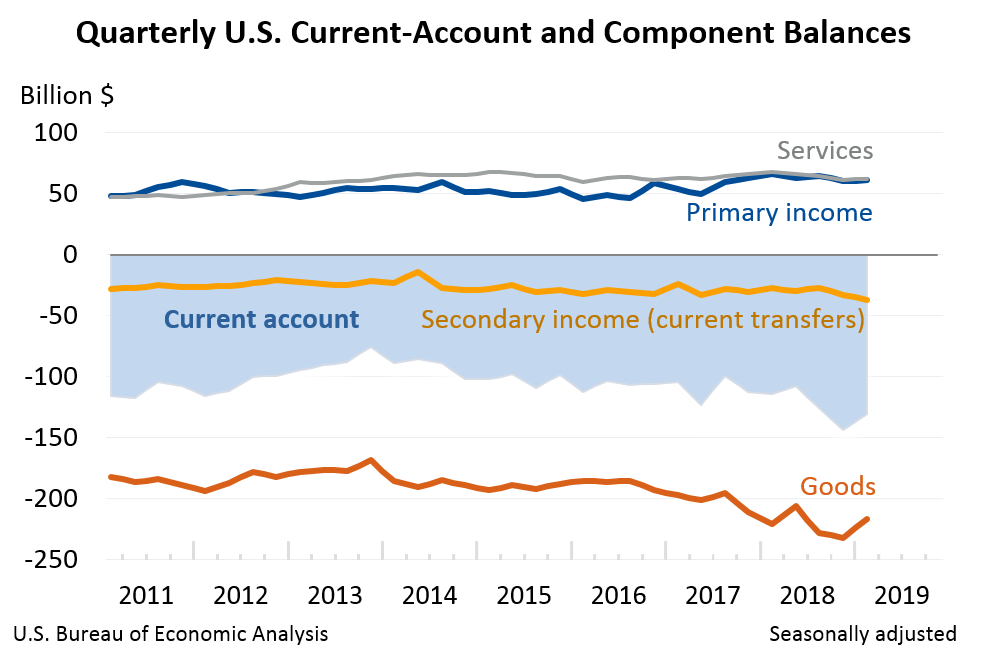
The $13.5 billion decrease in the current-account deficit mostly reflected a decrease in the deficit on goods that was partly offset by an increase in the deficit on secondary income.
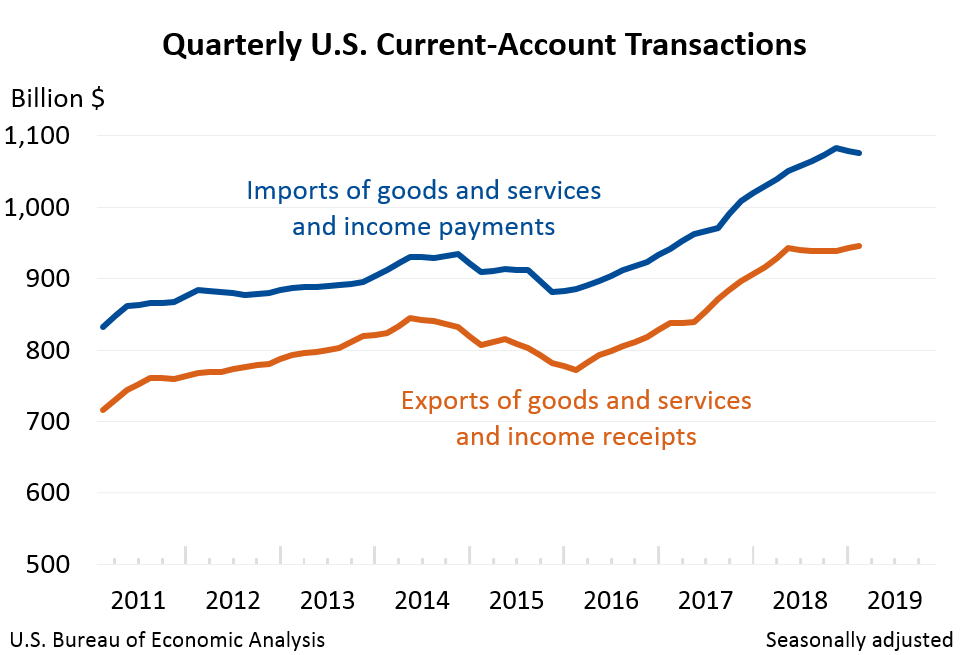
Current-Account Transactions (tables 1-5)
Exports of goods and services and income receipts
Exports of goods and services and income receipts increased $7.2 billion in the first quarter to $945.9 billion.
- Primary income receipts increased $5.3 billion to $281.8 billion, primarily reflecting increases in direct investment income and in other investment income. A decrease in portfolio investment income partly offset the increases. For more information on direct investment income, see "Effects of the 2017 Tax Cuts and Jobs Act on Components of the International Transactions Accounts."
- Goods exports increased $2.4 billion to $419.3 billion, primarily reflecting increases in automotive vehicles, parts, and engines, mostly passenger cars, and in foods, feeds, and beverages, mainly soybeans. A decrease in industrial supplies and materials partly offset the increases.
- Services exports increased $2.3 billion to $209.1 billion, primarily reflecting an increase in travel (for all purposes including education), mostly personal travel.
- Secondary income receipts decreased $2.8 billion to $35.6 billion, reflecting decreases in both private and U.S. government transfers.
Imports of goods and services and income payments
Imports of goods and services and income payments decreased $6.3 billion in the first quarter to $1.08 trillion.
- Goods imports decreased $13.4 billion to $635.9 billion, primarily reflecting a decrease in industrial supplies and materials, mainly petroleum and products.
- Primary income payments increased $4.3 billion to $220.7 billion, primarily reflecting an increase in direct investment income.
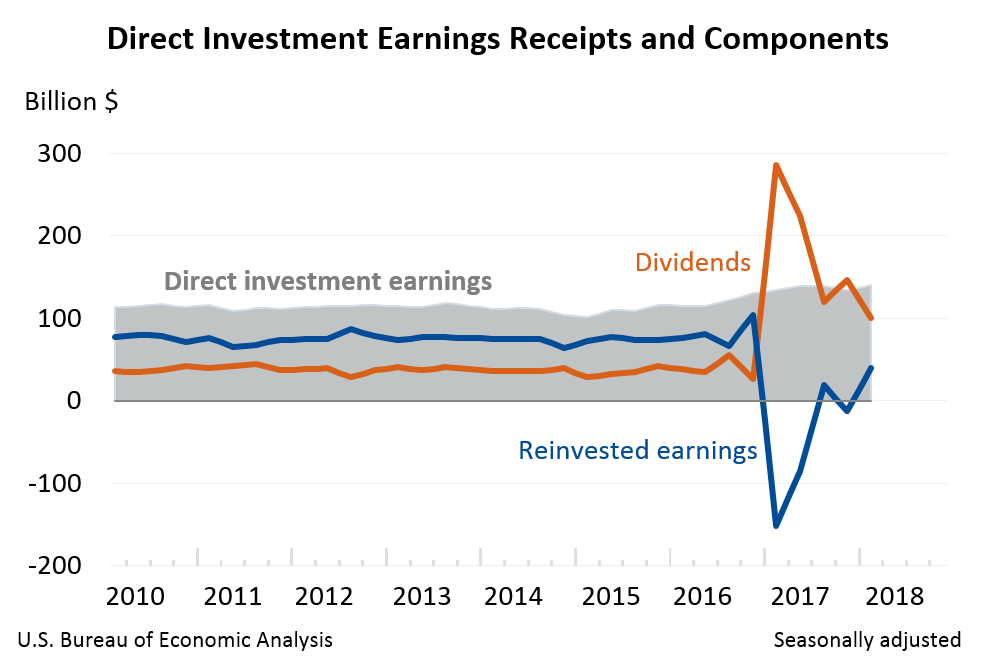
Effects of the 2017 Tax Cuts and Jobs Act on Components of the International Transactions Accounts
| Direct Investment Earnings Receipts Billions of dollars, seasonally adjusted | ||||||||||
| 2017 | 2018 | 2019 | ||||||||
| Ir | IIr | IIIr | IVr | Ir | IIr | IIIr | IVr | Ip | ||
|---|---|---|---|---|---|---|---|---|---|---|
| Direct investment earnings | 114.7 | 115.4 | 122.2 | 130.7 | 134.3 | 139.4 | 139.2 | 134.0 | 140.5 | |
| Dividends | 38.2 | 34.9 | 55.1 | 26.9 | 285.9 | 223.8 | 120.2 | 146.6 | 100.2 | |
| Reinvested earnings | 76.5 | 80.5 | 67.1 | 103.8 | −151.6 | −84.4 | 18.9 | −12.6 | 40.2 | |
| p Preliminary | r Revised | ||||||||||
Capital Account, Fourth Quarter (table 1)
There were no capital-account transactions recorded in the first quarter, following receipts of $2.7 billion in the fourth quarter. The fourth-quarter transactions reflected receipts from foreign insurance companies for losses resulting from the wildfires in California. For information on transactions associated with natural disasters, see "What are the effects of hurricanes and other disasters on the international economic accounts?"
Financial Account (tables 1, 6, 7, and 8)
Net U.S. borrowing measured by financial-account transactions was $37.8 billion in the first quarter, a decrease from net borrowing of $161.6 billion in the fourth quarter.
Financial assets
Net U.S. acquisition of financial assets excluding financial derivatives increased $4.3 billion in the first quarter to $151.6 billion.
- Net U.S. acquisition of direct investment assets increased $33.8 billion to $59.5 billion. For more information on recent transactions in direct investment assets, see "Effects of the 2017 Tax Cuts and Jobs Act on Components of the International Transactions Accounts."
- Net U.S. acquisition of other investment assets increased $9.9 billion to $151.6 billion, reflecting an increase in net U.S. provision of loans to foreign residents that was mostly offset by a decrease in net U.S acquisition of currency and deposits.
- Net U.S. sales of portfolio investment assets increased $37.5 billion to $59.7 billion, reflecting net U.S. sales of foreign stocks following net U.S. purchases in the fourth quarter.
Liabilities
Net U.S. incurrence of liabilities excluding financial derivatives decreased $118.3 billion in the first quarter to $167.9 billion.
- Net U.S. incurrence of other investment liabilities decreased $148.5 billion to $70.2 billion, mostly reflecting net foreign withdrawal of deposits in the United States following a net increase in deposits in the fourth quarter.
- Net foreign sales of U.S. portfolio investment liabilities were $7.7 billion following net foreign purchases of $14.9 billion in the fourth quarter, reflecting relatively large and nearly offsetting changes in U.S. stock and debt security transactions from the fourth to the first quarter.
- Net U.S. incurrence of direct investment liabilities increased $52.7 billion to $105.5 billion, primarily reflecting net U.S. incurrence of debt liabilities following net U.S. repayment in the fourth quarter.
Financial derivatives
Transactions in financial derivatives other than reserves reflected first-quarter net borrowing of $21.4 billion.
Statistical Discrepancy (table 1)
The statistical discrepancy was $92.6 billion in the first quarter following a statistical discrepancy of −$20.4 billion in the fourth quarter.
| Updates to Fourth Quarter 2018 International Transactions Accounts Aggregatess Billions of dollars, seasonally adjusted | ||
| Preliminary estimate | Revised estimate | |
|---|---|---|
| Current-account balance | −134.4 | −143.9 |
| Goods balance | −233.1 | −232.3 |
| Services balance | 66.1 | 61.2 |
| Primary-income balance | 60.4 | 60.1 |
| Secondary-income balance | −27.8 | −32.8 |
| Capital-account balance | 8.9 | 2.7 |
| Net lending (+)/borrowing (–) from financial-account transactions | −168.3 | −161.6 |
| Statistical discrepancy | −42.8 | −20.4 |
Annual Update of the International Transactions Accounts (table 9)
The statistics in this release reflect the annual update of the U.S. international transactions accounts. With this update, BEA has incorporated newly available and revised source data for 2016–2018 for most statistical series. The exceptions are direct investment income and financial transactions, for which BEA has incorporated newly available and revised survey data for 2018 only. The incorporation of updated direct investment survey data for 2016 and 2017 was delayed until 2020 because of the impact of the partial government shutdown that started in December 2018. With this annual update, BEA has also incorporated updated seasonal adjustments for 2014–2018.
Newly Available and Revised Source Data: Key Providers and Years Affected
Agency
|
Data
|
Years affected
|
BEA
|
Quarterly international services surveys
|
2016–2018
|
Quarterly direct investment surveys
|
2018
| |
U.S. Census Bureau
|
Revised source data for Census-basis goods
|
2016–2018
|
U.S. Department of the Treasury
|
Annual portfolio investment surveys
|
2017–2018
|
Quarterly and monthly portfolio and other investment surveys
|
2016–2018
|
UMCA
THE WHITE HOUSE. THEWASHINGTON EXAMINER. June 19, 2019. Mexico Becomes First Country to Approve USMCA
by Zachary Halaschak
“Mexico’s Senate voted overwhelmingly in favor of approving the U.S.-Mexico-Canada Agreement on trade, a deal that would replace the North American Free Trade Agreement,” Zachary Halaschak reports in the Washington Examiner.
“The measure passed with a 114-4 vote, bringing the agreement one step closer to fruition . . . Canada has already introduced legislation through its parliament to ratify the agreement and Canadian Prime Minister Justin Trudeau is expected to lobby Democrats to support the USMCA during his visit to Washington, D.C., this week.”
Mexico’s Senate voted overwhelmingly in favor of approving the U.S.-Mexico-Canada Agreement on trade, a deal that would replace the North American Free Trade Agreement.
The measure passed with a 114-4 vote, bringing the agreement one step closer to fruition. Mexican President Andrés Manuel López Obrador convened a special legislative session to hold the vote after the Senate convened in April.
“The USMCA is synonymous with opportunity in the short and long term,” Mexican Sen. Verónica Martínez García said of the pact.
Meanwhile, the deal is running into some roadblocks getting through Congress. House Speaker Nancy Pelosi has the authority to bring legislation on the matter before the chamber, but has expressed hesitation about the deal, which she says lacks adequate mechanisms to enforce its labor and environmental provisions.
Canada has already introduced legislation through its parliament to ratify the agreement and Canadian Prime Minister Justin Trudeau is expected to lobby Democrats to support the USMCA during his visit to Washington, D.C., this week. He is reportedly meeting with Pelosi on Thursday.
Foreign Minister Chrystia Freeland said last week that Canada would be working “in tandem” with the U.S. in hammering out final passage of the historic trade deal.
“We think of it as a kind of Goldilocks approach. Not too hot, not too cold. We’re not moving too fast, not moving too slow,” Freeland said.
If the agreement between the three North American countries gets finalized, it will replace NAFTA, which was established in 1994. In October 2018, the three countries agreed to work toward ratifying the USMCA.
“There’s too much at stake for our farmers to let this opportunity pass by. USMCA will expand economic opportunity in the heartland,” Rep. Darin LaHood (R-IL) writes in the Washington Examiner. “However, as things stand, USMCA is being held hostage by career politicians in Washington who are hell-bent on preventing President Trump from getting a win. A delay in approval of this agreement will hit the wallets of family farms in Illinois and across the country.”
CANADA
U.S. Department of State. JUNE 20, 2019. Secretary Pompeo’s Call With Canadian Foreign Minister Freeland
The below is attributable to Spokesperson Morgan Ortagus:
Secretary of State Michael R. Pompeo spoke today with Canadian Foreign Minister Chrystia Freeland. The Secretary and Foreign Minister discussed Prime Minister Trudeau’s trip to Washington. They emphasized the importance of supporting the Nicaraguan people in their calls for a restoration of democracy. The Secretary and Foreign Minister also discussed the ongoing humanitarian crisis in Venezuela and expressed concern about Cuba’s destabilizing interference in Venezuela. The Secretary and the Foreign Minister reiterated their continued concern about the ongoing detention in China of Canadian citizens Michael Kovrig and Michael Spavor.
The White House. June 20, 2019. President Trump hosts Canada’s Justin Trudeau at the White House

A day after Mexico’s 114-4 landslide vote to become the first country to ratify the new U.S.-Mexico-Canada trade deal, Canadian Prime Minister Justin Trudeau visited Washington today. In addition to meeting with President Donald J. Trump at the White House, the Prime Minister encouraged Congress to make USMCA a bipartisan priority.
“We’ve worked hard to build a great trade deal that’s good for Canadian workers, good for American workers, good for Mexican workers as well,” Prime Minister Trudeau said. “This is just a really great opportunity for us to continue to work and to develop and to build on the closest alliance in the world, between Canada and the United States.”
President Trump said the new deal, which would replace the 25-year-old NAFTA, is a win for everybody. “It’s great for the farmers, manufacturers . . . It’s great for unions,” he said. It also puts all of North America on the same economic team. “In a trade sense, we’re competing with the European Union. We’re competing with China. It gives us a bigger dialogue. It gives us a much bigger platform.”
Outside of Washington, momentum is growing for USMCA. Today, Congressional leaders from both parties received a letter signed by a majority of the nation’s Governors, calling for swift passage of the deal. “Nearly 25 years after the passage of the North American Free Trade Agreement, it is time to update our trade policies,” they write.
Former Democratic leaders have been vocal in their support for USMCA, as well. “Consider how USMCA would boost wages for workers in the auto industry, which supports over 7 million U.S. jobs,” former Vermont Governor and Democratic presidential candidate Howard Dean says. “It also makes it easier for Mexican workers to form unions and collectively bargain . . . thereby making it less attractive for U.S. companies to shift production and operations to our southern neighbor.”
The bottom line: “This deal has the strongest labor provisions of any U.S. trade agreement in history,” Dean says.
“I really believe that Nancy Pelosi and the House will approve it,” President Trump told reporters from the Oval Office today. “I think the Senate will approve it rapidly.”
AFRICA
DoC. USITC. June 20, 2019. Secretary of Commerce Wilbur Ross Appoints New Members of the President’s Advisory Council on Doing Business in Africa
WASHINGTON – Today, U.S. Secretary of Commerce Wilbur Ross announced that the Department of Commerce, on behalf of President Donald J. Trump, has appointed 26 members to the President’s Advisory Council on Doing Business in Africa (PAC-DBIA).
“The United States is making real progress in Africa, and we remain a strong, long-term, and stable partner in the continent’s economic development especially through the Prosper Africa initiative,” said Secretary of Commerce Wilbur Ross. “We are working to find solutions to transition aid-based economies to trade-based economies and to creating new pathways for mutually beneficial partnerships.”
The PAC-DBIA was established in 2014 to provide analysis and recommendations to the President, through the Secretary of Commerce, on strengthening commercial engagement between the United States and Africa. In its third term, 2019-2021, the PAC-DBIA will continue to play a critical role informing U.S. government policies and activities across the continent, particularly in advancing the economic pillar of the Trump Administration's Africa Strategy through Prosper Africa, which is a whole-of-government, economic initiative to substantially increase two-way trade and investment as well as support increased jobs in the United States and Africa. Prosper Africa demonstrates this Administration’s commitment to the growth of African countries and modernizes the way the government supports private sector opportunities.
U.S. Deputy Secretary of Commerce Karen Dunn Kelley publicly announced the new PAC-DBIA appointments in a keynote address at the Corporate Council on Africa’s U.S.-Africa Business Summit in Maputo, Mozambique, where business and government leaders from the United States and Africa are exploring business opportunities as well as discussing trade and investment policies.
"We are excited to work with the Council on developing private sector recommendations that help guide the expansion of U.S. companies, allowing countless African communities to flourish,” said Deputy Secretary Kelley. “Over the next two years, the PAC-DBIA will continue to serve as an important forum for dialogue between the United States and Africa, with a special focus on advancing the goals of the Prosper Africa initiative”
The appointed members for the 2019-2021 term of the PAC-DBIA are:
- Andrew Inglis, President and Chief Executive Officer, Kosmos Energy, Dallas, Texas
- Andrew Patterson, Global Manager for Strategy and Market and Business Development, Infrastructure, Bechtel Corporation, Reston, Virginia
- Andrew Torre, Regional President for Central and Eastern Europe, Middle East, and Africa, Visa Inc., Foster City, California
- Arjan Toor, Chief Executive Officer, Cigna Africa, Bloomfield, Connecticut
- Bill Killeen, President and Chief Executive Officer, Acrow Bridge, Parsippany, New Jersey
- Brittany Underwood, Founder and Executive Chairman, Akola, Dallas, Texas
- Bruce Hanson, President and Chief Executive Officer, Credence ID, Emeryville, California
- Chris Toth, President, Oncology Systems, Varian Medical Systems, Palo Alto, California
- Craig Arnold, President, Dow Sub-Saharan Africa, Dow Chemical Company, Midland, Michigan
- Damian Halloran, Vice President, Infectious Disease, Emerging Markets, Rapid Diagnostics, Abbott, Chicago, Illinois
- Denise Johnson, President, Resource Industries Group, Caterpillar Inc., Deerfield, Illinois
- Farid Fezoua, President and Chief Executive Officer, GE Africa, Washington, D.C.
- Frank Mosier, Chief Executive Officer, Rendeavour, Inc., New York, New York
- Fred Sisson, Chief Executive Officer, Synnove Energy, Reduit, Republic of Mauritius
- Jake Cusack, Founding and Managing Partner, CrossBoundary Group, Washington, D.C.
- Jason Andringa, President and Chief Executive Officer, Vermeer, Pella, Iowa
- Jason P.H. Brantley, Director for Sales and Marketing, Agriculture and Turf Division, Africa and Asia, John Deere, Moline, Illinois
- John Nevergole, Chief Executive Officer, ABD Group, Philadelphia, Pennsylvania
- Laura Lane, President, Global Public Affairs, UPS, Atlanta, Georgia
- Olivier Puech, Executive Vice President and President, Latin American and EMEA, American Tower Corporation, Miami, Florida
- Paul Marcroft, Chief Commercial Officer, APR Energy, Jacksonville, Florida
- Peter Sullivan, Managing Director, Africa Public Sector Group, Citi, New York, New York
- Raghu Malhotra, President, Middle East & Africa, Mastercard, Purchase, New York
- Rahamatu Wright, Founder and Chief Executive Officer, Shea Yeleen, Washington, D.C.
- Susan Silbermann, Global President for Emerging Markets, Pfizer, New York, New York
- Takreem El-Tohamy, General Manager, Middle East and Africa, IBM, Armonk, New York
FULL DOCUMENT: https://www.trade.gov/pac-dbia/
________________
ORGANISMS
INTERNATIONAL TRADE
TRADE POLICY REVIEW: CANADA. 12 AND 14 JUNE 2019
The eleventh review of the trade policies and practices of Canada takes place on 12 and 14 June 2019. The basis for the review is a report by the WTO Secretariat and a report by the Government of Canada.
Secretariat report, A detailed report written independently by the WTO Secretariat.
- Executive summary: https://www.wto.org/english/tratop_e/tpr_e/s389_sum_e.pdf
- Full report: https://www.wto.org/english/tratop_e/tpr_e/s389_e.pdf
Government report. A policy statement by the government of the member under review.
Background
Trade Policy Reviews are an exercise, mandated in the WTO agreements, in which member countries’ trade and related policies are examined and evaluated at regular intervals. Significant developments that may have an impact on the global trading system are also monitored. All WTO members are subject to review, with the frequency of review depending on the country’s size.
OTHER DOCUMENTS: https://www.wto.org/english/tratop_e/tpr_e/tp489_e.htm
________________
ECONOMIA BRASILEIRA / BRAZIL ECONOMICS
TAXA BÁSICA DE JUROS SELIC
BACEN. 19 Junho 2019. Copom mantém taxa Selic em 6,50% a.a.
Em sua 223ª reunião, o Copom decidiu, por unanimidade, manter a taxa Selic em 6,50% a.a.
A atualização do cenário básico do Copom pode ser descrita com as seguintes observações:
Indicadores recentes da atividade econômica indicam interrupção do processo de recuperação da economia brasileira nos últimos trimestres. O cenário do Copom contempla retomada desse processo adiante, de maneira gradual;
O cenário externo mostra-se menos adverso, em decorrência das mudanças nas perspectivas para a política monetária nas principais economias. Entretanto, os riscos associados a uma desaceleração da economia global permanecem;
O Comitê avalia que diversas medidas de inflação subjacente encontram-se em níveis apropriados, inclusive os componentes mais sensíveis ao ciclo econômico e à política monetária;
As expectativas de inflação para 2019, 2020 e 2021 apuradas pela pesquisa Focus encontram-se em torno de 3,8%, 4,0% e 3,75%, respectivamente; e
No cenário com trajetórias para as taxas de juros e câmbio extraídas da pesquisa Focus, as projeções do Copom situam-se em torno de 3,6% para 2019 e 3,9% para 2020. Esse cenário supõe trajetória de juros que encerra 2019 em 5,75% a.a. e se eleva a 6,50% a.a. em 2020. Também supõe trajetória para a taxa de câmbio que termina 2019 e 2020 em R$/US$ 3,80. No cenário com juros constantes a 6,50% a.a. e taxa de câmbio constante a R$/US$ 3,85*, as projeções situam-se em torno de 3,6% para 2019 e 3,7% para 2020.
O Comitê ressalta que, em seu cenário básico para a inflação, permanecem fatores de risco em ambas as direções. Por um lado, (i) o nível de ociosidade elevado pode continuar produzindo trajetória prospectiva abaixo do esperado. Por outro lado, (ii) uma eventual frustração das expectativas sobre a continuidade das reformas e ajustes necessários na economia brasileira pode afetar prêmios de risco e elevar a trajetória da inflação no horizonte relevante para a política monetária. O risco (ii) se intensifica no caso de (iii) deterioração do cenário externo para economias emergentes. O Comitê avalia que o balanço de riscos para a inflação evoluiu de maneira favorável, mas entende que, neste momento, o risco (ii) é preponderante.
Considerando o cenário básico, o balanço de riscos e o amplo conjunto de informações disponíveis, o Copom decidiu, por unanimidade, pela manutenção da taxa básica de juros em 6,50% a.a. O Comitê entende que essa decisão reflete seu cenário básico e balanço de riscos para a inflação prospectiva e é compatível com a convergência da inflação para a meta no horizonte relevante para a condução da política monetária, que inclui o ano-calendário de 2019 e, principalmente, de 2020.
O Copom reitera que a conjuntura econômica prescreve política monetária estimulativa, ou seja, com taxas de juros abaixo da taxa estrutural.
O Comitê julga importante observar o comportamento da economia brasileira ao longo do tempo, com redução do grau de incerteza a que continua exposta.
O Comitê enfatiza que a continuidade do processo de reformas e ajustes necessários na economia brasileira é essencial para a queda da taxa de juros estrutural e para a recuperação sustentável da economia. O Comitê ressalta ainda que a percepção de continuidade da agenda de reformas afeta as expectativas e projeções macroeconômicas correntes. Em particular, o Comitê julga que avanços concretos nessa agenda são fundamentais para consolidação do cenário benigno para a inflação prospectiva.
Na avaliação do Copom, a evolução do cenário básico e do balanço de riscos prescreve manutenção da taxa Selic no nível vigente. O Comitê ressalta que os próximos passos da política monetária continuarão dependendo da evolução da atividade econômica, do balanço de riscos e das projeções e expectativas de inflação.
Votaram por essa decisão os seguintes membros do Comitê: Roberto Oliveira Campos Neto (Presidente), Bruno Serra Fernandes, Carlos Viana de Carvalho, Carolina de Assis Barros, João Manoel Pinho de Mello, Maurício Costa de Moura, Otávio Ribeiro Damaso, Paulo Sérgio Neves de Souza e Tiago Couto Berriel.
*Valor obtido pelo procedimento usual de arredondar a cotação média da taxa de câmbio R$/US$ observada nos cinco dias úteis encerrados na sexta-feira anterior à reunião do Copom.
COMÉRCIO INTERNACIONAL
OMC. PORTAL G1. REUTERS. 20/06/2019. Chefe da OMC espera diminuição das tensões entre EUA e China. Roberto Azevêdo disse que reunião entre presidentes dos EUA e da China na cúpula do G20 seria 'um sinal bem-vindo'.
Líderes mundiais reunidos no Japão na semana que vem devem tomar medidas concretas em relação ao comércio e não apenas renovar seu pedido para aliviar as tensões comerciais, disse o diretor-geral da Organização Mundial do Comércio (OMC), Roberto Azevêdo, a repórteres nesta quinta-feira (20).
Uma reunião entre o presidente dos Estados Unidos, Donald Trump, e o presidente chinês, Xi Jinping, na cúpula do G20 em Osaka seria "um sinal bem-vindo", disse Azevêdo à associação de jornalistas da ONU, Acanu, em Genebra.
Azevêdo disse que a OMC publicará seu relatório de monitoramento mais recente na semana que vem, mostrando que as economias do G20 estão impondo novas barreiras comerciais acima da média histórica, sem sinal de abatimento desta tendência.
Trump denominou a si mesmo "homem tarifa" e tem feito uso crescente de altas tarifas de importação ou da ameaça de imposição dessas tarifas.
"No que toca a OMC, esperamos que as medidas de restrição ao comércio sejam revertidas em algum momento, porque elas estão - como eu já disse antes - afetando o crescimento da economia e do comércio globais", disse Azevêdo.
Ele acrescentou que está claro que Trump vê as tarifas como uma ferramenta importante para ganhar terreno na negociação, e que ele não é o primeiro a fazer isso, mas ressalvou que tarifas mais elevadas podem romper cadeias de fornecimento, deter o investimento e aumentar ainda mais o já elevado nível de incerteza global.
"Então eu não acho que estamos falando de uma situação onde haja um vencedor, francamente. Todos perdem. E quanto mais pobre e mais vulnerável é o país, quanto mais pobre e mais vulnerável é o cidadão, mais negativamente ele é afetado."
________________
LGCJ.:

