US ECONOMICS
GDP
DoC. BEA. May 1, 2019. Gross Domestic Product by State: Fourth Quarter and Annual 2018. Texas Had the Fastest Growth in the Fourth Quarter
Quarterly GDP by state in 2018:Q4
Real gross domestic product (GDP) increased in 49 states and the District of Columbia in the fourth quarter of 2018, according to statistics released today by the U.S. Bureau of Economic Analysis. The percent change in real GDP in the fourth quarter ranged from 6.6 percent in Texas to 0.0 percent in Delaware (table 1).
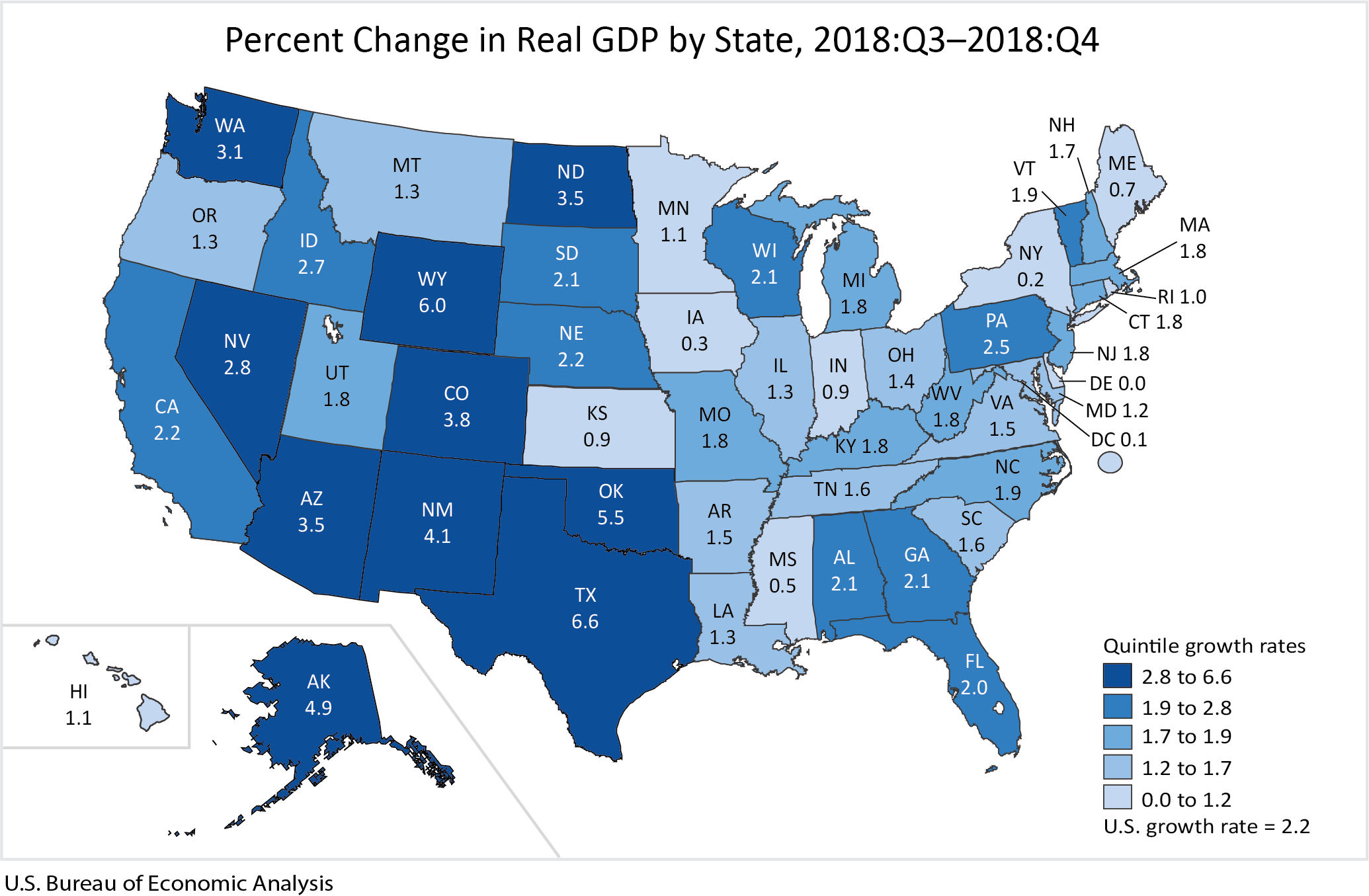
Wholesale trade, mining, and information services were the leading contributors to the increase in real GDP nationally (table 2). Mining and wholesale trade were the leading contributors to the increase in real GDP in Texas, the fastest growing state.
Other highlights
- Wholesale trade increased 9.1 percent nationally and contributed to growth in all 50 states (GDP by Industry table 1).
- Mining increased 38.0 percent nationally and contributed to growth in 49 states. In addition to Texas, this industry was the leading contributor to the increase in real GDP in Wyoming, Oklahoma, Alaska, and New Mexico–the second through fifth fastest growing states.
- Information services increased 8.9 percent nationally and contributed to growth in every state and the District of Columbia.
Annual GDP by state in 2018
Real GDP increased in 49 states and the District of Columbia in 2018. The percent change in real GDP ranged from 5.7 percent in Washington to -0.3 percent in Alaska (table 4).
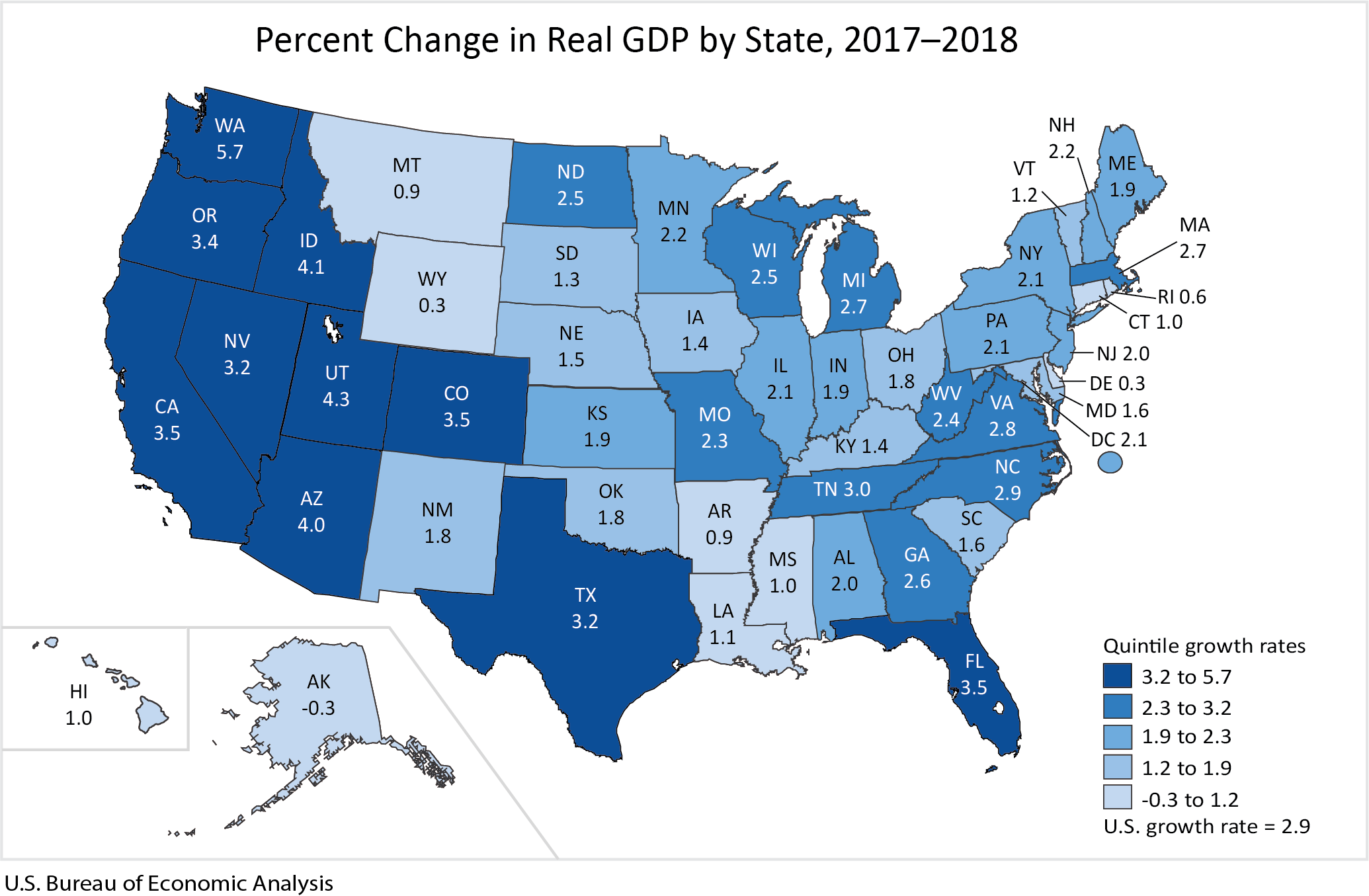
Information services; professional, scientific, and technical services; and durable goods manufacturing were the leading contributors to national economic growth in 2018. Information services and retail trade were the leading contributors to the increase in real GDP in Washington, the fastest growing state (table 5).
Other highlights
- In addition to Washington, information services was the leading contributor to the increase in real GDP in four additional states, including California.
- Professional, scientific, and technical services was the leading contributor to the increase in real GDP in Utah, the second fastest growing state.
- Durable goods manufacturing was the leading contributor to the increase in real GDP in Idaho, the third fastest growing state.
FULL DOCUMENT: https://www.bea.gov/system/files/2019-04/qgdpstate0519_4.pdf
INTEREST RATE
FED. May 01, 2019. Federal Reserve issues FOMC statement
Information received since the Federal Open Market Committee met in March indicates that the labor market remains strong and that economic activity rose at a solid rate. Job gains have been solid, on average, in recent months, and the unemployment rate has remained low. Growth of household spending and business fixed investment slowed in the first quarter. On a 12-month basis, overall inflation and inflation for items other than food and energy have declined and are running below 2 percent. On balance, market-based measures of inflation compensation have remained low in recent months, and survey-based measures of longer-term inflation expectations are little changed.
Consistent with its statutory mandate, the Committee seeks to foster maximum employment and price stability. In support of these goals, the Committee decided to maintain the target range for the federal funds rate at 2-1/4 to 2-1/2 percent. The Committee continues to view sustained expansion of economic activity, strong labor market conditions, and inflation near the Committee's symmetric 2 percent objective as the most likely outcomes. In light of global economic and financial developments and muted inflation pressures, the Committee will be patient as it determines what future adjustments to the target range for the federal funds rate may be appropriate to support these outcomes.
In determining the timing and size of future adjustments to the target range for the federal funds rate, the Committee will assess realized and expected economic conditions relative to its maximum employment objective and its symmetric 2 percent inflation objective. This assessment will take into account a wide range of information, including measures of labor market conditions, indicators of inflation pressures and inflation expectations, and readings on financial and international developments.
Voting for the FOMC monetary policy action were: Jerome H. Powell, Chair; John C. Williams, Vice Chair; Michelle W. Bowman; Lael Brainard; James Bullard; Richard H. Clarida; Charles L. Evans; Esther L. George; Randal K. Quarles; and Eric S. Rosengren.
Implementation Note issued May 1, 2019
Decisions Regarding Monetary Policy Implementation
The Federal Reserve has made the following decisions to implement the monetary policy stance announced by the Federal Open Market Committee in its statement on May 1, 2019:
- The Board of Governors of the Federal Reserve System voted unanimously to set the interest rate paid on required and excess reserve balances at 2.35 percent, effective May 2, 2019. Setting the interest rate paid on required and excess reserve balances 15 basis points below the top of the target range for the federal funds rate is intended to foster trading in the federal funds market at rates well within the FOMC's target range.
- As part of its policy decision, the Federal Open Market Committee voted to authorize and direct the Open Market Desk at the Federal Reserve Bank of New York, until instructed otherwise, to execute transactions in the System Open Market Account in accordance with the following domestic policy directive:
"Effective May 2, 2019, the Federal Open Market Committee directs the Desk to undertake open market operations as necessary to maintain the federal funds rate in a target range of 2-1/4 to 2-1/2 percent, including overnight reverse repurchase operations (and reverse repurchase operations with maturities of more than one day when necessary to accommodate weekend, holiday, or similar trading conventions) at an offering rate of 2.25 percent, in amounts limited only by the value of Treasury securities held outright in the System Open Market Account that are available for such operations and by a per-counterparty limit of $30 billion per day.Effective May 2, 2019, the Committee directs the Desk to roll over at auction the amount of principal payments from the Federal Reserve's holdings of Treasury securities maturing during each calendar month that exceeds $15 billion. The Committee directs the Desk to continue reinvesting in agency mortgage-backed securities the amount of principal payments from the Federal Reserve's holdings of agency debt and agency mortgage-backed securities received during each calendar month that exceeds $20 billion. Small deviations from these amounts for operational reasons are acceptable.
The Committee also directs the Desk to engage in dollar roll and coupon swap transactions as necessary to facilitate settlement of the Federal Reserve's agency mortgage-backed securities transactions."
- In a related action, the Board of Governors of the Federal Reserve System voted unanimously to approve the establishment of the primary credit rate at the existing level of 3.00 percent.
________________
ECONOMIA BRASILEIRA / BRAZIL ECONOMICS
ENERGIA
EUA. PORTAL G1. AFP. 01/05/2019. EUA elevam reserva de petróleo e produção marca novo recorde. Produção teve uma média de 12,3 milhões de barris por dia, o nível mais alto desde 1983.
As reservas americanas de petróleo subiram, e a produção alcançou um novo recorde - anunciou a Agência Federal de Energia dos EUA nesta quarta-feira (1º).
Na semana encerrada na última sexta-feira, as reservas comerciais subiram em 9,9 milhões de barris, chegando a 470,6 milhões. O total supera, assim, a expectativa de aumento dos analistas consultados pela agência Bloomberg, que era de 1,75 milhão.
A produção teve uma média de 12,3 milhões de barris por dia, o nível mais alto desde 1983, quando esses dados começaram a ser coletados.
Com uma produção de mais de 12 milhões de barris há meses, os Estados Unidos se tornaram o maior produtor mundial de petróleo.
As reservas de gasolina tiveram uma alta de 900.000 barris, enquanto os especialistas esperavam uma queda de 950.000. Os estoques de outros destilados tiveram uma diminuição de 1,3 milhão de barris, contra uma queda estimada em 750.000.
________________
LGCJ.:

