CANADA ECONOMICS
EMPLOYMENT
StatCan. 2018-06-08. Labour Force Survey, May 2018
- Employment — Canada: 18,596,000; May 2018; -0.0% decrease (monthly change)
- Unemployment rate — Canada: 5.8%; May 2018; 0.0 pts (monthly change)
- Source(s): Table 14-10-0287-01: https://www150.statcan.gc.ca/t1/tbl1/en/tv.action?pid=1410028701
On a year-over-year basis, employment grew by 238,000 or 1.3%, due to gains in full-time work. Over the same period, total hours worked were up 2.0%.
Chart 1: Employment

Highlights
In May, employment decreased for people in the core working ages of 25 to 54. It increased for people aged 55 and older, and was little changed among youth aged 15 to 24.
Employment increased in Prince Edward Island, while it decreased in British Columbia and Nova Scotia. There was little change in the other provinces.
There were employment increases in four industries in May: accommodation and food services; professional, scientific and technical services; transportation and warehousing; and finance, insurance, real estate, rental and leasing. At the same time, employment declined in health care and social assistance, manufacturing, construction, and "other services."
There was little change in the number of employees in both the private and public sectors, as well as the number of self-employed workers.
Chart 2: Unemployment rate
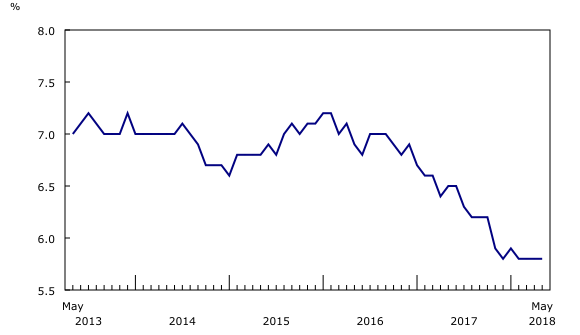
Employment decreases for core age population
For people in the core working ages of 25 to 54, employment fell among both men (-19,000) and women (-19,000). The unemployment rate for men in this age group held steady at 5.0%, while it increased by 0.2 percentage points to 4.9% for women. In the 12 months to May, employment among core-aged men grew by 33,000 (+0.5%), the slowest year-over-year growth for this group since November 2016. Employment increased by 40,000 (+0.7%) for core-aged women on a year-over-year basis.
Among people aged 55 and older, employment increased by 29,000 in May, bringing year-over-year gains to 173,000 (+4.5%). The unemployment rate for this age group fell 0.2 percentage points in the month to 5.1%.
Employment was little changed among youth aged 15 to 24 on both a monthly and year-over-year basis. The unemployment rate for this age group held steady at 11.1% in May.
Employment little changed in most provinces
Employment in Prince Edward Island increased by 800 in May, while the unemployment rate fell by 1.9 percentage points to 9.3%. Compared with 12 months earlier, employment in the province was little changed.
In British Columbia, employment fell by 12,000 in the month. For the first time since May 2015, employment in British Columbia recorded virtually no growth on a year-over-year basis. The unemployment rate was little changed compared with the previous month, at 4.8% in May.
The number of workers in Nova Scotia was down by 3,600 in May, and the unemployment rate increased by 0.5 percentage points to 7.2%. On a year-over-year basis, employment was little changed.
Employment in Quebec was little changed in May, as a decrease in full-time work was offset by more people working part time. The unemployment rate was little changed at 5.3%. In the 12 months to May, employment in the province increased by 65,000 (+1.6%).
In Ontario, there was virtually no change in the number of people working in May, and the unemployment rate was 5.7%. On a year-over-year basis, employment in the province was up by 126,000 (+1.8%).
Industry perspective
In accommodation and food services, employment rose by 18,000 in May, driven by growth in British Columbia. Employment gains in April and May accounted for more than half of the year-over-year increase (+56,000 or +4.7%) in this industry.
Employment in professional, scientific and technical services rose by 17,000 in May, entirely due to gains in Ontario. On a year-over-year basis, employment in this industry was up by 31,000 (+2.1%).
There were 12,000 more people working in transportation and warehousing in May, bringing the year-over-year increase to 42,000 (+4.5%).
Employment in finance, insurance, real estate, rental and leasing rose by 12,000, almost entirely in Quebec. Despite this increase in the month, the number of people working in this industry was similar to that observed 12 months earlier.
There were 24,000 fewer people working in health care and social assistance in the month, while employment was little changed on a year-over-year basis.
Manufacturing employment was down by 18,000 in May, and was virtually unchanged compared with 12 months earlier. Employment in this industry reached a five-year peak in December 2017, and has been trending downward in 2018.
Employment in construction fell for the second consecutive month, decreasing by 13,000 in May. Employment was little changed from 12 months earlier, with recent declines offsetting gains observed in late 2017.
Employment in "other services" fell by 12,000 (-1.5%) in May and was little changed on a year-over-year basis. "Other services" includes services related to civic and professional organizations, and private households.
There was little change in the number of employees and the self-employed in May. On a year-over-year basis, there were increases in the number of public sector (+84,000 or +2.3%) and private sector (+105,000 or +0.9%) employees, while the number of self-employed was little changed.
Summer employment for students
From May to August, the Labour Force Survey collects labour market data on youths aged 15 to 24 who were attending school full time in March and who intend to return to school full time in the fall. The May survey results provide the first indicators of the summer job market, especially for students aged 20 to 24, as many younger students are still in school. Data for June, July and August will provide further insight into the summer job market. Published data are not seasonally adjusted, therefore comparisons can only be made with data for the same month in previous years.
Compared with 12 months earlier, employment among 20- to 24-year-old students was virtually unchanged in May. The employment rate (57.0%) and unemployment rate (13.6%) for this group of students were also little changed compared with May 2017.
In May, there were 33,000 (-7.3%) fewer 17- to 19-year-old students employed compared with May 2017, entirely due to a decrease in part-time work. As there was a similar decrease in the population of students in this age group, there was little change to their employment rate at 49.9%. The unemployment rate for this younger group of students was also little changed at 14.6%.
Canada–US comparison
Adjusted to the concepts used in the United States, the unemployment rate in Canada was 4.8% in May, compared with 3.8% in the United States. In the 12 months to May 2018, the unemployment rate fell by 0.8 percentage points in Canada and by 0.5 percentage points in the United States.
The labour force participation rate in Canada (adjusted to US concepts) was 65.1% in May compared with 62.7% in the United States. On a year-over-year basis, the participation rate decreased by 0.6 percentage points in Canada, while it held steady in the United States.
The US-adjusted employment rate in Canada stood at 62.0% in May compared with 60.4% in the United States. On a year-over-year basis, the employment rate edged down by 0.1 percentage points in Canada and increased by 0.4 percentage points in the United States.
STUDY: https://www150.statcan.gc.ca/n1/en/pub/75-005-m/75-005-m2015002-eng.pdf?st=mVIDvIFD
FULL DOCUMENT: https://www150.statcan.gc.ca/n1/en/daily-quotidien/180608/dq180608a-eng.pdf?st=3bBWotAA
REUTERS. JUNE 8, 2018. Canada sheds jobs in May but wages grow by the most in six years
Leah Schnurr
OTTAWA (Reuters) - The Canadian economy unexpectedly shed jobs in May as hiring declined in manufacturing and construction, although wages rose at their strongest annual pace in nearly six years, which could give the central bank room to raise interest rates as soon as July.
Jobs declined by 7,500 in May, Statistics Canada said on Friday, in contrast with economists’ forecasts for a gain of 17,500 jobs. The unemployment rate held steady at 5.8 percent, as expected.
But average hourly wages rose 3.9 percent from a year earlier, matching a pace last seen in July 2012. The Bank of Canada has said it is closely watching income growth as it considers further interest rates increases.
“We don’t think this should put them off from a July hike ... but this does reinforce the fact that they don’t need to raise rates incredibly quickly,” said Andrew Kelvin, senior rates strategist at TD Securities.
The Bank of Canada laid the groundwork last week for more interest rate hikes, bolstering expectations the central bank will move as early as its next meeting in July.
Markets see 74 percent odds of a hike next month, which would be the bank’s fourth increase in the past year. The Canadian dollar weakened against the greenback immediately after the data.
The decline in jobs was driven by a 31,000 drop in full-time positions, while part-time work rose by 23,600. On a sector basis, goods-producing industries led the way down, with an 18,300 decline in manufacturing jobs and a 13,000 drop in construction.
The Canadian labor market is coming off of a robust 2017 and economists expect the pace of job creation to slow this year.
The decline in construction jobs also comes as the country’s once-hot housing market has cooled in recent months in response to rising interest rates and tighter mortgage rules that came into effect in January.
Indeed, separate data showed ground breaking on new homes cooled in May. The seasonally adjusted annual rate of housing starts fell to 195,613 units from a revised 216,775 units in April, the Canada Mortgage and Housing Corporation said.
A separate report from Statistics Canada showed Canadian industrial capacity utilization rose to 86.1 percent in the first quarter, its highest level in 12 years as it lifted by growth in the construction and manufacturing sectors.
Additional reporting by Fergal Smith in Toronto; Editing by Jim Finkle, Bernadette Baum and Bill Trott
INDUSTRY
StatCan. 2018-06-08. Industrial capacity utilization rates, first quarter 2018
- Industrial capacity use: 86.1%; First quarter 2018; 0.5 pts increase (quarterly change)
- Source(s): Table 16-10-0109-01:
The increase in the first quarter of 2018 was mainly attributable to the construction sector and, to a lesser extent, the manufacturing sector.
Chart 1: The industrial capacity utilization rate continues to climb

Increase mainly attributable to the construction sector
The capacity utilization rate in the construction industry posted a seventh consecutive quarterly increase, rising from 90.8% in the fourth quarter to 92.4% in the first quarter. As in the previous quarter, the gain was due to a widespread increase in construction activity.
Conversely, the capacity utilization rate in the forestry and logging industry decreased from 87.0% to 85.6% in the first quarter, the fifth decline in six quarters.
Durable goods manufacturing leads capacity utilization in the manufacturing sector
The capacity utilization rate of manufacturing edged up 0.4 percentage points in the first quarter to 86.1%. This was the seventh consecutive quarterly increase and the highest level since the fourth quarter of 2000. As in the previous quarter, durable goods manufacturing industries continued to be the main sources of the gain.
Chart 2: Capacity utilization in manufacturing slows

Among transportation equipment manufacturers, the capacity utilization rate rose from 83.6% in the fourth quarter to 85.6% in the first quarter, led by motor vehicle and motor vehicle parts manufacturing, and other transportation equipment manufacturing. This was the second quarterly increase following a large decline in the third quarter of 2017. Transportation equipment manufacturers have not had back-to-back increases since the first and second quarters of 2012.
The capacity utilization rate of the machinery manufacturing industry rose for the seventh consecutive quarter, up 2.5 percentage points to 90.2% in the first quarter on widespread production increases in every subsector of the industry.
The overall gain in the manufacturing sector was partly offset by some declines, particularly in the wood product manufacturing industry. After rising 4.1 percentage points in the fourth quarter, the capacity utilization rate in the wood product manufacturing industry declined for the first time in seven quarters, falling from 94.0% in the fourth quarter to 91.7% in the first quarter on widespread production declines. The United States imposed final countervailing and anti-dumping duties on Canadian softwood lumber in January.
Primary metals manufacturing, which includes aluminum and steel manufacturing, declined 1.1 percentage points to 81.2% in the first quarter, the first decrease in four quarters.
FULL DOCUMENT: https://www150.statcan.gc.ca/n1/en/daily-quotidien/180608/dq180608b-eng.pdf?st=eM5ElhZH
G7
The Globe and Mail. 8 Jun 2018. Trump to face off against angry leaders at G7 summit. Escalating dispute has strained relations between Trump and long-time allies ahead of the weekend summit
ROBERT FIFE, QUEBEC CITY
The Group of Seven Summit is shaping up to be a contentious event with Prime Minister Justin Trudeau and other leaders taking a hard-line against U.S. President Donald Trump’s trade and tariff actions.
The trade battle has strained Mr. Trump’s relations with Mr. Trudeau, German Chancellor Angela Merkel, British Prime Minister Theresa May and French President Emmanuel Macron. Mr. Trump reportedly had even considered sending Vice-President Mike Pence in his place.
On Thursday, however, Mr. Trump said he was looking forward to “good discussions” at the summit, especially on his historic denuclearization talks with North Korean leader Kim Jong-un in Singapore next week.
Later in the evening, Mr. Trump took to Twitter to take a personal pot shot at Mr. Trudeau, who will hold a bilateral meeting with the U.S. President on Friday aside from the talks amongst the leaders.
The U.S. President showed his displeasure with Mr. Trudeau for criticizing U.S. tariffs and lambasted Canada’s supplymanagement system.
The Prime Minister’s Office dismissed the President’s angry tweet against the Prime Minister, saying Mr. Trump has strong opinions as does Mr. Trudeau.
“We are not blind to the fact that there are going to be some serious disagreements on a lot of things and this is an opportunity for the leaders to get together to talk about them,” Mr. Trudeau’s spokesperson Cameron Ahmad said. “At the same time Canadians expect their Prime Minister to stand up for their values and their interests and that is what the Prime Minister is going to do.”
Although the G7 leaders endorse Mr. Trump’s North Korean gamble, they want the focus of the summit − hosted by Mr. Trudeau in the picturesque village of La Malbaie, Que. − to be on the United States’ recently deployed tariffs on steel and aluminum. The dispute is threatening to escalate into a full-blown trade war.
“A trade war doesn’t spare anyone. It will start first of all to hurt U.S. workers, and the cost of raw materials will rise, and industries will become less competitive,” Mr. Macron said at a joint news conference in Ottawa alongside Mr. Trudeau.
The Prime Minister said “we are going to defend our industries and our workers” and “show the U.S. President that his unacceptable actions are hurting his own citizens. American jobs are on the line because of his actions.”
In even blunter language, Mr. Macron said the U.S. tariffs on European, Canadian and Mexican steel and aluminum are “unilateral and illegal,” and predicted that they will hurt global growth.
The gang-up by the G7 leaders is unlikely to push the President to reverse course, however. In a tweet on Thursday, Mr. Trump said: “Getting ready to go to the G-7 in Canada to fight for our country on Trade (we have the worst trade deals ever made).”
Mr. Trump also tweeted: “Please tell Prime Minister Trudeau and President Macron that they are charging the U.S. massive tariffs and create non-monetary barriers. The EU trade surplus with the U.S. is $151 Billion, and Canada keeps our farmers and others out. Look forward to seeing them tomorrow.”
Mr. Trump’s top economic adviser, Larry Kudlow, told reporters on Wednesday the President won’t back down on his tradeand-tariffs dispute with the country’s allies. Mr. Kudlow characterized the angry reactions from Canada and Europe to the tariffs – including reciprocal tariffs on U.S. goods that come into effect on July 1 – as a “family quarrel.”
But Mr. Macron said: “I would like to say Mr. Trump that the measures taken are counterproductive. We can’t engage in a trade war against friends.”
Mr. Trudeau said the leaders want Mr. Trump to abandon the tariffs and, in exchange, they will seek reform of the World Trade Organization, which Mr. Trump has said is tilted against the U.S. economy.
The one issue on which all the leaders agree is Mr. Trump’s effort to denuclearize North Korea. Mr. Trump meets Mr. Kim in Singapore on June 12 − the first meeting of its kind between a leader of North Korea and a sitting U.S. president.
U.S. Secretary of State Mike Pompeo is expected to brief the G7 leaders on the issue on Saturday.
At a news conference in Washington on Thursday with Prime Minister Shinzo Abe of Japan, Mr. Trump said he was prepared to invite North Korea’s dictator to the White House if the nuclear talks are successful, but warned that he won’t be a pushover.
“They have to denuke. If they don’t denuclearize, that will not be acceptable. We cannot take sanctions off. The sanctions are extraordinarily powerful,” Mr. Trump said. “All I can say is I am totally prepared to walk away.”
Mr. Trump also said he would normalize relations with North Korea and sign an agreement to bring an official end to the 1950-53 Korean War if the Kim regime follows through with an agreement that meets U.S. expectations.
Mr. Abe pledged Japanese economic aid and the restoration of diplomatic relations if North Korea agrees to total denuclearization.
Mr. Trump also promised Mr. Abe that he would use the Singapore Summit to raise the issue of 12 Japanese citizens abducted in the late 1970s and early 1980s and held hostage in North Korea.
When he arrives in Canada on Friday for the G7 Summit, Mr. Trump can also expect to be the odd man out on the issues of climate change and Iran, given his decision to pull out of the Iranian nuclear deal. Europe and Canada will press the President to allow them to continue to co-operate with Iran, so that it maintains its promise not to build nuclear weapons.
The Globe and Mail. 8 Jun 2018. G7 expected to back measures against foreign interference in elections
MICHELLE ZILIO, PARLIAMENTARY REPORTER
QUEBEC CITY - G7 leaders are expected to endorse measures to protect the world’s leading liberal democracies from foreign interference in their elections in the wake of Russian interference in the 2016 U.S. election and evidence of tampering in other countries.
A senior diplomatic source, who was not authorized to speak publicly, told The Globe and Mail that Group of Seven leaders are anticipating a significant announcement on challenges facing democracy. The official said talks will centre on cybersecurity and disinformation efforts by foreign states. The official also said leaders will discuss the creation of a new system that would help G7 countries better respond to incidents such as the nerve-agent attack on a former Russian spy and his daughter in Salisbury, Britain, earlier this year.
The G7 is grappling with how to fight foreign interference, particularly meddling efforts by Russia after the Salisbury attack. Foreign Affairs Minister Chrystia Freeland said the G7 leaders will pick up where foreign ministers left off in April, when they backed the British assessment concluding Russia was likely behind the attack.
“Something which we are encountering, particularly from Russia, is a very orchestrated attempt to undermine our democratic institutions from the inside, to undermine the credibility and effectiveness of how our democracies work,” Ms. Freeland told a parliamentary committee on Wednesday night. “It’s an important issue for the world’s leading industrial democracies − that’s what the G7 is − to be addressing and we are seeing that action.”
Japan’s ambassador to Canada Kimihiro Ishikane said he thinks the G7 countries – Canada, the United States, Japan, Britain, France, Germany and Italy – can probably reach consensus on the threat posed by foreign interference, but said it remains to be seen if the leaders will outline any concrete steps to combat it.
“As a matter of principle, we can all agree that liberal democracies need to stay united and demonstrate our resilience vis-a-vis all those kinds of challenges,” Mr. Ishikane told The Globe in an interview on Thursday. “But when it comes to what we need to do, I don’t know.”
Experts expect any statement from G7 leaders on foreign interference will be broad and avoid naming specific countries.
John Kirton, a University of Toronto expert on the G7, predicted the leaders will include a paragraph in their joint communiqué outlining a “strategy” to safeguard liberal democracies, mostly focusing on cybersecurity and the protection of citizens’ data privacy. He said the section will fit into the theme of “building a more peaceful and secure world” − one of the five focuses of Canada’s G7 presidency.
However, Wesley Wark, a national-security expert at the University of Ottawa, doubts G7 leaders will adopt the same strong language recently used by their foreign ministers. At a meeting in Toronto this April, foreign ministers underlined their commitment to defend themselves against Russian interference and outlined plans to set up a working group to examine Russia’s “malign behaviour” on foreign soil.
Given the continuing investigation by U.S. special counsel Robert Mueller into Russian interference in the 2016 election and whether there was collusion with the Trump campaign, Mr. Wark said the other G7 leaders will probably tread lightly on questions of foreign interference with President Donald Trump in Charlevoix, Que., this week.
“I don’t think they’re going to make much headway on this specific piece on defending G7 countries against foreign interference because I think that topic is regarded as slightly offside with President Trump,” Mr. Wark said.
Mr. Trump set the stage for a tense G7 Summit when he announced U.S. tariffs on Canadian, European and Mexican steel and aluminum last week. Speaking to reporters in Ottawa on Thursday, Mr. Trudeau and French President Emmanuel Macron said they will demand Mr. Trump reverse the tariffs when they meet on Friday.
The Globe and Mail. 8 Jun 2018. Meanwhile, Trump’s mind is on that other summit
CAMPBELL CLARK, Columnist
At any other time, with any other president, there couldn’t be a summit like this. The President of the United States is coming to a G7 Summit to talk about his effort at a historic rapprochement with North Korea’s strongman. And most of his allies are consumed with trade, and pledging to stand up to Donald Trump.
Typically, a major presidential initiative on one of the intractable security conundrums of modern times would have the leaders of other Group of Seven countries searching for cues to follow the so-called leader of the free world. On Thursday, one day before the summit, Mr. Trump and other leaders of major industrial democracies were on different wavelengths.
Prime Minister Justin Trudeau and French President Emmanuel Macron preceded the summit with a news conference where they promised to stand up to Mr. Trump’s tariffs on steel and aluminum, and warned him that a trade war will hurt everyone.
Mr. Trump didn’t even talk about that. At his afternoon news conference, he didn’t mention the G7 or tariffs. He doesn’t even want to go to the G7, according to one report, which casts him as grumpy at the prospect of spending two days in Canada when he’s more concerned about meeting North Korean leader Kim Jong-un next week. He’s said to be put off by the prospect of being lectured about tariffs by the other six, and complaining privately about Mr. Trudeau’s opposition to the tariffs.
Mr. Trump did get personal in an evening tweet, complaining that Mr. Trudeau acted “indignant” about steel tariffs but that the Prime Minister didn’t mention Canada’s 300-per-cent tariffs on dairy products (foreign cheese entering Canada faces duties of 226.5 per cent). However, the President didn’t mention that the United States subsidizes its agriculture to the tune of $20-billion a year.
It should give the world pause. These are two big issues, a possible global trade war on the one hand and the first contact with a nuclear-armed rogue state on the other. And the leaders of the seven major industrialized countries are talking past each other.
The obvious exception was Japanese Prime Minister Shinzo Abe, the leader standing beside Mr. Trump at a White House press conference, obsequiously praising the President’s devotion to world peace. But Mr. Abe is different, because his country is a 10-minute missile flight away from Pyongyang. For Japan, understandably, North Korea’s nuclear capacity outranks steel tariffs. When Mr. Trump is preparing for a summit with high stakes for Japan’s security, Mr. Abe wants to be talking to him, a lot.
The North Korea initiative matters to other G7 leaders, of course. They’ll undoubtedly be listening closely to the U.S. plan, hoping to hear Mr. Trump has one. But going in, the tariffs have forestalled any shared sense of what matters most. If it were just these summits at stake, or their communiqués, that wouldn’t be overly consequential, but it can also blunt the ability of the world’s major industrialized democracies to act in concert.
There have been splits in this club before – with then-president George W. Bush on the Iraq War, for example. Every summit involves bridging differences. But there is now unusual direct conflict over trade. The other six believe Mr. Trump is breaching international trade law – and in Canada’s case, NAFTA – threatening a trade war directly aimed at them.
There were already bound to be other differences in Charlevoix – over the U.S. withdrawal from the nuclear agreement with Iran, notably. Mr. Macron, in Ottawa on Thursday, expressed the view of the others on that: If Mr. Trump doesn’t like the deal Barack Obama signed, so be it, but he shouldn’t try to prevent European countries from sticking with the agreement they signed. That’s a message the others feel a little bullied. The tariffs have added to that.
That’s partly because the non-U.S. G6 members don’t feel Mr. Trump’s trade logic should apply to them; if he wants to impose tariffs against countries that use unfair trade practices, and name China, that’s one thing, but the G7 countries are relatively free traders. It’s also because there are rules and multilateral institutions, notably the World Trade Organization, that are supposed to settle those things.
But there’s a division over whether the rules really apply, or to whom. Mr. Trudeau and Mr. Macron stressed multilateralism and the WTO on Thursday; a day earlier, Mr. Trump’s economic adviser, Larry Kudlow, said multilateral institutions such as the WTO won’t determine U.S. national policy.
American presidents have often come to these summits claiming a U.S. exceptionalism that bestows leadership. Now, Mr. Trump is simply declaring the United States an exception. He’s doing his thing, and he’s thinking about a different summit.
REUTERS. JUNE 7, 2018. G7 nations struggle to salvage summit as Trump attacks trade
David Ljunggren, Jan Strupczewski
LA MALBAIE, Quebec (Reuters) - Top U.S. allies scrambled on Friday to keep a Group of Seven nations summit from veering off track as President Donald Trump vowed to deal with “unfair trade practices” by Canada and the European Union.
Washington’s partners in the G7 have been reeling since the Trump administration last week imposed tariffs on steel and aluminum imports from Canada, the EU and Mexico, prompting retaliation and raising the specter of a global trade war.
Canada, the host of the two-day summit in La Malbaie, Quebec, and the nation that has borne much of the brunt of Trump’s trade fusillades in recent days, is holding out hope that progress can be made on less controversial issues.
Asked whether Canadian Prime Minister Justin Trudeau’s team was engaged in frantic damage control, a Canadian government official said it was always clear there would be disagreements at the summit over trade and relations with Russia.
Trump set the tone before leaving Washington on Friday.
“We’re going to deal with the unfair trade practices. If you look at what Canada, and Mexico, the European Union - all of them - have been doing to us for many, many decades. We have to change it. And they understand it’s going to happen,” Trump said.
He also said that Russia should be attending the summit, an idea that was unlikely to gain much traction at the G7 gathering, which groups Canada, the United States, Japan, Britain, Italy, France and Germany. The EU is also attending.
Russia was suspended from what was then called the G8 in 2014 because of its annexation of Crimea from Ukraine. Trump said Russia should be readmitted, but even Moscow seemed to reject that suggestion.
“Russia is focused on other formats, apart from the G7,” Kremlin spokesman Dmitry Peskov said in a statement reported by the government-controlled Sputnik news agency.
Trump’s presidency has been clouded by a federal investigation into alleged Russian meddling in the 2016 presidential election, and possible collusion by his campaign. Both Moscow and Trump have denied the allegations.
A source within the French presidency said Trump’s proposal did not seem “coherent,” and that it would be discussed in Quebec. A spokesman for Canada’s Trudeau said Ottawa’s position against allowing Russia back into the G7 had not changed.
New Italian Prime Minister Giuseppe Conte struck a contrarian note, saying Russia should be readmitted.
NERVOUS MARKETS
Trump, who aides said has scant interest in multilateralism, is set to have bilateral meetings with French President Emmanuel Macron and Canada’s Trudeau at the summit. The White House said he would leave four hours earlier than originally planned to fly to Singapore to meet with North Korean leader Kim Jong Un.
The Canadian government official said there could be meaningful progress on less controversial issues at the summit such as economic growth, the environment and gender equality. “We have no reason to believe there will be problems on those issues,” the official said on condition of anonymity.
The U.S. leader will miss talks about climate change and clean energy, and will have left Canada by the time the other leaders begin closing news conferences likely to be laden with criticism of Washington’s policies.
While the G7 chiefs have largely praised Trump for his efforts to stabilize the Korean peninsula, they are unhappy he pulled out of an international agreement designed to limit Iran’s nuclear ambitions.
Officials have conceded the mood at the summit will likely be exceptionally tense.
Although Trump says his tariffs are necessary to protect U.S. industry and workers, Canada and the EU have denounced them as illegal. Canada has proposed levies on a range of U.S. goods next month and the EU has pledged its own retaliatory measures.
That has financial markets worried about tit-for-tit escalation that could tarnish an overall rosy global economic outlook.
U.S. stock indexes initially dipped on Friday, partly due to investor nervousness over the G7 summit, but later turned positive.
“When it comes to trade - the positions are very clear. The President of the United States thinks that the U.S. has been treated in an unfair way by Europe and by others, and the others think that this is not the case,” European Commission President Jean-Claude Juncker told a press conference in La Malbaie.
“We will explain this through facts and figures, that this is not the right view one should have on this topic,” Juncker said.
Canada is also frustrated by what it sees as unacceptable U.S. demands in talks to modernize the North American Free Trade Agreement, a deal that Trump has frequently criticized and threatened to terminate. Mexico is also a member of NAFTA.
Additional reporting by Susan Heavey and Doina Chiacu in Washington and Jean-Baptiste Vey, Giselda Vagnoni, William James, Jan Strupczewski, Andrea Hopkins and David Ljunggren in La Malbaie, Quebec; Writing by Paul Simao; Editing by Hugh Lawson, Jeffrey Benkoe and Susan Thomas
REUTERS. JUNE 8, 2018. Trump says Russia should be at G7 meeting, Moscow not so sure
James Oliphant
WASHINGTON (Reuters) - Russia should be attending a Group of Seven summit in Canada, U.S. President Donald Trump said on Friday, a controversial idea that even Moscow seemed to reject, as he headed for a chilly reception at the meeting where other leaders are set to clash with him over trade.
Russia was expelled from what was then called the G8 in 2014 because of its annexation of Crimea from Ukraine. Trump’s suggestion of readmitting Russia was unlikely to gain any traction at the gathering of the group that includes the United States, Canada, Japan, Britain, Italy, France and Germany.
“You know, whether you like it or not, and it may not be politically correct, but we have a world to run and the G7, which used to be the G8, they threw Russia out, they can let Russia come back in, because we should have Russia at the negotiating table,” Trump told reporters before leaving Washington.
A senior British government source said Russia needs to change its approach before any conversation about it rejoining the G7 can begin.
A French presidential source said Trump’s proposal did not seem “coherent” in view of the latest economic sanctions imposed by the United States on Moscow.
The Russian government also appeared to snub Trump’s idea.
“Russia is focused on other formats, apart from the G7,” Kremlin spokesman Dmitry Peskov said in a brief statement reported by the government-controlled Sputnik news agency.
However, new Italian Prime Minister Giuseppe Conte threw his weight behind Trump’s call for Russia to be included, saying on Twitter it would be “in the interests of everyone.”
Trump was heading into a bigger controversy over trade as other G7 leaders, including host Canadian Prime Minister Justin Trudeau, have been angered by Washington’s imposition of tariffs on steel and aluminum imported from allies including Canada and the European Union.
At least three of Trump’s fellow Republicans in the U.S. Senate, all frequent critics of the president, assailed his suggestion of readmitting Russia to the group.
“This is weak,” Senator Ben Sasse said. “Putin is not our friend and he is not the president’s buddy. He is a thug using Soviet-style aggression to wage a shadow war against America, and our leaders should act like it.”
Trump’s presidency has been clouded by a federal investigation into Russian meddling into the 2016 U.S. election and possible coordination by people in Trump’s campaign. Both Moscow and Trump have denied any such activity.
Senators Jeff Flake and John McCain, one of the Kremlin’s fiercest critics, also denounced the idea.
“Vladimir Putin chose to make Russia unworthy of membership in the G8 by invading Ukraine and annexing Crimea. Nothing he has done since then has changed that most obvious fact,” McCain said.
Senate Democratic leader Chuck Schumer criticized the Republican president’s leadership.
“We need the president to be able to distinguish between our allies and adversaries, and to treat each accordingly,” he said in a statement.
Trump has periodically called for closer ties with Russia, although his administration’s policy has included strong sanctions against Moscow.
Reporting by James Oliphant; Additional reporting by Polina Nikolskaya in Moscow, Jean-Baptiste Vey, Crispian Balmer, William James in La Malbaie, Quebec; Writing by Eric Walsh; Editing by Frances Kerry and Grant McCool
REUTERS. JUNE 7, 2018. G7 nations struggle to salvage summit as Trump attacks trade
David Ljunggren, Jan Strupczewski
LA MALBAIE, Quebec (Reuters) - Top U.S. allies scrambled on Friday to keep a Group of Seven nations summit from veering off track as President Donald Trump vowed to deal with “unfair trade practices” by Canada and the European Union.
Washington’s partners in the G7 have been reeling since the Trump administration last week imposed tariffs on steel and aluminum imports from Canada, the EU and Mexico, prompting retaliation and raising the specter of a global trade war.
Canada, the host of the two-day summit in La Malbaie, Quebec, and the nation that has borne much of the brunt of Trump’s trade fusillades in recent days, is holding out hope that progress can be made on less controversial issues.
Asked whether Canadian Prime Minister Justin Trudeau’s team was engaged in frantic damage control, a Canadian government official said it was always clear there would be disagreements at the summit over trade and relations with Russia.
Trump set the tone before leaving Washington on Friday.
“We’re going to deal with the unfair trade practices. If you look at what Canada, and Mexico, the European Union - all of them - have been doing to us for many, many decades. We have to change it. And they understand it’s going to happen,” Trump said.
He also said that Russia should be attending the summit, an idea that was unlikely to gain much traction at the G7 gathering, which groups Canada, the United States, Japan, Britain, Italy, France and Germany. The EU is also attending.
Russia was suspended from what was then called the G8 in 2014 because of its annexation of Crimea from Ukraine. Trump said Russia should be readmitted, but even Moscow seemed to reject that suggestion.
“Russia is focused on other formats, apart from the G7,” Kremlin spokesman Dmitry Peskov said in a statement reported by the government-controlled Sputnik news agency.
Trump’s presidency has been clouded by a federal investigation into alleged Russian meddling in the 2016 presidential election, and possible collusion by his campaign. Both Moscow and Trump have denied the allegations.
A source within the French presidency said Trump’s proposal did not seem “coherent,” and that it would be discussed in Quebec. A spokesman for Canada’s Trudeau said Ottawa’s position against allowing Russia back into the G7 had not changed.
New Italian Prime Minister Giuseppe Conte struck a contrarian note, saying Russia should be readmitted.
NERVOUS MARKETS
Trump, who aides said has scant interest in multilateralism, is set to have bilateral meetings with French President Emmanuel Macron and Canada’s Trudeau at the summit. The White House said he would leave four hours earlier than originally planned to fly to Singapore to meet with North Korean leader Kim Jong Un.
The Canadian government official said there could be meaningful progress on less controversial issues at the summit such as economic growth, the environment and gender equality. “We have no reason to believe there will be problems on those issues,” the official said on condition of anonymity.
The U.S. leader will miss talks about climate change and clean energy, and will have left Canada by the time the other leaders begin closing news conferences likely to be laden with criticism of Washington’s policies.
While the G7 chiefs have largely praised Trump for his efforts to stabilize the Korean peninsula, they are unhappy he pulled out of an international agreement designed to limit Iran’s nuclear ambitions.
Officials have conceded the mood at the summit will likely be exceptionally tense.
Although Trump says his tariffs are necessary to protect U.S. industry and workers, Canada and the EU have denounced them as illegal. Canada has proposed levies on a range of U.S. goods next month and the EU has pledged its own retaliatory measures.
That has financial markets worried about tit-for-tit escalation that could tarnish an overall rosy global economic outlook.
U.S. stock indexes initially dipped on Friday, partly due to investor nervousness over the G7 summit, but later turned positive.
“When it comes to trade - the positions are very clear. The President of the United States thinks that the U.S. has been treated in an unfair way by Europe and by others, and the others think that this is not the case,” European Commission President Jean-Claude Juncker told a press conference in La Malbaie.
“We will explain this through facts and figures, that this is not the right view one should have on this topic,” Juncker said.
Canada is also frustrated by what it sees as unacceptable U.S. demands in talks to modernize the North American Free Trade Agreement, a deal that Trump has frequently criticized and threatened to terminate. Mexico is also a member of NAFTA.
Additional reporting by Susan Heavey and Doina Chiacu in Washington and Jean-Baptiste Vey, Giselda Vagnoni, William James, Jan Strupczewski, Andrea Hopkins and David Ljunggren in La Malbaie, Quebec; Writing by Paul Simao; Editing by Hugh Lawson, Jeffrey Benkoe and Susan Thomas
AVIATION
REUTERS. JUNE 8, 2018. Airbus nails down Bombardier CSeries deal in boost to jet
Allison Lampert, Rama Venkat Raman
(Reuters) - European planemaker Airbus SE (AIR.PA) has finalized a rescue deal for Bombardier Inc’s (BBDb.TO) CSeries jet and is expected to flex its cost-cutting and marketing muscle to revive the money-losing Canadian venture.
Bombardier agreed in October to sell Airbus a 50.01 percent stake in its flagship commercial jet for a token fee of one Canadian dollar, after sluggish sales and low production rates pushed the program well over budget.
Airbus will be able to offer airlines deals by packaging the CSeries with its own jets in a challenge to rival Boeing Co (BA.N) and is expected to use its industrial power to slash the price of parts and improve efficiencies internally.
After winning regulatory approvals and agreeing on the fine print of the deal late on Thursday, the two companies said they were ready to start the new tie-up formally on July 1.
The deal’s completion finalizes a historic shift in the aircraft industry, with 75-year-old Bombardier abandoning its standalone bid to enter the main jet market dominated by Airbus and Boeing, in exchange for a stake in a stronger project.
Boeing is now holding its own tie-up talks with Bombardier’s Brazilian rival Embraer SA (EMBR3.SA).
Bombardier will retain 31 percent in the CSeries while Investissement Quebec, run by the province of Quebec, will hold 19 percent.
The deal is also expected to mark the end of the CSeries branding chosen when Bombardier launched the jet a decade ago, though Airbus said it had not yet decided what to call it.
Canadian Innovation Minister Navdeep Bains said in a statement on Friday that Airbus had committed to maintaining Montreal as the main CSeries industrial site, where more than 2,000 Quebec workers rely on the jet.
David Chartrand, Quebec coordinator of a union representing around 1,200 CSeries workers, expressed concerns about possible job losses among office support staff as Airbus cuts costs, as opposed to workers on the shop floor.
“The synergies are not going to bring workers from France to work on the plane,” Chartrand said in a phone interview.
Airbus also plans to expand its Mobile, Alabama, assembly plant to handle four CSeries aircraft per month for the U.S. market as well as Airbus jets. It said work would begin next year.
The priority this year is to boost production, with 2018 CSeries deliveries expected be around double the 17 aircraft delivered last year, the companies said in a release. Bombardier has previously forecast 40 CSeries deliveries in 2018, but faced delays earlier in the year.
Philippe Balducchi, head of the new CSeries partnership, told reporters on a conference call that “we will be very focused on having a robust ramp-up,” in reference to increasing aircraft production.
Bombardier will continue for the time being to fund the investments needed to support the production increase up to certain agreed financial levels, beyond which any cash shortfalls will be shared by the main partners.
“Looking forward, I’m very confident that CSeries is going to contribute positively to the cash generation of Airbus in the future,” Airbus Finance Director Harald Wilhelm said on the same conference call.
BOMBARDIER UPDATES GUIDANCE
Closing the deal allows Bombardier to shed CSeries losses, while Airbus is betting that its ability to negotiate cuts in the cost of parts will help put the program in the black.
Bombardier had previously said it expected to break even on the CSeries in 2020. The company’s aerospace division has long trailed its higher-performing rail and business jet units.
Airbus SE
100.9
AIR.PAPARIS STOCK EXCHANGE
+1.25(+1.25%)
AIR.PA
AIR.PABBDb.TOBA.NEMBR3.SA
Bombardier raised its guidance for 2018 consolidated earnings before interest and tax by $100 million to a range of between $900 million and $1 billion, to reflect the separation of the loss-making CSeries. [nGNE1pBbkl
Bombardier also said it was cutting its revenue target by $500 million to $16.5 billion-$17 billion. The CSeries will no longer be consolidated in its results from July 1.
Bombardier shares were down 1 percent at C$4.87 on Friday afternoon in Toronto, while Airbus shares gained 1.25 percent to close at 100.90 euros in Paris.
Reporting by Allison Lampert in Montreal and Rama Venkat Raman in Bengaluru; Additional reporting by Parikshit Mishra in Bengaluru and Cyril Altmeyer and Tim Hepher in Paris; Editing by Patrick Graham and Matthew Lewis
PM
June 8, 2018. Prime Minister nominates new Parliamentary Librarian
Ottawa, Ontario - The Prime Minister, Justin Trudeau, today announced the nomination of Heather Lank as the new Parliamentary Librarian.
Dr. Lank has served in increasingly senior roles within the Senate of Canada administration for over 25 years. She is currently the Principal Clerk of the Senate Chamber Operations and Procedure Office, a position she has held since 2015.
Established in 1876, the Library of Parliament is a fully functioning library whose collection and services support the activities and decisions of Parliament and parliamentarians. The Parliamentary Librarian oversees the management of the Library and reports to the Speakers of the Senate and the House of Commons.
Dr. Lank was chosen as the nominee for the position of Parliamentary Librarian through the Government’s open, transparent, and merit-based appointment process.
Quote
“Heather Lank’s extensive career in the Senate of Canada administration makes her an outstanding candidate for the position of Parliamentary Librarian. Her knowledge and understanding of Canada’s parliamentary system and services are second-to-none. I know she will do an excellent job managing this important institution that Parliament and all parliamentarians rely on.”
– The Rt. Hon. Justin Trudeau, Prime Minister of Canada
Quick Facts
- The Parliamentary Librarian is appointed by the Governor in Council under the Parliament of Canada Act.
- The Library of Parliament contributes to Canadian parliamentary democracy by creating, managing, and delivering authoritative, reliable, and relevant information for both Houses of Parliament. The Library also collects, curates, preserves, and ensures access to historical information about Parliament.
Biographical Notes
Heather Lank: Born in Arvida, Quebec, and educated in Switzerland, the United States, and Canada, Heather Lank holds both a masters and a doctorate in sociology from the University of Toronto.
Dr. Lank joined the federal Public Service in 1990 as an operational auditor with Correctional Service Canada. She began her career with the Senate of Canada administration in 1991 as a committee clerk, and has assumed progressively senior leadership roles over the past 27 years.
Dr. Lank has served as Principal Clerk of the Senate Chamber Operations and Procedure Office since 2015. In this capacity, she is responsible for procedural, administrative, and informational support for all Senate sittings, including providing advice and support to the Speaker of the Senate on matters of procedure and practice.
She is also responsible for the preparation and publication of official parliamentary documents, including the Order Paper and Notice Paper, Journals of the Senate, Debates of the Senate, as well as numerous documents on parliamentary procedure.
Dr. Lank is a highly regarded leader, manager, and fluently bilingual communicator and educator with an in-depth knowledge of Canada’s parliamentary system and services.
June 8, 2018. Statement by the Prime Minister on World Oceans Day
Ottawa, Ontario - The Prime Minister, Justin Trudeau, today issued the following statement on World Oceans Day:
“Oceans have a profound impact on our way of life. They are vast sources of food and energy, home to unique habitats and abundant marine life, and the site of historical moments that continue to shape the world.
“With the longest coastline on earth, Canada’s past – and future – is inseparable from its oceans, coasts, and seas. These natural treasures form the economic bedrock of countless communities. They are gateways to jobs, destinations for recreation and tourism, and hubs of global trade and transportation networks.
“This year, World Oceans Day coincides with the first day of the G7 Summit, where Canada will bring together world leaders and heads of international organizations to fight climate change and preserve the health and resilience of our oceans, coasts, and seas.
“Young people from across G7 countries have already brought forward inspiring ideas, and the #myoceans2050 and #G7oceans conversation will continue when the G7 Environment and Energy ministers meet to discuss how to work together on climate change, oceans, and clean energy in the Fall.
“Since launching the historic Oceans Protection Plan in 2016, the Government of Canada has made meaningful progress to improve the health of our oceans and restore coastal habitats across the country. We are also working in partnership with Indigenous Peoples and coastal communities to help protect and support our vital aquatic ecosystems, including endangered whales species. We will continue to take concrete steps to meet our international commitment to protect 10 per cent of our marine and coastal areas by 2020.
“World Oceans Day is the perfect day to take action to protect the waters that sustain us. You can make a difference right now by joining an online discussion on how Canada can achieve zero plastic waste and reduce marine litter.
“All of us have a stake in keeping our oceans, coasts, and seas clean, healthy, and resilient. Today, and every day, let’s do our part to protect these great bodies of water and idyllic coasts for generations to come.”
June 7, 2018. Statement by the Prime Minister on the results of the provincial election in Ontario
Ottawa - The Prime Minister, Justin Trudeau, today issued the following statement on the results of the provincial election in Ontario:
“Ontarians have chosen to elect a majority government led by the Ontario Progressive Conservative Party.
“On behalf of the Government of Canada, I offer my sincere congratulations to Doug Ford who will have the honour and privilege to serve as Premier.
“I look forward to working with the new provincial government to create good, middle class jobs, make Ontario a world-leading centre for innovative and sustainable technologies, and build infrastructure that meets the needs of Ontarians.
“Together, we will continue to work to grow Ontario’s economy and address issues of importance to Ontarians and all Canadians.
“I also thank Kathleen Wynne for her years of service as Premier.”
June 7, 2018. Itinerary for June 8 to 10, 2018
Note: All times local
Itinerary for Friday, June 8:
La Malbaie, Quebec
8:15 a.m. The Prime Minister will meet with the Prime Minister of the United Kingdom, Theresa May.
Murray Room, Lobby Level
Fairmont Le Manoir Richelieu Hotel
Note for media:
Pooled photo opportunity
9 a.m. The Prime Minister will meet with the Prime Minister of Japan, Shinzo Abe.
Murray Room, Lobby Level
Fairmont Le Manoir Richelieu Hotel
Note for media:
Pooled photo opportunity
10:15 a.m. The Prime Minister will meet with the Prime Minister of Italy, Giuseppe Conte.
Murray Room, Lobby Level
Fairmont Le Manoir Richelieu Hotel
Note for media:
Pooled photo opportunity
11:30 a.m. The Prime Minister will meet with the Chancellor of Germany, Angela Merkel.
Murray Room, Lobby Level
Fairmont Le Manoir Richelieu Hotel
Note for media :
Pooled photo opportunity
11:45 a.m. The Prime Minister will participate in the G7 Official Welcoming Ceremony.
St-Laurent Terrace
Fairmont Le Manoir Richelieu Hotel
Note for media:
Pooled photo opportunity
12:30 p.m. The Prime Minister will attend the G7 Working Luncheon.
Le Point Cardinal Restaurant, Clubhouse
Fairmont Le Manoir Richelieu Hotel
Note for media:
Official photographers only
2:10 p.m. The Prime Minister will take part in the G7 Official Family Photograph.
Opposite Clubhouse
Fairmont Le Manoir Richelieu Hotel
Note for media:
Pooled photo opportunity
3 p.m. The Prime Minister will participate in the G7 Working Session I.
G7 Summit Room, Lobby Level
Fairmont Le Manoir Richelieu Hotel
Note for media:
Pooled photo opportunity
5 p.m. The Prime Minister will meet with the President of the United States of America, Donald Trump.
Murray Room, Lobby Level
Fairmont Le Manoir Richelieu Hotel
Note for media:
Pooled photo opportunity
6:30 p.m. The Prime Minister will attend the G7 Working Dinner.
Note for media:
Official photographers only
9 p.m. The Prime Minister will participate in the G7 Cultural Programme.
L’Ovale, St-Laurent Terrace
Fairmont Le Manoir Richelieu Hotel
Note for media:
Official photographers only
Itinerary for Saturday, June 9, 2018:
La Malbaie, Quebec
8 a.m. The Prime Minister will have breakfast with the members of the Gender Equality Advisory Council.
G7 Meeting Room, Lobby Level
Fairmont Le Manoir Richelieu Hotel
Note for media:
Pooled photo opportunity
9:30 a.m. The Prime Minister will participate in the G7 Working Session II.
G7 Summit Room, Lobby Level
Fairmont Le Manoir Richelieu Hotel
Note for media:
Pooled photo opportunity
10:45 a.m. The Prime Minister will participate in the G7 Working Session III.
G7 Summit Room, Lobby Level
Fairmont Le Manoir Richelieu Hotel
Closed to media
11:45 a.m. The Prime Minister will participate in the Official Welcoming Ceremony for Outreach Countries and International Organizations.
St-Laurent Terrace
Fairmont Le Manoir Richelieu Hotel
Note for media:
Pooled photo opportunity
12:15 p.m. The Prime Minister will participate in the G7 Working Session with Outreach Countries and International Organizations.
G7 Meeting Room with Outreach Countries, Lobby Level
Fairmont Le Manoir Richelieu Hotel
Note for media:
Pooled photo opportunity
1:30 p.m. The Prime Minister will take part in the G7 family photo with Outreach Countries and International Organizations.
Main Press Theatre, Lobby Level
Fairmont Le Manoir Richelieu Hotel
Note for media:
Pooled photo opportunity
1:45 p.m. The Prime Minister will attend the G7 Working Luncheon with Outreach Countries and International Organizations.
G7 Meeting Room with Outreach Countries, Lobby Level
Fairmont Le Manoir Richelieu Hotel
Closed to media
4 p.m. The Prime Minister will hold a media availability.
Press Theatre, Lobby Level
Fairmont Le Manoir Richelieu Hotel
Note for media:
Open coverage
5:15 p.m. The Prime Minister will meet with the Secretary-General of the United Nations, António Guterres.
Murray Room, Lobby Level
Fairmont Le Manoir Richelieu Hotel
Note for media:
Pooled photo opportunity
5:45 p.m. The Prime Minister will participate in a roundtable discussion with Small Island Developing States.
St-François Lounge, Lobby Level
Fairmont Le Manoir Richelieu Hotel
Note for media:
Pooled photo opportunity
7 p.m. The Prime Minister will meet with the President of Argentina, Mauricio Macri.
Murray Room, Lobby Level
Fairmont Le Manoir Richelieu Hotel
Note for media:
Pooled photo opportunity
Itinerary for Sunday, June 10, 2018:
Quebec City, Quebec
10 a.m. The Prime Minister will meet with the President of Senegal, Macky Sall.
Petit Frontenac Room, 2nd Floor
Fairmont Le Château Frontenac Hotel
Note for media:
Pooled photo opportunity
10:45 a.m. The Prime Minister will meet with the President of South Africa, Cyril Ramaphosa.
Petit Frontenac Room, 2nd Floor
Fairmont Le Château Frontenac Hotel
Note for media:
Pooled photo opportunity
11:30 a.m. The Prime Minister will meet with the Prime Minister of Bangladesh, Sheikh Hasina.
Petit Frontenac Room, 2nd Floor
Fairmont Le Château Frontenac Hotel
Note for media:
Pooled photo opportunity
12:15 p.m. The Prime Minister will meet with the Prime Minister of Vietnam, Nguyễn Xuân Phúc.
Petit Frontenac Room, 2nd Floor
Fairmont Le Château Frontenac Hotel
Note for media:
Pooled photo opportunity
1:30 p.m. The Prime Minister will meet with the President of Rwanda, Paul Kagame.
Petit Frontenac Room, 2nd Floor
Fairmont Le Château Frontenac Hotel
Note for media:
Pooled photo opportunity
2:15 p.m. The Prime Minister will meet with the President of Kenya, Uhuru Kenyatta.
Petit Frontenac Room, 2nd Floor
Fairmont Le Château Frontenac Hotel
Note for media:
Pooled photo opportunity
________________
LGCJ.:

