US ECONOMICS
CHINA
U.S. Department of State. 06/22/2020. Designation of Additional Chinese Media Entities as Foreign Missions
Over the past decade and particularly under General Secretary Xi Jinping’s tenure, the CCP has reorganized China’s state propaganda outlets disguised as news agencies and asserted even more direct control over them. He has stated “Party-owned media must. . . embody the party’s will, safeguard the party’s authority … their actions must be highly consistent with the party.” In short, while Western media are beholden to the truth, PRC media are beholden to the Chinese Communist Party.
Pursuant to authorities under the Foreign Missions Act, the State Department is issuing today a new determination that designates the U.S. operations of China Central Television, China News Service, the People’s Daily, and the Global Times as foreign missions. This follows on the February 18 designation of Xinhua News Agency, China Global Television Network, China Radio International, China Daily Distribution Corporation, and Hai Tian Development USA.
These nine entities all meet the definition of a foreign mission under the Foreign Missions Act, which is to say that they are “substantially owned or effectively controlled” by a foreign government. In this case, they are effectively controlled by the government of the People’s Republic of China.
The decision to designate these entities is not based on any content produced by these entities, nor does it place any restrictions on what the designated entities may publish in the United States. It simply recognizes them for what they are.
Entities designated as foreign missions must adhere to certain administrative requirements that also apply to foreign embassies and consulates in the United States.
This designation recognizes PRC propaganda outlets as foreign missions and increases transparency relating to the CCP and PRC government’s media activities in the United States.
U.S. Department of State. 06/22/2020. Briefing With Assistant Secretary for East Asian and Pacific Affairs David R. Stilwell On Designating Additional PRC State Media Entities as Foreign Missions. David R. Stilwell, Assistant SecretaryBureau of East Asian and Pacific Affairs. Via Teleconference
MS ORTAGUS: Great, thank you. Good afternoon, everyone. I hope everyone had a nice weekend, and Happy Father’s Day to all of the dads on the line. I’m happy to have my friend, of course, Assistant Secretary Dave Stilwell to speak with all of you today. I know that he spoke last week, Thursday afternoon, regarding our meetings in Hawaii. One thing I just want to make clear from the top: We need to embargo the contents of this briefing until 15:00, so 3:00 p.m. We – this will be on the record, but everything is just going to be embargoed until 3:00 p.m., 15:00. So if everybody can just please abide by that embargo, I would appreciate it. We’ll have an S – excuse me, a SPOX statement coming out at that time, and of course you’ll have this briefing as well.
So let’s see. Dave is actually here now for another on-the-record briefing to explain the next step in our almost yearlong effort to equalize the relationship with the Communist Party-led China. To remind you, for decades administrations of both parties adopted a “cooperate at all costs” approach to Beijing. We can see clearly what happened. Instead of liberalizing economically and adopting a more open political system, the CCP pushed back in the opposite direction. This administration has recognized that reality. We see the CCP for what it is, not for what we want it to be. We ask the CCP for a fair and reciprocal relationship. Today is a continuation of that process.
We are designating the U.S. operation of four additional Chinese propaganda outlets as foreign missions. This follows our original designation announcement back in February. These entities are not independent news organizations. They are effectively controlled by the Chinese Communist Party, CCP, also known as propaganda outlets. Furthermore, we hope our action will increase transparency on the PRC’s obsessive control of information and news not just among their state-owned propaganda outlets, but also amongst legitimate journalists and news gatherings in China.
Assistant Secretary Stilwell will of course provide brief introductory comments, and then we’ll be on to your questions. Just a reminder, you dial 1 and then 0 to get in the queue. Again, the contents of this briefing are embargoed until 15:00, 3:00 p.m., and we will go from there. Okay, Dave, go ahead.
ASSISTANT SECRETARY STILWELL: Morgan, many thanks for that introduction and setting the stage for the announcement of the next phase of getting the relationship back on an even footing. And so as you say, this designation simply means that because we’re identifying them – and they identify themselves, frankly, as foreign missions, as taking their direction from the Chinese Communist Party – that they certainly would have to adhere to certain administrative requirements that we apply to all foreign embassies and consulates here in the U.S. So at this time they’ll be required to inform the State Department of their personnel rosters, who they actually have here, as well as their real estate holdings. This does not prevent them from reporting legitimate news, however, but we do have to have them acknowledge and let us know who they are and who they work for.
In designating these outlets as foreign missions, we are formally recognizing the China party state’s effective control over so-called media entities, including those that operate here in the United States. While the Chinese Communist Party has always tightly controlled China’s state news agencies, its control has actually tightened in recent years. Over the past decade, particularly under General Secretary Xi Jinping’s tenure, the Chinese Communist Party has reorganized their state news agencies and asserted even more direct control over them. I got to witness this firsthand when I was in Beijing working with a friend who was an advisor to the China Daily outlet there, and he explained to me exactly how the party apparatus works inside of a paper like that to ensure that the word they were putting out was in fact aligned with what the Communist Party wanted. That’s not journalism; journalism is reporting the facts, not what the party tells you to report.
So Xi Jinping himself has said that managing China’s message is crucial for, quote, “the future and the fate of the Chinese Communist Party and the state,” unquote. As he told state media outlets in February of 2016, quote, “All the work by the party’s media must reflect the party’s will. It must safeguard the party’s authority and safeguard the party’s unity. They must love the party. They must protect the party and closely align themselves with the party in thought, politics, and action,” unquote. And he added that the state media are actually given all the surname of “party,” dang, stressing that they are an integral part of the Communist Party facility and organization.
So today’s announcement is simply a response to the PRC’s actions – or, in fact, inactions. We’ve heard many times how – Xi Jinping will say this multiple times – that China will continue to reform and open up while at the same time continuing to get tighter and less – more restrictive and less free. And that’s been the case in the PRC as you all have witnessed over the last six months or so – or year. To be more specific, the U.S. operations of these entities that we’ve designated meet the definition of a foreign mission under the Foreign Missions Act because they are, quote, “substantially owned or effectively controlled,” unquote, by the Chinese Communist Party and the government of the People’s Republic of China.
So China Central Television, CCTV, you’ve all seen that. That’s a state-run TV station that reports to both central committee of the Communist Party as well as the state council. China News Service, CNS, is the second-largest state-owned news agency in China after Xinhua. It’s run by the United Front Work Department and they report directly to the central committee of the Chinese Communist Party. People’s Daily, it goes without saying, is the official newspaper of the central committee of the Chinese Communist Party, and then Global Times is wholly owned by People’s Daily and takes its direction from them.
I would want to stress here that the Communist Party does not just exercise operational control over these propaganda entities but it has full editorial control over their content. This foreign mission designation is an obvious step in increasing the transparency of these and other PRC government propaganda activities in the United States. This determination is not intended to reduce or constrain journalistic activity by foreign media outlets. Again, these four entities are not media but propaganda outlets.
Secretary of State Pompeo has made clear that mature, responsible countries understand that a free press is essential, which is why I’m talking to you all. The U.S. Government has long welcomed foreign journalists to report the news of events happening in the U.S. freely without the threat of reprisal. They can report whatever they want. Journalists in the United States regardless of nationality have and will continue to enjoy the freedom of expression that is not permitted in the PRC.
You’ll note that this is the second tranche that we’ve designated. The first five I mentioned earlier, those were the big numbers and the obvious ones. This is the next step in that.
This is not all Chinese media. I mean, there are numbers – there are several who are actually reporting and doing good news in the spirit of journalism, reporting facts. But you all know in recent years PRC has imposed increasingly harsh surveillance, harassment, and intimidation against Chinese American and other foreign journalists operating in China.
A free press would benefit the Chinese people, and they tried – probably most glaringly during the disease outbreak in Wuhan, when a number of journalists were doing their best to warn fellow citizens of what was going on there because the government was not doing that. One – his name is Li Zehua; another lawyer, Chen Qiushi – “Qiushi” happens to mean “seek truth,” by the way – they actually put up video reports showing that the numbers of sick people in the hospitals and elsewhere were far greater than what the government was reporting. They and others have all been disappeared. They have not been heard from in a while.
A free press would benefit their people, especially during this global pandemic. We need to know what happened and that information would still be of value in saving lives around the world. PRC Government says it wants the world to know about China. However, its refusal to allow for a free and open press denies the world the ability to really know what is happening there vice what the government wants you to think is happening.
Finally, as Secretary Pompeo has said, we’re not just comparing apples to apples. The U.S. system guarantees press freedom while China subordinates the press to the Communist Party. We are formally recognizing that fact in today’s action. That’s – concludes the formal comments. I’ll be happy to take your questions.
MS ORTAGUS: Thanks so much, and just a reminder to dial 1 and 0 to get into the queue. And again, one more reminder that this briefing is embargoed until 3:00 p.m., 15:00, please. First up is Francesco Fontemaggi, AFP.
QUESTION: I was wondering if you could tell us how many staff this designation concern, how many people they have here in the U.S., and if you will further reduce their numbers. And also, if you don’t fear that, like the last time, Beijing will expel more U.S. journalists as an answer to that. Thank you.
ASSISTANT SECRETARY STILWELL: That was obviously a concern the last time we did this, and I would caution against any sort of moral or ethical equivalency in this for all. Anybody who has lived in the PRC understands just how hard it is to get a story and how, if you get too close to a subject – like I think you’ve heard Matt Pottinger’s story when he was a journalist in China – you get these unfortunate visits from the MSS.
So please, for everyone, we saw this the last time that we rolled out the first tranche because we had a number of people note that somehow the U.S. is shutting down free reporting here in the U.S., and again, I think you all see the obvious problem with that formulation.
If you want data on exactly how hard it is to operate, for those of you who have not been in Beijing or in the PRC, I point you to a report out of the Foreign Correspondents’ Club of China called “Control, Halt, Delete,” a really good piece that demonstrates that. Again, any form of equivalency to say that the U.S. is kicking out journalists – remember, these aren’t journalists. These are members of the propaganda apparatus in the PRC.
To your question about what this sets up in the future, I’m not going to say, except to note that we are – there are legitimate journalists from the PRC who operate freely in the U.S. and report the news, and this is just an acknowledgement that the folks that work for these companies are under orders from their boss and from the party to transmit to the U.S. and tell their story better. By their own admission, their job is to come here and tell you about China and tell you what the party is doing, vice what you would expect journalists to do, is to report back to the PRC about what’s going on in the – outside of the PRC. Over.
MS ORTAGUS: Thanks. Next up in the queue, David Brunnstrom, Reuters.
QUESTION: Yes, thank you very much for doing this. I was wondering, slightly changing the subject to former National Security Advisor John Bolton’s book —
MS ORTAGUS: Hey, David, David, that’s not what this call’s about. If you would like to ask about our new policy action today, we’re more than happy to take the question. If not, I can move on in the queue.
QUESTION: Well, I just wanted to ask whether any allies in the region have been in touch with —
MS ORTAGUS: David —
QUESTION: — the assistant secretary on this issue for clarification.
MS ORTAGUS: Thank you, David. Okay. AT&T, we can mute that line. We’ll now go to Will Mauldin, Wall Street Journal.
QUESTION: Thank you so much. I guess I had a similar question to what was already asked on the potential ramifications for American journalists working in China. Obviously, there are very different sorts of media organizations that we’re talking about and very different sorts of actions that each government would do, but at The Wall Street Journal, we’ve had to have some reporters leave the country in China. That affects the news picture that we get out of China.
What do you think will be China’s response to this, and how much of an impact did that have on your decision-making today? Thanks so much.
ASSISTANT SECRETARY STILWELL: That’s a really good question. It’s important to have objective, fair news reporting coming out of the PRC. The – again, the COVID outbreak in Wuhan makes it eminently clear why that is. These things don’t just affect the activities or life inside China. These things spill out and affect us all. And it’s not just in the disease realm. It’s in everything: economics, the system of governance there and how they treat their folks. It’s nice – it’s good to get a complete picture.
Your organization printed a – maybe the title could have been phrased better, but the topic of the “sick man of Asia” – it wasn’t the U.S. that got journalists kicked out. It was just a legitimate news organization in the U.S. or elsewhere simply reporting the facts of what was really going on there, and you felt the reprisal. So this is no different than that.
We would hope that the government would adhere to its claims to be open and accessible and supportive of journalism. Whether they’re going to change that approach, in this case I’m not going to hold my breath, but I can’t hold up actions to protect ourselves and the American people from their sort of intrusive propaganda machine that comes into our country that we invited in out of concern that they are somehow going to take unfortunate and unrelated actions inside the PRC.
Wall Street Journal reports a great story on the disease inside China and you lose reporters. Again, I don’t think you’re going to self-censor because of that; I would hope not. That’s what is the intent, though, is to, by taking these actions, to get people to think twice before they say anything that the Chinese Communist Party would consider unfortunate or offensive. That’s not how we – that’s not who we are and that’s not how we operate. We’re going to continue to do what we do for the right reasons in accordance with the law, and so as far as anticipating what the reaction is going to be, I would again expect organizations like yours and others to note the problem with putting those two things – making those apples-to-apples comparisons because they are not. Over.
MS ORTAGUS: Okay. Thanks, Will. Nick Wadhams, Bloomberg.
QUESTION: Hi, I have two questions. The first question is: Can you – I think you answered this previously. What are the specific numbers when you talk about each of the news organizations CCTV, CNS, People’s Daily, and Global Times?
And Dave, can I also get you to comment on the message you think it sends to foreign journalists and other people who would be listening to this call that you guys are not willing to take questions on the John Bolton book when you’re also talking about a message of ensuring freedom of the press in the United States? Thank you.
ASSISTANT SECRETARY STILWELL: Hey, that’s pretty easy. This one is focused on a guy from the East Asia Pacific bureau who could speak with great fluency to the topic at hand. If you were to ask me the other, is – my answer would be a deflecting “I really don’t know.” I got to tell you, I am not checking that story. I am too busy working this particular issue, so – so I – again, I would rethink that approach to how we’re handling this. You can ask anybody, especially those who are related to this, but for the subject at hand today in the short seven minutes we have left, I would like to talk about the subject at hand.
So you asked about numbers. We don’t know. That’s part of what this is going to identify is that these folks, we have allowed them to come into the country as journalists. Now acknowledging the fact that they are not, we know what companies they work for. They will then have to identify themselves as work – that they do work for these organizations. And then from that, we will have a better accounting for who they are, who is on their personnel rosters, and what real estate holdings they have. So it’s pretty straightforward.
It’s – as I said before, this is housekeeping, right? We’re just cleaning up some broken glass and stuff that we hadn’t really paid a lot of attention to in the past.
MS ORTAGUS: Okay. Nike Ching.
QUESTION: Yeah. Thanks much for the call. Is there discussion with the U.S. allies such as the EU that they will follow suit and also designate China’s state-run outlets as the foreign missions? The reason I ask is because some of the personnel after being designated by the United States as China’s foreign mission went to Brussels and other places, et cetera. Thank you.
ASSISTANT SECRETARY STILWELL: That’s a really good question. The best thing that can come from this, and I’m not going to dislocate my shoulder patting America on its back, but American leadership is important globally, and the things we do give others license to do the same. As you know, the Chinese like to use their strong economic levers as reprisals for doing things that the folks in Beijing don’t want. That in no way comports with the entire Westphalian system, the system of sovereignty that they claim to support. And so – but when the U.S. does something like this, it does give others more latitude to follow suit, to do things that they also would like to do. So we’re happy to hear that the EU and others are considering taking similar steps.
The second part of your question was – I think she got muted. Okay.
MS ORTAGUS: Yeah, she was asking about ally designations.
ASSISTANT SECRETARY STILWELL: I’m drawing a blank on that one, so.
MS ORTAGUS: Okay, no problem. John Hudson, Washington Post.
QUESTION: Hi, thanks. I hear your point about false equivalents. So I was wondering if we could just talk about the end result. I mean, the Chinese have a lot of third-rate mouthpieces in this country that aren’t particularly influential, while we have a lot of very intrepid trail-blazing journalists in Beijing that do have a big impact. So as Beijing and Washington go up this escalatory ladder, it seems like we just keep losing and losing and losing, and it doesn’t have a particularly big impact on the Chinese system. So why is it worth continuing up this escalatory ladder?
ASSISTANT SECRETARY STILWELL: Like I said, you can’t just allow this stuff. These people are doing more than just propaganda, right, and to understand exactly what that is we have to know who they are. It’s about understanding what’s going on inside your own country. We’re a free nation.
We assume – and we have assumed for 40 years – that this interaction with the PRC would then get them to follow suit in their own country, understand the importance of an open media that speaks freely, that allows – provides feedback to the government for things that may not be working out so well. And had they had that, you wouldn’t have had such just horrible things like the Sichuan earthquake, where their own government was building schools without rebar in them. They called them “tofu buildings.” And when the earthquake happened, they came apart. If there was a free media inside the PRC, that stuff would have been reported. This is what you all do so well.
So trying to tie what we do to defend ourselves to what they choose to do, to kick out the best investigative reporters – and especially the ones who speak Chinese – this is all their choice. This is not something that they were going to do these things anyway. Like I said, Wall Street Journal – I mean, Wall Street Journal prints an article they consider offensive, and they kick out journalists. Whether it’s the U.S. Government or you all reporting the news, they’re going to take advantage of this thing as an excuse to prevent bad news from leaving its borders.
And again, you probably know the best possibly example of that is how the world is suffering through a pandemic right now because we were kept in the dark as to how serious this thing was. So again, I would be careful about making that – the Chinese Government does what it does. You can’t say that they’re doing this specifically because we’re doing to them. It’s simply an excuse. Over.
MS ORTAGUS: Thank you. Ed Wong, New York Times.
QUESTION: (Inaudible) David and Morgan. Two questions.
One is: In terms of the goal of cracking down on sort of the work of the propagandists here in the U.S, what discussions have taken place around distribution of Chinese media within the U.S., whether it’s on television channels or China Daily appearing on – in newsstands? It seems to me that that’s the larger issue, and obviously there’s press freedom issues involved with that. But I was wondering, is that something you discuss behind the scenes, and would you take any action based on that? It also seems like that’s something that would hit the Chinese Government harder, too, like where it hurts, if that’s what you’re aiming for.
The second question I have is related to the – sort of some bizarre attacks that have come out of the White House on Voice of America, which, as you know, was designated as a foreign mission by the Chinese Government when you did your first round. So it seems like the Chinese Government is attacking an outfit like Voice of America and saying they dislike the reporting, it’s an arm of the U.S. Government, while the White House has been publicly attacking Voice of America, saying it disseminates Chinese propaganda. So can you sort of parse out that for me and how what the White House might be doing undermines the standing of Voice of America in the world?
ASSISTANT SECRETARY STILWELL: Okay, Ed, I got both questions. On the second one, I would refer you to the White House on that. On the first one, though, here’s the point is we really believe in freedom of the press and freedom of speech, and so all I would like to do is identify China Daily inserts and all those things, CCTV, although I just want to identify them as foreign propaganda outlets.
The American people are smart enough to decide whether this is real news or if it’s something that the government – the PRC is trying to push you under the guise of free speech and free and open reporting, which is the whole point of what we’re trying to do here is to help people understand. I mean, feel free to read China Daily. It actually gives you good viewshed into what the government and the PRC is thinking. I’m not going to rip inserts out of the – I mean, I know that governments – or that companies get funded for that, just like they get funded for other advertising. I just want to identify it as advertising and propaganda, not as news.
They’ve done a pretty good job of putting these things – slipping them in so they appear like genuine, legitimate news coming from Ed Wong at The New York Times or Washington Post or the others. It’s simply identifying what it is for the American people so they at least understand what they’re reading.
MS ORTAGUS: Thanks. We’re basically out of time, but I’m going to try to squeeze in one more question from Nick Schifrin, PBS.
QUESTION: Hey, thanks for doing this. Thanks, Morgan. Can I just zoom out on the China-U.S. relationship? Have you seen any movement from China on some of the topics that the Secretary discussed with Yang Jiechi? And the President over the weekend gave an interview in which he talked about trade and sanctions over the imprisonment of Uyghurs in Xinjiang and wondered if there were any sanctions being considered on Chinese officials over the detention of Uyghurs and whether there are any concerns about China reacting in the trade deal if those sanctions were employed. Thanks.
ASSISTANT SECRETARY STILWELL: Thanks, Nick. I got another press thing right now, so let me just quickly note that legislation in Congress here on the treatment of Uyghurs, it was welcome. It follows the trend over the last nine months, starting with the event at the UN to again flag publicly the Chinese treatment of its own minorities. And again, we’re going to continue to do that to help the world understand that the U.S. has, like I said before, taken leadership on this and brought others to help them find their voice on the subject.
Events out of Hawaii, too early to tell is all I can offer you on that one. But please keep an eye out for it. Over.
MS ORTAGUS: Thanks. We’re already over time, so that’s going to have to be our last question of the day. We will have a statement out around 3 o’clock, and that’s when our embargo will be lifted. However, before I end the call, I do think it’s – I’m going to have to address what I consider a pretty offensive question by Nick Wadhams.
We strive every day to give all of you multiple briefings a day. The Secretary goes to the podium once a week and we take as many questions as we can. We try to be very quick over email in responding to what all of you need. And so if there’s any question about any books by any officials or anything you may have, we’re – have proven to be available 24/7 to all of you and we will always answer them. We like to focus these policy briefings on the policy, but any insinuation that we haven’t made ourselves available or responsive to your questions – Nick’s insinuation is offensive and I just would like to go on the record that that’s totally inaccurate.
Okay, thanks for dialing into the call.
U.S. Department of State. 06/22/2020. Secretary Michael R. Pompeo With Sean Hannity of The Sean Hannity Show. Michael R. Pompeo, Secretary of State. WASHINGTON D.C.
QUESTION: Joining us now is Secretary of State Mike Pompeo. Mr. Secretary, I know we have you on for a lot of reasons – China top among them. We’ve been friends a long time. I’ve known you for a long time. You have – now you as the Secretary of State are in the position of negotiating some very significant, real, challenging issues as it involves safety and security for the world. You’re watching all this unfold in this country, and you see people that are unwilling to even protect the innocent citizens in their cities and states. And I know you as a person well enough to know that that’s our first – that’s the first job of government, isn’t it?
SECRETARY POMPEO: Sean, thanks for having me on tonight. When I watch this, it reminds me of what our founders understood most clearly, that the primary purpose – the primary purpose – of our government is to secure freedom and liberty, basic protections for its citizens. And so when you watch these things happening where mayors and governors refuse to take the actions to protect the innocent, to protect people who are trying to live their lives – you were talking about business people just a bit ago – to protect their property rights, this is the most fundamental duty of government. And to see that not happening in cities and states across America is disheartening, and these governments need to step up.
QUESTION: Before – there’s a lot going on with China tonight. We’re going to keep these pictures up and go back to our reporters in just a second. I’m not going to spend a lot of time on it. I can tell you I have read that you said that John Bolton is a liar. I know in conversations with me he didn’t tell me the truth at direct, specific conversations I can recall. I have all these quotes of John Bolton. I’ve mentioned them on the radio today and I can recap them.
But praising the president; nobody’s been tougher on China. The President’s been strong with Russia. The President on Iran, the President on North Korea, for example. I don’t know who he’s arguing with, but it seems to be this John Bolton and that John Bolton. And it’s a little disappointing, but I guess we’ve seen the President get stabbed in the back by a lot of people at this point – not even relevant to me.
SECRETARY POMPEO: Sean, it’s both sad and dangerous. I haven’t read the book in its entirety, but the excerpts I’ve seen, there’s lots of falsehoods, there’s lot of lies contained there. Indeed, the cover itself, to say he – in the room – he was in the room isn’t even completely true. The President and others, myself included, had to cut him out of meetings because he was leaking or he’d twist things or he’d lie. It was a really difficult situation where John Bolton thought he was more important than the President of the United States and the American people.
And the core story, Sean, that somehow the President took actions so he could get re-elected or that his foreign policy was driven by that, he didn’t kill Qasem Soleimani to get re-elected. He isn’t pushing back against the Chinese Communist Party to get re-elected. He didn’t get out of the Paris Climate Accord to get re-elected. He did this to secure the basic rights and security for every American.
This President’s foreign policy is something that John Bolton should have been proud of, and instead, he stepped away in a way that fundamentally misrepresents what we’ve done. And frankly, the information he has released puts criminal liability squarely on him. We all saw what’s happened when people leak classified information like Edward Snowden. What John Bolton did here is not dissimilar from that. And while we’ll leave open for the Justice Department to take its action, this kind of information getting out, it presents real risk and real harm to the United States of America.
QUESTION: Well, there’s half a vote for the ever-forgetful Joe Biden. He can ask himself these questions. Baghdadi is dead. Soleimani is dead. The leader of al-Qaida in Yemen is dead. I don’t see any possibility of President Trump – he gave nothing to Kim Jong-un, nothing at all, and we got a lot in return – just a little bit of his time. And I don’t see this President giving 150 billion in cash and other currencies to the Iranian mullahs. So his half a vote to Biden will go in that direction.
On to more important things. We have Peter Navarro and you taking lead on China. Apparently, we have now issues involving the trade deal and other new developments. This is significant tonight.
SECRETARY POMPEO: So I spent a day with my counterpart’s boss in Hawaii last week trying to understand why on Earth the Chinese Communist Party is engaged in the activities that they are. And I think we understand it; it’s ideological for them, whether that’s what’s taking place between China and India today.
Today, the State Department announced that four propaganda outlets here in the United States the State Department is going to put restrictions on. These are arms of the Chinese Government that President Obama and Vice President Biden allowed to operate freely inside the United States spewing communist propaganda all throughout the United States of America. This State Department, President Trump’s State Department, is taking action against that.
This is a President who understands that the Chinese Communist Party and globalists here in the United States have worked together to put real harm and real risk here to the United States. President Trump is not going to permit that to continue to happen.
QUESTION: One person that I would say is more right than anybody in the world about China – we learned this with the coronavirus, Mr. Secretary – is Donald Trump. And I don’t think that any of his sons got a sweetheart $1.5 billion deal with the Bank of China in a field of endeavor that they didn’t know much about.
One last thing. I do know on a private basis – people have told me – you went to bat to get American citizens home during the coronavirus from one country after another. It’s an untold story. Thank you for doing all of that. I heard about a group of missionaries that you got back to the country safely. You know what? Great job, sir. Thank you.
SECRETARY POMPEO: Thank you, Sean. It was important work, and I’m glad those people are all home with their families now.
THE WHITE HOUSE. REUTERS. 23 DE JUNHO DE 2020. Assessor da Casa Branca volta atrás em comentários de acordo comercial com China estaria "acabado"
WASHINGTON (Reuters) - O assessor comercial da Casa Branca, Peter Navarro, voltou atrás em suas declarações de que o pacto comercial entre EUA e China estaria “acabado”, provocando volatilidade nos mercados já abalados pela pandemia de coronavírus.
Navarro disse que seus comentários estavam “extremamente fora de contexto”, enquanto o presidente dos Estados Unidos, Donald Trump, confirmou no Twitter que o acordo com a China está “totalmente intacto”.
“A expectativa é de que eles continuem a cumprir os termos do acordo”, disse Trump no Twitter.
Mais cedo, Navarro disse à Fox News em uma entrevista que “ele está acabado” ao ser questionado sobre o acordo comercial.
Ele afirmou que o “ponto de virada” aconteceu quando os EUA souberam da disseminação do coronavírus apenas depois que uma delegação deixou Washington após a assinatura da fase 1 do acordo, em 15 de janeiro.
“Foi um momento em que eles já tinham enviado centenas de milhares de pessoas para este país para espalhar o vírus, e foi apenas minutos depois de as rodas terem subido quanto aquele avião decolou que começamos a saber dessa pandemia”, disse Navarro.
A China respondeu nesta terça-feira às afirmações de Navarro sobre o acordo comercial com desdém.
“Ele mente consistentemente e não tem honestidade e credibilidade”, disse o porta-voz do Ministério das Relações Exteriores, Zhao Lijian, a repórteres.
Quanto ao acordo comercial, Zhao afirmou: “A postura da China sobre a questão tem sido consistente e clara”. Ele direcionou perguntas específicas para os departamentos pertinentes.
Os mercados financeiros ficaram voláteis, com os futuros acionários dos EUA inicialmente caindo e moedas sensíveis ao risco em queda.
Eles recuperaram a maior parte das perdas depois que Navarro, um dos maiores críticos da China entre os assessores de Trump, divulgou comunicado afirmando que suas declarações “foram extremamente tiradas de contexto”.
“Elas não tinham nada a ver com a fase 1 do acordo comercial, que continua em vigor. Eu estava simplesmente falando da falta de confiança que temos agora no Partido Comunista Chinês depois de eles terem mentido sobre as origens do vírus e impingido uma pandemia ao mundo”, disse ele.
As negociações comerciais entre EUA e China levaram mais de dois anos, colocaram tarifas sobre 370 bilhões de dólares em produtos chineses, afetaram os mercados financeiro e o crescimento global bem antes do surto de coronavírus ter provocado uma recessão mundial.
Reportagem de Eric Beech; reportagem adicional de David Brunnstrom e Huizhong Wu em Pequim
REAL ESTATE
DoC. REUTERS. 23 DE JUNHO DE 2020. Vendas de novas moradias nos EUA têm forte recuperação em maio
WASHINGTON (Reuters) - As vendas de novas moradias nos Estados Unidos subiram mais do que o esperado em maio, sugerindo que o mercado imobiliário está prestes a entrar em recuperação após a crise da pandemia de Covid-19, juntamente com a economia em geral.
O Departamento de Comércio norte-americano informou nesta terça-feira que as vendas de novas residências saltaram 16,6%, a uma taxa anual ajustada sazonalmente de 676 mil unidades no mês passado. As vendas de novas casas são registradas após a assinatura de um contrato, tornando-as um importante indicador no mercado imobiliário.
Economistas consultados pela Reuters previam que as vendas de novas moradias, que representam cerca de 10% das vendas no mercado imobiliário, subiriam 2,9% em maio, para um ritmo de 640 mil.
O ritmo de vendas de abril foi revisado para 580 mil unidades, contra 623 mil unidades relatadas anteriormente.
Por Lucia Mutikani
_________________
ORGANISMS
INTERNATIONAL TRADE
WTO. 06/23/2020. Trade falls steeply in first half of 2020
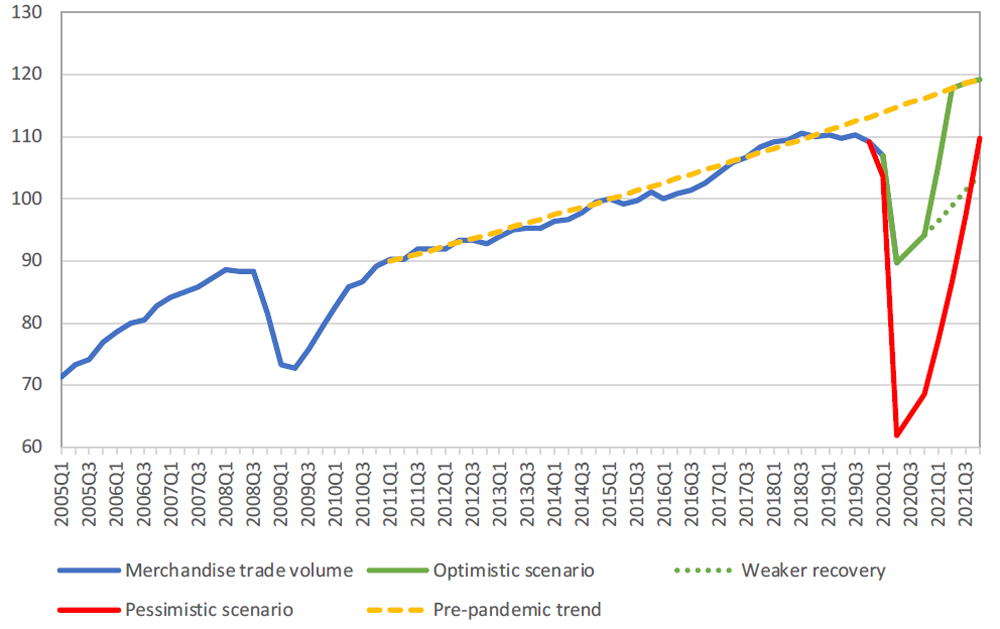
World trade fell sharply in the first half of the year, as the COVID-19 pandemic upended the global economy. However, rapid government responses helped temper the contraction, and WTO economists now believe that while trade volumes will register a steep decline in 2020, they are unlikely to reach the worst-case scenario projected in April.
The volume of merchandise trade shrank by 3% year‑on‑year in the first quarter according to WTO statistics. Initial estimates for the second quarter, when the virus and associated lockdown measures affected a large share of the global population, indicate a year‑on‑year drop of around 18.5% (Chart 1). These declines are historically large, but could have been much worse. The WTO's 20 April annual trade forecast, in light of the large degree of uncertainty around the pandemic’s severity and economic impact, set out two plausible paths: a relatively optimistic scenario in which the volume of world merchandise trade in 2020 would contract by 13%, and a pessimistic scenario in which trade would fall by 32%. As things currently stand, trade would only need to grow by 2.5% per quarter for the remainder of the year to meet the optimistic projection. However, looking ahead to 2021, adverse developments, including a second wave of COVID‑19 outbreaks, weaker than expected economic growth, or widespread recourse to trade restrictions, could see trade expansion fall short of earlier projections.
"The fall in trade we are now seeing is historically large – in fact, it would be the steepest on record. But there is an important silver lining here: it could have been much worse,” said Director‑General Roberto Azevêdo. "This is genuinely positive news but we cannot afford to be complacent. Policy decisions have been critical in softening the ongoing blow to output and trade, and they will continue to play an important role in determining the pace of economic recovery. For output and trade to rebound strongly in 2021, fiscal, monetary, and trade policies will all need to keep pulling in the same direction."
Chart 1: World merchandise trade volume, 2005Q1‑2021Q4
(Index, 2015=100)
Source: WTO/UNCTAD and WTO Secretariat estimates.
The COVID‑19 pandemic and associated containment efforts intensified in the second half of March. Strict social distancing measures and restrictions on travel and transport were fully in effect in most countries throughout April and May, and are now increasingly being relaxed. These developments are reflected in a variety of economic indicators which, taken together, suggest trade may have possibly bottomed out in the second quarter of 2020. Global commercial flights, which carry a substantial amount of international air cargo, were down nearly three quarters (‑74%) between 5 January and 18 April, and have since risen 58% through mid-June (Chart 2). Container port throughput also appears to have staged a partial recovery in June compared to May (Chart 3). Meanwhile, indices of new export orders from purchasing managers' indices also started to recover in May after record drops in April (Chart 4). It is useful to keep in mind that these rebounds follow historic or near-historic declines, and will need to be monitored carefully before drawing any definitive conclusions about the recovery.
Looking ahead to next year, a slower-than-expected pace of economic recovery would weigh on trade growth. This possibility is illustrated by the dotted green line in Chart 1, which would see trade growth for 2021 come in at closer to 5%, which would leave it well below the pre-pandemic trajectory. On the other hand, a quick return to its pre-pandemic trajectory would imply trade growth in 2021 of around 20%, in line with the April forecast’s optimistic scenario. Monetary, fiscal and trade policy choices will play a significant role in determining the pace of recovery.(1)
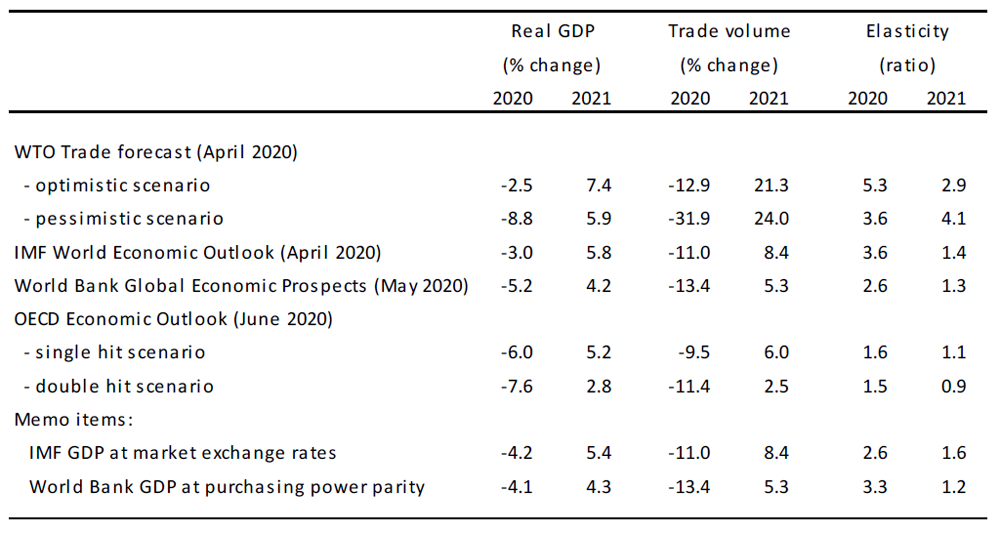
The outlook for the global economy over the next two years remains highly uncertain. This is reflected in the range of GDP estimates from other international organizations, in some cases relying on multiple scenarios (Table 1). The World Bank, OECD and IMF have all released forecasts showing significant slowdowns in global trade and GDP; all are broadly consistent with the WTO's forecast for the current year. The World Bank's recent forecast would see global output decline by 5.2% in 2020, falling between the WTO's optimistic and pessimistic range. Other international organizations' GDP forecasts for 2020 are also increasingly negative, even as their trade projections stay roughly in line with the WTO's optimistic scenario. These estimates imply a less negative trade response to declining GDP growth than was observed during the global financial crisis of 2008‑09.
Table 1: Summary of recent forecasts for world GDP and trade
Source: WTO Secretariat, International Monetary Fund, World Bank, Organisation for Economic Cooperation and Development, Federal Reserve Bank of Philadelphia, European Central Bank.
Note: Headline GDP figures from OECD and IMF are at purchasing power parity while figures from the World Bank and WTO are weighted at market exchange rates. WTO trade volume figures refer to merchandise trade while other organizations refer to goods and services trade.
The responsiveness of trade to changes in income can be measured by the ratio of the growth of merchandise trade volumes to real GDP growth at market exchange rates, also referred to as the income elasticity of trade. The implied elasticity under the WTO's optimistic forecast for 2020 was 5.3 – in line with that seen during the financial crisis. However, if world GDP instead contracts by the World Bank's estimated 5.2% with a trade decline of 13.4%, the elasticity would only be 2.6.(2) Lower elasticity implies trade holds up better for a given fall in income.
There are several reasons why trade might respond less to changes in GDP than it did during the financial crisis. First, fiscal and monetary policies have arguably been rolled out more quickly and on a larger scale in the current crisis than they were in 2008‑09. The WTO forecast scenarios did not include an attempt to model either set of policy responses, since, at the time, these policies were just being introduced. Second, income support to households and expectations that the pandemic would eventually ease may have encouraged consumers to maintain consumption levels at a higher level than expected. Finally, much of the decline in output has been concentrated in non‑tradeable services such as hospitality, personal services and entertainment, which tend to be less import‑intensive than manufacturing.
Although purchases of consumer durables such as automobiles fell sharply earlier in the crisis (Chart 5), other economic sectors have shown signs of resilience in recent weeks. Sales of consumer electronics have thus far held up better than might have been expected, supporting international trade in these products. For example, according to China's customs statistics, the country's exports of automatic data processing machines, including computers, were up 30% year-on-year in US dollar terms in April. Anecdotal evidence similarly points to strong demand for computer and information technology services, which have facilitated working from home during the crisis.
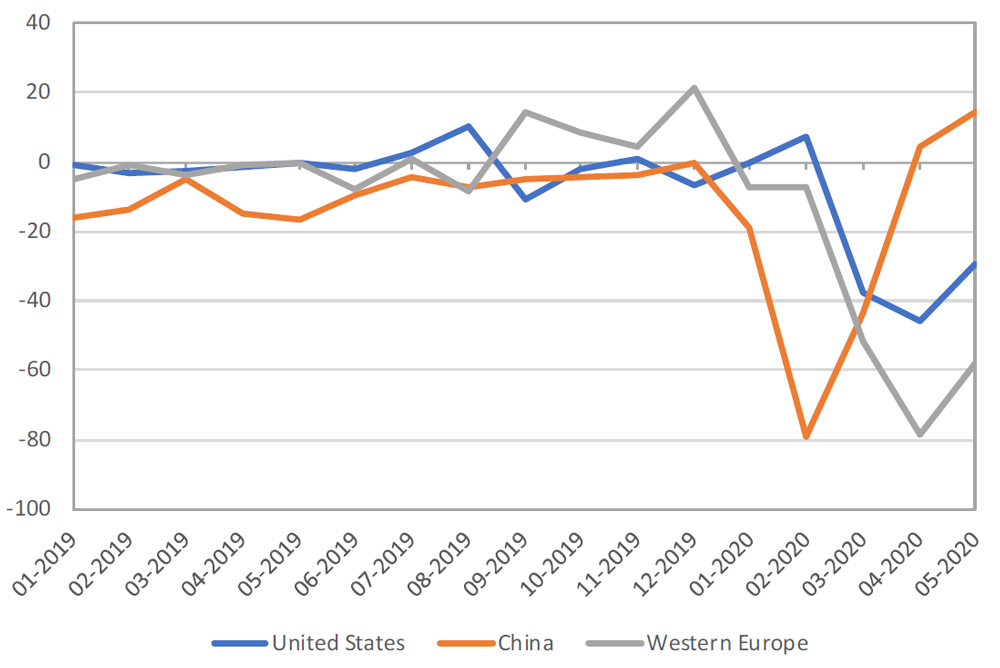
Automobile sales have also rebounded from recent, though admittedly extreme, lows. For example, sales of cars in China were up 5% year‑on‑year in May after falling 79% in February. Car sales in Western Europe and the United States were still down sharply in May compared to last year, but declines were smaller than in the previous month. Increased purchases of consumer durables could be seen as a bellwether signalling renewed consumer confidence as lockdowns are lifted and economies start to revive. They will thus be closely monitored in the coming months.
Chart 2: Global commercial flights per day tracked by FlightRadar
(number of of flights)

Source: FlightRadar.
Chart 3: Global container throughput, January 2007 ‑ June 2020
(seasonally adjusted index, 2015=100)
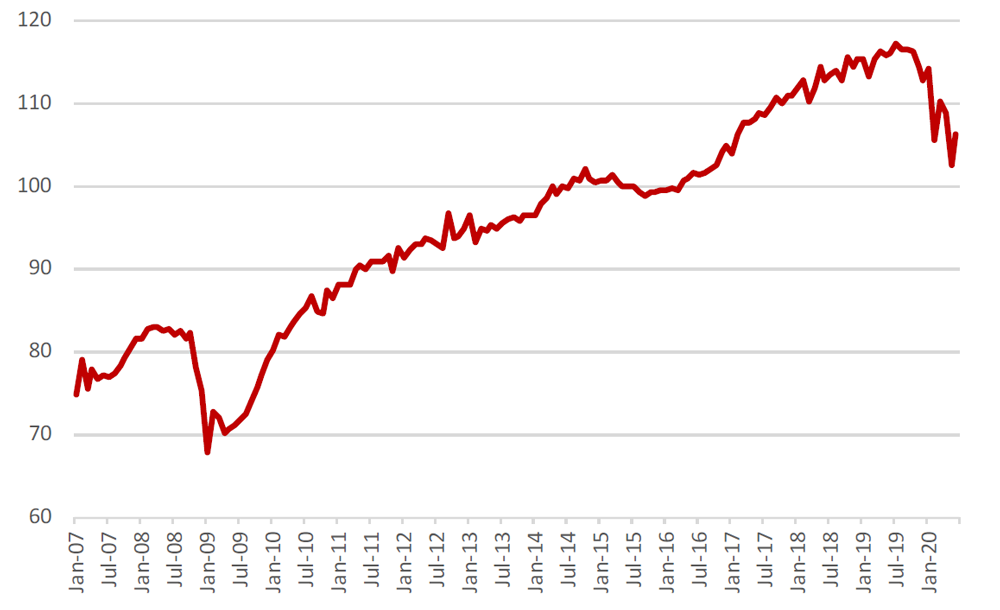
Source: Institute for Shipping Economics and Logistics through April 2020, WTO Secretariat estimates based on UN Comtrade AIS global/regional port calls for May and June.
Chart 4: New export orders from purchasing managers' indices, January 2008 – May 2020
(Index, base=50)
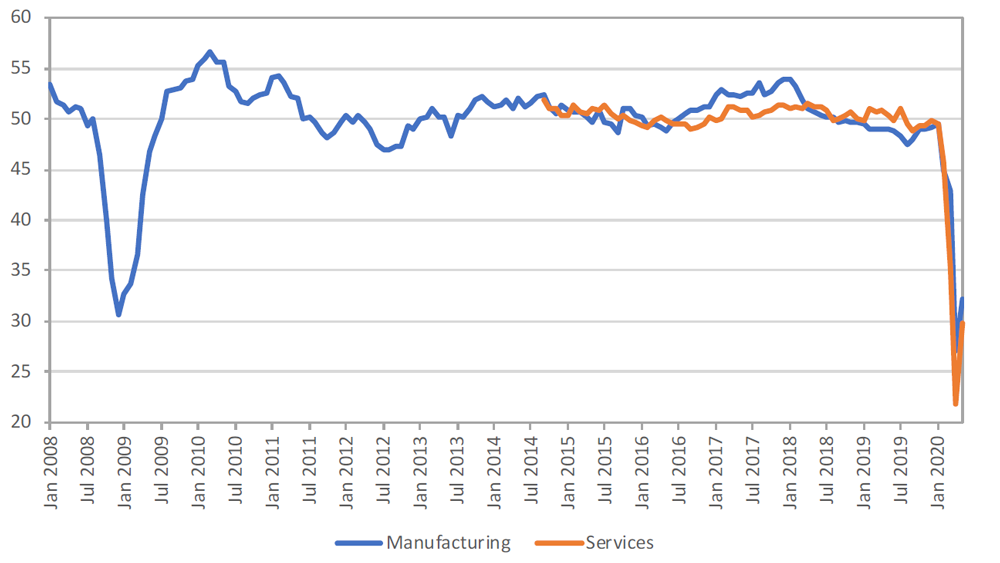
Note: Values greater than 50 indicate expansion while values less than 50 denote contraction.
Source: JPMorgan/IHS Markit.
Chart 5: Automobile sales in selected economies
(Year‑on‑year % change)
Source: Federal Reserve Bank of St. Louis, China Association of Automobile Manufacturers, European Association of Automobile Manufacturers
Notes:
- It should be noted that growth rates derived from quarterly merchandise trade volume indices are generally close but not exactly equal to growth rates derived from annual statistics.
- Implied elasticities for 2020 from the IMF are within this range while those from the OECD are lower, but these are not directly comparable to WTO forecasts since GDP growth is measured at purchasing power parity rather than at market exchange rates.
FULL DOCUMENT: https://www.wto.org/english/news_e/pres20_e/pr858_e.htm
OMC. REUTERS. 23 DE JUNHO DE 2020. OMC diz que queda recorde no comércio poderia ter sido pior
Por Philip Blenkinsop
BRUXELAS (Reuters) - O comércio mundial de mercadorias caiu a uma taxa recorde nos primeiros meses do ano devido à pandemia de Covid-19, mas não chegou a consolidar o pior cenário possível, disse a Organização Mundial do Comércio (OMC) nesta terça-feira.
O órgão com sede em Genebra previa em abril que o comércio global de mercadorias recuaria entre 13% e 32% em 2020, números que o chefe da OMC descreveu como “feios”, antes de se recuperar em 21% a 24% em 2021.
A OMC não estabeleceu novos números nesta terça-feira, mas disse que respostas rápidas dos governos significam que seu cenário pessimista para este ano é improvável.
De fato, o volume do comércio de mercadorias encolheu 3% no primeiro trimestre, informou a OMC, e as estimativas iniciais apontam para um declínio ano a ano de 18,5% no segundo trimestre.
“A queda no comércio que estamos vendo agora é historicamente grande — na verdade, seria a mais acentuada já registrada. Mas há um importante lado positivo aqui: poderia ter sido muito pior”, disse o diretor-geral da OMC, Roberto Azevêdo.
A OMC disse que os governos reagiram mais rapidamente do que na crise de 2008 e 2009, e o apoio à renda incentivou os consumidores a continuarem gastando. Alguns setores, como o de automóveis, caíram acentuadamente, mas outros, como eletrônicos, mantiveram-se bem.
Se o comércio crescer 2,5% por trimestre durante o resto do ano, a projeção mais otimista de queda de 13% poderá ser realizada, embora isso ainda seja pior do que no auge da crise financeira em 2009, quando o comércio recuou 12,5%.
No entanto, a OMC disse que o crescimento mais fraco do que o esperado, restrições comerciais mais amplas e uma possível segunda onda de infecções podem fazer com que a recuperação de 2021 decepcione.
O comércio poderia então se recuperar apenas cerca de 5%, deixando-o bem aquém da situação pré-pandemia. As medidas monetárias, fiscais e comerciais terão um papel significativo, disse a OMC.
GLOBAL ECONOMY
BANCO MUNDIAL. REUTERS. 23 DE JUNHO DE 2020. Chefe do Banco Mundial pede mais participação do setor privado no alívio da dívida pelo G20
Por Andrea Shalal
WASHINGTON (Reuters) - A iniciativa de alívio da dívida do Grupo das 20 principais economias para os países mais pobres do mundo fez um bom progresso, mas é necessário um alívio adicional e uma maior participação dos credores do setor privado, disse o presidente do Banco Mundial, David Malpass, na segunda-feira.
Malpass disse à Reuters em entrevista que 35 dos 73 países elegíveis estavam participando da iniciativa do G20, que congelará os pagamentos do serviço da dívida nas dívidas bilaterais oficiais até o final do ano, e mais manifestaram interesse.
A Iniciativa de Suspensão do Serviço da Dívida liberará 12 bilhões de dólares que os países poderão usar para lidar com os problemas de saúde e econômicos causados pelo coronavírus, mostrou um novo banco de dados do Banco Mundial.
Malpass disse que a pandemia claramente causou “um retrocesso muito sério e duradouro” à economia global, que atingiu especialmente os países mais pobres.
O alívio acordado pelos membros do G20 e pelo Clube de Paris de credores oficiais em abril estava ajudando, mas serão necessárias outras medidas para evitar que a crise econômica aumente as taxas de pobreza, disse ele.
CORONAVIRUS
IMF. 06/23/2020. We too are wondering what life will be like post-COVID-19. So in our latest issue of F&D, we attempt to grapple with this question by asking six leading thinkers to reflect on how the pandemic has changed the world, and what we can expect on the other side.
- Daniel Susskind of Oxford University notes that striking variations in COVID-19 infections and outcomes appear to reflect existing economic inequalities, and that the happy embrace of misinformation about the virus was to be expected, given a decade of rising populism and declining faith in experts. In a world post-COVID-19, many of the problems we will face in the next decade, writes Susskind, will simply be more extreme versions of those that we already confront today.
- James Manyika of the McKinsey Global Institute writes that many trends already underway in the global economy are being accelerated by the impact of the pandemic. This is especially true of the digital economy, with the rise of digital behaviors, such as remote working and learning, telemedicine, and delivery services. Other structural changes may also accelerate, says Manyika, including regionalization of supply chains and a further explosion of cross-border data flows.
- Jean Saldanha of the European Network on Debt and Development focuses on how COVID-19 pandemic has been testing the limits of global cooperation, and how support for developing economies in particular remains inadequate. Saldanha calls for a new multilateralism that addresses power imbalances in global institutions in order to give fair recognition to the needs and rights of the two-thirds of the world’s population who reside in the Global South.
- Sharan Burrow of the International Trade Union Confederation says we need to craft an ambitious reconstruction plan while working to end the pandemic. International support is a matter of collective survival and an investment in the future of health, the global economy, and multilateralism. Our goal for recovery should be full employment and a new social contract, writes Burrow. Public investment in the care economy, education, and low-carbon infrastructure can form the backbone of stimulus that reduces inequality.
- Sergio Rebelo of the Kellogg School of Management at Northwestern University believes that virus screening is likely to become part of our life, just like security measures became ubiquitous after 9/11. It is important to invest in the infrastructure necessary to detect future viral outbreaks, writes Rebelo. This investment protects economies in case immunity to COVID-19 turns out to be temporary. Governments will be bigger after playing the role of insurer and investor of last resort during the crisis. Public debt will balloon, creating financial challenges around the world.
- Ian Bremmer of the Eurasia Group says that COVID-19 has accelerated three key trends that will shape our next world order, which will await us on the other side of this pandemic: deglobalization, the inevitable growth of nationalism and “my nation first”, and China’s geopolitical rise.
DOCUMENTO: https://www.imf.org/external/pubs/ft/fandd/2020/06/how-will-the-world-be-different-after-COVID-19.htm?utm_medium=email&utm_source=govdelivery
________________
ECONOMIA BRASILEIRA / BRAZIL ECONOMICS
TAXA BÁSICA DE JUROS SELIC
BACEN. 23 Junho 2020. BC divulga Ata da 231ª reunião do Copom, realizada nos dias 16 e 17 de junho de 2020.
DOCUMENTO: https://www.bcb.gov.br/detalhenoticia/17102/nota
BACEN. REUTERS. 23 DE JUNHO DE 2020. BC vê fundo do poço para economia em abril e queda forte do PIB no 1º semestre
BRASÍLIA (Reuters) - O Banco Central avaliou que a atividade econômica brasileira atingiu seu menor patamar em abril e ressaltou que seu cenário básico considera queda forte do Produto Interno Bruto (PIB) no primeiro semestre, seguida de recuperação gradual a partir do terceiro trimestre.
A mensagem veio em ata do Comitê de Política Monetária (Copom) publicada nesta terça-feira. A nova projeção do BC para o PIB deste ano sairá na quinta-feira, no Relatório Trimestral de Inflação.
Na semana passada, o BC voltou a cortar os juros em 0,75 ponto percentual, à nova mínima histórica de 2,25% ao ano, ao mesmo tempo em que deixou aberta a porta para nova redução “residual” à frente, condicionada à avaliação do cenário. O BC reafirmou a sinalização na ata.
Por Marcela Ayres
SISTEMA FINANCEIRO
BACEN. 23 Junho 2020. BC regulamenta compra de ativos privados
O Banco Central (BC) definiu nesta data as condições para a compra de ativos privados em mercado secundário, prevista na Emenda Constitucional (EC) nº 106, de 7 de maio de 2020. Trata-se de medida visando dar liquidez, proporcionando melhores condições de funcionamento ao mercado secundário de ativos privados, com potenciais benefícios para o financiamento à atividade produtiva em geral.
Os efeitos econômicos e financeiros da propagação do novo Coronavírus (causador da Covid-19) geraram aumento da demanda por liquidez e retração no fluxo regular de recursos ao mercado de capitais, inclusive por meio da indústria de fundos de investimento. Tal movimento resultou, por vezes, em maior dificuldade para a adequada precificação das taxas e dos prêmios de risco de crédito negociados no mercado secundário, com impacto nas emissões primárias. Ressalte-se, nesse particular, que o mercado de ativos privados, no período recente, se tornara importante fonte de financiamento para empresas locais, elevando a competição no mercado de crédito em geral. O BC atuará visando a manutenção do normal funcionamento do mercado. A Diretoria Colegiada do BC decidirá pelas atuações, que serão anunciadas por Comunicado do Demab.
Serão elegíveis ativos com risco de crédito equivalente a BB- ou superior, depositados em depositária central, não conversíveis em ações e com prazo de vencimento igual ou superior a 12 meses. Para a realização das operações, serão levados em consideração os preços de referência divulgados pela Anbima e pela B3. A fim de melhor controlar o risco, haverá limites na carteira do BC por emissor, por série de ativo em mercado e em relação às classes de risco dos ativos.
Uma série de previsões visam dar preferência às operações com ativos emitidos por microempresas e empresas de pequeno e médio portes: os limites aplicados à carteira do BC em relação às classes de risco dos ativos não serão observados para ativos emitidos por essas empresas; será menos restritiva a limitação aplicável à série de ativo em mercado; e, na apuração das ofertas públicas, os ativos emitidos por tais empresas terão preferência como critério de desempate na seleção das propostas.
Atendendo à demanda de transparência exigida pela EC, o BC divulgará diariamente em sua página na internet, as operações liquidadas, de forma individualizada, com todas as correspondentes informações, incluindo a identificação dos beneficiários.
Circular nº 4.028: https://www.bcb.gov.br/estabilidadefinanceira/exibenormativo?tipo=Circular&numero=4028
INFLAÇÃO
FGV. IBRE. 23/06/2020. Inflação pelo IPC-S avança na terceira semana de junho
O IPC-S de 22 de junho de 2020 subiu 0,09%, ficando 0,22 ponto percentual (p.p) acima da taxa registrada na última divulgação.
Nesta apuração, sete das oito classes de despesa componentes do índice registraram acréscimo em suas taxas de variação. A maior contribuição partiu do grupo Transportes (-0,42% para 0,32%). Nesta classe de despesa, cabe mencionar o comportamento do item gasolina, cuja taxa passou de -1,76% para 0,69%.
Também registraram acréscimo em suas taxas de variação os grupos: Educação, Leitura e Recreação (-1,73% para -1,16%), Comunicação (0,19% para 0,47%), Vestuário (-0,27% para -0,01%), Alimentação (0,49% para 0,52%), Despesas Diversas (0,19% para 0,23%) e Habitação (-0,13% para -0,12%). Nestas classes de despesa, vale destacar o comportamento dos itens: passagem aérea (-15,08% para -8,00%), combo de telefonia, internet e TV por assinatura (0,43% para 1,16%), roupas (-0,17% para 0,13%), laticínios (-0,15% para 0,64%), despachante (0,31% para 0,88%) e máquina de lavar roupas (0,86% para 2,86%).
Em contrapartida, o grupo Saúde e Cuidados Pessoais (0,24% para 0,16%) apresentou recuo em sua taxa de variação. Nesta classe de despesa, vale citar o item artigos de higiene e cuidado pessoal (-0,20% para -0,50%).
DOCUMENTO: https://portalibre.fgv.br/noticias/inflacao-pelo-ipc-s-avanca-na-terceira-semana-de-junho
FGV. IBRE. 23/06/2020. Expectativa de Inflação dos Consumidores fica estável em junho e segue no menor patamar histórico
A expectativa de inflação dos consumidores brasileiros para os próximos 12 meses ficou estável no mês de junho, em 4,8%, seguindo no menor patamar histórico. Em relação ao mesmo mês do ano anterior, houve redução de 0,6 ponto percentual.
“Apesar de a mediana da expectativa da inflação dos consumidores permanecer no nível de maio, houve diminuição da inflação projetada pelas famílias dos extremos de renda da pesquisa. A boa notícia fica por conta do comportamento da renda mais alta que, pela primeira vez, encontra-se abaixo do patamar de 4%, convergindo cada vez mais para a expectativa dos especialistas de mercado”, afirma Renata de Mello Franco, Economista da FGV IBRE.
Em junho, 55,2% dos consumidores projetaram valores abaixo da meta de inflação (4,0%), a maior parcela nos últimos seis meses, enquanto a proporção de consumidores projetando acima do limite superior da meta de inflação (acima de 5,5%) para 2020 diminuiu 1,7%, de 32,1% para 30,4%.
Na análise por faixas de renda, somente as famílias entre R$ 2,1 mil e R$ 4,8 mil de renda familiar mensal ajustaram para cima suas expectativas para a inflação nos 12 meses seguintes. No sentido contrário, entre as famílias com renda superior a R$ 9,6 mil mensais, as expectativas caíram 0,3 p.p., para 3,7%, o menor valor histórico da série.
DOCUMENTO: https://portalibre.fgv.br/noticias/expectativa-de-inflacao-dos-consumidores-fica-estavel-em-junho-e-segue-no-menor-patamar
FGV. IBRE. 22/06/2020. Pesquisa mostra que acesso ao crédito por empresas continua com restrição em junho
O Indicador de Facilidade de Acesso ao Crédito, apurado pelo FGV IBRE na prévia das sondagens empresariais, indica que neste mês de junho a disponibilidade de crédito para as empresas continua, por enquanto, ainda restrita, apesar dos recentes esforços do governo de ampliar esse acesso. O indicador alcançou 55,6 pontos, próximo ao nível observado em maio (56,2 pontos). O resultado é decorrente da redução do percentual de empresas que, na sondagem, afirmaram “facilidade” de acesso ao crédito (de 10,8% para 7,7%), ainda que a parcela das empresas que relataram “dificuldade” tenha caído de 36,8% para 33,8%.
O nível de indicador prévio de junho é o menor desde junho de 2016, quando alcançou 55,3 pontos. Apresenta queda acumulada de 39,7 pontos desde janeiro deste ano, quando chegou a 95,3 pontos, perdendo 31,8 pontos apenas entre março e abril, a maior queda mensal da série histórica. Houve perda de mais de 41% do indicador em apenas cinco meses, movimento que não ocorreu nem durante a crise de 2014-2016 (no período de novembro de 2014 a setembro de 2015, o indicador caiu 37%).
Entre os setores, neste mês, apenas Serviços tende a apresentar queda, indo de 60,5 pontos para 54,5 pontos, o menor valor da sua série histórica. Se esse resultado se confirmar, o setor terá perdido 36,6 pontos (ou 40%) do maior valor observado no ano (90,8 pontos em janeiro). Ainda pelos resultados da prévia, o Comércio tende a reverter parte da queda do mês passado, saindo de 45,5 pontos, o menor valor da sua série, para 50,3 pontos. Embora o resultado seja positivo, ainda é o menor nível entre os setores e apresenta queda acumulada de 30,2 pontos em relação ao maior valor do ano (80,5 pontos em fevereiro), ou 38% do indicador.
Já a Construção teria desempenho favorável, com alta de 3,0 pontos, para 72,4 pontos, fazendo com que o indicador estivesse apenas 11,2 pontos abaixo do maior valor do ano (83,6 pontos em março). Por último, a Indústria ficaria praticamente estável em relação a maio, sendo o setor com a maior perda absoluta em relação ao maior valor do ano (110,2 pontos em janeiro), ‒44,4 pontos (40% do indicador).
DOCUMENTO: https://portalibre.fgv.br/noticias/pesquisa-mostra-que-acesso-ao-credito-por-empresas-continua-com-restricao-em-junho
CONSTRUÇÃO CIVIL
CNI. 23/06/2020. Indústria da Construção teve nova queda em maio, mas menos intensa e mais restrita, diz CNI. Sondagem mostra que a construção recuperou parte da utilização da capacidade operacional perdida em março e em abril. No entanto, os impactos da crise do coronavírus ainda são graves no setor
A Sondagem Indústria da Construção, da Confederação Nacional da Indústria (CNI), mostra que o pessimismo começa a se dissipar no setor. No entanto, a intenção de investir ainda é baixa e os empresários projetam queda da atividade, em novos empreendimentos e serviços, em compras de matérias-primas e no número de empregados nos próximos seis meses.
Atividade e emprego continuam em queda como indica os indicadores de evolução abaixo de 50 pontos. O indicador de evolução do nível de atividade chegou a 37,1 pontos em maio, com aumento de 7,7 pontos em relação ao mês anterior. E o índice de evolução do número de empregados registrou 37,5 pontos no mês, tendo crescido 2,8 pontos na comparação com abril.
Apesar da melhora, os dois índices continuam abaixo da linha divisória de 50 pontos, ainda como reflexo dos efeitos da pandemia do coronavírus. O índice varia de 0 a 100 e os todos os dados abaixo de 50 significam queda na atividade.

“Ainda que a crise continue presente, seu pior momento foi em abril. Já há sinais de melhora em maio, como o aumento da utilização da capacidade operacional do setor”, diz o gerente-executivo de Economia, Renato da Fonseca.
A Utilização da Capacidade Operacional (UCO) atingiu 53% no mês de maio e registra um ligeiro aumento em relação ao mês anterior, mais ainda é nove pontos percentuais inferior à média histórica. O mesmo movimento ocorreu com o Índice de Confiança do Empresário Industrial da Construção (ICEI-Construção). Ele ficou em 42,6 pontos em junho, um aumento de cinco pontos em relação a maio.
Em abril, o índice já havia crescido 2,8 pontos. Mesmo assim, o índice permanece distante da linha divisória e mostra falta de confiança dos empresários do setor. O ICEI – Construção está 14,4 pontos abaixo do patamar registrado no mesmo período de 2019.
Sondagem Indústria da Construção. Impacto da pandemia segue forte, mas pior momento pode ter ficado para trás
Os impactos da crise causada pela da pandemia de Covid-19 ainda são graves na indústria de construção. Mas o impacto foi menor em maio: o nível de atividade da indústria da construção apresentou nova queda, porém mais restrita e menos intensa do que as de abril e março.

DOCUMENTO: https://bucket-gw-cni-static-cms-si.s3.amazonaws.com/media/filer_public/23/75/2375ec26-5b9b-4a74-9035-6f82fd9bf5cd/sondagemindustriadaconstrucao_maio2020.pdf
INTEGRAÇÃO LATINO-AMERICANA
FGV. IBRE. 23/06/2020. Revista Conjuntura Econômica. Integração. Integração
A corrida por insumos médico-hospitalares provocada pelo choque da Covid-19 pressionou o mundo a se fragmentar em dois polos: o de países fabricantes desses produtos, que começaram a restringir exportações privilegiando seu próprio abastecimento; e os importadores, que passaram a questionar as vantagens dessa dependência e de uma concentração de mercado. Movimentos de reshoring, a proposta de uma autonomia estratégia como a defendida na União Europeia e a recente restrição de vistos de trabalho nos Estados Unidos somam-se a outros capítulos de tons protecionistas observados nos últimos anos, da instalação do Brexit à política exterior norte-americana, jogando três décadas de globalização definitivamente na berlinda.
“O processo de globalização produziu expectativas infladas que não se realizaram, mas isso não justifica que a solução seja fechar economias”, afirma Mauricio Mesquita Moreira, assessor econômico chefe do Departamento de Integração e Comércio do Banco Interamericano de Desenvolvimento (BID). Para qualificar essa discussão, Mesquita e Ernesto Stein, economista principal do Departamento de Pesquisa do BID, organizaram um estudo reunindo evidências empíricas dos efeitos desse movimento na América Latina, cuja versão em português é lançada nesta terça-feira (23), em webinar promovido pelo Ipea. Em Trocando Promessas por Resultados: o que a integração global pode fazer pela América Latina e o Caribe, eles mostram que os países que mais avançaram em abertura econômica e integração com o resto do mundo – que não é o caso de Brasil e Argentina –,tiveram um bônus em termos de crescimento que não chega a ser desprezível. “Em 30 anos, foi um ganho de renda per capita de 30% (no caso de países que reduziram tarifas de importação) a 40% (no caso daqueles que também incluíram redução de barreiras não-tarifárias). Algo muito difícil de se conseguir com uma política pública isoladamente, mas claramente longe de replicar o resultado do leste asiático”, diz.
A ideia de que a abertura incentivaria exportação produtos mais intensivos em mão de obra, estimulando o mercado de trabalho, entretanto, não se efetivou. No início dos anos 1990, as economias mais próximas dos Estados Unidos beneficiaram-se com emprego formal na indústria, mas esse ganho – em torno de 15% – foi perdido nos anos 2000, com o impacto dramático da entrada da China na OMC e na competição global por produção barata. Na América do Sul, que permaneceu como grande exportadora de commodities, os ganhos e perdas foram marginais. Um dos destaques apontados, no livro, entretanto é de que essa perda pelo lado da renda do trabalho não gerou aumento da desigualdade nos países da região, graças ao impacto positivo do comércio internacional no custo de vida da população mais pobre, com a redução de preço dos bens que estes consomem.
“Temos que adequar a globalização à realidade. Não foi o que esperávamos, mas nem por isso se deve fechar a economia”, reitera Mesquita, lembrando das tentativas malsucedidas de recuperar empregos na indústria com incentivos à volta da produção doméstica. “Desde 2016, quanto o presidente Trump começou a aumentar tarifas de importação, o nível de emprego na manufatura não se mexe, é praticamente estável”, lembra.
Para os países da região, especialmente as economias menores, Mesquita reforça o risco de aumento de vulnerabilidade se daqui para frente predominarem relações bilaterais. “Se o mercado mundial se tornar um negócio de balcão, onde leva quem pode mais, e não obedecer a regras de uma economia de mercado, será muito ruim”, diz. “Um pequeno exemplo disso foi o que aconteceu com o México na renegociação do Nafta. As medidas impostas ao país vão contra qualquer livro de Economia. Como pode impor conteúdo local com base em nível salarial definido por decreto? Como pode regular nível de exportação e importação no comércio entre estados? Isso certamente neutraliza os benefícios que um acordo desse tipo deve ter.”
Para o Brasil, Mesquita considera que, passado o período crítico da pandemia, o país tem que pensar em criar coragem para entrar nas negociações comerciais para valer. “Essa ideia de se autoproclamar país em desenvolvimento e ficar isento do resultado das negociações é um entrave, especialmente para países do porte do Brasil. Outra questão são os subsídios e a política industrial. Não faz sentido manter essa prerrogativa, primeiro porque temos um histórico terrível nessa área – estamos pagando até hoje a conta do que aconteceu no governo Dilma. E mesmo que fôssemos muito eficientes na implantação dessas medidas, não há como concorrer com o Tesouro americano ou chinês e sua capacidade de bancar esse tipo de estratégia”, afirma. E, completa Mesquita, enfrentar o antigo desafio da integração regional, com a convergência dos 33 acordos comerciais preferenciais existentes e acordos mais amplos entre as maiores economias da região: Argentina, Brasil e México. “Isso resultaria em um aumento estimado de 11,6% no comércio intrarregional, ou US$ 20 bilhões em números de 2018”, ilustra.
DOCUMENTO: https://portalibre.fgv.br/noticias/integracao
COMÉRCIO INTERNACIONAL
UE. CHINA. REUTERS. 23 DE JUNHO DE 2020. UE pressiona China por comércio e alerta sobre lei de Hong Kong
Por Robin Emmott e Philip Blenkinsop
BRUXELAS (Reuters) - A União Europeia disse à China na segunda-feira que ela deve cumprir a promessa de abrir sua economia e alertou para “consequências muito negativas” se Pequim avançar com uma nova lei de segurança sobre Hong Kong que, segundo o Ocidente, reduzirá direitos básicos.
Falando após videochamadas com o primeiro-ministro chinês, Li Keqiang, e o presidente, Xi Jinping, a chefe-executiva e o presidente da UE disse que eles repetiram acusações de que Pequim espalhou desinformação sobre o coronavírus.
“O relacionamento entre a UE e a China é simultaneamente um dos mais importantes estrategicamente e um dos mais desafiadores que temos”, disse a presidente da Comissão Europeia, Ursula von der Leyen, em entrevista coletiva.
O presidente do Conselho Europeu, Charles Michel, disse que a China não retribui a recepção que as empresas chinesas recebem na Europa.
Chamando a China de parceira e rival, von der Leyen disse que Pequim não seguiu um acordo de 2019 para permitir maior acesso das empresas europeias à China ou descartar regras que exigem que os investidores compartilhem seu conhecimento em joint ventures chinesas.
Quando perguntado sobre os comentários de von der Leyen sobre o acordo de 2019 nesta terça-feira, Wang Lutong, chefe do escritório europeu do Ministério das Relações Exteriores da China, disse que foram feitos progressos tangíveis em áreas como financiamento “verde” e compras governamentais, e que é necessário paciência.
PROMOÇÃO COMERCIAL
CNI. 22/06/2020. Rodada inédita de negócios reúne 340 empresas brasileiras e 130 compradores internacionais. Evento on-line começou hoje e vai até o próximo dia 26 com foco nas micro, pequenas e médias empresas brasileiras e compradores de 53 países estrangeiros
Um total de 340 micro, pequenas e média empresas brasileiras participam nesta semana de uma rodada inédita on-line de negócios com 130 compradores internacionais de 53 países diferentes. Organizada pelo Banco Interamericano de Desenvolvimento (BID), Sebrae, Confederação Nacional da Indústria (CNI), a Agência Brasileira de Promoção de Exportações e Investimentos (Apex-Brasil) com a participação de representantes dos ministérios da Economia, da Agricultura, Pecuária e Abastecimento e das Relações Exteriores, o Business Connections Brazil: Food & Beverage foi aberto hoje e vai até o próximo dia 26 com compradores da América Latina, Estados Unidos, Canadá, Índia e Emirados Árabes, entre outros países.
As rodadas de negócios serão realizadas por meio de reuniões individuais B2B entre as empresas fornecedoras do setor de alimentos e bebidas do Brasil e compradores internacionais. Durante a abertura do evento o diretor de Desenvolvimento Industrial da CNI, Carlos Eduardo Abijaodi, enfatizou a importância do trabalho integrado entre as esferas privada e pública bem como da diversificação do mercado para fortalecer o comércio exterior como saída estratégica para acelerar a retomada das empresas.
“Reconhecendo a necessidade de integração entre as entidades como um dos principais desafios para impulsionar a internacionalização das empresas, o governo brasileiro utiliza atualmente o Programa Rota Global, desenvolvido pela CNI em cooperação com a Comissão Europeia”, comentou Abijaodi. O Programa Rota Global integra com destaque a Agenda Internacional da Industria 2020 com foco em governança, coordenação e assistência para ajudar as empresas nacionais a internacionalizarem as suas operações.
América Latina tem aussificiência em produção de alimentos
De acordo com projeções apresentadas pelo gerente de Integração e Comércio do BID, Fabrizio Opertti, até 2028 os países da América Latina e Caribe serão responsáveis por 25% de todas as exportações de alimentos do mundo. “Atualmente, as nações dessa região registram 117% de autossuficiência na produção de alimentos. Em produtos como a banana e o açúcar, os nossos países já são responsáveis por 50% das exportações”, afirmou. Ele explicou que a rodada virtual internacional é um dos desdobramentos da Connect Americas. A plataforma de negócios gratuita foi criada pelo BID para apoiar mais de 300 mil empresários cadastrados na realização de mais e melhores negociações internacionais.
O presidente da Apex-Brasil, Sergio Segovia, destacou que, mesmo num cenário adverso provocado pela pandemia do novo coronavírus, as exportações do agronegócio do Brasil de janeiro a maio foram de US$ 42 bilhões, 7,9% maior que no mesmo período de 2019. “Desenvolvemos uma rede de parcerias, porque sabemos que juntos somos mais fortes para o enfrentamento dos desafios que chegaram com a Covid-19. É importante ressaltar que, mesmo no cenário adverso, o Brasil não deixou de cumprir com os seus compromissos internacionais. Como poucos países no mundo, o Brasil está preparado para enfrentar o desafio gerado pelas mudanças estruturais que estamos vivendo”, comentou.
Para o diretor-presidente do Sebrae Nacional, Carlos Melles, ações integradas entre o governo e representantes da iniciativa privada como o Business Connections Brazil: Food & Beverage são fundamentais para ajudar as micro e pequenas empresas a trilharem o caminho da internacionalização. “Nessa crise, fizemos o que precisava se feito e nos aproximamos da ponta, dos micro e pequenos empresários que mais precisam de suporte e da ação integrada e coordenada nossa com o governo num momento como este”, afirmou.
As micro, pequenas e médias empresas têm um papel de destaque nas exportações brasileiras. Juntas, representam 70% do número de empresas exportadoras, segundo estudo do Sebrae de 2019, principalmente do setor da indústria. De acordo com o Sebrae, mais de 40% das empresas exportadoras brasileiras são micro e pequenas. Elas foram responsáveis por vendas externas no montante de US$1,2 bilhão em 2018.
A abertura da rodada de negócios contou a participação do secretário de Comércio e Relações Internacionais do MAPA, Orlando Ribeiro, que inseriu no debate a importância do Brasil estar atento a novas barreira sanitárias e fitossanitárias que surgem no comércio internacional; e da subsecretária de Facilitação de Comércio Exterior, Ministério da Economia, Glenda Lustosa. Ao longo do evento, serão realizadas também palestras sobre o setor de alimentos e bebidas, que também podem ser acompanhadas pelos jornalistas.
MIGRAÇÃO
IPEA. 22/06/2020. Pesquisa aponta fragilidades no noticiário da imprensa sobre fluxo de imigrantes. Foram analisadas publicações entre os anos de 2010 e 2018 de três veículos de imprensa de grande circulação no país
O noticiário da grande imprensa sobre o fluxo migratório no Brasil caracteriza-se por limitações no debate sobre políticas de acolhimento social e informações com termos pejorativos. A conclusão faz parte do livro A Midiatização do Refúgio no Brasil, lançado pelo Instituto de Pesquisa Econômica Aplicada (Ipea). O estudo apresenta uma análise de discurso de dez mil notícias sobre imigrantes. Os dados mostram alta adjetivação nas informações e o impacto das notícias no processo de formulação das políticas de inclusão social.
A pesquisa analisou as publicações entre 2010 e 2018 de três veículos de imprensa (Folha de São Paulo, O Globo, Estado de São Paulo). As principais nacionalidades mencionadas no período foram cidadãos venezuelanos (69%), haitianos (56%) e sírios (18%). De acordo com os dados coletados, observa-se o uso de termos imprecisos como “refugiados”. A denominação adequada é “solicitantes de refúgio”, conforme adotado no texto da Lei de Imigração Brasileira. Além disso, as notícias divulgadas utilizam como fonte de informação apenas relatos jornalísticos e informações colhidas nas fronteiras do país, contendo ausência de dados estatísticos e fontes oficiais.
Na avaliação do pesquisador do Ipea e engenheiro agrônomo, João Brígido Bezerra, a pesquisa apresenta dados que confirmam a fragilidade na cobertura jornalística da grande mídia sobre o fluxo migratório no país. Segundo ele, em alguns casos foi possível coletar informações publicadas na mídia de caráter xenofobista. “A imprensa tem um importante papel na construção das políticas de acolhimento aos imigrantes. É preciso que ela esteja em consonância com a Lei de Imigração Brasileira para contribuir nesse processo construtivo”, destaca o pesquisador.
O livro contou com o apoio da Cooperação Brasileira para o Desenvolvimento Internacional (Cobradi) e Coordenação de Estudos em Cooperação Internacional da Diretoria de Estudos e Relações Econômicas e Políticas Internacionais (Coint/Dinte). Ele é um desdobramento de outras análises que incluíram a elaboração de um perfil sociodemográfico dos imigrantes no Brasil com base nos registros do Comitê Nacional para os Refugiados (Conare).
O Ipea deverá divulgar ainda este ano a próxima fase do estudo sobre fluxo migratório no Brasil. Entretanto, a pesquisa vai apresentar uma análise sobre os dados coletados relacionados ao fluxo migratório em Brasília. O estudo deverá contar com a colaboração de entidades do governo local no fornecimento de informações quantitativas e qualitativas para a consolidação do perfil sociodemográfico dos imigrantes na Capital.
DOCUMENTO: https://www.ipea.gov.br/portal/index.php?option=com_content&view=article&id=35874&Itemid=448
ENERGIA
CHINA. OPEP. REUTERS. 23 DE JUNHO DE 2020. China deve pisar no freio em importações de petróleo após onda de compras
Por Muyu Xu e Shu Zhang
PEQUIM/CINGAPURA (Reuters) - A China vai pisar no freio em suas importações de petróleo no terceiro trimestre, depois de compras recorde nos últimos meses, uma vez que a elevação nos preços impactou a demanda e em meio a preocupações de refinarias com uma segunda onda do coronavírus, disseram analistas e fontes comerciais.
A China importou um recorde de 1,13 milhão de barris por dia (bpd) de petróleo em maio, em volumes que devem crescer em junho e julho, à medida que compras de petróleo barato fechadas durante uma queda dos preços da commodity em abril chegam ao pais.
Mas a maior importadora global de petróleo deve receber entre 0,8 milhão e 1,3 milhão de bpd a menos em barris do exterior em agosto e setembro, quando na comparação com maio, projetaram analistas.
Com os preços do petróleo Brent de volta a níveis acima de 40 dólares e uma nova onda de casos de coronavírus gerando temores de que uma nascente retomada possa ser atrasada, operadores de mercado disseram que refinarias independentes já estão reduzindo suas compras.
Essas refinarias, conhecidas como “teapots”, respondem por um quinto das importações de petróleo da China.
“Com uma trajetória mais lenta de recuperação da demanda à frente, nós esperamos alguns cortes (no nível) de processamento nos próximos meses, o que poderia começar com algumas (refinarias) independentes”, disse Chen Jiyao, consultor em mercado de petróleo na FGE.
As consultorias SIA Energy e Rystad Energy também esperam que as importações caiam no terceiro trimestre na comparação com o segundo, mesmo com o país ampliando sua capacidade de refino.
As importações de petróleo da China devem retornar a níveis mais normais, com crescimento de 4,2% ano a ano no terceiro trimestre, abaixo do ritmo de expansão de 7,4% no segundo trimestre, disse o diretor da SIA Energy, Seng Yick Tee.
O analista de China da Energy Aspects, Yuntao Liu, estimou que as importações de petróleo do país devem somar 10,5 milhões de barris por dia em agosto e menos de 10 milhões de barris por dia em setembro, abaixo dos mais de 11,5 milhões de barris por dia em julho.
Por Muyu Xu em Pequim, Shu Zhang e Chen Aizhu em Cingapura
CORONAVÍRUS
AstraZeneca. REUTERS. 23 DE JUNHO DE 2020. Teste em suínos de vacina contra Covid-19 da AstraZeneca com 2 doses se mostra promissor
Por Kate Kelland
LONDRES (Reuters) - Um teste da vacina experimental contra Covid-19 da AstraZeneca em suínos mostrou que duas doses do remédio produziram uma reação de anticorpos maior do que uma única dose.
Uma pesquisa divulgada pelo britânico Instituto Pirbright nesta terça-feira revelou que uma primeira dose inicial seguida por uma dose de reforço da vacina provocou uma reação imunológica mais forte do que uma única dose. Isto sugere que a abordagem de duas doses pode ser mais eficiente para oferecer proteção contra a Covid-19, a doença causada pelo novo coronavírus.
“Os pesquisadores viram um aumento acentuado de anticorpos neutralizadores, que se ligam ao vírus de uma maneira que impede a infecção”, explicou a equipe do Pirbright em um comunicado. Eles acrescentaram, porém, que ainda não se sabe qual nível de reação imunológica será necessário para proteger humanos.
A vacina ChAdOx1 nCoV-19, também conhecida como AZD1222, foi desenvolvida originalmente por cientistas da Universidade de Oxford que agora estão trabalhando com a AstraZeneca no desenvolvimento e na produção.
“Estes resultados parecem animadores por mostrarem que administrar duas injeções... fortalece a reação de anticorpos que podem neutralizar o vírus, mas é a reação em humanos que é importante”, disse Bryan Charleston, diretor do Pirbright.
A AZD1222 já está em testes com humanos, e a AstraZeneca diz que aguarda dados sobre sua eficiência para o final do ano.
Dados preliminares de um testes com seis macacos apontaram que alguns destes que receberam uma dose desenvolveram anticorpos contra o vírus em 14 dias e que todos desenvolveram anticorpos protetores em 28 dias.
Mais de 100 vacinas estão sendo desenvolvidas no mundo para se tentar controlar a pandemia, que já matou milhares de pessoas.
Stephen Griffin, professor-associado da Universidade de Leeds que não se envolveu diretamente no trabalho, disse se tratar de um “avanço animador” que mostrou que “uma assim chamada estratégia de ‘reforço inicial’ dá ensejo a reações muito melhores” do que uma única dose.
“Embora seja necessário repetir estes estudos com humanos... este é um estudo encorajador.”
________________
LGCJ.:

