CANADA ECONOMICS
NAFTA
The Globe and Mail. 6 Jun 2018. Trump seeks separate talks with Canada, Mexico. Canada rejects U.S. plan, insisting trade agreement must remain trilateral pact. NAFTA: Champagne considers proposal by Kudlow to be a non-starter
ADRIAN MORROW
GREG KEENAN
STEVEN CHASE
U.S. President Donald Trump wants to negotiate separate trade deals with Canada and Mexico – a move that would fragment the world’s largest free-trade zone and give U.S. negotiators more leverage to wring concessions out of Canada and Mexico.
Canada immediately rejected the idea, insisting the North American free-trade agreement must remain a trilateral pact.
Mr. Trump’s chief economic adviser, Larry Kudlow, said in a television appearance on Tuesday morning that the President plans to “rather quickly” move to bilateral talks.
“His preference now, and he asked me to convey this, is to actually negotiate with Mexico and Canada separately. He prefers bilateral negotiations,” Mr. Kudlow said on Fox & Friends, the President’s favourite TV show.
“Canada is a whole lot different than Mexico. It’s got different problems.” Mr. Kudlow said he had informed a “top” Canadian official “right next to the Prime Minister” of the idea and was hoping to hear back soon. The President has mused before about breaking up NAFTA – as recently as last Friday – but Mr. Kudlow’s comments are the first indication he plans to move forward with this.
Canada and Mexico are already under intense pressure from the United States, which last week slammed its NAFTA partners with hefty steel and aluminium tariffs. Mexico hit back on Tuesday, imposing levies on U.S. steel, aluminium and other products. Canada has announced retaliatory tariffs to take effect on July 1 on the metals and consumer goods including bourbon, pickles and orange juice.
NAFTA negotiations have largely stalled in recent weeks: Canada and Mexico have proposed resolutions under which they would agree to U.S. demands on auto content rules and in a few other areas in exchange for Mr. Trump dropping most of his other protectionist proposals. U.S. trade representative Robert Lighthizer has rejected them.
Canada’s International Trade Minister was unequivocal that Mr. Kudlow’s proposal is a nonstarter.
“Our intention and what we want is obviously a trilateral agreement,” François-Philippe Champagne told reporters on Tuesday afternoon. “More than 24 years the supply chains have been integrated and … this has provided millions of good, middle-class jobs.”
One senior Canadian official said the United States had not presented Canada with a request for bilateral negotiations or any details on how such talks would work. Canadian officials have consistently told their U.S. counterparts that NAFTA must remain a three-way pact, said the official, who spoke on condition of anonymity.
Mr. Kudlow’s comments are not the equivalent of a request from Mr. Lighthizer, who is leading negotiations, but serve as a reminder that this option is still under consideration. Further direction will likely come when Mr. Trudeau meets Mr. Trump at the Group of Seven summit in Charlevoix, Que., later this week.
Canada and Mexico differ on some major NAFTA issues: Canada has been more willing to agree to tighter automotive content rules than Mexico, which has fought back against a U.S. demand to force auto makers to source at least 40 per cent of their car parts from companies paying US$16 an hour or more.
And Mexico – which Mr. Trump blames for the disappearance of U.S. manufacturing jobs – was the original impetus for the President’s decision to renegotiate NAFTA, with Canada getting roped in largely because it happens to be part of the trade deal.
However, Canada and Mexico have often presented a unified front in the negotiations in a bid to preserve as much of the current open market as possible against Mr. Trump’s protectionist demands. Separate talks would prevent them from teaming up against the United States. Among other things, Washington is proposing tough new Buy American rules for government contracting, the abolition of NAFTA’s dispute-resolution provisions and a “sunset clause” that would terminate the deal in five years unless all three countries agreed to extend it.
One Canadian source said the Trudeau government has told the Trump administration that Canada’s only preconditions are that NAFTA cannot have a sunset clause and must preserve a dispute-resolution mechanism. Otherwise, the source said, Canada is willing to negotiate on all of the other U.S. demands.
Ending the three-way deal could hurt businesses with supply chains that stretch across the continent. Many auto companies, for instance, find efficiencies by sourcing parts from all three countries.
Daniel Ujczo, a trade lawyer with Dickinson Wright, said Mr. Trump is pursuing a divide-andconquer strategy.
“It is a way to split your negotiating partners to get maximum advantage,” said Mr. Ujczo, who is based in Columbus, Ohio. “We will reduce competitiveness by increasing compliance costs for companies operating in North America that now would have to meet three sets of rules.”
Christopher Sands, director of the Center for Canadian Studies at Johns Hopkins University, said a divided NAFTA could also achieve Mr. Trump’s goal of getting companies to leave Canada and Mexico and set up in the United States.
“My fear is that NAFTA gets split up and the U.S. would be the only country that works in both directions,” he said.
Mr. Sands said it is possible Mr. Trump will skip the G7 summit, depriving Canada of an opportunity to “sweet talk” the President out of his trade war.
Veteran trade lawyer Larry Herman said it would be difficult for Ottawa to reject bilateral negotiations if Mr. Trump insisted. But the federal government will need more than Mr. Kudlow’s suggestions and tweets from Mr. Trump.
“Before we even get to that point, there has to be a much more detailed engagement with the Americans to sound out what they’re getting at and to determine how they intend to approach such a set of bilateral negotiations,” he said.
The Globe and Mail. JUNE 6, 2018. MORNING BUSINESS BRIEFING. Canadian dollar jumps, but curb your enthusiasm as tariff war, NAFTA collapse loom large
MICHAEL BABAD, Columnist
Investors have acclimatized to Donald Trump’s ‘megaphone’ diplomacy
— Ingvild Borgen Gjerde, Capital Economics
Ingvild Borgen Gdjere suggests you curb your enthusiasm.
The base case among many market players is that common sense will win out amid the threat of a full-scale tariff war.
That’s her base case, too, but don’t take it to the bank.
“Investors have acclimatized to Donald Trump’s ‘megaphone’ diplomacy,” Ms. Borgen Gdjere, markets economist at Capital Economics in London, said in a recent report.
“Despite the tariffs imposed by the U.S. on steel and aluminium imports from the EU, Mexico and Canada, investors presumably see it as a negotiating tactic, rather than the start of a full-blown trade war that could have serious ramifications for economic growth,” she added.
“Although we share this view, the risk of a trade war is greater now than it has been for many years. So at the very least, the risk ought to continue to curb investors’ enthusiasm for equities.”
Her comments came before Mr. Trump suggested breaking up NAFTA.
The European Union, Mexico and Canada have all drawn up lists of countermeasures to the Trump administration’s steel and aluminum tariffs, the latter planning to put them into effect in July.
Negotiations to remake the North American free-trade agreement have faltered. And, as The Globe and Mail’s Adrian Morrow and Greg Keenan report, Mr. Trump is now looking at breaking NAFTA apart and striking separate deals with each of Canada and Mexico, according to his chief economic adviser.
It’s not just the Canada, Mexico and the EU, either. China is a big target for the U.S., and the two countries are jockeying.
“With China attempting to stifle U.S. tariffs, we are clearly at a crucial juncture for global trade, despite the relative optimism seen throughout global financial markets,” said IG market analyst Joshua Mahony.

Brian Belski, for one, takes the calmer-heads-will-prevail view, and is one of the reasons the S&P/TSX Composite Index will drive higher, ending the year at 17,600.
“Although the TSX outperformed the S&P 500 in May, renewed concerns surrounding NAFTA saw the TSX start to underperform in the last week of the month and heading into June, as the U.S. levied steel and aluminum tariffs against Canada,” the chief investment strategist at BMO Capital Markets said Tuesday.
“Indeed, these negotiations are extending beyond what we had expected, however we continue to believe common sense will prevail and NAFTA will be renegotiated with the result generating a relatively minor impact on Canadian equities when all is said and done.”
Goldman Sachs, for another, expects that the “earnings-driven” bull market will continue apace, with the S&P 500 gaining 5 per cent to 2,850 by the end of this year.
This is playing out in the currency markets, too, where, for example, the Canadian dollar enjoyed something of a boost on an ABC News report saying Treasury Secretary Steven Mnuchin is pushing Mr. Trump to exempt Canada from the tariffs.
But “this can’t be considered a breakthrough or new news since Mnuchin is clearly a proponent of free trade, and in recent days/weeks his view has been undermined by none other than [Peter] Navarro and Trump,” said Sue Trinh, Royal Bank of Canada’s head of foreign exchange strategy in Hong Kong.
The loonie rose further after Canada’s monthly trade report.
“Whilst the loonie popped higher on hopes of an exemption for Canada from the steel and aluminium tariffs, a retaliation from Mexico in a sharp escalation in the tit-for-tat trade war over tariffs, and an increasingly elusive NAFTA agreement, sent the peso to a 15-month low,” London Capital Group analysts said in their morning note to clients.
“Mexico responded to the U.S. metal tariffs, with retaliatory tariffs on a wide range of U.S. agricultural products including pork, cheese and apples,” they added.
“The moves are expected to ramp up trade tensions, making any agreement on NAFTA unlikely before the Mexican election this summer.”
This comes just ahead of the G7 summit in Quebec, where Mr. Trump will be pounded by his peers amid the mounting trade tensions.
“There are also appears to be some nervousness over this week’s upcoming G7 meeting and the prospect of some form of agreement on tariffs, with some concern that we may not get any progress this weekend,” said CMC Markets chief analyst Michael Hewson.
“This raises the prospect of an extended period of uncertainty and whether investors are right in their belief that this is part of a strategy by President Trump to keep everyone off balance until stepping back at the last minute.”
This idea that common sense at the trade bargaining tables will prevail is actually just one of three reasons Ms. Borgen Gdjere is ringing alarms over the continued gains in the market.
“None of them, however, is especially reassuring,” she said.
The second reason is the easing of tensions in Italy, where bond yields settled down after a new government took power.
“But while the government sworn in by the president on Friday was arguably more market-friendly than many might have feared, we don’t think that Italy’s problems are over, and expect yields there to rise once more in due course,” Ms. Borgen Gdjere said.
“If we are right, global equities will probably come under pressure again.”
Her third reason relates to economic indicators, the latest on employment and manufacturing coming in better than expected.
“Although growth in the U.S. economy is likely to remain healthy this year, we think that it will falter in 2019 as monetary tightening bites and fiscal stimulus fades,” Ms. Borgen Gdjere said.
“Growth is also likely to slow elsewhere, if not as rapidly,” she added.
“This is significant because the rally in global equities since mid-2016 has been mainly driven by an upturn in the global economy. The upshot is that we doubt that the recent rebound in global equities will continue.”
US TARIFF ON STEEL AND ALUMINIUM IMPORTS
The Globe and Mail. REUTERS. JUNE 6, 2018. EU set to impose retaliatory tariffs on U.S. imports in July
PHILIP BLENKINSOP
BRUSSELS - The European Union expects to hit U.S. imports with additional duties from July, ratcheting up a transatlantic trade conflict after Washington imposed its own tariffs on incoming EU steel and aluminium.
EU members have given broad support to a European Commission plan to set 25 per cent duties on up to 2.8 billion euros (US$3.3-billion) of U.S. exports in response to what is sees as illegal U.S. action. EU exports that are now subject to U.S. tariffs are worth 6.4 billion euros.
“The Commission expects to conclude the relevant procedure in coordination with member states before the end of June so that the new duties start applying in July,” Commissioner Maros Sefcovic told a news conference on Wednesday after he and other commissioners endorsed the plan for duties on U.S. imports.
That plan also includes duties of between 10 and 50 per cent on a further 3.6 billion euros of U.S. imports in March 2021 or potentially sooner if the World Trade Organization has ruled the U.S. measures illegal.
U.S. products on the list include orange juice, bourbon, jeans, motorcycles and a variety of steel products.
The European Union, Canada and Mexico have all responded after U.S. President Donald Trump last Friday ended their exemptions from tariffs of 25 per cent for steel and 10 per cent for aluminium.
Canada has announced it will impose retaliatory tariffs on $16.6-billion worth of U.S. exports from July 1. Mexico put tariffs on American products ranging from steel to pork and bourbon on Tuesday
Some of the products chosen are designed to target states of senior Republicans who are seeking to retain control of both chambers of Congress in hotly contested November elections.
The European Commission launched a legal challenge against the U.S. tariffs at the World Trade Organization last Friday. It is also assessing the need for measures to prevent a surge of imports of steel and aluminium into Europe as non-EU exporters divert product initially bound for the United States.
European Trade Commissioner Cecilia Malmstrom said on Monday that preliminary “safeguard” measures for steel could come as early as July.
REUTERS. JUNE 6, 2018. Mexico minister sees more than 50 percent chance of initial NAFTA deal this year
MEXICO CITY (Reuters) - Mexico’s economy minister said on Tuesday that he sees a better than 50 percent chance of reaching an agreement in principle on NAFTA this year despite escalating tensions between his country and the United States.
“I would tell you that I see good probabilities that in the months that are left (this year)... we can reach a solution,” Economy Minister Ildefonso Guajardo said on local television.
White House economic adviser Larry Kudlow said on Tuesday that President Donald Trump may seek separate talks with Canada and Mexico in a bid to get individual trade deals with the two countries.
The Mexican peso fell to its weakest levels since February 2017 on pessimism about the trade negotiations.
The United States, Canada and Mexico have been in months of negotiations to rework the North American Free Trade Agreement, which Trump has long criticized as having harmed the United States economically.
Guajardo said the technical work of the negotiations, which began in August, is nearly done.
All of the “sections, composition and architecture is ready,” he said. “What’s missing is the political will and the flexibility necessary to be able to close (the deal)”.
Reporting by Sharay Angulo; Writing by Julia Love; Editing by Darren Schuettler
INTERNATIONAL TRADE
2018-06-06 balança comercial brasileira jan-mai-2018 detalhe canadá international trade balance canada jan-apr-2018
DOCUMENT: https://drive.google.com/file/d/1P2764DMn9Z2A_kxy2GC97rnHzUnjI6hJ/view?usp=sharing
StatCan. 2018-06-06. Canadian international merchandise trade, April 2018
- Exports: $48.6 billion; April 2018; 1.6% increase (monthly change)
- Imports: $50.5 billion; April 2018; -2.5% decrease (monthly change)
- Trade balance: -$1.9 billion; April 2018
- Source(s): Table 12-10-0011-01: https://www150.statcan.gc.ca/t1/tbl1/en/tv.action?pid=1210001101
In real (or volume) terms, exports rose 1.2% and imports fell 2.4%.
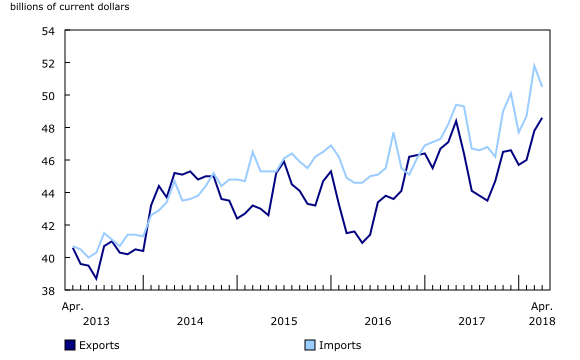
Chart 1: Merchandise exports and imports
Exports reach record high
Exports increased 1.6% to a record $48.6 billion in April, the sixth increase over the past seven months. Higher exports of metal and non-metallic mineral products, consumer goods and energy products were partially offset by lower exports of aircraft and other transportation equipment and parts. Year over year, total exports rose 3.1%.
Exports of metal and non-metallic mineral products increased 9.1% to $5.8 billion in April. Following two consecutive months of atypically low levels, exports of unwrought precious metals and precious metal alloys led the increase for the section in April, up 25.3% to $1.6 billion. Contributing to the increase were higher sales of unwrought gold to Hong Kong, following its refining in Canada. For the section as a whole, volumes rose 5.8%, while prices were up 3.1%.
Exports of consumer goods, up 5.4% to $6.2 billion in April, also contributed to the overall increase. Exports of pharmaceutical and medicinal products rose 33.3%, mostly on higher shipments to the United States. Other food products (+8.3%) also posted a significant gain in April, mainly on higher exports of dried peas to Asia.
In April, exports of energy products increased 2.3%, the eighth monthly increase in nine months. Exports of crude oil and crude bitumen (+4.9%) were the largest contributor, principally on higher volumes. The April increase in real exports of crude oil was the fifth consecutive monthly gain. For the section as a whole, prices rose 2.1%, while volumes edged up 0.2%. Year over year, prices increased 10.2% for the section.
Motor vehicles and parts lead the decrease in imports
After reaching a record high in March, imports fell 2.5% in April to $50.5 billion, with declines in 8 of 11 sections. Lower imports of motor vehicles and parts and consumer goods were partially offset by higher imports of energy products. Year over year, total imports were up 4.7%.
Following two months of strong increases, imports of motor vehicles and parts decreased 5.8% to $9.7 billion in April. Passenger cars and light trucks were down 8.9%, returning to more typical levels following higher than usual import levels for light trucks in March. Motor vehicle engines and motor vehicle parts (-4.4%) also contributed to the decrease in April.
Imports of consumer goods also contributed to the overall decrease, down 4.9% to $10.5 billion in April. Following a $200 million increase in March, pharmaceutical and medicinal products drove the widespread decrease in the section in April, down $228 million, mostly on lower imports from Switzerland, Belgium and the United States.
These declines were partially offset by higher imports of energy products, up 8.5% to $3.4 billion. Imports of refined petroleum energy products were responsible for the gain, increasing 28.5% to a record $1.4 billion. Temporary shutdowns in Canadian refineries in April led to higher imports of motor gasoline and diesel fuel to meet domestic demand. For the section as a whole, volumes were up 8.1% and prices edged up 0.4%.
Trade surplus with the United States increases for the first time in six months
Exports to the United States were up 3.2% to $36.1 billion in April, notably on higher exports of crude oil and crude oil bitumen. Imports from the United States decreased 1.4% to $32.5 billion, mostly on lower imports of passenger cars and light trucks.
Consequently, after five monthly contractions, Canada's merchandise trade surplus with the United States widened to $3.6 billion in April from a $2.0 billion surplus in March. Comparing the average exchange rates of March and April, the Canadian dollar gained 1.2 US cents relative to the American dollar. This followed a decline of 2.1 US cents in March.
Exports to countries other than the United States decreased 3.0% to $12.5 billion in April, mainly on lower shipments to the United Kingdom (crude oil), Saudi Arabia (other transportation equipment), Japan (coal) and South Korea (aircraft and coal). These decreases were partially offset by higher exports to China (crude oil), Hong Kong (unwrought gold) and the Netherlands (coal and diesel fuel).
Imports from countries other than the United States fell 4.3% to $18.0 billion in April, mainly on lower imports from China (computers). This follows record imports from China in March.
As a result, Canada's trade deficit with countries other than the United States narrowed from $6.0 billion in March to $5.5 billion in April.
Revisions to March exports and imports
Revisions reflected initial estimates being updated with or replaced by administrative and survey data as they became available, as well as amendments made for late documentation of high-value transactions. Exports in March, originally reported as $47.6 billion in last month's release, were revised to $47.8 billion in the current month's release. March imports, originally reported as $51.7 billion in last month's release, were essentially unchanged in the current month's release.
Chart 2: International merchandise trade balance

Information related to recent US-Canada tariff changes
On June 1, the United States implemented additional tariffs on selected Canadian steel and aluminum products exported to the United States. The additional tariff rates are 25% and 10% respectively. According to Statistics Canada's international merchandise trade customs-based data, in 2017, the export value of aluminum products that are subject to the 10% rate was $9.2 billion; and the export value of steel products that are subject to the 25% rate was $7.2 billion.
At the same time, Canada has proposed additional tariffs on the imports of certain products from the United States. These tariff rates are also at the 25% and 10% levels. The tariffs cover a more diverse range of products and primarily fall under the categories of aluminum products; articles of iron and steel; machinery and electrical equipment; prepared foodstuffs; chemical products; paper products; and other miscellaneous manufactured items. In 2017, the import value of US goods that may be subject to the proposed tariffs was $19.4 billion.
In order to help Canadians understand the trade flows of these products, table 3 below provides the Canadian International Merchandise Trade Import and Export Statistics for the items subject to the tariffs.
The Aluminum and Steel dashboard is now available. This series of graphs and charts provide statistics on aluminum and steel production, exports and imports.
International merchandise trade for all countries and by Principal Trading Partners (x 1,000,000)1 2 3 4
Frequency: Monthly
Table: 12-10-0011-01 (formerly CANSIM 228-0069)
Geography: Canada
StatCan. 2018-06-06. Canadian international merchandise trade: Annual review, 2017
Canada's annual exports increased 5.4% to $549.6 billion in 2017, mainly on higher exports of energy products. Imports increased 4.8% to $573.6 billion, with widespread gains throughout the product sections. Consequently, Canada's annual merchandise trade deficit with the world narrowed from $25.9 billion in 2016 to $24.0 billion in 2017.
Following a 0.5% decline in 2016, Canada's total merchandise trade—exports plus imports—rose 5.1% in 2017. This was the largest increase since 2014, when trade activity increased 9.0%. As a measure of openness to merchandise trade, the ratio of merchandise trade to nominal gross domestic product (up 5.4% to $2,145 billion) narrowed slightly from 52.5% in 2016, to 52.4% in 2017.
The increase in trade activity in 2017 was the result of gains in both US and non-US trade, as Canada's total trade with the United States increased 3.9% and trade with non-US countries was up 8.0%. As measured by the Herfindahl-Hirschman index (HHI), the degree of diversification of Canada's exports by market of destination remained unchanged at 0.56 in 2017, which represents high concentration.
Both exports and imports were up in every quarter in 2017 except the third quarter. Canada's quarterly merchandise trade balance remained in deficit throughout 2017. The trade deficit expanded in each of the first three quarters of the year, reaching $8.7 billion in the third quarter. In the fourth quarter, a rebound in exports resulted in a narrowing of the deficit to $7.5 billion.
Annual export prices rose 4.1% while volumes increased 1.3%. Meanwhile, import volumes were up 4.1% and prices edged up 0.7%. Comparing the average exchange rates of 2016 and 2017, the Canadian dollar gained 1.5 US cents relative to the American dollar, the first annual appreciation since 2011. Canada's terms of trade with the world increased 1.9% in 2017 to 0.91 (reference year 2007), the first annual gain since 2013.
Increase in energy products fuels record exports
Total exports were up 5.4% to a record $549.6 billion in 2017, the first annual increase since 2014. The gain in 2017 was due to higher exports of energy products and metal and non-metallic mineral products. Partially offsetting these increases were lower exports of motor vehicles and parts and consumer goods. Exports excluding energy products were up 1.1%. Non-energy exports increased significantly in 2014 and 2015, but have grown more modestly in the last two years. Canadian goods sold abroad in 2017 (HHI=0.09) were diversified in nature but showed increased concentration compared with 2016 (HHI=0.08).
Exports of energy products rose 32.4%, on the strength of higher shipments of crude oil and crude bitumen. The growth was mostly due to higher crude oil prices (+24.6%). Export volumes of crude oil increased 5.7%, despite declines in the third (-2.2 %) and fourth (-5.6%) quarters related to severe weather and pipeline disruptions in the United States.
On a customs basis, the share of Canadian heavy oil exports increased from 64.7% of total crude oil exports in 2016 to 70.5% in 2017. The share of heavy oil in crude oil exports has increased in each of the last three years. More than half of all crude oil was exported to three US states that have heavy oil refining capacity: Illinois (39.5%), Texas (11.3%) and Minnesota (9.5%).
Exports of metal and non-metallic mineral products were up 10.9% to a record $63.7 billion in 2017. Higher exports of aluminum (+20.3%) and iron and steel products (+20.0%) contributed the most to the increase, both rising on higher prices and volumes. For each of these two products, the share of exports destined for the United States was roughly 88% in 2017.
Partially offsetting these increases were lower exports of motor vehicles and parts, which fell 5.3% to $92.8 billion. Exports of passenger cars and light trucks were down 6.9% to $65.2 billion, following record exports of $70.1 billion in 2016. Several factors contributed to the decrease in 2017, including the production reallocation of some models to Mexico, atypical temporary plant closures for retooling, labor disruptions, and declining market share in the United States for some Canadian-built models.
Higher softwood lumber export prices offset decrease in volumes
The 2006 Softwood Lumber Agreement between Canada and the United States expired on October 12, 2015. In 2017, the U.S. Department of Commerce applied preliminary countervailing and anti-dumping duties on a temporary basis, and finalized these duty rates in late December. Canadian export values of softwood lumber fluctuated substantially throughout the year as duty rates and coverage varied.
On a quarterly basis, the value of exports of lumber and other sawmill and millwork products declined in the first (-2.2%) and third (-6.4 %) quarters of 2017. The modest increase in second quarter exports (+0.3%) resulted from growth in prices and lower volumes, while higher prices combined with temporary tariff reprieves contributed to a sharp 13.7% fourth quarter nominal increase.
In spite of those fluctuations, for the year, exports of lumber and other sawmill and millwork products increased 4.0% to $16.3 billion. The increase can be attributed to higher prices, which rose 10.3%, and coincided with strong US demand. New residential construction in the United States has been growing steadily since 2011, with new construction starts in 2017 exceeding the previous year's level.
Imports rise on widespread gains, led by motor vehicles and parts
After falling slightly in 2016, imports increased 4.8% to $573.6 billion in 2017. While gains were observed in 9 of 11 commodity sections, imports of motor vehicles and parts, energy products and consumer goods accounted for more than half of the growth.
Imports of motor vehicles and parts increased for an eighth-consecutive year, rising 4.7% to $111.7 billion. Passenger cars and light trucks led the increase, up 8.1% to $51.7 billion, which coincided with record sales volumes for light vehicles in Canada. Imports of motor vehicle engines and parts, however, were down 2.9%, as weakness in Canadian exports of passenger cars and light trucks meant lower demand for components. In 2017, Canada's trade deficit in motor vehicles and parts reached $18.8 billion, the largest deficit on record. Canada's last trade surplus in motor vehicles and parts was in 2006.
Imports of energy products rose 16.6% to $31.9 billion in 2017. As observed with exports, the growth reflects higher prices, which rose sharply in 2017 after two consecutive years of declines. Crude oil and crude bitumen led the increase, with higher imports from the Unites States. The share of crude oil imports from the United States has risen in recent years, growing from 7.5% in 2012 to 51.5% in 2017, mostly on higher imports coming from Texas and North Dakota.
Surplus with the United States widens while deficit with non-US countries increases
Exports to the United States represented 74.7% of Canada's total exports in 2017, down from 75.2% in 2016. Meanwhile, the share of Canada's imports from the United States decreased from 65.8% in 2016 to 64.6% in 2017. Historically, the United States' share of Canada's imports peaked at 77.0% in 1998, while the export share peaked at 83.9% in 2002.
Following two consecutive annual decreases, Canada's exports to the United States were up 4.7% in 2017 to a record $410.8 billion. Higher exports of crude oil and crude bitumen were partially offset by lower exports of passenger cars and light trucks. These two commodity groupings, along with motor vehicle engines and motor vehicle parts, were the top exported products to the United States in 2017.
Imports from the United States were up 3.0% to $370.7 billion, mostly on higher imports of energy products; basic and industrial chemical, plastic and rubber products; industrial machinery equipment and parts; and motor vehicles and parts. The top imported commodities from the United States in 2017 were passenger cars and light trucks and motor vehicle engines and motor vehicle parts.
Canada's merchandise trade surplus with the United States widened from $32.3 billion in 2016 to $40.1 billion in 2017.
Imports from countries other than the United States increased 8.3% to $202.9 billion. About one third of this increase was attributable to higher shipments from China (+13.4%), as imports of communications and audio and video equipment increased. Imports from Mexico (passenger cars and light trucks) and Japan (gold) also contributed to the growth in 2017. The top imported product from non-US countries was passenger cars and light trucks.
Exports to countries other than the United States rose 7.5% to $138.8 billion. Higher exports to China (+11.6%) led the gain, mostly on increased exports of canola and wood pulp. Shipments to Japan (+10.7%) also contributed to the growth, mainly on higher exports of coal.
Canada's merchandise trade deficit with countries other than the United States widened from $58.2 billion in 2016 to $64.1 billion in 2017.
State of trade with the Comprehensive and Progressive Agreement for Trans-Pacific Partnership member countries
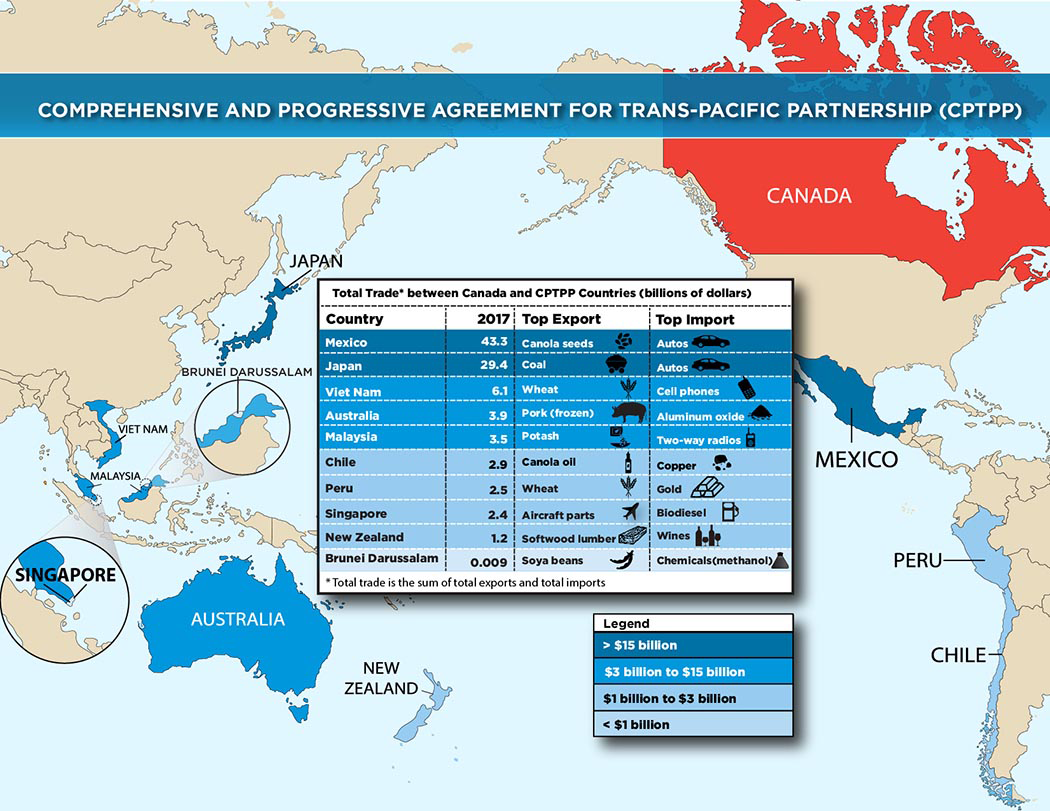
In March 2018, Canada signed the Comprehensive and Progressive Agreement for Trans-Pacific Partnership (CPTPP). The multilateral trade agreement includes 10 other partner countries: Australia, Brunei Darussalam, Chile, Japan, Malaysia, Mexico, New Zealand, Peru, Singapore and Viet Nam. Once ratified by the governments of each country, the agreement will reduce non-tariff and tariff barriers between members.
In 2017, Canada's total trade activity on a customs basis with the CPTPP members totalled $95.2 billion. In the past two years, Canada's total trade with these 10 countries has increased at more than twice the rate of its overall trade activity.
In comparison, Canada's total trade activity with the North American Free Trade Agreement (NAFTA) countries totalled $746 billion in 2017, while total trade with the European member countries of the Comprehensive Economic Trade Agreement (CETA) totalled $108 billion. Trade with CETA members, which came into effect in 2017, rose 7.0% compared with 2016.
In 2017, imports from CPTPP countries were $68.3 billion (12.2% of Canada's total imports with the world) and exports were $26.9 billion (4.9% of Canada's total exports with the world). Combined trade with Mexico and Japan accounted for roughly three quarters of both the import and export values. Compared with 2016, imports from the CPTPP countries increased 6.2% and exports rose 8.3% in 2017.
Since 2010, Canada's imports from the CPTPP countries have risen 43.1%. The top imported products from this group of countries in 2017 were motor vehicles and parts, electronic and electrical equipment and parts, and consumer goods.
Imports from Mexico accounted for the largest share (52.0%) of Canada's imports from the CPTPP countries, with motor vehicles and parts representing almost half of all imports from this country. These imports were roughly evenly split between passenger cars and light trucks, and motor vehicle engines and motor vehicle parts.
Imports from Japan accounted for 25.6% of Canada's total imports from the CPTPP countries in 2017. Canada's imports from Japan were led by motor vehicles and parts, and industrial machinery, equipment and parts.
Since 2010, Canada's exports to the CPTPP countries have increased 39.9%. The top exported commodities in 2017 were canola, meat products, coal and wheat.
Exports to Japan accounted for the largest share (44.0%) of Canada's exports to the CPTPP countries, followed by Mexico (29.2%). Canada's exports to Japan were widespread among products, led by coal, meat products and canola. Exports to Mexico were also diversified, with motor vehicle engines and motor vehicle parts, and canola being the top exported products to that country.
Thumbnail for Infographic 1: Canada's merchandise trade with the CPTPP member countries, 2017
FULL DOCUMENT: https://www150.statcan.gc.ca/n1/en/daily-quotidien/180606/dq180606c-eng.pdf?st=yShDmlxi
The Globe and Mail. JUNE 6, 2018. Trade gap narrows sharply as exports hit record high
DAVID PARKINSON, ECONOMICS REPORTER
Canada’s trade deficit narrowed sharply in April, as exports hit record highs while imports took a pause after their recent surge.
Statistics Canada reported that the merchandise trade deficit shrank to $1.9-billion, the smallest in six months. Economists had expected the April trade gap to be nearly twice that size, on the heels of March’s near-record $3.9-billion. (The March figure was revised from an originally reported $4.1-billion.)
Exports rose 1.6 per cent to a record $48.6-billion. It was their third straight month-to-month increase, and their sixth rise in seven months. The gain was partly due to higher prices, as well as a 1.2-per-cent increase in export volumes. Exports were led by a 9-per-cent jump in metals and minerals, as well as strong gains in consumer goods (up 5.4 per cent) and forest products (up 4.3 per cent).
Imports, meanwhile, fell 2.5 per cent, reversing part of March’s 6.2-per-cent surge. The decline, which was relatively broad-based, was almost entirely due to a 2.4-per-cent drop in volumes. The key contributor to the downturn was a 5.8-per-cent drop in auto-sector imports, reversing course after two straight months of strong gains. Consumer products fell 4.9 per cent.
Economists were encouraged by the continued upward momentum in exports, while they interpreted the dip in imports as largely expected after the strong March gains. They said April’s sharp decline in the trade deficit bodes well for the expected rebound in Canada’s economic growth in the second quarter, after a sluggish 1.3-per-cent annualized growth rate in the first quarter.
Most forecasters now see the second-quarter growth pace at somewhere between 2.5 and 3 per cent – in line with or a bit better than the most recent forecast from the Bank of Canada, which looks on track to raise interest rates again next month in light of the strengthening economy and firming trade trend.
“Canada’s trade picture perked up to start the second quarter, consistent with expectations that growth is going to bounce back after a soft start to the year,” said Bank of Montreal economist Benjamin Reitzes in a research note. “While there’s still tons of room for improvement on the trade front, this is welcome news, and consistent with the Bank of Canada hiking rates at the July policy meeting.”
But Statscan also used its monthly trade report to shed more light on one of the biggest clouds hanging over Canada’s trade outlook: The imposition by the United States of tariffs on Canadian steel and aluminum, part of a worrying trend of protectionist policies and rhetoric coming from Canada’s biggest trading partner. The statistical agency calculated that the tariffs – 10 per cent on aluminum and 25 per cent on steel – affect exports that totaled $9.2-billion of aluminum products and $7.2-billion of steel products in 2017.
Meanwhile, Canada’s retaliatory tariffs on U.S. imports affect shipments that in 2017 totalled $6.3-billion of steel products, $3-billion of aluminum products, and $10.1-billion of an assortment of other consumer products named in the action, ranging from food to appliances to motorboats. The total size of the Canadian retaliation, measured by dollar value of trade in 2017, is about $3-billion more than the U.S. action.
“Despite the good monthly [trade report], Canadian exporters are in for a rough ride in the coming months, and perhaps quarters. The recently imposed tariffs on aluminum and steel, together with retaliatory Canadian tariffs, will likely hold back movement of metals and metal products across the border and be a drag on economic activity – particularly in Quebec and Ontario,” Toronto-Dominion Bank senior economist Michael Dolega said in a research note.
“The tariffs also throw a wrench into the already difficult NAFTA negotiations, with any agreement looking less likely over the near-term – something that’s not going to do anything for business confidence on either side of the border,” he added.
REUTERS. JUNE 6, 2018. Canadian exports shrug off trade uncertainty to hit record high
David Ljunggren
OTTAWA (Reuters) - Canadian exports rose to a record high in April as firms shrugged off uncertainty caused by U.S. protectionist policies, helping to cut the trade deficit to a six-month low, Statistics Canada data indicated on Wednesday.
The deficit shrank to C$1.90 billion ($1.47 billion), down from C$3.93 billion in March. The shortfall - less than the C$3.40 billion deficit forecast by analysts in a Reuters poll - was the smallest since a C$1.49 billion gap recorded in October 2017.
“It’s really positive as we head into the second quarter. There is continued strength in the export side,” said Ross Prusakowski, a senior economist at Export Development Canada.
The data were released as policymakers fret over the impact of new U.S. tariffs on steel and aluminum imports and slow-moving talks to modernize the North American Free Trade Agreement.
The Bank of Canada repeatedly cites the uncertainty over NAFTA’s future as a risk factor for the economy. That means the central bank will be data-dependent as it sets monetary policy, Governor Stephen Poloz said on Saturday.
Canada’s exports increased 1.6 percent - the sixth gain in seven months - to a new high of C$48.56 billion, on higher shipments of metal and non-metallic mineral products, consumer goods and energy products.
“It is nice in the short term, but there are a lot of issues ahead of us for Canadian exporters to deal with,” said Michael Dolega, a senior economist at TD Bank.
Imports, which hit a new high in March, dipped 2.5 percent to C$50.47 billion in April. Imports of motor vehicles and parts fell 5.8 percent after two months of strong increases.
The Canadian dollar CAD=D4 strengthened, rising to C$1.2878 to the U.S. dollar, or 77.65 U.S. cents, from C$1.2909, or 77.47 U.S. cents, before the data were released.
Separately, data released in Washington showed the U.S. trade deficit in April fell to a seven-month low.
The data underscored the continued importance of the giant U.S. market, which took 74.3 percent of all Canadian goods exports in April.
Exports to the United States rose 3.2 percent while imports dropped 1.4 percent. As a result, the trade surplus with the United States grew to C$3.63 billion in April from C$2.03 billion in March.
Separately, Statscan said the value of Canadian building permits fell 4.6 percent in April from March, the biggest decline in five months, on weakness in both the residential and non-residential sectors.
Additional reporting by Fergal Smith in Toronto; Editing by Paul Simao
REUTERS. JUNE 6, 2018. Canadian dollar near one-week high as trade deficit shrinks
TORONTO (Reuters) - The Canadian dollar strengthened to a near one-week high against its U.S. counterpart on Wednesday as the greenback broadly fell and domestic data showed a narrower-than-expected trade deficit.
Canada’s trade deficit in April shrank to a six-month low of C$1.90 billion from C$3.93 billion in March, as exports climbed to a record high and imports dropped, Statistics Canada said. The shortfall was considerably less than the C$3.40 billion deficit forecast by analysts.
The U.S. dollar fell against a basket of major currencies after officials said the European Central Bank could wind down its stimulus program by end-2018, boosting the euro.
At 9:05 a.m. EDT (1305 GMT), the Canadian dollar CAD=D4 was trading 0.7 percent higher at C$1.2880 to the greenback, or 77.64 U.S. cents. The currency touched its strongest level since May 31 at C$1.2857.
The loonie was pressured on Tuesday by the prospect of U.S. President Donald Trump moving toward bilateral discussions on trade with Canada and Mexico.
On Wednesday, signs of easing trade tensions between the U.S. and China helped boost stocks.
The price of oil, one of Canada’s major exports, fell even after Venezuela raised the prospect of a halt to some crude exports.
U.S. crude CLc1 prices were down 0.6 percent at $65.16 a barrel.
Canadian government bond prices were lower across the yield curve in sympathy with U.S. Treasuries and German Bunds. The two-year CA2YT=RR fell 5.5 Canadian cents to yield 1.947 percent and the 10-year CA10YT=RR declined 37 Canadian cents to yield 2.295 percent.
In separate data, the value of Canadian building permits fell by 4.6 percent in April from March, the biggest decline in five months.
Canada’s employment report for May is due on Friday.
Reporting by Fergal Smith; Editing by Nick Zieminski
G7 (https://g7.gc.ca/)
Department of Finance Canada. June 6, 2018. Canada Leads in Bringing Together G7 Private Sector Investment for International Development
Toronto, Ontario – The Government of Canada is investing in growth that works for everyone. As this year's G7 host, Canada has an opportunity to ensure growth benefits not only Canadians, but also people in need around the world.
Following last week's meetings of G7 Finance and Development Ministers and Central Bank Governors in Whistler, major Canadian institutional investors—led by the Caisse de dépôt et placement du Québec (CDPQ) and the Ontario Teachers' Pension Plan (OTPP)—today launched a leadership initiative for international development, alongside Minister of Finance Bill Morneau and Minister of Environment and Climate Change Catherine McKenna.
The initiative brings together major institutional investors from across G7 countries to help address some of the big challenges that limit growth that works for everyone, including the lack of women in leadership positions; a persistent global infrastructure gap, especially in emerging markets; and the threats to growth posed by climate change. Marc-André Blanchard, Canada's Ambassador to the United Nations, has played a key role in the development of the initiative.
In collaboration with the Government of Canada, this group of leading global institutional investors, led by CDPQ and OTPP, will work together to promote gender diversity in capital markets, create an infrastructure fellowship program to help develop expertise in emerging and developing economies, and take steps to better recognize and report on the financial risks associated with climate change.
Quotes
"Canadian and other G7 institutional investors can lead by example in mobilizing financial resources to support sustainable development around the world, including initiatives that advance gender equality and deliver critical infrastructure to people and communities in need. I am pleased to see Canada at the forefront of these efforts through its G7 Presidency, and look forward to working with our partners in creating growth that works for everyone."
- Bill Morneau, Minister of Finance
"Climate change is putting both our environment and our economy at risk—but it's also creating trillions of dollars of investment opportunities as global demand for clean solutions grows. Improving our understanding of the economic risks and opportunities we'll encounter as our climate changes is essential as we work to strengthen Canada's economy and create jobs and opportunities for the middle class. Today, I applaud the G7 institutional investors for leading this dialogue and working towards cleaner, more inclusive growth and a more sustainable economy."
- Catherine McKenna, Minister of Environment and Climate Change
"Investments in infrastructure build stronger, more inclusive and sustainable communities where everyone has access to opportunities. Our government is making historic investments in infrastructure, but we recognize that traditional financing alone cannot close the infrastructure gap our country faces. We need to be innovative in how we conceive of and finance projects, which is why we created the Canada Infrastructure Bank, a new tool that will engage private and institutional investors to build new transformative infrastructure projects across Canada. We welcome the new initiatives put forward today and look forward to future collaborations."
- Amarjeet Sohi, Minister of Infrastructure and Communities
FULL DOCUMENT: https://www.fin.gc.ca/n18/18-046-eng.asp
The Globe and Mail. 6 Jun 2018. OPINION. Taking opposition in stride. Trudeau says gender equality to be top issue at G7 leaders’ summit
MICHELLE ZILIO
With a report from Shawn McCarthy
Prime Minister Justin Trudeau is met by protesters in British Columbia before his meeting with an Indigenous committee to discuss the pipeline expansion The Trudeau government says gender equality will be a top priority as a reachable goal at the G7 leaders’ summit in Quebec this week, despite concerns Canada’s agenda could be overshadowed by tensions between U.S. President Donald Trump and other leaders over trade and tariffs.
Regardless of disagreements between G7 countries on trade issues, Canadian officials said all of the G7 governments have expressed support for Canada’s overarching theme of gender equality and women’s empowerment. Leaders of the G7 countries – Canada, the United States, France, Britain, Germany, Italy and Japan – will attend a breakfast meeting with the G7 gender equality advisory council, created by Prime Minister Justin Trudeau as a part of Canada’s G7 presidency, on Saturday morning in Charlevoix.
The advisory council, a group of high-profile feminist leaders, recently submitted a report to the G7 calling on member states to promote the rights of women and girls by taking concrete action to ensure pay equity, the expansion of access to reproductive health services and improved access to education for girls.
The Malala Fund, founded by gender advisory council member and Nobel Peace Prize winner Malala Yousafzai, is asking leaders to commit at least US$1.3-billion in education-focused development aid over three years. “This is the most sound investment that can be made for people right across the board,” Malala Fund chief executive Farah Mohamed said in an interview. “Investing in girls and women is the single best solution for every single one of those G7 leaders.” Canadian development organizations say Canada can show leadership by contributing C$500-million toward the global ask of US$1.3-billion.
“This is an opportunity for Canada because if we want to turn feminist talk into feminist walk, now is the time,” Unicefs Canada president David Morley said.
Asked about the distraction Mr. Trump may pose at the G7 summit, World Vision Canada president Michael Messenger said it would be unfortunate if “discussion gridlock led to the poorest and most vulnerable once again being left behind.”
John Kirton, a University of Toronto expert on the G7, said the focus on girls’ education is a strategic one, as the Americans may “reach for their red pens” on other aspects of the gender-equality discussion, such as abortion. Mr. Trump reinstated a prohibition in January, 2017, on U.S. funding to international organizations that fail to disavow abortion.
Canada will also prioritize climate change and the protection of oceans at the Charlevoix meeting. Environment Minister Catherine McKenna said the Liberal government is playing a leadership role internationally to reduce plastics waste in the oceans and will push for concerted action at the G7 leaders’ summit.
“We are filling our oceans with plastic – it’s disgusting,” Ms. McKenna said on Tuesday. At the current rate of dumping, there will be more tonnage of plastics in the oceans than fish within 25 years, she said.
More than 40 environmental groups are urging the G7 to sign an anti-plastics charter, which would set international targets to cut down on the use of plastics. They are also calling on the Trudeau government to set an example at home by releasing a national plastics plan. Ms. McKenna said the federal government has to work with provincial and territorial government, as well as industry, to forge a national plan for reducing waste. Only 11 per cent of plastics tossed out in Canada is currently recycled, she said.
The Globe and Mail. 6 Jun 2018. What will Trudeau do with the skunk in the room? As the host country of the G7 summit, Canada must – finally – confront Donald Trump
LAWRENCE MARTIN, Columnist
At the G7 summit, which opens in Quebec on Friday, Donald Trump can contemplate a unique status among presidents at such gatherings: skunk in the room.
“What this G7 is going to show,” French Finance Minister Bruno Le Maire told reporters, “is that the United States are alone against everyone and especially alone against their allies.”
The only exception may be Group of Seven member Italy, which has just brought in a nationalist/populist government with antediluvian similarities to Washington’s. Mr. Trump’s former top strategist Steve Bannon has been in Italy observing the proceedings and keeping the Trumpians briefed. Though no longer an insider, Mr. Bannon has been pushing the President’s hot buttons. He believes that by pounding the nationalist drums and by selling himself as the last great hope of white hegemony, Mr. Trump will win the midterm elections in the fall.
The unruly President appears to be buying in. Making a collision in Quebec all the more likely is that he has hardened his act of late. Not only has he pushed crippling steel and aluminum tariffs, but he has turned on his Ugly American switch in other respects.
In lambasting undocumented immigrants, Mr. Trump said they “aren’t people, they’re animals.” He’s campaigning full bore for the Mexican wall again – and is again demanding that Mexico pay for it. His government is again reaching out to authoritarian leaders. His Secretary of State Mike Pompeo welcomed the Foreign Minister of Hungary to Washington, never mind the antiMuslim and anti-Semitic bent of that government. As for his own authoritarian streak, Mr. Trump went so far as to declare this week that the state is him; that he has the power to pardon himself of all crimes.
As he fulminates, G7 members, with Prime Minister Justin Trudeau in the chair, decide whether to confront him or to cower.
Coincidentally, the anniversary of the death of Robert F. Kennedy, 50 years to this day, is being commemorated. The syrupy reminisces on what he stood for, the antithesis of Mr. Trump, are pouring in. Campaigning for the Democratic nomination in 1968, Bobby Kennedy became the conscience of the country, its galvanizing spirit. More than anyone in the political galaxy, he projected deep caring and commitment – to the underprivileged, to ending the war in Southeast Asia, to healing racial discord.
Bobby Kennedy was killed a few months after Martin Luther King Jr. and he is much remembered for his impromptu speech in Indiana, a plea to bridge the racial divide, on the same night of King’s death.
Someone should pull Mr. Trump away from his TV set long enough to read that speech. Or perhaps, at the G7 summit, Mr. Trudeau should reference in his own words the ideals that Kennedy set out. It would be worth it just to watch Mr. Trump squirm in his seat, although, given his shamelessness, he would probably sneer instead.
One of the only things G7 leaders will concur on with Mr. Trump is his push toward denuclearization in North Korea. No quick fix seems apparent. More likely, there will be protracted negotiations, which other presidents have unsuccessfully attempted. On other questions – on his tariffs, on his trashing the Iran nuclear accord, the Paris climate accord, on his fuelling of divisions, on his aversion to collective engagement – Mr. Trump will face a united front.
But given the nature of these summits, more likely to come his way than hostility will be mild rebukes and diplomatic expressions of disappointment, which Mr. Trump will forget the moment he leaves the room.
Mr. Trudeau, who can be credited with an inclusionary RFK vision, hopefully will be bolder. He was that way with his reaction to the tariffs last week and, having fruitlessly tried the other diplomatic route for so long with the President, was applauded for doing so. But if he is to represent how Canadians feel about this man and how so much of the civilized world feels about him, he needs to take it further.
In an Angus Reid poll released this week, a sizable majority of Canadians said they see Mr. Trump as a bullying, corrupt liar. In the same poll, many rate Mr. Trudeau as feckless. They want more tough, less fluff.
Now is Mr. Trudeau’s chance to show it. With the summit in his backyard, there’s no better opportunity. Among all the presidents that PMs have faced, there has never been greater reason.
REUTERS. JUNE 6, 2018. G7 likely to discuss global economy, concerns about U.S. trade policy: Japan's Suga
TOKYO (Reuters) - Japan’s top government spokesman said on Wednesday that the Group of Seven leaders were likely to discuss the global economy and concerns about U.S. trade policy.
Chief Cabinet Secretary Yoshihide Suga, speaking to reporters, said it was important to maintain free and open trade in line with World Trade Organisation rules.
U.S. President Donald Trump, who is due to attend the G7 leaders’ meeting in the Canadian province of Quebec, imposed tariffs last week of 25 percent on steel and 10 percent on aluminum from Canada, the EU and Mexico, citing national security reasons.
G7 finance ministers met last week and rebuked Washington over the tariffs, setting up a fight at the G7 leaders’ summit.
Reporting by Stanley White
INVESTMENT
The Globe and Mail. 6 Jun 2018. OPINION. If Canada doesn’t boost business investment, companies will suffer in the long term. Business investment is the key to growth, not just competitiveness
FRANCES DONALD, senior economist at Manulife Asset Management.
Canada needs business investment, and it needs it now. The optimistic narrative for Canada’s economy in 2018 and 2019 has been that a meaningful export revival and a surge in company spending could compensate for slower consumer spending.
That story has been half-right: Cracks in household economic strength are now starting to show. Credit growth and spending activity are both decelerating. That’s the predictable consequence of higher interest rates. Yet the hoped-for drivers of growth are missing. Export growth has been tepid at best, particularly for non-energy exports. Even the Bank of Canada expects exports to contribute exactly zero per cent to growth in 2018.
More disappointing still is that most data suggest business investment is lukewarm. In any economic environment, that would be a knock against growth, but it’s even more concerning in the current environment. Companies are urgently running out of spare capacity, particularly in manufacturing; more and more of them say they would not be able to meet an unanticipated increase in demand. Canada needs its businesses to scale up operations now, or the economy will come up against a speed limit that it can’t surpass.
Just about everyone agrees that business spending would be higher if we weren’t contending with two Trump administration effects – heightened uncertainty about trade and lost tax competitiveness with the United States. However, there’s far less consensus about how to respond to this. Some say we need a weaker Canadian dollar and equivalent tax cuts to the United States. In my view, these aren’t the right solutions. A weaker loonie can help boost exports and economic activity at the margin, but it carries costs along with benefits.
Canada has particularly high import propensities – meaning that as the Canadian dollar weakens, anything we import becomes more expensive. Remember the Cauliflower Crisis of early 2016, when vegetable prices jumped 18 per cent from the previous year? It could well happen again. What bad luck that the Canadian industries where investment is most needed, such as manufacturing, also tend to have the highest import propensities.
A weaker Canadian dollar would therefore not only push costs up for these companies, it would also deter investment – the exact opposite of the goal. It’s also an unrealistic remedy. With oil prices floating around multiyear highs and a central bank that appears keen to continue hiking interest rates, a substantial depreciation of the Canadian dollar isn’t likely.
What about tax cuts? Broad cuts aren’t the answer either, at least not right now. For one thing, some of the new U.S. tax policies are not permanent and will expire between 2023 and 2027. Plus a sharply deteriorating U.S. fiscal position could also reasonably result in policy reversal in the future. The complexities of the U.S. corporate tax system (exemptions and depreciation allow-ances are examples) mean that it will likely be years before we can gauge the exact impact of the policy changes.
Deficit-financed tax cuts to cure a volatile and moving target are an expensive and risky approach. It’s also an approach that would attract unfavorable attention from global markets and rating agencies who are already closely monitoring Canada’s weakening fiscal position. But Canada does have a variety of cheaper and more effective methods to stimulate more business activity.
MAKE IT EASIER TO HIRE
Yes, streamlining occupational licensing is important, but let’s also address cost-of-living issues such as affordable housing and child-care costs so that companies can offer competitive wages to both domestic and foreign talent. Canada must be more than just a lovely and welcoming place to live; it also has to be accessible and affordable. When global companies announce new jobs in Vancouver or Toronto, our first reaction shouldn’t be, “But where will the employees live?”
MAKE IT EASIER TO BUILD
A major reason the Canadian dollar and Canadian energy stocks haven’t bounced back in tandem with oil prices is a growing perception that Canada can’t get its commodities to market. Canada’s energy market attracts one out of every five dollars of business investment – that figure used to be one out of every three. Red tape in infrastructure extends beyond pipelines. Canada continues to rank well in terms of tax competitiveness in the Organization for Economic Co-operation and Development, but is consistently found near the bottom of the list for government bureaucracy and has been losing ground on infrastructure rankings.
Canada’s economic story isn’t all bad.
Jobs are aplenty, the global economy is solid, and growth, while lower than in 2017, is still a long way from a recession. But if Canada wants to do more than muddle through for the next year, it has to recognize that business investment isn’t just about long-term competitiveness. It’s also about jump-starting growth right now.
TOURISM
The Globe and Mail. 6 Jun 2018. The travel industry is reaching out to travellers looking to reconnect with their past. Travel companies, educational institutions, tour operators and now even cruise lines are reaching out to those looking to reconnect with their past
SUZANNE MORPHET, Special to The Globe and Mail
Whereas before you may have known that your family came from a small town in Sicily, now you can identify precisely where they lived and worked.
LAEL KASSIS, DIRECTOR OF PRODUCT DEVELOPMENT, EF GO AHEAD
When the Queen Mary 2 sails from Southampton to New York this November, it will be the umpteenth transatlantic voyage for the venerable Cunard cruise line, but a unique one nonetheless.
For the first time, Cunard is collaborating with Ancestry.com, the world’s largest for-profit genealogy company, to provide cruise-ship passengers with the opportunity to trace their family lineage while taking the same life-changing voyage many of their ancestors may have made generations before.
Cunard is one of several companies currently at the forefront of what’s become known as genealogy tourism, or roots tourism. Along with travel companies, tour operators and educational institutions, the cruise line is reaching out to that segment of the tourism market consisting of travellers looking to reconnect with their past. Sometimes you can go home again.
Billed as “A Journey of Genealogy,” Cunard’s QM2 voyage will depart Southampton, England, on Nov. 4 and arrive in New York seven days later.
While crossing the Atlantic in style, passengers will have full access to four genealogists from Ancestry.com, who will conduct onboard seminars and assist guests in exploring their own unique family trees. After arriving in New York, guests have the option of booking a two-night post-voyage program that includes a guided tour of Ellis Island and other New York sites of interest.
“We think this is going to be one of our more popular experiences,” says Josh Leibowitz, senior vice-president of Cunard North America. “It’s so personal, and so meaningful for so many people. … It was a natural fit for us.”
Leading the program son the QM2 voyage is renowned genealogist Jennifer Utley, who oversees Ancestry.com’s research on the popular TLC series Who Do You Think You Are? Jon Lambert, director of client relations for Ancestry.com, says passengers should expect some surprises during the transatlantic trip.
“We’ll select six crew members and six actual travellers,” Lambert says. “And prior to the cruise, we’ll have all of them do DNA tests and submit a bit of background information about their family history. We’ll do some research and each day we’ll do a reveal. We always find something interesting.”
For some people, genealogy can be an obvious incentive when planning a vacation. After all, if you go back far enough, all of us come from somewhere else – and who wouldn’t want to see where that somewhere is? “It gives people a neat reason to travel, a purpose, a sense of discovery,” says Wendy Davis, owner of Zebrano Travel in Toronto.
Credit the rise in genealogy tourism to inexpensive genetic testing and the digitalization of personal data, such as birth, death and marriage records.
Ancestry.com, which implores its online customers to “discover what makes you uniquely you,” has sold more than 10 million DNA test kits since launching in 1983. Currently, for around $100, the average person can send in a saliva sample and within four to six weeks receive an estimate of their ethnicity and the names of people with matching DNA. The snapshot of their family history is inspiring many to revisit the land of their forebears.
“In general, many people travel to find themselves, but the advent of affordable DNA testing, which is getting more accurate as time goes on, has spurred some to plan detailed trips based on their results,” says Sarah Enelow-Snyder, assistant editor at the online travel journal Skift, which gathers intelligence on the travel industry.
Of course, the truly adventurous genealogy tourist will go wherever that bloodline blueprint leads them. Ancestry.com has started its own travel program and recently teamed with EF Go Ahead Tours to create new genealogy-themed expeditions starting this fall in Ireland, Italy and Germany that will merge DNA testing and genealogical expertise.
How it works: Before the trip, each traveller receives a DNA test kit and goes through five hours of one-one-one research time with a genealogist from Ancestry Pro Genealogists. That same genealogist later joins the group on tour to provide personalized context to each person’s family history. Travellers are also given free time to explore the specific ancestral setting where their relatives resided centuries ago.
“Whereas before you may have known that your family came from a small town in Sicily, now you can identify precisely where they lived and worked,” says Lael Kassis, EF Go Ahead’s director of product development
Also testing the genealogy-tourism waters is the venerable scientific and educational institution National Geographic, which has sold close to a million copies of its Geno DNA test kit in recent years. The international brand’s travel arm, National Geographic Expeditions, currently offers nearly 300 trips all over the world each year and a company spokesperson says the company is actively looking at adding genealogy tours in the near future.
Many popular travel destinations – particularly those that have experienced a large diaspora – are keenly aware of the roots-travel niche and what it can mean for their tourism industry. Research by Scotland’s tourism office in 2012 revealed that of the estimated 50 million people with Scottish heritage worldwide, at least onefifth intended to visit the land of their ancestors. Two more recent surveys showed 34 per cent of Canadians travelling to Scotland cited ancestry as the purpose of their visit.
But for many genealogy tourists, it’s simply about paying homage to the past. Cunard’s Leibowitz says it’s important to learn as much as possible about our distant relatives because they were travellers, too, and in most cases they were far more adventurous than we ever realized. “I think we all owe gratitude to them and owe it to ourselves to learn more about it,” he says, “because it’s part of who we are.”
OECD - Nomination
REUTERS. JUNE 5, 2018. OECD names ex-Hollande adviser Laurence Boone as chief economist
PARIS (Reuters) - French economist Laurence Boone, a former adviser to President Francois Hollande and currently chief economist at insurer AXA, will replace American national Catherine Mann as the OECD’s chief economist, the Paris-based policy forum said on Tuesday.
Boone, who helped craft France’s position during the Greek debt crisis since 2014 when she joined Hollande’s office, previously worked as the chief European Economist of Bank of America Merrill Lynch. She will take her position in July.
“Her leadership of the OECD’s economic team will be a vital part of our effort to rebuild the multilateral system for a new age,” OECD head Angel Gurria said in a statement.
The Organisation for Economic Cooperation and Development, which was founded in 1948 to manage the Marshall Plan to rebuild Europe after World War Two, produces policy recommendations and economic forecasts for its 35, mostly-rich member countries.
Reporting by Michel Rose; editing by John Irish
________________
LGCJ.:

